

Pictish language

Encyclopedia
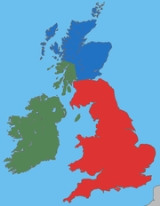
Pictish is a term used for the extinct language
or languages thought to have been spoken by the Picts
, the people of northern and central Scotland
in the Early Middle Ages
. The idea that a distinct Pictish language was perceived at some point is attested clearly in Bede
's early 8th-century Historia ecclesiastica gentis Anglorum
, which names Pictish as a language distinct from both Welsh and Gaelic.
There is virtually no direct attestation of Pictish, short of a limited number of place names and names of people found on monuments and the contemporary records in the area controlled by the Kingdom of the Picts.
The term "Pictish" was used by Jackson
(1955), and followed by Forsyth
(1997), to mean the language spoken mainly north of the Forth-Clyde line in the Early Middle Ages. They use the term "Pritennic" to refer to the proto-Pictish language spoken in this area during the Iron Age
.
 The evidence of place names
and personal names
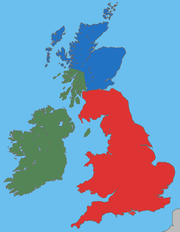
argues strongly that at some point at least some of the people in the Pictish area spoke Insular Celtic languages
related to the more southerly Brythonic languages
. Columba
, a Gael, used an interpreter in Pictland according to Bede (however, more recent historians have suggested that Columba did not necessarily use an interpreter but had instead learned the language himself). Bede also stated that Pictish was a distinct language from that spoken by the Britons
, the Irish
, and the English
.
Two other suggestions hold that Pictish may have been more similar to Gaulish
than the Brythonic languages, or that it may correspond to one or more surviving pre-Indo-European languages
, descending from the language of the Bronze Age population of Scotland.
expressed the view that the language was similar to Gaulish
.
The view of Pictish as a P-Celtic language (compatible with Buchanan's claim of Gaulish affinity) was reaffirmed by antiquarian George Chalmers
in the early 19th century. Chalmers considered that Pictish and British were one and the same, basing his argument on P-Celtic orthography in the Pictish king lists and in place names predominant in historically Pictish areas.
Celtic scholar Whitley Stokes in a philological study of the Irish annals
concluded that Pictish was closely related to Welsh, and toponymist William Watson's
extensive review of Scottish place names demonstrated convincingly the existence of a dominant P-Celtic language in historically Pictish areas, and concluded that the Pictish language was a Northern extension of British and that Gaelic was a later introduction from Ireland.
William Forbes Skene
argued in 1837 that Pictish was a Q-Celtic language allied to modern Gaelic
. He argued that Columba's use of an interpreter was explicable from the fact his preaching to the Picts would have been conducted in Latin
, rather than reflecting any difference between the Irish and Pictish languages. One reason this view, involving independent invasions of Ireland and Scotland by Goedelic invaders, enjoyed wide popular acceptance in 19th-century Scotland, was that it was viewed by some as discounting an Irish influence in the development of Gaelic Scotland. There is likely to have been an influence from Scotti invasions from Ireland, but the majority have considered it to have been a P-Celtic language since Stokes in 1890.
attempted in 1789 to demonstrate that Pictish was of Germanic
origin and that the Picts originated in Scandinavia
. He maintained that Pictish was the predecessor to Modern Scots
and his evidences were rambling and often bizarre (for example he sought to prove that the place name elements Aber and Inver were of Germanic rather than Celtic origin). The motivation behind his thesis was apparently his belief that Celts were an inferior people.
John Rhys
, in 1892, proposed that Pictish was a non-Indo-European
language. This opinion was based on the apparently unintelligible ogham inscriptions found in historically Pictish areas. He initially attempted to align the language with Basque
, but later revised his opinion, settling for an unspecified non-Indo-European language. Heinrich Zimmer
took a similar position, arguing in 1898 that Pictish was fundamentally "non-Aryan" (i.e. non-Indo-European), overlaid with Goidelic and Brittonic. His view was influenced by Rhys' study of inscriptions, supported by cultural practices he considered to be non-Indo-European, i.e. tattooing and matriliny. This position was maintained well into the 20th century by the likes of MacNeill and by Macalister. Occasional attempts have been made to align Pictish with modern non-Indo-European languages, but these have met with little success and have been firmly rejected by academics.
An influential 1955 review of Pictish by Kenneth Jackson
proposed that, while Pictish was probably P-Celtic related to Brittonic, it might have had a non-Celtic substratum and that a second language may have been used for inscriptions. Jackson's hypothesis was framed in the then-current opinion that a Brythonic elite, identified as the Broch
-builders, had migrated from the south of Britain into Pictish territory, dominating a pre-Celtic majority. He used this to reconcile the perceived translational difficulties of Ogham
previously noted by Rhys with overwhelming evidence for a P-Celtic Pictish language. Jackson was content to write off Ogham inscriptions as inherently unintelligible.
While Jackson's model was the orthodox position for the latter half of the 20th century, the academic view of brochs has been revised considerably, and current thought has the broch as an indigenous development. Taking this into account, as well as advances in the understanding of Ogham, Forsyth (1997) contends that a two-language model is unnecessary, and discounts the existence of a non-Indo-European Pictish in the historical period. Despite this assertion, she also acknowledges the almost certain existence of a pre-Celtic substratum
influence on Pictish.
 Among the ogham
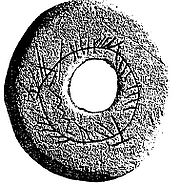
stones in Scotland there is a small subset that do not have Gaelic inscriptions. These are generally assumed to be in Pictish as they date from the Early Middle Ages
. However, many alternative languages have been suggested—from non-Indo-European
to Norse. It may have been that an older language was retained for inscriptions, in a similar way to Latin
. Interpretation is difficult and some writers have concluded that the inscriptions are a jumble of nonsense.
According to W. B. Lockwood (1975), the view that Pictish was a Celtic language is tentative. Referring to an inscription in Shetland, he writes: "When the personal names are extracted, the residue is entirely incomprehensible. Thus the Lunnasting stone
in Shetland reads ettocuhetts ahehhttann hccvvevv nehhtons. The last word is clearly the commonly occurring name Nechton. The rest, even allowing for the perhaps arbitrary doubling of consonants in ogham, appears so exotic that philologists conclude that Pictish was a non-Indo-European language of unknown affinities". Jackson considered that the language of the inscriptions was a different one from that of the place-names. However, Forsyth believes these inscriptions to be a Celtic language.
Richard Cox of the University of Aberdeen
claims that the Scottish ogham inscriptions are non-Pictish in origin, dating from the 11th to 13th centuries, and can be interpreted as Old Norse
. However this approach is controversial and has attracted unfavourable review.
. There are two sources of evidence, those recorded by classical writers and those of modern times. Ptolemy's Geographia provides the greatest number of names for Pictland.
mentions a Cape Orcas in Scotland, which was probably derived from a P-Celtic
tribal name of *Orci.
Tacitus, writing in AD 97 in Agricola, mentions Caledonia and Mount Graupius.
The main source of tribal and place names is Ptolemy's map (2nd century AD). Ptolemy has a total of 49 names, with 41 separate forms associated with Pictland (7 islands, 12 tribes, 3 towns and 19 coastal features).
Of these 16 are probably Celtic while the remainder are not certainly Celtic according to Jackson.
Of the latter, 23 are hydronym
s and toponyms that are known to be classes of names that do not change readily and may well be non-Celtic.
Forsyth points out that the towns are Roman Settlements, three of which are rivers and Bannatia is Brittonic.
Two of the tribes also occur in the south of Britain but the evidence for rejecting the Celticity of six of the others is slight. However, Forsyth does not dispute that some of the rivers and islands are best interpreted as pre-Celtic or even pre-Indo-European names.
, which possibly dates from the 8th century but is only available in a 10th century version. This gives the names of Pictish kings, some of which are considered to be in Pictish orthography (e.g. Urguist, Ciniod) while others are in Gaelic orthography (e.g. Fergus, Cinaed). It is claimed that Guor in each case has been mistaken as part of the name – it should be read as "over". This produces names such as Cein, then Cein son of Doli, Doli son of Dumn, and so on. "Guor" is taken to be "insular Celtic" *wor, Irish for, which should have taken the dative case, but the names remain uninflected.
-" (churchyard), "Pit-" (portion, share, farm), or "Fin-" (hill [?]) lie in regions inhabited by Picts in the past (for example: Aberdeen
, Lhanbryde
, Pitmedden
, Findochty
, etc). However, it is "Pit-" which is the most distinctive element, while "Aber-" can also be found in places which were Brythonic
-speaking (such as Aberystwyth
in Wales). Some of the Pictish elements, such as "Pit-", were formed after Pictish times and only attested therein. "Pit" refers to pett, a unit of land, and "Pit-" names occur in Scottish Gaelic place-names from the 12th century onwards as a generic element variation, showing that the word had this meaning in that language. The cognate Welsh word 'peth' is not used in place-names with this sense, though the French word "pièce" – 'part' (giving English 'piece') comes from the vulgar Latin 'pettia' which in turn seems to come from the Gaulish word cognate to the Pictish "Pit-" Other suggested Pictish place-name elements include "pert" (hedge, Welsh perth – Perth, Larbert), "carden" (thicket, Welsh cardden – Pluscarden, Kincardine), "pevr" (shining, Welsh pefr – Strathpeffer, Peffery).
The place-names of Pictland have been affected by the influx of later Gaelic and Norse speakers.
The evidence of place names may also reveal the advance of Gaelic into Pictland. As noted, Atholl
, perhaps meaning "New Ireland", is attested for the early 8th century. This may be an indication of the advance of Gaelic. Fortriu
also contains place names suggesting Gaelic settlement, or Gaelic influences. There are a number of Pictish loanwords in modern Scottish Gaelic.
Apart from personal names, Bede provides a single Pictish place name (HE, I, 12), when discussing the Antonine Wall
: "It begins at about two miles' distance from the monastery of Abercurnig, on the west, at a place called in the Pictish language, Peanfahel, but in the English tongue, Penneltun, and running to the westward, ends near the city Alcluith." Peanfahel – modern Kinneil
, near Bo'ness
– appears to contain elements cognate with Brythonic penn 'at the end' and Goidelic fal 'wall'. It is notable that this place is south of the Forth, in West Lothian
, outside of what is traditionally regarded as "Pictland". Alcluith, 'rock of the Clyde', is modern Dumbarton Rock, site of a major early medieval fortress and later castle.
" the Picts are referred to as Pryden and the island of Britain is known as Prydain
. These represent an original British *Priten-
and it is possible that this is the original P-Celtic name for Britain and its inhabitants. (Greek authors used the version Prettanike
for Britain.)
Extinct language
An extinct language is a language that no longer has any speakers., or that is no longer in current use. Extinct languages are sometimes contrasted with dead languages, which are still known and used in special contexts in written form, but not as ordinary spoken languages for everyday communication...
or languages thought to have been spoken by the Picts
Picts
The Picts were a group of Late Iron Age and Early Mediaeval people living in what is now eastern and northern Scotland. There is an association with the distribution of brochs, place names beginning 'Pit-', for instance Pitlochry, and Pictish stones. They are recorded from before the Roman conquest...
, the people of northern and central Scotland
Scotland
Scotland is a country that is part of the United Kingdom. Occupying the northern third of the island of Great Britain, it shares a border with England to the south and is bounded by the North Sea to the east, the Atlantic Ocean to the north and west, and the North Channel and Irish Sea to the...
in the Early Middle Ages
Early Middle Ages
The Early Middle Ages was the period of European history lasting from the 5th century to approximately 1000. The Early Middle Ages followed the decline of the Western Roman Empire and preceded the High Middle Ages...
. The idea that a distinct Pictish language was perceived at some point is attested clearly in Bede
Bede
Bede , also referred to as Saint Bede or the Venerable Bede , was a monk at the Northumbrian monastery of Saint Peter at Monkwearmouth, today part of Sunderland, England, and of its companion monastery, Saint Paul's, in modern Jarrow , both in the Kingdom of Northumbria...
's early 8th-century Historia ecclesiastica gentis Anglorum
Historia ecclesiastica gentis Anglorum
The Historia ecclesiastica gentis Anglorum is a work in Latin by Bede on the history of the Christian Churches in England, and of England generally; its main focus is on the conflict between Roman and Celtic Christianity.It is considered to be one of the most important original references on...
, which names Pictish as a language distinct from both Welsh and Gaelic.
There is virtually no direct attestation of Pictish, short of a limited number of place names and names of people found on monuments and the contemporary records in the area controlled by the Kingdom of the Picts.
The term "Pictish" was used by Jackson
Kenneth H. Jackson
Kenneth Hurlstone Jackson was an English linguist and a translator who specialised in the Celtic languages. He demonstrated how the text of the Ulster Cycle of tales, written circa AD 1100, preserves an oral tradition originating some six centuries earlier and reflects Celtic Irish society of the...
(1955), and followed by Forsyth
Katherine Forsyth
Katherine S. Forsyth is a British historian who specializes in the history and culture of Celtic peoples during the 1st millenium AD, in particular the Picts...
(1997), to mean the language spoken mainly north of the Forth-Clyde line in the Early Middle Ages. They use the term "Pritennic" to refer to the proto-Pictish language spoken in this area during the Iron Age
Iron Age
The Iron Age is the archaeological period generally occurring after the Bronze Age, marked by the prevalent use of iron. The early period of the age is characterized by the widespread use of iron or steel. The adoption of such material coincided with other changes in society, including differing...
.
Language classification
Toponymy
Toponymy is the scientific study of place names , their origins, meanings, use and typology. The word "toponymy" is derived from the Greek words tópos and ónoma . Toponymy is itself a branch of onomastics, the study of names of all kinds...
and personal names
Anthroponymy
Anthroponomastics , a branch of onomastics, is the study of anthroponyms Anthroponomastics (or anthroponymy), a branch of onomastics, is the study of anthroponyms Anthroponomastics (or anthroponymy), a branch of onomastics, is the study of anthroponyms (Anthroponomastics (or anthroponymy), a branch...
argues strongly that at some point at least some of the people in the Pictish area spoke Insular Celtic languages
Insular Celtic languages
Insular Celtic languages are those Celtic languages that originated in the British Isles, in contrast to the Continental Celtic languages of mainland Europe and Anatolia. All surviving Celtic languages are from the Insular Celtic group; the Continental Celtic languages are extinct...
related to the more southerly Brythonic languages
Brythonic languages
The Brythonic or Brittonic languages form one of the two branches of the Insular Celtic language family, the other being Goidelic. The name Brythonic was derived by Welsh Celticist John Rhys from the Welsh word Brython, meaning an indigenous Briton as opposed to an Anglo-Saxon or Gael...
. Columba
Columba
Saint Columba —also known as Colum Cille , Colm Cille , Calum Cille and Kolban or Kolbjørn —was a Gaelic Irish missionary monk who propagated Christianity among the Picts during the Early Medieval Period...
, a Gael, used an interpreter in Pictland according to Bede (however, more recent historians have suggested that Columba did not necessarily use an interpreter but had instead learned the language himself). Bede also stated that Pictish was a distinct language from that spoken by the Britons
Britons (historical)
The Britons were the Celtic people culturally dominating Great Britain from the Iron Age through the Early Middle Ages. They spoke the Insular Celtic language known as British or Brythonic...
, the Irish
Scoti
Scoti or Scotti was the generic name used by the Romans to describe those who sailed from Ireland to conduct raids on Roman Britain. It was thus synonymous with the modern term Gaels...
, and the English
Anglo-Saxons
Anglo-Saxon is a term used by historians to designate the Germanic tribes who invaded and settled the south and east of Great Britain beginning in the early 5th century AD, and the period from their creation of the English nation to the Norman conquest. The Anglo-Saxon Era denotes the period of...
.
Two other suggestions hold that Pictish may have been more similar to Gaulish
Gaulish language
The Gaulish language is an extinct Celtic language that was spoken by the Gauls, a people who inhabited the region known as Gaul from the Iron Age through the Roman period...
than the Brythonic languages, or that it may correspond to one or more surviving pre-Indo-European languages
Indo-European languages
The Indo-European languages are a family of several hundred related languages and dialects, including most major current languages of Europe, the Iranian plateau, and South Asia and also historically predominant in Anatolia...
, descending from the language of the Bronze Age population of Scotland.
Position within Celtic
During 1582, the humanist scholar (and native Gaelic-speaker) George BuchananGeorge Buchanan (humanist)
George Buchanan was a Scottish historian and humanist scholar. He was part of the Monarchomach movement.-Early life:...
expressed the view that the language was similar to Gaulish
Gaulish language
The Gaulish language is an extinct Celtic language that was spoken by the Gauls, a people who inhabited the region known as Gaul from the Iron Age through the Roman period...
.
The view of Pictish as a P-Celtic language (compatible with Buchanan's claim of Gaulish affinity) was reaffirmed by antiquarian George Chalmers
George Chalmers
George Chalmers was a Scottish antiquarian and political writer.-Biography:Chalmers was born at Fochabers, Moray, in 1742. His father, James Chalmers, was a grandson of George Chalmers of Pittensear, a small estate in the parish of Lhanbryde, now St Andrews-Lhanbryde, in Moray, owned by the family...
in the early 19th century. Chalmers considered that Pictish and British were one and the same, basing his argument on P-Celtic orthography in the Pictish king lists and in place names predominant in historically Pictish areas.
Celtic scholar Whitley Stokes in a philological study of the Irish annals
Irish annals
A number of Irish annals were compiled up to and shortly after the end of Gaelic Ireland in the 17th century.Annals were originally a means by which monks determined the yearly chronology of feast days...
concluded that Pictish was closely related to Welsh, and toponymist William Watson's
William J. Watson
Professor William J. Watson was a toponymist, one of the greatest Scottish scholars of the 20th century, and was the first scholar to place the study of Scottish place names on a firm linguistic basis....
extensive review of Scottish place names demonstrated convincingly the existence of a dominant P-Celtic language in historically Pictish areas, and concluded that the Pictish language was a Northern extension of British and that Gaelic was a later introduction from Ireland.
William Forbes Skene
William Forbes Skene
William Forbes Skene , Scottish historian and antiquary, was the second son of Sir Walter Scott's friend, James Skene , of Rubislaw, near Aberdeen....
argued in 1837 that Pictish was a Q-Celtic language allied to modern Gaelic
Scottish Gaelic language
Scottish Gaelic is a Celtic language native to Scotland. A member of the Goidelic branch of the Celtic languages, Scottish Gaelic, like Modern Irish and Manx, developed out of Middle Irish, and thus descends ultimately from Primitive Irish....
. He argued that Columba's use of an interpreter was explicable from the fact his preaching to the Picts would have been conducted in Latin
Latin
Latin is an Italic language originally spoken in Latium and Ancient Rome. It, along with most European languages, is a descendant of the ancient Proto-Indo-European language. Although it is considered a dead language, a number of scholars and members of the Christian clergy speak it fluently, and...
, rather than reflecting any difference between the Irish and Pictish languages. One reason this view, involving independent invasions of Ireland and Scotland by Goedelic invaders, enjoyed wide popular acceptance in 19th-century Scotland, was that it was viewed by some as discounting an Irish influence in the development of Gaelic Scotland. There is likely to have been an influence from Scotti invasions from Ireland, but the majority have considered it to have been a P-Celtic language since Stokes in 1890.
Non-Celtic hypotheses
John PinkertonJohn Pinkerton
John Pinkerton was a Scottish antiquarian, cartographer, author, numismatist, historian, and early advocate of Germanic racial supremacy theory....
attempted in 1789 to demonstrate that Pictish was of Germanic
Germanic languages
The Germanic languages constitute a sub-branch of the Indo-European language family. The common ancestor of all of the languages in this branch is called Proto-Germanic , which was spoken in approximately the mid-1st millennium BC in Iron Age northern Europe...
origin and that the Picts originated in Scandinavia
Scandinavia
Scandinavia is a cultural, historical and ethno-linguistic region in northern Europe that includes the three kingdoms of Denmark, Norway and Sweden, characterized by their common ethno-cultural heritage and language. Modern Norway and Sweden proper are situated on the Scandinavian Peninsula,...
. He maintained that Pictish was the predecessor to Modern Scots
Scots language
Scots is the Germanic language variety spoken in Lowland Scotland and parts of Ulster . It is sometimes called Lowland Scots to distinguish it from Scottish Gaelic, the Celtic language variety spoken in most of the western Highlands and in the Hebrides.Since there are no universally accepted...
and his evidences were rambling and often bizarre (for example he sought to prove that the place name elements Aber and Inver were of Germanic rather than Celtic origin). The motivation behind his thesis was apparently his belief that Celts were an inferior people.
John Rhys
John Rhys
Sir John Rhys was a Welsh scholar, fellow of the British Academy, celticist and the first Professor of Celtic at Oxford University.-Early years and education:...
, in 1892, proposed that Pictish was a non-Indo-European
Indo-European languages
The Indo-European languages are a family of several hundred related languages and dialects, including most major current languages of Europe, the Iranian plateau, and South Asia and also historically predominant in Anatolia...
language. This opinion was based on the apparently unintelligible ogham inscriptions found in historically Pictish areas. He initially attempted to align the language with Basque
Basque language
Basque is the ancestral language of the Basque people, who inhabit the Basque Country, a region spanning an area in northeastern Spain and southwestern France. It is spoken by 25.7% of Basques in all territories...
, but later revised his opinion, settling for an unspecified non-Indo-European language. Heinrich Zimmer
Heinrich Zimmer (Celticist)
Heinrich Friedrich Zimmer was a German Celticist and Indologist.Born to a farming family in Kastellaun in the Rhineland-Palatinate in western Germany, he studied ancient languages at Kaiser Wilhelm University in Strassburg, going on to study Indology and Sanskrit under Rudolf von Roth at the...
took a similar position, arguing in 1898 that Pictish was fundamentally "non-Aryan" (i.e. non-Indo-European), overlaid with Goidelic and Brittonic. His view was influenced by Rhys' study of inscriptions, supported by cultural practices he considered to be non-Indo-European, i.e. tattooing and matriliny. This position was maintained well into the 20th century by the likes of MacNeill and by Macalister. Occasional attempts have been made to align Pictish with modern non-Indo-European languages, but these have met with little success and have been firmly rejected by academics.
An influential 1955 review of Pictish by Kenneth Jackson
Kenneth H. Jackson
Kenneth Hurlstone Jackson was an English linguist and a translator who specialised in the Celtic languages. He demonstrated how the text of the Ulster Cycle of tales, written circa AD 1100, preserves an oral tradition originating some six centuries earlier and reflects Celtic Irish society of the...
proposed that, while Pictish was probably P-Celtic related to Brittonic, it might have had a non-Celtic substratum and that a second language may have been used for inscriptions. Jackson's hypothesis was framed in the then-current opinion that a Brythonic elite, identified as the Broch
Broch
A broch is an Iron Age drystone hollow-walled structure of a type found only in Scotland. Brochs include some of the most sophisticated examples of drystone architecture ever created, and belong to the classification "complex Atlantic Roundhouse" devised by Scottish archaeologists in the 1980s....
-builders, had migrated from the south of Britain into Pictish territory, dominating a pre-Celtic majority. He used this to reconcile the perceived translational difficulties of Ogham
Ogham
Ogham is an Early Medieval alphabet used primarily to write the Old Irish language, and occasionally the Brythonic language. Ogham is sometimes called the "Celtic Tree Alphabet", based on a High Medieval Bríatharogam tradition ascribing names of trees to the individual letters.There are roughly...
previously noted by Rhys with overwhelming evidence for a P-Celtic Pictish language. Jackson was content to write off Ogham inscriptions as inherently unintelligible.
While Jackson's model was the orthodox position for the latter half of the 20th century, the academic view of brochs has been revised considerably, and current thought has the broch as an indigenous development. Taking this into account, as well as advances in the understanding of Ogham, Forsyth (1997) contends that a two-language model is unnecessary, and discounts the existence of a non-Indo-European Pictish in the historical period. Despite this assertion, she also acknowledges the almost certain existence of a pre-Celtic substratum
Substratum
In linguistics, a stratum or strate is a language that influences, or is influenced by another through contact. A substratum is a language which has lower power or prestige than another, while a superstratum is the language that has higher power or prestige. Both substratum and superstratum...
influence on Pictish.
Inscriptions
Ogham
Ogham is an Early Medieval alphabet used primarily to write the Old Irish language, and occasionally the Brythonic language. Ogham is sometimes called the "Celtic Tree Alphabet", based on a High Medieval Bríatharogam tradition ascribing names of trees to the individual letters.There are roughly...
stones in Scotland there is a small subset that do not have Gaelic inscriptions. These are generally assumed to be in Pictish as they date from the Early Middle Ages
Early Middle Ages
The Early Middle Ages was the period of European history lasting from the 5th century to approximately 1000. The Early Middle Ages followed the decline of the Western Roman Empire and preceded the High Middle Ages...
. However, many alternative languages have been suggested—from non-Indo-European
Indo-European
Indo-European may refer to:* Indo-European languages** Aryan race, a 19th century and early 20th century term for those peoples who are the native speakers of Indo-European languages...
to Norse. It may have been that an older language was retained for inscriptions, in a similar way to Latin
Latin
Latin is an Italic language originally spoken in Latium and Ancient Rome. It, along with most European languages, is a descendant of the ancient Proto-Indo-European language. Although it is considered a dead language, a number of scholars and members of the Christian clergy speak it fluently, and...
. Interpretation is difficult and some writers have concluded that the inscriptions are a jumble of nonsense.
According to W. B. Lockwood (1975), the view that Pictish was a Celtic language is tentative. Referring to an inscription in Shetland, he writes: "When the personal names are extracted, the residue is entirely incomprehensible. Thus the Lunnasting stone
Lunnasting stone
The Lunnasting stone is a stone bearing an ogham inscription, found at Lunnasting, Shetland and donated to the National Museum of Antiquities of Scotland in 1876.-Discovery:...
in Shetland reads ettocuhetts ahehhttann hccvvevv nehhtons. The last word is clearly the commonly occurring name Nechton. The rest, even allowing for the perhaps arbitrary doubling of consonants in ogham, appears so exotic that philologists conclude that Pictish was a non-Indo-European language of unknown affinities". Jackson considered that the language of the inscriptions was a different one from that of the place-names. However, Forsyth believes these inscriptions to be a Celtic language.
Richard Cox of the University of Aberdeen
University of Aberdeen
The University of Aberdeen, an ancient university founded in 1495, in Aberdeen, Scotland, is a British university. It is the third oldest university in Scotland, and the fifth oldest in the United Kingdom and wider English-speaking world...
claims that the Scottish ogham inscriptions are non-Pictish in origin, dating from the 11th to 13th centuries, and can be interpreted as Old Norse
Old Norse
Old Norse is a North Germanic language that was spoken by inhabitants of Scandinavia and inhabitants of their overseas settlements during the Viking Age, until about 1300....
. However this approach is controversial and has attracted unfavourable review.
Place and tribal names
Place names are often used to try to deduce the existence of Pictish use in ScotlandScotland
Scotland is a country that is part of the United Kingdom. Occupying the northern third of the island of Great Britain, it shares a border with England to the south and is bounded by the North Sea to the east, the Atlantic Ocean to the north and west, and the North Channel and Irish Sea to the...
. There are two sources of evidence, those recorded by classical writers and those of modern times. Ptolemy's Geographia provides the greatest number of names for Pictland.
Classical ethnography
During the 1st century BC Diodorus SiculusDiodorus Siculus
Diodorus Siculus was a Greek historian who flourished between 60 and 30 BC. According to Diodorus' own work, he was born at Agyrium in Sicily . With one exception, antiquity affords no further information about Diodorus' life and doings beyond what is to be found in his own work, Bibliotheca...
mentions a Cape Orcas in Scotland, which was probably derived from a P-Celtic
tribal name of *Orci.
Tacitus, writing in AD 97 in Agricola, mentions Caledonia and Mount Graupius.
The main source of tribal and place names is Ptolemy's map (2nd century AD). Ptolemy has a total of 49 names, with 41 separate forms associated with Pictland (7 islands, 12 tribes, 3 towns and 19 coastal features).
Of these 16 are probably Celtic while the remainder are not certainly Celtic according to Jackson.
Of the latter, 23 are hydronym
Hydronym
A hydronym is a proper name of a body of water. Hydronymy is the study of hydronyms and of how bodies of water receive their names and how they are transmitted through history...
s and toponyms that are known to be classes of names that do not change readily and may well be non-Celtic.
Forsyth points out that the towns are Roman Settlements, three of which are rivers and Bannatia is Brittonic.
Two of the tribes also occur in the south of Britain but the evidence for rejecting the Celticity of six of the others is slight. However, Forsyth does not dispute that some of the rivers and islands are best interpreted as pre-Celtic or even pre-Indo-European names.
Personal names and orthography
Apart from the inscriptions, the main source of personal names in Pictish is the Pictish ChroniclePictish Chronicle
The Pictish Chronicle is a name often given by historians to a list of the kings of the Picts beginning many thousand years before history was recorded in Pictavia and ending after Pictavia had been enveloped by Scotland...
, which possibly dates from the 8th century but is only available in a 10th century version. This gives the names of Pictish kings, some of which are considered to be in Pictish orthography (e.g. Urguist, Ciniod) while others are in Gaelic orthography (e.g. Fergus, Cinaed). It is claimed that Guor in each case has been mistaken as part of the name – it should be read as "over". This produces names such as Cein, then Cein son of Doli, Doli son of Dumn, and so on. "Guor" is taken to be "insular Celtic" *wor, Irish for, which should have taken the dative case, but the names remain uninflected.
Modern toponymy
Those modern place-names prefixed with "Aber-" (river mouth), "LhanLlan place name element
Llan or Lan is a common place name element in Brythonic languages such as Welsh, Cornish, Breton, Cumbric, and possibly Pictish. In Wales there are over 630 place names beginning with 'Llan', pronounced...
-" (churchyard), "Pit-" (portion, share, farm), or "Fin-" (hill [?]) lie in regions inhabited by Picts in the past (for example: Aberdeen
Aberdeen
Aberdeen is Scotland's third most populous city, one of Scotland's 32 local government council areas and the United Kingdom's 25th most populous city, with an official population estimate of ....
, Lhanbryde
Lhanbryde
Lhanbryde is a village in Moray, Scotland, four miles east of Elgin. Previously bisected by the A96, it was bypassed in the early 1990s and now lies to the north of this busy trunk road....
, Pitmedden
Pitmedden
Pitmedden is a rural village in Aberdeenshire, Scotland, situated midway between Ellon and Oldmeldrum, and approximately distant from Aberdeen. In addition to local shops, primary school, church, village hall and parks, the village is home to the National Trust for Scotland's Pitmedden Garden and...
, Findochty
Findochty
Findochty is a village in Banffshire, Scotland, 4 miles east of the town of Buckie.Findochty stands on the shores of the Moray Firth. The Gaelic name of the village was recorded by Diack in his own transcription method as fanna-guchti which is unclear in meaning...
, etc). However, it is "Pit-" which is the most distinctive element, while "Aber-" can also be found in places which were Brythonic
Cumbric language
Cumbric was a variety of the Celtic British language spoken during the Early Middle Ages in the Hen Ogledd or "Old North", or what is now northern England and southern Lowland Scotland, the area anciently known as Cumbria. It was closely related to Old Welsh and the other Brythonic languages...
-speaking (such as Aberystwyth
Aberystwyth
Aberystwyth is a historic market town, administrative centre and holiday resort within Ceredigion, Wales. Often colloquially known as Aber, it is located at the confluence of the rivers Ystwyth and Rheidol....
in Wales). Some of the Pictish elements, such as "Pit-", were formed after Pictish times and only attested therein. "Pit" refers to pett, a unit of land, and "Pit-" names occur in Scottish Gaelic place-names from the 12th century onwards as a generic element variation, showing that the word had this meaning in that language. The cognate Welsh word 'peth' is not used in place-names with this sense, though the French word "pièce" – 'part' (giving English 'piece') comes from the vulgar Latin 'pettia' which in turn seems to come from the Gaulish word cognate to the Pictish "Pit-" Other suggested Pictish place-name elements include "pert" (hedge, Welsh perth – Perth, Larbert), "carden" (thicket, Welsh cardden – Pluscarden, Kincardine), "pevr" (shining, Welsh pefr – Strathpeffer, Peffery).
The place-names of Pictland have been affected by the influx of later Gaelic and Norse speakers.
The evidence of place names may also reveal the advance of Gaelic into Pictland. As noted, Atholl
Atholl
Atholl or Athole is a large historical division in the Scottish Highlands. Today it forms the northern part of Perth and Kinross, Scotland bordering Marr, Badenoch, Breadalbane, Strathearn, Perth and Lochaber....
, perhaps meaning "New Ireland", is attested for the early 8th century. This may be an indication of the advance of Gaelic. Fortriu
Fortriu
Fortriu or the Kingdom of Fortriu is the name given by historians for an ancient Pictish kingdom, and often used synonymously with Pictland in general...
also contains place names suggesting Gaelic settlement, or Gaelic influences. There are a number of Pictish loanwords in modern Scottish Gaelic.
Apart from personal names, Bede provides a single Pictish place name (HE, I, 12), when discussing the Antonine Wall
Antonine Wall
The Antonine Wall is a stone and turf fortification built by the Romans across what is now the Central Belt of Scotland, between the Firth of Forth and the Firth of Clyde. Representing the northernmost frontier barrier of the Roman Empire, it spanned approximately 39 miles and was about ten feet ...
: "It begins at about two miles' distance from the monastery of Abercurnig, on the west, at a place called in the Pictish language, Peanfahel, but in the English tongue, Penneltun, and running to the westward, ends near the city Alcluith." Peanfahel – modern Kinneil
Kinneil House
Kinneil House is a historic house to the west of Bo'ness in east-central Scotland. It was once the principal seat of the Hamilton family in the east of Scotland. The house was saved from demolition in 1936 when 16th-century mural paintings were discovered, and it is now in the care of Historic...
, near Bo'ness
Bo'ness
Bo'ness, properly Borrowstounness, is a coastal town in the Central Lowlands of Scotland. It lies on a hillside on the south bank of the Firth of Forth within the Falkirk council area, north-west of Edinburgh and east of Falkirk. At the 2001 census, Bo'ness had a resident population of 13,961...
– appears to contain elements cognate with Brythonic penn 'at the end' and Goidelic fal 'wall'. It is notable that this place is south of the Forth, in West Lothian
West Lothian
West Lothian is one of the 32 unitary council areas in Scotland, and a Lieutenancy area. It borders the City of Edinburgh, Falkirk, North Lanarkshire, the Scottish Borders and South Lanarkshire....
, outside of what is traditionally regarded as "Pictland". Alcluith, 'rock of the Clyde', is modern Dumbarton Rock, site of a major early medieval fortress and later castle.
Name of the Picts
In the Welsh literature of the "Old NorthHen Ogledd
Yr Hen Ogledd is a Welsh term used by scholars to refer to those parts of what is now northern England and southern Scotland in the years between 500 and the Viking invasions of c. 800, with particular interest in the Brythonic-speaking peoples who lived there.The term is derived from heroic...
" the Picts are referred to as Pryden and the island of Britain is known as Prydain
Prydain
Prydain is the modern Welsh name for Britain.-Medieval:Prydain is the medieval Welsh term for the island of Britain . More specifically, Prydain may refer to the Brittonic parts of the island; that is, the parts south of Caledonia...
. These represent an original British *Priten-
Cruthin
The Cruthin were a people of early Ireland, who occupied parts of Counties Down, Antrim and Londonderry in the early medieval period....
and it is possible that this is the original P-Celtic name for Britain and its inhabitants. (Greek authors used the version Prettanike
Britain (name)
The name Britain is derived from the Latin name Britannia , via Old French Bretaigne and Middle English Bretayne, Breteyne...
for Britain.)