Home      Discussion      Topics      Dictionary      Almanac
Signup       Login
Amalienburg

Amalienburg

Overview
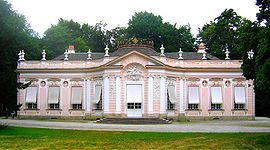
The Amalienburg is a small hunting lodge constructed in 1734-1739 by François de Cuvilliés
François de Cuvilliés
François de Cuvilliés was a Belgian-born Bavarian decorative designer and architect who was instrumental in bringing the Rococo style to the Wittelsbach court at Munich and to Central Europe in general.Cuvilliés was so diminutive in stature that it was as a court dwarf he first came to the notice...

 for the Holy Roman Emperor
Holy Roman Emperor
The Holy Roman Emperor is a term used by historians to denote a Middle Ages ruler, who as German King had in addition received the title of "Emperor of the Romans" from the Pope of the Holy Roman Church, and after the 16th century, the elected monarch governing the Holy Roman Empire, a Central...

 Charles VII
Charles VII
Charles VII may refer to:* Charles VII of Sweden * Charles VII of France, "the Victorious" * Charles VII, Holy Roman Emperor * Charles VII of Naples and III of Spain...

 and his wife, Maria Amalia of Austria
Maria Amalia of Austria
Maria Amalia of Austria was the daughter of Joseph I, Holy Roman Emperor and Amalia Wilhelmina, daughter of Duke Frederick of Brunswick-Lüneburg. During the reign of their grandfather Leopold I, a decree was signed which gave precedence in succession to the daughters of Leopold's eldest son...

, in the park of Nymphenburg Palace
Nymphenburg Palace
The Nymphenburg Palace , i.e. "Nymph's Castle", is a Baroque palace in Munich, Bavaria, Germany. The palace was the main summer residence of the rulers of Bavaria.-History:...

 in Munich
Munich
Munich is the capital city of Bavaria, Germany. It is located on the River Isar north of the Bavarian Alps. Munich is the third largest city in Germany, after Berlin and Hamburg...

 and in the eyes of many experts, it is the finest example of the German Rococo
Rococo
Rococo is a style of 18th century French art and interior design. Rococo rooms were designed as total works of art with elegant and ornate furniture, small sculptures, ornamental mirrors, and tapestry complementing architecture, reliefs, and wall paintings...

.

The Amalienburg was built and designed between 1734 and 1739 for the Electress Maria Amalia. It was designed by François de Cuvilliés
François de Cuvilliés
François de Cuvilliés was a Belgian-born Bavarian decorative designer and architect who was instrumental in bringing the Rococo style to the Wittelsbach court at Munich and to Central Europe in general.Cuvilliés was so diminutive in stature that it was as a court dwarf he first came to the notice...

 who helped make the Rococo the most important style of the first half of the 18th Century, between 1738 and 1756, by publishing many books on subjects such as interior decoration, wall panelling, ceilings, furniture, wrought-iron work, and other decorative subjects.

Most of the ground plan of the interior layout is given over to the round Hall of Mirrors in the center of the building which was designed by Johann Baptist Zimmermann
Johann Baptist Zimmermann
Johann Baptist Zimmermann was a German painter and a prime stucco plasterer during the Baroque....

 and Joachim Dietrich (1690-1753).
Discussion
Ask a question about 'Amalienburg'
Start a new discussion about 'Amalienburg'
Answer questions from other users
Full Discussion Forum
 
Encyclopedia
The Amalienburg is a small hunting lodge constructed in 1734-1739 by François de Cuvilliés
François de Cuvilliés
François de Cuvilliés was a Belgian-born Bavarian decorative designer and architect who was instrumental in bringing the Rococo style to the Wittelsbach court at Munich and to Central Europe in general.Cuvilliés was so diminutive in stature that it was as a court dwarf he first came to the notice...

 for the Holy Roman Emperor
Holy Roman Emperor
The Holy Roman Emperor is a term used by historians to denote a Middle Ages ruler, who as German King had in addition received the title of "Emperor of the Romans" from the Pope of the Holy Roman Church, and after the 16th century, the elected monarch governing the Holy Roman Empire, a Central...

 Charles VII
Charles VII
Charles VII may refer to:* Charles VII of Sweden * Charles VII of France, "the Victorious" * Charles VII, Holy Roman Emperor * Charles VII of Naples and III of Spain...

 and his wife, Maria Amalia of Austria
Maria Amalia of Austria
Maria Amalia of Austria was the daughter of Joseph I, Holy Roman Emperor and Amalia Wilhelmina, daughter of Duke Frederick of Brunswick-Lüneburg. During the reign of their grandfather Leopold I, a decree was signed which gave precedence in succession to the daughters of Leopold's eldest son...

, in the park of Nymphenburg Palace
Nymphenburg Palace
The Nymphenburg Palace , i.e. "Nymph's Castle", is a Baroque palace in Munich, Bavaria, Germany. The palace was the main summer residence of the rulers of Bavaria.-History:...

 in Munich
Munich
Munich is the capital city of Bavaria, Germany. It is located on the River Isar north of the Bavarian Alps. Munich is the third largest city in Germany, after Berlin and Hamburg...

 and in the eyes of many experts, it is the finest example of the German Rococo
Rococo
Rococo is a style of 18th century French art and interior design. Rococo rooms were designed as total works of art with elegant and ornate furniture, small sculptures, ornamental mirrors, and tapestry complementing architecture, reliefs, and wall paintings...

.

Architecture


The Amalienburg was built and designed between 1734 and 1739 for the Electress Maria Amalia. It was designed by François de Cuvilliés
François de Cuvilliés
François de Cuvilliés was a Belgian-born Bavarian decorative designer and architect who was instrumental in bringing the Rococo style to the Wittelsbach court at Munich and to Central Europe in general.Cuvilliés was so diminutive in stature that it was as a court dwarf he first came to the notice...

 who helped make the Rococo the most important style of the first half of the 18th Century, between 1738 and 1756, by publishing many books on subjects such as interior decoration, wall panelling, ceilings, furniture, wrought-iron work, and other decorative subjects.

Most of the ground plan of the interior layout is given over to the round Hall of Mirrors in the center of the building which was designed by Johann Baptist Zimmermann
Johann Baptist Zimmermann
Johann Baptist Zimmermann was a German painter and a prime stucco plasterer during the Baroque....

 and Joachim Dietrich (1690-1753). It creates an ethereal atmosphere in the Bavarian national colors of silver and blue.

Other rooms include the Blue Cabinet (the bedroom of the Electress) and the tiny palace also accommodates a kennel room for the hunting dogs. The kitchen is decorated with precious tiles from Delft
Delft
See also: Delft, Cape Town, Delft IslandDelft is a city and municipality in the province of South Holland , the Netherlands...

 which when put up, were mixed up when they were being laid by workers who thought they had the right order. The Castrol stove
Stove
A stove is an enclosed heated space. The term is commonly taken to mean an enclosed space in which fuel is burned to provide heating, either to heat the space in which the stove is situated or to heat the stove itself, and items placed on it...

(1735) constructed for the kitchen is a masonry construction with several fireholes covered by perforated iron plates. It is also known as a stew stove and the first design that completely enclosed the fire.

External links