
In
Roman mythologyRoman mythology is the body of traditional stories pertaining to ancient Rome's legendary origins and religious system, as represented in the literature and visual arts of the Romans...
,
Cupid (Latin
cupido, meaning "desire") is the god of desire, affection and
eroticEroticism is generally understood to refer to a state of sexual arousal or anticipation of such – an insistent sexual impulse, desire, or pattern of thoughts, as well as a philosophical contemplation concerning the aesthetics of sexual desire, sensuality and romantic love...
loveLove is an emotion of strong affection and personal attachment. In philosophical context, love is a virtue representing all of human kindness, compassion, and affection. Love is central to many religions, as in the Christian phrase, "God is love" or Agape in the Canonical gospels...
. He is the son of the goddess
Venus Venus is a Roman goddess principally associated with love, beauty, sex,sexual seduction and fertility, who played a key role in many Roman religious festivals and myths...
and the god
MarsMars was the Roman god of war and also an agricultural guardian, a combination characteristic of early Rome. He was second in importance only to Jupiter, and he was the most prominent of the military gods worshipped by the Roman legions...
. His Greek counterpart is
ErosEros , in Greek mythology, was the Greek god of love. His Roman counterpart was Cupid . Some myths make him a primordial god, while in other myths, he is the son of Aphrodite....
. He is also known in Latin as
Amor ("Love"); the
Amores (plural) are the equivalent of the Greek
ErotesThe erotes are a group of winged gods and demi-gods from Classical mythology, associated with love and sex, and part of Aphrodite's retinue. The collective term ἔρωτες - erotes is simply the plural of ἔρως - eros, or "desire"....
.
In popular culture, Cupid is frequently shown shooting his bow to inspire romantic love, often as an icon of
Valentine's DaySaint Valentine's Day, commonly shortened to Valentine's Day, is an annual commemoration held on February 14 celebrating love and affection between intimate companions. The day is named after one or more early Christian martyrs named Saint Valentine, and was established by Pope Gelasius I in 496...
. He is now in the current culture the personification of love and
courtshipCourtship is the period in a couple's relationship which precedes their engagement and marriage, or establishment of an agreed relationship of a more enduring kind. In courtship, a couple get to know each other and decide if there will be an engagement or other such agreement...
in general.
Legend
In the Roman version, Cupid was the son of Venus (goddess of love) and Mars (god of war) In the Greek version he was named
ErosEros , in Greek mythology, was the Greek god of love. His Roman counterpart was Cupid . Some myths make him a primordial god, while in other myths, he is the son of Aphrodite....
and seen as one of the primordial gods (though other myths exist as well). Cupid was often depicted with wings, a bow, and a quiver of arrows. The following story of
Cupid and PsycheCupid and Psyche , is a legend that first appeared as a digressionary story told by an old woman in Lucius Apuleius' novel, The Golden Ass, written in the 2nd century CE. Apuleius likely used an earlier tale as the basis for his story, modifying it to suit the thematic needs of his novel.It has...
is almost identical in both cultures; the most familiar version is found in Ovid's
Metamorphoses. When Cupid's mother Venus became jealous of the princess
PsycheCupid and Psyche , is a legend that first appeared as a digressionary story told by an old woman in Lucius Apuleius' novel, The Golden Ass, written in the 2nd century CE. Apuleius likely used an earlier tale as the basis for his story, modifying it to suit the thematic needs of his novel.It has...
, who was so beloved by her subjects that they forgot to worship Venus, she ordered Cupid to make Psyche fall in love with the vilest thing in the world. While Cupid was sneaking into her room to shoot Psyche with a golden arrow, he accidentally scratched himself with his own arrow and fell deeply in love with her.
Following that, Cupid visited Psyche every night while she slept. Speaking to her so that she could not see him, he told her never to try to see him. Psyche, though, incited by her two older sisters who told her Cupid was a monster, tried to look at him and angered Cupid. When he left, she looked all over the known world for him until at last the leader of the gods, Jupiter, gave Psyche the gift of immortality so that she could be with him. Together they had a daughter,
VoluptasIn Roman mythology, Voluptas or Volupta is the beautiful daughter born from the union of Cupid and Psyche. She is often found in the company of the Charites, or Three Graces, and she is known as the goddess of "sensual pleasures" whose Latin name means "pleasure" or "bliss".Some Roman authors...
, or
HedoneHēdonē is an English transliteration of a Greek word meaning pleasure, and is the root of the English word "hedonism". In the philosophy of Epicurus, hēdonē was the quest for pleasure that would have only good consequences...
, (meaning pleasure) and Psyche became a goddess. Her name "Psyche" means "soul."
Portrayal
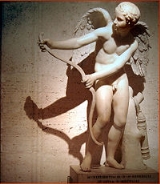
In painting and sculpture, Cupid is often portrayed as a nude (or sometimes
diaperA nappy or a diaper is a kind of pant that allows one to defecate or urinate on oneself discreetly. When diapers become soiled, they require changing; this process is often performed by a second person such as a parent or caregiver...
ed) winged boy or baby (a
puttoA putto is a figure of an infant often depicted as a young male. Putti are defined as chubby, winged or wingless, male child figure in nude. Putti are distinct from cherubim, but some English-speakers confuse them with each other, except that in the plural, "the Cherubim" refers to the biblical...
) armed with a bow and a quiver of arrows.
On gems and other surviving pieces, Cupid is usually shown amusing himself with childhood play, sometimes driving a hoop, throwing darts, catching a butterfly, or flirting with a
nymphA nymph in Greek mythology is a female minor nature deity typically associated with a particular location or landform. Different from gods, nymphs are generally regarded as divine spirits who animate nature, and are usually depicted as beautiful, young nubile maidens who love to dance and sing;...
. He is often depicted with his mother (in graphic arts, this is nearly always Venus), playing a horn. In other images, his mother is depicted scolding or even spanking him due to his mischievous nature. He is also shown wearing a helmet and carrying a buckler, perhaps in reference to
VirgilPublius Vergilius Maro, usually called Virgil or Vergil in English , was an ancient Roman poet of the Augustan period. He is known for three major works of Latin literature, the Eclogues , the Georgics, and the epic Aeneid...
's
Omnia vincit amor or as
political satirePolitical satire is a significant part of satire that specializes in gaining entertainment from politics; it has also been used with subversive intent where political speech and dissent are forbidden by a regime, as a method of advancing political arguments where such arguments are expressly...
on wars for love or love as war.
Cupid figures prominently in ariel poetry, lyrics and, of course,
elegiacElegiac refers either to those compositions that are like elegies or to a specific poetic meter used in Classical elegies. The Classical elegiac meter has two lines, making it a couplet: a line of dactylic hexameter, followed by a line of dactylic pentameter...
love and metamorphic poetry. In epic poetry, he is less often invoked, but he does appear in
VirgilPublius Vergilius Maro, usually called Virgil or Vergil in English , was an ancient Roman poet of the Augustan period. He is known for three major works of Latin literature, the Eclogues , the Georgics, and the epic Aeneid...
's
AeneidThe Aeneid is a Latin epic poem, written by Virgil between 29 and 19 BC, that tells the legendary story of Aeneas, a Trojan who travelled to Italy, where he became the ancestor of the Romans. It is composed of roughly 10,000 lines in dactylic hexameter...
changed into the shape of
AscaniusAscanius is the son of the Trojan hero Aeneas and a legendary king of Alba Longa. He is a character of Roman mythology, and has a divine lineage, being the son of Aeneas, who is son of Venus and the hero Anchises, a relative of Priam; thus Ascanius has divine ascendents by both parents, being...
inspiring Dido's love. In later literature, Cupid is frequently invoked as fickle, playful, and perverse. He is often depicted as carrying two sets of arrows: one set gold-headed, which inspire love; and the other lead-headed, which inspire hatred.
See also
- Aphrodite
Aphrodite is the Greek goddess of love, beauty, pleasure, and procreation.Her Roman equivalent is the goddess .Historically, her cult in Greece was imported from, or influenced by, the cult of Astarte in Phoenicia....
- Apollo and Daphne
Apollo and Daphne is a story from ancient Greek mythology, retold by Hellenistic and Roman authors in the form of an amorous vignette;The curse of Apollo, the god of the sun and music, was brought onto him when he insulted the young Eros Apollo and Daphne is a story from ancient Greek mythology,...
- Cherub
A cherub is a type of spiritual being mentioned in the Hebrew Bible and cited later on in the Christian biblical canons, usually associated with the presence of God...
- Cupid's bow
Cupid's bow is a facial feature where the double curve of a human upper lip is said to resemble the bow of Cupid, the Roman god of erotic love...
- Eros (love)
Eros is one of the four words in Ancient Greek which can be rendered into English as “love”. The other three are storge, philia and agape...
- Eros (mythology)
- He-He er xian
He-He er xian , also known as the "Immortals of Harmony and Union " or "the two spirits of Harmony and Union" are two Taoist immortals. They are popularly associated with a happy marriage....
, the TaoistTaoism refers to a philosophical or religious tradition in which the basic concept is to establish harmony with the Tao , which is the mechanism of everything that exists...
"ImmortalsXian is a Chinese word for an enlightened person, translatable in English as:*"spiritually immortal; transcendent; super-human; celestial being"...
of Harmony and Union", popularly associated with a happy marriage
- Hearts and arrows
Hearts and Arrows Diamonds are precision cut variations of the traditional 57 faceted round brilliant cut. They are cut to “ideal proportions” with superior optical symmetry and a specific faceting pattern...
- Kama
Kāmadeva is the Hindu god of human love or desire. Other names for him include; Atanu , Ragavrinta , Ananga , Kandarpa , Manmatha , Manasija ,...
, the god of love in HinduismHinduism is the predominant and indigenous religious tradition of the Indian Subcontinent. Hinduism is known to its followers as , amongst many other expressions...
- Love at first sight
Love at first sight is a common trope in Western literature, in which a person, character, or speaker feels romantic attraction for a stranger on the first sight of them...
- Putto
A putto is a figure of an infant often depicted as a young male. Putti are defined as chubby, winged or wingless, male child figure in nude. Putti are distinct from cherubim, but some English-speakers confuse them with each other, except that in the plural, "the Cherubim" refers to the biblical...
- Roman mythology
Roman mythology is the body of traditional stories pertaining to ancient Rome's legendary origins and religious system, as represented in the literature and visual arts of the Romans...
- Love dart
A love dart is a hard, long, sharp, calcareous or chitinous dart which some hermaphroditic land snails and slugs create. Love darts are made in sexually mature animals only, and are used as part of the sequence of events during courtship, before actual mating takes place...
s, as used by snails
- Till We Have Faces
Till We Have Faces: A Myth Retold is a 1956 novel by C. S. Lewis. It is a retelling of the Greek myth of Cupid and Psyche, which had haunted Lewis all his life, and which is itself based on a chapter of The Golden Ass of Apuleius...