


James Gibbs

Encyclopedia
James Gibbs was one of Britain
's most influential architect
s. Born in Scotland
, he trained as an architect in Rome
, and practised mainly in England. His most important works are St Martin-in-the-Fields
, in London
, and the cylindrical, domed Radcliffe Camera
at Oxford University.
Gibbs very privately was Roman Catholic and a Tory
, and was therefore not part of the Palladian movement which was prevalent in English architecture
of the period. The Palladians were largely Whigs, led by Lord Burlington
and Colen Campbell
, a fellow Scot who developed a rivalry with Gibbs. Gibbs' professional Italian training under the Baroque master, Carlo Fontana
, also set him uniquely apart from the Palladian school. However, despite being unfashionable, he gained a number of Tory patrons and clients, and became hugely influential through his published works, which became popular as pattern books for architecture.
His architectural style did incorporate Palladian elements, as well as forms from Italian baroque and Inigo Jones
(1573–1652), but was most strongly influenced by the work of Sir Christopher Wren
(1632–1723), who was an early supporter of Gibbs. Overall, Gibbs was an individual who formed his own style independently of current fashions. Architectural historian John Summerson
describes his work as the fulfilment of Wren's architectural ideas, which were not fully developed in his own buildings. Despite the influence of his books, Gibbs, as a stylistic outsider, had little effect on the later direction of British architecture, which saw the rise of Neoclassicism
shortly after his death.
, Scotland
, a younger son of a Patrick Gibbs merchant and his second wife Ann née Gordon, the family was Roman Catholic, there was a half-brother William from the first marriage to Isabel née Farquhar. He was educated at Aberdeen Grammar School
and Marischal College
. After the death of his parents he went in 1700 to stay with relatives in Holland. He later travelled through Europe, visiting Flanders
, France
, Switzerland
and Germany
. Some time after he left for Rome
travelling via France
. On the 12 October 1703 he registered as a student at The Scots College (Rome)
. He would have been studying for the Catholic Priesthood
but had second thoughts. By the end of 1704 he was studying architecture
under Carlo Fontana
, he also was taught by Pietro Francesco Garroli, professor of perspective at the Accademia di San Luca
. While in Rome Gibbs met John Perceval, 1st Earl of Egmont
who attempted to persuade Gibbs to move to Ireland. He moved to London
in November 1708, his return to Britain was probably due to the terminal illness of his half-brother William, who died before James reached Britain.
while abroad, the Earl persuaded Gibbs to remain in London, offering Gibbs his first commission, alterations of his house in Whitehall
. Around this time he met Edward Harley, 2nd Earl of Oxford and Earl Mortimer
, who would be a powerful patron and friend to Gibbs, who would later remodel the Earl's house Wimpole Hall
and James Brydges, 1st Duke of Chandos
for whom he would be one of the architects to work at Cannons (house)
from 1715-19. Gibbs was one of the sixty founder members of Godfrey Kneller
's Academy of Painting, founded in 1711. In August 1713 Gibbs discovered that an architect by the name of William Dickinson was resigning as architect from the Commission for Building Fifty New Churches
, the commissioners included Sir Christopher Wren, Sir John Vanbrugh
and Thomas Archer
, with the backing amongst others of the Earl of Mar and Sir Christopher Wren, Gibbs was appointed architect to the commission on the 18 November 1713, where he would have worked with Nicholas Hawksmoor
, his fellow architect to the commission. But a combination of events would ensure Gibbs was deprived of his place as architect to the commission by December 1715: Queen Anne had died and a Whig government had replaced the Tories; and the failure of the 1715 Jacobite rising that was supported by the Earl of Mar were all factors. Still he was able to complete one church, St Mary-le-Strand, that he described as "the first publick (sic) building I was employed in after my arrival from Italy; which being situated in a very publick place, the Commissioners... spar'd no cost to beautify". On the 18 December 1716 Gibbs joined the "Vandykes clubb" (sic
), also called the Club of St Luke for "Virtuosi in London" fellow architects that were members included William Kent
and William Talman
, other notable members with who Gibbs would later work included the garden designer Charles Bridgeman
and the sculptor John Michael Rysbrack
who sculpted many of the memorials Gibbs designed. In March 1721 Charles Bridgeman, James Thornhill
, John Wootton and Gibbs were all travelling together from London to Wimpole Hall where they were all working for the Edward Harley Earl of Oxford, Thornhill recalled they drank Harley's "healths over and over, as well in our civil as bacchanalian hours" and talked "of building, pictures and may be towards the close of politics or religion".
In 1720 Gibbs was invited along with other architects to enter a competition to design a new church to replace the dilapidated church of St. Martin-in-the-fields, he won and on the 24th November 1720 he was appointed architect of the new church, Gibbs' most famous building. Horace Walpole
described Gibbs as being around 1720 as "the architect most in vogue". In 1720 Gibbs was approached by the Provost of King's College, Cambridge
to complete the college, the scheme consisted of three buildings, all 53 feet (16.2 m) high, forming a courtyard 240 by to the south of the Chapel. In the end only the western block, the 236 feet (71.9 m) long Fellows' Building was constructed from 1721–24, the eastern Fellows' Building would have been identical, the southern building would have had a great octastyle
Corinthian portico
, and been 236 feet (71.9 m) long, containing the great dining hall, Provost's Lodge and offices. On the 11 December 1721 Edward Lany, one of the Syndics of University of Cambridge
thanked Edward Harley Earl of Oxford for sending "Mr Gibbs's design for our building. I design to offer it to the Syndics as soon as they meet...I have not skill enough myself to judge of it", this referred to a design for a new central building for the University to house the library, Senate House, the Consistory and Register Offices. Gibbs produced a second larger design in 1722, consisting of a courtyard building with two projecting wings to the east, 189 by. Work started on the building in November 1722, in the end only the Senate House
, 110 by, the northern of the two east wings was built, being finished in 1730.
By 1723 Gibbs was rich enough to open an account at Drummonds Bank
with his first year's balance being £1055 11 shillings 4 pence. 1723 also saw Gibbs being made a governor of St Bartholomew's Hospital
, fellow governors included fellow architects Richard Boyle, 3rd Earl of Burlington
and George Dance the Elder
, on the 1 August 1728 it was decided to rebuild the Hospital, Gibbs offered his service for free, and designed a quadrangle of 200 by 160 feet with four near-identical plain blocks. March 1726 saw Gibbs made a member of the Society of Antiquaries of London
. In 1727 Gibbs was awarded with the only government post he ever held, Architect of the Ordnance, which he held for life, he was given it thanks to the Duke of Argyll who was Master of the Ordnance and in 1729 he was elected to the Royal Society
. One of the most serious disappointments of Gibbs's career was his failure to win the commission for the Mansion House, London
, there were two competitions for the building, both of which he entered the first in 1728 and a second one in 1735, in the end George Dance the elder won the commission. In 1735, Gavin Hamilton
painted A Conversation of Virtuosis... at the Kings Arms, a group portrait that included: Michael Dahl
; George Vertue
; John Wootton
; Gibbs; and Rysbrack; along with other artists who were instrumental in bringing the Rococo
style to English design and interiors. After the death of Nicholas Hawksmoor in 1736, who was architect for the Radcliffe Camera, Gibbs was appointed on 4 March 1737 to replace him, this, arguably Gibbs' finest building, was finished by the 19th May 1749. Gibbs was awarded by Oxford University an honorary degree
of Master of Arts
in 1749 recognition of the completion of the Radcliffe Camera.
while architecture and related crafts made up the bulk of his books; other subjects covered included: antiquities, coins, and heraldry; histories of England, Scotland and Rome and other nations; literature included works by Alexander Pope
, Jonathan Swift
, Daniel Defoe
and Matthew Prior
; travel books including Egypt, the South Seas, Russia, Hungary, Lapland, Virginia, Ceylon and Abyssinia, missionary travels included China, Formosa, Guinea, Borneo and the East Indies; books on religion included both Anglican and Roman Catholic works; and even cookery books. The most significant of the architectural works were: Vincenzo Scamozzi
's L’Idea dell’Architettura Universale; Sebastiano Serlio
's Sette Libri d'Architettura; Domenico Fontana
's Della transportatione dell'obelisco Vaticano e delle fabriche di Sisto V; Colen Campbell
's Vitruvius Britannicus; Giacomo Leoni
's The Architecture of A. Palladio, in Four Books; William Kent
's The Designs of Inigo Jones and Robert Wood
's The ruins of Palmyra. Gibbs is also known to have owned at least 117 paintings, including works by Canaletto
, Giovanni Paolo Panini, Sebastiano Ricci
, Antoine Watteau
and Willem van de Velde the Younger
. Sculptures owned by Gibbs included a bust of Flora
by François Girardon
, a bust of Matthew Prior by Antoine Coysevox
and busts of Alexander Pope and Gibbs by Rysbrack.
and food, was described as "corpulent". In June 1749 Gibbs set out for the spa town
of Aix-la-Chapelle for treatment: he long suffered from kidney stone
s and had lost weight and was in pain, he remained until September when he returned to London. Gibbs never married. Gibbs died in his London house on the corner of Wimpole Street
and Henrietta Street on the 5th August 1754 and was buried in St Marylebone Parish Church
, and a modest wall tablet
was erected with this inscription:
In his will made on the 9th May 1754, Gibbs left £1000, his Plate
, and three houses in Marylebone
to Lord Erskine in gratitude for favours from his father the late Earl of Mar. Further bequests included £1,400 and two houses in Marylebone and Argyll Ground Westminster
to John Sherwine of Soho plus £100 to be given to a charity of Sherwine's daughters choice, to Robert Pringle of Clifton a Cavendish Square
house and £400 and to Cosmo Alexander (1724–1772) a Scottish painter "my house I live in withall [sic] its furniture as it stands with pictures bustoes [sic] etc". Further bequests of £100 each went to William Thomas, Dr William King, St. Bartholomew's Hospital and the Foundling Hospital
. The Trustees of Radcliffe Camera
were given "all my printed books, Books of Architecture books of prints and drawings books of maps and a pair of globes with leather covers to be placed ... in the library... of which I was architect... next to my Bustoe".
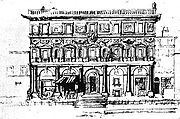
, and in 1713 he was appointed one of the Commission's two surveyors, the contemporary term for an architect, alongside Nicholas Hawksmoor
. He held this post for two years, until he was forced out by the Whigs, because of his Tory sympathies, and replaced by John James. During his tenure he completed his first important commission, the church of St Mary-le-Strand (1714–1717), in the City of Westminster
. A previous design had been prepared by the English Baroque
architect Thomas Archer
, which Gibbs developed in an Italian Mannerist style, influenced by the Palazzo Branconio dall'Aquila in Rome, attributed to Raphael
, as well as incorporating elements from Wren. Such strong Italian influence was not popular with the Whigs, who were now taking political control following the accession of King George I
in 1714, leading to Gibbs' dismissal, and causing him to modify the foreign influences in his work. Colen Campbell's Vitruvius Britannicus (1715), which promoted the Palladian style, also contains unfavourable comments regarding Carlo Fontana and St Mary-le-Strand. Campbell went on to replace Gibbs as the architect of Burlington House
around 1717, where the latter had designed the offices and colonnades for the young Lord Burlington.
 Other early designs include the house of Cannons
, Middlesex (1716–1720), for James Brydges, 1st Duke of Chandos
, and the tower of Wren's St. Clement Danes (1719). At Twickenham
he designed the pavilion at Orleans House, called the Octagon Room, for a Scottish patron, James Johnston
(1655–1737) former Secretary of State for Scotland, about 1720. It is the only part of the house and grounds that has survived.
, Oxfordshire (1720–1722), for George Lee, 2nd Earl of Lichfield
. It typifies his conservative domestic manner, which changed little throughout the rest of his career. His other houses include Sudbrooke Lodge, Petersham
(1728), for the Duke of Argyll
, works at Wimpole Hall
, Cambridgeshire, for the 2nd Earl of Oxford
, Patshull Hall
, Staffordshire (1730) for Sir John Astley
, and modifications to Colen Campbell
's designs at Houghton Hall
in Norfolk
. Gibbs also completed the Gothic Temple (1741–1748), a triangular folly
at Stowe
, Buckinghamshire. Other garden buildings at Stowe include the pair of "Boycott Pavilions", which were altered by Giovanni Battista Borra
in 1754 to replace the pyramidal stone roofs with more conventional domes.
this was St Mary le Strand, construction began in 1714 and it was complete by 1717. Between 1721 and 1726 Gibbs designed his most important and influential work, the church of St Martin-in-the-Fields
, located in Trafalgar Square
, London. Gibbs' initial radical design for the commission was for a circular church, derived from a design by Andrea Pozzo
; its illustration in Gibbs' book was to influence several adaptations by Neoclassical architects
. This was rejected by the commission, and Gibbs developed the present rectangular design. The layout and detailing of the building owes much to Wren, in particular the church of St James', Piccadilly
. However, Gibbs' innovation at St Martin's was to place the steeple centrally, behind the pediment
. By contrast, Wren's steeples were usually adjacent to the church, rather than within the walls. This apparent incongruity was criticised at the time, but St Martin-in-the-Fields nevertheless became a model for church buildings, particularly for Anglican worship, across Britain and around the world.
At the same time, Gibbs designed a chapel of ease
for the 1st Earl of Oxford, now known as St Peter's Vere Street
(1721–1724). In 1725 he designed All Saints', Derby
, now Derby Cathedral
, on similar lines to St Martin's, although at Derby the original gothic steeple was retained. Gibbs, the first British architect to do so, created numerous designs for funeral monuments, often collaborating with the sculptor Michael Rysbrack. In 1733 Gibbs was commissioned by Lord Foley
to adapt the chapel from Cannons House
(Gibbs was one of the architects involved in designing Cannons), as the parish church at Great Witley
.
this would be used for all the blocks, being finished in 1732, this contains the Great Hall and the main staircase the walls of which are covered by murals painted by William Hogarth
, again he gave his services for free. These depict Christ
healing the sick at the Pool of Bethesda
and the parable of the good Samaritan
. The other blocks contained wards. The south block was built from 1735-40 (demolished 1937). the west block was built from 1743 to 1753, this was delayed due to the War of the Austrian Succession
. The east block was built 1758-68 to Gibbs's design.
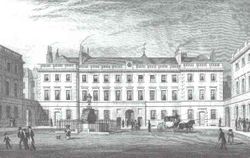
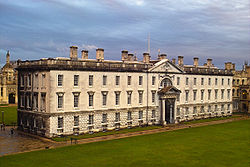 Gibbs worked at both Oxford
and Cambridge
Universities. Designs for the Senate House
(1722–1730) at Cambridge were begun by Gibbs, but as executed the building is probably the work of James Burrough (1691–1764). The Fellows' Building at King's College
(1724–1730) is, however, the work of James Gibbs. A simple composition, similar in style to his houses, the building is enlivened by a central feature incorporating an arch, within a doric portal, and a Diocletian window
, all under a pediment. This mannerist composition of features from Wren and Palladio is an example of Gibbs' more adventurous Italian style.
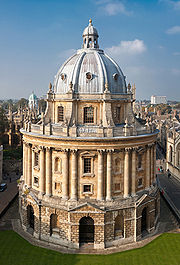 More adventurous still was Gibbs' last major work, the Radcliffe Camera
, Oxford
(1739–1749). A circular library building was first planned by Hawksmoor around 1715, but nothing was done at the time. Sometime before 1736, new designs were submitted by Hawksmoor and Gibbs, with the latter's rectangular design being preferred. However, this plan was abandoned in favour of a circular plan by Gibbs, which drew on Hawksmoor's 1715 scheme, although it was very different in detail. Gibbs' design saw him returning to his Italian mannerist sources, and in particular shows the influence of Santa Maria della Salute, Venice (1681), by Baldassarre Longhena
. The building incorporates unexpected vertical alignments, for instance the ribs of the dome do not line up with the columns of the drum, but lie in between, creating a rhythmically complex composition.
, was a folio of his building designs both executed and not, as well as numerous designs for ornaments, there are 150 engraved plates covering 380 different designs, he was the first British architect to publish a book devoted to his own designs. The major works illustrated include, St Martin-in-the-fields including the unexecuted version with a circular nave, St. Mary le Strand, the complete schemes for King's College Cambridge and the Public Building (including the Senate House) Cambridge University, numerous designs for medium sized country houses, garden building and follies, obelisks and memorial columns, church memorials and monuments, as well as wrought iron work, fireplaces, window and door surrounds, Cartouche (design)
and urns. The first page of the introduction included: '...such a Work as this would be of use to such Gentleman as might be concerned in Building, especially in the remote parts of the Country, where little or no assistance for designs can be procured'. It was intended to be a pattern book for both architects and clients, and became, according to John Summerson, "probably the most widely-used architecture book of the century, not only throughout Britain, but in the American colonies
and the West Indies". For example, Plate 58 was an inspiration for the river façade of Mount Airy, Richmond County, Virginia
, and perhaps for the floorplan of Drayton Hall
in Charleston County, South Carolina, as well.
Other published works by Gibbs include: In 1732, The Rules for Drawing the Several Parts of Architecture that explained how to draw the Classical order
s and related details, a textbook which was used well into the 19th century. Bibliotheca Radcliviana subtitled A Short Description of the Radcliffe Library Oxford in 1747 to celebrate the Radcliffe Camera, it includes a list of all the craftsmen employed in the building's construction as well as twenty-one plates. In 1752 he published a two volume translation of the Latin
book De Rebus Emanuelis, that was by a 16th century Portuguese Bishop Jerome Osorio da Fonseca, his English title was The History of the Portuguese during the Reign of Emanuel and is a history book with accounts of warfare, voyages of discovery from Africa to China including descriptions of the religious beliefs of these countries and also the initial colonisation of Brazil
.
,
Kingdom of Great Britain
The former Kingdom of Great Britain, sometimes described as the 'United Kingdom of Great Britain', That the Two Kingdoms of Scotland and England, shall upon the 1st May next ensuing the date hereof, and forever after, be United into One Kingdom by the Name of GREAT BRITAIN. was a sovereign...
's most influential architect
Architect
An architect is a person trained in the planning, design and oversight of the construction of buildings. To practice architecture means to offer or render services in connection with the design and construction of a building, or group of buildings and the space within the site surrounding the...
s. Born in Scotland
Kingdom of Scotland
The Kingdom of Scotland was a Sovereign state in North-West Europe that existed from 843 until 1707. It occupied the northern third of the island of Great Britain and shared a land border to the south with the Kingdom of England...
, he trained as an architect in Rome
Rome
Rome is the capital of Italy and the country's largest and most populated city and comune, with over 2.7 million residents in . The city is located in the central-western portion of the Italian Peninsula, on the Tiber River within the Lazio region of Italy.Rome's history spans two and a half...
, and practised mainly in England. His most important works are St Martin-in-the-Fields
St Martin-in-the-Fields
St Martin-in-the-Fields is an Anglican church at the north-east corner of Trafalgar Square in the City of Westminster, London. Its patron is Saint Martin of Tours.-Roman era:Excavations at the site in 2006 led to the discovery of a grave dated about 410...
, in London
London
London is the capital city of :England and the :United Kingdom, the largest metropolitan area in the United Kingdom, and the largest urban zone in the European Union by most measures. Located on the River Thames, London has been a major settlement for two millennia, its history going back to its...
, and the cylindrical, domed Radcliffe Camera
Radcliffe Camera
The Radcliffe Camera is a building in Oxford, England, designed by James Gibbs in the English Palladian style and built in 1737–1749 to house the Radcliffe Science Library.-History:...
at Oxford University.
Gibbs very privately was Roman Catholic and a Tory
Tory
Toryism is a traditionalist and conservative political philosophy which grew out of the Cavalier faction in the Wars of the Three Kingdoms. It is a prominent ideology in the politics of the United Kingdom, but also features in parts of The Commonwealth, particularly in Canada...
, and was therefore not part of the Palladian movement which was prevalent in English architecture
Architecture of the United Kingdom
The Architecture of England refers to the architecture practised in the territory of the present-day country of England, and in the historic Kingdom of England...
of the period. The Palladians were largely Whigs, led by Lord Burlington
Richard Boyle, 3rd Earl of Burlington
Richard Boyle, 3rd Earl of Burlington and 4th Earl of Cork PC , born in Yorkshire, England, was the son of Charles Boyle, 2nd Earl of Burlington and 3rd Earl of Cork...
and Colen Campbell
Colen Campbell
Colen Campbell was a pioneering Scottish architect who spent most of his career in England, and is credited as a founder of the Georgian style...
, a fellow Scot who developed a rivalry with Gibbs. Gibbs' professional Italian training under the Baroque master, Carlo Fontana
Carlo Fontana
Carlo Fontana was an Italian architect, who was in part responsible for the classicizing direction taken by Late Baroque Roman architecture.-Biography:...
, also set him uniquely apart from the Palladian school. However, despite being unfashionable, he gained a number of Tory patrons and clients, and became hugely influential through his published works, which became popular as pattern books for architecture.
His architectural style did incorporate Palladian elements, as well as forms from Italian baroque and Inigo Jones
Inigo Jones
Inigo Jones is the first significant British architect of the modern period, and the first to bring Italianate Renaissance architecture to England...
(1573–1652), but was most strongly influenced by the work of Sir Christopher Wren
Christopher Wren
Sir Christopher Wren FRS is one of the most highly acclaimed English architects in history.He used to be accorded responsibility for rebuilding 51 churches in the City of London after the Great Fire in 1666, including his masterpiece, St. Paul's Cathedral, on Ludgate Hill, completed in 1710...
(1632–1723), who was an early supporter of Gibbs. Overall, Gibbs was an individual who formed his own style independently of current fashions. Architectural historian John Summerson
John Summerson
Sir John Newenham Summerson CH CBE was one of the leading British architectural historians of the 20th century....
describes his work as the fulfilment of Wren's architectural ideas, which were not fully developed in his own buildings. Despite the influence of his books, Gibbs, as a stylistic outsider, had little effect on the later direction of British architecture, which saw the rise of Neoclassicism
Neoclassical architecture
Neoclassical architecture was an architectural style produced by the neoclassical movement that began in the mid-18th century, manifested both in its details as a reaction against the Rococo style of naturalistic ornament, and in its architectural formulas as an outgrowth of some classicizing...
shortly after his death.
Background and education
Born on the 23rd December 1682 in Fittysmire, AberdeenAberdeen
Aberdeen is Scotland's third most populous city, one of Scotland's 32 local government council areas and the United Kingdom's 25th most populous city, with an official population estimate of ....
, Scotland
Kingdom of Scotland
The Kingdom of Scotland was a Sovereign state in North-West Europe that existed from 843 until 1707. It occupied the northern third of the island of Great Britain and shared a land border to the south with the Kingdom of England...
, a younger son of a Patrick Gibbs merchant and his second wife Ann née Gordon, the family was Roman Catholic, there was a half-brother William from the first marriage to Isabel née Farquhar. He was educated at Aberdeen Grammar School
Aberdeen Grammar School
Aberdeen Grammar School, known to students as The Grammar is a state secondary school in the City of Aberdeen, Scotland. It is one of twelve secondary schools run by the Aberdeen City Council educational department...
and Marischal College
Marischal College
Marischal College is a building and former university in the centre of the city of Aberdeen in north-east Scotland. The building is owned by the University of Aberdeen and used for ceremonial events...
. After the death of his parents he went in 1700 to stay with relatives in Holland. He later travelled through Europe, visiting Flanders
Flanders
Flanders is the community of the Flemings but also one of the institutions in Belgium, and a geographical region located in parts of present-day Belgium, France and the Netherlands. "Flanders" can also refer to the northern part of Belgium that contains Brussels, Bruges, Ghent and Antwerp...
, France
France
The French Republic , The French Republic , The French Republic , (commonly known as France , is a unitary semi-presidential republic in Western Europe with several overseas territories and islands located on other continents and in the Indian, Pacific, and Atlantic oceans. Metropolitan France...
, Switzerland
Switzerland
Switzerland name of one of the Swiss cantons. ; ; ; or ), in its full name the Swiss Confederation , is a federal republic consisting of 26 cantons, with Bern as the seat of the federal authorities. The country is situated in Western Europe,Or Central Europe depending on the definition....
and Germany
Germany
Germany , officially the Federal Republic of Germany , is a federal parliamentary republic in Europe. The country consists of 16 states while the capital and largest city is Berlin. Germany covers an area of 357,021 km2 and has a largely temperate seasonal climate...
. Some time after he left for Rome
Rome
Rome is the capital of Italy and the country's largest and most populated city and comune, with over 2.7 million residents in . The city is located in the central-western portion of the Italian Peninsula, on the Tiber River within the Lazio region of Italy.Rome's history spans two and a half...
travelling via France
France
The French Republic , The French Republic , The French Republic , (commonly known as France , is a unitary semi-presidential republic in Western Europe with several overseas territories and islands located on other continents and in the Indian, Pacific, and Atlantic oceans. Metropolitan France...
. On the 12 October 1703 he registered as a student at The Scots College (Rome)
The Scots College (Rome)
The Scots College in Rome was established by Clement VIII in 1600, when it was assigned the revenue of the old Scots' hospice...
. He would have been studying for the Catholic Priesthood
Priesthood (Catholic Church)
The ministerial orders of the Catholic Church include the orders of bishops, deacons and presbyters, which in Latin is sacerdos. The ordained priesthood and common priesthood are different in function and essence....
but had second thoughts. By the end of 1704 he was studying architecture
Architecture
Architecture is both the process and product of planning, designing and construction. Architectural works, in the material form of buildings, are often perceived as cultural and political symbols and as works of art...
under Carlo Fontana
Carlo Fontana
Carlo Fontana was an Italian architect, who was in part responsible for the classicizing direction taken by Late Baroque Roman architecture.-Biography:...
, he also was taught by Pietro Francesco Garroli, professor of perspective at the Accademia di San Luca
Accademia di San Luca
The Accademia di San Luca, was founded in 1577 as an association of artists in Rome, under the directorship of Federico Zuccari, with the purpose of elevating the work of "artists", which included painters, sculptors and architects, above that of mere craftsmen. Other founders included Girolamo...
. While in Rome Gibbs met John Perceval, 1st Earl of Egmont
John Perceval, 1st Earl of Egmont
John Perceval, 1st Earl of Egmont PC, FRS , known as Sir John Perceval, 5t, from 1691 to 1715, as The Lord Perceval from 1715 to 1722 and as The Viscount Perceval from 1722 to 1733, was an Anglo-Irish politician....
who attempted to persuade Gibbs to move to Ireland. He moved to London
London
London is the capital city of :England and the :United Kingdom, the largest metropolitan area in the United Kingdom, and the largest urban zone in the European Union by most measures. Located on the River Thames, London has been a major settlement for two millennia, its history going back to its...
in November 1708, his return to Britain was probably due to the terminal illness of his half-brother William, who died before James reached Britain.
Career
Still intending to take up the offer of work in Ireland, he had been befriended by John Erskine, 22nd Earl of MarJohn Erskine, 22nd Earl of Mar
John Erskine, 22nd and de jure 6th Earl of Mar, KT , Scottish Jacobite, was the eldest son of the 21st Earl of Mar , from whom he inherited estates that were heavily loaded with debt. By modern reckoning he was 22nd Earl of Mar of the first creation and de jure 6th Earl of Mar of the seventh...
while abroad, the Earl persuaded Gibbs to remain in London, offering Gibbs his first commission, alterations of his house in Whitehall
Whitehall
Whitehall is a road in Westminster, in London, England. It is the main artery running north from Parliament Square, towards Charing Cross at the southern end of Trafalgar Square...
. Around this time he met Edward Harley, 2nd Earl of Oxford and Earl Mortimer
Edward Harley, 2nd Earl of Oxford and Earl Mortimer
Edward Harley, 2nd Earl of Oxford and Earl Mortimer , styled Lord Harley between 1711 and 1724, was a British politician, bibliophile, collector and patron of the arts.-Background:...
, who would be a powerful patron and friend to Gibbs, who would later remodel the Earl's house Wimpole Hall
Wimpole Hall
Wimpole Hall is a country house located within the Parish of Wimpole, Cambridgeshire, England, about 8½ miles southwest of Cambridge. The house, begun in 1640, and its 3,000 acres of parkland and farmland are owned by the National Trust and are regularly open to the public.Wimpole is...
and James Brydges, 1st Duke of Chandos
James Brydges, 1st Duke of Chandos
James Brydges, 1st Duke of Chandos, MP, PC was the first of fourteen children by Sir James Brydges, 3rd Baronet of Wilton Castle, Sheriff of Herefordshire, 8th Baron Chandos; and Elizabeth Barnard...
for whom he would be one of the architects to work at Cannons (house)
Cannons (house)
Cannons was a stately home in Little Stanmore, Middlesex built for James Brydges, 1st Duke of Chandos between 1713 and 1724 at a cost of £200,000 but which in 1747 was razed and its contents dispersed....
from 1715-19. Gibbs was one of the sixty founder members of Godfrey Kneller
Godfrey Kneller
Sir Godfrey Kneller, 1st Baronet was the leading portrait painter in England during the late 17th and early 18th centuries, and was court painter to British monarchs from Charles II to George I...
's Academy of Painting, founded in 1711. In August 1713 Gibbs discovered that an architect by the name of William Dickinson was resigning as architect from the Commission for Building Fifty New Churches
Commission for Building Fifty New Churches
The Commission for Building Fifty New Churches was an organisation set up by Act of Parliament in England in 1711, with the purpose of building fifty new churches for the rapidly growing conurbation of London...
, the commissioners included Sir Christopher Wren, Sir John Vanbrugh
John Vanbrugh
Sir John Vanbrugh – 26 March 1726) was an English architect and dramatist, perhaps best known as the designer of Blenheim Palace and Castle Howard. He wrote two argumentative and outspoken Restoration comedies, The Relapse and The Provoked Wife , which have become enduring stage favourites...
and Thomas Archer
Thomas Archer
Thomas Archer was an English Baroque architect, whose work is somewhat overshadowed by that of his contemporaries Sir John Vanbrugh and Nicholas Hawksmoor. Archer was born at Umberslade Hall in Tanworth-in-Arden in Warwickshire, the youngest son of Thomas Archer, a country gentleman, Parliamentary...
, with the backing amongst others of the Earl of Mar and Sir Christopher Wren, Gibbs was appointed architect to the commission on the 18 November 1713, where he would have worked with Nicholas Hawksmoor
Nicholas Hawksmoor
Nicholas Hawksmoor was a British architect born in Nottinghamshire, probably in East Drayton.-Life:Hawksmoor was born in Nottinghamshire in 1661, into a yeoman farming family, almost certainly in East Drayton, Nottinghamshire. On his death he was to leave property at nearby Ragnall, Dunham and a...
, his fellow architect to the commission. But a combination of events would ensure Gibbs was deprived of his place as architect to the commission by December 1715: Queen Anne had died and a Whig government had replaced the Tories; and the failure of the 1715 Jacobite rising that was supported by the Earl of Mar were all factors. Still he was able to complete one church, St Mary-le-Strand, that he described as "the first publick (sic) building I was employed in after my arrival from Italy; which being situated in a very publick place, the Commissioners... spar'd no cost to beautify". On the 18 December 1716 Gibbs joined the "Vandykes clubb" (sic
Sic
Sic—generally inside square brackets, [sic], and occasionally parentheses, —when added just after a quote or reprinted text, indicates the passage appears exactly as in the original source...
), also called the Club of St Luke for "Virtuosi in London" fellow architects that were members included William Kent
William Kent
William Kent , born in Bridlington, Yorkshire, was an eminent English architect, landscape architect and furniture designer of the early 18th century.He was baptised as William Cant.-Education:...
and William Talman
William Talman (architect)
William Talman was an English architect and landscape designer. A pupil of Sir Christopher Wren, in 1678 he and Thomas Apprice gained the office of King's Waiter in the Port of London...
, other notable members with who Gibbs would later work included the garden designer Charles Bridgeman
Charles Bridgeman
Charles Bridgeman was an English garden designer in the onset of the naturalistic landscape style. Although he was a key figure in the transition of English garden design from the Anglo-Dutch formality of patterned parterres and avenues to a freer style that incorporated formal, structural and...
and the sculptor John Michael Rysbrack
John Michael Rysbrack
Johannes Michel or John Michael Rysbrack, original name Jan Michiel Rijsbrack , was an 18th-century Flemish sculptor. His birth-year is sometimes given as 1693 or 1684....
who sculpted many of the memorials Gibbs designed. In March 1721 Charles Bridgeman, James Thornhill
James Thornhill
Sir James Thornhill was an English painter of historical subjects, in the Italian baroque tradition.-Life:...
, John Wootton and Gibbs were all travelling together from London to Wimpole Hall where they were all working for the Edward Harley Earl of Oxford, Thornhill recalled they drank Harley's "healths over and over, as well in our civil as bacchanalian hours" and talked "of building, pictures and may be towards the close of politics or religion".
In 1720 Gibbs was invited along with other architects to enter a competition to design a new church to replace the dilapidated church of St. Martin-in-the-fields, he won and on the 24th November 1720 he was appointed architect of the new church, Gibbs' most famous building. Horace Walpole
Horace Walpole, 4th Earl of Orford
Horatio Walpole, 4th Earl of Orford was an English art historian, man of letters, antiquarian and Whig politician. He is now largely remembered for Strawberry Hill, the home he built in Twickenham, south-west London where he revived the Gothic style some decades before his Victorian successors,...
described Gibbs as being around 1720 as "the architect most in vogue". In 1720 Gibbs was approached by the Provost of King's College, Cambridge
King's College, Cambridge
King's College is a constituent college of the University of Cambridge, England. The college's full name is "The King's College of our Lady and Saint Nicholas in Cambridge", but it is usually referred to simply as "King's" within the University....
to complete the college, the scheme consisted of three buildings, all 53 feet (16.2 m) high, forming a courtyard 240 by to the south of the Chapel. In the end only the western block, the 236 feet (71.9 m) long Fellows' Building was constructed from 1721–24, the eastern Fellows' Building would have been identical, the southern building would have had a great octastyle
Portico
A portico is a porch leading to the entrance of a building, or extended as a colonnade, with a roof structure over a walkway, supported by columns or enclosed by walls...
Corinthian portico
Corinthian order
The Corinthian order is one of the three principal classical orders of ancient Greek and Roman architecture. The other two are the Doric and Ionic. When classical architecture was revived during the Renaissance, two more orders were added to the canon, the Tuscan order and the Composite order...
, and been 236 feet (71.9 m) long, containing the great dining hall, Provost's Lodge and offices. On the 11 December 1721 Edward Lany, one of the Syndics of University of Cambridge
University of Cambridge
The University of Cambridge is a public research university located in Cambridge, United Kingdom. It is the second-oldest university in both the United Kingdom and the English-speaking world , and the seventh-oldest globally...
thanked Edward Harley Earl of Oxford for sending "Mr Gibbs's design for our building. I design to offer it to the Syndics as soon as they meet...I have not skill enough myself to judge of it", this referred to a design for a new central building for the University to house the library, Senate House, the Consistory and Register Offices. Gibbs produced a second larger design in 1722, consisting of a courtyard building with two projecting wings to the east, 189 by. Work started on the building in November 1722, in the end only the Senate House
Senate House (University of Cambridge)
The Senate House of the University of Cambridge is now used mainly for degree ceremonies. It was formerly also used for meetings of the Council of the Senate...
, 110 by, the northern of the two east wings was built, being finished in 1730.
By 1723 Gibbs was rich enough to open an account at Drummonds Bank
Drummonds Bank
Messrs. Drummond is an English private banking house founded in 1717 by goldsmith Andrew Drummond . Drummonds Bank was owned by the Drummond family until 1924, when it was taken over by the Royal Bank of Scotland in its first acquisition south of the border.The bank offers a variety of services to...
with his first year's balance being £1055 11 shillings 4 pence. 1723 also saw Gibbs being made a governor of St Bartholomew's Hospital
St Bartholomew's Hospital
St Bartholomew's Hospital, also known as Barts, is a hospital in Smithfield in the City of London, England.-Early history:It was founded in 1123 by Raherus or Rahere , a favourite courtier of King Henry I...
, fellow governors included fellow architects Richard Boyle, 3rd Earl of Burlington
Richard Boyle, 3rd Earl of Burlington
Richard Boyle, 3rd Earl of Burlington and 4th Earl of Cork PC , born in Yorkshire, England, was the son of Charles Boyle, 2nd Earl of Burlington and 3rd Earl of Cork...
and George Dance the Elder
George Dance the Elder
George Dance the Elder was an English architect of the 18th century. He served as the City of London surveyor and architect from 1735 until his death....
, on the 1 August 1728 it was decided to rebuild the Hospital, Gibbs offered his service for free, and designed a quadrangle of 200 by 160 feet with four near-identical plain blocks. March 1726 saw Gibbs made a member of the Society of Antiquaries of London
Society of Antiquaries of London
The Society of Antiquaries of London is a learned society "charged by its Royal Charter of 1751 with 'the encouragement, advancement and furtherance of the study and knowledge of the antiquities and history of this and other countries'." It is based at Burlington House, Piccadilly, London , and is...
. In 1727 Gibbs was awarded with the only government post he ever held, Architect of the Ordnance, which he held for life, he was given it thanks to the Duke of Argyll who was Master of the Ordnance and in 1729 he was elected to the Royal Society
Royal Society
The Royal Society of London for Improving Natural Knowledge, known simply as the Royal Society, is a learned society for science, and is possibly the oldest such society in existence. Founded in November 1660, it was granted a Royal Charter by King Charles II as the "Royal Society of London"...
. One of the most serious disappointments of Gibbs's career was his failure to win the commission for the Mansion House, London
Mansion House, London
Mansion House is the official residence of the Lord Mayor of the City of London in London, England. It is used for some of the City of London's official functions, including an annual dinner, hosted by the Lord Mayor, at which the Chancellor of the Exchequer customarily gives a speech – his...
, there were two competitions for the building, both of which he entered the first in 1728 and a second one in 1735, in the end George Dance the elder won the commission. In 1735, Gavin Hamilton
Gavin Hamilton (artist)
Gavin Hamilton was a Scottish neoclassical history painterwho is more widely remembered for his hunts for antiquities in the neighborhood of Rome...
painted A Conversation of Virtuosis... at the Kings Arms, a group portrait that included: Michael Dahl
Michael Dahl
Michael Dahl was a Swedish portrait painter, who lived and worked in London for the larger part of his life....
; George Vertue
George Vertue
George Vertue was an English engraver and antiquary, whose notebooks on British art of the first half of the 18th century are a valuable source for the period.-Life:...
; John Wootton
John Wootton
John Wootton was an English painter of sporting subjects, battle scenes and landscapes, and illustrator.-Life:Born in Snitterfield, Warwickshire , he is best remembered as a pioneer in the painting of sporting subjects – together with Peter Tillemans and James Seymour – and was considered the...
; Gibbs; and Rysbrack; along with other artists who were instrumental in bringing the Rococo
Rococo
Rococo , also referred to as "Late Baroque", is an 18th-century style which developed as Baroque artists gave up their symmetry and became increasingly ornate, florid, and playful...
style to English design and interiors. After the death of Nicholas Hawksmoor in 1736, who was architect for the Radcliffe Camera, Gibbs was appointed on 4 March 1737 to replace him, this, arguably Gibbs' finest building, was finished by the 19th May 1749. Gibbs was awarded by Oxford University an honorary degree
Honorary degree
An honorary degree or a degree honoris causa is an academic degree for which a university has waived the usual requirements, such as matriculation, residence, study, and the passing of examinations...
of Master of Arts
Master's degree
A master's is an academic degree granted to individuals who have undergone study demonstrating a mastery or high-order overview of a specific field of study or area of professional practice...
in 1749 recognition of the completion of the Radcliffe Camera.
Collections
A list of the nearly 700 books in his library is preserved in the Bodleian LibraryBodleian Library
The Bodleian Library , the main research library of the University of Oxford, is one of the oldest libraries in Europe, and in Britain is second in size only to the British Library...
while architecture and related crafts made up the bulk of his books; other subjects covered included: antiquities, coins, and heraldry; histories of England, Scotland and Rome and other nations; literature included works by Alexander Pope
Alexander Pope
Alexander Pope was an 18th-century English poet, best known for his satirical verse and for his translation of Homer. He is the third-most frequently quoted writer in The Oxford Dictionary of Quotations, after Shakespeare and Tennyson...
, Jonathan Swift
Jonathan Swift
Jonathan Swift was an Irish satirist, essayist, political pamphleteer , poet and cleric who became Dean of St...
, Daniel Defoe
Daniel Defoe
Daniel Defoe , born Daniel Foe, was an English trader, writer, journalist, and pamphleteer, who gained fame for his novel Robinson Crusoe. Defoe is notable for being one of the earliest proponents of the novel, as he helped to popularise the form in Britain and along with others such as Richardson,...
and Matthew Prior
Matthew Prior
Matthew Prior was an English poet and diplomat.Prior was the son of a Nonconformist joiner at Wimborne Minster, East Dorset. His father moved to London, and sent him to Westminster School, under Dr. Busby. On his father's death, he left school, and was cared for by his uncle, a vintner in Channel...
; travel books including Egypt, the South Seas, Russia, Hungary, Lapland, Virginia, Ceylon and Abyssinia, missionary travels included China, Formosa, Guinea, Borneo and the East Indies; books on religion included both Anglican and Roman Catholic works; and even cookery books. The most significant of the architectural works were: Vincenzo Scamozzi
Vincenzo Scamozzi
thumb|250px|Portrait of Vincenzo Scamozzi by [[Paolo Veronese]]Vincenzo Scamozzi was a Venetian architect and a writer on architecture, active mainly in Vicenza and Republic of Venice area in the second half of the 16th century...
's L’Idea dell’Architettura Universale; Sebastiano Serlio
Sebastiano Serlio
Sebastiano Serlio was an Italian Mannerist architect, who was part of the Italian team building the Palace of Fontainebleau...
's Sette Libri d'Architettura; Domenico Fontana
Domenico Fontana
Domenico Fontana was a Swiss-born Italian architect of the late Renaissance.-Biography:200px|thumb|Fountain of Moses in Rome....
's Della transportatione dell'obelisco Vaticano e delle fabriche di Sisto V; Colen Campbell
Colen Campbell
Colen Campbell was a pioneering Scottish architect who spent most of his career in England, and is credited as a founder of the Georgian style...
's Vitruvius Britannicus; Giacomo Leoni
Giacomo Leoni
Giacomo Leoni , also known as James Leoni, was an Italian architect, born in Venice. He was a devotee of the work of Florentine Renaissance architect Leon Battista Alberti, who had also been an inspiration for Andrea Palladio. Leoni thus served as a prominent exponent of Palladianism in English...
's The Architecture of A. Palladio, in Four Books; William Kent
William Kent
William Kent , born in Bridlington, Yorkshire, was an eminent English architect, landscape architect and furniture designer of the early 18th century.He was baptised as William Cant.-Education:...
's The Designs of Inigo Jones and Robert Wood
Robert Wood (engraver)
Robert Wood was a British traveller, classical scholar, civil servant and politician.In 1750-1751 Wood travelled around the Levant with two wealthy young Oxford scholars James Dawkins and John Bouverie and an Italian draftsman Giovanni Battista Borra...
's The ruins of Palmyra. Gibbs is also known to have owned at least 117 paintings, including works by Canaletto
Canaletto
Giovanni Antonio Canal better known as Canaletto , was a Venetian painter famous for his landscapes, or vedute, of Venice. He was also an important printmaker in etching.- Early career :...
, Giovanni Paolo Panini, Sebastiano Ricci
Sebastiano Ricci
Sebastiano Ricci was an Italian painter of the late Baroque school of Venice. About the same age as Piazzetta, and an elder contemporary of Tiepolo, he represents a late version of the vigorous and luminous Cortonesque style of grand manner fresco painting.-Early years:He was born in Belluno, son...
, Antoine Watteau
Antoine Watteau
Jean-Antoine Watteau was a French painter whose brief career spurred the revival of interest in colour and movement...
and Willem van de Velde the Younger
Willem van de Velde the Younger
Willem van de Velde the Younger was a Dutch marine painter.-Biography:Willem van de Velde was baptised on 18 December 1633 in Leiden, Holland, Dutch Republic....
. Sculptures owned by Gibbs included a bust of Flora
Flora (mythology)
In Roman mythology, Flora was a goddess of flowers and the season of spring. While she was otherwise a relatively minor figure in Roman mythology, being one among several fertility goddesses, her association with the spring gave her particular importance at the coming of springtime...
by François Girardon
François Girardon
François Girardon was a French sculptor.He was born at Troyes. As a boy he had for master a joiner and wood-carver of his native town, named Baudesson, under whom he is said to have worked at the chateau of Liebault, where he attracted the notice of Chancellor Séguier...
, a bust of Matthew Prior by Antoine Coysevox
Antoine Coysevox
Charles Antoine Coysevox , French sculptor, was born at Lyon, and belonged to a family which had emigrated from Spain...
and busts of Alexander Pope and Gibbs by Rysbrack.
Death and will
By 1743 Gibbs, who was fond of wineWine
Wine is an alcoholic beverage, made of fermented fruit juice, usually from grapes. The natural chemical balance of grapes lets them ferment without the addition of sugars, acids, enzymes, or other nutrients. Grape wine is produced by fermenting crushed grapes using various types of yeast. Yeast...
and food, was described as "corpulent". In June 1749 Gibbs set out for the spa town
Spa town
A spa town is a town situated around a mineral spa . Patrons resorted to spas to "take the waters" for their purported health benefits. The word comes from the Belgian town Spa. In continental Europe a spa was known as a ville d'eau...
of Aix-la-Chapelle for treatment: he long suffered from kidney stone
Kidney stone
A kidney stone, also known as a renal calculus is a solid concretion or crystal aggregation formed in the kidneys from dietary minerals in the urine...
s and had lost weight and was in pain, he remained until September when he returned to London. Gibbs never married. Gibbs died in his London house on the corner of Wimpole Street
Wimpole Street
Wimpole Street is a street in central London, England. Located in the City of Westminster, it is associated with private medical practice and medical associations. No. 1 Wimpole Street is an example of Edwardian baroque architecture, completed in 1912 by architect John Belcher as the home of the...
and Henrietta Street on the 5th August 1754 and was buried in St Marylebone Parish Church
St Marylebone Parish Church
-First church:The first church for the parish was built in the vicinity of the present Marble Arch c.1200, and dedicated to St John the Evangelist.-Second church:...
, and a modest wall tablet
Commemorative plaque
A commemorative plaque, or simply plaque, is a plate of metal, ceramic, stone, wood, or other material, typically attached to a wall, stone, or other vertical surface, and bearing text in memory of an important figure or event...
was erected with this inscription:
Underneath lye the Remains of JAMES
GIBBS Esqr. whose Skill in Architecture
appears by his Printed Works as well
as the Buildings directed by him,
Among other Legacys & Charitys
He left One Hundred Pounds towards
Enlarging this Church
He died Augt. 5th. 1754.
Aged 71.
In his will made on the 9th May 1754, Gibbs left £1000, his Plate
Silver (household)
Household silver or silverware includes dishware, cutlery and other household items made of sterling, Britannia or Sheffield plate silver. The term is often extended to items made of stainless steel...
, and three houses in Marylebone
Marylebone
Marylebone is an affluent inner-city area of central London, located within the City of Westminster. It is sometimes written as St. Marylebone or Mary-le-bone....
to Lord Erskine in gratitude for favours from his father the late Earl of Mar. Further bequests included £1,400 and two houses in Marylebone and Argyll Ground Westminster
Westminster
Westminster is an area of central London, within the City of Westminster, England. It lies on the north bank of the River Thames, southwest of the City of London and southwest of Charing Cross...
to John Sherwine of Soho plus £100 to be given to a charity of Sherwine's daughters choice, to Robert Pringle of Clifton a Cavendish Square
Cavendish Square
Cavendish Square is a public square in the West End of London, very close to Oxford Circus, where the two main shopping thoroughfares of Oxford Street and Regent Street meet. It is located at the eastern end of Wigmore Street, which connects it to Portman Square, part of the Portman Estate, to its...
house and £400 and to Cosmo Alexander (1724–1772) a Scottish painter "my house I live in withall [sic] its furniture as it stands with pictures bustoes [sic] etc". Further bequests of £100 each went to William Thomas, Dr William King, St. Bartholomew's Hospital and the Foundling Hospital
Foundling Hospital
The Foundling Hospital in London, England was founded in 1741 by the philanthropic sea captain Thomas Coram. It was a children's home established for the "education and maintenance of exposed and deserted young children." The word "hospital" was used in a more general sense than it is today, simply...
. The Trustees of Radcliffe Camera
Radcliffe Camera
The Radcliffe Camera is a building in Oxford, England, designed by James Gibbs in the English Palladian style and built in 1737–1749 to house the Radcliffe Science Library.-History:...
were given "all my printed books, Books of Architecture books of prints and drawings books of maps and a pair of globes with leather covers to be placed ... in the library... of which I was architect... next to my Bustoe".
Early works
Mar attached Gibbs' name among the list of architects to be responsible for the new churches to be built under the Act for Fifty New ChurchesCommission for Building Fifty New Churches
The Commission for Building Fifty New Churches was an organisation set up by Act of Parliament in England in 1711, with the purpose of building fifty new churches for the rapidly growing conurbation of London...
, and in 1713 he was appointed one of the Commission's two surveyors, the contemporary term for an architect, alongside Nicholas Hawksmoor
Nicholas Hawksmoor
Nicholas Hawksmoor was a British architect born in Nottinghamshire, probably in East Drayton.-Life:Hawksmoor was born in Nottinghamshire in 1661, into a yeoman farming family, almost certainly in East Drayton, Nottinghamshire. On his death he was to leave property at nearby Ragnall, Dunham and a...
. He held this post for two years, until he was forced out by the Whigs, because of his Tory sympathies, and replaced by John James. During his tenure he completed his first important commission, the church of St Mary-le-Strand (1714–1717), in the City of Westminster
City of Westminster
The City of Westminster is a London borough occupying much of the central area of London, England, including most of the West End. It is located to the west of and adjoining the ancient City of London, directly to the east of the Royal Borough of Kensington and Chelsea, and its southern boundary...
. A previous design had been prepared by the English Baroque
English Baroque
English Baroque is a term sometimes used to refer to the developments in English architecture that were parallel to the evolution of Baroque architecture in continental Europe between the Great Fire of London and the Treaty of Utrecht ....
architect Thomas Archer
Thomas Archer
Thomas Archer was an English Baroque architect, whose work is somewhat overshadowed by that of his contemporaries Sir John Vanbrugh and Nicholas Hawksmoor. Archer was born at Umberslade Hall in Tanworth-in-Arden in Warwickshire, the youngest son of Thomas Archer, a country gentleman, Parliamentary...
, which Gibbs developed in an Italian Mannerist style, influenced by the Palazzo Branconio dall'Aquila in Rome, attributed to Raphael
Raphael
Raffaello Sanzio da Urbino , better known simply as Raphael, was an Italian painter and architect of the High Renaissance. His work is admired for its clarity of form and ease of composition and for its visual achievement of the Neoplatonic ideal of human grandeur...
, as well as incorporating elements from Wren. Such strong Italian influence was not popular with the Whigs, who were now taking political control following the accession of King George I
George I of Great Britain
George I was King of Great Britain and Ireland from 1 August 1714 until his death, and ruler of the Duchy and Electorate of Brunswick-Lüneburg in the Holy Roman Empire from 1698....
in 1714, leading to Gibbs' dismissal, and causing him to modify the foreign influences in his work. Colen Campbell's Vitruvius Britannicus (1715), which promoted the Palladian style, also contains unfavourable comments regarding Carlo Fontana and St Mary-le-Strand. Campbell went on to replace Gibbs as the architect of Burlington House
Burlington House
Burlington House is a building on Piccadilly in London. It was originally a private Palladian mansion, and was expanded in the mid 19th century after being purchased by the British government...
around 1717, where the latter had designed the offices and colonnades for the young Lord Burlington.
Cannons (house)
Cannons was a stately home in Little Stanmore, Middlesex built for James Brydges, 1st Duke of Chandos between 1713 and 1724 at a cost of £200,000 but which in 1747 was razed and its contents dispersed....
, Middlesex (1716–1720), for James Brydges, 1st Duke of Chandos
James Brydges, 1st Duke of Chandos
James Brydges, 1st Duke of Chandos, MP, PC was the first of fourteen children by Sir James Brydges, 3rd Baronet of Wilton Castle, Sheriff of Herefordshire, 8th Baron Chandos; and Elizabeth Barnard...
, and the tower of Wren's St. Clement Danes (1719). At Twickenham
Twickenham
Twickenham is a large suburban town southwest of central London. It is the administrative headquarters of the London Borough of Richmond upon Thames and one of the locally important district centres identified in the London Plan...
he designed the pavilion at Orleans House, called the Octagon Room, for a Scottish patron, James Johnston
James Johnston (Secretary of State)
James Johnston , was envoy extraordinary to Prussia 1690-92, Secretary of State, Scotland, 1692-96 and Lord Clerk Register 1704-5....
(1655–1737) former Secretary of State for Scotland, about 1720. It is the only part of the house and grounds that has survived.
Country houses
Gibbs' mature style emerges in the early 1720s, with the house of DitchleyDitchley
Ditchley is a country house and estate about northeast of Charlbury in Oxfordshire.-Archaeology:There are remains of a Roman villa on the Ditchley Park estate at Watts Wells, less than southeast of the house...
, Oxfordshire (1720–1722), for George Lee, 2nd Earl of Lichfield
George Lee, 2nd Earl of Lichfield
George Henry Lee I, 2nd Earl of Lichfield was the sixth son of Edward Henry Lee, 1st Earl of Lichfield and his wife Charlotte Fitzroy, an illegitimate daughter of Charles II by his mistress, the celebrated courtesan Barbara Villiers. On 14 July 1716 George Henry Lee succeeded his father as the 2nd...
. It typifies his conservative domestic manner, which changed little throughout the rest of his career. His other houses include Sudbrooke Lodge, Petersham
Petersham
Petersham is a place in the London Borough of Richmond upon Thames on the east of the bend in the River Thames south of Richmond, which it shares with neighbouring Ham. It provides the foreground of the scenic view from Richmond Hill across Petersham Meadows, with Ham House further along the River...
(1728), for the Duke of Argyll
John Campbell, 2nd Duke of Argyll
Field Marshal John Campbell, 2nd Duke of Argyll, 1st Duke of Greenwich KG , known as Iain Ruaidh nan Cath or Red John of the Battles, was a Scottish soldier and nobleman.-Early Life:...
, works at Wimpole Hall
Wimpole Hall
Wimpole Hall is a country house located within the Parish of Wimpole, Cambridgeshire, England, about 8½ miles southwest of Cambridge. The house, begun in 1640, and its 3,000 acres of parkland and farmland are owned by the National Trust and are regularly open to the public.Wimpole is...
, Cambridgeshire, for the 2nd Earl of Oxford
Edward Harley, 2nd Earl of Oxford and Earl Mortimer
Edward Harley, 2nd Earl of Oxford and Earl Mortimer , styled Lord Harley between 1711 and 1724, was a British politician, bibliophile, collector and patron of the arts.-Background:...
, Patshull Hall
Patshull Hall
Patshull Hall is a substantial Georgian mansion house situated near Pattingham in Staffordshire, England. It is a Grade I listed building and by repute is one of the largest listed buildings in the county.-History:...
, Staffordshire (1730) for Sir John Astley
Sir John Astley, 2nd Baronet
Sir John Astley, 2nd Baronet was a longtime British politician.The son of Sir Richard Astley, 1st Baronet and Henrietta Borlase, he was baptised in Patshull in Staffordshire on 24 January 1687. Already one year later, he succeeded to his father's baronetcy...
, and modifications to Colen Campbell
Colen Campbell
Colen Campbell was a pioneering Scottish architect who spent most of his career in England, and is credited as a founder of the Georgian style...
's designs at Houghton Hall
Houghton Hall
Houghton Hall is a country house in Norfolk, England. It was built for the de facto first British Prime Minister, Sir Robert Walpole, and it is a key building in the history of Palladian architecture in England...
in Norfolk
Norfolk
Norfolk is a low-lying county in the East of England. It has borders with Lincolnshire to the west, Cambridgeshire to the west and southwest and Suffolk to the south. Its northern and eastern boundaries are the North Sea coast and to the north-west the county is bordered by The Wash. The county...
. Gibbs also completed the Gothic Temple (1741–1748), a triangular folly
Folly
In architecture, a folly is a building constructed primarily for decoration, but either suggesting by its appearance some other purpose, or merely so extravagant that it transcends the normal range of garden ornaments or other class of building to which it belongs...
at Stowe
Stowe House
Stowe House is a Grade I listed country house located in Stowe, Buckinghamshire, England. It is the home of Stowe School, an independent school. The gardens , a significant example of the English Landscape Garden style, along with part of the Park, passed into the ownership of The National Trust...
, Buckinghamshire. Other garden buildings at Stowe include the pair of "Boycott Pavilions", which were altered by Giovanni Battista Borra
Giovanni Battista Borra
Giovanni Battista Borra was an Italian architect, engineer and architectural draughtsman.-Life:...
in 1754 to replace the pyramidal stone roofs with more conventional domes.
Churches
Gibbs designed one church for the Commission for Building Fifty New ChurchesCommission for Building Fifty New Churches
The Commission for Building Fifty New Churches was an organisation set up by Act of Parliament in England in 1711, with the purpose of building fifty new churches for the rapidly growing conurbation of London...
this was St Mary le Strand, construction began in 1714 and it was complete by 1717. Between 1721 and 1726 Gibbs designed his most important and influential work, the church of St Martin-in-the-Fields
St Martin-in-the-Fields
St Martin-in-the-Fields is an Anglican church at the north-east corner of Trafalgar Square in the City of Westminster, London. Its patron is Saint Martin of Tours.-Roman era:Excavations at the site in 2006 led to the discovery of a grave dated about 410...
, located in Trafalgar Square
Trafalgar Square
Trafalgar Square is a public space and tourist attraction in central London, England, United Kingdom. At its centre is Nelson's Column, which is guarded by four lion statues at its base. There are a number of statues and sculptures in the square, with one plinth displaying changing pieces of...
, London. Gibbs' initial radical design for the commission was for a circular church, derived from a design by Andrea Pozzo
Andrea Pozzo
Andrea Pozzo was an Italian Jesuit Brother, Baroque painter and architect, decorator, stage designer, and art theoretician. He was best known for his grandiose frescoes using illusionistic technique called quadratura, in which architecture and fancy are intermixed...
; its illustration in Gibbs' book was to influence several adaptations by Neoclassical architects
Neoclassical architecture
Neoclassical architecture was an architectural style produced by the neoclassical movement that began in the mid-18th century, manifested both in its details as a reaction against the Rococo style of naturalistic ornament, and in its architectural formulas as an outgrowth of some classicizing...
. This was rejected by the commission, and Gibbs developed the present rectangular design. The layout and detailing of the building owes much to Wren, in particular the church of St James', Piccadilly
St James's Church, Piccadilly
St James’s Church, Piccadilly is an Anglican church on Piccadilly in the centre of London, UK. It was designed and built by Sir Christopher Wren....
. However, Gibbs' innovation at St Martin's was to place the steeple centrally, behind the pediment
Pediment
A pediment is a classical architectural element consisting of the triangular section found above the horizontal structure , typically supported by columns. The gable end of the pediment is surrounded by the cornice moulding...
. By contrast, Wren's steeples were usually adjacent to the church, rather than within the walls. This apparent incongruity was criticised at the time, but St Martin-in-the-Fields nevertheless became a model for church buildings, particularly for Anglican worship, across Britain and around the world.
At the same time, Gibbs designed a chapel of ease
Chapel of ease
A chapel of ease is a church building other than the parish church, built within the bounds of a parish for the attendance of those who cannot reach the parish church conveniently....
for the 1st Earl of Oxford, now known as St Peter's Vere Street
Marybone Chapel
The Marybone Chapel or Marylebone Chapel also known until 1832 as the Oxford Chapel after its founder Edward Harley, 2nd Earl of Oxford and Earl Mortimer, and now known as St Peter's Vere Street, was a former Anglican church off Oxford Street, London. It was designed by James Gibbs in 1722...
(1721–1724). In 1725 he designed All Saints', Derby
Derby
Derby , is a city and unitary authority in the East Midlands region of England. It lies upon the banks of the River Derwent and is located in the south of the ceremonial county of Derbyshire. In the 2001 census, the population of the city was 233,700, whilst that of the Derby Urban Area was 229,407...
, now Derby Cathedral
Derby Cathedral
The Cathedral of All Saints , is a cathedral church in the City of Derby, England. It is the seat of the Bishop of Derby, and with an area of around is the smallest Anglican cathedral in England.-History:...
, on similar lines to St Martin's, although at Derby the original gothic steeple was retained. Gibbs, the first British architect to do so, created numerous designs for funeral monuments, often collaborating with the sculptor Michael Rysbrack. In 1733 Gibbs was commissioned by Lord Foley
Thomas Foley, 2nd Baron Foley (1703–1766)
Thomas Foley, 2nd Baron Foley was the eldest son of Thomas Foley, 1st Baron Foley and inherited the vast Great Witley estate on his father's death in 1733, including ironworks at Wilden and Shelsley Walsh....
to adapt the chapel from Cannons House
Cannons (house)
Cannons was a stately home in Little Stanmore, Middlesex built for James Brydges, 1st Duke of Chandos between 1713 and 1724 at a cost of £200,000 but which in 1747 was razed and its contents dispersed....
(Gibbs was one of the architects involved in designing Cannons), as the parish church at Great Witley
Great Witley
Great Witley is a village and civil parish in the Malvern Hills District in the northwest of the county of Worcestershire, England...
.
St. Bartholomew's Hospital
In 1723 Gibbs was appointed a governor of St. Bartholomew's Hospital. This led to him being commissioned to redesign the hospital, in 1728 he produced a design with four near identical blocks around a square 200 by 160 feet, he gave his services for free. The first block to be built, the north, administration block was constructed from 9 June 1730, using Bath StoneBath Stone
Bath Stone is an Oolitic Limestone comprising granular fragments of calcium carbonate. Originally obtained from the Combe Down and Bathampton Down Mines under Combe Down, Somerset, England, its warm, honey colouring gives the World Heritage City of Bath, England its distinctive appearance...
this would be used for all the blocks, being finished in 1732, this contains the Great Hall and the main staircase the walls of which are covered by murals painted by William Hogarth
William Hogarth
William Hogarth was an English painter, printmaker, pictorial satirist, social critic and editorial cartoonist who has been credited with pioneering western sequential art. His work ranged from realistic portraiture to comic strip-like series of pictures called "modern moral subjects"...
, again he gave his services for free. These depict Christ
Christ
Christ is the English term for the Greek meaning "the anointed one". It is a translation of the Hebrew , usually transliterated into English as Messiah or Mashiach...
healing the sick at the Pool of Bethesda
Pool of Bethesda
The Pool of Bethesda is a pool of water in the Muslim Quarter of Jerusalem, on the path of the Beth Zeta Valley. The Gospel of John describes such a pool in Jerusalem, near the Sheep Gate, which is surrounded by five covered colonnades. It is associated with healing. Until the 19th century, there...
and the parable of the good Samaritan
Parable of the Good Samaritan
The parable of the Good Samaritan is a parable told by Jesus and is mentioned in only one of the Canonical gospels. According to the Gospel of Luke a traveller is beaten, robbed, and left half dead along the road. First a priest and then a Levite come by, but both avoid the man. Finally, a...
. The other blocks contained wards. The south block was built from 1735-40 (demolished 1937). the west block was built from 1743 to 1753, this was delayed due to the War of the Austrian Succession
War of the Austrian Succession
The War of the Austrian Succession – including King George's War in North America, the Anglo-Spanish War of Jenkins' Ear, and two of the three Silesian wars – involved most of the powers of Europe over the question of Maria Theresa's succession to the realms of the House of Habsburg.The...
. The east block was built 1758-68 to Gibbs's design.
The universities
University of Oxford
The University of Oxford is a university located in Oxford, United Kingdom. It is the second-oldest surviving university in the world and the oldest in the English-speaking world. Although its exact date of foundation is unclear, there is evidence of teaching as far back as 1096...
and Cambridge
University of Cambridge
The University of Cambridge is a public research university located in Cambridge, United Kingdom. It is the second-oldest university in both the United Kingdom and the English-speaking world , and the seventh-oldest globally...
Universities. Designs for the Senate House
Senate House (University of Cambridge)
The Senate House of the University of Cambridge is now used mainly for degree ceremonies. It was formerly also used for meetings of the Council of the Senate...
(1722–1730) at Cambridge were begun by Gibbs, but as executed the building is probably the work of James Burrough (1691–1764). The Fellows' Building at King's College
King's College, Cambridge
King's College is a constituent college of the University of Cambridge, England. The college's full name is "The King's College of our Lady and Saint Nicholas in Cambridge", but it is usually referred to simply as "King's" within the University....
(1724–1730) is, however, the work of James Gibbs. A simple composition, similar in style to his houses, the building is enlivened by a central feature incorporating an arch, within a doric portal, and a Diocletian window
Diocletian window
Diocletian windows, also called thermal windows, are large semicircular windows characteristic of the enormous public baths of Ancient Rome...
, all under a pediment. This mannerist composition of features from Wren and Palladio is an example of Gibbs' more adventurous Italian style.
Radcliffe Camera
The Radcliffe Camera is a building in Oxford, England, designed by James Gibbs in the English Palladian style and built in 1737–1749 to house the Radcliffe Science Library.-History:...
, Oxford
Oxford
The city of Oxford is the county town of Oxfordshire, England. The city, made prominent by its medieval university, has a population of just under 165,000, with 153,900 living within the district boundary. It lies about 50 miles north-west of London. The rivers Cherwell and Thames run through...
(1739–1749). A circular library building was first planned by Hawksmoor around 1715, but nothing was done at the time. Sometime before 1736, new designs were submitted by Hawksmoor and Gibbs, with the latter's rectangular design being preferred. However, this plan was abandoned in favour of a circular plan by Gibbs, which drew on Hawksmoor's 1715 scheme, although it was very different in detail. Gibbs' design saw him returning to his Italian mannerist sources, and in particular shows the influence of Santa Maria della Salute, Venice (1681), by Baldassarre Longhena
Baldassarre Longhena
thumb|250px|Tower of the church [[Santa Maria del Soccorso]], [[Rovigo]].Baldassarre Longhena was an Italian architect, who worked mainly in Venice, where he was one of the greatest exponents of Baroque architecture of the period....
. The building incorporates unexpected vertical alignments, for instance the ribs of the dome do not line up with the columns of the drum, but lie in between, creating a rhythmically complex composition.
Published works
Gibbs published the first edition of A Book of Architecture, containing designs of buildings and ornaments in 1728, dedicated to one of his patrons John Campbell, 2nd Duke of ArgyllJohn Campbell, 2nd Duke of Argyll
Field Marshal John Campbell, 2nd Duke of Argyll, 1st Duke of Greenwich KG , known as Iain Ruaidh nan Cath or Red John of the Battles, was a Scottish soldier and nobleman.-Early Life:...
, was a folio of his building designs both executed and not, as well as numerous designs for ornaments, there are 150 engraved plates covering 380 different designs, he was the first British architect to publish a book devoted to his own designs. The major works illustrated include, St Martin-in-the-fields including the unexecuted version with a circular nave, St. Mary le Strand, the complete schemes for King's College Cambridge and the Public Building (including the Senate House) Cambridge University, numerous designs for medium sized country houses, garden building and follies, obelisks and memorial columns, church memorials and monuments, as well as wrought iron work, fireplaces, window and door surrounds, Cartouche (design)
Cartouche (design)
A cartouche is an oval or oblong design with a slightly convex surface, typically edged with ornamental scrollwork. It is used to hold a painted or low relief design....
and urns. The first page of the introduction included: '...such a Work as this would be of use to such Gentleman as might be concerned in Building, especially in the remote parts of the Country, where little or no assistance for designs can be procured'. It was intended to be a pattern book for both architects and clients, and became, according to John Summerson, "probably the most widely-used architecture book of the century, not only throughout Britain, but in the American colonies
Thirteen Colonies
The Thirteen Colonies were English and later British colonies established on the Atlantic coast of North America between 1607 and 1733. They declared their independence in the American Revolution and formed the United States of America...
and the West Indies". For example, Plate 58 was an inspiration for the river façade of Mount Airy, Richmond County, Virginia
Mount Airy, Richmond County, Virginia
Mount Airy, near Warsaw in Richmond County, Virginia, built in 1758-62, is a mid-Georgian plantation house, the first built in the manner of a neo-Palladian villa. It was constructed for Colonel John Tayloe II, perhaps the richest Virginia planter of his generation...
, and perhaps for the floorplan of Drayton Hall
Drayton Hall
Drayton Hall, in the South Carolina "Lowcountry" and about 15 miles northwest of Charleston, South Carolina and directly across the Ashley River from North Charleston, South Carolina, is one of the most handsome examples of Palladian architecture in North America.The house was built for John...
in Charleston County, South Carolina, as well.
Other published works by Gibbs include: In 1732, The Rules for Drawing the Several Parts of Architecture that explained how to draw the Classical order
Classical order
A classical order is one of the ancient styles of classical architecture, each distinguished by its proportions and characteristic profiles and details, and most readily recognizable by the type of column employed. Three ancient orders of architecture—the Doric, Ionic, and Corinthian—originated in...
s and related details, a textbook which was used well into the 19th century. Bibliotheca Radcliviana subtitled A Short Description of the Radcliffe Library Oxford in 1747 to celebrate the Radcliffe Camera, it includes a list of all the craftsmen employed in the building's construction as well as twenty-one plates. In 1752 he published a two volume translation of the Latin
Latin
Latin is an Italic language originally spoken in Latium and Ancient Rome. It, along with most European languages, is a descendant of the ancient Proto-Indo-European language. Although it is considered a dead language, a number of scholars and members of the Christian clergy speak it fluently, and...
book De Rebus Emanuelis, that was by a 16th century Portuguese Bishop Jerome Osorio da Fonseca, his English title was The History of the Portuguese during the Reign of Emanuel and is a history book with accounts of warfare, voyages of discovery from Africa to China including descriptions of the religious beliefs of these countries and also the initial colonisation of Brazil
Brazil
Brazil , officially the Federative Republic of Brazil , is the largest country in South America. It is the world's fifth largest country, both by geographical area and by population with over 192 million people...
.
Public buildings
- Senate House (University of Cambridge)Senate House (University of Cambridge)The Senate House of the University of Cambridge is now used mainly for degree ceremonies. It was formerly also used for meetings of the Council of the Senate...
, 1721–30 - King's College, CambridgeKing's College, CambridgeKing's College is a constituent college of the University of Cambridge, England. The college's full name is "The King's College of our Lady and Saint Nicholas in Cambridge", but it is usually referred to simply as "King's" within the University....
, the Fellows' Building 1724-42, the only part of Gibbs's scheme executed - Oxford Market House, MaryleboneMaryleboneMarylebone is an affluent inner-city area of central London, located within the City of Westminster. It is sometimes written as St. Marylebone or Mary-le-bone....
, London, 1726–37, demolished 1880-1 - St Bartholomew's HospitalSt Bartholomew's HospitalSt Bartholomew's Hospital, also known as Barts, is a hospital in Smithfield in the City of London, England.-Early history:It was founded in 1123 by Raherus or Rahere , a favourite courtier of King Henry I...
, 1728–68, the south block demolished 1937 - Marylebone Court House, MaryleboneMaryleboneMarylebone is an affluent inner-city area of central London, located within the City of Westminster. It is sometimes written as St. Marylebone or Mary-le-bone....
, London, 1729–33, demolished 1803-4 - Radcliffe CameraRadcliffe CameraThe Radcliffe Camera is a building in Oxford, England, designed by James Gibbs in the English Palladian style and built in 1737–1749 to house the Radcliffe Science Library.-History:...
, 1736–49 - HertfordHertfordHertford is the county town of Hertfordshire, England, and is also a civil parish in the East Hertfordshire district of the county. Forming a civil parish, the 2001 census put the population of Hertford at about 24,180. Recent estimates are that it is now around 28,000...
Town Hall, 1737 (unexecuted) - Codrington LibraryCodrington LibraryThe Codrington Library is a library in All Souls College, one of the colleges forming part of Oxford University in England.The library was founded through a bequest by Christopher Codrington , a Fellow of the College. Codrington bequeathed books worth £6,000 and £10,000 in money, which allowed the...
, All Souls College, OxfordAll Souls College, OxfordThe Warden and the College of the Souls of all Faithful People deceased in the University of Oxford or All Souls College is one of the constituent colleges of the University of Oxford in England....
, completed the interior left unfinished by the architect Nicholas HawksmoorNicholas HawksmoorNicholas Hawksmoor was a British architect born in Nottinghamshire, probably in East Drayton.-Life:Hawksmoor was born in Nottinghamshire in 1661, into a yeoman farming family, almost certainly in East Drayton, Nottinghamshire. On his death he was to leave property at nearby Ragnall, Dunham and a...
, 1740–50 - St John's College, OxfordSt John's College, Oxford__FORCETOC__St John's College is a constituent college of the University of Oxford, one of the larger Oxford colleges with approximately 390 undergraduates, 200 postgraduates and over 100 academic staff. It was founded by Sir Thomas White, a merchant, in 1555, whose heart is buried in the chapel of...
, new screen in the Hall, 1743
Church buildings
- St Mary le Strand, London, 1713–24
- Steeple, added to Christopher WrenChristopher WrenSir Christopher Wren FRS is one of the most highly acclaimed English architects in history.He used to be accorded responsibility for rebuilding 51 churches in the City of London after the Great Fire in 1666, including his masterpiece, St. Paul's Cathedral, on Ludgate Hill, completed in 1710...
's church of St Clement DanesSt Clement DanesSt Clement Danes is a church in the City of Westminster, London. It is situated outside the Royal Courts of Justice on the Strand. The current building was completed in 1682 by Sir Christopher Wren and it now functions as the central church of the Royal Air Force.The church is sometimes claimed to...
, 1719–21 - St Martin-in-the-FieldsSt Martin-in-the-FieldsSt Martin-in-the-Fields is an Anglican church at the north-east corner of Trafalgar Square in the City of Westminster, London. Its patron is Saint Martin of Tours.-Roman era:Excavations at the site in 2006 led to the discovery of a grave dated about 410...
, London, 1720-7 - Marybone ChapelMarybone ChapelThe Marybone Chapel or Marylebone Chapel also known until 1832 as the Oxford Chapel after its founder Edward Harley, 2nd Earl of Oxford and Earl Mortimer, and now known as St Peter's Vere Street, was a former Anglican church off Oxford Street, London. It was designed by James Gibbs in 1722...
(now St. Peter's Vere Street), London, 1721-4 - St. Giles Church, ShipbourneShipbourneShipbourne lies in the English county of Kent, in an undulating landscape traversed by the small streams of the River Bourne, set in a clay vale at the foot of the wooded Sevenoaks Greensand Ridge....
, 1722-3, rebuilt 1880-1 - Derby CathedralDerby CathedralThe Cathedral of All Saints , is a cathedral church in the City of Derby, England. It is the seat of the Bishop of Derby, and with an area of around is the smallest Anglican cathedral in England.-History:...
, rebuilding of existing church except for the tower, 1723-6 - Lincoln CathedralLincoln CathedralLincoln Cathedral is a historic Anglican cathedral in Lincoln in England and seat of the Bishop of Lincoln in the Church of England. It was reputedly the tallest building in the world for 249 years . The central spire collapsed in 1549 and was not rebuilt...
, strengthening of western towers, 1725-6 - St Michael and All Saints, Great WitleyGreat WitleyGreat Witley is a village and civil parish in the Malvern Hills District in the northwest of the county of Worcestershire, England...
, using decoration and fittings from the chapel at Cannons, 1733–47 - Chandos MausoleumChandos MausoleumThe Chandos Mausoleum is attached to the north side of the church of St Lawrence Whitchurch, which is sited at the southeast corner of Canons Park in the London Borough of Harrow, England. It was built for the 1st Duke of Chandos in 1735, and designed by James Gibbs. The church is an active...
, St Lawrence, WhitchurchCanons ParkCanons Park is a residential suburb of London, situated in the north west London Borough of Harrow. It is located to the south of Stanmore, the west of Edgware, and the east of Wealdstone.-Etymology and history:...
, for James Brydges, 1st Duke of ChandosJames Brydges, 1st Duke of ChandosJames Brydges, 1st Duke of Chandos, MP, PC was the first of fourteen children by Sir James Brydges, 3rd Baronet of Wilton Castle, Sheriff of Herefordshire, 8th Baron Chandos; and Elizabeth Barnard...
, 1735-6 - Kirk of St Nicholas, AberdeenKirk of St Nicholas, AberdeenThe Kirk of St Nicholas is a historic church located in the city centre of Aberdeen, Scotland. It is now officially known as the "Kirk of St Nicholas " as it is membership of both of the Church of Scotland and the United Reformed Church...
, new nave 1741-55 - Turner Mausoleum, Kirkleatham Church, 1740
- Sir William Turner's Hospital Chapel, KirkleathamKirkleathamKirkleatham is a village in the borough of Redcar and Cleveland and the ceremonial county of North Yorkshire, England. It is located approximately north/northwest of Guisborough, and south of Redcar. It is near the mouth of the River Tees...
1741 - St. Mary's Church, Patshull HallSt Mary's Church, PatshullSt Mary's Church, Patshull, is a redundant Anglican church near the village of Pattingham, Staffordshire, England, near Patshull Hall. It has been designated by English Heritage as a Grade II* listed building, and is under the care of the Churches Conservation Trust...
, 1742
Church memorials
- Westminster AbbeyWestminster AbbeyThe Collegiate Church of St Peter at Westminster, popularly known as Westminster Abbey, is a large, mainly Gothic church, in the City of Westminster, London, United Kingdom, located just to the west of the Palace of Westminster. It is the traditional place of coronation and burial site for English,...
, to John DrydenJohn DrydenJohn Dryden was an influential English poet, literary critic, translator, and playwright who dominated the literary life of Restoration England to such a point that the period came to be known in literary circles as the Age of Dryden.Walter Scott called him "Glorious John." He was made Poet...
, 1720-1 - Westminster Abbey, to John Sheffield, 1st Duke of Buckingham and NormanbyJohn Sheffield, 1st Duke of Buckingham and NormanbyJohn Sheffield, 1st Duke of Buckingham and Normanby, KG, PC , was a poet and notable Tory politician of the late Stuart period, who served as Lord Privy Seal and Lord President of the Council.-Career:...
, 1721-2 - Westminster Abbey, to John Holles, 1st Duke of Newcastle-upon-Tyne, 1721-3
- Westminster Abbey, to Matthew PriorMatthew PriorMatthew Prior was an English poet and diplomat.Prior was the son of a Nonconformist joiner at Wimborne Minster, East Dorset. His father moved to London, and sent him to Westminster School, under Dr. Busby. On his father's death, he left school, and was cared for by his uncle, a vintner in Channel...
, 1721-3 - Westminster Abbey, to Ben JonsonBen JonsonBenjamin Jonson was an English Renaissance dramatist, poet and actor. A contemporary of William Shakespeare, he is best known for his satirical plays, particularly Volpone, The Alchemist, and Bartholomew Fair, which are considered his best, and his lyric poems...
c.1723 - Westminster Abbey, to John Smith, 1723
- St. Giles Church, Shipbourne to Christopher Vane, 1st Baron BarnardChristopher Vane, 1st Baron BarnardChristopher Vane, 1st Baron Barnard was an English peer. He is known for his treatment of his heirs, and his employment as steward of Peter Smart, father of the poet Christopher Smart.-Biography:...
, 1723, re-erected when the church was rebuilt - Westminster Abbey, to William Johnstone, 1st Marquess of AnnandaleWilliam Johnstone, 1st Marquess of AnnandaleWilliam Johnstone, 2nd Earl of Annandale and Hartfell, 1st Marquess of Annandale KT was a Scottish nobleman. He was the son of James Johnstone, 1st Earl of Hartfell and Henrietta Douglas...
, James Johnstone, 2nd Marquess of AnnandaleJames Johnstone, 2nd Marquess of AnnandaleJames Johnstone, 3rd Earl of Annandale and Hartfell and 2nd Marquess of Annandale, was born about 1687-8 and was the eldest son of William Johnstone, 2nd Earl of Annandale and Hartfell and 1st Marquess of Annandale, by his first wife Sophia Fairholm...
& his wife Sophia Fairholm 1723 - Westminster Abbey, to James Craggs the YoungerJames Craggs the YoungerJames Craggs the Younger , son of James Craggs the Elder, was born at Westminster. Part of his early life was spent abroad, where he made the acquaintance of George Louis, Elector of Hanover, afterwards King George I...
1724-7 - St. Mary's AmershamAmershamAmersham is a market town and civil parish within Chiltern district in Buckinghamshire, England, 27 miles north west of London, in the Chiltern Hills. It is part of the London commuter belt....
, to Montague & Jane Drake, 1725 - SS. Peter & Paul, AstonAstonAston is an area of the City of Birmingham, in the West Midlands of England. Lying to the north-east of the Birmingham city centre, Aston constitutes an electoral ward within the council constituency of Ladywood.-History:...
, to Sir John & Lady Bridgeman, 1726 - SS. Peter & Paul, MitchamMitchamMitcham is a district in the south west area of London, in the London Borough of Merton. A suburban area, Mitcham is located on the border of Inner London and Outer London. It is both residentially and financially developed, well served by Transport for London, and home to Mitcham Town Centre,...
, to Sir Ambrose & Lady Crowley, c.1727 - St. Mary's BolsoverBolsoverBolsover is a town near Chesterfield, Derbyshire, England. It is 145 miles from London, 18 miles from Sheffield, 26 miles from Nottingham and 54 miles from Manchester. It is the main town in the Bolsover district.The civil parish for the town is called...
, to Henry Cavendish, 2nd Duke of Newcastle-upon-Tyne, 1727-8 - Westminster Abbey, Katherine Bovey, 1727-8
- St Margaret's, Westminster, to Robert Stuart, 1728
- All Saints' Church, BristolAll Saints' Church, BristolAll Saints is a church in Corn Street, Bristol, England.The west end of the nave survives from the original 12th century church, and the east nave and aisles were built in the 15th century. The north-east tower was added in 1716 by William Paul, and completed by George Townesend...
, to Edward ColstonEdward ColstonEdward Colston was a Bristol-born English merchant and Member of Parliament. Much of his wealth, although used often for philanthropic purposes, was acquired through the trade and exploitation of slaves...
1728-9 - All Saints, Maiden Bradley, to Sir Edward Seymour, 4th BaronetSir Edward Seymour, 4th BaronetSir Edward Seymour, of Berry Pomeroy, 4th Baronet, MP was a British nobleman, and a Royalist and Tory politician.-Life:...
, 1728–30 - Westminster Abbey, to Dr John Friend, 1730-1
- Turner Mausoleum, Kirkleatham Church, Monument to Marwood William Turner, 1739–41
- All Saints SoulburySoulburySoulbury is a village and also a civil parish within Aylesbury Vale district in Buckinghamshire, England. It is located in the Aylesbury Vale, about three miles south of the Milton Keynes urban area, three miles north of Wing. The village name is Anglo Saxon in origin, and means 'stronghold in a...
, to Robert Lovett c.1740 - St Marylebone Parish ChurchSt Marylebone Parish Church-First church:The first church for the parish was built in the vicinity of the present Marble Arch c.1200, and dedicated to St John the Evangelist.-Second church:...
, his own memorial, Gibb's was buried in the previous church, 1754, survives in the present church
London houses
- Houses in the Privy Gardens, WhitehallWhitehallWhitehall is a road in Westminster, in London, England. It is the main artery running north from Parliament Square, towards Charing Cross at the southern end of Trafalgar Square...
, London, 1710–11, demolished 1807 - Burlington HouseBurlington HouseBurlington House is a building on Piccadilly in London. It was originally a private Palladian mansion, and was expanded in the mid 19th century after being purchased by the British government...
, wings and twin colonnades in forecourt, 1715–16, demolished - Thanet House, Great Russell Street, 1719, demolished
- 9-11 Henrietta Street, 1723-7, demolished 1956, the drawing room from No 11 is now in the Victoria and Albert MuseumVictoria and Albert MuseumThe Victoria and Albert Museum , set in the Brompton district of The Royal Borough of Kensington and Chelsea, London, England, is the world's largest museum of decorative arts and design, housing a permanent collection of over 4.5 million objects...
- 52 Grosvenor Street, alterations 1727
- Savile House, 6 Leicester Square, 1733, demolished
- 25 Leicester SquareLeicester SquareLeicester Square is a pedestrianised square in the West End of London, England. The Square lies within an area bound by Lisle Street, to the north; Charing Cross Road, to the east; Orange Street, to the south; and Whitcomb Street, to the west...
, 1733-4 demolished - 49 great Ormond Street, new library, 1734, demolished
- 16 Arlington Street, 1734–40
- House in Mortimer Street, MaryleboneMaryleboneMarylebone is an affluent inner-city area of central London, located within the City of Westminster. It is sometimes written as St. Marylebone or Mary-le-bone....
, London 1735-40, demolished - Houses in Argyll Street, WestminsterWestminsterWestminster is an area of central London, within the City of Westminster, England. It lies on the north bank of the River Thames, southwest of the City of London and southwest of Charing Cross...
1736-1761 - House in Hanover SquareHanover SquareHanover Square may refer to:* Hanover Square, London, England* Hanover Square, Manhattan, New York City, USA** Hanover Square , elevated station* Hanover Square, Syracuse, USA-See also:* Hanover Square Rooms, London...
, 1740, demolished
New country houses
- Sudbrooke House, PetershamPetershamPetersham is a place in the London Borough of Richmond upon Thames on the east of the bend in the River Thames south of Richmond, which it shares with neighbouring Ham. It provides the foreground of the scenic view from Richmond Hill across Petersham Meadows, with Ham House further along the River...
, 1715-19 (now Richmond Golf Club) - Cannons (house)Cannons (house)Cannons was a stately home in Little Stanmore, Middlesex built for James Brydges, 1st Duke of Chandos between 1713 and 1724 at a cost of £200,000 but which in 1747 was razed and its contents dispersed....
, one of several architects involved, 1716–19, demolished 1747 - Shrewsbury House, Isleworth, 1718–22, demolished c.1810
- DitchleyDitchleyDitchley is a country house and estate about northeast of Charlbury in Oxfordshire.-Archaeology:There are remains of a Roman villa on the Ditchley Park estate at Watts Wells, less than southeast of the house...
House, 1720-7 - Antony HouseAntony HouseAntony House is the name given to an early 18th-century house, which today is in the ownership of the National Trust. It is located between the towns of Torpoint and the village of Antony in the county of Cornwall, United Kingdom...
, Cornwall, 1720-4 - Balveny House, BanffshireBanffshireThe County of Banff is a registration county for property, and Banffshire is a Lieutenancy area of Scotland.The County of Banff, also known as Banffshire, was a local government county of Scotland with its own county council between 1890 and 1975. The county town was Banff although the largest...
, 1724, demolished 1929 - House for Bartholomew Clarke & Hitch Young, RoehamptonRoehamptonRoehampton is a district in south-west London, forming the western end of the London Borough of Wandsworth. It lies between the town of Barnes to the north, Putney to the east and Wimbledon Common to the south. The Richmond Park golf courses are west of the neighbourhood, and just south of these is...
, c.1724-29, demolished c.1788 - Acton place, Acton, SuffolkActon, SuffolkActon is a village and civil parish in the English county of Suffolk. The parish also includes the hamlets of Cuckoo Tye and Newman's Green. According to Eilert Ekwall the meaning of the name is Village by the Oaks....
, c.1725-6, demolished 1825 - Whitton Place, Whitton, LondonWhitton, LondonWhitton is a town in the London Borough of Richmond upon Thames, situated 10.7 miles west south-west of Charing Cross in Central London...
, 1725–31, demolished 1935 - Stowe HouseStowe HouseStowe House is a Grade I listed country house located in Stowe, Buckinghamshire, England. It is the home of Stowe School, an independent school. The gardens , a significant example of the English Landscape Garden style, along with part of the Park, passed into the ownership of The National Trust...
, various garden temples from 1726–1749 - Houghton HallHoughton HallHoughton Hall is a country house in Norfolk, England. It was built for the de facto first British Prime Minister, Sir Robert Walpole, and it is a key building in the history of Palladian architecture in England...
, one of several architects that worked on the building, c.1727-35 - Kelmarsh HallKelmarsh HallKelmarsh Hall in Northamptonshire, England is an elegant, 18th century country house about south of Market Harborough and miles north of Northampton....
, 1728–32 - KirkleathamKirkleathamKirkleatham is a village in the borough of Redcar and Cleveland and the ceremonial county of North Yorkshire, England. It is located approximately north/northwest of Guisborough, and south of Redcar. It is near the mouth of the River Tees...
Hall, designs 1728, probably not executed - Gumley House, IsleworthIsleworthIsleworth is a small town of Saxon origin sited within the London Borough of Hounslow in west London, England. It lies immediately east of the town of Hounslow and west of the River Thames and its tributary the River Crane. Isleworth's original area of settlement, alongside the Thames, is known as...
, 1729 - Hamstead MarshallHamstead MarshallHamstead Marshall is a village and civil parish in the English county of Berkshire. Although the village name is spelt Hamstead Marshall, the alternative Hampstead Marshall was quite commonly used in the past, and remains the official name of the civil parish...
, work was started on a new house, 1739 but abandoned after the client died the year work started - Catton HallCatton HallCatton Hall is a country house near the boundary between Derbyshire and Staffordshire. It gives its postal address as Walton-on-Trent although there was a village of Catton at one time. It is a Grade II* listed building....
, 1741 - Patshull HallPatshull HallPatshull Hall is a substantial Georgian mansion house situated near Pattingham in Staffordshire, England. It is a Grade I listed building and by repute is one of the largest listed buildings in the county.-History:...
, 1742–54 - Bank HallWarrington Town HallWarrington Town Hall is in the town of Warrington, Cheshire, England. It consists of a house, originally called Bank Hall, flanked by two detached service wings at right angles to the house, one on each side. The house and the service wings have each been designated by English Heritage as...
, Warrington, 1749-50 (now Town Hall)
Alterations to existing country houses
- Orleans House, TwickenhamTwickenhamTwickenham is a large suburban town southwest of central London. It is the administrative headquarters of the London Borough of Richmond upon Thames and one of the locally important district centres identified in the London Plan...
, the Octagon room, c.1716-21 - Alexander PopeAlexander PopeAlexander Pope was an 18th-century English poet, best known for his satirical verse and for his translation of Homer. He is the third-most frequently quoted writer in The Oxford Dictionary of Quotations, after Shakespeare and Tennyson...
's Villa, TwickenhamTwickenhamTwickenham is a large suburban town southwest of central London. It is the administrative headquarters of the London Borough of Richmond upon Thames and one of the locally important district centres identified in the London Plan...
, additions, 1719–20, demolished 1807-8 - Wimpole HallWimpole HallWimpole Hall is a country house located within the Parish of Wimpole, Cambridgeshire, England, about 8½ miles southwest of Cambridge. The house, begun in 1640, and its 3,000 acres of parkland and farmland are owned by the National Trust and are regularly open to the public.Wimpole is...
, remodelling, including the Chapel 1722-27, new Library & Main Staircase 1732 - Fairlawne, ShipbourneShipbourneShipbourne lies in the English county of Kent, in an undulating landscape traversed by the small streams of the River Bourne, set in a clay vale at the foot of the wooded Sevenoaks Greensand Ridge....
, extension, c.1723 - Hartwell House, Buckinghamshire, remodelling of interiors 1723-25
- Wentworth CastleWentworth CastleWentworth Castle is a stately home and estate near Barnsley in South Yorkshire. It was originally the seat of the Earls of Strafford. An older house existed on the estate, then called Stainborough, when it was purchased by Thomas Wentworth, Lord Raby , in 1711...
, designed the wainscoting in the gallery 1724-5 - Compton Verney HouseCompton Verney HouseCompton Verney House is an 18th century country mansion at Compton Verney near Kineton in Warwickshire which has been converted into the Compton Verney Art Gallery....
, stables, 1740 - Hackwood Park, HampshireHampshireHampshire is a county on the southern coast of England in the United Kingdom. The county town of Hampshire is Winchester, a historic cathedral city that was once the capital of England. Hampshire is notable for housing the original birthplaces of the Royal Navy, British Army, and Royal Air Force...
, new portico 1740 - Badminton HouseBadminton HouseBadminton House is a large country house in Gloucestershire, England, and has been the principal seat of the Dukes of Beaufort since the late 17th century, when the family moved from Raglan Castle, which had been ruined in the English Civil War...
, further remodelling of north front already remodelled by William KentWilliam KentWilliam Kent , born in Bridlington, Yorkshire, was an eminent English architect, landscape architect and furniture designer of the early 18th century.He was baptised as William Cant.-Education:...
, 1745 - Ragley HallRagley HallRagley Hall is located south of Alcester, Warwickshire, eight miles west of Stratford-upon-Avon. It is the ancestral seat of the Marquess of Hertford and is one of the stately homes of England.-The present day:...
, interiors of the house, original architect Robert HookeRobert HookeRobert Hooke FRS was an English natural philosopher, architect and polymath.His adult life comprised three distinct periods: as a scientific inquirer lacking money; achieving great wealth and standing through his reputation for hard work and scrupulous honesty following the great fire of 1666, but...
had left unfinished, 1751-c.1760
,
External links
- James Gibbs, Twickenham Museum