
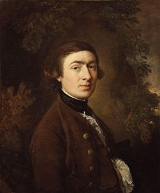
Thomas Gainsborough was an
EnglishThe English are a nation and ethnic group native to England, who speak English. The English identity is of early mediaeval origin, when they were known in Old English as the Anglecynn. England is now a country of the United Kingdom, and the majority of English people in England are British Citizens...
portrait and landscape
painterPainting is the practice of applying paint, pigment, color or other medium to a surface . The application of the medium is commonly applied to the base with a brush but other objects can be used. In art, the term painting describes both the act and the result of the action. However, painting is...
.
Suffolk
Thomas Gainsborough was born in
SudburySudbury is a small, ancient market town in the county of Suffolk, England, on the River Stour, from Colchester and from London.-Early history:...
,
SuffolkSuffolk is a non-metropolitan county of historic origin in East Anglia, England. It has borders with Norfolk to the north, Cambridgeshire to the west and Essex to the south. The North Sea lies to the east...
. He was the youngest son of John Gainsborough, a weaver and maker of woolen goods. At the age of thirteen he impressed his father with his penciling skills so that he let him go to London to study art in 1740. In London he first trained under engraver Hubert Gravelot but eventually became associated with
William HogarthWilliam Hogarth was an English painter, printmaker, pictorial satirist, social critic and editorial cartoonist who has been credited with pioneering western sequential art. His work ranged from realistic portraiture to comic strip-like series of pictures called "modern moral subjects"...
and his school. One of his mentors was
Francis HaymanFrancis Hayman was an English painter and illustrator who became one of the founding members of the Royal Academy in 1768 and later its first librarian....
. In those years he contributed to the decoration of what is now the
Thomas Coram Foundation for ChildrenThe Thomas Coram Foundation for Children is a large children's charity in London which uses the working name Coram ....
and the supper boxes at
Vauxhall GardensVauxhall Gardens was a pleasure garden, one of the leading venues for public entertainment in London, England from the mid 17th century to the mid 19th century. Originally known as New Spring Gardens, the site was believed to have opened before the Restoration of 1660 with the first mention being...
.
In 1746, Gainsborough married Margaret Burr, an illegitimate daughter of the
Duke of BeaufortHenry Somerset-Scudamore, 3rd Duke of Beaufort was born Henry Somerset, the elder son of Henry Somerset, 2nd Duke of Beaufort and his second wife, Rachel Noel. As his father's eldest son and heir to his father's title he was known as Marquess of Worcester, a courtesy title...
, who settled a £200 annuity on the couple. The artist's work, then mainly composed of landscape paintings, was not selling very well. He returned to Sudbury in 1748–1749 and concentrated on the painting of
portraitthumb|250px|right|Portrait of [[Thomas Jefferson]] by [[Rembrandt Peale]], 1805. [[New-York Historical Society]].A portrait is a painting, photograph, sculpture, or other artistic representation of a person, in which the face and its expression is predominant. The intent is to display the likeness,...
s.
In 1752, he and his family, now including two daughters, moved to
IpswichIpswich is a large town and a non-metropolitan district. It is the county town of Suffolk, England. Ipswich is located on the estuary of the River Orwell...
. Commissions for personal portraits increased, but his clientele included mainly local merchants and squires. He had to borrow against his wife's annuity.
Bath
In 1759, Gainsborough and his family moved to Bath. There, he studied portraits by van Dyck and was eventually able to attract a better-paying high society clientele. In 1761, he began to send work to the Society of Arts exhibition in London (now the
Royal Society of ArtsThe Royal Society for the encouragement of Arts, Manufacturers and Commerce is a British multi-disciplinary institution, based in London. The name Royal Society of Arts is frequently used for brevity...
, of which he was one of the earliest members); and from 1769 on, he submitted works to the
Royal AcademyThe Royal Academy of Arts is an art institution based in Burlington House on Piccadilly, London. The Royal Academy of Arts has a unique position in being an independent, privately funded institution led by eminent artists and architects whose purpose is to promote the creation, enjoyment and...
's annual exhibitions. He selected portraits of well-known or notorious clients in order to attract attention. These exhibitions helped him acquire a national reputation, and he was invited to become one of the founding members of the Royal Academy in 1769. His relationship with the academy, however, was not an easy one and he stopped exhibiting his paintings there in 1773.
London
In 1774, Gainsborough and his family moved to London to live in
Schomberg HouseSchomberg House is a mansion on the south side of Pall Mall in central London which has a colourful history. Only the street facade survives today. It was built for Meinhardt Schomberg, 3rd Duke of Schomberg, a Huguenot general in the service of the British crown...
,
Pall MallPall Mall is a street in the City of Westminster, London, and parallel to The Mall, from St. James's Street across Waterloo Place to the Haymarket; while Pall Mall East continues into Trafalgar Square. The street is a major thoroughfare in the St James's area of London, and a section of the...
. In 1777, he again began to exhibit his paintings at the Royal Academy, including portraits of contemporary celebrities, such as the Duke and Duchess of Cumberland. Exhibitions of his work continued for the next six years.
In 1780, he painted the portraits of King
George IIIGeorge III was King of Great Britain and King of Ireland from 25 October 1760 until the union of these two countries on 1 January 1801, after which he was King of the United Kingdom of Great Britain and Ireland until his death...
and his queen and afterwards received many royal commissions. This gave him some influence with the Academy and allowed him to dictate the manner in which he wished his work to be exhibited. However, in 1783, he removed his paintings from the forthcoming exhibition and transferred them to Schomberg House.
In 1784, royal painter Allan Ramsay died and the King was obliged to give the job to Gainsborough's rival and Academy president,
Joshua ReynoldsSir Joshua Reynolds RA FRS FRSA was an influential 18th-century English painter, specialising in portraits and promoting the "Grand Style" in painting which depended on idealization of the imperfect. He was one of the founders and first President of the Royal Academy...
. Gainsborough remained the Royal Family's favorite painter, however. At his own express wish, he was buried at St. Anne's Church,
KewKew is a place in the London Borough of Richmond upon Thames in South West London. Kew is best known for being the location of the Royal Botanic Gardens, now a World Heritage Site, which includes Kew Palace...
, where the Family regularly worshipped.
In his later years, Gainsborough often painted relatively simple, ordinary landscapes. With
Richard WilsonRichard Wilson was a Welsh landscape painter, and one of the founder members of the Royal Academy in 1768. Wilson has been described as '...the most distinguished painter Wales has ever produced and the first to appreciate the aesthetic possibilities of his country.' He is considered to be the...
, he was one of the originators of the eighteenth-century British landscape school; though simultaneously, in conjunction with Sir Joshua Reynolds, he was the dominant British portraitist of the second half of the 18th century.
He died of
cancerCancer , known medically as a malignant neoplasm, is a large group of different diseases, all involving unregulated cell growth. In cancer, cells divide and grow uncontrollably, forming malignant tumors, and invade nearby parts of the body. The cancer may also spread to more distant parts of the...
on 2 August 1788 at the age of 61 and is interred at
St. Anne's Church, KewSt Anne's Church, Kew is the parish church of Kew, London, situated on Kew Green.-History:Originally built in 1714, on land given by Queen Anne as a church within the parish of Kingston, St. Anne's Church has been extended several times since, as the settlement of Kew grew with royal patronage. In...
, Surrey (located on Kew Green). He is buried next to Francis Bauer, the famous botanical illustrator. As of 2011, an appeal is underway to pay the costs of restoration of his tomb.
Technique
Gainsborough was noted for the speed with which he applied his paint, and he worked more from his observations of nature (and of human nature) than from any application of formal academic rules. The poetic sensibility of his paintings caused
ConstableJohn Constable was an English Romantic painter. Born in Suffolk, he is known principally for his landscape paintings of Dedham Vale, the area surrounding his home—now known as "Constable Country"—which he invested with an intensity of affection...
to say, "On looking at them, we find tears in our eyes and know not what brings them." He himself said, "I'm sick of portraits, and wish very much to take my viol-da-gam and walk off to some sweet village, where I can paint landskips
(sic) and enjoy the fag end of life in quietness and ease."
This likeness of landscapes is shown in the way he merged the figures of the portraits with the scenes behind them. His later work was characterized by a light palette and easy, economical strokes.
His most famous works, such as
Portrait of Mrs. Graham;
Mary and Margaret: The Painter's Daughters;
William Hallett and His Wife Elizabeth, nee Stephen, known as
The Morning Walk; and
Cottage Girl with Dog and Pitcher, display the unique individuality of his subjects.
Gainsborough's only known assistant was his nephew,
Gainsborough DupontGainsborough Dupont, the nephew and pupil of Thomas Gainsborough, R.A., was born in 1754. He painted portraits and landscapes in imitation of the style of his uncle, and also landscapes with architectural ruins, in which he imitated Nicolas Poussin. His principal work is a large picture containing...
. In the last year of his life he collaborated with
John HoppnerJohn Hoppner was an English portrait painter, .-Early life:Hoppner was born in Whitechapel, London, the son of German parents - his mother was one of the German attendants at the royal palace. King George's fatherly interest and patronage of the young boy gave rise to rumours, quite unfounded,...
in painting a full length portrait of Charlotte, Countess Talbot.
In fiction and music
- Kitty
Kitty is a 1945 film, a fictional costume drama set in London during the 1780s, directed by Mitchell Leisen, based on the novel of the same name by Rosamond Marshall , with a screenplay by Karl Tunberg. It stars Paulette Goddard, Ray Milland, Constance Collier, Patric Knowles, Reginald Owen, and...
(1945) is a notable fictional film about Gainsborough, portrayed by Cecil KellawayCecil Lauriston Kellaway was a South African-born character actor.Cecil Kellaway spent many years as an actor, author, and director in the Australian film industry until he tried his luck in Hollywood in the 1930s. Finding he could get only gangster bit parts, he got discouraged and returned to...
.
See also
- English school of painting
- British art
British art could refer to:* Art of the United Kingdom - post 1707* English art* Irish art* Scottish art* Welsh art...
- List of British painters
- Humphrey Gainsborough
Humphrey Gainsborough was a non-conformist minister, engineer and inventor.Humphrey Gainsborough was pastor to the Independent Church in Henley-on-Thames, England. He was the brother of the artist Thomas Gainsborough. He invented the drill plough , winning a prize of £60 from the Royal Society for...
- Holywells Park, Ipswich
Holywells Park is a public park in Ipswich, England situated between Nacton Road and Cliff Lane, near to Ipswich dock. Previously private land, it was opened to the public in 1936.The park contains a Grade II listed orangery, built in the late 19th century...
- Gainsborough paintings
- Western painting
The history of Western painting represents a continuous, though disrupted, tradition from antiquity. Until the mid-19th century it was primarily concerned with representational and Classical modes of production, after which time more modern, abstract and conceptual forms gained favor.Developments...
Further reading
- Thomas Gainsborough’s 'Lost' Portrait of Auguste Vestri, Martin Postle
Dr. Martin Postle serves as the assistant director of the Paul Mellon Centre for Studies in British Art, London, United Kingdom, and is an expert on Sir Joshua Reynolds.-Career:...
- The Letters of Thomas Gainsborough (Paul Mellon Centre for Studies), John Hayes
External links