

Rise of nationalism in Europe

Encyclopedia
Nationalism
has been an important factor in the development of Europe
. In the 19th century, a wave of romantic nationalism
swept the continent of Europe transforming the countries of the continent. Some new countries, such as Germany and Italy were formed by uniting smaller states with a common "national identity". Others, such as Romania
, Greece, Poland and Bulgaria, were formed by winning their independence.
 The French Revolution
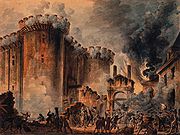
paved the way for the modern nation-state
. Across Europe radical intellectuals questioned the old monarchial
order and encouraged the development of a popular nationalism committed to re-drawing the political map of the continent
. By 1814 the days of multi-national empire
s were numbered. The French Revolution
, by destroying the traditional structures of power in France
and territories conquered by Napoleon, was the instrument for the political transformation of Europe. Revolutionary armies carried the slogan of "liberty, equality and brotherhood" and ideas of liberalism
and national self-determinism. National awakening also grew out of an intellectual
reaction to the Enlightenment
that emphasized national identity
and developed a romantic view of cultural self-expression through nationhood. The key exponent of the modern idea of the nation-state
was the German G. W. F. Hegel
. He argued that a sense of nationality
was the cement that held modern societies
together in an age when dynastic and religious allegiance was in decline. In 1815, at the end of the Napoleonic wars
, the major powers of Europe tried to restore the old dynastic system as far as possible, ignoring the principle of nationality
in favour of "legitimism", the assertion of traditional claims to royal authority. With most of Europe's peoples still loyal to their local province
or city
, nationalism was confined to small groups of intellectuals and political radicals. Furthermore, political repression
, symbolized by the Carlsbad Decrees
published in Austria
in 1819, pushed nationalist agitation underground.
.
1815 - The Congress of Vienna
.
1821-29 - Greek declaration of national independence and revolution against the Ottoman Empire
.
1830-31 - Belgian Revolution
1830-31 - Revolution in Poland and Lithuania
1846 - Uprising in Greater Poland
1848 - Nationalist revolts in Hungary
, Italy
and Germany
(including Polish revolt in Greater Poland).
1859-61 - Italy unified
.
1863 - Polish national revolt
.
1866-71 - Germany unified
.
1867 - Hungary
granted autonomy.
1878 - Congress of Berlin
: Serbia
, Romania
and Montenegro
granted independence, after they won the war against The Ottoman Empire.
1908 - Bulgaria
becomes independent.
rule began to develop. In Ireland
, Italy
, Belgium
, Greece
, Poland
, Hungary
and Norway
local hostility to alien dynastic authority
started to take the form of nationalist agitation. Nationalism
came to be seen as the most effective way to create the symbols of resistance and to unite in a common cause. First national revolution was in Serbian
(1804–1817) which created the first nation-state
in Central Europe
. Success came in Greece
where an eight-year war
(1821–1829) against Ottoman
rule led to an independent Greek state
; in 1831 Belgium
obtained independence
from the Netherlands
. Over the next two decades nationalism
developed a more powerful voice, spurred by nationalist writers championing the cause of nationalist self-determination. In 1848, revolution
s broke out across Europe
, sparked by a severe famine
and economic crisis and mounting popular demand for political
change. In Italy
Giuseppe Mazzini
used the opportunity to encourage a war for national unity
. In 1861 he wrote:
, Lajos Kossuth
led a national revolt against Austrian
rule; in Transylvania
, Avram Iancu
(also known as Craisorul Muntilor, which means The Prince of the Mountains) led the Romanian
revolt against the Hungarian rule; in the German Confederation
a National Assembly was elected at Frankfurt
and debated the creation of a German nation
. None of the nationalist revolts in 1848 were successful, any more than the two attempts to win Polish independence from Russia
n rule in 1831 and 1846 had been. Conservative forces proved too strong, while the majority of the populations little understood the meaning of national struggle
. But the 1848 crisis had given nationalism
its first full public airing, and in the thirty years that followed no fewer than seven new national states were created in Europe
. This was partly the result of the recognition by conservative forces that the old order could not continue in its existing form. Conservative reformers such as Cavour
and Bismarck
made common cause with liberal
political modernizers to create a consensus for the creation of conservative nation-states in Italy
and Germany
. In the Habsburg empire
a compromise was reached with Hungarian nationalists in 1867 granting them a virtually independent state
. In the Balkans
the Serbian
example had inspired other national awakenings. Native history
and culture
were rediscovered and appropriated for the national
struggle. Following a conflict between Russia
and Turkey
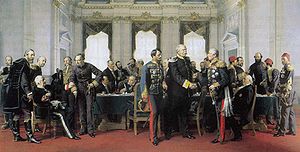
, the Great Powers met at Berlin
in 1878 and granted independence to Romania
, Serbia
and Montenegro
and a limited autonomy to Bulgaria
.
 The invention of a symbolic national identity
became the concern of racial, ethnic or linguistic
groups throughout Europe
as they struggled to come to terms with the rise of mass politics
, the decline of the traditional social elites
, popular discrimination
and xenophobia
. Within the Habsburg empire the different peoples developed a more mass-based, violent and exclusive form of nationalism
. This developed even among the Germans and Magyars, who actually benefited from the power-structure of the empire
. On the Europe
an periphery, especially in Ireland
and Norway
, campaigns for national independence
became more strident. In 1905 Norway
won independence from Sweden
, but attempts to grant Ireland
the kind of autonomy
enjoyed by Hungary
foundered on the national divisions on the island
between the Catholic
and Protestant populations. The Polish attempts to win independence from Russia
had previously proved to be unsuccessful, with Poland
being the only country in Europe whose autonomy was gradually limited rather than expanded throughout the 19th century, as a punishment for the failed uprisings; in 1831 Poland lost its status as a formally independent state and was merged into Russia as a real union
country and in 1867 she became nothing more than just another Russian province. Faced with internal and external resistance to assimilation
, as well as increased xenophobic anti-Semitism
, radical demands began to develop among the stateless Jewish population of eastern
and central Europe
for their own national home and refuge. In 1897, inspired by the Hungarian-born Jewish nationalist Theodor Herzl
, the First Zionist Congress
was held in Basle
, and declared their national 'home' should be in Palestine
. By the end of the period, the ideals of Europe
an nationalism
had been exported worldwide and were now beginning to develop, and both compete and threaten the empires ruled by colonial
European nation-states.
Nationalism
Nationalism is a political ideology that involves a strong identification of a group of individuals with a political entity defined in national terms, i.e. a nation. In the 'modernist' image of the nation, it is nationalism that creates national identity. There are various definitions for what...
has been an important factor in the development of Europe
Europe
Europe is, by convention, one of the world's seven continents. Comprising the westernmost peninsula of Eurasia, Europe is generally 'divided' from Asia to its east by the watershed divides of the Ural and Caucasus Mountains, the Ural River, the Caspian and Black Seas, and the waterways connecting...
. In the 19th century, a wave of romantic nationalism
Romantic nationalism
Romantic nationalism is the form of nationalism in which the state derives its political legitimacy as an organic consequence of the unity of those it governs...
swept the continent of Europe transforming the countries of the continent. Some new countries, such as Germany and Italy were formed by uniting smaller states with a common "national identity". Others, such as Romania
Romania
Romania is a country located at the crossroads of Central and Southeastern Europe, on the Lower Danube, within and outside the Carpathian arch, bordering on the Black Sea...
, Greece, Poland and Bulgaria, were formed by winning their independence.
French Revolution
The French Revolution , sometimes distinguished as the 'Great French Revolution' , was a period of radical social and political upheaval in France and Europe. The absolute monarchy that had ruled France for centuries collapsed in three years...
paved the way for the modern nation-state
Nation-state
The nation state is a state that self-identifies as deriving its political legitimacy from serving as a sovereign entity for a nation as a sovereign territorial unit. The state is a political and geopolitical entity; the nation is a cultural and/or ethnic entity...
. Across Europe radical intellectuals questioned the old monarchial
Monarchy
A monarchy is a form of government in which the office of head of state is usually held until death or abdication and is often hereditary and includes a royal house. In some cases, the monarch is elected...
order and encouraged the development of a popular nationalism committed to re-drawing the political map of the continent
Europe
Europe is, by convention, one of the world's seven continents. Comprising the westernmost peninsula of Eurasia, Europe is generally 'divided' from Asia to its east by the watershed divides of the Ural and Caucasus Mountains, the Ural River, the Caspian and Black Seas, and the waterways connecting...
. By 1814 the days of multi-national empire
Empire
The term empire derives from the Latin imperium . Politically, an empire is a geographically extensive group of states and peoples united and ruled either by a monarch or an oligarchy....
s were numbered. The French Revolution
French Revolution
The French Revolution , sometimes distinguished as the 'Great French Revolution' , was a period of radical social and political upheaval in France and Europe. The absolute monarchy that had ruled France for centuries collapsed in three years...
, by destroying the traditional structures of power in France
France
The French Republic , The French Republic , The French Republic , (commonly known as France , is a unitary semi-presidential republic in Western Europe with several overseas territories and islands located on other continents and in the Indian, Pacific, and Atlantic oceans. Metropolitan France...
and territories conquered by Napoleon, was the instrument for the political transformation of Europe. Revolutionary armies carried the slogan of "liberty, equality and brotherhood" and ideas of liberalism
Liberalism
Liberalism is the belief in the importance of liberty and equal rights. Liberals espouse a wide array of views depending on their understanding of these principles, but generally, liberals support ideas such as constitutionalism, liberal democracy, free and fair elections, human rights,...
and national self-determinism. National awakening also grew out of an intellectual
Intellectual
An intellectual is a person who uses intelligence and critical or analytical reasoning in either a professional or a personal capacity.- Terminology and endeavours :"Intellectual" can denote four types of persons:...
reaction to the Enlightenment
Age of Enlightenment
The Age of Enlightenment was an elite cultural movement of intellectuals in 18th century Europe that sought to mobilize the power of reason in order to reform society and advance knowledge. It promoted intellectual interchange and opposed intolerance and abuses in church and state...
that emphasized national identity
National identity
National identity is the person's identity and sense of belonging to one state or to one nation, a feeling one shares with a group of people, regardless of one's citizenship status....
and developed a romantic view of cultural self-expression through nationhood. The key exponent of the modern idea of the nation-state
Nation-state
The nation state is a state that self-identifies as deriving its political legitimacy from serving as a sovereign entity for a nation as a sovereign territorial unit. The state is a political and geopolitical entity; the nation is a cultural and/or ethnic entity...
was the German G. W. F. Hegel
Georg Wilhelm Friedrich Hegel
Georg Wilhelm Friedrich Hegel was a German philosopher, one of the creators of German Idealism. His historicist and idealist account of reality as a whole revolutionized European philosophy and was an important precursor to Continental philosophy and Marxism.Hegel developed a comprehensive...
. He argued that a sense of nationality
Nationality
Nationality is membership of a nation or sovereign state, usually determined by their citizenship, but sometimes by ethnicity or place of residence, or based on their sense of national identity....
was the cement that held modern societies
Society
A society, or a human society, is a group of people related to each other through persistent relations, or a large social grouping sharing the same geographical or virtual territory, subject to the same political authority and dominant cultural expectations...
together in an age when dynastic and religious allegiance was in decline. In 1815, at the end of the Napoleonic wars
Napoleonic Wars
The Napoleonic Wars were a series of wars declared against Napoleon's French Empire by opposing coalitions that ran from 1803 to 1815. As a continuation of the wars sparked by the French Revolution of 1789, they revolutionised European armies and played out on an unprecedented scale, mainly due to...
, the major powers of Europe tried to restore the old dynastic system as far as possible, ignoring the principle of nationality
Nationality
Nationality is membership of a nation or sovereign state, usually determined by their citizenship, but sometimes by ethnicity or place of residence, or based on their sense of national identity....
in favour of "legitimism", the assertion of traditional claims to royal authority. With most of Europe's peoples still loyal to their local province
Province
A province is a territorial unit, almost always an administrative division, within a country or state.-Etymology:The English word "province" is attested since about 1330 and derives from the 13th-century Old French "province," which itself comes from the Latin word "provincia," which referred to...
or city
City
A city is a relatively large and permanent settlement. Although there is no agreement on how a city is distinguished from a town within general English language meanings, many cities have a particular administrative, legal, or historical status based on local law.For example, in the U.S...
, nationalism was confined to small groups of intellectuals and political radicals. Furthermore, political repression
Political repression
Political repression is the persecution of an individual or group for political reasons, particularly for the purpose of restricting or preventing their ability to take political life of society....
, symbolized by the Carlsbad Decrees
Carlsbad Decrees
The Carlsbad Decrees were a set of reactionary restrictions introduced in the states of the German Confederation by resolution of the Bundesversammlung on 20 September 1819 after a conference held in the spa town of Carlsbad, Bohemia...
published in Austria
Austria
Austria , officially the Republic of Austria , is a landlocked country of roughly 8.4 million people in Central Europe. It is bordered by the Czech Republic and Germany to the north, Slovakia and Hungary to the east, Slovenia and Italy to the south, and Switzerland and Liechtenstein to the...
in 1819, pushed nationalist agitation underground.
Timeline
1804 - Serbian revolutionSerbian revolution
Serbian revolution or Revolutionary Serbia refers to the national and social revolution of the Serbian people taking place between 1804 and 1835, during which this territory evolved from an Ottoman province into a constitutional monarchy and a modern nation-state...
.
1815 - The Congress of Vienna
Congress of Vienna
The Congress of Vienna was a conference of ambassadors of European states chaired by Klemens Wenzel von Metternich, and held in Vienna from September, 1814 to June, 1815. The objective of the Congress was to settle the many issues arising from the French Revolutionary Wars, the Napoleonic Wars,...
.
1821-29 - Greek declaration of national independence and revolution against the Ottoman Empire
Ottoman Empire
The Ottoman EmpireIt was usually referred to as the "Ottoman Empire", the "Turkish Empire", the "Ottoman Caliphate" or more commonly "Turkey" by its contemporaries...
.
1830-31 - Belgian Revolution
Belgian Revolution
The Belgian Revolution was the conflict which led to the secession of the Southern provinces from the United Kingdom of the Netherlands and established an independent Kingdom of Belgium....
1830-31 - Revolution in Poland and Lithuania
November Uprising
The November Uprising , Polish–Russian War 1830–31 also known as the Cadet Revolution, was an armed rebellion in the heartland of partitioned Poland against the Russian Empire. The uprising began on 29 November 1830 in Warsaw when the young Polish officers from the local Army of the Congress...
1846 - Uprising in Greater Poland
1848 - Nationalist revolts in Hungary
Hungary
Hungary , officially the Republic of Hungary , is a landlocked country in Central Europe. It is situated in the Carpathian Basin and is bordered by Slovakia to the north, Ukraine and Romania to the east, Serbia and Croatia to the south, Slovenia to the southwest and Austria to the west. The...
, Italy
Italy
Italy , officially the Italian Republic languages]] under the European Charter for Regional or Minority Languages. In each of these, Italy's official name is as follows:;;;;;;;;), is a unitary parliamentary republic in South-Central Europe. To the north it borders France, Switzerland, Austria and...
and Germany
Germany
Germany , officially the Federal Republic of Germany , is a federal parliamentary republic in Europe. The country consists of 16 states while the capital and largest city is Berlin. Germany covers an area of 357,021 km2 and has a largely temperate seasonal climate...
(including Polish revolt in Greater Poland).
1859-61 - Italy unified
Italian unification
Italian unification was the political and social movement that agglomerated different states of the Italian peninsula into the single state of Italy in the 19th century...
.
1863 - Polish national revolt
January Uprising
The January Uprising was an uprising in the former Polish-Lithuanian Commonwealth against the Russian Empire...
.
1866-71 - Germany unified
Unification of Germany
The formal unification of Germany into a politically and administratively integrated nation state officially occurred on 18 January 1871 at the Versailles Palace's Hall of Mirrors in France. Princes of the German states gathered there to proclaim Wilhelm of Prussia as Emperor Wilhelm of the German...
.
1867 - Hungary
Hungary
Hungary , officially the Republic of Hungary , is a landlocked country in Central Europe. It is situated in the Carpathian Basin and is bordered by Slovakia to the north, Ukraine and Romania to the east, Serbia and Croatia to the south, Slovenia to the southwest and Austria to the west. The...
granted autonomy.
1878 - Congress of Berlin
Congress of Berlin
The Congress of Berlin was a meeting of the European Great Powers' and the Ottoman Empire's leading statesmen in Berlin in 1878. In the wake of the Russo-Turkish War of 1877–78, the meeting's aim was to reorganize the countries of the Balkans...
: Serbia
Serbia
Serbia , officially the Republic of Serbia , is a landlocked country located at the crossroads of Central and Southeast Europe, covering the southern part of the Carpathian basin and the central part of the Balkans...
, Romania
Romania
Romania is a country located at the crossroads of Central and Southeastern Europe, on the Lower Danube, within and outside the Carpathian arch, bordering on the Black Sea...
and Montenegro
Montenegro
Montenegro Montenegrin: Crna Gora Црна Гора , meaning "Black Mountain") is a country located in Southeastern Europe. It has a coast on the Adriatic Sea to the south-west and is bordered by Croatia to the west, Bosnia and Herzegovina to the northwest, Serbia to the northeast and Albania to the...
granted independence, after they won the war against The Ottoman Empire.
1908 - Bulgaria
Bulgaria
Bulgaria , officially the Republic of Bulgaria , is a parliamentary democracy within a unitary constitutional republic in Southeast Europe. The country borders Romania to the north, Serbia and Macedonia to the west, Greece and Turkey to the south, as well as the Black Sea to the east...
becomes independent.
The struggle for independence
A strong resentment of what came to be regarded as foreignColonialism
Colonialism is the establishment, maintenance, acquisition and expansion of colonies in one territory by people from another territory. It is a process whereby the metropole claims sovereignty over the colony and the social structure, government, and economics of the colony are changed by...
rule began to develop. In Ireland
Ireland
Ireland is an island to the northwest of continental Europe. It is the third-largest island in Europe and the twentieth-largest island on Earth...
, Italy
Italy
Italy , officially the Italian Republic languages]] under the European Charter for Regional or Minority Languages. In each of these, Italy's official name is as follows:;;;;;;;;), is a unitary parliamentary republic in South-Central Europe. To the north it borders France, Switzerland, Austria and...
, Belgium
Belgium
Belgium , officially the Kingdom of Belgium, is a federal state in Western Europe. It is a founding member of the European Union and hosts the EU's headquarters, and those of several other major international organisations such as NATO.Belgium is also a member of, or affiliated to, many...
, Greece
Greece
Greece , officially the Hellenic Republic , and historically Hellas or the Republic of Greece in English, is a country in southeastern Europe....
, Poland
Poland
Poland , officially the Republic of Poland , is a country in Central Europe bordered by Germany to the west; the Czech Republic and Slovakia to the south; Ukraine, Belarus and Lithuania to the east; and the Baltic Sea and Kaliningrad Oblast, a Russian exclave, to the north...
, Hungary
Hungary
Hungary , officially the Republic of Hungary , is a landlocked country in Central Europe. It is situated in the Carpathian Basin and is bordered by Slovakia to the north, Ukraine and Romania to the east, Serbia and Croatia to the south, Slovenia to the southwest and Austria to the west. The...
and Norway
Norway
Norway , officially the Kingdom of Norway, is a Nordic unitary constitutional monarchy whose territory comprises the western portion of the Scandinavian Peninsula, Jan Mayen, and the Arctic archipelago of Svalbard and Bouvet Island. Norway has a total area of and a population of about 4.9 million...
local hostility to alien dynastic authority
Authority
The word Authority is derived mainly from the Latin word auctoritas, meaning invention, advice, opinion, influence, or command. In English, the word 'authority' can be used to mean power given by the state or by academic knowledge of an area .-Authority in Philosophy:In...
started to take the form of nationalist agitation. Nationalism
Nationalism
Nationalism is a political ideology that involves a strong identification of a group of individuals with a political entity defined in national terms, i.e. a nation. In the 'modernist' image of the nation, it is nationalism that creates national identity. There are various definitions for what...
came to be seen as the most effective way to create the symbols of resistance and to unite in a common cause. First national revolution was in Serbian
Serbian revolution
Serbian revolution or Revolutionary Serbia refers to the national and social revolution of the Serbian people taking place between 1804 and 1835, during which this territory evolved from an Ottoman province into a constitutional monarchy and a modern nation-state...
(1804–1817) which created the first nation-state
Nation-state
The nation state is a state that self-identifies as deriving its political legitimacy from serving as a sovereign entity for a nation as a sovereign territorial unit. The state is a political and geopolitical entity; the nation is a cultural and/or ethnic entity...
in Central Europe
Central Europe
Central Europe or alternatively Middle Europe is a region of the European continent lying between the variously defined areas of Eastern and Western Europe...
. Success came in Greece
Greece
Greece , officially the Hellenic Republic , and historically Hellas or the Republic of Greece in English, is a country in southeastern Europe....
where an eight-year war
Greek War of Independence
The Greek War of Independence, also known as the Greek Revolution was a successful war of independence waged by the Greek revolutionaries between...
(1821–1829) against Ottoman
Ottoman Empire
The Ottoman EmpireIt was usually referred to as the "Ottoman Empire", the "Turkish Empire", the "Ottoman Caliphate" or more commonly "Turkey" by its contemporaries...
rule led to an independent Greek state
Greece
Greece , officially the Hellenic Republic , and historically Hellas or the Republic of Greece in English, is a country in southeastern Europe....
; in 1831 Belgium
Belgium
Belgium , officially the Kingdom of Belgium, is a federal state in Western Europe. It is a founding member of the European Union and hosts the EU's headquarters, and those of several other major international organisations such as NATO.Belgium is also a member of, or affiliated to, many...
obtained independence
Belgian Revolution
The Belgian Revolution was the conflict which led to the secession of the Southern provinces from the United Kingdom of the Netherlands and established an independent Kingdom of Belgium....
from the Netherlands
Netherlands
The Netherlands is a constituent country of the Kingdom of the Netherlands, located mainly in North-West Europe and with several islands in the Caribbean. Mainland Netherlands borders the North Sea to the north and west, Belgium to the south, and Germany to the east, and shares maritime borders...
. Over the next two decades nationalism
Nationalism
Nationalism is a political ideology that involves a strong identification of a group of individuals with a political entity defined in national terms, i.e. a nation. In the 'modernist' image of the nation, it is nationalism that creates national identity. There are various definitions for what...
developed a more powerful voice, spurred by nationalist writers championing the cause of nationalist self-determination. In 1848, revolution
Revolution
A revolution is a fundamental change in power or organizational structures that takes place in a relatively short period of time.Aristotle described two types of political revolution:...
s broke out across Europe
Europe
Europe is, by convention, one of the world's seven continents. Comprising the westernmost peninsula of Eurasia, Europe is generally 'divided' from Asia to its east by the watershed divides of the Ural and Caucasus Mountains, the Ural River, the Caspian and Black Seas, and the waterways connecting...
, sparked by a severe famine
Famine
A famine is a widespread scarcity of food, caused by several factors including crop failure, overpopulation, or government policies. This phenomenon is usually accompanied or followed by regional malnutrition, starvation, epidemic, and increased mortality. Every continent in the world has...
and economic crisis and mounting popular demand for political
Politics
Politics is a process by which groups of people make collective decisions. The term is generally applied to the art or science of running governmental or state affairs, including behavior within civil governments, but also applies to institutions, fields, and special interest groups such as the...
change. In Italy
Italy
Italy , officially the Italian Republic languages]] under the European Charter for Regional or Minority Languages. In each of these, Italy's official name is as follows:;;;;;;;;), is a unitary parliamentary republic in South-Central Europe. To the north it borders France, Switzerland, Austria and...
Giuseppe Mazzini
Giuseppe Mazzini
Giuseppe Mazzini , nicknamed Soul of Italy, was an Italian politician, journalist and activist for the unification of Italy. His efforts helped bring about the independent and unified Italy in place of the several separate states, many dominated by foreign powers, that existed until the 19th century...
used the opportunity to encourage a war for national unity
Italian unification
Italian unification was the political and social movement that agglomerated different states of the Italian peninsula into the single state of Italy in the 19th century...
. In 1861 he wrote:
In Hungary
"No people ever die, nor stop
short upon their path, before they have achieved the ultimate aim of their existence, before having completed and fulfilled their mission. A people destined to achieve great things for the welfare of humanity must on day or other be constituted a nation".
Hungary
Hungary , officially the Republic of Hungary , is a landlocked country in Central Europe. It is situated in the Carpathian Basin and is bordered by Slovakia to the north, Ukraine and Romania to the east, Serbia and Croatia to the south, Slovenia to the southwest and Austria to the west. The...
, Lajos Kossuth
Lajos Kossuth
Lajos Kossuth de Udvard et Kossuthfalva was a Hungarian lawyer, journalist, politician and Regent-President of Hungary in 1849. He was widely honored during his lifetime, including in the United Kingdom and the United States, as a freedom fighter and bellwether of democracy in Europe.-Family:Lajos...
led a national revolt against Austrian
Austrian Empire
The Austrian Empire was a modern era successor empire, which was centered on what is today's Austria and which officially lasted from 1804 to 1867. It was followed by the Empire of Austria-Hungary, whose proclamation was a diplomatic move that elevated Hungary's status within the Austrian Empire...
rule; in Transylvania
Transylvania
Transylvania is a historical region in the central part of Romania. Bounded on the east and south by the Carpathian mountain range, historical Transylvania extended in the west to the Apuseni Mountains; however, the term sometimes encompasses not only Transylvania proper, but also the historical...
, Avram Iancu
Avram Iancu
Avram Iancu was a Transylvanian Romanian lawyer who played an important role in the local chapter of the Austrian Empire Revolutions of 1848–1849. He was especially active in the Ţara Moţilor region and the Apuseni Mountains...
(also known as Craisorul Muntilor, which means The Prince of the Mountains) led the Romanian
Romanians
The Romanians are an ethnic group native to Romania, who speak Romanian; they are the majority inhabitants of Romania....
revolt against the Hungarian rule; in the German Confederation
German Confederation
The German Confederation was the loose association of Central European states created by the Congress of Vienna in 1815 to coordinate the economies of separate German-speaking countries. It acted as a buffer between the powerful states of Austria and Prussia...
a National Assembly was elected at Frankfurt
Frankfurt
Frankfurt am Main , commonly known simply as Frankfurt, is the largest city in the German state of Hesse and the fifth-largest city in Germany, with a 2010 population of 688,249. The urban area had an estimated population of 2,300,000 in 2010...
and debated the creation of a German nation
Germany
Germany , officially the Federal Republic of Germany , is a federal parliamentary republic in Europe. The country consists of 16 states while the capital and largest city is Berlin. Germany covers an area of 357,021 km2 and has a largely temperate seasonal climate...
. None of the nationalist revolts in 1848 were successful, any more than the two attempts to win Polish independence from Russia
Russia
Russia or , officially known as both Russia and the Russian Federation , is a country in northern Eurasia. It is a federal semi-presidential republic, comprising 83 federal subjects...
n rule in 1831 and 1846 had been. Conservative forces proved too strong, while the majority of the populations little understood the meaning of national struggle
Nationalism
Nationalism is a political ideology that involves a strong identification of a group of individuals with a political entity defined in national terms, i.e. a nation. In the 'modernist' image of the nation, it is nationalism that creates national identity. There are various definitions for what...
. But the 1848 crisis had given nationalism
Nationalism
Nationalism is a political ideology that involves a strong identification of a group of individuals with a political entity defined in national terms, i.e. a nation. In the 'modernist' image of the nation, it is nationalism that creates national identity. There are various definitions for what...
its first full public airing, and in the thirty years that followed no fewer than seven new national states were created in Europe
Europe
Europe is, by convention, one of the world's seven continents. Comprising the westernmost peninsula of Eurasia, Europe is generally 'divided' from Asia to its east by the watershed divides of the Ural and Caucasus Mountains, the Ural River, the Caspian and Black Seas, and the waterways connecting...
. This was partly the result of the recognition by conservative forces that the old order could not continue in its existing form. Conservative reformers such as Cavour
Cavour
-Places:Italy* Cavour, Piedmont in Italy* Cavour in ItalyUnited States* Cavour, South Dakota, United States* Cavour, Wisconsin, United States-Other:* Italian aircraft carrier Cavour* the Italian dreadnought Conte di Cavour...
and Bismarck
Otto von Bismarck
Otto Eduard Leopold, Prince of Bismarck, Duke of Lauenburg , simply known as Otto von Bismarck, was a Prussian-German statesman whose actions unified Germany, made it a major player in world affairs, and created a balance of power that kept Europe at peace after 1871.As Minister President of...
made common cause with liberal
Liberalism
Liberalism is the belief in the importance of liberty and equal rights. Liberals espouse a wide array of views depending on their understanding of these principles, but generally, liberals support ideas such as constitutionalism, liberal democracy, free and fair elections, human rights,...
political modernizers to create a consensus for the creation of conservative nation-states in Italy
Italy
Italy , officially the Italian Republic languages]] under the European Charter for Regional or Minority Languages. In each of these, Italy's official name is as follows:;;;;;;;;), is a unitary parliamentary republic in South-Central Europe. To the north it borders France, Switzerland, Austria and...
and Germany
Germany
Germany , officially the Federal Republic of Germany , is a federal parliamentary republic in Europe. The country consists of 16 states while the capital and largest city is Berlin. Germany covers an area of 357,021 km2 and has a largely temperate seasonal climate...
. In the Habsburg empire
Habsburg Monarchy
The Habsburg Monarchy covered the territories ruled by the junior Austrian branch of the House of Habsburg , and then by the successor House of Habsburg-Lorraine , between 1526 and 1867/1918. The Imperial capital was Vienna, except from 1583 to 1611, when it was moved to Prague...
a compromise was reached with Hungarian nationalists in 1867 granting them a virtually independent state
Hungary
Hungary , officially the Republic of Hungary , is a landlocked country in Central Europe. It is situated in the Carpathian Basin and is bordered by Slovakia to the north, Ukraine and Romania to the east, Serbia and Croatia to the south, Slovenia to the southwest and Austria to the west. The...
. In the Balkans
Balkans
The Balkans is a geopolitical and cultural region of southeastern Europe...
the Serbian
Serbian revolution
Serbian revolution or Revolutionary Serbia refers to the national and social revolution of the Serbian people taking place between 1804 and 1835, during which this territory evolved from an Ottoman province into a constitutional monarchy and a modern nation-state...
example had inspired other national awakenings. Native history
History
History is the discovery, collection, organization, and presentation of information about past events. History can also mean the period of time after writing was invented. Scholars who write about history are called historians...
and culture
Culture
Culture is a term that has many different inter-related meanings. For example, in 1952, Alfred Kroeber and Clyde Kluckhohn compiled a list of 164 definitions of "culture" in Culture: A Critical Review of Concepts and Definitions...
were rediscovered and appropriated for the national
Nationalism
Nationalism is a political ideology that involves a strong identification of a group of individuals with a political entity defined in national terms, i.e. a nation. In the 'modernist' image of the nation, it is nationalism that creates national identity. There are various definitions for what...
struggle. Following a conflict between Russia
Russia
Russia or , officially known as both Russia and the Russian Federation , is a country in northern Eurasia. It is a federal semi-presidential republic, comprising 83 federal subjects...
and Turkey
Turkey
Turkey , known officially as the Republic of Turkey , is a Eurasian country located in Western Asia and in East Thrace in Southeastern Europe...
, the Great Powers met at Berlin
Congress of Berlin
The Congress of Berlin was a meeting of the European Great Powers' and the Ottoman Empire's leading statesmen in Berlin in 1878. In the wake of the Russo-Turkish War of 1877–78, the meeting's aim was to reorganize the countries of the Balkans...
in 1878 and granted independence to Romania
Romania
Romania is a country located at the crossroads of Central and Southeastern Europe, on the Lower Danube, within and outside the Carpathian arch, bordering on the Black Sea...
, Serbia
Serbia
Serbia , officially the Republic of Serbia , is a landlocked country located at the crossroads of Central and Southeast Europe, covering the southern part of the Carpathian basin and the central part of the Balkans...
and Montenegro
Montenegro
Montenegro Montenegrin: Crna Gora Црна Гора , meaning "Black Mountain") is a country located in Southeastern Europe. It has a coast on the Adriatic Sea to the south-west and is bordered by Croatia to the west, Bosnia and Herzegovina to the northwest, Serbia to the northeast and Albania to the...
and a limited autonomy to Bulgaria
Bulgaria
Bulgaria , officially the Republic of Bulgaria , is a parliamentary democracy within a unitary constitutional republic in Southeast Europe. The country borders Romania to the north, Serbia and Macedonia to the west, Greece and Turkey to the south, as well as the Black Sea to the east...
.
Nationalism's growth and export
Nation
A nation may refer to a community of people who share a common language, culture, ethnicity, descent, and/or history. In this definition, a nation has no physical borders. However, it can also refer to people who share a common territory and government irrespective of their ethnic make-up...
became the concern of racial, ethnic or linguistic
Language
Language may refer either to the specifically human capacity for acquiring and using complex systems of communication, or to a specific instance of such a system of complex communication...
groups throughout Europe
Europe
Europe is, by convention, one of the world's seven continents. Comprising the westernmost peninsula of Eurasia, Europe is generally 'divided' from Asia to its east by the watershed divides of the Ural and Caucasus Mountains, the Ural River, the Caspian and Black Seas, and the waterways connecting...
as they struggled to come to terms with the rise of mass politics
Mass politics
Mass politics is a political order resting on the emergence of mass political parties.The emergence of mass politics generally associated with the rise of mass society coinciding with the Industrial Revolution in the West around the time of President Andrew Jackson...
, the decline of the traditional social elites
Elitism
Elitism is the belief or attitude that some individuals, who form an elite — a select group of people with intellect, wealth, specialized training or experience, or other distinctive attributes — are those whose views on a matter are to be taken the most seriously or carry the most...
, popular discrimination
Discrimination
Discrimination is the prejudicial treatment of an individual based on their membership in a certain group or category. It involves the actual behaviors towards groups such as excluding or restricting members of one group from opportunities that are available to another group. The term began to be...
and xenophobia
Xenophobia
Xenophobia is defined as "an unreasonable fear of foreigners or strangers or of that which is foreign or strange". It comes from the Greek words ξένος , meaning "stranger," "foreigner" and φόβος , meaning "fear."...
. Within the Habsburg empire the different peoples developed a more mass-based, violent and exclusive form of nationalism
Nationalism
Nationalism is a political ideology that involves a strong identification of a group of individuals with a political entity defined in national terms, i.e. a nation. In the 'modernist' image of the nation, it is nationalism that creates national identity. There are various definitions for what...
. This developed even among the Germans and Magyars, who actually benefited from the power-structure of the empire
Empire
The term empire derives from the Latin imperium . Politically, an empire is a geographically extensive group of states and peoples united and ruled either by a monarch or an oligarchy....
. On the Europe
Europe
Europe is, by convention, one of the world's seven continents. Comprising the westernmost peninsula of Eurasia, Europe is generally 'divided' from Asia to its east by the watershed divides of the Ural and Caucasus Mountains, the Ural River, the Caspian and Black Seas, and the waterways connecting...
an periphery, especially in Ireland
Ireland
Ireland is an island to the northwest of continental Europe. It is the third-largest island in Europe and the twentieth-largest island on Earth...
and Norway
Norway
Norway , officially the Kingdom of Norway, is a Nordic unitary constitutional monarchy whose territory comprises the western portion of the Scandinavian Peninsula, Jan Mayen, and the Arctic archipelago of Svalbard and Bouvet Island. Norway has a total area of and a population of about 4.9 million...
, campaigns for national independence
Independence
Independence is a condition of a nation, country, or state in which its residents and population, or some portion thereof, exercise self-government, and usually sovereignty, over its territory....
became more strident. In 1905 Norway
Norway
Norway , officially the Kingdom of Norway, is a Nordic unitary constitutional monarchy whose territory comprises the western portion of the Scandinavian Peninsula, Jan Mayen, and the Arctic archipelago of Svalbard and Bouvet Island. Norway has a total area of and a population of about 4.9 million...
won independence from Sweden
Sweden
Sweden , officially the Kingdom of Sweden , is a Nordic country on the Scandinavian Peninsula in Northern Europe. Sweden borders with Norway and Finland and is connected to Denmark by a bridge-tunnel across the Öresund....
, but attempts to grant Ireland
Ireland
Ireland is an island to the northwest of continental Europe. It is the third-largest island in Europe and the twentieth-largest island on Earth...
the kind of autonomy
Autonomy
Autonomy is a concept found in moral, political and bioethical philosophy. Within these contexts, it is the capacity of a rational individual to make an informed, un-coerced decision...
enjoyed by Hungary
Hungary
Hungary , officially the Republic of Hungary , is a landlocked country in Central Europe. It is situated in the Carpathian Basin and is bordered by Slovakia to the north, Ukraine and Romania to the east, Serbia and Croatia to the south, Slovenia to the southwest and Austria to the west. The...
foundered on the national divisions on the island
Ireland
Ireland is an island to the northwest of continental Europe. It is the third-largest island in Europe and the twentieth-largest island on Earth...
between the Catholic
Catholic
The word catholic comes from the Greek phrase , meaning "on the whole," "according to the whole" or "in general", and is a combination of the Greek words meaning "about" and meaning "whole"...
and Protestant populations. The Polish attempts to win independence from Russia
Russian Empire
The Russian Empire was a state that existed from 1721 until the Russian Revolution of 1917. It was the successor to the Tsardom of Russia and the predecessor of the Soviet Union...
had previously proved to be unsuccessful, with Poland
Congress Poland
The Kingdom of Poland , informally known as Congress Poland , created in 1815 by the Congress of Vienna, was a personal union of the Russian parcel of Poland with the Russian Empire...
being the only country in Europe whose autonomy was gradually limited rather than expanded throughout the 19th century, as a punishment for the failed uprisings; in 1831 Poland lost its status as a formally independent state and was merged into Russia as a real union
Real union
Real union is a union of two or more states, which share some state institutions as in contrast to personal unions; however they are not as unified as states in a political union...
country and in 1867 she became nothing more than just another Russian province. Faced with internal and external resistance to assimilation
Jewish assimilation
Jewish assimilation refers to the cultural assimilation and social integration of Jews in their surrounding culture. Assimilation became legally possible in Europe during the Age of Enlightenment.-Background:Judaism forbids the worship of other gods...
, as well as increased xenophobic anti-Semitism
Anti-Semitism
Antisemitism is suspicion of, hatred toward, or discrimination against Jews for reasons connected to their Jewish heritage. According to a 2005 U.S...
, radical demands began to develop among the stateless Jewish population of eastern
Eastern Europe
Eastern Europe is the eastern part of Europe. The term has widely disparate geopolitical, geographical, cultural and socioeconomic readings, which makes it highly context-dependent and even volatile, and there are "almost as many definitions of Eastern Europe as there are scholars of the region"...
and central Europe
Central Europe
Central Europe or alternatively Middle Europe is a region of the European continent lying between the variously defined areas of Eastern and Western Europe...
for their own national home and refuge. In 1897, inspired by the Hungarian-born Jewish nationalist Theodor Herzl
Theodor Herzl
Theodor Herzl , born Benjamin Ze’ev Herzl was an Ashkenazi Jew Austro-Hungarian journalist and the father of modern political Zionism and in effect the State of Israel.-Early life:...
, the First Zionist Congress
First Zionist Congress
The First Zionist Congress was the inaugural congress of the Zionist Organization held in Basel , Switzerland, from August 29 to August 31, 1897. It was convened and chaired by Theodor Herzl, the founder of the modern Zionism movement...
was held in Basle
Basel
Basel or Basle In the national languages of Switzerland the city is also known as Bâle , Basilea and Basilea is Switzerland's third most populous city with about 166,000 inhabitants. Located where the Swiss, French and German borders meet, Basel also has suburbs in France and Germany...
, and declared their national 'home' should be in Palestine
Palestine
Palestine is a conventional name, among others, used to describe the geographic region between the Mediterranean Sea and the Jordan River, and various adjoining lands....
. By the end of the period, the ideals of Europe
Europe
Europe is, by convention, one of the world's seven continents. Comprising the westernmost peninsula of Eurasia, Europe is generally 'divided' from Asia to its east by the watershed divides of the Ural and Caucasus Mountains, the Ural River, the Caspian and Black Seas, and the waterways connecting...
an nationalism
Nationalism
Nationalism is a political ideology that involves a strong identification of a group of individuals with a political entity defined in national terms, i.e. a nation. In the 'modernist' image of the nation, it is nationalism that creates national identity. There are various definitions for what...
had been exported worldwide and were now beginning to develop, and both compete and threaten the empires ruled by colonial
Colonialism
Colonialism is the establishment, maintenance, acquisition and expansion of colonies in one territory by people from another territory. It is a process whereby the metropole claims sovereignty over the colony and the social structure, government, and economics of the colony are changed by...
European nation-states.
See also
- CommunitarianismCommunitarianismCommunitarianism is an ideology that emphasizes the connection between the individual and the community. That community may be the family unit, but it can also be understood in a far wider sense of personal interaction, of geographical location, or of shared history.-Terminology:Though the term...
- Cultural identityCultural identityCultural identity is the identity of a group or culture, or of an individual as far as one is influenced by one's belonging to a group or culture. Cultural identity is similar to and has overlaps with, but is not synonymous with, identity politics....
- Ethnic autonomous regions
- ExpansionismExpansionismIn general, expansionism consists of expansionist policies of governments and states. While some have linked the term to promoting economic growth , more commonly expansionism refers to the doctrine of a state expanding its territorial base usually, though not necessarily, by means of military...
- French RevolutionFrench RevolutionThe French Revolution , sometimes distinguished as the 'Great French Revolution' , was a period of radical social and political upheaval in France and Europe. The absolute monarchy that had ruled France for centuries collapsed in three years...
- Identity politicsIdentity politicsIdentity politics are political arguments that focus upon the self interest and perspectives of self-identified social interest groups and ways in which people's politics may be shaped by aspects of their identity through race, class, religion, sexual orientation or traditional dominance...
- Intercultural competenceIntercultural competenceIntercultural competence is the ability of successful communication with people of other cultures.A person who is interculturally competent captures and understands, in interaction with people from foreign cultures, their specific concepts in perception, thinking, feeling and acting...
- Irish nationalismIrish nationalismIrish nationalism manifests itself in political and social movements and in sentiment inspired by a love for Irish culture, language and history, and as a sense of pride in Ireland and in the Irish people...
- National flagNational flagA national flag is a flag that symbolizes a country. The flag is flown by the government, but usually can also be flown by citizens of the country.Both public and private buildings such as schools and courthouses may fly the national flag...
- National liberation movements
- National personificationNational personificationA national personification is an anthropomorphization of a nation or its people; it can appear in both editorial cartoons and propaganda.Some early personifications in the Western world tended to be national manifestations of the majestic wisdom and war goddess Minerva/Athena, and often took the...
- National romanticism
- Society of the United IrishmenSociety of the United IrishmenThe Society of United Irishmen was founded as a liberal political organisation in eighteenth century Ireland that sought Parliamentary reform. However, it evolved into a revolutionary republican organisation, inspired by the American Revolution and allied with Revolutionary France...