

Contras

Encyclopedia
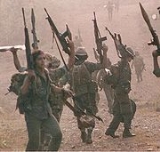
The contras is a label given to the various rebel groups opposing Nicaragua
's FSLN (Sandinista National Liberation Front
) Sandinista
Junta of National Reconstruction
government following the July 1979 overthrow of Anastasio Somoza Debayle
's dictatorship. Among the separate contra groups, the Nicaraguan Democratic Force
(FDN) emerged as by far the largest. In 1987, virtually all contra organizations were united, at least nominally, into the Nicaraguan Resistance
.
From an early stage, the rebels received decisive financial and military support from the United States government, initially supplemented by the Argentine dictatorship
of the time. After U.S. support was banned by Congress
, the Reagan administration
tried to covertly continue contra aid.
The term "contra" comes from the Spanish contra, which means against but in this case is short for , in English "the counter-revolution". Some rebels disliked being called contras, feeling that it defined their cause only in negative terms, or implied a desire to restore the old order. Rebel fighters usually referred to themselves as ("commandos"); peasant sympathizers also called the rebels ("the cousins"). From the mid-1980s, as the Reagan administration and the rebels sought to portray the movement as the "democratic resistance," members started describing themselves as .
During the war against the Sandinista government, the contras carried out many violations of human rights
. Their supporters in Miami and the White House
often tried to downplay these, or countered that the Sandinista government carried out more such violations. In particular, the Reagan administration engaged in a campaign to alter public opinion on the contra which has been denoted as "white propaganda".
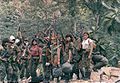
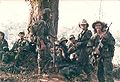 The CIA and Argentine intelligence, seeking to unify the anti-Sandinista cause before initiating large-scale aid, persuaded the 15 September Legion, the UDN and several former smaller groups to merge in August 1981 as the Nicaraguan Democratic Force
(Fuerza Democrática Nicaragüense, FDN). Although the FDN had its roots in two groups made up of former National Guardsmen (of the Somoza regime), its joint political directorate was led by businessman and former anti-Somoza activist Adolfo Calero Portocarrero
. Edgar Chamorro
later stated that there was strong opposition within the UDN against working with the Guardsmen and that the merging only took place because of insistence by the CIA.
Based in Honduras
, Nicaragua's northern neighbor, under the command of former National Guard Colonel Enrique Bermúdez
, the new FDN commenced to draw in other smaller insurgent forces in the north. Largely financed, trained, equipped, armed and organized by the U.S., it emerged as the largest and most active contra group.
In April 1982, Edén Pastora
(Comandante Cero), one of the heroes in the fight against Somoza, organized the Sandinista Revolutionary Front (FRS) - embedded in the Democratic Revolutionary Alliance
(ARDE) - and declared war on the Sandinista government. Himself a former Sandinista who had held several high posts in the government, he had resigned apruptly in 1981 and defected, believing that the newly found power had corrupted the Sandinista's original ideas. A popular and charismatic leader, Pastora initially saw his group develop quickly. He confined himself to operate in the southern part of Nicaragua; after a press conference he was holding on 30 May 1984 was bombed
, he "voluntarily withdrew" from the contra struggle.
A third force, Misurasata, appeared among the Miskito, Sumo
and Rama Amerindian peoples of Nicaragua's Atlantic coast, who in December 1981 found themselves in conflict with the authorities following the government's efforts to nationalize Indian land. In the course of this conflict, forced removal of at least 10,000 Indians to relocation centers in the interior of the country and subsequent burning of some villages took place. The Misurasata movement split in 1983, with the breakaway Misura group of Stedman Fagoth Muller allying itself more closely with the FDN, and the rest accommodating themselves with the Sandinista government. A subsequent autonomy statute in September 1987 largely defused Miskito resistance.
(UNO), under the leadership of Adolfo Calero
, Arturo Cruz
and Alfonso Robelo
, all originally supporters of the anti-Somoza revolution. After UNO's dissolution early in 1987, the Nicaraguan Resistance
(RN) was organized along similar lines in May.
, Nicaragua claimed that the contras altogether were a creation of the U.S. This claim was rejected. The evidence of a very close relationship between the contras and the U.S. was overwhelming and incontrovertible, though. The U.S. played a very large role in financing, training, arming, and advising the contras over a long period, and the contras only became capable of carrying out significant military operations as a result of this support.
, who had assumed the American presidency in January 1981, accused the Sandinistas of importing Cuban-style socialism
and aiding leftist guerrillas in El Salvador
. On 4 January 1982, Reagan signed the top secret
National Security Decision Directive 17 (NSDD-17), giving the CIA
the authority to recruit and support the contras with $19 million in military aid. The effort to support the contras was one component of the Reagan Doctrine
, which called for providing military support to movements opposing Soviet-supported
, communist
governments
.
By December 1981, however, the U.S. had already begun to support armed opponents of the Sandinista regime. From the beginning, the CIA was in charge. To arm, clothe, feed, and supervise the contras would become the most ambitious paramilitary and political action operation mounted by the agency in nearly a decade.
In the fiscal year 1984, the U.S. congress approved $24 million in contra aid. However, since the contras failed to win widespread popular support or military victories within Nicaragua, since opinion polls indicated that a majority of the U.S. public was not supportive of the contras, and since the Reagan administration lost much of its support regarding its contra policy within congress after disclosure of CIA mining of Nicaraguan ports, congress cut off all funds for the contras in 1985 by the third Boland Amendment
. The Boland Amendment had first been passed by congress in December 1982. At this time, it only outlawed U.S. assistance to the contras for the purpose of overthrowing the Nicaraguan government, while allowing assistance for other purposes. In October 1984, it was amended to forbid action by not only the Defense Department and the Central Intelligence Agency but all U.S. government agencies.
, with officer Lt. Col. Oliver North
in charge. With the third-party funds, North created an organization called "The Enterprise" which served as the secret arm of the NSC staff and had its own airplanes, pilots, airfield, ship, operatives and secret Swiss bank accounts. It also received assistance from personnel from other government agencies, especially from CIA personnel in Central America. This operation functioned, however, without any of the accountability required of U.S. government activities. The Enterprise's efforts culminated in the Iran-Contra Affair of 1986–1987, which facilitated contra funding through the proceeds of arms sales to Iran.
According to the National Security Archive
, Oliver North
had been in contact with Manuel Noriega
, the military leader of Panama
later convicted on drug charges, whom he personally met. The issue of drug money and its importance in funding the Nicaraguan conflict was the subject of various reports and publications. The contras were funded by drug trafficking, of which the USA was aware. Senator
John Kerry
's 1988 Committee on Foreign Relations
report on Contra drug links concluded that "senior U.S. policy makers were not immune to the idea that drug money was a perfect solution to the Contras' funding problems."
The Reagan administration's support for the Contras continued to stir controversy well into the 1990s. In August 1996, San Jose Mercury News
reporter Gary Webb
published a series titled Dark Alliance, alleging that the contras contributed to the rise of crack cocaine
in California. http://www.narconews.com/darkalliance/drugs/start.htm http://www.gwu.edu/~nsarchiv/NSAEBB/NSAEBB2/nsaebb2.htm
established an interagency working group which in turn coordinated the Office for Public Diplomacy for Latin America and the Caribbean (S/LPD), which conducted the campaign.
The S/LPD produced and widely disseminated a variety of pro-contra publications, arranged speeches and press conferences. It also disseminated "white propaganda" - pro-contra newspaper articles by paid consultants who did not disclose their connection to the Reagan administration.
On top of that, Oliver North
helped Carl Channell's tax-exempt organization, the "National Endowment for the Preservation of Liberty", to raise $10 million, by arranging numerous briefings for groups of potential contributors at the premises of the White House and by facilitating private visits and photo sessions with president Reagan for major contributors. Channell, in turn, used part of that money to run a series of television advertisements directed at home districts of congressmen considered to be swing votes on contra aid. Out of the $10 million raised, more than $1 million was spent on pro-contra publicity.
(ICJ) against the United States (Nicaragua v. United States), which resulted in a 1986 judgment against the United States. The ICJ held that the U.S. had violated international law
by supporting the contras in their rebellion against the Nicaraguan government and by mining
Nicaragua's harbors. Regarding the alleged human rights violations by the contras, however, the ICJ took the view that the U.S. could only be held accountable for them if it would have been proven that the U.S. had effective control of the contra operations resulting in these alleged violations. Nevertheless, the ICJ found that the U.S. encouraged acts contrary to general principles of humanitarian law by producing the manual Psychological Operations in Guerrilla Warfare
(Operaciones sicológicas en guerra de guerrillas) and disseminating it to the contras. The manual, amongst other things, advised on how to rationalize killings of civilians and recommended to hire professional killers for specific selective tasks.
The United States, which did not participate in the merits phase of the proceedings, maintained that the ICJ's power did not supersede the Constitution of the United States and argued that the court did not seriously consider the Nicaraguan role in El Salvador, while it accused Nicaragua of actively supporting armed groups there, specifically in the form of supply of arms. The ICJ had found that evidence of a responsibility of the Nicaraguan government in this matter was insufficient. The U.S. argument was affirmed, however, by the dissenting opinion of ICJ member U.S. Judge Schwebel, who concluded that in supporting the contras, the U.S. acted lawfully in collective self-defence in El Salvador's support. The U.S. blocked enforcement of the ICJ judgment by the United Nations Security Council
and thereby prevented Nicaragua from obtaining any actual compensation. The Nicaraguan government finally withdrew the complaint from the court in September 1992 (under the later, post-FSLN, government of Violeta Chamorro
), following a repeal of the law requiring the country to seek compensation.
- stated that "the Contras systematically engage in violent abuses... so prevalent that these may be said to be their principal means of waging war." It accused the Contras of:
Human Rights Watch released a report on the situation in 1989, which stated: "[The] contras were major and systematic violators of the most basic standards of the laws of armed conflict, including by launching indiscriminate attacks on civilians, selectively murdering non-combatants, and mistreating prisoners."
The Catholic Institute for International Relations (CIIR, now known as "Progressio"), a human rights
organization which identifies itself with liberation theology
, summarized Contra operating procedures in their 1987 human rights report: "The record of the contras in the field, as opposed to their official professions of democratic faith, is one of consistent and bloody abuse of human rights, of murder, torture, mutilation, rape, arson, destruction and kidnapping."
Nicaragua
Nicaragua is the largest country in the Central American American isthmus, bordered by Honduras to the north and Costa Rica to the south. The country is situated between 11 and 14 degrees north of the Equator in the Northern Hemisphere, which places it entirely within the tropics. The Pacific Ocean...
's FSLN (Sandinista National Liberation Front
Sandinista National Liberation Front
The Sandinista National Liberation Front is a socialist political party in Nicaragua. Its members are called Sandinistas in both English and Spanish...
) Sandinista
Sandinista National Liberation Front
The Sandinista National Liberation Front is a socialist political party in Nicaragua. Its members are called Sandinistas in both English and Spanish...
Junta of National Reconstruction
Junta of National Reconstruction
The Junta of National Reconstruction officially ruled Nicaragua from July 1979 to January 1985, though effective power was in the hands of the Sandinista National Liberation Front's National Directorate....
government following the July 1979 overthrow of Anastasio Somoza Debayle
Anastasio Somoza Debayle
Anastasio Somoza Debayle was a Nicaraguan leader and officially the 73rd and 76th President of Nicaragua from 1 May 1967 to 1 May 1972 and from 1 December 1974 to 17 July 1979. As head of the National Guard, he was de facto ruler of the country from 1967 to 1979...
's dictatorship. Among the separate contra groups, the Nicaraguan Democratic Force
Nicaraguan Democratic Force
The Nicaraguan Democratic Force was one of the earliest Contra groups, formed on August 11, 1981 in Guatemala City. It was formed to oppose Nicaragua's revolutionary Sandinista government following the 1979 overthrow of Anastasio Somoza Debayle...
(FDN) emerged as by far the largest. In 1987, virtually all contra organizations were united, at least nominally, into the Nicaraguan Resistance
Nicaraguan Resistance
The Nicaraguan Resistance was the last and arguably most successful effort to unify Nicaragua's rebel Contras into a single umbrella organization. It was established in May 1987, after the United Nicaraguan Opposition foundered....
.
From an early stage, the rebels received decisive financial and military support from the United States government, initially supplemented by the Argentine dictatorship
National Reorganization Process
The National Reorganization Process was the name used by its leaders for the military government that ruled Argentina from 1976 to 1983. In Argentina it is often known simply as la última junta militar or la última dictadura , because several of them existed throughout its history.The Argentine...
of the time. After U.S. support was banned by Congress
United States Congress
The United States Congress is the bicameral legislature of the federal government of the United States, consisting of the Senate and the House of Representatives. The Congress meets in the United States Capitol in Washington, D.C....
, the Reagan administration
Reagan Administration
The United States presidency of Ronald Reagan, also known as the Reagan administration, was a Republican administration headed by Ronald Reagan from January 20, 1981, to January 20, 1989....
tried to covertly continue contra aid.
The term "contra" comes from the Spanish contra, which means against but in this case is short for , in English "the counter-revolution". Some rebels disliked being called contras, feeling that it defined their cause only in negative terms, or implied a desire to restore the old order. Rebel fighters usually referred to themselves as ("commandos"); peasant sympathizers also called the rebels ("the cousins"). From the mid-1980s, as the Reagan administration and the rebels sought to portray the movement as the "democratic resistance," members started describing themselves as .
During the war against the Sandinista government, the contras carried out many violations of human rights
Human rights
Human rights are "commonly understood as inalienable fundamental rights to which a person is inherently entitled simply because she or he is a human being." Human rights are thus conceived as universal and egalitarian . These rights may exist as natural rights or as legal rights, in both national...
. Their supporters in Miami and the White House
White House
The White House is the official residence and principal workplace of the president of the United States. Located at 1600 Pennsylvania Avenue NW in Washington, D.C., the house was designed by Irish-born James Hoban, and built between 1792 and 1800 of white-painted Aquia sandstone in the Neoclassical...
often tried to downplay these, or countered that the Sandinista government carried out more such violations. In particular, the Reagan administration engaged in a campaign to alter public opinion on the contra which has been denoted as "white propaganda".
Origins
The Contras were not a monolithic group, but a combination of three distinct elements of Nicaraguan society:- Ex-guardsmen of the Nicaraguan National Guard and other right wing figures who had fought for Nicaragua's ex-dictator SomozaSomozaThe Somoza family was an influential political dynasty who ruled Nicaragua as an hereditary dictatorship. Their influence exceeded their combined 43 years in the de facto presidency, as they were the power behind the other presidents of the time through their control of the National Guard...
- these later were especially found in the military wing of the FDNNicaraguan Democratic ForceThe Nicaraguan Democratic Force was one of the earliest Contra groups, formed on August 11, 1981 in Guatemala City. It was formed to oppose Nicaragua's revolutionary Sandinista government following the 1979 overthrow of Anastasio Somoza Debayle...
. After the Guard's disbandment, they formed groups such as the Fifteenth of September Legion, the Anti-Sandinista Guerrilla Special Forces, and the National Army of Liberation. Initially, these groups were small and conducted little active raiding into Nicaragua.
- Anti-Somozistas who had supported the revolution but felt betrayed by the Sandinista government - e.g. Edgar ChamorroEdgar ChamorroEdgar Chamorro Coronel is an ousted leader of the Nicaraguan rebel Contras who later became a critic of the rebels and their Central Intelligence Agency sponsors, even cooperating with the Sandinista government in their World Court case, Nicaragua v. United States...
, prominent member of the political directorate of the FDN, or Jose Francisco CardenalJosé Francisco CardenalJosé Francisco Cardenal was a Nicaraguan businessman who became known as one of the most pugnacious opponents of the Somoza and then the Sandinista regimes of Nicaragua, and played an important role in the early days of the Contra rebellion....
, who had briefly served in the Council of State before leaving Nicaragua out of disagreement with the Sandinista government's policies and founding the Nicaraguan Democratic Union (UDN)Nicaraguan Democratic UnionThe Nicaraguan Democratic Union was founded in late 1980 by José Francisco Cardenal, an early leader of the anti-Sandinista rebel movement that became known as the Nicaraguan Contras. The UDN was based in Miami, Florida, among its growing community of exiles from Nicaragua's middle class...
, an opposition group of Nicaraguan exiles in Miami. Another example are the MILPASMILPASThe acronym MILPAS originally stood for , fighting alongside the Sandinista National Liberation Front against the regime of Anastasio Somoza Debayle. However, after his overthrow, some disaffected MILPAS veterans revived it as the , one of the earliest rebel groups that would form the contra...
(Milicias Populares Anti-Sandinistas), peasant militiaMilitiaThe term militia is commonly used today to refer to a military force composed of ordinary citizens to provide defense, emergency law enforcement, or paramilitary service, in times of emergency without being paid a regular salary or committed to a fixed term of service. It is a polyseme with...
s led by disillusioned Sandinista veterans from the northern mountains. Founded by Pedro Joaquín González (known as "Dimas"), the Milpistas were also known as (green corn). Even after his death, other MILPAS bands sprouted during 1980–1981. The Milpistas were composed largely of the (peasantPeasantA peasant is an agricultural worker who generally tend to be poor and homeless-Etymology:The word is derived from 15th century French païsant meaning one from the pays, or countryside, ultimately from the Latin pagus, or outlying administrative district.- Position in society :Peasants typically...
) highlanders and rural workers who would later form the rank and file of the rebellion.
- Nicaraguans who had avoided direct involvement in the revolution but opposed the Sandinistas' increasingly anti-democratic regime.
Main groups
Nicaraguan Democratic Force
The Nicaraguan Democratic Force was one of the earliest Contra groups, formed on August 11, 1981 in Guatemala City. It was formed to oppose Nicaragua's revolutionary Sandinista government following the 1979 overthrow of Anastasio Somoza Debayle...
(Fuerza Democrática Nicaragüense, FDN). Although the FDN had its roots in two groups made up of former National Guardsmen (of the Somoza regime), its joint political directorate was led by businessman and former anti-Somoza activist Adolfo Calero Portocarrero
Adolfo Calero
Adolfo Calero Portocarrero was a Nicaraguan businessman, and leader of the Nicaraguan Democratic Force, which was the largest contra rebel group opposing the Sandinista government. In the contra leadership, Calero was responsible for managing the bank accounts into which money was deposited and...
. Edgar Chamorro
Edgar Chamorro
Edgar Chamorro Coronel is an ousted leader of the Nicaraguan rebel Contras who later became a critic of the rebels and their Central Intelligence Agency sponsors, even cooperating with the Sandinista government in their World Court case, Nicaragua v. United States...
later stated that there was strong opposition within the UDN against working with the Guardsmen and that the merging only took place because of insistence by the CIA.
Based in Honduras
Honduras
Honduras is a republic in Central America. It was previously known as Spanish Honduras to differentiate it from British Honduras, which became the modern-day state of Belize...
, Nicaragua's northern neighbor, under the command of former National Guard Colonel Enrique Bermúdez
Enrique Bermúdez
Enrique Bermúdez Varela was a Nicaraguan who founded and commanded the Nicaraguan Contras. In this capacity, he became a central global figure in one of the most prominent conflicts of the Cold War....
, the new FDN commenced to draw in other smaller insurgent forces in the north. Largely financed, trained, equipped, armed and organized by the U.S., it emerged as the largest and most active contra group.
In April 1982, Edén Pastora
Edén Pastora
Edén Atanacio Pastora Gómez is a Nicaraguan politician and former guerrilla who ran for president as the candidate of the Alternative for Change party in the 2006 general elections...
(Comandante Cero), one of the heroes in the fight against Somoza, organized the Sandinista Revolutionary Front (FRS) - embedded in the Democratic Revolutionary Alliance
Democratic Revolutionary Alliance
The Democratic Revolutionary Alliance were the Southern Front guerrillas in Nicaragua that fought against the Marxist elements of the original Sandinista Revolution in 1979...
(ARDE) - and declared war on the Sandinista government. Himself a former Sandinista who had held several high posts in the government, he had resigned apruptly in 1981 and defected, believing that the newly found power had corrupted the Sandinista's original ideas. A popular and charismatic leader, Pastora initially saw his group develop quickly. He confined himself to operate in the southern part of Nicaragua; after a press conference he was holding on 30 May 1984 was bombed
La Penca bombing
The "La Penca bombing" refers to a bomb attack on May 30, 1984, in the guerilla outpost of La Penca in Nicaragua, near the Costa Rican border. The bomb attack occurred during a press conference being conducted by Edén Pastora, a Contra leader, who is presumed to have been the target...
, he "voluntarily withdrew" from the contra struggle.
A third force, Misurasata, appeared among the Miskito, Sumo
Sumo (people)
The Mayagna are a people who live on the eastern coasts of Nicaragua and Honduras, an area commonly known as the Mosquito Coast. Their preferred autonym is Mayagna, as the name "Sumo" is a deragatory name historically used by the Miskito people.Their language belongs to the Misumalpan language...
and Rama Amerindian peoples of Nicaragua's Atlantic coast, who in December 1981 found themselves in conflict with the authorities following the government's efforts to nationalize Indian land. In the course of this conflict, forced removal of at least 10,000 Indians to relocation centers in the interior of the country and subsequent burning of some villages took place. The Misurasata movement split in 1983, with the breakaway Misura group of Stedman Fagoth Muller allying itself more closely with the FDN, and the rest accommodating themselves with the Sandinista government. A subsequent autonomy statute in September 1987 largely defused Miskito resistance.
Unity efforts
U.S. officials were active in attempting to unite the Contra groups. In June 1985 most of the groups reorganized as the United Nicaraguan OppositionUnited Nicaraguan Opposition
The United Nicaraguan Opposition was a Nicaraguan rebel umbrella group formed in 1985, led by the triumvirate of Adolfo Calero, Alfonso Robelo, and Arturo Cruz...
(UNO), under the leadership of Adolfo Calero
Adolfo Calero
Adolfo Calero Portocarrero was a Nicaraguan businessman, and leader of the Nicaraguan Democratic Force, which was the largest contra rebel group opposing the Sandinista government. In the contra leadership, Calero was responsible for managing the bank accounts into which money was deposited and...
, Arturo Cruz
Arturo Cruz
Arturo José Cruz Porras , sometimes called Arturo Cruz, Sr. to distinguish him from his son, is a Nicaraguan banker and technocrat. He became prominent in politics during the Sandinista era...
and Alfonso Robelo
Alfonso Robelo
Luis Alfonso Robelo Callejas , a Nicaraguan businessman, was the founder of the Nicaraguan Democratic Movement . He was one of the "moderates" on the five-members Junta of National Reconstruction that the Sandinistas claimed would rule Nicaragua following the overthrow of Anastasio Somoza Debayle...
, all originally supporters of the anti-Somoza revolution. After UNO's dissolution early in 1987, the Nicaraguan Resistance
Nicaraguan Resistance
The Nicaraguan Resistance was the last and arguably most successful effort to unify Nicaragua's rebel Contras into a single umbrella organization. It was established in May 1987, after the United Nicaraguan Opposition foundered....
(RN) was organized along similar lines in May.
U.S. military and financial assistance
In front of the International Court of JusticeInternational Court of Justice
The International Court of Justice is the primary judicial organ of the United Nations. It is based in the Peace Palace in The Hague, Netherlands...
, Nicaragua claimed that the contras altogether were a creation of the U.S. This claim was rejected. The evidence of a very close relationship between the contras and the U.S. was overwhelming and incontrovertible, though. The U.S. played a very large role in financing, training, arming, and advising the contras over a long period, and the contras only became capable of carrying out significant military operations as a result of this support.
Political background
Ronald ReaganRonald Reagan
Ronald Wilson Reagan was the 40th President of the United States , the 33rd Governor of California and, prior to that, a radio, film and television actor....
, who had assumed the American presidency in January 1981, accused the Sandinistas of importing Cuban-style socialism
Socialism
Socialism is an economic system characterized by social ownership of the means of production and cooperative management of the economy; or a political philosophy advocating such a system. "Social ownership" may refer to any one of, or a combination of, the following: cooperative enterprises,...
and aiding leftist guerrillas in El Salvador
El Salvador
El Salvador or simply Salvador is the smallest and the most densely populated country in Central America. The country's capital city and largest city is San Salvador; Santa Ana and San Miguel are also important cultural and commercial centers in the country and in all of Central America...
. On 4 January 1982, Reagan signed the top secret
Top Secret
Top Secret generally refers to the highest acknowledged level of classified information.Top Secret may also refer to:- Film and television :* Top Secret , a British comedy directed by Mario Zampi...
National Security Decision Directive 17 (NSDD-17), giving the CIA
Central Intelligence Agency
The Central Intelligence Agency is a civilian intelligence agency of the United States government. It is an executive agency and reports directly to the Director of National Intelligence, responsible for providing national security intelligence assessment to senior United States policymakers...
the authority to recruit and support the contras with $19 million in military aid. The effort to support the contras was one component of the Reagan Doctrine
Reagan Doctrine
The Reagan Doctrine was a strategy orchestrated and implemented by the United States under the Reagan Administration to oppose the global influence of the Soviet Union during the final years of the Cold War...
, which called for providing military support to movements opposing Soviet-supported
Soviet Union
The Soviet Union , officially the Union of Soviet Socialist Republics , was a constitutionally socialist state that existed in Eurasia between 1922 and 1991....
, communist
Communism
Communism is a social, political and economic ideology that aims at the establishment of a classless, moneyless, revolutionary and stateless socialist society structured upon common ownership of the means of production...
governments
Communist state
A communist state is a state with a form of government characterized by single-party rule or dominant-party rule of a communist party and a professed allegiance to a Leninist or Marxist-Leninist communist ideology as the guiding principle of the state...
.
By December 1981, however, the U.S. had already begun to support armed opponents of the Sandinista regime. From the beginning, the CIA was in charge. To arm, clothe, feed, and supervise the contras would become the most ambitious paramilitary and political action operation mounted by the agency in nearly a decade.
In the fiscal year 1984, the U.S. congress approved $24 million in contra aid. However, since the contras failed to win widespread popular support or military victories within Nicaragua, since opinion polls indicated that a majority of the U.S. public was not supportive of the contras, and since the Reagan administration lost much of its support regarding its contra policy within congress after disclosure of CIA mining of Nicaraguan ports, congress cut off all funds for the contras in 1985 by the third Boland Amendment
Boland Amendment
The Boland Amendment was the name given to three U.S. legislative amendments between 1982 and 1984, all aimed at limiting U.S. government assistance to the Contras in Nicaragua...
. The Boland Amendment had first been passed by congress in December 1982. At this time, it only outlawed U.S. assistance to the contras for the purpose of overthrowing the Nicaraguan government, while allowing assistance for other purposes. In October 1984, it was amended to forbid action by not only the Defense Department and the Central Intelligence Agency but all U.S. government agencies.
Illegal covert operations
With congress blocking further contra aid, the Reagan administration sought to arrange funding and military supplies by means of third countries and private sources. Between 1984 and 1986, $34 million from third countries and $2.7 million from private sources were raised this way. The secret contra assistance was run by the National Security CouncilUnited States National Security Council
The White House National Security Council in the United States is the principal forum used by the President of the United States for considering national security and foreign policy matters with his senior national security advisors and Cabinet officials and is part of the Executive Office of the...
, with officer Lt. Col. Oliver North
Oliver North
Oliver Laurence North is a retired U.S. Marine Corps officer, political commentator, host of War Stories with Oliver North on Fox News Channel, a military historian, and a New York Times best-selling author....
in charge. With the third-party funds, North created an organization called "The Enterprise" which served as the secret arm of the NSC staff and had its own airplanes, pilots, airfield, ship, operatives and secret Swiss bank accounts. It also received assistance from personnel from other government agencies, especially from CIA personnel in Central America. This operation functioned, however, without any of the accountability required of U.S. government activities. The Enterprise's efforts culminated in the Iran-Contra Affair of 1986–1987, which facilitated contra funding through the proceeds of arms sales to Iran.
According to the National Security Archive
National Security Archive
The National Security Archive is a 501 non-governmental, non-profit research and archival institution located in the George Washington University in Washington, D.C.. Founded in 1985 by Scott Armstrong, it archives and publishes declassified U.S. government files concerning selected topics of US...
, Oliver North
Oliver North
Oliver Laurence North is a retired U.S. Marine Corps officer, political commentator, host of War Stories with Oliver North on Fox News Channel, a military historian, and a New York Times best-selling author....
had been in contact with Manuel Noriega
Manuel Noriega
Manuel Antonio Noriega Moreno is a Panamanian politician and soldier. He was military dictator of Panama from 1983 to 1989.The 1989 invasion of Panama by the United States removed him from power; he was captured, detained as a prisoner of war, and flown to the United States. Noriega was tried on...
, the military leader of Panama
Panama
Panama , officially the Republic of Panama , is the southernmost country of Central America. Situated on the isthmus connecting North and South America, it is bordered by Costa Rica to the northwest, Colombia to the southeast, the Caribbean Sea to the north and the Pacific Ocean to the south. The...
later convicted on drug charges, whom he personally met. The issue of drug money and its importance in funding the Nicaraguan conflict was the subject of various reports and publications. The contras were funded by drug trafficking, of which the USA was aware. Senator
United States Senate
The United States Senate is the upper house of the bicameral legislature of the United States, and together with the United States House of Representatives comprises the United States Congress. The composition and powers of the Senate are established in Article One of the U.S. Constitution. Each...
John Kerry
John Kerry
John Forbes Kerry is the senior United States Senator from Massachusetts, the 10th most senior U.S. Senator and chairman of the Senate Foreign Relations Committee. He was the presidential nominee of the Democratic Party in the 2004 presidential election, but lost to former President George W...
's 1988 Committee on Foreign Relations
United States Senate Committee on Foreign Relations
The United States Senate Committee on Foreign Relations is a standing committee of the United States Senate. It is charged with leading foreign-policy legislation and debate in the Senate. The Foreign Relations Committee is generally responsible for overseeing and funding foreign aid programs as...
report on Contra drug links concluded that "senior U.S. policy makers were not immune to the idea that drug money was a perfect solution to the Contras' funding problems."
The Reagan administration's support for the Contras continued to stir controversy well into the 1990s. In August 1996, San Jose Mercury News
San Jose Mercury News
The San Jose Mercury News is a daily newspaper in San Jose, California. On its web site, however, it calls itself Silicon Valley Mercury News. The paper is owned by MediaNews Group...
reporter Gary Webb
Gary Webb
Gary Webb was a Pulitzer prize-winning American investigative journalist.Webb was best known for his 1996 "Dark Alliance" series of articles written for the San Jose Mercury News and later published as a book...
published a series titled Dark Alliance, alleging that the contras contributed to the rise of crack cocaine
Crack cocaine
Crack cocaine is the freebase form of cocaine that can be smoked. It may also be termed rock, hard, iron, cavvy, base, or just crack; it is the most addictive form of cocaine. Crack rocks offer a short but intense high to smokers...
in California. http://www.narconews.com/darkalliance/drugs/start.htm http://www.gwu.edu/~nsarchiv/NSAEBB/NSAEBB2/nsaebb2.htm
Propaganda
During the time congress blocked funding for the contras, the Reagan government engaged in a campaign to alter public opinion and change the vote in congress on contra aid. For this purpose, the NSCUnited States National Security Council
The White House National Security Council in the United States is the principal forum used by the President of the United States for considering national security and foreign policy matters with his senior national security advisors and Cabinet officials and is part of the Executive Office of the...
established an interagency working group which in turn coordinated the Office for Public Diplomacy for Latin America and the Caribbean (S/LPD), which conducted the campaign.
The S/LPD produced and widely disseminated a variety of pro-contra publications, arranged speeches and press conferences. It also disseminated "white propaganda" - pro-contra newspaper articles by paid consultants who did not disclose their connection to the Reagan administration.
On top of that, Oliver North
Oliver North
Oliver Laurence North is a retired U.S. Marine Corps officer, political commentator, host of War Stories with Oliver North on Fox News Channel, a military historian, and a New York Times best-selling author....
helped Carl Channell's tax-exempt organization, the "National Endowment for the Preservation of Liberty", to raise $10 million, by arranging numerous briefings for groups of potential contributors at the premises of the White House and by facilitating private visits and photo sessions with president Reagan for major contributors. Channell, in turn, used part of that money to run a series of television advertisements directed at home districts of congressmen considered to be swing votes on contra aid. Out of the $10 million raised, more than $1 million was spent on pro-contra publicity.
International Court of Justice ruling
In 1984, the Sandinista government filed a suit in the International Court of JusticeInternational Court of Justice
The International Court of Justice is the primary judicial organ of the United Nations. It is based in the Peace Palace in The Hague, Netherlands...
(ICJ) against the United States (Nicaragua v. United States), which resulted in a 1986 judgment against the United States. The ICJ held that the U.S. had violated international law
International law
Public international law concerns the structure and conduct of sovereign states; analogous entities, such as the Holy See; and intergovernmental organizations. To a lesser degree, international law also may affect multinational corporations and individuals, an impact increasingly evolving beyond...
by supporting the contras in their rebellion against the Nicaraguan government and by mining
Naval mine
A naval mine is a self-contained explosive device placed in water to destroy surface ships or submarines. Unlike depth charges, mines are deposited and left to wait until they are triggered by the approach of, or contact with, an enemy vessel...
Nicaragua's harbors. Regarding the alleged human rights violations by the contras, however, the ICJ took the view that the U.S. could only be held accountable for them if it would have been proven that the U.S. had effective control of the contra operations resulting in these alleged violations. Nevertheless, the ICJ found that the U.S. encouraged acts contrary to general principles of humanitarian law by producing the manual Psychological Operations in Guerrilla Warfare
Psychological Operations in Guerrilla Warfare
On October 15, 1984, Associated Press reported that the Central Intelligence Agency had written a manual for the Nicaraguan Contras , entitled Psychological Operations in Guerrilla Warfare...
(Operaciones sicológicas en guerra de guerrillas) and disseminating it to the contras. The manual, amongst other things, advised on how to rationalize killings of civilians and recommended to hire professional killers for specific selective tasks.
The United States, which did not participate in the merits phase of the proceedings, maintained that the ICJ's power did not supersede the Constitution of the United States and argued that the court did not seriously consider the Nicaraguan role in El Salvador, while it accused Nicaragua of actively supporting armed groups there, specifically in the form of supply of arms. The ICJ had found that evidence of a responsibility of the Nicaraguan government in this matter was insufficient. The U.S. argument was affirmed, however, by the dissenting opinion of ICJ member U.S. Judge Schwebel, who concluded that in supporting the contras, the U.S. acted lawfully in collective self-defence in El Salvador's support. The U.S. blocked enforcement of the ICJ judgment by the United Nations Security Council
United Nations Security Council
The United Nations Security Council is one of the principal organs of the United Nations and is charged with the maintenance of international peace and security. Its powers, outlined in the United Nations Charter, include the establishment of peacekeeping operations, the establishment of...
and thereby prevented Nicaragua from obtaining any actual compensation. The Nicaraguan government finally withdrew the complaint from the court in September 1992 (under the later, post-FSLN, government of Violeta Chamorro
Violeta Chamorro
Violeta Barrios Torres de Chamorro is a Nicaraguan political leader, former president and publisher. She became president of Nicaragua on April 25, 1990, when she unseated Daniel Ortega...
), following a repeal of the law requiring the country to seek compensation.
Human rights violations
Americas Watch - which subsequently became part of Human Rights WatchHuman Rights Watch
Human Rights Watch is an international non-governmental organization that conducts research and advocacy on human rights. Its headquarters are in New York City and it has offices in Berlin, Beirut, Brussels, Chicago, Geneva, Johannesburg, London, Los Angeles, Moscow, Paris, San Francisco, Tokyo,...
- stated that "the Contras systematically engage in violent abuses... so prevalent that these may be said to be their principal means of waging war." It accused the Contras of:
- targeting health care clinics and health care workers for assassination
- kidnapping civilians
- torturing civilians
- executing civilians, including children, who were captured in combat
- raping women
- indiscriminately attacking civilians and civilian houses
- seizing civilian property
- burning civilian houses in captured towns.
Human Rights Watch released a report on the situation in 1989, which stated: "[The] contras were major and systematic violators of the most basic standards of the laws of armed conflict, including by launching indiscriminate attacks on civilians, selectively murdering non-combatants, and mistreating prisoners."
The Catholic Institute for International Relations (CIIR, now known as "Progressio"), a human rights
Human rights
Human rights are "commonly understood as inalienable fundamental rights to which a person is inherently entitled simply because she or he is a human being." Human rights are thus conceived as universal and egalitarian . These rights may exist as natural rights or as legal rights, in both national...
organization which identifies itself with liberation theology
Liberation theology
Liberation theology is a Christian movement in political theology which interprets the teachings of Jesus Christ in terms of a liberation from unjust economic, political, or social conditions...
, summarized Contra operating procedures in their 1987 human rights report: "The record of the contras in the field, as opposed to their official professions of democratic faith, is one of consistent and bloody abuse of human rights, of murder, torture, mutilation, rape, arson, destruction and kidnapping."