


Crown jewels

Encyclopedia
Crown jewels are jewels
or artifacts of the reigning royal family
of their respective country. They belong to monarchs and are passed to the next sovereign to symbolize the right to rule. They may include crowns
, sceptre
s, orbs
, sword
s, rings, and other objects. See also: regalia
.
(Please see below).
(king
) was the Karyenda
drum. These holy drums were kept at special drum-sanctuaries throughout the country and were brought out for special ceremonies only. One such place is in Gitega
, location of the ibwami royal court.
, Emperor Bokassa
, Central African Empire
.
The jewels were largely provided by the emperor's political allies in France
as part of that country's infamous Francafrique
policy, much to the chagrin of many progressive elements both within and without the empire. Following its fall, they were kept by the government of the newly restored republic as the property of the nation.
The treasures of the Pharaoh
s can be seen in the Egyptian Museum
in Cairo
and in other museums throughout the world.
Most of the Crown Jewels of the Mehmet Ali
Dynasty
are at the Museum at Abdin Palace in Cairo.
in Axum
have the form of a gold cube) with a convex dome on the top with usually some form of cross on a pedestal. These gold cylinders/cubes are composed of openwork, filigree, medallions with images of saints in repousse and settings of precious stones. Fringes of small gold cones on short gold chains are also frequently used in the decoration of these crowns, both on the cylinders/cubes themselves and on the pedestal supporting the cross on the top. Also, convex circular gold medallions/disks of openwork or filigree hanging from chains over the ears are also frequently found on these crowns as well, much like the ornaments that formerly hung from sides of the Byzantine imperial crowns and which hang from the sides and back of the Holy Crown of St. Stephan of Hungary. Some crowns also appear to have a semi-circular platform for additional ornaments attached to the lower front edge of the crown (on two of the crowns of Menelik II these platforms each support a small gold statuette of St. George fighting the dragon). For a photograph of one of Menelik II's crowns; a photograph of Haile Selassie wearing his imperial crown.
Other parts of the Ethiopian regalia include, a jeweled gold sword, a gold and ivory sceptre, a large gold orb with cross, a diamond studded ring, two gold filigreed lances of traditional Ethiopian form, long scarlet robes heavily embroidered in gold. Each of these seven ornaments is given to the emperor after each of his seven anointing on his head, brow and shoulders with seven differently scented holy oils, the last being the crown itself.
These imperial robes consist of a number of tunics and cloaks, of scarlet cloth heavy embroidered in gold and including an elbow length cape with a deeply scalloped edge, fringed in gold (the scallops on either side of the opening on the front being particularly long, giving them the appearance of a western priest's stole) and two large squares of scarlet cloth similarly heavily embroidered and fringed in gold attached to each shoulder. This cape is apparently identical in form to that also worn by the Patriarch and other higher-ranking members of the Ethiopian clergy.
The empress consort also is crowned and given a ring at her at her husband's coronation, although formerly this took place at a semi-public court ceremony three days after the emperor's coronation. Her scarlet imperial mantle has a very similar shape and ornamentation as that of the emperor, but lacking the scalloped edge and shoulder squares. The crowns of empress consorts took a variety of different forms; that of Empress Menen was modeled on the traditional form of European sovereign's crown. Other members of the imperial family and high ranking Ethiopian princes and nobles also had crowns, some resembling the coronets worn by the members of the British peerage at a British coronation, while others have uniquely Ethiopian forms.
Traditionally Ethiopian emperors were crowned at the Church of Our Lady Mary of Zion in Axum, the site of the chapel in which is kept what is believed to be the Ark of the Covenant, in order to validate the new emperor's legitimacy by reinforcing his claim to descent from Menelik I
, the son of King Solomon and the Queen of Sheba, who is believed to have brought the Ark
from Jerusalem to Axum. Their imperial crowns were afterwards frequently donated to the church and are kept in the church's treasury — medieval crowns and those of more recent monarchs - although other monarchs have given their crowns and other regalia to various other churches. The Crown Jewels used at the coronation of Emperor Haile Selassie are kept at the museum in the National Palace (formerly the Jubilee Palace) in Addis Ababa
.
The symbol of the power and authority of the Asantehene or sovereign ruler of the Ashanti) is the sacred Golden Stool
, the Sika 'dwa. It is used for the enthronement and symbolizes the very soul of the Ashanti as a people. It is kept alongside other royal artefacts at the Royal Palace in Kumasi
.
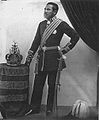 The crown of the Malagasy sovereign was made in France for Ranavalona I
. It is a large crown made from locally mined gold in c.1890 and is very heavy. In its essential form it followed the pattern of crown associated with a sovereign in European heraldry and had four arches which intersected at the top of the crown, while the circlet was made of openwork and set with precious stones and from the circlet between the arches were triangular leaf-like ornaments which also were set with precious stones (pearls?). One of the two most distinctive features of the crown was a large fan-like ornament generally described as a representation of seven of the spearhead of the traditional Malagasy warrior's spear joined together at the base, but in photographs and paintings it appear to look more like seven large feathers. The second distinctive feature is the representation of a falcon at the very top of the crown in the same position a cross would occupy on the top of an orb in the traditional crown of a Christian sovereign. The falcon
is a traditional symbol of the Malagasy sovereign. The inside of the crown was filled with a large red velvet cap — red being the color traditionally associated with royalty in Malagasy tradition. This crown (termed "the massive gold state crown") and many other royal artifacts were saved when the Rova (the royal palace and royal tomb complex) in Antananarivo
burned on November 6, 1995 and are now kept in the Andafivaratra Palace museum nearby. Many of the rescued items have only recently been put on display There is a painting of Radama II standing next to the state crown and another of Queen Ranavalona III - the last monarch - wearing it. A recent picture of the massive gold state crown as it is today in the museum can be seen here: http://img62.imageshack.us/i/lacouronnedetatenormass.jpg/. The smaller queen's crown last worn by Ranavalona III was taken with her into exile, first in Réunion
and then later in Algiers
, where she eventually died in 1917. The queen's crown can now be seen in the Musée de l'Armée
in Paris
.
is normally kept in the capital city of the respective state. See also List of Nigerian traditional states.
List of some of the kingdoms
Abeokuta
-
Adamawa
-
Benin -
Borno
-
Edo
-
Fika -
Gombe
-
Ibadan
-
Ijebu
-
Ile Ife -
Ilorin
-
Jos
-
Kano
-
Katsina
-
Lagos
-
Onitsha
-
Oshogbo -
Oyo
-
Sokoto -
Tiv
-
Warri -
Zaria (Zazzau
) -
Zamfara
lies the nearby Nyabisindu, formerly known as Nyanza
, the traditional seat of Rwanda's monarchy
. The Royal Palace at Nyanza, a domed construction made with traditional materials, has been restored to its 19th-century state and is now maintained as a museum. Further historical artifacts are kept at the National Museum
in Butare.
in Uganda
. During the upheavals after gaining independence
, the monarchies were abolished. Only in the 1990s were the various kings restored to their thrones. Although they do not wield any political powers anymore, they are still a symbol of unity and continuance to their people. The royal regalia normally consisted of the Royal Drums, and are kept at the various palaces in the capital cities of the Ugandan states.
The kingdoms
Ankole
-
Buganda
-
Bunyoro
-
Busoga
-
Toro
are kept in the National Museum in Yangon
. They include items such as the Sihasana Pallanka (Great Lion Throne), and various other items. Other items can be seen in the old capital city of Mandalay
.
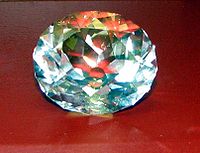
Diamond, mined in India in antiquity, is now set in the Crown of Queen Elizabeth
(the deceased Queen Mother).
are kept in the Royal Regalia Building, which was completed in 1992, in Bandar Seri Begawan
. Also housed are the Royal Chariot, the gold and silver ceremonial armoury and the jewel-encrusted crowns.
in 1970. It bore a similar appearance to the one worn by the King of Thailand. The royal crown of Cambodia was last worn at the coronation of Norodom Sihanouk
in 1941.
, which gave the emperor the mandate of heaven
authority. These are kept either in the Forbidden City
or the National Palace Museum
. Numerous crowns, robes, jewels and headwear made especially for coronations and other official events. They usually contain very large Manchurian pearls and most date from the Qing Dynasty
.
has various kingdoms and sultanates, all with their own unique history. The most known royal courts
are distributed amongst the islands of Java, Madura
, Bali
, Sumatra
, Kalimantan
, Sulawesi
, and Sumbawa
. There are 23 royal courts or more which still exist today, headed either by a sultan
or a ruler
. Although today only HM
the Sultan of Yogyakarta wields any political influence as the governor
. In Indonesia the royal courts are either called Kraton or istana
.
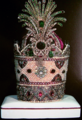
, 30 tiaras and numerous aigrette
s, a dozen jewel laden swords and shields, a vast amount of precious unset gemstones, numerous plates and other dining services cast in precious metals and encrusted with gems and several other more unique items (such as a gemstone globe) collected by the Iranian monarchy
during its 2,500 year existence.
For many centuries the Iranian Crown Jewels
were kept in the vaults of the Imperial Treasury. However, in the early 20th century, the first Pahlavi
Shah transferred ownership of the crown jewels to the state as part of a massive restructuring of the country's financial system. Later in the 1950s his son and successor, Mohammad Reza Pahlavi
, decreed that the most spectacular of these items be put on public display at the Central Bank of Iran.
The Imperial crown jewels of Iran is the largest jewelry collection in the world.
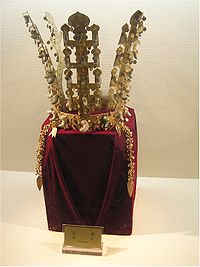 There have been a number of crown jewels present in Korea since ancient times, spanning from the ancient Gojoseon Dynasty
to the last Joseon Dynasty
. Most of the regalia of these kingdoms, however, have been lost at various points in time, due to the successive rise and fall of the Korean dynasties and the subsequent and frequent raiding of Korean royal tombs and palaces by both Korean and foreign armies. The surviving regalia derive mainly from the Silla
, Gaya
, Baekje
and Joseon dynasties.
The crowns of Silla are noted for their exquisite gold and jade workmanship, which resulted from the spread of goldsmithing technologies from Egypt
and Mesopotamia
to Korea via the Silk Road
. The surviving Silla regalia comprise of many golden crowns, girdles, belts, necklaces, a sword, a dagger, golden shoes, earrings, and more than 35 rings and hairpins. However, the Silla custom was that every king and queen had their own set of regalia, hence the regalia for each monarch was buried with them in their tombs, warranting the creation of many different regalia depending on personal preferences, contemporary fashion and available goldsmithing technology.
The Joseon dynasty regalia comprise of formal jewel-encrusted wigs for the queen and everyday crowns encrusted with various precious gems.
The Baekje regalia are similar to the Silla regalia, but are even more arabesque and consist of magnificent girdles. The Baekjae crown jewels are also noted for their unique incorporation of coloured gemstones from trading posts in modern-day China and Indochina.
During the period of the Great Korean Empire
under Emperor Gojong, the imperial family commissioned many brooches, western-style diadems and tiaras to suit western-style clothes. Unfortunately, when the Japan
colonized the Korean Empire in 1910, such jewels and regalia were lost to Japan.
(草薙剣), the Holy Jewel Yasakani no magatama (八尺瓊曲玉), and the Holy Mirror Yata no kagami
(八咫鏡). The sword and the mirror are kept at the Shinto
shrines in Nagoya and Ise in Central Japan
, and the jewel at the Kokyo
Imperial Palace in Tokyo.
The enthronement
cerenomy is traditionally held in Kyoto
. The Imperial Throne is kept at the Gosho Imperial Palace in Kyoto.
are kept in the Royal Palace Museum in Luang Prabang
.
.jpg)
. The regalia is worn by HM the King (ms: Yang di-Pertuan Agong
), and HM the Queen
(Raja Permaisuri Agong
) during certain ceremonies, such as the election
as head of state
, HM's birthday, awards ceremonies, and the calling of parliament.
They consist of the Tengkolok Diraja (Royal Head Dress), the Queen's Gendik Diraja (Royal Tiara), the Keris Panjang Diraja (Royal Long Kris or Keris of State), the Kris Pendek Diraja (Royal Short Keris), the Cogan Alam dan Cogan Agama (Sceptre of the Universe and Sceptre of Religion), the Cokmar (Maces
), the Pedang Keris Panjang dan Sundang (Royal sword, long Keris
and sword Keris), the Payung Ubur-ubur Kuning dan Tombak Berambu (Yellow-fringed umbrella
and tassled lances), and the Pending Diraja (Royal Waist Buckle).
Malaysia is a federal state, consisting of thirteen states and two federal territories. Out of these, nine are monarchies headed by sultans. Royal regalia and other items of the rulers are kept in the respective palaces and courts. These are:
Johore -
Kedah
-
Kelantan
-
Negeri Sembilan
-
Pahang
-
Perak
-
Perlis
-
Selangor
-
Terengganu
, the Sword of Victory
, the Royal Staff
, the Royal Fan (or Flywhisk), and the Royal Slippers.
The 28 items are traditionally presented to the Kings of Thailand at their coronation
ceremonies. They are kept, amongst other royal items, at the Grand Palace in Bangkok
.
, the last Emperor of Vietnam, abdicated in August 1945 at Huế
he is recorded to have surrendered the royal insignia to the new communist authorities. What happened to them after this is not known, but presumably they took them away, perhaps to Hanoi
. In 1949 the former emperor became "Head of State" of the State of Vietnam
, was not crowned, and was ousted by his Prime Minister Ngo Dinh Diem
in a fraudulent 1955 referendum, and spent the rest of his life in exile. In 1968 the city of Huế was the scene of Battle of Huefierce fighting between the communist People's Army of Vietnam and Vietcong and US Marines and the Army of the Republic of Vietnam
. The imperial palace was bombed, ransacked and almost completely destroyed. It is possible that the imperial insignia, if they had not been removed and taken elsewhere in 1945, were lost or destroyed at this time.
, believed to have been created for the medieval king in the 15th century, was smuggled out of Albania by members of the Kastrioti
family following the occupation of Albania by the Ottoman Empire
. The crown eventually found its way into the collections of the Habsburg
dynasty (via an Italian noble family) and currently resides in the Schatzkammer
in Vienna
, Austria. In 1931, King Zog of Albania made a rare foreign tour and visited Vienna in an unsuccessful attempt to repatriate the crown, presumably for a future coronation (he considered giving himself the regnal name "Skanderbeg III"). Several replicas exist in Albania, most notably at Kruja Castle
.
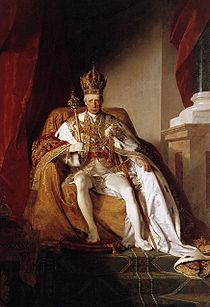 The Austrian Crown Jewels (de
: Insignien und Kleinodien) are kept at the Schatzkammer (Vienna)
, the Imperial Treasury located in the Hofburg Palace. They are a collection of imperial regalia and jewels dating from the 10th century to the 19th. They are one of the biggest and most important collection
of royal objects still today, and reflect more than a thousand years of European history. The treasury can be quantified into six important parts:
The most outstanding objects are the ancient crown of the Holy Roman Emperors and also the insignia of the much later hereditary Austrian emperors. They consist of the 10th Century Imperial Crown of the Holy Roman Empire
as well as the associated Orb, Cross, and Holy Lance, the Imperial Crown
, the Imperial Orb and the mantle of the Austrian Empire
, and the Coronation Robes of the Kingdom of Lombardy-Venetia.
was a Papal gift to King Zvonimir of Croatia
. It is thought likely to have been lost during the Ottoman
invasions of the Balkans
in the 16th century. The distinctive crown adorns several local flags in Croatia
and Dalmatia
.
of Bohemia
(Svatováclavská koruna) are kept in Prague Castle
(Pražský hrad) and are displayed to the public only once every (circa) eight years. Made from gold and a set of precious rubies, sapphires, emeralds and pearls, the 22-carat gold crown weighes 2.475g. The crown is named and dedicated after the Duke and Patron Saint
Wenceslas I
of the Přemyslids dynasty of Bohemia. The crown has an unusual design, with vertical fleurs-de-lis standing at the front, back and sides. Made from gold
and precious stones, its weight is 2.475g.
It was made for King Charles IV
in 1346. Since 1867 it has been stored in St. Vitus Cathedral
of Prague Castle. The jewels have always played an important role as a symbol of Bohemian statehood
.
An ancient Czech legend says that any usurper who places the crown on his head is doomed to die within a year. In the eyes of some this was confirmed during World War II when Reinhard Heydrich
, the Nazi governor of the puppet Protectorate of Bohemia and Moravia
secretly wore them believing himself to be a great king, and was assassinated less than a year later by the Czech underground
.
in Copenhagen
.
, Duke of Åland, Grand Prince
of Lapland
, Lord of Kaleva
and the North" (Suomen ja Karjalan kuningas, Ahvenanmaan herttua, Lapinmaan suuriruhtinas, Kalevan ja Pohjolan isäntä). However, the political situation changed before the new crown could be used in the coronation ceremony of Finland's first independent monarch. By the end of 1918 the uncrowned monarch had abdicated and Finland had adopted a new republican constitution. The crown which exists today was made by goldsmith Teuvo Ypyä in the 1990s, based on the original drawings, and is kept in a museum in Kemi
where it can be seen today. The crown, which is made of silver gilt, consists of a circlet and cap decorated with the arms
in enamel
of various provinces of the realm. Above the circlet
are two arches. Topping the arches is not a Globus Crusiger like in most European crowns, but a gold rampant lion in the form as found in the Coat of arms of Finland
. Inner circumference of the crown is approximately 58 centimeters and it weight about 2 kilograms.
including a set of historic crowns are principally on display in the Galerie d'Apollon of the Louvre
, France's premier museum and former royal palace, and scattered in different museums like the National Library of France, the Basilica of Saint Denis the Natural history museum
, the Ecole des Mines or in Reims
.
to Charles VIII of France
in 1513 Breton independence began to slip away. The last person known to have been crowned in Brittany with their royal crown was Francis III, Duke of Brittany in 1524. He was a member of the ruling dynasty of France and heir to the French throne. He died in 1536 and was succeeded as dauphin by his brother Henry. Henry became King Henry II of France
in 1547 when his father, Francis I
, died. Neither Henry nor any of his successors bothered to get crowned separately as Duke of Brittany but did use the title. The location of the Breton crown is unknown but it is thought to have been moved to Paris at some point. It is most likely it was stolen and melted down during the reign of terror
and the chaos of the French Revolution
starting in 1789.
in 1476 when his army was routed and his baggage train was captured by the Swiss. After the battle it came into the hands of the canton of Basle who hid it. Charles the Bold was killed at the Battle of Nancy
the following year and the hat re-emerged to be sold first to the Fuggers in 1506 and then later to Maximilian I, Holy Roman Emperor
. What happened to the hat after this is not known. Presumably, after this it was kept for a while by successive emperors (particularly Emperor Charles V
who was also the Duke of Burgundy) but at some point it was lost.
, were lost in 1795 when Shah Agha Mohammed Khan of Persia invaded Kartli and ravaged the kingdom.
A replacement crown was commissioned by George XII of Georgia for his coronation in 1798. It was made in Russia and deviated from the traditional Georgian design. It was a closed crown or "corona clausa" made of gold and decorated with 145 diamonds, 58 rubies, 24 emeralds and 16 amethysts. It took the form of a circlet surmounted by ornaments and eight arches. A globe surmounted by a cross rested on the top of the crown.
Following the death of George XII in 1800 the crown was sent to Moscow and deposited in the Kremlin to prevent the coronation of any of his successors. In 1923 it was presented to the National Museum of Georgia in Tbilisi
but in 1930 it was once again sent back to Moscow where this time it was broken up.
A sword of King Heraclius II survives and is kept at the National Museum in Tbilisi.
dating from the 12th century and believed to have been commissioned by David IV of Georgia
was known to have been kept at the monastery at Gelati
after the last king Solomon II
was deposed in 1810 and Imereti occupied by Russia. It is recorded as remaining there until at least 1917 after which it disappears from the record, presumably stolen or destroyed during the communist revolution
, but perhaps hidden.
conquered the Holy Roman Empire. He restructured the many German states and the Duchy of Bavaria
was promoted to a 'Kingdom'. The ruling Wittelsbach
Duke became Maximilian I
became King of Bavaria
.
With his new status, the King ordered new regalia to be made, which included the 35.56 carats (7.1 g) Wittelsbach Diamond
, an oval Old Mine cut blue diamond. The diamond's history dates back to the 1660s and for the most part has been uneventful. The gem was offered with other Bavarian Crown Jewels in a 1931 auction at Christies in London, but apparently it did not sell, nor did it return to its display in Munich. Rumors included one that the stone had been sold illegally in 1932 through a Munich jeweller and had reappeared in Holland. Later research unveiled the fact that the gem had actually been sold in Belgium in 1951 and that it had changed hands again in 1955. In 1958 millions of visitors came to Brussels for the World Exhibition and many must have cast eyes upon the jewelry display which included a large blue diamond. But not one person appeared to have any inkling that this was in fact a missing famous gem: the Wittelsbach Diamond. Credit for the recognition of the true identity of the blue diamond must go to Joseph Komkommer, a leading figure in the Belgian diamond industry and the fourth generation of a diamond family. In January 1962 Mr. Komkommer received a phone call asking him to look at an Old Mine cut diamond with a view of its recutting. When he opened the package he received a shock — a dark blue diamond is among the rarest and most valuable of gems. Mr. Komkommer at once recognized that the diamond was one of historical significance and that it would be a tragedy to recut it. With the assistance of his son, Jacques Komkommer, he identified the diamond as the 'lost' blue diamond that was formerly owned by the House of Wittelsbach. He thereupon formed a consortium of diamond buyers from Belgium and the USA which purchased the diamond, then valued at £180,000. The vendors were the trustees of an estate whose identity remained undisclosed. Finally, the Wittelsbach was acquired by private collector in 1964. It was announced in October 2008 the diamond would be offered for auction at Christies in December. Its original Golden Fleece ornament can be seen today in the Treasury
of the Residenz
Palace in Munich
, a blue glass replica of the Wittelsbach in place of where the diamond was set.
The Bavarian Coronation Set consists of the Crown of Bavaria, the Crown of the Queen (originally made for Maximilian's Queen, Caroline Frederika of Baden), the State Sword, the Royal Orb, and the Royal Sceptre.
. See Schlosshotel Kronberg
.
are kept in Dresden
.
are kept at Hohenzollern Castle in Sigmaringen
, Baden-Württemberg
.
, the orb, the sceptre
, the Holy Lance
, and various other items are kept in the Schatzkammer Treasury in Vienna, Austria.
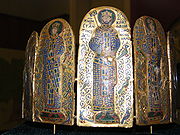
: Magyar Szent Korona, German
: Stephanskrone, Croatian
: Kruna svetoga Stjepana, Latin: Sacra Corona), also known as the Crown of Saint Stephen, was the coronation crown
used by the Kingdom of Hungary
for most of its existence.
The Crown was bound to the Lands of the Crown of Saint Stephen
, (sometimes the Sacra Corona meant the Land, the Carpathian Basin, but it also meant the coronation body, too). No king of Hungary was regarded as having been truly legitimate without being crowned with it. In the history of Hungary
, more than fifty kings were crowned with it (the two kings who were not so crowned were John II Sigismund and Joseph II
).
The Hungarian coronation
insignia consists of the Holy Crown, the sceptre, the orb, and the mantle. Since the twelfth century kings have been crowned with the still extant crown. The orb has the coat-of-arms of Charles I of Hungary
(1310–1342); the other insignia can be linked to Saint Stephen.
It was first called the Holy Crown in 1256. During the 14th century royal power came to be represented not simply by a crown, but by just one specific object: the Holy Crown. This also meant that the Kingdom of Hungary
was a special state: they were not looking for a crown to inaugurate a king, but rather, they were looking for a king for the crown; as written by Crown Guard Péter Révay
. He also depicts that "the Holy Crown is the same for the Hungarians as the Lost Ark
is for the Jewish".
Since 2000, the Holy Crown has been on display in the central Domed Hall of the Hungarian Parliament Building
.
Older pre-conquest items relevant to the ancient gaelic dynasties that once ruled Ireland probably also existed. One example of this is an ancient relic called the Comerford or "Ikerrin" Crown
that was discovered in 1692 but may have since been lost.
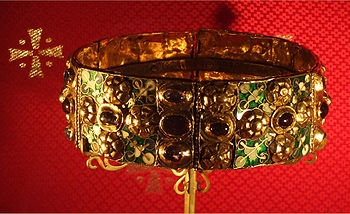 the Iron Crown
of the Lombard Kingdom
, later used as crown of the medieval Kingdom of Italy
and by Napoleon Bonaparte for its coronation as King of Italy, is kept at the Cathedral of Monza
. The coronation robe is kept in the Schatzkammer
in Vienna
, Austria.
The Crown jewels of the Kingdom of Italy (1861–1946)
are in the custody of the Bank of Italy
, due to legal controversy between the Italian Republic and the Savoia
family. It is not clear who is the legal owner. The value of crowns, diadems and various jewels is valued at over €2,5 Billion.
On being made Grand Duke of Tuscany
Cosimo I de' Medici was granted the use of an open radial crown with a representation of the red Florentine fleurs-de-lis with its stamen
s posed between the petals in place of the ray in the front, completely covered with precious stones, by Pope Pius V
, who specified that the circlet of this crown be engraved with an inscription that the crown had been granted him to wear by the Pope. On the actual crown made this inscription was place on the back of the circlet, while the front was actually covered with precious stones like the rest of the crown. A sceptre consisting of a gilt rod topped with a red-enameled globe topped in turn by a red-enameled Florentine Lily also formed part of the regalia of the Grand Dukes of Tuscany. The coronation portrait of the Grand Duke Gian Gaston de' Medici shows the same Florentine grand ducal crown closed with the pearl set arches associated with sovereignty. This crown was also used as the heraldic crown in the arms of the Grand Duchy of Tuscany.
features a heraldic crown on its coat-of-arms, but does not possess any crown jewels or regalia per se.
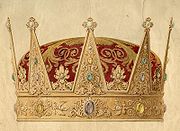 The crown jewels, or royal regalia, of Norway are together with some other old treasures on permanent display in an exhibition next to the Nidaros Cathedral
, in Trondheim
.
Crown Jewels is from the Piast dynasty
and consists of the coronation sword known as the Szczerbiec
. It is currently on display along with other royal items in the Wawel Royal Castle Museum
, Kraków
. Most of the Crown Jewels were plundered by foreign invaders such as the Swedes, Germans and Russians.
One of many royal crowns was made for King August II, Elector of Saxony when he became King of Poland in 1697. Since the original set was stolen, a new set was made for the coronation in Kraków. Today it is displayed in the Royal Castle in Dresden, Germany.
, Brazil
, in the workshop of Don Antonio Gomes da Silva, for King John VI
.
, the Imperial Orb of Catherine the Great, the Imperial Sceptre with the Orlov Diamond, the Shah Diamond
, and others are kept at the Kremlin Armoury
and Diamond Fund
in Moscow.
were created in 1904 for the coronation
of King Peter I. The pieces were made from material that included bronze
of Karađorđe's cannon
. This gesture was symbol
ic because 1904 was the 100th anniversary
of the First Serbian Uprising
. They were made in Paris
by the famous Falise brothers jewellery
company.
imparted coats of arms to those provinces without them and ordered the Slovenian Hat to be placed above the arms of the Slovenian March (later called Lower Carniola
and now a province of Slovenia).
A crown called the "ducal hat" of Carniola still exists.
Much of what did exist into the modern era of the regalia of Spain was destroyed in the Great Fire of Christmas Eve 1734. In the 18th century, King Charles III
ordered a new crown and sceptre to be made. This crown is made of golden silver, and it features half-arches resting on 8 plates bearing the emblems of the Kingdom. The crown and scepter are displayed during the opening of the Cortes
(Parliament
). During ceremonies of accession with a new monarch, the crown and scepter are also present, but the crown itself is never placed on the monarch's head. Today they are kept by the Patrimonio Nacional
(the Crown Heritage).
Today, there are other pieces of jewelry and historically important items that would be considered "crown jewels" in other countries but are not denominated as such in Spain. In terms of jewelry, all of the jewels and tiaras worn by the members of the Spanish Royal Family
are privately owned by them. More historically important elements are kept as pieces of cultural interest in different parts of Spain. For example, the personal crown used by Isabella I of Castile
, her scepters, and her sword, are kept in the Royal Chapel in the Cathedral of Granada. As a consequence, this means that beyond the crown and scepter used during important occasions of the Spanish state, there is no other element of the crown jewels of Spain.
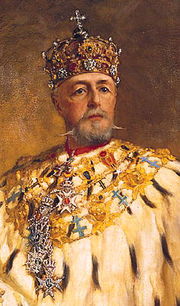
Sweden's Crown Jewels are kept deep in the vaults of the Royal Treasury, underneath the Royal Palace in Stockholm, in a museum which is open to the public. The symbols of Swedish monarchy have not actually been worn since 1907, but are still displayed at weddings, christenings and funerals. Until 1974 the crown jewels were also displayed at the opening of the Riksdag
(Parliament
). Among the oldest objects are the sword of Gustav Vasa and the crown
, orb, sceptre and key of King Erik XIV and numerous other sovereigns.
(the largest diamond ever found before it was cut).
. Apart from an Ampule and Spoon
they all date from after The Restoration of Charles II
in 1661. The ancient crown jewels of England were destroyed by Oliver Cromwell
in 1649 when he established Commonwealth of England
. Among the original crown jewels were Alfred the Great
's State Crown described as "Gould wyerworke set with slight stones and two little bells" which once melted down the gold it contained fetched £248 and 10 shillings, while the little 11th century crown of Queen Edith
only realised £16. It is considered that both these crowns date from the 11th century and the crown described as that of Alfred the Great is, in fact, the Crown of St Edward the Confessor and was renamed thus following the Reformation
. There are conflicting legends that this ancient Crown of England still exists; that it was secreted by some Royalist and its hiding place was never revealed, although official sources state that the gold from this crown was recovered and used to make the present St Edward's Crown.
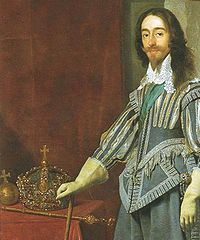 We know the appearance of the later State Crown of Henry VII, which shared their fate, as it is depicted in some of the portraits of Charles I, by Daniel Mytens and Van Dyck. The state crown of Henry VII had five fleurs-de-lis, five crosses and two arches topped by a gold orb and cross. The five fleurs-de-lis each had the enameled image of a saint on the central upright petal (the front fleur-de-lis had an image of the Virgin and Child, while two of the other fleurs-de-lis had images of St George and the dragon) as well as precious stones on the two curved side petals, while the five crosses and the arches were ornamented only with precious stones. The early paintings of Charles I show the front fleur-de-lis, (as, for example, in the painting by Daniel Mytens), while later paintings show the cross on the back of the crown (i. e., the crown shown from the back), which some suggest might have been a concession to Puritan objections to the representation of saints on the state crown.
There were also various sceptres, swords, coronet
s, rings
and an Anglo-Saxon
comb, Some of the pieces were probably reclaimed burial regalia, including those stripped from the rich shrine
of Edward the Confessor in Westminster Abbey by Henry VIII
. Various medieval garments used in past coronation ceremonies were also sold off at the time, an irreparable loss.
In 1660 when a replacement crown called St Edward's Crown was cast for the coronation of Charles II the gold from the aforementioned King Alfred's Crown (the original crown of Edward the Confessor) was used, so presumably even after the various jewels had been melted down strenuous efforts were made to recover their components. The present Imperial Crown of State is decorated with the principal surviving historic jewels, which were recovered at the time of the Restoration. These include Edward the Confessor's Sapphire, which is set in a Maltese cross
at the top of the crown. This sapphire was once part of a ring owned by Edward the Confessor, which was buried with him in 1066. In 1101, when his shrine was opened and the ring removed, the sapphire was re-set in a crown worn by Henry I of England
.
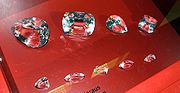 The ruby which adorns the centre of the Imperial Crown of State has a rich and dramatic history. It once belonged to a Sultan of Granada, who was murdered by Pedro the Cruel, King of Castille
. He presented it to Edward, the Black Prince
, in gratitude for his military assistance at the Battle of Navaretto in 1367. It was inherited by Edward's son, Richard II of England
. Richard had it in his possession when he surrendered to his cousin, the future Henry IV of England
in Wales in 1399. Henry later usurped the throne and Richard was murdered. Henry's son, Henry V of England
, wore this ruby in the crown he wore around his helmet at the Battle of Agincourt, a bejewelled gold fleuron was struck of this same crown during the battle and lost. The ruby was similarly worn in the crown of Richard III of England
at the Battle of Bosworth Field
in 1485. When Richard was killed during the fighting it famously rolled under a hawthorn bush to be retrieved by Lord Stanley and placed on the head of the victorious Henry Tudor, later Henry VII of England. The Imperial Crown of State also contains pearls worn as earrings by Queen Elizabeth I of England, these are suspended from the arches of the crown.
. The Sword of State is carried by the sword bearer before the Queens personal representative to the Isle of Man, the Lieutenant Governor, at each meeting of Tynwald day
and dates from not later than the 12th Century. It is popularly said to be the sword of Olaf the Black, who became King of Mann and the Isles in 1226. Recent analysis of the sword has determined that it is a 15th-century design, and probably made in London
. The blade itself is thought to have been fitted in the late 16th century, or 17th century. It is possible that the sword was made for the 1422 Tynwald meeting that was attended by Sir John Stanley
. The sword has a two-edged steel blade, 29 inches long, with a hardwood hilt, 9 inches long, which tapers from the guard to the pommel. The guard is a thin steel band, 11 inches across, surmounted where the guard intersects the blade with shields carrying the 'Three Legs of Man'
, which also appear on the flattened pommel.
', including the Stone of Scone
, are kept in Edinburgh Castle
. They are the oldest surviving crown jewels in the United Kingdom and were a gift by the Pope
to the King of Scotland in the 16th century. They were hidden during the Interregnum
. The Honours of Scotland were almost forgotten following their last use at the coronation of Charles II
in 1651 until they were discovered in a chest inside Edinburgh Castle in the early Nineteenth century.
A 'golden royal crown' pre-dating the existing 'Honours' had been in existence. It is recorded that it was seized by the English authorities following a search of the luggage of the deposed John Balliol as he attempted to leave England and make his way to exile in France following his release from imprisonment in London in 1299. This crown was sent to King Edward I in London where it was probably placed with the English crown jewels at Westminster Abbey
. The later fate of this crown is not entirely clear, but it may have been returned to Scotland during the negotiations between Robert I of Scotland and Edward II of England (following the English defeat at Bannockburn in 1314) or perhaps was returned to Scotland for use in the coronation of Edward Balliol
when he was installed as king of Scots by England in 1332. Nevertheless, it is not in existence today.
.
The original regalia of the Welsh princes have been lost. Llywelyn's coronet
was kept after its capture with the English crown jewels between 1284 and 1649.
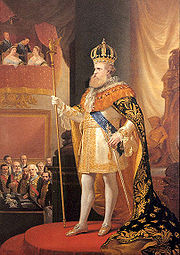 The Imperial Crown of Brazil
alongside with other regalia and mementos of the Brazilian Empire
are kept at the Imperial Museum of Brazil (Museu Imperial) in the former palace of Brazilian emperor Pedro II
, in Petrópolis
, Brazil. Some pieces are also owned by the jewellery collector Aimee de Heeren, former mistress of President Getulio Vargas
.
s of the Kingdom of Hawaii reside within the custody of the Bishop Museum
. The two royals crowns were ordered from England in 1883 during Kalakaua's coronation. Worn once and only by Kalakaua and his Queen Kapiolani, they were damaged by looters during the overthrow but later restored and replace with glass jewels. Copies of the thrones can be seen at Iolani Palace. Some lie in state with the royals at the Royal Mausoleum at Mauna Ala
. Feather cloak and wear are among the oldest of Hawaiian regalias: Nahienaena's Pa'u
, the 180 feather skirt of Nahienaena
and later the funeral attire for the dead monarch while lying in state; Kiwalao's Cloak aka Kamehameha's Cloak, the cloak won by Kamehameha I during his battle with Kiwalao; and Liloa's Kaei
, the feather belt of Liloa, the 14th century King of Hawaii. Also the Kiha-pu or the War Trumpet (Conch Shell) of Kihanuilulumoku
which is one generation older than Liloa's Kaei.
formed the Aztec Empire, a native American empire ruled from Tenochtitlán (present day Mexico City
) by a tlatoani
or "emperor". The ceremonial feathered headdress or quetzalāpanecayōtl that was worn by Montezuma II - the last reigning emperor - was seized by the Spanish Conquistadors in c.1520 and sent back to Charles V
, the King of Spain as a gift. Remarkably it still survives and Montezuma's headdress
can be seen at the Museum of Ethnology (inventory number 10402VO) in Vienna
alongside other ancient Mexican artifact
s.
This Kingdom is an unofficial one, but one that has become an important one to Māori today. The current monarch is Tuheitia Paki
. The crown regalia consists of a cloak.
for his coronation in 1824. The original is housed in the "Museum of Tahiti and the Islands" in Punaauia.
Gemstone
A gemstone or gem is a piece of mineral, which, in cut and polished form, is used to make jewelry or other adornments...
or artifacts of the reigning royal family
Royal family
A royal family is the extended family of a king or queen regnant. The term imperial family appropriately describes the extended family of an emperor or empress, while the terms "ducal family", "grand ducal family" or "princely family" are more appropriate to describe the relatives of a reigning...
of their respective country. They belong to monarchs and are passed to the next sovereign to symbolize the right to rule. They may include crowns
Crown (headgear)
A crown is the traditional symbolic form of headgear worn by a monarch or by a deity, for whom the crown traditionally represents power, legitimacy, immortality, righteousness, victory, triumph, resurrection, honour and glory of life after death. In art, the crown may be shown being offered to...
, sceptre
Sceptre
A sceptre is a symbolic ornamental rod or wand borne in the hand by a ruling monarch as an item of royal or imperial insignia.-Antiquity:...
s, orbs
Globus cruciger
The globus cruciger is an orb topped with a cross , a Christian symbol of authority used throughout the Middle Ages and even today on coins, iconography and royal regalia...
, sword
Sword
A sword is a bladed weapon used primarily for cutting or thrusting. The precise definition of the term varies with the historical epoch or the geographical region under consideration...
s, rings, and other objects. See also: regalia
Regalia
Regalia is Latin plurale tantum for the privileges and the insignia characteristic of a Sovereign.The word stems from the Latin substantivation of the adjective regalis, 'regal', itself from Rex, 'king'...
.
Axum
Mostly incorporated as part of the regalia of the monarchs of the succeeding Ethiopian EmpireEthiopian Empire
The Ethiopian Empire also known as Abyssinia, covered a geographical area that the present-day northern half of Ethiopia and Eritrea covers, and included in its peripheries Zeila, Djibouti, Yemen and Western Saudi Arabia...
(Please see below).
Bangladesh
The most significant objects are: ancient petrified wood (2.5 million years old) collected from lalmai and mainamati; blackstone Naga Darwaza (serpent doorway) of 10th-11th century collected from Bangarh, Dinajpur; mat made of ivory; objects of the Liberation War of Bangladesh; objects used by the martyrs of the language movement; muslin of Dhaka; items of folk art and crafts; coins of emperor Sher Shah; terracotta plaques; sculptures and collection of contemporary art including various types of statues.Burundi
The traditional emblem of the MwamiMwami
Mwami is the chiefly title in Kirundi and Kinyarwanda, the Congolese Nande and Bashi languages, Luhya in Kenya and various other Bantu languages, such as the Tonga language . The word is usually translated as king...
(king
Monarch
A monarch is the person who heads a monarchy. This is a form of government in which a state or polity is ruled or controlled by an individual who typically inherits the throne by birth and occasionally rules for life or until abdication...
) was the Karyenda
Karyenda
The karyenda is a traditional African drum. It was the main symbol of Burundi and its mwami and had semidivine status. The mwami was said to interpret the beatings of the karyenda into rules for the kingdom.- History :...
drum. These holy drums were kept at special drum-sanctuaries throughout the country and were brought out for special ceremonies only. One such place is in Gitega
Gitega
Gitega is the second largest city in Burundi, lying east of Bujumbura. It is the capital of Gitega Province, one of the 17 provinces of Burundi. It is the home of the Burundi National Museum and the Archdiocese of Gitega...
, location of the ibwami royal court.
Central African Republic
See Coronations in AfricaCoronations in Africa
Coronations in Africa are, or have been, held in the following countries:- Ashanti :The Asantehene, the ruler of the Ashanti of Ghana begins his reign by being raised and lowered over the Golden Stool , which is believed to embody the very soul of the Ashanti people, without touching it...
, Emperor Bokassa
Jean-Bédel Bokassa
Jean-Bédel Bokassa , a military officer, was the head of state of the Central African Republic and its successor state, the Central African Empire, from his coup d'état on 1 January 1966 until 20 September 1979...
, Central African Empire
Central African Empire
The Central African Empire was a short-lived, self-declared autocratic monarchy that replaced the Central African Republic and was, in turn, replaced by the restoration of the republic. The empire was formed when Jean-Bédel Bokassa, President of the republic, declared himself Emperor Bokassa I on...
.
The jewels were largely provided by the emperor's political allies in France
France
The French Republic , The French Republic , The French Republic , (commonly known as France , is a unitary semi-presidential republic in Western Europe with several overseas territories and islands located on other continents and in the Indian, Pacific, and Atlantic oceans. Metropolitan France...
as part of that country's infamous Francafrique
Françafrique
Françafrique is a term that refers to France's relationship with Africa. The term was first used in a positive sense by President Félix Houphouët-Boigny of Côte d'Ivoire, but it is now generally understood to denounce the neocolonial relationship France has with its African backyard...
policy, much to the chagrin of many progressive elements both within and without the empire. Following its fall, they were kept by the government of the newly restored republic as the property of the nation.
Egypt
- Ancient Egypt
The treasures of the Pharaoh
Pharaoh
Pharaoh is a title used in many modern discussions of the ancient Egyptian rulers of all periods. The title originates in the term "pr-aa" which means "great house" and describes the royal palace...
s can be seen in the Egyptian Museum
Egyptian Museum
The Museum of Egyptian Antiquities, known commonly as the Egyptian Museum, in Cairo, Egypt, is home to an extensive collection of ancient Egyptian antiquities. It has 120,000 items, with a representative amount on display, the remainder in storerooms....
in Cairo
Cairo
Cairo , is the capital of Egypt and the largest city in the Arab world and Africa, and the 16th largest metropolitan area in the world. Nicknamed "The City of a Thousand Minarets" for its preponderance of Islamic architecture, Cairo has long been a centre of the region's political and cultural life...
and in other museums throughout the world.
- Kingdom of Egypt
Most of the Crown Jewels of the Mehmet Ali
Muhammad Ali of Egypt
Muhammad Ali Pasha al-Mas'ud ibn Agha was a commander in the Ottoman army, who became Wāli, and self-declared Khedive of Egypt and Sudan...
Dynasty
Dynasty
A dynasty is a sequence of rulers considered members of the same family. Historians traditionally consider many sovereign states' history within a framework of successive dynasties, e.g., China, Ancient Egypt and the Persian Empire...
are at the Museum at Abdin Palace in Cairo.
Ethiopia
The principal crowns worn by Ethiopian emperors and empresses regnant are unique in that they are made to be worn over a turban. They usually have the form of a cylinder of gold (although some of the crowns at the Church of Our Lady Mary of ZionChurch of Our Lady Mary of Zion
The Church of Our Virgin Mary of Zion of the Ethiopian Orthodox Church is the most important church in Ethiopia...
in Axum
Axum
Axum or Aksum is a city in northern Ethiopia which was the original capital of the eponymous kingdom of Axum. Population 56,500 . Axum was a naval and trading power that ruled the region from ca. 400 BC into the 10th century...
have the form of a gold cube) with a convex dome on the top with usually some form of cross on a pedestal. These gold cylinders/cubes are composed of openwork, filigree, medallions with images of saints in repousse and settings of precious stones. Fringes of small gold cones on short gold chains are also frequently used in the decoration of these crowns, both on the cylinders/cubes themselves and on the pedestal supporting the cross on the top. Also, convex circular gold medallions/disks of openwork or filigree hanging from chains over the ears are also frequently found on these crowns as well, much like the ornaments that formerly hung from sides of the Byzantine imperial crowns and which hang from the sides and back of the Holy Crown of St. Stephan of Hungary. Some crowns also appear to have a semi-circular platform for additional ornaments attached to the lower front edge of the crown (on two of the crowns of Menelik II these platforms each support a small gold statuette of St. George fighting the dragon). For a photograph of one of Menelik II's crowns; a photograph of Haile Selassie wearing his imperial crown.
Other parts of the Ethiopian regalia include, a jeweled gold sword, a gold and ivory sceptre, a large gold orb with cross, a diamond studded ring, two gold filigreed lances of traditional Ethiopian form, long scarlet robes heavily embroidered in gold. Each of these seven ornaments is given to the emperor after each of his seven anointing on his head, brow and shoulders with seven differently scented holy oils, the last being the crown itself.
These imperial robes consist of a number of tunics and cloaks, of scarlet cloth heavy embroidered in gold and including an elbow length cape with a deeply scalloped edge, fringed in gold (the scallops on either side of the opening on the front being particularly long, giving them the appearance of a western priest's stole) and two large squares of scarlet cloth similarly heavily embroidered and fringed in gold attached to each shoulder. This cape is apparently identical in form to that also worn by the Patriarch and other higher-ranking members of the Ethiopian clergy.
The empress consort also is crowned and given a ring at her at her husband's coronation, although formerly this took place at a semi-public court ceremony three days after the emperor's coronation. Her scarlet imperial mantle has a very similar shape and ornamentation as that of the emperor, but lacking the scalloped edge and shoulder squares. The crowns of empress consorts took a variety of different forms; that of Empress Menen was modeled on the traditional form of European sovereign's crown. Other members of the imperial family and high ranking Ethiopian princes and nobles also had crowns, some resembling the coronets worn by the members of the British peerage at a British coronation, while others have uniquely Ethiopian forms.
Traditionally Ethiopian emperors were crowned at the Church of Our Lady Mary of Zion in Axum, the site of the chapel in which is kept what is believed to be the Ark of the Covenant, in order to validate the new emperor's legitimacy by reinforcing his claim to descent from Menelik I
Menelik I
Menelik I , first Jewish Emperor of Ethiopia, is traditionally believed to be the son of King Solomon of ancient Israel and Makeda, ancient Ethiopia Queen of Sheba. He ruled around 950 BC, according to traditional sources...
, the son of King Solomon and the Queen of Sheba, who is believed to have brought the Ark
Ark of the Covenant
The Ark of the Covenant , also known as the Ark of the Testimony, is a chest described in Book of Exodus as solely containing the Tablets of Stone on which the Ten Commandments were inscribed...
from Jerusalem to Axum. Their imperial crowns were afterwards frequently donated to the church and are kept in the church's treasury — medieval crowns and those of more recent monarchs - although other monarchs have given their crowns and other regalia to various other churches. The Crown Jewels used at the coronation of Emperor Haile Selassie are kept at the museum in the National Palace (formerly the Jubilee Palace) in Addis Ababa
Addis Ababa
Addis Ababa is the capital city of Ethiopia...
.
Ghana and Cameroon
- Ashanti Confederacy
The symbol of the power and authority of the Asantehene or sovereign ruler of the Ashanti) is the sacred Golden Stool
Asante royal thrones
According to legend, Okomfo Anokye caused the famous Asante royal throne known as the Golden Stool to descend from the heavens and land on the lap of the first Asante king, Osei Tutu...
, the Sika 'dwa. It is used for the enthronement and symbolizes the very soul of the Ashanti as a people. It is kept alongside other royal artefacts at the Royal Palace in Kumasi
Kumasi
Kumasi is a city in southern central Ghana's Ashanti region. It is located near Lake Bosomtwe, in the Rain Forest Region about northwest of Accra. Kumasi is approximately north of the Equator and north of the Gulf of Guinea...
.
Madagascar
Ranavalona I
Ranavalona I , also known as Ranavalo-Manjaka I, was a sovereign of the Kingdom of Madagascar from 1828 to 1861...
. It is a large crown made from locally mined gold in c.1890 and is very heavy. In its essential form it followed the pattern of crown associated with a sovereign in European heraldry and had four arches which intersected at the top of the crown, while the circlet was made of openwork and set with precious stones and from the circlet between the arches were triangular leaf-like ornaments which also were set with precious stones (pearls?). One of the two most distinctive features of the crown was a large fan-like ornament generally described as a representation of seven of the spearhead of the traditional Malagasy warrior's spear joined together at the base, but in photographs and paintings it appear to look more like seven large feathers. The second distinctive feature is the representation of a falcon at the very top of the crown in the same position a cross would occupy on the top of an orb in the traditional crown of a Christian sovereign. The falcon
Falcon
A falcon is any species of raptor in the genus Falco. The genus contains 37 species, widely distributed throughout Europe, Asia, and North America....
is a traditional symbol of the Malagasy sovereign. The inside of the crown was filled with a large red velvet cap — red being the color traditionally associated with royalty in Malagasy tradition. This crown (termed "the massive gold state crown") and many other royal artifacts were saved when the Rova (the royal palace and royal tomb complex) in Antananarivo
Antananarivo
Antananarivo , formerly Tananarive , is the capital and largest city in Madagascar. It is also known by its French colonial shorthand form Tana....
burned on November 6, 1995 and are now kept in the Andafivaratra Palace museum nearby. Many of the rescued items have only recently been put on display There is a painting of Radama II standing next to the state crown and another of Queen Ranavalona III - the last monarch - wearing it. A recent picture of the massive gold state crown as it is today in the museum can be seen here: http://img62.imageshack.us/i/lacouronnedetatenormass.jpg/. The smaller queen's crown last worn by Ranavalona III was taken with her into exile, first in Réunion

Réunion
Réunion is a French island with a population of about 800,000 located in the Indian Ocean, east of Madagascar, about south west of Mauritius, the nearest island.Administratively, Réunion is one of the overseas departments of France...
and then later in Algiers
Algiers
' is the capital and largest city of Algeria. According to the 1998 census, the population of the city proper was 1,519,570 and that of the urban agglomeration was 2,135,630. In 2009, the population was about 3,500,000...
, where she eventually died in 1917. The queen's crown can now be seen in the Musée de l'Armée
Musée de l'Armée
The Musée de l'Armée is a museum at Les Invalides in Paris, France. Originally built as a hospital and home for disabled soldiers by Louis XIV, it now houses the Tomb of Napoleon and the museum of the Army of France...
in Paris
Paris
Paris is the capital and largest city in France, situated on the river Seine, in northern France, at the heart of the Île-de-France region...
.
Nigeria
The Nigerian Royal RegaliaNigerian Royal Regalia
Nigeria is a federal republic, one composed of a plethora of governorates and kingdoms. Some of the latter had a huge significance in the history of Nigeria before they were subdued by the British during the colonial era...
is normally kept in the capital city of the respective state. See also List of Nigerian traditional states.
List of some of the kingdoms
Abeokuta
Abeokuta
Abeokuta is the largest city and capital of Ogun State in southwest Nigeria and is situated at , on the Ogun River; 64 miles north of Lagos by railway, or 81 miles by water. As of 2005, Abeokuta and the surrounding area had a population of 593,140....
-
Adamawa
Adamawa Emirate
The Adamawa Emirate is a traditional state located in Fumbina, what is now the Adamawa State, Nigeria, and previously also in the three northern provinces of Cameroon . It was founded by Modibo Adama, a commander of Sheikh Usman dan Fodio, the man who began the Fulani jihad in 1809...
-
Benin -
Borno
Borno State
Borno State is a state in north-eastern Nigeria. Its capital is Maiduguri. The state was formed in 1976 from the split of the North-Eastern State...
-
Edo
Edo
, also romanized as Yedo or Yeddo, is the former name of the Japanese capital Tokyo, and was the seat of power for the Tokugawa shogunate which ruled Japan from 1603 to 1868...
-
Fika -
Gombe
Gombe State
Gombe State, located in the northeastern part of Nigeria, is one of the country's 36 states; its capital is Gombe. The boundaries of the state roughly correspond to those of the Gombe Emirate,a traditional state.[2]...
-
Ibadan
Ibadan
Ibadan is the capital city of Oyo State and the third largest metropolitan area in Nigeria, after Lagos and Kano, with a population of 1,338,659 according to the 2006 census. Ibadan is also the largest metropolitan geographical area...
-
Ijebu
Ijebu
Ijebu was a Yoruba kingdom in pre-colonial Nigeria. It formed around the fifteenth century. According to legend, its ruling dynasty was founded by Obanta of Ile-Ife...
-
Ile Ife -
Ilorin
Ilorin
Ilorin is one of the largest cities in Nigeria and is the capital of Kwara State. As of 2007 it had a population of 847,582.-History:Ilorin was founded by the Yoruba, one of the three largest ethnic groups in Nigeria, in 1450...
-
Jos
Jos
Jos is a city in the Middle Belt of Nigeria.The city has a population of about 1.5 million residents. Popularly called "J-town" or "Jesus Our Saviour" by the residents, it is the administrative capital of Plateau State....
-
Kano
Kano
Kano is a city in Nigeria and the capital of Kano State in Northern Nigeria. Its metropolitan population is the second largest in Nigeria after Lagos. The Kano Urban area covers 137 sq.km and comprises six Local Government Area - Kano Municipal, Fagge, Dala, Gwale, Tarauni and Nassarawa - with a...
-
Katsina
Katsina
Katsina is a city , and a Local Government Area in northern Nigeria, and is the capital of Katsina State. Katsina is located some 160 miles east of the city of Sokoto, and 84 miles northwest of Kano, close to the border with Niger. As of 2007, Katsina's estimated population was 459,022...
-
Lagos
Lagos
Lagos is a port and the most populous conurbation in Nigeria. With a population of 7,937,932, it is currently the third most populous city in Africa after Cairo and Kinshasa, and currently estimated to be the second fastest growing city in Africa...
-
Onitsha
Onitsha
Onitsha is a city, a commercial, educational, and religious center and river port on the eastern bank of the Niger river in Anambra State, southeastern Nigeria....
-
Oshogbo -
Oyo
Oyo Empire
The Oyo Empire was a Yoruba empire of what is today southwestern Nigeria. The empire was established before the 14th century and grew to become one of the largest West African states encountered by European explorers. It rose to preeminence through its possession of a powerful cavalry and wealth...
-
Sokoto -
Tiv
Tiv
Tiv are an ethno-linguistic group or ethnic nation in West Africa. They constitute approximately 2.5% of Nigeria's total population, and number over 5.6 million individuals throughout Nigeria and Cameroon. The Tiv are the 4th largest ethnic group in Nigeria. Tiv language is spoken by about 6...
-
Warri -
Zaria (Zazzau
Zazzau
The Zazzau, also known as the Zaria Emirate is a traditional state with headquarters in the city of Zaria, Kaduna State, Nigeria.As of 2010 the emir was Alhaji Muhammad Bello Idris.-Early Hausa kingdom:...
) -
Zamfara
Rwanda
Close to the old capital of ButareButare
Butare is a city in the Southern Province of Rwanda and capital of Huye district. It was the capital of the former Butare Province, Rwanda, that was dissolved on January 1, 2006....
lies the nearby Nyabisindu, formerly known as Nyanza
Nyanza, Rwanda
Nyanza is a town located in Nyanza in the Southern Province of Rwanda.The old Royal Palace of the Rwandan monarchy is located in the town of Nyanza. It is now the Rwesero Art Museum....
, the traditional seat of Rwanda's monarchy
Rwandan monarchy
The Kingdom of Banyarwanda was founded in the 15th century by a pastoral group, the Tutsi. It occupied approximately the territory controlled by the modern state of Rwanda. The kingdom became gradually subdued by European colonial interests starting in 1890...
. The Royal Palace at Nyanza, a domed construction made with traditional materials, has been restored to its 19th-century state and is now maintained as a museum. Further historical artifacts are kept at the National Museum
National Museum of Rwanda
The National Museum of Rwanda is the national museum of Rwanda. It is located in Butare.It was built in the late 1980s and is a good source of information on the cultural history of the country and the region. It is also known as the site of the murder of Queen Dowager Rosalie Gicanda and several...
in Butare.
Uganda
There are several kingdomsMonarchy
A monarchy is a form of government in which the office of head of state is usually held until death or abdication and is often hereditary and includes a royal house. In some cases, the monarch is elected...
in Uganda
Uganda
Uganda , officially the Republic of Uganda, is a landlocked country in East Africa. Uganda is also known as the "Pearl of Africa". It is bordered on the east by Kenya, on the north by South Sudan, on the west by the Democratic Republic of the Congo, on the southwest by Rwanda, and on the south by...
. During the upheavals after gaining independence
Independence
Independence is a condition of a nation, country, or state in which its residents and population, or some portion thereof, exercise self-government, and usually sovereignty, over its territory....
, the monarchies were abolished. Only in the 1990s were the various kings restored to their thrones. Although they do not wield any political powers anymore, they are still a symbol of unity and continuance to their people. The royal regalia normally consisted of the Royal Drums, and are kept at the various palaces in the capital cities of the Ugandan states.
The kingdoms
Ankole
Ankole
Ankole, also referred to as Nkore, is one of four traditional kingdoms in Uganda. The kingdom is located in the southwestern Uganda, east of Lake Edward. It was ruled by a monarch known as The Mugabe or Omugabe of Ankole. The kingdom was formally abolished in 1967 by the government of President...
-
Buganda
Buganda
Buganda is a subnational kingdom within Uganda. The kingdom of the Ganda people, Buganda is the largest of the traditional kingdoms in present-day Uganda, comprising all of Uganda's Central Region, including the Ugandan capital Kampala, with the exception of the disputed eastern Kayunga District...
-
Bunyoro
Bunyoro
Bunyoro is a kingdom in Western Uganda. It was one of the most powerful kingdoms in East Africa from the 16th to the 19th century. It is ruled by the Omukama of Bunyoro...
-
Busoga
Busoga
Busoga is a traditional Bantu kingdom in present-day Uganda.It is a cultural institution that promotes popular participation and unity among the people of Busoga, through cultural and developmental programs for the improved livelihood of the people of Busoga. It strives for a united people of...
-
Toro
Toro (kingdom)
Toro is one of the four traditional kingdoms located within the borders of Uganda. It was founded in 1830 when Omukama Kaboyo Olimi I, the eldest son of Omukama Nyamutukura Kyebambe III of Bunyoro, rebelled and established his own independent kingdom...
Pooma
The treasures of Burma´s Konbaung DynastyKonbaung dynasty
The Konbaung Dynasty was the last dynasty that ruled Burma from 1752 to 1885. The dynasty created the second largest empire in Burmese history, and continued the administrative reforms begun by the Toungoo dynasty, laying the foundations of modern state of Burma...
are kept in the National Museum in Yangon
Yangon
Yangon is a former capital of Burma and the capital of Yangon Region . Although the military government has officially relocated the capital to Naypyidaw since March 2006, Yangon, with a population of over four million, continues to be the country's largest city and the most important commercial...
. They include items such as the Sihasana Pallanka (Great Lion Throne), and various other items. Other items can be seen in the old capital city of Mandalay
Mandalay
Mandalay is the second-largest city and the last royal capital of Burma. Located north of Yangon on the east bank of the Irrawaddy River, the city has a population of one million, and is the capital of Mandalay Region ....
.
India
The Koh-I-NoorKoh-i-Noor
The Kōh-i Nūr which means "Mountain of Light" in Persian, also spelled Koh-i-noor, Koh-e Noor or Koh-i-Nur, is a 105 carat diamond that was once the largest known diamond in the world. The Kōh-i Nūr originated in the state of Andhra Pradesh in India along with its double, the Darya-ye Noor...
Diamond, mined in India in antiquity, is now set in the Crown of Queen Elizabeth
Crown of Queen Elizabeth
The Crown of the Queen Mother is the platinum crown manufactured for, and worn by, Queen Elizabeth, the former Lady Elizabeth Bowes-Lyon, the queen consort of King George VI of the United Kingdom at their coronation in Westminster Abbey in 1937...
(the deceased Queen Mother).
Brunei
The royal regalia of BruneiBrunei
Brunei , officially the State of Brunei Darussalam or the Nation of Brunei, the Abode of Peace , is a sovereign state located on the north coast of the island of Borneo, in Southeast Asia...
are kept in the Royal Regalia Building, which was completed in 1992, in Bandar Seri Begawan
Bandar Seri Begawan
Bandar Seri Begawan, with an estimated population 140,000 , is the capital and largest city of the Sultanate of Brunei...
. Also housed are the Royal Chariot, the gold and silver ceremonial armoury and the jewel-encrusted crowns.
Cambodia
The jewel encrusted royal crown was lost after the coup by Lon NolLon Nol
Lon Nol was a Cambodian politician and general who served as Prime Minister of Cambodia twice, as well as serving repeatedly as Defense Minister...
in 1970. It bore a similar appearance to the one worn by the King of Thailand. The royal crown of Cambodia was last worn at the coronation of Norodom Sihanouk
Norodom Sihanouk
Norodom Sihanouk regular script was the King of Cambodia from 1941 to 1955 and again from 1993 until his semi-retirement and voluntary abdication on 7 October 2004 in favor of his son, the current King Norodom Sihamoni...
in 1941.
China
The most important item for the assumption of the throne were the Imperial SealsImperial Seal of China
The Imperial Seal of China, or the Heirloom Seal of the Realm is a Chinese jade seal carved out of the He Shi Bi, a historically famous piece of jade.-Creation:...
, which gave the emperor the mandate of heaven
Mandate of Heaven
The Mandate of Heaven is a traditional Chinese philosophical concept concerning the legitimacy of rulers. It is similar to the European concept of the divine right of kings, in that both sought to legitimaze rule from divine approval; however, unlike the divine right of kings, the Mandate of...
authority. These are kept either in the Forbidden City
Forbidden City
The Forbidden City was the Chinese imperial palace from the Ming Dynasty to the end of the Qing Dynasty. It is located in the middle of Beijing, China, and now houses the Palace Museum...
or the National Palace Museum
National Palace Museum
The National Palace Museum is an art museum in Taipei. It is the national museum of the Republic of China, and has a permanent collection of over 677,687 pieces of ancient Chinese artifacts and artworks, making it one of the largest in the world. The collection encompasses over 8,000 years of...
. Numerous crowns, robes, jewels and headwear made especially for coronations and other official events. They usually contain very large Manchurian pearls and most date from the Qing Dynasty
Qing Dynasty
The Qing Dynasty was the last dynasty of China, ruling from 1644 to 1912 with a brief, abortive restoration in 1917. It was preceded by the Ming Dynasty and followed by the Republic of China....
.
Indonesia
IndonesiaIndonesia
Indonesia , officially the Republic of Indonesia , is a country in Southeast Asia and Oceania. Indonesia is an archipelago comprising approximately 13,000 islands. It has 33 provinces with over 238 million people, and is the world's fourth most populous country. Indonesia is a republic, with an...
has various kingdoms and sultanates, all with their own unique history. The most known royal courts
Noble court
The court of a monarch, or at some periods an important nobleman, is a term for the extended household and all those who regularly attended on the ruler or central figure...
are distributed amongst the islands of Java, Madura
Madura
Madura is an Indonesian island off the northeastern coast of Java. The island comprises an area of approximately 4,250 km². Madura is administered as part of the East Java province. It is separated from Java by the narrow Strait of Madura.-History:...
, Bali
Bali
Bali is an Indonesian island located in the westernmost end of the Lesser Sunda Islands, lying between Java to the west and Lombok to the east...
, Sumatra
Sumatra
Sumatra is an island in western Indonesia, westernmost of the Sunda Islands. It is the largest island entirely in Indonesia , and the sixth largest island in the world at 473,481 km2 with a population of 50,365,538...
, Kalimantan
Kalimantan
In English, the term Kalimantan refers to the Indonesian portion of the island of Borneo, while in Indonesian, the term "Kalimantan" refers to the whole island of Borneo....
, Sulawesi
Sulawesi
Sulawesi is one of the four larger Sunda Islands of Indonesia and is situated between Borneo and the Maluku Islands. In Indonesia, only Sumatra, Borneo, and Papua are larger in territory, and only Java and Sumatra have larger Indonesian populations.- Etymology :The Portuguese were the first to...
, and Sumbawa
Sumbawa
Sumbawa is an Indonesian island, located in the middle of the Lesser Sunda Islands chain, with Lombok to the west, Flores to the east, and Sumba further to the southeast. It is in the province of West Nusa Tenggara....
. There are 23 royal courts or more which still exist today, headed either by a sultan
Sultan
Sultan is a title with several historical meanings. Originally, it was an Arabic language abstract noun meaning "strength", "authority", "rulership", and "dictatorship", derived from the masdar سلطة , meaning "authority" or "power". Later, it came to be used as the title of certain rulers who...
or a ruler
Ruler
A ruler, sometimes called a rule or line gauge, is an instrument used in geometry, technical drawing, printing and engineering/building to measure distances and/or to rule straight lines...
. Although today only HM
Majesty
Majesty is an English word derived ultimately from the Latin maiestas, meaning "greatness".- Origin :Originally, during the Roman republic, the word maiestas was the legal term for the supreme status and dignity of the state, to be respected above everything else...
the Sultan of Yogyakarta wields any political influence as the governor
Governor
A governor is a governing official, usually the executive of a non-sovereign level of government, ranking under the head of state...
. In Indonesia the royal courts are either called Kraton or istana
Istana
Istana is a Malay and Indonesian word meaning palace.-Notable Istanas:*Istana Besar, 19th and early 20th century residence of the Sultan of Johor*Istana Bogor, one of presidential palaces of Indonesia in Bogor, West Java...
.
Iran (Persia)
The Imperial Crown Jewels of Iran (alternatively known as the Imperial Crown Jewels of Persia) includes several elaborate Crowns and decorative ThronesThrones
The Thrones are a class of celestial beings mentioned by Paul of Tarsus in and related to the throne of God. They are living symbols of God's justice and authority. According to the New Testament, these high celestial beings are among those Orders at the Christ's service...
, 30 tiaras and numerous aigrette
Aigrette
The term aigrette refers to the tufted crest or head-plumes of the egret, used for adorning a woman's headdress. The word may also identify any similar ornament, in gems. Aigrettes, studded with diamonds and rubies, decorated the turbans of Ottoman sultans or the ceremonial chamfron of their horses...
s, a dozen jewel laden swords and shields, a vast amount of precious unset gemstones, numerous plates and other dining services cast in precious metals and encrusted with gems and several other more unique items (such as a gemstone globe) collected by the Iranian monarchy
History of Iran
The history of Iran has been intertwined with the history of a larger historical region, comprising the area from the Danube River in the west to the Indus River and Jaxartes in the east and from the Caucasus, Caspian Sea, and Aral Sea in the north to the Persian Gulf and the Gulf of Oman and Egypt...
during its 2,500 year existence.
For many centuries the Iranian Crown Jewels
Iranian Crown Jewels
The Imperial crown jewels of Iran include several elaborate crowns and decorative thrones, thirty tiaras, and numerous aigrettes, a dozen bejewelled swords and shields, a vast number of unset precious gems, numerous plates and other dining services cast in precious metals and encrusted with gems,...
were kept in the vaults of the Imperial Treasury. However, in the early 20th century, the first Pahlavi
Pahlavi dynasty
The Pahlavi dynasty consisted of two Iranian/Persian monarchs, father and son Reza Shah Pahlavi and Mohammad Reza Shah Pahlavi The Pahlavi dynasty consisted of two Iranian/Persian monarchs, father and son Reza Shah Pahlavi (reg. 1925–1941) and Mohammad Reza Shah Pahlavi The Pahlavi dynasty ...
Shah transferred ownership of the crown jewels to the state as part of a massive restructuring of the country's financial system. Later in the 1950s his son and successor, Mohammad Reza Pahlavi
Mohammad Reza Pahlavi
Mohammad Rezā Shāh Pahlavi, Shah of Iran, Shah of Persia , ruled Iran from 16 September 1941 until his overthrow by the Iranian Revolution on 11 February 1979...
, decreed that the most spectacular of these items be put on public display at the Central Bank of Iran.
The Imperial crown jewels of Iran is the largest jewelry collection in the world.
Korea
Gojoseon
Gojoseon was an ancient Korean kingdom. Go , meaning "ancient," distinguishes it from the later Joseon Dynasty; Joseon, as it is called in contemporaneous writings, is also romanized as Chosŏn....
to the last Joseon Dynasty
Joseon Dynasty
Joseon , was a Korean state founded by Taejo Yi Seong-gye that lasted for approximately five centuries. It was founded in the aftermath of the overthrow of the Goryeo at what is today the city of Kaesong. Early on, Korea was retitled and the capital was relocated to modern-day Seoul...
. Most of the regalia of these kingdoms, however, have been lost at various points in time, due to the successive rise and fall of the Korean dynasties and the subsequent and frequent raiding of Korean royal tombs and palaces by both Korean and foreign armies. The surviving regalia derive mainly from the Silla
Silla
Silla was one of the Three Kingdoms of Korea, and one of the longest sustained dynasties in...
, Gaya
Gaya confederacy
Gaya was a confederacy of territorial polities in the Nakdong River basin of southern Korea, growing out of the Byeonhan confederacy of the Samhan period.The traditional period used by historians for Gaya chronology is 42–532 CE...
, Baekje
Baekje
Baekje or Paekche was a kingdom located in southwest Korea. It was one of the Three Kingdoms of Korea, together with Goguryeo and Silla....
and Joseon dynasties.
The crowns of Silla are noted for their exquisite gold and jade workmanship, which resulted from the spread of goldsmithing technologies from Egypt
Egypt
Egypt , officially the Arab Republic of Egypt, Arabic: , is a country mainly in North Africa, with the Sinai Peninsula forming a land bridge in Southwest Asia. Egypt is thus a transcontinental country, and a major power in Africa, the Mediterranean Basin, the Middle East and the Muslim world...
and Mesopotamia
Mesopotamia
Mesopotamia is a toponym for the area of the Tigris–Euphrates river system, largely corresponding to modern-day Iraq, northeastern Syria, southeastern Turkey and southwestern Iran.Widely considered to be the cradle of civilization, Bronze Age Mesopotamia included Sumer and the...
to Korea via the Silk Road
Silk Road
The Silk Road or Silk Route refers to a historical network of interlinking trade routes across the Afro-Eurasian landmass that connected East, South, and Western Asia with the Mediterranean and European world, as well as parts of North and East Africa...
. The surviving Silla regalia comprise of many golden crowns, girdles, belts, necklaces, a sword, a dagger, golden shoes, earrings, and more than 35 rings and hairpins. However, the Silla custom was that every king and queen had their own set of regalia, hence the regalia for each monarch was buried with them in their tombs, warranting the creation of many different regalia depending on personal preferences, contemporary fashion and available goldsmithing technology.
The Joseon dynasty regalia comprise of formal jewel-encrusted wigs for the queen and everyday crowns encrusted with various precious gems.
The Baekje regalia are similar to the Silla regalia, but are even more arabesque and consist of magnificent girdles. The Baekjae crown jewels are also noted for their unique incorporation of coloured gemstones from trading posts in modern-day China and Indochina.
During the period of the Great Korean Empire
Korean Empire
The Greater Korean Empire was an empire of Korea that succeeded the Joseon Dynasty.In October 1897, Emperor Gojong proclaimed the new entity at Gyeongungung Palace and oversaw the partially successful modernization of the military, economy, land system, education system, and various industries...
under Emperor Gojong, the imperial family commissioned many brooches, western-style diadems and tiaras to suit western-style clothes. Unfortunately, when the Japan
Empire of Japan
The Empire of Japan is the name of the state of Japan that existed from the Meiji Restoration on 3 January 1868 to the enactment of the post-World War II Constitution of...
colonized the Korean Empire in 1910, such jewels and regalia were lost to Japan.
Japan
("Three Sacred Treasures") consist of the Holy Sword KusanagiKusanagi
is a legendary Japanese sword and one of three Imperial Regalia of Japan. It was originally called but its name was later changed to the more popular Kusanagi-no-Tsurugi .-Legends:...
(草薙剣), the Holy Jewel Yasakani no magatama (八尺瓊曲玉), and the Holy Mirror Yata no kagami
Yata no kagami
is a sacred mirror that is part of the Imperial Regalia of Japan. It is said to be housed in Ise Shrine in Mie prefecture, Japan, although a lack of public access makes this difficult to verify. The Yata no Kagami represents "wisdom" or "honesty," depending on the source. Its name literally means...
(八咫鏡). The sword and the mirror are kept at the Shinto
Shinto
or Shintoism, also kami-no-michi, is the indigenous spirituality of Japan and the Japanese people. It is a set of practices, to be carried out diligently, to establish a connection between present day Japan and its ancient past. Shinto practices were first recorded and codified in the written...
shrines in Nagoya and Ise in Central Japan
Chubu region
The is the central region of Honshū, Japan's main island. Chūbu has a population estimate of 21,886,324 as of 2008.Chūbu, which means "central region", encompasses nine prefectures : Aichi, Fukui, Gifu, Ishikawa, Nagano, Niigata, Shizuoka, Toyama, Yamanashi, and often Mie.It is located directly...
, and the jewel at the Kokyo
Kokyo
is the main residence of the Emperor of Japan. It is a large park-like area located in the Chiyoda area of Tokyo close to Tokyo Station and contains several buildings including the main palace , the emperor left Kyoto Imperial Palace for Tokyo...
Imperial Palace in Tokyo.
The enthronement
Enthronement
An enthronement is a ceremony of inauguration, involving a person—usually a monarch or religious leader—being formally seated for the first time upon their throne. This ritual is generally distinguished from a coronation because there is no crown or other regalia that is physically...
cerenomy is traditionally held in Kyoto
Kyoto
is a city in the central part of the island of Honshū, Japan. It has a population close to 1.5 million. Formerly the imperial capital of Japan, it is now the capital of Kyoto Prefecture, as well as a major part of the Osaka-Kobe-Kyoto metropolitan area.-History:...
. The Imperial Throne is kept at the Gosho Imperial Palace in Kyoto.
Laos
The regalia of LaosLaos
Laos Lao: ສາທາລະນະລັດ ປະຊາທິປະໄຕ ປະຊາຊົນລາວ Sathalanalat Paxathipatai Paxaxon Lao, officially the Lao People's Democratic Republic, is a landlocked country in Southeast Asia, bordered by Burma and China to the northwest, Vietnam to the east, Cambodia to the south and Thailand to the west...
are kept in the Royal Palace Museum in Luang Prabang
Luang Prabang
Luang Prabang, or Louangphrabang , is a city located in north central Laos, where the Nam Khan river meets the Mekong River about north of Vientiane. It is the capital of Luang Prabang Province...
.
Malaysia
The royal regalia of Malaysia are kept in the Istana Negara (National Palace) in Kuala LumpurKuala Lumpur
Kuala Lumpur is the capital and the second largest city in Malaysia by population. The city proper, making up an area of , has a population of 1.4 million as of 2010. Greater Kuala Lumpur, also known as the Klang Valley, is an urban agglomeration of 7.2 million...
. The regalia is worn by HM the King (ms: Yang di-Pertuan Agong
Yang di-Pertuan Agong
The Yang di-Pertuan Agong is the head of state of Malaysia. The office was established in 1957 when the Federation of Malaya gained independence....
), and HM the Queen
Queen regnant
A queen regnant is a female monarch who reigns in her own right, in contrast to a queen consort, who is the wife of a reigning king. An empress regnant is a female monarch who reigns in her own right over an empire....
(Raja Permaisuri Agong
Raja Permaisuri Agong
Raja Permaisuri Agong, or in full, Seri Paduka Baginda Raja Permaisuri Agong, is the title given to the Queen of Malaysia, consort of the Yang di-Pertuan Agong.The holders of this office have been:...
) during certain ceremonies, such as the election
Election
An election is a formal decision-making process by which a population chooses an individual to hold public office. Elections have been the usual mechanism by which modern representative democracy operates since the 17th century. Elections may fill offices in the legislature, sometimes in the...
as head of state
Head of State
A head of state is the individual that serves as the chief public representative of a monarchy, republic, federation, commonwealth or other kind of state. His or her role generally includes legitimizing the state and exercising the political powers, functions, and duties granted to the head of...
, HM's birthday, awards ceremonies, and the calling of parliament.
They consist of the Tengkolok Diraja (Royal Head Dress), the Queen's Gendik Diraja (Royal Tiara), the Keris Panjang Diraja (Royal Long Kris or Keris of State), the Kris Pendek Diraja (Royal Short Keris), the Cogan Alam dan Cogan Agama (Sceptre of the Universe and Sceptre of Religion), the Cokmar (Maces
Ceremonial mace
The ceremonial mace is a highly ornamented staff of metal or wood, carried before a sovereign or other high official in civic ceremonies by a mace-bearer, intended to represent the official's authority. The mace, as used today, derives from the original mace used as a weapon...
), the Pedang Keris Panjang dan Sundang (Royal sword, long Keris
Kris
The kris or keris is an asymmetrical dagger or sword nowadays most strongly associated with the culture of Indonesia, but also indigenous to Malaysia, Southern Thailand and Brunei. It is known as kalis in the southern Philippines. The kris is famous for its distinctive wavy blade , but many have...
and sword Keris), the Payung Ubur-ubur Kuning dan Tombak Berambu (Yellow-fringed umbrella
Umbrella
An umbrella or parasol is a canopy designed to protect against rain or sunlight. The term parasol usually refers to an item designed to protect from the sun; umbrella refers to a device more suited to protect from rain...
and tassled lances), and the Pending Diraja (Royal Waist Buckle).
Malaysia is a federal state, consisting of thirteen states and two federal territories. Out of these, nine are monarchies headed by sultans. Royal regalia and other items of the rulers are kept in the respective palaces and courts. These are:
Johore -
Kedah
Kedah
Kedah is a state of Malaysia, located in the northwestern part of Peninsular Malaysia. The state covers a total area of over 9,000 km², and it consists of the mainland and Langkawi. The mainland has a relatively flat terrain, which is used to grow rice...
-
Kelantan
Kelantan
Kelantan is a state of Malaysia. The capital and royal seat is Kota Bharu. The Arabic honorific of the state is Darul Naim, ....
-
Negeri Sembilan
Negeri Sembilan
Negeri Sembilan, one of the 13 states that constitutes Malaysia, lies on the western coast of Peninsular Malaysia, just south of Kuala Lumpur and borders Selangor on the north, Pahang in the east, and Malacca and Johor to the south....
-
Pahang
Pahang
Pahang is the third largest state in Malaysia, after Sarawak and Sabah, occupying the huge Pahang River river basin. It is bordered to the north by Kelantan, to the west by Perak, Selangor, Negeri Sembilan, to the south by Johor and to the east by Terengganu and the South China Sea.Its state...
-
Perak
Perak
Perak , one of the 13 states of Malaysia, is the second largest state in the Peninsular Malaysia bordering Kedah and Yala Province of Thailand to the north, Penang to the northwest, Kelantan and Pahang to the east, Selangor the Strait of Malacca to the south and west.Perak means silver in Malay...
-
Perlis
Perlis
Perlis is the smallest state in Malaysia. It lies at the northern part of the west coast of Peninsular Malaysia and has Satun and Songkhla Provinces of Thailand on its northern border. It is bordered by the state of Kedah to the south...
-
Selangor
Selangor
Selangor also known by its Arabic honorific, Darul Ehsan, or "Abode of Sincerity") is one of the 13 states of Malaysia. It is on the west coast of Peninsular Malaysia and is bordered by Perak to the north, Pahang to the east, Negeri Sembilan to the south and the Strait of Malacca to the west...
-
Terengganu
Terengganu
Terengganu is a sultanate and constitutive state of federal Malaysia. The state is also known by its Arabic honorific, Darul Iman...
Thailand (Siam)
The Royal Regalia, Royal Utensils, and the Royal Eight Weapons of Sovereignty comprise a total of 28 items. The Royal Regalia consists of the Great Crown of VictoryGreat Crown of Victory
The Great Crown of Victory or Phra Maha Phichai Mongkut is one of the Royal Regalia of Thailand. Made of gold in the reign of King Buddha Yodfa Chulaloke or Rama I in 1782, it is 66 centimeters high and weighs 7.3 kg, and enamelled in red and green. Thanks to King Mongkut or Rama IV, the Great...
, the Sword of Victory
Sword of Victory
The Sword of Victory or Phra Saeng Khan Chai Si is one of the Royal Regalia of the King of Thailand. The Sword represents the military might and power of the King. The hilt has a length of 25.4 centimeters with the blade measuring 64.5 centimeters. When placed in the scabbard the sword has a total...
, the Royal Staff
Royal Staff
The Royal Staff or Than Phra Kon is one of the five Royal Regalia of the King of Thailand. The staff is made of cassia wood and enclosed at both ends in gold. It has a length of 118 cm. One end has a knob and there are three tines at the foot...
, the Royal Fan (or Flywhisk), and the Royal Slippers.
The 28 items are traditionally presented to the Kings of Thailand at their coronation
Coronation
A coronation is a ceremony marking the formal investiture of a monarch and/or their consort with regal power, usually involving the placement of a crown upon their head and the presentation of other items of regalia...
ceremonies. They are kept, amongst other royal items, at the Grand Palace in Bangkok
Bangkok
Bangkok is the capital and largest urban area city in Thailand. It is known in Thai as Krung Thep Maha Nakhon or simply Krung Thep , meaning "city of angels." The full name of Bangkok is Krung Thep Mahanakhon Amon Rattanakosin Mahintharayutthaya Mahadilok Phop Noppharat Ratchathani Burirom...
.
Vietnam
The signs of the imperial power of the Nguyen Emperors were the Great Imperial Seal and the Sword. When Bảo ĐạiBảo Đài
Bảo Đài is a commune and village in Lục Nam District, Bac Giang Province, in northeastern Vietnam.-References:...
, the last Emperor of Vietnam, abdicated in August 1945 at Huế
Hue
Hue is one of the main properties of a color, defined technically , as "the degree to which a stimulus can be describedas similar to or different from stimuli that are described as red, green, blue, and yellow,"...
he is recorded to have surrendered the royal insignia to the new communist authorities. What happened to them after this is not known, but presumably they took them away, perhaps to Hanoi
Hanoi
Hanoi , is the capital of Vietnam and the country's second largest city. Its population in 2009 was estimated at 2.6 million for urban districts, 6.5 million for the metropolitan jurisdiction. From 1010 until 1802, it was the most important political centre of Vietnam...
. In 1949 the former emperor became "Head of State" of the State of Vietnam
State of Vietnam
The State of Vietnam was a state that claimed authority over all of Vietnam during the First Indochina War, and replaced the Provisional Central Government of Vietnam . The provisional government was a brief transitional administration between colonial Cochinchina and an independent state...
, was not crowned, and was ousted by his Prime Minister Ngo Dinh Diem
Ngo Dinh Diem
Ngô Đình Diệm was the first president of South Vietnam . In the wake of the French withdrawal from Indochina as a result of the 1954 Geneva Accords, Diệm led the effort to create the Republic of Vietnam. Accruing considerable U.S. support due to his staunch anti-Communism, he achieved victory in a...
in a fraudulent 1955 referendum, and spent the rest of his life in exile. In 1968 the city of Huế was the scene of Battle of Huefierce fighting between the communist People's Army of Vietnam and Vietcong and US Marines and the Army of the Republic of Vietnam
Army of the Republic of Vietnam
The Army of the Republic of Viet Nam , sometimes parsimoniously referred to as the South Vietnamese Army , was the land-based military forces of the Republic of Vietnam , which existed from October 26, 1955 until the fall of Saigon on April 30, 1975...
. The imperial palace was bombed, ransacked and almost completely destroyed. It is possible that the imperial insignia, if they had not been removed and taken elsewhere in 1945, were lost or destroyed at this time.
Albania
The crown of SkanderbegSkanderbeg
George Kastrioti Skanderbeg or Gjergj Kastrioti Skënderbeu , widely known as Skanderbeg , was a 15th-century Albanian lord. He was appointed as the governor of the Sanjak of Dibra by the Ottomans in 1440...
, believed to have been created for the medieval king in the 15th century, was smuggled out of Albania by members of the Kastrioti
Kastrioti
The Kastrioti family were a noble Albanian family in the middle Ages. The Kastrioti dynasty originally hailed from the Dibër region in Albania...
family following the occupation of Albania by the Ottoman Empire
Ottoman Empire
The Ottoman EmpireIt was usually referred to as the "Ottoman Empire", the "Turkish Empire", the "Ottoman Caliphate" or more commonly "Turkey" by its contemporaries...
. The crown eventually found its way into the collections of the Habsburg
Habsburg
The House of Habsburg , also found as Hapsburg, and also known as House of Austria is one of the most important royal houses of Europe and is best known for being an origin of all of the formally elected Holy Roman Emperors between 1438 and 1740, as well as rulers of the Austrian Empire and...
dynasty (via an Italian noble family) and currently resides in the Schatzkammer
Schatzkammer
Schatzkammer is a German word which translates as Treasure Room, and is a term also used in English for the collection of treasures, especially those in precious metals and jewels, of a ruler or other collector, kept in a secure room, often in the basement of a palace or castle...
in Vienna
Vienna
Vienna is the capital and largest city of the Republic of Austria and one of the nine states of Austria. Vienna is Austria's primary city, with a population of about 1.723 million , and is by far the largest city in Austria, as well as its cultural, economic, and political centre...
, Austria. In 1931, King Zog of Albania made a rare foreign tour and visited Vienna in an unsuccessful attempt to repatriate the crown, presumably for a future coronation (he considered giving himself the regnal name "Skanderbeg III"). Several replicas exist in Albania, most notably at Kruja Castle
Kruja castle
The Krujë castle is a castle in the city of Krujë, Albania and the center of Skanderbeg's battle against the Ottoman Turks. The castle withstood three massive sieges from the Turks, with garrisons usually no larger than 2,000-3,000 men. Mehmed II "The Conqueror" himself could not break the...
.
Austria
German language
German is a West Germanic language, related to and classified alongside English and Dutch. With an estimated 90 – 98 million native speakers, German is one of the world's major languages and is the most widely-spoken first language in the European Union....
: Insignien und Kleinodien) are kept at the Schatzkammer (Vienna)
Schatzkammer (Vienna)
The Imperial Treasury in Vienna, Austria is located in the Hofburg with its entrance at the Schweizerhof , the oldest part of the palace rebuilt in a Renaissance style under Emperor Ferdinand I...
, the Imperial Treasury located in the Hofburg Palace. They are a collection of imperial regalia and jewels dating from the 10th century to the 19th. They are one of the biggest and most important collection
Collection (museum)
A museum is distinguished by a collection of often unique objects that forms the core of its activities for exhibitions, education, research, etc. This differentiates it from an archive or library, where the contents may be more paper-based, replaceable and less exhibition oriented...
of royal objects still today, and reflect more than a thousand years of European history. The treasury can be quantified into six important parts:
- The Insignia of the Austrian Hereditary Homage
- The Austrian EmpireAustrian EmpireThe Austrian Empire was a modern era successor empire, which was centered on what is today's Austria and which officially lasted from 1804 to 1867. It was followed by the Empire of Austria-Hungary, whose proclamation was a diplomatic move that elevated Hungary's status within the Austrian Empire...
- The Habsburg-Lorraine Household Treasure
- The Holy Roman EmpireHoly Roman EmpireThe Holy Roman Empire was a realm that existed from 962 to 1806 in Central Europe.It was ruled by the Holy Roman Emperor. Its character changed during the Middle Ages and the Early Modern period, when the power of the emperor gradually weakened in favour of the princes...
- The Burgundian Inheritance and the Order of the Golden FleeceOrder of the Golden FleeceThe Order of the Golden Fleece is an order of chivalry founded in Bruges by Philip III, Duke of Burgundy in 1430, to celebrate his marriage to the Portuguese princess Infanta Isabella of Portugal, daughter of King John I of Portugal. It evolved as one of the most prestigious orders in Europe...
- The Ecclesiastical Treasury
The most outstanding objects are the ancient crown of the Holy Roman Emperors and also the insignia of the much later hereditary Austrian emperors. They consist of the 10th Century Imperial Crown of the Holy Roman Empire
Imperial Crown of the Holy Roman Empire
The Imperial Crown , is the hoop crown of the King of the Romans, the rulers of the German Kingdom, since the High Middle Ages. Most of the kings were crowned with it. It was made probably somewhere in Western Germany, either under Otto I , by Conrad II or Conrad III during the late 10th and early...
as well as the associated Orb, Cross, and Holy Lance, the Imperial Crown
Imperial crown
An Imperial Crown is a crown used for the coronation of emperors.- Imperial Crowns with Mitre :-Legal usage:Throughout the Commonwealth Realms, The Crown is an abstract concept which represents the legal authority for the existence of any government...
, the Imperial Orb and the mantle of the Austrian Empire
Austrian Empire
The Austrian Empire was a modern era successor empire, which was centered on what is today's Austria and which officially lasted from 1804 to 1867. It was followed by the Empire of Austria-Hungary, whose proclamation was a diplomatic move that elevated Hungary's status within the Austrian Empire...
, and the Coronation Robes of the Kingdom of Lombardy-Venetia.
- The archducal hat is kept today at the Augustinian AbbeyAbbeyAn abbey is a Catholic monastery or convent, under the authority of an Abbot or an Abbess, who serves as the spiritual father or mother of the community.The term can also refer to an establishment which has long ceased to function as an abbey,...
of KlosterneuburgKlosterneuburgKlosterneuburg is an attractive small town in Lower Austria, Austria with a population of 24,442.It is located on the Danube, immediately north of Vienna, from which it is separated by the Kahlenberg and Leopoldsberg hills...
, in Lower AustriaLower AustriaLower Austria is the northeasternmost state of the nine states in Austria. The capital of Lower Austria since 1986 is Sankt Pölten, the most recently designated capital town in Austria. The capital of Lower Austria had formerly been Vienna, even though Vienna is not officially part of Lower Austria...
. See archducal hatArchducal hatThe archducal hat is the insignia of the Archduchy of Austria. It is kept in Klosterneuburg Monastery in perpetuity.-History:The first archducal coronet was shown on a portrait of Rudolf IV, Duke of Austria, though this coronet probably never existed...
for further information. - The ducal hat of Styria is kept at the Landesmuseum JoanneumLandesmuseum JoanneumThe Universalmuseum Joanneum is a multidisciplinary museum in Styria, Austria. It has galleries and collections in many subject areas including Archaeology, Geology, Palaeontology, Mineralogy, Botany, Zoology, History, Art and Folk Culture...
in GrazGrazThe more recent population figures do not give the whole picture as only people with principal residence status are counted and people with secondary residence status are not. Most of the people with secondary residence status in Graz are students...
, StyriaDuchy of StyriaThe history of Styria concerns the region roughly corresponding to the modern Austrian state of Styria and the Slovene region of Styria from its settlement by Germans and Slavs in the Dark Ages until the present...
.
Croatia
The 11th century Crown of ZvonimirCrown of Zvonimir
The Crown of Zvonimir was bestowed on King Dmitar Zvonimir of Croatia in 1076 by the papal legate. Zvonimir ruled Croatia until 1089 after which the crown was used in the coronation of his successor Stjepan II and presumably by the numerous Hungarian monarchs after the unification of Croatia and...
was a Papal gift to King Zvonimir of Croatia
Kingdom of Croatia (medieval)
The Kingdom of Croatia , also known as the Kingdom of the Croats , was a medieval kingdom covering most of what is today Croatia and Bosnia and Herzegovina in the Balkans.Established in 925, it ruled as a sovereign state for almost two centuries...
. It is thought likely to have been lost during the Ottoman
Ottoman Empire
The Ottoman EmpireIt was usually referred to as the "Ottoman Empire", the "Turkish Empire", the "Ottoman Caliphate" or more commonly "Turkey" by its contemporaries...
invasions of the Balkans
Balkans
The Balkans is a geopolitical and cultural region of southeastern Europe...
in the 16th century. The distinctive crown adorns several local flags in Croatia
Croatia
Croatia , officially the Republic of Croatia , is a unitary democratic parliamentary republic in Europe at the crossroads of the Mitteleuropa, the Balkans, and the Mediterranean. Its capital and largest city is Zagreb. The country is divided into 20 counties and the city of Zagreb. Croatia covers ...
and Dalmatia
Dalmatia
Dalmatia is a historical region on the eastern coast of the Adriatic Sea. It stretches from the island of Rab in the northwest to the Bay of Kotor in the southeast. The hinterland, the Dalmatian Zagora, ranges from fifty kilometers in width in the north to just a few kilometers in the south....
.
Czech Republic (Bohemia)
The jewels (cs: korunovační klenoty), and the Crown of Saint WenceslasCrown of Saint Wenceslas
Crown of Saint Wenceslas is the part of Bohemian crown jewels made in 1347. The eleventh king of Bohemia from the House of Luxembourg, and Holy Roman Emperor Charles IV had it made for his coronation and forthwith he dedicated it to the first patron saint of the country St...
of Bohemia
Bohemia
Bohemia is a historical region in central Europe, occupying the western two-thirds of the traditional Czech Lands. It is located in the contemporary Czech Republic with its capital in Prague...
(Svatováclavská koruna) are kept in Prague Castle
Prague Castle
Prague Castle is a castle in Prague where the Kings of Bohemia, Holy Roman Emperors and presidents of Czechoslovakia and the Czech Republic have had their offices. The Czech Crown Jewels are kept here...
(Pražský hrad) and are displayed to the public only once every (circa) eight years. Made from gold and a set of precious rubies, sapphires, emeralds and pearls, the 22-carat gold crown weighes 2.475g. The crown is named and dedicated after the Duke and Patron Saint
Patron saint
A patron saint is a saint who is regarded as the intercessor and advocate in heaven of a nation, place, craft, activity, class, clan, family, or person...
Wenceslas I
Wenceslaus I, Duke of Bohemia
Wenceslaus I , or Wenceslas I, was the duke of Bohemia from 921 until his assassination in 935, purportedly in a plot by his own brother, Boleslav the Cruel....
of the Přemyslids dynasty of Bohemia. The crown has an unusual design, with vertical fleurs-de-lis standing at the front, back and sides. Made from gold
Gold
Gold is a chemical element with the symbol Au and an atomic number of 79. Gold is a dense, soft, shiny, malleable and ductile metal. Pure gold has a bright yellow color and luster traditionally considered attractive, which it maintains without oxidizing in air or water. Chemically, gold is a...
and precious stones, its weight is 2.475g.
It was made for King Charles IV
Charles IV, Holy Roman Emperor
Charles IV , born Wenceslaus , was the second king of Bohemia from the House of Luxembourg, and the first king of Bohemia to also become Holy Roman Emperor....
in 1346. Since 1867 it has been stored in St. Vitus Cathedral
St. Vitus Cathedral
Saint Vitus' Cathedral is as a Roman Catholic cathedral in Prague, and the seat of the Archbishop of Prague. The full name of the cathedral is St. Vitus, St. Wenceslas and St. Adalbert Cathedral...
of Prague Castle. The jewels have always played an important role as a symbol of Bohemian statehood
Sovereign state
A sovereign state, or simply, state, is a state with a defined territory on which it exercises internal and external sovereignty, a permanent population, a government, and the capacity to enter into relations with other sovereign states. It is also normally understood to be a state which is neither...
.
An ancient Czech legend says that any usurper who places the crown on his head is doomed to die within a year. In the eyes of some this was confirmed during World War II when Reinhard Heydrich
Reinhard Heydrich
Reinhard Tristan Eugen Heydrich , also known as The Hangman, was a high-ranking German Nazi official.He was SS-Obergruppenführer and General der Polizei, chief of the Reich Main Security Office and Stellvertretender Reichsprotektor of Bohemia and Moravia...
, the Nazi governor of the puppet Protectorate of Bohemia and Moravia
Protectorate of Bohemia and Moravia
The Protectorate of Bohemia and Moravia was the majority ethnic-Czech protectorate which Nazi Germany established in the central parts of Bohemia, Moravia and Czech Silesia in what is today the Czech Republic...
secretly wore them believing himself to be a great king, and was assassinated less than a year later by the Czech underground
Czech resistance to Nazi occupation
Czech resistance to German Nazi occupation during World War II is a scarcely documented subject, by and large a result of little formal resistance and an effective German policy that deterred acts of resistance or annihilated organizations of resistance...
.
Denmark
The crown jewels and other royal regalia of Denmark are kept in Rosenborg CastleRosenborg Castle
Rosenborg Castle is a renaissance castle located in the centre of Copenhagen, Denmark. The castle was originally built as a country summerhouse in 1606 and is an example of Christian IV's many architectural projects...
in Copenhagen
Copenhagen
Copenhagen is the capital and largest city of Denmark, with an urban population of 1,199,224 and a metropolitan population of 1,930,260 . With the completion of the transnational Øresund Bridge in 2000, Copenhagen has become the centre of the increasingly integrating Øresund Region...
.
Finland
In 1918 a unique crown was designed in Finland for the proposed "King of Finland and KareliaKarelia
Karelia , the land of the Karelian peoples, is an area in Northern Europe of historical significance for Finland, Russia, and Sweden...
, Duke of Åland, Grand Prince
Grand Prince
The title grand prince or great prince ranked in honour below emperor and tsar and above a sovereign prince .Grand duke is the usual and established, though not literal, translation of these terms in English and Romance languages, which do not normally use separate words for a "prince" who reigns...
of Lapland
Lapland (region)
Lapland is a region in northern Fennoscandia, largely within the Arctic Circle. It streches across Norway, Sweden, Finland and the Kola Peninsula . On the North it is bounded by the Barents Sea, on the West by the Norwegian Sea and on the East by the White Sea...
, Lord of Kaleva
Kaleva (Tampere)
Kaleva is an eastern part of the city of Tampere, Finland. The population of Kaleva is about 10,000 people .The most notable landmark is the Kaleva Church, built between 1959 and 1966....
and the North" (Suomen ja Karjalan kuningas, Ahvenanmaan herttua, Lapinmaan suuriruhtinas, Kalevan ja Pohjolan isäntä). However, the political situation changed before the new crown could be used in the coronation ceremony of Finland's first independent monarch. By the end of 1918 the uncrowned monarch had abdicated and Finland had adopted a new republican constitution. The crown which exists today was made by goldsmith Teuvo Ypyä in the 1990s, based on the original drawings, and is kept in a museum in Kemi
Kemi
Kemi is a town and municipality of Finland. It is located very near the city of Tornio. It was founded in 1869 by royal decree, because of its proximity to a deep water harbour....
where it can be seen today. The crown, which is made of silver gilt, consists of a circlet and cap decorated with the arms
Coat of arms
A coat of arms is a unique heraldic design on a shield or escutcheon or on a surcoat or tabard used to cover and protect armour and to identify the wearer. Thus the term is often stated as "coat-armour", because it was anciently displayed on the front of a coat of cloth...
in enamel
Vitreous enamel
Vitreous enamel, also porcelain enamel in U.S. English, is a material made by fusing powdered glass to a substrate by firing, usually between 750 and 850 °C...
of various provinces of the realm. Above the circlet
Circlet
A circlet is a crown with neither arches nor a cap ....
are two arches. Topping the arches is not a Globus Crusiger like in most European crowns, but a gold rampant lion in the form as found in the Coat of arms of Finland
Coat of arms of Finland
The coat of arms of Finland is a crowned lion on a red field, the right forepaw replaced with an armoured hand brandishing a sword, trampling on a saber with the hindpaws...
. Inner circumference of the crown is approximately 58 centimeters and it weight about 2 kilograms.
France
The surviving French Crown Jewels and main RegaliaRegalia
Regalia is Latin plurale tantum for the privileges and the insignia characteristic of a Sovereign.The word stems from the Latin substantivation of the adjective regalis, 'regal', itself from Rex, 'king'...
including a set of historic crowns are principally on display in the Galerie d'Apollon of the Louvre
Louvre
The Musée du Louvre – in English, the Louvre Museum or simply the Louvre – is one of the world's largest museums, the most visited art museum in the world and a historic monument. A central landmark of Paris, it is located on the Right Bank of the Seine in the 1st arrondissement...
, France's premier museum and former royal palace, and scattered in different museums like the National Library of France, the Basilica of Saint Denis the Natural history museum
Muséum national d'histoire naturelle
The Muséum national d'Histoire naturelle is the National Museum of Natural History in Paris, France.- History :The museum was formally founded on 10 June 1793, during the French Revolution...
, the Ecole des Mines or in Reims
Reims
Reims , a city in the Champagne-Ardenne region of France, lies east-northeast of Paris. Founded by the Gauls, it became a major city during the period of the Roman Empire....
.
Brittany
The Dukes of Brittany were crowned with a royal crown said to be that of the former kings of Brittany in a ceremony designed to emphasise the royal ancestry and sovereignty of the reigning duke. After the marriage of Anne of BrittanyAnne of Brittany
Anne, Duchess of Brittany , also known as Anna of Brittany , was a Breton ruler, who was to become queen to two successive French kings. She was born in Nantes, Brittany, and was the daughter of Francis II, Duke of Brittany and Margaret of Foix. Her maternal grandparents were Queen Eleanor of...
to Charles VIII of France
Charles VIII of France
Charles VIII, called the Affable, , was King of France from 1483 to his death in 1498. Charles was a member of the House of Valois...
in 1513 Breton independence began to slip away. The last person known to have been crowned in Brittany with their royal crown was Francis III, Duke of Brittany in 1524. He was a member of the ruling dynasty of France and heir to the French throne. He died in 1536 and was succeeded as dauphin by his brother Henry. Henry became King Henry II of France
Henry II of France
Henry II was King of France from 31 March 1547 until his death in 1559.-Early years:Henry was born in the royal Château de Saint-Germain-en-Laye, near Paris, the son of Francis I and Claude, Duchess of Brittany .His father was captured at the Battle of Pavia in 1525 by his sworn enemy,...
in 1547 when his father, Francis I
Francis I of France
Francis I was King of France from 1515 until his death. During his reign, huge cultural changes took place in France and he has been called France's original Renaissance monarch...
, died. Neither Henry nor any of his successors bothered to get crowned separately as Duke of Brittany but did use the title. The location of the Breton crown is unknown but it is thought to have been moved to Paris at some point. It is most likely it was stolen and melted down during the reign of terror
Reign of Terror
The Reign of Terror , also known simply as The Terror , was a period of violence that occurred after the onset of the French Revolution, incited by conflict between rival political factions, the Girondins and the Jacobins, and marked by mass executions of "enemies of...
and the chaos of the French Revolution
French Revolution
The French Revolution , sometimes distinguished as the 'Great French Revolution' , was a period of radical social and political upheaval in France and Europe. The absolute monarchy that had ruled France for centuries collapsed in three years...
starting in 1789.
Burgundy
The Dukes of Burgundy had a jewelled "Ducal Hat" rather than a formal crown which they wore for ceremonial occasions. This hat was lost by Charles the Bold at the Battle of GrandsonBattle of Grandson
The Battle of Grandson, took place on 2 March 1476, was part of the Burgundian Wars, and resulted in a major defeat for Charles the Bold, Duke of Burgundy.- Siege of Grandson, February 1476 :...
in 1476 when his army was routed and his baggage train was captured by the Swiss. After the battle it came into the hands of the canton of Basle who hid it. Charles the Bold was killed at the Battle of Nancy
Battle of Nancy
The Battle of Nancy was the final and decisive battle of the Burgundian Wars, fought outside the walls of Nancy on 5 January 1477 between Charles the Bold, Duke of Burgundy, and René II, Duke of Lorraine...
the following year and the hat re-emerged to be sold first to the Fuggers in 1506 and then later to Maximilian I, Holy Roman Emperor
Maximilian I, Holy Roman Emperor
Maximilian I , the son of Frederick III, Holy Roman Emperor and Eleanor of Portugal, was King of the Romans from 1486 and Holy Roman Emperor from 1493 until his death, though he was never in fact crowned by the Pope, the journey to Rome always being too risky...
. What happened to the hat after this is not known. Presumably, after this it was kept for a while by successive emperors (particularly Emperor Charles V
Charles V, Holy Roman Emperor
Charles V was ruler of the Holy Roman Empire from 1519 and, as Charles I, of the Spanish Empire from 1516 until his voluntary retirement and abdication in favor of his younger brother Ferdinand I and his son Philip II in 1556.As...
who was also the Duke of Burgundy) but at some point it was lost.
Kartli-Kakheti
There is no information about any crown for Kartli-Kakheti predating 1798 although presumably there was one. It is likely that the ancient crown or crowns, traditionally kept at MtskhetaMtskheta
Mtskheta , one of the oldest cities of the country of Georgia , is located approximately 20 kilometers north of Tbilisi at the confluence of the Aragvi and Kura rivers. The city is now the administrative centre of the Mtskheta-Mtianeti region...
, were lost in 1795 when Shah Agha Mohammed Khan of Persia invaded Kartli and ravaged the kingdom.
A replacement crown was commissioned by George XII of Georgia for his coronation in 1798. It was made in Russia and deviated from the traditional Georgian design. It was a closed crown or "corona clausa" made of gold and decorated with 145 diamonds, 58 rubies, 24 emeralds and 16 amethysts. It took the form of a circlet surmounted by ornaments and eight arches. A globe surmounted by a cross rested on the top of the crown.
Following the death of George XII in 1800 the crown was sent to Moscow and deposited in the Kremlin to prevent the coronation of any of his successors. In 1923 it was presented to the National Museum of Georgia in Tbilisi
Tbilisi
Tbilisi is the capital and the largest city of Georgia, lying on the banks of the Mt'k'vari River. The name is derived from an early Georgian form T'pilisi and it was officially known as Tiflis until 1936...
but in 1930 it was once again sent back to Moscow where this time it was broken up.
A sword of King Heraclius II survives and is kept at the National Museum in Tbilisi.
Imereti
The Crown of ImeretiImereti
Imereti is a province in Georgia situated along the middle and upper reaches of the Rioni river. It consists of the following Georgian administrative-territorial units:#Kutaisi #Baghdati region#Vani region#Zestafoni region...
dating from the 12th century and believed to have been commissioned by David IV of Georgia
David IV of Georgia
David IV "the Builder", also known as David II , of the Bagrationi dynasty, was a king of Georgia from 1089 until his death in 1125....
was known to have been kept at the monastery at Gelati
Gelati Monastery
The Monastery of Gelati is a monastic complex near Kutaisi, Imereti, western Georgia. It contains the Church of the Virgin founded by the King of Georgia David the Builder in 1106, and the 13th-century churches of St George and St Nicholas....
after the last king Solomon II
Solomon II of Imereti
Solomon II , of the Bagrationi Dynasty, was the last King of Imereti from 1789 to 1790 and from 1792 until his deposition by the Imperial Russian government in 1810....
was deposed in 1810 and Imereti occupied by Russia. It is recorded as remaining there until at least 1917 after which it disappears from the record, presumably stolen or destroyed during the communist revolution
Georgian Communist party
Georgia was incorporated into the Soviet Union as the Georgian Soviet Socialist Republic after 25 February 1921 when the Red Army entered its capital Tbilisi and installed a communist government led by Georgian Bolshevik Filipp Makharadze. After the 1924 August Uprising in Georgia the country was...
, but perhaps hidden.
Baden
Grand Duke Karl II of Baden was given a crown by Napoleon I, the cousin by marriage of his wife, Stéphanie Louise Adrienne de Beauharnais. The design of the crown follows the general pattern typical of a European royal crown, but is unique in that the circlet and the arches of the crown are made of gold fabric rather than of a precious metal such as gold or silver-gilt. The precious stones which ornament this crown are in metal settings which are attached to this circlet and these arches much like brooches pinned to fabric. At the intersection of the four arches of this crown is a blue enameled orb and a cross both set with diamonds. The cap on the inside of the crown is made of the same crimson velvet which also covers the reverse sides of the arches of the crown.Bavaria
In 1806, Napoleon I of FranceNapoleon I of France
Napoleon Bonaparte was a French military and political leader during the latter stages of the French Revolution.As Napoleon I, he was Emperor of the French from 1804 to 1815...
conquered the Holy Roman Empire. He restructured the many German states and the Duchy of Bavaria
Duchy of Bavaria
The Duchy of Bavaria was the only one of the stem duchies from the earliest days of East Francia and the Kingdom of Germany to preserve both its name and most of its territorial extent....
was promoted to a 'Kingdom'. The ruling Wittelsbach
Wittelsbach
The Wittelsbach family is a European royal family and a German dynasty from Bavaria.Members of the family served as Dukes, Electors and Kings of Bavaria , Counts Palatine of the Rhine , Margraves of Brandenburg , Counts of Holland, Hainaut and Zeeland , Elector-Archbishops of Cologne , Dukes of...
Duke became Maximilian I
Maximilian I, Elector of Bavaria
Maximilian I, Duke/Elector of Bavaria , called "the Great", was a Wittelsbach ruler of Bavaria and a prince-elector of the Holy Roman Empire. His reign was marked by the Thirty Years' War ....
became King of Bavaria
Bavaria
Bavaria, formally the Free State of Bavaria is a state of Germany, located in the southeast of Germany. With an area of , it is the largest state by area, forming almost 20% of the total land area of Germany...
.
With his new status, the King ordered new regalia to be made, which included the 35.56 carats (7.1 g) Wittelsbach Diamond
Wittelsbach Diamond
The Wittelsbach-Graff Diamond is a fancy deep-blue diamond with internally flawless clarity. Laurence Graff purchased the Wittelsbach Diamond in 2008 for £16.4 million Sterling. In 2010, Graff revealed he had had the diamond cut by three diamond cutters to remove flaws. The diamond was now...
, an oval Old Mine cut blue diamond. The diamond's history dates back to the 1660s and for the most part has been uneventful. The gem was offered with other Bavarian Crown Jewels in a 1931 auction at Christies in London, but apparently it did not sell, nor did it return to its display in Munich. Rumors included one that the stone had been sold illegally in 1932 through a Munich jeweller and had reappeared in Holland. Later research unveiled the fact that the gem had actually been sold in Belgium in 1951 and that it had changed hands again in 1955. In 1958 millions of visitors came to Brussels for the World Exhibition and many must have cast eyes upon the jewelry display which included a large blue diamond. But not one person appeared to have any inkling that this was in fact a missing famous gem: the Wittelsbach Diamond. Credit for the recognition of the true identity of the blue diamond must go to Joseph Komkommer, a leading figure in the Belgian diamond industry and the fourth generation of a diamond family. In January 1962 Mr. Komkommer received a phone call asking him to look at an Old Mine cut diamond with a view of its recutting. When he opened the package he received a shock — a dark blue diamond is among the rarest and most valuable of gems. Mr. Komkommer at once recognized that the diamond was one of historical significance and that it would be a tragedy to recut it. With the assistance of his son, Jacques Komkommer, he identified the diamond as the 'lost' blue diamond that was formerly owned by the House of Wittelsbach. He thereupon formed a consortium of diamond buyers from Belgium and the USA which purchased the diamond, then valued at £180,000. The vendors were the trustees of an estate whose identity remained undisclosed. Finally, the Wittelsbach was acquired by private collector in 1964. It was announced in October 2008 the diamond would be offered for auction at Christies in December. Its original Golden Fleece ornament can be seen today in the Treasury
Treasury
A treasury is either*A government department related to finance and taxation.*A place where currency or precious items is/are kept....
of the Residenz
Residenz
Residenz is a very formal, otherwise obsolete, German word for "place of living". It is in particular used to denote the building or town where a sovereign ruler resided, therefore also carrying a similar meaning as the modern expressions seat of government or capital...
Palace in Munich
Munich
Munich The city's motto is "" . Before 2006, it was "Weltstadt mit Herz" . Its native name, , is derived from the Old High German Munichen, meaning "by the monks' place". The city's name derives from the monks of the Benedictine order who founded the city; hence the monk depicted on the city's coat...
, a blue glass replica of the Wittelsbach in place of where the diamond was set.
The Bavarian Coronation Set consists of the Crown of Bavaria, the Crown of the Queen (originally made for Maximilian's Queen, Caroline Frederika of Baden), the State Sword, the Royal Orb, and the Royal Sceptre.
Hesse
Most of the crown jewels were stolen and destroyed by US army officers at the end of World War IIWorld War II
World War II, or the Second World War , was a global conflict lasting from 1939 to 1945, involving most of the world's nations—including all of the great powers—eventually forming two opposing military alliances: the Allies and the Axis...
. See Schlosshotel Kronberg
Schlosshotel Kronberg
Schlosshotel Kronberg in Kronberg im Taunus was built between 1889 and 1894 for the dowager German Empress Victoria, Princess Royal and named in honour of her husband, Frederick III, German Emperor....
.
Mecklenburg
MISSINGSaxony
The treasures of the Kings of SaxonySaxony
The Free State of Saxony is a landlocked state of Germany, contingent with Brandenburg, Saxony Anhalt, Thuringia, Bavaria, the Czech Republic and Poland. It is the tenth-largest German state in area, with of Germany's sixteen states....
are kept in Dresden
Dresden
Dresden is the capital city of the Free State of Saxony in Germany. It is situated in a valley on the River Elbe, near the Czech border. The Dresden conurbation is part of the Saxon Triangle metropolitan area....
.
Prussia
The crown and the insignia of the Kingdom of PrussiaKingdom of Prussia
The Kingdom of Prussia was a German kingdom from 1701 to 1918. Until the defeat of Germany in World War I, it comprised almost two-thirds of the area of the German Empire...
are kept at Hohenzollern Castle in Sigmaringen
Sigmaringen
Sigmaringen is a town in southern Germany, in the state of Baden-Württemberg. Situated on the upper Danube, it is the capital of the Sigmaringen district....
, Baden-Württemberg
Baden-Württemberg
Baden-Württemberg is one of the 16 states of Germany. Baden-Württemberg is in the southwestern part of the country to the east of the Upper Rhine, and is the third largest in both area and population of Germany's sixteen states, with an area of and 10.7 million inhabitants...
.
Holy Roman Empire
The Imperial Regalia like the Holy Crown of CharlemagneCharlemagne
Charlemagne was King of the Franks from 768 and Emperor of the Romans from 800 to his death in 814. He expanded the Frankish kingdom into an empire that incorporated much of Western and Central Europe. During his reign, he conquered Italy and was crowned by Pope Leo III on 25 December 800...
, the orb, the sceptre
Sceptre
A sceptre is a symbolic ornamental rod or wand borne in the hand by a ruling monarch as an item of royal or imperial insignia.-Antiquity:...
, the Holy Lance
Holy Lance
The Holy Lance is the name given to the lance that pierced Jesus' side as he hung on the cross in John's account of the Crucifixion.-Biblical references:The lance is mentioned only in the Gospel of John and not in any of the...
, and various other items are kept in the Schatzkammer Treasury in Vienna, Austria.
Greece
- The crown of the Byzantine emperor Nicephorus Phocas (963-969) at the Great Lavra monastery on Mount Athos.
- The enameled plates from the crown of the Byzantine emperor Constantine IX MonomachosConstantine IX MonomachosConstantine IX Monomachos, Latinized as Constantine IX Monomachus , c. 1000 – January 11, 1055, reigned as Byzantine emperor from June 11, 1042 to January 11, 1055. He had been chosen by the Empress Zoe as a husband and co-emperor in 1042, although he had been exiled for conspiring...
, 1042–1055, made c. 1042, survive in Budapest.
Hungary
The "Holy Crown of Hungary" HungarianHungarian language
Hungarian is a Uralic language, part of the Ugric group. With some 14 million speakers, it is one of the most widely spoken non-Indo-European languages in Europe....
: Magyar Szent Korona, German
German language
German is a West Germanic language, related to and classified alongside English and Dutch. With an estimated 90 – 98 million native speakers, German is one of the world's major languages and is the most widely-spoken first language in the European Union....
: Stephanskrone, Croatian
Croatian language
Croatian is the collective name for the standard language and dialects spoken by Croats, principally in Croatia, Bosnia and Herzegovina, the Serbian province of Vojvodina and other neighbouring countries...
: Kruna svetoga Stjepana, Latin: Sacra Corona), also known as the Crown of Saint Stephen, was the coronation crown
Coronation crown
A coronation crown is a crown used by a monarch when being crowned. In some monarchies, monarchs did not wear the one crown but had a number of crowns for different occasions; a coronation crown for the moment of coronation, and a state crown for general usage in state ceremonial...
used by the Kingdom of Hungary
Kingdom of Hungary
The Kingdom of Hungary comprised present-day Hungary, Slovakia and Croatia , Transylvania , Carpatho Ruthenia , Vojvodina , Burgenland , and other smaller territories surrounding present-day Hungary's borders...
for most of its existence.
The Crown was bound to the Lands of the Crown of Saint Stephen
Lands of the Crown of Saint Stephen
The historical term Lands of the Crown of Saint Stephen was used to denote a group of territories connected to the Kingdom of Hungary within Austria-Hungary...
, (sometimes the Sacra Corona meant the Land, the Carpathian Basin, but it also meant the coronation body, too). No king of Hungary was regarded as having been truly legitimate without being crowned with it. In the history of Hungary
History of Hungary
Hungary is a country in central Europe. Its history under this name dates to the early Middle Ages, when the Pannonian Basin was colonized by the Magyars, a semi-nomadic people from what is now central-northern Russia...
, more than fifty kings were crowned with it (the two kings who were not so crowned were John II Sigismund and Joseph II
Joseph II, Holy Roman Emperor
Joseph II was Holy Roman Emperor from 1765 to 1790 and ruler of the Habsburg lands from 1780 to 1790. He was the eldest son of Empress Maria Theresa and her husband, Francis I...
).
The Hungarian coronation
Coronation of the Hungarian monarch
The Coronation of the Hungarian Monarch was a ceremony in which the King or Queen of the Kingdom of Hungary was formally crowned and invested with regalia...
insignia consists of the Holy Crown, the sceptre, the orb, and the mantle. Since the twelfth century kings have been crowned with the still extant crown. The orb has the coat-of-arms of Charles I of Hungary
Charles I of Hungary
Charles I , also known as Charles Robert , was the first King of Hungary and Croatia of the House of Anjou. He was also descended from the old Hungarian Árpád dynasty. His claim to the throne of Hungary was contested by several pretenders...
(1310–1342); the other insignia can be linked to Saint Stephen.
It was first called the Holy Crown in 1256. During the 14th century royal power came to be represented not simply by a crown, but by just one specific object: the Holy Crown. This also meant that the Kingdom of Hungary
Kingdom of Hungary
The Kingdom of Hungary comprised present-day Hungary, Slovakia and Croatia , Transylvania , Carpatho Ruthenia , Vojvodina , Burgenland , and other smaller territories surrounding present-day Hungary's borders...
was a special state: they were not looking for a crown to inaugurate a king, but rather, they were looking for a king for the crown; as written by Crown Guard Péter Révay
Péter Révay
Baron Péter Révay de Szklabina et Blathnicza was a Hungarian nobleman, Royal Crown Guard for the Holy Crown of Hungary, poet, state official, soldier and historian.He is the grandson of Ferenc Révay.-Life:Péter Révay was a member of an old Révay family from...
. He also depicts that "the Holy Crown is the same for the Hungarians as the Lost Ark
Ark of the Covenant
The Ark of the Covenant , also known as the Ark of the Testimony, is a chest described in Book of Exodus as solely containing the Tablets of Stone on which the Ten Commandments were inscribed...
is for the Jewish".
Since 2000, the Holy Crown has been on display in the central Domed Hall of the Hungarian Parliament Building
Hungarian Parliament Building
The Hungarian Parliament Building is the seat of the National Assembly of Hungary, one of Europe's oldest legislative buildings, a notable landmark of Hungary and a popular tourist destination of Budapest. It lies in Lajos Kossuth Square, on the bank of the Danube, in Budapest...
.
Ireland
The Crown Jewels of Ireland were heavily jewelled insignia of the Most Illustrious Order of St Patrick. They were worn by the sovereign at the installation of knights of that order, the Irish equivalent of the English Order of the Garter and the Scottish Order of the Thistle.Older pre-conquest items relevant to the ancient gaelic dynasties that once ruled Ireland probably also existed. One example of this is an ancient relic called the Comerford or "Ikerrin" Crown
Comerford Crown
The Comerford Crown or Ikerrin Crown is the name of a lost archaeological relic probably dating from the Bronze Age that was in the possession of the noble Comerford Family from its discovery in 1692 in Ireland, later removal from Ireland, and possible loss by that family while living in exile in...
that was discovered in 1692 but may have since been lost.
Italy
- Lombardy
Iron Crown of Lombardy
The Iron Crown of Lombardy is both a reliquary and one of the most ancient royal insignia of Europe. The crown became one of the symbols of the Kingdom of Lombards and later of the medieval Kingdom of Italy...
of the Lombard Kingdom
Kingdom of the Lombards
The Kingdom of the Lombards or Lombard Kingdom was an early medieval state, with its capital in Pavia, established by the Lombards on the Italian Peninsula between 568-569 and 774 .Effective control by the rulers of both the major areas that constituted the...
, later used as crown of the medieval Kingdom of Italy
Kingdom of Italy (medieval)
The Kingdom of Italy was a political entity under control of Carolingian dynasty of Francia first, after the defeat of the Lombards in 774. It was finally incorporated as a part of the Holy Roman Empire in 962....
and by Napoleon Bonaparte for its coronation as King of Italy, is kept at the Cathedral of Monza
Monza
Monza is a city and comune on the river Lambro, a tributary of the Po, in the Lombardy region of Italy some 15 km north-northeast of Milan. It is the capital of the Province of Monza and Brianza. It is best known for its Grand Prix motor racing circuit, the Autodromo Nazionale Monza.On June...
. The coronation robe is kept in the Schatzkammer
Schatzkammer
Schatzkammer is a German word which translates as Treasure Room, and is a term also used in English for the collection of treasures, especially those in precious metals and jewels, of a ruler or other collector, kept in a secure room, often in the basement of a palace or castle...
in Vienna
Vienna
Vienna is the capital and largest city of the Republic of Austria and one of the nine states of Austria. Vienna is Austria's primary city, with a population of about 1.723 million , and is by far the largest city in Austria, as well as its cultural, economic, and political centre...
, Austria.
- Kings of Italy
The Crown jewels of the Kingdom of Italy (1861–1946)
Kingdom of Italy (1861–1946)
The Kingdom of Italy was a state forged in 1861 by the unification of Italy under the influence of the Kingdom of Sardinia, which was its legal predecessor state...
are in the custody of the Bank of Italy
Banca d'Italia
Banca d'Italia is the central bank of Italy and part of the European System of Central Banks. It is located in Palazzo Koch, Roma, via Nazionale...
, due to legal controversy between the Italian Republic and the Savoia
House of Savoy
The House of Savoy was formed in the early 11th century in the historical Savoy region. Through gradual expansion, it grew from ruling a small county in that region to eventually rule the Kingdom of Italy from 1861 until the end of World War II, king of Croatia and King of Armenia...
family. It is not clear who is the legal owner. The value of crowns, diadems and various jewels is valued at over €2,5 Billion.
- Grand Dukes of Tuscany
On being made Grand Duke of Tuscany
Grand Duchy of Tuscany
The Grand Duchy of Tuscany was a central Italian monarchy that existed, with interruptions, from 1569 to 1859, replacing the Duchy of Florence. The grand duchy's capital was Florence...
Cosimo I de' Medici was granted the use of an open radial crown with a representation of the red Florentine fleurs-de-lis with its stamen
Stamen
The stamen is the pollen producing reproductive organ of a flower...
s posed between the petals in place of the ray in the front, completely covered with precious stones, by Pope Pius V
Pope Pius V
Pope Saint Pius V , born Antonio Ghislieri , was Pope from 1566 to 1572 and is a saint of the Catholic Church. He is chiefly notable for his role in the Council of Trent, the Counter-Reformation, and the standardization of the Roman liturgy within the Latin Church...
, who specified that the circlet of this crown be engraved with an inscription that the crown had been granted him to wear by the Pope. On the actual crown made this inscription was place on the back of the circlet, while the front was actually covered with precious stones like the rest of the crown. A sceptre consisting of a gilt rod topped with a red-enameled globe topped in turn by a red-enameled Florentine Lily also formed part of the regalia of the Grand Dukes of Tuscany. The coronation portrait of the Grand Duke Gian Gaston de' Medici shows the same Florentine grand ducal crown closed with the pearl set arches associated with sovereignty. This crown was also used as the heraldic crown in the arms of the Grand Duchy of Tuscany.
Monaco
MonacoMonaco
Monaco , officially the Principality of Monaco , is a sovereign city state on the French Riviera. It is bordered on three sides by its neighbour, France, and its centre is about from Italy. Its area is with a population of 35,986 as of 2011 and is the most densely populated country in the...
features a heraldic crown on its coat-of-arms, but does not possess any crown jewels or regalia per se.
Norway
Nidaros Cathedral
Nidaros Cathedral is a Church of Norway cathedral located in the city of Trondheim in Sør-Trøndelag county, Norway. It was the cathedral of the Roman Catholic Archdiocese of Nidaros from its establishment in 1152 until its abolition in 1537. Since the Reformation, it has been the cathedral of the...
, in Trondheim
Trondheim
Trondheim , historically, Nidaros and Trondhjem, is a city and municipality in Sør-Trøndelag county, Norway. With a population of 173,486, it is the third most populous municipality and city in the country, although the fourth largest metropolitan area. It is the administrative centre of...
.
- King's Crown:
- King's Sceptre:
- King's Orb: https://info.ovf-nett.no/index.gan?id=27162&subid=0
- Anointing Horn:
- Sword of State:
- Queen's Crown:
- Queen's Sceptre:
- Queen's Orb: https://info.ovf-nett.no/index.gan?id=27168&subid=0
- Crown Prince's Crown:
Poland
The only surviving part of the PolishPoland
Poland , officially the Republic of Poland , is a country in Central Europe bordered by Germany to the west; the Czech Republic and Slovakia to the south; Ukraine, Belarus and Lithuania to the east; and the Baltic Sea and Kaliningrad Oblast, a Russian exclave, to the north...
Crown Jewels is from the Piast dynasty
Piast dynasty
The Piast dynasty was the first historical ruling dynasty of Poland. It began with the semi-legendary Piast Kołodziej . The first historical ruler was Duke Mieszko I . The Piasts' royal rule in Poland ended in 1370 with the death of king Casimir the Great...
and consists of the coronation sword known as the Szczerbiec
Szczerbiec
Szczerbiec is the coronation sword that was used in crowning ceremonies of most kings of Poland from 1320 to 1764. It is currently on display in the treasure vault of the Royal Wawel Castle in Kraków as the only preserved piece of Polish Crown Jewels...
. It is currently on display along with other royal items in the Wawel Royal Castle Museum
Wawel
Wawel is an architectural complex erected over many centuries atop a limestone outcrop on the left bank of the Vistula River in Kraków, Poland, at an altitude of 228 metres above the sea level. It is a place of great significance to the Polish people. The Royal Castle with an armoury and the...
, Kraków
Kraków
Kraków also Krakow, or Cracow , is the second largest and one of the oldest cities in Poland. Situated on the Vistula River in the Lesser Poland region, the city dates back to the 7th century. Kraków has traditionally been one of the leading centres of Polish academic, cultural, and artistic life...
. Most of the Crown Jewels were plundered by foreign invaders such as the Swedes, Germans and Russians.
One of many royal crowns was made for King August II, Elector of Saxony when he became King of Poland in 1697. Since the original set was stolen, a new set was made for the coronation in Kraków. Today it is displayed in the Royal Castle in Dresden, Germany.
Portugal
The royal Crown of Portugal was made in 1817. It was created in Rio de JaneiroRio de Janeiro
Rio de Janeiro , commonly referred to simply as Rio, is the capital city of the State of Rio de Janeiro, the second largest city of Brazil, and the third largest metropolitan area and agglomeration in South America, boasting approximately 6.3 million people within the city proper, making it the 6th...
, Brazil
Brazil
Brazil , officially the Federative Republic of Brazil , is the largest country in South America. It is the world's fifth largest country, both by geographical area and by population with over 192 million people...
, in the workshop of Don Antonio Gomes da Silva, for King John VI
John VI of Portugal
John VI John VI John VI (full name: João Maria José Francisco Xavier de Paula Luís António Domingos Rafael; (13 May 1767 – 10 March 1826) was King of the United Kingdom of Portugal, Brazil and the Algarves (later changed to just King of Portugal and the Algarves, after Brazil was recognized...
.
Romania
The Romanian Crown Jewels consist of three crowns: the Steel Crown, the Crown of Queen Elisabeta and the Crown of Queen Maria; and two scepters: the Scepter of Ferdinand I and the Scepter of Carol II. They are displayed at The National History Museum of Romania in Bucharest.Russia
The coronation regalia, such as the Imperial Crown of RussiaImperial Crown of Russia
The Imperial Crown of Russia, also known as the Great Imperial Crown, is the crown that was used by the Emperors of Russia until the abolition of the monarchy in 1917. The Great Imperial Crown was first used in a coronation by Catherine II, and was last used at the coronation of Nicholas II...
, the Imperial Orb of Catherine the Great, the Imperial Sceptre with the Orlov Diamond, the Shah Diamond
Shah Diamond
The Diamond Shah is 88.7 carat , 3 cm long, yellow diamond, extremely clear. This diamond was found in Central India, probably in 1450....
, and others are kept at the Kremlin Armoury
Kremlin Armoury
The Kremlin Armory is one of the oldest museums of Moscow, established in 1808 and located in the Moscow Kremlin .The Kremlin Armoury originated as the royal arsenal in 1508. Until the transfer of the court to St Petersburg, the Armoury was in charge of producing, purchasing and storing weapons,...
and Diamond Fund
Diamond Fund
Diamond Fund is a unique collection of gems, jewelry and natural nuggets, stored and exhibited in Moscow Kremlin, Russia. The Fund dates back to the Russian Crown treasury instituted by emperor Peter I of Russia in 1719.-Imperial treasury:...
in Moscow.
- Barmas of Old Ryazan, late 12th-early 13th century:,
- Monomakh's CapMonomakh's CapMonomakh's Cap , also called the Golden Cap , is one of the symbols of Russian autocracy, and is the oldest of the crowns currently exhibited at the Kremlin Armoury...
, late 13th-early 14th century: - The Crown of Kazan Tzardom of Tsar Ivan IVIvan IV of RussiaIvan IV Vasilyevich , known in English as Ivan the Terrible , was Grand Prince of Moscow from 1533 until his death. His long reign saw the conquest of the Khanates of Kazan, Astrakhan, and Siberia, transforming Russia into a multiethnic and multiconfessional state spanning almost one billion acres,...
, mid. 16th century: - Ivory throne of Tsar Ivan IV, Western Europe, 16th century:
- Orb of Tsar Boris GodunovBoris GodunovBoris Fyodorovich Godunov was de facto regent of Russia from c. 1585 to 1598 and then the first non-Rurikid tsar from 1598 to 1605. The end of his reign saw Russia descend into the Time of Troubles.-Early years:...
, Western Europe, end of the 16th century: - Sceptre of Tsar Boris Godunov, Western Europe, end of the 16th century.
- Golden throne of Tsar Boris Godunov, Persia, before 1604:
- Golden chain of Tsar Boris Godunov, Western Europe, the 16th century.
- State helmet of Prince Fyodor Mstislavsky, Turkey, the 16th century:
- State helmets ("Jericho caps") of Tsar Michael FyodorovichMichael of RussiaMikhail I Fyodorovich Romanov Mikhail Fedorovich Romanov was the first Russian Tsar of the house of Romanov. He was the son of Feodor Nikitich Romanov and Xenia...
, 1620-s, master N.Davydov: and - Crown of Tsar Michael Fyodorovich, 1627:
- Golden chain of Tsar Michael Fyodorovich, 1nd half of the 17th century.
- Golden throne of Tsar Michael Fyodorovich, Persia, before 1642:
- Orb of Tsar Alexis Mikhailovich, Turkey, 1662:
- Sceptre of Tsar Alexis Mikhailovich, Turkey, 1658:
- Barmas of Tsar Alexis Mikhailovich, Turkey, 2nd half of the 17th century.
- Diamond throne of Tsar Alexis Mikhailovich, Persia, 1659:
- Staff of Tsar Alexis Mikhailovich, Turkey, mid. 17th century:
- Pectoral cross with a chain of Tsar Theodore AlekseevichFeodor III of RussiaFeodor III Alexeevich of Russia was the Tsar of all Russia between 1676 and 1682....
, 1662. - "Cap of Monomakh" of the second set of Tsar Peter I Alekseevich, 1682:
- Sceptre of Tsar Peter I Alekseevich, 1680s.
- Pectoral cross of Tsar Peter I Alekseevich, 1680s.
- Diamond crown of Tsar Peter I Alekseevich, 1680s:
- Diamond crown of Tsar Ivan V AlekseevichIvan V of RussiaIvan V Alekseyevich Romanov was a joint Tsar of Russia who co-reigned between 1682 and 1696. He was the youngest son of Alexis I of Russia and Maria Miloslavskaya. His reign was only formal, since he had serious physical and mental disabilities...
, 1680s: - Altabas crown of the third set of Tsar Ivan V Alekseevich, 1684:
- Silver double throne of Tsars Ivan V Alekseevich and Peter I Alekseevich, 1684:
- State shield, the late 17th century.
- Crown of Empress Catherine ICatherine I of RussiaCatherine I , the second wife of Peter the Great, reigned as Empress of Russia from 1725 until her death.-Life as a peasant woman:The life of Catherine I was said by Voltaire to be nearly as extraordinary as that of Peter the Great himself. There are no documents that confirm her origins. Born on...
, 1724, (only wreck survived): - Orb of Emperor Peter IIPeter II of RussiaPyotr II Alekseyevich was Emperor of Russia from 1727 until his death. He was the only son of Tsarevich Alexei Petrovich, son of Peter I of Russia by his first wife Eudoxia Lopukhina, and Princess Charlotte, daughter of Duke Louis Rudolph of Brunswick-Lüneburg and sister-in-law of Charles VI,...
, 1727. - Crown of Empress Anna IvanovnaAnna of RussiaAnna of Russia or Anna Ivanovna reigned as Duchess of Courland from 1711 to 1730 and as Empress of Russia from 1730 to 1740.-Accession to the throne:Anna was the daughter of Ivan V of Russia, as well as the niece of Peter the Great...
, 1730, master G.W. Dunkel: - Great Imperial Crown, 1762, master J.Pauzie:
- Imperial sceptre, 1762, 1774, with Orlov diamond.
- Imperial orb, 1762, master G.F.Ekart:
- Maltese Crown of Emperor Pavel IPaul I of RussiaPaul I was the Emperor of Russia between 1796 and 1801. He also was the 72nd Prince and Grand Master of the Order of Malta .-Childhood:...
, 1798: - Maltese sceptre of Emperor Pavel I, 1798:
- State sword, the late 18th century.
- Small Imperial Crown, 1856, master L.Zeftigen.
Serbia
The Karađorđević Crown Jewels of SerbiaSerbia
Serbia , officially the Republic of Serbia , is a landlocked country located at the crossroads of Central and Southeast Europe, covering the southern part of the Carpathian basin and the central part of the Balkans...
were created in 1904 for the coronation
Coronation
A coronation is a ceremony marking the formal investiture of a monarch and/or their consort with regal power, usually involving the placement of a crown upon their head and the presentation of other items of regalia...
of King Peter I. The pieces were made from material that included bronze
Bronze
Bronze is a metal alloy consisting primarily of copper, usually with tin as the main additive. It is hard and brittle, and it was particularly significant in antiquity, so much so that the Bronze Age was named after the metal...
of Karađorđe's cannon
Cannon
A cannon is any piece of artillery that uses gunpowder or other usually explosive-based propellents to launch a projectile. Cannon vary in caliber, range, mobility, rate of fire, angle of fire, and firepower; different forms of cannon combine and balance these attributes in varying degrees,...
. This gesture was symbol
Symbol
A symbol is something which represents an idea, a physical entity or a process but is distinct from it. The purpose of a symbol is to communicate meaning. For example, a red octagon may be a symbol for "STOP". On a map, a picture of a tent might represent a campsite. Numerals are symbols for...
ic because 1904 was the 100th anniversary
Anniversary
An anniversary is a day that commemorates or celebrates a past event that occurred on the same day of the year as the initial event. For example, the first event is the initial occurrence or, if planned, the inaugural of the event. One year later would be the first anniversary of that event...
of the First Serbian Uprising
First Serbian Uprising
The First Serbian Uprising was the first stage of the Serbian Revolution , the successful wars of independence that lasted for 9 years and approximately 9 months , during which Serbia perceived itself as an independent state for the first time after more than three centuries of Ottoman rule and...
. They were made in Paris
Paris
Paris is the capital and largest city in France, situated on the river Seine, in northern France, at the heart of the Île-de-France region...
by the famous Falise brothers jewellery
Jewellery
Jewellery or jewelry is a form of personal adornment, such as brooches, rings, necklaces, earrings, and bracelets.With some exceptions, such as medical alert bracelets or military dog tags, jewellery normally differs from other items of personal adornment in that it has no other purpose than to...
company.
Slovenia
A document known as "The Swabian Mirror" or Schwabenspiegel (c.1275) refers to the installation of the dukes of Carantania and in it mentions a crown of sorts called the "Slovenian Hat" (windischer huot). This crown was placed on the head of the duke during the enthronement ceremony. The crown or hat is described as "a grey Slovenian Hat with a grey cord and four leaves suspended from the brim". In 1358 the Habsburg Duke Rudolf IVRudolf IV, Duke of Austria
Rudolf IV der Stifter was a scion of the House of Habsburg and Duke of Austria and Duke of Styria and Carinthia from 1358, as well as Count of Tyrol from 1363 and first Duke of Carniola from 1364 until his death...
imparted coats of arms to those provinces without them and ordered the Slovenian Hat to be placed above the arms of the Slovenian March (later called Lower Carniola
Lower Carniola
Lower Carniola was a kreis of the historical Habsburg crown land of Carniola from 1849 till 1919 and is nowadays a traditional region of Slovenia. Its center is Novo Mesto, while other urban centers include Kočevje, Grosuplje, Krško, Trebnje, Mirna, Črnomelj, Semič, and Metlika.-See also:* Upper...
and now a province of Slovenia).
A crown called the "ducal hat" of Carniola still exists.
Spain
The kingdoms that would consolidate to form Spain during the 15th and 16th centuries, namely the Kingdoms of Castile and Aragon, did not have consistent coronation ceremonies. The last recorded coronation ceremony in what would become Spain occurred in the 15th century; since then, the monarchs were not crowned, but proclaimed. As such, there was decreased importance for a coherent set of crown jewels, as these are usually themselves coronation regalia.Much of what did exist into the modern era of the regalia of Spain was destroyed in the Great Fire of Christmas Eve 1734. In the 18th century, King Charles III
Charles III of Spain
Charles III was the King of Spain and the Spanish Indies from 1759 to 1788. He was the eldest son of Philip V of Spain and his second wife, the Princess Elisabeth Farnese...
ordered a new crown and sceptre to be made. This crown is made of golden silver, and it features half-arches resting on 8 plates bearing the emblems of the Kingdom. The crown and scepter are displayed during the opening of the Cortes
Cortes Generales
The Cortes Generales is the legislature of Spain. It is a bicameral parliament, composed of the Congress of Deputies and the Senate . The Cortes has power to enact any law and to amend the constitution...
(Parliament
Parliament
A parliament is a legislature, especially in those countries whose system of government is based on the Westminster system modeled after that of the United Kingdom. The name is derived from the French , the action of parler : a parlement is a discussion. The term came to mean a meeting at which...
). During ceremonies of accession with a new monarch, the crown and scepter are also present, but the crown itself is never placed on the monarch's head. Today they are kept by the Patrimonio Nacional
Patrimonio Nacional
The Consejo de Administración del Patrimonio Nacional is a Spanish state agency, under the jurisdiction of the Minister of the Presidency by delegation of the Prime Minister of Spain, that administers the sites owned by the Spanish...
(the Crown Heritage).
Today, there are other pieces of jewelry and historically important items that would be considered "crown jewels" in other countries but are not denominated as such in Spain. In terms of jewelry, all of the jewels and tiaras worn by the members of the Spanish Royal Family
Spanish Royal Family
The Royal Family of the Kingdom of Spain consists of the current king, Juan Carlos, his spouse, Queen Sofia of Spain and their direct descendants. The Spanish royal family belongs to the House of Borbón...
are privately owned by them. More historically important elements are kept as pieces of cultural interest in different parts of Spain. For example, the personal crown used by Isabella I of Castile
Isabella I of Castile
Isabella I was Queen of Castile and León. She and her husband Ferdinand II of Aragon brought stability to both kingdoms that became the basis for the unification of Spain. Later the two laid the foundations for the political unification of Spain under their grandson, Charles V, Holy Roman Emperor...
, her scepters, and her sword, are kept in the Royal Chapel in the Cathedral of Granada. As a consequence, this means that beyond the crown and scepter used during important occasions of the Spanish state, there is no other element of the crown jewels of Spain.
Sweden
Sweden's Crown Jewels are kept deep in the vaults of the Royal Treasury, underneath the Royal Palace in Stockholm, in a museum which is open to the public. The symbols of Swedish monarchy have not actually been worn since 1907, but are still displayed at weddings, christenings and funerals. Until 1974 the crown jewels were also displayed at the opening of the Riksdag
Parliament of Sweden
The Riksdag is the national legislative assembly of Sweden. The riksdag is a unicameral assembly with 349 members , who are elected on a proportional basis to serve fixed terms of four years...
(Parliament
Parliament
A parliament is a legislature, especially in those countries whose system of government is based on the Westminster system modeled after that of the United Kingdom. The name is derived from the French , the action of parler : a parlement is a discussion. The term came to mean a meeting at which...
). Among the oldest objects are the sword of Gustav Vasa and the crown
Crown of Eric XIV
The Crown of King Eric XIV of Sweden was made in Stockholm in 1561 by Flemish goldsmith Cornelius ver Weiden, for the coronation of king Eric XIV. It is held in the Treasury under the Stockholm Palace along with the rest of the Swedish Royal Regalia....
, orb, sceptre and key of King Erik XIV and numerous other sovereigns.
United Kingdom
The Crown Jewels of the United Kingdom are considered to be the most valuable and one of the largest jewellery collections in existence, with a number of famous diamonds and rubies including the Cullinan DiamondCullinan Diamond
The Cullinan diamond is the largest rough gem-quality diamond ever found, at .The largest polished gem from the stone is named Cullinan I or the Great Star of Africa, and at was the largest polished diamond in the world until the 1985 discovery of the Golden Jubilee Diamond, , also from the...
(the largest diamond ever found before it was cut).
England
The crown jewels of England, and now of the United Kingdom, are kept in the Tower of LondonTower of London
Her Majesty's Royal Palace and Fortress, more commonly known as the Tower of London, is a historic castle on the north bank of the River Thames in central London, England. It lies within the London Borough of Tower Hamlets, separated from the eastern edge of the City of London by the open space...
. Apart from an Ampule and Spoon
Spoon
A spoon is a utensil consisting of a small shallow bowl, oval or round, at the end of a handle. A type of cutlery , especially as part of a place setting, it is used primarily for serving. Spoons are also used in food preparation to measure, mix, stir and toss ingredients...
they all date from after The Restoration of Charles II
Charles II of England
Charles II was monarch of the three kingdoms of England, Scotland, and Ireland.Charles II's father, King Charles I, was executed at Whitehall on 30 January 1649, at the climax of the English Civil War...
in 1661. The ancient crown jewels of England were destroyed by Oliver Cromwell
Oliver Cromwell
Oliver Cromwell was an English military and political leader who overthrew the English monarchy and temporarily turned England into a republican Commonwealth, and served as Lord Protector of England, Scotland, and Ireland....
in 1649 when he established Commonwealth of England
Commonwealth of England
The Commonwealth of England was the republic which ruled first England, and then Ireland and Scotland from 1649 to 1660. Between 1653–1659 it was known as the Commonwealth of England, Scotland and Ireland...
. Among the original crown jewels were Alfred the Great
Alfred the Great
Alfred the Great was King of Wessex from 871 to 899.Alfred is noted for his defence of the Anglo-Saxon kingdoms of southern England against the Vikings, becoming the only English monarch still to be accorded the epithet "the Great". Alfred was the first King of the West Saxons to style himself...
's State Crown described as "Gould wyerworke set with slight stones and two little bells" which once melted down the gold it contained fetched £248 and 10 shillings, while the little 11th century crown of Queen Edith
Edith of Wessex
Edith of Wessex married King Edward the Confessor of England on 23 January 1045. Unlike most wives of kings of England in the tenth and eleventh centuries, she was crowned queen, but the marriage produced no children...
only realised £16. It is considered that both these crowns date from the 11th century and the crown described as that of Alfred the Great is, in fact, the Crown of St Edward the Confessor and was renamed thus following the Reformation
English Reformation
The English Reformation was the series of events in 16th-century England by which the Church of England broke away from the authority of the Pope and the Roman Catholic Church....
. There are conflicting legends that this ancient Crown of England still exists; that it was secreted by some Royalist and its hiding place was never revealed, although official sources state that the gold from this crown was recovered and used to make the present St Edward's Crown.
There were also various sceptres, swords, coronet
Coronet
A coronet is a small crown consisting of ornaments fixed on a metal ring. Unlike a crown, a coronet never has arches.The word stems from the Old French coronete, a diminutive of coronne , itself from the Latin corona .Traditionally, such headgear is – as indicated by the German equivalent...
s, rings
Ring (jewellery)
A finger ring is a circular band worn as a type of ornamental jewelry around a finger; it is the most common current meaning of the word ring. Other types of metal bands worn as ornaments are also called rings, such as arm rings and neck rings....
and an Anglo-Saxon
Anglo-Saxon
Anglo-Saxon may refer to:* Anglo-Saxons, a group that invaded Britain** Old English, their language** Anglo-Saxon England, their history, one of various ships* White Anglo-Saxon Protestant, an ethnicity* Anglo-Saxon economy, modern macroeconomic term...
comb, Some of the pieces were probably reclaimed burial regalia, including those stripped from the rich shrine
Shrine
A shrine is a holy or sacred place, which is dedicated to a specific deity, ancestor, hero, martyr, saint, daemon or similar figure of awe and respect, at which they are venerated or worshipped. Shrines often contain idols, relics, or other such objects associated with the figure being venerated....
of Edward the Confessor in Westminster Abbey by Henry VIII
Henry VIII of England
Henry VIII was King of England from 21 April 1509 until his death. He was Lord, and later King, of Ireland, as well as continuing the nominal claim by the English monarchs to the Kingdom of France...
. Various medieval garments used in past coronation ceremonies were also sold off at the time, an irreparable loss.
In 1660 when a replacement crown called St Edward's Crown was cast for the coronation of Charles II the gold from the aforementioned King Alfred's Crown (the original crown of Edward the Confessor) was used, so presumably even after the various jewels had been melted down strenuous efforts were made to recover their components. The present Imperial Crown of State is decorated with the principal surviving historic jewels, which were recovered at the time of the Restoration. These include Edward the Confessor's Sapphire, which is set in a Maltese cross
Maltese cross
The Maltese cross, also known as the Amalfi cross, is identified as the symbol of an order of Christian warriors known as the Knights Hospitaller or Knights of Malta and through them came to be identified with the Mediterranean island of Malta and is one of the National symbols of Malta...
at the top of the crown. This sapphire was once part of a ring owned by Edward the Confessor, which was buried with him in 1066. In 1101, when his shrine was opened and the ring removed, the sapphire was re-set in a crown worn by Henry I of England
Henry I of England
Henry I was the fourth son of William I of England. He succeeded his elder brother William II as King of England in 1100 and defeated his eldest brother, Robert Curthose, to become Duke of Normandy in 1106...
.
Crown of Castile
The Crown of Castile was a medieval and modern state in the Iberian Peninsula that formed in 1230 as a result of the third and definitive union of the crowns and parliaments of the kingdoms of Castile and León upon the accession of the then King Ferdinand III of Castile to the vacant Leonese throne...
. He presented it to Edward, the Black Prince
Edward, the Black Prince
Edward of Woodstock, Prince of Wales, Duke of Cornwall, Prince of Aquitaine, KG was the eldest son of King Edward III of England and his wife Philippa of Hainault as well as father to King Richard II of England....
, in gratitude for his military assistance at the Battle of Navaretto in 1367. It was inherited by Edward's son, Richard II of England
Richard II of England
Richard II was King of England, a member of the House of Plantagenet and the last of its main-line kings. He ruled from 1377 until he was deposed in 1399. Richard was a son of Edward, the Black Prince, and was born during the reign of his grandfather, Edward III...
. Richard had it in his possession when he surrendered to his cousin, the future Henry IV of England
Henry IV of England
Henry IV was King of England and Lord of Ireland . He was the ninth King of England of the House of Plantagenet and also asserted his grandfather's claim to the title King of France. He was born at Bolingbroke Castle in Lincolnshire, hence his other name, Henry Bolingbroke...
in Wales in 1399. Henry later usurped the throne and Richard was murdered. Henry's son, Henry V of England
Henry V of England
Henry V was King of England from 1413 until his death at the age of 35 in 1422. He was the second monarch belonging to the House of Lancaster....
, wore this ruby in the crown he wore around his helmet at the Battle of Agincourt, a bejewelled gold fleuron was struck of this same crown during the battle and lost. The ruby was similarly worn in the crown of Richard III of England
Richard III of England
Richard III was King of England for two years, from 1483 until his death in 1485 during the Battle of Bosworth Field. He was the last king of the House of York and the last of the Plantagenet dynasty...
at the Battle of Bosworth Field
Battle of Bosworth Field
The Battle of Bosworth Field was the penultimate battle of the Wars of the Roses, the civil war between the House of Lancaster and the House of York that raged across England in the latter half of the 15th century. Fought on 22 August 1485, the battle was won by the Lancastrians...
in 1485. When Richard was killed during the fighting it famously rolled under a hawthorn bush to be retrieved by Lord Stanley and placed on the head of the victorious Henry Tudor, later Henry VII of England. The Imperial Crown of State also contains pearls worn as earrings by Queen Elizabeth I of England, these are suspended from the arches of the crown.
Isle of Man
The crown jewels of the Kingdom of Man consist of a ceremonial sword known as the Manx Sword of StateSword of State (Isle of Man)
The Manx Sword of State is a ceremonial sword that represents the Tynwald on the Isle of Man. It represents the duties of the Sovereign of the Isle of Man, and is used every month in Tynwald, and annually during the Tynwald Day ceremony. There have been three swords used for such functions over the...
. The Sword of State is carried by the sword bearer before the Queens personal representative to the Isle of Man, the Lieutenant Governor, at each meeting of Tynwald day
Tynwald Day
Tynwald Day is the National Day of the Isle of Man, usually occurring on 5 July.On this day the Isle's legislature, Tynwald, meets at St John's, instead of its usual meeting place, Douglas. The session is held partly in the Royal Chapel of St John the Baptist and partly in the open air on the...
and dates from not later than the 12th Century. It is popularly said to be the sword of Olaf the Black, who became King of Mann and the Isles in 1226. Recent analysis of the sword has determined that it is a 15th-century design, and probably made in London
London
London is the capital city of :England and the :United Kingdom, the largest metropolitan area in the United Kingdom, and the largest urban zone in the European Union by most measures. Located on the River Thames, London has been a major settlement for two millennia, its history going back to its...
. The blade itself is thought to have been fitted in the late 16th century, or 17th century. It is possible that the sword was made for the 1422 Tynwald meeting that was attended by Sir John Stanley
John II Stanley of the Isle of Man
Sir John II Stanley was Knight, Sheriff of Anglesey, Constable of Carnarvon, Justice of Chester, Steward of Macclesfield and titular King of Mann, the second of that name.-Biography:...
. The sword has a two-edged steel blade, 29 inches long, with a hardwood hilt, 9 inches long, which tapers from the guard to the pommel. The guard is a thin steel band, 11 inches across, surmounted where the guard intersects the blade with shields carrying the 'Three Legs of Man'
Triskelion
A triskelion or triskele is a motif consisting of three interlocked spirals, or three bent human legs, or any similar symbol with three protrusions and a threefold rotational symmetry. Both words are from Greek or , "three-legged", from prefix "τρι-" , "three times" + "σκέλος" , "leg"...
, which also appear on the flattened pommel.
Scotland
The crown jewels, or 'HonoursHonours of Scotland
The Honours of Scotland, also known as the Scottish regalia and the Scottish Crown Jewels, dating from the fifteenth and sixteenth centuries, are the oldest set of crown jewels in the British Isles. The existing set were used for the coronation of Scottish monarchs from 1543 to 1651...
', including the Stone of Scone
Stone of Scone
The Stone of Scone , also known as the Stone of Destiny and often referred to in England as The Coronation Stone, is an oblong block of red sandstone, used for centuries in the coronation of the monarchs of Scotland and later the monarchs of England, Great Britain and the United Kingdom...
, are kept in Edinburgh Castle
Edinburgh Castle
Edinburgh Castle is a fortress which dominates the skyline of the city of Edinburgh, Scotland, from its position atop the volcanic Castle Rock. Human habitation of the site is dated back as far as the 9th century BC, although the nature of early settlement is unclear...
. They are the oldest surviving crown jewels in the United Kingdom and were a gift by the Pope
Pope
The Pope is the Bishop of Rome, a position that makes him the leader of the worldwide Catholic Church . In the Catholic Church, the Pope is regarded as the successor of Saint Peter, the Apostle...
to the King of Scotland in the 16th century. They were hidden during the Interregnum
English Interregnum
The English Interregnum was the period of parliamentary and military rule by the Lord Protector Oliver Cromwell under the Commonwealth of England after the English Civil War...
. The Honours of Scotland were almost forgotten following their last use at the coronation of Charles II
Charles II of England
Charles II was monarch of the three kingdoms of England, Scotland, and Ireland.Charles II's father, King Charles I, was executed at Whitehall on 30 January 1649, at the climax of the English Civil War...
in 1651 until they were discovered in a chest inside Edinburgh Castle in the early Nineteenth century.
A 'golden royal crown' pre-dating the existing 'Honours' had been in existence. It is recorded that it was seized by the English authorities following a search of the luggage of the deposed John Balliol as he attempted to leave England and make his way to exile in France following his release from imprisonment in London in 1299. This crown was sent to King Edward I in London where it was probably placed with the English crown jewels at Westminster Abbey
Westminster Abbey
The Collegiate Church of St Peter at Westminster, popularly known as Westminster Abbey, is a large, mainly Gothic church, in the City of Westminster, London, United Kingdom, located just to the west of the Palace of Westminster. It is the traditional place of coronation and burial site for English,...
. The later fate of this crown is not entirely clear, but it may have been returned to Scotland during the negotiations between Robert I of Scotland and Edward II of England (following the English defeat at Bannockburn in 1314) or perhaps was returned to Scotland for use in the coronation of Edward Balliol
Edward Balliol
Edward Balliol was a claimant to the Scottish throne . With English help, he briefly ruled the country from 1332 to 1336.-Life:...
when he was installed as king of Scots by England in 1332. Nevertheless, it is not in existence today.
Wales
The Honours of the Principality of WalesHonours of the Principality of Wales
The Honours of the Principality of Wales are the Crown Jewels used at the investiture of Princes of Wales. They include a coronet, a ring, a rod, a sword, a girdle, and a mantle....
.
The original regalia of the Welsh princes have been lost. Llywelyn's coronet
Llywelyn's coronet
Llywelyn's coronet is a lost treasure of Welsh history. It is recorded that Llywelyn ap Gruffudd, Prince of Wales and Lord of Aberffraw had deposited this crown and other items with the monks at Cymer Abbey for safekeeping at the start of his final campaign in 1282. He was killed later that year...
was kept after its capture with the English crown jewels between 1284 and 1649.
Vatican
- The Papal TiaraPapal TiaraThe Papal Tiara, also known incorrectly as the Triple Tiara, or in Latin as the Triregnum, in Italian as the Triregno and as the Trirègne in French, is the three-tiered jewelled papal crown, supposedly of Byzantine and Persian origin, that is a prominent symbol of the papacy...
is kept in the Vatican CityVatican CityVatican City , or Vatican City State, in Italian officially Stato della Città del Vaticano , which translates literally as State of the City of the Vatican, is a landlocked sovereign city-state whose territory consists of a walled enclave within the city of Rome, Italy. It has an area of...
. For further Information, see Papal regalia and insigniaPapal regalia and insigniaPapal regalia and insignia are the official items of attire and decoration proper to the Pope in his capacity as the head of the Roman Catholic Church and sovereign of the Vatican City State.- Regalia :...
.
Chile
- The Kingdom of Araucania and Patagonia has a crown, presented to Prince Philippe of Araucania in 1986 by a group of Araucanian nobles. Previously, the Royal House had no crown. Made of steelSteelSteel is an alloy that consists mostly of iron and has a carbon content between 0.2% and 2.1% by weight, depending on the grade. Carbon is the most common alloying material for iron, but various other alloying elements are used, such as manganese, chromium, vanadium, and tungsten...
and containing stones from the Rio Bio-Bio, it is on display at the Museum of the Kings of Araucania, outside the village of Chourgnac d'Ans, Dordogne, France.
Colombia
- Although not made to be worn by human beings and not a piece of regalia, the Crown of the AndesCrown of the AndesThe Crown of the Andes, or La Corona de Nuestra Senora de los Andes, is a votive crown originally made for a larger than life-size statue of the Virgin in the Cathedral of Popayán, Colombia. The crown is 34.5 cm high, 52 cm in circumference, weighs 2.18 kilos in all and is made from 18 - 22 carat...
is a crown made of 18-22 carat gold and set with 450 Colombian emeralds originally made for a statue of the Virgin Mary in the Cathedral of Our Lady of the Assumption in PopayánPopayánPopayán is the capital of the Colombian department of Cauca. It is located in southwestern Colombia between Colombia's Western Mountain Range and Central Mountain Range...
, Colombia.
Brazil
Imperial Crown of Brazil
The Imperial Crown of Brazil, also known as the Crown of Dom Pedro II, was the Crown manufactured for the second Brazilian Emperor, Pedro II....
alongside with other regalia and mementos of the Brazilian Empire
Brazilian Empire
The Empire of Brazil was a 19th-century state that broadly comprised the territories which form modern Brazil. Its government was a representative parliamentary constitutional monarchy under the rule of Emperors Dom Pedro I and his son Dom Pedro II, both members of the House of Braganza—a...
are kept at the Imperial Museum of Brazil (Museu Imperial) in the former palace of Brazilian emperor Pedro II
Pedro II of Brazil
Dom Pedro II , nicknamed "the Magnanimous", was the second and last ruler of the Empire of Brazil, reigning for over 58 years. Born in Rio de Janeiro, he was the seventh child of Emperor Dom Pedro I of Brazil and Empress Dona Maria Leopoldina and thus a member of the Brazilian branch of...
, in Petrópolis
Petrópolis
Petrópolis , also known as The Imperial City of Brazil, is a town in the state of Rio de Janeiro, about 65 km from the city of Rio de Janeiro....
, Brazil. Some pieces are also owned by the jewellery collector Aimee de Heeren, former mistress of President Getulio Vargas
Getúlio Vargas
Getúlio Dornelles Vargas served as President of Brazil, first as dictator, from 1930 to 1945, and in a democratically elected term from 1951 until his suicide in 1954. Vargas led Brazil for 18 years, the most for any President, and second in Brazilian history to Emperor Pedro II...
.
Hawaii
Some of the Crown Jewels and the original ThroneThrone
A throne is the official chair or seat upon which a monarch is seated on state or ceremonial occasions. "Throne" in an abstract sense can also refer to the monarchy or the Crown itself, an instance of metonymy, and is also used in many expressions such as "the power behind the...
s of the Kingdom of Hawaii reside within the custody of the Bishop Museum
Bishop Museum
The Bishop Museum , is a museum of history and science in the historic Kalihi district of Honolulu on the Hawaiian island of O'ahu...
. The two royals crowns were ordered from England in 1883 during Kalakaua's coronation. Worn once and only by Kalakaua and his Queen Kapiolani, they were damaged by looters during the overthrow but later restored and replace with glass jewels. Copies of the thrones can be seen at Iolani Palace. Some lie in state with the royals at the Royal Mausoleum at Mauna Ala
Royal Mausoleum of Hawaii
The Royal Mausoleum of Hawaii, known as Mauna Ala in the Hawaiian language, is the final resting place of Hawaii's two prominent royal families: the Kamehameha Dynasty and the Kalākaua Dynasty.-Description:...
. Feather cloak and wear are among the oldest of Hawaiian regalias: Nahienaena's Pa'u
Nahienaena's Pa'u
Nāhienaena's Paū is the largest known Hawaiian feather cloak. It is a feather skirt made for Princess Nāhienaena.-Story:The paū, or feather skirt, was made about 1824 for the Princess Nāhienaena, the daughter of King Kamehameha I and Keōpūolani, a highborn chiefess considered the most "sacred" of...
, the 180 feather skirt of Nahienaena
Nahienaena
Harriet or Harrieta Keōpūolani Nāhienaena was a high ranking princess during the founding of the Kingdom of Hawaii and the conversion of its royalty to Christianity.-Life:...
and later the funeral attire for the dead monarch while lying in state; Kiwalao's Cloak aka Kamehameha's Cloak, the cloak won by Kamehameha I during his battle with Kiwalao; and Liloa's Kaei
Liloa's Kaei
Liloa's Kāei or Kāei Kapu o Liloa is the sacred feathered sash of Liloa, king of the Big Island of Hawaii. The Statue of Kamehameha the Great, commissioned by King Kalākaua, displayed the kāei....
, the feather belt of Liloa, the 14th century King of Hawaii. Also the Kiha-pu or the War Trumpet (Conch Shell) of Kihanuilulumoku
Kihanuilulumoku
Kihanuilulumoku was the 11th Alii Aimoku of Hawaii ruling from 1435 to 1465. He was sovereign king or chief of the island of Hawaii.- Biography :Kiha-nui-lulu-moku was the son of Kauholanuimahu and Neula, and succeeded his father as Moi of Hawaii...
which is one generation older than Liloa's Kaei.
Mexico
Prior to the Spanish conquest (1519–1522) most of present day MexicoMexico
The United Mexican States , commonly known as Mexico , is a federal constitutional republic in North America. It is bordered on the north by the United States; on the south and west by the Pacific Ocean; on the southeast by Guatemala, Belize, and the Caribbean Sea; and on the east by the Gulf of...
formed the Aztec Empire, a native American empire ruled from Tenochtitlán (present day Mexico City
Mexico City
Mexico City is the Federal District , capital of Mexico and seat of the federal powers of the Mexican Union. It is a federal entity within Mexico which is not part of any one of the 31 Mexican states but belongs to the federation as a whole...
) by a tlatoani
Tlatoani
Tlatoani is the Nahuatl term for the ruler of an altepetl, a pre-Hispanic state. The word literally means "speaker", but may be translated into English as "king". A is a female ruler, or queen regnant....
or "emperor". The ceremonial feathered headdress or quetzalāpanecayōtl that was worn by Montezuma II - the last reigning emperor - was seized by the Spanish Conquistadors in c.1520 and sent back to Charles V
Charles V, Holy Roman Emperor
Charles V was ruler of the Holy Roman Empire from 1519 and, as Charles I, of the Spanish Empire from 1516 until his voluntary retirement and abdication in favor of his younger brother Ferdinand I and his son Philip II in 1556.As...
, the King of Spain as a gift. Remarkably it still survives and Montezuma's headdress
Montezuma's headdress
Moctezuma's headdress is a featherwork crown which tradition holds belonged to Moctezuma II, the Aztec emperor at the time of the Spanish Conquest. However, its provenance is uncertain, and even its identity as a headdress has been questioned. It is made of quetzal and other feathers mounted in a...
can be seen at the Museum of Ethnology (inventory number 10402VO) in Vienna
Vienna
Vienna is the capital and largest city of the Republic of Austria and one of the nine states of Austria. Vienna is Austria's primary city, with a population of about 1.723 million , and is by far the largest city in Austria, as well as its cultural, economic, and political centre...
alongside other ancient Mexican artifact
Artifact (archaeology)
An artifact or artefact is "something made or given shape by man, such as a tool or a work of art, esp an object of archaeological interest"...
s.
New Zealand
- Kingitanga
This Kingdom is an unofficial one, but one that has become an important one to Māori today. The current monarch is Tuheitia Paki
Tuheitia Paki
Tuheitia Paki, KStJ is the current Māori King in New Zealand. He is the eldest son of the previous Māori monarch, Dame Te Atairangikaahu, and was announced as her successor and crowned on the same day as her tangihanga took place, on 21 August 2006...
. The crown regalia consists of a cloak.
Tahiti
The Kingdom of Tahiti had a crown. The crown was a gift from the London Missionary Society to King Pōmare IIIPomare III
Pōmare III, King of Tahiti , more properly Teriʻitariʻa Pōmare III, was the king of Tahiti between 1821 and 1827. He was the second son of King Pōmare II and his wife Queen Teriʻtoʻoterai Teremoemoe....
for his coronation in 1824. The original is housed in the "Museum of Tahiti and the Islands" in Punaauia.
External links
- Egyptian Museum
- Kingdoms of Nigeria Arochukwu
- Virtual Rwanda Nyanza Royal Palace
- Rwanda Tourism Kigali & Butare
- The Thai Monarchy The Royal Regalia
- http://web.archive.org/web/20091026063008/http://geocities.com/threeb.rm/index.html
- On East Java Art and Culture
- Joglosermar Karaton Surakarta Hadiningrat
- Royal jewelry on http://schmuck-boerse.com/system-cgi/blog/