
All Topics  
Mussel


   Email Print
   Bookmark   Link


Mussel


The common name
Common name

A common name is a name in general use within a community . A common name is not necessarily a commonly used name.Many of the conventions and traditions described in this article are based on the English language, and thus may not apply to common names in other languages....
 mussel is used for members of several different families of clam
Clam

Clam is a word which can be used for all, some, or only a few species of bivalve mollusks; the word is a common name which has no real Taxonomy significance in biology....
s or bivalve molluscs, from both saltwater and freshwater habitats. The one thing that these different groups have in common, is that they have a shell whose outline is somewhat elongated and asymmetrical compared with that of many other edible clams, the shells of which are often more or less rounded or oval in shape.

The word "mussel" is most frequently used to mean the edible bivalves of the marine family Mytilidae
Mytilidae

Mytilidae is a family of small to large saltwater mussels, marine bivalve mollusks in the order Mytiloida. It is the only family in the order....
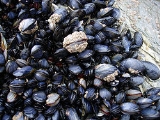
, most of which live on exposed shores in the intertidal zone, attached by means of their strong byssal threads ("beard") to a firm substrate.


Nutrition Facts


Discussion
Ask a question about 'Mussel'
Start a new discussion about 'Mussel'
Answer questions from other users
Full Discussion Forum


Recent Posts


Encyclopedia


The common name
Common name

A common name is a name in general use within a community . A common name is not necessarily a commonly used name.Many of the conventions and traditions described in this article are based on the English language, and thus may not apply to common names in other languages....
 mussel is used for members of several different families of clam
Clam

Clam is a word which can be used for all, some, or only a few species of bivalve mollusks; the word is a common name which has no real Taxonomy significance in biology....
s or bivalve molluscs, from both saltwater and freshwater habitats. The one thing that these different groups have in common, is that they have a shell whose outline is somewhat elongated and asymmetrical compared with that of many other edible clams, the shells of which are often more or less rounded or oval in shape.

The word "mussel" is most frequently used to mean the edible bivalves of the marine family Mytilidae
Mytilidae

Mytilidae is a family of small to large saltwater mussels, marine bivalve mollusks in the order Mytiloida. It is the only family in the order....
, most of which live on exposed shores in the intertidal zone, attached by means of their strong byssal threads ("beard") to a firm substrate. A few species (in the genus Bathymodiolus) have colonized hydrothermal vents associated with deep ocean ridges.

In most marine mussels the shell is longer than it is wide, being wedge-shaped or asymmetrical. The external color of the shell is often dark blue, blackish, or brown, while the interior is silvery and somewhat nacre
Nacre

Nacre, also known as mother of pearl, is an organic-inorganic composite material produced by some mollusks as an inner seashell layer. It is strong, resilient, and Iridescence....
ous.
Mussels Norway
The word "mussel" is also used for many freshwater bivalves, including the freshwater pearl mussel
Freshwater pearl mussel

The freshwater pearl mussel, scientific name Margaritifera margaritifera, is an endangered species of freshwater mussel, an Aquatic animal bivalve mollusk in the family Margaritiferidae, the freshwater pearl mussels....
s. Freshwater mussel species inhabit lakes, ponds, rivers, creeks, canals, and similar habitats. These bivalves belong to several allied families, the largest family being the Unionidae
Unionidae

Unionidae is a Family of freshwater mussels, aquatic animal bivalve mollusks which are sometimes known as river mussels, naiads or simply as unionids....
. They are not closely related to saltwater mussels; they are taxonomically grouped in a different subclass, despite some very superficial similarities in appearance.

The freshwater Zebra mussels and their relatives in the family Dreissenidae
Dreissenidae

The Dreissenidae are a family of small freshwater mussels, aquatic animal bivalve mollusks. They attach themselves to stones or to any other hard surface using a byssus....
 are not related to either of the previously mentioned groups, even though they resemble many Mytilus species in shape, and live attached to rocks and other hard surfaces in a similar manner, using a byssus
Byssus

The word Byssus has two related meanings, and one rather different one, according to the context:IN BIOLOGY: Byssus is the wiktionary:Filaments created by numerous different kinds of marine and freshwater bivalve mollusks, by which they can attach themselves to hard substrates, or to the sea bed....
. They are classified with the Heterodonta
Heterodonta

Heterodonta is a mollusc subclass in the class Bivalvia and contains the orders ?Cycloconchidae, ?Hippuritoida , ?Lyrodesmatidae, Myoida , ?Redoniidae, and Veneroida ....
, the taxonomic group which includes most of the bivalves commonly referred to as "clam
Clam

Clam is a word which can be used for all, some, or only a few species of bivalve mollusks; the word is a common name which has no real Taxonomy significance in biology....
s".

General anatomy

The mussel's external shell is composed of two hinged halves or "valves". The valves are joined together on the outside by a ligament, and are closed when necessary by strong internal muscles. Mussel shells carry out a variety of functions, including support for soft tissues, protection from predators and protection against desiccation.

The shell is made of three layers. In the pearly mussels there is an inner iridescent layer of nacre
Nacre

Nacre, also known as mother of pearl, is an organic-inorganic composite material produced by some mollusks as an inner seashell layer. It is strong, resilient, and Iridescence....
 (mother-of-pearl) composed of calcium carbonate
Calcium carbonate

Calcium carbonate is a chemical compound with the chemical formula CalciumCarbonOxygen3. It is a common substance found as Rock in all parts of the world, and is the main component of seashells, snails, and eggshells....
, which is continuously secreted by the mantle; the prismatic layer, a middle layer of chalky white crystals of calcium carbonate in a protein matrix; and the periostracum
Periostracum

File:Spisula solidissima juv.jpgFile:Arctica islandica Islandmuschel.jpgFile:Arctica islandica valves.jpgPeriostracum is a thin organic coating or "skin" which is the outermost layer of the animal shell of many shelled mollusks....
, an outer pigmented layer resembling a skin. The periostracum is composed of a protein called conchin, and its function is to protect the prismatic layer from abrasion and dissolution by acids (especially important in freshwater forms where the decay of leaf materials produces acids).

Like most bivalves, mussels have a large organ called a foot. In freshwater mussels, the foot is large, muscular, and generally hatchet-shaped. It is used to pull the animal through the substrate (typically sand, gravel, or silt) in which it lies partially buried. It does this by repeatedly advancing the foot through the substrate, expanding the end so it serves as an anchor, and then pulling the rest of the animal with its shell forward. It also serves as a fleshy anchor when the animal is stationary. In marine mussels, the foot is smaller, tongue-like in shape, with a groove on the ventral surface which is continuous with the byssus
Byssus

The word Byssus has two related meanings, and one rather different one, according to the context:IN BIOLOGY: Byssus is the wiktionary:Filaments created by numerous different kinds of marine and freshwater bivalve mollusks, by which they can attach themselves to hard substrates, or to the sea bed....
 pit. In this pit, a viscous secretion is exuded, entering the groove and hardening gradually upon contact with sea water. This forms extremely tough, strong, elastic, byssus
Byssus

The word Byssus has two related meanings, and one rather different one, according to the context:IN BIOLOGY: Byssus is the wiktionary:Filaments created by numerous different kinds of marine and freshwater bivalve mollusks, by which they can attach themselves to hard substrates, or to the sea bed....
 threads that secure the mussel to its substrate. The byssus thread is also sometimes used by mussels as a defensive measure, to tether predatory molluscs, such as dog whelk
Dog Whelk

The dog whelk, dogwhelk, or Atlantic dogwinkle, scientific name Nucella lapillus, is a species of predatory sea snail; a carnivorous marine rocky shore gastropod mollusc in the family Muricidae, the rock snails....
s, that invade mussel beds, immobilising them and thus starving them to death.

In cooking, the byssus of the mussel is known as the "beard" and is removed before the mussels are prepared.

Life habits


Feeding

Both marine and freshwater mussels are filter feeders; they feed on plankton
Plankton

Plankton consist of any drifting organisms that inhabit the pelagic zone of oceans, seas, or bodies of fresh water. Plankton are defined by their ecological niche rather than their Phylogenetics or taxonomy classification....
 and other microscopic sea creatures which are free-floating in seawater. A mussel draws water in through its incurrent siphon. The water is then brought into the branchial chamber by the actions of the cilia located on the gill
Gill

A gill is an anatomical structure found in many aquatic ecosystem organisms. It is a respiration organ whose function is the extraction of oxygen from water and the excretion of carbon dioxide....
s for cilliary-mucus feeding. The wastewater exits through the excurrent siphon. The labial palps finally funnel the food into the mouth, where digestion begins.

Marine mussels are usually found clumping
Sessility (zoology)

In zoology, sessility is a characteristic of animals which are not able to move about. They are usually permanently attached to a solid Wiktionary:substrate of some kind, such as a rock , or the Hull of a ship in the case of barnacles....
 together on wave-washed rocks, each attached to the rock by its byssus
Byssus

The word Byssus has two related meanings, and one rather different one, according to the context:IN BIOLOGY: Byssus is the wiktionary:Filaments created by numerous different kinds of marine and freshwater bivalve mollusks, by which they can attach themselves to hard substrates, or to the sea bed....
. The clumping habit helps hold the mussels firm against the force of the waves. At low tide mussels in the middle of a clump will undergo less water loss because of water capture by the other mussels.

Reproduction

Both marine and freshwater mussels are gonochoristic
Gonochorism

In biology, gonochorism or unisexualism describes sexual reproduction species in which there are at least two distinct sexes. The sex of an individual is most often genetically determined and does not usually change throughout its lifetime....
, with separate male and female individuals. In marine mussels, fertilization occurs outside the body, with a larval stage that drifts for three weeks to six months, before settling on a hard surface as a young mussel. There, it is capable of moving slowly by means of attaching and detaching byssal threads to attain a better life position.

Freshwater mussels also reproduce sexually. Sperm released by the male directly into the water enters the female via the incurrent siphon. After fertilization, the eggs develop into the larval stage called glochidia. The glochidia grow in the gills of the female where they are constantly flushed with oxygen-rich water. For a time, these glochidia are parasitic on fish, attaching themselves to the fish's fins or gills. Glochidia are generally species-specific, and will only live if they find the correct fish host. Once the larval mussels attach to the fish, the fish body reacts to cover them with cells forming a cyst
Cyst

A cyst is a closed sac having a distinct biological membrane and cell division on the nearby Biological tissue. It may contain air, fluids, or semi-solid material....
, where the glochidia remain for two to five weeks (depending on temperature). They grow, break free from the host, and drop to the bottom of the water. If they land in a suitable location, they will continue development and begin an independent life.

Reproduction in the Dreissenidae
Dreissenidae

The Dreissenidae are a family of small freshwater mussels, aquatic animal bivalve mollusks. They attach themselves to stones or to any other hard surface using a byssus....
 (zebra mussel
Zebra mussel

The zebra mussel, Dreissena polymorpha, is a species of small freshwater mussel, an Aquatic animal bivalve mollusk. This species was originally native to the lakes of southeast Russia....
s and their relatives) is similar to marine mussels.

Predators


Marine mussels are eaten by humans, seastar
SeaStar

SeaStar may refer to either of two unrelated two-seat flying boats of compostite material construction:* the AAC SeaStar, a biplane from Canada...
s, seabirds, and by numerous different species of predatory marine gastropods in the family Muricidae
Muricidae

Muricidae, common names murex snails or rock snails, is a large and varied taxonomic family of small to large predatory sea snails....
, such as the dog whelk
Dog Whelk

The dog whelk, dogwhelk, or Atlantic dogwinkle, scientific name Nucella lapillus, is a species of predatory sea snail; a carnivorous marine rocky shore gastropod mollusc in the family Muricidae, the rock snails....
, Nucella lapillus.

Freshwater mussels are eaten by otter
Otter

Otters are semi-aquatic fish-eating mammals. The otter Rank Lutrinae forms part of the Family Mustelidae, which also includes weasels, polecats, badgers, as well as others....
s, raccoon
Raccoon

Procyon is a genus of nocturnal mammals, comprising three species commonly known as raccoons, in the family Procyonidae. The most widespread species, the Raccoon , is often known simply as "the" raccoon, as the two other raccoon species in the genus are native only to the tropics and are considerably lesser-known....
s, some ducks, and geese.

Distribution and habitat

Marine mussels are abundant in the low and mid intertidal zone in temperate seas globally.

Other species of marine mussel live in tropical intertidal areas, but not in the same huge numbers as in temperate zones.

Certain species of marine mussels prefer salt marshes or quiet bays, while others thrive in pounding surf, completely covering wave-washed rocks. Some species have colonized abyssal depths near hydrothermal vents.

Freshwater mussels inhabit permanent lakes, rivers, canals and streams throughout the world except in the polar regions. They require a constant source of cool, clean water, with bottoms that are not muddy. They prefer water with a substantial mineral content, using calcium carbonate to build their shells.

Aquaculture

Bouchots Dsc04101
In 2005, China accounted for 40 per cent of the global mussel catch according to a FAO study. Within Europe, Spain remained the industry leader.

Freshwater mussels are used as host animals for the cultivation of freshwater pearls. Some species of marine mussel, including the Blue Mussel
Blue mussel

The blue mussel, Mytilus edulis, is a medium-sized edible marine bivalve mollusc in the family Mytilidae....
 (Mytilus edulis) and the New Zealand green-lipped mussel
New Zealand green-lipped mussel

The New Zealand green-lipped mussel, also known as the New Zealand mussel or the greenshell mussel, Perna canaliculus, is a species of bivalve mollusc in the family Mytilidae....
  (Perna canaliculus), are also cultivated as a source of food.

There are a variety of techniques for growing mussels.
  • Intertidal growth technique, or bouchot technique: pilings, known in French
    French language

    French is a Romance language spoken around the world by around 80 million people as first language, by 190 million as second language, and by about another 200 million people as an acquired tongue, with significant speakers in 54 countries....
     as bouchots, are planted at sea; ropes, on which the mussels grow, are tied in a spiral on the pilings; some mesh netting prevents the mussels from falling away. This method needs an extended tidal zone.
  • Mussels are cultivated extensively in New Zealand, where the most common method is to attach mussels to ropes which are hung from a rope back-bone supported by large plastic floats. The most common species cultivated in New Zealand is the New Zealand green-lipped mussel
    New Zealand green-lipped mussel

    The New Zealand green-lipped mussel, also known as the New Zealand mussel or the greenshell mussel, Perna canaliculus, is a species of bivalve mollusc in the family Mytilidae....
    .


Mussels as food

There is archaeological evidence that humans have utilized mussels as a source of food for thousands of years. Nowadays marine mussels remain a popular seafood
Seafood

Seafood is any aquatic animal that is served as food and eaten by humans. Seafoods include fish and shellfish .The harvesting of seafood is known as fishing and the cultivation and farming of seafood is known as aquaculture, mariculture, or in the case of fish, fish farming....
, especially in Belgium
Belgium

* A small German-speaking Community of Belgium exists in eastern Wallonia. Belgium's linguistic diversity and related political and cultural conflicts are reflected in the history of Belgium and a complex Communities and regions of Belgium....
 and the Netherlands
Netherlands

The Netherlands is a country that is part of the Kingdom of the Netherlands. It is a parliamentary democratic constitutional monarchy. The Netherlands is located in North-West Europe, and bordered by the North Sea to the north and west, Belgium to the south, and Germany to the east....
, and France
France

France , officially the French Republic , is a country whose Metropolitan France is located in Western Europe and that also comprises various Overseas departments and territories of France....
 (called moules marinières), where they are consumed with french fries
French fries

French fries , chips , fries, or French-fried potatoes are thin strips of potato that have been deep-frying. A distinction is sometimes made between fries and chips; whereby North Americans sometimes refer to any elongated pieces of fried potatoes as fries, while in the UK, long slices of potatoes are sometimes called '...
 ("mosselen met friet" or "moules frites"). In France
France

France , officially the French Republic , is a country whose Metropolitan France is located in Western Europe and that also comprises various Overseas departments and territories of France....
, the Éclade des Moules is a mussel bake popular along the beaches of the Bay of Biscay
Bay of Biscay

The Bay of Biscay is a Headlands and bays of the North Atlantic Ocean. It lies along the western coast of France from Brest, France south to the Spain border, and the northern coast of Spain west to Punta de Estaca de Bares, and is named for the Spanish province of Biscay....
. In Italy
Italian cuisine

Italian cuisine as a national cuisine known today has evolved through centuries of social and political changes, with its roots traced back to 4th century BC....
, they are popular, often mixed with other sea food, or eaten with pasta. In Turkey
Turkey

Turkey , known officially as the Republic of Turkey , is a Eurasian country that stretches across the Anatolian peninsula in southwest Asia and Thrace in the Balkans region of Southern Europe....
, mussels are either covered with flour and fried on shish
SHISH

The State Intelligence Service, commonly known by its acronym SHISH, is the primary intelligence agency of Albania. It was created in 1992 by the Albanian Parliament as SHIK, acronym of Sh?rbimi Informativ Komb?tar ....
s ('midye tava'), or filled with rice and served cold ('midye dolma') and are usually consumed with alcohol (mostly with raki
Raki (alcoholic beverage)

Raki is a non-sweet usually anise-flavored ap?ritif that is produced by twice Distillation either only suma or suma that has been mixed with Ethanol in traditional copper alembics of 5000 litres volume or less with aniseed....
 or beer). In Cantonese cuisine
Cantonese cuisine

Cantonese cuisine comes from Guangdong in Southern China, or specifically from Guangzhou . Of all the regional varieties of Chinese cuisine, Cantonese is the best known outside China; most "Chinese restaurants" in Western countries serve Cantonese cuisine and dishes based on it....
, mussels are cooked in a broth of garlic and fermented black bean. In New Zealand
New Zealand

New Zealand is an island country in the south-western Pacific Ocean comprising two main landmasses , and numerous Islands of New Zealand, most notably Stewart Island/Rakiura and the Chatham Islands....
, they are commonly served in a chili-based vinaigrette
Vinaigrette

The word vinaigrette or vinegarette can refer to:* Vinaigrette , the salad dressing or sauce.* A small container with a perforated top, used to contain an aromatic substance such as vinegar or smelling salts, especially popular for women in Victorian era to combat the aroma from the waste products common in cities....
.

During the second World War in the United States, mussels were commonly served in diners. This was due to the unavailability of red meat related to wartime rationing. They are popular in Ireland
Ireland

Ireland is the List of islands by area in Europe, and the twentieth-largest island in the world. It lies to the north-west of continental Europe and is surrounded by hundreds of islands and islet....
 and among the Irish Community
Irish diaspora

The Irish diaspora consists of Irish people emigrants and their descendants in countries such as the United Kingdom, the United States, Canada, Australia, Argentina, New Zealand, Mexico, South Africa, Brazil and states of the Caribbean and continental Europe....
 in the West of Scotland
Scotland

conventional_long_name = ScotlandAlba|common_name= Scotland|image_flag = Flag of Scotland.svg|flag_width = 130px...
; boiled and seasoned with vinegar, with the "bray" or boiling water as a supplementary hot drink.

Cooked Mussels Dsc09244
In India
India

India, officially the Republic of India , is a country in South Asia. It is the List of countries and outlying territories by total area country by geographical area, the List of countries by population country, and the most populous liberal democracy in the world....
 mussels are popular in Kerala
Kerala

Kerala is a Indian Union States and territories of India located in the southwestern part of India. With an Arabian Sea coastline on the west, it is bordered on the north by Karnataka and by Tamil Nadu on the south and east....
, Bhatkal
Bhatkal

Bhatkal is a port town in Uttara Kannada district of Karnataka, India. The Nawayath Muslim community comes from Bhatkal.The town lies on NH-17 running between Mumbai and Mangalore....
, and Goa
Goa

Goa is India's smallest states and territories of India in terms of area and the List of states and territories of India by population. Located on the west coast of India in the region known as the Konkan, it is bounded by the state of Maharashtra to the north, and by Karnataka to the east and south, while the Arabian Sea forms its western...
. They are either prepared with drumsticks
Moringa oleifera

Moringa oleifera, commonly referred to simply as Moringa , , is the most widely cultivated variety of the genus Moringa. It is of the family Moringaceae....
, breadfruit
Breadfruit

Breadfruit is a species of Flowering plant tree in the Morus family, Moraceae, that is native to the Malay Peninsula and western Pacific Ocean islands....
 or other vegetables, or filled with rice and coconut paste with spices and served hot.For spicy food lovers, the Fried Mussels of north Kerala is a favored delicacy.

Mussels can be smoked, boiled
Boiling

Boiling, a type of phase transition, is the rapid vaporization of a liquid, which typically occurs when a liquid is heated to its boiling point, the temperature at which the vapor pressure of the liquid is equal to the pressure exerted on the liquid by the surrounding environmental pressure....
, steamed
Steaming

Steaming is a method of cooking using steam. Steaming is considered a relatively healthier cooking technique and capable of cooking almost all kinds of food....
 or fried
Frying

Frying is the cooking of food in oil or fat, a technique that originated in ancient Old_Kingdom around 2500BC. Chemically, oils and fats are the same, differing only in melting point, but the distinction is only made when needed....
 in batter
Batter (cooking)

Batter is a liquid mixture, usually based on one or more flours combined with liquids such as water, milk or beer. egg is also a common component....
.

As with all shellfish
Shellfish

Shellfish is a culinary and fisheries term for exoskeleton bearing aquatic invertebrate used as food, including various species of Molluscas, crustaceans, and echinoderms....
, mussels should be checked to make sure they are still alive just before they are cooked; they quickly become toxic after they die. A simple criterion is that live mussels, when in the air, will shut tightly when disturbed. Open, unresponsive mussels are dead, and must be discarded. Closed mussel shells that are unusually heavy should be discarded as well, because they usually contain only mud. They can be tested to see if they are full of mud or sand by slightly moving the two shells away from each other.

A thorough rinse in water and removal of "the beard" is suggested. Mussel shells usually open by themselves when cooked, revealing the cooked soft parts. It is a common misconseption that unopened shells are unsafe to eat and should be discarded. The myth seems to have been started by the English food writer, Jane Grigson in her 1973 publication, Fish Book.

In Belgium, mussels are often served with fresh herbs and flavorful vegetables in a stock of butter and white wine. Frites/Frieten
French fries

French fries , chips , fries, or French-fried potatoes are thin strips of potato that have been deep-frying. A distinction is sometimes made between fries and chips; whereby North Americans sometimes refer to any elongated pieces of fried potatoes as fries, while in the UK, long slices of potatoes are sometimes called '...
 and Belgian beer
Belgian beer

Belgian beer comprises the most diverse national collection of quality beer in the world , and varies from the popular pale lager to lambic beer and Flanders red ale....
 are popular accompaniments. Months with an "R" in their name (September to April) are said to be the "in" season for mussels.

In the Netherlands, mussels are sometimes served fried in batter or breadcrumbs
Breading

Breading is a dry grain-derived coating for a piece of food such as meat, vegetable, poultry, fish, shellfish, crustacean, wheat gluten , or textured vegetable protein, etc., made from breadcrumbs or a breading mixture with seasonings....
, particularly at take-out
Take-out

Take-out , carry-out ,, take-away , parcel , or tapau , , is food purchased at a restaurant but eaten elsewhere. The restaurant may or may not provide table service....
 food outlets or other informal settings.

Although mussels are valued as food, mussel poisoning due to toxic planktonic organisms can be a danger along some coastlines. For instance, mussels should be avoided along the west coast of the United States during the warmer months. This poisoning is usually due to a bloom of dinoflagellate
Dinoflagellate

The dinoflagellates are a large group of flagellate protists. Most are marine plankton, but they are common in fresh water habitats as well. Their populations are distributed depending on sea surface temperature, salinity, or depth....
s (red tides), which contain toxins. The dinoflagellates and their toxin are harmless to mussels, even when concentrated by the mussel's filter feeding, but if the mussels are consumed by humans, the concentrated toxins cause serious illness, such as paralytic shellfish poisoning
Paralytic shellfish poisoning

Paralytic shellfish poisoning is one of the four recognized syndromes of shellfish poisoning . All four syndromes share some common features and are primarily associated with Bivalvia ....
. Usually the U.S. government monitors the levels of toxins throughout the year at fishing sites. See Red Tide
Red tide

"Red tide" is a common name for a phenomenon known as an algal bloom, an event in which estuarine, marine, or fresh water algae accumulate rapidly in the water column....
.

Freshwater mussels nowadays are generally considered to be unpalatable, though the native peoples in North America utilized them extensively.

Nutrition highlights


Raw blue mussels
Serving size 3 ounces
Calories 73
Protein
Protein

Proteins are organic compounds made of amino acids arranged in a linear chain and joined together by peptide bonds between the carboxyl and amino groups of adjacent amino acid Residue ....
 
10.1 g
Carbohydrate
Carbohydrate

Carbohydrates or saccharides are the most abundant of the four major classes of biomolecules. They fill numerous roles in living things, such as the storage and transport of energy and structural components ....
 
3.1 g
Fiber
Dietary fiber

Dietary fiber, sometimes called "roughage", is the indigestible portion of plant foods that pushes food through the digestive system, absorbing water and easing defecation....
 
0.0 g
Total fat
Fat

Fats consist of a wide group of compounds that are generally soluble in organic solvents and largely insoluble in water. Chemistry, fats are generally ester of glycerol and fatty acids....
 
1.9 g
Saturated fat
Saturated fat

Saturated fat is fat that consists of triglycerides containing only Saturation fatty acid radicals. There are several kinds of naturally occurring saturated fatty acids, which differ by the number of carbon atoms - from 1 to 24....
 
0.4 g
Sodium
Sodium

Sodium is an element which has the symbol Na , atomic number 11, atomic mass 23 amu , and a common oxidation number +1. Sodium is a soft, silvery white, highly reactive element and is a member of the alkali metals within "group 1" ....
 
243 mg


  • Excellent source of: Selenium
    Selenium

    Selenium is a chemical element with the atomic number 34, represented by the chemical symbol Se, an atomic mass of 78.96. It is a nonmetal, chemically related to sulfur and tellurium, and rarely occurs in its elemental state in nature....
     (76 mcg), and vitamin B12
    Vitamin B12

    Vitamin B12 is a water soluble vitamin with a key role in the normal functioning of the brain and nervous system, and for the formation of blood....
     (20 mcg)
  • Good source of: Zinc
    Zinc

    Zinc is a metallic chemical element with the symbol Zn and atomic number 30. It is a first-row transition metal of the group 12 element of the periodic table....
     (2.3 mg), and folate (64 mcg)


Foods that are an “excellent source” of a particular nutrient provide 20% or more of the recommended daily value. Foods that are a “good source” of a particular nutrient provide between 10 and 20% of the recommended daily value.

See also

  • California mussel
    California mussel

    The California mussel, Mytilus californianus, is a large edible mussel, a Marine bivalvia mollusk in the family Mytilidae.This species is native to the west coast of North America, occurring from northern Mexico to the Aleutian Islands of Alaska....
    , Mytilus californianus
  • Clam
    Clam

    Clam is a word which can be used for all, some, or only a few species of bivalve mollusks; the word is a common name which has no real Taxonomy significance in biology....
  • Dwarf wedge mussel, Alasmidonta heterodon
  • Oyster
    Oyster

    The common name oyster is used for a number of different groups of bivalve mollusks, most of which live in marine habitats or brackish water....
  • Zebra mussel
    Zebra mussel

    The zebra mussel, Dreissena polymorpha, is a species of small freshwater mussel, an Aquatic animal bivalve mollusk. This species was originally native to the lakes of southeast Russia....
    , Dreissena polymorpha


External links

  • Studying the physiology and behaviour of marine fouling organisms