


Federal Trade Commission

Encyclopedia
The Federal Trade Commission (FTC) is an independent agency of the United States government
, established in 1914 by the Federal Trade Commission Act
. Its principal mission is the promotion of consumer protection
and the elimination and prevention of what regulators perceive to be harmfully anti-competitive business practices, such as coercive monopoly
.
The Federal Trade Commission Act
was one of President Woodrow Wilson
's major acts against trusts
. Trusts and trust-busting were significant political concerns during the Progressive Era
. Since its inception, the FTC has enforced the provisions of the Clayton Act, a key antitrust
statute, as well as the provisions of the FTC Act, et seq. Over time, the FTC has been delegated the enforcement of additional business regulation statutes and has promulgated a number of regulations (codified in Title 16 of the Code of Federal Regulations
).
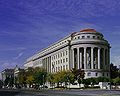
. Under the FTC Act, no more than three commissioners may be from the same political party. A commissioner's term of office is seven years, and the terms are staggered so that in a given year no more than one commissioner's term expires (although in certain years no commissioner's term expires and in years where commissioners choose to step down, more than one new commissioner may be appointed).
The current commissioners are:
Recent former commissioners were:
, privacy and identity protection etc. The bureau also is responsible for the United States National Do Not Call Registry
.
Under the FTC Act, the Commission has the authority, in most cases, to bring its actions in federal court through its own attorneys. In some consumer protection matters, the FTC appears with, or supports, the U.S. Department of Justice.
laws, review of proposed mergers, and investigation into other non-merger business practices that may impair competition. Such non-merger practices include horizontal restraints, involving agreements between direct competitors, and vertical restraints
, involving agreements among businesses at different levels in the same industry (such as suppliers and commercial buyers).
The FTC shares enforcement of antitrust laws with the Department of Justice
. However, while the FTC is responsible for civil enforcement of antitrust laws, the Antitrust Division of the Department of Justice has the power to bring both civil and criminal action in antitrust matters.
. These issues include, for instance, false advertising
and other forms of fraud
. FTC investigations may pertain to a single company or an entire industry. If the results of the investigation reveal unlawful conduct, the FTC may seek voluntary compliance by the offending business through a consent order, file an administrative complaint, or initiate federal litigation.
Traditionally an administrative complaint is heard in front of an independent administrative law judge (ALJ) with FTC staff acting as prosecutors. The case is reviewed de novo by the full FTC commission which then may be appealed to the U.S. Court of Appeals and finally to the Supreme Court. A summary of cases heard since 1996 indicates that the commission has never upheld an administrative law judge's decision to dismiss a complaint. After adverse results in which the independent administrative law judges have ruled against the FTC (Schering Plough and Rambus), there has been a move towards FTC commissioners being appointed as ALJ (Commissioner Rosch in Inova Health).
Under the FTC Act, the federal courts retain their traditional authority to issue equitable relief, including the appointment of receivers, monitors, the imposition of asset freezes to guard against the spoliation of funds, immediate access to business premises to preserve evidence, and other relief including financial disclosures and expedited discovery. In numerous cases, the FTC employs this authority to combat serious consumer deception or fraud. Additionally, the FTC has rulemaking
power to address concerns regarding industry-wide practices. Rules promulgated under this authority are known as Trade Rules.
In the mid-1990s, the FTC launched the fraud sweeps concept where the agency and its federal, state, and local partners filed simultaneous legal actions against multiple telemarketing fraud targets. The first sweeps operation was Project Telesweep in July 1995 which cracked down on 100 business opportunity scams.
In 1984, the FTC began to regulate the funeral home
industry in order to protect consumers from deceptive practices. The FTC Funeral Rule
requires funeral homes to provide all customers (and potential customers) with a General Price List (GPL), specifically outlining goods and services in the funeral industry, as defined by the FTC, and a listing of their prices. By law, the GPL must be presented to all individuals that ask, no one is to be denied a written, retainable copy of the GPL. In 1996, the FTC instituted the Funeral Rule Offenders Program (FROP), under which "funeral homes make a voluntary payment to the U.S. Treasury or appropriate state fund for an amount less than what would likely be sought if the Commission authorized filing a lawsuit for civil penalties. In addition, the funeral homes participate in the NFDA compliance program, which includes a review of the price lists, on-site training of the staff, and follow-up testing and certification on compliance with the Funeral Rule
."
One of the Federal Trade Commission's other major focuses is identity theft
. The FTC serves as a federal repository for individual consumer complaints regarding identity theft. Even though the FTC does not resolve individual complaints, it does use the aggregated information to determine where federal action might be taken. The complaint form is available online or by phone (1-877-ID-THEFT).
The FTC has been involved in the oversight of the online advertising industry and its practice of behavioral targeting
for some time. In 2011 the FTC proposed a "Do Not Track" mechanism to allow Internet users to opt-out
of behavioral targeting
.
In F.T.C. v. Cyberspace.com the FTC found that sending consumers mail that appeared to be a check for $3.50 to the consumer attached to an invoice was deceptive when cashing the check constituted an agreement to pay a monthly fee for internet access. The back of the check, in fine print, disclosed the existence of this agreement to the consumer. The FTC concluded that the practice was misleading to reasonable consumers, especially since there was evidence that less than one percent of the 225,000 individuals and businesses billed for the internet service actually logged on.
In In re Gateway Learning Corp.
the FTC alleged that Gateway committed unfair and deceptive trade practices by making retroactive changes to its privacy policy without informing customers and by violating its own privacy policy by selling customer information when it had said it would not. Gateway settled the complaint by entering into a consent decree with the FTC that required it to surrender some profits and placed restrictions upon Gateway for the following 20 years.
In In the Matter of Sears Holdings Management Corp., the FTC alleged that a research software program provided by Sears was deceptive because it collected information about nearly all online behavior, a fact that was only disclosed in legalese, buried within the end user license agreement.
, once known as the "father of the Federal Trade Commission." Morgan also made the first speech on the House floor advocating its creation on February 21, 1912. Though the initial bill did not pass, the Republican party platform of June 1912 endorsed the establishment of the Federal Trade Commission. Morgan reintroduced a slightly amended version of his bill during the April 1913 special session.
On May 23, 2007, the House passed the Energy Price Gouging Prevention Act, H.R. 1252, which will provide immediate relief to consumers by giving the Federal Trade Commission the authority to investigate and punish those who artificially inflate the price of energy. It will ensure the federal government has the tools it needs to adequately respond to energy emergencies and prohibit price gouging – with a priority on refineries and big oil companies.
Independent agencies of the United States government
Independent agencies of the United States federal government are those agencies that exist outside of the federal executive departments...
, established in 1914 by the Federal Trade Commission Act
Federal Trade Commission Act
The Federal Trade Commission Act of 1914 started the Federal Trade Commission , a bipartisan body of five members appointed by the president of the United States for seven-year terms. This commission was authorized to issue “cease and desist” orders to large corporations to curb unfair trade...
. Its principal mission is the promotion of consumer protection
Consumer protection
Consumer protection laws designed to ensure fair trade competition and the free flow of truthful information in the marketplace. The laws are designed to prevent businesses that engage in fraud or specified unfair practices from gaining an advantage over competitors and may provide additional...
and the elimination and prevention of what regulators perceive to be harmfully anti-competitive business practices, such as coercive monopoly
Coercive monopoly
In economics and business ethics, a coercive monopoly is a business concern that prohibits competitors from entering the field, with the natural result being that the firm is able to make pricing and production decisions independent of competitive forces...
.
The Federal Trade Commission Act
Federal Trade Commission Act
The Federal Trade Commission Act of 1914 started the Federal Trade Commission , a bipartisan body of five members appointed by the president of the United States for seven-year terms. This commission was authorized to issue “cease and desist” orders to large corporations to curb unfair trade...
was one of President Woodrow Wilson
Woodrow Wilson
Thomas Woodrow Wilson was the 28th President of the United States, from 1913 to 1921. A leader of the Progressive Movement, he served as President of Princeton University from 1902 to 1910, and then as the Governor of New Jersey from 1911 to 1913...
's major acts against trusts
Trust (19th century)
A special trust or business trust is a business entity formed with intent to monopolize business, to restrain trade, or to fix prices. Trusts gained economic power in the U.S. in the late 19th and early 20th centuries. Some, but not all, were organized as trusts in the legal sense...
. Trusts and trust-busting were significant political concerns during the Progressive Era
Progressive Era
The Progressive Era in the United States was a period of social activism and political reform that flourished from the 1890s to the 1920s. One main goal of the Progressive movement was purification of government, as Progressives tried to eliminate corruption by exposing and undercutting political...
. Since its inception, the FTC has enforced the provisions of the Clayton Act, a key antitrust
Antitrust
The United States antitrust law is a body of laws that prohibits anti-competitive behavior and unfair business practices. Antitrust laws are intended to encourage competition in the marketplace. These competition laws make illegal certain practices deemed to hurt businesses or consumers or both,...
statute, as well as the provisions of the FTC Act, et seq. Over time, the FTC has been delegated the enforcement of additional business regulation statutes and has promulgated a number of regulations (codified in Title 16 of the Code of Federal Regulations
Code of Federal Regulations
The Code of Federal Regulations is the codification of the general and permanent rules and regulations published in the Federal Register by the executive departments and agencies of the Federal Government of the United States.The CFR is published by the Office of the Federal Register, an agency...
).
Organization
FTC chairmen and commissioners
The Federal Trade Commission is headed by five commissioners who are nominated by the President and confirmed by the United States SenateUnited States Senate
The United States Senate is the upper house of the bicameral legislature of the United States, and together with the United States House of Representatives comprises the United States Congress. The composition and powers of the Senate are established in Article One of the U.S. Constitution. Each...
. Under the FTC Act, no more than three commissioners may be from the same political party. A commissioner's term of office is seven years, and the terms are staggered so that in a given year no more than one commissioner's term expires (although in certain years no commissioner's term expires and in years where commissioners choose to step down, more than one new commissioner may be appointed).
The current commissioners are:
Recent former commissioners were:
Bureau of Consumer Protection
The Bureau of Consumer Protection’s mandate is to protect consumers against unfair or deceptive acts or practices in commerce. With the written consent of the Commission, Bureau attorneys enforce federal laws related to consumer affairs and rules promulgated by the FTC. Its functions include investigations, enforcement actions, and consumer and business education. Areas of principal concern for this bureau are: advertising and marketing, financial products and practices, telemarketing fraudTelemarketing fraud
Telemarketing fraud is fraudulent selling conducted over the phone. It most often targets the poor and elderly. Common types include:*Advance fee fraud...
, privacy and identity protection etc. The bureau also is responsible for the United States National Do Not Call Registry
United States National Do Not Call Registry
The National Do Not Call Registry is intended to give U.S. consumers an opportunity to limit the telemarketing calls they receive. To register by telephone , consumers may call 1-888-382-1222. The registry was set to begin in 2003, but a court challenge delayed its implementation until 2004. The...
.
Under the FTC Act, the Commission has the authority, in most cases, to bring its actions in federal court through its own attorneys. In some consumer protection matters, the FTC appears with, or supports, the U.S. Department of Justice.
Bureau of Competition
The Bureau of Competition is the division of the FTC charged with elimination and prevention of "anticompetitive" business practices. It accomplishes this through the enforcement of antitrustAntitrust
The United States antitrust law is a body of laws that prohibits anti-competitive behavior and unfair business practices. Antitrust laws are intended to encourage competition in the marketplace. These competition laws make illegal certain practices deemed to hurt businesses or consumers or both,...
laws, review of proposed mergers, and investigation into other non-merger business practices that may impair competition. Such non-merger practices include horizontal restraints, involving agreements between direct competitors, and vertical restraints
Vertical restraints
Vertical restraints are competition restrictions in agreements between firms or individuals at different levels of the production and distribution process. Vertical restraints are to be distinguished from so-called “horizontal restraints,” which are found in agreements between horizontal competitors...
, involving agreements among businesses at different levels in the same industry (such as suppliers and commercial buyers).
The FTC shares enforcement of antitrust laws with the Department of Justice
United States Department of Justice
The United States Department of Justice , is the United States federal executive department responsible for the enforcement of the law and administration of justice, equivalent to the justice or interior ministries of other countries.The Department is led by the Attorney General, who is nominated...
. However, while the FTC is responsible for civil enforcement of antitrust laws, the Antitrust Division of the Department of Justice has the power to bring both civil and criminal action in antitrust matters.
Bureau of Economics
The Bureau of Economics was established to support the Bureau of Competition and Consumer Protection by providing expert knowledge related to the economic impacts of the FTC's legislation and operation.Activities of the FTC
The FTC puts out its mission by investigating issues raised by reports from consumers and businesses, pre-merger notification filings, congressional inquiries, or reports in the mediaMass media
Mass media refers collectively to all media technologies which are intended to reach a large audience via mass communication. Broadcast media transmit their information electronically and comprise of television, film and radio, movies, CDs, DVDs and some other gadgets like cameras or video consoles...
. These issues include, for instance, false advertising
False advertising
False advertising or deceptive advertising is the use of false or misleading statements in advertising. As advertising has the potential to persuade people into commercial transactions that they might otherwise avoid, many governments around the world use regulations to control false, deceptive or...
and other forms of fraud
Fraud
In criminal law, a fraud is an intentional deception made for personal gain or to damage another individual; the related adjective is fraudulent. The specific legal definition varies by legal jurisdiction. Fraud is a crime, and also a civil law violation...
. FTC investigations may pertain to a single company or an entire industry. If the results of the investigation reveal unlawful conduct, the FTC may seek voluntary compliance by the offending business through a consent order, file an administrative complaint, or initiate federal litigation.
Traditionally an administrative complaint is heard in front of an independent administrative law judge (ALJ) with FTC staff acting as prosecutors. The case is reviewed de novo by the full FTC commission which then may be appealed to the U.S. Court of Appeals and finally to the Supreme Court. A summary of cases heard since 1996 indicates that the commission has never upheld an administrative law judge's decision to dismiss a complaint. After adverse results in which the independent administrative law judges have ruled against the FTC (Schering Plough and Rambus), there has been a move towards FTC commissioners being appointed as ALJ (Commissioner Rosch in Inova Health).
Under the FTC Act, the federal courts retain their traditional authority to issue equitable relief, including the appointment of receivers, monitors, the imposition of asset freezes to guard against the spoliation of funds, immediate access to business premises to preserve evidence, and other relief including financial disclosures and expedited discovery. In numerous cases, the FTC employs this authority to combat serious consumer deception or fraud. Additionally, the FTC has rulemaking
Rulemaking
In administrative law, rulemaking refers to the process that executive and independent agencies use to create, or promulgate, regulations. In general, legislatures first set broad policy mandates by passing statutes, then agencies create more detailed regulations through rulemaking.By bringing...
power to address concerns regarding industry-wide practices. Rules promulgated under this authority are known as Trade Rules.
In the mid-1990s, the FTC launched the fraud sweeps concept where the agency and its federal, state, and local partners filed simultaneous legal actions against multiple telemarketing fraud targets. The first sweeps operation was Project Telesweep in July 1995 which cracked down on 100 business opportunity scams.
In 1984, the FTC began to regulate the funeral home
Funeral home
A funeral home, funeral parlor or mortuary, is a business that provides burial and funeral services for the deceased and their families. These services may include aprepared wake and funeral, and the provision of a chapel for the funeral....
industry in order to protect consumers from deceptive practices. The FTC Funeral Rule
Funeral Rule
The Federal Trade Commission, established in 1914 under president Woodrow Wilson as a government agency to investigate and eliminate unfair and deceptive practices in business, enacted the Funeral Rule on April 30, 1984, and amended it effective 1994...
requires funeral homes to provide all customers (and potential customers) with a General Price List (GPL), specifically outlining goods and services in the funeral industry, as defined by the FTC, and a listing of their prices. By law, the GPL must be presented to all individuals that ask, no one is to be denied a written, retainable copy of the GPL. In 1996, the FTC instituted the Funeral Rule Offenders Program (FROP), under which "funeral homes make a voluntary payment to the U.S. Treasury or appropriate state fund for an amount less than what would likely be sought if the Commission authorized filing a lawsuit for civil penalties. In addition, the funeral homes participate in the NFDA compliance program, which includes a review of the price lists, on-site training of the staff, and follow-up testing and certification on compliance with the Funeral Rule
Funeral Rule
The Federal Trade Commission, established in 1914 under president Woodrow Wilson as a government agency to investigate and eliminate unfair and deceptive practices in business, enacted the Funeral Rule on April 30, 1984, and amended it effective 1994...
."
One of the Federal Trade Commission's other major focuses is identity theft
Identity theft
Identity theft is a form of stealing another person's identity in which someone pretends to be someone else by assuming that person's identity, typically in order to access resources or obtain credit and other benefits in that person's name...
. The FTC serves as a federal repository for individual consumer complaints regarding identity theft. Even though the FTC does not resolve individual complaints, it does use the aggregated information to determine where federal action might be taken. The complaint form is available online or by phone (1-877-ID-THEFT).
The FTC has been involved in the oversight of the online advertising industry and its practice of behavioral targeting
FTC Regulation of Behavioral Advertising
The United States Federal Trade Commission has been involved in oversight of the behavioral targeting techniques used by online advertisers since the mid-1990s. These techniques, known initially as online profiling, and now known as behavioral targeting, are used to target online behavioral...
for some time. In 2011 the FTC proposed a "Do Not Track" mechanism to allow Internet users to opt-out
Opt-out
The term opt-out refers to several methods by which individuals can avoid receiving unsolicited product or service information. This ability is usually associated with direct marketing campaigns such as telemarketing, e-mail marketing, or direct mail. A list of those who have opted-out is called a...
of behavioral targeting
Behavioral targeting
Behavioral targeting is a technique used by online publishers and advertisers to increase the effectiveness of their campaigns.Behavioral targeting uses information collected on an individual's web-browsing behavior, such as the pages they have visited or the searches they have made, to select...
.
Unfair or deceptive practices affecting consumers
Section 5 of the Federal Trade Commission Act, grants the FTC power to investigate and prevent deceptive trade practices. The statute declares that “unfair methods of competition in or affecting commerce, and unfair or deceptive acts or practices in or affecting commerce, are hereby declared unlawful.” Unfairness and deception towards consumers represent two distinct areas of FTC enforcement and authority. The FTC also has authority over unfair methods of competition between businesses.In F.T.C. v. Cyberspace.com the FTC found that sending consumers mail that appeared to be a check for $3.50 to the consumer attached to an invoice was deceptive when cashing the check constituted an agreement to pay a monthly fee for internet access. The back of the check, in fine print, disclosed the existence of this agreement to the consumer. The FTC concluded that the practice was misleading to reasonable consumers, especially since there was evidence that less than one percent of the 225,000 individuals and businesses billed for the internet service actually logged on.
In In re Gateway Learning Corp.
In re Gateway Learning Corp.
In re Gateway Learning Corp, 138 F.T.C. 443 File No. 042-3047, was an investigatory action by the Federal Trade Commission of the Gateway Learning Corporation, distributor of Hooked on Phonics...
the FTC alleged that Gateway committed unfair and deceptive trade practices by making retroactive changes to its privacy policy without informing customers and by violating its own privacy policy by selling customer information when it had said it would not. Gateway settled the complaint by entering into a consent decree with the FTC that required it to surrender some profits and placed restrictions upon Gateway for the following 20 years.
In In the Matter of Sears Holdings Management Corp., the FTC alleged that a research software program provided by Sears was deceptive because it collected information about nearly all online behavior, a fact that was only disclosed in legalese, buried within the end user license agreement.
Legislation
The first version of a bill to establish a commission to regulate trade was introduced on January 25, 1912 by Oklahoma congressman Dick Thompson MorganDick Thompson Morgan
Dick Thompson Morgan was a U.S. Representative from Oklahoma.-Early life and education:Born at Prairie Creek, Indiana, Morgan attended the country schools and the Prairie Creek High School. In 1876 he received a bachelor's degree and in 1878 a master's degree both from Union Christian College,...
, once known as the "father of the Federal Trade Commission." Morgan also made the first speech on the House floor advocating its creation on February 21, 1912. Though the initial bill did not pass, the Republican party platform of June 1912 endorsed the establishment of the Federal Trade Commission. Morgan reintroduced a slightly amended version of his bill during the April 1913 special session.
On May 23, 2007, the House passed the Energy Price Gouging Prevention Act, H.R. 1252, which will provide immediate relief to consumers by giving the Federal Trade Commission the authority to investigate and punish those who artificially inflate the price of energy. It will ensure the federal government has the tools it needs to adequately respond to energy emergencies and prohibit price gouging – with a priority on refineries and big oil companies.
Further reading
- G. Cullom Davis. "The Transformation of the Federal Trade Commission, 1914–1929," The Mississippi Valley Historical Review, Vol. 49, No. 3. (Dec., 1962), pp. 437–455 (archived in JSTORJSTORJSTOR is an online system for archiving academic journals, founded in 1995. It provides its member institutions full-text searches of digitized back issues of several hundred well-known journals, dating back to 1665 in the case of the Philosophical Transactions of the Royal Society...
)
External links
- Consumer Complaint Assistant, Federal Trade Commission
- Federal Trade Commission Decisions (July 1949 - December 2005) This is a compendium of agency decisions in administrative cases brought under 16 C.F.R. parts II and III. Federal court decisions may be found elsewhere, in published federal case reports. The site's search engine can limit its results from the archive.
- Federal Trade Commission Meeting Notices and Rule Changes from The Federal Register RSS Feed
- Federal Trade Commission Identity Theft Complaint Form