
Home      Discussion      Topics      Dictionary      Almanac
Signup       Login
Giant clam

Giant clam

Overview
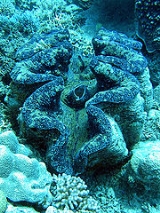
The giant clam, Tridacna gigas (known as pā’ua in Cook Islands Māori
Cook Islands Maori
The Cook Islands Māori language, also called Māori Kūki 'Āirani or Rarotongan, is the official language of the Cook Islands. Most Cook Islanders also call it Te reo Ipukarea, literally "the language of the Ancestral Homeland"....

), is the largest living bivalve mollusc. T. gigas is one of the most endangered clam species. It was mentioned as early as 1825 in scientific reports. One of a number of large clam
Clam
The word "clam" can be applied to freshwater mussels, and other freshwater bivalves, as well as marine bivalves.In the United States, "clam" can be used in several different ways: one, as a general term covering all bivalve molluscs...

 species native to the shallow coral
Coral
Corals are marine animals in class Anthozoa of phylum Cnidaria typically living in compact colonies of many identical individual "polyps". The group includes the important reef builders that inhabit tropical oceans and secrete calcium carbonate to form a hard skeleton.A coral "head" is a colony of...

 reefs of the South Pacific
Pacific Ocean
The Pacific Ocean is the largest of the Earth's oceanic divisions. It extends from the Arctic in the north to the Southern Ocean in the south, bounded by Asia and Australia in the west, and the Americas in the east.At 165.2 million square kilometres in area, this largest division of the World...

 and Indian ocean
Indian Ocean
The Indian Ocean is the third largest of the world's oceanic divisions, covering approximately 20% of the water on the Earth's surface. It is bounded on the north by the Indian Subcontinent and Arabian Peninsula ; on the west by eastern Africa; on the east by Indochina, the Sunda Islands, and...

s, they can weigh more than 200 kilograms (440.9 lb) measure as much as 120 cm (47.2 in) across, and have an average lifespan in the wild of 100 years or more. They are also found off the shores of the Philippines
Pearl of Lao Tzu
The Pearl of Lao Tzu is the largest known pearl in the world. It is not a gem-quality pearl, but is instead what is known as a "clam pearl" or "Tridacna pearl" from a giant clam. It measures 24 centimeters in diameter and weighs 6.4 kilograms...

, where they are called taklobo. T. gigas lives in flat coral
Coral
Corals are marine animals in class Anthozoa of phylum Cnidaria typically living in compact colonies of many identical individual "polyps". The group includes the important reef builders that inhabit tropical oceans and secrete calcium carbonate to form a hard skeleton.A coral "head" is a colony of...

 sand
Sand
Sand is a naturally occurring granular material composed of finely divided rock and mineral particles.The composition of sand is highly variable, depending on the local rock sources and conditions, but the most common constituent of sand in inland continental settings and non-tropical coastal...

 or broken coral and can be found at depth of as much as 20 m (66 ft). Its range covers the Indo-Pacific, but populations are diminishing quickly and the giant clam has become extinct in many areas where it was once common. T. maxima has the largest geographical distribution among giant clam species; it can be found in high- or low-islands, lagoon
Lagoon
A lagoon is a body of shallow sea water or brackish water separated from the sea by some form of barrier. The EU's habitat directive defines lagoons as "expanses of shallow coastal salt water, of varying salinity or water volume, wholly or partially separated from the sea by sand banks or shingle,...

s, or fringing reef
Fringing reef
A fringing reef is one of the three main types of coral reefs recognized by most coral reef scientists. It is distinguished from the other two main types in that it has either an entirely shallow backreef zone or none at all...

s. Its rapid growth rate is likely due to its ability to cultivate plants in its body tissue.
Discussion
Ask a question about 'Giant clam'
Start a new discussion about 'Giant clam'
Answer questions from other users
Full Discussion Forum
 
Unanswered Questions
Encyclopedia
The giant clam, Tridacna gigas (known as pā’ua in Cook Islands Māori
Cook Islands Maori
The Cook Islands Māori language, also called Māori Kūki 'Āirani or Rarotongan, is the official language of the Cook Islands. Most Cook Islanders also call it Te reo Ipukarea, literally "the language of the Ancestral Homeland"....

), is the largest living bivalve mollusc. T. gigas is one of the most endangered clam species. It was mentioned as early as 1825 in scientific reports. One of a number of large clam
Clam
The word "clam" can be applied to freshwater mussels, and other freshwater bivalves, as well as marine bivalves.In the United States, "clam" can be used in several different ways: one, as a general term covering all bivalve molluscs...

 species native to the shallow coral
Coral
Corals are marine animals in class Anthozoa of phylum Cnidaria typically living in compact colonies of many identical individual "polyps". The group includes the important reef builders that inhabit tropical oceans and secrete calcium carbonate to form a hard skeleton.A coral "head" is a colony of...

 reefs of the South Pacific
Pacific Ocean
The Pacific Ocean is the largest of the Earth's oceanic divisions. It extends from the Arctic in the north to the Southern Ocean in the south, bounded by Asia and Australia in the west, and the Americas in the east.At 165.2 million square kilometres in area, this largest division of the World...

 and Indian ocean
Indian Ocean
The Indian Ocean is the third largest of the world's oceanic divisions, covering approximately 20% of the water on the Earth's surface. It is bounded on the north by the Indian Subcontinent and Arabian Peninsula ; on the west by eastern Africa; on the east by Indochina, the Sunda Islands, and...

s, they can weigh more than 200 kilograms (440.9 lb) measure as much as 120 cm (47.2 in) across, and have an average lifespan in the wild of 100 years or more. They are also found off the shores of the Philippines
Pearl of Lao Tzu
The Pearl of Lao Tzu is the largest known pearl in the world. It is not a gem-quality pearl, but is instead what is known as a "clam pearl" or "Tridacna pearl" from a giant clam. It measures 24 centimeters in diameter and weighs 6.4 kilograms...

, where they are called taklobo. T. gigas lives in flat coral
Coral
Corals are marine animals in class Anthozoa of phylum Cnidaria typically living in compact colonies of many identical individual "polyps". The group includes the important reef builders that inhabit tropical oceans and secrete calcium carbonate to form a hard skeleton.A coral "head" is a colony of...

 sand
Sand
Sand is a naturally occurring granular material composed of finely divided rock and mineral particles.The composition of sand is highly variable, depending on the local rock sources and conditions, but the most common constituent of sand in inland continental settings and non-tropical coastal...

 or broken coral and can be found at depth of as much as 20 m (66 ft). Its range covers the Indo-Pacific, but populations are diminishing quickly and the giant clam has become extinct in many areas where it was once common. T. maxima has the largest geographical distribution among giant clam species; it can be found in high- or low-islands, lagoon
Lagoon
A lagoon is a body of shallow sea water or brackish water separated from the sea by some form of barrier. The EU's habitat directive defines lagoons as "expanses of shallow coastal salt water, of varying salinity or water volume, wholly or partially separated from the sea by sand banks or shingle,...

s, or fringing reef
Fringing reef
A fringing reef is one of the three main types of coral reefs recognized by most coral reef scientists. It is distinguished from the other two main types in that it has either an entirely shallow backreef zone or none at all...

s. Its rapid growth rate is likely due to its ability to cultivate plants in its body tissue.

Although larva
Larva
A larva is a distinct juvenile form many animals undergo before metamorphosis into adults. Animals with indirect development such as insects, amphibians, or cnidarians typically have a larval phase of their life cycle...

l clams are plankton
Plankton
Plankton are any drifting organisms that inhabit the pelagic zone of oceans, seas, or bodies of fresh water. That is, plankton are defined by their ecological niche rather than phylogenetic or taxonomic classification...

ic, they become sessile
Sessility (zoology)
In zoology, sessility is a characteristic of animals which are not able to move about. They are usually permanently attached to a solid substrate of some kind, such as a part of a plant or dead tree trunk, a rock, or the hull of a ship in the case of barnacles. Corals lay down their own...

 in adulthood. The creature's mantle
Mantle (mollusc)
The mantle is a significant part of the anatomy of molluscs: it is the dorsal body wall which covers the visceral mass and usually protrudes in the form of flaps well beyond the visceral mass itself.In many, but by no means all, species of molluscs, the epidermis of the mantle secretes...

 tissues
Biological tissue
Tissue is a cellular organizational level intermediate between cells and a complete organism. A tissue is an ensemble of cells, not necessarily identical, but from the same origin, that together carry out a specific function. These are called tissues because of their identical functioning...

 act as a habitat
Habitat (ecology)
A habitat is an ecological or environmental area that is inhabited by a particular species of animal, plant or other type of organism...

 for the symbiotic single-celled dinoflagellate
Dinoflagellate
The dinoflagellates are a large group of flagellate protists. Most are marine plankton, but they are common in fresh water habitats as well. Their populations are distributed depending on temperature, salinity, or depth...

 algae
Algae
Algae are a large and diverse group of simple, typically autotrophic organisms, ranging from unicellular to multicellular forms, such as the giant kelps that grow to 65 meters in length. They are photosynthetic like plants, and "simple" because their tissues are not organized into the many...

 (zooxanthella
Zooxanthella
Zooxanthellae are flagellate protozoa that are golden-brown intracellular endosymbionts of various marine animals and protozoa, especially anthozoans such as the scleractinian corals and the tropical sea anemone, Aiptasia....

e) from which it gets nutrition. By day, the clam opens its shell and extends its mantle tissue so that the algae receive the sunlight
Sunlight
Sunlight, in the broad sense, is the total frequency spectrum of electromagnetic radiation given off by the Sun. On Earth, sunlight is filtered through the Earth's atmosphere, and solar radiation is obvious as daylight when the Sun is above the horizon.When the direct solar radiation is not blocked...

 they need to photosynthesize
Photosynthesis
Photosynthesis is a chemical process that converts carbon dioxide into organic compounds, especially sugars, using the energy from sunlight. Photosynthesis occurs in plants, algae, and many species of bacteria, but not in archaea. Photosynthetic organisms are called photoautotrophs, since they can...

.

Anatomy


Young T. gigas are difficult to distinguish from other species of Tridacnidae
Tridacnidae
The Tridacninae are a subfamily of Bivalves colloquially known as giant clams. The family contains the biggest bivalve species, including Tridacna gigas, the giant clam. They have heavy shells, fluted with 4–6 folds. Mantle is usually brightly coloured. They inhabit coral reefs in warm seas of the...

. Adult T. gigas are the only giant clams unable to close their shells completely. Even when closed, part of the mantle is visible, unlike the very similar T. derasa. However, this can only be recognized with increasing age and growth. Small gaps always remain between shells through which retracted brownish-yellow mantle can be seen.

T. gigas has four or five vertical folds in its shell; this is the main characteristic that separates it from the very similar shell of T. derasa, which has six or seven vertical folds. As with massive deposition of coral matrices composed of calcium carbonate
Calcium carbonate
Calcium carbonate is a chemical compound with the formula CaCO3. It is a common substance found in rocks in all parts of the world, and is the main component of shells of marine organisms, snails, coal balls, pearls, and eggshells. Calcium carbonate is the active ingredient in agricultural lime,...

, the bivalves containing zooxanthellae have a tendency to grow massive calcium carbonate
Calcium carbonate
Calcium carbonate is a chemical compound with the formula CaCO3. It is a common substance found in rocks in all parts of the world, and is the main component of shells of marine organisms, snails, coal balls, pearls, and eggshells. Calcium carbonate is the active ingredient in agricultural lime,...

 shells. The mantle's edges are packed with symbiotic zooxanthellae that presumably utilize carbon dioxide
Carbon dioxide
Carbon dioxide is a naturally occurring chemical compound composed of two oxygen atoms covalently bonded to a single carbon atom...

, phosphates, and nitrates supplied by the clam.

Largest specimens


The largest known T. gigas specimen measured 137 cm. It was discovered around 1817 on the north western coast of Sumatra
Sumatra
Sumatra is an island in western Indonesia, westernmost of the Sunda Islands. It is the largest island entirely in Indonesia , and the sixth largest island in the world at 473,481 km2 with a population of 50,365,538...

. The weight of the two shells was 230 kilograms (507.1 lb). This suggests that the live weight of the animal would have been roughly 250 kilograms (551.2 lb). Today these shells are on display in a museum in Northern Ireland
Northern Ireland
Northern Ireland is one of the four countries of the United Kingdom. Situated in the north-east of the island of Ireland, it shares a border with the Republic of Ireland to the south and west...

.

Another unusually large giant clam was found in 1956 off the Japanese island of Ishigaki. However, it was not examined scientifically before 1984. The shell's length was 115 cm and the weight of the shells and soft parts was 333 kilograms (734.1 lb). Scientists estimated the live weight to be around 340 kilograms (749.6 lb).

Feeding


Algae provide giant clams with a supplementary source of nutrition. These plants consist of unicellular algae, whose metabolic
Metabolism
Metabolism is the set of chemical reactions that happen in the cells of living organisms to sustain life. These processes allow organisms to grow and reproduce, maintain their structures, and respond to their environments. Metabolism is usually divided into two categories...

 products add to the clam's filter food. As a result, they are able to grow as large as100 cm length even in nutrient-poor coral-reef waters. The clams cultivate algae in a special circulatory system
Circulatory system
The circulatory system is an organ system that passes nutrients , gases, hormones, blood cells, etc...

 which enables them to keep a substantially higher number of symbionts per unit of volume.

In small clams—10 milligram (0.01 g) dry tissue weight—filter feeding provides about 65% of total carbon needed for respiration
Aquatic respiration
Aquatic respiration is the process whereby an aquatic animal obtains oxygen from water.-Fish:In most fish respiration takes place through gills. Lungfish, however, possess one or two lungs...

 and growth; large clams (10 g) acquire only 34% of carbon from this source. A single species of zooxenthellae may be symbionts of both giant clams and nearby reef–building (hermatypic) corals.

Reproduction


T. gigas reproduce sexually, and are hermaphrodites (producing both egg
Egg (biology)
An egg is an organic vessel in which an embryo first begins to develop. In most birds, reptiles, insects, molluscs, fish, and monotremes, an egg is the zygote, resulting from fertilization of the ovum, which is expelled from the body and permitted to develop outside the body until the developing...

s and sperm
Sperm
The term sperm is derived from the Greek word sperma and refers to the male reproductive cells. In the types of sexual reproduction known as anisogamy and oogamy, there is a marked difference in the size of the gametes with the smaller one being termed the "male" or sperm cell...

). Self-fertilization is not possible, but this characteristic does allow them to reproduce with any other member of the species. This reduces the burden of finding a compatible mate, while simultaneously doubling the number of offspring produced by the process. As with all other forms of sexual reproduction, hermaphroditism ensures that new gene combinations are passed to further generations.

Since giant clams cannot move themselves, they adopt broadcast spawning. They release sperm and eggs into the water. A transmitter substance called Spawning Induced Substance (SIS) helps synchronize the release of sperm and eggs to ensure fertilization. The substance is released through a syphonal outlet
Siphon
The word siphon is sometimes used to refer to a wide variety of devices that involve the flow of liquids through tubes. But in the English language today, the word siphon usually refers to a tube in an inverted U shape which causes a liquid to flow uphill, above the surface of the reservoir,...

. Other clams can detect SIS immediately. Incoming water passes chemoreceptors situated close to the inccurent syphon, which transmit the information directly to the cerebral ganglia, a simple form of brain.

Detection of SIS stimulates the giant clam to swell its mantle in the central region and to contract its adductor muscle
Adduction
Adduction is a movement which brings a part of the anatomy closer to the middle sagittal plane of the body. It is opposed to abduction.-Upper limb:* of arm at shoulder ** Subscapularis** Teres major** Pectoralis major** Infraspinatus...

. Each clam then fills its water chambers and closes the incurrent syphon. The shell contracts vigorously with the adductor's help, so the excurrent chamber's contents flows through the excurrent syphon. After a few contractions containing only water, eggs and sperm appear in the excurrent chamber and then pass through the excurrent syphon into the water. Female eggs have a diameter of 100 micrometre. Egg release initiates the reproductive process. An adult T. gigas can release more than 500 million eggs at a time.

Richard D. Braley of the University of New South Wales
University of New South Wales
The University of New South Wales , is a research-focused university based in Kensington, a suburb in Sydney, New South Wales, Australia...

 School of Zoology
Zoology
Zoology |zoölogy]]), is the branch of biology that relates to the animal kingdom, including the structure, embryology, evolution, classification, habits, and distribution of all animals, both living and extinct...

 observed that spawning seems to coincide with incoming tides near the second (full), third, and fourth (new) quarters of the moon phase. Spawning contractions occurred every 2–3 minutes, with intense spawning ranging from thirty minutes to two and a half hours. Braley also hypothesized that clams that do not respond to the spawning of neighbor clams may be reproductively inactive.

Development


The fertilized egg floats in the sea for about 12 hours until eventually a larva
Larva
A larva is a distinct juvenile form many animals undergo before metamorphosis into adults. Animals with indirect development such as insects, amphibians, or cnidarians typically have a larval phase of their life cycle...

 (trocophore) hatches. It then starts to produce a chalk
Chalk
Chalk is a soft, white, porous sedimentary rock, a form of limestone composed of the mineral calcite. Calcite is calcium carbonate or CaCO3. It forms under reasonably deep marine conditions from the gradual accumulation of minute calcite plates shed from micro-organisms called coccolithophores....

 shell. Two days after fertilization it measures 160 micrometre. Soon it develops a “foot,” which is used to move on the ground; it can also swim to search for appropriate habitat.

At roughly one week of age, the clam settles on the ground, although it changes location frequently within the first few weeks. The larva does not yet have symbiotic algae, so it depends completely on plankton
Plankton
Plankton are any drifting organisms that inhabit the pelagic zone of oceans, seas, or bodies of fresh water. That is, plankton are defined by their ecological niche rather than phylogenetic or taxonomic classification...

. Free floating zooxanthellae are also captured while filtering food. Eventually the front adductor muscle disappears and the rear muscle moves into the clam's center. Many small clams die at this stage. The clam is considered a juvenile
Juvenile (organism)
A juvenile is an individual organism that has not yet reached its adult form, sexual maturity or size. Juveniles sometimes look very different from the adult form, particularly in terms of their colour...

 when it reaches a length of 20 cm . It is difficult to observe the growth rate of T. gigas in the wild, but laboratory-reared giant clams have been observed to grow 12 cm a year.

Relation to People


The main reason that giant clams are becoming endangered is likely to be intensive exploitation by mussel
Mussel
The common name mussel is used for members of several families of clams or bivalvia mollusca, from saltwater and freshwater habitats. These groups have in common a shell whose outline is elongated and asymmetrical compared with other edible clams, which are often more or less rounded or oval.The...

-catching vessels. Mainly large adults are killed since they are the most profitable.

The giant clam is considered a delicacy in Japan
Japan
Japan is an island nation in East Asia. Located in the Pacific Ocean, it lies to the east of the Sea of Japan, China, North Korea, South Korea and Russia, stretching from the Sea of Okhotsk in the north to the East China Sea and Taiwan in the south...

 (known as Himejako), France, South East Asia and many Pacific Islands. Some Asian foods include the meat from the muscles of clam. On the black market, giant clam shells are sold as decorative accouterments. At times large amounts of money were paid for the adductor muscle, which Chinese people believed have aphrodisiac
Aphrodisiac
An aphrodisiac is a substance that increases sexual desire. The name comes from Aphrodite, the Greek goddess of sexuality and love. Throughout history, many foods, drinks, and behaviors have had a reputation for making sex more attainable and/or pleasurable...

 powers.

Legend


As is often the case with uncharacteristically large species, the giant clam has been historically misunderstood. It was known in times past as the killer clam or man-eating clam, and reputable scientific and technical manuals once claimed that the great mollusc had caused deaths; versions of the U.S. Navy Diving Manual even gave detailed instructions for releasing oneself from its grasp by severing the adductor muscles used to close its shell.

In a colorful account of the discovery of the Pearl of Lao Tzu
Pearl of Lao Tzu
The Pearl of Lao Tzu is the largest known pearl in the world. It is not a gem-quality pearl, but is instead what is known as a "clam pearl" or "Tridacna pearl" from a giant clam. It measures 24 centimeters in diameter and weighs 6.4 kilograms...

, Wilburn Cobb said he was told that a Dyak diver was drowned when the Tridacna closed its shell on his arm.

Today the giant clam is considered neither aggressive nor particularly dangerous. While it is certainly capable of gripping a person, the shell's closing action is defensive, not aggressive and the shell valves close too slowly to pose a serious threat. Furthermore, many large individuals are unable to completely close their shells.

Aquaculture


Mass culture of giant clams began at the Micronesian Mariculture Demonstration Center in Palau
Palau
Palau , officially the Republic of Palau , is an island nation in the Pacific Ocean, east of the Philippines and south of Tokyo. In 1978, after three decades as being part of the United Nations trusteeship, Palau chose independence instead of becoming part of the Federated States of Micronesia, a...

 (belau). A large Australia
Australia
Australia , officially the Commonwealth of Australia, is a country in the Southern Hemisphere comprising the mainland of the Australian continent, the island of Tasmania, and numerous smaller islands in the Indian and Pacific Oceans. It is the world's sixth-largest country by total area...

n government-funded project from 1985-1992 mass cultured giant clams, particularly T. gigas at James Cook University
James Cook University
James Cook University is a public university based in Townsville, Queensland, Australia. The university has two Australian campuses, located in Townsville and Cairns respectively, and an international campus in Singapore. JCU is the second oldest university in Queensland—proclaimed in 1970—and the...

's Orpheus Island Research Station, and supported the development of hatcheries in the Pacific Islands and the Philippines. Recent developments in aquaculture
Aquaculture
Aquaculture, also known as aquafarming, is the farming of aquatic organisms such as fish, crustaceans, molluscs and aquatic plants. Aquaculture involves cultivating freshwater and saltwater populations under controlled conditions, and can be contrasted with commercial fishing, which is the...

, specifically at Harbor Branch Oceanographic Institute
Harbor Branch Oceanographic Institute
Harbor Branch Oceanographic Institute at Florida Atlantic University, also commonly referred to as HBOI or HBOI at FAU, is a non-profit oceanographic institution operated by Florida Atlantic University in Fort Pierce, Florida, USA. HBOI traces its history to a 1971 entity which was merged into...

 in Ft. Pierce, Florida, and in the Marshall Islands
Marshall Islands
The Republic of the Marshall Islands , , is a Micronesian nation of atolls and islands in the middle of the Pacific Ocean, just west of the International Date Line and just north of the Equator. As of July 2011 the population was 67,182...

, have succeeded in tank-raising T. gigas both for use in home aquariums and for release into the wild.

Conservation status


The IUCN lists the giant clams as vulnerable. There is concern among conservationist
Conservationist
Conservationists are proponents or advocates of conservation. They advocate for the protection of all the species in an ecosystem with a strong focus on the natural environment...

s about whether those who use the species as a source of livelihood are overexploiting it. The numbers in the wild have been greatly reduced by extensive harvesting for food and the aquarium trade.

External links


Listed as Vulnerable (VU A2cd v2.3)