


Nuclear fuel cycle

Encyclopedia
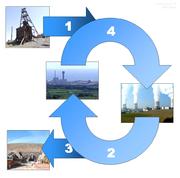
The nuclear fuel cycle, also called nuclear fuel chain, is the progression of nuclear fuel
through a series of differing stages. It consists of steps in the front end, which are the preparation of the fuel, steps in the service period in which the fuel is used during reactor operation, and steps in the back end, which are necessary to safely manage, contain, and either reprocess
or dispose of spent nuclear fuel. If spent fuel is not reprocessed, the fuel cycle is referred to as an open fuel cycle (or a once-through fuel cycle); if the spent fuel is reprocessed, it is referred to as a closed fuel cycle.
relies on fissionable material that can sustain a chain reaction
with neutron
s. Examples of such materials include uranium
and plutonium
. Most nuclear reactors use a moderator
to lower the kinetic energy of the neutrons and increase the probability that fission
will occur. This allows reactors to use material with far lower concentration of fissile
isotopes than nuclear weapon
s. Graphite
and heavy water
are the most effective moderators, because they slow the neutrons through collisions without absorbing them. Reactors using heavy water
or graphite as the moderator can operate using natural uranium
.
A Light water reactor
(LWR) uses water in the form that occurs in nature, and require fuel that is enriched in fissile isotopes, typically uranium enriched
to 3-5% in the less common isotope U-235, the only fissile isotope that is found in significant quantity in nature. One alternative to this low-enriched uranium (LEU) fuel are Mixed Oxide
(MOX) fuels produced by blending plutonium with natural or depleted uranium, and these fuels provide an avenue to utilize surplus weapons-grade
plutonium. Another type of MOX fuel involves mixing LEU with thorium
, which generates the fissile isotope U-233
. Both plutonium and U-233 are produced from the absorption of neutrons by irradiating fertile material
s in a reactor, in particular the common uranium isotope U-238
and thorium
, respectively, and can be separated from spent uranium and thorium fuels in reprocessing plants
.
Some reactors do not use moderators to slow the neutrons. Like nuclear weapons, which also use unmoderated or "fast" neutrons, these Fast-neutron reactors require much higher concentrations of fissile isotopes in order to sustain a chain reaction. They are also capable of breeding
fissile isotopes from fertile materials; a Breeder reactor
is one that generates more fissile material in this way than it consumes.
During the nuclear reaction inside a reactor, the fissile isotopes in nuclear fuel are consumed, producing more and more fission products, most of which are considered radioactive waste
. The buildup of fission products and consumption of fissile isotopes eventually stop the nuclear reaction, causing the fuel to become a spent nuclear fuel
. When 3% enriched LEU fuel is used, the spent fuel typically consists of roughly 1% U-235, 95% U-238, 1% plutonium and 3% fission products. Spent fuel and other high-level radioactive waste is extremely hazardous, although nuclear reactors produce relatively small volumes of waste compared to other power plants because of the high energy density of nuclear fuel. Safe management of these byproducts of nuclear power, including their storage and disposal, is a difficult problem for any country using nuclear power.
, discovered by geophysical techniques, is evaluated and sampled to determine the amounts of uranium materials that are extractable at specified costs from the deposit. Uranium reserves are the amounts of ore that are estimated to be recoverable at stated costs. Uranium in nature consists primarily of two isotopes, U-238 and U-235. The numbers refer to the atomic mass number
for each isotope
, or the number of proton
s and neutron
s in the atomic nucleus
. Naturally occurring uranium consists of approximately 99.28% U-238 and 0.71% U-235. The atomic nucleus of U-235 will nearly always fission when struck by a free neutron, and the isotope is therefore said to be a "fissile
" isotope. The nucleus of a U-238 atom on the other hand, rather than undergoing fission when struck by a free neutron, will nearly always absorb the neutron and yield an atom of the isotope U-239. This isotope then undergoes natural radioactive decay to yield Pu-239, which, like U-235, is a fissile isotope. The atoms of U-238 are said to be fertile, because, through neutron irradiation in the core, some eventually yield atoms of fissile Pu-239.
mining
methods also are used to mine uranium in the United States
. In this technology, uranium is leached from the in-place ore through an array of regularly spaced wells and is then recovered from the leach solution at a surface plant. Uranium ores in the United States typically range from about 0.05 to 0.3% uranium oxide (U3O8). Some uranium deposits developed in other countries are of higher grade and are also larger than deposits mined in the United States. Uranium is also present in very low-grade amounts (50 to 200 parts per million) in some domestic phosphate
-bearing deposits of marine origin. Because very large quantities of phosphate-bearing rock are mined for the production of wet-process phosphoric acid
used in high analysis fertilizer
s and other phosphate chemicals, at some phosphate processing plants the uranium, although present in very low concentrations, can be economically recovered from the process stream.
", which is sold on the uranium market as U3O8.
, UF6, which is the form required by most commercial uranium enrichment facilities currently in use. A solid at room temperature, uranium hexafluoride can be changed to a gaseous form at moderately higher temperature of 57 °C (134 °F). The uranium hexafluoride conversion product contains only natural, not enriched, uranium.
Triuranium octaoxide
(U3O8) is also converted directly to ceramic
grade uranium dioxide
(UO2) for use in reactors not requiring enriched fuel, such as CANDU. The volumes of material converted directly to UO2 are typically quite small compared to the amounts converted to UF6.
 The concentration of the fissionable isotope, U-235 (0.71% in natural uranium) is less than that required to sustain a nuclear chain reaction in light water reactor
cores. Natural UF6 thus must be enriched in the fissionable isotope for it to be used as nuclear fuel. The different levels of enrichment required for a particular nuclear fuel application are specified by the customer: light-water reactor fuel normally is enriched to 3.5% U-235, but uranium enriched to lower concentrations is also required. Enrichment is accomplished using one or more methods of isotope separation
. Gaseous diffusion
and gas centrifuge
are the commonly used uranium enrichment technologies, but new enrichment technologies are currently being developed.
The bulk (96%) of the byproduct from enrichment is depleted uranium
(DU), which can be used for armor, kinetic energy penetrator
s, radiation shielding and ballast
. Still, there are vast quantities of depleted uranium in storage. The United States Department of Energy
alone has 470,000 tonne
s. About 95% of depleted uranium is stored as uranium hexafluoride
(UF6).
(UO2) powder that is then processed into pellet form. The pellets are then fired in a high temperature sintering
furnace
to create hard, ceramic
pellets of enriched uranium
. The cylindrical pellets then undergo a grinding process to achieve a uniform pellet size. The pellets are stacked, according to each nuclear reactor core
's design specifications, into tubes of corrosion-resistant metal alloy
. The tubes are sealed to contain the fuel pellets: these tubes are called fuel rods. The finished fuel rods are grouped in special fuel assemblies that are then used to build up the nuclear fuel core of a power reactor.
The metal used for the tubes depends on the design of the reactor. Stainless steel
was used in the past, but most reactors now use zirconium
. For the most common types of reactors, boiling water reactor
s (BWR) and pressurized water reactor
s (PWR), the tubes are assembled into bundles with the tubes spaced precise distances apart. These bundles are then given a unique identification number, which enables them to be tracked from manufacture through use and into disposal.
is an integral part of the nuclear fuel cycle. There are nuclear power reactors in operation in several countries but uranium mining is viable in only a few areas. Also, in the course of over forty years of operation by the nuclear industry, a number of specialized facilities have been developed in various locations around the world to provide fuel cycle services and there is a need to transport nuclear materials to and from these facilities. Most transports of nuclear fuel
material occur between different stages of the cycle, but occasionally a material may be transported between similar facilities. With some exceptions, nuclear fuel cycle materials are transported in solid form, the exception being uranium hexafluoride
(UF6) which is considered a gas. Most of the material used in nuclear fuel is transported several times during the cycle. Transports are frequently international, and are often over large distances. Nuclear materials are generally transported by specialized transport companies.
Since nuclear materials are radioactive, it is important to ensure that radiation exposure of both those involved in the transport of such materials and the general public along transport routes is limited. Packaging for nuclear materials includes, where appropriate, shielding to reduce potential radiation exposures. In the case of some materials, such as fresh uranium fuel assemblies, the radiation levels are negligible and no shielding is required. Other materials, such as spent fuel and high-level waste, are highly radioactive and require special handling. To limit the risk in transporting highly radioactive materials, containers known as spent nuclear fuel shipping cask
s are used which are designed to maintain integrity under normal transportation conditions and during hypothetical accident conditions.
is composed of a few hundred "assemblies", arranged in a regular array of cells, each cell being formed by a fuel or control rod surrounded, in most designs, by a moderator
and coolant
, which is water in most reactors.
Because of the fission
process that consumes the fuels, the old fuel rods must be changed periodically to fresh ones (this period is called a cycle). However, only a part of the assemblies (typically one-third) are removed since the fuel depletion is not spatially uniform. Furthermore, it is not a good policy, for efficiency reasons, to put the new assemblies exactly at the location of the removed ones. Even bundles of the same age may have different burn-up levels, which depends on their previous positions in the core. Thus the available bundles must be arranged in such a way that the yield is maximized, while safety limitations and operational constraints are satisfied. Consequently reactor operators are faced with the so-called optimal fuel reloading problem, which consists in optimizing the rearrangement of all the assemblies, the old and fresh ones, while still maximizing the reactivity of the reactor core so as to maximise fuel burn-up and minimise fuel-cycle costs.
This is a discrete optimization
problem, and computationally infeasible by current combinatorial methods, due to the huge number of permutation
s and the complexity of each computation. Many numerical methods have been proposed for solving it and many commercial software packages have been written to support fuel management. This is an on-going issue in reactor operations as no definitive solution to this problem has been found and operators use a combination of computation
al and empirical
techniques to manage this problem.
, where used fuel is examined to know more about the processes that occur in fuel during use, and how these might alter the outcome of an accident. For example, during normal use, the fuel expands due to thermal expansion, which can cause cracking. Most nuclear fuel
is uranium dioxide, which is a cubic
solid with a structure similar to that of calcium fluoride
. In used fuel the solid state structure of most of the solid remains the same as that of pure cubic uranium dioxide. SIMFUEL is the name given to the simulated spent fuel which is made by mixing finely ground metal oxides, grinding as a slurry, spray drying it before heating in hydrogen/argon to 1700 oC. In SIMFUEL, 4.1% of the volume of the solid was in the form of metal nanoparticle
s which are made of molybdenum
, ruthenium
, rhodium
and palladium
. Most of these metal particles are of the ε phase (hexagonal
) of Mo-Ru-Rh-Pd alloy, while smaller amounts of the α (cubic
) and σ (tetragonal
) phases of these metals were found in the SIMFUEL. Also present within the SIMFUEL was a cubic perovskite
phase which is a barium
strontium
zirconate
(BaxSr1-xZrO3).
Uranium dioxide is very insoluble in water, but after oxidation it can be converted to uranium trioxide or another uranium(VI) compound which is much more soluble. Uranium dioxide (UO2) can be oxidised to an oxygen rich hyperstoichiometric oxide (UO2+x) which can be further oxidised to U4O9, U3O7, U3O8 and UO3.2H2O.
Because used fuel contains alpha emitters (plutonium and the minor actinides
), the effect of adding an alpha emitter (238Pu) to uranium dioxide on the leaching rate of the oxide has been investigated. For the crushed oxide, adding 238Pu tended to increase the rate of leaching, but the difference in the leaching rate between 0.1 and 10% 238Pu was very small.
The concentration of carbonate
in the water which is in contact with the used fuel has a considerable effect on the rate of corrosion, because uranium
(VI) forms soluble anionic carbonate complexes such as [UO2(CO3)2]2- and [UO2(CO3)3]4-. When carbonate ions are absent, and the water is not strongly acidic, the hexavalent uranium compounds which form on oxidation of uranium dioxide
often form insoluble hydrated uranium trioxide
phases.
By ‘sputtering
’, using uranium metal and an argon
/oxygen
gas mixture, thin films of uranium dioxide can be deposited upon gold surfaces. These gold surfaces modified with uranium dioxide have been used for both cyclic voltammetry
and AC impedance experiments, and these offer an insight into the likely leaching behaviour of uranium dioxide.
based fuel interacts with the zirconium
alloy tubing used to cover it. During use, the fuel swells due to thermal expansion
and then starts to react with the surface of the zirconium alloy, forming a new layer which contains both fuel and zirconium (from the cladding). Then, on the fuel side of this mixed layer, there is a layer of fuel which has a higher caesium
to uranium
ratio than most of the fuel. This is because xenon
isotopes are formed as fission products that diffuse out of the lattice of the fuel into voids such as the narrow gap between the fuel and the cladding. After diffusing into these voids, it decays to caesium isotopes. Because of the thermal gradient which exists in the fuel during use, the volatile fission products tend to be driven from the centre of the pellet to the rim area. Below is a graph of the temperature of uranium metal, uranium nitride and uranium dioxide
as a function of distance from the centre of a 20 mm diameter pellet with a rim temperature of 200 oC. The uranium dioxide (because of its poor thermal conductivity) will overheat at the centre of the pellet, while the other more thermally conductive forms of uranium remain below their melting points.
The releases of radioactivity from normal operations are the small planned releases from uranium ore processing, enrichment, power reactors, reprocessing plants and waste stores. These can be in a different chemical/physical form to the releases which could occur under accident conditions. In addition the isotope signature of a hypothetical accident may be very different to that of a planned normal operational discharge of radioactivity to the environment.
Just because a radioisotope is released it does not mean it will enter a human and then cause harm. For instance the migration of radioactivity can be altered by the binding of the radioisotope to the surfaces of soil particles. For example caesium binds tightly to clay minerals such as illite
and montmorillonite
hence it remains in the upper layers of soil where it can be accessed by plants with shallow roots (such as grass). Hence grass and mushrooms can carry a considerable amount of 137Cs which can be transferred to humans through the food chain. But 137Cs is not able to migrate quickly through most soils and thus is unlikely to contaminate well
water. Colloids of soil minerals can migrate through soil so simple binding of a metal to the surfaces of soil particles does not fix the metal totally.
According to Jiří Hála's text book the distribution coefficient Kd is the ratio of the soil's radioactivity (Bq g−1) to that of the soil water (Bq ml−1). If the radioisotope is tightly bound to the minerals in the soil then less radioactivity can be absorbed by crops and grass
growing on the soil.
One of the best countermeasures in dairy farming against 137Cs is to mix up the soil by deeply ploughing the soil. This has the effect of putting the 137Cs out of reach of the shallow roots of the grass, hence the level of radioactivity in the grass will be lowered. Also after a nuclear war or serious accident the removal of top few cm of soil and its burial in a shallow trench will reduce the long term gamma dose to humans due to 137Cs as the gamma photons will be attenuated by their passage through the soil.
Even after the radioactive element arrives at the roots of the plant, the metal may be rejected by the biochemistry of the plant. The details of the uptake of 90Sr and 137Cs into sunflower
s grown under hydroponic conditions has been reported. The caesium was found in the leaf veins, in the stem and in the apical leaves. It was found that 12% of the caesium entered the plant, and 20% of the strontium. This paper also reports details of the effect of potassium
, ammonium
and calcium
ions on the uptake of the radioisotopes.
In livestock
farming an important countermeasure against 137Cs is to feed animals a small amount of prussian blue
. This iron
potassium
cyanide
compound acts as a ion-exchanger. The cyanide is so tightly bonded to the iron that it is safe for a human to eat several grams of prussian blue per day. The prussian blue reduces the biological half-life
(different from the nuclear half-life
) of the caesium. The physical or nuclear half-life of 137Cs is about 30 years. This is a constant which can not be changed but the biological half-life is not a constant. It will change according to the nature and habits of the organism for which it is expressed. Caesium
in humans normally has a biological half-life of between one and four months. An added advantage of the prussian blue is that the caesium which is stripped from the animal in the droppings
is in a form which is not available to plants. Hence it prevents the caesium from being recycled. The form of prussian blue required for the treatment of humans or animals is a special grade. Attempts to use the pigment
grade used in paint
s have not been successful. Note that a good source of data on the subject of caesium
in Chernobyl
fallout exists at http://www.uiar.org.ua/Eng/index.htm (Ukrainian Research Institute for Agricultural Radiology).
The IAEA assume that under normal operation the coolant of a water-cooled reactor will contain some radioactivity but during a reactor accident the coolant radioactivity level may rise. The IAEA state that under a series of different conditions different amounts of the core inventory can be released from the fuel, the four conditions the IAEA consider are normal operation, a spike in coolant activity due to a sudden shutdown/loss of pressure (core remains covered with water), a cladding failure resulting in the release of the activity in the fuel/cladding gap (this could be due to the fuel being uncovered by the loss of water for 15–30 minutes where the cladding reached a temperature of 650-1250 oC) or a melting of the core (the fuel will have to be uncovered for at least 30 minutes, and the cladding would reach a temperature in excess of 1650 oC).
Based upon the assumption that a PWR contains 300 tons of water
, and that the activity of the fuel of a 1 GWe reactor is as the IAEA predict, then the coolant activity after an accident such as the three mile island accident (where a core is uncovered and then recovered with water) can be predicted.
It is normal to allow used fuel to stand after the irradiation to allow the short-lived and radiotoxic iodine
isotopes to decay away. In one experiment in the USA fresh fuel which had not been allowed to decay was reprocessed (the Green run
http://www.osti.gov/energycitations/product.biblio.jsp?osti_id=7296321 http://www10.antenna.nl/wise/index.html?http://www10.antenna.nl/wise/381/3733.html http://archive.tri-cityherald.com/thyroid/history.html) to investigate the effects of a large iodine release from the reprocessing of short cooled fuel. It is normal in reprocessing plants to scrub the off gases from the dissolver to prevent the emission of iodine. In addition to the emission of iodine the noble gas
es and tritium
are released from the fuel when it is dissolved. It has been proposed that by voloxidation (heating the fuel in a furnace under oxidizing conditions) the majority of the tritium can be recovered from the fuel.http://www.ornl.gov/~webworks/cppr/y2001/pres/123514.pdf
A paper was written on the radioactivity in oyster
s found in the Irish Sea
. These were found by gamma spectroscopy to contain 141Ce, 144Ce, 103Ru, 106Ru, 137Cs, 95Zr and 95Nb. Additionally, a zinc activation product (65Zn) was found, which is thought to be due to the corrosion of magnox
fuel cladding in cooling pond
s. It is likely that the modern releases of all these isotopes from Windscale is smaller.
s or CANDU reactor
s, can be refueled without being shut down. This is achieved through the use of many small pressure tubes to contain the fuel and coolant, as opposed to one large pressure vessel as in pressurized water reactor
(PWR) or boiling water reactor
(BWR) designs. Each tube can be individually isolated and refueled by an operator-controlled fueling machine, typically at a rate of up to 8 channels per day out of roughly 400 in CANDU reactors. On-load refueling allows for the optimal fuel reloading problem to be dealt with continuously, leading to more efficient use of fuel. This increase in efficiency is partially offset by the added complexity of having hundreds of pressure tubes and the fueling machines to service them.
) or potentially in a common facility away from reactor sites. If on-site pool storage capacity is exceeded, it may be desirable to store the now cooled aged fuel in modular dry storage facilities known as Independent Spent Fuel Storage Installations (ISFSI) at the reactor site or at a facility away from the site. The spent fuel rods are usually stored in water or boric acid, which provides both cooling (the spent fuel continues to generate decay heat
as a result of residual radioactive decay) and shielding to protect the environment from residual ionizing radiation
, although after at least a year of cooling they may be moved to dry cask storage
.
 Spent fuel discharged from reactors contains appreciable quantities of fissile (U-235 and Pu-239), fertile (U-238), and other radioactive materials, including reaction poisons
, which is why the fuel had to be removed. These fissile and fertile materials can be chemically separated and recovered from the spent fuel. The recovered uranium and plutonium can, if economic and institutional conditions permit, be recycled for use as nuclear fuel. This is currently not done for civilian spent nuclear fuel in the United States
.
Mixed oxide, or MOX fuel
, is a blend of reprocessed uranium
and plutonium and depleted uranium which behaves similarly, although not identically, to the enriched uranium feed for which most nuclear reactors were designed. MOX fuel is an alternative to low-enriched uranium (LEU) fuel used in the light water reactors which predominate nuclear power generation.
Currently, plants in Europe are reprocessing spent fuel from utilities in Europe and Japan. Reprocessing of spent commercial-reactor nuclear fuel is currently not permitted in the United States
due to the perceived danger of nuclear proliferation
. However the recently announced Global Nuclear Energy Partnership
would see the U.S. form an international partnership to see spent nuclear fuel reprocessed in a way that renders the plutonium in it usable for nuclear fuel but not for nuclear weapon
s.
in glass
or Synroc
, the most radiotoxic elements can be removed through advanced reprocessing. After separation the minor actinides
and some long lived fission product
s can be converted to short-lived isotope
s by either neutron
or photon
irradiation. This is called transmutation
.
or, if the reprocessing option is used, wastes from reprocessing plants. These materials must be isolated from the biosphere
until the radioactivity contained in them has diminished to a safe level. In the U.S., under the Nuclear Waste Policy Act
of 1982 as amended, the Department of Energy
has responsibility for the development of the waste disposal system for spent nuclear fuel and high-level radioactive waste. Current plans call for the ultimate disposal of the wastes in solid form in a licensed deep, stable geologic structure called a deep geological repository
. The Department of Energy chose Yucca Mountain as the location for the repository. However, its opening has been repeatedly delayed.
It is worth noting that some non-PLWR reactor designs, and in particular the ones using liquid thorium fuel
in molten salt reactors, would produce virtually no long-lasting nuclear waste. It is also possible to burn rather than bury nuclear waste, for instance in Integral Fast Reactor
s or in variations of molten salt reactor
s.
A proposed type of nuclear reactor called a traveling wave reactor
is claimed, if it were to be built, to be able to be fueled by nuclear waste, and to be able to operate for 200 years without needing any refueling.
. This method is favored by six countries: the United States
, Canada
, Sweden
, Finland
, Spain
and South Africa
. Some countries, notably Sweden and Canada, have designed repositories to permit future recovery of the material should the need arise, while others plan for permanent sequestration in a geological repository like the Yucca Mountain nuclear waste repository in the United States.
services offered by BNFL
and COGEMA
. Here, the fission product
s, minor actinides
, activation product
s, and reprocessed uranium
are separated from the reactor-grade plutonium
, which can then be fabricated into MOX fuel
. Because the proportion of the non-fissile
even
-mass
isotopes of plutonium
rises with each pass through the cycle, there are currently no plans to reuse plutonium from used MOX fuel for a third pass in a thermal reactor
. However, if fast reactors become available, they may be able to burn these, or almost any other actinide
isotope
s.
is being used as a fuel.
A number of reactor designs, like the Integral Fast Reactor
, have been designed for this rather different fuel cycle. In principle, it should be possible to derive energy from the fission of any actinide nucleus. With a careful reactor design, all the actinides in the fuel can be consumed, leaving only lighter elements with short half-lives
. Whereas this has been done in prototype plants, no such reactor has ever been operated on a large scale, and the first plants with full actinide recovery are expected to be ready for commercial deployment in 2015 at the earliest.
However, such schemes would most likely require advanced remote reprocessing methods due to the neutron emitting compounds formed. For instance if curium
is irradiated with neutron
s it will form the very heavy actinides californium
and fermium
which undergo spontaneous fission
. As a result, the neutron emission
from a used fuel element which had included curium will be much higher, potentially posing a risk to workers at the back end of the cycle unless all reprocessing is done remotely. This could be seen as a disadvantage, but on the other hand it also makes the nuclear material difficult to steal or divert, making it more resistant to nuclear proliferation
It so happens that the neutron cross-section
of many actinides decreases with increasing neutron energy, but the ratio of fission to simple activation (neutron capture
) changes in favour of fission as the neutron energy increases. Thus with a sufficiently high neutron energy, it should be possible to destroy even curium without the generation of the transcurium metals. This could be very desirable as it would make it significantly easier to reprocess and handle the actinide fuel.
One promising alternative from this perspective is an accelerator driven subcritical reactor
. Here a beam of either proton
s (United States and European designs) or electron
s (Japanese design) is directed into a target. In the case of protons, very fast neutrons will spall off the target, while in the case of the electrons, very high energy photon
s will be generated. These high-energy neutrons and photons will then be able to cause the fission of the heavy actinides.
Such reactors compare very well to other neutron sources in terms of neutron energy:
As an alternative, the curium-244, with a half-life of 18 years, could be left to decay into plutonium-240 before being used in fuel in a fast reactor.
If actinides are transmuted in a Subcritical reactor
it is likely that the fuel will have to be able to tolerate more thermal cycles than conventional fuel. An accelerator driven sub critical reactor is unlikely to be able to maintain a constant operation period for equally long times as a critical reactor, and each time the accelerator stops then the fuel will cool down.
On the other hand, if actinides are destroyed using a fast reactor, such as an Integral Fast Reactor
, then the fuel will most likely not be exposed to many more thermal cycles than in a normal power station.
Depending on the matrix the process can generate more transuranics from the matrix. This could either be viewed as good (generate more fuel) or can be viewed as bad (generation of more radiotoxic transuranic elements). A series of different matrices exists which can control this production of heavy actinides.
Fissile nuclei, like Uranium-235, Plutonium-239 and Uranium-233 respond well to delayed neutrons and are thus important to keep a critical reactor stable, and this limits the amount of minor actinides that can be destroyed in a critical reactor. As a consequence it is important that the chosen matrix allows the reactor to keep the ratio of fissile to non-fissile nuclei high, as this enables it to destroy the long lived actinides safely. In contrast, the power output of a sub-critical reactor is limited by the intensity of the driving particle accelerator, and thus it need not contain any uranium or plutonium at all. In such a system it may be preferable to have an inert matrix that doesn't produce additional long-lived isotopes.
The actinides will be mixed with a metal which will not form more actinides, for instance an alloy
of actinides in a solid such as zirconia could be used.
Thorium
will on neutron bombardment form uranium-233
. U-233 is fissile, and has a larger fission cross section than both U-235 and U-238, and thus it is likely to produce very little additional actinides through neutron capture.
If the actinides are incorporated into a uranium-metal or uranium-oxide matrix, then the neutron capture of U-238 is likely to generate new plutonium-239
. An advantage of mixing the actinides with uranium and plutonium is that the large fission cross sections of U-235 and Pu-239 for the less energetic delayed-neutrons could make the reaction stable enough to be carried out in a critical fast reactor, which is likely to be both cheaper and simpler than an accelerator driven system.
It is also possible to create a matrix made from a mix of the above mentioned materials. This is most commonly done in fast reactors where one may wish to keep the breeding ratio of new fuel high enough to keep powering the reactor, but still low enough that the generated actinides can be safely destroyed without transporting them to another site. One way to do this is to use fuel where actinides and uranium is mixed with inert zirconium, producing fuel elements with the desired properties.
in either a fast or thermal reactor. The thorium-233 beta decay
s to protactinium
-233 and then to uranium-233
, which in turn is used as fuel. Hence, like uranium-238
, thorium-232 is a fertile material
.
After starting the reactor with existing U-233 or some other fissile material such as U-235
or Pu-239, a breeding cycle similar to but more efficient than that with U-238 and plutonium can be created. The Th-232 absorbs a neutron to become Th-233 which quickly decays to protactinium
-233. Protactinium-233 in turn decays with a half-life of 27 days to U-233. In some molten salt reactor
designs, the Pa-233 is extracted and protected from neutrons (which could transform it to Pa-234 and then to U-234), until it has decayed to U-233. This is done in order to improve the breeding ratio which is low compared to fast reactors.
Thorium
is at least 4-5 times more abundant in nature than all of uranium isotopes combined; thorium is fairly evenly spread around Earth with a lot of countries
having huge supplies of it; preparation of thorium fuel does not require difficult
and expensive enrichment processes; the thorium fuel cycle creates mainly Uranium-233 contaminated with Uranium-232 which makes it harder to use in a normal, pre-assembled nuclear weapon which is stable over long periods of time (unfortunately drawbacks are much lower for immediate use weapons or where final assembly occurs just prior to usage time); elimination of at least the transuranic portion of the nuclear waste problem is possible in MSR and other breeder reactor designs.
One of the earliest efforts to use a thorium fuel cycle took place at Oak Ridge National Laboratory
in the 1960s. An experimental reactor was built based on molten salt reactor
technology to study the feasibility of such an approach, using thorium fluoride salt kept hot enough to be liquid, thus eliminating the need for fabricating fuel elements. This effort culminated in the Molten-Salt Reactor Experiment
that used 232Th as the fertile material and 233U as the fissile fuel. Due to a lack of funding, the MSR program was discontinued in 1976.
(U-235), uranium-238
(U-238) and plutonium-239
, although the proposed thorium fuel cycle has advantages. Some modern reactors, with minor modifications, can use thorium
. Thorium is approximately three times more abundant in the Earth's crust
than uranium (and 550 times more abundant than uranium-235). However, there has been little exploration for thorium resources, and thus the proved resource is small. Thorium
is more plentiful than uranium
in some countries, notably India
.
Heavy water reactor
s and graphite-moderated reactors can use natural uranium
, but the vast majority of the world's reactors require enriched uranium
, in which the ratio of U-235 to U-238 is increased. In civilian reactors the enrichment is increased to as much as 5% U-235 and 95% U-238, but in naval reactors
there is as much as 93% U-235.
The term nuclear fuel
is not normally used in respect to fusion power
, which fuses isotope
s of hydrogen
into helium
to release energy
.
Nuclear fuel
Nuclear fuel is a material that can be 'consumed' by fission or fusion to derive nuclear energy. Nuclear fuels are the most dense sources of energy available...
through a series of differing stages. It consists of steps in the front end, which are the preparation of the fuel, steps in the service period in which the fuel is used during reactor operation, and steps in the back end, which are necessary to safely manage, contain, and either reprocess
Nuclear reprocessing
Nuclear reprocessing technology was developed to chemically separate and recover fissionable plutonium from irradiated nuclear fuel. Reprocessing serves multiple purposes, whose relative importance has changed over time. Originally reprocessing was used solely to extract plutonium for producing...
or dispose of spent nuclear fuel. If spent fuel is not reprocessed, the fuel cycle is referred to as an open fuel cycle (or a once-through fuel cycle); if the spent fuel is reprocessed, it is referred to as a closed fuel cycle.
Basic concepts
Nuclear powerNuclear power
Nuclear power is the use of sustained nuclear fission to generate heat and electricity. Nuclear power plants provide about 6% of the world's energy and 13–14% of the world's electricity, with the U.S., France, and Japan together accounting for about 50% of nuclear generated electricity...
relies on fissionable material that can sustain a chain reaction
Nuclear chain reaction
A nuclear chain reaction occurs when one nuclear reaction causes an average of one or more nuclear reactions, thus leading to a self-propagating number of these reactions. The specific nuclear reaction may be the fission of heavy isotopes or the fusion of light isotopes...
with neutron
Neutron
The neutron is a subatomic hadron particle which has the symbol or , no net electric charge and a mass slightly larger than that of a proton. With the exception of hydrogen, nuclei of atoms consist of protons and neutrons, which are therefore collectively referred to as nucleons. The number of...
s. Examples of such materials include uranium
Uranium
Uranium is a silvery-white metallic chemical element in the actinide series of the periodic table, with atomic number 92. It is assigned the chemical symbol U. A uranium atom has 92 protons and 92 electrons, of which 6 are valence electrons...
and plutonium
Plutonium
Plutonium is a transuranic radioactive chemical element with the chemical symbol Pu and atomic number 94. It is an actinide metal of silvery-gray appearance that tarnishes when exposed to air, forming a dull coating when oxidized. The element normally exhibits six allotropes and four oxidation...
. Most nuclear reactors use a moderator
Neutron moderator
In nuclear engineering, a neutron moderator is a medium that reduces the speed of fast neutrons, thereby turning them into thermal neutrons capable of sustaining a nuclear chain reaction involving uranium-235....
to lower the kinetic energy of the neutrons and increase the probability that fission
Nuclear fission
In nuclear physics and nuclear chemistry, nuclear fission is a nuclear reaction in which the nucleus of an atom splits into smaller parts , often producing free neutrons and photons , and releasing a tremendous amount of energy...
will occur. This allows reactors to use material with far lower concentration of fissile
Fissile
In nuclear engineering, a fissile material is one that is capable of sustaining a chain reaction of nuclear fission. By definition, fissile materials can sustain a chain reaction with neutrons of any energy. The predominant neutron energy may be typified by either slow neutrons or fast neutrons...
isotopes than nuclear weapon
Nuclear weapon
A nuclear weapon is an explosive device that derives its destructive force from nuclear reactions, either fission or a combination of fission and fusion. Both reactions release vast quantities of energy from relatively small amounts of matter. The first fission bomb test released the same amount...
s. Graphite
Graphite
The mineral graphite is one of the allotropes of carbon. It was named by Abraham Gottlob Werner in 1789 from the Ancient Greek γράφω , "to draw/write", for its use in pencils, where it is commonly called lead . Unlike diamond , graphite is an electrical conductor, a semimetal...
and heavy water
Heavy water
Heavy water is water highly enriched in the hydrogen isotope deuterium; e.g., heavy water used in CANDU reactors is 99.75% enriched by hydrogen atom-fraction...
are the most effective moderators, because they slow the neutrons through collisions without absorbing them. Reactors using heavy water
Heavy water reactor
A pressurised heavy water reactor is a nuclear power reactor, commonly using unenriched natural uranium as its fuel, that uses heavy water as its coolant and moderator. The heavy water coolant is kept under pressure in order to raise its boiling point, allowing it to be heated to higher...
or graphite as the moderator can operate using natural uranium
Natural uranium
Natural uranium refers to refined uranium with the same isotopic ratio as found in nature. It contains 0.7 % uranium-235, 99.3 % uranium-238, and a trace of uranium-234 by weight. In terms of the amount of radioactivity, approximately 2.2 % comes from uranium-235, 48.6 % uranium-238, and 49.2 %...
.
A Light water reactor
Light water reactor
The light water reactor is a type of thermal reactor that uses normal water as its coolant and neutron moderator. Thermal reactors are the most common type of nuclear reactor, and light water reactors are the most common type of thermal reactor...
(LWR) uses water in the form that occurs in nature, and require fuel that is enriched in fissile isotopes, typically uranium enriched
Enriched uranium
Enriched uranium is a kind of uranium in which the percent composition of uranium-235 has been increased through the process of isotope separation. Natural uranium is 99.284% 238U isotope, with 235U only constituting about 0.711% of its weight...
to 3-5% in the less common isotope U-235, the only fissile isotope that is found in significant quantity in nature. One alternative to this low-enriched uranium (LEU) fuel are Mixed Oxide
MOX fuel
Mixed oxide fuel, commonly referred to as MOX fuel, is nuclear fuel that contains more than one oxide of fissile material. MOX fuel contains plutonium blended with natural uranium, reprocessed uranium, or depleted uranium. MOX fuel is an alternative to the low-enriched uranium fuel used in the...
(MOX) fuels produced by blending plutonium with natural or depleted uranium, and these fuels provide an avenue to utilize surplus weapons-grade
Weapons-grade
A weapons-grade substance is one that is pure enough to be used to make a weapon or has properties that make it suitable for weapons use. Weapons-grade plutonium and uranium are the most common examples, but it may also be used to refer to chemical and biological weapons...
plutonium. Another type of MOX fuel involves mixing LEU with thorium
Thorium fuel cycle
The thorium fuel cycle is a nuclear fuel cycle that uses the naturally abundant isotope of thorium, , as the fertile material. In the reactor, is transmuted into the fissile artificial uranium isotope which is the nuclear fuel. Unlike natural uranium, natural thorium contains only trace amounts...
, which generates the fissile isotope U-233
Uranium-233
Uranium-233 is a fissile isotope of uranium, bred from Thorium as part of the thorium fuel cycle. It has been used in a few nuclear reactors and has been proposed for much wider use as a nuclear fuel. It has a half-life of 160,000 years....
. Both plutonium and U-233 are produced from the absorption of neutrons by irradiating fertile material
Fertile material
Fertile material is a term used to describe nuclides which generally themselves do not undergo induced fission but from which fissile material is generated by neutron absorption and subsequent nuclei conversions...
s in a reactor, in particular the common uranium isotope U-238
Uranium-238
Uranium-238 is the most common isotope of uranium found in nature. It is not fissile, but is a fertile material: it can capture a slow neutron and after two beta decays become fissile plutonium-239...
and thorium
Thorium
Thorium is a natural radioactive chemical element with the symbol Th and atomic number 90. It was discovered in 1828 and named after Thor, the Norse god of thunder....
, respectively, and can be separated from spent uranium and thorium fuels in reprocessing plants
Nuclear reprocessing
Nuclear reprocessing technology was developed to chemically separate and recover fissionable plutonium from irradiated nuclear fuel. Reprocessing serves multiple purposes, whose relative importance has changed over time. Originally reprocessing was used solely to extract plutonium for producing...
.
Some reactors do not use moderators to slow the neutrons. Like nuclear weapons, which also use unmoderated or "fast" neutrons, these Fast-neutron reactors require much higher concentrations of fissile isotopes in order to sustain a chain reaction. They are also capable of breeding
Breeder reactor
A breeder reactor is a nuclear reactor capable of generating more fissile material than it consumes because its neutron economy is high enough to breed fissile from fertile material like uranium-238 or thorium-232. Breeders were at first considered superior because of their superior fuel economy...
fissile isotopes from fertile materials; a Breeder reactor
Breeder reactor
A breeder reactor is a nuclear reactor capable of generating more fissile material than it consumes because its neutron economy is high enough to breed fissile from fertile material like uranium-238 or thorium-232. Breeders were at first considered superior because of their superior fuel economy...
is one that generates more fissile material in this way than it consumes.
During the nuclear reaction inside a reactor, the fissile isotopes in nuclear fuel are consumed, producing more and more fission products, most of which are considered radioactive waste
Radioactive waste
Radioactive wastes are wastes that contain radioactive material. Radioactive wastes are usually by-products of nuclear power generation and other applications of nuclear fission or nuclear technology, such as research and medicine...
. The buildup of fission products and consumption of fissile isotopes eventually stop the nuclear reaction, causing the fuel to become a spent nuclear fuel
Spent nuclear fuel
Spent nuclear fuel, occasionally called used nuclear fuel, is nuclear fuel that has been irradiated in a nuclear reactor...
. When 3% enriched LEU fuel is used, the spent fuel typically consists of roughly 1% U-235, 95% U-238, 1% plutonium and 3% fission products. Spent fuel and other high-level radioactive waste is extremely hazardous, although nuclear reactors produce relatively small volumes of waste compared to other power plants because of the high energy density of nuclear fuel. Safe management of these byproducts of nuclear power, including their storage and disposal, is a difficult problem for any country using nuclear power.
Exploration
A deposit of uranium, such as uraniniteUraninite
Uraninite is a radioactive, uranium-rich mineral and ore with a chemical composition that is largely UO2, but also contains UO3 and oxides of lead, thorium, and rare earth elements...
, discovered by geophysical techniques, is evaluated and sampled to determine the amounts of uranium materials that are extractable at specified costs from the deposit. Uranium reserves are the amounts of ore that are estimated to be recoverable at stated costs. Uranium in nature consists primarily of two isotopes, U-238 and U-235. The numbers refer to the atomic mass number
Mass number
The mass number , also called atomic mass number or nucleon number, is the total number of protons and neutrons in an atomic nucleus. Because protons and neutrons both are baryons, the mass number A is identical with the baryon number B as of the nucleus as of the whole atom or ion...
for each isotope
Isotope
Isotopes are variants of atoms of a particular chemical element, which have differing numbers of neutrons. Atoms of a particular element by definition must contain the same number of protons but may have a distinct number of neutrons which differs from atom to atom, without changing the designation...
, or the number of proton
Proton
The proton is a subatomic particle with the symbol or and a positive electric charge of 1 elementary charge. One or more protons are present in the nucleus of each atom, along with neutrons. The number of protons in each atom is its atomic number....
s and neutron
Neutron
The neutron is a subatomic hadron particle which has the symbol or , no net electric charge and a mass slightly larger than that of a proton. With the exception of hydrogen, nuclei of atoms consist of protons and neutrons, which are therefore collectively referred to as nucleons. The number of...
s in the atomic nucleus
Atomic nucleus
The nucleus is the very dense region consisting of protons and neutrons at the center of an atom. It was discovered in 1911, as a result of Ernest Rutherford's interpretation of the famous 1909 Rutherford experiment performed by Hans Geiger and Ernest Marsden, under the direction of Rutherford. The...
. Naturally occurring uranium consists of approximately 99.28% U-238 and 0.71% U-235. The atomic nucleus of U-235 will nearly always fission when struck by a free neutron, and the isotope is therefore said to be a "fissile
Fissile
In nuclear engineering, a fissile material is one that is capable of sustaining a chain reaction of nuclear fission. By definition, fissile materials can sustain a chain reaction with neutrons of any energy. The predominant neutron energy may be typified by either slow neutrons or fast neutrons...
" isotope. The nucleus of a U-238 atom on the other hand, rather than undergoing fission when struck by a free neutron, will nearly always absorb the neutron and yield an atom of the isotope U-239. This isotope then undergoes natural radioactive decay to yield Pu-239, which, like U-235, is a fissile isotope. The atoms of U-238 are said to be fertile, because, through neutron irradiation in the core, some eventually yield atoms of fissile Pu-239.
Mining
Uranium ore can be extracted through conventional mining in open pit and underground methods similar to those used for mining other metals. In-situ leachIn-situ leach
In-situ leaching , also called in-situ recovery or solution mining, is a mining process used to recover minerals such as copper and uranium through boreholes drilled into a deposit, in situ....
mining
Mining
Mining is the extraction of valuable minerals or other geological materials from the earth, from an ore body, vein or seam. The term also includes the removal of soil. Materials recovered by mining include base metals, precious metals, iron, uranium, coal, diamonds, limestone, oil shale, rock...
methods also are used to mine uranium in the United States
United States
The United States of America is a federal constitutional republic comprising fifty states and a federal district...
. In this technology, uranium is leached from the in-place ore through an array of regularly spaced wells and is then recovered from the leach solution at a surface plant. Uranium ores in the United States typically range from about 0.05 to 0.3% uranium oxide (U3O8). Some uranium deposits developed in other countries are of higher grade and are also larger than deposits mined in the United States. Uranium is also present in very low-grade amounts (50 to 200 parts per million) in some domestic phosphate
Phosphate
A phosphate, an inorganic chemical, is a salt of phosphoric acid. In organic chemistry, a phosphate, or organophosphate, is an ester of phosphoric acid. Organic phosphates are important in biochemistry and biogeochemistry or ecology. Inorganic phosphates are mined to obtain phosphorus for use in...
-bearing deposits of marine origin. Because very large quantities of phosphate-bearing rock are mined for the production of wet-process phosphoric acid
Phosphoric acid
Phosphoric acid, also known as orthophosphoric acid or phosphoric acid, is a mineral acid having the chemical formula H3PO4. Orthophosphoric acid molecules can combine with themselves to form a variety of compounds which are also referred to as phosphoric acids, but in a more general way...
used in high analysis fertilizer
Fertilizer
Fertilizer is any organic or inorganic material of natural or synthetic origin that is added to a soil to supply one or more plant nutrients essential to the growth of plants. A recent assessment found that about 40 to 60% of crop yields are attributable to commercial fertilizer use...
s and other phosphate chemicals, at some phosphate processing plants the uranium, although present in very low concentrations, can be economically recovered from the process stream.
Milling
Mined uranium ores normally are processed by grinding the ore materials to a uniform particle size and then treating the ore to extract the uranium by chemical leaching. The milling process commonly yields dry powder-form material consisting of natural uranium, "yellowcakeYellowcake
Yellowcake is a kind of uranium concentrate powder obtained from leach solutions, in an intermediate step in the processing of uranium ores. Yellowcake concentrates are prepared by various extraction and refining methods, depending on the types of ores...
", which is sold on the uranium market as U3O8.
Uranium conversion
Milled uranium oxide, U3O8, must be converted to uranium hexafluorideUranium hexafluoride
Uranium hexafluoride , referred to as "hex" in the nuclear industry, is a compound used in the uranium enrichment process that produces fuel for nuclear reactors and nuclear weapons. It forms solid grey crystals at standard temperature and pressure , is highly toxic, reacts violently with water...
, UF6, which is the form required by most commercial uranium enrichment facilities currently in use. A solid at room temperature, uranium hexafluoride can be changed to a gaseous form at moderately higher temperature of 57 °C (134 °F). The uranium hexafluoride conversion product contains only natural, not enriched, uranium.
Triuranium octaoxide
Triuranium octaoxide
Triuranium octoxide is a compound of uranium. It is present as an olive green to black, odorless solid. In spite of its color, it is one of the more popular forms of yellowcake and is shipped between mills and refineries in this form....
(U3O8) is also converted directly to ceramic
Ceramic
A ceramic is an inorganic, nonmetallic solid prepared by the action of heat and subsequent cooling. Ceramic materials may have a crystalline or partly crystalline structure, or may be amorphous...
grade uranium dioxide
Uranium dioxide
Uranium dioxide or uranium oxide , also known as urania or uranous oxide, is an oxide of uranium, and is a black, radioactive, crystalline powder that naturally occurs in the mineral uraninite. It is used in nuclear fuel rods in nuclear reactors. A mixture of uranium and plutonium dioxides is used...
(UO2) for use in reactors not requiring enriched fuel, such as CANDU. The volumes of material converted directly to UO2 are typically quite small compared to the amounts converted to UF6.
Enrichment
Light water reactor
The light water reactor is a type of thermal reactor that uses normal water as its coolant and neutron moderator. Thermal reactors are the most common type of nuclear reactor, and light water reactors are the most common type of thermal reactor...
cores. Natural UF6 thus must be enriched in the fissionable isotope for it to be used as nuclear fuel. The different levels of enrichment required for a particular nuclear fuel application are specified by the customer: light-water reactor fuel normally is enriched to 3.5% U-235, but uranium enriched to lower concentrations is also required. Enrichment is accomplished using one or more methods of isotope separation
Isotope separation
Isotope separation is the process of concentrating specific isotopes of a chemical element by removing other isotopes, for example separating natural uranium into enriched uranium and depleted uranium. This is a crucial process in the manufacture of uranium fuel for nuclear power stations, and is...
. Gaseous diffusion
Gaseous diffusion
Gaseous diffusion is a technology used to produce enriched uranium by forcing gaseous uranium hexafluoride through semi-permeable membranes. This produces a slight separation between the molecules containing uranium-235 and uranium-238 . By use of a large cascade of many stages, high separations...
and gas centrifuge
Gas centrifuge
A gas centrifuge is a device that performs isotope separation of gases. A centrifuge relies on the principles of centripetal force accelerating molecules so that particles of different masses are physically separated in a gradient along the radius of a rotating container.A prominent use of gas...
are the commonly used uranium enrichment technologies, but new enrichment technologies are currently being developed.
The bulk (96%) of the byproduct from enrichment is depleted uranium
Depleted uranium
Depleted uranium is uranium with a lower content of the fissile isotope U-235 than natural uranium . Uses of DU take advantage of its very high density of 19.1 g/cm3...
(DU), which can be used for armor, kinetic energy penetrator
Kinetic energy penetrator
A kinetic energy penetrator is a type of ammunition which, like a bullet, does not contain explosives and uses kinetic energy to penetrate the target....
s, radiation shielding and ballast
Sailing ballast
Ballast is used in sailboats to provide moment to resist the lateral forces on the sail. Insufficiently ballasted boats will tend to tip, or heel, excessively in high winds. Too much heel may result in the boat capsizing. If a sailing vessel should need to voyage without cargo then ballast of...
. Still, there are vast quantities of depleted uranium in storage. The United States Department of Energy
United States Department of Energy
The United States Department of Energy is a Cabinet-level department of the United States government concerned with the United States' policies regarding energy and safety in handling nuclear material...
alone has 470,000 tonne
Tonne
The tonne, known as the metric ton in the US , often put pleonastically as "metric tonne" to avoid confusion with ton, is a metric system unit of mass equal to 1000 kilograms. The tonne is not an International System of Units unit, but is accepted for use with the SI...
s. About 95% of depleted uranium is stored as uranium hexafluoride
Uranium hexafluoride
Uranium hexafluoride , referred to as "hex" in the nuclear industry, is a compound used in the uranium enrichment process that produces fuel for nuclear reactors and nuclear weapons. It forms solid grey crystals at standard temperature and pressure , is highly toxic, reacts violently with water...
(UF6).
Fabrication
For use as nuclear fuel, enriched uranium hexafluoride is converted into uranium dioxideUranium dioxide
Uranium dioxide or uranium oxide , also known as urania or uranous oxide, is an oxide of uranium, and is a black, radioactive, crystalline powder that naturally occurs in the mineral uraninite. It is used in nuclear fuel rods in nuclear reactors. A mixture of uranium and plutonium dioxides is used...
(UO2) powder that is then processed into pellet form. The pellets are then fired in a high temperature sintering
Sintering
Sintering is a method used to create objects from powders. It is based on atomic diffusion. Diffusion occurs in any material above absolute zero, but it occurs much faster at higher temperatures. In most sintering processes, the powdered material is held in a mold and then heated to a temperature...
furnace
Furnace
A furnace is a device used for heating. The name derives from Latin fornax, oven.In American English and Canadian English, the term furnace on its own is generally used to describe household heating systems based on a central furnace , and sometimes as a synonym for kiln, a device used in the...
to create hard, ceramic
Ceramic
A ceramic is an inorganic, nonmetallic solid prepared by the action of heat and subsequent cooling. Ceramic materials may have a crystalline or partly crystalline structure, or may be amorphous...
pellets of enriched uranium
Enriched uranium
Enriched uranium is a kind of uranium in which the percent composition of uranium-235 has been increased through the process of isotope separation. Natural uranium is 99.284% 238U isotope, with 235U only constituting about 0.711% of its weight...
. The cylindrical pellets then undergo a grinding process to achieve a uniform pellet size. The pellets are stacked, according to each nuclear reactor core
Nuclear reactor core
A nuclear reactor core is the portion of a nuclear reactor containing the nuclear fuel components where the nuclear reactions take place.- Description :...
's design specifications, into tubes of corrosion-resistant metal alloy
Alloy
An alloy is a mixture or metallic solid solution composed of two or more elements. Complete solid solution alloys give single solid phase microstructure, while partial solutions give two or more phases that may or may not be homogeneous in distribution, depending on thermal history...
. The tubes are sealed to contain the fuel pellets: these tubes are called fuel rods. The finished fuel rods are grouped in special fuel assemblies that are then used to build up the nuclear fuel core of a power reactor.
The metal used for the tubes depends on the design of the reactor. Stainless steel
Stainless steel
In metallurgy, stainless steel, also known as inox steel or inox from French "inoxydable", is defined as a steel alloy with a minimum of 10.5 or 11% chromium content by mass....
was used in the past, but most reactors now use zirconium
Zirconium
Zirconium is a chemical element with the symbol Zr and atomic number 40. The name of zirconium is taken from the mineral zircon. Its atomic mass is 91.224. It is a lustrous, grey-white, strong transition metal that resembles titanium...
. For the most common types of reactors, boiling water reactor
Boiling water reactor
The boiling water reactor is a type of light water nuclear reactor used for the generation of electrical power. It is the second most common type of electricity-generating nuclear reactor after the pressurized water reactor , also a type of light water nuclear reactor...
s (BWR) and pressurized water reactor
Pressurized water reactor
Pressurized water reactors constitute a large majority of all western nuclear power plants and are one of three types of light water reactor , the other types being boiling water reactors and supercritical water reactors...
s (PWR), the tubes are assembled into bundles with the tubes spaced precise distances apart. These bundles are then given a unique identification number, which enables them to be tracked from manufacture through use and into disposal.
Transport of radioactive materials
TransportTransport
Transport or transportation is the movement of people, cattle, animals and goods from one location to another. Modes of transport include air, rail, road, water, cable, pipeline, and space. The field can be divided into infrastructure, vehicles, and operations...
is an integral part of the nuclear fuel cycle. There are nuclear power reactors in operation in several countries but uranium mining is viable in only a few areas. Also, in the course of over forty years of operation by the nuclear industry, a number of specialized facilities have been developed in various locations around the world to provide fuel cycle services and there is a need to transport nuclear materials to and from these facilities. Most transports of nuclear fuel
Nuclear fuel
Nuclear fuel is a material that can be 'consumed' by fission or fusion to derive nuclear energy. Nuclear fuels are the most dense sources of energy available...
material occur between different stages of the cycle, but occasionally a material may be transported between similar facilities. With some exceptions, nuclear fuel cycle materials are transported in solid form, the exception being uranium hexafluoride
Uranium hexafluoride
Uranium hexafluoride , referred to as "hex" in the nuclear industry, is a compound used in the uranium enrichment process that produces fuel for nuclear reactors and nuclear weapons. It forms solid grey crystals at standard temperature and pressure , is highly toxic, reacts violently with water...
(UF6) which is considered a gas. Most of the material used in nuclear fuel is transported several times during the cycle. Transports are frequently international, and are often over large distances. Nuclear materials are generally transported by specialized transport companies.
Since nuclear materials are radioactive, it is important to ensure that radiation exposure of both those involved in the transport of such materials and the general public along transport routes is limited. Packaging for nuclear materials includes, where appropriate, shielding to reduce potential radiation exposures. In the case of some materials, such as fresh uranium fuel assemblies, the radiation levels are negligible and no shielding is required. Other materials, such as spent fuel and high-level waste, are highly radioactive and require special handling. To limit the risk in transporting highly radioactive materials, containers known as spent nuclear fuel shipping cask
Spent nuclear fuel shipping cask
Spent nuclear fuel shipping casks are used to transport spent nuclear fuel used in nuclear power plants and research reactors to disposal sites such as the nuclear reprocessing center at COGEMA La Hague site...
s are used which are designed to maintain integrity under normal transportation conditions and during hypothetical accident conditions.
In-core fuel management
A nuclear reactor coreNuclear reactor core
A nuclear reactor core is the portion of a nuclear reactor containing the nuclear fuel components where the nuclear reactions take place.- Description :...
is composed of a few hundred "assemblies", arranged in a regular array of cells, each cell being formed by a fuel or control rod surrounded, in most designs, by a moderator
Neutron moderator
In nuclear engineering, a neutron moderator is a medium that reduces the speed of fast neutrons, thereby turning them into thermal neutrons capable of sustaining a nuclear chain reaction involving uranium-235....
and coolant
Coolant
A coolant is a fluid which flows through a device to prevent its overheating, transferring the heat produced by the device to other devices that use or dissipate it. An ideal coolant has high thermal capacity, low viscosity, is low-cost, non-toxic, and chemically inert, neither causing nor...
, which is water in most reactors.
Because of the fission
Nuclear fission
In nuclear physics and nuclear chemistry, nuclear fission is a nuclear reaction in which the nucleus of an atom splits into smaller parts , often producing free neutrons and photons , and releasing a tremendous amount of energy...
process that consumes the fuels, the old fuel rods must be changed periodically to fresh ones (this period is called a cycle). However, only a part of the assemblies (typically one-third) are removed since the fuel depletion is not spatially uniform. Furthermore, it is not a good policy, for efficiency reasons, to put the new assemblies exactly at the location of the removed ones. Even bundles of the same age may have different burn-up levels, which depends on their previous positions in the core. Thus the available bundles must be arranged in such a way that the yield is maximized, while safety limitations and operational constraints are satisfied. Consequently reactor operators are faced with the so-called optimal fuel reloading problem, which consists in optimizing the rearrangement of all the assemblies, the old and fresh ones, while still maximizing the reactivity of the reactor core so as to maximise fuel burn-up and minimise fuel-cycle costs.
This is a discrete optimization
Discrete optimization
Discrete optimization is a branch of optimization in applied mathematics and computer science.As opposed to continuous optimization, the variables used in the mathematical program are restricted to assume only discrete values, such as the integers.Two notable branches of discrete optimization...
problem, and computationally infeasible by current combinatorial methods, due to the huge number of permutation
Permutation
In mathematics, the notion of permutation is used with several slightly different meanings, all related to the act of permuting objects or values. Informally, a permutation of a set of objects is an arrangement of those objects into a particular order...
s and the complexity of each computation. Many numerical methods have been proposed for solving it and many commercial software packages have been written to support fuel management. This is an on-going issue in reactor operations as no definitive solution to this problem has been found and operators use a combination of computation
Computation
Computation is defined as any type of calculation. Also defined as use of computer technology in Information processing.Computation is a process following a well-defined model understood and expressed in an algorithm, protocol, network topology, etc...
al and empirical
Empirical
The word empirical denotes information gained by means of observation or experimentation. Empirical data are data produced by an experiment or observation....
techniques to manage this problem.
The study of used fuel
Used nuclear fuel is studied in Post irradiation examinationPost Irradiation Examination
Post Irradiation Examination is the study of used nuclear materials such as nuclear fuel. It has several purposes. It is known that by examination of used fuel that the failure modes which occur during normal use can be studied...
, where used fuel is examined to know more about the processes that occur in fuel during use, and how these might alter the outcome of an accident. For example, during normal use, the fuel expands due to thermal expansion, which can cause cracking. Most nuclear fuel
Nuclear fuel
Nuclear fuel is a material that can be 'consumed' by fission or fusion to derive nuclear energy. Nuclear fuels are the most dense sources of energy available...
is uranium dioxide, which is a cubic
Cubic crystal system
In crystallography, the cubic crystal system is a crystal system where the unit cell is in the shape of a cube. This is one of the most common and simplest shapes found in crystals and minerals....
solid with a structure similar to that of calcium fluoride
Calcium fluoride
Calcium fluoride is the inorganic compound with the formula CaF2. This ionic compound of calcium and fluorine occurs naturally as the mineral fluorite . It is the source of most of the world's fluorine. This insoluble solid adopts a cubic structure wherein calcium is coordinated to eight fluoride...
. In used fuel the solid state structure of most of the solid remains the same as that of pure cubic uranium dioxide. SIMFUEL is the name given to the simulated spent fuel which is made by mixing finely ground metal oxides, grinding as a slurry, spray drying it before heating in hydrogen/argon to 1700 oC. In SIMFUEL, 4.1% of the volume of the solid was in the form of metal nanoparticle
Nanoparticle
In nanotechnology, a particle is defined as a small object that behaves as a whole unit in terms of its transport and properties. Particles are further classified according to size : in terms of diameter, coarse particles cover a range between 10,000 and 2,500 nanometers. Fine particles are sized...
s which are made of molybdenum
Molybdenum
Molybdenum , is a Group 6 chemical element with the symbol Mo and atomic number 42. The name is from Neo-Latin Molybdaenum, from Ancient Greek , meaning lead, itself proposed as a loanword from Anatolian Luvian and Lydian languages, since its ores were confused with lead ores...
, ruthenium
Ruthenium
Ruthenium is a chemical element with symbol Ru and atomic number 44. It is a rare transition metal belonging to the platinum group of the periodic table. Like the other metals of the platinum group, ruthenium is inert to most chemicals. The Russian scientist Karl Ernst Claus discovered the element...
, rhodium
Rhodium
Rhodium is a chemical element that is a rare, silvery-white, hard and chemically inert transition metal and a member of the platinum group. It has the chemical symbol Rh and atomic number 45. It is composed of only one isotope, 103Rh. Naturally occurring rhodium is found as the free metal, alloyed...
and palladium
Palladium
Palladium is a chemical element with the chemical symbol Pd and an atomic number of 46. It is a rare and lustrous silvery-white metal discovered in 1803 by William Hyde Wollaston. He named it after the asteroid Pallas, which was itself named after the epithet of the Greek goddess Athena, acquired...
. Most of these metal particles are of the ε phase (hexagonal
Hexagonal crystal system
In crystallography, the hexagonal crystal system is one of the 7 crystal systems, the hexagonal lattice system is one of the 7 lattice systems, and the hexagonal crystal family is one of the 6 crystal families...
) of Mo-Ru-Rh-Pd alloy, while smaller amounts of the α (cubic
Cubic crystal system
In crystallography, the cubic crystal system is a crystal system where the unit cell is in the shape of a cube. This is one of the most common and simplest shapes found in crystals and minerals....
) and σ (tetragonal
Tetragonal crystal system
In crystallography, the tetragonal crystal system is one of the 7 lattice point groups. Tetragonal crystal lattices result from stretching a cubic lattice along one of its lattice vectors, so that the cube becomes a rectangular prism with a square base and height .There are two tetragonal Bravais...
) phases of these metals were found in the SIMFUEL. Also present within the SIMFUEL was a cubic perovskite
Perovskite
A perovskite structure is any material with the same type of crystal structure as calcium titanium oxide , known as the perovskite structure, or XIIA2+VIB4+X2−3 with the oxygen in the face centers. Perovskites take their name from this compound, which was first discovered in the Ural mountains of...
phase which is a barium
Barium
Barium is a chemical element with the symbol Ba and atomic number 56. It is the fifth element in Group 2, a soft silvery metallic alkaline earth metal. Barium is never found in nature in its pure form due to its reactivity with air. Its oxide is historically known as baryta but it reacts with...
strontium
Strontium
Strontium is a chemical element with the symbol Sr and the atomic number 38. An alkaline earth metal, strontium is a soft silver-white or yellowish metallic element that is highly reactive chemically. The metal turns yellow when exposed to air. It occurs naturally in the minerals celestine and...
zirconate
Zirconium
Zirconium is a chemical element with the symbol Zr and atomic number 40. The name of zirconium is taken from the mineral zircon. Its atomic mass is 91.224. It is a lustrous, grey-white, strong transition metal that resembles titanium...
(BaxSr1-xZrO3).
Uranium dioxide is very insoluble in water, but after oxidation it can be converted to uranium trioxide or another uranium(VI) compound which is much more soluble. Uranium dioxide (UO2) can be oxidised to an oxygen rich hyperstoichiometric oxide (UO2+x) which can be further oxidised to U4O9, U3O7, U3O8 and UO3.2H2O.
Because used fuel contains alpha emitters (plutonium and the minor actinides
Minor actinides
The minor actinides are the actinide elements in used nuclear fuel other than uranium and plutonium, which are termed the major actinides. The minor actinides include neptunium, americium, curium, berkelium, californium, einsteinium, and fermium...
), the effect of adding an alpha emitter (238Pu) to uranium dioxide on the leaching rate of the oxide has been investigated. For the crushed oxide, adding 238Pu tended to increase the rate of leaching, but the difference in the leaching rate between 0.1 and 10% 238Pu was very small.
The concentration of carbonate
Carbonate
In chemistry, a carbonate is a salt of carbonic acid, characterized by the presence of the carbonate ion, . The name may also mean an ester of carbonic acid, an organic compound containing the carbonate group C2....
in the water which is in contact with the used fuel has a considerable effect on the rate of corrosion, because uranium
Uranium
Uranium is a silvery-white metallic chemical element in the actinide series of the periodic table, with atomic number 92. It is assigned the chemical symbol U. A uranium atom has 92 protons and 92 electrons, of which 6 are valence electrons...
(VI) forms soluble anionic carbonate complexes such as [UO2(CO3)2]2- and [UO2(CO3)3]4-. When carbonate ions are absent, and the water is not strongly acidic, the hexavalent uranium compounds which form on oxidation of uranium dioxide
Uranium dioxide
Uranium dioxide or uranium oxide , also known as urania or uranous oxide, is an oxide of uranium, and is a black, radioactive, crystalline powder that naturally occurs in the mineral uraninite. It is used in nuclear fuel rods in nuclear reactors. A mixture of uranium and plutonium dioxides is used...
often form insoluble hydrated uranium trioxide
Uranium trioxide
Uranium trioxide , also called uranyl oxide, uranium oxide, and uranic oxide, is the hexavalent oxide of uranium. The solid may be obtained by heating uranyl nitrate to 400 °C. Its most commonly encountered polymorph, γ-UO3, is a yellow-orange powder.-Production and use:There are three methods...
phases.
By ‘sputtering
Sputtering
Sputtering is a process whereby atoms are ejected from a solid target material due to bombardment of the target by energetic particles. It is commonly used for thin-film deposition, etching and analytical techniques .-Physics of sputtering:...
’, using uranium metal and an argon
Argon
Argon is a chemical element represented by the symbol Ar. Argon has atomic number 18 and is the third element in group 18 of the periodic table . Argon is the third most common gas in the Earth's atmosphere, at 0.93%, making it more common than carbon dioxide...
/oxygen
Oxygen
Oxygen is the element with atomic number 8 and represented by the symbol O. Its name derives from the Greek roots ὀξύς and -γενής , because at the time of naming, it was mistakenly thought that all acids required oxygen in their composition...
gas mixture, thin films of uranium dioxide can be deposited upon gold surfaces. These gold surfaces modified with uranium dioxide have been used for both cyclic voltammetry
Cyclic voltammetry
Cyclic voltammetry or CV is a type of potentiodynamic electrochemical measurement. In a cyclic voltammetry experiment the working electrode potential is ramped linearly versus time like linear sweep voltammetry. Cyclic voltammetry takes the experiment a step further than linear sweep voltammetry...
and AC impedance experiments, and these offer an insight into the likely leaching behaviour of uranium dioxide.
Fuel cladding interactions
The study of the nuclear fuel cycle includes the study of the behaviour of nuclear materials both under normal conditions and under accident conditions. For example, there has been much work on how uranium dioxideUranium dioxide
Uranium dioxide or uranium oxide , also known as urania or uranous oxide, is an oxide of uranium, and is a black, radioactive, crystalline powder that naturally occurs in the mineral uraninite. It is used in nuclear fuel rods in nuclear reactors. A mixture of uranium and plutonium dioxides is used...
based fuel interacts with the zirconium
Zirconium
Zirconium is a chemical element with the symbol Zr and atomic number 40. The name of zirconium is taken from the mineral zircon. Its atomic mass is 91.224. It is a lustrous, grey-white, strong transition metal that resembles titanium...
alloy tubing used to cover it. During use, the fuel swells due to thermal expansion
Thermal expansion
Thermal expansion is the tendency of matter to change in volume in response to a change in temperature.When a substance is heated, its particles begin moving more and thus usually maintain a greater average separation. Materials which contract with increasing temperature are rare; this effect is...
and then starts to react with the surface of the zirconium alloy, forming a new layer which contains both fuel and zirconium (from the cladding). Then, on the fuel side of this mixed layer, there is a layer of fuel which has a higher caesium
Caesium
Caesium or cesium is the chemical element with the symbol Cs and atomic number 55. It is a soft, silvery-gold alkali metal with a melting point of 28 °C , which makes it one of only five elemental metals that are liquid at room temperature...
to uranium
Uranium
Uranium is a silvery-white metallic chemical element in the actinide series of the periodic table, with atomic number 92. It is assigned the chemical symbol U. A uranium atom has 92 protons and 92 electrons, of which 6 are valence electrons...
ratio than most of the fuel. This is because xenon
Xenon
Xenon is a chemical element with the symbol Xe and atomic number 54. The element name is pronounced or . A colorless, heavy, odorless noble gas, xenon occurs in the Earth's atmosphere in trace amounts...
isotopes are formed as fission products that diffuse out of the lattice of the fuel into voids such as the narrow gap between the fuel and the cladding. After diffusing into these voids, it decays to caesium isotopes. Because of the thermal gradient which exists in the fuel during use, the volatile fission products tend to be driven from the centre of the pellet to the rim area. Below is a graph of the temperature of uranium metal, uranium nitride and uranium dioxide
Uranium dioxide
Uranium dioxide or uranium oxide , also known as urania or uranous oxide, is an oxide of uranium, and is a black, radioactive, crystalline powder that naturally occurs in the mineral uraninite. It is used in nuclear fuel rods in nuclear reactors. A mixture of uranium and plutonium dioxides is used...
as a function of distance from the centre of a 20 mm diameter pellet with a rim temperature of 200 oC. The uranium dioxide (because of its poor thermal conductivity) will overheat at the centre of the pellet, while the other more thermally conductive forms of uranium remain below their melting points.
Normal and abnormal conditions
The nuclear chemistry associated with the nuclear fuel cycle can be divided into two main areas, one area is concerned with operation under the intended conditions while the other area is concerned with maloperation conditions where some alteration from the normal operating conditions has occurred or (more rarely) an accident is occurring.The releases of radioactivity from normal operations are the small planned releases from uranium ore processing, enrichment, power reactors, reprocessing plants and waste stores. These can be in a different chemical/physical form to the releases which could occur under accident conditions. In addition the isotope signature of a hypothetical accident may be very different to that of a planned normal operational discharge of radioactivity to the environment.
Just because a radioisotope is released it does not mean it will enter a human and then cause harm. For instance the migration of radioactivity can be altered by the binding of the radioisotope to the surfaces of soil particles. For example caesium binds tightly to clay minerals such as illite
Illite
Illite is a non-expanding, clay-sized, micaceous mineral. Illite is a phyllosilicate or layered alumino-silicate. Its structure is constituted by the repetition of tetrahedron – octahedron – tetrahedron layers. The interlayer space is mainly occupied by poorly hydrated potassium cations...
and montmorillonite
Montmorillonite
Montmorillonite is a very soft phyllosilicate group of minerals that typically form in microscopic crystals, forming a clay. It is named after Montmorillon in France. Montmorillonite, a member of the smectite family, is a 2:1 clay, meaning that it has 2 tetrahedral sheets sandwiching a central...
hence it remains in the upper layers of soil where it can be accessed by plants with shallow roots (such as grass). Hence grass and mushrooms can carry a considerable amount of 137Cs which can be transferred to humans through the food chain. But 137Cs is not able to migrate quickly through most soils and thus is unlikely to contaminate well
Water well
A water well is an excavation or structure created in the ground by digging, driving, boring or drilling to access groundwater in underground aquifers. The well water is drawn by an electric submersible pump, a trash pump, a vertical turbine pump, a handpump or a mechanical pump...
water. Colloids of soil minerals can migrate through soil so simple binding of a metal to the surfaces of soil particles does not fix the metal totally.
According to Jiří Hála's text book the distribution coefficient Kd is the ratio of the soil's radioactivity (Bq g−1) to that of the soil water (Bq ml−1). If the radioisotope is tightly bound to the minerals in the soil then less radioactivity can be absorbed by crops and grass
Grass
Grasses, or more technically graminoids, are monocotyledonous, usually herbaceous plants with narrow leaves growing from the base. They include the "true grasses", of the Poaceae family, as well as the sedges and the rushes . The true grasses include cereals, bamboo and the grasses of lawns ...
growing on the soil.
- Cs-137 Kd = 1000
- Pu-239PlutoniumPlutonium is a transuranic radioactive chemical element with the chemical symbol Pu and atomic number 94. It is an actinide metal of silvery-gray appearance that tarnishes when exposed to air, forming a dull coating when oxidized. The element normally exhibits six allotropes and four oxidation...
Kd = 10000 to 100000 - Sr-90StrontiumStrontium is a chemical element with the symbol Sr and the atomic number 38. An alkaline earth metal, strontium is a soft silver-white or yellowish metallic element that is highly reactive chemically. The metal turns yellow when exposed to air. It occurs naturally in the minerals celestine and...
Kd = 80 to 150 - I-131IodineIodine is a chemical element with the symbol I and atomic number 53. The name is pronounced , , or . The name is from the , meaning violet or purple, due to the color of elemental iodine vapor....
Kd = 0.007 to 50
One of the best countermeasures in dairy farming against 137Cs is to mix up the soil by deeply ploughing the soil. This has the effect of putting the 137Cs out of reach of the shallow roots of the grass, hence the level of radioactivity in the grass will be lowered. Also after a nuclear war or serious accident the removal of top few cm of soil and its burial in a shallow trench will reduce the long term gamma dose to humans due to 137Cs as the gamma photons will be attenuated by their passage through the soil.
Even after the radioactive element arrives at the roots of the plant, the metal may be rejected by the biochemistry of the plant. The details of the uptake of 90Sr and 137Cs into sunflower
Sunflower
Sunflower is an annual plant native to the Americas. It possesses a large inflorescence . The sunflower got its name from its huge, fiery blooms, whose shape and image is often used to depict the sun. The sunflower has a rough, hairy stem, broad, coarsely toothed, rough leaves and circular heads...
s grown under hydroponic conditions has been reported. The caesium was found in the leaf veins, in the stem and in the apical leaves. It was found that 12% of the caesium entered the plant, and 20% of the strontium. This paper also reports details of the effect of potassium
Potassium
Potassium is the chemical element with the symbol K and atomic number 19. Elemental potassium is a soft silvery-white alkali metal that oxidizes rapidly in air and is very reactive with water, generating sufficient heat to ignite the hydrogen emitted in the reaction.Potassium and sodium are...
, ammonium
Ammonium
The ammonium cation is a positively charged polyatomic cation with the chemical formula NH. It is formed by the protonation of ammonia...
and calcium
Calcium
Calcium is the chemical element with the symbol Ca and atomic number 20. It has an atomic mass of 40.078 amu. Calcium is a soft gray alkaline earth metal, and is the fifth-most-abundant element by mass in the Earth's crust...
ions on the uptake of the radioisotopes.
In livestock
Livestock
Livestock refers to one or more domesticated animals raised in an agricultural setting to produce commodities such as food, fiber and labor. The term "livestock" as used in this article does not include poultry or farmed fish; however the inclusion of these, especially poultry, within the meaning...
farming an important countermeasure against 137Cs is to feed animals a small amount of prussian blue
Prussian blue
Prussian blue is a dark blue pigment with the idealized formula Fe718. Another name for the color Prussian blue is Berlin blue or, in painting, Parisian blue. Turnbull's blue is the same substance but is made from different reagents....
. This iron
Iron
Iron is a chemical element with the symbol Fe and atomic number 26. It is a metal in the first transition series. It is the most common element forming the planet Earth as a whole, forming much of Earth's outer and inner core. It is the fourth most common element in the Earth's crust...
potassium
Potassium
Potassium is the chemical element with the symbol K and atomic number 19. Elemental potassium is a soft silvery-white alkali metal that oxidizes rapidly in air and is very reactive with water, generating sufficient heat to ignite the hydrogen emitted in the reaction.Potassium and sodium are...
cyanide
Cyanide
A cyanide is a chemical compound that contains the cyano group, -C≡N, which consists of a carbon atom triple-bonded to a nitrogen atom. Cyanides most commonly refer to salts of the anion CN−. Most cyanides are highly toxic....
compound acts as a ion-exchanger. The cyanide is so tightly bonded to the iron that it is safe for a human to eat several grams of prussian blue per day. The prussian blue reduces the biological half-life
Biological half-life
The biological half-life or elimination half-life of a substance is the time it takes for a substance to lose half of its pharmacologic, physiologic, or radiologic activity, as per the MeSH definition...
(different from the nuclear half-life
Half-life
Half-life, abbreviated t½, is the period of time it takes for the amount of a substance undergoing decay to decrease by half. The name was originally used to describe a characteristic of unstable atoms , but it may apply to any quantity which follows a set-rate decay.The original term, dating to...
) of the caesium. The physical or nuclear half-life of 137Cs is about 30 years. This is a constant which can not be changed but the biological half-life is not a constant. It will change according to the nature and habits of the organism for which it is expressed. Caesium
Caesium
Caesium or cesium is the chemical element with the symbol Cs and atomic number 55. It is a soft, silvery-gold alkali metal with a melting point of 28 °C , which makes it one of only five elemental metals that are liquid at room temperature...
in humans normally has a biological half-life of between one and four months. An added advantage of the prussian blue is that the caesium which is stripped from the animal in the droppings
Feces
Feces, faeces, or fæces is a waste product from an animal's digestive tract expelled through the anus or cloaca during defecation.-Etymology:...
is in a form which is not available to plants. Hence it prevents the caesium from being recycled. The form of prussian blue required for the treatment of humans or animals is a special grade. Attempts to use the pigment
Pigment
A pigment is a material that changes the color of reflected or transmitted light as the result of wavelength-selective absorption. This physical process differs from fluorescence, phosphorescence, and other forms of luminescence, in which a material emits light.Many materials selectively absorb...
grade used in paint
Paint
Paint is any liquid, liquefiable, or mastic composition which after application to a substrate in a thin layer is converted to an opaque solid film. One may also consider the digital mimicry thereof...
s have not been successful. Note that a good source of data on the subject of caesium
Caesium
Caesium or cesium is the chemical element with the symbol Cs and atomic number 55. It is a soft, silvery-gold alkali metal with a melting point of 28 °C , which makes it one of only five elemental metals that are liquid at room temperature...
in Chernobyl
Chernobyl
Chernobyl or Chornobyl is an abandoned city in northern Ukraine, in Kiev Oblast, near the border with Belarus. The city had been the administrative centre of the Chernobyl Raion since 1932....
fallout exists at http://www.uiar.org.ua/Eng/index.htm (Ukrainian Research Institute for Agricultural Radiology).
Release of radioactivity from fuel during normal use and accidents
The IAEA assume that under normal operation the coolant of a water-cooled reactor will contain some radioactivity but during a reactor accident the coolant radioactivity level may rise. The IAEA state that under a series of different conditions different amounts of the core inventory can be released from the fuel, the four conditions the IAEA consider are normal operation, a spike in coolant activity due to a sudden shutdown/loss of pressure (core remains covered with water), a cladding failure resulting in the release of the activity in the fuel/cladding gap (this could be due to the fuel being uncovered by the loss of water for 15–30 minutes where the cladding reached a temperature of 650-1250 oC) or a melting of the core (the fuel will have to be uncovered for at least 30 minutes, and the cladding would reach a temperature in excess of 1650 oC).
Based upon the assumption that a PWR contains 300 tons of water
Water
Water is a chemical substance with the chemical formula H2O. A water molecule contains one oxygen and two hydrogen atoms connected by covalent bonds. Water is a liquid at ambient conditions, but it often co-exists on Earth with its solid state, ice, and gaseous state . Water also exists in a...
, and that the activity of the fuel of a 1 GWe reactor is as the IAEA predict, then the coolant activity after an accident such as the three mile island accident (where a core is uncovered and then recovered with water) can be predicted.
Releases from reprocessing under normal conditions
It is normal to allow used fuel to stand after the irradiation to allow the short-lived and radiotoxic iodine
Iodine
Iodine is a chemical element with the symbol I and atomic number 53. The name is pronounced , , or . The name is from the , meaning violet or purple, due to the color of elemental iodine vapor....
isotopes to decay away. In one experiment in the USA fresh fuel which had not been allowed to decay was reprocessed (the Green run
Green Run
The "Green Run" was a secret U.S. Government release of radioactive fission products on December 2–3, 1949, at the Hanford Site plutonium production facility. Radioisotopes released at that time were supposed to be detected by U.S. Air Force reconnaissance. Freedom of Information Act requests to...
http://www.osti.gov/energycitations/product.biblio.jsp?osti_id=7296321 http://www10.antenna.nl/wise/index.html?http://www10.antenna.nl/wise/381/3733.html http://archive.tri-cityherald.com/thyroid/history.html) to investigate the effects of a large iodine release from the reprocessing of short cooled fuel. It is normal in reprocessing plants to scrub the off gases from the dissolver to prevent the emission of iodine. In addition to the emission of iodine the noble gas
Noble gas
The noble gases are a group of chemical elements with very similar properties: under standard conditions, they are all odorless, colorless, monatomic gases, with very low chemical reactivity...
es and tritium
Tritium
Tritium is a radioactive isotope of hydrogen. The nucleus of tritium contains one proton and two neutrons, whereas the nucleus of protium contains one proton and no neutrons...
are released from the fuel when it is dissolved. It has been proposed that by voloxidation (heating the fuel in a furnace under oxidizing conditions) the majority of the tritium can be recovered from the fuel.http://www.ornl.gov/~webworks/cppr/y2001/pres/123514.pdf
A paper was written on the radioactivity in oyster
Oyster
The word oyster is used as a common name for a number of distinct groups of bivalve molluscs which live in marine or brackish habitats. The valves are highly calcified....
s found in the Irish Sea
Irish Sea
The Irish Sea separates the islands of Ireland and Great Britain. It is connected to the Celtic Sea in the south by St George's Channel, and to the Atlantic Ocean in the north by the North Channel. Anglesey is the largest island within the Irish Sea, followed by the Isle of Man...
. These were found by gamma spectroscopy to contain 141Ce, 144Ce, 103Ru, 106Ru, 137Cs, 95Zr and 95Nb. Additionally, a zinc activation product (65Zn) was found, which is thought to be due to the corrosion of magnox
Magnox
Magnox is a now obsolete type of nuclear power reactor which was designed and is still in use in the United Kingdom, and was exported to other countries, both as a power plant, and, when operated accordingly, as a producer of plutonium for nuclear weapons...
fuel cladding in cooling pond
Cooling pond
A cooling pond is a man-made body of water primarily formed for the purpose of supplying cooling water to a nearby power plant or industrial facility such as a petroleum refinery, pulp and paper mill, chemical plant, steel mill or smelter...
s. It is likely that the modern releases of all these isotopes from Windscale is smaller.
On-load reactors
Some reactor designs, such as RBMKRBMK
RBMK is an initialism for the Russian reaktor bolshoy moshchnosti kanalniy which means "High Power Channel-type Reactor", and describes a class of graphite-moderated nuclear power reactor which was built in the Soviet Union. The RBMK reactor was the type involved in the Chernobyl disaster...
s or CANDU reactor
CANDU reactor
The CANDU reactor is a Canadian-invented, pressurized heavy water reactor. The acronym refers to its deuterium-oxide moderator and its use of uranium fuel...
s, can be refueled without being shut down. This is achieved through the use of many small pressure tubes to contain the fuel and coolant, as opposed to one large pressure vessel as in pressurized water reactor
Pressurized water reactor
Pressurized water reactors constitute a large majority of all western nuclear power plants and are one of three types of light water reactor , the other types being boiling water reactors and supercritical water reactors...
(PWR) or boiling water reactor
Boiling water reactor
The boiling water reactor is a type of light water nuclear reactor used for the generation of electrical power. It is the second most common type of electricity-generating nuclear reactor after the pressurized water reactor , also a type of light water nuclear reactor...
(BWR) designs. Each tube can be individually isolated and refueled by an operator-controlled fueling machine, typically at a rate of up to 8 channels per day out of roughly 400 in CANDU reactors. On-load refueling allows for the optimal fuel reloading problem to be dealt with continuously, leading to more efficient use of fuel. This increase in efficiency is partially offset by the added complexity of having hundreds of pressure tubes and the fueling machines to service them.
Interim storage
After its operating cycle, the reactor is shut down for refueling. The fuel discharged at that time (spent fuel) is stored either at the reactor site (commonly in a spent fuel poolSpent fuel pool
Spent fuel pools are storage pools for spent fuel from nuclear reactors. They are typically 40 or more feet deep, with the bottom 14 feet equipped with storage racks designed to hold fuel assemblies removed from the reactor. A reactor's pool is specially designed for the reactor in which the...
) or potentially in a common facility away from reactor sites. If on-site pool storage capacity is exceeded, it may be desirable to store the now cooled aged fuel in modular dry storage facilities known as Independent Spent Fuel Storage Installations (ISFSI) at the reactor site or at a facility away from the site. The spent fuel rods are usually stored in water or boric acid, which provides both cooling (the spent fuel continues to generate decay heat
Decay heat
Decay heat is the heat released as a result of radioactive decay. This is when the radiation interacts with materials: the energy of the alpha, beta or gamma radiation is converted into the thermal movement of atoms.-Natural occurrence:...
as a result of residual radioactive decay) and shielding to protect the environment from residual ionizing radiation
Ionizing radiation
Ionizing radiation is radiation composed of particles that individually have sufficient energy to remove an electron from an atom or molecule. This ionization produces free radicals, which are atoms or molecules containing unpaired electrons...
, although after at least a year of cooling they may be moved to dry cask storage
Dry cask storage
Dry cask storage is a method of storing high-level radioactive waste, such as spent nuclear fuel that has already been cooled in the spent fuel pool for at least one year.. These casks are typically steel cylinders that are either welded or bolted closed. When inside, the fuel rods are surrounded...
.
Reprocessing
Nuclear poison
A neutron poison is a substance with a large neutron absorption cross-section in applications, such as nuclear reactors. In such applications, absorbing neutrons is normally an undesirable effect...
, which is why the fuel had to be removed. These fissile and fertile materials can be chemically separated and recovered from the spent fuel. The recovered uranium and plutonium can, if economic and institutional conditions permit, be recycled for use as nuclear fuel. This is currently not done for civilian spent nuclear fuel in the United States
United States
The United States of America is a federal constitutional republic comprising fifty states and a federal district...
.
Mixed oxide, or MOX fuel
MOX fuel
Mixed oxide fuel, commonly referred to as MOX fuel, is nuclear fuel that contains more than one oxide of fissile material. MOX fuel contains plutonium blended with natural uranium, reprocessed uranium, or depleted uranium. MOX fuel is an alternative to the low-enriched uranium fuel used in the...
, is a blend of reprocessed uranium
Reprocessed uranium
Reprocessed uranium is the uranium recovered from nuclear reprocessing, as done commercially in France, the UK and Japan and by nuclear weapons states' military plutonium production programs. This uranium actually makes up the bulk of the material separated during reprocessing...
and plutonium and depleted uranium which behaves similarly, although not identically, to the enriched uranium feed for which most nuclear reactors were designed. MOX fuel is an alternative to low-enriched uranium (LEU) fuel used in the light water reactors which predominate nuclear power generation.
Currently, plants in Europe are reprocessing spent fuel from utilities in Europe and Japan. Reprocessing of spent commercial-reactor nuclear fuel is currently not permitted in the United States
United States
The United States of America is a federal constitutional republic comprising fifty states and a federal district...
due to the perceived danger of nuclear proliferation
Nuclear proliferation
Nuclear proliferation is a term now used to describe the spread of nuclear weapons, fissile material, and weapons-applicable nuclear technology and information, to nations which are not recognized as "Nuclear Weapon States" by the Treaty on the Nonproliferation of Nuclear Weapons, also known as the...
. However the recently announced Global Nuclear Energy Partnership
Global Nuclear Energy Partnership
The International Framework for Nuclear Energy Cooperation formerly the Global Nuclear Energy Partnership began as a U.S. proposal, announced by United States Secretary of Energy Samuel Bodman on February 6, 2006, to form an international partnership to promote the use of nuclear power and close...
would see the U.S. form an international partnership to see spent nuclear fuel reprocessed in a way that renders the plutonium in it usable for nuclear fuel but not for nuclear weapon
Nuclear weapon
A nuclear weapon is an explosive device that derives its destructive force from nuclear reactions, either fission or a combination of fission and fusion. Both reactions release vast quantities of energy from relatively small amounts of matter. The first fission bomb test released the same amount...
s.
Partitioning and transmutation
As an alternative to the disposal of the PUREX raffinatePUREX raffinate
The term PUREX raffinate is a better term for the mixture of metals in nitric acid which are left behind when the uranium and plutonium have been removed by the PUREX process from a nuclear fuel dissolution liquor. This mixture is often known as high level nuclear waste.Two PUREX raffinates exist...
in glass
Glass
Glass is an amorphous solid material. Glasses are typically brittle and optically transparent.The most familiar type of glass, used for centuries in windows and drinking vessels, is soda-lime glass, composed of about 75% silica plus Na2O, CaO, and several minor additives...
or Synroc
Synroc
Synroc, a portmanteau of "synthetic rock", is a means of safely storing radioactive waste. It was pioneered in 1978 by a team led by Dr Ted Ringwood at the Australian National University, with further research undertaken in collaboration with ANSTO at research laboratories in Lucas...
, the most radiotoxic elements can be removed through advanced reprocessing. After separation the minor actinides
Minor actinides
The minor actinides are the actinide elements in used nuclear fuel other than uranium and plutonium, which are termed the major actinides. The minor actinides include neptunium, americium, curium, berkelium, californium, einsteinium, and fermium...
and some long lived fission product
Fission product
Nuclear fission products are the atomic fragments left after a large atomic nucleus fissions. Typically, a large nucleus like that of uranium fissions by splitting into two smaller nuclei, along with a few neutrons and a large release of energy in the form of heat , gamma rays and neutrinos. The...
s can be converted to short-lived isotope
Isotope
Isotopes are variants of atoms of a particular chemical element, which have differing numbers of neutrons. Atoms of a particular element by definition must contain the same number of protons but may have a distinct number of neutrons which differs from atom to atom, without changing the designation...
s by either neutron
Neutron
The neutron is a subatomic hadron particle which has the symbol or , no net electric charge and a mass slightly larger than that of a proton. With the exception of hydrogen, nuclei of atoms consist of protons and neutrons, which are therefore collectively referred to as nucleons. The number of...
or photon
Photon
In physics, a photon is an elementary particle, the quantum of the electromagnetic interaction and the basic unit of light and all other forms of electromagnetic radiation. It is also the force carrier for the electromagnetic force...
irradiation. This is called transmutation
Nuclear transmutation
Nuclear transmutation is the conversion of one chemical element or isotope into another. In other words, atoms of one element can be changed into atoms of other element by 'transmutation'...
.
Waste disposal
A current concern in the nuclear power field is the safe disposal and isolation of either spent fuel from reactorsSpent nuclear fuel
Spent nuclear fuel, occasionally called used nuclear fuel, is nuclear fuel that has been irradiated in a nuclear reactor...
or, if the reprocessing option is used, wastes from reprocessing plants. These materials must be isolated from the biosphere
Biosphere
The biosphere is the global sum of all ecosystems. It can also be called the zone of life on Earth, a closed and self-regulating system...
until the radioactivity contained in them has diminished to a safe level. In the U.S., under the Nuclear Waste Policy Act
Nuclear Waste Policy Act
During the first 40 years that nuclear waste was being created in the United States, no legislation was enacted to manage its disposal. Nuclear waste, some of which remains dangerously radioactive with a half-life of more than one million years, was kept in various types of temporary storage...
of 1982 as amended, the Department of Energy
United States Department of Energy
The United States Department of Energy is a Cabinet-level department of the United States government concerned with the United States' policies regarding energy and safety in handling nuclear material...
has responsibility for the development of the waste disposal system for spent nuclear fuel and high-level radioactive waste. Current plans call for the ultimate disposal of the wastes in solid form in a licensed deep, stable geologic structure called a deep geological repository
Deep geological repository
A deep geological repository is a nuclear waste repository excavated deep within a stable geologic environment...
. The Department of Energy chose Yucca Mountain as the location for the repository. However, its opening has been repeatedly delayed.
It is worth noting that some non-PLWR reactor designs, and in particular the ones using liquid thorium fuel
Thorium fuel cycle
The thorium fuel cycle is a nuclear fuel cycle that uses the naturally abundant isotope of thorium, , as the fertile material. In the reactor, is transmuted into the fissile artificial uranium isotope which is the nuclear fuel. Unlike natural uranium, natural thorium contains only trace amounts...
in molten salt reactors, would produce virtually no long-lasting nuclear waste. It is also possible to burn rather than bury nuclear waste, for instance in Integral Fast Reactor
Integral Fast Reactor
The Integral Fast Reactor is a design for a nuclear reactor using fast neutrons and no neutron moderator . IFR is distinguished by a nuclear fuel cycle that uses reprocessing via electrorefining at the reactor site.The U.S...
s or in variations of molten salt reactor
Molten salt reactor
A molten salt reactor is a type of nuclear fission reactor in which the primary coolant, or even the fuel itself is a molten salt mixture...
s.
A proposed type of nuclear reactor called a traveling wave reactor
Traveling wave reactor
A traveling-wave reactor, or TWR, is a type of conceptual nuclear reactor that theorists speculate can convert fertile material into fissile fuel as it runs using the process of nuclear transmutation...
is claimed, if it were to be built, to be able to be fueled by nuclear waste, and to be able to operate for 200 years without needing any refueling.
Once-through nuclear fuel cycle
Not a cycle per se, fuel is used once and then sent to storage without further processing save additional packaging to provide for better isolation from the biosphereBiosphere
The biosphere is the global sum of all ecosystems. It can also be called the zone of life on Earth, a closed and self-regulating system...
. This method is favored by six countries: the United States
United States
The United States of America is a federal constitutional republic comprising fifty states and a federal district...
, Canada
Canada
Canada is a North American country consisting of ten provinces and three territories. Located in the northern part of the continent, it extends from the Atlantic Ocean in the east to the Pacific Ocean in the west, and northward into the Arctic Ocean...
, Sweden
Sweden
Sweden , officially the Kingdom of Sweden , is a Nordic country on the Scandinavian Peninsula in Northern Europe. Sweden borders with Norway and Finland and is connected to Denmark by a bridge-tunnel across the Öresund....
, Finland
Finland
Finland , officially the Republic of Finland, is a Nordic country situated in the Fennoscandian region of Northern Europe. It is bordered by Sweden in the west, Norway in the north and Russia in the east, while Estonia lies to its south across the Gulf of Finland.Around 5.4 million people reside...
, Spain
Spain
Spain , officially the Kingdom of Spain languages]] under the European Charter for Regional or Minority Languages. In each of these, Spain's official name is as follows:;;;;;;), is a country and member state of the European Union located in southwestern Europe on the Iberian Peninsula...
and South Africa
South Africa
The Republic of South Africa is a country in southern Africa. Located at the southern tip of Africa, it is divided into nine provinces, with of coastline on the Atlantic and Indian oceans...
. Some countries, notably Sweden and Canada, have designed repositories to permit future recovery of the material should the need arise, while others plan for permanent sequestration in a geological repository like the Yucca Mountain nuclear waste repository in the United States.
Plutonium cycle
Several countries, including Japan, Switzerland, and previously Spain and Germany, are using or have used the reprocessingNuclear reprocessing
Nuclear reprocessing technology was developed to chemically separate and recover fissionable plutonium from irradiated nuclear fuel. Reprocessing serves multiple purposes, whose relative importance has changed over time. Originally reprocessing was used solely to extract plutonium for producing...
services offered by BNFL
BNFL
British Nuclear Fuels Limited was a nuclear energy and fuels company owned by the UK Government. It was a former manufacturer and transporter of nuclear fuel , ran reactors, generated and sold electricity, reprocessed and managed spent fuel , and decommissioned nuclear plants and other similar...
and COGEMA
Areva NC
Areva NC, formerly Cogema is a French company, created in 1976 from the production division of the French government's CEA It is an industrial group active in all stages of the uranium fuel cycle, including uranium mining, conversion, enrichment, spent fuel reprocessing, and recycling...
. Here, the fission product
Fission product
Nuclear fission products are the atomic fragments left after a large atomic nucleus fissions. Typically, a large nucleus like that of uranium fissions by splitting into two smaller nuclei, along with a few neutrons and a large release of energy in the form of heat , gamma rays and neutrinos. The...
s, minor actinides
Minor actinides
The minor actinides are the actinide elements in used nuclear fuel other than uranium and plutonium, which are termed the major actinides. The minor actinides include neptunium, americium, curium, berkelium, californium, einsteinium, and fermium...
, activation product
Activation product
Activation products are materials made radioactive by neutron activation.Fission products and actinides produced by neutron absorption of nuclear fuel itself are normally referred to by those specific names, and activation product reserved for products of neutron capture by other materials, such as...
s, and reprocessed uranium
Reprocessed uranium
Reprocessed uranium is the uranium recovered from nuclear reprocessing, as done commercially in France, the UK and Japan and by nuclear weapons states' military plutonium production programs. This uranium actually makes up the bulk of the material separated during reprocessing...
are separated from the reactor-grade plutonium
Plutonium
Plutonium is a transuranic radioactive chemical element with the chemical symbol Pu and atomic number 94. It is an actinide metal of silvery-gray appearance that tarnishes when exposed to air, forming a dull coating when oxidized. The element normally exhibits six allotropes and four oxidation...
, which can then be fabricated into MOX fuel
MOX fuel
Mixed oxide fuel, commonly referred to as MOX fuel, is nuclear fuel that contains more than one oxide of fissile material. MOX fuel contains plutonium blended with natural uranium, reprocessed uranium, or depleted uranium. MOX fuel is an alternative to the low-enriched uranium fuel used in the...
. Because the proportion of the non-fissile
Fissile
In nuclear engineering, a fissile material is one that is capable of sustaining a chain reaction of nuclear fission. By definition, fissile materials can sustain a chain reaction with neutrons of any energy. The predominant neutron energy may be typified by either slow neutrons or fast neutrons...
even
Even and odd numbers
In mathematics, the parity of an object states whether it is even or odd.This concept begins with integers. An even number is an integer that is "evenly divisible" by 2, i.e., divisible by 2 without remainder; an odd number is an integer that is not evenly divisible by 2...
-mass
Atomic mass
The atomic mass is the mass of a specific isotope, most often expressed in unified atomic mass units. The atomic mass is the total mass of protons, neutrons and electrons in a single atom....
isotopes of plutonium
Isotopes of plutonium
Plutonium is an artificial element, except for trace quantities of primordial 244Pu, and thus a standard atomic mass cannot be given. Like all artificial elements, it has no stable isotopes. It was synthesized long before being found in nature, the first isotope synthesized being 238Pu in 1940....
rises with each pass through the cycle, there are currently no plans to reuse plutonium from used MOX fuel for a third pass in a thermal reactor
Thermal reactor
A thermal reactor is a nuclear reactor that uses slow or thermal neutrons. Most power reactors are of this type. These type of reactors use a neutron moderator to slow neutrons until they approach the average kinetic energy of the surrounding particles, that is, to reduce the speed of the neutrons...
. However, if fast reactors become available, they may be able to burn these, or almost any other actinide
Actinide
The actinide or actinoid series encompasses the 15 metallic chemical elements with atomic numbers from 89 to 103, actinium through lawrencium.The actinide series derives its name from the group 3 element actinium...
isotope
Isotope
Isotopes are variants of atoms of a particular chemical element, which have differing numbers of neutrons. Atoms of a particular element by definition must contain the same number of protons but may have a distinct number of neutrons which differs from atom to atom, without changing the designation...
s.
Minor actinides recycling
It has been proposed that in addition to the use of plutonium, the minor actinides could be used in a critical power reactor. Tests are already being conducted in which americiumAmericium
Americium is a synthetic element that has the symbol Am and atomic number 95. This transuranic element of the actinide series is located in the periodic table below the lanthanide element europium, and thus by analogy was named after another continent, America.Americium was first produced in 1944...
is being used as a fuel.
A number of reactor designs, like the Integral Fast Reactor
Integral Fast Reactor
The Integral Fast Reactor is a design for a nuclear reactor using fast neutrons and no neutron moderator . IFR is distinguished by a nuclear fuel cycle that uses reprocessing via electrorefining at the reactor site.The U.S...
, have been designed for this rather different fuel cycle. In principle, it should be possible to derive energy from the fission of any actinide nucleus. With a careful reactor design, all the actinides in the fuel can be consumed, leaving only lighter elements with short half-lives
Half-life
Half-life, abbreviated t½, is the period of time it takes for the amount of a substance undergoing decay to decrease by half. The name was originally used to describe a characteristic of unstable atoms , but it may apply to any quantity which follows a set-rate decay.The original term, dating to...
. Whereas this has been done in prototype plants, no such reactor has ever been operated on a large scale, and the first plants with full actinide recovery are expected to be ready for commercial deployment in 2015 at the earliest.
However, such schemes would most likely require advanced remote reprocessing methods due to the neutron emitting compounds formed. For instance if curium
Curium
Curium is a synthetic chemical element with the symbol Cm and atomic number 96. This radioactive transuranic element of the actinide series was named after Marie Skłodowska-Curie and her husband Pierre Curie. Curium was first intentionally produced and identified in summer 1944 by the group of...
is irradiated with neutron
Neutron
The neutron is a subatomic hadron particle which has the symbol or , no net electric charge and a mass slightly larger than that of a proton. With the exception of hydrogen, nuclei of atoms consist of protons and neutrons, which are therefore collectively referred to as nucleons. The number of...
s it will form the very heavy actinides californium
Californium
Californium is a radioactive metallic chemical element with the symbol Cf and atomic number 98. The element was first made in the laboratory in 1950 by bombarding curium with alpha particles at the University of California, Berkeley. It is the ninth member of the actinide series and was the...
and fermium
Fermium
Fermium is a synthetic element with the symbol Fm. It is the 100th element in the periodic table and a member of the actinide series. It is the heaviest element that can be formed by neutron bombardment of lighter elements, and hence the last element that can be prepared in macroscopic quantities,...
which undergo spontaneous fission
Spontaneous fission
Spontaneous fission is a form of radioactive decay characteristic of very heavy isotopes. Because the nuclear binding energy reaches a maximum at a nuclear mass greater than about 60 atomic mass units , spontaneous breakdown into smaller nuclei and single particles becomes possible at heavier masses...
. As a result, the neutron emission
Neutron emission
Neutron emission is a type of radioactive decay of atoms containing excess neutrons, in which a neutron is simply ejected from the nucleus. Two examples of isotopes which emit neutrons are helium-5 and beryllium-13...
from a used fuel element which had included curium will be much higher, potentially posing a risk to workers at the back end of the cycle unless all reprocessing is done remotely. This could be seen as a disadvantage, but on the other hand it also makes the nuclear material difficult to steal or divert, making it more resistant to nuclear proliferation
Nuclear proliferation
Nuclear proliferation is a term now used to describe the spread of nuclear weapons, fissile material, and weapons-applicable nuclear technology and information, to nations which are not recognized as "Nuclear Weapon States" by the Treaty on the Nonproliferation of Nuclear Weapons, also known as the...
It so happens that the neutron cross-section
Neutron cross-section
In nuclear and particle physics, the concept of a neutron cross section is used to express the likelihood of interaction between an incident neutron and a target nucleus. In conjunction with the neutron flux, it enables the calculation of the reaction rate, for example to derive the thermal power...
of many actinides decreases with increasing neutron energy, but the ratio of fission to simple activation (neutron capture
Neutron capture
Neutron capture is a kind of nuclear reaction in which an atomic nucleus collides with one or more neutrons and they merge to form a heavier nucleus. Since neutrons have no electric charge they can enter a nucleus more easily than positively charged protons, which are repelled...
) changes in favour of fission as the neutron energy increases. Thus with a sufficiently high neutron energy, it should be possible to destroy even curium without the generation of the transcurium metals. This could be very desirable as it would make it significantly easier to reprocess and handle the actinide fuel.
One promising alternative from this perspective is an accelerator driven subcritical reactor
Subcritical reactor
A subcritical reactor is a nuclear fission reactor that produces fission without achieving criticality. Instead of a sustaining chain reaction, a subcritical reactor uses additional neutrons from an outside source...
. Here a beam of either proton
Proton
The proton is a subatomic particle with the symbol or and a positive electric charge of 1 elementary charge. One or more protons are present in the nucleus of each atom, along with neutrons. The number of protons in each atom is its atomic number....
s (United States and European designs) or electron
Electron
The electron is a subatomic particle with a negative elementary electric charge. It has no known components or substructure; in other words, it is generally thought to be an elementary particle. An electron has a mass that is approximately 1/1836 that of the proton...
s (Japanese design) is directed into a target. In the case of protons, very fast neutrons will spall off the target, while in the case of the electrons, very high energy photon
Photon
In physics, a photon is an elementary particle, the quantum of the electromagnetic interaction and the basic unit of light and all other forms of electromagnetic radiation. It is also the force carrier for the electromagnetic force...
s will be generated. These high-energy neutrons and photons will then be able to cause the fission of the heavy actinides.
Such reactors compare very well to other neutron sources in terms of neutron energy:
- Thermal 0 to 100 eV
- Epithermal 100 eV to 100 KeV
- Fast (from nuclear fissionNuclear fissionIn nuclear physics and nuclear chemistry, nuclear fission is a nuclear reaction in which the nucleus of an atom splits into smaller parts , often producing free neutrons and photons , and releasing a tremendous amount of energy...
) 100 KeV to 3 MeV - DD fusionNuclear fusionNuclear fusion is the process by which two or more atomic nuclei join together, or "fuse", to form a single heavier nucleus. This is usually accompanied by the release or absorption of large quantities of energy...
2.5 MeV - DT fusion 14 MeV
- Accelerator driven core 200 MeV (lead driven by 1.6 GeV protonProtonThe proton is a subatomic particle with the symbol or and a positive electric charge of 1 elementary charge. One or more protons are present in the nucleus of each atom, along with neutrons. The number of protons in each atom is its atomic number....
s) - Muon-catalyzed fusionMuon-catalyzed fusionMuon-catalyzed fusion is a process allowing nuclear fusion to take place at temperatures significantly lower than the temperatures required for thermonuclear fusion, even at room temperature or lower...
7 GeV.
As an alternative, the curium-244, with a half-life of 18 years, could be left to decay into plutonium-240 before being used in fuel in a fast reactor.
Fuel or targets for this actinide transmutation
To date the nature of the fuel (targets) for actinide transformation has not been chosen.If actinides are transmuted in a Subcritical reactor
Subcritical reactor
A subcritical reactor is a nuclear fission reactor that produces fission without achieving criticality. Instead of a sustaining chain reaction, a subcritical reactor uses additional neutrons from an outside source...
it is likely that the fuel will have to be able to tolerate more thermal cycles than conventional fuel. An accelerator driven sub critical reactor is unlikely to be able to maintain a constant operation period for equally long times as a critical reactor, and each time the accelerator stops then the fuel will cool down.
On the other hand, if actinides are destroyed using a fast reactor, such as an Integral Fast Reactor
Integral Fast Reactor
The Integral Fast Reactor is a design for a nuclear reactor using fast neutrons and no neutron moderator . IFR is distinguished by a nuclear fuel cycle that uses reprocessing via electrorefining at the reactor site.The U.S...
, then the fuel will most likely not be exposed to many more thermal cycles than in a normal power station.
Depending on the matrix the process can generate more transuranics from the matrix. This could either be viewed as good (generate more fuel) or can be viewed as bad (generation of more radiotoxic transuranic elements). A series of different matrices exists which can control this production of heavy actinides.
Fissile nuclei, like Uranium-235, Plutonium-239 and Uranium-233 respond well to delayed neutrons and are thus important to keep a critical reactor stable, and this limits the amount of minor actinides that can be destroyed in a critical reactor. As a consequence it is important that the chosen matrix allows the reactor to keep the ratio of fissile to non-fissile nuclei high, as this enables it to destroy the long lived actinides safely. In contrast, the power output of a sub-critical reactor is limited by the intensity of the driving particle accelerator, and thus it need not contain any uranium or plutonium at all. In such a system it may be preferable to have an inert matrix that doesn't produce additional long-lived isotopes.
Actinides in an inert matrix
The actinides will be mixed with a metal which will not form more actinides, for instance an alloy
Alloy
An alloy is a mixture or metallic solid solution composed of two or more elements. Complete solid solution alloys give single solid phase microstructure, while partial solutions give two or more phases that may or may not be homogeneous in distribution, depending on thermal history...
of actinides in a solid such as zirconia could be used.
Actinides in a thorium matrix
Thorium
Thorium
Thorium is a natural radioactive chemical element with the symbol Th and atomic number 90. It was discovered in 1828 and named after Thor, the Norse god of thunder....
will on neutron bombardment form uranium-233
Uranium-233
Uranium-233 is a fissile isotope of uranium, bred from Thorium as part of the thorium fuel cycle. It has been used in a few nuclear reactors and has been proposed for much wider use as a nuclear fuel. It has a half-life of 160,000 years....
. U-233 is fissile, and has a larger fission cross section than both U-235 and U-238, and thus it is likely to produce very little additional actinides through neutron capture.
Actinides in a uranium matrix
If the actinides are incorporated into a uranium-metal or uranium-oxide matrix, then the neutron capture of U-238 is likely to generate new plutonium-239
Plutonium-239
Plutonium-239 is an isotope of plutonium. Plutonium-239 is the primary fissile isotope used for the production of nuclear weapons, although uranium-235 has also been used and is currently the secondary isotope. Plutonium-239 is also one of the three main isotopes demonstrated usable as fuel in...
. An advantage of mixing the actinides with uranium and plutonium is that the large fission cross sections of U-235 and Pu-239 for the less energetic delayed-neutrons could make the reaction stable enough to be carried out in a critical fast reactor, which is likely to be both cheaper and simpler than an accelerator driven system.
Mixed matrix
It is also possible to create a matrix made from a mix of the above mentioned materials. This is most commonly done in fast reactors where one may wish to keep the breeding ratio of new fuel high enough to keep powering the reactor, but still low enough that the generated actinides can be safely destroyed without transporting them to another site. One way to do this is to use fuel where actinides and uranium is mixed with inert zirconium, producing fuel elements with the desired properties.
Thorium cycle
In the thorium fuel cycle thorium-232 absorbs a neutronNeutron
The neutron is a subatomic hadron particle which has the symbol or , no net electric charge and a mass slightly larger than that of a proton. With the exception of hydrogen, nuclei of atoms consist of protons and neutrons, which are therefore collectively referred to as nucleons. The number of...
in either a fast or thermal reactor. The thorium-233 beta decay
Beta decay
In nuclear physics, beta decay is a type of radioactive decay in which a beta particle is emitted from an atom. There are two types of beta decay: beta minus and beta plus. In the case of beta decay that produces an electron emission, it is referred to as beta minus , while in the case of a...
s to protactinium
Protactinium
Protactinium is a chemical element with the symbol Pa and atomic number 91. It is a dense, silvery-gray metal which readily reacts with oxygen, water vapor and inorganic acids. It forms various chemical compounds where protactinium is usually present in the oxidation state +5, but can also assume...
-233 and then to uranium-233
Uranium-233
Uranium-233 is a fissile isotope of uranium, bred from Thorium as part of the thorium fuel cycle. It has been used in a few nuclear reactors and has been proposed for much wider use as a nuclear fuel. It has a half-life of 160,000 years....
, which in turn is used as fuel. Hence, like uranium-238
Uranium-238
Uranium-238 is the most common isotope of uranium found in nature. It is not fissile, but is a fertile material: it can capture a slow neutron and after two beta decays become fissile plutonium-239...
, thorium-232 is a fertile material
Fertile material
Fertile material is a term used to describe nuclides which generally themselves do not undergo induced fission but from which fissile material is generated by neutron absorption and subsequent nuclei conversions...
.
After starting the reactor with existing U-233 or some other fissile material such as U-235
Uranium-235
- References :* .* DOE Fundamentals handbook: Nuclear Physics and Reactor theory , .* A piece of U-235 the size of a grain of rice can produce energy equal to that contained in three tons of coal or fourteen barrels of oil. -External links:* * * one of the earliest articles on U-235 for the...
or Pu-239, a breeding cycle similar to but more efficient than that with U-238 and plutonium can be created. The Th-232 absorbs a neutron to become Th-233 which quickly decays to protactinium
Protactinium
Protactinium is a chemical element with the symbol Pa and atomic number 91. It is a dense, silvery-gray metal which readily reacts with oxygen, water vapor and inorganic acids. It forms various chemical compounds where protactinium is usually present in the oxidation state +5, but can also assume...
-233. Protactinium-233 in turn decays with a half-life of 27 days to U-233. In some molten salt reactor
Molten salt reactor
A molten salt reactor is a type of nuclear fission reactor in which the primary coolant, or even the fuel itself is a molten salt mixture...
designs, the Pa-233 is extracted and protected from neutrons (which could transform it to Pa-234 and then to U-234), until it has decayed to U-233. This is done in order to improve the breeding ratio which is low compared to fast reactors.
Thorium
Thorium
Thorium is a natural radioactive chemical element with the symbol Th and atomic number 90. It was discovered in 1828 and named after Thor, the Norse god of thunder....
is at least 4-5 times more abundant in nature than all of uranium isotopes combined; thorium is fairly evenly spread around Earth with a lot of countries
having huge supplies of it; preparation of thorium fuel does not require difficult
and expensive enrichment processes; the thorium fuel cycle creates mainly Uranium-233 contaminated with Uranium-232 which makes it harder to use in a normal, pre-assembled nuclear weapon which is stable over long periods of time (unfortunately drawbacks are much lower for immediate use weapons or where final assembly occurs just prior to usage time); elimination of at least the transuranic portion of the nuclear waste problem is possible in MSR and other breeder reactor designs.
One of the earliest efforts to use a thorium fuel cycle took place at Oak Ridge National Laboratory
Oak Ridge National Laboratory
Oak Ridge National Laboratory is a multiprogram science and technology national laboratory managed for the United States Department of Energy by UT-Battelle. ORNL is the DOE's largest science and energy laboratory. ORNL is located in Oak Ridge, Tennessee, near Knoxville...
in the 1960s. An experimental reactor was built based on molten salt reactor
Molten salt reactor
A molten salt reactor is a type of nuclear fission reactor in which the primary coolant, or even the fuel itself is a molten salt mixture...
technology to study the feasibility of such an approach, using thorium fluoride salt kept hot enough to be liquid, thus eliminating the need for fabricating fuel elements. This effort culminated in the Molten-Salt Reactor Experiment
Molten-Salt Reactor Experiment
The Molten-Salt Reactor Experiment was an experimental molten-salt reactor at the Oak Ridge National Laboratory researching this technology through the 1960s; constructed by 1964, it went critical in 1965 and was operated until 1969....
that used 232Th as the fertile material and 233U as the fissile fuel. Due to a lack of funding, the MSR program was discontinued in 1976.
Current industrial activity
Currently the only isotopes used as nuclear fuel are uranium-235Uranium-235
- References :* .* DOE Fundamentals handbook: Nuclear Physics and Reactor theory , .* A piece of U-235 the size of a grain of rice can produce energy equal to that contained in three tons of coal or fourteen barrels of oil. -External links:* * * one of the earliest articles on U-235 for the...
(U-235), uranium-238
Uranium-238
Uranium-238 is the most common isotope of uranium found in nature. It is not fissile, but is a fertile material: it can capture a slow neutron and after two beta decays become fissile plutonium-239...
(U-238) and plutonium-239
Plutonium-239
Plutonium-239 is an isotope of plutonium. Plutonium-239 is the primary fissile isotope used for the production of nuclear weapons, although uranium-235 has also been used and is currently the secondary isotope. Plutonium-239 is also one of the three main isotopes demonstrated usable as fuel in...
, although the proposed thorium fuel cycle has advantages. Some modern reactors, with minor modifications, can use thorium
Thorium
Thorium is a natural radioactive chemical element with the symbol Th and atomic number 90. It was discovered in 1828 and named after Thor, the Norse god of thunder....
. Thorium is approximately three times more abundant in the Earth's crust
Crust (geology)
In geology, the crust is the outermost solid shell of a rocky planet or natural satellite, which is chemically distinct from the underlying mantle...
than uranium (and 550 times more abundant than uranium-235). However, there has been little exploration for thorium resources, and thus the proved resource is small. Thorium
Thorium
Thorium is a natural radioactive chemical element with the symbol Th and atomic number 90. It was discovered in 1828 and named after Thor, the Norse god of thunder....
is more plentiful than uranium
Uranium
Uranium is a silvery-white metallic chemical element in the actinide series of the periodic table, with atomic number 92. It is assigned the chemical symbol U. A uranium atom has 92 protons and 92 electrons, of which 6 are valence electrons...
in some countries, notably India
India
India , officially the Republic of India , is a country in South Asia. It is the seventh-largest country by geographical area, the second-most populous country with over 1.2 billion people, and the most populous democracy in the world...
.
Heavy water reactor
Heavy water reactor
A pressurised heavy water reactor is a nuclear power reactor, commonly using unenriched natural uranium as its fuel, that uses heavy water as its coolant and moderator. The heavy water coolant is kept under pressure in order to raise its boiling point, allowing it to be heated to higher...
s and graphite-moderated reactors can use natural uranium
Natural uranium
Natural uranium refers to refined uranium with the same isotopic ratio as found in nature. It contains 0.7 % uranium-235, 99.3 % uranium-238, and a trace of uranium-234 by weight. In terms of the amount of radioactivity, approximately 2.2 % comes from uranium-235, 48.6 % uranium-238, and 49.2 %...
, but the vast majority of the world's reactors require enriched uranium
Enriched uranium
Enriched uranium is a kind of uranium in which the percent composition of uranium-235 has been increased through the process of isotope separation. Natural uranium is 99.284% 238U isotope, with 235U only constituting about 0.711% of its weight...
, in which the ratio of U-235 to U-238 is increased. In civilian reactors the enrichment is increased to as much as 5% U-235 and 95% U-238, but in naval reactors
Nuclear marine propulsion
Nuclear marine propulsion is propulsion of a ship by a nuclear reactor. Naval nuclear propulsion is propulsion that specifically refers to naval warships...
there is as much as 93% U-235.
The term nuclear fuel
Nuclear fuel
Nuclear fuel is a material that can be 'consumed' by fission or fusion to derive nuclear energy. Nuclear fuels are the most dense sources of energy available...
is not normally used in respect to fusion power
Fusion power
Fusion power is the power generated by nuclear fusion processes. In fusion reactions two light atomic nuclei fuse together to form a heavier nucleus . In doing so they release a comparatively large amount of energy arising from the binding energy due to the strong nuclear force which is manifested...
, which fuses isotope
Isotope
Isotopes are variants of atoms of a particular chemical element, which have differing numbers of neutrons. Atoms of a particular element by definition must contain the same number of protons but may have a distinct number of neutrons which differs from atom to atom, without changing the designation...
s of hydrogen
Hydrogen
Hydrogen is the chemical element with atomic number 1. It is represented by the symbol H. With an average atomic weight of , hydrogen is the lightest and most abundant chemical element, constituting roughly 75% of the Universe's chemical elemental mass. Stars in the main sequence are mainly...
into helium
Helium
Helium is the chemical element with atomic number 2 and an atomic weight of 4.002602, which is represented by the symbol He. It is a colorless, odorless, tasteless, non-toxic, inert, monatomic gas that heads the noble gas group in the periodic table...
to release energy
Energy
In physics, energy is an indirectly observed quantity. It is often understood as the ability a physical system has to do work on other physical systems...
.