
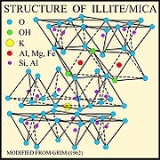
Illite is a non-expanding,
clayClay is a general term including many combinations of one or more clay minerals with traces of metal oxides and organic matter. Geologic clay deposits are mostly composed of phyllosilicate minerals containing variable amounts of water trapped in the mineral structure.- Formation :Clay minerals...
-sized, micaceous mineral. Illite is a
phyllosilicateThe silicate minerals make up the largest and most important class of rock-forming minerals, constituting approximately 90 percent of the crust of the Earth. They are classified based on the structure of their silicate group...
or layered alumino-silicate. Its structure is constituted by the repetition of tetrahedron – octahedron – tetrahedron (TOT) layers. The interlayer space is mainly occupied by poorly hydrated potassium cations responsible for the absence of swelling. Structurally illite is quite similar to
muscoviteMuscovite is a phyllosilicate mineral of aluminium and potassium with formula KAl22, or 236. It has a highly-perfect basal cleavage yielding remarkably-thin laminæ which are often highly elastic...
with slightly more
siliconSilicon is a chemical element with the symbol Si and atomic number 14. A tetravalent metalloid, it is less reactive than its chemical analog carbon, the nonmetal directly above it in the periodic table, but more reactive than germanium, the metalloid directly below it in the table...
,
magnesiumMagnesium is a chemical element with the symbol Mg, atomic number 12, and common oxidation number +2. It is an alkaline earth metal and the eighth most abundant element in the Earth's crust and ninth in the known universe as a whole...
,
ironIron is a chemical element with the symbol Fe and atomic number 26. It is a metal in the first transition series. It is the most common element forming the planet Earth as a whole, forming much of Earth's outer and inner core. It is the fourth most common element in the Earth's crust...
, and water and slightly less tetrahedral
aluminiumAluminium or aluminum is a silvery white member of the boron group of chemical elements. It has the symbol Al, and its atomic number is 13. It is not soluble in water under normal circumstances....
and interlayer
potassiumPotassium is the chemical element with the symbol K and atomic number 19. Elemental potassium is a soft silvery-white alkali metal that oxidizes rapidly in air and is very reactive with water, generating sufficient heat to ignite the hydrogen emitted in the reaction.Potassium and sodium are...
. The chemical formula is given as (K,H
3O)(Al,Mg,Fe)
2(Si,Al)
4O
10[(OH)
2,(H
2O)], but there is considerable ion substitution. It occurs as aggregates of small monoclinic grey to white crystals. Due to the small size, positive identification usually requires x-ray diffraction or SEM-EDS (
automated mineralogyAutomated mineralogy is a generic term describing a range of analytical solutions, areas of commercial enterprise, and a growing field of scientific research and engineering applications involving largely automated and quantitative analysis of minerals, rocks and man-made...
) analysis. Illite occurs as an alteration product of muscovite and
feldsparFeldspars are a group of rock-forming tectosilicate minerals which make up as much as 60% of the Earth's crust....
in
weatheringWeathering is the breaking down of rocks, soils and minerals as well as artificial materials through contact with the Earth's atmosphere, biota and waters...
and hydrothermal environments; it may be a component of
sericiteSericite is a fine grained mica, similar to muscovite, illite, or paragonite. Sericite is a common alteration mineral of orthoclase or plagioclase feldspars in areas that have been subjected to hydrothermal alteration typically associated with copper, tin, or other hydrothermal ore deposits...
. It is common in sediments, soils, and argillaceous sedimentary rocks as well as in some low grade metamorphic rocks. The iron rich member of the illite group,
glauconiteGlauconite is an iron potassium phyllosilicate mineral of characteristic green color with very low weathering resistance and very friable.It crystallizes with a monoclinic geometry...
, in sediments can be differentiated by x-ray analysis.
The cation exchange capacity (CEC) of illite is smaller than that of smectite but higher than that of
kaoliniteKaolinite is a clay mineral, part of the group of industrial minerals, with the chemical composition Al2Si2O54. It is a layered silicate mineral, with one tetrahedral sheet linked through oxygen atoms to one octahedral sheet of alumina octahedra...
, typically around 20 – 30 meq/100 g.
Illite was first described for occurrences in the Maquoketa
shaleShale is a fine-grained, clastic sedimentary rock composed of mud that is a mix of flakes of clay minerals and tiny fragments of other minerals, especially quartz and calcite. The ratio of clay to other minerals is variable. Shale is characterized by breaks along thin laminae or parallel layering...
in
Calhoun County, IllinoisCalhoun County is a county located in the U.S. state of Illinois. According to the 2010 census, it has a population of 5,089, which is an increase of 0.1% from 5,084 in 2000. Its county seat is Hardin. It is part of the Metro-East portion of the St...
, USA, in 1937. The name was derived from its type location in Illinois.
Illite is also called hydromica or hydromuscovite.
BrammalliteBrammallite is a sodium rich analogue of illite. First described in 1943 for an occurrence in Llandybie, Carmarthenshire, Wales, it was named for British geologist and mineralogist Alfred Brammall ....
is a sodium rich analogue. Avalite is a
chromiumChromium is a chemical element which has the symbol Cr and atomic number 24. It is the first element in Group 6. It is a steely-gray, lustrous, hard metal that takes a high polish and has a high melting point. It is also odorless, tasteless, and malleable...
bearing variety which has been described form
Mt. AvalaAvala is a mountain in Serbia, overlooking Belgrade. It is situated in the south-eastern corner of the city and provides a great panoramic view to Belgrade, Vojvodina and Šumadija, as the surrounding area on all sides is mostly a lowlands...
,
BelgradeBelgrade is the capital and largest city of Serbia. It is located at the confluence of the Sava and Danube rivers, where the Pannonian Plain meets the Balkans. According to official results of Census 2011, the city has a population of 1,639,121. It is one of the 15 largest cities in Europe...
,
SerbiaSerbia , officially the Republic of Serbia , is a landlocked country located at the crossroads of Central and Southeast Europe, covering the southern part of the Carpathian basin and the central part of the Balkans...
.
Illite crystallinity
The crystallinity of illite has been used as an indicator of metamorphic grade in clay-bearing rocks metamorphosed under conditions between
diagenesisIn geology and oceanography, diagenesis is any chemical, physical, or biological change undergone by a sediment after its initial deposition and during and after its lithification, exclusive of surface alteration and metamorphism. These changes happen at relatively low temperatures and pressures...
and low-grade metamorphism.With increasing temperature illite is thought to undergo a transformation into
muscoviteMuscovite is a phyllosilicate mineral of aluminium and potassium with formula KAl22, or 236. It has a highly-perfect basal cleavage yielding remarkably-thin laminæ which are often highly elastic...
.