


Enriched uranium

Encyclopedia
Uranium
Uranium is a silvery-white metallic chemical element in the actinide series of the periodic table, with atomic number 92. It is assigned the chemical symbol U. A uranium atom has 92 protons and 92 electrons, of which 6 are valence electrons...
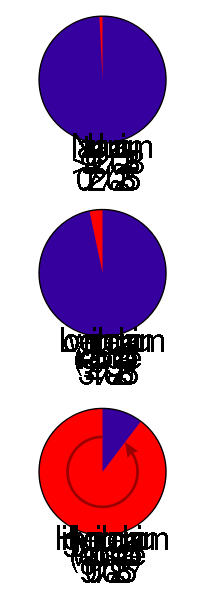
in which the percent composition of uranium-235
Uranium-235
- References :* .* DOE Fundamentals handbook: Nuclear Physics and Reactor theory , .* A piece of U-235 the size of a grain of rice can produce energy equal to that contained in three tons of coal or fourteen barrels of oil. -External links:* * * one of the earliest articles on U-235 for the...
has been increased through the process of isotope separation
Isotope separation
Isotope separation is the process of concentrating specific isotopes of a chemical element by removing other isotopes, for example separating natural uranium into enriched uranium and depleted uranium. This is a crucial process in the manufacture of uranium fuel for nuclear power stations, and is...
. Natural uranium
Natural uranium
Natural uranium refers to refined uranium with the same isotopic ratio as found in nature. It contains 0.7 % uranium-235, 99.3 % uranium-238, and a trace of uranium-234 by weight. In terms of the amount of radioactivity, approximately 2.2 % comes from uranium-235, 48.6 % uranium-238, and 49.2 %...
is 99.284% 238U
Uranium-238
Uranium-238 is the most common isotope of uranium found in nature. It is not fissile, but is a fertile material: it can capture a slow neutron and after two beta decays become fissile plutonium-239...
isotope
Isotope
Isotopes are variants of atoms of a particular chemical element, which have differing numbers of neutrons. Atoms of a particular element by definition must contain the same number of protons but may have a distinct number of neutrons which differs from atom to atom, without changing the designation...
, with 235U only constituting about 0.711% of its weight. 235U is the only nuclide existing in nature
Primordial nuclide
In geochemistry and geonuclear physics, primordial nuclides or primordial isotopes are nuclides found on the earth that have existed in their current form since before Earth was formed. Only 288 such nuclides are known...
(in any appreciable amount) that is fissile
Fissile
In nuclear engineering, a fissile material is one that is capable of sustaining a chain reaction of nuclear fission. By definition, fissile materials can sustain a chain reaction with neutrons of any energy. The predominant neutron energy may be typified by either slow neutrons or fast neutrons...
with thermal neutrons.
Enriched uranium is a critical component for both civil nuclear power generation
Nuclear power
Nuclear power is the use of sustained nuclear fission to generate heat and electricity. Nuclear power plants provide about 6% of the world's energy and 13–14% of the world's electricity, with the U.S., France, and Japan together accounting for about 50% of nuclear generated electricity...
and military nuclear weapon
Nuclear weapon
A nuclear weapon is an explosive device that derives its destructive force from nuclear reactions, either fission or a combination of fission and fusion. Both reactions release vast quantities of energy from relatively small amounts of matter. The first fission bomb test released the same amount...
s. The International Atomic Energy Agency
International Atomic Energy Agency
The International Atomic Energy Agency is an international organization that seeks to promote the peaceful use of nuclear energy, and to inhibit its use for any military purpose, including nuclear weapons. The IAEA was established as an autonomous organization on 29 July 1957...
attempts to monitor and control enriched uranium supplies and processes in its efforts to ensure nuclear power generation safety and curb nuclear weapons proliferation
Nuclear proliferation
Nuclear proliferation is a term now used to describe the spread of nuclear weapons, fissile material, and weapons-applicable nuclear technology and information, to nations which are not recognized as "Nuclear Weapon States" by the Treaty on the Nonproliferation of Nuclear Weapons, also known as the...
.
During the Manhattan Project
Manhattan Project
The Manhattan Project was a research and development program, led by the United States with participation from the United Kingdom and Canada, that produced the first atomic bomb during World War II. From 1942 to 1946, the project was under the direction of Major General Leslie Groves of the US Army...
enriched uranium was given the codename oralloy, a shortened version of Oak Ridge
Oak Ridge, Tennessee
Oak Ridge is a city in Anderson and Roane counties in the eastern part of the U.S. state of Tennessee, about west of Knoxville. Oak Ridge's population was 27,387 at the 2000 census...
alloy
Alloy
An alloy is a mixture or metallic solid solution composed of two or more elements. Complete solid solution alloys give single solid phase microstructure, while partial solutions give two or more phases that may or may not be homogeneous in distribution, depending on thermal history...
, after the location of the plants where the uranium was enriched. The term oralloy is still occasionally used to refer to enriched uranium. There are about 2,000 tonnes (t, Mg) of highly enriched uranium in the world, produced mostly for nuclear weapons, naval propulsion
Nuclear submarine
A nuclear submarine is a submarine powered by a nuclear reactor . The performance advantages of nuclear submarines over "conventional" submarines are considerable: nuclear propulsion, being completely independent of air, frees the submarine from the need to surface frequently, as is necessary for...
, and smaller quantities for research reactors.
The 238U remaining after enrichment is known as depleted uranium
Depleted uranium
Depleted uranium is uranium with a lower content of the fissile isotope U-235 than natural uranium . Uses of DU take advantage of its very high density of 19.1 g/cm3...
(DU), and is considerably less radioactive than even natural uranium, though still very dense and extremely hazardous in granulated form—such granules are a natural by-product of the shearing action that makes it useful for armour
Vehicle armour
Military vehicles are commonly armoured to withstand the impact of shrapnel, bullets, missiles, or shells, protecting the personnel inside from enemy fire. Such vehicles include tanks, aircraft, and ships....
-penetrating weapons
Staballoy
]Staballoy is the name of two different classes of metal alloys, one class typically used for munitions and a different class developed for drilling rods....
, and radiation shielding. At present, 95% of the world's stocks of depleted uranium remain in secure storage.
Slightly enriched uranium (SEU)
Natural uranium
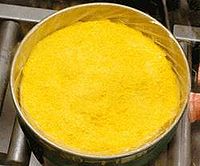
Natural uranium refers to refined uranium with the same isotopic ratio as found in nature. It contains 0.7 % uranium-235, 99.3 % uranium-238, and a trace of uranium-234 by weight. In terms of the amount of radioactivity, approximately 2.2 % comes from uranium-235, 48.6 % uranium-238, and 49.2 %...
(NU) fuel in some heavy water reactor
Heavy water reactor
A pressurised heavy water reactor is a nuclear power reactor, commonly using unenriched natural uranium as its fuel, that uses heavy water as its coolant and moderator. The heavy water coolant is kept under pressure in order to raise its boiling point, allowing it to be heated to higher...
s like the CANDU. Costs are lowered because less uranium and fewer bundles are needed to fuel the reactor. This in turn reduces the quantity of used fuel and its subsequent management costs.
Reprocessed uranium
Reprocessed uranium (RepU) is a product of nuclear fuel cycleNuclear fuel cycle
The nuclear fuel cycle, also called nuclear fuel chain, is the progression of nuclear fuel through a series of differing stages. It consists of steps in the front end, which are the preparation of the fuel, steps in the service period in which the fuel is used during reactor operation, and steps in...
s involving nuclear reprocessing
Nuclear reprocessing
Nuclear reprocessing technology was developed to chemically separate and recover fissionable plutonium from irradiated nuclear fuel. Reprocessing serves multiple purposes, whose relative importance has changed over time. Originally reprocessing was used solely to extract plutonium for producing...
of spent fuel. RepU recovered from light water reactor
Light water reactor
The light water reactor is a type of thermal reactor that uses normal water as its coolant and neutron moderator. Thermal reactors are the most common type of nuclear reactor, and light water reactors are the most common type of thermal reactor...
(LWR) spent fuel typically contains slightly more U-235 than natural uranium
Natural uranium
Natural uranium refers to refined uranium with the same isotopic ratio as found in nature. It contains 0.7 % uranium-235, 99.3 % uranium-238, and a trace of uranium-234 by weight. In terms of the amount of radioactivity, approximately 2.2 % comes from uranium-235, 48.6 % uranium-238, and 49.2 %...
, and therefore could be used to fuel reactors that customarily use natural uranium as fuel. It also contains the undesirable isotope uranium-236
Uranium-236
- See also :* Depleted uranium* Uranium market* Nuclear reprocessing* United States Enrichment Corporation* Nuclear fuel cycle* Nuclear power-External links:* *...
which undergoes neutron capture
Neutron capture
Neutron capture is a kind of nuclear reaction in which an atomic nucleus collides with one or more neutrons and they merge to form a heavier nucleus. Since neutrons have no electric charge they can enter a nucleus more easily than positively charged protons, which are repelled...
, wasting neutrons (and requiring higher U-235 enrichment) and creating neptunium-237 which would be one of the more mobile and troublesome radionuclides in deep geological repository
Deep geological repository
A deep geological repository is a nuclear waste repository excavated deep within a stable geologic environment...
disposal of nuclear waste.
Low-enriched uranium (LEU)
Low-enriched uranium (LEU) has a lower than 20% concentration of 235U.For use in commercial light water reactor
Light water reactor
The light water reactor is a type of thermal reactor that uses normal water as its coolant and neutron moderator. Thermal reactors are the most common type of nuclear reactor, and light water reactors are the most common type of thermal reactor...
s (LWR), the most prevalent power reactors in the world, uranium is enriched to 3 to 5% 235U. Fresh LEU used in research reactor
Research reactor
Research reactors are nuclear reactors that serve primarily as a neutron source. They are also called non-power reactors, in contrast to power reactors that are used for electricity production, heat generation, or maritime propulsion.-Purpose:...
s is usually enriched 12% to 19.75% U-235, the latter concentration being used to replace HEU fuels when converting to LEU.
Highly enriched uranium (HEU)

The very first uranium bomb, Little Boy
Little Boy
"Little Boy" was the codename of the atomic bomb dropped on Hiroshima on August 6, 1945 by the Boeing B-29 Superfortress Enola Gay, piloted by Colonel Paul Tibbets of the 393rd Bombardment Squadron, Heavy, of the United States Army Air Forces. It was the first atomic bomb to be used as a weapon...
dropped on Hiroshima
Hiroshima
is the capital of Hiroshima Prefecture, and the largest city in the Chūgoku region of western Honshu, the largest island of Japan. It became best known as the first city in history to be destroyed by a nuclear weapon when the United States Army Air Forces dropped an atomic bomb on it at 8:15 A.M...
in 1945, used 64 kilograms of 80% enriched uranium. Wrapping the weapon's fissile core in a neutron reflector
Neutron reflector
A neutron reflector is any material that reflects neutrons. This refers to elastic scattering rather than to a specular reflection. The material may be graphite, beryllium, steel, and tungsten carbide, or other materials...
(which is standard on all nuclear explosives) can dramatically reduce the critical mass
Critical mass
A critical mass is the smallest amount of fissile material needed for a sustained nuclear chain reaction. The critical mass of a fissionable material depends upon its nuclear properties A critical mass is the smallest amount of fissile material needed for a sustained nuclear chain reaction. The...
. Because the core was surrounded by a good neutron reflector, at explosion it comprised almost 2.5 critical masses. Neutron reflectors, compressing the fissile core via implosion, fusion boosting, and "tamping", which slows the expansion of the fissioning core with inertia, allow nuclear weapon design
Nuclear weapon design
Nuclear weapon designs are physical, chemical, and engineering arrangements that cause the physics package of a nuclear weapon to detonate. There are three basic design types...
s that use less than what would be one bare-sphere critical mass at normal density. The presence of too much of the 238U isotope inhibits the runaway nuclear chain reaction
Nuclear chain reaction
A nuclear chain reaction occurs when one nuclear reaction causes an average of one or more nuclear reactions, thus leading to a self-propagating number of these reactions. The specific nuclear reaction may be the fission of heavy isotopes or the fusion of light isotopes...
that is responsible for the weapon's power. The critical mass for 85% highly enriched uranium is about 50 kilograms (110.2 lb), which at normal density would be a sphere about 17 centimetres (6.7 in) in diameter.
Later US nuclear weapons usually use plutonium-239
Plutonium-239
Plutonium-239 is an isotope of plutonium. Plutonium-239 is the primary fissile isotope used for the production of nuclear weapons, although uranium-235 has also been used and is currently the secondary isotope. Plutonium-239 is also one of the three main isotopes demonstrated usable as fuel in...
in the primary stage, but the secondary stage which is compressed by the primary nuclear explosion often uses HEU with enrichment between 40% and 80%
along with the fusion
Nuclear fusion
Nuclear fusion is the process by which two or more atomic nuclei join together, or "fuse", to form a single heavier nucleus. This is usually accompanied by the release or absorption of large quantities of energy...
fuel lithium deuteride. For the secondary of a large nuclear weapon, the higher critical mass of less-enriched uranium can be an advantage as it allows the core at explosion time to contain a larger amount of fuel. The 238U is not fissile
Fissile
In nuclear engineering, a fissile material is one that is capable of sustaining a chain reaction of nuclear fission. By definition, fissile materials can sustain a chain reaction with neutrons of any energy. The predominant neutron energy may be typified by either slow neutrons or fast neutrons...
but still fissionable by fusion neutrons.
HEU is also used in fast neutron reactor
Fast neutron reactor
A fast neutron reactor or simply a fast reactor is a category of nuclear reactor in which the fission chain reaction is sustained by fast neutrons...
s, whose cores require about 20% or more of fissile material, as well as in naval reactors
Nuclear marine propulsion
Nuclear marine propulsion is propulsion of a ship by a nuclear reactor. Naval nuclear propulsion is propulsion that specifically refers to naval warships...
, where it often contains at least 50% 235U, but typically does not exceed 90%. The Fermi-1 commercial fast reactor prototype used HEU with 26.5% 235U. Significant quantities of HEU are used in the production of medical isotopes, for example molybdenum-99 for technetium-99m generator
Technetium-99m generator
A technetium-99m generator, or colloquially a technetium cow or moly cow, is a device used to extract the metastable isotope 99mTc of technetium from a source of decaying molybdenum-99...
s.
Enrichment methods
Isotope separationIsotope separation
Isotope separation is the process of concentrating specific isotopes of a chemical element by removing other isotopes, for example separating natural uranium into enriched uranium and depleted uranium. This is a crucial process in the manufacture of uranium fuel for nuclear power stations, and is...
is difficult because two isotopes of the same elements have very nearly identical chemical properties, and can only be separated gradually using small mass differences. (235U is only 1.26% lighter than 238U.) This problem is compounded by the fact that uranium is rarely separated in its atomic form, but instead as a compound (235UF6 is only 0.852% lighter than 238UF6.)
A cascade
Cascade (chemical engineering)
In chemical engineering, a cascade is a plant consisting of several similar stages with each processing the output from the previous stage. Cascades are most commonly used in isotope separation, distillation and other separation or purification processes....
of identical stages produces successively higher concentrations of 235U. Each stage passes a slightly more concentrated product to the next stage and returns a slightly less concentrated residue to the previous stage.
There are currently two generic commercial methods employed internationally for enrichment: gaseous diffusion
Gaseous diffusion
Gaseous diffusion is a technology used to produce enriched uranium by forcing gaseous uranium hexafluoride through semi-permeable membranes. This produces a slight separation between the molecules containing uranium-235 and uranium-238 . By use of a large cascade of many stages, high separations...
(referred to as first generation) and gas centrifuge
Gas centrifuge
A gas centrifuge is a device that performs isotope separation of gases. A centrifuge relies on the principles of centripetal force accelerating molecules so that particles of different masses are physically separated in a gradient along the radius of a rotating container.A prominent use of gas...
(second generation) which consumes only 6% as much energy as gaseous diffusion. Later generation methods will become established because they will be more efficient in terms of the energy input for the same degree of enrichment and the next method of enrichment to be commercialized will be referred to as third generation. Some work is being done that would use nuclear resonance
Nuclear magnetic resonance
Nuclear magnetic resonance is a physical phenomenon in which magnetic nuclei in a magnetic field absorb and re-emit electromagnetic radiation...
; however there is no reliable evidence that any nuclear resonance processes have been scaled up to production.
Gaseous diffusion
Gaseous diffusion is a technology used to produce enriched uranium by forcing gaseous uranium hexafluorideUranium hexafluoride
Uranium hexafluoride , referred to as "hex" in the nuclear industry, is a compound used in the uranium enrichment process that produces fuel for nuclear reactors and nuclear weapons. It forms solid grey crystals at standard temperature and pressure , is highly toxic, reacts violently with water...
(hex) through semi-permeable membranes. This produces a slight separation between the molecules containing 235U and 238U. Throughout the Cold War
Cold War
The Cold War was the continuing state from roughly 1946 to 1991 of political conflict, military tension, proxy wars, and economic competition between the Communist World—primarily the Soviet Union and its satellite states and allies—and the powers of the Western world, primarily the United States...
, gaseous diffusion played a major role as a uranium enrichment technique, and as of 2008 accounted for about 33% of enriched uranium production, but is now an obsolete technology that is steadily being replaced by the later generations of technology as the diffusion plants reach their ends-of-life.
Thermal diffusion
Thermal diffusionThermal diffusion
Thermal diffusion may refer to:* Thermal diffusion, an obsolete method of uranium enrichment* Brownian motion .* Diffusion in a temperature gradient ....
utilizes the transfer of heat across a thin liquid or gas to accomplish isotope separation. The process exploits the fact that the lighter 235U gas molecules will diffuse toward a hot surface, and the heavier 238U gas molecules will diffuse toward a cold surface. The S-50 plant at Oak Ridge, Tennessee
Oak Ridge, Tennessee
Oak Ridge is a city in Anderson and Roane counties in the eastern part of the U.S. state of Tennessee, about west of Knoxville. Oak Ridge's population was 27,387 at the 2000 census...
was used during World War II
World War II
World War II, or the Second World War , was a global conflict lasting from 1939 to 1945, involving most of the world's nations—including all of the great powers—eventually forming two opposing military alliances: the Allies and the Axis...
to prepare feed material for the EMIS process. It was abandoned in favor of gaseous diffusion.
Gas centrifuge
Centrifugal force
Centrifugal force can generally be any force directed outward relative to some origin. More particularly, in classical mechanics, the centrifugal force is an outward force which arises when describing the motion of objects in a rotating reference frame...
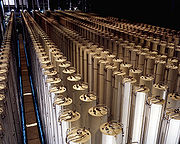
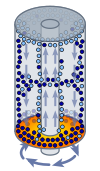
so that the heavier gas molecules containing 238U move toward the outside of the cylinder and the lighter gas molecules rich in 235U collect closer to the center. It requires much less energy to achieve the same separation than the older gaseous diffusion process, which it has largely replaced and so is the current method of choice and is termed second generation. It has a separation factor per stage of 1.3 relative to gaseous diffusion of 1.005, which translates to about one-fiftieth of the energy requirements. Gas centrifuge techniques produce about 54% of the world's enriched uranium.
Zippe centrifuge
Urenco Group
The URENCO Group is a nuclear fuel company operating several uranium enrichment plants in Germany, Netherlands, the United Kingdom, and the United States. It supplies nuclear power stations in about 15 countries, and has a 25% share of the global market for enrichment services...
to produce nuclear fuel and was used by Pakistan
Pakistan
Pakistan , officially the Islamic Republic of Pakistan is a sovereign state in South Asia. It has a coastline along the Arabian Sea and the Gulf of Oman in the south and is bordered by Afghanistan and Iran in the west, India in the east and China in the far northeast. In the north, Tajikistan...
in their nuclear weapons program.
Laser techniques
Laser processes promise lower energy inputs, lower capital costs and lower tails assays, hence significant economic advantages. Several laser processes have been investigated or are under development. None of the laser processes below are yet ready for commercial use, though SILEX is well advanced and expected to begin commercial production in 2012.(see here: 30 April 2008) and May 2010 Investor PresentationAtomic vapor laser isotope separation (AVLIS)
Atomic vapor laser isotope separationAVLIS
AVLIS Is an acronym which stands for atomic vapor laser isotope separation and is a method by which specially tuned lasers are used to separate isotopes of uranium using selective ionization of hyperfine transitions....
employs specially tuned lasers to separate isotopes of uranium using selective ionization of hyperfine transitions. The technique uses laser
Laser
A laser is a device that emits light through a process of optical amplification based on the stimulated emission of photons. The term "laser" originated as an acronym for Light Amplification by Stimulated Emission of Radiation...
s which are tuned to frequencies that ionize 235U atoms and no others. The positively charged 235U ions are then attracted to a negatively charged plate and collected.
Molecular laser isotope separation (MLIS)
Molecular laser isotope separationMolecular laser isotope separation
Molecular laser isotope separation is a method of isotope separation, where specially tuned lasers are used to separate isotopes of uranium using selective ionization of hyperfine transitions of uranium hexafluoride molecules. It is similar to AVLIS...
uses an infrared laser directed at UF6
Uranium hexafluoride
Uranium hexafluoride , referred to as "hex" in the nuclear industry, is a compound used in the uranium enrichment process that produces fuel for nuclear reactors and nuclear weapons. It forms solid grey crystals at standard temperature and pressure , is highly toxic, reacts violently with water...
, exciting molecules that contain a 235U atom. A second laser frees a fluorine
Fluorine
Fluorine is the chemical element with atomic number 9, represented by the symbol F. It is the lightest element of the halogen column of the periodic table and has a single stable isotope, fluorine-19. At standard pressure and temperature, fluorine is a pale yellow gas composed of diatomic...
atom, leaving uranium pentafluoride
Uranium pentafluoride
Uranium pentafluoride an inorganic chemical consisting of uranium and fluorine. The compound exists both as individual UF5 molecular entities and with extended order in several crystal-lattice forms. The monomer, formed by photolysis of uranium hexafluoride, has a square pyramidal geometry...
which then precipitates out of the gas.
Separation of Isotopes by Laser Excitation (SILEX)
Separation of isotopes by laser excitationSilex
Silex is any of various forms of ground stone. In modern contexts the word refers to a finely ground, nearly pure form of silica or silicate....
is an Australian development that also uses UF6
Uranium hexafluoride
Uranium hexafluoride , referred to as "hex" in the nuclear industry, is a compound used in the uranium enrichment process that produces fuel for nuclear reactors and nuclear weapons. It forms solid grey crystals at standard temperature and pressure , is highly toxic, reacts violently with water...
. After a protracted development process involving U.S. enrichment company USEC acquiring and then relinquishing commercialization rights to the technology, GE Hitachi Nuclear Energy
GE Hitachi Nuclear Energy
GE Hitachi Nuclear Energy is a provider of advanced reactors and nuclear services. It is located in Wilmington, N.C.. Established in June 2007, GEH is a global nuclear alliance created by General Electric and Hitachi...
(GEH) signed a commercialization agreement with Silex Systems in 2006 (see here). GEH has since begun construction of a demonstration test loop and announced plans to build an initial commercial facility. (see here: 30 April 2008). Details of the process are restricted by intergovernmental agreements between USA and Australia and the commercial entities. SILEX has been indicated to be an order of magnitude more efficient than existing production techniques but again, the exact figure is classified. In August, 2011 The New York Times
The New York Times
The New York Times is an American daily newspaper founded and continuously published in New York City since 1851. The New York Times has won 106 Pulitzer Prizes, the most of any news organization...
reported that Global Laser Enrichment, a subsidiary of GE Hitachi Nuclear Energy, had applied to the Nuclear Regulatory Commission
Nuclear Regulatory Commission
The Nuclear Regulatory Commission is an independent agency of the United States government that was established by the Energy Reorganization Act of 1974 from the United States Atomic Energy Commission, and was first opened January 19, 1975...
for a permit to build a commercial plant. Details of the process are secret.
Aerodynamic processes
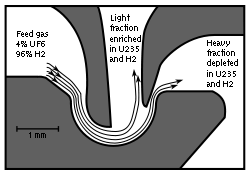
LIGA
LIGA is a German acronym for Lithographie, Galvanoformung, Abformung that describes a fabrication technology used to create high-aspect-ratio microstructures.-Overview:...
process and the vortex tube
Vortex tube
The vortex tube, also known as the Ranque-Hilsch vortex tube, is a mechanical device that separates a compressed gas into hot and cold streams. It has no moving parts....
separation process. These aerodynamic separation processes depend upon diffusion driven by pressure gradients, as does the gas centrifuge. In effect, aerodynamic processes can be considered as non-rotating centrifuges. Enhancement of the centrifugal forces is achieved by dilution of UF6
Uranium hexafluoride
Uranium hexafluoride , referred to as "hex" in the nuclear industry, is a compound used in the uranium enrichment process that produces fuel for nuclear reactors and nuclear weapons. It forms solid grey crystals at standard temperature and pressure , is highly toxic, reacts violently with water...
with hydrogen
Hydrogen
Hydrogen is the chemical element with atomic number 1. It is represented by the symbol H. With an average atomic weight of , hydrogen is the lightest and most abundant chemical element, constituting roughly 75% of the Universe's chemical elemental mass. Stars in the main sequence are mainly...
or helium
Helium
Helium is the chemical element with atomic number 2 and an atomic weight of 4.002602, which is represented by the symbol He. It is a colorless, odorless, tasteless, non-toxic, inert, monatomic gas that heads the noble gas group in the periodic table...
as a carrier gas achieving a much higher flow velocity for the gas than could be obtained using pure uranium hexafluoride. The Uranium Enrichment Corporation of South Africa
NECSA
The South African Nuclear Energy Corporation was established as a public company by the Republic of South Africa Nuclear Energy Act in 1999 and is wholly owned by the State...
(UCOR) developed and deployed the Helikon vortex separation process
Helikon vortex separation process
The Helikon vortex separation process is an aerodynamic uranium enrichment process designed around a device called a vortex tube. This method was designed and used in South Africa for producing reactor fuel with a uranium-235 content of around 3–5%, and 80–93% enriched uranium for use in nuclear...
based on the vortex tube and a demonstration plant was built in Brazil
Brazil
Brazil , officially the Federative Republic of Brazil , is the largest country in South America. It is the world's fifth largest country, both by geographical area and by population with over 192 million people...
by NUCLEI, a consortium led by Industrias Nucleares do Brasil that used the separation nozzle process. However both methods have high energy consumption and substantial requirements for removal of waste heat; neither is currently in use.
Electromagnetic isotope separation
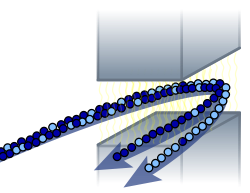
Calutron
A calutron is a mass spectrometer used for separating the isotopes of uranium. It was developed by Ernest O. Lawrence during the Manhattan Project and was similar to the cyclotron invented by Lawrence. Its name is a concatenation of Cal. U.-tron, in tribute to the University of California,...
was developed during World War II that provided some of the 235U used for the Little Boy
Little Boy
"Little Boy" was the codename of the atomic bomb dropped on Hiroshima on August 6, 1945 by the Boeing B-29 Superfortress Enola Gay, piloted by Colonel Paul Tibbets of the 393rd Bombardment Squadron, Heavy, of the United States Army Air Forces. It was the first atomic bomb to be used as a weapon...
nuclear bomb, which was dropped over Hiroshima
Hiroshima
is the capital of Hiroshima Prefecture, and the largest city in the Chūgoku region of western Honshu, the largest island of Japan. It became best known as the first city in history to be destroyed by a nuclear weapon when the United States Army Air Forces dropped an atomic bomb on it at 8:15 A.M...
in 1945. Properly the term 'Calutron' applies to a multistage device arranged in a large oval around a powerful electromagnet. Electromagnetic isotope separation has been largely abandoned in favour of more effective methods.
Chemical methods
One chemical process has been demonstrated to pilot plant stage but not used. The French CHEMEX process exploited a very slight difference in the two isotopes' propensity to change valencyValence (chemistry)
In chemistry, valence, also known as valency or valence number, is a measure of the number of bonds formed by an atom of a given element. "Valence" can be defined as the number of valence bonds...
in oxidation/reduction
Redox
Redox reactions describe all chemical reactions in which atoms have their oxidation state changed....
, utilising immiscible aqueous and organic phases. An ion-exchange process was developed by the Asahi Chemical Company in Japan
Japan
Japan is an island nation in East Asia. Located in the Pacific Ocean, it lies to the east of the Sea of Japan, China, North Korea, South Korea and Russia, stretching from the Sea of Okhotsk in the north to the East China Sea and Taiwan in the south...
which applies similar chemistry but effects separation on a proprietary resin ion-exchange column.
Plasma separation
Plasma separation process (PSP) describes a technique that makes use of superconducting magnetSuperconducting magnet
A superconducting magnet is an electromagnet made from coils of superconducting wire. They must be cooled to cryogenic temperatures during operation. In its superconducting state the wire can conduct much larger electric currents than ordinary wire, creating intense magnetic fields...
s and plasma physics. In this process, the principle of ion cyclotron resonance
Cyclotron
In technology, a cyclotron is a type of particle accelerator. In physics, the cyclotron frequency or gyrofrequency is the frequency of a charged particle moving perpendicularly to the direction of a uniform magnetic field, i.e. a magnetic field of constant magnitude and direction...
is used to selectively energize the 235U isotope in a plasma
Plasma (physics)
In physics and chemistry, plasma is a state of matter similar to gas in which a certain portion of the particles are ionized. Heating a gas may ionize its molecules or atoms , thus turning it into a plasma, which contains charged particles: positive ions and negative electrons or ions...
containing a mix of ion
Ion
An ion is an atom or molecule in which the total number of electrons is not equal to the total number of protons, giving it a net positive or negative electrical charge. The name was given by physicist Michael Faraday for the substances that allow a current to pass between electrodes in a...
s. The French developed their own version of PSP, which they called RCI. Funding for RCI was drastically reduced in 1986, and the program was suspended around 1990, although RCI is still used for stable isotope separation.
Separative work unit
"Separative work"—the amount of separation done by an enrichment process—is a function of the concentrations of the feedstock, the enriched output, and the depleted tailings; and is expressed in units which are so calculated as to be proportional to the total input (energy / machine operation time) and to the mass processed. Separative work is not energy. The same amount of separative work will require different amounts of energy depending on the efficiency of the separation technology. Separative work is measured in Separative work units SWU, kg SW, or kg UTA (from the German Urantrennarbeit—literally uranium separation work)- 1 SWU = 1 kg SW = 1 kg UTA
- 1 kSWU = 1 tSW = 1 t UTA
- 1 MSWU = 1 ktSW = 1 kt UTA
The work
 necessary to separate a mass
  of feed of assay
  into a mass
  of product assay
  , and tails of mass
  and assay
  is given by the expression
where
 is the value function, defined as
The feed to product ratio is given by the expression

whereas the tails to product ratio is given by the expression

For example, beginning with 100 kilograms (220.5 lb) of NU, it takes about 61 SWU to produce 10 kilograms (22 lb) of LEU in 235U content to 4.5%, at a tails assay of 0.3%.
The number of separative work units provided by an enrichment facility is directly related to the amount of energy that the facility consumes. Modern gaseous diffusion plants typically require 2,400 to 2,500 kilowatt-hours (kW·h), or 8.6–9 gigajoules, (GJ) of electricity per SWU while gas centrifuge plants require just 50 to 60 kW·h (180–220 MJ) of electricity per SWU.
Example:
A large nuclear power station with a net electrical capacity of 1300 MW requires about 25 tonnes per year (25 t
Tonne
The tonne, known as the metric ton in the US , often put pleonastically as "metric tonne" to avoid confusion with ton, is a metric system unit of mass equal to 1000 kilograms. The tonne is not an International System of Units unit, but is accepted for use with the SI...
/a
Julian year (astronomy)
In astronomy, a Julian year is a unit of measurement of time defined as exactly 365.25 days of 86 400 SI seconds each, totaling 31 557 600 seconds. The Julian year is the average length of the year in the Julian calendar used in Western societies in previous centuries, and for which the unit is...
) of LEU with a 235U concentration of 3.75%. This quantity is produced from about 210 t of NU using about 120 kSWU. An enrichment plant with a capacity of 1000 kSWU/a is, therefore, able to enrich the uranium needed to fuel about eight large nuclear power stations.
Cost issues
In addition to the separative work units provided by an enrichment facility, the other important parameter to be considered is the mass of natural uranium (NU) that is needed to yield a desired mass of enriched uranium. As with the number of SWUs, the amount of feed material required will also depend on the level of enrichment desired and upon the amount of 235U that ends up in the depleted uranium. However, unlike the number of SWUs required during enrichment which increases with decreasing levels of 235U in the depleted stream, the amount of NU needed will decrease with decreasing levels of 235U that end up in the DU.
For example, in the enrichment of LEU for use in a light water reactor it is typical for the enriched stream to contain 3.6% 235U (as compared to 0.7% in NU) while the depleted stream contains 0.2% to 0.3% 235U. In order to produce one kilogram of this LEU it would require approximately 8 kilograms of NU and 4.5 SWU if the DU stream was allowed to have 0.3% 235U. On the other hand, if the depleted stream had only 0.2% 235U, then it would require just 6.7 kilograms of NU, but nearly 5.7 SWU of enrichment. Because the amount of NU required and the number of SWUs required during enrichment change in opposite directions, if NU is cheap and enrichment services are more expensive, then the operators will typically choose to allow more 235U to be left in the DU stream whereas if NU is more expensive and enrichment is less so, then they would choose the opposite.
Downblending
The opposite of enriching is downblending; surplus HEU can be downblended to LEU to make it suitable for use in commercial nuclear fuel.The HEU feedstock can contain unwanted uranium isotopes: 234U is a minor isotope contained in natural uranium
Natural uranium
Natural uranium refers to refined uranium with the same isotopic ratio as found in nature. It contains 0.7 % uranium-235, 99.3 % uranium-238, and a trace of uranium-234 by weight. In terms of the amount of radioactivity, approximately 2.2 % comes from uranium-235, 48.6 % uranium-238, and 49.2 %...
; during the enrichment process, its concentration increases but remains well below 1%. High concentrations of 236U
Uranium-236
- See also :* Depleted uranium* Uranium market* Nuclear reprocessing* United States Enrichment Corporation* Nuclear fuel cycle* Nuclear power-External links:* *...
are a byproduct from irradiation in a reactor and may be contained in the HEU, depending on its manufacturing history. HEU reprocessed from nuclear weapons material production reactors (with an 235U assay of approx. 50%) may contain 236U concentrations as high as 25%, resulting in concentrations of approximately 1.5% in the blended LEU product. 236U
Uranium-236
- See also :* Depleted uranium* Uranium market* Nuclear reprocessing* United States Enrichment Corporation* Nuclear fuel cycle* Nuclear power-External links:* *...
is a neutron poison; therefore the actual 235U concentration in the LEU product must be raised accordingly to compensate for the presence of 236U.
The blendstock can be NU, or DU, however depending on feedstock quality, SEU at typically 1.5 wt% 235U may used as a blendstock to dilute the unwanted byproducts that may contained in the HEU feed. Concentrations of these isotopes in the LEU product in some cases could exceed ASTM specifications for nuclear fuel, if NU, or DU were used. So, the HEU downblending generally cannot contribute to the waste management problem posed by the existing large stockpiles of depleted uranium.
A major downblending undertaking called the Megatons to Megawatts Program
Megatons to Megawatts Program
The Megatons to Megawatts Program is the name given to the program that implemented the 1993 United States-Russia nonproliferation agreement to convert high-enriched uranium taken from dismantled Russian nuclear weapons into low-enriched-uranium for nuclear fuel.-Extent of program since 1995:From...
converts ex-Soviet weapons-grade HEU to fuel for U.S. commercial power reactors. From 1995 through mid-2005, 250 tonnes of high-enriched uranium (enough for 10,000 warheads) was recycled into low-enriched-uranium. The goal is to recycle 500 tonnes by 2013. The decommissioning programme of Russian nuclear warheads accounted for about 13% of total world requirement for enriched uranium leading up to 2008.
The United States Enrichment Corporation
United States Enrichment Corporation
The United States Enrichment Corporation, a subsidiary of USEC Inc. , is a corporation that contracts with the United States Department of Energy to produce enriched uranium for use in nuclear power plants.-History:...
has been involved in the disposition of a portion of the 174.3 tonnes of highly enriched uranium (HEU) that the U.S. government declared as surplus military material in 1996. Through the U.S. HEU Downblending Program, this HEU material, taken primarily from dismantled U.S. nuclear warheads, was recycled into low-enriched uranium (LEU) fuel, used by nuclear power plants to generate electricity.
Global enrichment facilities
The following countries are known to operate enrichment facilities: Argentina, Brazil, China, France, Germany, India, Iran, Japan, the Netherlands, North Korea, Pakistan, Russia, the United Kingdom, and the United States. Belgium, Iran, Italy, and Spain hold an investment interest in the French EurodifEurodif
Eurodif, which means European Gaseous Diffusion Uranium Enrichment Consortium, is a subsidiary of the French company AREVA which operates a uranium enrichment plant established at the Tricastin Nuclear Power Center in Pierrelatte in Drôme...
enrichment plant, with Iran's holding entitling it to 10% of the enriched uranium output. Countries that had enrichment programs in the past include Libya and South Africa, although Libya's facility was never operational. Australia has developed a laser enrichment
Laser isotope separation
Laser isotope separation, or laser enrichment, is a technology of isotope separation using selective ionization of atoms or molecules by the means of precisely tuned lasers.The techniques are:* AVLIS, applied to atoms, and* MLIS, applied to molecules....
process known as SILEX, which it intends to pursue through financial investment in a U.S. commercial venture by General Electric.
See also
- Uranium miningUranium miningUranium mining is the process of extraction of uranium ore from the ground. The worldwide production of uranium in 2009 amounted to 50,572 tonnes, of which 27% was mined in Kazakhstan. Kazakhstan, Canada, and Australia are the top three producers and together account for 63% of world uranium...
- Uranium marketUranium marketThe uranium market, like all commodity markets, has a history of volatility, moving not only with the standard forces of supply and demand, but also to whims of geopolitics. It has also evolved particularities of its own in response to the unique nature and use of this material.The only significant...
- Nuclear reprocessingNuclear reprocessingNuclear reprocessing technology was developed to chemically separate and recover fissionable plutonium from irradiated nuclear fuel. Reprocessing serves multiple purposes, whose relative importance has changed over time. Originally reprocessing was used solely to extract plutonium for producing...
- United States Enrichment CorporationUnited States Enrichment CorporationThe United States Enrichment Corporation, a subsidiary of USEC Inc. , is a corporation that contracts with the United States Department of Energy to produce enriched uranium for use in nuclear power plants.-History:...
- Nuclear fuel bankNuclear fuel bankA nuclear fuel bank is a proposed approach to provide countries access to enriched nuclear fuel, without the need for them to possess enrichment technology...
- Nuclear fuel cycleNuclear fuel cycleThe nuclear fuel cycle, also called nuclear fuel chain, is the progression of nuclear fuel through a series of differing stages. It consists of steps in the front end, which are the preparation of the fuel, steps in the service period in which the fuel is used during reactor operation, and steps in...
- Nuclear powerNuclear powerNuclear power is the use of sustained nuclear fission to generate heat and electricity. Nuclear power plants provide about 6% of the world's energy and 13–14% of the world's electricity, with the U.S., France, and Japan together accounting for about 50% of nuclear generated electricity...
- AREVAArevaAREVA is a French public multinational industrial conglomerate headquartered in the Tour Areva in Courbevoie, Paris. AREVA is mainly known for nuclear power; it also has interests in other energy projects. It was created on 3 September 2001, by the merger of Framatome , Cogema and...
- EurodifEurodifEurodif, which means European Gaseous Diffusion Uranium Enrichment Consortium, is a subsidiary of the French company AREVA which operates a uranium enrichment plant established at the Tricastin Nuclear Power Center in Pierrelatte in Drôme...
—European Gaseous Diffusion Uranium Enrichment Consortium - Urenco GroupUrenco GroupThe URENCO Group is a nuclear fuel company operating several uranium enrichment plants in Germany, Netherlands, the United Kingdom, and the United States. It supplies nuclear power stations in about 15 countries, and has a 25% share of the global market for enrichment services...
External links
- Uranium Enrichment and Nuclear Weapon Proliferation, by Allan S. Krass, Peter Boskma, Boelie Elzen and Wim A. Smit, 296 pp., Published for SIPRI by Taylor and Francis Ltd, London, 1983
- Annotated bibliography on enriched uranium from the Alsos Digital Library for Nuclear Issues
- Silex Systems Ltd
- Uranium Enrichment, World Nuclear Association
- Overview and history of U.S. HEU production
- News Resource on Uranium Enrichment
- Nuclear Chemistry-Uranium Enrichment
- A busy year for SWU (a 2008 review of the commercial enrichment marketplace), Nuclear Engineering International, 1 September 2008