
All Topics  
Atomic nucleus


Atomic nucleus


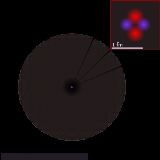
The nucleus of an atomAtom

In chemistry and physics, an atom is the smallest possible particle of a chemical element that retains its chemical propert...
 is the very small dense region of an atom, in its center consisting of nucleonNucleon

In physics a nucleon is a collective name for two baryons: the neutron and the proton....
s. The size (diameter) of the nucleus is in the range of 1.6 fmMetre

The metre, or meter , is a measure of length....
 (10-15 m) (for a proton in light hydrogen) to about 15 fm (for the heaviest atoms, such as uranium). These dimensions are much smaller than the size of the atom itself by a factor of about 23,000 (uranium) to about 145,000 (hydrogen). Almost all of the mass in an atom is made up from the protons and neutrons in the nucleus with a very small contribution from the orbiting electronElectron

The electron is a fundamental subatomic particle that carries an electric charge....
s. The etymology of the term nucleus is from 1704 meaning “kernel of a nut”. In 1844, Michael FaradayMichael Faraday

Michael Faraday, FRS was an English chemist and physicist who contributed significantly to the fields of electromagnetism ...
 used the term to refer to the “central point of an atom”. The modern atomic meaning was proposed by Ernest RutherfordErnest Rutherford

Ernest Rutherford, 1st Baron Rutherford of Nelson, OM, PC, FRS , was a nuclear physicist from New Zealand....
 in 1912. The adoption of the term “nucleus” to atomic theory, however, was not immediate. In 1916, for example, Gilbert N. LewisGilbert N. Lewis

Gilbert Newton Lewis was a famous American physical chemist....
 stated, in his famous article , that “the atom is composed of the kernel and an outer atom or shell”.

Introduction


Nuclear makeup

The nucleus of an atom consists of protons and neutrons (two types of baryons) bound by the nuclear forceNuclear force

The nuclear force is the force between two or more nucleons....
. These baryons are further composed of sub-atomic fundamental particles known as quarks bound by the strong interactionStrong interaction

The strong interaction or strong force is today understood to represent the interactions between quarks and gluons as ...
. Which chemical elementChemical element

A chemical element, often called simply an element, is a substance that cannot be decomposed or transformed into other...
 an atom belongs to is determined by the number of protons in the nucleus.

Isotopes and nuclides


The isotopeIsotope Overview

An isotope is any of several different forms of an element each having different atomic mass....
 of an atom is determined by the number of neutrons in the nucleus. Different isotopes of the same element have very similar chemicalChemistry

Chemistry is the science of matter at the atomic to molecular scale, dealing primarily with collections of atoms ....
 properties. Different isotopes in a sample of a particular chemical can be separated by using a centrifugeCentrifuge

A centrifuge is a piece of equipment, generally driven by a motor, that puts an object in rotation around a fixed axis....
 or by using a mass spectrometer. The first method is used in producing enriched uraniumEnriched uranium Summary

Enriched uranium is uranium whose uranium-235 content has been increased through the process of isotope separation....
 from a sample of regular uranium, and the second is used in carbon dating.

The number of protons and neutrons together determine the nuclide (type of nucleus). Protons and neutrons have nearly equal masses, and their combined number, the mass numberMass number

The mass number, also called atomic mass number or nucleon number, is the number of nucleons in an atomic nucleu...
, is approximately equal to the atomic massAtomic mass

The atomic mass of a chemical element is the mass of an atom at rest, most often expressed in unified atomic mass units....
 of an atom. The combined mass of the electrons is very small in comparison to the mass of the nucleus, since protons and neutrons weigh roughly 2000 times more than electrons.

History


The discovery of the electronFacts About Electron

The electron is a fundamental subatomic particle that carries an electric charge....
 by J. J. ThomsonJ. J. Thomson

Sir Joseph John Thomson, OM, FRS often known as J....
 was the first indication that the atom had internal structure. At the turn of the 20th century the accepted model of the atom was J. J. Thomson's "plum pudding" modelPlum pudding model

In physics, the plum pudding model of the atom was proposed by J....
 in which the atom was a large positively charged ball with small negatively charged electrons embedded inside of it. By the turn of the century physicists had also discovered three types of radiationRadiation Summary

Radiation in Physics is the process of emitting energy in the form of waves or particles....
 coming from atoms, which they named alphaAlpha decay

Alpha decay is a form of radioactive decay in which an atomic nucleus ejects an alpha particle through the electromagnetic f...
, betaBeta decay

In nuclear physics, beta decay is a type of radioactive decay in which a beta particle is emitted....
, and gamma radiation. Experiments in 1911 by Lise MeitnerLise Meitner

Lise Meitner was an Austrian physicist who studied radioactivity and nuclear physics. ...
 and Otto HahnOtto Hahn

Otto Hahn was a German chemist. He received the 1944 Nobel Prize in Chemistry....
, and by James ChadwickJames Chadwick

Sir James Chadwick was an English physicist and Nobel laureate. ...
 in 1914 discovered that the beta decay spectrumSpectrum

A spectrum is a condition or value that is not limited to a specific set of values but can vary infinely within a continuum...
 was continuous rather than discrete. That is, electrons were ejected from the atom with a range of energies, rather than the discrete amounts of energies that were observed in gamma and alpha decays. This was a problem for nuclear physics at the time, because it indicated that energy was not conservedConservation of energy

Conservation of energy states that the total amount of energy in an isolated system remains constant....
 in these decays. The problem would later lead to the discovery of the neutrino (see below).

In 1906 Ernest RutherfordErnest Rutherford

Ernest Rutherford, 1st Baron Rutherford of Nelson, OM, PC, FRS , was a nuclear physicist from New Zealand....
 published "Radiation of the a Particle from Radium in passing through Matter". GeigerHans Geiger

Johannes Wilhelm Geiger was a German physicist....
 expanded on this work in a communication to the Royal Society with experiments he and Rutherford had done passing a particles through air, aluminum foil and gold foil. More work was published in 1909 by GeigerHans Geiger

Johannes Wilhelm Geiger was a German physicist....
 and MarsdenErnest Marsden

Sir Ernest Marsden, was a British-New Zealand physicist....
 and further greatly expanded work was published in 1910 by Geiger, In 1911-2 Rutherford went before the Royal Society to explain the experiments and propound the new theory of the atomic nucleus as we now understand it.

Around the same time that this was happening Ernest Rutherford performed a remarkable experimentGeiger-Marsden experiment

The Geiger-Marsden experiment was an experiment done by Hans Geiger and Ernest Marsden in 1909, under the direction of Ernes...
 in which Hans GeigerHans Geiger

Johannes Wilhelm Geiger was a German physicist....
 and Ernest MarsdenErnest Marsden

Sir Ernest Marsden, was a British-New Zealand physicist....
 under his supervision fired alpha particles (helium nuclei) at a thin film of goldGold

Gold is a highly sought-after precious metal that for many centuries has been used as money, a store of value and in jewelry...
 foil. The plum pudding model predicted that the alpha particles should come out of the foil with their trajectories being at most slightly bent. He was shocked to discover that a few particles were scattered through large angles, even completely backwards in some cases. The discovery, beginning with Rutherford's analysis of the data in 1911, eventually led to the Rutherford model of the atom, in which the atom has a very small, very dense nucleus consisting of heavy positively charged particles with embedded electrons in order to balance out the charge. As an example, in this model nitrogen-14 consisted of a nucleus with 14 protons and 7 electrons, and the nucleus was surrounded by 7 more orbiting electrons.

The Rutherford model worked quite well until studies of nuclear spinSpin (physics)

In physics, spin refers to the angular momentum intrinsic to a body, as opposed to orbital angular momentum, which is the mo...
 were carried out by Franco RasettiFranco Rasetti Summary

Franco Dino Rasetti was an Italian scientist....
 at the California Institute of TechnologyCalifornia Institute of Technology

The California Institute of Technology is a private, coeducational university located in Pasadena, California, in the Unite...
 in 1929. By 1925 it was known that protons and electrons had a spin of 1/2, and in the Rutherford model of nitrogen-14 the 14 protons and six of the electrons should have paired up to cancel each others spin, and the final electron should have left the nucleus with a spin of 1/2. Rasetti discovered, however, that nitrogen-14 has a spin of one.

In 1930 Wolfgang PauliWolfgang Pauli

Wolfgang Ernst Pauli was an Austrian physicist noted for his work on the theory of spin, and in particular the discovery of...
 was unable to attend a meeting in TübingenTübingen

Tbingen, a traditional university town of Baden-Wrttemberg, Germany, is situated 20 miles southwest of Stuttgart, on a ridg...
, and instead sent a famous letter with the classic introduction "Dear Radioactive Ladies and Gentlemen". In his letter Pauli suggested that perhaps there was a third particle in the nucleus which he named the "neutron". He suggested that it was very light (lighter than an electron), had no charge, and that it did not readily interact with matter (which is why it hadn't yet been detected). This desperate way out solved both the problem of energy conservation and the spin of nitrogen-14, the first because Pauli's "neutron" was carrying away the extra energy and the second because an extra "neutron" paired off with the electron in the nitrogen-14 nucleus giving it spin one. Pauli's "neutron" was renamed the neutrinoNeutrino

The neutrino is an elementary particle....
 (Italian for little neutral one) by Enrico FermiEnrico Fermi Overview

Enrico Fermi was an Italian physicist most noted for his work on beta decay, the development of the first nuclear reactor, ...
 in 1931, and after about thirty years it was finally demonstrated that a neutrino really is emitted during beta decay.

In 1932 Chadwick realized that radiation that had been observed by Walther BotheWalther Bothe

Walther Wilhelm Georg Bothe was a German physicist, mathematician, chemist, and Nobel Prize winner....
, Herbert L. BeckerHerbert L. Becker

Dr. Herbert L. Becker is the inventor and patent/copyright holder for BOIP and the founder of IPTV ....
, IrèneIrène Joliot-Curie

Irne Joliot-Curie ne) Curie, was a French-Polish scientist, the daughter of Marie Sklodowska and Pierre Curie and the wife ...
 and Frédéric Joliot-CurieFrédéric Joliot-Curie Summary

Jean Frdric Joliot-Curie n Joliot was a French physicist and Nobel laureate....
 was actually due to a massive particle that he called the neutron. In the same year Dmitri IvanenkoDmitri Ivanenko

Dmitri Ivanenko was a Professor of Moscow State University, made a great contribution to the physical science of the twentie...
 suggested that neutrons were in fact spin 1/2 particles and that the nucleus contained neutrons and that there were no electrons in it, and Francis PerrinFrancis Perrin

Francis Perrin was a French physicist, the son of Jean Perrin....
 suggested that neutrinos were not nuclear particles but were created during beta decay. To cap the year off, Fermi submitted a theory of the neutrino to NatureNature (journal)

Nature is one of the oldest scientific journals, first published on 4 November 1869....
(which the editors rejected for being "too remote from reality"). Fermi continued working on his theory and published a paper in 1934 which placed the neutrino on solid theoretical footing. In the same year Hideki YukawaHideki Yukawa

Hideki Yukawa FRSE was a Japanese theoretical physicist and the first Japanese to win the Nobel prize....
 proposed the first significant theory of the strong force to explain how the nucleus holds together.

With Fermi and Yukawa's papers the modern model of the atom was complete. The center of the atom contains a tight ball of neutrons and protons, which is held together by the strong nuclear force. Unstable nuclei may undergo alpha decay, in which they emit an energetic helium nucleus, or beta decay, in which they eject an electron (or positronPositron

The positron is the antiparticle or the antimatter counterpart of the electron....
). After one of these decays the resultant nucleus may be left in an excited state, and in this case it decays to its ground state by emitting high energy photons (gamma decay).

The study of the strong and weak nuclear forces led physicists to collide nuclei and electrons at ever higher energies. This research became the science of particle physicsParticle physics

Particle physics is a branch of physics that studies the elementary constituents of matter and radiation, and the interactio...
, the crown jewel of which is the standard model of particle physicsStandard Model

The Standard Model of particle physics is a theory which describes the strong, weak, and electromagnetic fundamental forces,...
 which unifies the strong, weak, and electromagnetic forces.

Modern nuclear physics


A heavy nucleus can contain hundreds of nucleonNucleon

In physics a nucleon is a collective name for two baryons: the neutron and the proton....
s which means that with some approximation it can be treated as a classical system, rather than a quantum-mechanicalQuantum mechanics

Quantum mechanics is a first quantized quantum theory that supersedes classical mechanics at the atomic and subatomic levels...
 one. In the resulting liquid-drop model, the nucleus has an energy which arises partly from surface tensionSurface tension

In physics, surface tension is an effect within the surface layer of a liquid that causes that layer to behave as an elastic...
 and partly from electrical repulsion of the protons. The liquid-drop model is able to reproduce many features of nuclei, including the general trend of binding energyBinding energy

Binding energy is the energy required to disassemble a whole into separate parts....
 with respect to mass number, as well as the phenomenon of nuclear fissionNuclear fission Overview

For the generation of electrical power by fission, see Nuclear power plant...
.

Superimposed on this classical picture, however, are quantum-mechanical effects, which can be described using the nuclear shell modelFacts About Shell model

In nuclear physics, the nuclear shell model is a model of the atomic nucleus....
, developed in large part by Maria Goeppert-Mayer. Nuclei with certain numbers of neutrons and protons (the magic numbersMagic number (physics)

In nuclear physics, a magic number is a number of nucleons such that they are arranged into complete shells within the atomi...
 2, 8, 20, 50, 82, 126, ...) are particularly stable, because their shells are filled.

Much of current research in nuclear physicsNuclear physics

Nuclear physics is the branch of physics concerned with the nucleus of the atom....
 relates to the study of nuclei under extreme conditions such as high spinSpin (physics)

In physics, spin refers to the angular momentum intrinsic to a body, as opposed to orbital angular momentum, which is the mo...
 and excitation energy. Nuclei may also have extreme shapes (similar to that of American footballAmerican football

American football, known in the United States and Canada simply as football, is a competitive team sport....
s) or extreme neutron-to-proton ratios. Experimenters can create such nuclei using artificially induced fusion or nucleon transfer reactions, employing ion beams from an acceleratorParticle accelerator

A particle accelerator is a device that uses electric and/or magnetic fields to propel electrically charged particles to hig...
.
Beams with even higher energies can be used to create nuclei at very high temperatures, and there are signs that these experiments have produced a phase transitionPhase transition

In physics, a phase transition or phase change is the transformation of a thermodynamic system from one phase to anoth...
 from normal nuclear matter to a new state, the quark-gluon plasmaQuark-gluon plasma

A quark-gluon plasma is a phase of quantum chromodynamics which exists at extremely high temperature and density....
, in which the quarkQuark

In particle physics, quarks are one of the two basic constituents of matter ....
s mingle with one another, rather than being segregated in triplets as they are in neutrons and protons.

Modern topics in nuclear physics


Spontaneous changes from one nuclide to another: nuclear decay


If a nucleus has too few or too many neutrons it may be unstable, and will decay after some period of time. For example, nitrogenNitrogen

Nitrogen is a chemical element which has the symbol N and atomic number 7 in the periodic table....
-16 atoms (7 protons, 9 neutrons) beta decayBeta decay Summary

In nuclear physics, beta decay is a type of radioactive decay in which a beta particle is emitted....
 to oxygenOxygen

Oxygen is a chemical element with the chemical symbol O and atomic number 8....
-16 atoms (8 protons, 8 neutrons) within a few seconds of being created. In this decay a neutron in the nitrogen nucleus is turned into a proton and an electron by the weak nuclear force. The element of the atom changes because while it previously had seven protons (which makes it nitrogen) it now has eight (which makes it oxygen). Many elements have multiple isotopes which are stable for weeks, years, or even billions of years.

Nuclear fusion


When two light nuclei come into very close contact with each other it is possible for the strong force to fuseNuclear fusion Summary

In physics, nuclear fusion is the process by which multiple nuclei join together to form a heavier nucleus....
 the two together. It takes a great deal of energy to push the nuclei close enough together for the strong force to have an effect, so the process of nuclear fusion can only take place at very high temperatures or high densities. Once the nuclei are close enough together the strong force overcomes their electromagnetic repulsion and squishes them into a new nucleus. A very large amount of energy is released when light nuclei fuse together because the binding energy per nucleon increases with mass number up until nickelNickel

Nickel is a metallic chemical element in the periodic table that has the symbol Ni and atomic number 28....
-62. StarStar

A star is a massive, compact body of plasma in outer space that is held together by its own gravity and, unlike a planet, is...
s like our sun are powered by the fusion of four protons into a helium nucleus, two positrons, and two neutrinos. The uncontrolled fusion of hydrogen into helium is known as thermonuclear runaway. Research to find an economically viable method of using energy from a controlled fusion reaction is currently being undertaken by various research establishments (see JETJoint European Torus

JET, the Joint European Torus, is the largest nuclear fusion experimental reactor yet built....
 and ITERITER

ITER is an international tokamak experiment, planned to be built in France and designed to show the scientific and technolog...
).

Nuclear fission


For nuclei heavier than nickel-62 the binding energy per nucleon decreases with the mass number. It is therefore possible for energy to be released if a heavy nucleus breaks apart into two lighter ones. This splitting of atoms is known as nuclear fission.

The process of alpha decayAlpha decay

Alpha decay is a form of radioactive decay in which an atomic nucleus ejects an alpha particle through the electromagnetic f...
 may be thought of as a special type of spontaneous nuclear fissionNuclear fission

For the generation of electrical power by fission, see Nuclear power plant...
. This process produces a highly asymmetrical fission because the four particles which make up the alpha particle are especially tightly bound to each other, making production of this nucleus in fission particularly likely.

For certain of the heaviest nuclei which produce neutrons on fission, and which also easily absorb neutrons to initiate fission, a self-igniting type of neutron-initiated fission can be obtained, in a so-called chain reactionChain reaction

A chain reaction is a sequence of reactions where a reactive product or by-product causes additional reactions....
. [Chain reactions were known in chemistryChemistry

Chemistry is the science of matter at the atomic to molecular scale, dealing primarily with collections of atoms ....
 before physicsPhysics

Physics , the most fundamental physical science, is concerned with the underlying principles of the natural world....
, and in fact many familiar processes like fires and chemical explosions are chemical chain reactions]. The fission or "nuclear" chain-reaction, using fission-produced neutrons, is the source of energy for nuclear powerNuclear power

Nuclear power is the controlled use of nuclear reactions to release energy for work including propulsion, heat, and the gen...
 plants and fission type nuclear bombs such as the two that the United StatesUnited States

The United States of America, also known as the United States, the U.S., the U.S.A., and America, is...
 used against HiroshimaHiroshima

The Japanese city of is the capital of Hiroshima Prefecture, and the largest city in the Chugoku region of western Honshu, the la...
 and Nagasaki at the end of World War IIFacts About World War II

World War II, or the Second World War, was a worldwide conflict fought between the Allied Powers and the Axis Powers ,...
. Heavy nuclei such as uraniumFacts About Uranium

Uranium is a chemical element in the periodic table that has the symbol U and atomic number 92....
 and thoriumThorium

Thorium is a chemical element in the periodic table that has the symbol Th and atomic number 90....
 may undergo spontaneous fissionSpontaneous fission

Spontaneous fission is a form of radioactive decay characteristic of very heavy isotopes, and is theoretically possible for ...
, but they are much more likely to undergo decay by alpha decay.

For a neutron-initiated chain-reaction to occur, there must be a critical massCritical Mass

Critical Mass is a bike ride typically held on the last Friday of every month in cities around the world where bicyclists an...
 of the element present in a certain space under certain conditions (these conditions slow and conserve neutrons for the reactions). There is one known example of a natural nuclear fission reactorNatural nuclear fission reactor

A natural nuclear fission reactor is a uranium deposit where analysis of isotope ratios has shown that self-sustaining nucle...
, which was active in two regions of OkloOklo

Oklo is a region near the town of Franceville, in the Haut-Ogoou province of the Central African state of Gabon....
, Gabon, Africa, over 1.5 billion years ago. Measurements of natural neutrino emission have demonstrated that around half of the heat emanating from the earth's core results from radioactive decay. However, it is not known if any of this results from fission chain-reactions.

Production of heavy elements


As the Universe cooled after the big bangBig Bang

In physical cosmology, the Big Bang is the scientific theory of how the universe emerged from a tremendously dense and hot s...
  it eventually became possible for particles as we know them to exist. The most common particles created in the big bang which are still easily observable to us today were protons and electrons (in equal numbers). Some heavier elements were created as the protons collided with each other, but most of the heavy elements we see today were created inside of stars during a series of fusion stages, such as the proton-proton chain, the CNO cycleCNO cycle

The CNO cycleis one of two fusion reactions by which stars convert hydrogen to helium, the other being the proton-proton c...
 and the triple-alpha processTriple-alpha process

The triple alpha process is the process by which three helium nuclei are transformed into carbon....
.
Progressively heavier elements are created during the evolutionStellar evolution

In astronomy, stellar evolution is the sequence of changes that a star undergoes during its lifetime; the hundreds of thousa...
 of a star.
Since the binding energy per nucleon peaks around iron, energy is only released in fusion processes occurring below this point. Since the creation of heavier nuclei by fusion costs energy, nature resorts to the process of neutron capture. Neutrons (due to their lack of charge) are readily absorbed by a nucleus. The heavy elements are created by either a slow neutron capture process (the so-called s process) or by the rapid, or r process. The s process occurs in thermally pulsing stars (called AGB, or asymptotic giant branch stars) and takes hundreds to thousands of years to reach the heaviest elements of lead and bismuth. The r process is thought to occur in supernova explosions because the conditions of high temperature, high neutron flux and ejected matter are present. These stellar conditions make the successive neutron captures very fast, involving very neutron-rich species which then beta-decay to heavier elements, especially at the so-called waiting points that correspond to more stable nuclides with closed neutron shells (magic numbers). The r process duration is typically in the range of a few seconds.

See also


External links