
See Also

Paint

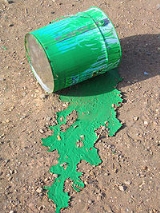
Paint is the general term for a family of products used to protect and add color Color

Color or colour is the visual perceptual property corresponding in humans to the categories... 

 to an object or surface by covering it with a pigmented coating. As a verb, painting Painting

Painting taken literally is the practice of applying pigment [i] suspended in a liquid vehicle to a surface [i] ... 

 is the application of paint. Someone who paints artistically is usually called a painter Painter

A painter is a person who applies paint [i] to a surface. ... 

, while someone who paints commercially is often referred to as a painter and decorator Painter and decorator

A painter and decorator is a tradesman [i] responsible for the painting and decorating of buildings, and ... 

. Paint can be applied to almost any kind of object. It is used, among many other uses, in the production of art Art

By its original and broadest definition, art is the product or process of the effective application... 

, in industrial coating, as a driving aid , or as a preservative . Paint is a semifinished product, as the final product is the painted article itself.

Discussions

  Discussion Features

   Ask a question about 'Paint'

   Start a new discussion about 'Paint'

   Answer questions about 'Paint'

   'Paint' discussion forum

Timeline

1767   The Townshend Acts are passed by British Parliament Parliament of the United Kingdom

The Parliament of the United Kingdom of Great Britain and Northern Ireland is the supreme legislative body [i] ... 

, placing a tax Tax

A tax is a financial charge or other levy [i] imposed on an individual or a legal entity [i] by a state [i] ... 

 on common products, such as lead Lead

Lead is a chemical element [i] in the periodic table [i] that has the symbol Pb and atomic number [i] ... 

, paper Paper

Paper is a thin, flat material produced by the amalgamation of plant fibre [i]s, which are subsequently ... 

, paint, glass Glass

Glass is a uniform amorphous solid [i] material, usually produced when the viscous molten material cools ... 

, and tea Tea

Tea is the second most popular beverage [i] in the world . ... 

.


Encyclopedia


Paint is the general term for a family of products used to protect and add color Color

Color or colour is the visual perceptual property corresponding in humans to the categories... 

 to an object or surface by covering it with a pigmented coating. As a verb, painting Painting

Painting taken literally is the practice of applying pigment [i] suspended in a liquid vehicle to a surface [i] ... 

 is the application of paint. Someone who paints artistically is usually called a painter Painter

A painter is a person who applies paint [i] to a surface.
... 

, while someone who paints commercially is often referred to as a painter and decorator Painter and decorator

A painter and decorator is a tradesman [i] responsible for the painting and decorating of buildings, and ... 

.

Paint can be applied to almost any kind of object. It is used, among many other uses, in the production of art Art

By its original and broadest definition, art is the product or process of the effective application... 

, in industrial coating, as a driving aid , or as a preservative . Paint is a semifinished product, as the final product is the painted article itself.

Components


There are several primary components to a paint: binder Binder

The reaper-binder, or binder, was a farm implement that improved upon the reaper [i]. ... 

, pigment, filler, diluent, and additives. However, only the binder is absolutely required. The binder is the part which eventually solidifies to form the dried paint film. Pigments give a color to a paint. Pigments may also have the same functions as fillers: increase the thickness and hardness of the film and adjust the coloring power and opacity. The diluent serves to adjust the viscosity of the paint. It is volatile and does not become part of the paint film. There are various additives, which components that are added in small amounts to improve some property, such as color opacity and matness, pigment dispersion, or stability.

Typical binders include synthetic or natural resin Resin

Resin is a hydrocarbon [i] secretion [i] of many plant [i]s, particularly coniferous trees [i]... 

s such as acrylic Acryl group

In organic chemistry [i], the acryl group is the functional group [i] with structure H [i]2C [i] ... 

s, polyurethane Polyurethane

A polyurethane is any polymer [i] consisting of a chain of organic [i] units joined by ... 

s, polyester Polyester

Polyester is a category of polymer [i]s, or, more specifically condensation polymer [i]s, which contain ... 

s, melamine Melamine

Melamine is a strong organic base with chemical formula C3 [i]H6 [i]N6 [i], wit ... 

s, epoxy Epoxy

Epoxy or polyepoxide is a thermoset [i]ting epoxide [i] polymer [i] that cures when mixed with a catalyzing [i] ... 

, or oil Oil paint

Oil paint is a type of slow-drying paint [i] consisting of small pigment [i] particles suspended in a drying oil [i] ... 

s. Binders can be categorized into three sorts: those that dry, those that cure when they dry, and those that do not depend on drying for curing. Paints that dry contain a solid binder dissolved in a solvent; this forms a solid film when the solvent evaporates, and the film can dissolve in the solvent again. Latex paints, for example, cure irreversibly when they dry, since they undergo polymerization into irreversibly bound networked structures, so that the paint will not redissolve in the solvent. Recent environmental protection requirements discourage the use of evaporating solvents , and alternative means of curing have been developed, particularly for industrial purposes. Epoxy coating, for example, is applied by mixing paint and hardener, which cure by forming a hard plastic Plastic

Plastic covers a range of synthetic or semisynthetic polymerization [i] products. ... 

 structure. Such paints do not, strictly speaking, "dry" at all, but harden. In UV curing paints, the solvent is evaporated first, and hardening is then initiated by ultraviolet light.

Typical diluents include organic solvents such as petroleum distillate, alcohol Alcohol

In chemistry [i], an alcohol is any organic compound [i] in which a hydroxyl [i] group [i] ... 

s, ketone Ketone

A ketone is either the functional group [i] characterized by a carbonyl [i] group linked to two other carbon [i]... 

s, ester Ester

In chemistry [i], esters are organic compound [i]s in which an organic group [i] replac ... 

s, glycol ethers, and the like. Water is a common diluent. Sometimes volatile low-molecular weight synthetic resins also serve as diluents.

Fillers serve to thicken the film, support its structure and simply increase the volume of the paint. Not all paints include fillers. Pigments that also function as fillers are called simply "pigments"; "fillers" are generally color-neutral and opaque. It is necessary to adjust the resulting off-white color with pigments to give the desired color. Common fillers are cheap and inert, such as talc Talc

Talc is a mineral [i] composed of hydrated [i] magnesium [i] silicate [i] with the chemical form ... 

, lime, baryte Barite

Barite is a mineral [i] consisting of barium sulfate [i].... 

, clay, etc. Depending on the paint, most of the paint film may consist of pigment/filler and binder, the rest being additives.

Typical additives include pigment Pigment

A pigment is a material that changes the color of light [i] it reflects as the result of selective color ... 

s, dye Dye

A dye can generally be described as a color [i]ed substance that has an affinity [i] t ... 

s, catalyst Catalyst

In chemistry, a catalyst is a substance [i] that decreases the activation energy [i] ... 

s, thickeners, stabilizers, emulsifier Emulsion

An emulsion is a mixture of two immiscible [i] substances. ... 

s, texturizers, adhesion promoters, flatteners , and the like.

After application, the paint solidifies and becomes tack-free. Depending on the type of binder, this hardening may be a result of curing , evaporation Evaporation

Evaporation is one of the two forms of vaporization.... 

, or even cooling. In oil-based paint, curing takes the form of oxidation Redox

Redox reactions include all chemical processes [i] in which atoms have their oxidation number [i] ... 

, for example oxidation of linseed oil to form linoxin to create a varnish. Other common cured films are prepared from crosslinkers Cross-link

Cross-links are covalent bond [i]s linking one polymer [i] chain to another. ... 

, such as polyurethane or melamine resins, reacted with acrylic polyester or polyurethane resins, often in the presence of a catalyst which serves to make the curing reaction proceed more quickly or under milder conditions. These cured-film paints can be either solvent-borne or waterborne.

Latex paint is a water-based emulsion of solid monomers. The term "latex" in the context of paint simply means a water emulsion; latex rubber is not an ingredient. When the water evaporates, the monomer undergoes emulsion polymerization Emulsion polymerization

Emulsion polymerization is a type of polymerization [i] that usually starts with an emulsion [i] incorpo ... 

 to form a solid film. The polymer itself resists water . Residual surfactants in the paint as well as hydrolytic Hydrolysis

Hydrolysis is a chemical reaction [i] or process in which a molecule [i] is split into two parts by reac ... 

 effects with some polymers cause the paint to remain susceptible to softening and, over time, degradation by water.

Still other films are formed by cooling of the binder. For example, encaustic Encaustic painting

Encaustic painting, also known as hot wax painting, involves using heated beeswax [i] to which col ... 

 or wax paints are liquid when warm, and harden upon cooling.

Art


Main article: Painting Painting

Painting taken literally is the practice of applying pigment [i] suspended in a liquid vehicle to a surface [i] ... 


Since the time of the Renaissance Renaissance

In the traditional view, the Renaissance was understood as a historical age in Europe [i] that follo ... 

, siccative  oil paints, primarily linseed oil, have been the most commonly used kind of paints in fine art applications; oil paint Oil paint

Oil paint is a type of slow-drying paint [i] consisting of small pigment [i] particles suspended in a drying oil [i] ... 

 is still common today. However, in the 20th century 20th century

The 20th century started on 1 January [i] 1901 [i] and ended on 31 December [i] 2000 [i], according to t... 

, water-based paints, including watercolor Watercolor painting

Watercolor is a painting [i] technique using paint [i] made of colorants [i] suspended or dissolved in w ... 

s and acrylic paint Acrylic paint

Acrylic paint is fast-drying paint [i] containing pigment suspended in an [i] ... 

s, became very popular with the development of acrylic Acryl group

In organic chemistry [i], the acryl group is the functional group [i] with structure H [i]2C [i] ... 

 and other latex paints. Milk paints , where the medium is derived from the natural emulsion that is milk Milk

Milk is the nutrient fluid produced by the mammary gland [i]s of female mammal [i]s . ... 

, were popular in the 19th century 19th century

The 19th century lasted from 1801 [i] through 1900 [i] in the Gregorian calendar [i].
... 

 and are still available today. Egg tempera Tempera

Tempera is the primary type of artist's paint [i] and associated art techniques [i] ... 

  is still in use as well, as are encaustic wax-based paints. Gouache is a variety of watercolor paint which was also used in the Middle Ages Middle Ages

The Middle Ages formed the middle period in a traditional schematic division of European history [i] ... 

 and Renaissance for manuscript illumination. The pigment was often made from ground semiprecious stones such as lapis lazuli Lapis lazuli

Lapis lazuli, also known as just lapis, is a stone with one of the longest traditions of being con... 

 and the binder made from either gum arabic Gum arabic

Gum arabic, a natural gum [i] also called gum acacia, is a substance that is taken from two sub-Sahara [i] ... 

 or egg white Egg white

Egg white is the common name for the clear liquid contained within an egg [i]. ... 

. Gouache is commercially available today.

Poster paint has been used primarily in the creation of student works, or by children.

Pigment


The proper name for the effects of "prism paint," a made up name, is "interference."
Main article: Pigment Pigment

A pigment is a material that changes the color of light [i] it reflects as the result of selective color ... 


Pigments, usually insoluble powders, are used both to provide color, and to make paint opaque, thus protecting the substrate from the harmful effects of ultraviolet light while also increasing a paint's hiding power.

Some pigments are toxic, such as those used in lead paint Lead paint

Lead paint is paint [i] containing lead [i], a heavy metal. ... 

. Paint manufacturers replaced lead white with a less toxic substitute, which can even be used to color food titanium white which was first used in paints in the 19th century 19th century

The 19th century lasted from 1801 [i] through 1900 [i] in the Gregorian calendar [i].
... 

. The titanium white used in most paints today is often coated with silicon or aluminum oxides for better durability.

Some newer paints—called prism paint—can produce effects where the color changes depending on the angle at which it is viewed. Modern U.S. United States

The United States of America, also known as the United States, the U.S., the U.S.A., a... 

 and Canadian Canada

Canada is the world's second-largest [i] country by total area, occupying most ... 

 banknotes, specifically the newer higher denomination notes, have this effect on them. This effect is produced by having pigment molecules that are long and thin and are meant to dry in a specific orientation, with different ends of the molecule being different colors.

Application

Paint can be applied as a solid, a gaseous suspension or a liquid. Techniques vary depending on the practical or artistic results desired.

As a solid , the paint is applied as a very fine powder, then baked at high temperature. This melts the powder and causes it to adhere to the surface. The reasons for doing this involve the chemistries of the paint, the surface itself, and perhaps even the chemistry of the substrate .

As a gas or as a gaseous suspension, the paint is suspended in solid or liquid form in a gas that is sprayed on Spray painting

Spray painting is painting [i] using a device that sprays the paint.
... 

 an object. The paint sticks to the object. The reasons for doing this include:
  • the application mechanism is air and thus no solid object ever touches the object being painted;
  • the distribution of the paint is very uniform so there are no sharp lines
  • it is possible to deliver very small amounts of paint or to paint very slowly;
  • a chemical can sprayed along with the paint to dissolve together both the delivered paint and the chemicals on the surface of the object being painted;
  • some chemical reactions in paint involve the orientation of the paint molecules Molecule

    In chemistry, a molecule is an aggregate of two or more atom [i]s in a definite arrangement held togethe ... 

    .


In the liquid application, paint can be applied by direct application using brushes Brush

The term brush refers to a variety of devices mainly with bristle [i]s, wire or other filament of any po ... 

, paint rollers, blades Palette knife

A palette knife is a blunt knife [i] with a very flexible steel [i] blade and no sharpened cutting edge. ... 

, other instruments, or body parts. Examples of body parts include fingerpainting Fingerpaint

Fingerpaint is a kind of paint [i] intended to be applied with the finger [i]s; it typically comes in po ... 

, where the paint is applied by hand, whole-body painting , and cave painting Cave painting

Cave or rock paintings are painting [i]s painted on cave [i] or rock [i] walls and ceilings, ... 

, in which a pigment Pigment

A pigment is a material that changes the color of light [i] it reflects as the result of selective color ... 

  is held in the mouth and spat at a wall .

Rollers generally have a handle that allows for different lengths of poles which can be attached to allow for painting at different heights. Generally, roller application takes two coats for even color. A roller with a thicker nap is used to apply paint on uneven surfaces. Edges are often finished with an angled brush.

After liquid paint is applied, there is an interval during which it can be blended with additional painted regions called "open time." The open time of an oil or alkyd-based emulsion paint can be extended by adding white spirit, similar glycols such as Dowanol™ or commercial open time prolongers. This can also facilitate the mixing of different wet paint layers for aesthetic effect. Latex and acrylic emulsions require the use of drying retardants suitable for water-based coatings.

Paint may also be applied by flipping the paint, dripping, or by dipping an object in paint.

Product variants

  • Primer is a preparatory coating put on materials before painting. Priming ensures better adhesion Adhesion

    Adhesion is the molecular attraction [i] exerted between bodies in contact.

... 

 of paint to the surface, increases paint durability, and provides additional protection for the material being painted.
  • Wood stain is a type of paint that is very "thin," that is, low in viscosity, and formulated so that the pigment penetrates the surface rather than remaining in a film on top of the surface. Stain is predominantly pigment Pigment

    A pigment is a material that changes the color of light [i] it reflects as the result of selective color ... 

     or dye Dye

    A dye can generally be described as a color [i]ed substance that has an affinity [i] t ... 

     and solvent with little binder, designed primarily to add color without providing a surface coating.
  • Varnish and shellac Shellac

    Shellac is a brittle or flaky secretion of the lac insect [i] Coccus lacca [i], found in the forests ... 

     provide a protective coating without changing the color. They are paints without pigment.
  • Lacquer Lacquer

    In a general sense, lacquer is a clear or coloured coating, that dries by solvent evaporation only and t... 

     is usually a fast-drying solvent-based paint or varnish that produces an especially hard, durable finish.
  • An enamel paint Enamel paint

    An enamel paint is a paint [i] that dries to an especially hard, usually glossy, finish.

... 

 is a paint that dries to an especially hard, usually glossy, finish. Enamel can be made by adding varnish to oil-based paint.
  • Fingerpaint Fingerpaint

    Fingerpaint is a kind of paint [i] intended to be applied with the finger [i]s; it typically comes in po ... 

  • Inks Ink

    An ink is a liquid [i] containing various pigment [i]s and/or dye [i]s used for colouring a surface to r ... 

     are similar to paints, except they are typically made using dyes exclusively , and are designed so as not to leave a thick film of binder.
  • Titanium dioxide Titanium dioxide

    Titanium dioxide, also known as titanium(IV) oxide or titania, is the naturally occurring oxide [i]... 

     is extensively used for both house paint and artist's paint, because it is permanent and has good covering power. Titanium oxide pigment accounts for the largest use of the element. Titanium paint is an excellent reflector of infrared, and is extensively used in solar observatories where heat causes poor seeing conditions.
  • Anti-Graphiti paints are used to defeat the marking of surfaces by graphiti Graffiti

    Graffiti is the application of media by human [i]s on publicly viewable surfaces. ... 

     artists. There are two categories, sacrificial and non-bonding. Sacrificial coatings are clear coatings that allow the removal of graphiti, usually by pressure washing the surface with high-pressure water, removing the graphiti, and the coating They must be re-applied afterward for continued protection. This is most commonly used on natual-looking masonry surfaces, such as statuary and marble walls, and on rougher surfaces that are difficult to clean. Non-bonding coatings are clear, high-performance coatings, usually catalyzed polyurethanes Polyurethane

    A polyurethane is any polymer [i] consisting of a chain of organic [i] units joined by ... 

    , that allow the graphiti very little to bond to. After the graphiti is discovered, it can be removed with the use of a solvent wash, without damaging the underlying substrate or protective coating. These work best when used on smoother surfaces, and especially over other painted surfaces, including murals.
  • Anti-climb paint is a non-drying paint that appears normal whilst being extremely slippery. It is usually used on drainpipes and ledges to deter burglars and vandals from climbing them, and is found in many public places. When a person attempts to climb objects coated with the paint, it rubs off onto the climber, as well as making it hard for them to climb.

History


Ancient painted walls, to be seen at Dendera Dendera

Dendera, is a little town in Egypt [i] on the west bank of the Nile [i], about 5 km up Nile [i] from Qina [i] ... 

, Egypt Egypt

[i] country in [[North Africa]... 

, although exposed for many ages to the open air, still possess a perfect brilliancy of color, as vivid as when painted, perhaps 2000 years ago. The Egyptians mixed their colors with some gummy substance, and applied them detached from each other without any blending or mixture. They appeared to have used six colors: white, black, blue, red, yellow, and green. They first covered the field entirely with white, upon which they traced the design in black, leaving out the lights of the ground color. They used minium for red, and generally of a dark tinge.

Pliny Pliny the Elder

Gaius Plinius Secundus, better known as Pliny the Elder, was an ancient author [i] and natural philosopher [i] ... 

 mentions some painted ceilings in his day in the town of Ardea, which had been executed at a date prior to the foundation of Rome Rome

Rome is the capital [i] of Italy [i] and of its region, called Latium [i]. ... 

. He expresses great surprise and admiration at their freshness, after the lapse of so many centuries.

See also

  • Primer
  • Lacquer Lacquer

    In a general sense, lacquer is a clear or coloured coating, that dries by solvent evaporation only and t... 

  • varnish
  • fresco Fresco

    A fresco is a term for several related painting [i] types. ... 

  • brush Brush

    The term brush refers to a variety of devices mainly with bristle [i]s, wire or other filament of any po ... 


External links