

Milos

Encyclopedia
- Melos redirects here; for the Japanese short story, see Run, Melos
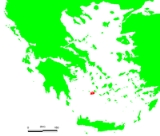
Milos (in Greek
Greek language
Greek is an independent branch of the Indo-European family of languages. Native to the southern Balkans, it has the longest documented history of any Indo-European language, spanning 34 centuries of written records. Its writing system has been the Greek alphabet for the majority of its history;...
, Μήλος, classic Greek: – Melos, Doric Greek
Doric Greek
Doric or Dorian was a dialect of ancient Greek. Its variants were spoken in the southern and eastern Peloponnese, Crete, Rhodes, some islands in the southern Aegean Sea, some cities on the coasts of Asia Minor, Southern Italy, Sicily, Epirus and Macedon. Together with Northwest Greek, it forms the...
: Μάλος – Malos), is a volcanic Greek
Greece
Greece , officially the Hellenic Republic , and historically Hellas or the Republic of Greece in English, is a country in southeastern Europe....
island
Island
An island or isle is any piece of sub-continental land that is surrounded by water. Very small islands such as emergent land features on atolls can be called islets, cays or keys. An island in a river or lake may be called an eyot , or holm...
in the Aegean Sea
Aegean Sea
The Aegean Sea[p] is an elongated embayment of the Mediterranean Sea located between the southern Balkan and Anatolian peninsulas, i.e., between the mainlands of Greece and Turkey. In the north, it is connected to the Marmara Sea and Black Sea by the Dardanelles and Bosporus...
, just north of the Sea of Crete
Sea of Crete
thumb|300px|Map of the Sea of CreteThe Sea of Crete is the sea south of the Aegean Sea, north of the island Crete, and south of the Cyclades. The sea also stretches from Kythera east to the Dodecanese islands of Karpathos and Kassos. The bounding seas to the west are the Ionian Sea as well as...
. Milos is the southwesternmost island in the Cyclades
Cyclades
The Cyclades is a Greek island group in the Aegean Sea, south-east of the mainland of Greece; and a former administrative prefecture of Greece. They are one of the island groups which constitute the Aegean archipelago. The name refers to the islands around the sacred island of Delos...
group.
The island
Island
An island or isle is any piece of sub-continental land that is surrounded by water. Very small islands such as emergent land features on atolls can be called islets, cays or keys. An island in a river or lake may be called an eyot , or holm...
is famous for the statue
Statue
A statue is a sculpture in the round representing a person or persons, an animal, an idea or an event, normally full-length, as opposed to a bust, and at least close to life-size, or larger...
of Aphrodite
Aphrodite
Aphrodite is the Greek goddess of love, beauty, pleasure, and procreation.Her Roman equivalent is the goddess .Historically, her cult in Greece was imported from, or influenced by, the cult of Astarte in Phoenicia....
(the "Venus de Milo
Venus de Milo
Aphrodite of Milos , better known as the Venus de Milo, is an ancient Greek statue and one of the most famous works of ancient Greek sculpture. Created at some time between 130 and 100 BC, it is believed to depict Aphrodite the Greek goddess of love and beauty. It is a marble sculpture, slightly...
", now in the Louvre
Louvre
The Musée du Louvre – in English, the Louvre Museum or simply the Louvre – is one of the world's largest museums, the most visited art museum in the world and a historic monument. A central landmark of Paris, it is located on the Right Bank of the Seine in the 1st arrondissement...
), and also for statues of the Greek
Greek mythology
Greek mythology is the body of myths and legends belonging to the ancient Greeks, concerning their gods and heroes, the nature of the world, and the origins and significance of their own cult and ritual practices. They were a part of religion in ancient Greece...
god
God (male deity)
A god, as a male deity, contrasts with female deities, or "goddesses". While the term 'goddess' specifically refers to a female deity, the plural 'gods' can be applied to all gods collectively, regardless of gender....
Asclepius
Asclepius
Asclepius is the God of Medicine and Healing in ancient Greek religion. Asclepius represents the healing aspect of the medical arts; his daughters are Hygieia , Iaso , Aceso , Aglæa/Ægle , and Panacea...
(now in the British Museum
British Museum
The British Museum is a museum of human history and culture in London. Its collections, which number more than seven million objects, are amongst the largest and most comprehensive in the world and originate from all continents, illustrating and documenting the story of human culture from its...
) and the Poseidon
Poseidon
Poseidon was the god of the sea, and, as "Earth-Shaker," of the earthquakes in Greek mythology. The name of the sea-god Nethuns in Etruscan was adopted in Latin for Neptune in Roman mythology: both were sea gods analogous to Poseidon...
and an archaic Apollo
Apollo
Apollo is one of the most important and complex of the Olympian deities in Greek and Roman mythology...
in Athens
Athens
Athens , is the capital and largest city of Greece. Athens dominates the Attica region and is one of the world's oldest cities, as its recorded history spans around 3,400 years. Classical Athens was a powerful city-state...
. The Municipality
Communities and Municipalities of Greece
For the new municipalities of Greece see the Kallikratis ProgrammeThe municipalities and communities of Greece are one of several levels of government within the organizational structure of that country. Thirteen regions called peripheries form the largest unit of government beneath the State. ...
of Milos also includes the uninhabited offshore islands of Antimilos
Antimilos
Antimilos is a Greek island in the Cyclades, 13 miles northwest of Milos. Administratively, it is part of the municipality of Milos. Antimilos is an uninhabited mass of trachyte , often called Erimomilos . It is a volcanic island and the crater is still obvious...
and Akradies. The combined land area is 160.147 km² and the 2001 census population was 4,771 inhabitants.
History
ObsidianObsidian
Obsidian is a naturally occurring volcanic glass formed as an extrusive igneous rock.It is produced when felsic lava extruded from a volcano cools rapidly with minimum crystal growth...
from Milos was a commodity as early as 13,000
Obsidian hydration dating
Obsidian hydration dating is a geochemical method of determining age in either absolute or relative terms of an artifact made of obsidian....
years ago. Milos natural glass used for razor sharp "stone tools" was transported well before farming began and later: "There is no early farming village in the Near East that doesn't get obsidian". The material was transported for thousands of miles.
The position of Milos, between mainland Greece and Crete
Crete
Crete is the largest and most populous of the Greek islands, the fifth largest island in the Mediterranean Sea, and one of the thirteen administrative regions of Greece. It forms a significant part of the economy and cultural heritage of Greece while retaining its own local cultural traits...
, and its possession of obsidian
Obsidian
Obsidian is a naturally occurring volcanic glass formed as an extrusive igneous rock.It is produced when felsic lava extruded from a volcano cools rapidly with minimum crystal growth...
, made it an important centre of early Aegean civilization. Milos lost its arms-making importance when bronze became the preferred material for the manufacture of weapons.
At the Bronze Age
Bronze Age
The Bronze Age is a period characterized by the use of copper and its alloy bronze as the chief hard materials in the manufacture of some implements and weapons. Chronologically, it stands between the Stone Age and Iron Age...
site of Phylakopi
Phylakopi
Phylakopi , located at the northern coast of the island of Milos, is one of the most important Bronze Age settlements in the Aegean and especially in the Cyclades. The importance of Phylakopi is in its almost continuous inhabitance throughout the Bronze Age Phylakopi (Greek=Φυλακωπή), located at...
(Greek
Greek language
Greek is an independent branch of the Indo-European family of languages. Native to the southern Balkans, it has the longest documented history of any Indo-European language, spanning 34 centuries of written records. Its writing system has been the Greek alphabet for the majority of its history;...
Φυλακωπή), the chief settlement, on the north-east coast, excavations by the British School of Archeology revealed a town wall and a Minoan
Minoan civilization
The Minoan civilization was a Bronze Age civilization that arose on the island of Crete and flourished from approximately the 27th century BC to the 15th century BC. It was rediscovered at the beginning of the 20th century through the work of the British archaeologist Arthur Evans...
palace with some important and very interesting wall paintings. "The famous fresco of the flying fish found in the ruins of the principal house or palace at Phylakopi, with its delicate coloring and graphic observation of nature in the graceful movement of the fish, seems to be the work of a Cretan artist, who probably was summoned to Milos for the purpose." Part of the site has been washed away by the sea.
The antiquities found were of three main periods, all preceding the Mycenaean age of Greece
Mycenaean Greece
Mycenaean Greece was a cultural period of Bronze Age Greece taking its name from the archaeological site of Mycenae in northeastern Argolis, in the Peloponnese of southern Greece. Athens, Pylos, Thebes, and Tiryns are also important Mycenaean sites...
. Much pottery
Pottery
Pottery is the material from which the potteryware is made, of which major types include earthenware, stoneware and porcelain. The place where such wares are made is also called a pottery . Pottery also refers to the art or craft of the potter or the manufacture of pottery...
was found, including examples of a peculiar style, with decorative designs, mostly floral, and also considerable deposits of obsidian. There are some traditions of a Phoenicia
Phoenicia
Phoenicia , was an ancient civilization in Canaan which covered most of the western, coastal part of the Fertile Crescent. Several major Phoenician cities were built on the coastline of the Mediterranean. It was an enterprising maritime trading culture that spread across the Mediterranean from 1550...
n occupation of Milos.
In historical times, the island was occupied by Dorians from Laconia
Laconia
Laconia , also known as Lacedaemonia, is one of the regional units of Greece. It is part of the region of Peloponnese. It is situated in the southeastern part of the Peloponnese peninsula. Its administrative capital is Sparti...
. In the 6th century BC, it again produced a remarkable series of vases, of large size, with mythological subjects and orientalizing ornamentation, and also a series of terra-cotta reliefs (Melian Reliefs
Melian reliefs
Melian Reliefs were produced on the island of Milos from about 470 to 416 BC. Most of them were found on this island. They share the same technical features, with a shallow relief, not higher than 1.5 cm and a flat back. Details were once painted, but the paint is now most often gone. They...
).
Conflict with Athens
The Greek historian ThucydidesThucydides
Thucydides was a Greek historian and author from Alimos. His History of the Peloponnesian War recounts the 5th century BC war between Sparta and Athens to the year 411 BC...
wrote in his History of the Peloponnesian War
History of the Peloponnesian War
The History of the Peloponnesian War is an account of the Peloponnesian War in Ancient Greece, fought between the Peloponnesian League and the Delian League . It was written by Thucydides, an Athenian general who served in the war. It is widely considered a classic and regarded as one of the...
of how, in 416 BC, Athens
Athens
Athens , is the capital and largest city of Greece. Athens dominates the Attica region and is one of the world's oldest cities, as its recorded history spans around 3,400 years. Classical Athens was a powerful city-state...
attacked Melos for refusing to submit tribute and refusing to join Athen's alliance against Sparta.
The invasion of Melos
Battle of Melos
The Battle of Melos was fought in 415 BC between Athens and Melos. Melos had attempted to remain neutral in the Peloponnesian War, but Athens attacked and forced Melos to surrender...
occurred during the second phase of the Peloponnesian War
Peloponnesian War
The Peloponnesian War, 431 to 404 BC, was an ancient Greek war fought by Athens and its empire against the Peloponnesian League led by Sparta. Historians have traditionally divided the war into three phases...
(431 to 404 BC). The Melians claimed Sparta
Sparta
Sparta or Lacedaemon, was a prominent city-state in ancient Greece, situated on the banks of the River Eurotas in Laconia, in south-eastern Peloponnese. It emerged as a political entity around the 10th century BC, when the invading Dorians subjugated the local, non-Dorian population. From c...
n descent but had remained neutral throughout this conflict. In 426 BC, Athens had prosecuted a brief perfunctory operation on the island but had withdrawn quickly because they were at the time involved in open conflict with Sparta
Sparta
Sparta or Lacedaemon, was a prominent city-state in ancient Greece, situated on the banks of the River Eurotas in Laconia, in south-eastern Peloponnese. It emerged as a political entity around the 10th century BC, when the invading Dorians subjugated the local, non-Dorian population. From c...
. In 425 BC Athens claimed suzerainty
Suzerainty
Suzerainty occurs where a region or people is a tributary to a more powerful entity which controls its foreign affairs while allowing the tributary vassal state some limited domestic autonomy. The dominant entity in the suzerainty relationship, or the more powerful entity itself, is called a...
over Melos and had demanded tribute. The second attack on Melos occurred five years after Athens and Sparta had signed a peace agreement and some historians like Bosworth believe that Athens' campaign against Melos in 416 BC was motivated by imperial expansion.
In the summer of 416 BC the Athenians landed an army of over 3,000 soldiers on the island, led by the generals Cleomedes and Tisias. They sent diplomats to negotiate a surrender, offering to spare the Melians if they joined the Athenian-dominated Delian League
Delian League
The Delian League, founded in circa 477 BC, was an association of Greek city-states, members numbering between 150 to 173, under the leadership of Athens, whose purpose was to continue fighting the Persian Empire after the Greek victory in the Battle of Plataea at the end of the Greco–Persian Wars...
and paid tribute to Athens. The Melians rejected the ultimatum. The Athenians laid siege to the city and withdrew most of their troops from the island to fight elsewhere. For months the Melians withstood the siege, but with reinforcements from Athens and the help of traitors within Melos, the Athenians took the city that winter. In the aftermath, as was common in ancient history with resisted sieges, the Athenians executed all the adult men they caught, and sold the women and children into slavery. They then settled 500 of their own colonists on the island.
When Athens was defeated by Sparta at the end of the Peloponnesian War, the Melian survivors, who had been resettled by Sparta, was restored to their homes by the Spartan general Lysander.
Milos in the Common Era
During the FrankishLatin Empire
The Latin Empire or Latin Empire of Constantinople is the name given by historians to the feudal Crusader state founded by the leaders of the Fourth Crusade on lands captured from the Byzantine Empire. It was established after the capture of Constantinople in 1204 and lasted until 1261...
period the island formed part of the Duchy of Naxos, except for the few years (1341–1383) when it was a separate lordship under Marco Sanudo
Marco Sanudo
Marco Sanudo was the creator and first Duke of the Duchy of the Archipelago, after the Fourth Crusade.Maternal nephew of Venetian doge Enrico Dandolo, he was a participant in the Fourth Crusade...
and his daughter.
Geography

Coast
A coastline or seashore is the area where land meets the sea or ocean. A precise line that can be called a coastline cannot be determined due to the dynamic nature of tides. The term "coastal zone" can be used instead, which is a spatial zone where interaction of the sea and land processes occurs...
of Laconia. From east to west it measures about 23 km (14.3 mi), from north to south 13 km (8.1 mi), and its area is estimated at 151 km² (58.3 mi²). The greater portion is rugged and hilly, culminating in Mount Profitis Elias 748 m (2,454 ft) in the west. Like the rest of the cluster, the island is of volcanic origin, with tuff
Tuff
Tuff is a type of rock consisting of consolidated volcanic ash ejected from vents during a volcanic eruption. Tuff is sometimes called tufa, particularly when used as construction material, although tufa also refers to a quite different rock. Rock that contains greater than 50% tuff is considered...
, trachyte
Trachyte
Trachyte is an igneous volcanic rock with an aphanitic to porphyritic texture. The mineral assemblage consists of essential alkali feldspar; relatively minor plagioclase and quartz or a feldspathoid such as nepheline may also be present....
and obsidian
Obsidian
Obsidian is a naturally occurring volcanic glass formed as an extrusive igneous rock.It is produced when felsic lava extruded from a volcano cools rapidly with minimum crystal growth...
among its ordinary rocks. The natural harbour is the hollow of the principal crater, which, with a depth diminishing from 70 to 30 fathom
Fathom
A fathom is a unit of length in the imperial and the U.S. customary systems, used especially for measuring the depth of water.There are 2 yards in an imperial or U.S. fathom...
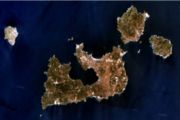
s (130–55 m), strikes in from the northwest so as to separate the island into two fairly equal portions (see photo), with an isthmus not more than 18 km (11.2 mi) broad. In one of the caves on the south coast, the heat from the volcano is still great, and on the eastern shore of the harbour, there are hot sulphurous springs.
Antimelos or Antimilos, 13 miles (20.9 km) north-west of Milos, is an uninhabited mass of trachyte, often called Erimomilos (Desert Milos). Kimolos, or Argentiera, 1.6 km (0.994196378639691 mi) to the north-east, was famous in antiquity for its fig
Ficus
Ficus is a genus of about 850 species of woody trees, shrubs, vines, epiphytes, and hemiepiphyte in the family Moraceae. Collectively known as fig trees or figs, they are native throughout the tropics with a few species extending into the semi-warm temperate zone. The Common Fig Ficus is a genus of...
s and fuller's earth, and contained a considerable city, the remains of which cover the cliff of St. Andrew's. Polyaigos
Polyaigos
Polýaigos is an uninhabited Greek island in the Cyclades near Milos and Kimolos. It is part of the community of Kimolos . Its name means "many goats", since it is inhabited only by goats....
(also called Polinos, Polybos or Polivo — alternative spelling Polyaegos) lies 2 km south-east of Kimolos. It was the subject of dispute between the Milians and Kimolians. It is now uninhabited.
The harbour town is Adamantas; from this there is an ascent to the plateau above the harbour, on which are situated Plaka
Plaka, Milos
Plaka is the chief town in Milos, a Greek island in the Cyclades group. It is perched on the top of large rock, overlooking the gulf of Milos. No cars can enter the village because of the narrow spaces between walls and buildings. Motorbikes, Mopeds and the like are the only usable...
, the chief town, and Kastro, rising on a hill above it, and other villages. The ancient town of Milos was nearer to the entrance of the harbour than Adamas, and occupied the slope between the village of Trypiti and the landing-place at Klima
Klima
Klima or Klíma may refer to:- People :* Edward Klima , American linguist* Ivan Klíma , Czech author* Jan Klíma , Czech physicist...
. Here is a theatre of Roman
Ancient Rome
Ancient Rome was a thriving civilization that grew on the Italian Peninsula as early as the 8th century BC. Located along the Mediterranean Sea and centered on the city of Rome, it expanded to one of the largest empires in the ancient world....
date and some remains of town walls and other buildings, one with a fine mosaic
Mosaic
Mosaic is the art of creating images with an assemblage of small pieces of colored glass, stone, or other materials. It may be a technique of decorative art, an aspect of interior decoration, or of cultural and spiritual significance as in a cathedral...
excavated by the British
United Kingdom
The United Kingdom of Great Britain and Northern IrelandIn the United Kingdom and Dependencies, other languages have been officially recognised as legitimate autochthonous languages under the European Charter for Regional or Minority Languages...
school at Athens in 1896. Numerous fine works of art have been found on this site, notably the Aphrodite
Venus de Milo
Aphrodite of Milos , better known as the Venus de Milo, is an ancient Greek statue and one of the most famous works of ancient Greek sculpture. Created at some time between 130 and 100 BC, it is believed to depict Aphrodite the Greek goddess of love and beauty. It is a marble sculpture, slightly...
in Paris
Paris
Paris is the capital and largest city in France, situated on the river Seine, in northern France, at the heart of the Île-de-France region...
, the Asclepius
Asclepius
Asclepius is the God of Medicine and Healing in ancient Greek religion. Asclepius represents the healing aspect of the medical arts; his daughters are Hygieia , Iaso , Aceso , Aglæa/Ægle , and Panacea...
in London
London
London is the capital city of :England and the :United Kingdom, the largest metropolitan area in the United Kingdom, and the largest urban zone in the European Union by most measures. Located on the River Thames, London has been a major settlement for two millennia, its history going back to its...
, and the Poseidon
Poseidon
Poseidon was the god of the sea, and, as "Earth-Shaker," of the earthquakes in Greek mythology. The name of the sea-god Nethuns in Etruscan was adopted in Latin for Neptune in Roman mythology: both were sea gods analogous to Poseidon...
and the archaic Apollo
Apollo
Apollo is one of the most important and complex of the Olympian deities in Greek and Roman mythology...
in Athens. Other villages include Triovasalos, Peran Triovasalos, Pollonia and Zefyria (Kampos).
Natural resources
BentoniteBentonite
Bentonite is an absorbent aluminium phyllosilicate, essentially impure clay consisting mostly of montmorillonite. There are different types of bentonite, each named after the respective dominant element, such as potassium , sodium , calcium , and aluminum . Experts debate a number of nomenclatorial...
, perlite
Perlite
Perlite is an amorphous volcanic glass that has a relatively high water content, typically formed by the hydration of obsidian. It occurs naturally and has the unusual property of greatly expanding when heated sufficiently...
, pozzolana
Pozzolana
Pozzolana, also known as pozzolanic ash , is a fine, sandy volcanic ash. Pozzolanic ash was first discovered and dug in Italy, at Pozzuoli. It was later discovered at a number of other sites as well...
and small quantities of kaolin are actively collected via strip mine or open-pit mine techniques in Milos and sold all over the world. In the past, baryte, sulfur
Sulfur
Sulfur or sulphur is the chemical element with atomic number 16. In the periodic table it is represented by the symbol S. It is an abundant, multivalent non-metal. Under normal conditions, sulfur atoms form cyclic octatomic molecules with chemical formula S8. Elemental sulfur is a bright yellow...
, millstones and gypsum
Gypsum
Gypsum is a very soft sulfate mineral composed of calcium sulfate dihydrate, with the chemical formula CaSO4·2H2O. It is found in alabaster, a decorative stone used in Ancient Egypt. It is the second softest mineral on the Mohs Hardness Scale...
were also mined; in fact, Pliny notes that Milos was the most abundant source of sulfur in the ancient world. In ancient times the alum of Milos was reckoned next to that of Egypt
Egypt
Egypt , officially the Arab Republic of Egypt, Arabic: , is a country mainly in North Africa, with the Sinai Peninsula forming a land bridge in Southwest Asia. Egypt is thus a transcontinental country, and a major power in Africa, the Mediterranean Basin, the Middle East and the Muslim world...
(Pliny xxxv. 15 [52]). The Melian earth was employed as a pigment
Pigment
A pigment is a material that changes the color of reflected or transmitted light as the result of wavelength-selective absorption. This physical process differs from fluorescence, phosphorescence, and other forms of luminescence, in which a material emits light.Many materials selectively absorb...
by ancient artists. Milos was a source of obsidian
Obsidian
Obsidian is a naturally occurring volcanic glass formed as an extrusive igneous rock.It is produced when felsic lava extruded from a volcano cools rapidly with minimum crystal growth...
during the Neolithic ages for the Aegean and Mediterranean. Orange
Orange (fruit)
An orange—specifically, the sweet orange—is the citrus Citrus × sinensis and its fruit. It is the most commonly grown tree fruit in the world....
, olive
Olive
The olive , Olea europaea), is a species of a small tree in the family Oleaceae, native to the coastal areas of the eastern Mediterranean Basin as well as northern Iran at the south end of the Caspian Sea.Its fruit, also called the olive, is of major agricultural importance in the...
, cypress, tamarisk, juniper (Juniperus oxycedrus) and arbutus
Arbutus
Arbutus is a genus of at least 14 species of flowering plants in the family Ericaceae, native to warm temperate regions of the Mediterranean, western Europe, and North America.-Description:...
trees grow throughout the island, which, however, is too dry to have any profusion of vegetation. Vine
Vine
A vine in the narrowest sense is the grapevine , but more generally it can refer to any plant with a growth habit of trailing or scandent, that is to say climbing, stems or runners...
s, cotton
Cotton
Cotton is a soft, fluffy staple fiber that grows in a boll, or protective capsule, around the seeds of cotton plants of the genus Gossypium. The fiber is almost pure cellulose. The botanical purpose of cotton fiber is to aid in seed dispersal....
and barley
Barley
Barley is a major cereal grain, a member of the grass family. It serves as a major animal fodder, as a base malt for beer and certain distilled beverages, and as a component of various health foods...
are the main crops.
The beaches of Milos Island
There are about 70 beaches on Milos Island. Hivadolimni Beach is the longest at about 1 kilometre (0.621372736649807 mi). The rest of the beaches are starting from (North): Sarakiniko BeachSarakiniko Beach
Sarakiniko is a beach in Milos Island. It is situated on the north shore of the island. Often compared to a moonscape. The local people often refer to the scenic landscape of Sarakiniko as Lunar. The bone white beach derives its unusual characteristics from volcanic rocks shaped by wind and wave...
, Papafragas, Kapros, Pachena, Alogomantra, Konstantinos, Mitakas, Mantrakia, Firopotamos, Nerodafni, Lakida, Plathiena, Fourkovouni, Areti, Pollonia, Gourado and Filakopi. (South): Firiplaka, Paliochori, Provatas, Tsigrado, Agia Kyriaki, Psaravolada, Kleftiko, Gerontas, Gerakas, Agios Sostis, Mouchlioti, Katergo, Spathi, Firligos, Pialothiafes, Kalamos, Krotiraki, Psathi, Svoronou and Sakelari. (West): Agios Ioannis, Cave of Sikia, Agathia, Triades and Ammoudaraki. (East): Voudia, Thalassa, Paliorema, Tria Pagidia and Thiafes. (In the Bay Area): Hivadolimni, Lagada, Papikinou, Fatourena, Klima, Skinopi and Patrikia. The North and South and the bay beaches are tourists attraction. The east beaches are very quiet and the west are also quiet and lonesome beaches.
Historical population
| Year | Island population |
|---|---|
| 1907 | 17,638 |
| 1991 | 4,390 |
| 2001 | 4,771 |
Notable people
- Antonio VassilacchiAntonio VassilacchiAntonio Vassilacchi, also called L'Aliense, was a Greekpainter, who was active mostly in Venice and the Veneto.-Biography:...
(1556–1629), a painter - DiagorasDiagoras of MelosDiagoras "the Atheist" of Melos was a Greek poet and sophist of the 5th century BCE. Throughout antiquity he was regarded as an atheist. With the exception of this one point, there is little information concerning his life and beliefs. He spoke out against the Greek religion, and criticized the...
(5th century BC), a philosopherPhilosophyPhilosophy is the study of general and fundamental problems, such as those connected with existence, knowledge, values, reason, mind, and language. Philosophy is distinguished from other ways of addressing such problems by its critical, generally systematic approach and its reliance on rational...
See also
- Aegean IslandsAegean IslandsThe Aegean Islands are the group of islands in the Aegean Sea, with mainland Greece to the west and north and Turkey to the east; the island of Crete delimits the sea to the south, those of Rhodes, Karpathos and Kasos to the southeast...
- List of Aegean Islands
- Sarakiniko BeachSarakiniko BeachSarakiniko is a beach in Milos Island. It is situated on the north shore of the island. Often compared to a moonscape. The local people often refer to the scenic landscape of Sarakiniko as Lunar. The bone white beach derives its unusual characteristics from volcanic rocks shaped by wind and wave...
- Milos Island National AirportMilos Island National AirportMilos Island National Airport is an airport in Milos, Greece . Milos is an island in the Cyclades. The airport is located 5 kilometers southeast of the harbour of the island. The airport was opened on January 17, 1973...
(MLO) - AntimilosAntimilosAntimilos is a Greek island in the Cyclades, 13 miles northwest of Milos. Administratively, it is part of the municipality of Milos. Antimilos is an uninhabited mass of trachyte , often called Erimomilos . It is a volcanic island and the crater is still obvious...
- KimolosKimolosKimolos is a Greek island in the Aegean Sea, belonging to the islands group of Cyclades, located on the SW tip of them, near the bigger island of Milos. It is considered as a middle class, rural island, not included in the tourist hotspots, thus, ferry connection is sometimes of bad quality...