
Home      Discussion      Topics      Dictionary      Almanac
Signup       Login
Venus de Milo

Venus de Milo

Overview
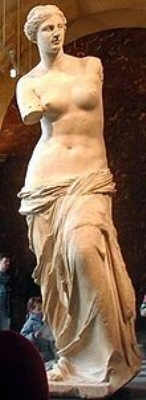
Aphrodite of Milos (Greek: Αφροδίτη της Μήλου, Aphroditē tēs Mēlou), better known as the Venus de Milo, is an ancient Greek
Ancient Greece
Ancient Greece is the civilisation belonging to the period of Greek history lasting from the Greek Dark Ages ca. 1100 BC and the Dorian invasion, to 146 BC and the Roman conquest of Greece after the Battle of Corinth. It is generally considered to be the seminal culture which provided the...

 statue and one of the most famous works of ancient Greek sculpture. Created at some time between 130 and 100 BCE, it is believed to depict Aphrodite
Aphrodite
Aphrodite is the Greek goddess of love, beauty and raw sexuality. According to Greek poet Hesiod, she was born when Cronus cut off Ouranos's genitals and threw them into the sea, and from the aphros arose Aphrodite.Because of her beauty other gods feared that jealousy would interrupt the peace...

 (Venus
Venus (mythology)
Venus was a major Roman goddess principally associated with love, beauty and fertility, who played a key role in many Roman religious festivals and myths. From the third century BC, the increasing Hellenization of Roman upper classes identified her as the equivalent of the Greek goddess...

 to the Romans
Roman mythology
Roman mythology, or Latin mythology, refers to the mythological beliefs of the Italic people inhabiting the region of Latium and its main city, Ancient Rome. It can be considered as having two parts; One part, largely later and literary, consists of borrowings from Greek mythology...

) the Greek goddess of love and beauty. It is a marble
Marble
Marble is a non foliated metamorphic rock resulting from the metamorphism of limestone, composed mostly of calcite . It is extensively used for sculpture, as a building material, and in many other applications...

 sculpture, slightly larger than life size at high.
Discussion
Ask a question about 'Venus de Milo'
Start a new discussion about 'Venus de Milo'
Answer questions from other users
Full Discussion Forum
 
Encyclopedia
Aphrodite of Milos (Greek: Αφροδίτη της Μήλου, Aphroditē tēs Mēlou), better known as the Venus de Milo, is an ancient Greek
Ancient Greece
Ancient Greece is the civilisation belonging to the period of Greek history lasting from the Greek Dark Ages ca. 1100 BC and the Dorian invasion, to 146 BC and the Roman conquest of Greece after the Battle of Corinth. It is generally considered to be the seminal culture which provided the...

 statue and one of the most famous works of ancient Greek sculpture. Created at some time between 130 and 100 BCE, it is believed to depict Aphrodite
Aphrodite
Aphrodite is the Greek goddess of love, beauty and raw sexuality. According to Greek poet Hesiod, she was born when Cronus cut off Ouranos's genitals and threw them into the sea, and from the aphros arose Aphrodite.Because of her beauty other gods feared that jealousy would interrupt the peace...

 (Venus
Venus (mythology)
Venus was a major Roman goddess principally associated with love, beauty and fertility, who played a key role in many Roman religious festivals and myths. From the third century BC, the increasing Hellenization of Roman upper classes identified her as the equivalent of the Greek goddess...

 to the Romans
Roman mythology
Roman mythology, or Latin mythology, refers to the mythological beliefs of the Italic people inhabiting the region of Latium and its main city, Ancient Rome. It can be considered as having two parts; One part, largely later and literary, consists of borrowings from Greek mythology...

) the Greek goddess of love and beauty. It is a marble
Marble
Marble is a non foliated metamorphic rock resulting from the metamorphism of limestone, composed mostly of calcite . It is extensively used for sculpture, as a building material, and in many other applications...

 sculpture, slightly larger than life size at high. Its arms and original plinth
Plinth
A plinth is the base of a cabinet in cabinet making.In architecture, a plinth is the base or platform upon which a column, pedestal, statue, monument or structure rests. Gottfried Semper's The Four Elements of Architecture posited that the plinth, the hearth, the roof, and the wall make up all of...

 have been lost. From an inscription that was on its plinth, it is thought to be the work of Alexandros of Antioch
Alexandros of Antioch
Alexandros of Antioch was an otherwise unknown artist of the Hellenistic age who is most well known today for the Venus de Milo at the Louvre Museum in Paris, France...

; it was earlier mistakenly attributed to the master sculptor Praxiteles
Praxiteles
Praxiteles of Athens, the son of Cephisodotus the Elder, was the most renowned of the Attic sculptors of the 4th century BC. He was the first to sculpt the nude female form in a life-size statue...

. It is at present on display at the Louvre Museum
Louvre
The Musée du Louvre or officially the Grand Louvre — in English, the Louvre Museum or Great Louvre, or simply the Louvre — is the largest national museum of France, the most visited museum in the world, and a historic monument. It is a central landmark of Paris, located on the Right Bank of the...

 in Paris.

Description


Although the Venus de Milo is widely renowned for the mystery of her missing arms enough evidence remains to prove that the right arm of the goddess was lowered across the torso with the right hand resting on the raised left knee so the sliding drapery wrapped around the hips and legs could be held in place. There is a filled hole below the right breast that originally contained a metal tenon that would have supported the separately carved right arm.

The left arm was held at just below the eye level of the statue above a herm while holding an apple. The right side of the statue is more carefully worked and finished than the left side or back, indicating that the statue was intended to be seen mainly as a profile from its right. The left hand would have held the apple up into the air further back inside the niche the statue was set in. When the left hand was still attached, it would have been clear to an observer that the goddess was looking at the apple she held up in her left hand.

The statue would have been tinted as was the custom of the era, adorned with jewellery and positioned in a niche inside of a gymnasium
Gymnasium (ancient Greece)
The gymnasium in ancient Greece functioned as a training facility for competitors in public games. It was also a place for socializing and engaging in intellectual pursuits. The name comes from the Greek term gymnos meaning naked. Athletes competed in the nude, a practice said to encourage...

. The painting of the statue along with the bedecking in jewellery were intended to make it appear more lifelike. Today, all traces of any paint have disappeared and the only signs of the armbands, necklace, earrings and crown are the attachment holes.

The twisting stance and strong projection of the knee, as well as the rich, three-dimensional quality of the drapery, are typical of Hellenistic art of the third century BC and later. Moreover, the sensuous juxtaposition of flesh with the texture of drapery, which seems about to slip off the figure, adds an insistent note of erotic tension that is thoroughly Hellenistic in concept and intent.


Discovery and history


The Venus de Milo was discovered by a peasant named Yorgos Kentrotas in 1820, inside a buried niche within the ancient city ruins of Milos, on the Aegean
Aegean Sea
The Aegean Sea is an elongated embayment of the Mediterranean Sea located between the southern Balkan and Anatolian peninsulas, i.e., between the mainlands of Greece and Turkey respectively. In the north, it is connected to the Marmara Sea and Black Sea by the Dardanelles and Bosporus...

 island
Island
An island or isle is any piece of land that is surrounded by water. Very small islands such as emergent land features on atolls are called islets. A key or cay is another name for a small island or islet. An island in a river or lake may be called an eyot, .There are two main types of islands:...

 of Milos
Milos
Milos , formerly known as Μῆλος – Melos, and before the Athenian massacre and recolonization in 416 BC as Μάλος – Malos, is a volcanic Greek island in the Sea of Crete, just south of the Aegean Sea....

, (also Melos or Milo). The statue was found in two main pieces (the upper torso and the lower draped legs) along with several herm
Herma
A Herma, herm or herme is a sculpture with a head, and perhaps a torso, above a plain, usually squared lower section, on which male genitals may also be carved at the appropriate height...

s (pillars topped with heads), fragments of the upper left arm and left hand holding an apple, and an inscribed plinth. Olivier Voutier
Olivier Voutier
Olivier Voutier was a French naval officer who discovered the statue of the Venus de Milo in 1820, and fought in the Greek War of Independence.- Discovery of the Venus de Milo :...

, a French naval officer, was exploring the island. With the help of the young farmer, Voutier began to dig around what were clearly ancient ruins. Within a few hours Voutier had uncovered a piece of art that would become renowned throughout the world. About ten days later, another French naval officer, Jules Dumont d'Urville
Jules Dumont d'Urville
Rear Admiral Jules Sébastien César Dumont d'Urville was a French explorer and naval officer, who explored the south and western Pacific, Australia, New Zealand, and Antarctica....

, recognized its significance and arranged for a purchase by the French ambassador to Turkey, Charles-François de Riffardeau, marquis, later duc de Rivière
Charles François de Riffardeau, marquis de Rivière
Charles François de Riffardeau, marquis de Rivière was French ambassador to the Sublime Porte of the Ottoman Empire, 1815-1821, for which service he was made duc in 1825. He played a role in getting the Venus de Milo for the Musée du Louvre.Rivière joined the Guards at the age of seventeen...

.

Twelve days out of Touloun the ship was anchored off the island of Melos. Ashore, d'Urville and [fellow officer] Matterer met a Greek peasant, who a few days earlier while ploughing had uncovered blocks of marble and a statue in two pieces, which he offered cheaply to the two young men. It was of a naked woman with an apple in her raised left hand, the right hand holding a draped sash falling from hips to feet, both hands damaged and separated from the body. Even with a broken nose, the face was beautiful. D'Urville the classicist recognized the Venus of the Judgement of Paris. It was, of course, the Venus de Milo. He was eager to acquire it, but his practical captain, apparently uninterested in antiquities, said there was nowhere to store it on the ship, so the transaction lapsed. The tenacious d'Urville on arrival at Constantinople showed the sketches he had made to the French ambassador, the Marquis de Riviére, who sent his secretary in a French Navy vessel to buy it for France. Before he could take delivery, French sailors had to fight Greek brigands for possession. In the mêlée the statue was roughly dragged across rocks to the ship, breaking off both arms, and the sailors refused to go back to search for them.
This story however proved to be a fabrication - Voutier's drawings of the statue when it was first discovered show that its arms were already missing (Curtis, 2003).

News of the discovery took longer than normal to get to the French ambassador. The peasant grew tired of waiting for payment and was pressured into selling it to Nicholas Mourousi, Grand Dragoman of the Fleet, working as a translator for Sultan Mahmud II in Constantinople
Constantinople
Constantinople was the imperial capital of the Roman Empire , the Byzantine/Eastern Roman Empire , the Latin Empire , and the Ottoman Empire...

 (present day Istanbul
Istanbul
Istanbul is the largest city in Turkey and fifth largest city proper in the world with a population of 12.6 million. Istanbul is also a megacity, as well as the cultural and financial centre of Turkey. The city covers 39 districts of the Istanbul province...

, Turkey
Turkey
Turkey , known officially as the Republic of Turkey , is a Eurasian country that stretches across the Anatolian peninsula in Western Asia and Thrace in the Balkan region of southeastern Europe...

).

The French ambassador's representative, Vicomte de Marcellus, arrived just as the statue was being loaded aboard a ship bound for Constantinople and seized the statue and persuaded the island's chief citizens to annul the sale.

Upon learning of the reversal of the sale, Nicholas Mourousi presumably had the chiefs whipped and fined. In 1821, Mourousi was executed by order of Sultan Mahmud II in front of the arsenal in Constantinople. This was amidst massive executions of Phanariote Greeks and the beginning of the Greek War of Independence.
Upon arrival at the Louvre, the statue was reassembled, but the fragments of the left hand and arm were initially dismissed as being a later restoration because of the rougher workmanship. It is now accepted that the left hand holding the apple and the left arm are in fact original to the statue but were not as well finished as the rest of the statue since they would have been somewhat above eye level and difficult to see. This was a standard practice for many sculptors of the era—less visible parts of statues were often not as well finished since they would typically be invisible to the casual observer. Sculptures and statues from this era were normally carved out of several blocks of stone and carefully pieced together. The Venus de Milo turns out to have been carved from at least six to seven blocks of Parian marble: one block for the nude torso, another block for the draped legs, another block apiece for each arm, another small block for the left foot, another block for the inscribed plinth and finally the separately carved herm that stood beside the goddess.

The controversial plinth was initially found to fit perfectly as part of the statue, but after it was translated and dated, the embarrassed experts who had publicized the statue as a possible original work by the artist Praxiteles
Praxiteles
Praxiteles of Athens, the son of Cephisodotus the Elder, was the most renowned of the Attic sculptors of the 4th century BC. He was the first to sculpt the nude female form in a life-size statue...

 dismissed it as another later addition to the statue. The inscription read: "...(Alex)andros son of Menides, citizen of Antioch on the Maeander
Antioch on the Maeander
Antiochia on the Maeander also Antioch on the Maeander , earlier Pythopolis, was a city of ancient Caria, in Anatolia. The city was situated between the Maeander and Orsinus rivers near their confluence and, though it was the site of a bridge over the Maeander had "little or no individual history"...

 made this (statue)..."
. The inscribed plinth would have moved the dating of the statue from the Classical period
Classical Greece
Classical Greece was a culture that was highly advanced and which heavily influenced the cultures of Ancient Rome and still has an enduring effect on Western Civilization. Much of modern politics, artistic thought, scientific thought, literature, and philosophy derives from this ancient society...

 to the Hellenistic period
Hellenistic period
The Hellenistic period describes the era which followed the conquests of Alexander the Great. During this time, Greek cultural influence and power was at its zenith in Europe and Asia. It is often considered a period of transition, sometimes even of decline or decadence, between the brilliance of...

 because of the style of lettering and the mention of the ancient city of Antioch on the Maeander
Antioch on the Maeander
Antiochia on the Maeander also Antioch on the Maeander , earlier Pythopolis, was a city of ancient Caria, in Anatolia. The city was situated between the Maeander and Orsinus rivers near their confluence and, though it was the site of a bridge over the Maeander had "little or no individual history"...

, which did not exist at the time Praxiteles lived. The Hellenistic Age was at that time considered a period of decline for Greek art
Art in Ancient Greece
The arts of ancient Greece have exercised an enormous influence on the culture of many countries, particularly in the areas of sculpture and architecture. In the West, the art of the Roman Empire was largely derived from Greek models...

. The plinth mysteriously disappeared shortly before the statue was presented to King Louis XVIII
Louis XVIII of France
Louis XVIII , Louis Stanislas Xavier de France, was King of France and Navarre from 1814 to 1824, omitting the Hundred Days in 1815. Louis XVIII spent twenty-three years in exile, from 1791 to 1814, due to the French Revolution, and was exiled again in 1815, upon the return of Napoleon Bonaparte...

 in 1821 and only survives in two drawings and an early description. The king eventually presented the statue to the Louvre
Louvre
The Musée du Louvre or officially the Grand Louvre — in English, the Louvre Museum or Great Louvre, or simply the Louvre — is the largest national museum of France, the most visited museum in the world, and a historic monument. It is a central landmark of Paris, located on the Right Bank of the...

 museum
Museum
A museum is a building or institution which houses a collection of artifacts.Museums collect and care for objects of scientific, artistic, or historical importance and make them available for public viewing through exhibits that may be permanent or temporary...

 in Paris.

In the autumn of 1939, the Venus was packed for removal from the Louvre in anticipation of the outbreak of war. A scenery trucks from the Comédie-Française
Comédie-Française
The Comédie-Française or Théâtre-Français is one of the few state theaters in France. It is the only state theater to have its own troupe of actors. It is located in the Ier arrondissement of Paris....

 transported the masterpieces of the Louvre to safer locations in the countryside. During the years of World War II, the statue sheltered in safety in the Château de Valençay
Château de Valençay
Château de Valençay is a residence of the d'Estampes and Talleyrand-Périgord families in the commune of Valençay, the Indre département of France. Although geographically it is part of the province of Berry, its architecture invites comparison with the Renaissance châteaux of the Loire Valley,...

 along with the Winged Victory of Samothrace
Winged Victory of Samothrace
The Winged Victory of Samothrace, also called the Nike of Samothrace, is a third century B.C. marble sculpture of the Greek goddess Nike...

and Michelangelo's Slaves.

Fame


The Venus de Milos great fame in the 19th century was not simply the result of its admitted beauty, but also owed much to a major propaganda effort by the French authorities. In 1815, France had returned the Medici Venus
Venus de' Medici
The Venus de' Medici or Medici Venus is a lifesize Hellenistic marble sculpture depicting the Greek goddess of love Aphrodite. It is a first century BC marble copy, perhaps made in Athens, of a bronze original Greek sculpture, following the type of the Aphrodite of Cnidos, which would have been...

to the Italians after it had been looted from Italy by Napoleon Bonaparte. The Medici Venus, regarded as one of the finest Classical sculptures in existence, caused the French to consciously promote the Venus de Milo as a greater treasure than that which they had recently lost. It was duly praised by artists and critics as the epitome of graceful female beauty; however, Pierre-Auguste Renoir
Pierre-Auguste Renoir
Pierre-Auguste Renoir was a French artist who was a leading painter in the development of the Impressionist style...

 was among its detractors, labeling it a "big gendarme
Gendarme
Gendarme can mean:* Gendarme , French medieval or early modern cavalryman* A member of a gendarmerie; the word is often incorrectly used in English to refer to any French policeman...

".

External links