


History of the Peloponnesian War

Encyclopedia
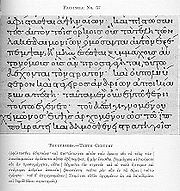
The History of the Peloponnesian War is an account of the Peloponnesian War
Peloponnesian War
The Peloponnesian War, 431 to 404 BC, was an ancient Greek war fought by Athens and its empire against the Peloponnesian League led by Sparta. Historians have traditionally divided the war into three phases...
in Ancient Greece
Ancient Greece
Ancient Greece is a civilization belonging to a period of Greek history that lasted from the Archaic period of the 8th to 6th centuries BC to the end of antiquity. Immediately following this period was the beginning of the Early Middle Ages and the Byzantine era. Included in Ancient Greece is the...
, fought between the Peloponnesian League
Peloponnesian League
The Peloponnesian League was an alliance in the Peloponnesus from the 6th to the 4th centuries BC.- Early history:By the end of the 6th century, Sparta had become the most powerful state in the Peloponnese, and was the political and military hegemon over Argos, the next most powerful state...
(led by Sparta
Sparta
Sparta or Lacedaemon, was a prominent city-state in ancient Greece, situated on the banks of the River Eurotas in Laconia, in south-eastern Peloponnese. It emerged as a political entity around the 10th century BC, when the invading Dorians subjugated the local, non-Dorian population. From c...
) and the Delian League
Delian League
The Delian League, founded in circa 477 BC, was an association of Greek city-states, members numbering between 150 to 173, under the leadership of Athens, whose purpose was to continue fighting the Persian Empire after the Greek victory in the Battle of Plataea at the end of the Greco–Persian Wars...
(led by Athens
Athens
Athens , is the capital and largest city of Greece. Athens dominates the Attica region and is one of the world's oldest cities, as its recorded history spans around 3,400 years. Classical Athens was a powerful city-state...
). It was written by Thucydides
Thucydides
Thucydides was a Greek historian and author from Alimos. His History of the Peloponnesian War recounts the 5th century BC war between Sparta and Athens to the year 411 BC...
, an Athenian general who served in the war. It is widely considered a classic and regarded as one of the earliest scholarly works of history. The History was divided into eight books by editors of later antiquity
Library of Alexandria
The Royal Library of Alexandria, or Ancient Library of Alexandria, in Alexandria, Egypt, was the largest and most significant great library of the ancient world. It flourished under the patronage of the Ptolemaic dynasty and functioned as a major center of scholarship from its construction in the...
.
Analyses of the History generally fall into one of two camps. On the one hand are those who view the work as an objective and scientific piece of history. The judgement of J. B. Bury
J. B. Bury
John Bagnell Bury , known as J. B. Bury, was an Irish historian, classical scholar, Byzantinist and philologist.-Biography:...
reflects this traditional interpretation of the work: "[The History is] severe in its detachment, written from a purely intellectual point of view, unencumbered with platitudes and moral judgements, cold and critical." A more recent interpretation, associated with reader-response criticism
Reader-response criticism
Reader-response criticism is a school of literary theory that focuses on the reader and his or her experience of a literary work, in contrast to other schools and theories that focus attention primarily on the author or the content and form of the work.Although literary theory has long paid some...
, argues that the History is better understood as a piece of literature than an objective record of the past. This view is embodied in the words of W. R. Connor, who describes Thucydides as "an artist who responds to, selects and skillfully arranges his material, and develops its symbolic and emotional potential." The former outlook views Thucydides as pathbreaking, modern, and philosophical, ahead of his time; the latter views the historian as closely connected with his historical and cultural context. Both interpretations are accepted by scholars, sometimes by the same scholar, and seem to capture the contradictory impulses and tensions within the History.
Historical method
Thucydides' History made a number of contributions to early historiographyHistoriography
Historiography refers either to the study of the history and methodology of history as a discipline, or to a body of historical work on a specialized topic...
. Many of his principles have become standard methods of history writing today, though others have not.
Chronology
One of Thucydides' major innovations was to employ a strict standard of chronology, recording events by year, each year consisting of the summer campaigning season and a less active winter season. As a result, events that span several years are divided up and described in parts of the book that are sometimes quite distant from one another, causing the impression that he is oscillating between the various theatres of conflict. This method contrasts sharply with HerodotusHerodotus
Herodotus was an ancient Greek historian who was born in Halicarnassus, Caria and lived in the 5th century BC . He has been called the "Father of History", and was the first historian known to collect his materials systematically, test their accuracy to a certain extent and arrange them in a...
' earlier work The Histories, which jumps around chronologically and makes frequent and roundabout excursions into seemingly unrelated areas and time periods.
Speeches
Another distinctive feature of the work is Thucydides' inclusion of dozens of speeches assigned to the principal figures engaged in the war. These include addresses given to troops by their generals before battles and numerous political speeches, both by Athenian and Spartan leaders, as well as debates between various parties. Of the speeches, the most famous is the funeral oration of PericlesPericles' Funeral Oration
Pericles' Funeral Oration is a famous speech from Thucydides' History of the Peloponnesian War. The speech was delivered by Pericles, an eminent Athenian politician, at the end of the first year of the Peloponnesian War as a part of the annual public funeral for the war dead.-Background:It was an...
, which is found in Book Two. Thucydides undoubtedly heard some of these speeches himself while for others he relied on eyewitness accounts. Some of the speeches are probably fabricated according to his expectations of, as he puts it, "what was called for in each situation" (1.22.2).
While the inclusion of long first-person speeches is somewhat alien to modern historical method, in the context of ancient Greek
Ancient Greece
Ancient Greece is a civilization belonging to a period of Greek history that lasted from the Archaic period of the 8th to 6th centuries BC to the end of antiquity. Immediately following this period was the beginning of the Early Middle Ages and the Byzantine era. Included in Ancient Greece is the...
oral culture
Oral tradition
Oral tradition and oral lore is cultural material and traditions transmitted orally from one generation to another. The messages or testimony are verbally transmitted in speech or song and may take the form, for example, of folktales, sayings, ballads, songs, or chants...
speeches are expected. A brief glance at Homer
Homer
In the Western classical tradition Homer , is the author of the Iliad and the Odyssey, and is revered as the greatest ancient Greek epic poet. These epics lie at the beginning of the Western canon of literature, and have had an enormous influence on the history of literature.When he lived is...
's poems, the works of the tragedians, and Herodotus
Herodotus
Herodotus was an ancient Greek historian who was born in Halicarnassus, Caria and lived in the 5th century BC . He has been called the "Father of History", and was the first historian known to collect his materials systematically, test their accuracy to a certain extent and arrange them in a...
's Histories shows that many of the most influential literary forms in Thucydides' time included substantial first-person speeches. Oratory also played a large part in the political life of the democracy
Athenian democracy
Athenian democracy developed in the Greek city-state of Athens, comprising the central city-state of Athens and the surrounding territory of Attica, around 508 BC. Athens is one of the first known democracies. Other Greek cities set up democracies, and even though most followed an Athenian model,...
in Thucydides' home city of Athens
Athens
Athens , is the capital and largest city of Greece. Athens dominates the Attica region and is one of the world's oldest cities, as its recorded history spans around 3,400 years. Classical Athens was a powerful city-state...
.
Neutral point of view?
Despite being an Athenian and a participant in the conflict, Thucydides is often regarded as having written a generally unbiasedBias
Bias is an inclination to present or hold a partial perspective at the expense of alternatives. Bias can come in many forms.-In judgement and decision making:...
account of the conflict and all the sides involved in it. In the introduction to the piece he states, "My work is not a piece of writing designed to meet the taste of an immediate public, but was done to last for ever" (1.22.4). However, this has been challenged; Ernst Badian
Ernst Badian
Ernst Badian was an Austrian-born classical scholar who served as a professor at Harvard University from 1971 to 1998....
is one scholar who has argued that Thucydides has a strong pro-Athenian bias. Others claim he had an ulterior motive, specifically to create an epic comparable to those of the past, and that this led him to create a nonobjective dualism favoring the Athenians.
Role of religion
The godsGreek mythology
Greek mythology is the body of myths and legends belonging to the ancient Greeks, concerning their gods and heroes, the nature of the world, and the origins and significance of their own cult and ritual practices. They were a part of religion in ancient Greece...
play no active role in Thucydides' work. This is very different from Herodotus, who frequently mentions the role of the gods, as well as a nearly ubiquitous divine presence in the centuries-earlier poems of Homer
Homer
In the Western classical tradition Homer , is the author of the Iliad and the Odyssey, and is revered as the greatest ancient Greek epic poet. These epics lie at the beginning of the Western canon of literature, and have had an enormous influence on the history of literature.When he lived is...
. Instead, Thucydides regards history as being caused by the choices and actions of human beings
Free will
"To make my own decisions whether I am successful or not due to uncontrollable forces" -Troy MorrisonA pragmatic definition of free willFree will is the ability of agents to make choices free from certain kinds of constraints. The existence of free will and its exact nature and definition have long...
.
Despite the absence of actions of the gods, religion and piety play critical roles in the actions of the Spartans, and to a lesser degree, the Athenians. Thus natural occurrences such as earthquake and eclipses were viewed as religiously significant (1.23.3; 7.50.4)
It has been further argued that Thucydides attributes the existence of the gods entirely to the needs of political life. The gods are portrayed as existing only in the minds of men. Religion as such reveals itself in the History to be not simply one type of social behavior among others, but what permeates the whole of social existence, permitting the emergence of justice.
Subject matter of the History
The first book of the History, after a brief review of early Greek history and some programmatic historiographical commentary, seeks to explain why the Peloponnesian War broke out when it did and what its causes were. Except for a few short excursuses (notably 6.54-58 on the Tyrant SlayersHarmodius and Aristogeiton
Harmodius and Aristogeiton were two men from ancient Athens...
), the remainder of the History (books 2 through 8) rigidly maintains its focus on the Peloponnesian War
Peloponnesian War
The Peloponnesian War, 431 to 404 BC, was an ancient Greek war fought by Athens and its empire against the Peloponnesian League led by Sparta. Historians have traditionally divided the war into three phases...
to the exclusion of other topics.

Military
A military is an organization authorized by its greater society to use lethal force, usually including use of weapons, in defending its country by combating actual or perceived threats. The military may have additional functions of use to its greater society, such as advancing a political agenda e.g...
aspects of the Peloponnesian War
Peloponnesian War
The Peloponnesian War, 431 to 404 BC, was an ancient Greek war fought by Athens and its empire against the Peloponnesian League led by Sparta. Historians have traditionally divided the war into three phases...
, it uses these events as a medium to suggest several other themes closely related to the war. It specifically discusses in several passages the socially and culturally degenerative effects of war on humanity itself. The History is especially concerned with the lawlessness and atrocities committed by Greek citizens to each other in the name of one side or another in the war. Some events depicted in the History, such as the Melian dialogue
Melian dialogue
The Melian Dialogue, contained in Thucydides’ History of the Peloponnesian War, is an account of the confrontation between the people of Melos, a small island in the southern Aegean Sea, and the Athenians in 416–415 BC. Melos was a neutral island, lying just east of Sparta; the Athenians wanted to...
, describe early instances of realpolitik
Realpolitik
Realpolitik refers to politics or diplomacy based primarily on power and on practical and material factors and considerations, rather than ideological notions or moralistic or ethical premises...
or power politics
Power politics
Power politics, or Machtpolitik , is a state of international relations in which sovereigns protect their own interests by threatening one another with military, economic, or political aggression...
. The History is preoccupied with the interplay of justice
Justice
Justice is a concept of moral rightness based on ethics, rationality, law, natural law, religion, or equity, along with the punishment of the breach of said ethics; justice is the act of being just and/or fair.-Concept of justice:...
and power in political and military decision-making. Thucydides' presentation is decidedly ambivalent on this theme. While the History seems to suggest that considerations of justice are artificial and necessarily capitulate to power, it sometimes also shows a significant degree of empathy with those who suffer from the exigencies of the war.
For the most part, the History does not discuss topics such as the art
Art
Art is the product or process of deliberately arranging items in a way that influences and affects one or more of the senses, emotions, and intellect....
and architecture
Architecture of Ancient Greece
The architecture of Ancient Greece is the architecture produced by the Greek-speaking people whose culture flourished on the Greek mainland and Peloponnesus, the Aegean Islands, and in colonies in Asia Minor and Italy for a period from about 900 BC until the 1st century AD, with the earliest...
of Greece.
Military technology
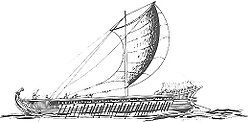
Trireme
A trireme was a type of galley, a Hellenistic-era warship that was used by the ancient maritime civilizations of the Mediterranean, especially the Phoenicians, ancient Greeks and Romans.The trireme derives its name from its three rows of oars on each side, manned with one man per oar...
, the supreme naval ship for the next several hundred years. In his emphasis on sea power, Thucydides resembles the modern naval theorist Alfred Thayer Mahan
Alfred Thayer Mahan
Alfred Thayer Mahan was a United States Navy flag officer, geostrategist, and historian, who has been called "the most important American strategist of the nineteenth century." His concept of "sea power" was based on the idea that countries with greater naval power will have greater worldwide...
, whose influential work The Influence of Sea Power upon History
The Influence of Sea Power upon History
The Influence of Sea Power Upon History: 1660-1783 is a history of naval warfare written in 1890 by Alfred Thayer Mahan. It details the role of sea power throughout history and discusses the various factors needed to support and achieve sea power, with emphasis on having the largest and most...
helped set in motion the naval arms race prior to World War I.
Empire
The History explains that the primary cause of the Peloponnesian WarPeloponnesian War
The Peloponnesian War, 431 to 404 BC, was an ancient Greek war fought by Athens and its empire against the Peloponnesian League led by Sparta. Historians have traditionally divided the war into three phases...
was the "growth in power of Athens, and the alarm which this inspired in Sparta" (1.23.6). Thucydides traces the development of Athenian power through the growth of the Athenian empire in the years 479 BC
479 BC
Year 479 BC was a year of the pre-Julian Roman calendar. At the time, it was known as the Year of the Consulship of Vibulanus and Rutilus...
to 432 BC
432 BC
Year 432 BC was a year of the pre-Julian Roman calendar. At the time, it was known as the Year of the Tribunate of Mamercus, Albinus and Medullinus...
in book one of the History (1.89-118). The legitimacy of the empire is explored in several passages, notably in the speech at 1.73-78, where an anonymous Athenian legation defends the empire on the grounds that it was freely given to the Athenians and not taken by force. The subsequent expansion of the empire is defended by these Athenians, "...the nature of the case first compelled us to advance our empire to its present height; fear being our principal motive, though honor and interest came afterward." (1.75.3) The Athenians also argue that, "We have done nothing extraordinary, nothing contrary to human nature in accepting an empire when it was offered to us and then in refusing to give it up." (1.76) They claim that anyone in their position would act in the same fashion. The Sparta
Sparta
Sparta or Lacedaemon, was a prominent city-state in ancient Greece, situated on the banks of the River Eurotas in Laconia, in south-eastern Peloponnese. It emerged as a political entity around the 10th century BC, when the invading Dorians subjugated the local, non-Dorian population. From c...
ns represent a more traditional, circumspect, and less expansive power. Indeed, the Athenians are nearly destroyed by their greatest act of imperial overreach, the Sicilian expedition, described in books six and seven of the History.
Some difficulties of interpretation
Thucydides' History is extraordinarily dense and complex. This has resulted in much scholarly disagreement on a cluster of issues of interpretation.Strata of composition
It is commonly thought that Thucydides died while still working on the History, since it ends in mid-sentence and only goes up to 410 BC, leaving six years of war uncovered. Furthermore, there is a great deal of uncertainty whether he intended to revise the sections he had already written. Since there appear to be some contradictions between certain passages in the History, it has been proposed that the conflicting passages were written at different times and that Thucydides' opinion on the conflicting matter had changed. Those who argue that the History can be divided into various levels of composition are usually called "analysts" and those who argue that the passages must be made to reconcile with one another are called "unitarians". This conflict is called the "strata of composition" debate.Sources
The History is notoriously reticent about its sources. Thucydides almost never names his informants and alludes to competing versions of events only a handful of times. This is in marked contrast to HerodotusHerodotus
Herodotus was an ancient Greek historian who was born in Halicarnassus, Caria and lived in the 5th century BC . He has been called the "Father of History", and was the first historian known to collect his materials systematically, test their accuracy to a certain extent and arrange them in a...
, who frequently mentions multiple versions of his stories and allows the reader to decide which is true. Instead, Thucydides strives to create the impression of a seamless and irrefutable narrative. Nevertheless, scholars have sought to detect the sources behind the various sections of the History. For example, the narrative after Thucydides' exile (4.108ff.) seems to focus on Peloponnesian events more than the first four books, leading to the conclusion that he had greater access to Peloponnesian sources at that time.
Frequently, Thucydides appears to assert knowledge of the thoughts of individuals at key moments in the narrative. Scholars have asserted that these moments are evidence that he interviewed these individuals after the fact. However, the evidence of the Sicilian Expedition
Sicilian Expedition
The Sicilian Expedition was an Athenian expedition to Sicily from 415 BC to 413 BC, during the Peloponnesian War. The expedition was hampered from the outset by uncertainty in its purpose and command structure—political maneuvering in Athens swelled a lightweight force of twenty ships into a...
argues against this, since Thucydides
Thucydides
Thucydides was a Greek historian and author from Alimos. His History of the Peloponnesian War recounts the 5th century BC war between Sparta and Athens to the year 411 BC...
discusses the thoughts of the generals who died there and whom he would have had no chance to interview. Instead it seems likely that, as with the speeches, Thucydides is looser than previously thought in inferring the thoughts, feelings, and motives of principal characters in his History from their actions, as well as his own sense of what would be appropriate or likely in such a situation.
Influence
Thucydides' History has been enormously influential in both ancient and modern historiographyHistoriography
Historiography refers either to the study of the history and methodology of history as a discipline, or to a body of historical work on a specialized topic...
. It was embraced by the author's contemporaries and immediate successors with enthusiasm; indeed, many authors sought to complete the unfinished history. For example, Xenophon
Xenophon
Xenophon , son of Gryllus, of the deme Erchia of Athens, also known as Xenophon of Athens, was a Greek historian, soldier, mercenary, philosopher and a contemporary and admirer of Socrates...
wrote his Hellenica
Hellenica (Xenophon)
Hellenica simply means writings on Greek— Hellenic— subjects. Several histories of fourth-century Greece, written in the mold of Thucydides or straying from it, have borne the conventional Latin title Hellenica...
as a continuation of Thucydides' work, beginning at the exact moment that Thucydides' History leaves off. His work, however, is generally considered inferior in style and accuracy compared with Thucydides'. In later antiquity, Thucydides' reputation suffered somewhat, with critics such as Dionysius of Halicarnassus
Dionysius of Halicarnassus
Dionysius of Halicarnassus was a Greek historian and teacher of rhetoric, who flourished during the reign of Caesar Augustus. His literary style was Attistic — imitating Classical Attic Greek in its prime.-Life:...
rejecting the History as turgid and excessively austere. Lucian
Lucian
Lucian of Samosata was a rhetorician and satirist who wrote in the Greek language. He is noted for his witty and scoffing nature.His ethnicity is disputed and is attributed as Assyrian according to Frye and Parpola, and Syrian according to Joseph....
also parodies it (among others) in his satire The True Histories. Woodrow Wilson
Woodrow Wilson
Thomas Woodrow Wilson was the 28th President of the United States, from 1913 to 1921. A leader of the Progressive Movement, he served as President of Princeton University from 1902 to 1910, and then as the Governor of New Jersey from 1911 to 1913...
read the History on his voyage across the Atlantic to the Versailles Peace Conference.
Miscellaneous
Thucydides correlates, in his description of the 426 BC Malian Gulf tsunami, for the first time in the history of natural scienceNatural science
The natural sciences are branches of science that seek to elucidate the rules that govern the natural world by using empirical and scientific methods...
, quakes and waves in terms of cause and effect.
Method of citation
Most critics writing about the History, including this article, use a standard format to direct readers to passages in the text: book.chapter.section. For example, the notation that Pericles' last speech runs from 2.60.1 to 2.64.6, this means that it can be found in the second book, from the sixtieth chapter through the sixty-fourth. Most modern editions and translations of the History include the chapter numbers in the margins (a notable exception being Rex WarnerRex Warner
Rex Warner was an English classicist, writer and translator. He is now probably best remembered for The Aerodrome , an allegorical novel whose young hero is faced with the disintegration of his certainties about his loved ones and with a choice between the earthy, animalistic life of his home...
's translation published by Penguin Classics
Penguin Books
Penguin Books is a publisher founded in 1935 by Sir Allen Lane and V.K. Krishna Menon. Penguin revolutionised publishing in the 1930s through its high quality, inexpensive paperbacks, sold through Woolworths and other high street stores for sixpence. Penguin's success demonstrated that large...
).
Manuscripts
To the most important manuscripts belong: Codex Parisinus suppl. Gr. 255, Codex Vaticanus 126, Codex Laurentianus LXIX.2, Codex Palatinus 252, Codex Monacensis 430, Codex Monacensis 228, Codex Britannicus II,727, and other.Grenfell and Hunt discovered in Oxyrhynchus
Oxyrhynchus
Oxyrhynchus is a city in Upper Egypt, located about 160 km south-southwest of Cairo, in the governorate of Al Minya. It is also an archaeological site, considered one of the most important ever discovered...
about 20 manuscripts on papyrus from ancient time.
Outline of the work
- Book 1
- The state of Greece from the earliest times to the commencement of the Peloponnesian WarPeloponnesian WarThe Peloponnesian War, 431 to 404 BC, was an ancient Greek war fought by Athens and its empire against the Peloponnesian League led by Sparta. Historians have traditionally divided the war into three phases...
, also known as the Archaeology. 1.1-1.19. - Methodological excursus. 1.20-1.23.
- Causes of the war (433-432 BC) 1.24-1.66.
- The Affair of Epidamnus. 1.24-1.55.
- The Affair of PotidaeaBattle of PotidaeaThe Battle of Potidaea was, with the Battle of Sybota, one of the catalysts for the Peloponnesian War. It was fought near Potidaea in 432 BC between Athens and a combined army from Corinth and Potidaea, along with their various allies....
. 1.56-1.66.
- Congress of the Peloponnesian LeaguePeloponnesian LeagueThe Peloponnesian League was an alliance in the Peloponnesus from the 6th to the 4th centuries BC.- Early history:By the end of the 6th century, Sparta had become the most powerful state in the Peloponnese, and was the political and military hegemon over Argos, the next most powerful state...
at Lacedaemon. 1.67-1.88- The Speech of the Corinthians. 1.68-1.71.
- The Speech of the Athenian envoys. 1.73-1.78.
- The Speech of Archidamus. 1.80-1.85.
- The Speech of Sthenelaidas. 1.86.
- From the end of the Persian WarGreco-Persian WarsThe Greco-Persian Wars were a series of conflicts between the Achaemenid Empire of Persia and city-states of the Hellenic world that started in 499 BC and lasted until 449 BC. The collision between the fractious political world of the Greeks and the enormous empire of the Persians began when Cyrus...
to the beginning of the Peloponnesian War, also known as the Pentecontaetia. 1.89-1.117.- The progress from supremacy to empire.
- Second congress at Lacedaemon and the Corinthian Speech. 1.119-1.125.
- Diplomatic maneuvering. 1.126-1.139.
- Excursus on Cylon. 1.126-1.127.
- Excursus on PausaniasPausanias (general)Pausanias was a Spartan general of the 5th century BC. He was the son of Cleombrotus and nephew of Leonidas I, serving as regent after the latter's death, since Leonidas' son Pleistarchus was still under-age. Pausanias was also the father of Pleistoanax, who later became king, and Cleomenes...
and ThemistoclesThemistoclesThemistocles ; c. 524–459 BC, was an Athenian politician and a general. He was one of a new breed of politicians who rose to prominence in the early years of the Athenian democracy, along with his great rival Aristides...
. 1.128-1.138
- PericlesPericlesPericles was a prominent and influential statesman, orator, and general of Athens during the city's Golden Age—specifically, the time between the Persian and Peloponnesian wars...
' first speech. 1.140-1.145.
- The state of Greece from the earliest times to the commencement of the Peloponnesian War
- Book 2 (431-428 BC)
- War begins with ThebesThebes, GreeceThebes is a city in Greece, situated to the north of the Cithaeron range, which divides Boeotia from Attica, and on the southern edge of the Boeotian plain. It played an important role in Greek myth, as the site of the stories of Cadmus, Oedipus, Dionysus and others...
' attempt to subvert PlataeaPlataeaPlataea or Plataeae was an ancient city, located in Greece in southeastern Boeotia, south of Thebes. It was the location of the Battle of Plataea in 479 BC, in which an alliance of Greek city-states defeated the Persians....
. 2.1-2.6. - Account of the mobilization of and list of the allies of the two combatants. 2.7-2.9.
- First invasion of AtticaAtticaAttica is a historical region of Greece, containing Athens, the current capital of Greece. The historical region is centered on the Attic peninsula, which projects into the Aegean Sea...
. 2.10-2.23.- ArchidamusArchidamusArchidamus may refer to:*one of several kings of Sparta:**Archidamus I **Archidamus II **Archidamus III **Archidamus IV **Archidamus V...
leads the Peloponnesian army into AtticaAtticaAttica is a historical region of Greece, containing Athens, the current capital of Greece. The historical region is centered on the Attic peninsula, which projects into the Aegean Sea...
. 2.10-2.12. - Athenian preparations and abandonment of the countryside. 2.13-2.14.
- Excursus on Athenian synoikism. 2.15-2.16.
- Difficult conditions in AthensAthensAthens , is the capital and largest city of Greece. Athens dominates the Attica region and is one of the world's oldest cities, as its recorded history spans around 3,400 years. Classical Athens was a powerful city-state...
for refugees from countryside. 2.17. - ArchidamusArchidamusArchidamus may refer to:*one of several kings of Sparta:**Archidamus I **Archidamus II **Archidamus III **Archidamus IV **Archidamus V...
ravages OenoeOenoeOenoe , also written Oinoi or Oene, referred to several cities in Greece:*Oenoe, a city in Attica, modern Oinoi*Oenoe, an ancient city located in Argolis*Oene , an ancient city in modern Elis...
and Acharnai. 2.18-2.20. - Athenian fury and anger at PericlesPericlesPericles was a prominent and influential statesman, orator, and general of Athens during the city's Golden Age—specifically, the time between the Persian and Peloponnesian wars...
. 2.21-2.22.
- Archidamus
- Athenian naval counter-attacks along coast of Peloponese and islands. 2.23-2.32.
- Pericles' Funeral OrationPericles' Funeral OrationPericles' Funeral Oration is a famous speech from Thucydides' History of the Peloponnesian War. The speech was delivered by Pericles, an eminent Athenian politician, at the end of the first year of the Peloponnesian War as a part of the annual public funeral for the war dead.-Background:It was an...
. 2.34-2.46. - The plague of AthensPlague of AthensThe Plague of Athens was a devastating epidemic which hit the city-state of Athens in ancient Greece during the second year of the Peloponnesian War , when an Athenian victory still seemed within reach. It is believed to have entered Athens through Piraeus, the city's port and sole source of food...
. 2.47-2.54. - Second invasion of AtticaAtticaAttica is a historical region of Greece, containing Athens, the current capital of Greece. The historical region is centered on the Attic peninsula, which projects into the Aegean Sea...
and Athenian naval counter-attacks. 2.55-2.58. - PericlesPericlesPericles was a prominent and influential statesman, orator, and general of Athens during the city's Golden Age—specifically, the time between the Persian and Peloponnesian wars...
' third speech, defending his position and policy. 2.59-2.64. - ThucydidesThucydidesThucydides was a Greek historian and author from Alimos. His History of the Peloponnesian War recounts the 5th century BC war between Sparta and Athens to the year 411 BC...
' estimate of PericlesPericlesPericles was a prominent and influential statesman, orator, and general of Athens during the city's Golden Age—specifically, the time between the Persian and Peloponnesian wars...
' qualities and the causes for AthensAthensAthens , is the capital and largest city of Greece. Athens dominates the Attica region and is one of the world's oldest cities, as its recorded history spans around 3,400 years. Classical Athens was a powerful city-state...
' eventual defeat. 2.65. - Diplomacy and skirmishes in ThraceThraceThrace is a historical and geographic area in southeast Europe. As a geographical concept, Thrace designates a region bounded by the Balkan Mountains on the north, Rhodope Mountains and the Aegean Sea on the south, and by the Black Sea and the Sea of Marmara on the east...
, the islands, and the Northeast. 2.66-2.69. - Fall of PotidaeaBattle of PotidaeaThe Battle of Potidaea was, with the Battle of Sybota, one of the catalysts for the Peloponnesian War. It was fought near Potidaea in 432 BC between Athens and a combined army from Corinth and Potidaea, along with their various allies....
. 2.70. - Investment of PlataeaPlataeaPlataea or Plataeae was an ancient city, located in Greece in southeastern Boeotia, south of Thebes. It was the location of the Battle of Plataea in 479 BC, in which an alliance of Greek city-states defeated the Persians....
. 2.71-2.78. - Naval victories of PhormioPhormioPhormio , the son of Asopius, was an Athenian general and admiral before and during the Peloponnesian War. A talented naval commander, Phormio commanded at several famous Athenian victories in 428 BC, and was honored after his death with a statue on the acropolis and a state funeral...
in the Northeast. 2.80-2.92. - Threat of raid on the PiraeusPiraeusPiraeus is a city in the region of Attica, Greece. Piraeus is located within the Athens Urban Area, 12 km southwest from its city center , and lies along the east coast of the Saronic Gulf....
. 2.93-2.94. - ThracianThraceThrace is a historical and geographic area in southeast Europe. As a geographical concept, Thrace designates a region bounded by the Balkan Mountains on the north, Rhodope Mountains and the Aegean Sea on the south, and by the Black Sea and the Sea of Marmara on the east...
campaign in MacedonMacedonMacedonia or Macedon was an ancient kingdom, centered in the northeastern part of the Greek peninsula, bordered by Epirus to the west, Paeonia to the north, the region of Thrace to the east and Thessaly to the south....
ia under Sitalces. 2.95-2.101.
- War begins with Thebes
- Book 3 (428-425 BC)
- Annual invasion of AtticaAtticaAttica is a historical region of Greece, containing Athens, the current capital of Greece. The historical region is centered on the Attic peninsula, which projects into the Aegean Sea...
. 3.1. - Revolt of MytileneMytileneMytilene is a town and a former municipality on the island of Lesbos, North Aegean, Greece. Since the 2011 local government reform it is part of the municipality Lesbos, of which it is a municipal unit. It is the capital of the island of Lesbos. Mytilene, whose name is pre-Greek, is built on the...
. 3.2-3.50.- Speech of Mytilenian envoys to SpartaSpartaSparta or Lacedaemon, was a prominent city-state in ancient Greece, situated on the banks of the River Eurotas in Laconia, in south-eastern Peloponnese. It emerged as a political entity around the 10th century BC, when the invading Dorians subjugated the local, non-Dorian population. From c...
at OlympiaOlympia, GreeceOlympia , a sanctuary of ancient Greece in Elis, is known for having been the site of the Olympic Games in classical times, comparable in importance to the Pythian Games held in Delphi. Both games were held every Olympiad , the Olympic Games dating back possibly further than 776 BC...
, asking for help. 3.9-3.14. - Sparta accepts Lesbos as an ally and prepares to counter the Athenians. 3.15.
- MytileneMytileneMytilene is a town and a former municipality on the island of Lesbos, North Aegean, Greece. Since the 2011 local government reform it is part of the municipality Lesbos, of which it is a municipal unit. It is the capital of the island of Lesbos. Mytilene, whose name is pre-Greek, is built on the...
surrenders to Athens despite Spartan support. 3.28. - Mytilenian DebateMytilenian DebateThe Mytilenian Debate, according to Thucydides, occurred in Athens during the time of the Peloponnesian War in 427 BCE. Thucydides documented many detailed events that occurred over the course of the Peloponnesian War. The Mytilenian Debate is in book three of Thucydides’ History of the...
. 3.37-3.50.
- Speech of Mytilenian envoys to Sparta
- Fall of PlataeaPlataeaPlataea or Plataeae was an ancient city, located in Greece in southeastern Boeotia, south of Thebes. It was the location of the Battle of Plataea in 479 BC, in which an alliance of Greek city-states defeated the Persians....
. 3.20-3.24, 3.52-68.- Some Plataeans escape. 3.20-3.24.
- PlataeaPlataeaPlataea or Plataeae was an ancient city, located in Greece in southeastern Boeotia, south of Thebes. It was the location of the Battle of Plataea in 479 BC, in which an alliance of Greek city-states defeated the Persians....
surrenders. 3.52. - Trial and execution of the Plataeans. 3.53-3.68.
- Speech of Plataeans, 3.53-3.59.
- Speech of the Thebans. 3.61-3.67.
- Revolution at CorcyraCorfuCorfu is a Greek island in the Ionian Sea. It is the second largest of the Ionian Islands, and, including its small satellite islands, forms the edge of the northwestern frontier of Greece. The island is part of the Corfu regional unit, and is administered as a single municipality. The...
. 3.70-3.85.- ThucydidesThucydidesThucydides was a Greek historian and author from Alimos. His History of the Peloponnesian War recounts the 5th century BC war between Sparta and Athens to the year 411 BC...
' account of the evils of civil strife. 3.82-3.84.
- Thucydides
- Athenian campaigns in SicilySicilySicily is a region of Italy, and is the largest island in the Mediterranean Sea. Along with the surrounding minor islands, it constitutes an autonomous region of Italy, the Regione Autonoma Siciliana Sicily has a rich and unique culture, especially with regard to the arts, music, literature,...
. 3.86, 3.90, 3.99, 3.103, 3.115-3.116. - Tsunami and inquiry into its causes426 BC Maliakos Gulf tsunamiThe 426 BC Malian Gulf tsunami was a tsunami devastating the coasts of the Malian and Euboean Gulfs, Greece, in the summer of 426 BC. Thucydides inquired into its causes, and concluded that the tsunami must have been caused by an earthquake, He was thus the first to describe the cause of tsunamis...
3.89.2-5 - Campaigns of DemosthenesDemosthenes (general)Demosthenes , son of Alcisthenes, was an Athenian general during the Peloponnesian War.-Early Military Actions:The military activities of Demosthenes are first recorded from 426 BC when he led an Athenian invasion of Aetolia. This was a failure. Demosthenes lost about 120 Athenians along with his...
in western Greece. 3.94-3.98, 3.100-3.102, 3.105-3.114. - Spartans establish Heracleia in Trachis. 3.92-3.93.
- Athenians purify DelosDelosThe island of Delos , isolated in the centre of the roughly circular ring of islands called the Cyclades, near Mykonos, is one of the most important mythological, historical and archaeological sites in Greece...
. 3.104.
- Annual invasion of Attica
- Book 4 (425-423 BC)
- Annual invasion of AtticaAtticaAttica is a historical region of Greece, containing Athens, the current capital of Greece. The historical region is centered on the Attic peninsula, which projects into the Aegean Sea...
. 4.2. - Athenians en route to SicilySicilySicily is a region of Italy, and is the largest island in the Mediterranean Sea. Along with the surrounding minor islands, it constitutes an autonomous region of Italy, the Regione Autonoma Siciliana Sicily has a rich and unique culture, especially with regard to the arts, music, literature,...
occupy PylosBattle of PylosThe naval Battle of Pylos took place in 425 BC during the Peloponnesian War at the peninsula of Pylos, on the Bay of Navarino in Messenia, and was an Athenian victory over Sparta...
in the PeloponnesePeloponneseThe Peloponnese, Peloponnesos or Peloponnesus , is a large peninsula , located in a region of southern Greece, forming the part of the country south of the Gulf of Corinth...
. 4.2-4.6.- King AgisAgis IIAgis II was the 17th Eurypontid king of Sparta, the eldest son of Archidamus II by his first wife, and half-brother of Agesilaus II. He ruled with his Agiad co-monarch Pausanias....
of SpartaSpartaSparta or Lacedaemon, was a prominent city-state in ancient Greece, situated on the banks of the River Eurotas in Laconia, in south-eastern Peloponnese. It emerged as a political entity around the 10th century BC, when the invading Dorians subjugated the local, non-Dorian population. From c...
cuts short the invasion of AtticaAtticaAttica is a historical region of Greece, containing Athens, the current capital of Greece. The historical region is centered on the Attic peninsula, which projects into the Aegean Sea...
to return to the PeloponnesePeloponneseThe Peloponnese, Peloponnesos or Peloponnesus , is a large peninsula , located in a region of southern Greece, forming the part of the country south of the Gulf of Corinth...
. 4.6.
- King Agis
- Concerted Spartan attack on the Athenian fort at PylosBattle of PylosThe naval Battle of Pylos took place in 425 BC during the Peloponnesian War at the peninsula of Pylos, on the Bay of Navarino in Messenia, and was an Athenian victory over Sparta...
. 4.8-4.15.- The Athenian general DemosthenesDemosthenes (general)Demosthenes , son of Alcisthenes, was an Athenian general during the Peloponnesian War.-Early Military Actions:The military activities of Demosthenes are first recorded from 426 BC when he led an Athenian invasion of Aetolia. This was a failure. Demosthenes lost about 120 Athenians along with his...
coordinates the defense of PylosPylosPylos , historically known under its Italian name Navarino, is a town and a former municipality in Messenia, Peloponnese, Greece. Since the 2011 local government reform it is part of the municipality Pylos-Nestoras, of which it is the seat and a municipal unit. It was the capital of the former...
and rouses the troops with a speech. 4.9-4.10. - The Spartan commander BrasidasBrasidasBrasidas was a Spartan officer during the first decade of the Peloponnesian War.He was the son of Tellis and Argileonis, and won his first laurels by the relief of Methone, which was besieged by the Athenians . During the following year he seems to have been eponymous ephor Brasidas (died 422...
distinguishes himself for bravery. 4.11-4.12.
- The Athenian general Demosthenes
- The Athenians defeat the Spartan assault on PylosBattle of PylosThe naval Battle of Pylos took place in 425 BC during the Peloponnesian War at the peninsula of Pylos, on the Bay of Navarino in Messenia, and was an Athenian victory over Sparta...
and cut off a garrison of Spartiates on the adjacent island of SphacteriaSphacteriaSphacteria Sphacteria Sphacteria (Sphacteria (Sphacteria is a small island at the entrance to the bay of Pylos in the Peloponnese, Greece. It was the site of three battles:*the 425 BC Battle of Sphacteria in the Peloponnesian war....
. 4.13-4.14. - The Spartans, concerned for the men on the island, conclude an immediate armistice and send an embassy to AthensAthensAthens , is the capital and largest city of Greece. Athens dominates the Attica region and is one of the world's oldest cities, as its recorded history spans around 3,400 years. Classical Athens was a powerful city-state...
to negotiate peace. 4.13-4.22.- The speech of the Spartan ambassadors offers to peace and alliance to AthensAthensAthens , is the capital and largest city of Greece. Athens dominates the Attica region and is one of the world's oldest cities, as its recorded history spans around 3,400 years. Classical Athens was a powerful city-state...
in exchange for the return of the men on SphacteriaSphacteriaSphacteria Sphacteria Sphacteria (Sphacteria (Sphacteria is a small island at the entrance to the bay of Pylos in the Peloponnese, Greece. It was the site of three battles:*the 425 BC Battle of Sphacteria in the Peloponnesian war....
. 4.17-4.20. - The Athenian CleonCleonCleon was an Athenian statesman and a Strategos during the Peloponnesian War. He was the first prominent representative of the commercial class in Athenian politics, although he was an aristocrat himself...
, speaking in the Assembly, encourages the Athenians to demand the return of the territories surrendered by AthensAthensAthens , is the capital and largest city of Greece. Athens dominates the Attica region and is one of the world's oldest cities, as its recorded history spans around 3,400 years. Classical Athens was a powerful city-state...
at the conclusion of the First Peloponnesian WarFirst Peloponnesian WarThe First Peloponnesian War was fought between Sparta as the leaders of the Peloponnesian League and Sparta's other allies, most notably Thebes, and the Delian League led by Athens with support from Argos. This war consisted of a series of conflicts and minor wars, such as the Second Sacred War...
. 4.21-4.22.
- The speech of the Spartan ambassadors offers to peace and alliance to Athens
- Events in Sicily. 4.24-4.25.
- Siege of the Spartiates on SphacteriaBattle of SphacteriaThe Battle of Sphacteria was a land battle of the Peloponnesian War, fought in 425 BC between Athens and Sparta. Following the Battle of Pylos and subsequent peace negotiations, which failed, a number of Spartans were stranded on the island of Sphacteria...
continues without result. 4.26-4.27. - CleonCleonCleon was an Athenian statesman and a Strategos during the Peloponnesian War. He was the first prominent representative of the commercial class in Athenian politics, although he was an aristocrat himself...
takes command at Pylos. 4.27-4.29.- With the siege of SphacteriaSphacteriaSphacteria Sphacteria Sphacteria (Sphacteria (Sphacteria is a small island at the entrance to the bay of Pylos in the Peloponnese, Greece. It was the site of three battles:*the 425 BC Battle of Sphacteria in the Peloponnesian war....
yielding no results, the Athenians grow angry at CleonCleonCleon was an Athenian statesman and a Strategos during the Peloponnesian War. He was the first prominent representative of the commercial class in Athenian politics, although he was an aristocrat himself...
for encouraging them to reject the Spartan offer of peace. 4.27.1-.4.27.3. - CleonCleonCleon was an Athenian statesman and a Strategos during the Peloponnesian War. He was the first prominent representative of the commercial class in Athenian politics, although he was an aristocrat himself...
blames NiciasNiciasNicias or Nikias was an Athenian politician and general during the period of the Peloponnesian War. Nicias was a member of the Athenian aristocracy because he had inherited a large fortune from his father, which was invested into the silver mines around Attica's Mt. Laurium...
and the generals for ineptitude. 4.27.5. - NiciasNiciasNicias or Nikias was an Athenian politician and general during the period of the Peloponnesian War. Nicias was a member of the Athenian aristocracy because he had inherited a large fortune from his father, which was invested into the silver mines around Attica's Mt. Laurium...
yields command to CleonCleonCleon was an Athenian statesman and a Strategos during the Peloponnesian War. He was the first prominent representative of the commercial class in Athenian politics, although he was an aristocrat himself...
. 4.28.
- With the siege of Sphacteria
- Battle of SphacteriaBattle of SphacteriaThe Battle of Sphacteria was a land battle of the Peloponnesian War, fought in 425 BC between Athens and Sparta. Following the Battle of Pylos and subsequent peace negotiations, which failed, a number of Spartans were stranded on the island of Sphacteria...
results in the capture of all the Spartiates trapped there. 4.29-4.41. - NiciasNiciasNicias or Nikias was an Athenian politician and general during the period of the Peloponnesian War. Nicias was a member of the Athenian aristocracy because he had inherited a large fortune from his father, which was invested into the silver mines around Attica's Mt. Laurium...
leads an Athenian attack on CorinthCorinthCorinth is a city and former municipality in Corinthia, Peloponnese, Greece. Since the 2011 local government reform it is part of the municipality Corinth, of which it is the seat and a municipal unit...
. 4.42-4.45. - End of Corcyraean revolution. 4.46-4.48.
- Athenians capture Cythera, an island off the PeloponnesePeloponneseThe Peloponnese, Peloponnesos or Peloponnesus , is a large peninsula , located in a region of southern Greece, forming the part of the country south of the Gulf of Corinth...
, and Thyrea, a town in the PeloponnesePeloponneseThe Peloponnese, Peloponnesos or Peloponnesus , is a large peninsula , located in a region of southern Greece, forming the part of the country south of the Gulf of Corinth...
. SpartaSpartaSparta or Lacedaemon, was a prominent city-state in ancient Greece, situated on the banks of the River Eurotas in Laconia, in south-eastern Peloponnese. It emerged as a political entity around the 10th century BC, when the invading Dorians subjugated the local, non-Dorian population. From c...
is hemmed in on all sides and desperate. 4.53-4.57. - SicilianSicilySicily is a region of Italy, and is the largest island in the Mediterranean Sea. Along with the surrounding minor islands, it constitutes an autonomous region of Italy, the Regione Autonoma Siciliana Sicily has a rich and unique culture, especially with regard to the arts, music, literature,...
cities make peace in conference at GelaGelaGela is a town and comune in the province of Caltanissetta in the south of Sicily, Italy. The city is at about 84 kilometers distance from the city of Caltanissetta, on the Mediterranean Sea. The city has a larger population than the provincial capital, and ranks second in land area.Gela is an...
, frustrating Athenian designs on the island. 4.58-65.- Speech of Hermocrates at Gela. 4.59-4.64.
- Athenian attack on MegaraMegaraMegara is an ancient city in Attica, Greece. It lies in the northern section of the Isthmus of Corinth opposite the island of Salamis, which belonged to Megara in archaic times, before being taken by Athens. Megara was one of the four districts of Attica, embodied in the four mythic sons of King...
. 4.66-4.74.- Capture of NisaeaNisaeaNisaea was the main port of ancient Megara.According to Thucydides , the distance of the port from Megara itself was about eight Greek furlongs; Fraser says it is a mile and a half from the modern town. When Megara joined the Athenian alliance c...
. 4.69. - Inconclusive engagements at MegaraMegaraMegara is an ancient city in Attica, Greece. It lies in the northern section of the Isthmus of Corinth opposite the island of Salamis, which belonged to Megara in archaic times, before being taken by Athens. Megara was one of the four districts of Attica, embodied in the four mythic sons of King...
. 4.73. - MegaraMegaraMegara is an ancient city in Attica, Greece. It lies in the northern section of the Isthmus of Corinth opposite the island of Salamis, which belonged to Megara in archaic times, before being taken by Athens. Megara was one of the four districts of Attica, embodied in the four mythic sons of King...
eludes Athenian capture. 4.74.
- Capture of Nisaea
- Invasion of BoeotiaBoeotiaBoeotia, also spelled Beotia and Bœotia , is one of the regional units of Greece. It is part of the region of Central Greece. It was also a region of ancient Greece. Its capital is Livadeia, the second largest city being Thebes.-Geography:...
. 4.76, 4.89-4.101.2.- Athenians occupy temple at DeliumBattle of DeliumThe Battle of Delium or of Delion took place in 424 BC between the Athenians and the Boeotians, and ended with the siege of Delium in the following weeks.-Prelude:...
. 4.90. - Battle of DeliumBattle of DeliumThe Battle of Delium or of Delion took place in 424 BC between the Athenians and the Boeotians, and ended with the siege of Delium in the following weeks.-Prelude:...
results in Athenian retreat. 4.91-4.96. - Boeotians refuse to return Athenian dead until Athenians relinquish the shrine of DeliumBattle of DeliumThe Battle of Delium or of Delion took place in 424 BC between the Athenians and the Boeotians, and ended with the siege of Delium in the following weeks.-Prelude:...
. 4.97-4.99. - Boeotians assault the Athenian in the temple and burn it down. 4.100.
- Athenians occupy temple at Delium
- BrasidasBrasidasBrasidas was a Spartan officer during the first decade of the Peloponnesian War.He was the son of Tellis and Argileonis, and won his first laurels by the relief of Methone, which was besieged by the Athenians . During the following year he seems to have been eponymous ephor Brasidas (died 422...
marches through ThessalyThessalyThessaly is a traditional geographical region and an administrative region of Greece, comprising most of the ancient region of the same name. Before the Greek Dark Ages, Thessaly was known as Aeolia, and appears thus in Homer's Odyssey....
to ThraceThraceThrace is a historical and geographic area in southeast Europe. As a geographical concept, Thrace designates a region bounded by the Balkan Mountains on the north, Rhodope Mountains and the Aegean Sea on the south, and by the Black Sea and the Sea of Marmara on the east...
and begins to cause Athenian subject cities to revolt. 4.78-4.88.- Speech of Brasidas to the Acanthians. 4.85-4.87.
- Fall of AmphipolisBattle of AmphipolisThe Battle of Amphipolis was fought in 422 BC during the Peloponnesian War between Athens and Sparta. It was the culmination of events that began in 424 BC with the capture of Amphipolis by the Spartans.-Capture of Amphipolis, 424–423 BC:...
to BrasidasBrasidasBrasidas was a Spartan officer during the first decade of the Peloponnesian War.He was the son of Tellis and Argileonis, and won his first laurels by the relief of Methone, which was besieged by the Athenians . During the following year he seems to have been eponymous ephor Brasidas (died 422...
. 4.102-4.108. - Continued successes of BrasidasBrasidasBrasidas was a Spartan officer during the first decade of the Peloponnesian War.He was the son of Tellis and Argileonis, and won his first laurels by the relief of Methone, which was besieged by the Athenians . During the following year he seems to have been eponymous ephor Brasidas (died 422...
in ThraceThraceThrace is a historical and geographic area in southeast Europe. As a geographical concept, Thrace designates a region bounded by the Balkan Mountains on the north, Rhodope Mountains and the Aegean Sea on the south, and by the Black Sea and the Sea of Marmara on the east...
. 4.111-4.135.- BrasidasBrasidasBrasidas was a Spartan officer during the first decade of the Peloponnesian War.He was the son of Tellis and Argileonis, and won his first laurels by the relief of Methone, which was besieged by the Athenians . During the following year he seems to have been eponymous ephor Brasidas (died 422...
secures the revolt of the garrison of Torone. 4.110-4.116. - One-year armistice between Athenians and Spartans. 4.117-4.118.
- ScioneScioneScione was an ancient Greek city in Pallene, the westernmost headland of Chalcidice, on the southern coast east of the modern town of Nea Skioni....
revolts from AthensAthensAthens , is the capital and largest city of Greece. Athens dominates the Attica region and is one of the world's oldest cities, as its recorded history spans around 3,400 years. Classical Athens was a powerful city-state...
to BrasidasBrasidasBrasidas was a Spartan officer during the first decade of the Peloponnesian War.He was the son of Tellis and Argileonis, and won his first laurels by the relief of Methone, which was besieged by the Athenians . During the following year he seems to have been eponymous ephor Brasidas (died 422...
. 4.120-4.123. - Truce breaks down. 4.122-4.123.
- Athenians retake Mende and besiege ScioneScioneScione was an ancient Greek city in Pallene, the westernmost headland of Chalcidice, on the southern coast east of the modern town of Nea Skioni....
. 4.129-4.131.
- Brasidas
- Annual invasion of Attica
- Book 5 (422-415 BC)
- Death of CleonCleonCleon was an Athenian statesman and a Strategos during the Peloponnesian War. He was the first prominent representative of the commercial class in Athenian politics, although he was an aristocrat himself...
and Brasidas - Peace of NiciasPeace of NiciasThe Peace of Nicias was a peace treaty signed between the Greek city-states of Athens and Sparta in the March of 421 BC, ending the first half of the Peloponnesian War....
- Feeling against Sparta in the PeloponnesePeloponneseThe Peloponnese, Peloponnesos or Peloponnesus , is a large peninsula , located in a region of southern Greece, forming the part of the country south of the Gulf of Corinth...
- League of the Mantineans, Eleans, Argives, and Athenians
- Battle of MantineaBattle of Mantinea (418 BC)The Battle of Mantinea of 418 BC was a significant engagement in the Peloponnesian War. Sparta and its allies defeated an army led by Argos and Athens.-Prelude to the battle:...
and breaking up of the League - The Melian DialogueMelian dialogueThe Melian Dialogue, contained in Thucydides’ History of the Peloponnesian War, is an account of the confrontation between the people of Melos, a small island in the southern Aegean Sea, and the Athenians in 416–415 BC. Melos was a neutral island, lying just east of Sparta; the Athenians wanted to...
- Fate of Melos
- Death of Cleon
- Book 6 (415-414 BC)
- The Sicilian ExpeditionSicilian ExpeditionThe Sicilian Expedition was an Athenian expedition to Sicily from 415 BC to 413 BC, during the Peloponnesian War. The expedition was hampered from the outset by uncertainty in its purpose and command structure—political maneuvering in Athens swelled a lightweight force of twenty ships into a...
- Affair of the Hermae
- Departure of the expedition to SicilySicilySicily is a region of Italy, and is the largest island in the Mediterranean Sea. Along with the surrounding minor islands, it constitutes an autonomous region of Italy, the Regione Autonoma Siciliana Sicily has a rich and unique culture, especially with regard to the arts, music, literature,...
- Parties at SyracuseSyracuse, ItalySyracuse is a historic city in Sicily, the capital of the province of Syracuse. The city is notable for its rich Greek history, culture, amphitheatres, architecture, and as the birthplace of the preeminent mathematician and engineer Archimedes. This 2,700-year-old city played a key role in...
- Story of Harmodius and Aristogiton
- Disgrace of AlcibiadesAlcibiadesAlcibiades, son of Clinias, from the deme of Scambonidae , was a prominent Athenian statesman, orator, and general. He was the last famous member of his mother's aristocratic family, the Alcmaeonidae, which fell from prominence after the Peloponnesian War...
- Inaction of the Athenian army
- Alcibiades at Sparta
- Investment of Syracuse
- The Sicilian Expedition
- Book 7 (414-413 BC)
- Arrival of Gylippus at Syracuse
- Fortification of DeceleaDeceleaDecelea , modern Dekeleia or Dekelia, Deceleia or Decelia, previous name Tatoi, was an ancient village in northern Attica serving as a trade route connecting Euboea with Athens, Greece. The historian Herodotus reports that its citizens enjoyed a special relationship with Sparta. The Spartans took...
- Successes of the Syracusans
- Arrival of DemosthenesDemosthenes (general)Demosthenes , son of Alcisthenes, was an Athenian general during the Peloponnesian War.-Early Military Actions:The military activities of Demosthenes are first recorded from 426 BC when he led an Athenian invasion of Aetolia. This was a failure. Demosthenes lost about 120 Athenians along with his...
- Defeat of the Athenians at Epipolae
- Folly and obstinacy of Nicias
- Battles in the Great Harbour
- Retreat and annihilation of the Athenian army
- Book 8 (413-411 BC)
- Revolt of IoniaIoniaIonia is an ancient region of central coastal Anatolia in present-day Turkey, the region nearest İzmir, which was historically Smyrna. It consisted of the northernmost territories of the Ionian League of Greek settlements...
- Intervention of Persia
- The war in Ionia
- Intrigues of Alcibiades
- Withdrawal of the Persian subsidies
- Oligarchical coup d'étatCoup d'étatA coup d'état state, literally: strike/blow of state)—also known as a coup, putsch, and overthrow—is the sudden, extrajudicial deposition of a government, usually by a small group of the existing state establishment—typically the military—to replace the deposed government with another body; either...
at Athens - Patriotism of the Athenian army at SamosSamos IslandSamos is a Greek island in the eastern Aegean Sea, south of Chios, north of Patmos and the Dodecanese, and off the coast of Asia Minor, from which it is separated by the -wide Mycale Strait. It is also a separate regional unit of the North Aegean region, and the only municipality of the regional...
- Recall of Alcibiades to Samos
- Revolt of EuboeaEuboeaEuboea is the second largest Greek island in area and population, after Crete. The narrow Euripus Strait separates it from Boeotia in mainland Greece. In general outline it is a long and narrow, seahorse-shaped island; it is about long, and varies in breadth from to...
and downfall of the Council of the Four HundredBoule (Ancient Greece)In cities of ancient Greece, the boule meaning to will ) was a council of citizens appointed to run daily affairs of the city... - Battle of CynossemaBattle of CynossemaThe naval Battle of Cynossema took place in 411 BC during the Peloponnesian War. In the battle, an Athenian fleet commanded by Thrasybulus and Thrasyllus, although initially thrown on the defensive by a numerically superior Spartan fleet, won a narrow victory...
- Revolt of Ionia
Secondary sources
- Connor, W. Robert, Thucydides. Princeton: Princeton University Press (1984). ISBN 0-691-03569-5.
- Crane, Gregory, Thucydides and the Ancient Simplicity: the Limits of Political Realism. Berkeley: University of California Press (1998).
- Hornblower, Simon, A Commentary on Thucydides. 2 vols. Oxford: Clarendon (1991–1996). ISBN 0-19-815099-7 (vol. 1), ISBN 0-19-927625-0 (vol. 2).
- Hornblower, Simon, Thucydides. London: Duckworth (1987). ISBN 0-7156-2156-4.
- Orwin, CliffordClifford OrwinClifford Orwin is a Canadian professor of ancient, modern, contemporary and Jewish political thought. He is also a prominent controversial writer on contemporary politics and culture.-Academic career:...
, The Humanity of Thucydides. Princeton: Princeton University Press (1994). ISBN 0-69103-449-4. - Romilly, Jacqueline de, Thucydides and Athenian Imperialism. Oxford: Basil Blackwell (1963). ISBN 0-88143-072-2.
- Rood, Tim, Thucydides: Narrative and Explanation. Oxford: Oxford University Press (1998). ISBN 0-19-927585-8.
- Strassler, Robert B, ed. The Landmark Thucydides: A Comprehensive Guide to the Peloponnesian War. New York: Free Press (1996). ISBN 0-684-82815-4.
- Thucydides, Thucydidis, olori fil, De bello peloponnesiacoa libri VIII, Versione Latina, (London 1819)
Translations
- http://oll.libertyfund.org/Intros/Thucydides.phpfull text Thomas HobbesThomas HobbesThomas Hobbes of Malmesbury , in some older texts Thomas Hobbs of Malmsbury, was an English philosopher, best known today for his work on political philosophy...
, 1628] - William SmithWilliam Smith (scholar)Very Revd. Dr William Smith , Dean of Chester, Greek and Latin scholar.Smith was born in Worcester in 1711, the son of the rector of St Nicholas' Church. He was sent to RGS Worcester after which he proceeded to New College, Oxford in 1728. He remained here for many years gaining four degrees...
, 1753 - Johann David Heilmann, 1760
- http://www.gutenberg.org/ebooks/7142full text Richard CrawleyRichard CrawleyRichard Crawley was a Welsh writer, an academic who eventually pursued a career in insurance.-life:Crawley was born at a Bryngwyn rectory on 26 December 1840, the eldest son of William Crawley, archdeacon of Monmouth, by his wife, Mary Gertrude, third daughter of Sir Love Jones Parry of Madryn,...
, 1874] - http://classicpersuasion.org/pw/thucydides/thucydides-jowetttoc-b.htmfull text Benjamin JowettBenjamin JowettBenjamin Jowett was renowned as an influential tutor and administrative reformer in the University of Oxford, a theologian and translator of Plato. He was Master of Balliol College, Oxford.-Early career:...
, 1881] - Edgar C. Marchant, 1900
- Charles Forster Smith, 1919
- Rex WarnerRex WarnerRex Warner was an English classicist, writer and translator. He is now probably best remembered for The Aerodrome , an allegorical novel whose young hero is faced with the disintegration of his certainties about his loved ones and with a choice between the earthy, animalistic life of his home...
, 1954 - John H. Finley, Jr., 1963
- Walter Blanco, 1998
- Steven Lattimore, 2002
- Bryn Mawr review of Lattimore's translation, which discusses the other major translations as well.