
|
|
|
|
Battle of Chacabuco
|
| |
|
| |
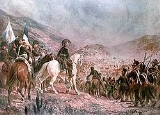
The Battle of Chacabuco, fought during the Chilean War of Independence, occurred on February 12, 1817. It was a defeat for the General Captaincy of Chile, the Spain-controlled government established after the division of the Viceroyalty of Peru. BackgroundIn 1814, having been instrumental in the establishment of a popularly elected congress in Argentina, José de San Martín began to consider the problem of driving the Spanish royalists from South America. He realised that the first step would be to drive them from Chile, and, to this end, he set about recruiting and equipping an army. In just under two years, he had an army of some 6,000 men with 1,200 horses and 22 cannons, and, on January 17, 1817, he set out with this force to cross the Andes and liberate Chile.

Discussion
Ask a question about 'Battle of Chacabuco'
Start a new discussion about 'Battle of Chacabuco'
Answer questions from other users
|
Timeline
|
|
1817 The Argentine/Chilean patriotic army defeates the Spanish in the Battle of Chacabuco
|
Encyclopedia
The Battle of Chacabuco, fought during the Chilean War of Independence, occurred on February 12, 1817. It was a defeat for the General Captaincy of Chile, the Spain-controlled government established after the division of the Viceroyalty of Peru.
BackgroundIn 1814, having been instrumental in the establishment of a popularly elected congress in Argentina, José de San Martín began to consider the problem of driving the Spanish royalists from South America. He realised that the first step would be to drive them from Chile, and, to this end, he set about recruiting and equipping an army. In just under two years, he had an army of some 6,000 men with 1,200 horses and 22 cannons, and, on January 17, 1817, he set out with this force to cross the Andes and liberate Chile. Careful planning on his part had meant that the Royalist forces in Chile were deployed to meet threats that did not exist, and his crossing went unopposed.
At the beginning of February 1817 the troops of José de San Martín finished his crossing of the Andes and prepared to put an end to Spanish dominion in Chile. The Army of the Andes (as San Martin's force was called) had suffered heavy losses during the crossing, losing as much as one-third of its men and more than half of its horses. The Royalist forces had rushed north to respond to their approach, and a force of about 1,500 under Brigadier Rafael Maroto blocked San Martin's advance at a valley called Chacabuco, near Santiago. In the face of the disintegration of the royalist forces, Maroto proposed abandoning the capital and retreating southward, where they could hold out and obtain resources for a new campaign. The military conference called by Royal Governor Field Marshal Casimiro Marcó del Pont on February 8th adopted Maroto's strategy, but the following morning the captain general changed his mind and ordered Maroto to prepare for battle in Chacabuco.
The night before the combat, Antonio Quintanilla, who would later distinguish himself extraordinarily in the defense of Chiloé, confided with another official regarding the ill-chosen strategy and that, given the position of the insurgents, the royalist forces ought to retreat a few leagues towards the hills of Colina: Maroto overheard this conversation from a nearby chamber and either couldn't or refused to hear me because of his pride and self importance, called on an attendant with his notorious hoarse voice and proclaimed a general decree on pain of death, to whomever suggested a retreat.
Although all Maroto and his troops had to do was delay San Martin, as he knew that further Royalist reinforcements were on the way from Santiago. San Martin was well aware of this as well, and opted to attack whilst he still had the advantage of numbers. The royalists fought with valor, but the battle turned into a complete defeat for them. Maroto, who succeeded in escaping thanks to the speed of his horse, was slightly injured during the retreat.
The battleSan Martin divided his army into two parts. The first, under General Bernardo O'Higgins, was to fix the attention of the Royalist force to their front, whilst the second, under General Soler, was to move around their left flank. Unfortunately, the flanking force experienced a series of delays, and, as the day wore on, O'Higgins found himself confronting the majority of the Royalist army in an exchange of fire over a deep creek. Taking decisive action (although disobeying orders), O'Higgins ordered a general advance and attacked the Royalist line. The line buckled under the attack, allowing O'Higgins' cavalry to sweep through. The defeated Royalists retreated towards a farm on the vicinity. In the meanwhile, San Martin had personally gone to find the flanking force, and with his arrival turned the Royalist retreat into a rout.
|
| |
|
|