

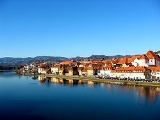
Maribor

Encyclopedia
Maribor is the second largest city
in Slovenia
with 157,947 inhabitants . Maribor is also the largest and the capital
city
of Slovenian region Lower Styria
and the seat of the Municipality of Maribor.
In 2012 Maribor will be the European Capital of Culture
and in 2013 it will host the XXVI 2013 Winter Universiade
. In November 2010, The European Youth Forum announced that Maribor will also be the 2013 European Youth Capital
.
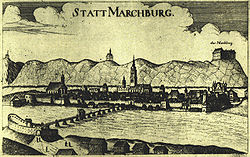 In 1164 a castle known as the Marchburch (Middle High German
for "March Castle") was documented in Styria
. It was first built on Piramida Hill, just above the city. Maribor was first mentioned as a market near the castle in 1204, and received town privileges
in 1254. It began to grow rapidly after the victory of Rudolf I
of Habsburg
over Otakar II of Bohemia
in 1278. Maribor withstood sieges by Matthias Corvinus in 1480 and 1481 and by the Ottoman Empire
in 1532 and 1683, and the city remained under the control of the Habsburg Monarchy
until 1918.
Maribor, previously in the Catholic Diocese of Graz-Seckau, became part of the Diocese of Lavant on 1 June 1859, and the seat of its Prince-Bishop
. The name of the diocese (after a river in Carinthia
) was later changed to the Diocese of Maribor on 5 March 1962. It was elevated to an archdiocese by Pope Benedict XVI
on 7 April 2006.
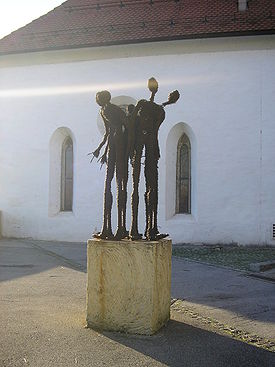 The Jews of Maribor were first mentioned in 1277 but it is suggested that there was already a Jewish quarter of the city, however, the first reliable source for Jews living in the city appears in 1317. The Jewish ghetto was located in the south-eastern part of the city and it comprised, at its peak, several main streets in the city centre as well as part of the main city square. The ghetto boasted a synagogue
, a Jewish cemetery and also a Talmud
ic school. The Talmud
ist, and Halakhist
Israel Isserlein
was the chief Rabbi of Carinthia
, Styria and Carniola
, and thus spent most of his life as a resident of the city. The Jewish community of Maribor was numerically most significant around 1410. After 1450, the circumstances changed dramatically: increasing competition that coincided with an economic crisis dealt a severe blow to economic activities that were crucial to their economic success. According to the decree issued by Emperor Maximilian I
in 1496, Jews were forced to leave. Restrictions on settlement and business for Jews remained until 1861.
In April 1941, Nazi Germany invaded Yugoslavia
and Lower Styria
was annexed to the Third Reich. The Jews of Maribor were deported to concentration camps from the late spring of 1941.
Maribor synagogue is one of the oldest preserved synagogues in Europe, and one of only two left in Slovenia.
, the city had a population that was 80% Austrian Germans
and 20% Slovenes; most of the city's capital and public life was in Austrian German hands. Thus, it was mainly known by its Austrian
name . According to the last Austro-Hungarian
census in 1910, the city of Maribor and the suburbs Studenci (Brunndorf), Pobrežje (Pobersch), Tezno (Thesen), Radvanje (Rothwein), Krčevina (Kartschowin), and Košaki (Leitersberg) consisted of 31,995 Austrian Germans (including German-speaking Jews
) and just 6,151 ethnic Slovenes. The surrounding area however was populated almost entirely by Slovenes, although many Austrian Germans lived in smaller towns like Ptuj
.
During World War I, many Slovenes in Carinthia
and Styria were detained on suspicion of being enemies of the Austrian Empire, which led to distrust between Austrian Germans and Slovenes. After the collapse of Austria-Hungary in 1918, Maribor was claimed by both the State of Slovenes, Croats and Serbs
and by German Austria
. On 1 November 1918, a meeting was held by Colonel Anton Holik in Melje's barracks, where it was decided the German speaking city should be part of German Austria. Ethnic Slovene Major Rudolf Maister
, who was present at the meeting, denounced the decision. That same day he was awarded the rank of general by the National Council for (Slovenian) Styria
and organized Slovenian military units which successfully seized control of the city. All Austrian officers and soldiers were disarmed and demobilized and to new German Austria
. The city council then held a secret meeting, where it was decided to do whatever possible to regain Maribor for German Austria. They organized a military unit, called the Green Guard (Schutzwehr), and approximately 400 well-armed soldiers of this unit opposed the pro-Slovenian and pro-Yugoslav Major Maister. Slovenian troops surprised and disarmed the GreenGuard early in the morning of 23 November. Thereafter, there was no threat to the authority of Rudolf Maister in the city.
On 27 January 1919, Austrian Germans gathered to await the United States
peace delegation at the city's marketplace were fired on by Slovenian troops, who apparently feared the crowd of thousands of ethnic German citizens. Nine citizens were killed and more than eighteen were seriously wounded; who ordered the shooting has never been conclusively established. German sources accused Maister's troops of shooting without cause; Slovene witnesses, such as Dr. Maks Pohar, claimed that the Austrian Germans attacked the Slovenian soldiers guarding the Maribor city hall. Regardless of the reason, the Austrian German victims had all been unarmed. German language media named the incident Marburg's Bloody Sunday
.
As Maribor was now firmly in the hands of the Slovenian forces and encircled completely by Slovenian territory, the city was recognized as part of the Kingdom of Serbs, Croats and Slovenes without a plebiscite in the Treaty of Saint-Germain
of September 1919 between the victors and German Austria.
After 1918, most of Maribor's Austrian Germans left the Kingdom of Slovenes, Croats and Serbs for Austria
, including the German-speaking officials who did not originate from the region. Austrian German schools, clubs, and organisations were ordered closed by the new state of Yugoslavia
, even though ethnic Germans still made up more than 25% of the city's total population as late as the 1930s. A policy of cultural assimilation
was pursued in Yugoslavia against the Austrian German minority similar to the Germanization policy followed by Austria against its Slovene minority in Carinthia
. However, in the late 1930s the policy was abandoned and the Austrian German minority's position improved significantly in an attempt to gain better diplomatic relations with Nazi Germany
.
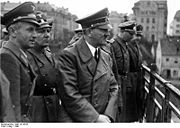 In 1941, Lower Styria
, the Yugoslav part of Styria, was annexed by Nazi Germany
. German troops marched into the town at about 9 pm on April 8, 1941.
On April 26, Adolf Hitler
, who encouraged his followers to "make this land German again", visited Maribor and a grand reception was organized by local Germans in the city castle. Immediately after the occupation, Nazi Germany began mass expulsions of Slovenes to the Independent State of Croatia
, Serbia
, and later to the concentration and work camps
in Germany. The Nazi goal was to re-Germanize the population of Lower Styria after the war. Many Slovene patriots were taken hostage and some were believed to have been later shot in the prisons of Maribor and Graz. This led to organized partisans resistance.. Maribor 'hosted' a German PoW camp from 1941 -1945 for many British, Australian and New Zealand troops who had been captured in Crete in 1941. The city, a major industrial center with extensive armaments industry, was systematically bombed by the Allies
in the closing years of World War II
. The remaining German-speaking population, except those who had actively collaborated with the resistance during the war, was summarily expelled
following the end of the war in 1945.
After the liberation, Maribor capitalized on its proximity to Austria as well as its skilled workforce, and developed into a major transit and cultural center of Northern Slovenia, enabled by Tito's
decision not to build an Iron Curtain
at the borders towards Austria and Italy and to provide passports to the citizens.
When Slovenia seceded from Yugoslavia in 1991, the loss of the Yugoslav market severely strained the city's economy which was based on heavy industry, resulting in record levels of unemployment of almost 25%. The situation improved since the mid-1990s with the development of small- and medium-sized businesses and industry, allowing Maribor to overcome the industrial crisis. Slovenia entered the European Union in 2004, introduced the Euro currency in 2007 and joined the Schengen
treaty; accordingly all border controls between Slovenia and Austria ceased on 25 December 2007.
in the Gothic style
and the Maribor Town Hall
constructed in the Renaissance
style. The Maribor castle dates from the 15th century.
Piramida Hill with chapel from 19th century dominates on the northern border limit of the city. Here you can recognize ruins of first Maribor's castle from 12th century. It also offers easy-to-reach view on Maribor and further to the south, along with Drava river.
The city hosts the University of Maribor
, established in 1975, and many other schools. It is also home to the oldest grapevine
in the world, called Stara trta, which is more than 400 years old.
Maribor is hometown of NK Maribor
, a Slovenian football team. They participated in the UEFA Champions League
in 1999/2000 season, and UEFA Europa League in 2011/12 season.
Every January, the skiing centre of Mariborsko Pohorje, situated on the outskirts of the city on the slopes of the Pohorje
mountain range, hosts women's slalom
and giant slalom
races for the Alpine Skiing World Cup
known as Zlata lisica (The Golden Fox). Every June, the two-week Festival Lent (named after the waterfront district called Lent) is held, with hundreds of musical, theatrical and other events.
Maribor was named as an Alpine city in 2000 and chosen as European Capital of Culture
2012 alongside with Guimarães
, Portugal
. Maribor will be the host city of the 2013 Winter Universiade
. In 2011 it was also announced that Maribor will be European Youth Capital
in 2013.
.
Some years ago it was also huge discusion to build the new modern business, residential and entertainment district in Maribor called "Dravska vrata" with nickname Maribor Manhattan. This megalomanic project would include many new exclusive residential apartments, offices and conference halls, green and recreational "oasis" and other objects. In project was also included 111m tall skyscraper, which would be, if build, the tallest building in Slovenia. Currently the project is on hold, because of the recent financial crisis.
In 2010 City of Maribor also organized an international architectural competition ECC Maribor 2012 - Drava 2012 for designing and reconstruction of river Drava banks, for new Art Gallery and for new footbridge. They received about 400 solutions for three competition zones. The footbridge and river embankments will be build in near future, but the Art Gallery was exchanged with cultural multicenter MAKS, which is currently under construction. MAKS Centre will be build on the site of the existing industrial building - designed by arhitectural firm Sadar+Vuga.
In 2011 also began the construction of new modern Faculty of Medicine near to river Drava. The faculty was designed by arhitect Boris Podrecca
and it is expected to be completed in 2013.
Not long ago it was also an architectural competition for renovation of Maribor City Library Rotovž with Rotovž Square and for the Main Square in Maribor. In addition, also the renovation of Maribor Island - Mariborski otok waiting for the beginning.
Main bridges (from west to east):
In Maribor are also many remains of medieval walls, including towers (Judgement Tower
, Water Tower, Maribor and Jewish Tower).
Population development
The city of Maribor has 12 districts as listed below, but the whole Municipality of Maribor also includes Kamnica, Pekre, Limbuš, Razvanje, Malečnik-Ruperče and Brestrenica-Gaj.
The river Drava divides the districts Center, Koroška Vrata, Melje and Ivan Cankar from the other districts of the city. They are all connected with 4 traffic bridges, 1 train bridge and 1 pedestrian bridge.
with:
City
A city is a relatively large and permanent settlement. Although there is no agreement on how a city is distinguished from a town within general English language meanings, many cities have a particular administrative, legal, or historical status based on local law.For example, in the U.S...
in Slovenia
Slovenia
Slovenia , officially the Republic of Slovenia , is a country in Central and Southeastern Europe touching the Alps and bordering the Mediterranean. Slovenia borders Italy to the west, Croatia to the south and east, Hungary to the northeast, and Austria to the north, and also has a small portion of...
with 157,947 inhabitants . Maribor is also the largest and the capital
Capital City
Capital City was a television show produced by Euston Films which focused on the lives of investment bankers in London living and working on the corporate trading floor for the fictional international bank Shane-Longman....
city
City
A city is a relatively large and permanent settlement. Although there is no agreement on how a city is distinguished from a town within general English language meanings, many cities have a particular administrative, legal, or historical status based on local law.For example, in the U.S...
of Slovenian region Lower Styria
Lower Styria
Lower Styria or Slovenian Styria is a traditional region in northeastern Slovenia, comprising the southern third of the former Duchy of Styria. The population of Lower Styria in its historical boundaries amounts to around 705,000 inhabitants, or 34.5% of the population of Slovenia...
and the seat of the Municipality of Maribor.
In 2012 Maribor will be the European Capital of Culture
European Capital of Culture
The European Capital of Culture is a city designated by theEuropean Union for a period of one calendar year during which it organises a series of cultural events with a strong European dimension....
and in 2013 it will host the XXVI 2013 Winter Universiade
2013 Winter Universiade
The 2013 Winter Universiade, the XXVI Winter Universiade, is a multi sport winter event which will take place in Maribor, Slovenia.-External links:**...
. In November 2010, The European Youth Forum announced that Maribor will also be the 2013 European Youth Capital
European Youth Capital
thumb| [[Antwerp]] is the European Youth Capital for 2011.thumb| [[Rotterdam]] thumb| [[Torino]] thumb| [[Braga]] thumb| [[Maribor]] thumb| [[Thessaloniki]]...
.
History
Middle High German
Middle High German , abbreviated MHG , is the term used for the period in the history of the German language between 1050 and 1350. It is preceded by Old High German and followed by Early New High German...
for "March Castle") was documented in Styria
March of Styria
The March of Styria was originally broken off the Duchy of Carinthia before 970 as a buffer zone against the Magyars. Originally it was known as the Carantanian march , after the former Slavic principality of Carantania, a predecessor of the Carinthian duchy...
. It was first built on Piramida Hill, just above the city. Maribor was first mentioned as a market near the castle in 1204, and received town privileges
Town privileges
Town privileges or city rights were important features of European towns during most of the second millennium.Judicially, a town was distinguished from the surrounding land by means of a charter from the ruling monarch that defined its privileges and laws. Common privileges were related to trading...
in 1254. It began to grow rapidly after the victory of Rudolf I
Rudolph I of Germany
Rudolph I was King of the Romans from 1273 until his death. He played a vital role in raising the Habsburg dynasty to a leading position among the Imperial feudal dynasties...
of Habsburg
Habsburg
The House of Habsburg , also found as Hapsburg, and also known as House of Austria is one of the most important royal houses of Europe and is best known for being an origin of all of the formally elected Holy Roman Emperors between 1438 and 1740, as well as rulers of the Austrian Empire and...
over Otakar II of Bohemia
Bohemia
Bohemia is a historical region in central Europe, occupying the western two-thirds of the traditional Czech Lands. It is located in the contemporary Czech Republic with its capital in Prague...
in 1278. Maribor withstood sieges by Matthias Corvinus in 1480 and 1481 and by the Ottoman Empire
Ottoman Empire
The Ottoman EmpireIt was usually referred to as the "Ottoman Empire", the "Turkish Empire", the "Ottoman Caliphate" or more commonly "Turkey" by its contemporaries...
in 1532 and 1683, and the city remained under the control of the Habsburg Monarchy
Habsburg Monarchy
The Habsburg Monarchy covered the territories ruled by the junior Austrian branch of the House of Habsburg , and then by the successor House of Habsburg-Lorraine , between 1526 and 1867/1918. The Imperial capital was Vienna, except from 1583 to 1611, when it was moved to Prague...
until 1918.
Maribor, previously in the Catholic Diocese of Graz-Seckau, became part of the Diocese of Lavant on 1 June 1859, and the seat of its Prince-Bishop
Prince-Bishop
A Prince-Bishop is a bishop who is a territorial Prince of the Church on account of one or more secular principalities, usually pre-existent titles of nobility held concurrently with their inherent clerical office...
. The name of the diocese (after a river in Carinthia
Carinthia (province)
Slovenian Carinthia or Slovene Carinthia, most commonly simply Carinthia is a traditional region in the north of Slovenia. It has no official status as an administrative unit within Slovenia, although the association with an informal province is still quite common.The region is referred to as...
) was later changed to the Diocese of Maribor on 5 March 1962. It was elevated to an archdiocese by Pope Benedict XVI
Pope Benedict XVI
Benedict XVI is the 265th and current Pope, by virtue of his office of Bishop of Rome, the Sovereign of the Vatican City State and the leader of the Catholic Church as well as the other 22 sui iuris Eastern Catholic Churches in full communion with the Holy See...
on 7 April 2006.
Jewish community
Maribor Synagogue
The Maribor Synagogue is a former synagogue and current museum in the city of Maribor, Slovenia. Located in what was the center of the medieval Maribor ghetto at 4 Židovska ulica , it is one of the oldest preserved synagogues in Europe, and one of two only left in Slovenia...
, a Jewish cemetery and also a Talmud
Talmud
The Talmud is a central text of mainstream Judaism. It takes the form of a record of rabbinic discussions pertaining to Jewish law, ethics, philosophy, customs and history....
ic school. The Talmud
Talmud
The Talmud is a central text of mainstream Judaism. It takes the form of a record of rabbinic discussions pertaining to Jewish law, ethics, philosophy, customs and history....
ist, and Halakhist
Halakha
Halakha — also transliterated Halocho , or Halacha — is the collective body of Jewish law, including biblical law and later talmudic and rabbinic law, as well as customs and traditions.Judaism classically draws no distinction in its laws between religious and ostensibly non-religious life; Jewish...
Israel Isserlein
Israel Isserlein
Rabbi Israel Isserlein ben Petachia, also Israel Isserlin, Israel of Neustadt, Israel of Marpurk was a Talmudist, and Halakhist, best known for his Terumat HaDeshen, which served as one source for HaMapah, the component of the Shulkhan Arukh by Moses Isserles.- Biography :Even though...
was the chief Rabbi of Carinthia
Duchy of Carinthia
The Duchy of Carinthia was a duchy located in southern Austria and parts of northern Slovenia. It was separated from the Duchy of Bavaria in 976, then the first newly created Imperial State beside the original German stem duchies....
, Styria and Carniola
Carniola
Carniola was a historical region that comprised parts of what is now Slovenia. As part of Austria-Hungary, the region was a crown land officially known as the Duchy of Carniola until 1918. In 1849, the region was subdivided into Upper Carniola, Lower Carniola, and Inner Carniola...
, and thus spent most of his life as a resident of the city. The Jewish community of Maribor was numerically most significant around 1410. After 1450, the circumstances changed dramatically: increasing competition that coincided with an economic crisis dealt a severe blow to economic activities that were crucial to their economic success. According to the decree issued by Emperor Maximilian I
Maximilian I, Holy Roman Emperor
Maximilian I , the son of Frederick III, Holy Roman Emperor and Eleanor of Portugal, was King of the Romans from 1486 and Holy Roman Emperor from 1493 until his death, though he was never in fact crowned by the Pope, the journey to Rome always being too risky...
in 1496, Jews were forced to leave. Restrictions on settlement and business for Jews remained until 1861.
In April 1941, Nazi Germany invaded Yugoslavia
Yugoslavia
Yugoslavia refers to three political entities that existed successively on the western part of the Balkans during most of the 20th century....
and Lower Styria
Lower Styria
Lower Styria or Slovenian Styria is a traditional region in northeastern Slovenia, comprising the southern third of the former Duchy of Styria. The population of Lower Styria in its historical boundaries amounts to around 705,000 inhabitants, or 34.5% of the population of Slovenia...
was annexed to the Third Reich. The Jews of Maribor were deported to concentration camps from the late spring of 1941.
Maribor synagogue is one of the oldest preserved synagogues in Europe, and one of only two left in Slovenia.
Early 20th century
Before the First World WarWorld War I
World War I , which was predominantly called the World War or the Great War from its occurrence until 1939, and the First World War or World War I thereafter, was a major war centred in Europe that began on 28 July 1914 and lasted until 11 November 1918...
, the city had a population that was 80% Austrian Germans
Ethnic German
Ethnic Germans historically also ), also collectively referred to as the German diaspora, refers to people who are of German ethnicity. Many are not born in Europe or in the modern-day state of Germany or hold German citizenship...
and 20% Slovenes; most of the city's capital and public life was in Austrian German hands. Thus, it was mainly known by its Austrian
German language
German is a West Germanic language, related to and classified alongside English and Dutch. With an estimated 90 – 98 million native speakers, German is one of the world's major languages and is the most widely-spoken first language in the European Union....
name . According to the last Austro-Hungarian
Austria-Hungary
Austria-Hungary , more formally known as the Kingdoms and Lands Represented in the Imperial Council and the Lands of the Holy Hungarian Crown of Saint Stephen, was a constitutional monarchic union between the crowns of the Austrian Empire and the Kingdom of Hungary in...
census in 1910, the city of Maribor and the suburbs Studenci (Brunndorf), Pobrežje (Pobersch), Tezno (Thesen), Radvanje (Rothwein), Krčevina (Kartschowin), and Košaki (Leitersberg) consisted of 31,995 Austrian Germans (including German-speaking Jews
Jews
The Jews , also known as the Jewish people, are a nation and ethnoreligious group originating in the Israelites or Hebrews of the Ancient Near East. The Jewish ethnicity, nationality, and religion are strongly interrelated, as Judaism is the traditional faith of the Jewish nation...
) and just 6,151 ethnic Slovenes. The surrounding area however was populated almost entirely by Slovenes, although many Austrian Germans lived in smaller towns like Ptuj
Ptuj
Ptuj is a city and one of 11 urban municipalities in Slovenia. Traditionally the area was part of the Lower Styria region. The municipality is now included in the Podravje statistical region...
.
During World War I, many Slovenes in Carinthia
Duchy of Carinthia
The Duchy of Carinthia was a duchy located in southern Austria and parts of northern Slovenia. It was separated from the Duchy of Bavaria in 976, then the first newly created Imperial State beside the original German stem duchies....
and Styria were detained on suspicion of being enemies of the Austrian Empire, which led to distrust between Austrian Germans and Slovenes. After the collapse of Austria-Hungary in 1918, Maribor was claimed by both the State of Slovenes, Croats and Serbs
State of Slovenes, Croats and Serbs
The State of Slovenes, Croats and Serbs was a short-lived state formed from the southernmost parts of the Austro-Hungarian monarchy after its dissolution at the end of the World War I by the resident population of Slovenes, Croats, and Serbs...
and by German Austria
German Austria
Republic of German Austria was created following World War I as the initial rump state for areas with a predominantly German-speaking population within what had been the Austro-Hungarian Empire, without the Kingdom of Hungary, which in 1918 had become the Hungarian Democratic Republic.German...
. On 1 November 1918, a meeting was held by Colonel Anton Holik in Melje's barracks, where it was decided the German speaking city should be part of German Austria. Ethnic Slovene Major Rudolf Maister
Rudolf Maister
Rudolf Maister was a Slovene military officer, poet and political activist. The soldiers who fought under Maister's command in northern Slovenia became known as "Maister's fighters"...
, who was present at the meeting, denounced the decision. That same day he was awarded the rank of general by the National Council for (Slovenian) Styria
Lower Styria
Lower Styria or Slovenian Styria is a traditional region in northeastern Slovenia, comprising the southern third of the former Duchy of Styria. The population of Lower Styria in its historical boundaries amounts to around 705,000 inhabitants, or 34.5% of the population of Slovenia...
and organized Slovenian military units which successfully seized control of the city. All Austrian officers and soldiers were disarmed and demobilized and to new German Austria
German Austria
Republic of German Austria was created following World War I as the initial rump state for areas with a predominantly German-speaking population within what had been the Austro-Hungarian Empire, without the Kingdom of Hungary, which in 1918 had become the Hungarian Democratic Republic.German...
. The city council then held a secret meeting, where it was decided to do whatever possible to regain Maribor for German Austria. They organized a military unit, called the Green Guard (Schutzwehr), and approximately 400 well-armed soldiers of this unit opposed the pro-Slovenian and pro-Yugoslav Major Maister. Slovenian troops surprised and disarmed the GreenGuard early in the morning of 23 November. Thereafter, there was no threat to the authority of Rudolf Maister in the city.
On 27 January 1919, Austrian Germans gathered to await the United States
United States
The United States of America is a federal constitutional republic comprising fifty states and a federal district...
peace delegation at the city's marketplace were fired on by Slovenian troops, who apparently feared the crowd of thousands of ethnic German citizens. Nine citizens were killed and more than eighteen were seriously wounded; who ordered the shooting has never been conclusively established. German sources accused Maister's troops of shooting without cause; Slovene witnesses, such as Dr. Maks Pohar, claimed that the Austrian Germans attacked the Slovenian soldiers guarding the Maribor city hall. Regardless of the reason, the Austrian German victims had all been unarmed. German language media named the incident Marburg's Bloody Sunday
Marburg's Bloody Sunday
Marburg's Bloody Sunday is the name of a massacre that took place on Monday, January 27, 1919 at Maribor in Slovenia...
.
As Maribor was now firmly in the hands of the Slovenian forces and encircled completely by Slovenian territory, the city was recognized as part of the Kingdom of Serbs, Croats and Slovenes without a plebiscite in the Treaty of Saint-Germain
Treaty of Saint-Germain
The Treaty of Saint-Germain-en-Laye, was signed on 10 September 1919 by the victorious Allies of World War I on the one hand and by the new Republic of Austria on the other...
of September 1919 between the victors and German Austria.
After 1918, most of Maribor's Austrian Germans left the Kingdom of Slovenes, Croats and Serbs for Austria
Austria
Austria , officially the Republic of Austria , is a landlocked country of roughly 8.4 million people in Central Europe. It is bordered by the Czech Republic and Germany to the north, Slovakia and Hungary to the east, Slovenia and Italy to the south, and Switzerland and Liechtenstein to the...
, including the German-speaking officials who did not originate from the region. Austrian German schools, clubs, and organisations were ordered closed by the new state of Yugoslavia
Yugoslavia
Yugoslavia refers to three political entities that existed successively on the western part of the Balkans during most of the 20th century....
, even though ethnic Germans still made up more than 25% of the city's total population as late as the 1930s. A policy of cultural assimilation
Cultural assimilation
Cultural assimilation is a socio-political response to demographic multi-ethnicity that supports or promotes the assimilation of ethnic minorities into the dominant culture. The term assimilation is often used with regard to immigrants and various ethnic groups who have settled in a new land. New...
was pursued in Yugoslavia against the Austrian German minority similar to the Germanization policy followed by Austria against its Slovene minority in Carinthia
Carinthia (state)
Carinthia is the southernmost Austrian state or Land. Situated within the Eastern Alps it is chiefly noted for its mountains and lakes.The main language is German. Its regional dialects belong to the Southern Austro-Bavarian group...
. However, in the late 1930s the policy was abandoned and the Austrian German minority's position improved significantly in an attempt to gain better diplomatic relations with Nazi Germany
Nazi Germany
Nazi Germany , also known as the Third Reich , but officially called German Reich from 1933 to 1943 and Greater German Reich from 26 June 1943 onward, is the name commonly used to refer to the state of Germany from 1933 to 1945, when it was a totalitarian dictatorship ruled by...
.
World War II
Lower Styria
Lower Styria or Slovenian Styria is a traditional region in northeastern Slovenia, comprising the southern third of the former Duchy of Styria. The population of Lower Styria in its historical boundaries amounts to around 705,000 inhabitants, or 34.5% of the population of Slovenia...
, the Yugoslav part of Styria, was annexed by Nazi Germany
Nazi Germany
Nazi Germany , also known as the Third Reich , but officially called German Reich from 1933 to 1943 and Greater German Reich from 26 June 1943 onward, is the name commonly used to refer to the state of Germany from 1933 to 1945, when it was a totalitarian dictatorship ruled by...
. German troops marched into the town at about 9 pm on April 8, 1941.
On April 26, Adolf Hitler
Adolf Hitler
Adolf Hitler was an Austrian-born German politician and the leader of the National Socialist German Workers Party , commonly referred to as the Nazi Party). He was Chancellor of Germany from 1933 to 1945, and head of state from 1934 to 1945...
, who encouraged his followers to "make this land German again", visited Maribor and a grand reception was organized by local Germans in the city castle. Immediately after the occupation, Nazi Germany began mass expulsions of Slovenes to the Independent State of Croatia
Independent State of Croatia
The Independent State of Croatia was a World War II puppet state of Nazi Germany, established on a part of Axis-occupied Yugoslavia. The NDH was founded on 10 April 1941, after the invasion of Yugoslavia by the Axis powers. All of Bosnia and Herzegovina was annexed to NDH, together with some parts...
, Serbia
Serbia
Serbia , officially the Republic of Serbia , is a landlocked country located at the crossroads of Central and Southeast Europe, covering the southern part of the Carpathian basin and the central part of the Balkans...
, and later to the concentration and work camps
Nazi concentration camps
Nazi Germany maintained concentration camps throughout the territories it controlled. The first Nazi concentration camps set up in Germany were greatly expanded after the Reichstag fire of 1933, and were intended to hold political prisoners and opponents of the regime...
in Germany. The Nazi goal was to re-Germanize the population of Lower Styria after the war. Many Slovene patriots were taken hostage and some were believed to have been later shot in the prisons of Maribor and Graz. This led to organized partisans resistance.. Maribor 'hosted' a German PoW camp from 1941 -1945 for many British, Australian and New Zealand troops who had been captured in Crete in 1941. The city, a major industrial center with extensive armaments industry, was systematically bombed by the Allies
Allies of World War II
The Allies of World War II were the countries that opposed the Axis powers during the Second World War . Former Axis states contributing to the Allied victory are not considered Allied states...
in the closing years of World War II
World War II
World War II, or the Second World War , was a global conflict lasting from 1939 to 1945, involving most of the world's nations—including all of the great powers—eventually forming two opposing military alliances: the Allies and the Axis...
. The remaining German-speaking population, except those who had actively collaborated with the resistance during the war, was summarily expelled
Expulsion of Germans after World War II
The later stages of World War II, and the period after the end of that war, saw the forced migration of millions of German nationals and ethnic Germans from various European states and territories, mostly into the areas which would become post-war Germany and post-war Austria...
following the end of the war in 1945.
After the liberation, Maribor capitalized on its proximity to Austria as well as its skilled workforce, and developed into a major transit and cultural center of Northern Slovenia, enabled by Tito's
Josip Broz Tito
Marshal Josip Broz Tito – 4 May 1980) was a Yugoslav revolutionary and statesman. While his presidency has been criticized as authoritarian, Tito was a popular public figure both in Yugoslavia and abroad, viewed as a unifying symbol for the nations of the Yugoslav federation...
decision not to build an Iron Curtain
Iron Curtain
The concept of the Iron Curtain symbolized the ideological fighting and physical boundary dividing Europe into two separate areas from the end of World War II in 1945 until the end of the Cold War in 1989...
at the borders towards Austria and Italy and to provide passports to the citizens.
When Slovenia seceded from Yugoslavia in 1991, the loss of the Yugoslav market severely strained the city's economy which was based on heavy industry, resulting in record levels of unemployment of almost 25%. The situation improved since the mid-1990s with the development of small- and medium-sized businesses and industry, allowing Maribor to overcome the industrial crisis. Slovenia entered the European Union in 2004, introduced the Euro currency in 2007 and joined the Schengen
Schengen
Schengen may refer to:* Schengen Agreement, a European treaty that provided for the removal of border controls between participating countries* Schengen Area, the group of European countries that have abolished border controls between each other...
treaty; accordingly all border controls between Slovenia and Austria ceased on 25 December 2007.
Contemporary
Popular tourist sites in Maribor include the 12th century Maribor CathedralMaribor Cathedral
Maribor Cathedral is a cathedral in the city of Maribor, Slovenia.The Gothic building dates to the 12th century, and is dedicated to John the Baptist. It is the seat of the Roman Catholic Archdiocese of Maribor....
in the Gothic style
Gothic architecture
Gothic architecture is a style of architecture that flourished during the high and late medieval period. It evolved from Romanesque architecture and was succeeded by Renaissance architecture....
and the Maribor Town Hall
Maribor Town Hall
Maribor Town Hall is the town hall of Maribor, Slovenia. It is situated on the town's Main Square .Built in 1515, it was remodeled in Renaissance style between 1563 and 1565...
constructed in the Renaissance
Renaissance architecture
Renaissance architecture is the architecture of the period between the early 15th and early 17th centuries in different regions of Europe, demonstrating a conscious revival and development of certain elements of ancient Greek and Roman thought and material culture. Stylistically, Renaissance...
style. The Maribor castle dates from the 15th century.
Piramida Hill with chapel from 19th century dominates on the northern border limit of the city. Here you can recognize ruins of first Maribor's castle from 12th century. It also offers easy-to-reach view on Maribor and further to the south, along with Drava river.
The city hosts the University of Maribor
University of Maribor
The University of Maribor is the second university in Slovenia, established in 1975. It currently has 17 faculties.-History:The university's roots reach back to 1859, when a theological seminary was established with the encouragement of Maribor bishop and patriot Anton Martin Slomšek...
, established in 1975, and many other schools. It is also home to the oldest grapevine
Vitis
Vitis is a genus of about 60 species of vining plants in the flowering plant family Vitaceae. The genus is made up of species predominantly from the Northern hemisphere. It is economically important as the source of grapes, both for direct consumption of the fruit and for fermentation to produce...
in the world, called Stara trta, which is more than 400 years old.
Maribor is hometown of NK Maribor
NK Maribor
Nogometni Klub Maribor , commonly referred to as NK Maribor or simply Maribor, is a professional association football club based in the city of Maribor, Slovenia. Founded on 12 December, 1960, Maribor is one of only three football clubs in the country who have never been relegated from...
, a Slovenian football team. They participated in the UEFA Champions League
UEFA Champions League
The UEFA Champions League, known simply the Champions League and originally known as the European Champion Clubs' Cup or European Cup, is an annual international club football competition organised by the Union of European Football Associations since 1955 for the top football clubs in Europe. It...
in 1999/2000 season, and UEFA Europa League in 2011/12 season.
Every January, the skiing centre of Mariborsko Pohorje, situated on the outskirts of the city on the slopes of the Pohorje
Pohorje
Pohorje is a mountain range in northern Slovenia, near the towns of Dravograd and Maribor. Made of metamorphic rock, it is geologically part of the Central Eastern Alps, though due to its location south of the Drava River it is commonly regarded as a Southern Limestone Alps range.-Peaks:The most...
mountain range, hosts women's slalom
Slalom skiing
Slalom is an alpine skiing discipline, involving skiing between poles spaced much closer together than in Giant Slalom, Super-G or Downhill, thereby causing quicker and shorter turns.- Origins :...
and giant slalom
Giant Slalom skiing
Giant slalom is an alpine skiing discipline. It involves skiing between sets of poles spaced at a greater distance to each other than in slalom but less than in super G....
races for the Alpine Skiing World Cup
Alpine skiing World Cup
The FIS Alpine Ski World Cup is the top international circuit of alpine skiing competitions, launched in 1966 by a group of ski racing friends and experts which included French journalist Serge Lang and the alpine ski team directors from France and the USA...
known as Zlata lisica (The Golden Fox). Every June, the two-week Festival Lent (named after the waterfront district called Lent) is held, with hundreds of musical, theatrical and other events.
Maribor was named as an Alpine city in 2000 and chosen as European Capital of Culture
European Capital of Culture
The European Capital of Culture is a city designated by theEuropean Union for a period of one calendar year during which it organises a series of cultural events with a strong European dimension....
2012 alongside with Guimarães
Guimarães
Guimarães Municipality is located in northwestern Portugal in the province of Minho and in the Braga District. It contains the city of Guimarães.The present Mayor is António Magalhães Silva, elected by the Socialist Party.-Parishes:-Economy:...
, Portugal
Portugal
Portugal , officially the Portuguese Republic is a country situated in southwestern Europe on the Iberian Peninsula. Portugal is the westernmost country of Europe, and is bordered by the Atlantic Ocean to the West and South and by Spain to the North and East. The Atlantic archipelagos of the...
. Maribor will be the host city of the 2013 Winter Universiade
2013 Winter Universiade
The 2013 Winter Universiade, the XXVI Winter Universiade, is a multi sport winter event which will take place in Maribor, Slovenia.-External links:**...
. In 2011 it was also announced that Maribor will be European Youth Capital
European Youth Capital
thumb| [[Antwerp]] is the European Youth Capital for 2011.thumb| [[Rotterdam]] thumb| [[Torino]] thumb| [[Braga]] thumb| [[Maribor]] thumb| [[Thessaloniki]]...
in 2013.
Architecture
In 2008 was completed the new footbridge called "Studenška brv". It was designed by Slovenian well known structural engineering company Ponting. This bridge also received in 2008 the prestige Footbridge Award, awarded on 3rd International Conference Footbridge in PortoPorto
Porto , also known as Oporto in English, is the second largest city in Portugal and one of the major urban areas in the Iberian Peninsula. Its administrative limits include a population of 237,559 inhabitants distributed within 15 civil parishes...
.
Some years ago it was also huge discusion to build the new modern business, residential and entertainment district in Maribor called "Dravska vrata" with nickname Maribor Manhattan. This megalomanic project would include many new exclusive residential apartments, offices and conference halls, green and recreational "oasis" and other objects. In project was also included 111m tall skyscraper, which would be, if build, the tallest building in Slovenia. Currently the project is on hold, because of the recent financial crisis.
In 2010 City of Maribor also organized an international architectural competition ECC Maribor 2012 - Drava 2012 for designing and reconstruction of river Drava banks, for new Art Gallery and for new footbridge. They received about 400 solutions for three competition zones. The footbridge and river embankments will be build in near future, but the Art Gallery was exchanged with cultural multicenter MAKS, which is currently under construction. MAKS Centre will be build on the site of the existing industrial building - designed by arhitectural firm Sadar+Vuga.
In 2011 also began the construction of new modern Faculty of Medicine near to river Drava. The faculty was designed by arhitect Boris Podrecca
Boris Podrecca
Boris Podrecca is a Slovene-Italian architect and urban designer living in Vienna, Austria. Podrecca is considered by some critics a pioneer of postmodernism...
and it is expected to be completed in 2013.
Not long ago it was also an architectural competition for renovation of Maribor City Library Rotovž with Rotovž Square and for the Main Square in Maribor. In addition, also the renovation of Maribor Island - Mariborski otok waiting for the beginning.
Main bridges (from west to east):
- Corinthian Bridge (Koroški most)
- Footbridge Studenci (Studenška brv)
- Old Bridge (Stari most, MariborStari most, MariborStari most is a bridge crossing the river Drava in Maribor, Slovenia. It was built in 1913, and it is the oldest bridge in Maribor....
) - Tito's bridge (Titov most)
- Rail bridge (Železniški most)
- Double-storey bridge (Dvoetažni most)
In Maribor are also many remains of medieval walls, including towers (Judgement Tower
Judgement Tower
The Judgement Tower is a fortified medieval tower in the city of Maribor, Slovenia. An original tower built on the site in the early 14th century secured the southwestern corner of the city walls...
, Water Tower, Maribor and Jewish Tower).
Tourist attractions
Maribor has many touristic places and attractions, such as many interesting events:- Lent FestivalLent Festivalthumb|Lent FestivalThe Lent International Summer Festival is a major arts festival held for approximately two weeks at the end of June annually in Maribor, Slovenia. Organized by the Narodni dom Cultural Center every year the festival attracts theatre, opera, ballet performers, classical, modern,...
- major festival event held for approximately two weeks at the end of June. Every year the festival attracts theatre, opera, ballet performers, classical, modern, and jazz musicians and dancers from all over the world as well as visitors. There are also mimes, magicians, and acrobats performing during the festival. - House of the oldest grapevine in the world (Hiša stare trte) - in Maribor is also the world's oldest living grapevine, which was in 2004 signed in book of Guinness World RecordsGuinness World RecordsGuinness World Records, known until 2000 as The Guinness Book of Records , is a reference book published annually, containing a collection of world records, both human achievements and the extremes of the natural world...
. The grapevine is about 440 years old. - Women's slalomSlalomTo slalom is to zigzag between obstacles. It can refer to:Sports:*Alpine Slalom skiing*Whitewater slalom/kayaking*Freestyle slalom skating*Slalom skateboarding*Slalom water skiing*Slalom ice skating*Slalom windsurfing...
and giant slalom races for the Alpine Skiing World CupAlpine skiing World CupThe FIS Alpine Ski World Cup is the top international circuit of alpine skiing competitions, launched in 1966 by a group of ski racing friends and experts which included French journalist Serge Lang and the alpine ski team directors from France and the USA...
known as "Zlata lisica" (The Golden Fox). This event is hold on mountain range PohorjePohorjePohorje is a mountain range in northern Slovenia, near the towns of Dravograd and Maribor. Made of metamorphic rock, it is geologically part of the Central Eastern Alps, though due to its location south of the Drava River it is commonly regarded as a Southern Limestone Alps range.-Peaks:The most...
which is also the most visited place - both recreational and touristic in winter and also summer. - Maribor Island (Mariborski otok) - the oldest public baths, but still important and well visited place in Maribor. The city also offers many indoor swimming pools (Pristan, Fontana).
- Maribor CastleMaribor CastleMaribor Castle is a castle or rather a mansion in the town of Maribor in Slovenia.It contains a museum....
, Maribor Town HallMaribor Town HallMaribor Town Hall is the town hall of Maribor, Slovenia. It is situated on the town's Main Square .Built in 1515, it was remodeled in Renaissance style between 1563 and 1565...
Rotovž, Betnava CastleBetnava CastleBetnava Mansion is a manorhouse located near the city of Maribor in northern Slovenia.A structure on the site is first mentioned in 1319, under the name Wintenaw...
, Plague Memorial, MariborPlague Memorial, MariborThe Plague Memorial is a monument in Main Square of the city of Maribor, Slovenia, erected by "pious burghers" in gratitude for the end of a 1680 plague epidemic that had claimed a third of the city's population....
, ruins of old castle Upper MariborPyramid, MariborThe Pyramid is a low hill in the city of Maribor, Slovenia. It is a popular excursion spot, affording a good view of the city. An ascent takes 15-30 minutes.-History:...
on Piramida Hill. - Medieval Maribor's defence walls with defence towers all along the old-city limits.
- Wine and culinary specialities - international and Slovene cousine (mushroom soup with buckwheat mush, tripe, sour soup, sausages with sauerkraut, cheese dumplings, apple strudel, special cheese cake called gibanicaGibanicaGibanica , pron. gheebanitsa, is a traditional Balkan pastry dish, usually made with white cheese, now popular throughout the Balkans.Gibanica is a traditional dish in parts of Balkan region...
). Also many popular restaurant with Serbian cuisineSerbian cuisineSerbian cuisine is a heterogeneous cuisine, sharing characteristics of the Balkans , the Mediterranean , Turkish, and Central European cuisines....
. - Vinag Wine Cellar (Vinagova vinska klet) - with 20.000 m2 surface and 2 km (1 mi) length has 5,5 millions litres of excellent wine.
- Maribor City Park (with City Aquarium and Terrarium, wide promenade, which lead to the Three Ponds (Trije ribniki), in park is over 100 local and foreign species of deciduous and coniferous trees).
- Adrenaline park Pohorje (Adrenalinski park Pohorje) with High Ropes Course, one track line PohorJET, summer sledding and Bike park Pohorje.
- Maribor SynagogueMaribor SynagogueThe Maribor Synagogue is a former synagogue and current museum in the city of Maribor, Slovenia. Located in what was the center of the medieval Maribor ghetto at 4 Židovska ulica , it is one of the oldest preserved synagogues in Europe, and one of two only left in Slovenia...
(Sinagoga Maribor) - built in 14th century, it is the second oldest in Europe. Today, it serves as a centre for cultural activities and it offers visitors various events including exhibitions, concerts, literary evenings and round tables. The Synagogue is located in the square Jewish square (Židovski trg) in the former Jewish quarter. - Kalvarija and Piramida (well visited city hills Pyramid, Maribor) surrounded by vineyards, and ruins of old castle Upper MariborPyramid, MariborThe Pyramid is a low hill in the city of Maribor, Slovenia. It is a popular excursion spot, affording a good view of the city. An ascent takes 15-30 minutes.-History:...
. - Birthplace of Austrian admiral Wilhelm von TegetthoffWilhelm von TegetthoffWilhelm von Tegetthoff was an Austrian admiral. Considered one of the prominent naval commanders of the 19th century, Tegetthoff was known for his innovative tactics as well as his inspirational leadership....
in "Slovenska ulica" (at today's "Admiral" caffe) - Maribor, jointly with GuimarãesGuimarãesGuimarães Municipality is located in northwestern Portugal in the province of Minho and in the Braga District. It contains the city of Guimarães.The present Mayor is António Magalhães Silva, elected by the Socialist Party.-Parishes:-Economy:...
, is going to be European Capital of CultureEuropean Capital of CultureThe European Capital of Culture is a city designated by theEuropean Union for a period of one calendar year during which it organises a series of cultural events with a strong European dimension....
in 2012. - 2013 Winter Universiade2013 Winter UniversiadeThe 2013 Winter Universiade, the XXVI Winter Universiade, is a multi sport winter event which will take place in Maribor, Slovenia.-External links:**...
. - 2013 European Youth CapitalEuropean Youth Capitalthumb| [[Antwerp]] is the European Youth Capital for 2011.thumb| [[Rotterdam]] thumb| [[Torino]] thumb| [[Braga]] thumb| [[Maribor]] thumb| [[Thessaloniki]]...
.
Demography
Population development
| 1991 | 1996 | 2002 | 2004 |
|---|---|---|---|
| 119,828 | 116,147 | 110,668 | 112,558 |
City districts
The city districtsThe city of Maribor has 12 districts as listed below, but the whole Municipality of Maribor also includes Kamnica, Pekre, Limbuš, Razvanje, Malečnik-Ruperče and Brestrenica-Gaj.
The river Drava divides the districts Center, Koroška Vrata, Melje and Ivan Cankar from the other districts of the city. They are all connected with 4 traffic bridges, 1 train bridge and 1 pedestrian bridge.
| No. | District |
|---|---|
| 1. | Center Center, Maribor Center is the central district of the city of Maribor in Slovenia. It comprises the inner city area including the Main Square and commercial streets and Maribor Town Hall.... |
| 2. | Koroška vrata |
| 3. | Melje |
| 4. | Ivan Cankar Ivan Cankar, Maribor Ivan Cankar is a suburb of the city of Maribor in Slovenia. It is named after Ivan Cankar one of Slovenia's great heroes.... |
| 5. | Magdalena |
| 6. | Tabor Tabor, Maribor Tabor is a suburb of the city of Maribor in Slovenia.-References:... |
| 7. | Studenci Studenci, Maribor Studenci is a suburb of the city of Maribor in Slovenia. Notable landmarks include the Maribor Bridge which crosses the Drava river .... |
| 8. | Pobrežje |
| 9. | Nova Vas Nova Vas Nova Vas may refer to*Nova Vas, Brtonigla, village in the Brtonigla municipality in Croatia*Nova Vas, Kršan, village in the Kršan municipality in Croatia*Nova Vas, Poreč, settlement within the town of Poreč in Croatia... |
| 10. | Tezno Tezno Tezno is a suburb of the city of Maribor in Slovenia.During World War II, an anti-tank trench was dug in Tezno, around one kilometer in length and 3 to 4 meters wide. At the end of the war in 1945, in the events now collectively referred to as the Bleiburg massacre, the Yugoslav Partisans buried... |
| 11. | Brezje - Dogoše Dogoše Dogoše is a village on the right bank of the river Drava in north-eastern Slovenia in the urban municipality of Maribor.-External links:*... - Zrkovci Zrkovci Zrkovci is a settlement on the right bank of the river Drava to the east of Maribor in northeastern Slovenia. It belongs to the Maribor urban municipality.-External links:*... |
| 12. | Radvanje Radvanje Radvanje is a suburb of the city of Maribor in Slovenia.... |
Famous natives and residents
List of notable individuals who were born or lived in Maribor:- Bernhard von SpanheimBernhard von SpanheimBernhard von Spanheim was Duke of Carinthia for 54 years from 1202 until his death.-Family:...
, duke of Carinthia, founder of the city - Leon ŠtukeljLeon ŠtukeljLeon Štukelj was a Yugoslav gymnast of Slovene nationality, Olympic gold medalist and athlete.Štukelj was born in Novo Mesto, Austria-Hungary . He is a noted figure in Slovenian sporting history...
, Olympic champion - Zlatko ZahovičZlatko ZahovicZlatko Zahovič is a retired Slovenian footballer who played as an attacking midfielder.After making a name for himself in Europe in Portugal, most notably with Porto and Benfica, he went on to have unassuming spells in Spain and Greece...
, football player - Tomaž BaradaTomaž BaradaTomaž Barada is a former Slovenian martial artist in kickboxing and taekwon-do. He gained several titles during his career.He became 6x ITF European Champion, 3x ITF World Champion and 3x King of Taekwon-Do Tokyo....
, taekwondoist - Sani BečirovičSani BecirovicSani Bečirović is a Slovenian 1.96 m professional basketball player currently plays for the Benetton Treviso, that plays at both point guard and shooting guard positions...
, basketball player - Danilo TürkDanilo Türk- Early life :Türk was born in a lower middle class family in Maribor, Slovenia . His father died when he was a child. He attended the prestigious II. Gymnasium High school in Maribor. In 1971 he enrolled to the University of Ljubljana where he studied law...
, president of Slovenia - Saša Vujačić, NBA basketball player
- Fredi Bobic, German-Slovene football player
- Andrej Brvar, poet
- Aleš ČehAleš CehAleš Čeh is a retired Slovenian footballer who has represented his country at the two major tournaments for which they have qualified .-Club career:...
, football player - Lev Detela, writer, poet, and translator
- Mladen DolarMladen DolarMladen Dolar is a Slovenian philosopher, cultural theorist, film critic and expert in psychoanalysis.Dolar was born in Maribor as the son of the literary critic Jaro Dolar. In 1978 he graduated in Philosophy and French language at the University of Ljubljana, where he graduated under the...
, philosopher - Vekoslav Grmič, Roman Catholic bishop and theologian
- Herta HaasHerta HaasHerta Haas was a Yugoslav Partisan during World War II and the second wife of Josip Broz Tito, leader of the Partisans and a future President of Yugoslavia....
, second wife of Joseph Broz Tito - Polona HercogPolona HercogPolona Hercog is a Slovenian tennis player. Her highest ranking is No. 35 in singles and No. 56 in doubles. Hercog has won two WTA Tour doubles title and one singles title. She also enjoyed success on the ITF Circuit, winning nine singles and five doubles titles...
, tennis player - Israel Isserlin, Medieval rabbi
- Archduke Johann of AustriaArchduke Johann of AustriaArchduke John of Austria was a member of the Habsburg dynasty, an Austrian field marshal and German Imperial regent .-Biography:...
, Habsburg nobleman and philanthropist - Drago JančarDrago JancarDrago Jančar is a Slovenian writer, playwright and essayist. Jančar is one of the most known contemporary Slovene writers. In Slovenia, he is also famous for his political commentaries and civic engagement.-Life:...
, author - Janko KastelicJanko KastelicJanko Kastelic is a conductor from Canada who is currently the music director for the Opera House of Maribor, Slovenia.- Biography :...
, conductor and music director - Matjaž KekMatjaž KekMatjaž Kek is a former Slovenian footballer and former manager of the Slovenia national team.-Club career:Kek started his professional football career at his home club Maribor in 1979, before moving to the Austrian club Spittal/Drau in 1985, where he spent 3 seasons...
, football player and coach - Ottokar Kernstock, Austrian poet
- Aleksander KnavsAleksander KnavsAleksander Knavs is a former Slovenian football defender.-Club career:He was born in Maribor and started his professional career playing at the club Olimpija Ljubljana from the Slovenian capital city of Ljubljana in 1993...
, football player - Edvard KocbekEdvard KocbekEdvard Kocbek was a Slovenian poet, writer, essayist, translator, political activist, and resistance fighter. He is considered as one of the best authors who have written in Slovene, and one of the best Slovene poets after Prešeren...
, poet, essayist, and politician - Katja KorenKatja KorenKatja Koren Miklavec is a former Slovenian alpine skier.Born in Maribor, she won a bronze medal in the 1994 Winter Olympics in Lillehammer. She retired from skiing in 1998, due to a spinal injury....
, alpine skier - Anton KorošecAnton KorošecAnton Korošec was a Slovenian political leader, a prominent member of the conservative People's Party, a priest and a noted orator....
, politician - Bratko KreftBratko KreftBratko Kreft was an Slovenian playwright, writer, literary and theater historian and director.- Biography :...
, author - Rene KrhinRene KrhinRene Krhin is a Slovenian footballer who plays for Serie A club Bologna.-Club career:Signing for Internazionale alongside fellow rising star Vid Belec from hometown club NK Maribor at age of 16 as an European Union player, he started to play for Internazionale at Allievi Nazionali team.In July...
, football player - Marko Letonja, conductor
- Rudolf MaisterRudolf MaisterRudolf Maister was a Slovene military officer, poet and political activist. The soldiers who fought under Maister's command in northern Slovenia became known as "Maister's fighters"...
, military leader - Janez MenartJanez MenartJanez Menart has been one of the most influential and most widely sold Slovenian poets, translators and screenwriters from the first post-war generation...
, poet and translator - Guiseppe Morpurgo, Founder of Generali
- Mima JaušovecMima JaušovecMima Jaušovec is a Slovenian female former tennis player. She was born on July 20, 1956, in Maribor, PR Slovenia, FPR Yugoslavia). In singles she reached a career high of No. 6 in 1982, in doubles she reached a career high of No. 211 in 1986....
, female former tennis player - Tomaž Pandur, stage director
- Tone PartljičTone PartljičTone Partljič is a Slovene writer, playwright and politician. Betwen 1990 and 2004 he was a member of the Slovenian National Assembly, form 1994 as a member of the LDS party. He was also president of the Slovene Writers' Association between 1983 and 1987.Partljič was born in Maribor and grew up in...
, playwright, screenwriter, politician - Žarko PetanŽarko Petanthumb|Žarko PetanŽarko Petan is a Slovenian writer, essayist, screenwriter, and theatre and film director. He is most famous as writer of aphorisms....
, writer, essayist, theatre and film director - Janko PleterskiJanko PleterskiJanko Pleterski is a Slovenian historian, politician and diplomat.He was born in Maribor, Slovenia, then part of the Kingdom of Serbs, Croats and Slovenes. He attended high school in Ljubljana. In August 1941, he was arrested by the Fascist authorities of the Italian-occupied Province of Ljubljana...
, historian - Tomaž Gnyra, carpenter
- Miran Potrč, politician
- Zoran PredinZoran PredinZoran Predin is a Slovenian singer-songwriter from Maribor. In the 1980s, he was the front man of the folk-rock band Lačni Franz. He also writes music for film, television and theatre....
, singer - Ladislaus von RabcewiczLadislaus von RabcewiczLadislaus von Rabcewicz was an Austrian engineer, university professor and one of the main contributors to the New Austrian Tunneling method....
, Austrian civil engineer - Stanko Majcen, playwright
- Zorko Simčič, writer and essayist
- Anton Martin SlomšekAnton Martin SlomšekAnton Martin Slomšek was a Slovene bishop, author, poet, and advocate of Slovene culture.Slomšek was born to a peasant family in the hamlet of Slom near the village of Ponikva in the Municipality of Šentjur, Lower Styria. He studied theology and philosophy before being ordained in 1824 at the...
, Roman Catholic bishop, author, poet, and advocate of Slovene culture. - Wilhelm von TegetthoffWilhelm von TegetthoffWilhelm von Tegetthoff was an Austrian admiral. Considered one of the prominent naval commanders of the 19th century, Tegetthoff was known for his innovative tactics as well as his inspirational leadership....
, Austrian admiral - Anton Trstenjak, theologian, psychologist, essayist
- Prežihov VorancPrežihov VorancPrežihov Voranc was the pen name of Lovro Kuhar, a Slovene writer and Communist political activist. Voranc's literary reputation was established during the 1930s with a series of Slovene novels and short stories in the social realist style, notable for their depictions of poverty in rural and...
, writer and political activist - Krištof Wildenrainer, mayor, who defended Maribor from Osmans in 1532
- Karmina Šilec, conductor
- Jan MuršakJan MursakJan Muršak is a professional Slovenian ice hockey forward currently playing for the Detroit Red Wings of the National Hockey League . Muršak first played hockey in Slovenia as a member of HDK Maribor before he left to spend one season in the Czech junior league...
, second ever Slovenian NHL hockey player - Luka Krajnc, football player
- Maja KeucMaja KeucMaja Keuc , is a singer who represented Slovenia at the Eurovision Song Contest 2011 with the song "No One"....
, singer
Twin towns — sister cities
Maribor is twinnedTown twinning
Twin towns and sister cities are two of many terms used to describe the cooperative agreements between towns, cities, and even counties in geographically and politically distinct areas to promote cultural and commercial ties.- Terminology :...
with:
| Graz Graz The more recent population figures do not give the whole picture as only people with principal residence status are counted and people with secondary residence status are not. Most of the people with secondary residence status in Graz are students... , Austria Austria Austria , officially the Republic of Austria , is a landlocked country of roughly 8.4 million people in Central Europe. It is bordered by the Czech Republic and Germany to the north, Slovakia and Hungary to the east, Slovenia and Italy to the south, and Switzerland and Liechtenstein to the... Greenwich London Borough of Greenwich The London Borough of Greenwich is an Inner London borough in south-east London, England. Taking its name from the historic town of Greenwich, the present borough was formed in 1965 by the amalgamation of the former area of the Metropolitan Borough of Greenwich with part of the Metropolitan... , England England England is a country that is part of the United Kingdom. It shares land borders with Scotland to the north and Wales to the west; the Irish Sea is to the north west, the Celtic Sea to the south west, with the North Sea to the east and the English Channel to the south separating it from continental... , United Kingdom United Kingdom The United Kingdom of Great Britain and Northern IrelandIn the United Kingdom and Dependencies, other languages have been officially recognised as legitimate autochthonous languages under the European Charter for Regional or Minority Languages... Kraljevo Kraljevo Kraljevo is a city and municipality in central Serbia, built beside the river Ibar, 7 km west of its confluence with the Western Morava. It is located in the midst of an upland valley, between the mountains of Kotlenik in the north, and Stolovi in the south.In 2011 the city has population of... , Serbia Serbia Serbia , officially the Republic of Serbia , is a landlocked country located at the crossroads of Central and Southeast Europe, covering the southern part of the Carpathian basin and the central part of the Balkans... Marburg Marburg Marburg is a city in the state of Hesse, Germany, on the River Lahn. It is the main town of the Marburg-Biedenkopf district and its population, as of March 2010, was 79,911.- Founding and early history :... , Germany Germany Germany , officially the Federal Republic of Germany , is a federal parliamentary republic in Europe. The country consists of 16 states while the capital and largest city is Berlin. Germany covers an area of 357,021 km2 and has a largely temperate seasonal climate... |
Osijek Osijek Osijek is the fourth largest city in Croatia with a population of 83,496 in 2011. It is the largest city and the economic and cultural centre of the eastern Croatian region of Slavonia, as well as the administrative centre of Osijek-Baranja county... , Croatia Croatia Croatia , officially the Republic of Croatia , is a unitary democratic parliamentary republic in Europe at the crossroads of the Mitteleuropa, the Balkans, and the Mediterranean. Its capital and largest city is Zagreb. The country is divided into 20 counties and the city of Zagreb. Croatia covers ... Pétange Pétange Pétange is a commune and town in south-western Luxembourg. It is part of the canton of Esch-sur-Alzette, which is part of the district of Luxembourg. Pétange lies on the borders with both Belgium and France.... , Luxembourg Luxembourg Luxembourg , officially the Grand Duchy of Luxembourg , is a landlocked country in western Europe, bordered by Belgium, France, and Germany. It has two principal regions: the Oesling in the North as part of the Ardennes massif, and the Gutland in the south... Pueblo Pueblo, Colorado Pueblo is a Home Rule Municipality that is the county seat and the most populous city of Pueblo County, Colorado, United States. The population was 106,595 in 2010 census, making it the 246th most populous city in the United States.... , Colorado Colorado Colorado is a U.S. state that encompasses much of the Rocky Mountains as well as the northeastern portion of the Colorado Plateau and the western edge of the Great Plains... , United States United States The United States of America is a federal constitutional republic comprising fifty states and a federal district... Saint Petersburg Saint Petersburg Saint Petersburg is a city and a federal subject of Russia located on the Neva River at the head of the Gulf of Finland on the Baltic Sea... , Russia Russia Russia or , officially known as both Russia and the Russian Federation , is a country in northern Eurasia. It is a federal semi-presidential republic, comprising 83 federal subjects... |
Szombathely Szombathely Szombathely is the 10th largest city in Hungary. It is the administrative centre of Vas county in the west of the country, located near the border with Austria... , Hungary Hungary Hungary , officially the Republic of Hungary , is a landlocked country in Central Europe. It is situated in the Carpathian Basin and is bordered by Slovakia to the north, Ukraine and Romania to the east, Serbia and Croatia to the south, Slovenia to the southwest and Austria to the west. The... Tours Tours Tours is a city in central France, the capital of the Indre-et-Loire department.It is located on the lower reaches of the river Loire, between Orléans and the Atlantic coast. Touraine, the region around Tours, is known for its wines, the alleged perfection of its local spoken French, and for the... , France France The French Republic , The French Republic , The French Republic , (commonly known as France , is a unitary semi-presidential republic in Western Europe with several overseas territories and islands located on other continents and in the Indian, Pacific, and Atlantic oceans. Metropolitan France... Udine Udine Udine is a city and comune in northeastern Italy, in the middle of Friuli-Venezia Giulia region, between the Adriatic sea and the Alps , less than 40 km from the Slovenian border. Its population was 99,439 in 2009, and that of its urban area was 175,000.- History :Udine is the historical... , Italy Italy Italy , officially the Italian Republic languages]] under the European Charter for Regional or Minority Languages. In each of these, Italy's official name is as follows:;;;;;;;;), is a unitary parliamentary republic in South-Central Europe. To the north it borders France, Switzerland, Austria and... |