

Magnetism

Encyclopedia
Magnetism is a property of materials that respond at an atomic or subatomic level to an applied magnetic field
. Ferromagnetism
is the strongest and most familiar type of magnetism. It is responsible for the behavior of permanent magnets
, which produce their own persistent magnetic fields, as well as the materials that are attracted to them. However, all materials are influenced to a greater or lesser degree by the presence of a magnetic field. Some are attracted to a magnetic field (paramagnetism
); others are repulsed by a magnetic field (diamagnetism
); others have a much more complex relationship with an applied magnetic field (spin glass
behavior and antiferromagnetism
). Substances that are negligibly affected by magnetic fields are known as non-magnetic substances. They include copper
, aluminium
, gases, and plastic
.
The magnetic state (or phase) of a material depends on temperature (and other variables such as pressure and applied magnetic field) so that a material may exhibit more than one form of magnetism depending on its temperature, etc.
attributed the first of what could be called a scientific discussion on magnetism to Thales
, who lived from about 625 BCE to about 545 BCE. Around the same time, in ancient India
, the Indian surgeon
, Sushruta, was the first to make use of the magnet for surgical purposes.
In ancient China, the earliest literary reference to magnetism lies in a 4th century BCE book called Book of the Devil Valley Master (鬼谷子): "The lodestone
makes iron come or it attracts it." The earliest mention of the attraction of a needle appears in a work composed between AD 20 and 100 (Louen-heng): "A lodestone attracts a needle." The ancient Chinese scientist
Shen Kuo
(1031–1095) was the first person to write of the magnetic needle compass and that it improved the accuracy of navigation by employing the astronomical concept of true north
(Dream Pool Essays
, AD 1088), and by the 12th century the Chinese were known to use the lodestone compass
for navigation. They sculpted a directional spoon from lodestone in such a way that the handle of the spoon always pointed south.
Alexander Neckham, by 1187, was the first in Europe
to describe the compass and its use for navigation. In 1269, Peter Peregrinus de Maricourt
wrote the Epistola de magnete, the first extant treatise describing the properties of magnets. In 1282, the properties of magnets and the dry compass were discussed by Al-Ashraf, a Yemeni physicist
, astronomer
, and geographer
.
In 1600, William Gilbert published his De Magnete, Magneticisque Corporibus, et de Magno Magnete Tellure
(On the Magnet and Magnetic Bodies, and on the Great Magnet the Earth). In this work he describes many of his experiments with his model earth called the terrella
. From his experiments, he concluded that the Earth
was itself magnetic and that this was the reason compasses pointed north (previously, some believed that it was the pole star (Polaris
) or a large magnetic island on the north pole that attracted the compass).
An understanding of the relationship between electricity
and magnetism began in 1819 with work by Hans Christian Oersted
, a professor at the University of Copenhagen, who discovered more or less by accident that an electric current could influence a compass needle. This landmark experiment is known as Oersted's Experiment. Several other experiments followed, with André-Marie Ampère
, who in 1820 discovered that the magnetic field circulating in a closed-path was related to the current flowing through the perimeter of the path; Carl Friedrich Gauss
; Jean-Baptiste Biot
and Félix Savart
, both of which in 1820 came up with the Biot-Savart Law
giving an equation for the magnetic field from a current-carrying wire; Michael Faraday
, who in 1831 found that a time-varying magnetic flux through a loop of wire induced a voltage, and others finding further links between magnetism and electricity. James Clerk Maxwell
synthesized and expanded these insights into Maxwell's equations
, unifying electricity, magnetism, and optics
into the field of electromagnetism
. In 1905, Einstein used these laws in motivating his theory of special relativity
, requiring that the laws held true in all inertial reference frames.
Electromagnetism has continued to develop into the 21st century, being incorporated into the more fundamental theories of gauge theory
, quantum electrodynamics
, electroweak theory, and finally the standard model
.
In magnetic materials, sources of magnetization are the electron
s' orbital angular motion around the nucleus
, and the electrons' intrinsic magnetic moment (see electron magnetic dipole moment
). The other sources of magnetism are the nuclear magnetic moment
s of the nuclei in the material which are typically thousands of times smaller than the electrons' magnetic moments, so they are negligible in the context of the magnetization of materials. Nuclear magnetic moments are important in other contexts, particularly in nuclear magnetic resonance
(NMR) and magnetic resonance imaging
(MRI).
Ordinarily, the enormous number of electrons in a material are arranged such that their magnetic moments (both orbital and intrinsic) cancel out. This is due, to some extent, to electrons combining into pairs with opposite intrinsic magnetic moments as a result of the Pauli exclusion principle
(see electron configuration
), or combining into filled subshells with zero net orbital motion. In both cases, the electron arrangement is so as to exactly cancel the magnetic moments from each electron. Moreover, even when the electron configuration
is such that there are unpaired electrons and/or non-filled subshells, it is often the case that the various electrons in the solid will contribute magnetic moments that point in different, random directions, so that the material will not be magnetic.
However, sometimes — either spontaneously, or owing to an applied external magnetic field — each of the electron magnetic moments will be, on average, lined up. Then the material can produce a net total magnetic field, which can potentially be quite strong.
The magnetic behavior of a material depends on its structure, particularly its electron configuration
, for the reasons mentioned above, and also on the temperature. At high temperatures, random thermal motion makes it more difficult for the electrons to maintain alignment.
as follows:
Note that this description is meant only as an heuristic
; a proper understanding requires a quantum-mechanical
description.
Note that all materials undergo this orbital response. However, in paramagnetic and ferromagnetic substances, the diamagnetic effect is overwhelmed by the much stronger effects caused by the unpaired electrons.
or molecular orbital
s with exactly one electron in them. While paired electrons are required by the Pauli exclusion principle
to have their intrinsic ('spin') magnetic moments pointing in opposite directions, causing their magnetic fields to cancel out, an unpaired electron is free to align its magnetic moment in any direction. When an external magnetic field is applied, these magnetic moments will tend to align themselves in the same direction as the applied field, thus reinforcing it.
Every ferromagnetic substance has its own individual temperature, called the Curie temperature, or Curie point, above which it loses its ferromagnetic properties. This is because the thermal tendency to disorder overwhelms the energy-lowering due to ferromagnetic order.
Some well-known ferromagnetic materials that exhibit easily detectable magnetic properties (to form magnet
s) are nickel
, iron
, cobalt
, gadolinium
and their alloy
s.
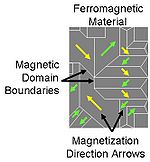
The magnetic moment of atoms in a ferromagnetic
material cause them to behave something like tiny permanent magnets. They stick together and align themselves into small regions of more or less uniform alignment called magnetic domains
or Weiss domains
. Magnetic domains can be observed with a magnetic force microscope
to reveal magnetic domain boundaries that resemble white lines in the sketch. There are many scientific experiments that can physically show magnetic fields.
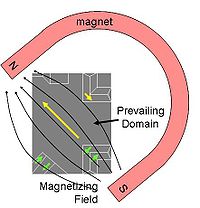 When a domain contains too many molecules, it becomes unstable and divides into two domains aligned in opposite directions so that they stick together more stably as shown at the right.
When exposed to a magnetic field, the domain boundaries move so that the domains aligned with the magnetic field grow and dominate the structure as shown at the left. When the magnetizing field is removed, the domains may not return to an unmagnetized state. This results in the ferromagnetic material's being magnetized, forming a permanent magnet.
When magnetized strongly enough that the prevailing domain overruns all others to result in only one single domain, the material is magnetically saturated
. When a magnetized ferromagnetic material is heated to the Curie point
temperature, the molecules are agitated to the point that the magnetic domains lose the organization and the magnetic properties they cause cease. When the material is cooled, this domain alignment structure spontaneously returns, in a manner roughly analogous to how a liquid can freeze
into a crystalline solid.
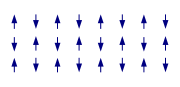
In an antiferromagnet, unlike a ferromagnet, there is a tendency for the intrinsic magnetic moments of neighboring valence electrons to point in opposite directions. When all atoms are arranged in a substance so that each neighbor is 'anti-aligned', the substance is antiferromagnetic. Antiferromagnets have a zero net magnetic moment, meaning no field is produced by them. Antiferromagnets are less common compared to the other types of behaviors, and are mostly observed at low temperatures. In varying temperatures, antiferromagnets can be seen to exhibit diamagnetic and ferrimagnetic properties.
In some materials, neighboring electrons want to point in opposite directions, but there is no geometrical arrangement in which each pair of neighbors is anti-aligned. This is called a spin glass
, and is an example of geometrical frustration
.
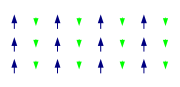
Like ferromagnetism, ferrimagnets retain their magnetization in the absence of a field. However, like antiferromagnets, neighboring pairs of electron spins like to point in opposite directions. These two properties are not contradictory, because in the optimal geometrical arrangement, there is more magnetic moment from the sublattice of electrons that point in one direction, than from the sublattice that points in the opposite direction.
The first discovered magnetic substance, magnetite
, was originally believed to be a ferromagnet; Louis Néel disproved this, however, with the discovery of ferrimagnetism.
. Its response to a magnetic field is qualitatively similar to the response of a paramagnet, but much larger.
is a type of magnet
whose magnetism is produced by the flow of electric current. The magnetic field disappears when the current ceases.
, time dilation
, and the fact that the magnetic force is velocity-dependent. However, when both electricity and magnetism are taken into account, the resulting theory (electromagnetism) is fully consistent with special relativity. In particular, a phenomenon that appears purely electric to one observer may be purely magnetic to another, or more generally the relative contributions of electricity and magnetism are dependent on the frame of reference. Thus, special relativity "mixes" electricity and magnetism into a single, inseparable phenomenon called electromagnetism, analogous to how relativity "mixes" space and time into spacetime
.

where is the vacuum permeability
.
In a material,
The quantity is called magnetic polarization.
If the field is small, the response of the magnetization in a diamagnet or paramagnet is approximately linear:
the constant of proportionality being called the magnetic susceptibility. If so,
In a hard magnet such as a ferromagnet, is not proportional to the field and is generally nonzero even when is zero (see Remanence
).
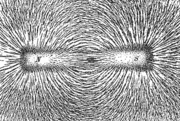 The phenomenon of magnetism is "mediated" by the magnetic field. An electric current or magnetic dipole creates a magnetic field, and that field, in turn, imparts magnetic forces on other particles that are in the fields.
Maxwell's equations, which simplify to the Biot-Savart law
in the case of steady currents, describe the origin and behavior of the fields that govern these forces. Therefore magnetism is seen whenever electrically charged particles
are in motion
---for example, from movement of electrons in an electric current
, or in certain cases from the orbital motion of electrons around an atom's nucleus. They also arise from "intrinsic" magnetic dipole
s arising from quantum-mechanical spin
.
The same situations that create magnetic fields — charge moving in a current or in an atom, and intrinsic magnetic dipoles — are also the situations in which a magnetic field has an effect, creating a force. Following is the formula for moving charge; for the forces on an intrinsic dipole, see magnetic dipole.
When a charged particle moves through a magnetic field B, it feels a Lorentz force
F given by the cross product
:
where
Because this is a cross product, the force is perpendicular
to both the motion of the particle and the magnetic field. It follows that the magnetic force does no work
on the particle; it may change the direction of the particle's movement, but it cannot cause it to speed up or slow down. The magnitude of the force is
where is the angle between v and B.
One tool for determining the direction of the velocity vector of a moving charge, the magnetic field, and the force exerted is labeling the index finger
"V", the middle finger
"B", and the thumb
"F" with your right hand. When making a gun-like configuration, with the middle finger crossing under the index finger, the fingers represent the velocity vector, magnetic field vector, and force vector, respectively. See also right hand rule.
, with a "South pole
" and a "North pole
", terms dating back to the use of magnets as compasses, interacting with the Earth's magnetic field
to indicate North and South on the globe
. Since opposite ends of magnets are attracted, the north pole of a magnet is attracted to the south pole of another magnet. The Earth's North Magnetic Pole
(currently in the Arctic Ocean, north of Canada) is physically a south pole, as it attracts the north pole of a compass.
A magnetic field contains energy
, and physical systems move toward configurations with lower energy. When diamagnetic material is placed in a magnetic field, a magnetic dipole tends to align itself in opposed polarity to that field, thereby lowering the net field strength. When ferromagnetic material is placed within a magnetic field, the magnetic dipoles align to the applied field, thus expanding the domain walls of the magnetic domains.
Nevertheless, some theoretical physics
models predict the existence of these magnetic monopoles. Paul Dirac
observed in 1931 that, because electricity and magnetism show a certain symmetry
, just as quantum theory
predicts that individual positive or negative electric charges can be observed without the opposing charge, isolated South or North magnetic poles should be observable. Using quantum theory Dirac showed that if magnetic monopoles exist, then one could explain the quantization of electric charge---that is, why the observed elementary particles carry charges that are multiples of the charge of the electron.
Certain grand unified theories predict the existence of monopoles which, unlike elementary particles, are solitons (localized energy packets). The initial results of using these models to estimate the number of monopoles created in the big bang
contradicted cosmological observations — the monopoles would have been so plentiful and massive that they would have long since halted the expansion of the universe. However, the idea of inflation
(for which this problem served as a partial motivation) was successful in solving this problem, creating models in which monopoles existed but were rare enough to be consistent with current observations.
) from specific quantum-mechanical phenomena which are not easily explained (e.g. Mathematical formulation of quantum mechanics
, in particular the chapters on spin
and on the Pauli principle).
A successful model was developed already in 1927, by Walter Heitler
and Fritz London
, who derived quantum-mechanically, how hydrogen molecules are formed from hydrogen atoms, i.e. from the atomic hydrogen orbitals and
and  centered at the nuclei A and B, see below. That this leads to magnetism, is not at all obvious, but will be explained in the following.
According the Heitler-London theory, so-called two-body molecular -orbitals are formed, namely the resulting orbital is:

Here the last product means that a first electron, r1, is in an atomic hydrogen-orbital centered at the second nucleus, whereas the second electron runs around the first nucleus. This "exchange" phenomenon is an expression for the quantum-mechanical property that particles with identical properties cannot be distinguished. It is specific not only for the formation of chemical bond
s, but as we will see, also for magnetism, i.e. in this connection the term exchange interaction
arises, a term which is essential for the origin of magnetism, and which is stronger, roughly by factors 100 and even by 1000, than the energies arising from the electrodynamic dipole-dipole interaction.
As for the spin function , which is responsible for the magnetism, we have the already mentioned Pauli's principle, namely that a symmetric orbital (i.e. with the + sign as above) must be multiplied with an antisymmetric spin function (i.e. with a - sign), and vice versa. Thus:
 ,
,
I.e., not only and
and  must be substituted by α and β, respectively (the first entity means "spin up", the second one "spin down"), but also the sign + by the − sign, and finally ri by the discrete values si (= ±½); thereby we have
  and
and  . The "singlet state", i.e. the - sign, means: the spins are antiparallel, i.e. for the solid we have antiferromagnetism
, and for two-atomic molecules one has diamagnetism
. The tendency to form a (homoeopolar) chemical bond (this means: the formation of a symmetric molecular orbital , i.e. with the + sign) results through the Pauli principle automatically in an antisymmetric spin state (i.e. with the - sign). In contrast, the Coulomb repulsion of the electrons, i.e. the tendency that they try to avoid each other by this repulsion, would lead to an antisymmetric orbital function (i.e. with the - sign) of these two particles, and complementary to a symmetric spin function (i.e. with the + sign, one of the so-called "triplet functions
"). Thus, now the spins would be parallel (ferromagnetism
in a solid, paramagnetism
in two-atomic gases).
The last-mentioned tendency dominates in the metals iron
, cobalt
and nickel
, and in some rare earths, which are ferromagnetic. Most of the other metals, where the first-mentioned tendency dominates, are nonmagnetic (e.g. sodium
, aluminium
, and magnesium
) or antiferromagnetic (e.g. manganese
). Diatomic gases are also almost exclusively diamagnetic, and not paramagnetic. However, the oxygen molecule, because of the involvement of π-orbitals, is an exception important for the life-sciences.
The Heitler-London considerations can be generalized to the Heisenberg model
of magnetism (Heisenberg 1928).
The explanation of the phenomena is thus essentially based on all subtleties of quantum mechanics, whereas the electrodynamics covers mainly the phenomenology.
. Magnetobiology
studies magnetic fields as a medical treatment; fields naturally produced by an organism are known as biomagnetism
.
Magnetic field
A magnetic field is a mathematical description of the magnetic influence of electric currents and magnetic materials. The magnetic field at any given point is specified by both a direction and a magnitude ; as such it is a vector field.Technically, a magnetic field is a pseudo vector;...
. Ferromagnetism
Ferromagnetism
Ferromagnetism is the basic mechanism by which certain materials form permanent magnets, or are attracted to magnets. In physics, several different types of magnetism are distinguished...
is the strongest and most familiar type of magnetism. It is responsible for the behavior of permanent magnets
Magnet
A magnet is a material or object that produces a magnetic field. This magnetic field is invisible but is responsible for the most notable property of a magnet: a force that pulls on other ferromagnetic materials, such as iron, and attracts or repels other magnets.A permanent magnet is an object...
, which produce their own persistent magnetic fields, as well as the materials that are attracted to them. However, all materials are influenced to a greater or lesser degree by the presence of a magnetic field. Some are attracted to a magnetic field (paramagnetism
Paramagnetism
Paramagnetism is a form of magnetism whereby the paramagnetic material is only attracted when in the presence of an externally applied magnetic field. In contrast with this, diamagnetic materials are repulsive when placed in a magnetic field...
); others are repulsed by a magnetic field (diamagnetism
Diamagnetism
Diamagnetism is the property of an object which causes it to create a magnetic field in opposition to an externally applied magnetic field, thus causing a repulsive effect. Specifically, an external magnetic field alters the orbital velocity of electrons around their nuclei, thus changing the...
); others have a much more complex relationship with an applied magnetic field (spin glass
Spin glass
A spin glass is a magnet with frustrated interactions, augmented by stochastic disorder, where usually ferromagnetic and antiferromagnetic bonds are randomly distributed...
behavior and antiferromagnetism
Antiferromagnetism
In materials that exhibit antiferromagnetism, the magnetic moments of atoms or molecules, usuallyrelated to the spins of electrons, align in a regular pattern with neighboring spins pointing in opposite directions. This is, like ferromagnetism and ferrimagnetism, a manifestation of ordered magnetism...
). Substances that are negligibly affected by magnetic fields are known as non-magnetic substances. They include copper
Copper
Copper is a chemical element with the symbol Cu and atomic number 29. It is a ductile metal with very high thermal and electrical conductivity. Pure copper is soft and malleable; an exposed surface has a reddish-orange tarnish...
, aluminium
Aluminium
Aluminium or aluminum is a silvery white member of the boron group of chemical elements. It has the symbol Al, and its atomic number is 13. It is not soluble in water under normal circumstances....
, gases, and plastic
Plastic
A plastic material is any of a wide range of synthetic or semi-synthetic organic solids used in the manufacture of industrial products. Plastics are typically polymers of high molecular mass, and may contain other substances to improve performance and/or reduce production costs...
.
The magnetic state (or phase) of a material depends on temperature (and other variables such as pressure and applied magnetic field) so that a material may exhibit more than one form of magnetism depending on its temperature, etc.
History
AristotleAristotle
Aristotle was a Greek philosopher and polymath, a student of Plato and teacher of Alexander the Great. His writings cover many subjects, including physics, metaphysics, poetry, theater, music, logic, rhetoric, linguistics, politics, government, ethics, biology, and zoology...
attributed the first of what could be called a scientific discussion on magnetism to Thales
Thales
Thales of Miletus was a pre-Socratic Greek philosopher from Miletus in Asia Minor, and one of the Seven Sages of Greece. Many, most notably Aristotle, regard him as the first philosopher in the Greek tradition...
, who lived from about 625 BCE to about 545 BCE. Around the same time, in ancient India
History of India
The history of India begins with evidence of human activity of Homo sapiens as long as 75,000 years ago, or with earlier hominids including Homo erectus from about 500,000 years ago. The Indus Valley Civilization, which spread and flourished in the northwestern part of the Indian subcontinent from...
, the Indian surgeon
Ayurveda
Ayurveda or ayurvedic medicine is a system of traditional medicine native to India and a form of alternative medicine. In Sanskrit, words , meaning "longevity", and , meaning "knowledge" or "science". The earliest literature on Indian medical practice appeared during the Vedic period in India,...
, Sushruta, was the first to make use of the magnet for surgical purposes.
In ancient China, the earliest literary reference to magnetism lies in a 4th century BCE book called Book of the Devil Valley Master (鬼谷子): "The lodestone
Lodestone
A lodestone or loadstone is a naturally magnetized piece of the mineral magnetite. They are naturally occurring magnets, that attract pieces of iron. Ancient people first discovered the property of magnetism in lodestone...
makes iron come or it attracts it." The earliest mention of the attraction of a needle appears in a work composed between AD 20 and 100 (Louen-heng): "A lodestone attracts a needle." The ancient Chinese scientist
History of science and technology in China
The history of science and technology in China is both long and rich with many contributions to science and technology. In antiquity, independently of other civilizations, ancient Chinese philosophers made significant advances in science, technology, mathematics, and astronomy...
Shen Kuo
Shen Kuo
Shen Kuo or Shen Gua , style name Cunzhong and pseudonym Mengqi Weng , was a polymathic Chinese scientist and statesman of the Song Dynasty...
(1031–1095) was the first person to write of the magnetic needle compass and that it improved the accuracy of navigation by employing the astronomical concept of true north
True north
True north is the direction along the earth's surface towards the geographic North Pole.True geodetic north usually differs from magnetic north , and from grid north...
(Dream Pool Essays
Dream Pool Essays
The Dream Pool Essays was an extensive book written by the polymath Chinese scientist and statesman Shen Kuo by 1088 AD, during the Song Dynasty of China...
, AD 1088), and by the 12th century the Chinese were known to use the lodestone compass
Compass
A compass is a navigational instrument that shows directions in a frame of reference that is stationary relative to the surface of the earth. The frame of reference defines the four cardinal directions – north, south, east, and west. Intermediate directions are also defined...
for navigation. They sculpted a directional spoon from lodestone in such a way that the handle of the spoon always pointed south.
Alexander Neckham, by 1187, was the first in Europe
Europe
Europe is, by convention, one of the world's seven continents. Comprising the westernmost peninsula of Eurasia, Europe is generally 'divided' from Asia to its east by the watershed divides of the Ural and Caucasus Mountains, the Ural River, the Caspian and Black Seas, and the waterways connecting...
to describe the compass and its use for navigation. In 1269, Peter Peregrinus de Maricourt
Peter of Maricourt
Pierre Pelerin de Maricourt , Petrus Peregrinus de Maricourt or Peter Peregrinus of Maricourt; was a 13th century French scholar who conducted experiments on magnetism and wrote the first extant treatise describing the properties of magnets...
wrote the Epistola de magnete, the first extant treatise describing the properties of magnets. In 1282, the properties of magnets and the dry compass were discussed by Al-Ashraf, a Yemeni physicist
Islamic physics
Physics in medieval Islam is the development of physics in the medieval Islamic world in the history of physics. In the course of the expansion of the Islamic world, Muslim scholars encountered the science, mathematics, and medicine of antiquity through the works of Aristotle, Archimedes, Galen,...
, astronomer
Islamic astronomy
Islamic astronomy or Arabic astronomy comprises the astronomical developments made in the Islamic world, particularly during the Islamic Golden Age , and mostly written in the Arabic language. These developments mostly took place in the Middle East, Central Asia, Al-Andalus, and North Africa, and...
, and geographer
Islamic geography
Geography and cartography in medieval Islam refers to the advancement of geography, cartography and the earth sciences in the medieval Islamic civilization....
.
In 1600, William Gilbert published his De Magnete, Magneticisque Corporibus, et de Magno Magnete Tellure
De Magnete
De Magnete, Magneticisque Corporibus, et de Magno Magnete Tellure is a scientific work published in 1600 by the English physician and scientist William Gilbert and his partner Aaron Dowling...
(On the Magnet and Magnetic Bodies, and on the Great Magnet the Earth). In this work he describes many of his experiments with his model earth called the terrella
Terrella
A terrella is a small magnetised model ball representing the Earth, that is thought to have been invented by the English physician William Gilbert while investigating magnetism, and further developed 300 years later by the Norwegian scientist and explorer Kristian Birkeland, while investigating...
. From his experiments, he concluded that the Earth
Earth's magnetic field
Earth's magnetic field is the magnetic field that extends from the Earth's inner core to where it meets the solar wind, a stream of energetic particles emanating from the Sun...
was itself magnetic and that this was the reason compasses pointed north (previously, some believed that it was the pole star (Polaris
Polaris
Polaris |Alpha]] Ursae Minoris, commonly North Star or Pole Star, also Lodestar) is the brightest star in the constellation Ursa Minor. It is very close to the north celestial pole, making it the current northern pole star....
) or a large magnetic island on the north pole that attracted the compass).
An understanding of the relationship between electricity
Electricity
Electricity is a general term encompassing a variety of phenomena resulting from the presence and flow of electric charge. These include many easily recognizable phenomena, such as lightning, static electricity, and the flow of electrical current in an electrical wire...
and magnetism began in 1819 with work by Hans Christian Oersted
Hans Christian Ørsted
Hans Christian Ørsted was a Danish physicist and chemist who discovered that electric currents create magnetic fields, an important aspect of electromagnetism...
, a professor at the University of Copenhagen, who discovered more or less by accident that an electric current could influence a compass needle. This landmark experiment is known as Oersted's Experiment. Several other experiments followed, with André-Marie Ampère
André-Marie Ampère
André-Marie Ampère was a French physicist and mathematician who is generally regarded as one of the main discoverers of electromagnetism. The SI unit of measurement of electric current, the ampere, is named after him....
, who in 1820 discovered that the magnetic field circulating in a closed-path was related to the current flowing through the perimeter of the path; Carl Friedrich Gauss
Carl Friedrich Gauss
Johann Carl Friedrich Gauss was a German mathematician and scientist who contributed significantly to many fields, including number theory, statistics, analysis, differential geometry, geodesy, geophysics, electrostatics, astronomy and optics.Sometimes referred to as the Princeps mathematicorum...
; Jean-Baptiste Biot
Jean-Baptiste Biot
Jean-Baptiste Biot was a French physicist, astronomer, and mathematician who established the reality of meteorites, made an early balloon flight, and studied the polarization of light.- Biography :...
and Félix Savart
Félix Savart
Félix Savart became a professor at Collège de France in 1836 and was the co-originator of the Biot-Savart Law, along with Jean-Baptiste Biot. Together, they worked on the theory of magnetism and electrical currents. Their law was developed about 1820. The Biot-Savart Law relates magnetic fields to...
, both of which in 1820 came up with the Biot-Savart Law
Biot-Savart law
The Biot–Savart law is an equation in electromagnetism that describes the magnetic field B generated by an electric current. The vector field B depends on the magnitude, direction, length, and proximity of the electric current, and also on a fundamental constant called the magnetic constant...
giving an equation for the magnetic field from a current-carrying wire; Michael Faraday
Michael Faraday
Michael Faraday, FRS was an English chemist and physicist who contributed to the fields of electromagnetism and electrochemistry....
, who in 1831 found that a time-varying magnetic flux through a loop of wire induced a voltage, and others finding further links between magnetism and electricity. James Clerk Maxwell
James Clerk Maxwell
James Clerk Maxwell of Glenlair was a Scottish physicist and mathematician. His most prominent achievement was formulating classical electromagnetic theory. This united all previously unrelated observations, experiments and equations of electricity, magnetism and optics into a consistent theory...
synthesized and expanded these insights into Maxwell's equations
Maxwell's equations
Maxwell's equations are a set of partial differential equations that, together with the Lorentz force law, form the foundation of classical electrodynamics, classical optics, and electric circuits. These fields in turn underlie modern electrical and communications technologies.Maxwell's equations...
, unifying electricity, magnetism, and optics
Optics
Optics is the branch of physics which involves the behavior and properties of light, including its interactions with matter and the construction of instruments that use or detect it. Optics usually describes the behavior of visible, ultraviolet, and infrared light...
into the field of electromagnetism
Electromagnetism
Electromagnetism is one of the four fundamental interactions in nature. The other three are the strong interaction, the weak interaction and gravitation...
. In 1905, Einstein used these laws in motivating his theory of special relativity
Special relativity
Special relativity is the physical theory of measurement in an inertial frame of reference proposed in 1905 by Albert Einstein in the paper "On the Electrodynamics of Moving Bodies".It generalizes Galileo's...
, requiring that the laws held true in all inertial reference frames.
Electromagnetism has continued to develop into the 21st century, being incorporated into the more fundamental theories of gauge theory
Gauge theory
In physics, gauge invariance is the property of a field theory in which different configurations of the underlying fundamental but unobservable fields result in identical observable quantities. A theory with such a property is called a gauge theory...
, quantum electrodynamics
Quantum electrodynamics
Quantum electrodynamics is the relativistic quantum field theory of electrodynamics. In essence, it describes how light and matter interact and is the first theory where full agreement between quantum mechanics and special relativity is achieved...
, electroweak theory, and finally the standard model
Standard Model
The Standard Model of particle physics is a theory concerning the electromagnetic, weak, and strong nuclear interactions, which mediate the dynamics of the known subatomic particles. Developed throughout the mid to late 20th century, the current formulation was finalized in the mid 1970s upon...
.
Sources of magnetism
Magnetism, at its root, arises from two sources:- Electric currentElectric currentElectric current is a flow of electric charge through a medium.This charge is typically carried by moving electrons in a conductor such as wire...
s or more generally, moving electric chargeElectric chargeElectric charge is a physical property of matter that causes it to experience a force when near other electrically charged matter. Electric charge comes in two types, called positive and negative. Two positively charged substances, or objects, experience a mutual repulsive force, as do two...
s create magnetic fields (see Maxwell's EquationsMaxwell's equationsMaxwell's equations are a set of partial differential equations that, together with the Lorentz force law, form the foundation of classical electrodynamics, classical optics, and electric circuits. These fields in turn underlie modern electrical and communications technologies.Maxwell's equations...
). - Many particles have nonzero "intrinsic" (or "spinSpin magnetic moment-Basis for spin magnetic moments:A spin magnetic moment is induced by all charged particles. The electron is an example of one such charged particle. A spin magnetic moment is created because a particle has physical properties known as spin and electric charge. The spin within classical physics...
") magnetic moments. Just as each particle, by its nature, has a certain massMassMass can be defined as a quantitive measure of the resistance an object has to change in its velocity.In physics, mass commonly refers to any of the following three properties of matter, which have been shown experimentally to be equivalent:...
and chargeElectric chargeElectric charge is a physical property of matter that causes it to experience a force when near other electrically charged matter. Electric charge comes in two types, called positive and negative. Two positively charged substances, or objects, experience a mutual repulsive force, as do two...
, each has a certain magnetic moment, possibly zero.
In magnetic materials, sources of magnetization are the electron
Electron
The electron is a subatomic particle with a negative elementary electric charge. It has no known components or substructure; in other words, it is generally thought to be an elementary particle. An electron has a mass that is approximately 1/1836 that of the proton...
s' orbital angular motion around the nucleus
Atomic nucleus
The nucleus is the very dense region consisting of protons and neutrons at the center of an atom. It was discovered in 1911, as a result of Ernest Rutherford's interpretation of the famous 1909 Rutherford experiment performed by Hans Geiger and Ernest Marsden, under the direction of Rutherford. The...
, and the electrons' intrinsic magnetic moment (see electron magnetic dipole moment
Electron magnetic dipole moment
In atomic physics, the electron magnetic dipole moment is the magnetic moment of an electron caused by its intrinsic property of spin.-Magnetic moment of an electron:...
). The other sources of magnetism are the nuclear magnetic moment
Nuclear magnetic moment
The nuclear magnetic moment is the magnetic moment of an atomic nucleus and arises from the spin of the protons and neutrons. It is mainly a magnetic dipole moment; the quadrupole moment does cause some small shifts in the hyperfine structure as well....
s of the nuclei in the material which are typically thousands of times smaller than the electrons' magnetic moments, so they are negligible in the context of the magnetization of materials. Nuclear magnetic moments are important in other contexts, particularly in nuclear magnetic resonance
Nuclear magnetic resonance
Nuclear magnetic resonance is a physical phenomenon in which magnetic nuclei in a magnetic field absorb and re-emit electromagnetic radiation...
(NMR) and magnetic resonance imaging
Magnetic resonance imaging
Magnetic resonance imaging , nuclear magnetic resonance imaging , or magnetic resonance tomography is a medical imaging technique used in radiology to visualize detailed internal structures...
(MRI).
Ordinarily, the enormous number of electrons in a material are arranged such that their magnetic moments (both orbital and intrinsic) cancel out. This is due, to some extent, to electrons combining into pairs with opposite intrinsic magnetic moments as a result of the Pauli exclusion principle
Pauli exclusion principle
The Pauli exclusion principle is the quantum mechanical principle that no two identical fermions may occupy the same quantum state simultaneously. A more rigorous statement is that the total wave function for two identical fermions is anti-symmetric with respect to exchange of the particles...
(see electron configuration
Electron configuration
In atomic physics and quantum chemistry, electron configuration is the arrangement of electrons of an atom, a molecule, or other physical structure...
), or combining into filled subshells with zero net orbital motion. In both cases, the electron arrangement is so as to exactly cancel the magnetic moments from each electron. Moreover, even when the electron configuration
Electron configuration
In atomic physics and quantum chemistry, electron configuration is the arrangement of electrons of an atom, a molecule, or other physical structure...
is such that there are unpaired electrons and/or non-filled subshells, it is often the case that the various electrons in the solid will contribute magnetic moments that point in different, random directions, so that the material will not be magnetic.
However, sometimes — either spontaneously, or owing to an applied external magnetic field — each of the electron magnetic moments will be, on average, lined up. Then the material can produce a net total magnetic field, which can potentially be quite strong.
The magnetic behavior of a material depends on its structure, particularly its electron configuration
Electron configuration
In atomic physics and quantum chemistry, electron configuration is the arrangement of electrons of an atom, a molecule, or other physical structure...
, for the reasons mentioned above, and also on the temperature. At high temperatures, random thermal motion makes it more difficult for the electrons to maintain alignment.
Diamagnetism
Diamagnetism appears in all materials, and is the tendency of a material to oppose an applied magnetic field, and therefore, to be repelled by a magnetic field. However, in a material with paramagnetic properties (that is, with a tendency to enhance an external magnetic field), the paramagnetic behavior dominates. Thus, despite its universal occurrence, diamagnetic behavior is observed only in a purely diamagnetic material. In a diamagnetic material, there are no unpaired electrons, so the intrinsic electron magnetic moments cannot produce any bulk effect. In these cases, the magnetization arises from the electrons' orbital motions, which can be understood classicallyClassical physics
What "classical physics" refers to depends on the context. When discussing special relativity, it refers to the Newtonian physics which preceded relativity, i.e. the branches of physics based on principles developed before the rise of relativity and quantum mechanics...
as follows:
- When a material is put in a magnetic field, the electrons circling the nucleus will experience, in addition to their CoulombCoulomb's lawCoulomb's law or Coulomb's inverse-square law, is a law of physics describing the electrostatic interaction between electrically charged particles. It was first published in 1785 by French physicist Charles Augustin de Coulomb and was essential to the development of the theory of electromagnetism...
attraction to the nucleus, a Lorentz forceLorentz forceIn physics, the Lorentz force is the force on a point charge due to electromagnetic fields. It is given by the following equation in terms of the electric and magnetic fields:...
from the magnetic field. Depending on which direction the electron is orbiting, this force may increase the centripetal forceCentripetal forceCentripetal force is a force that makes a body follow a curved path: it is always directed orthogonal to the velocity of the body, toward the instantaneous center of curvature of the path. The mathematical description was derived in 1659 by Dutch physicist Christiaan Huygens...
on the electrons, pulling them in towards the nucleus, or it may decrease the force, pulling them away from the nucleus. This effect systematically increases the orbital magnetic moments that were aligned opposite the field, and decreases the ones aligned parallel to the field (in accordance with Lenz's lawLenz's lawLenz's law is a common way of understanding how electromagnetic circuits must always obey Newton's third law and The Law of Conservation of Energy...
). This results in a small bulk magnetic moment, with an opposite direction to the applied field.
Note that this description is meant only as an heuristic
Heuristic
Heuristic refers to experience-based techniques for problem solving, learning, and discovery. Heuristic methods are used to speed up the process of finding a satisfactory solution, where an exhaustive search is impractical...
; a proper understanding requires a quantum-mechanical
Quantum mechanics
Quantum mechanics, also known as quantum physics or quantum theory, is a branch of physics providing a mathematical description of much of the dual particle-like and wave-like behavior and interactions of energy and matter. It departs from classical mechanics primarily at the atomic and subatomic...
description.
Note that all materials undergo this orbital response. However, in paramagnetic and ferromagnetic substances, the diamagnetic effect is overwhelmed by the much stronger effects caused by the unpaired electrons.
Paramagnetism
In a paramagnetic material there are unpaired electrons, i.e. atomicAtomic orbital
An atomic orbital is a mathematical function that describes the wave-like behavior of either one electron or a pair of electrons in an atom. This function can be used to calculate the probability of finding any electron of an atom in any specific region around the atom's nucleus...
or molecular orbital
Molecular orbital
In chemistry, a molecular orbital is a mathematical function describing the wave-like behavior of an electron in a molecule. This function can be used to calculate chemical and physical properties such as the probability of finding an electron in any specific region. The term "orbital" was first...
s with exactly one electron in them. While paired electrons are required by the Pauli exclusion principle
Pauli exclusion principle
The Pauli exclusion principle is the quantum mechanical principle that no two identical fermions may occupy the same quantum state simultaneously. A more rigorous statement is that the total wave function for two identical fermions is anti-symmetric with respect to exchange of the particles...
to have their intrinsic ('spin') magnetic moments pointing in opposite directions, causing their magnetic fields to cancel out, an unpaired electron is free to align its magnetic moment in any direction. When an external magnetic field is applied, these magnetic moments will tend to align themselves in the same direction as the applied field, thus reinforcing it.
Ferromagnetism
A ferromagnet, like a paramagnetic substance, has unpaired electrons. However, in addition to the electrons' intrinsic magnetic moment's tendency to be parallel to an applied field, there is also in these materials a tendency for these magnetic moments to orient parallel to each other to maintain a lowered-energy state. Thus, even when the applied field is removed, the electrons in the material maintain a parallel orientation.Every ferromagnetic substance has its own individual temperature, called the Curie temperature, or Curie point, above which it loses its ferromagnetic properties. This is because the thermal tendency to disorder overwhelms the energy-lowering due to ferromagnetic order.
Some well-known ferromagnetic materials that exhibit easily detectable magnetic properties (to form magnet
Magnet
A magnet is a material or object that produces a magnetic field. This magnetic field is invisible but is responsible for the most notable property of a magnet: a force that pulls on other ferromagnetic materials, such as iron, and attracts or repels other magnets.A permanent magnet is an object...
s) are nickel
Nickel
Nickel is a chemical element with the chemical symbol Ni and atomic number 28. It is a silvery-white lustrous metal with a slight golden tinge. Nickel belongs to the transition metals and is hard and ductile...
, iron
Iron
Iron is a chemical element with the symbol Fe and atomic number 26. It is a metal in the first transition series. It is the most common element forming the planet Earth as a whole, forming much of Earth's outer and inner core. It is the fourth most common element in the Earth's crust...
, cobalt
Cobalt
Cobalt is a chemical element with symbol Co and atomic number 27. It is found naturally only in chemically combined form. The free element, produced by reductive smelting, is a hard, lustrous, silver-gray metal....
, gadolinium
Gadolinium
Gadolinium is a chemical element with the symbol Gd and atomic number 64. It is a silvery-white, malleable and ductile rare-earth metal. It is found in nature only in combined form. Gadolinium was first detected spectroscopically in 1880 by de Marignac who separated its oxide and is credited with...
and their alloy
Alloy
An alloy is a mixture or metallic solid solution composed of two or more elements. Complete solid solution alloys give single solid phase microstructure, while partial solutions give two or more phases that may or may not be homogeneous in distribution, depending on thermal history...
s.
Magnetic domains
The magnetic moment of atoms in a ferromagnetic
Ferromagnetism
Ferromagnetism is the basic mechanism by which certain materials form permanent magnets, or are attracted to magnets. In physics, several different types of magnetism are distinguished...
material cause them to behave something like tiny permanent magnets. They stick together and align themselves into small regions of more or less uniform alignment called magnetic domains
Magnetic domains
A magnetic domain describes a region within a magnetic material which has uniform magnetization. This means that the individual magnetic moments of the atoms are aligned with one another and they point in the same direction...
or Weiss domains
Weiss domains
Weiss domains are small areas in a crystal structure of a ferromagnetic material with uniformly oriented magnetic momenta. They were named after the French physicist Pierre-Ernest Weiss ....
. Magnetic domains can be observed with a magnetic force microscope
Magnetic force microscope
Magnetic force microscope is a variety of atomic force microscope, where a sharp magnetized tip scans a magnetic sample; the tip-sample magnetic interactions are detected and used to reconstruct the magnetic structure of the sample surface. Many kinds of magnetic interactions are measured by MFM,...
to reveal magnetic domain boundaries that resemble white lines in the sketch. There are many scientific experiments that can physically show magnetic fields.
When exposed to a magnetic field, the domain boundaries move so that the domains aligned with the magnetic field grow and dominate the structure as shown at the left. When the magnetizing field is removed, the domains may not return to an unmagnetized state. This results in the ferromagnetic material's being magnetized, forming a permanent magnet.
When magnetized strongly enough that the prevailing domain overruns all others to result in only one single domain, the material is magnetically saturated
Saturation (magnetic)
Seen in some magnetic materials, saturation is the state reached when an increase in applied external magnetizing field H cannot increase the magnetization of the material further, so the total magnetic field B levels off...
. When a magnetized ferromagnetic material is heated to the Curie point
Curie point
In physics and materials science, the Curie temperature , or Curie point, is the temperature at which a ferromagnetic or a ferrimagnetic material becomes paramagnetic on heating; the effect is reversible. A magnet will lose its magnetism if heated above the Curie temperature...
temperature, the molecules are agitated to the point that the magnetic domains lose the organization and the magnetic properties they cause cease. When the material is cooled, this domain alignment structure spontaneously returns, in a manner roughly analogous to how a liquid can freeze
Freezing
Freezing or solidification is a phase change in which a liquid turns into a solid when its temperature is lowered below its freezing point. The reverse process is melting....
into a crystalline solid.
Antiferromagnetism
In an antiferromagnet, unlike a ferromagnet, there is a tendency for the intrinsic magnetic moments of neighboring valence electrons to point in opposite directions. When all atoms are arranged in a substance so that each neighbor is 'anti-aligned', the substance is antiferromagnetic. Antiferromagnets have a zero net magnetic moment, meaning no field is produced by them. Antiferromagnets are less common compared to the other types of behaviors, and are mostly observed at low temperatures. In varying temperatures, antiferromagnets can be seen to exhibit diamagnetic and ferrimagnetic properties.
In some materials, neighboring electrons want to point in opposite directions, but there is no geometrical arrangement in which each pair of neighbors is anti-aligned. This is called a spin glass
Spin glass
A spin glass is a magnet with frustrated interactions, augmented by stochastic disorder, where usually ferromagnetic and antiferromagnetic bonds are randomly distributed...
, and is an example of geometrical frustration
Geometrical frustration
In condensed matter physics, the term geometrical frustration means a phenomenon in which the geometrical properties of the crystal lattice or the presence of conflicting atomic forces forbid simultaneous minimization of the interaction energies acting at a given site.This may lead to highly...
.
Ferrimagnetism
Like ferromagnetism, ferrimagnets retain their magnetization in the absence of a field. However, like antiferromagnets, neighboring pairs of electron spins like to point in opposite directions. These two properties are not contradictory, because in the optimal geometrical arrangement, there is more magnetic moment from the sublattice of electrons that point in one direction, than from the sublattice that points in the opposite direction.
The first discovered magnetic substance, magnetite
Magnetite
Magnetite is a ferrimagnetic mineral with chemical formula Fe3O4, one of several iron oxides and a member of the spinel group. The chemical IUPAC name is iron oxide and the common chemical name is ferrous-ferric oxide. The formula for magnetite may also be written as FeO·Fe2O3, which is one part...
, was originally believed to be a ferromagnet; Louis Néel disproved this, however, with the discovery of ferrimagnetism.
Superparamagnetism
When a ferromagnet or ferrimagnet is sufficiently small, it acts like a single magnetic spin that is subject to Brownian motionBrownian motion
Brownian motion or pedesis is the presumably random drifting of particles suspended in a fluid or the mathematical model used to describe such random movements, which is often called a particle theory.The mathematical model of Brownian motion has several real-world applications...
. Its response to a magnetic field is qualitatively similar to the response of a paramagnet, but much larger.
Electromagnet
An electromagnetElectromagnet
An electromagnet is a type of magnet in which the magnetic field is produced by the flow of electric current. The magnetic field disappears when the current is turned off...
is a type of magnet
Magnet
A magnet is a material or object that produces a magnetic field. This magnetic field is invisible but is responsible for the most notable property of a magnet: a force that pulls on other ferromagnetic materials, such as iron, and attracts or repels other magnets.A permanent magnet is an object...
whose magnetism is produced by the flow of electric current. The magnetic field disappears when the current ceases.
Other types of magnetism
- Molecular magnet
- MetamagnetismMetamagnetismMetamagnetism is a blanket term used loosely in physics to describe a sudden increase in the magnetization of a material with a small change in an externally applied magnetic field. The metamagnetic behavior may have quite different physical causes for different types of metamagnets...
- Molecule-based magnet
- Spin glassSpin glassA spin glass is a magnet with frustrated interactions, augmented by stochastic disorder, where usually ferromagnetic and antiferromagnetic bonds are randomly distributed...
Magnetism, electricity, and special relativity
As a consequence of Einstein's theory of special relativity, electricity and magnetism are fundamentally interlinked. Both magnetism lacking electricity, and electricity without magnetism, are inconsistent with special relativity, due to such effects as length contractionLength contraction
In physics, length contraction – according to Hendrik Lorentz – is the physical phenomenon of a decrease in length detected by an observer of objects that travel at any non-zero velocity relative to that observer...
, time dilation
Time dilation
In the theory of relativity, time dilation is an observed difference of elapsed time between two events as measured by observers either moving relative to each other or differently situated from gravitational masses. An accurate clock at rest with respect to one observer may be measured to tick at...
, and the fact that the magnetic force is velocity-dependent. However, when both electricity and magnetism are taken into account, the resulting theory (electromagnetism) is fully consistent with special relativity. In particular, a phenomenon that appears purely electric to one observer may be purely magnetic to another, or more generally the relative contributions of electricity and magnetism are dependent on the frame of reference. Thus, special relativity "mixes" electricity and magnetism into a single, inseparable phenomenon called electromagnetism, analogous to how relativity "mixes" space and time into spacetime
Spacetime
In physics, spacetime is any mathematical model that combines space and time into a single continuum. Spacetime is usually interpreted with space as being three-dimensional and time playing the role of a fourth dimension that is of a different sort from the spatial dimensions...
.
Magnetic fields in a material
In a vacuum,where is the vacuum permeability
Vacuum permeability
The physical constant μ0, commonly called the vacuum permeability, permeability of free space, or magnetic constant is an ideal, physical constant, which is the value of magnetic permeability in a classical vacuum...
.
In a material,
The quantity is called magnetic polarization.
If the field is small, the response of the magnetization in a diamagnet or paramagnet is approximately linear:
the constant of proportionality being called the magnetic susceptibility. If so,
In a hard magnet such as a ferromagnet, is not proportional to the field and is generally nonzero even when is zero (see Remanence
Remanence
Remanence or remanent magnetization is the magnetization left behind in a ferromagnetic material after an external magnetic field is removed. It is also the measure of that magnetization. Colloquially, when a magnet is "magnetized" it has remanence...
).
Force due to magnetic field - The magnetic force
Maxwell's equations, which simplify to the Biot-Savart law
Biot-Savart law
The Biot–Savart law is an equation in electromagnetism that describes the magnetic field B generated by an electric current. The vector field B depends on the magnitude, direction, length, and proximity of the electric current, and also on a fundamental constant called the magnetic constant...
in the case of steady currents, describe the origin and behavior of the fields that govern these forces. Therefore magnetism is seen whenever electrically charged particles
Electric charge
Electric charge is a physical property of matter that causes it to experience a force when near other electrically charged matter. Electric charge comes in two types, called positive and negative. Two positively charged substances, or objects, experience a mutual repulsive force, as do two...
are in motion
Motion (physics)
In physics, motion is a change in position of an object with respect to time. Change in action is the result of an unbalanced force. Motion is typically described in terms of velocity, acceleration, displacement and time . An object's velocity cannot change unless it is acted upon by a force, as...
---for example, from movement of electrons in an electric current
Electric current
Electric current is a flow of electric charge through a medium.This charge is typically carried by moving electrons in a conductor such as wire...
, or in certain cases from the orbital motion of electrons around an atom's nucleus. They also arise from "intrinsic" magnetic dipole
Magnetic dipole
A magnetic dipole is the limit of either a closed loop of electric current or a pair of poles as the dimensions of the source are reduced to zero while keeping the magnetic moment constant. It is a magnetic analogue of the electric dipole, but the analogy is not complete. In particular, a magnetic...
s arising from quantum-mechanical spin
Spin (physics)
In quantum mechanics and particle physics, spin is a fundamental characteristic property of elementary particles, composite particles , and atomic nuclei.It is worth noting that the intrinsic property of subatomic particles called spin and discussed in this article, is related in some small ways,...
.
The same situations that create magnetic fields — charge moving in a current or in an atom, and intrinsic magnetic dipoles — are also the situations in which a magnetic field has an effect, creating a force. Following is the formula for moving charge; for the forces on an intrinsic dipole, see magnetic dipole.
When a charged particle moves through a magnetic field B, it feels a Lorentz force
Lorentz force
In physics, the Lorentz force is the force on a point charge due to electromagnetic fields. It is given by the following equation in terms of the electric and magnetic fields:...
F given by the cross product
Cross product
In mathematics, the cross product, vector product, or Gibbs vector product is a binary operation on two vectors in three-dimensional space. It results in a vector which is perpendicular to both of the vectors being multiplied and normal to the plane containing them...
:

where
-
 is the electric charge of the particle, and
 - v is the velocityVelocityIn physics, velocity is speed in a given direction. Speed describes only how fast an object is moving, whereas velocity gives both the speed and direction of the object's motion. To have a constant velocity, an object must have a constant speed and motion in a constant direction. Constant ...
vector of the particle
Because this is a cross product, the force is perpendicular
Perpendicular
In geometry, two lines or planes are considered perpendicular to each other if they form congruent adjacent angles . The term may be used as a noun or adjective...
to both the motion of the particle and the magnetic field. It follows that the magnetic force does no work
Mechanical work
In physics, work is a scalar quantity that can be described as the product of a force times the distance through which it acts, and it is called the work of the force. Only the component of a force in the direction of the movement of its point of application does work...
on the particle; it may change the direction of the particle's movement, but it cannot cause it to speed up or slow down. The magnitude of the force is

where
is the angle between v and B.One tool for determining the direction of the velocity vector of a moving charge, the magnetic field, and the force exerted is labeling the index finger
Index finger
The index finger, , is the first finger and the second digit of a human hand. It is located between the first and third digits, between the thumb and the middle finger...
"V", the middle finger
Middle finger
The middle finger or long finger is the third digit of the human hand, located between the index finger and the ring finger. It is usually the longest finger...
"B", and the thumb
Thumb
The thumb is the first digit of the hand. When a person is standing in the medical anatomical position , the thumb is the lateral-most digit...
"F" with your right hand. When making a gun-like configuration, with the middle finger crossing under the index finger, the fingers represent the velocity vector, magnetic field vector, and force vector, respectively. See also right hand rule.
Magnetic dipoles
A very common source of magnetic field shown in nature is a dipoleDipole
In physics, there are several kinds of dipoles:*An electric dipole is a separation of positive and negative charges. The simplest example of this is a pair of electric charges of equal magnitude but opposite sign, separated by some distance. A permanent electric dipole is called an electret.*A...
, with a "South pole
South Pole
The South Pole, also known as the Geographic South Pole or Terrestrial South Pole, is one of the two points where the Earth's axis of rotation intersects its surface. It is the southernmost point on the surface of the Earth and lies on the opposite side of the Earth from the North Pole...
" and a "North pole
North Pole
The North Pole, also known as the Geographic North Pole or Terrestrial North Pole, is, subject to the caveats explained below, defined as the point in the northern hemisphere where the Earth's axis of rotation meets its surface...
", terms dating back to the use of magnets as compasses, interacting with the Earth's magnetic field
Earth's magnetic field
Earth's magnetic field is the magnetic field that extends from the Earth's inner core to where it meets the solar wind, a stream of energetic particles emanating from the Sun...
to indicate North and South on the globe
Globe
A globe is a three-dimensional scale model of Earth or other spheroid celestial body such as a planet, star, or moon...
. Since opposite ends of magnets are attracted, the north pole of a magnet is attracted to the south pole of another magnet. The Earth's North Magnetic Pole
North Magnetic Pole
The Earth's North Magnetic Pole is the point on the surface of the Northern Hemisphere at which the Earth's magnetic field points vertically downwards . Though geographically in the north, it is, by the direction of the magnetic field lines, physically the south pole of the Earth's magnetic field...
(currently in the Arctic Ocean, north of Canada) is physically a south pole, as it attracts the north pole of a compass.
A magnetic field contains energy
Energy
In physics, energy is an indirectly observed quantity. It is often understood as the ability a physical system has to do work on other physical systems...
, and physical systems move toward configurations with lower energy. When diamagnetic material is placed in a magnetic field, a magnetic dipole tends to align itself in opposed polarity to that field, thereby lowering the net field strength. When ferromagnetic material is placed within a magnetic field, the magnetic dipoles align to the applied field, thus expanding the domain walls of the magnetic domains.
Magnetic monopoles
Since a bar magnet gets its ferromagnetism from electrons distributed evenly throughout the bar, when a bar magnet is cut in half, each of the resulting pieces is a smaller bar magnet. Even though a magnet is said to have a north pole and a south pole, these two poles cannot be separated from each other. A monopole — if such a thing exists — would be a new and fundamentally different kind of magnetic object. It would act as an isolated north pole, not attached to a south pole, or vice versa. Monopoles would carry "magnetic charge" analogous to electric charge. Despite systematic searches since 1931, , they have never been observed, and could very well not exist.Nevertheless, some theoretical physics
Theoretical physics
Theoretical physics is a branch of physics which employs mathematical models and abstractions of physics to rationalize, explain and predict natural phenomena...
models predict the existence of these magnetic monopoles. Paul Dirac
Paul Dirac
Paul Adrien Maurice Dirac, OM, FRS was an English theoretical physicist who made fundamental contributions to the early development of both quantum mechanics and quantum electrodynamics...
observed in 1931 that, because electricity and magnetism show a certain symmetry
Symmetry
Symmetry generally conveys two primary meanings. The first is an imprecise sense of harmonious or aesthetically pleasing proportionality and balance; such that it reflects beauty or perfection...
, just as quantum theory
Quantum electrodynamics
Quantum electrodynamics is the relativistic quantum field theory of electrodynamics. In essence, it describes how light and matter interact and is the first theory where full agreement between quantum mechanics and special relativity is achieved...
predicts that individual positive or negative electric charges can be observed without the opposing charge, isolated South or North magnetic poles should be observable. Using quantum theory Dirac showed that if magnetic monopoles exist, then one could explain the quantization of electric charge---that is, why the observed elementary particles carry charges that are multiples of the charge of the electron.
Certain grand unified theories predict the existence of monopoles which, unlike elementary particles, are solitons (localized energy packets). The initial results of using these models to estimate the number of monopoles created in the big bang
Big Bang
The Big Bang theory is the prevailing cosmological model that explains the early development of the Universe. According to the Big Bang theory, the Universe was once in an extremely hot and dense state which expanded rapidly. This rapid expansion caused the young Universe to cool and resulted in...
contradicted cosmological observations — the monopoles would have been so plentiful and massive that they would have long since halted the expansion of the universe. However, the idea of inflation
Cosmic inflation
In physical cosmology, cosmic inflation, cosmological inflation or just inflation is the theorized extremely rapid exponential expansion of the early universe by a factor of at least 1078 in volume, driven by a negative-pressure vacuum energy density. The inflationary epoch comprises the first part...
(for which this problem served as a partial motivation) was successful in solving this problem, creating models in which monopoles existed but were rare enough to be consistent with current observations.
Quantum-mechanical origin of magnetism
In principle all kinds of magnetism originate (similar to SuperconductivitySuperconductivity
Superconductivity is a phenomenon of exactly zero electrical resistance occurring in certain materials below a characteristic temperature. It was discovered by Heike Kamerlingh Onnes on April 8, 1911 in Leiden. Like ferromagnetism and atomic spectral lines, superconductivity is a quantum...
) from specific quantum-mechanical phenomena which are not easily explained (e.g. Mathematical formulation of quantum mechanics
Mathematical formulation of quantum mechanics
The mathematical formulations of quantum mechanics are those mathematical formalisms that permit a rigorous description of quantum mechanics. Such are distinguished from mathematical formalisms for theories developed prior to the early 1900s by the use of abstract mathematical structures, such as...
, in particular the chapters on spin
Spin (physics)
In quantum mechanics and particle physics, spin is a fundamental characteristic property of elementary particles, composite particles , and atomic nuclei.It is worth noting that the intrinsic property of subatomic particles called spin and discussed in this article, is related in some small ways,...
and on the Pauli principle).
A successful model was developed already in 1927, by Walter Heitler
Walter Heitler
Walter Heinrich Heitler was a German physicist who made contributions to quantum electrodynamics and quantum field theory...
and Fritz London
Fritz London
Fritz Wolfgang London was a German theoretical physicist. His fundamental contributions to the theories of chemical bonding and of intermolecular forces are today considered classic and are discussed in standard textbooks of physical chemistry.With his brother Heinz, he made a significant...
, who derived quantum-mechanically, how hydrogen molecules are formed from hydrogen atoms, i.e. from the atomic hydrogen orbitals
and centered at the nuclei A and B, see below. That this leads to magnetism, is not at all obvious, but will be explained in the following.According the Heitler-London theory, so-called two-body molecular
-orbitals are formed, namely the resulting orbital is:Here the last product means that a first electron, r1, is in an atomic hydrogen-orbital centered at the second nucleus, whereas the second electron runs around the first nucleus. This "exchange" phenomenon is an expression for the quantum-mechanical property that particles with identical properties cannot be distinguished. It is specific not only for the formation of chemical bond
Chemical bond
A chemical bond is an attraction between atoms that allows the formation of chemical substances that contain two or more atoms. The bond is caused by the electromagnetic force attraction between opposite charges, either between electrons and nuclei, or as the result of a dipole attraction...
s, but as we will see, also for magnetism, i.e. in this connection the term exchange interaction
Exchange interaction
In physics, the exchange interaction is a quantum mechanical effect without classical analog which increases or decreases the expectation value of the energy or distance between two or more identical particles when their wave functions overlap...
arises, a term which is essential for the origin of magnetism, and which is stronger, roughly by factors 100 and even by 1000, than the energies arising from the electrodynamic dipole-dipole interaction.
As for the spin function
, which is responsible for the magnetism, we have the already mentioned Pauli's principle, namely that a symmetric orbital (i.e. with the + sign as above) must be multiplied with an antisymmetric spin function (i.e. with a - sign), and vice versa. Thus:,I.e., not only
and must be substituted by α and β, respectively (the first entity means "spin up", the second one "spin down"), but also the sign + by the − sign, and finally ri by the discrete values si (= ±½); thereby we have and . The "singlet state", i.e. the - sign, means: the spins are antiparallel, i.e. for the solid we have antiferromagnetismAntiferromagnetism
In materials that exhibit antiferromagnetism, the magnetic moments of atoms or molecules, usuallyrelated to the spins of electrons, align in a regular pattern with neighboring spins pointing in opposite directions. This is, like ferromagnetism and ferrimagnetism, a manifestation of ordered magnetism...
, and for two-atomic molecules one has diamagnetism
Diamagnetism
Diamagnetism is the property of an object which causes it to create a magnetic field in opposition to an externally applied magnetic field, thus causing a repulsive effect. Specifically, an external magnetic field alters the orbital velocity of electrons around their nuclei, thus changing the...
. The tendency to form a (homoeopolar) chemical bond (this means: the formation of a symmetric molecular orbital , i.e. with the + sign) results through the Pauli principle automatically in an antisymmetric spin state (i.e. with the - sign). In contrast, the Coulomb repulsion of the electrons, i.e. the tendency that they try to avoid each other by this repulsion, would lead to an antisymmetric orbital function (i.e. with the - sign) of these two particles, and complementary to a symmetric spin function (i.e. with the + sign, one of the so-called "triplet functions
Triplet state
A spin triplet is a set of three quantum states of a system, each with total spin S = 1 . The system could consist of a single elementary massive spin 1 particle such as a W or Z boson, or be some multiparticle state with total spin angular momentum of one.In physics, spin is the angular momentum...
"). Thus, now the spins would be parallel (ferromagnetism
Ferromagnetism
Ferromagnetism is the basic mechanism by which certain materials form permanent magnets, or are attracted to magnets. In physics, several different types of magnetism are distinguished...
in a solid, paramagnetism
Paramagnetism
Paramagnetism is a form of magnetism whereby the paramagnetic material is only attracted when in the presence of an externally applied magnetic field. In contrast with this, diamagnetic materials are repulsive when placed in a magnetic field...
in two-atomic gases).
The last-mentioned tendency dominates in the metals iron
Iron
Iron is a chemical element with the symbol Fe and atomic number 26. It is a metal in the first transition series. It is the most common element forming the planet Earth as a whole, forming much of Earth's outer and inner core. It is the fourth most common element in the Earth's crust...
, cobalt
Cobalt
Cobalt is a chemical element with symbol Co and atomic number 27. It is found naturally only in chemically combined form. The free element, produced by reductive smelting, is a hard, lustrous, silver-gray metal....
and nickel
Nickel
Nickel is a chemical element with the chemical symbol Ni and atomic number 28. It is a silvery-white lustrous metal with a slight golden tinge. Nickel belongs to the transition metals and is hard and ductile...
, and in some rare earths, which are ferromagnetic. Most of the other metals, where the first-mentioned tendency dominates, are nonmagnetic (e.g. sodium
Sodium
Sodium is a chemical element with the symbol Na and atomic number 11. It is a soft, silvery-white, highly reactive metal and is a member of the alkali metals; its only stable isotope is 23Na. It is an abundant element that exists in numerous minerals, most commonly as sodium chloride...
, aluminium
Aluminium
Aluminium or aluminum is a silvery white member of the boron group of chemical elements. It has the symbol Al, and its atomic number is 13. It is not soluble in water under normal circumstances....
, and magnesium
Magnesium
Magnesium is a chemical element with the symbol Mg, atomic number 12, and common oxidation number +2. It is an alkaline earth metal and the eighth most abundant element in the Earth's crust and ninth in the known universe as a whole...
) or antiferromagnetic (e.g. manganese
Manganese
Manganese is a chemical element, designated by the symbol Mn. It has the atomic number 25. It is found as a free element in nature , and in many minerals...
). Diatomic gases are also almost exclusively diamagnetic, and not paramagnetic. However, the oxygen molecule, because of the involvement of π-orbitals, is an exception important for the life-sciences.
The Heitler-London considerations can be generalized to the Heisenberg model
Heisenberg model (classical)
The Classical Heisenberg model is the n = 3 case of the n-vector model, one of the models used in statistical physics to model ferromagnetism, and other phenomena.-Definition:...
of magnetism (Heisenberg 1928).
The explanation of the phenomena is thus essentially based on all subtleties of quantum mechanics, whereas the electrodynamics covers mainly the phenomenology.
SI units related to magnetism
| SI Si Si, si, or SI may refer to :- Measurement, mathematics and science :* International System of Units , the modern international standard version of the metric system... electromagnetism units |
|||
|---|---|---|---|
| Symbol | Name of Quantity | Derived Units | Conversion of International to SI base unit SI base unit The International System of Units defines seven units of measure as a basic set from which all other SI units are derived. These SI base units and their physical quantities are:* metre for length... s |
 |
Electric current Electric current Electric current is a flow of electric charge through a medium.This charge is typically carried by moving electrons in a conductor such as wire... |
ampere Ampere The ampere , often shortened to amp, is the SI unit of electric current and is one of the seven SI base units. It is named after André-Marie Ampère , French mathematician and physicist, considered the father of electrodynamics... (SI base unit SI base unit The International System of Units defines seven units of measure as a basic set from which all other SI units are derived. These SI base units and their physical quantities are:* metre for length... ) |
 |
 |
Electric charge Electric charge Electric charge is a physical property of matter that causes it to experience a force when near other electrically charged matter. Electric charge comes in two types, called positive and negative. Two positively charged substances, or objects, experience a mutual repulsive force, as do two... |
coulomb |  |
 |
Potential difference; Electromotive force Electromotive force In physics, electromotive force, emf , or electromotance refers to voltage generated by a battery or by the magnetic force according to Faraday's Law, which states that a time varying magnetic field will induce an electric current.It is important to note that the electromotive "force" is not a... |
volt Volt The volt is the SI derived unit for electric potential, electric potential difference, and electromotive force. The volt is named in honor of the Italian physicist Alessandro Volta , who invented the voltaic pile, possibly the first chemical battery.- Definition :A single volt is defined as the... |
 |
 |
Electric resistance; Impedance Electrical impedance Electrical impedance, or simply impedance, is the measure of the opposition that an electrical circuit presents to the passage of a current when a voltage is applied. In quantitative terms, it is the complex ratio of the voltage to the current in an alternating current circuit... ; Reactance |
ohm |  |
 |
Resistivity Resistivity Electrical resistivity is a measure of how strongly a material opposes the flow of electric current. A low resistivity indicates a material that readily allows the movement of electric charge. The SI unit of electrical resistivity is the ohm metre... |
ohm metre Metre The metre , symbol m, is the base unit of length in the International System of Units . Originally intended to be one ten-millionth of the distance from the Earth's equator to the North Pole , its definition has been periodically refined to reflect growing knowledge of metrology... |
 |
 |
Electric power Electric power Electric power is the rate at which electric energy is transferred by an electric circuit. The SI unit of power is the watt.-Circuits:Electric power, like mechanical power, is represented by the letter P in electrical equations... |
watt Watt The watt is a derived unit of power in the International System of Units , named after the Scottish engineer James Watt . The unit, defined as one joule per second, measures the rate of energy conversion.-Definition:... |
 |
 |
Capacitance Capacitance In electromagnetism and electronics, capacitance is the ability of a capacitor to store energy in an electric field. Capacitance is also a measure of the amount of electric potential energy stored for a given electric potential. A common form of energy storage device is a parallel-plate capacitor... |
farad Farad The farad is the SI unit of capacitance. The unit is named after the English physicist Michael Faraday.- Definition :A farad is the charge in coulombs which a capacitor will accept for the potential across it to change 1 volt. A coulomb is 1 ampere second... |
 |
 |
Electric field Electric field In physics, an electric field surrounds electrically charged particles and time-varying magnetic fields. The electric field depicts the force exerted on other electrically charged objects by the electrically charged particle the field is surrounding... strength |
volt Volt The volt is the SI derived unit for electric potential, electric potential difference, and electromotive force. The volt is named in honor of the Italian physicist Alessandro Volta , who invented the voltaic pile, possibly the first chemical battery.- Definition :A single volt is defined as the... per metre Metre The metre , symbol m, is the base unit of length in the International System of Units . Originally intended to be one ten-millionth of the distance from the Earth's equator to the North Pole , its definition has been periodically refined to reflect growing knowledge of metrology... |
 |
 |
Electric displacement field | Coulomb per square metre Square metre The square metre or square meter is the SI derived unit of area, with symbol m2 . It is defined as the area of a square whose sides measure exactly one metre... |
 |
 |
Permittivity Permittivity In electromagnetism, absolute permittivity is the measure of the resistance that is encountered when forming an electric field in a medium. In other words, permittivity is a measure of how an electric field affects, and is affected by, a dielectric medium. The permittivity of a medium describes how... |
farad Farad The farad is the SI unit of capacitance. The unit is named after the English physicist Michael Faraday.- Definition :A farad is the charge in coulombs which a capacitor will accept for the potential across it to change 1 volt. A coulomb is 1 ampere second... per metre Metre The metre , symbol m, is the base unit of length in the International System of Units . Originally intended to be one ten-millionth of the distance from the Earth's equator to the North Pole , its definition has been periodically refined to reflect growing knowledge of metrology... |
 |
 |
Electric susceptibility Electric susceptibility In electromagnetism, the electric susceptibility \chi_e is a dimensionless proportionality constant that indicates the degree of polarization of a dielectric material in response to an applied electric field... |
Dimensionless Dimensionless quantity In dimensional analysis, a dimensionless quantity or quantity of dimension one is a quantity without an associated physical dimension. It is thus a "pure" number, and as such always has a dimension of 1. Dimensionless quantities are widely used in mathematics, physics, engineering, economics, and... |
|
 |
Conductance; Admittance Admittance In electrical engineering, the admittance is a measure of how easily a circuit or device will allow a current to flow. It is defined as the inverse of the impedance . The SI unit of admittance is the siemens... ; Susceptance Susceptance In electrical engineering, susceptance is the imaginary part of admittance. The inverse of admittance is impedance and the real part of admittance is conductance. In SI units, susceptance is measured in siemens... |
siemens Siemens (unit) The siemens is the SI derived unit of electric conductance and electric admittance. Conductance and admittance are the reciprocals of resistance and impedance respectively, hence one siemens is equal to the reciprocal of one ohm, and is sometimes referred to as the mho. In English, the term... |
 |
 |
Conductivity | siemens Siemens (unit) The siemens is the SI derived unit of electric conductance and electric admittance. Conductance and admittance are the reciprocals of resistance and impedance respectively, hence one siemens is equal to the reciprocal of one ohm, and is sometimes referred to as the mho. In English, the term... per metre Metre The metre , symbol m, is the base unit of length in the International System of Units . Originally intended to be one ten-millionth of the distance from the Earth's equator to the North Pole , its definition has been periodically refined to reflect growing knowledge of metrology... |
 |
 |
Magnetic flux density, Magnetic induction Magnetic field A magnetic field is a mathematical description of the magnetic influence of electric currents and magnetic materials. The magnetic field at any given point is specified by both a direction and a magnitude ; as such it is a vector field.Technically, a magnetic field is a pseudo vector;... |
tesla Tesla (unit) The tesla is the SI derived unit of magnetic field B . One tesla is equal to one weber per square meter, and it was defined in 1960 in honour of the inventor, physicist, and electrical engineer Nikola Tesla... |
 |
 |
Magnetic flux Magnetic flux Magnetic flux , is a measure of the amount of magnetic B field passing through a given surface . The SI unit of magnetic flux is the weber... |
weber Weber (unit) In physics, the weber is the SI unit of magnetic flux. A flux density of one Wb/m2 is one tesla.The weber is named for the German physicist Wilhelm Eduard Weber .- Definition :... |
 |
 |
Magnetic field Magnetic field A magnetic field is a mathematical description of the magnetic influence of electric currents and magnetic materials. The magnetic field at any given point is specified by both a direction and a magnitude ; as such it is a vector field.Technically, a magnetic field is a pseudo vector;... strength |
ampere Ampere The ampere , often shortened to amp, is the SI unit of electric current and is one of the seven SI base units. It is named after André-Marie Ampère , French mathematician and physicist, considered the father of electrodynamics... per metre Metre The metre , symbol m, is the base unit of length in the International System of Units . Originally intended to be one ten-millionth of the distance from the Earth's equator to the North Pole , its definition has been periodically refined to reflect growing knowledge of metrology... |
 |
 |
Inductance Inductance In electromagnetism and electronics, inductance is the ability of an inductor to store energy in a magnetic field. Inductors generate an opposing voltage proportional to the rate of change in current in a circuit... |
henry |  |
 |
Permeability Permeability (electromagnetism) In electromagnetism, permeability is the measure of the ability of a material to support the formation of a magnetic field within itself. In other words, it is the degree of magnetization that a material obtains in response to an applied magnetic field. Magnetic permeability is typically... |
henry per metre Metre The metre , symbol m, is the base unit of length in the International System of Units . Originally intended to be one ten-millionth of the distance from the Earth's equator to the North Pole , its definition has been periodically refined to reflect growing knowledge of metrology... |
 |
 |
Magnetic susceptibility Magnetic susceptibility In electromagnetism, the magnetic susceptibility \chi_m is a dimensionless proportionality constant that indicates the degree of magnetization of a material in response to an applied magnetic field... |
Dimensionless Dimensionless quantity In dimensional analysis, a dimensionless quantity or quantity of dimension one is a quantity without an associated physical dimension. It is thus a "pure" number, and as such always has a dimension of 1. Dimensionless quantities are widely used in mathematics, physics, engineering, economics, and... |
Other units
- gaussGauss (unit)The gauss, abbreviated as G, is the cgs unit of measurement of a magnetic field B , named after the German mathematician and physicist Carl Friedrich Gauss. One gauss is defined as one maxwell per square centimeter; it equals 1 tesla...
– The gauss, abbreviated as G, is the CGS unitUnits of measurementA unit of measurement is a definite magnitude of a physical quantity, defined and adopted by convention and/or by law, that is used as a standard for measurement of the same physical quantity. Any other value of the physical quantity can be expressed as a simple multiple of the unit of...
of magnetic field (B). - oerstedOerstedOersted is the unit of magnetizing field in the CGS system of units.-Difference between cgs and SI systems:...
– The oersted is the CGS unit of magnetizing field (H). - MaxwellMaxwell (unit)The maxwell, abbreviated as Mx, is the compound derived CGS unit of magnetic flux. The unit was previously called a line. The unit name honours James Clerk Maxwell, who presented the unified theory of electromagnetism, and was established by the IEC in 1930.In a magnetic field of strength one...
– is the CGS unit for the magnetic fluxMagnetic fluxMagnetic flux , is a measure of the amount of magnetic B field passing through a given surface . The SI unit of magnetic flux is the weber...
. - gamma – is a unit of magnetic flux density that was commonly used before the tesla became popular (1 gamma = 1 nT)
- μ0 – common symbol for the permeabilityPermeability (electromagnetism)In electromagnetism, permeability is the measure of the ability of a material to support the formation of a magnetic field within itself. In other words, it is the degree of magnetization that a material obtains in response to an applied magnetic field. Magnetic permeability is typically...
of free space (4π×10−7 N/(ampere-turnAmpere-turnThe ampere-turn was the MKS unit of magnetomotive force , represented by a direct current of one ampere flowing in a single-turn loop in a vacuum...
)2).
Living things
Some organisms can detect magnetic fields, a phenomenon known as magnetoceptionMagnetoception
Magnetoception is the ability to detect a magnetic field to perceive direction, altitude or location. This sense plays a role in the navigational abilities of several animal species and has been postulated as a method for animals to develop regional maps.Magnetoception is most commonly observed in...
. Magnetobiology
Magnetobiology
Magnetobiology is the study of biological effects of mainly weak static and low-frequency magnetic fields, which do not cause heating of tissues. Magnetobiological effects have unique features that obviously distinguish them from thermal effects; often they are observed for alternating magnetic...
studies magnetic fields as a medical treatment; fields naturally produced by an organism are known as biomagnetism
Biomagnetism
Biomagnetism is the phenomenon of magnetic fields produced by living organisms; it is a subset of bioelectromagnetism. The study of the biological effects of magnetic fields is magnetobiology...
.
External links
- Magnetism Experiments
- Electromagnetism - a chapter from an online textbook
- Video: The physicist Richard Feynman answers the question, Why do bar magnets attract or repel each other?
- On the Magnet, 1600 First scientific book on magnetism by the father of electrical engineering. Full English text, full text search.