
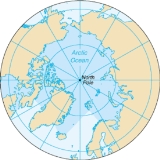
The
North Pole, also known as the
Geographic North Pole or
Terrestrial North Pole, is, subject to the caveats explained below, defined as the point in the
northern hemisphereThe Northern Hemisphere is the half of a planet that is north of its equator—the word hemisphere literally means “half sphere”. It is also that half of the celestial sphere north of the celestial equator...
where the
EarthEarth is the third planet from the Sun, and the densest and fifth-largest of the eight planets in the Solar System. It is also the largest of the Solar System's four terrestrial planets...
's axis of rotation meets its surface. It should not be confused with the
North Magnetic PoleThe Earth's North Magnetic Pole is the point on the surface of the Northern Hemisphere at which the Earth's magnetic field points vertically downwards . Though geographically in the north, it is, by the direction of the magnetic field lines, physically the south pole of the Earth's magnetic field...
.
The North Pole is the northernmost point on Earth, lying diametrically opposite the
South PoleThe South Pole, also known as the Geographic South Pole or Terrestrial South Pole, is one of the two points where the Earth's axis of rotation intersects its surface. It is the southernmost point on the surface of the Earth and lies on the opposite side of the Earth from the North Pole...
. It defines geodetic latitude 90° North, as well as the direction of
True NorthTrue north is the direction along the earth's surface towards the geographic North Pole.True geodetic north usually differs from magnetic north , and from grid north...
. At the North Pole all directions point south; all lines of longitude converge there, so its longitude can be defined as any degree value.
While the South Pole lies on a continental
land mass, the North Pole is located in the middle of the
Arctic OceanThe Arctic Ocean, located in the Northern Hemisphere and mostly in the Arctic north polar region, is the smallest and shallowest of the world's five major oceanic divisions...
amidst waters that are almost permanently covered with constantly shifting
sea iceSea ice is largely formed from seawater that freezes. Because the oceans consist of saltwater, this occurs below the freezing point of pure water, at about -1.8 °C ....
. This makes it impractical to construct a permanent station at the North Pole (unlike the South Pole). However, the
Soviet UnionThe Soviet Union , officially the Union of Soviet Socialist Republics , was a constitutionally socialist state that existed in Eurasia between 1922 and 1991....
, and later
RussiaRussia or , officially known as both Russia and the Russian Federation , is a country in northern Eurasia. It is a federal semi-presidential republic, comprising 83 federal subjects...
, have constructed a number of
manned drifting stationsSoviet and Russian manned drifting ice stations are important contributors to exploration of the Arctic. The stations are named North Pole Soviet and Russian manned drifting ice stations are important contributors to exploration of the Arctic. The stations are named North Pole Soviet and...
, some of which have passed over or very close to the Pole. In recent years, a number of studies have predicted that the North Pole may become seasonally ice-free due to
Arctic shrinkageOngoing changes in the climate of the Arctic include rising temperatures, loss of sea ice, and melting of the Greenland ice sheet. Projections of sea ice loss suggest that the Arctic ocean will likely be free of summer sea ice sometime between 2060 and 2080, while another estimate puts this date at...
, with timescales varying from a few years to fifty years or more.
The sea depth at the North Pole has been measured at 4261 m (13,979.7 ft). The nearest land is usually said to be
Kaffeklubben IslandKaffeklubben Island or The Coffee Club Island is a small island lying off the northern tip of Greenland. It is the northernmost point of land on Earth....
, off the northern coast of
GreenlandGreenland is an autonomous country within the Kingdom of Denmark, located between the Arctic and Atlantic Oceans, east of the Canadian Arctic Archipelago. Though physiographically a part of the continent of North America, Greenland has been politically and culturally associated with Europe for...
about 700 km (435 mi) away, though some perhaps non-permanent gravel banks lie slightly closer. The nearest permanently inhabited place is
AlertAlert, in the Qikiqtaaluk Region, Nunavut, Canada, is the northernmost permanently inhabited place in the world, from the North Pole. It takes its name from HMS Alert, which wintered east of the present station, off what is now Cape Sheridan, in 1875–1876.Alert was reported to have five permanent...
in the Qikiqtaaluk Region, Nunavut, Canada, which is located 817 kilometres (507.7 mi) from the Pole.
Precise definition
The Earth's axis of rotation – and hence the position of the North Pole – was commonly believed to be fixed (relative to the surface of the Earth) until, in the 18th century, the mathematician
Leonhard EulerLeonhard Euler was a pioneering Swiss mathematician and physicist. He made important discoveries in fields as diverse as infinitesimal calculus and graph theory. He also introduced much of the modern mathematical terminology and notation, particularly for mathematical analysis, such as the notion...
predicted that the axis might "wobble" slightly. Around the beginning of the 20th century astronomers noticed a small apparent "variation of latitude," as determined for a fixed point on Earth from the observation of stars. Part of this variation could be attributed to a wandering of the Pole across the Earth's surface, by a range of a few meters. The wandering has several periodic components and an irregular component. The component with a period of about 435 days is identified with the 8 month wandering predicted by Euler and is now called the
Chandler wobbleThe Chandler wobble is a small motion in the Earth's axis of rotation relative to the Earth's surface, which was discovered by American astronomer Seth Carlo Chandler in 1891. It amounts to on the Earth's surface and has a period of 433 days...
after its discoverer. The exact point of intersection of the Earth's axis and the Earth's surface, at any given moment, is called the "instantaneous pole", but because of the "wobble" this cannot be used as a definition of a fixed North Pole (or South Pole) when metre-scale precision is required.
It is desirable to tie the system of Earth coordinates (
latitudeIn geography, the latitude of a location on the Earth is the angular distance of that location south or north of the Equator. The latitude is an angle, and is usually measured in degrees . The equator has a latitude of 0°, the North pole has a latitude of 90° north , and the South pole has a...
,
longitudeLongitude is a geographic coordinate that specifies the east-west position of a point on the Earth's surface. It is an angular measurement, usually expressed in degrees, minutes and seconds, and denoted by the Greek letter lambda ....
, and elevations or
orographyOrography is the study of the formation and relief of mountains, and can more broadly include hills, and any part of a region's elevated terrain...
) to fixed landforms. Of course, given
plate tectonicsPlate tectonics is a scientific theory that describes the large scale motions of Earth's lithosphere...
and
isostasyIsostasy is a term used in geology to refer to the state of gravitational equilibrium between the earth's lithosphere and asthenosphere such that the tectonic plates "float" at an elevation which depends on their thickness and density. This concept is invoked to explain how different topographic...
, there is no system in which all geographic features are fixed. Yet the
International Earth Rotation and Reference Systems ServiceThe International Earth Rotation and Reference Systems Service , formerly the International Earth Rotation Service, is the body responsible for maintaining global time and reference frame standards, notably through its Earth Orientation Parameter and International Celestial Reference System ...
and the
International Astronomical UnionThe International Astronomical Union IAU is a collection of professional astronomers, at the Ph.D. level and beyond, active in professional research and education in astronomy...
have defined a framework called the
International Terrestrial Reference SystemThe International Terrestrial Reference System describes procedures for creating reference frames suitable for use with measurements on or near the Earth's surface. This is done in much the same way that a physical standard might be described as a set of procedures for creating a realization of...
.
Pre-1900
As early as the sixteenth century, many eminent people correctly believed that the North Pole was in a sea, which in the nineteenth century was called the Polynia or
Open Polar SeaThe Open Polar Sea was a hypothesized ice-free ocean surrounding the North Pole. This unproven theory was once so widely believed that many exploring expeditions used it as justification for attempts to reach the North Pole by sea, or to find a navigable sea route between Europe and the Pacific...
. It was therefore hoped that passage could be found through ice floes at favorable times of the year. Several expeditions set out to find the way, generally with whaling ships, already commonly used in the cold northern latitudes.
One of the earliest expeditions to set out with the explicit intention of reaching the North Pole was that of British naval officer
William Edward ParrySir William Edward Parry was an English rear-admiral and Arctic explorer, who in 1827 attempted one of the earliest expeditions to the North Pole...
, who in 1827 reached latitude 82°45′ North. In 1871 the
Polaris expeditionThe Polaris expedition was led by the American Charles Francis Hall, who intended it to be the first expedition to reach the North Pole. Sponsored by the United States government, it was one of the first serious attempts at the Pole, after that of British naval officer William Edward Parry, who in...
, a US attempt on the Pole led by
Charles Francis HallCharles Francis Hall was an American Arctic explorer. Little is known of Hall's early life. He was born in the state of Vermont, but while he was still a child his family moved to Rochester, New Hampshire, where, as a boy, he was apprenticed to a blacksmith. In the 1840s he married and drifted...
, ended in disaster. Another British
Royal NavyThe Royal Navy is the naval warfare service branch of the British Armed Forces. Founded in the 16th century, it is the oldest service branch and is known as the Senior Service...
attempt on the pole, part of the
British Arctic ExpeditionThe British Arctic Expedition of 1875-1876, led by Sir George Strong Nares, was sent by the British Admiralty to attempt to reach the North Pole via Smith Sound. Two ships, HMS Alert and HMS Discovery , sailed from Portsmouth on 29 May 1875...
, by Commander
Albert H. MarkhamAdmiral Sir Albert Hastings Markham, KCB was a British explorer, author, and officer in the Royal Navy. In 1903 he was made Knight Commander in the Order of the Bath...
reached a then-record 83°20'26" North in May 1876 before turning back. An 1879–1881 expedition commanded by US naval officer George Washington DeLong ended tragically when their ship the
USS JeanetteThe first USS Jeannette was originally HMS Pandora, a Philomel-class gunvessel of the Royal Navy, and was purchased in 1875 by Sir Allen Young for his arctic voyages in 1875-1876. The ship was purchased in 1878 by James Gordon Bennett, Jr., owner of the New York Herald; and renamed Jeannette...
, was crushed by ice. Over half the crew, including DeLong, were lost.
In April 1895 the Norwegian explorers
Fridtjof NansenFridtjof Wedel-Jarlsberg Nansen was a Norwegian explorer, scientist, diplomat, humanitarian and Nobel Peace Prize laureate. In his youth a champion skier and ice skater, he led the team that made the first crossing of the Greenland interior in 1888, and won international fame after reaching a...
and Fredrik Hjalmar Johansen struck out for the Pole on skis after leaving Nansen's icebound ship
FramFram is a ship that was used in expeditions of the Arctic and Antarctic regions by the Norwegian explorers Fridtjof Nansen, Otto Sverdrup, Oscar Wisting, and Roald Amundsen between 1893 and 1912...
. The pair reached latitude 86°14′ North before they abandoned the attempt and turned southwards, eventually reaching
Franz Josef LandFranz Josef Land, Franz Joseph Land, or Francis Joseph's Land is an archipelago located in the far north of Russia. It is found in the Arctic Ocean north of Novaya Zemlya and east of Svalbard, and is administered by Arkhangelsk Oblast. Franz Josef Land consists of 191 ice-covered islands with a...
.
In 1897 Swedish engineer
Salomon August AndréeSalomon August Andrée , during his lifetime most often known as S. A. Andrée, was a Swedish engineer, physicist, aeronaut and polar explorer who died while leading an attempt to reach the Geographic North Pole by hydrogen balloon...
and two companions tried to reach the North Pole in the hydrogen balloon
Örnen ("Eagle"), but were stranded 300 km (186.4 mi) north of
KvitøyaKvitøya is an island in the Svalbard archipelago in the Arctic Ocean, with an area of . It is located at , making it the easternmost part of the Kingdom of Norway...
, the northeasternmost part of the
SvalbardSvalbard is an archipelago in the Arctic, constituting the northernmost part of Norway. It is located north of mainland Europe, midway between mainland Norway and the North Pole. The group of islands range from 74° to 81° north latitude , and from 10° to 35° east longitude. Spitsbergen is the...
ArchipelagoAn archipelago , sometimes called an island group, is a chain or cluster of islands. The word archipelago is derived from the Greek ἄρχι- – arkhi- and πέλαγος – pélagos through the Italian arcipelago...
, and perished on this lonely island. In 1930 the remains of this expedition were found by the Norwegian
Bratvaag ExpeditionThe Bratvaag Expedition was a Norwegian expedition in 1930 led by Dr. Gunnar Horn, whose official tasks were hunting seals and to study glaciers and seas in the Svalbard Arctic region. The name of the expedition was taken from its ship, M/S Bratvaag of Ålesund, in which captain Peder Eliassen had...
.
The Italian explorer
Luigi Amedeo, Duke of the AbruzziPrince Luigi Amedeo Giuseppe Maria Ferdinando Francesco di Savoia-Aosta , Duke of the Abruzzi , was an Italian nobleman, mountaineer and explorer of the royal House of Savoy...
and Captain
Umberto CagniUmberto Cagni was a polar explorer and an admiral in the Royal Italian Navy. He is best known for his leadership in a probe, by dogsled, northward over the surface of the Arctic Ocean in 1900...
of the Italian Royal Navy (Regia Marina) sailed the converted whaler
Stella Polare from Norway in 1899. On March 11, 1900 Cagni led a party over the ice and reached latitude 86° 34’ on April 25, setting a new record by beating Nansen's result of 1895 by 35 kilometre. Cagni barely managed to return to the camp, remaining there until June 23. On August 16 the
Stella Polare left
Rudolf IslandPrince Rudolf Land, Crown Prince Rudolf Land, Prince Rudolf Island or Rudolf Island is the northernmost island of the Franz Josef Archipelago, Russia. The island was named by the Austro-Hungarian North Pole Expedition in honor of Archduke Rudolf , Crown Prince of Austria, Hungary and Bohemia...
heading south and the expedition returned to Norway.
1900–1940
The US explorer Frederick Albert Cook claimed to have reached the North Pole on April 21, 1908 with two Inuit men, Ahwelah and Etukishook, but he was unable to produce convincing proof and his claim is not widely accepted.
The conquest of the North Pole was for many years credited to US Navy engineer
Robert PearyRobert Edwin Peary, Sr. was an American explorer who claimed to have been the first person, on April 6, 1909, to reach the geographic North Pole...
, who claimed to have reached the Pole on April 6, 1909, accompanied by
Matthew HensonMatthew Alexander Henson was an African American explorer and associate of Robert Peary during various expeditions, the most famous being a 1909 expedition which it was discovered that he was the the first person to reach the Geographic North Pole.-Life:Henson was born on a farm in Nanjemoy,...
and four
InuitThe Inuit are a group of culturally similar indigenous peoples inhabiting the Arctic regions of Canada , Denmark , Russia and the United States . Inuit means “the people” in the Inuktitut language...
men named Ootah, Seeglo, Egingwah, and Ooqueah. However, Peary's claim remains controversial. The party that accompanied Peary on the final stage of the journey included no one who was trained in navigation and could independently confirm his own navigational work, which some claim to have been particularly sloppy as he approached the Pole.
The distances and speeds that Peary claimed to have achieved once the last support party turned back seem incredible to many people, almost three times that which he had accomplished up to that point. Peary's account of a journey to the Pole and back while traveling along the direct line – the only strategy that is consistent with the time constraints that he was facing – is contradicted by Henson's account of tortuous detours to avoid pressure ridges and open leads.
The British explorer
Wally HerbertSir Walter William "Wally" Herbert was a British polar explorer, writer and artist. In 1969 he became the first man to walk undisputed to the North Pole, on the 60th anniversary of Robert Peary's famous, but disputed, expedition...
, initially a supporter of Peary, researched Peary's records in 1989 and concluded that they must have been falsified and that Peary had not reached the Pole. Support for Peary came again in 2005, however, when the British explorer
Tom AveryThomas Avery is a British explorer and author. He gained notoriety for his record-breaking journey to the South Pole in 2002. He has travelled by foot to both the North and South Poles.-Early life:...
and four companions recreated the outward portion of Peary's journey with replica wooden sleds and
Canadian Eskimo DogThe Canadian Eskimo Dog is an Arctic breed of dog , which is often considered to be North America’s oldest and rarest remaining purebred indigenous domestic canine. Other names include Qimmiq...
teams, reaching the North Pole in 36 days, 22 hours – nearly five hours faster than Peary. Avery writes on his web site that "The admiration and respect which I hold for Robert Peary, Matthew Henson and the four Inuit men who ventured North in 1909, has grown enormously since we set out from Cape Columbia. Having now seen for myself how he travelled across the pack ice, I am more convinced than ever that Peary did indeed discover the North Pole."
The first claimed flight over the Pole was made on May 9, 1926 by US naval officer Richard E. Byrd and pilot
Floyd BennettFloyd Bennett was an American aviator who piloted Richard E. Byrd on his attempt to reach the North Pole in 1926.-Biography:...
in a Fokker tri-motor aircraft. Although verified at the time by the US Navy and a committee of the
National Geographic SocietyThe National Geographic Society , headquartered in Washington, D.C. in the United States, is one of the largest non-profit scientific and educational institutions in the world. Its interests include geography, archaeology and natural science, the promotion of environmental and historical...
, this claim has since been disputed.
The first undisputed sighting of the Pole was on May 12, 1926 by
NorwegianNorway , officially the Kingdom of Norway, is a Nordic unitary constitutional monarchy whose territory comprises the western portion of the Scandinavian Peninsula, Jan Mayen, and the Arctic archipelago of Svalbard and Bouvet Island. Norway has a total area of and a population of about 4.9 million...
explorer
Roald AmundsenRoald Engelbregt Gravning Amundsen was a Norwegian explorer of polar regions. He led the first Antarctic expedition to reach the South Pole between 1910 and 1912 and he was the first person to reach both the North and South Poles. He is also known as the first to traverse the Northwest Passage....
and his
United StatesThe United States of America is a federal constitutional republic comprising fifty states and a federal district...
sponsor
Lincoln EllsworthLincoln Ellsworth was an arctic explorer from the United States.-Birth:He was born on May 12, 1880 to James Ellsworth and Eva Frances Butler in Chicago, Illinois...
from the
airshipAn airship or dirigible is a type of aerostat or "lighter-than-air aircraft" that can be steered and propelled through the air using rudders and propellers or other thrust mechanisms...
NorgeThe Norge was a semi-rigid Italian-built airship that carried out what many consider the first verified overflight of the North Pole on May 12, 1926. It was also the first aircraft to fly over the polar ice cap between Europe and America...
.
Norge, though Norwegian owned, was designed and piloted by the
ItalianItaly , officially the Italian Republic languages]] under the European Charter for Regional or Minority Languages. In each of these, Italy's official name is as follows:;;;;;;;;), is a unitary parliamentary republic in South-Central Europe. To the north it borders France, Switzerland, Austria and...
Umberto NobileUmberto Nobile was an Italian aeronautical engineer and Arctic explorer. Nobile was a developer and promoter of semi-rigid airships during the Golden Age of Aviation between the two World Wars...
. The flight started from
SvalbardSvalbard is an archipelago in the Arctic, constituting the northernmost part of Norway. It is located north of mainland Europe, midway between mainland Norway and the North Pole. The group of islands range from 74° to 81° north latitude , and from 10° to 35° east longitude. Spitsbergen is the...
and crossed the icecap to
AlaskaAlaska is the largest state in the United States by area. It is situated in the northwest extremity of the North American continent, with Canada to the east, the Arctic Ocean to the north, and the Pacific Ocean to the west and south, with Russia further west across the Bering Strait...
. Nobile, along with several scientists and crew from the
Norge, overflew the Pole a second time on May 24, 1928 in the airship
ItaliaAirship Italia was a semi-rigid airship used by Italian engineer Umberto Nobile in his second series of flights around the North Pole.-Design and specifications:...
. The
Italia crashed on its return from the Pole, with the loss of half the crew.
1940–2000
In May 1945 an
RAFThe Royal Air Force is the aerial warfare service branch of the British Armed Forces. Formed on 1 April 1918, it is the oldest independent air force in the world...
LancasterThe Avro Lancaster is a British four-engined Second World War heavy bomber made initially by Avro for the Royal Air Force . It first saw active service in 1942, and together with the Handley Page Halifax it was one of the main heavy bombers of the RAF, the RCAF, and squadrons from other...
of the
Aries expedition became the first
CommonwealthThe Commonwealth of Nations, normally referred to as the Commonwealth and formerly known as the British Commonwealth, is an intergovernmental organisation of fifty-four independent member states...
aircraft to overfly the North Geographic and North Magnetic Poles. The plane was piloted by David Cecil McKinley of the
Royal Air ForceThe Royal Air Force is the aerial warfare service branch of the British Armed Forces. Formed on 1 April 1918, it is the oldest independent air force in the world...
. It carried an 11-man crew, with Kenneth C. Maclure of the
Royal Canadian Air ForceThe history of the Royal Canadian Air Force begins in 1920, when the air force was created as the Canadian Air Force . In 1924 the CAF was renamed the Royal Canadian Air Force and granted royal sanction by King George V. The RCAF existed as an independent service until 1968...
in charge of all scientific observations. In 2006, Maclure was honoured with a spot in the Canadian Aviation Hall Of Fame.
Not counting Peary's disputed claim, the first men to set foot at the North Pole were a Soviet Union party. These are variously described as including Pavel Gordiyenko (or Geordiyenko) and three or five others, or Aleksandr Kuznetsov and 23 others, who landed a plane (or planes) there on April 23, 1948. According to Antarctica.org, three Li-2 planes landed, carrying a total of seven men.
On May 3, 1952, U.S. Air Force Lieutenant Colonel
Joseph O. FletcherJoseph Otis Fletcher was an American Air Force pilot and polar explorer.-Biography:Born outside of Ryegate, Montana, the family moved to Oklahoma during the Dust Bowl. Fletcher started studying at the University of Oklahoma and then continued his studies in meteorology at the MIT. After...
and Lieutenant William P. Benedict, along with scientist
Albert P. CraryAlbert Paddock Crary , was a pioneer polar geophysicist and glaciologist. He made it to the North and then to the South Pole on February 12, 1961 as the leader of a team of eight. The south pole expedition had set out from McMurdo Station on December 10, 1960, using three Snowcats with trailers...
, landed a modified
C-47 SkytrainThe Douglas C-47 Skytrain or Dakota is a military transport aircraft that was developed from the Douglas DC-3 airliner. It was used extensively by the Allies during World War II and remained in front line operations through the 1950s with a few remaining in operation to this day.-Design and...
at the North Pole. Some sources consider this, rather than the Soviet mission, to be the first ever landing at the Pole.
The United States Navy submarine
USS NautilusUSS Nautilus is the world's first operational nuclear-powered submarine. She was the first vessel to complete a submerged transit beneath the North Pole on August 3, 1958...
(SSN-571) crossed the North Pole on August 3, 1958, and on March 17, 1959, the
USS SkateUSS Skate , the third submarine of the United States Navy named for the skate, a type of ray, was the lead ship of the Skate class of nuclear submarines...
(SSN-578) surfaced at the Pole, becoming the first naval vessel to do so.
Setting aside Peary's claim, the first confirmed surface conquest of the North Pole was that of
Ralph PlaistedRalph Plaisted and his three companions, Walt Pederson, Gerry Pitzl and Jean-Luc Bombardier, are regarded by most polar authorities to be the first to succeed in a surface traverse across the ice to the North Pole on 19 April 1968, making the first confirmed surface conquest of the Pole.Plaisted...
, Walt Pederson, Gerry Pitzl and Jean Luc Bombardier, who traveled over the ice by
snowmobileA snowmobile, also known in some places as a snowmachine, or sled,is a land vehicle for winter travel on snow. Designed to be operated on snow and ice, they require no road or trail. Design variations enable some machines to operate in deep snow or forests; most are used on open terrain, including...
and arrived on April 19, 1968. The
United States Air ForceThe United States Air Force is the aerial warfare service branch of the United States Armed Forces and one of the American uniformed services. Initially part of the United States Army, the USAF was formed as a separate branch of the military on September 18, 1947 under the National Security Act of...
independently confirmed their position.
On April 6, 1969, Wally Herbert and companions Allan Gill, Roy Koerner and Kenneth Hedges of the British Trans-Arctic Expedition became the first men to reach the North Pole on foot (albeit with the aid of dog teams and air drops). They continued on to complete the first surface crossing of the
Arctic OceanThe Arctic Ocean, located in the Northern Hemisphere and mostly in the Arctic north polar region, is the smallest and shallowest of the world's five major oceanic divisions...
– and by its longest axis,
Barrow, AlaskaBarrow is the largest city of the North Slope Borough in the U.S. state of Alaska. It is one of the northernmost cities in the world and is the northernmost city in the United States of America, with nearby Point Barrow being the nation's northernmost point. Barrow's population was 4,212 at the...
to
SvalbardSvalbard is an archipelago in the Arctic, constituting the northernmost part of Norway. It is located north of mainland Europe, midway between mainland Norway and the North Pole. The group of islands range from 74° to 81° north latitude , and from 10° to 35° east longitude. Spitsbergen is the...
– a feat that has never been repeated. Because of suggestions of Plaisted's use of air transport, some sources classify Herbert's expedition as the first confirmed to reach the North Pole over the ice surface by any means.
On August 17, 1977, the Soviet
nuclear powered icebreakerA nuclear powered icebreaker is a purpose-built ship for use in waters continuously covered with ice. Icebreakers are ships capable of cruising on ice-covered water by breaking through the ice with their strong, heavy, steel bows...
ArktikaThe Arktika class is a Russian class of nuclear powered icebreakers. They are owned by the federal government, but were operated by the Murmansk Shipping Company until 2008, when they were transferred to the fully government-owned operator Atomflot. Of the ten civilian nuclear powered vessels...
completed the first surface vessel journey to the North Pole.
In 1982 Sir Ranulph Fiennes and Charles Burton became the first people to cross the Arctic Ocean in a single season. They departed from Cape Crozier,
Ellesmere IslandEllesmere Island is part of the Qikiqtaaluk Region of the Canadian territory of Nunavut. Lying within the Canadian Arctic Archipelago, it is considered part of the Queen Elizabeth Islands, with Cape Columbia being the most northerly point of land in Canada...
, on 17 February 1982 and arrived at the geographic North Pole on 10 April 1982. They travelled on foot and skidoo. From the Pole, they travelled towards
SvalbardSvalbard is an archipelago in the Arctic, constituting the northernmost part of Norway. It is located north of mainland Europe, midway between mainland Norway and the North Pole. The group of islands range from 74° to 81° north latitude , and from 10° to 35° east longitude. Spitsbergen is the...
but, due to the unstable nature of the ice, ended their crossing at the ice edge after drifting south on an ice floe for 99 days. They were eventually able to walk to their expedition ship
MV Benjamin Bowring and boarded it on 4 August 1982 at position 80:31N 00:59W. As a result of this journey, which formed a section of the three-year
Transglobe ExpeditionIn 1979, adventurers Sir Ranulph Fiennes and Charles R. Burton set out to make the first circumpolar navigation, traveling the world "vertically" traversing both of the poles. Starting from Greenwich in the United Kingdom, they went south, arriving at the South Pole on December 17, 1980. Over the...
1979–1982, Fiennes and Burton became the first people to complete a circumnavigation of the world via both North and South Poles, by surface travel alone. This achievement remains unchallenged to this day.
On September 7, 1991, the German research vessel RV Polarstern and the Swedish ice breaker
OdenThe Oden is a large Swedish icebreaker, built in 1988 for the Swedish Maritime Administration. It is named after the asa god Odin. First built to clear a passage through the ice of the Baltic sea for cargo ships, it was later modified to serve as a research vessel...
reached the North Pole as the first conventional powered vessels. Both scientific parties and crew took oceanographic and geological samples and had a common
tug of warTug of war, also known as tug o' war, tug war, rope war or rope pulling, is a sport that directly pits two teams against each other in a test of strength. The term may also be used as a metaphor to describe a demonstration of brute strength by two opposing groups, such as a rivalry between two...
and a football game on an ice floe. Polarstern again reached the pole exactly 10 years later together with the USCGC Healy.
21st century
In recent years, journeys to the North Pole by air (landing by helicopter or on a runway prepared on the ice) or by icebreaker have become relatively routine, and are even available to small groups of tourists through adventure holiday companies.
Parachute jumps have frequently been made onto the North Pole in recent years. There has been underwater exploration of the North Pole, although it is disputed if the first underwater exploration of the North Pole occurred in 1998 by a team of divers from Moscow State University (only one scuba dive was undertaken and that dive resulted in a fatality) or in April 1999 by a team of international scuba divers.
In 2005, the United States Navy submarine
USS CharlotteUSS Charlotte , a , is the fourth ship of the United States Navy to be named for Charlotte, North Carolina. The contract to build her was awarded to Newport News Shipbuilding and Dry Dock Company in Newport News, Virginia on 6 February 1987 and her keel was laid down on 17 August 1990. She was...
(SSN-766) surfaced through 155 cm (61 in) of ice at the North Pole and spent 18 hours there.
In July 2007, British endurance swimmer
Lewis Gordon PughLewis Gordon Pugh, OIG is a British environmental campaigner, maritime lawyer and endurance swimmer.Pugh was the first person to complete a long distance swim in every ocean...
completed a 1 km (0.621372736649807 mi) swim at the North Pole. His feat, undertaken to highlight the effects of climate change, took place in clear water that had opened up between the ice floes. His later attempt to paddle a
kayakA kayak is a small, relatively narrow, human-powered boat primarily designed to be manually propelled by means of a double blade paddle.The traditional kayak has a covered deck and one or more cockpits, each seating one paddler...
to the North Pole in late 2008, following the erroneous prediction of clear water to the Pole, was stymied when his expedition found itself stuck in thick ice after only three days. The expedition was then abandoned.
2007 descent to North Pole seabed
On August 2, 2007, a
RussiaRussia or , officially known as both Russia and the Russian Federation , is a country in northern Eurasia. It is a federal semi-presidential republic, comprising 83 federal subjects...
n scientific expedition
Arktika 2007Arktika 2007 was a 2007 expedition in which Russia performed the first ever crewed descent to the ocean bottom at the North Pole, as part of research related to the 2001 Russian territorial claim, one of many territorial claims in the Arctic, made possible, in part, because of Arctic shrinkage...
made the first ever manned descent to the ocean bottom at the North Pole, to a depth of 4.3 km (2.7 mi), as part of a research programme in support of Russia's 2001 territorial claim to a large swathe of the
Arctic OceanThe Arctic Ocean, located in the Northern Hemisphere and mostly in the Arctic north polar region, is the smallest and shallowest of the world's five major oceanic divisions...
. The descent took place in two
MIR submersibleMir is a self-propelled Deep Submergence Vehicle. The project was initially developed by the USSR Academy of Sciences along with Design Bureau Lazurith. Later two vehicles were ordered from Finland...
s and was led by
SovietThe Soviet Union , officially the Union of Soviet Socialist Republics , was a constitutionally socialist state that existed in Eurasia between 1922 and 1991....
and Russian polar explorer Arthur Chilingarov. In a symbolic act, the Russian flag was placed on the seabed at the exact position of the Pole.
The expedition is the latest in a decades-long series of moves by Russia intended to show that it is the dominant influence in the Arctic. The warming Arctic climate and summer retreat of sea ice there has suddenly turned the attention of countries from China to the United States toward the top of the world, where resources and shipping routes may soon be exploitable.
MLAE-2009 Expedition
In 2009 Russian expedition
MLAE-2009In 2009 Marine Live-ice Automobile Expedition successfully traversed 2033 kilometers of the Arctic waters and ice between Ostrov Sredniy island of Severnaya Zemlya archipelago and The North Pole. The route took 38 days between 20 March and the 26th of April 2009....
reached the North Pole in two custom built amphibious
"Yemelya" vehicles designed by the prominent Russian explorer, adventurer and engineer Vasily Elagin. The expedition has been organized by the
Russian Geographical Society and the Russian Book of Records recorded the journey as the first expedition in the history of Arctic exploration to reach the Geographic North Pole using wheeled land auto vehicles. MLAE-2009 expedition crew reached the North Pole on April 26th 2009 at 1730 (Moscow time). Subsequent expedition MLAE-2011 followed two years later in 2011.
Day and night
- See also Midnight sun
The midnight sun is a natural phenomenon occurring in summer months at latitudes north and nearby to the south of the Arctic Circle, and south and nearby to the north of the Antarctic Circle where the sun remains visible at the local midnight. Given fair weather, the sun is visible for a continuous...
and Polar nightThe polar night occurs when the night lasts for more than 24 hours. This occurs only inside the polar circles. The opposite phenomenon, the polar day, or midnight sun, occurs when the sun stays above the horizon for more than 24 hours.-Description:...
At the North Pole, the
sunThe Sun is the star at the center of the Solar System. It is almost perfectly spherical and consists of hot plasma interwoven with magnetic fields...
is continuously above the horizon during the summer and continuously below the horizon during the winter.
SunriseSunrise is the instant at which the upper edge of the Sun appears above the horizon in the east. Sunrise should not be confused with dawn, which is the point at which the sky begins to lighten, some time before the sun itself appears, ending twilight...
is just before the vernal equinox (around March 19); the sun then takes three months to reach its highest point of near 23½° elevation at the summer
solsticeA solstice is an astronomical event that happens twice each year when the Sun's apparent position in the sky, as viewed from Earth, reaches its northernmost or southernmost extremes...
(around June 21), after which time it begins to sink, reaching
sunsetSunset or sundown is the daily disappearance of the Sun below the horizon in the west as a result of Earth's rotation.The time of sunset is defined in astronomy as the moment the trailing edge of the Sun's disk disappears below the horizon in the west...
just after the autumnal equinox (around September 24). When the sun is visible in the polar sky, it appears to move in a horizontal circle above the horizon. This circle gradually rises from near the horizon just after the vernal equinox to its maximum elevation (in degrees) above the horizon at summer solstice and then sinks back toward the horizon before sinking below it at the autumnal equinox.
A civil twilight period of about two weeks occurs before sunrise and after sunset, a nautical twilight period of about five weeks occurs before sunrise and after sunset and an astronomical twilight period of about seven weeks occurs before sunrise and after sunset.
These effects are caused by a combination of the
EarthEarth is the third planet from the Sun, and the densest and fifth-largest of the eight planets in the Solar System. It is also the largest of the Solar System's four terrestrial planets...
's
axial tiltIn astronomy, axial tilt is the angle between an object's rotational axis, and a line perpendicular to its orbital plane...
and its revolution around the sun. The direction of the Earth's axial tilt, as well as its angle relative to the plane of the Earth's orbit around the sun, remains very nearly constant over the course of a year (both change very slowly over long time periods). At northern midsummer the North Pole is facing towards the sun to its maximum extent. As the year progresses and the Earth moves around the sun, the North Pole gradually turns away from the sun until at midwinter it is facing away from the Sun to its maximum extent. A similar sequence is observed at the South Pole, with a six-month time difference.
Time
In most places on Earth, local time is determined by
longitudeLongitude is a geographic coordinate that specifies the east-west position of a point on the Earth's surface. It is an angular measurement, usually expressed in degrees, minutes and seconds, and denoted by the Greek letter lambda ....
, such that the time of day is more-or-less synchronised to the position of the sun in the sky (for example, at midday the sun is roughly at its highest). This line of reasoning fails at the North Pole, where the sun rises and sets only once per year, and all lines of longitude, and hence all time zones, converge. There is no permanent human presence at the North Pole, and no particular time zone has been assigned. Polar expeditions may use any time zone that is convenient, such as GMT, or the time zone of the country they departed from.
Climate
The North Pole is significantly warmer than the South Pole because it lies at sea level in the middle of an ocean (which acts as a reservoir of heat), rather than at altitude in a continental land mass.
Winter (January) temperatures at the North Pole can range from about -43 C to -26 C, perhaps averaging around -34 C. Summer temperatures (June, July and August) average around the freezing point (0 °C (32 °F)). The highest temperature yet recorded is 5 °C (41 °F), much warmer than the South Pole's record high of only -13.5 C.
The sea ice at the North Pole is typically around 2 metre thick, though there is considerable variation and occasionally the movement of floes exposes clear water. Studies have shown that the average ice thickness has decreased in recent years. Many attribute this decrease to
global warmingGlobal warming refers to the rising average temperature of Earth's atmosphere and oceans and its projected continuation. In the last 100 years, Earth's average surface temperature increased by about with about two thirds of the increase occurring over just the last three decades...
, though this conclusion is disputed by some. Reports have also predicted that within a few decades the
Arctic OceanThe Arctic Ocean, located in the Northern Hemisphere and mostly in the Arctic north polar region, is the smallest and shallowest of the world's five major oceanic divisions...
will be entirely free of ice in the summer. This may have significant commercial implications; see "Territorial Claims," below.
Flora and fauna
Polar bearThe polar bear is a bear native largely within the Arctic Circle encompassing the Arctic Ocean, its surrounding seas and surrounding land masses. It is the world's largest land carnivore and also the largest bear, together with the omnivorous Kodiak Bear, which is approximately the same size...
s are believed rarely to travel beyond about 82° North owing to the scarcity of food, though tracks have been seen in the vicinity of the North Pole, and a 2006 expedition reported sighting a polar bear just 1 mi (1.6 km) from the Pole. The
ringed sealThe ringed seal , also known as the jar seal and as netsik or nattiq by the Inuit, is an earless seal inhabiting the Arctic and sub-Arctic regions...
has also been seen at the Pole, and
Arctic foxThe arctic fox , also known as the white fox, polar fox or snow fox, is a small fox native to Arctic regions of the Northern Hemisphere and is common throughout the Arctic tundra biome. The Greek word alopex, means a fox and Vulpes is the Latin version...
es have been observed less than 60 km (37.3 mi) away at 89°40′ N.
Birds seen at or very near the Pole include the
Snow BuntingThe Snow Bunting , sometimes colloquially called a snowflake, is a passerine bird in the longspur family Calcariidae. It is an arctic specialist, with a circumpolar Arctic breeding range throughout the northern hemisphere...
,
Northern FulmarThe Northern Fulmar, Fulmarus glacialis, Fulmar, or Arctic Fulmar is a highly abundant sea bird found primarily in subarctic regions of the north Atlantic and north Pacific oceans. Fulmars come in one of two color morphs: a light one which is almost entirely white, and a dark one which is...
and
Black-legged KittiwakeThe Black-legged Kittiwake is a seabird species in the gull family Laridae.This species was first described by Linnaeus in his Systema naturae in 1758 as Larus tridactylus....
, though some bird sightings may be distorted by the tendency of birds to follow ships and expeditions.
Fish have been seen in the waters at the North Pole, but these are probably few in number. A member of the Russian team that descended to the North Pole seabed in August 2007 reported seeing no sea creatures living there. However, it was later reported that a
sea anemoneSea anemones are a group of water-dwelling, predatory animals of the order Actiniaria; they are named after the anemone, a terrestrial flower. Sea anemones are classified in the phylum Cnidaria, class Anthozoa, subclass Zoantharia. Anthozoa often have large polyps that allow for digestion of larger...
had been scooped up from the seabed mud by the Russian team and that video footage from the dive showed unidentified
shrimpShrimp are swimming, decapod crustaceans classified in the infraorder Caridea, found widely around the world in both fresh and salt water. Adult shrimp are filter feeding benthic animals living close to the bottom. They can live in schools and can swim rapidly backwards. Shrimp are an important...
s and amphipods.
Territorial claims to the North Pole and Arctic regions
Under international law, no country currently owns the North Pole or the region of the
Arctic OceanThe Arctic Ocean, located in the Northern Hemisphere and mostly in the Arctic north polar region, is the smallest and shallowest of the world's five major oceanic divisions...
surrounding it. The five surrounding Arctic countries,
RussiaRussia or , officially known as both Russia and the Russian Federation , is a country in northern Eurasia. It is a federal semi-presidential republic, comprising 83 federal subjects...
,
CanadaCanada is a North American country consisting of ten provinces and three territories. Located in the northern part of the continent, it extends from the Atlantic Ocean in the east to the Pacific Ocean in the west, and northward into the Arctic Ocean...
,
NorwayNorway , officially the Kingdom of Norway, is a Nordic unitary constitutional monarchy whose territory comprises the western portion of the Scandinavian Peninsula, Jan Mayen, and the Arctic archipelago of Svalbard and Bouvet Island. Norway has a total area of and a population of about 4.9 million...
,
DenmarkDenmark is a Scandinavian country in Northern Europe. The countries of Denmark and Greenland, as well as the Faroe Islands, constitute the Kingdom of Denmark . It is the southernmost of the Nordic countries, southwest of Sweden and south of Norway, and bordered to the south by Germany. Denmark...
(via
GreenlandGreenland is an autonomous country within the Kingdom of Denmark, located between the Arctic and Atlantic Oceans, east of the Canadian Arctic Archipelago. Though physiographically a part of the continent of North America, Greenland has been politically and culturally associated with Europe for...
), and the
United StatesThe United States of America is a federal constitutional republic comprising fifty states and a federal district...
, are limited to a 200 nautical miles (370.4 km)
Exclusive Economic ZoneUnder the law of the sea, an exclusive economic zone is a seazone over which a state has special rights over the exploration and use of marine resources, including production of energy from water and wind. It stretches from the seaward edge of the state's territorial sea out to 200 nautical...
around their coasts, and the area beyond that is administered by the
International Seabed AuthorityThe International Seabed Authority is an intergovernmental body based in Kingston, Jamaica, that was established to organize and control all mineral-related activities in the international seabed area beyond the limits of national jurisdiction, an area underlying most of the world’s oceans...
.
Upon ratification of the
United Nations Convention on the Law of the SeaThe United Nations Convention on the Law of the Sea , also called the Law of the Sea Convention or the Law of the Sea treaty, is the international agreement that resulted from the third United Nations Conference on the Law of the Sea , which took place from 1973 through 1982...
, a country has a ten year period to make claims to extend its 200 mile zone. Norway (ratified the convention in 1996), Russia (ratified in 1997), Canada (ratified in 2003) and Denmark (ratified in 2004) have all launched projects to base claims that certain Arctic sectors should belong to their territories.
In 1907 Canada invoked a "sector principle" to claim sovereignty over a sector stretching from its coasts to the North Pole. Although this claim has not been relinquished, neither has it been consistently pressed.
Cultural associations
In some Western cultures, the geographic North Pole is described as being the location of the
workshop and residenceSanta's workshop may refer to:*Santa's workshop, the mythological workshop at the North Pole*Santa's Workshop , Wilmington, New York, USA*Santa's Workshop , an 1932 animated short by Disney...
of
Santa ClausSanta Claus is a folklore figure in various cultures who distributes gifts to children, normally on Christmas Eve. Each name is a variation of Saint Nicholas, but refers to Santa Claus...
, although the depictions have been inconsistent between the geographic and magnetic North Pole.
Canada PostCanada Post Corporation, known more simply as Canada Post , is the Canadian crown corporation which functions as the country's primary postal operator...
has assigned postal code H0H 0H0 to the North Pole (referring to Santa's traditional exclamation of "Ho-ho-ho!").
This association reflects an age-old esoteric mythology of
Hyperborea that posits the North Pole, the otherworldly world-axis, as the abode of God and superhuman beings (see
Joscelyn GodwinJoscelyn Godwin is a composer, musicologist and translator, known for his work on ancient music, paganism and music in the occult....
,
Arktos: The Polar Myth). The popular figure of the pole-dwelling Santa Claus thus functions as an archetype of spiritual purity and transcendence (
http://livingheritage.org/pole-spirits.htm). As
Henry CorbinHenry Corbin was a philosopher, theologian and professor of Islamic Studies at the Sorbonne in Paris, France.Corbin was born in Paris in April 1903. As a boy he revealed the profound sensitivity to music so evident in his work...
has documented, the North Pole plays a key part in the cultural worldview of Sufism and Iranian mysticism. "The Orient sought by the mystic, the Orient that cannot be located on our maps, is in the direction of the north, beyond the north."
Owing to its remoteness, the Pole is sometimes identified with a mysterious mountain of ancient Islamic tradition called Mount Qaf (Jabal Qaf), the "farthest point of the earth". According to certain authors, the Jabal Qaf of Muslim cosmology is a version of
Rupes NigraThe Rupes Nigra , a phantom island, was believed to be a 33-mile-wide magnetic island of black rock located at the Magnetic North Pole or at the North Pole itself. It purportedly explained why all compasses point to this location...
, a mountain whose ascent, like Dante's climbing of the Mountain of Purgatory, represents the pilgrim's progress through spiritual states. In Iranian theosophy, the heavenly Pole, the focal point of the spiritual ascent, acts as a magnet to draw beings to its "palaces ablaze with immaterial matter."
Fantasy flightFantasy flights are charity flights operated by a host airline for locally disadvantaged and terminally ill children to fly to a fictitious destination.The destination is often the North Pole, the home of Santa Claus' workshop...
s often refer to a flight to the North Pole for these same reasons.
See also
- Arctic Circle
The Arctic Circle is one of the five major circles of latitude that mark maps of the Earth. For Epoch 2011, it is the parallel of latitude that runs north of the Equator....
- Arctic Council
The Arctic Council is a high-level intergovernmental forum which addresses issues faced by the Arctic governments and the indigenous people of the Arctic.- History of the Arctic Council :...
- Biome
Biomes are climatically and geographically defined as similar climatic conditions on the Earth, such as communities of plants, animals, and soil organisms, and are often referred to as ecosystems. Some parts of the earth have more or less the same kind of abiotic and biotic factors spread over a...
- Inuit Circumpolar Council
- North Pole, Alaska
North Pole is a small city in the Fairbanks North Star Borough, Alaska, United States. It is part of the Fairbanks, Alaska metropolitan statistical area. The U.S. Census Bureau estimated its population as of July 1, 2009 at 2,226. The name "North Pole" is often applied to the entire area covered...
- Polaris
Polaris |Alpha]] Ursae Minoris, commonly North Star or Pole Star, also Lodestar) is the brightest star in the constellation Ursa Minor. It is very close to the north celestial pole, making it the current northern pole star....
External links
- Arctic Council
- The Northern Forum
- North Pole Web Cam
- The short Arctic summer of 2004
- The puzzling Arctic summer of 2003
- Review of surface melting from 2002 to the present revealed by the North Pole Web Cam
- FAQ on the Arctic and the North Pole
- Polar Controversies Still Rage article by Roderick Eime
- Daylight, Darkness and Changing of the Seasons at the North Pole
- Video of scientists on sea ice at the North Pole as it begins to crack underfoot
- Experts warn North Pole will be 'ice free' by 2040
- Goudarzi, Sara, "Meltdown: Ice Cracks at North Pole." Sept 2006, LiveScience
LiveScience is a science news website run by TechMediaNetwork, who purchased it from Imaginova in 2009. Stories and editorial commentary are commonly syndicated to major news outlets, such as Yahoo!, MSNBC, AOL, and Fox News....
, <Web Link>, Accessed 29 January 2007.
- "The North Pole Was Here: Puzzles and Perils at the Top of the World (first chapter)"
- Video of the Nuclear Icebreaker Yamal visiting the North Pole in 2001
- Polar Discovery: North Pole Observatory Expedition