


Curie point

Encyclopedia
In physics
and materials science
, the Curie temperature (Tc), or Curie point, is the temperature
at which a ferromagnetic
or a ferrimagnetic
material becomes paramagnetic
on heating; the effect is reversible. A magnet will lose its magnetism
if heated above the Curie temperature. The term is also used in piezoelectric materials to refer to the temperature at which spontaneous polarization is lost on heating. An analogous temperature, the Néel temperature
, is defined for antiferromagnetic materials. The Curie temperature is named after Pierre Curie
.
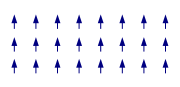
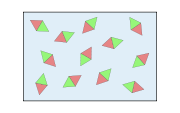
Below the Curie temperature neighboring magnetic spins are aligned parallel within in ferromagnetic materials and anti-parallel in ferrimagnetic materials. As the temperature is increased towards the Curie point, the alignment (magnetization) within each domain decreases. Above the Curie temperature, the material is paramagnetic
so that magnetic moments are in a completely disordered state.
The destruction of magnetization at the Curie temperature is a second-order phase transition
and a critical point
where the magnetic susceptibility
is theoretically infinite.
A heat-induced ferromagnetic-paramagnetic transition is used in magneto-optical storage media, for erasing and writing of new data. Famous examples include the Sony
Minidisc
format, as well as the now-obsolete CD-MO format. Other uses include temperature control in soldering iron
s, and stabilizing the magnetic field of tachometer
generators against temperature variation.
Gadolinium
is ferromagnetic at temperatures below 19 °C (66 °F), approximately room temperature, and strongly paramagnetic above that temperature.
(PZT), the material is tetragonal below Tc and the unit cell contains a displaced central cation and hence a net dipole moment. Above Tc, the material is cubic and the central cation is no longer displaced from the centre of the unit cell. Hence, there is no net dipole moment and no spontaneous polarization.
, χ, is given by the Curie-Weiss law:

where C is a material-specific Curie constant, T is absolute temperature, measured in kelvins, and Tc is the Curie temperature, measured in kelvins.
Thus, the susceptibility approaches infinity as the temperature approaches Tc.
Physics
Physics is a natural science that involves the study of matter and its motion through spacetime, along with related concepts such as energy and force. More broadly, it is the general analysis of nature, conducted in order to understand how the universe behaves.Physics is one of the oldest academic...
and materials science
Materials science
Materials science is an interdisciplinary field applying the properties of matter to various areas of science and engineering. This scientific field investigates the relationship between the structure of materials at atomic or molecular scales and their macroscopic properties. It incorporates...
, the Curie temperature (Tc), or Curie point, is the temperature
Temperature
Temperature is a physical property of matter that quantitatively expresses the common notions of hot and cold. Objects of low temperature are cold, while various degrees of higher temperatures are referred to as warm or hot...
at which a ferromagnetic
Ferromagnetism
Ferromagnetism is the basic mechanism by which certain materials form permanent magnets, or are attracted to magnets. In physics, several different types of magnetism are distinguished...
or a ferrimagnetic
Ferrimagnetism
In physics, a ferrimagnetic material is one in which the magnetic moments of the atoms on different sublattices are opposed, as in antiferromagnetism; however, in ferrimagnetic materials, the opposing moments are unequal and a spontaneous magnetization remains...
material becomes paramagnetic
Paramagnetism
Paramagnetism is a form of magnetism whereby the paramagnetic material is only attracted when in the presence of an externally applied magnetic field. In contrast with this, diamagnetic materials are repulsive when placed in a magnetic field...
on heating; the effect is reversible. A magnet will lose its magnetism
Magnetism
Magnetism is a property of materials that respond at an atomic or subatomic level to an applied magnetic field. Ferromagnetism is the strongest and most familiar type of magnetism. It is responsible for the behavior of permanent magnets, which produce their own persistent magnetic fields, as well...
if heated above the Curie temperature. The term is also used in piezoelectric materials to refer to the temperature at which spontaneous polarization is lost on heating. An analogous temperature, the Néel temperature
Néel temperature
The Néel temperature or magnetic ordering temperature , TN, is the temperature above which an antiferromagnetic material becomes paramagnetic—that is, the thermal energy becomes large enough to destroy the macroscopic magnetic ordering within the material....
, is defined for antiferromagnetic materials. The Curie temperature is named after Pierre Curie
Pierre Curie
Pierre Curie was a French physicist, a pioneer in crystallography, magnetism, piezoelectricity and radioactivity, and Nobel laureate. He was the son of Dr. Eugène Curie and Sophie-Claire Depouilly Curie ...
.
Below the Curie temperature neighboring magnetic spins are aligned parallel within in ferromagnetic materials and anti-parallel in ferrimagnetic materials. As the temperature is increased towards the Curie point, the alignment (magnetization) within each domain decreases. Above the Curie temperature, the material is paramagnetic
Paramagnetism
Paramagnetism is a form of magnetism whereby the paramagnetic material is only attracted when in the presence of an externally applied magnetic field. In contrast with this, diamagnetic materials are repulsive when placed in a magnetic field...
so that magnetic moments are in a completely disordered state.
The destruction of magnetization at the Curie temperature is a second-order phase transition
Phase transition
A phase transition is the transformation of a thermodynamic system from one phase or state of matter to another.A phase of a thermodynamic system and the states of matter have uniform physical properties....
and a critical point
Critical point (thermodynamics)
In physical chemistry, thermodynamics, chemistry and condensed matter physics, a critical point, also called a critical state, specifies the conditions at which a phase boundary ceases to exist...
where the magnetic susceptibility
Magnetic susceptibility
In electromagnetism, the magnetic susceptibility \chi_m is a dimensionless proportionality constant that indicates the degree of magnetization of a material in response to an applied magnetic field...
is theoretically infinite.
A heat-induced ferromagnetic-paramagnetic transition is used in magneto-optical storage media, for erasing and writing of new data. Famous examples include the Sony
Sony
, commonly referred to as Sony, is a Japanese multinational conglomerate corporation headquartered in Minato, Tokyo, Japan and the world's fifth largest media conglomerate measured by revenues....
Minidisc
MiniDisc
The disc is permanently housed in a cartridge with a sliding door, similar to the casing of a 3.5" floppy disk. This shutter is opened automatically by a mechanism upon insertion. The audio discs can either be recordable or premastered. Recordable MiniDiscs use a magneto-optical system to record...
format, as well as the now-obsolete CD-MO format. Other uses include temperature control in soldering iron
Soldering iron
A soldering iron is a hand tool most commonly used in soldering. It supplies heat to melt the solder so that it can flow into the joint between two workpieces.A soldering iron is composed of a heated metal tip and an insulated handle...
s, and stabilizing the magnetic field of tachometer
Tachometer
A tachometer is an instrument measuring the rotation speed of a shaft or disk, as in a motor or other machine. The device usually displays the revolutions per minute on a calibrated analogue dial, but digital displays are increasingly common...
generators against temperature variation.
Curie temperature in ferromagnetic and ferrimagnetic materials
Given below are various Curie temperatures for different substances.| Substance | Curie temp °C |
|---|---|
| Iron (Fe) | 770 |
| Cobalt (Co) | 1130 |
| Nickel (Ni) | 358 |
| Iron Oxide (Fe2O3) | 622 |
Gadolinium
Gadolinium
Gadolinium is a chemical element with the symbol Gd and atomic number 64. It is a silvery-white, malleable and ductile rare-earth metal. It is found in nature only in combined form. Gadolinium was first detected spectroscopically in 1880 by de Marignac who separated its oxide and is credited with...
is ferromagnetic at temperatures below 19 °C (66 °F), approximately room temperature, and strongly paramagnetic above that temperature.
Curie temperature in piezoelectric materials
In analogy to ferromagnetic materials, the Curie temperature is also used in piezoelectric materials to describe the temperature above which the material loses its spontaneous polarization and piezoelectric characteristics. In lead zirconate titanateLead zirconate titanate
Lead zirconate titanate , also called PZT, is a ceramic perovskite material that shows a marked piezoelectric effect. PZT-based compounds are composed of the chemical elements lead and zirconium and the chemical compound titanate which are combined under extremely high temperatures. A filter is...
(PZT), the material is tetragonal below Tc and the unit cell contains a displaced central cation and hence a net dipole moment. Above Tc, the material is cubic and the central cation is no longer displaced from the centre of the unit cell. Hence, there is no net dipole moment and no spontaneous polarization.
The Curie-Weiss law
A simple theory predicts that, above the Curie temperature, the magnetic susceptibilityMagnetic susceptibility
In electromagnetism, the magnetic susceptibility \chi_m is a dimensionless proportionality constant that indicates the degree of magnetization of a material in response to an applied magnetic field...
, χ, is given by the Curie-Weiss law:
where C is a material-specific Curie constant, T is absolute temperature, measured in kelvins, and Tc is the Curie temperature, measured in kelvins.
Thus, the susceptibility approaches infinity as the temperature approaches Tc.
External links
- Ferromagnetic Curie Point. Video by Walter LewinWalter LewinWalter H. G. Lewin is a professor emeritus of physics at the Massachusetts Institute of Technology .-Education and career:...
, M.I.T.