
All Topics  
Magnet


   Email Print
   Bookmark   Link


Magnet


A magnet (from Greek , "Magnesia
Magnesia

Magnesia , deriving from the tribe name Magnetes, is the name of the southeastern area of Thessaly in central Greece. The modern prefecture was created in 1947 out of the Larissa prefecture....
n stone") is a material or object that produces a magnetic field
Magnetic field

A magnetism field is a vector field which can exert a magnetic force on moving electric charges and on magnetic dipoles . When placed in a magnetic field, magnetic dipoles tend to align their axes parallel to the magnetic field....
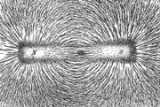
. This magnetic field is invisible but is responsible for the most notable property of a magnet: a force that pulls on other ferromagnetic materials and attracts or repels other magnets.

A permanent magnet is one that stays magnetized, such as a magnet used to hold notes on a refrigerator
Refrigerator

A refrigerator is a cooling appliance comprising a thermal insulation compartment and a heat pump - a mechanism to transfer heat from it to the external environment, cooling the contents to a temperature below ambient....
 door.


Discussion
Ask a question about 'Magnet'
Start a new discussion about 'Magnet'
Answer questions from other users
Full Discussion Forum


Recent Posts


Encyclopedia


Magnet0873
Solenoid
A magnet (from Greek , "Magnesia
Magnesia

Magnesia , deriving from the tribe name Magnetes, is the name of the southeastern area of Thessaly in central Greece. The modern prefecture was created in 1947 out of the Larissa prefecture....
n stone") is a material or object that produces a magnetic field
Magnetic field

A magnetism field is a vector field which can exert a magnetic force on moving electric charges and on magnetic dipoles . When placed in a magnetic field, magnetic dipoles tend to align their axes parallel to the magnetic field....
. This magnetic field is invisible but is responsible for the most notable property of a magnet: a force that pulls on other ferromagnetic materials and attracts or repels other magnets.

A permanent magnet is one that stays magnetized, such as a magnet used to hold notes on a refrigerator
Refrigerator

A refrigerator is a cooling appliance comprising a thermal insulation compartment and a heat pump - a mechanism to transfer heat from it to the external environment, cooling the contents to a temperature below ambient....
 door. Materials which can be magnetized, which are also the ones that are strongly attracted to a magnet, are called ferromagnetic. These include iron
Iron

Iron is a chemical element with the symbol Fe and atomic number 26. Iron is a Group 8 element and period 4 element. Iron is lustrous and silvery in color....
, nickel
Nickel

Nickel is a chemical element, with the chemical symbol Ni and atomic number 28. It is a silvery-white lustrous metal with a slight golden tinge....
, cobalt
Cobalt

Cobalt is a hard, lustrous, grey metal, a chemical element with symbol Co and atomic number 27. Although cobalt-based colors and pigments have been used since ancient times, and miners have long used the name kobold ore for some minerals, cobalt was only discovered in 1735 by Georg Brandt....
, some rare earth metals
Rare earth element

According to IUPAC, rare earth elements or rare earth metals are a collection of seventeen chemical elements in the periodic table, namely scandium, yttrium, and the fifteen lanthanoids....
 and some of their alloy
Alloy

An alloy is a partial or complete solid solution of one or more chemical element in a metallic matrix. Complete solid solution alloys give single solid phase microstructure, while partial solutions give two or more phases that may be homogeneous in distribution depending on thermal history....
s, and some naturally occurring minerals such as lodestone
Lodestone

Lodestone or loadstone refers to naturally occurring pieces of intensely magnetic magnetite that were used for magnetizing compasses.Iron, steel and ordinary magnetite are attracted to a magnetic field, including the Earth's magnetic field....
. Permanent magnets are made from "hard" ferromagnetic materials which are designed to stay magnetized, while "soft" ferromagnetic materials like soft iron are attracted to a magnet but do not tend to stay magnetized.

An electromagnet
Electromagnet

An electromagnet is a type of magnet in which the magnetic field is produced by the flow of electric Current . The magnetic field disappears when the current ceases....
 is made from a coil of wire which acts as a magnet when an electric current
Electric current

Electric current is the flow of electric charge. The electric charge may be either electrons or ions.The International System of Units unit of electric current intensity is the ampere....
 passes through it, but stops being a magnet when the current stops. Often an electromagnet is wrapped around a core of ferromagnetic material like steel, which enhances the magnetic field produced by the coil.

Although ferromagnetic materials are the only ones strongly enough attracted to a magnet to be commonly considered "magnetic", all other substances respond weakly to a magnetic field, by one of several other types of magnetism. Paramagnetic materials, such as aluminum and oxygen
Oxygen

Oxygen no O2 produced; 2) O2 produced, but absorbed in oceans & seabed rock; 3) O2 starts to gas out of the oceans, but is absorbed by land surfaces and formation of ozone layer; 4-5) O2 sinks filled and the gas accumulates]]...
 are weakly attracted to a magnet. Diamagnetic materials, such as carbon
Carbon

Carbon is a chemical element with chemical symbol C and atomic number 6. As a member of group 14 on the periodic table, it is nonmetallic and tetravalence?making four electrons available to form covalent bond chemical bonds....
 and water
Water

Water is a common chemical substance that is essential for the survival of all known forms of life. In typical usage, water refers only to its liquid form or States of matter, but the substance also has a solid state, ice, and a gaseous state, water vapor or steam....
, which include all substances not having another type of magnetism, are weakly repelled by a magnet.

The overall strength of a magnet is measured by its magnetic moment
Magnetic moment

In physics, astronomy, chemistry, and electrical engineering, the term magnetic moment of a system usually refers to its magnetic dipole moment, and is a measure of the strength of the system's net Magnetism....
, while the local strength of the magnetism in a material is measured by its magnetization
Magnetization

Magnetization is defined as the quantity of magnetic moment per unit volume. The origin of the magnetic moments responsible for magnetization can be either microscopic electric currents resulting from the motion of electrons in atoms, or the spin of the electrons or the nuclei....
.

Background on the physics of magnetism and magnets


Magnetic field

The magnetic field (usually denoted B) is called a field
Field (physics)

In physics, a field is a physical quantity associated to each point of spacetime. A field can be classified as a scalar field, a vector field, or a tensor field, according to whether the value of the field at each point is a scalar , a vector , or, more generally, a tensor, respectively....
 because it has a value at every point in space. The magnetic field (at a given point) is specified by two properties: (1) its direction, which is along the orientation of a compass needle
Compass

A compass, magnetic compass or mariner's compass is a navigational instrument for determining direction relative to the earth's magnetic poles....
; and (2) its magnitude (also called strength), which is proportional to how strongly the compass needle orients along that direction. Direction and magnitude makes B a vector
Vector

Vector may refer to:...
, so B is a vector field
Vector field

In mathematics a vector field is a construction in vector calculus which associates a vector to every point in a Euclidean space.Vector fields are often used in physics to model, for example, the speed and direction of a moving fluid throughout space, or the strength and direction of some force, such as the magnetic field or gravity for...
. (B can also depend on time.) In SI
Si

Si, si, or SI may refer to :...
 units the strength of the magnetic field is given in teslas
Tesla (unit)

The tesla is the SI derived unit of magnetic flux density B . The tesla is equal to one weber per square metre and was defined in 1960 in honor of inventor, scientist and electrical engineer Nikola Tesla....
.

Magnetic moment

A magnet's magnetic moment (also called magnetic dipole moment, and usually denoted µ) is a vector that characterizes the magnet's overall magnetic properties. For a bar magnet, the direction of the magnetic moment points from the magnet's south pole to its north pole, and the magnitude relates to how strong and how far apart these poles are. In SI
Si

Si, si, or SI may refer to :...
 units the magnetic moment is specified in terms of A·m².

A magnet both produces its own magnetic field and it responds to magnetic fields. The strength of the magnetic field it produces is at any given point proportional to the magnitude of its magnetic moment. In addition, when the magnet is put into an "external" magnetic field produced by a different source, it is subject to a torque
Torque

Torque is the tendency of a force to rotate an object about an axis . Just as a force is a push or a pull, a torque can be thought of as a twist....
 tending to orient the magnetic moment parallel to the field. The amount of this torque is proportional both to the magnetic moment and the "external" field. A magnet may also be subject to a force driving it in one direction or another, according to the positions and orientations of the magnet and source. If the field is uniform in space the magnet is subject to no net force, although it is subject to a torque.

A wire in the shape of a circle with area A and carrying current
Electric current

Electric current is the flow of electric charge. The electric charge may be either electrons or ions.The International System of Units unit of electric current intensity is the ampere....
 I is a magnet, with a magnetic moment of magnitude equal to IA.

Magnetization

The magnetization of a magnetized material is the local value of its magnetic moment per unit volume, usually denoted M, with units A
Ampere

The ampere is the International System of Units unit of electric current. The ampere, in practice often shortened to amp, is an SI base unit, and is named after Andr?-Marie Amp?re, one of the main discoverers of electromagnetism....
/m. It is a vector field
Vector field

In mathematics a vector field is a construction in vector calculus which associates a vector to every point in a Euclidean space.Vector fields are often used in physics to model, for example, the speed and direction of a moving fluid throughout space, or the strength and direction of some force, such as the magnetic field or gravity for...
, rather than just a vector (like the magnetic moment), because different areas in a magnet can be magnetized with different directions and strengths (for example, because of domains, see below). A good bar magnet may have a magnetic moment of magnitude 0.1 A·m² and a volume of 1 cm³, or 0.000001 m³, and therefore an average magnetization magnitude is 100,000 A/m. Iron can have a magnetization of around a million A/m. Such a large value explains why magnets are so effective at producing magnetic fields.

Two models for magnets: magnetic poles and atomic currents

Magnetic pole model: Although for many purposes it is convenient to think of a magnet as having distinct north and south magnetic poles, the concept of poles should not be taken literally: it is merely a way of referring to the two different ends of a magnet. The magnet does not have distinct "north" or "south" particles on opposing sides. (No magnetic monopole
Magnetic monopole

In physics, a magnetic monopole is a hypothetical particle that is a magnet with only one magnetic pole . In more technical terms, it would have a net "magnetic charge"....
 has yet been observed.) If a bar magnet is broken in half, in an attempt to separate the north and south poles, the result will be two bar magnets, each of which has both a north and south pole.

The magnetic pole approach is used by professional magneticians to design permanent magnets. In this approach, the pole surfaces of a permanent magnet are imagined to be covered with 'magnetic charge', little 'north pole' particles on the north pole and 'south poles' on the south pole, that are the source of the magnetic field lines. If the magnetic pole distribution is known, then outside the magnet the pole model gives the magnetic field exactly. In the interior of the magnet this model fails to give the correct field, but (see Units and Calculations, below). This pole model is also called the "Gilbert model" of a magnetic dipole. Griffiths suggests (p. 258): "My advice is to use the Gilbert model, if you like, to get an intuitive "feel" for a problem, but never rely on it for quantitative results."

Ampère model: Another model is the "Ampère
André-Marie Ampère

Andr?-Marie Amp?re Fellow of the Royal Society , was a French physicist and mathematician who is generally credited as one of the main discoverers of electromagnetism....
 model", where all magnetization is due to the effect of microscopic, or atomic, circular "bound currents", also called "Ampèrian currents" throughout the material. For a uniformly magnetized cylindrical bar magnet, the net effect of the microscopic bound currents is to make the magnet behave as if there is a macroscopic sheet of electric current
Electric current

Electric current is the flow of electric charge. The electric charge may be either electrons or ions.The International System of Units unit of electric current intensity is the ampere....
 flowing around the surface, with local flow direction normal to the cylinder axis. (Since scraping off the outer layer of a magnet will not destroy its magnetic field, it can be seen that this is just a model, and the tiny currents are actually distributed throughout the material). The right-hand rule
Right-hand rule

In mathematics and physics, the right-hand rule is a common mnemonic for understanding notation conventions for vector in 3 dimensions. It was invented for use in electromagnetism by British physicist Zachariah William Cole in the late 1800s....
 tells which direction the current flows. The Ampere model gives the exact magnetic field both inside and outside the magnet. It is usually difficult to calculate the Amperian currents on the surface of a magnet, whereas it is often easier to find the effective poles for the same magnet.

Pole naming conventions


The north pole of the magnet is the pole which, when the magnet is freely suspended, points towards the Earth's magnetic north pole in northern Canada. Since opposite poles (north and south) attract whereas like poles (north and north, or south and south) repel, the Earth's present geographic north is thus actually its magnetic south. Confounding the situation further, the Earth's magnetic field has reversed itself
Geomagnetic reversal

A geomagnetic reversal is a change in the orientation of Earth's magnetic field such that the positions of magnetic north and magnetic south become interchanged....
 many times in the distant past.

As a practical matter, in order to tell which pole of a magnet is north and which is south, it is not necessary to use the earth's magnetic field at all. For example, one calibration method would be to compare it to an electromagnet
Electromagnet

An electromagnet is a type of magnet in which the magnetic field is produced by the flow of electric Current . The magnetic field disappears when the current ceases....
, whose poles can be identified by the right-hand rule
Right-hand rule

In mathematics and physics, the right-hand rule is a common mnemonic for understanding notation conventions for vector in 3 dimensions. It was invented for use in electromagnetism by British physicist Zachariah William Cole in the late 1800s....
.

Descriptions of magnetic behaviors


There are several types of magnetism, and all materials exhibit at least one of them. This section describes, qualitatively, the primary types of magnetic behavior that materials can show. The physics underlying each of these behaviors is described in the next section below, and can also be found in more detail in their respective articles.

  • Ferromagnetic and ferrimagnetic materials are the ones normally thought of as 'magnetic'; they are attracted to a magnet strongly enough that the attraction can be felt. These materials are the only ones that can retain magnetization and become magnets; a common example is a traditional refrigerator magnet
    Refrigerator magnet

    A refrigerator magnet is an decoration attached to a magnet that is used to post items such as shopping lists or report cards on a refrigerator, or simply as decoration....
    . Ferrimagnetic materials, which include ferrite
    Ferrite

    Ferrite may refer to:* Ferrite , iron or iron alloys with a body centred cubic crystal structure.* Ferrite , ferrimagnetic ceramic materials used in magnetic applications....
    s and the oldest magnetic materials magnetite
    Magnetite

    Magnetite is a ferrimagnetism mineral with chemical formula Iron3Oxygen4, one of several iron oxides and a member of the spinel group....
     and lodestone
    Lodestone

    Lodestone or loadstone refers to naturally occurring pieces of intensely magnetic magnetite that were used for magnetizing compasses.Iron, steel and ordinary magnetite are attracted to a magnetic field, including the Earth's magnetic field....
    , are similar to but weaker than ferromagnetics. The difference between ferro- and ferrimagnetic materials is related to their microscopic structure, as explained below.


  • Paramagnetic substances such as platinum
    Platinum

    Platinum is a chemical element with the chemical symbol Pt and an atomic number of 78. Its name is derived from the Spanish term platina del Pinto, which is literally translated into "little silver of the Pinto River." It is in Group 10 of the periodic table of elements....
    , aluminum, and oxygen
    Oxygen

    Oxygen no O2 produced; 2) O2 produced, but absorbed in oceans & seabed rock; 3) O2 starts to gas out of the oceans, but is absorbed by land surfaces and formation of ozone layer; 4-5) O2 sinks filled and the gas accumulates]]...
     are weakly attracted to a magnet. This effect is hundreds of thousands of times weaker than ferromagnetic materials attraction, so it can only be detected by using sensitive instruments, or using extremely strong magnets. Magnetic ferrofluid
    Ferrofluid

    A ferrofluid is a liquid which becomes strongly polarised in the presence of a magnetic field.Ferrofluids are colloidal mixtures composed of nanoscale ferromagnetic, or ferrimagnetic, particles suspended in a Wiktionary:carrier fluid, usually an organic solvent or water....
    s, although they are made of tiny ferromagnetic particles suspended in liquid, are sometimes considered paramagnetic since they cannot be magnetized.


  • Diamagnetic means repelled by both poles. Compared to paramagnetic and ferromagnetic substances, diamagnetic substances such as carbon
    Carbon

    Carbon is a chemical element with chemical symbol C and atomic number 6. As a member of group 14 on the periodic table, it is nonmetallic and tetravalence?making four electrons available to form covalent bond chemical bonds....
    , copper
    Copper

    Copper is a chemical element with the symbol Cu and atomic number 29.It is a ductile metal with very high thermal and electrical conductivity....
    , water
    Water

    Water is a common chemical substance that is essential for the survival of all known forms of life. In typical usage, water refers only to its liquid form or States of matter, but the substance also has a solid state, ice, and a gaseous state, water vapor or steam....
    , and plastic
    Plastic

    Plastic is the general common term for a wide range of synthetic or semisynthetic organic chemistry solid materials suitable for the manufacture of industrial products....
     are even more weakly repelled by a magnet. The permeability of diamagnetic materials is less than the permeability of a vacuum. All substances not possessing one of the other types of magnetism are diamagnetic; this includes most substances. Although force on a diamagnetic object from an ordinary magnet is far too weak to be felt, using extremely strong superconducting magnet
    Superconducting magnet

    A superconducting magnet is an electromagnet that is built using superconductivity coils. They must be cooled to cryogenic temperatures during operation....
    s diamagnetic objects such as pieces of lead
    Lead

    Lead is a main-group Chemical element with symbol Pb and atomic number 82. Lead is a soft, malleable poor metal, also considered to be one of the heavy metal ....
     and even frog
    Frog

    Frogs are amphibians in the order Anura , formerly referred to as Salientia . The name frog derives from Old English language frogga, , cognate with Sanskrit plava , probably deriving from Proto-Indo-European language praw = "to jump"....
    s can be levitated so they float in midair. Superconductors repel magnetic fields from their interior and are strongly diamagnetic.


Physics of magnetic behaviors


Overview


Magnetism
Magnetism

In physics, magnetism is one of the phenomena by which materials exert attractive or repulsive forces on other materials. Some well-known materials that exhibit easily detectable magnetic properties are nickel, iron, cobalt, and their alloys; however, all materials are influenced to greater or lesser degree by the presence of a magnetic fiel...
, at its root, arises from two sources:
  • Electric current
    Electric current

    Electric current is the flow of electric charge. The electric charge may be either electrons or ions.The International System of Units unit of electric current intensity is the ampere....
    s, or more generally moving electric charge
    Electric charge

    Electric charge is a fundamental conserved property of some subatomic particles, which determines their electromagnetic interaction. Electrically charged matter is influenced by, and produces, electromagnetic fields....
    s, create magnetic fields (see Maxwell's Equations
    Maxwell's equations

    In electromagnetism, James Clerk Maxwell equations are a set of four partial differential equations that describe the properties of the electric field and magnetic field fields and relate them to their sources, charge density and current density....
    ).
  • Many particles have nonzero "intrinsic" (or "spin
    Spin (physics)

    In quantum mechanics, spin is a fundamental property of atomic nucleus, hadrons, and elementary particles. For particles with non-zero spin, spin direction is an important intrinsic degrees of freedom ....
    ") magnetic moments. (Just as each particle, by its nature, has a certain mass
    Mass

    In physical science, mass refers to the degree of acceleration a body acquires when subject to a force: bodies with greater mass are accelerated less by the same force....
     and charge
    Electric charge

    Electric charge is a fundamental conserved property of some subatomic particles, which determines their electromagnetic interaction. Electrically charged matter is influenced by, and produces, electromagnetic fields....
    , each has a certain magnetic moment, possibly zero.)


In magnetic materials, the most important sources of magnetization are, more specifically, the electron
Electron

The electron is a subatomic particle that carries a negative electric charge. It has elementary particle and is believed to be a point particle....
s' orbital angular motion around the nucleus
Atomic nucleus

The nucleus of an atom is the very dense region, consisting of nucleons , at the center of an atom. Although the size of the nucleus varies considerably according to the mass of the atom, the size of the entire atom is comparatively constant....
, and the electrons' intrinsic magnetic moment (see Electron magnetic dipole moment
Electron magnetic dipole moment

In atomic physics, the electron magnetic dipole moment is the magnetic moment of an electron caused by its intrinsic property of spin ....
). The other potential sources of magnetism are much less important: For example, the nuclear magnetic moment
Nuclear magnetic moment

The nuclear magnetic moment is the magnetic moment of an atomic nucleus and arises from the spin of the protons and neutrons. It is mainly a magnetic dipole moment; the quadrupole moment does cause some small shifts in the hyperfine structure as well....
s of the nuclei in the material are typically thousands of times smaller than the electrons' magnetic moments, so they are negligible in the context of the magnetization of materials. (Nuclear magnetic moments are important in other contexts, particularly in Nuclear Magnetic Resonance
Nuclear magnetic resonance

Nuclear magnetic resonance is the name given to a physical resonance phenomenon involving the observation of specific quantum mechanics magnetism properties of an atomic atomic nucleus in the presence of an applied, external magnetic field....
 (NMR) and Magnetic Resonance Imaging
Magnetic resonance imaging

GaneshMagnetic resonance imaging , or nuclear magnetic resonance imaging , is primarily a medical imaging technique most commonly used in radiology to visualize the structure and function of the body....
 (MRI).)

Ordinarily, the countless electrons in a material are arranged such that their magnetic moments (both orbital and intrinsic) cancel out. This is due, to some extent, to electrons combining into pairs with opposite intrinsic magnetic moments (as a result of the Pauli exclusion principle
Pauli exclusion principle

The Pauli exclusion principle is a quantum mechanics principle formulated by Wolfgang Pauli in 1925. It states that no two identical particles fermions may occupy the same quantum state simultaneously....
; see Electron configuration
Electron configuration

In atomic physics and quantum chemistry, electron configuration is the arrangement of electrons in an atom, molecule, or other physical structure....
), or combining into "filled subshells" with zero net orbital motion; in both cases, the electron arrangement is so as to exactly cancel the magnetic moments from each electron. Moreover, even when the electron configuration
Electron configuration

In atomic physics and quantum chemistry, electron configuration is the arrangement of electrons in an atom, molecule, or other physical structure....
 is such that there are unpaired electrons and/or non-filled subshells, it is often the case that the various electrons in the solid will contribute magnetic moments that point in different, random directions, so that the material will not be magnetic.

However, sometimes (either spontaneously, or owing to an applied external magnetic field) each of the electron magnetic moments will be, on average, lined up. Then the material can produce a net total magnetic field, which can potentially be quite strong.

The magnetic behavior of a material depends on its structure (particularly its electron configuration
Electron configuration

In atomic physics and quantum chemistry, electron configuration is the arrangement of electrons in an atom, molecule, or other physical structure....
, for the reasons mentioned above), and also on the temperature (at high temperatures, random thermal motion
Thermal motion

Thermal motion is the random motion of molecules or other small objects that results from their being in thermodynamic equilibrium at a particular temperature....
 makes it more difficult for the electrons to maintain alignment).

Physics of paramagnetism

In a paramagnetic material there are unpaired electrons, i.e. atomic
Atomic orbital

An atomic orbital is a mathematical function that describes the wave-like behavior of an electron in an atom. This function can be used to calculate the probability of finding any electron of an atom in any specific region around the atom's nucleus....
 or molecular orbital
Molecular orbital

In chemistry, a molecular orbital is a mathematical function that describes the wave-like behavior of an electron in a molecule. This function can be used to calculate chemical and physical properties such as the probability of finding an electron in any specific region....
s with exactly one electron in them. While paired electrons are required by the Pauli exclusion principle
Pauli exclusion principle

The Pauli exclusion principle is a quantum mechanics principle formulated by Wolfgang Pauli in 1925. It states that no two identical particles fermions may occupy the same quantum state simultaneously....
 to have their intrinsic ('spin') magnetic moments pointing in opposite directions, causing their magnetic fields to cancel out, an unpaired electron is free to align its magnetic moment in any direction. When an external magnetic field is applied, these magnetic moments will tend to align themselves in the same direction as the applied field, thus reinforcing it.

Physics of diamagnetism

In a diamagnetic material, there are no unpaired electrons, so the intrinsic electron magnetic moments cannot produce any bulk effect. In these cases, the magnetization arises from the electrons' orbital motions, which can be understood classically
Classical physics

Classical physics is a general term used to describe the branches of physics based on principles developed before the rise of general theory of relativity and Quantum mechanics, usually including special theory of relativity....
 as follows:

When a material is put in a magnetic field, the electrons circling the nucleus will experience, in addition to their Coulomb
Coulomb's law

Coulomb's law, sometimes called the Coulomb law, is an equation describing the electrostatic force between electric charges. It was developed in the 1780s by French physicist Charles Augustin de Coulomb and was essential to the development of the classical electromagnetism....
 attraction to the nucleus, a Lorentz force
Lorentz force

In physics, the Hendrik Lorentz force is the force on a point charge due to electromagnetic fields. It is given by the following equation in terms of the electric field and magnetic fields:...
 from the magnetic field. Depending on which direction the electron is orbiting, this force may increase the centripetal force
Centripetal force

The centripetal force is the external force required to make a body follow a curved path. Hence centripetal force is a kinematic force requirement, not a particular kind of force like gravity or electromagnetism....
 on the electrons, pulling them in towards the nucleus, or it may decrease the force, pulling them away from the nucleus. This effect systematically increases the orbital magnetic moments that were aligned opposite the field, and decreases the ones aligned parallel to the field (in accordance with Lenz's law
Lenz's law

Lenz's law gives the direction of the induced electromotive force and Electric current resulting from electromagnetic induction. The law provides a physical interpretation of the choice of sign in Faraday's law of induction, indicating that the induced emf and the change in flux have opposite signs....
). This results in a small bulk magnetic moment, with an opposite direction to the applied field.

Note that this description is meant only as an heuristic
Heuristic

Heuristic is an adjective for methods that help in problem solving, in turn leading to learning and discovery. These methods in most cases employ experimentation and trial-and-error techniques....
; a proper understanding requires a quantum-mechanical
Quantum mechanics

Quantum mechanics is a set of principles underlying the most fundamental known description of all physical systems at the microscopic scale . Notable amongst these principles are both a dual wave-like and particle-like behavior of matter and radiation, and prediction of probabilities in situations where classical physics predicts certaintie...
 description.

Note that all materials undergo this orbital response. However, in paramagnetic and ferromagnetic substances, the diamagnetic effect is overwhelmed by the much stronger effects caused by the unpaired electrons.

Physics of ferromagnetism

A ferromagnet, like a paramagnetic substance, has unpaired electrons. However, in addition to the electrons' intrinsic magnetic moments wanting to be parallel to an applied field, there is also in these materials a tendency for these magnetic moments to want to be parallel to each other. Thus, even when the applied field is removed, the electrons in the material can keep each other continually pointed in the same direction.

Every ferromagnetic substance has its own individual temperature, called the Curie temperature, or Curie point, above which it loses its ferromagnetic properties. This is because the thermal tendency to disorder overwhelms the energy-lowering due to ferromagnetic order.

Magnetic domains
The magnetic moment of atoms in a ferromagnetic
Ferromagnetism

Ferromagnetism is the basic mechanism by which certain materials form permanent magnets and/or exhibit strong interactions with magnets; it is responsible for most phenomena of magnetism Magnet#Common uses of magnets ....
 material cause them to behave something like tiny permanent magnets. They stick together and align themselves into small regions of more or less uniform alignment called magnetic domains
Magnetic domains

A magnetic domain describes a region within a material which has uniform magnetization. This means that the individual moments of the atoms are aligned with one another....
 or Weiss domains
Weiss domains

Weiss domains are small areas in a crystal structure of a ferromagnetism material with uniformly oriented magnetic momenta. They were named after the French physicist Pierre-Ernest Weiss ....
. Magnetic domains can be observed with a magnetic force microscope
Magnetic force microscope

A magnetic force microscope is a type of atomic force microscope . Unlike typical AFM, magnetic materials are used for the sample and tip, so that the tip-sample magnetic interactions are detected....
 to reveal magnetic domain boundaries that resemble white lines in the sketch.There are many scientific experiments that can physically show magnetic fields.

When a domain contains too many molecules, it becomes unstable and divides into two domains aligned in opposite directions so that they stick together more stably as shown at the right.

When exposed to a magnetic field, the domain boundaries move so that the domains aligned with the magnetic field grow and dominate the structure as shown at the left. When the magnetizing field is removed, the domains may not return to a unmagnetized state. This results in the ferromagnetic material being magnetized, forming a permanent magnet.

When magnetized strongly enough that the prevailing domain overruns all others to result in only one single domain, the material is magnetically saturated. When a magnetized ferromagnetic material is heated to the Curie point
Curie point

The Curie point , or Curie temperature, is a term in physics and materials science, named after Pierre Curie , and refers to a characteristic property of a ferromagnetic or piezoelectric material....
 temperature, the molecules are agitated to the point that the magnetic domains lose the organization and the magnetic properties they cause cease. When the material is cooled, this domain alignment structure spontaneously returns, in a manner roughly analogous to how a liquid can freeze
Freezing

In physical science, freezing or solidification is the process in which a liquid turns into a solid when cold enough. The Melting point is the temperature at which this happens....
 into a crystalline solid.

Physics of antiferromagnetism

In an antiferromagnet, unlike a ferromagnet, there is a tendency for the intrinsic magnetic moments of neighboring valence electrons to point in opposite directions. When all atoms are arranged in a substance so that each neighbor is 'anti-aligned', the substance is antiferromagnetic. Antiferromagnets have a zero net magnetic moment, meaning no field is produced by them. Antiferromagnets are less common compared to the other types of behaviors, and are mostly observed at low temperatures. In varying temperatures, antiferromagnets can be seen to exhibit diamagnetic and ferrimagnetic properties.

In some materials, neighboring electrons want to point in opposite directions, but there is no geometrical arrangement in which each pair of neighbors is anti-aligned. This is called a spin glass
Spin glass

A spin glass is a magnet with Geometrically frustrated magnet, augmented by stochastic disorder, where usually ferromagnetic and antiferromagnetic bonds are randomly distributed....
, and is an example of geometrical frustration
Geometrical frustration

frustration is a phenomenon in condensed matter physics in which the geometrical properties of the crystal lattice or the presence of conflicting atomic forces forbid simultaneous minimization of the interaction energies acting at a given site....
.

Physics of ferrimagnetism

Like ferromagnetism, ferrimagnets retain their magnetization in the absence of a field. However, like antiferromagnets, neighboring pairs of electron spins like to point in opposite directions. These two properties are not contradictory, because in the optimal geometrical arrangement, there is more magnetic moment from the sublattice of electrons which point in one direction, than from the sublattice which points in the opposite direction.

The first discovered magnetic substance, magnetite
Magnetite

Magnetite is a ferrimagnetism mineral with chemical formula Iron3Oxygen4, one of several iron oxides and a member of the spinel group....
, was originally believed to be a ferromagnet; Louis Néel disproved this, however, with the discovery of ferrimagnetism.

Other types of magnetism


There are various other types of magnetism, such as spin glass
Spin glass

A spin glass is a magnet with Geometrically frustrated magnet, augmented by stochastic disorder, where usually ferromagnetic and antiferromagnetic bonds are randomly distributed....
 (mentioned above), superparamagnetism
Superparamagnetism

Superparamagnetism is a form of magnetism. A superparamagnetic material is composed of small ferromagnetic clusters , but where the clusters are so small that they can randomly flip direction under temperature....
, superdiamagnetism
Superdiamagnetism

Superdiamagnetism is a phenomenon occurring in certain materials at low temperatures, characterised by the complete absence of magnetic permeability and the exclusion of the interior magnetic field....
, and metamagnetism
Metamagnetism

Metamagnetism is a blanket term used loosely in physics to describe a sudden increase in the magnetization of a material with a small change in an externally applied magnetic field....
.

Common uses of magnets

  • Magnetic recording media: VHS
    VHS

    The Video Home System, better known by its abbreviation VHS, is a recording and playing standard developed by JVC and launched in Europe and Asia in September 1976, and the United States in June 1977....
     tapes contain a reel of magnetic tape
    Magnetic tape

    Magnetic tape is a medium for magnetic recording generally consisting of a thin magnetizable coating on a long and narrow strip of plastic. Nearly all recording tape is of this type, whether used for recording Audio frequency or video or for computer data storage....
    . The information that makes up the video and sound is encoded on the magnetic coating on the tape. Common audio cassettes also rely on magnetic tape. Similarly, in computers, floppy disk
    Floppy disk

    A floppy disk is a data storage medium that is composed of a disk of thin, flexible magnetic storage medium encased in a square or rectangle plastic shell....
    s and hard disk
    Hard disk

    A hard disk drive , commonly referred to as a hard drive, hard disk, or fixed disk drive, is a non-volatile storage device which stores digitally encoded data on rapidly rotating hard disk platters with magnetic surfaces....
    s record data on a thin magnetic coating.


  • Credit
    Credit card

    A credit card is part of a system of payments named after the small plastic card issued to users of the system. It is a card entitling its holder to buy goods and services based on the holders promise to pay for these goods and services....
    , debit
    Debit card

    A debit card is a plastic card which provides an alternative payment method to cash when making purchases. Functionally, it can be called an electronic check, as the funds are withdrawn directly from either the bank account , or from the remaining balance on the card....
    , and ATM cards: All of these cards have a magnetic strip on one side. This strip encodes the information to contact an individual's financial institution and connect with their account(s).


  • Common television
    Television

    Television is a widely used telecommunication mass-media for transmitting and receiving moving , either monochrome or color, usually accompanied by sound....
    s and computer monitors: TV and computer screens containing a cathode ray tube
    Cathode ray tube

    The cathode ray tube is a vacuum tube containing an electron gun and a fluorescent screen, with internal or external means to accelerate and deflect the electron beam, used to create images in the form of light emitted from the fluorescent screen....
     employ an electromagnet to guide electrons to the screen. Plasma screens and LCDs use different technologies.


  • Speaker
    Loudspeaker

    A loudspeaker, speaker, or speaker system is an electroacoustical transducer that converts an electricity signal processing to sound....
    s and Microphone
    Microphone

    A microphone, sometimes referred to as a mike or?more recently?mic, is an acoustic-to-electric transducer or sensor that converts sound into an electrical signal....
    s: Most speakers employ a permanent magnet and a current-carrying coil to convert electric energy (the signal) into mechanical energy (movement which creates the sound). The coil
    Coil

    A coil is a series of wiktionary:loops. A coiled coil is a structure where the coil itself is in turn also looping....
     is wrapped around a bobbin
    Bobbin

    A bobbin is a spindle or cylinder, with or without flanges, on which wire, yarn, thread or roll film is wound. Bobbins are typically found in sewing machines, cameras, and within Electronics equipment....
     attached to the speaker cone
    Diaphragm (acoustics)

    In a loudspeaker, a diaphragm is the thin, semi-rigid artificial membrane attached to the voice coil, which moves in a magnetic gap, vibrating the diaphragm, and producing sound....
    , and carries the signal as changing current which interacts with the field of the permanent magnet. The voice coil
    Voice coil

    A voice coil is the coil of wire attached to the apex of the cone of a speaker driver. It provides the motive force to the cone by the reaction of a magnetic field to the current passing through it....
     feels a magnetic force and in response moves the cone and pressurizes the neighboring air, thus generating sound
    Sound

    Sound is vibration transmitted through a solid, liquid, or gas, composed of frequencies within the range of hearing and of a threshold of hearing to be heard, or the sensation stimulated in organs of hearing by such vibrations....
    . Dynamic microphones employ the same concept, but in reverse. A microphone has a diaphragm or membrane attached to a coil of wire. The coil rests inside a specially shaped magnet. When sound vibrates the membrane, the coil is vibrated as well. As the coil moves through the magnetic field, a voltage is induced
    Faraday's law of induction

    Faraday's law of induction describes a basic law of electromagnetism, which is involved in the working of transformers, inductors, and many forms of electrical generators....
     across the coil. This voltage drives a current in the wire that is characteristic of the original sound.
  • Electric motor
    Electric motor

    An electric motor uses electrical energy to produce mechanical energy, nearly always by the interaction of magnetic fields and current-carrying conductors....
    s and generators
    Electrical generator

    In electricity generation, an electrical generator is a device that converts mechanical energy to electrical energy, generally using electromagnetic induction....
    : Some electric motors (much like loudspeakers) rely upon a combination of an electromagnet and a permanent magnet, and much like loudspeakers, they convert electric energy into mechanical energy. A generator is the reverse: it converts mechanical energy into electric energy by moving a conductor through a magnetic field.


  • Transformer
    Transformer

    A transformer is a device that transfers electrical energy from one electrical network to another through inductive coupling conductors — the transformer's coils or "windings"....
    s: Transformers are devices that transfer electric energy between two windings of wire that are electrically isolated but are coupled magnetically
    Inductive coupling

    In electrical engineering, two conductors are referred to as "inductively coupled" when they are configured such that change in current flow through one wire Faraday's law of induction a voltage across the ends of the other wire....
    .


  • Chuck
    Chuck (engineering)

    A chuck is a specialized type of Clamp used to hold rotating tools or materials....
    s: Chucks are used in the metalworking
    Metalworking

    Metalworking is the process of working with metals to create individual parts, assemblies, or large scale structures. The term covers a wide range of work from large ships, bridges and oil refineries to delicate jewellery....
     field to hold objects. Magnets are also used in other types of fastening devices, such as the magnetic base
    Magnetic base

    A magnetic base is a magnetic fixture based on a magnet that can effectively be turned "on" and "off" at will; they are often used in optics and metalworking, e.g., to hold a dial indicator....
    , the magnetic clamp and the refrigerator magnet
    Refrigerator magnet

    A refrigerator magnet is an decoration attached to a magnet that is used to post items such as shopping lists or report cards on a refrigerator, or simply as decoration....
    .


  • Compass
    Compass

    A compass, magnetic compass or mariner's compass is a navigational instrument for determining direction relative to the earth's magnetic poles....
    es: A compass (or mariner's compass) is a magnetized pointer free to align itself with a magnetic field, most commonly Earth's magnetic field
    Earth's magnetic field

    Earth's magnetic field is approximately a magnetic dipole, with one magnetic pole near the north pole and the other near the geographic south pole ....
    .


  • Art
    Art

    Art is the process or product of deliberately arranging elements in a way that appeals to the senses or emotions. It encompasses a diverse range of human activities, creations, and modes of expression, including music and literature....
    : Vinyl magnet sheets may be attached to paintings, photographs, and other ornamental articles, allowing them to be attached to refrigerators and other metal surfaces.


  • Science
    Science

    In its broadest sense, science refers to any systematic knowledge or practice. In its more usual restricted sense, science refers to a system of acquiring knowledge based on scientific method, as well as to the organized body of knowledge gained through such research....
     Projects: Many topic questions are based on magnets. For example: how is the strength of a magnet affected by glass, plastic, and cardboard?
M Tic
* Toys
Toys

Toys is a 1992 in film surreal comedy film directed by Barry Levinson and starring Robin Williams, Michael Gambon, Joan Cusack, and Robin Wright-Penn....
: Given their ability to counteract the force of gravity at close range, magnets are often employed in children's toys such as the Magnet Space Wheel
Magnet Space Wheel

The Magnet Space Wheel is a toy that propels a plastic wheel along both sides of a metal track with magnets built into the wheel.By tilting the track up and down, the wheel rolls the length of the track, top and bottom, and then again but on the opposite side of the wire....
 to amusing effect.

  • Magnets can be used to make jewellery. Necklaces and bracelets can have a magnetic clasp, or may be constructed entirely from a linked series of magnets and ferrous beads.


  • Magnets can pick up magnetic items (iron nails, staples, tacks, paper clips) that are either too small, too hard to reach, or too thin for fingers to hold. Some screwdrivers are magnetized for this purpose.


  • Magnets can be used in scrap and salvage operations to separate magnetic metals (iron, steel, and nickel) from non-magnetic metals (aluminum, non-ferrous alloys, etc.). The same idea can be used in the so-called "magnet test", in which an auto body is inspected with a magnet to detect areas repaired using fiberglass or plastic putty.


  • Magnetic levitation transport, or maglev
    Maglev

    Maglev can refer to:* Magnetic levitation, a method by which an object is suspended using magnetic fields* Maglev , a form of rail transport that works using magnetic levitation...
    , is a form of transportation that suspends, guides and propels vehicles (especially trains) through electromagnetic force. The maximum recorded speed of a maglev train is .


  • Magnets may be used to connect some cables to serve as a fail-safe
    Fail-safe

    Fail-safe or fail-secure describes a device or feature which, in the event of Failure mode, responds in a way that will cause no harm or at least a minimum of harm to other devices or danger to personnel....
     if the cord is pulled.


Safety

Human tissues have a very low level of susceptibility to static magnetic fields, and there is no scientific evidence showing a health hazard associated with exposure to these fields. However, if a ferromagnetic foreign body is present in human tissue, the magnetic field will interact with it, which can pose a serious safety risk.

Children sometimes swallow small magnets from toys; and this can be hazardous if two or more magnets are swallowed, as the magnets can pinch or puncture internal tissues; one death has been reported.

Magnetization and demagnetization

Ferromagnetic materials can be magnetized in the following ways:
  • Heating the object above its Curie temperature, allowing it to cool in a magnetic field and hammering it as it cools. This is the most effective method, and is similar to the industrial processes used to create permanent magnets.
  • Placing the item in an external magnetic field will result in the item retaining some of the magnetism on removal. Vibration
    Oscillation

    Oscillation is the repetitive variation, typically in time, of some measure about a central value or between two or more different states. Familiar examples include a swinging pendulum and Alternating current power....
     has been shown to increase the effect. Ferrous materials aligned with the earth's magnetic field and which are subject to vibration (e.g. frame of a conveyor) have been shown to acquire significant residual magnetism. A magnetic field much stronger than the earth's can be generated inside a solenoid
    Solenoid

    A solenoid is a three-dimensional coil. In physics, the term solenoid refers to a loop of wire, often wrapped around a metallic core, which produces a magnetic field when an electric current is passed through it....
     by passing direct current
    Direct current

    Direct current is the unidirectional flow of electric charge. Direct current is produced by such sources as battery , thermocouples, solar cells, and commutator-type electric machines of the dynamo type....
     through it.
  • Stroking - An existing magnet is moved from one end of the item to the other repeatedly in the same direction.


Magnetized materials can be demagnetized in the following ways:
  • Heat
    Heat

    In physics and thermodynamics, heat is any transfer of energy from one body or thermodynamic system to another due to a difference in temperature....
    ing a magnet past its Curie temperature - the molecular motion destroys the alignment of the magnetic domains. This always removes all magnetization.
  • Hammering or jarring - the mechanical disturbance tends to randomize the magnetic domains. Will leave some residual magnetization.
  • Placing the magnet in an alternating magnetic field, such as that generated by a solenoid
    Solenoid

    A solenoid is a three-dimensional coil. In physics, the term solenoid refers to a loop of wire, often wrapped around a metallic core, which produces a magnetic field when an electric current is passed through it....
     with an alternating current
    Alternating current

    In alternating current the movement of electric charge periodically reverses direction. An electric charge would for instance move forward, then backward, then forward, then backward, over and over again....
     through it, and then either slowly drawing the magnet out or slowly decreasing the magnetic field to zero. This is the principle used in commercial demagnetizers to demagnetize tools and erase credit cards and hard disk
    Hard disk

    A hard disk drive , commonly referred to as a hard drive, hard disk, or fixed disk drive, is a non-volatile storage device which stores digitally encoded data on rapidly rotating hard disk platters with magnetic surfaces....
    s, and degaussing coils used to demagnetize CRT
    CRT

    CRT may refer to:In computing:* Transport_Layer_Security, in computing* The C runtime library , in programming* The C++ Curiously recurring template pattern, in programming....
    s.


Types of permanent magnets

Ceramic Magnets

Magnetic metallic elements

Many materials have unpaired electron spins, and the majority of these materials are paramagnetic. When the spins interact with each other in such a way that the spins align spontaneously, the materials are called ferromagnetic (what is often loosely termed as "magnetic"). Because of the way their regular crystalline atomic structure causes their spins to interact, some metal
Metal

In chemistry, a metal is a chemical element whose atoms readily lose electrons to form positive ions , and form metallic bonds between other metal atoms and ionic bonds between nonmetal atoms....
s are (ferro)magnetic when found in their natural states, as ore
Ore

An ore is a type of Rock that contains minerals such as gemstones and metals that can be extracted through mining and refined for use. Samples of ore in the form of exceptionally beautiful crystals, exotic layering visible when sectioned or polished or metallic presentations such as large nuggets or crystalline formations of metals suc...
s. These include iron ore
Iron ore

Iron ores are Rock and minerals from which metallic iron can be economically extracted. The ores are usually rich in iron oxides and vary in colour from dark grey, bright yellow, deep purple, to rusty red....
 (magnetite
Magnetite

Magnetite is a ferrimagnetism mineral with chemical formula Iron3Oxygen4, one of several iron oxides and a member of the spinel group....
 or lodestone
Lodestone

Lodestone or loadstone refers to naturally occurring pieces of intensely magnetic magnetite that were used for magnetizing compasses.Iron, steel and ordinary magnetite are attracted to a magnetic field, including the Earth's magnetic field....
), cobalt
Cobalt

Cobalt is a hard, lustrous, grey metal, a chemical element with symbol Co and atomic number 27. Although cobalt-based colors and pigments have been used since ancient times, and miners have long used the name kobold ore for some minerals, cobalt was only discovered in 1735 by Georg Brandt....
 and nickel
Nickel

Nickel is a chemical element, with the chemical symbol Ni and atomic number 28. It is a silvery-white lustrous metal with a slight golden tinge....
, as well the rare earth metals gadolinium
Gadolinium

Gadolinium is a chemical element that has the symbol Gd and atomic number 64....
 and dysprosium
Dysprosium

Dysprosium is a chemical element with the symbol Dy and atomic number 66. It is a rare earth element with a metallic silver luster. Dysprosium is never found in nature as a free element, though it is found in various minerals, such as xenotime....
 (when at a very low temperature). Such naturally occurring (ferro)magnets were used in the first experiments with magnetism. Technology has since expanded the availability of magnetic materials to include various manmade products, all based, however, on naturally magnetic elements.

Composites


Ceramic or ferrite
Ceramic, or ferrite, magnets are made of a sintered composite
Alloy

An alloy is a partial or complete solid solution of one or more chemical element in a metallic matrix. Complete solid solution alloys give single solid phase microstructure, while partial solutions give two or more phases that may be homogeneous in distribution depending on thermal history....
 of powdered iron oxide and barium/strontium carbonate ceramic
Ceramic

File:Bridge from dental porcelain.jpgFile:Qing vase p1070256.jpgA ceramic is an inorganic, nonmetal solid prepared by the action of heat and subsequent cooling....
. Given the low cost of the materials and manufacturing methods, inexpensive magnets (or nonmagnetized ferromagnetic cores, for use in electronic component
Electronic component

An electronic component is a basic Electronics element usually packaged in a discrete form with two or more connecting leads or metallic pads....
 such as radio antennas, for example) of various shapes can be easily mass-produced. The resulting magnets are noncorroding, but brittle
Brittle

A material is brittle if it is liable to fracture when subjected to stress . That is, it has little tendency to deform before fracture. This fracture absorbs relatively little energy, even in materials of high Strength of materials, and usually makes a snapping sound....
 and must be treated like other ceramics.

Alnico
Alnico
Alnico

Alnico is an acronym referring to alloys which are composed primarily of aluminium , nickel and cobalt , hence al-ni-co, with the addition of iron, copper, and sometimes titanium, typically 8?12% Al, 15?26% Ni, 5?24% Co, up to 6% Cu, up to 1% Ti, and the balance is Fe....
 magnets are made by casting or sintering
Sintering

Sintering is a method for making objects from Powder , by heating the material below its melting point until its particles adhesion to each other....
 a combination of aluminium
Aluminium

Aluminium or aluminum is a silvery white and ductile member of the boron group of chemical elements. It has the symbol Al; its atomic number is 13....
, nickel and cobalt with iron and small amounts of other elements added to enhance the properties of the magnet. Sintering offers superior mechanical characteristics, whereas casting delivers higher magnetic fields and allows for the design of intricate shapes. Alnico magnets resist corrosion and have physical properties more forgiving than ferrite, but not quite as desirable as a metal.

Ticonal
Ticonal magnets are an alloy of titanium, cobalt, nickel, and aluminum, with iron and small amounts of other elements. It was developed by Philips
Philips

Koninklijke Philips Electronics N.V. , usually known as Philips, is a Netherlands electronics company. It is one of the largest electronics companies in the world, founded and headquartered in the Netherlands....
 for loudspeakers.

Injection molded
Injection molded magnets are a composite
Mixture

In chemistry, a mixture is a substance made by combining two or more different materials without a chemical reaction occurring .While there are no physical changes in a mixture, the chemical properties of a mixture, such as its melting point, may differ from those of its components....
 of various types of resin
Resin

Resin is a hydrocarbon secretion of many plants, particularly Pinophyta. It is valued for its chemical constituents and uses, such as varnishes and adhesives, as an important source of raw materials for organic synthesis, or for incense and perfume....
 and magnetic powders, allowing parts of complex shapes to be manufactured by injection molding. The physical and magnetic properties of the product depend on the raw materials, but are generally lower in magnetic strength and resemble plastic
Plastic

Plastic is the general common term for a wide range of synthetic or semisynthetic organic chemistry solid materials suitable for the manufacture of industrial products....
s in their physical properties.

Flexible
Flexible magnets are similar to injection molded magnets, using a flexible resin or binder such as vinyl
Vinyl

A vinyl compound is any organic compound that contains a vinyl group , −CarbonHydrogenCovalent bondCH2. These are derivatives of ethene, CH2=CH2, with one hydrogen atom replaced with some other group....
, and produced in flat strips, shapes or sheets. These magnets are lower in magnetic strength but can be very flexible, depending on the binder used. Flexible magnets can be used in industrial printers.

Rare earth magnets

'Rare earth' (lanthanoid) elements have a partially occupied f electron shell
Electron shell

File:Periodic Table of Elements showing Electron Shells.svgAn electron shell may be crudely thought of as an orbit followed by electrons around an atom Atomic nucleus....
 (which can accommodate up to 14 electrons.) The spin of these electrons can be aligned, resulting in very strong magnetic fields, and therefore these elements are used in compact high-strength magnets where their higher price is not a concern. The most common types of rare earth magnets are samarium-cobalt
Samarium-cobalt magnet

Samarium-cobalt magnets are primarily composed of samarium and cobalt. They have been available since the early 1970s. This type of rare-earth magnet is very powerful, however they are brittle and prone to cracking and chipping....
 and neodymium-iron-boron (NIB)
Neodymium magnet

A neodymium magnet or NIB magnet, a variety of rare-earth magnet, is a permanent magnet made of an alloy of neodymium, iron, and boron — Nd2Fe14B....
 magnets.

Single-molecule magnets (SMMs) and single-chain magnets (SCMs)

In the 1990s it was discovered that certain molecules containing paramagnetic metal ions are capable of storing a magnetic moment at very low temperatures. These are very different from conventional magnets that store information at a "domain" level and theoretically could provide a far denser storage medium than conventional magnets. In this direction research on monolayers of SMMs is currently under way. Very briefly, the two main attributes of an SMM are:

  1. a large ground state spin value (S), which is provided by ferromagnetic or ferrimagnetic coupling between the paramagnetic metal centres.
  2. a negative value of the anisotropy of the zero field splitting (D)


Most SMM's contain manganese, but can also be found with vanadium, iron, nickel and cobalt clusters. More recently it has been found that some chain systems can also display a magnetization which persists for long times at relatively higher temperatures. These systems have been called single-chain magnets.

Nano-structured magnets

Some nano-structured materials exhibit energy wave
Wave

A wave is a disturbance that propagates through space and time, usually with transference of energy. While a mechanical wave exists in a medium , waves of electromagnetic radiation can travel through vacuum, that is, without a medium....
s called magnon
Magnon

A magnon is a collective excitation of the electron' spin structure in a crystal lattice. In contrast, a phonon is a collective excitation of the crystal lattice atoms or ions....
s that coalesce into a common ground state in the manner of a Bose-Einstein condensate.

Costs

The cheapest permanent magnets, allowing for field strengths, are flexible and ceramic magnets, but these are also among the weakest types. Neodymium-iron-boron (NIB)
Neodymium magnet

A neodymium magnet or NIB magnet, a variety of rare-earth magnet, is a permanent magnet made of an alloy of neodymium, iron, and boron — Nd2Fe14B....
 magnets are among the strongest. These cost more per kilogram than most other magnetic materials, but owing to their intense field, are smaller and cheaper in many applications.

Temperature

Temperature sensitivity varies, but when a magnet is heated to a temperature known as the Curie point
Curie point

The Curie point , or Curie temperature, is a term in physics and materials science, named after Pierre Curie , and refers to a characteristic property of a ferromagnetic or piezoelectric material....
, it loses all of its magnetism, even after cooling below that temperature. The magnets can often be remagnetised however. Additionally some magnets are brittle and can fracture at high temperatures.

Electromagnets


An electromagnet in its simplest form, is a wire that has been coiled into one or more loops, known as a solenoid
Solenoid

A solenoid is a three-dimensional coil. In physics, the term solenoid refers to a loop of wire, often wrapped around a metallic core, which produces a magnetic field when an electric current is passed through it....
. When electric current flows through the wire, a magnetic field is generated. It is concentrated near (and especially inside) the coil, and its field lines are very similar to those for a magnet. The orientation of this effective magnet is determined by the right hand rule. The magnetic moment and the magnetic field of the electromagnet are proportional to the number of loops of wire, to the cross-section of each loop, and to the current passing through the wire.

If the coil of wire is wrapped around a material with no special magnetic properties (e.g., cardboard), it will tend to generate a very weak field. However, if it is wrapped around a "soft" ferromagnetic material, such as an iron nail, then the net field produced can result in a several hundred- to thousandfold increase of field strength.

Uses for electromagnets include particle accelerator
Particle accelerator

A particle accelerator is a device that uses electric fields to propel electric charge Elementary particles to high speeds and to contain them....
s, electric motors, junkyard cranes, and magnetic resonance imaging
Magnetic resonance imaging

GaneshMagnetic resonance imaging , or nuclear magnetic resonance imaging , is primarily a medical imaging technique most commonly used in radiology to visualize the structure and function of the body....
 machines. Some applications involve configurations more than a simple magnetic dipole, for example quadrupole
Quadrupole magnet

Quadrupole magnets consist of groups of four magnets laid out so that in the multipole expansion of the field the dipole terms cancel and where the lowest significant terms in the field equations are quadrupole....
 and sextupole magnet
Sextupole magnet

Sextupole magnets consist of groups of six magnets set out in an arrangement of alternating north and south magnet arranged around an axis. They are used in particle beam focusing in particle accelerators....
s are used to focus
Strong focusing

In accelerator physics strong focusing or alternating-gradient focusing is the principle that the net effect on a particle beam of charged particles passing through alternating field gradients is to make the beam converge....
 particle beam
Particle beam

A particle beam is an accelerated stream of charged particles or neutrons which may be directed by magnets and focused by electrostatic lenses, although they may also be self-focusing ....
s.

Units and calculations in magnetism

For most engineering applications, MKS (rationalized) or SI
Si

Si, si, or SI may refer to :...
 (Système International) is common. Two other sets, Gaussian and CGS-emu, are the same for magnetic properties, and are commonly used in physics.

In all units it is convenient to employ two types of magnetic field, B and H, as well as the magnetization M, defined as the magnetic moment per unit volume.

  1. The magnetic induction field B is given in SI units of teslas (T). B is the true magnetic field, whose time variation produces, by Faraday's Law, circulating electric fields (which the power companies sell). B also produces a deflection force on moving charged particles (as in TV tubes). The tesla is equivalent to the magnetic flux (in webers) per unit area (in meters squared), thus giving B the unit of a flux density. In CGS the unit of B is the gauss (G). One tesla equals 104 G.
  2. The magnetic field H is given in SI units of ampere-turns per meter (A-turn/m). The "turns" appears because when H is produced by a current-carrying wire, its value is proportional to the number of turns of that wire. In CGS the unit of H is the oersted (Oe). One A-turn/m equals x 10-3 Oe.
  3. The magnetization M is given in SI units of amperes per meter (A/m). In CGS the unit of M is the emu, or electromagnetic unit. One A/m equals 10-3 emu. A good permanent magnet can have a magnetization as large as a million amperes per meter. Magnetic fields produced by current-carrying wires would require comparably huge currents per unit length, one reason we employ permanent magnets and electromagnets.
  4. In SI units, the relation B = µ0(H + M) holds, where µ0 is the permeability of space, which equals x 10-7 tesla meters per ampere. In CGS it is written as B = H + 4pM. [The pole approach gives µ0H in SI units. A µ0M term in SI must then supplement this µ0H to give the correct field within B the magnet. It will agree with the field B calculated using Amperian currents.]


Materials that are not permanent magnets usually satisfy the relation M = ?H in SI, where ? is the (dimensionless) magnetic susceptibility. Most non-magnetic materials have a relatively small ? (on the order of a millionth), but soft magnets can have ? on the order of hundreds or thousands. For materials satisfying M = ?H, we can also write B = µ0(1 + ?)H = µ0µrH = µH, where µr = 1 + ? is the (dimensionless) relative permeability and is the magnetic permeability. Both hard and soft magnets have a more complex, history-dependent, behavior described by what are called hysteresis loops, which give either B vs H or M vs H. In CGS M = ?H, but ?SI = 4p?CGS, and .

Caution: In part because there are not enough Roman and Greek symbols, there is no commonly agreed upon symbol for magnetic pole strength and magnetic moment. The symbol m has been used for both pole strength (unit = A·m, where here the upright m is for meter) and for magnetic moment (unit = A·m²). The symbol µ has been used in some texts for magnetic permeability and in other texts for magnetic moment. We will use µ for magnetic permeability and m for magnetic moment. For pole strength we will employ qm. For a bar magnet of cross-section A with uniform magnetization M along its axis, the pole strength is given by qm = MA, so that M can be thought of as a pole strength per unit area.

Fields of a magnet


Far away from a magnet, the magnetic field created by that magnet is almost always described (to a good approximation) by a dipole field
Dipole

In physics, there are two kinds of dipoles :*An electric dipole is a separation of positive and negative charge. The simplest example of this is a pair of electric charges of equal magnitude but opposite sign, separated by some, usually small, distance....
 characterized by its total magnetic moment. This is true regardless of the shape of the magnet, so long as the magnetic moment is nonzero. One characteristic of a dipole field is that the strength of the field falls off inversely with the cube of the distance from the magnet's center.

Closer to the magnet, the magnetic field becomes more complicated, and more dependent on the detailed shape and magnetization of the magnet. Formally, the field can be expressed as a multipole expansion
Multipole expansion

A multipole expansion is a Series representing a Function that depends on angles ? usually spherical coordinates. These series are useful because they can often be truncated, meaning that only the first few terms need to be retained for a good approximation to the original function....
: A dipole field, plus a quadrupole field
Quadrupole

A quadrupole or quadrapole is one of a sequence of configurations of ? for example ? electric charge or current, or gravitational mass that can exist in ideal form, but it is usually just part of a multipole expansion of a more complex structure reflecting various orders of complexity....
, plus an octupole field, etc.

At close range, many different fields are possible. For example, for a long, skinny bar magnet with its north pole at one end and south pole at the other, the magnetic field near either end falls off inversely with the square of the distance from that pole.

Calculating the magnetic force

Calculating the attractive or repulsive force between two magnets is, in the general case, an extremely complex operation, as it depends on the shape, magnetization, orientation and separation of the magnets.

Force between two magnetic poles
The force between two magnetic poles is given by:


where
F is force (SI unit: newton
Newton

The newton is the International System of Units SI derived unit of force, named after Isaac Newton in recognition of his work on classical mechanics....
)
qm1 and qm2 are the magnitudes of magnetic poles (SI unit: ampere
Ampere

The ampere is the International System of Units unit of electric current. The ampere, in practice often shortened to amp, is an SI base unit, and is named after Andr?-Marie Amp?re, one of the main discoverers of electromagnetism....
 meter
Metre

The metre or meter is a Unit of measurement of length. It is the SI base unit of length in the metric system and in the International System of Units , used around the world for general and scientific purposes....
)
μ is the permeability
Permeability (electromagnetism)

In electromagnetism, permeability is the degree of magnetization of a material that responds linearly to an applied magnetic field. Magnetic permeability is typically represented by the Greek letter Mu ....
 of the intervening medium (SI unit: tesla
Tesla (unit)

The tesla is the SI derived unit of magnetic flux density B . The tesla is equal to one weber per square metre and was defined in 1960 in honor of inventor, scientist and electrical engineer Nikola Tesla....
 meter
Metre

The metre or meter is a Unit of measurement of length. It is the SI base unit of length in the metric system and in the International System of Units , used around the world for general and scientific purposes....
 per ampere
Ampere

The ampere is the International System of Units unit of electric current. The ampere, in practice often shortened to amp, is an SI base unit, and is named after Andr?-Marie Amp?re, one of the main discoverers of electromagnetism....
, henry per meter or newton per ampere squared)
r is the separation (SI unit: meter).


The pole description is useful to practicing magneticians who design real-world magnets, but real magnets have a pole distribution more complex than a single north and south. Therefore, implementation of the pole idea is not simple. In some cases, one of the more complex formulae given below will be more useful.

Force between two nearby attracting surfaces of area A and equal but opposite magnetizations M
where
A is the area of each surface, in m²
M is their magnetization, in A/m.
is the permeability of space, which equals x 10-7 tesla-meters per ampere

Force between two bar magnets
The force between two identical cylindrical bar magnets placed end to end is given by: where
B0 is the magnetic flux density very close to each pole, in T,
A is the area of each pole, in m2,
L is the length of each magnet, in m,
R is the radius of each magnet, in m, and
x is the separation between the two magnets, in m
B0 =M relates the flux density at the pole to the magnetization of the magnet.

Footnotes and in-line references


Online references

  • , good complete tree diagram of electromagnetic relationships with magnets
  • Maxwell's Equations
    Maxwell's equations

    In electromagnetism, James Clerk Maxwell equations are a set of four partial differential equations that describe the properties of the electric field and magnetic field fields and relate them to their sources, charge density and current density....
     and some history...
  • or a Coil Gun


Printed references

1. "positive pole n." The Concise Oxford English Dictionary
Oxford English Dictionary

The Oxford English Dictionary , published by the Oxford University Press , is a comprehensive dictionary of the English language. Two fully-bound print editions of the OED have been published under its current name, in 1928 and 1989; as of December 2008 the dictionary's current editors have completed a quarter of the third edition....
. Ed. Catherine Soanes and Angus Stevenson. Oxford University Press
Oxford University Press

Oxford University Press is a publisher and a department of the University of Oxford in England. It is the largest university press in the world, being larger than all the American university presses combined with Cambridge University Press....
, 2004. Oxford Reference Online. Oxford University Press.

2. Wayne M. Saslow, "Electricity, Magnetism, and Light", Academic (2002). ISBN 0-12-619455-6. Chapter 9 discusses magnets and their magnetic fields using the concept of magnetic poles, but it also gives evidence that magnetic poles do not really exist in ordinary matter. Chapters 10 and 11, following what appears to be a 19th century approach, use the pole concept to obtain the laws describing the magnetism of electric currents.

3. Edward P. Furlani, "Permanent Magnet and Electromechanical Devices: Materials, Analysis and Applications", Academic Press Series in Electromagnetism (2001). ISBN 0-12-269951-3.

External links

  • National High Magnetic Field Laboratory


See also

  • B-H Analyzer
    B-H Analyzer

    A B-H Analyzer is an instrument that measures the alternating current magnetic characteristics of soft magnetic materials. It measures residual flux density and coercive force and is used in manufacturing magnetic-related products such as hard disks and magnetic tape....
     - a mechanism for measuring the response of materials to an applied field
  • Dipole magnet
    Dipole magnet

    A dipole magnet, in particle accelerators, is a magnet constructed to create a homogeneous magnetic field over some distance. Particle motion in that field will be circular in a plane perpendicular to the field and collinear to the direction of particle motion and free in the direction orthogonal to it....
     - a magnet constructed to create a homogeneous magnetic field over some distance
  • Earnshaw's theorem
    Earnshaw's theorem

    Earnshaw's theorem states that a collection of point charges cannot be maintained in a stable stationary mechanical equilibrium configuration solely by the electrostatic interaction of the charges....
     - static magnetic levitation under gravity is impossible except for diamagnets or with control systems
  • Electromagnet
    Electromagnet

    An electromagnet is a type of magnet in which the magnetic field is produced by the flow of electric Current . The magnetic field disappears when the current ceases....
     - magnets produced by electric current
  • Electromagnetism
    Electromagnetism

    Electromagnetism is the physics of the electromagnetic field, a field which exerts a force on Elementary particles with the property of electric charge and which is reciprocally affected by the presence and motion of such particles....
     - the branch of physics related to magnetic and electric fields
  • Electromagnetic field
    Electromagnetic field

    The electromagnetic field is a physical field produced by electric charge. It affects the behavior of charged objects in the vicinity of the field....
  • Diamagnetism
    Diamagnetism

    Diamagnetism is the property of an object which causes it to create a magnetic field in opposition of an externally applied magnetic field, thus causing a repulsive effect....
     - materials that are repelled by magnetic fields
  • Halbach Array
    Halbach array

    A Halbach array is a special arrangement of permanent magnets that augments the magnetic field on one side of the array while cancelling the field to near zero on the other side....
     - a configuration of magnets that focuses the field
  • Halbach cylinder - a cylindrical very strong (~5T) magnetic configuration that has little external field
  • Magnetic dipole
  • Magnetic levitation
    Magnetic levitation

    Magnetic levitation, maglev, or magnetic suspension is a method by which an object is levitation with no support other than magnetic fields....
     - magnetism used to levitate objects
  • Magnetic monopole
    Magnetic monopole

    In physics, a magnetic monopole is a hypothetical particle that is a magnet with only one magnetic pole . In more technical terms, it would have a net "magnetic charge"....
     - a theoretical source of magnetism that has never been found in real life
  • Magnetism
    Magnetism

    In physics, magnetism is one of the phenomena by which materials exert attractive or repulsive forces on other materials. Some well-known materials that exhibit easily detectable magnetic properties are nickel, iron, cobalt, and their alloys; however, all materials are influenced to greater or lesser degree by the presence of a magnetic fiel...
     - the general study of magnetic phenomena
  • Magneto
    Magneto (comics)

    Magneto is a fictional character that appears in comic books published by Marvel Comics. The character first appears in Uncanny X-Men #1 , and was created by writer Stan Lee and artist Jack Kirby....
  • Molecular magnet
  • Paramagnetism
    Paramagnetism

    Paramagnetism is a form of magnetism which occurs only in the presence of an externally applied magnetic field. Paramagnetic materials are attracted to magnetic fields, hence have a relative magnetic permeability greater than 1 ....
  • Quadrupole magnet
    Quadrupole magnet

    Quadrupole magnets consist of groups of four magnets laid out so that in the multipole expansion of the field the dipole terms cancel and where the lowest significant terms in the field equations are quadrupole....
     - group of four magnets laid out so that the dipole terms cancel
  • Sextupole magnet
    Sextupole magnet

    Sextupole magnets consist of groups of six magnets set out in an arrangement of alternating north and south magnet arranged around an axis. They are used in particle beam focusing in particle accelerators....
     - group of six magnets laid in alternating arrangement of poles
  • Supermagnets - Neodymium magnets