

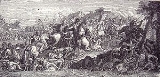
Battle of the Granicus

Encyclopedia
The Battle of the Granicus River in May 334 BC
was the first of three major battles fought between Alexander the Great and the Persian Empire
. Fought in Northwestern Asia Minor, near the site of Troy
, it was here that Alexander defeated the forces of the Persian satraps of Asia Minor, including a large force of Greek mercenaries led by Memnon of Rhodes
.
The battle took place on the road from Abydos
to Dascylium (near modern day Ergili, Turkey
), at the crossing of the Granicus
River (modern day Biga Çayı).
, and the subsequent consolidation of Alexander's Macedonian positions, he set out into Asia in 334 BC
.
He crossed the Hellespont from Sestos
to Abydos, and advanced up the road to Dascylium, which was the capital of the Satrapy of Phrygia
. The various satraps of the Persian empire gathered with their forces at the town of Zelea and offered battle on the banks of the Granicus River. Memnon suggested a scorched-earth policy of burning the grain and supplies and retreating in front of Alexander, but his suggestion was rejected by the commanding satraps.
, Diodorus, and Plutarch
all mention the battle, with Arrian providing the most detail. The Persians placed their cavalry in front of their infantry, and drew up on the right (east) bank of the river. Historians differ significantly on the effectiveness of the Persian dispositions. Some consider it a tactical mistake on the Persian side, others feel it was an attempt to take advantage of their superior number of cavalry, while Sir William Tarn felt "the Persian leaders had in fact a very gallant plan; they meant if possible to strangle the war at birth by killing Alexander."
, Alexander's army met the Persians on the third day of May from Abydos. Alexander's second-in-command, Parmenion
suggested crossing the river upstream and attacking at dawn the next day, but Alexander attacked immediately. This tactic caught the Persians off guard. The Macedonian line was arrayed with the heavy Phalanx
es in the middle, and cavalry on either side. Alexander was with the Companions
on the right flank. The Persians expected the main assault to come from Alexander's position and moved units from their center to that flank.
The battle started with a cavalry and light infantry feint from the Macedonian left, from Parmenion's side of the battle line. The Persians heavily reinforced that side, and the feint was driven back, but at that point, Alexander led the horse companions in their classic wedge-shaped charge, and smashed into the center of the Persian line. The Persians countercharged with a squadron of nobles on horse, and accounts show that in the melee, several high-ranking Persian nobles were killed by Alexander himself or his bodyguards, although Alexander was stunned by an axe-blow from a Persian nobleman named Spithridates
. Before the noble could deal a death-blow, however, he was himself killed by Cleitus the Black. Alexander quickly recovered.
The Macedonian cavalry then turned left and started rolling up the Persian cavalry, which was engaged with the left side of the Macedonian line after a general advance. A hole opened in the recently vacated place in the battle line, and the Macedonian infantry charged through to engage the poor-quality Persian infantry in the rear. At this, and with many of their leaders already dead, both flanks of the Persian cavalry retreated, seeing the collapse of the center. The infantry also routed, many being cut down as they fled.
Total casualties for the Macedonians were between 300 and 400. The Persians had roughly 1,000 cavalry and 3,000 infantry killed, mostly in the rout. The Greek mercenaries, under the command of Memnon of Rhodes, who fought for the Persians, were abandoned after the cavalry retreat. They attempted to broker a peace with Alexander but to no avail. As a result, after the battle Alexander ordered his infantry, who until this point had played no role in the battle, to slaughter the mercenaries to a man. 18,000 mercenaries were killed and 2,000 enslaved and sent back to Macedonia in chains for hard labour. It is believed that Alexander had a strong majority of the mercenaries killed in fear of plague.
Also, Alexander sent 300 Persian armour
s to the Parthenon of Athens
as an oblation
to Athena
, with this epigram
: "Alexander, son of Philipp, and the Greeks, except of Lacedaemonians, from the barbarians who live in Asia". («Αλέξανδρος Φιλίππου και οι Έλληνες, πλην Λακεδαιμονίων, από των βαρβάρων των την Ασία κατοικούντων»-"Alexandros Philippou kai oi Ellines plin Lakedemonion apo ton barbaron ton tin Asia katoikounton").
That account of the battle is directly contradicted by Diodorus Siculus
who states "When Alexander learned of the concentration of the Persian forces, he advanced rapidly and encamped opposite the enemy, so that the Granicus flowed between the encampments. The Persians, resting on high ground, made no move, intending to fall upon the foes as he crossed the river, for they supposed they could easily carry the day when the Macedonian phalanx was divided. But Alexander at dawn boldly brought his army across the river and deployed in good order before they could stop him. In return, they posted their mass of horsemen all along the front of the Macedonians since they had decided to press the battle with these. Memnon of Rhodes and satrap Arsamenes held the left wing each with his own cavalry; Arsites was stationed next with the horsemen from Paphlagonia; then came Spithrobates satrap of Ionia at the head of the Hyrcanian cavalry. The right wing was held by a thousand Medes and two thousand horsemen with Rheomithres as well as Bactrians of like number. Other national contingents occupied the centre, numerous and picked for their valour. In all, the cavalry amounted to more than ten thousand. The Persian foot soldiers were not fewer than one hundred thousand, but they were posted behind the line and did not advance since the cavalry was thought to be sufficient to crush the Macedonians. The record of Arrian and Diodorus on the battle of Granicus can't be reconciled so historians usually prefer Arrian, although some revisionists try to reconcile the two accounts.
would Darius decide to confront the Macedonian conqueror in person.
334 BC
Year 334 BC was a year of the pre-Julian Roman calendar. At the time, it was known as the Year of the Consulship of Caudinus and Calvinus...
was the first of three major battles fought between Alexander the Great and the Persian Empire
Achaemenid Empire
The Achaemenid Empire , sometimes known as First Persian Empire and/or Persian Empire, was founded in the 6th century BCE by Cyrus the Great who overthrew the Median confederation...
. Fought in Northwestern Asia Minor, near the site of Troy
Troy
Troy was a city, both factual and legendary, located in northwest Anatolia in what is now Turkey, southeast of the Dardanelles and beside Mount Ida...
, it was here that Alexander defeated the forces of the Persian satraps of Asia Minor, including a large force of Greek mercenaries led by Memnon of Rhodes
Memnon of Rhodes
Memnon of Rhodes was the commander of the Greek mercenaries working for the Persian king Darius III when Alexander the Great of Macedonia invaded Persia in 334 BC. He commanded the mercenaries at the Battle of the Granicus River, where his troops were massacred by the victorious Macedonians...
.
The battle took place on the road from Abydos
Abydos, Hellespont
For other uses, see Abydos Abydos , an ancient city of Mysia, in Asia Minor, situated at Nara Burnu or Nagara Point on the best harbor on the Asiatic shore of the Hellespont. Across Abydos lies Sestus on the European side marking the shortest point in the Dardanelles, scarcely a mile broad...
to Dascylium (near modern day Ergili, Turkey
Turkey
Turkey , known officially as the Republic of Turkey , is a Eurasian country located in Western Asia and in East Thrace in Southeastern Europe...
), at the crossing of the Granicus
Granicus
The Biga River is a small river or large creek in Çanakkale Province in northwestern Turkey. The river begins at the base of Mount Ida and trends generally northeasterly to the Sea of Marmara. It is located approximately 50 km to the east of the Dardanelles. It flows past the towns of Çan...
River (modern day Biga Çayı).
Background
Following the assassination of Alexander's father, Philip II of MacedonPhilip II of Macedon
Philip II of Macedon "friend" + ἵππος "horse" — transliterated ; 382 – 336 BC), was a king of Macedon from 359 BC until his assassination in 336 BC. He was the father of Alexander the Great and Philip III.-Biography:...
, and the subsequent consolidation of Alexander's Macedonian positions, he set out into Asia in 334 BC
334 BC
Year 334 BC was a year of the pre-Julian Roman calendar. At the time, it was known as the Year of the Consulship of Caudinus and Calvinus...
.
He crossed the Hellespont from Sestos
Sestos
200px|200px|thumb|The Ancient Map of Gallipoli PeninsulaSestos was an ancient Greek town of the Thracian Chersonese, the modern Gallipoli peninsula in European Turkey. Situated on the Hellespont opposite Abydos, it was the home of Hero in the legend of Hero and Leander, where according to legend...
to Abydos, and advanced up the road to Dascylium, which was the capital of the Satrapy of Phrygia
Phrygia
In antiquity, Phrygia was a kingdom in the west central part of Anatolia, in what is now modern-day Turkey. The Phrygians initially lived in the southern Balkans; according to Herodotus, under the name of Bryges , changing it to Phruges after their final migration to Anatolia, via the...
. The various satraps of the Persian empire gathered with their forces at the town of Zelea and offered battle on the banks of the Granicus River. Memnon suggested a scorched-earth policy of burning the grain and supplies and retreating in front of Alexander, but his suggestion was rejected by the commanding satraps.
Deployment of Persian troops
ArrianArrian
Lucius Flavius Arrianus 'Xenophon , known in English as Arrian , and Arrian of Nicomedia, was a Roman historian, public servant, a military commander and a philosopher of the 2nd-century Roman period...
, Diodorus, and Plutarch
Plutarch
Plutarch then named, on his becoming a Roman citizen, Lucius Mestrius Plutarchus , c. 46 – 120 AD, was a Greek historian, biographer, essayist, and Middle Platonist known primarily for his Parallel Lives and Moralia...
all mention the battle, with Arrian providing the most detail. The Persians placed their cavalry in front of their infantry, and drew up on the right (east) bank of the river. Historians differ significantly on the effectiveness of the Persian dispositions. Some consider it a tactical mistake on the Persian side, others feel it was an attempt to take advantage of their superior number of cavalry, while Sir William Tarn felt "the Persian leaders had in fact a very gallant plan; they meant if possible to strangle the war at birth by killing Alexander."
The battle
According to Alexander's biographer ArrianArrian
Lucius Flavius Arrianus 'Xenophon , known in English as Arrian , and Arrian of Nicomedia, was a Roman historian, public servant, a military commander and a philosopher of the 2nd-century Roman period...
, Alexander's army met the Persians on the third day of May from Abydos. Alexander's second-in-command, Parmenion
Parmenion
Parmenion was a Macedonian general in the service of Philip II of Macedon and Alexander the Great, murdered on a suspected false charge of treason....
suggested crossing the river upstream and attacking at dawn the next day, but Alexander attacked immediately. This tactic caught the Persians off guard. The Macedonian line was arrayed with the heavy Phalanx
Macedonian phalanx
The Macedonian phalanx is an infantry formation developed by Philip II and used by his son Alexander the Great to conquer the Persian Empire and other armies...
es in the middle, and cavalry on either side. Alexander was with the Companions
Companion cavalry
The Companions were the elite cavalry of the Macedonian army from the time of king Philip II of Macedon and reached the most prestige under Alexander the Great, and have been regarded as the best cavalry in the ancient world and the first shock cavalry...
on the right flank. The Persians expected the main assault to come from Alexander's position and moved units from their center to that flank.
The battle started with a cavalry and light infantry feint from the Macedonian left, from Parmenion's side of the battle line. The Persians heavily reinforced that side, and the feint was driven back, but at that point, Alexander led the horse companions in their classic wedge-shaped charge, and smashed into the center of the Persian line. The Persians countercharged with a squadron of nobles on horse, and accounts show that in the melee, several high-ranking Persian nobles were killed by Alexander himself or his bodyguards, although Alexander was stunned by an axe-blow from a Persian nobleman named Spithridates
Spithridates
Spithridates was a satrap of Lydia and Ionia under the high king Darius III Codomannus and was one of the Persian commanders at the Battle of the Granicus, in 334 BC, in which engagement, while he was aiming a blow from behind at Alexander the Great, his arm was cut off by Cleitus, son of Dropides...
. Before the noble could deal a death-blow, however, he was himself killed by Cleitus the Black. Alexander quickly recovered.
The Macedonian cavalry then turned left and started rolling up the Persian cavalry, which was engaged with the left side of the Macedonian line after a general advance. A hole opened in the recently vacated place in the battle line, and the Macedonian infantry charged through to engage the poor-quality Persian infantry in the rear. At this, and with many of their leaders already dead, both flanks of the Persian cavalry retreated, seeing the collapse of the center. The infantry also routed, many being cut down as they fled.
Total casualties for the Macedonians were between 300 and 400. The Persians had roughly 1,000 cavalry and 3,000 infantry killed, mostly in the rout. The Greek mercenaries, under the command of Memnon of Rhodes, who fought for the Persians, were abandoned after the cavalry retreat. They attempted to broker a peace with Alexander but to no avail. As a result, after the battle Alexander ordered his infantry, who until this point had played no role in the battle, to slaughter the mercenaries to a man. 18,000 mercenaries were killed and 2,000 enslaved and sent back to Macedonia in chains for hard labour. It is believed that Alexander had a strong majority of the mercenaries killed in fear of plague.
Also, Alexander sent 300 Persian armour
Armour
Armour or armor is protective covering used to prevent damage from being inflicted to an object, individual or a vehicle through use of direct contact weapons or projectiles, usually during combat, or from damage caused by a potentially dangerous environment or action...
s to the Parthenon of Athens
Parthenon
The Parthenon is a temple on the Athenian Acropolis, Greece, dedicated to the Greek goddess Athena, whom the people of Athens considered their virgin patron. Its construction began in 447 BC when the Athenian Empire was at the height of its power. It was completed in 438 BC, although...
as an oblation
Oblation
Oblation, an offering , a term, particularly in ecclesiastical usage, for a solemn offering or presentation to God.-Bible usage:...
to Athena
Athena
In Greek mythology, Athena, Athenê, or Athene , also referred to as Pallas Athena/Athene , is the goddess of wisdom, courage, inspiration, civilization, warfare, strength, strategy, the arts, crafts, justice, and skill. Minerva, Athena's Roman incarnation, embodies similar attributes. Athena is...
, with this epigram
Epigram
An epigram is a brief, interesting, usually memorable and sometimes surprising statement. Derived from the epigramma "inscription" from ἐπιγράφειν epigraphein "to write on inscribe", this literary device has been employed for over two millennia....
: "Alexander, son of Philipp, and the Greeks, except of Lacedaemonians, from the barbarians who live in Asia". («Αλέξανδρος Φιλίππου και οι Έλληνες, πλην Λακεδαιμονίων, από των βαρβάρων των την Ασία κατοικούντων»-"Alexandros Philippou kai oi Ellines plin Lakedemonion apo ton barbaron ton tin Asia katoikounton").
That account of the battle is directly contradicted by Diodorus Siculus
Diodorus Siculus
Diodorus Siculus was a Greek historian who flourished between 60 and 30 BC. According to Diodorus' own work, he was born at Agyrium in Sicily . With one exception, antiquity affords no further information about Diodorus' life and doings beyond what is to be found in his own work, Bibliotheca...
who states "When Alexander learned of the concentration of the Persian forces, he advanced rapidly and encamped opposite the enemy, so that the Granicus flowed between the encampments. The Persians, resting on high ground, made no move, intending to fall upon the foes as he crossed the river, for they supposed they could easily carry the day when the Macedonian phalanx was divided. But Alexander at dawn boldly brought his army across the river and deployed in good order before they could stop him. In return, they posted their mass of horsemen all along the front of the Macedonians since they had decided to press the battle with these. Memnon of Rhodes and satrap Arsamenes held the left wing each with his own cavalry; Arsites was stationed next with the horsemen from Paphlagonia; then came Spithrobates satrap of Ionia at the head of the Hyrcanian cavalry. The right wing was held by a thousand Medes and two thousand horsemen with Rheomithres as well as Bactrians of like number. Other national contingents occupied the centre, numerous and picked for their valour. In all, the cavalry amounted to more than ten thousand. The Persian foot soldiers were not fewer than one hundred thousand, but they were posted behind the line and did not advance since the cavalry was thought to be sufficient to crush the Macedonians. The record of Arrian and Diodorus on the battle of Granicus can't be reconciled so historians usually prefer Arrian, although some revisionists try to reconcile the two accounts.
Revisionist view
Historian Peter Green in his 1974 book Alexander of Macedon, proposed a way to reconcile the account of Diodorus and Arrian. According to Green, the riverbank was guarded by infantry, not cavalry, and Alexander's forces sustained heavy losses and were forced to retire. Alexander then grudgingly accepted Parmenion's advice, crossed the river during the night in an uncontested location, and fought the battle at dawn the next day. The Persian army hurried to the location of Alexander's crossing, with the cavalry reaching the scene of the battle first before the slower infantry, and then the battle continued largely as described by the Arrian and Plutarch accounts. Green accounts for the differences between his account and the ancient sources by suggesting that Alexander later covered up his initial failed crossing. Green devotes an entire appendix in support of his interpretation, taking the view that for political considerations, Alexander could not admit even a temporary defeat. Thus, the initial defeat was covered up by his propagandists, by a very heroic (and Homeric) suicide charge into the teeth of the enemy. However, Green freely admits this is a theory, and most still pick Arrian over Diodorus.Aftermath
Alexander (purportedly) came close to dying in the battle. Mithridates, Rhoesaces, Spithridates and several other Persian leaders were killed, while Arsites fled and shortly after committed suicide in his satrapy. The Greek cities in Asia Minor fell to Alexander, and a beachhead was established so that further campaigns against the Persian empire could be accomplished. Darius III continued to leave the responsibility of battling against Alexander to his satraps and gave Memnon a commanding role over the navy and coastal areas. Not until the Battle of IssusBattle of Issus
The Battle of Issus occurred in southern Anatolia, in November 333 BC. The invading troops, led by the young Alexander of Macedonia, defeated the army personally led by Darius III of Achaemenid Persia in the second great battle for primacy in Asia...
would Darius decide to confront the Macedonian conqueror in person.
Sources
- Delbrück, Hans (1920). History of the Art of War. University of Nebraska Press. Reprint edition, 1990. Translated by Walter, J. Renfroe. 4 Volumes.
- Engels, Donald W. (1978). Alexander the Great and the Logistics of the Macedonian Army. Berkeley/Los Angeles/London.
- Fuller, John F. C. (1960). The Generalship of Alexander the Great. New Jersey: De Capo Press.
- Green, PeterPeter Green (historian)Peter Green is a British classical scholar noted for his works on Alexander the Great and the Hellenistic Age of ancient history, generally regarded as spanning the era from the death of Alexander in 323 BC up to either the date of the Battle of Actium or the death of Augustus in 14 AD...
(1974). Alexander of Macedon: A Historical Biography. - Moerbeek, Martijn (1997). The battle of Granicus, 333 BC. Universiteit TwenteUniversiteit TwenteUniversity of Twente is a university located in Enschede, Netherlands. It offers research and degree programmes in the social and behavioral sciences and in engineering. In keeping with its entrepreneurial spirit, the University is committed to making economic and social contribution to the region...
. - Rogers, Guy (2004). Alexander: The Ambiguity of Greatness. New York: Random House.
- Warry, J. (1998), Warfare in the Classical World. ISBN 1-84065-004-4.
- Welman, Nick. Battles (Major) and Army. Fontys University.
See also
- Battle of IssusBattle of IssusThe Battle of Issus occurred in southern Anatolia, in November 333 BC. The invading troops, led by the young Alexander of Macedonia, defeated the army personally led by Darius III of Achaemenid Persia in the second great battle for primacy in Asia...