


Pelagonia

Encyclopedia
Greece
Greece , officially the Hellenic Republic , and historically Hellas or the Republic of Greece in English, is a country in southeastern Europe....
and the Republic of Macedonia
Republic of Macedonia
Macedonia , officially the Republic of Macedonia , is a country located in the central Balkan peninsula in Southeast Europe. It is one of the successor states of the former Yugoslavia, from which it declared independence in 1991...
. For the political unit in Macedonia, go to Pelagonia Statistical Region
Pelagonia statistical region
The Pelagonia Statistical Region is one of eight arbitrary statistical regions in the Republic of Macedonia. It is located in southwestern part of the country along the eponymous plain. It borders Greece and Albania...
.
Pelagonia (Greek
Ancient Greek
Ancient Greek is the stage of the Greek language in the periods spanning the times c. 9th–6th centuries BC, , c. 5th–4th centuries BC , and the c. 3rd century BC – 6th century AD of ancient Greece and the ancient world; being predated in the 2nd millennium BC by Mycenaean Greek...
: Πελαγονíα, Macedonian
Macedonian language
Macedonian is a South Slavic language spoken as a first language by approximately 2–3 million people principally in the region of Macedonia but also in the Macedonian diaspora...
: Пелагонија, Pelagonija) is a geographical region of Macedonia
Macedonia (region)
Macedonia is a geographical and historical region of the Balkan peninsula in southeastern Europe. Its boundaries have changed considerably over time, but nowadays the region is considered to include parts of five Balkan countries: Greece, the Republic of Macedonia, Bulgaria, Albania, Serbia, as...
.
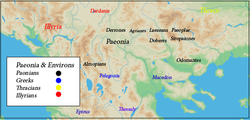
In antiquity, it was roughly bounded by Dardania to the far north, Illyria
Illyria
In classical antiquity, Illyria was a region in the western part of the Balkan Peninsula inhabited by the Illyrians....
to the west and north, Paionia
Paionia
In ancient geography, Paeonia or Paionia was the land of the Paeonians . The exact original boundaries of Paeonia, like the early history of its inhabitants, are very obscure, but it is believed that they lay in the region of Thrace...
to the east, and Lynkestis
Lynkestis
Lynkestis or Lynchestia was a region of Upper Macedonia on the southern borders of Illyria which was ruled by kings, lords and independent or semi-independent chieftains till the later Argead rulers of Macedon neutralized their independence with dynastic alliances and the practice of bringing up...
to the south and west. Ancient Pelagonia is located in south-western regions of modern Republic of Macedonia
Republic of Macedonia
Macedonia , officially the Republic of Macedonia , is a country located in the central Balkan peninsula in Southeast Europe. It is one of the successor states of the former Yugoslavia, from which it declared independence in 1991...
. Later the region was annexed to the Macedonian kingdom during the 4th century BC. In medieval times, when the names of Lynkestis
Lynkestis
Lynkestis or Lynchestia was a region of Upper Macedonia on the southern borders of Illyria which was ruled by kings, lords and independent or semi-independent chieftains till the later Argead rulers of Macedon neutralized their independence with dynastic alliances and the practice of bringing up...
and Orestis
Orestis (region)
For the modern municipality, see OrestidaOrestis was a region of Upper Macedonia, corresponding roughly to the modern Kastoria Prefecture, West Macedonia, Greece. Its inhabitants were the Greek tribe Orestae...
had become obsolete, Pelagonia acquired a broader meaning. This is why the Battle of Pelagonia
Battle of Pelagonia
The Battle of Pelagonia took place in September of 1259, between the Empire of Nicaea and the Despotate of Epirus, Sicily and the Principality of Achaea...
(1259) between Byzantines and Latins includes also the Kastoria Prefecture
Kastoria
Kastoria is a city in northern Greece in the periphery of West Macedonia. It is the capital of Kastoria peripheral unit. It is situated on a promontory on the western shore of Lake Orestiada, in a valley surrounded by limestone mountains...
, modern Macedonia (Greece)
Macedonia (Greece)
Macedonia is a geographical and historical region of Greece in Southern Europe. Macedonia is the largest and second most populous Greek region...
, ancient Orestis.
Many Mycenaean
Helladic period
Helladic is a modern archaeological term meant to identify a sequence of periods characterizing the culture of mainland ancient Greece during the Bronze Age. The term is commonly used in archaeology and art history...
objects have been found found in the area, such as the double axe, later found in Mycenae
Mycenae
Mycenae is an archaeological site in Greece, located about 90 km south-west of Athens, in the north-eastern Peloponnese. Argos is 11 km to the south; Corinth, 48 km to the north...
. Mycenaean finds are exhibited in the Museum of Bitola
Bitola
Bitola is a city in the southwestern part of the Republic of Macedonia. The city is an administrative, cultural, industrial, commercial, and educational centre. It is located in the southern part of the Pelagonia valley, surrounded by the Baba and Nidže mountains, 14 km north of the...
. The region was inhabited by the Pelagones, an Epirote Molossian tribe according to Strabo
Strabo
Strabo, also written Strabon was a Greek historian, geographer and philosopher.-Life:Strabo was born to an affluent family from Amaseia in Pontus , a city which he said was situated the approximate equivalent of 75 km from the Black Sea...
, who calls Pelagonia Tripolitis albeit he names only one city of the supposed three; Azorus. Only two Pelagonians are known to us: the one, the mythological Pelagon
Pelagon
There are several figures named Pelagon in Greek mythology.# Pelagon, the King of Phocis who gives Cadmus the cow that will guide him to Boeotia....
, the eponymous of the region, was son of the river-god Axius
Axius (mythology)
Axius is a Paeonian river god, the son of Oceanus and Tethys. He was the father of Pelagon, by Periboea, daughter of Acessamenus. His domain is the river Axius, or Vardar, in Macedonia ....
(modern Vardar) and father of the Paeonian Asteropaeus in the Iliad
Iliad
The Iliad is an epic poem in dactylic hexameters, traditionally attributed to Homer. Set during the Trojan War, the ten-year siege of the city of Troy by a coalition of Greek states, it tells of the battles and events during the weeks of a quarrel between King Agamemnon and the warrior Achilles...
. The second one is Menelaus of Pelagonia
Menelaus of Pelagonia
Menelaus was a local ruler of Pelagonia, honoured as euergetes of Athens in 363 BC, for helping Athenians in the war against Amphipolis and the Chalcidian League. In the decree it is stated that not only Menelaus himself but also his ancestors were benefactors of Athens...
(ca. 360 BC) who, according to Bossworth, fled his kingdom when it was annexed by Philip II
Philip II of Macedon
Philip II of Macedon "friend" + ἵππος "horse" — transliterated ; 382 – 336 BC), was a king of Macedon from 359 BC until his assassination in 336 BC. He was the father of Alexander the Great and Philip III.-Biography:...
, finding refuge and citizenship in Athens.
Today, Pelagonia is a plain
Plain
In geography, a plain is land with relatively low relief, that is flat or gently rolling. Prairies and steppes are types of plains, and the archetype for a plain is often thought of as a grassland, but plains in their natural state may also be covered in shrublands, woodland and forest, or...
shared between the Republic of Macedonia
Republic of Macedonia
Macedonia , officially the Republic of Macedonia , is a country located in the central Balkan peninsula in Southeast Europe. It is one of the successor states of the former Yugoslavia, from which it declared independence in 1991...
and Greece
Greece
Greece , officially the Hellenic Republic , and historically Hellas or the Republic of Greece in English, is a country in southeastern Europe....
. It incorporates the southern towns of Bitola
Bitola
Bitola is a city in the southwestern part of the Republic of Macedonia. The city is an administrative, cultural, industrial, commercial, and educational centre. It is located in the southern part of the Pelagonia valley, surrounded by the Baba and Nidže mountains, 14 km north of the...
and Prilep
Prilep
Prilep is the fourth largest city in the Republic of Macedonia. It has a population of 66,246 citizens. Prilep is known as "the city under Marko's Towers" because of its proximity to the towers of Prince Marko.-Name:...
in the Republic of Macedonia and the northwestern Greek Macedonian city Florina
Florina
Florina is a town and municipality in mountainous northwestern Macedonia, Greece. Its motto is, 'Where Greece begins'. It is also the Metropolitan seat for the region. It lies in the central part of Florina peripheral unit, of which it is the capital. Florina belongs to the periphery of West...
in Greece; it is also the location of the lower key border crossing between the two countries Medžitlija-Niki
Medžitlija-Niki
The Medžitlija-Níki border crossing linking the Republic of Macedonia with Greece is one of the three transit points for road vehicles between the two states. Situated about 190 km from Thessaloniki and the same to Skopje, it also once served as Yugoslavia's southernmost exit...
.