

Ancient Olympic Games

Encyclopedia
The Olympic Games were a series of athletic competitions held for representatives of various city-state
s of Ancient Greece
held in honor of Zeus
. The exact origins of the Games are shrouded in myth and legend but records indicate that they began in 776 BC in Olympia
in Greece. They were celebrated until 393 AD when they were suppressed by Theodosius I
as part of the campaign to impose Christianity as a state religion
. The Games were usually held every four years, or olympiad
, as the unit of time came to be known. During a celebration of the Games, an Olympic Truce was enacted so that athletes could travel from their countries to the Games in safety. The prizes for the victors were wreaths of laurel leaves. The Games became a political tool used by city-states to assert dominance over their rivals. Politicians would announce political alliances at the Games, and in times of war, priests would offer sacrifices to the gods for victory. The Games were also used to help spread Hellenistic culture throughout the Mediterranean. The Olympics also featured religious celebrations and artistic competitions. A great statue of Zeus
, one of the seven wonders of the ancient world
was erected in Olympia to preside over the Games, and no longer stands in Olympia. Sculptors and poets would congregate each olympiad to display their works of art to would-be patrons.
The ancient Olympics were rather different from the modern Games. There were fewer events, and only free men who spoke Greek could compete (although a woman Bilistiche is also mentioned as a winner). As long as they met the entrance criteria, athletes from any country or city-state were allowed to participate. The Games were always held at Olympia rather than alternating to different locations as is the tradition with the modern Olympic Games
. There is one major commonality between the ancient and modern Games, the victorious athletes are honored, feted, and praised. Their deeds were heralded and chronicled so that future generations could appreciate their accomplishments.
 To the Greeks it was important to root the Olympic Games in mythology. During the time of the ancient Games their origins were attributed to the gods, and competing legends persisted as to who actually was responsible for the Games' genesis. These origin of traditions have become nearly impossible to untangle, yet a chronology and patterns have arisen that help people understand the story behind the Games. The earliest myths regarding the origin of the Games are recounted by the Greek historian, Pausanias. According to the story, the dactyl
Herakles (not to be confused with the son of Zeus
) and two of his brothers raced at Olympia. He crowned the victor with a laureel wreath, which explains the traditional prize given to Olympic champions. The other Olympian gods (so named because they lived permanently on Mount Olympus), would also engage in wrestling, jumping and running contests. Another myth, this one occurring after the aforementioned myth, is attributed to Pindar
. He claims the festival at Olympia involved Pelops
, king of Olympia
and eponymous hero of the Peloponnesus, and Herakles, the son of Zeus. The story goes that after completing his labors, Herakles established an athletic festival to honor his father. Pelops, using trickery, and the help of Poseidon
, won a chariot race against a local king and claimed the king's daughter, Hippodamia
as his prize. A final myth, also attributed to Pausanias is dated by the historian at 776 BC. For some reason the Games of previous millennia were discontinued and then revived by Lycurgus of Sparta, Iphitos
of Elis
, and Cleoisthenes of Pisa at the behest of the Oracle of Delphi who claimed that the people had strayed from the gods, which had caused a plague and constant war. Restoration of the Games would end the plague, usher in a time of peace, and signal a return to a more traditional lifestyle. The patterns that emerge from these myths are that the Greeks believed the Games had their roots in religion, that athletic competition was tied to worship of the gods, and the revival of the ancient Games was intended to bring peace, harmony and a return to the origins of Greek life. Since these myths were documented by historians like Pausanias, who lived during the reign of Marcus Aurelius in the 160s AD, it is likely that these stories are more fable than fact.
, the other being the much older religious festival, the Eleusinian Mysteries
.
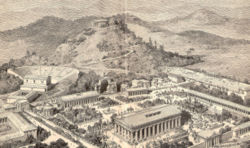
The games started in Olympia, Greece, in a sanctuary site for the Greek deities near the towns of Elis and Pisa
(both in Elis
on the peninsula of Peloponnesos). The first Games began as an annual foot race of young women in competition for the position of the priestess for the goddess, Hera
and a second race was instituted for a consort for the priestess who would participate in the religious traditions at the temple.
The Heraea Games
, the first recorded competition for women in the Olympic Stadium, were held as early as the sixth century BC. It originally consisted of foot races only, as did the competition for males. Some texts, including Pausanias's Description of Greece, c. AD 175, state that Hippodameia gathered a group known as the "Sixteen Women" and made them administrators of the Heraea Games, out of gratitude for her marriage to Pelops
. Other texts related to the Elis and Pisa conflict indicate that the "Sixteen Women
" were peacemakers from Pisa and Elis and, because of their political competence, became administrators of the Heraea. Being the consort of Hera in Classical Greek
mythology
, Zeus was the father of the deities in the pantheon
of that era. The Sanctuary of Zeus
in Olympia housed a 13 metres (42.7 ft) statue in ivory and gold of Zeus
that had been sculpted by Phidias
circa 445 BC. This statue was one of the ancient Seven Wonders of the World. By the time of the Classical Greek culture, in the fifth and fourth centuries BC, the games were restricted to male participants.
The historian Ephorus
, who lived in the fourth century BC, is believed to have established the use of Olympiads to count years. The Olympic Games were held at four-year intervals, and later, the Greek method of counting the years even referred to these Games, using the term Olympiad
for the period between two Games. Previously, every Greek state used its own dating system, something that continued for local events, which led to confusion when trying to determine dates. For example, Diodorus states that there was a solar eclipse in the third year of the 113th Olympiad, which must be the eclipse of 316 BC. This gives a date of (mid-summer) 765 BC for the first year of the first Olympiad. Nevertheless, there is disagreement among scholars as to when the Games began.
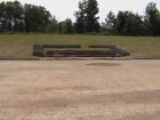
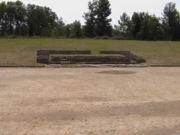 The only competition held then was, according to the later Greek traveller Pausanias
who wrote in 175 A.D., the stadion race, a race over about 190 metres (623.4 ft), measured after the feet of Hercules. The word stadium is derived from this foot race.
The Greek tradition of athletic nudity
was introduced in 720 BC, either by the Spartans or by the Megarian Orsippus
, and this was adopted early in the Olympics as well.
Several groups fought over control of the sanctuary at Olympia, and hence the Games, for prestige and political advantage. Pausanias later writes that in 668 BC, Pheidon of Argos
was commissioned by the town of Pisa to capture the sanctuary from the town of Elis, which he did and then personally controlled the Games for that year. The next year, Elis regained control.
The Olympic Games were part of the Panhellenic Games
, four separate games held at two- or four-year intervals, but arranged so that there was at least one set of games every year. The Olympic Games were more important and more prestigious than the Pythian
, Nemean
, and Isthmian Games
.
Finally, the Olympic Games were suppressed, either by Theodosius I
in AD 393 or his grandson Theodosius II
in AD 435, as part of the campaign to impose Christianity as a state religion
. The site of Olympia remained until an earthquake destroyed it in the 6th century AD.
, and on the middle day of the Games, 100 oxen would be sacrificed to him. Over time Olympia, site of the Games, became a central spot for the worship of the head of the Greek pantheon
and a temple, built by the Greek architect Libon
was erected on the mountaintop. The temple was one of the largest Doric
temples in Greece. The sculptor Pheidias created a statue of the god made of gold and ivory. It stood 42 feet (12.8 m) tall. It was placed on a throne in the temple. The statue became one of the seven wonders of the ancient world
. As the historian Strabo
put it,
Artistic expression was a major part of the Games. Sculptors, poets and other artisans would come to the Games to display their works in what became an artistic competition. Sculptors created works like Myron
's Diskobolos or Discus Thrower. Their aim was to highlight natural human movement and the shape of muscles and the body. Poets would be commissioned to write prose in honor of the Olympic victors. These poems, known as Epinicians, were passed on from generation to generation and many of them have lasted far longer than any other honor made for the same purpose. Baron Pierre de Coubertin, one of the founders of the modern Olympic Games
, wanted to fully imitate the ancient Olympics in every way. Included in his vision was to feature an artistic competition modeled on the ancient Olympics and held every four years, during the celebration of the Olympic Games. His desire came to fruition at the Olympics held in London
in 1908.
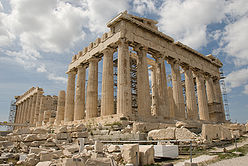 Power in ancient Greece
became centered around the city-state
in the 8th century BC. The city-state was a population center that became organized into a self-contained political entity. These city-states often lived in close proximity to each other, which created competition for limited resources. Though conflict between the city-states was ubiquitous, it was also in their self-interest to engage in trade, military alliances and cultural interaction. The city-states had a dichotomous relationship with each other, on one hand they relied on their neighbors for political and military alliances, on the other they competed fiercely with those same neighbors for the resources necessary to sustain life. The Olympic Games were established in this political context. Representatives of the city-states would compete against each other at the Games.
In the first 200 years of the Games' existence Olympia had only regional religious importance. Greeks beyond the area immediately around the mountain did not compete in these early Games. This is evidenced by the dominance of Peloponnesian athletes in the victors' rolls. The spread of Greek colonies in the 5th and 6th century BC is repeatedly linked to successful Olympic athletes. For example, Pausanias recounts that Cyrene
was founded c. 630 BC by settlers from Thera
with Sparta
n support. The support Sparta gave was primarily the loan of three-time Olympic champion Chionis. The draw of settling with an Olympic champion helped to populate the colonies and maintain cultural and political ties with the city-states in proximity to Olympia. Thus Hellenistic culture and the Games spread while the primacy of Olympia persisted.
The Games faced a serious challenge during the Peloponnesian War
, which primarily pitted Athens against Sparta, but in reality touched nearly every Hellenistic city-state. The Olympics were used during this time to announce alliances and offer sacrifices to the gods for victory.
During the Olympic Games, a truce, or ekecheiria was observed. Three runners, known as spondophoroi were sent from Elis
to the participant cities at each set of games to announce the beginning of the truce. During this period, armies were forbidden from entering Olympia, wars were suspended, and legal disputes and the use of the death penalty were forbidden. The truce was primarily designed to allow athletes and visitors to travel safely to the Games and was, for the most part, observed. Thucydides
wrote of a situation when the Sparta
ns were forbidden from attending the Games, and the violators of the truce were fined 2,000 minae
for assaulting the city of Lepreum
during the period of the ekecheiria. The Spartans disputed the fine and claimed that the truce had not yet taken hold.
While a martial truce was observed by all participating city-states, no such reprieve from conflict existed in the political arena. The Olympic Games evolved the most influential athletic and cultural stage in ancient Greece, and arguably in the ancient world. As such the Games became a vehicle for city-states to promote themselves. The result was political intrigue and controversy. For example, Pausanias, a Greek historian, explains the situation of the athlete Sotades,
in Beijing. In what is becoming a growing trend, many athletes are switching citizenships in order to compete at the Games. There are an equal number of countries willing to grant citizenship and monetary considerations to these athletes in exchange for their representation and the honor that comes with potential Olympic success. In this the Olympics have changed very little from their roots in antiquity.
 Only free men who spoke Greek
were allowed to participate in the Ancient Games of classical times. They were to some extent "international", in the sense that they included athletes from the various Greek city-states. Additionally, participants eventually came from Greek colonies as well, extending the range of the games to far shores of the Mediterranean and of the Black Sea
.
To be in the Games, the athletes had to qualify and have their names written in the lists. It seems that only young people were allowed to participate, as the Greek writer Plutarch
relates that one young man was rejected for seeming overmature, and only after his lover, who presumably vouched for his youth, interceded with the King of Sparta, was he permitted to participate. Before being able to participate, every participant had to take an oath in front of the statue of Zeus
, saying that he had been in training for ten months.
At first, the Olympic Games lasted only one day, but eventually grew to five days. The Olympic Games originally contained one event: the stadion (or "stade") race, a short sprint measuring between 180 and 240 m (590.6 and 787.4 ), or the length of the stadium. The length of the race is uncertain, since tracks found at archeological sites, as well as literary evidence, provide conflicting measurements. Runners had to pass five stakes that divided the lanes: one stake at the start, another at the finish, and three stakes in between.
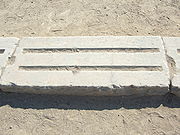 The diaulos
, or two-stade race, was introduced in 724 BC, during the 14th Olympic games. The race was a single lap of the stadium, approximately 400 metres (1,312.3 ft), and scholars debate whether or not the runners had individual "turning" posts for the return leg of the race, or whether all the runners approached a common post, turned, and then raced back to the starting line.
A third foot race, the dolichos, was introduced in 720 BC. Accounts of the race present conflicting evidence as to the length of the dolichos; however, the length of the race was 18–24 laps, or about three miles (5 km). The event was run similarly to modern marathons—the runners would begin and end their event in the stadium proper, but the race course would wind its way through the Olympic grounds. The course often would flank important shrines and statues in the sanctuary, passing by the Nike
statue by the temple of Zeus
before returning to the stadium.
The last running event added to the Olympic program was the hoplitodromos
, or "Hoplite race", introduced in 520 BC and traditionally run as the last race of the Olympic Games. The runners would run either a single or double diaulos
(approximately 400 or 800 yards) in full or partial armour, carrying a shield and additionally equipped either with greaves or a helmet. As the armour weighed between 50 and 60 lb (27.2 kg), the hoplitodromos emulated the speed and stamina needed for warfare. Due to the weight of the armour, it was easy for runners to drop their shields or trip over fallen competitors. In a vase painting depicting the event, some runners are shown leaping over fallen shields. The course they used for these runs were made out of clay, with sand over the clay.
Over the years, more events were added: boxing
(pygme/pygmachia), wrestling
(pale), a very bloody pankration
. Due to the popularity of modern Mixed Martial arts culture, there is the misconception that the two would be similar but unfortunately greco-roman martial arts would have had no similarity to modern striking and grappling methods of fighting. Boxing was an umbrella term for a variety of striking arts used by the British (examples: Thai boxing, Chinese boxing, French boxing, Burmese boxing). Archeology has shown little or no similarities between Ancient Greco-roman "pale" and any modern form of grappling including modern Greco-roman wrestling. Other events include chariot racing
, and several other running events (the diaulos
, hippios
, dolichos, and hoplitodromos), as well as a pentathlon
, consisting of wrestling, stadion, long jump
, javelin throw
, and discus throw
(the latter three were not separate events).
Boxing became increasingly brutal over the centuries. Initially, soft leather covered their fingers, but eventually, hard leather weighted with metal sometimes was used. The fights had no rest periods and no rules against hitting a man while he was down. Bouts continued until one man either surrendered or died- however, killing an opponent wasn't a good thing, as the dead boxer was automatically declared the winner.
In the chariot racing event, it was not the rider, but the owner of the chariot and team who was considered to be the competitor, so one owner could win more than one of the top spots. The addition of events meant the festival grew from one day to five days, three of which were used for competition. The other two days were dedicated to religious rituals. On the final day, there was a banquet for all the participants, consisting of 100 oxen that had been sacrificed to Zeus
on the first day.
The winner of an Olympic event was awarded an olive branch
and often was received with much honour throughout Greece, especially in his home town, where he was often granted large sums of money (in Athens, 500 drachma, a small fortune) and prizes including vats of olive oil
. (See Milo of Croton
.) Sculptors would create statues of Olympic victors, and poets would sing odes in their praise for money.
Archaeologists believe that wars between the city-states of Greece were halted so that the athletes as well as the spectators of the Olympics could get there safely. However, some archaeologists argue that the wars were not halted, but that the athletes who were in the armies were allowed to leave and participate in the Olympics.
Participation in the classical games was limited to male athletes except for women who were allowed to take part by entering horses in the equestrian
events. In 396 BC, and again in 392 BC, the horses of a Sparta
n princess named Cynisca
won her the four-horse race. It is thought that single women (not betrothed or married) were allowed to watch the races. Also priestesses in the temple of Zeus who lit the oil lamps were permitted.
The athletes usually competed nude, not only as the weather was appropriate, but also as the festival was meant to celebrate, in part, the achievements of the human body. Olive oil was used by the competitors, not only as a substitute for soap
for washing, bathing, and cleaning, but also as a natural cosmetic
, to keep skin smooth, and provide an appealing look for the participants.
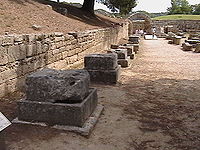
, obtained great celebrity. After these Olympic festivals had been established in several places, the great Olympic festival itself was sometimes designated in inscriptions by the addition of Pisa
.
City-state
A city-state is an independent or autonomous entity whose territory consists of a city which is not administered as a part of another local government.-Historical city-states:...
s of Ancient Greece
Ancient Greece
Ancient Greece is a civilization belonging to a period of Greek history that lasted from the Archaic period of the 8th to 6th centuries BC to the end of antiquity. Immediately following this period was the beginning of the Early Middle Ages and the Byzantine era. Included in Ancient Greece is the...
held in honor of Zeus
Zeus
In the ancient Greek religion, Zeus was the "Father of Gods and men" who ruled the Olympians of Mount Olympus as a father ruled the family. He was the god of sky and thunder in Greek mythology. His Roman counterpart is Jupiter and his Etruscan counterpart is Tinia.Zeus was the child of Cronus...
. The exact origins of the Games are shrouded in myth and legend but records indicate that they began in 776 BC in Olympia
Olympia, Greece
Olympia , a sanctuary of ancient Greece in Elis, is known for having been the site of the Olympic Games in classical times, comparable in importance to the Pythian Games held in Delphi. Both games were held every Olympiad , the Olympic Games dating back possibly further than 776 BC...
in Greece. They were celebrated until 393 AD when they were suppressed by Theodosius I
Theodosius I
Theodosius I , also known as Theodosius the Great, was Roman Emperor from 379 to 395. Theodosius was the last emperor to rule over both the eastern and the western halves of the Roman Empire. During his reign, the Goths secured control of Illyricum after the Gothic War, establishing their homeland...
as part of the campaign to impose Christianity as a state religion
State religion
A state religion is a religious body or creed officially endorsed by the state...
. The Games were usually held every four years, or olympiad
Olympiad
An Olympiad is a period of four years, associated with the Olympic Games of Classical Greece. In the Hellenistic period, beginning with Ephorus, Olympiads were used as calendar epoch....
, as the unit of time came to be known. During a celebration of the Games, an Olympic Truce was enacted so that athletes could travel from their countries to the Games in safety. The prizes for the victors were wreaths of laurel leaves. The Games became a political tool used by city-states to assert dominance over their rivals. Politicians would announce political alliances at the Games, and in times of war, priests would offer sacrifices to the gods for victory. The Games were also used to help spread Hellenistic culture throughout the Mediterranean. The Olympics also featured religious celebrations and artistic competitions. A great statue of Zeus
Zeus
In the ancient Greek religion, Zeus was the "Father of Gods and men" who ruled the Olympians of Mount Olympus as a father ruled the family. He was the god of sky and thunder in Greek mythology. His Roman counterpart is Jupiter and his Etruscan counterpart is Tinia.Zeus was the child of Cronus...
, one of the seven wonders of the ancient world
Seven Wonders of the Ancient World
The Seven Wonders of the World refers to remarkable constructions of classical antiquity listed by various authors in guidebooks popular among the ancient Hellenic tourists, particularly in the 1st and 2nd centuries BC...
was erected in Olympia to preside over the Games, and no longer stands in Olympia. Sculptors and poets would congregate each olympiad to display their works of art to would-be patrons.
The ancient Olympics were rather different from the modern Games. There were fewer events, and only free men who spoke Greek could compete (although a woman Bilistiche is also mentioned as a winner). As long as they met the entrance criteria, athletes from any country or city-state were allowed to participate. The Games were always held at Olympia rather than alternating to different locations as is the tradition with the modern Olympic Games
Olympic Games
The Olympic Games is a major international event featuring summer and winter sports, in which thousands of athletes participate in a variety of competitions. The Olympic Games have come to be regarded as the world’s foremost sports competition where more than 200 nations participate...
. There is one major commonality between the ancient and modern Games, the victorious athletes are honored, feted, and praised. Their deeds were heralded and chronicled so that future generations could appreciate their accomplishments.
Origins
Dactyl (mythology)
In Greek mythology, the Dactyls were the archaic mythical race of small phallic male beings associated with the Great Mother, whether as Cybele or Rhea. Their numbers vary, but often they were ten spirit-men so like the three Curetes, the Cabiri or the Korybantes that they were often interchangeable...
Herakles (not to be confused with the son of Zeus
Zeus
In the ancient Greek religion, Zeus was the "Father of Gods and men" who ruled the Olympians of Mount Olympus as a father ruled the family. He was the god of sky and thunder in Greek mythology. His Roman counterpart is Jupiter and his Etruscan counterpart is Tinia.Zeus was the child of Cronus...
) and two of his brothers raced at Olympia. He crowned the victor with a laureel wreath, which explains the traditional prize given to Olympic champions. The other Olympian gods (so named because they lived permanently on Mount Olympus), would also engage in wrestling, jumping and running contests. Another myth, this one occurring after the aforementioned myth, is attributed to Pindar
Pindar
Pindar , was an Ancient Greek lyric poet. Of the canonical nine lyric poets of ancient Greece, his work is the best preserved. Quintilian described him as "by far the greatest of the nine lyric poets, in virtue of his inspired magnificence, the beauty of his thoughts and figures, the rich...
. He claims the festival at Olympia involved Pelops
Pelops
In Greek mythology, Pelops , was king of Pisa in the Peloponnesus. He was the founder of the House of Atreus through his son of that name....
, king of Olympia
Olympia, Greece
Olympia , a sanctuary of ancient Greece in Elis, is known for having been the site of the Olympic Games in classical times, comparable in importance to the Pythian Games held in Delphi. Both games were held every Olympiad , the Olympic Games dating back possibly further than 776 BC...
and eponymous hero of the Peloponnesus, and Herakles, the son of Zeus. The story goes that after completing his labors, Herakles established an athletic festival to honor his father. Pelops, using trickery, and the help of Poseidon
Poseidon
Poseidon was the god of the sea, and, as "Earth-Shaker," of the earthquakes in Greek mythology. The name of the sea-god Nethuns in Etruscan was adopted in Latin for Neptune in Roman mythology: both were sea gods analogous to Poseidon...
, won a chariot race against a local king and claimed the king's daughter, Hippodamia
Hippodamia
Hippodamia was a daughter of King Oenomaus and wife of Pelops with whom her offspring were Thyestes, Atreus, Pittheus, Alcathous, Troezen, Hippalcimus, Copreus, Astydameia, Nicippe, Eurydice and others....
as his prize. A final myth, also attributed to Pausanias is dated by the historian at 776 BC. For some reason the Games of previous millennia were discontinued and then revived by Lycurgus of Sparta, Iphitos
Iphitos
Iphitos , also Iphitus, was a name attributed to five individuals in Greek mythology.*Iphitos was the son of Eurytus, king of Oechalia, and a descendant of Oxylus. After defeating Eurytus in an archery contest, Heracles was accused of stealing Eurytus's cattle as revenge because he was not given...
of Elis
Elis
Elis, or Eleia is an ancient district that corresponds with the modern Elis peripheral unit...
, and Cleoisthenes of Pisa at the behest of the Oracle of Delphi who claimed that the people had strayed from the gods, which had caused a plague and constant war. Restoration of the Games would end the plague, usher in a time of peace, and signal a return to a more traditional lifestyle. The patterns that emerge from these myths are that the Greeks believed the Games had their roots in religion, that athletic competition was tied to worship of the gods, and the revival of the ancient Games was intended to bring peace, harmony and a return to the origins of Greek life. Since these myths were documented by historians like Pausanias, who lived during the reign of Marcus Aurelius in the 160s AD, it is likely that these stories are more fable than fact.
History
The games were held to be one of the two central rituals in Ancient GreeceAncient Greece
Ancient Greece is a civilization belonging to a period of Greek history that lasted from the Archaic period of the 8th to 6th centuries BC to the end of antiquity. Immediately following this period was the beginning of the Early Middle Ages and the Byzantine era. Included in Ancient Greece is the...
, the other being the much older religious festival, the Eleusinian Mysteries
Eleusinian Mysteries
The Eleusinian Mysteries were initiation ceremonies held every year for the cult of Demeter and Persephone based at Eleusis in ancient Greece. Of all the mysteries celebrated in ancient times, these were held to be the ones of greatest importance...
.
The games started in Olympia, Greece, in a sanctuary site for the Greek deities near the towns of Elis and Pisa
Pisa (Greece)
Pisa was the name of an ancient town in the western Peloponnese, Greece. The area controlled by Pisa was called Pisatis, which included Olympia, the site of the Ancient Olympic Games. Pisa and Pisatis were subjugated by Elis in 572 BC. Currently, it is a village within the municipality of Olympia...
(both in Elis
Elis
Elis, or Eleia is an ancient district that corresponds with the modern Elis peripheral unit...
on the peninsula of Peloponnesos). The first Games began as an annual foot race of young women in competition for the position of the priestess for the goddess, Hera
Hera
Hera was the wife and one of three sisters of Zeus in the Olympian pantheon of Greek mythology and religion. Her chief function was as the goddess of women and marriage. Her counterpart in the religion of ancient Rome was Juno. The cow and the peacock were sacred to her...
and a second race was instituted for a consort for the priestess who would participate in the religious traditions at the temple.
The Heraea Games
Heraea Games
The ancient Heraean Games, dedicated to the goddess Hera were the first sanctioned women's athletic competition to be held in the stadium at Olympia, possibly in the Olympic year, prior to the men's events. It is dated as early as the 6th century BC. Some texts, including Pausanias's...
, the first recorded competition for women in the Olympic Stadium, were held as early as the sixth century BC. It originally consisted of foot races only, as did the competition for males. Some texts, including Pausanias's Description of Greece, c. AD 175, state that Hippodameia gathered a group known as the "Sixteen Women" and made them administrators of the Heraea Games, out of gratitude for her marriage to Pelops
Pelops
In Greek mythology, Pelops , was king of Pisa in the Peloponnesus. He was the founder of the House of Atreus through his son of that name....
. Other texts related to the Elis and Pisa conflict indicate that the "Sixteen Women
Sixteen Women
Pausanias, in his Description of Greece , refers to "the Sixteen Women." It's unclear how "the Sixteen Women" became a group. Several interpretations exist, including that they were selected as negotiators from 16 cities, for the purpose of making peace between Elis and Pisa....
" were peacemakers from Pisa and Elis and, because of their political competence, became administrators of the Heraea. Being the consort of Hera in Classical Greek
Classical Greece
Classical Greece was a 200 year period in Greek culture lasting from the 5th through 4th centuries BC. This classical period had a powerful influence on the Roman Empire and greatly influenced the foundation of Western civilizations. Much of modern Western politics, artistic thought, such as...
mythology
Mythology
The term mythology can refer either to the study of myths, or to a body or collection of myths. As examples, comparative mythology is the study of connections between myths from different cultures, whereas Greek mythology is the body of myths from ancient Greece...
, Zeus was the father of the deities in the pantheon
Pantheon (gods)
A pantheon is a set of all the gods of a particular polytheistic religion or mythology.Max Weber's 1922 opus, Economy and Society discusses the link between a...
of that era. The Sanctuary of Zeus
Zeus
In the ancient Greek religion, Zeus was the "Father of Gods and men" who ruled the Olympians of Mount Olympus as a father ruled the family. He was the god of sky and thunder in Greek mythology. His Roman counterpart is Jupiter and his Etruscan counterpart is Tinia.Zeus was the child of Cronus...
in Olympia housed a 13 metres (42.7 ft) statue in ivory and gold of Zeus
Statue of Zeus at Olympia
The Statue of Zeus at Olympia was made by the Greek sculptor Phidias, circa 432 BC on the site where it was erected in the Temple of Zeus, Olympia, Greece. It was one of the Seven Wonders of the Ancient World.-Description:...
that had been sculpted by Phidias
Phidias
Phidias or the great Pheidias , was a Greek sculptor, painter and architect, who lived in the 5th century BC, and is commonly regarded as one of the greatest of all sculptors of Classical Greece: Phidias' Statue of Zeus at Olympia was one of the Seven Wonders of the Ancient World...
circa 445 BC. This statue was one of the ancient Seven Wonders of the World. By the time of the Classical Greek culture, in the fifth and fourth centuries BC, the games were restricted to male participants.
The historian Ephorus
Ephorus
Ephorus or Ephoros , of Cyme in Aeolia, in Asia Minor, was an ancient Greek historian. Information on his biography is limited; he was the father of Demophilus, who followed in his footsteps as a historian, and to Plutarch's claim that Ephorus declined Alexander the Great's offer to join him on his...
, who lived in the fourth century BC, is believed to have established the use of Olympiads to count years. The Olympic Games were held at four-year intervals, and later, the Greek method of counting the years even referred to these Games, using the term Olympiad
Olympiad
An Olympiad is a period of four years, associated with the Olympic Games of Classical Greece. In the Hellenistic period, beginning with Ephorus, Olympiads were used as calendar epoch....
for the period between two Games. Previously, every Greek state used its own dating system, something that continued for local events, which led to confusion when trying to determine dates. For example, Diodorus states that there was a solar eclipse in the third year of the 113th Olympiad, which must be the eclipse of 316 BC. This gives a date of (mid-summer) 765 BC for the first year of the first Olympiad. Nevertheless, there is disagreement among scholars as to when the Games began.
Pausanias (geographer)
Pausanias was a Greek traveler and geographer of the 2nd century AD, who lived in the times of Hadrian, Antoninus Pius and Marcus Aurelius. He is famous for his Description of Greece , a lengthy work that describes ancient Greece from firsthand observations, and is a crucial link between classical...
who wrote in 175 A.D., the stadion race, a race over about 190 metres (623.4 ft), measured after the feet of Hercules. The word stadium is derived from this foot race.
The Greek tradition of athletic nudity
Gymnasium (ancient Greece)
The gymnasium in ancient Greece functioned as a training facility for competitors in public games. It was also a place for socializing and engaging in intellectual pursuits. The name comes from the Ancient Greek term gymnós meaning "naked". Athletes competed in the nude, a practice said to...
was introduced in 720 BC, either by the Spartans or by the Megarian Orsippus
Orsippus
Orsippus was an ancient Greek runner from Megara who was famed as the first to run the footrace naked at the Olympic Games and "first of all Greeks to be crowned victor naked." Others argue that it was Acanthus instead who first introduced Greek athletic nudity. Orsippus won the stadion-race of the...
, and this was adopted early in the Olympics as well.
Several groups fought over control of the sanctuary at Olympia, and hence the Games, for prestige and political advantage. Pausanias later writes that in 668 BC, Pheidon of Argos
Argos
Argos is a city and a former municipality in Argolis, Peloponnese, Greece. Since the 2011 local government reform it is part of the municipality Argos-Mykines, of which it is a municipal unit. It is 11 kilometres from Nafplion, which was its historic harbour...
was commissioned by the town of Pisa to capture the sanctuary from the town of Elis, which he did and then personally controlled the Games for that year. The next year, Elis regained control.
The Olympic Games were part of the Panhellenic Games
Panhellenic Games
Panhellenic Games is the collective term for four separate sports festivals held in ancient Greece. The four Games were:-Description:The Games took place in a four-year cycle known as the Olympiad, which was one of the ways the Greeks measured time...
, four separate games held at two- or four-year intervals, but arranged so that there was at least one set of games every year. The Olympic Games were more important and more prestigious than the Pythian
Pythian Games
The Pythian Games were one of the four Panhellenic Games of Ancient Greece, a forerunner of the modern Olympic Games, held every four years at the sanctuary of Apollo at Delphi....
, Nemean
Nemean Games
The Nemean Games were one of the four Panhellenic Games of Ancient Greece, and were held at Nemea every two years ....
, and Isthmian Games
Isthmian Games
The Isthmian Games or Isthmia were one of the Panhellenic Games of Ancient Greece, and were named after the isthmus of Corinth, where they were held...
.
Finally, the Olympic Games were suppressed, either by Theodosius I
Theodosius I
Theodosius I , also known as Theodosius the Great, was Roman Emperor from 379 to 395. Theodosius was the last emperor to rule over both the eastern and the western halves of the Roman Empire. During his reign, the Goths secured control of Illyricum after the Gothic War, establishing their homeland...
in AD 393 or his grandson Theodosius II
Theodosius II
Theodosius II , commonly surnamed Theodosius the Younger, or Theodosius the Calligrapher, was Byzantine Emperor from 408 to 450. He is mostly known for promulgating the Theodosian law code, and for the construction of the Theodosian Walls of Constantinople...
in AD 435, as part of the campaign to impose Christianity as a state religion
State religion
A state religion is a religious body or creed officially endorsed by the state...
. The site of Olympia remained until an earthquake destroyed it in the 6th century AD.
Culture
The ancient Olympics were as much a religious festival as an athletic event. The Games were held in honor of the Greek god ZeusZeus
In the ancient Greek religion, Zeus was the "Father of Gods and men" who ruled the Olympians of Mount Olympus as a father ruled the family. He was the god of sky and thunder in Greek mythology. His Roman counterpart is Jupiter and his Etruscan counterpart is Tinia.Zeus was the child of Cronus...
, and on the middle day of the Games, 100 oxen would be sacrificed to him. Over time Olympia, site of the Games, became a central spot for the worship of the head of the Greek pantheon
Pantheon (gods)
A pantheon is a set of all the gods of a particular polytheistic religion or mythology.Max Weber's 1922 opus, Economy and Society discusses the link between a...
and a temple, built by the Greek architect Libon
Libon
Libon was a 5th century BC Greek architect. Born in Elis, he built the Doric temple to Zeus at Olympia in about 460 BC. Libon, through his work on the Temple of Zeus at Olympia, is said to have inspired the technique and design of the Parthenon on the Athenian Acropolis - though this was obviously...
was erected on the mountaintop. The temple was one of the largest Doric
Doric order
The Doric order was one of the three orders or organizational systems of ancient Greek or classical architecture; the other two canonical orders were the Ionic and the Corinthian.-History:...
temples in Greece. The sculptor Pheidias created a statue of the god made of gold and ivory. It stood 42 feet (12.8 m) tall. It was placed on a throne in the temple. The statue became one of the seven wonders of the ancient world
Seven Wonders of the Ancient World
The Seven Wonders of the World refers to remarkable constructions of classical antiquity listed by various authors in guidebooks popular among the ancient Hellenic tourists, particularly in the 1st and 2nd centuries BC...
. As the historian Strabo
Strabo
Strabo, also written Strabon was a Greek historian, geographer and philosopher.-Life:Strabo was born to an affluent family from Amaseia in Pontus , a city which he said was situated the approximate equivalent of 75 km from the Black Sea...
put it,
"... the glory of the temple persisted ... on account both of the festal assembly and of the Olympian Games, in which the prize was a crown and which were regarded as sacred, the greatest games in the world. The temple was adorned by its numerous offerings, which were dedicated there from all parts of Greece."
Artistic expression was a major part of the Games. Sculptors, poets and other artisans would come to the Games to display their works in what became an artistic competition. Sculptors created works like Myron
Myron
Myron of Eleutherae working circa 480-440 BC, was an Athenian sculptor from the mid-5th century BC. He was born in Eleutherae on the borders of Boeotia and Attica. According to Pliny's Natural History, Ageladas of Argos was his teacher....
's Diskobolos or Discus Thrower. Their aim was to highlight natural human movement and the shape of muscles and the body. Poets would be commissioned to write prose in honor of the Olympic victors. These poems, known as Epinicians, were passed on from generation to generation and many of them have lasted far longer than any other honor made for the same purpose. Baron Pierre de Coubertin, one of the founders of the modern Olympic Games
Olympic Games
The Olympic Games is a major international event featuring summer and winter sports, in which thousands of athletes participate in a variety of competitions. The Olympic Games have come to be regarded as the world’s foremost sports competition where more than 200 nations participate...
, wanted to fully imitate the ancient Olympics in every way. Included in his vision was to feature an artistic competition modeled on the ancient Olympics and held every four years, during the celebration of the Olympic Games. His desire came to fruition at the Olympics held in London
London
London is the capital city of :England and the :United Kingdom, the largest metropolitan area in the United Kingdom, and the largest urban zone in the European Union by most measures. Located on the River Thames, London has been a major settlement for two millennia, its history going back to its...
in 1908.
Politics
Ancient Greece
Ancient Greece is a civilization belonging to a period of Greek history that lasted from the Archaic period of the 8th to 6th centuries BC to the end of antiquity. Immediately following this period was the beginning of the Early Middle Ages and the Byzantine era. Included in Ancient Greece is the...
became centered around the city-state
City-state
A city-state is an independent or autonomous entity whose territory consists of a city which is not administered as a part of another local government.-Historical city-states:...
in the 8th century BC. The city-state was a population center that became organized into a self-contained political entity. These city-states often lived in close proximity to each other, which created competition for limited resources. Though conflict between the city-states was ubiquitous, it was also in their self-interest to engage in trade, military alliances and cultural interaction. The city-states had a dichotomous relationship with each other, on one hand they relied on their neighbors for political and military alliances, on the other they competed fiercely with those same neighbors for the resources necessary to sustain life. The Olympic Games were established in this political context. Representatives of the city-states would compete against each other at the Games.
In the first 200 years of the Games' existence Olympia had only regional religious importance. Greeks beyond the area immediately around the mountain did not compete in these early Games. This is evidenced by the dominance of Peloponnesian athletes in the victors' rolls. The spread of Greek colonies in the 5th and 6th century BC is repeatedly linked to successful Olympic athletes. For example, Pausanias recounts that Cyrene
Cyrene, Libya
Cyrene was an ancient Greek colony and then a Roman city in present-day Shahhat, Libya, the oldest and most important of the five Greek cities in the region. It gave eastern Libya the classical name Cyrenaica that it has retained to modern times.Cyrene lies in a lush valley in the Jebel Akhdar...
was founded c. 630 BC by settlers from Thera
Santorini
Santorini , officially Thira , is an island located in the southern Aegean Sea, about southeast from Greece's mainland. It is the largest island of a small, circular archipelago which bears the same name and is the remnant of a volcanic caldera...
with Sparta
Sparta
Sparta or Lacedaemon, was a prominent city-state in ancient Greece, situated on the banks of the River Eurotas in Laconia, in south-eastern Peloponnese. It emerged as a political entity around the 10th century BC, when the invading Dorians subjugated the local, non-Dorian population. From c...
n support. The support Sparta gave was primarily the loan of three-time Olympic champion Chionis. The draw of settling with an Olympic champion helped to populate the colonies and maintain cultural and political ties with the city-states in proximity to Olympia. Thus Hellenistic culture and the Games spread while the primacy of Olympia persisted.
The Games faced a serious challenge during the Peloponnesian War
Peloponnesian War
The Peloponnesian War, 431 to 404 BC, was an ancient Greek war fought by Athens and its empire against the Peloponnesian League led by Sparta. Historians have traditionally divided the war into three phases...
, which primarily pitted Athens against Sparta, but in reality touched nearly every Hellenistic city-state. The Olympics were used during this time to announce alliances and offer sacrifices to the gods for victory.
During the Olympic Games, a truce, or ekecheiria was observed. Three runners, known as spondophoroi were sent from Elis
Elis
Elis, or Eleia is an ancient district that corresponds with the modern Elis peripheral unit...
to the participant cities at each set of games to announce the beginning of the truce. During this period, armies were forbidden from entering Olympia, wars were suspended, and legal disputes and the use of the death penalty were forbidden. The truce was primarily designed to allow athletes and visitors to travel safely to the Games and was, for the most part, observed. Thucydides
Thucydides
Thucydides was a Greek historian and author from Alimos. His History of the Peloponnesian War recounts the 5th century BC war between Sparta and Athens to the year 411 BC...
wrote of a situation when the Sparta
Sparta
Sparta or Lacedaemon, was a prominent city-state in ancient Greece, situated on the banks of the River Eurotas in Laconia, in south-eastern Peloponnese. It emerged as a political entity around the 10th century BC, when the invading Dorians subjugated the local, non-Dorian population. From c...
ns were forbidden from attending the Games, and the violators of the truce were fined 2,000 minae
MINAE
MINAE, the Ministry of Environment and Energy or in Spanish , is part of the government of Costa Rica.-Agencies:*SINAC - National System of Conservation Areas*DGGM - Geology and Mining General Directorate...
for assaulting the city of Lepreum
Lepreum
Lepreum was an Ancient Greek city-state in Triphylia, a district of Elis...
during the period of the ekecheiria. The Spartans disputed the fine and claimed that the truce had not yet taken hold.
While a martial truce was observed by all participating city-states, no such reprieve from conflict existed in the political arena. The Olympic Games evolved the most influential athletic and cultural stage in ancient Greece, and arguably in the ancient world. As such the Games became a vehicle for city-states to promote themselves. The result was political intrigue and controversy. For example, Pausanias, a Greek historian, explains the situation of the athlete Sotades,
"Sotades at the ninety-ninth Festival was victorious in the long race and proclaimed a Cretan, as in fact he was. But at the next Festival he made himself an Ephesian, being bribed to do so by the Ephesian people. For this act he was banished by the Cretans."This situation repeated itself at the 2008 Summer Olympics
2008 Summer Olympics
The 2008 Summer Olympics, officially known as the Games of the XXIX Olympiad, was a major international multi-sport event that took place in Beijing, China, from August 8 to August 24, 2008. A total of 11,028 athletes from 204 National Olympic Committees competed in 28 sports and 302 events...
in Beijing. In what is becoming a growing trend, many athletes are switching citizenships in order to compete at the Games. There are an equal number of countries willing to grant citizenship and monetary considerations to these athletes in exchange for their representation and the honor that comes with potential Olympic success. In this the Olympics have changed very little from their roots in antiquity.
Events
Greek language
Greek is an independent branch of the Indo-European family of languages. Native to the southern Balkans, it has the longest documented history of any Indo-European language, spanning 34 centuries of written records. Its writing system has been the Greek alphabet for the majority of its history;...
were allowed to participate in the Ancient Games of classical times. They were to some extent "international", in the sense that they included athletes from the various Greek city-states. Additionally, participants eventually came from Greek colonies as well, extending the range of the games to far shores of the Mediterranean and of the Black Sea
Black Sea
The Black Sea is bounded by Europe, Anatolia and the Caucasus and is ultimately connected to the Atlantic Ocean via the Mediterranean and the Aegean seas and various straits. The Bosphorus strait connects it to the Sea of Marmara, and the strait of the Dardanelles connects that sea to the Aegean...
.
To be in the Games, the athletes had to qualify and have their names written in the lists. It seems that only young people were allowed to participate, as the Greek writer Plutarch
Plutarch
Plutarch then named, on his becoming a Roman citizen, Lucius Mestrius Plutarchus , c. 46 – 120 AD, was a Greek historian, biographer, essayist, and Middle Platonist known primarily for his Parallel Lives and Moralia...
relates that one young man was rejected for seeming overmature, and only after his lover, who presumably vouched for his youth, interceded with the King of Sparta, was he permitted to participate. Before being able to participate, every participant had to take an oath in front of the statue of Zeus
Zeus
In the ancient Greek religion, Zeus was the "Father of Gods and men" who ruled the Olympians of Mount Olympus as a father ruled the family. He was the god of sky and thunder in Greek mythology. His Roman counterpart is Jupiter and his Etruscan counterpart is Tinia.Zeus was the child of Cronus...
, saying that he had been in training for ten months.
At first, the Olympic Games lasted only one day, but eventually grew to five days. The Olympic Games originally contained one event: the stadion (or "stade") race, a short sprint measuring between 180 and 240 m (590.6 and 787.4 ), or the length of the stadium. The length of the race is uncertain, since tracks found at archeological sites, as well as literary evidence, provide conflicting measurements. Runners had to pass five stakes that divided the lanes: one stake at the start, another at the finish, and three stakes in between.
Diaulos (running race)
Diaulos was a double-stadion race introduced in the 14th Olympiad of the ancient Olympics...
, or two-stade race, was introduced in 724 BC, during the 14th Olympic games. The race was a single lap of the stadium, approximately 400 metres (1,312.3 ft), and scholars debate whether or not the runners had individual "turning" posts for the return leg of the race, or whether all the runners approached a common post, turned, and then raced back to the starting line.
A third foot race, the dolichos, was introduced in 720 BC. Accounts of the race present conflicting evidence as to the length of the dolichos; however, the length of the race was 18–24 laps, or about three miles (5 km). The event was run similarly to modern marathons—the runners would begin and end their event in the stadium proper, but the race course would wind its way through the Olympic grounds. The course often would flank important shrines and statues in the sanctuary, passing by the Nike
Nike (mythology)
In Greek mythology, Nike was a goddess who personified victory, also known as the Winged Goddess of Victory. The Roman equivalent was Victoria. Depending upon the time of various myths, she was described as the daughter of Pallas and Styx and the sister of Kratos , Bia , and Zelus...
statue by the temple of Zeus
Zeus
In the ancient Greek religion, Zeus was the "Father of Gods and men" who ruled the Olympians of Mount Olympus as a father ruled the family. He was the god of sky and thunder in Greek mythology. His Roman counterpart is Jupiter and his Etruscan counterpart is Tinia.Zeus was the child of Cronus...
before returning to the stadium.
The last running event added to the Olympic program was the hoplitodromos
Hoplitodromos
The hoplitodromos or hoplitodromia was an ancient foot race, part of the Olympic Games and the other Panhellenic Games...
, or "Hoplite race", introduced in 520 BC and traditionally run as the last race of the Olympic Games. The runners would run either a single or double diaulos
Diaulos (running race)
Diaulos was a double-stadion race introduced in the 14th Olympiad of the ancient Olympics...
(approximately 400 or 800 yards) in full or partial armour, carrying a shield and additionally equipped either with greaves or a helmet. As the armour weighed between 50 and 60 lb (27.2 kg), the hoplitodromos emulated the speed and stamina needed for warfare. Due to the weight of the armour, it was easy for runners to drop their shields or trip over fallen competitors. In a vase painting depicting the event, some runners are shown leaping over fallen shields. The course they used for these runs were made out of clay, with sand over the clay.
Over the years, more events were added: boxing
Boxing
Boxing, also called pugilism, is a combat sport in which two people fight each other using their fists. Boxing is supervised by a referee over a series of between one to three minute intervals called rounds...
(pygme/pygmachia), wrestling
Amateur wrestling
Amateur wrestling is the most widespread form of sport wrestling. There are two international wrestling styles performed in the Olympic Games under the supervision of FILA : Greco-Roman and freestyle. Freestyle is possibly derived from the English Lancashire style...
(pale), a very bloody pankration
Pankration
Pankration was a martial art introduced into the Greek Olympic Games in 648 BC and founded as a blend of boxing and wrestling but without any rules. The term comes from the Greek , literally meaning "all powers" from "all" + "strength, power". Spartans were taught to use this ancient...
. Due to the popularity of modern Mixed Martial arts culture, there is the misconception that the two would be similar but unfortunately greco-roman martial arts would have had no similarity to modern striking and grappling methods of fighting. Boxing was an umbrella term for a variety of striking arts used by the British (examples: Thai boxing, Chinese boxing, French boxing, Burmese boxing). Archeology has shown little or no similarities between Ancient Greco-roman "pale" and any modern form of grappling including modern Greco-roman wrestling. Other events include chariot racing
Chariot racing
Chariot racing was one of the most popular ancient Greek, Roman and Byzantine sports. Chariot racing was often dangerous to both driver and horse as they frequently suffered serious injury and even death, but generated strong spectator enthusiasm...
, and several other running events (the diaulos
Diaulos (running race)
Diaulos was a double-stadion race introduced in the 14th Olympiad of the ancient Olympics...
, hippios
Hippios
Hippios may be:*Kolonos Hippios, a deme of Attica* a short running distance in Ancient Greece. It was 4 stades long. This is approximately 750 metres, which is probably similar to the 800 metre dash in the modern Olympics.* Poseidon...
, dolichos, and hoplitodromos), as well as a pentathlon
Pentathlon
A pentathlon is a contest featuring five different events. The name is derived from Greek: combining the words pente and -athlon . The first pentathlon was documented in Ancient Greece and was part of the Ancient Olympic Games...
, consisting of wrestling, stadion, long jump
Long jump
The long jump is a track and field event in which athletes combine speed, strength, and agility in an attempt to leap as far as possible from a take off point...
, javelin throw
Javelin throw
The javelin throw is a track and field athletics throwing event where the object to be thrown is the javelin, a spear approximately 2.5 metres in length. Javelin is an event of both the men's decathlon and the women's heptathlon...
, and discus throw
Discus throw
The discus throw is an event in track and field athletics competition, in which an athlete throws a heavy disc—called a discus—in an attempt to mark a farther distance than his or her competitors. It is an ancient sport, as evidenced by the 5th century BC Myron statue, Discobolus...
(the latter three were not separate events).
Boxing became increasingly brutal over the centuries. Initially, soft leather covered their fingers, but eventually, hard leather weighted with metal sometimes was used. The fights had no rest periods and no rules against hitting a man while he was down. Bouts continued until one man either surrendered or died- however, killing an opponent wasn't a good thing, as the dead boxer was automatically declared the winner.
In the chariot racing event, it was not the rider, but the owner of the chariot and team who was considered to be the competitor, so one owner could win more than one of the top spots. The addition of events meant the festival grew from one day to five days, three of which were used for competition. The other two days were dedicated to religious rituals. On the final day, there was a banquet for all the participants, consisting of 100 oxen that had been sacrificed to Zeus
Zeus
In the ancient Greek religion, Zeus was the "Father of Gods and men" who ruled the Olympians of Mount Olympus as a father ruled the family. He was the god of sky and thunder in Greek mythology. His Roman counterpart is Jupiter and his Etruscan counterpart is Tinia.Zeus was the child of Cronus...
on the first day.
The winner of an Olympic event was awarded an olive branch
Olive wreath
The olive wreath also known as kotinos , was the prize for the winner at the ancient Olympic Games. It was an olive branch, of the wild- olive tree that grew at Olympia, intertwined to form a circle or a horse-shoe. According to Pausanias it was introduced by Heracles as a prize for the running...
and often was received with much honour throughout Greece, especially in his home town, where he was often granted large sums of money (in Athens, 500 drachma, a small fortune) and prizes including vats of olive oil
Olive oil
Olive oil is an oil obtained from the olive , a traditional tree crop of the Mediterranean Basin. It is commonly used in cooking, cosmetics, pharmaceuticals, and soaps and as a fuel for traditional oil lamps...
. (See Milo of Croton
Milo of Croton
Milo of Croton was a 6th century BC wrestler from the Magna Graecian city of Croton in southern Italy who enjoyed a brilliant wrestling career and won many victories in the most important athletic festivals of ancient Greece...
.) Sculptors would create statues of Olympic victors, and poets would sing odes in their praise for money.
Archaeologists believe that wars between the city-states of Greece were halted so that the athletes as well as the spectators of the Olympics could get there safely. However, some archaeologists argue that the wars were not halted, but that the athletes who were in the armies were allowed to leave and participate in the Olympics.
Participation in the classical games was limited to male athletes except for women who were allowed to take part by entering horses in the equestrian
Equestrianism
Equestrianism more often known as riding, horseback riding or horse riding refers to the skill of riding, driving, or vaulting with horses...
events. In 396 BC, and again in 392 BC, the horses of a Sparta
Sparta
Sparta or Lacedaemon, was a prominent city-state in ancient Greece, situated on the banks of the River Eurotas in Laconia, in south-eastern Peloponnese. It emerged as a political entity around the 10th century BC, when the invading Dorians subjugated the local, non-Dorian population. From c...
n princess named Cynisca
Cynisca
Cynisca or Kyneska was a Greek princess of Sparta. She became the first woman in history to win at the ancient Olympic Games.-Early life:...
won her the four-horse race. It is thought that single women (not betrothed or married) were allowed to watch the races. Also priestesses in the temple of Zeus who lit the oil lamps were permitted.
The athletes usually competed nude, not only as the weather was appropriate, but also as the festival was meant to celebrate, in part, the achievements of the human body. Olive oil was used by the competitors, not only as a substitute for soap
Soap
In chemistry, soap is a salt of a fatty acid.IUPAC. "" Compendium of Chemical Terminology, 2nd ed. . Compiled by A. D. McNaught and A. Wilkinson. Blackwell Scientific Publications, Oxford . XML on-line corrected version: created by M. Nic, J. Jirat, B. Kosata; updates compiled by A. Jenkins. ISBN...
for washing, bathing, and cleaning, but also as a natural cosmetic
Cosmetics
Cosmetics are substances used to enhance the appearance or odor of the human body. Cosmetics include skin-care creams, lotions, powders, perfumes, lipsticks, fingernail and toe nail polish, eye and facial makeup, towelettes, permanent waves, colored contact lenses, hair colors, hair sprays and...
, to keep skin smooth, and provide an appealing look for the participants.
Famous athletes
- from Athens:
- Aurelios ZopyrosAurelios ZopyrosAurelios Zopyros of Athens is the last reported athlete at the Ancient Olympic Games before the banning by Theodosius I in 393 AD. He was victor in "junior boxing" of 385 AD. His brother Eukarpidês was also a pankratiast, Olympic winner in 381 AD.-References:...
(junior boxing)
- Aurelios Zopyros
- from Sparta:
- Acanthus of Sparta (running: diaulos)
- Chionis of SpartaChionis of SpartaChionis of Sparta was an athlete of ancient Greece who was most notable for his jumping records in the ancient Olympics. Records suggest that in the 656 BC Olympics Chionis jumped a then record of 7 meters and 5 centimetres...
(running: stadion, diaulos, long and triple jump) - Cynisca of SpartaCyniscaCynisca or Kyneska was a Greek princess of Sparta. She became the first woman in history to win at the ancient Olympic Games.-Early life:...
(first woman to be listed as an Olympic victor)
- from RhodesRhodesRhodes is an island in Greece, located in the eastern Aegean Sea. It is the largest of the Dodecanese islands in terms of both land area and population, with a population of 117,007, and also the island group's historical capital. Administratively the island forms a separate municipality within...
:- Diagoras of RhodesDiagoras of RhodesDiagoras of Rhodes was an ancient Greek boxer from the 5th century BC, who was celebrated for his own victories, as well as the victories of his sons and grandsons. He was a member of the Eratidae family at Ialysus in Rhodes. He descended from Damagetus, king of Ialysus, and, on the mother's side,...
(boxing 79th Olympiad, 464 BC) and his sons Akusilaos and Damagetos (boxing and pankrationPankrationPankration was a martial art introduced into the Greek Olympic Games in 648 BC and founded as a blend of boxing and wrestling but without any rules. The term comes from the Greek , literally meaning "all powers" from "all" + "strength, power". Spartans were taught to use this ancient...
) - Leonidas of RhodesLeonidas of RhodesLeonidas of Rhodes was one of the most famous Olympic runners of antiquity. Competing in the Olympic Games of 164 BCE, he captured the crown in three separate foot races — the stadion, the diaulos, and the hoplitodromos...
(running: stadion, diaulos and hoplitodromos)
- Diagoras of Rhodes
- from CrotonCrotoneCrotone is a city and comune in Calabria, southern Italy, on the Ionian Sea. Founded circa 710 BC as the Achaean colony of Croton , it was known as Cotrone from the Middle Ages until 1928, when its name was changed to the current one. In 1994 it became the capital of the newly established...
:- Astylos of CrotonAstylos of CrotonAstylos of Croton was an athlete from ancient Greece that starred in the ancient Olympics of the 5th century BC...
(running: stadion, diaulos and hoplitodromos) - Milo of CrotonMilo of CrotonMilo of Croton was a 6th century BC wrestler from the Magna Graecian city of Croton in southern Italy who enjoyed a brilliant wrestling career and won many victories in the most important athletic festivals of ancient Greece...
(wrestling) - Timasitheos of Croton (wrestling)
- Astylos of Croton
- from other cities:
- Koroibos of Elis (stadion, the very first Olympic champion)
- OrsippusOrsippusOrsippus was an ancient Greek runner from Megara who was famed as the first to run the footrace naked at the Olympic Games and "first of all Greeks to be crowned victor naked." Others argue that it was Acanthus instead who first introduced Greek athletic nudity. Orsippus won the stadion-race of the...
of MegaraMegaraMegara is an ancient city in Attica, Greece. It lies in the northern section of the Isthmus of Corinth opposite the island of Salamis, which belonged to Megara in archaic times, before being taken by Athens. Megara was one of the four districts of Attica, embodied in the four mythic sons of King...
(running: diaulos) - Theagenes of ThasosTheagenes of ThasosFor other persons with the same name, see TheagenesTheagenes of Thasos was an ancient Greek olympian.-Background:Son of Timosthenes, Theagenes was renowned for his extraordinary strength and swiftness...
(pankration)
- non-Greek:
- TiberiusTiberiusTiberius , was Roman Emperor from 14 AD to 37 AD. Tiberius was by birth a Claudian, son of Tiberius Claudius Nero and Livia Drusilla. His mother divorced Nero and married Augustus in 39 BC, making him a step-son of Octavian...
(steerer of a four-horse chariot) - NeroNeroNero , was Roman Emperor from 54 to 68, and the last in the Julio-Claudian dynasty. Nero was adopted by his great-uncle Claudius to become his heir and successor, and succeeded to the throne in 54 following Claudius' death....
(steerer of a ten-horse chariot) - Varastades, Prince and future King of Armenia, last known Ancient Olympic victor (boxing) during the 291st Olympic Games in the 4th century
- Tiberius
Festivals in other places
Athletic festivals under the name of "Olympic games", named in imitation of the original festival at Olympia, were established over time in various places all over the Greek world. Some of these are only known to us by inscriptions and coins; but others, as the Olympic festival at AntiochAntioch
Antioch on the Orontes was an ancient city on the eastern side of the Orontes River. It is near the modern city of Antakya, Turkey.Founded near the end of the 4th century BC by Seleucus I Nicator, one of Alexander the Great's generals, Antioch eventually rivaled Alexandria as the chief city of the...
, obtained great celebrity. After these Olympic festivals had been established in several places, the great Olympic festival itself was sometimes designated in inscriptions by the addition of Pisa
Pisa (Greece)
Pisa was the name of an ancient town in the western Peloponnese, Greece. The area controlled by Pisa was called Pisatis, which included Olympia, the site of the Ancient Olympic Games. Pisa and Pisatis were subjugated by Elis in 572 BC. Currently, it is a village within the municipality of Olympia...
.
See also
- PindarPindarPindar , was an Ancient Greek lyric poet. Of the canonical nine lyric poets of ancient Greece, his work is the best preserved. Quintilian described him as "by far the greatest of the nine lyric poets, in virtue of his inspired magnificence, the beauty of his thoughts and figures, the rich...
- Heraea GamesHeraea GamesThe ancient Heraean Games, dedicated to the goddess Hera were the first sanctioned women's athletic competition to be held in the stadium at Olympia, possibly in the Olympic year, prior to the men's events. It is dated as early as the 6th century BC. Some texts, including Pausanias's...
- Olympic GamesOlympic GamesThe Olympic Games is a major international event featuring summer and winter sports, in which thousands of athletes participate in a variety of competitions. The Olympic Games have come to be regarded as the world’s foremost sports competition where more than 200 nations participate...
- Isthmian GamesIsthmian GamesThe Isthmian Games or Isthmia were one of the Panhellenic Games of Ancient Greece, and were named after the isthmus of Corinth, where they were held...
- Olympic Games ceremonyOlympic Games ceremonyOlympic Games ceremonies were an integral part of the Ancient Olympic Games. Some of the elements of the modern ceremonies harken back to the Ancient Games from which the Modern Olympics draw their ancestry. An example of this is the prominence of Greece in both the opening and closing ceremonies...
- Archaeological Museum of Olympia
- New Testament athletic metaphorsNew Testament athletic metaphorsThe New Testament uses a number of athletic metaphors in discussing Christianity, especially in the Pauline epistles and the Epistle to the Hebrews...
External links
- The Ancient Olympic Games virtual museum (requires registration)
- Olympiakoi Agones
- Ancient Olympics: General and detailed information
- The Ancient Olympics: A special exhibit
- The story of the Ancient Olympic Games
- Heraea Games
- The origin of the Olympics
- Olympia and Macedonia: Games,Gymnasia and Politics. Thomas F. Scanlon, professor of Classics, University of California
- List of Macedonian Olympic winners (in Greek)
- Webquest The ancient and modern Olympic Games
- Goddess Nike and the Olympic Games: Excellence, Glory and Strife