

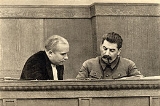
Khrushchev Thaw

Encyclopedia
The Khrushchev Thaw refers to the period from the mid 1950s to the early 1960s, when repression
and censorship
in the Soviet Union
were partially reversed and millions of Soviet political prisoners were released from Gulag
labor camps, due to Nikita Khrushchev
's policies of de-Stalinization
and peaceful coexistence
with other nations.
The Thaw became possible after the death of Joseph Stalin
in March 1953. Khrushchev denounced Stalin in "The Secret Speech
" at the 20th Congress of the Communist Party, then ousted the pro-Stalinists during his power struggle in the Kremlin
. The term was coined after Ilya Ehrenburg
's 1954 novel The Thaw, "Оттепель", sensational for its time. The Khrushchev Thaw was highlighted by Khrushchev's 1954 visit to Beijing
, People's Republic of China
, his 1955 visit to Belgrade
, Yugoslavia
and his subsequent meeting with Dwight Eisenhower later that year, culminating in Khrushchev's 1959 visit to the United States
.
The Thaw initiated irreversible transformation of the entire Soviet society by opening up for some economic reforms and international trade, educational and cultural contacts, festivals, books by foreign authors, foreign movies, art shows, popular music, dances and new fashions, massive involvement in international sport competitions; it was a chain of unprecedented steps to free people from fear and dictatorship that culminated in the removal of Stalin's body from Lenin's Mausoleum
. Although the power struggle between liberals and conservative pro-Stalinists never stopped, it eventually weakened the Soviet Communist Party
.
Khrushchev's Thaw allowed some freedom of information in the media, arts and culture; international festival, foreign movies, uncensored books, and new forms of entertainment on the emerging national TV, ranging from massive parades and celebrations to popular music and variety shows, satire and comedies, and all-star shows, like "Goluboy Ogonek." Such political and cultural updates all together helped liberate minds of millions and changed public consciousness of several generations of people in the Soviet Union.
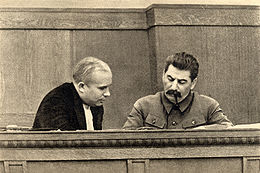 Khrushchev's Thaw had its genesis in the concealed power struggle among Stalin's lieutenants. Several major leaders among the Red Army
commanders, such as Marshal Georgy Zhukov
and his loyal officers, had some serious tensions with Stalin's secret service. On the surface the Red Army
and the Soviet leadership seemed united after their victory in the Second World War. However, the hidden ambitions of the top people around Stalin, as well as Stalin's own suspicion and paranoia, had prompted Khrushchev that he could rely only on those few; they would stay with him through the entire political power struggle. That power struggle was surreptitiously prepared by Khrushchev while Stalin was alive, and came to surface after Stalin's death in March 1953. By that time, Khrushchev's people were planted everywhere in the Soviet hierarchy, which allowed Khrushchev to execute, or remove his main opponents, and then introduce some changes in the rigid Soviet ideology and hierarchy.
Stalin's dictatorship had reached new extremes in abusing people at all levels, such as the deportations of nationalities
, the Leningrad Affair
, the Doctors' plot
, and official attacks on writers and other intellectuals. At the same time, millions of soldiers and officers had seen Europe after World War II, and had become aware of the better ways of life which existed outside the Soviet Union. Upon Stalin's orders many were arrested and punished again, including the attacks on the popular Marshal Georgy Zhukov
and other top generals, who had exceeded the limits on taking trophies when they looted the defeated Germany. The loot was confiscated by Stalin's security apparatus, and Marshal Zhukov was demoted, humiliated and exiled; he became a staunch anti-Stalinist. Zhukov waited until the death of Stalin, which allowed Khrushchev to bring Zhukov back for a new political battle.
The temporary union between Nikita Khrushchev and Marshal Georgy Zhukov was founded on their similar backgrounds, interests and weaknesses: both were peasants, both were ambitious, both were abused by Stalin, both feared the Stalinists, and both wanted to change these things. Khrushchev and Zhukov needed one another to eliminate their mutual enemies in the Soviet political elite.
In 1953, Zhukov helped Khrushchev to eliminate Lavrenty Beria, then a First Vice-Premier, who was executed in Moscow, as well as several other figures of Stalin's circle. Soon Khrushchev ordered the release of millions of political prisoners from the Gulag
camps. Under Khrushchev's rule the number of prisoners in the Soviet Union was decreased from 13 million to 5 million people.
Khrushchev also promoted and groomed Leonid Brezhnev
, whom he brought to Kremlin
and introduced to Stalin in 1952. Then Khrushchev promoted Brezhnev to Presidium (Politburo) and made him the Head of Political Directorate of the Red Army and Navy, and moved him up to several other powerful positions. Brezhnev in return helped Khrushchev by tipping the balance of power during several critical confrontations with the conservative hard-liners, including the ouster of pro-Stalinists headed by Molotov and Malenkov.
, delivered at the closed session of the 20th Party Congress, behind closed doors, after midnight on February 25, 1956. In this speech, Khrushchev described the damages done by Joseph Stalin
's Personality Cult, and the repressions, known as Great Purge
s that killed millions and traumatized all people in the Soviet Union.
After the delivery of the speech, it was officially disseminated in a shorter form among members of the Soviet Communist Party across the USSR starting March 5, 1956. Then Khrushchev initiated a wave of rehabilitation
s that officially restored the reputations of many millions of innocent victims, who were killed or imprisoned in the Great Purges under Stalin. Further, tentative moves were made through official and unofficial channels to relax restrictions on freedom of speech
that had been held over from the rule of Stalin.
Khrushchev's 1956 speech was the strongest effort ever in the USSR to bring reconciliation and healing to the people, at that time, after several decades of fear of Stalin's Terror, that took millions of innocent lives. Khrushchev's speech was published internationally within a few months, and his initiatives to open and liberalise the USSR had surprised the world. Khrushchev's speech had angered many of his powerful enemies, thus igniting another round of ruthless power struggle within the Soviet Communist Party. At that time, Moshe Dayan
said that the USSR would disappear in 30 years, and he was only 5 years off in predicting the dissolution of the Soviet Union
in 1991.
in Moscow
and calls for the independence of Georgia from the Soviet Union
appeared, leading to the Soviet army intervention and bloodshed in the streets of Tbilisi
.
The Hungarian Revolution of 1956 was suppressed by the massive invasion of the Soviet tanks and the Red Army
troops in Budapest. The street fighting against the invading Red Army
caused thousands of casualties among Hungarian civilians and militia, as well as hundreds of the Soviet military personnel killed. The attack of the Soviet Red Army also caused massive emigration from Hungary, as hundreds of thousands of Hungarians had fled as refugees.
At the same time, the Polish October
emerged as the political and social climax in Poland
. Such democratic changes in the internal life of Poland were also perceived with fear and anger in Moscow, where the hard-line "Stalinists" did not want to lose control, fearing the political threat to the Soviet strength and power in Eastern Europe.
and liberalisation of Soviet society. One year after Khrushchev's secret speech, the Stalinists attempted to oust Khrushchev from the leadership position in the Soviet Communist Party.
Khrushchev's enemies considered him hypocritical as well as ideologically wrong, given Khrushchev's involvement in Stalin's Great Purge
s, and other similar events as one of Stalin's favourites. They believed that Khrushchev's policy of peaceful coexistence
would leave the Soviet Union open to attack. Vyacheslav Molotov
, Lazar Kaganovich
, Georgy Malenkov
and joined by Dmitri Shepilov
at the last minute after Kaganovich convinced him the group had a majority, attempted to depose Khrushchev as First Secretary of the Party in May 1957.
But Khrushchev had used Marshal Georgy Zhukov
again. Khrushchev was saved by several strong appearances in his support, especially powerful was support from both Zhukov and Brezhnev. At the extraordinary session of the Central Committee held in late June 1957, Khrushchev labeled his opponents as Anti-Party Group
and won a vote which reaffirmed his position as First Secretary. Then he expelled Molotov, Kaganovich and Malenkov from the Secretariat and ultimately from the Communist Party itself.
es, causing himself many new enemies among the ranks in Soviet government.
Eventually Khrushchev's power, although indisputable, was slowly eroding and never became comparable to that of Stalin's. Some of the new people who came into the Soviet hierarchy, like Mikhail Gorbachev
were younger, better educated and more independent thinkers.
In 1956, Khrushchev introduced the concept of a minimum wage. The idea was met with much criticism with communist hardliners, they claimed that the minimum wage was so small, that most people were still underpaid in reality. The next step was a contemplated financial reform. However, Khrushchev stopped short of the real monetary reform, when he ordered to replace the old money with portraits of Stalin, and made a simple redenomination of the ruble
10:1 in 1961.
In 1961, Khrushchev finalized his battle against Stalin: the body of dictator was removed from the Lenin's Mausoleum
on the Red Square
and then buried outside the walls of the Kremlin
. The removal of Stalin's body out of the Lenin's Mausoleum was arguably among the most provocative moves made by Khrushchev during the Thaw. Stalin's body removal consolidated pro-Stalinists against Khrushchev, and alienated even his loyal apprentices, such as Leonid Brezhnev
.
, as well as several innovative film comedies, such as The Carnival Night, and several popular music festivals. Some classical musicians, filmmakers and ballet stars were allowed to make appearances outside the Soviet Union in order to better represent its culture and society to the world.
In 1956, an agreement was achieved between the Soviet and US Governments to resume the publication and distribution in the Soviet Union of the US-produced magazine Amerika (magazine)
, and to launch its counterpart, the USSR
magazine in the USA.
In the summer of 1956, just a few months after Khrushchev's secret speech, Moscow became the center of the first Spartakiada of the Peoples of the USSR. The event was made pompous and loud in the Soviet style: Moscow hosted large sports teams and groups of fans in national costumes who came from all republics of the USSR. Khrushchev used the event to accentuate his new political and social goals, and to show himself as a new leader who was completely different from Stalin.
In July 1957, the 6th World Festival of Youth and Students
(Russian: Всемирный фестиваль молодёжи и студентов) was held in Moscow. This became possible after the bold political changes initiated by Nikita Khrushchev
. It was the first World Festival of Youth and Students held in the Soviet Union, which was opening its doors for the first time to the world. The festival attracted 34 thousand people from 130 countries.
In 1958, the first International Tchaikovsky Competition
was held in Moscow. The winner was American
pianist Van Cliburn
, who gave sensational performances of Russian music. Khrushchev personally approved giving the top award to the American musician.
Khrushchev's Thaw opened the Soviet society to a degree that allowed some foreign movies, books, art and music. Some previously banned writers and composers, such as Dmitri Shostakovich
, Sergei Prokofiev
, Anna Akhmatova
, Mikhail Zoshchenko
, among others, were brought back to public life, as the official Soviet censorship policies had changed. Books by some internationally recognised authors, such as Ernest Hemingway
, were published in millions of copies to satisfy the interest of readers in the USSR.
In 1962, Khrushchev personally approved the publication of Aleksandr Solzhenitsyn
's story One Day in the Life of Ivan Denisovich
, which became a sensation, and made history as the first uncensored publication about Stalin's Gulag
labor camps.
Despite the new freedoms in the Soviet Union, there was still a lot of persecution of religion that had temporarily halted during the war effort and the years after toward the end of Stalin's rule.
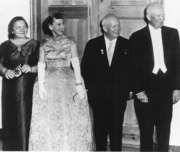
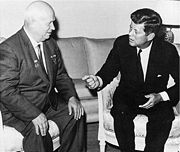 In the West, Khrushchev's Thaw is known as a temporary thaw in the icy tension between the United States
and the USSR during the Cold War
. The tensions were able to thaw because of Khrushchev's de-Stalinization of the USSR and peaceful co-existence theory and also because of US President Eisenhower
's cautious attitude and peace attempts. For example, both leaders attempted to achieve peace by attending the 1955 Geneva International Peace Summit and developing the Open Skies Policy and Quest for Arms Agreement. The leaders’ attitudes allowed them to, as Khrushchev put it, "break the ice."
Khrushchev's Thaw developed largely as a result of Khrushchev's theory of peaceful co-existence which believed the two superpowers (USA and USSR) and their ideologies could co-exist together, without war (peacefully). Khrushchev had created the theory of peaceful existence in an attempt to reduce hostility between the two superpowers. He tried to prove peaceful coexistence by attending international peace conferences, such as the Geneva Summit, and by traveling internationally, such as his trip to America’s Camp David
in 1959.
This spirit of cooperation was severely damaged by the U-2 spy plane incident
. The Soviet presentation of downed pilot Gary Powers
at the May 1960 Paris Peace Summit and Eisenhower's refusal to apologize ended much of the progress of this era. Then Khrushchev approved the construction of the Berlin Wall
in 1961.
Further deterioration of the Thaw and decay of Khrushchev's international political standing happened during the Cuban Missile Crisis
in 1962. At that time the Soviet and international media were making two completely opposite pictures of reality, while the world was at the brink of a Nuclear war
. Although, direct communication between Khrushchev and the US president John Kennedy helped to end the crisis, Khrushchev's political image, in the West, was damaged.
The 6th World Festival of Youth and Students
had opened many eyes and ears in the Soviet Union. Many new social trends stemmed from that festival. Many Russian women became involved in love affairs with men visiting from all over the world, what resulted in the so-called "inter-baby boom" in Moscow
and Leningrad
. The festival also brought new styles and fashions that caused further spread of youth subculture called "stilyagi
". The festival also "revolutionized" the underground currency trade and boosted the black market, causing headaches for the Soviet KGB
.
Emergence of such popular stars as Bulat Okudzhava
, Edita Piekha
, Evgeny Evtushenko, Bella Akhmadulina, and the superstar Vladimir Vysotsky
had changed the popular culture forever in the USSR. Their poetry and songs liberated the public consciousness of the Soviet people and pushed guitars and tape recorders to masses, so the Soviet people became exposed to independent channels of information and public mentality was eventually updated in many ways.
Khrushchev finally liberated millions of peasants; by his order the Soviet government gave them identifications, passports, and thus allowed them to move out of poor villages to big cities. Massive housing construction, known as khrushchevkas, were undertaken during the 1950s and 1960s. Millions of cheap and basic residential blocks of low-end flats were built all over the Soviet Union to accommodate the largest migration ever in the Soviet history, when masses of landless peasants moved to Soviet cities. The move caused a dramatic change of the demographic picture in the USSR, and eventually finalized the decay of peasantry in Russia
.
Economic reforms were contemplated by Alexei Kosygin, who was chairman of the USSR State Planning Committee in 1959 and then a full member of the Presidium (also known as Politburo after 1966) in 1960.
Recognizing the necessity of rebuilding the family in the postwar years, Khrushchev enacted policies that attempted to reestablish a more conventional domestic realm, moving away from the policies of his predecessors, and most of these were aimed at women. Despite being an active part of the workforce, women’s conditions were considered by the western, capitalist world to exemplify the “backwardness” of the Soviet Union. This concept goes back to traditional Marxism, which found the roots of woman’s inherent backwardness in fact that she was confined to the home; Lenin spoke of woman as a “domestic slave” who would remain in confinement as long as housework remained an activity for individuals inside the home. The prior abolition of private homes and the individual kitchen attempted to move away from the domestic regime that imprisoned women. Instead, the government tried to implement public dining, socialized housework, and collective childcare. These programs that fulfilled the original tenets of Marxism were widely resisted by women.
The Third Party Programme of 1961, the defining document of Khrushchev’s policies, related social progress with technological progress, especially technological progress inside the home. Khrushchev spoke of a commitment to increasing production of consumer goods, specifically household goods and appliances that would decrease the intensity of housework. The kitchen was defined as a “workshop” that relied on the “correct organization of labour” to be most efficient. Creating what were perceived to be the best conditions for the woman’s work in the kitchen was an attempt on the part of the government to ensure that the Soviet woman would be able to continue her labor inside and outside of the home. Despite the increasing demands of housework, women were expected to maintain jobs outside the home in order to sustain the national economy as well as fulfill the ideals of a Soviet well-rounded individual.
During this time, women were flooded with pamphlets and magazines teeming with advice on how best to run a household. This literature emphasized the virtues of simplicity and efficiency. Additionally, furniture was designed to suit the average height of Moscow women, emphasizing a modern, simple style that allowed for efficient mass production. However, in the newly built apartments of the Khrushchev era, the individual kitchens were rarely up to the standards invoked by the government’s rhetoric. Providing fully fitted kitchens were too expensive and time-consuming to be realized in the mass housing project.
as General Secretary of the Communist Party of the Soviet Union
in 1964. When Khrushchev was dismissed, Alexei Kosygin took over Khrushchev's position as Soviet Premier, but Kosygin's reforms was not successful and conservative communists led by Brezhnev blocked any motions for reforms after Kosygin's failed attempt.
Brezhnev begun his career as the General Secretary
with the Sinyavsky-Daniel trial
in 1965, which showed the establishment of an authoritarian ideology. After that, Brezhnev approved the invasion of Czechoslovakia
in 1968 (Prague Spring
) and ended with the Soviet war in Afghanistan
which continued after his death; he installed an authoritarian regime that lasted throughout his life and the lives of his two successors, Yuri Andropov
and Konstantin Chernenko
.
and glasnost
during the 1980s. Although they led the Soviet Union in different eras, both Khrushchev and Gorbachev had initiated dramatic reforms. Both efforts lasted only a few years, and both efforts were supported by the people, while being opposed by the hard-liners. Both leaders were dismissed, albeit with completely different results for their country.
Mikhail Gorbachev
has been calling Khrushchev's achievements remarkable, he praised Khrushchev's 1956 speech, but stated that Khrushchev did not succeed in his reforms.
Political repression
Political repression is the persecution of an individual or group for political reasons, particularly for the purpose of restricting or preventing their ability to take political life of society....
and censorship
Censorship
thumb|[[Book burning]] following the [[1973 Chilean coup d'état|1973 coup]] that installed the [[Military government of Chile |Pinochet regime]] in Chile...
in the Soviet Union
Soviet Union
The Soviet Union , officially the Union of Soviet Socialist Republics , was a constitutionally socialist state that existed in Eurasia between 1922 and 1991....
were partially reversed and millions of Soviet political prisoners were released from Gulag
Gulag
The Gulag was the government agency that administered the main Soviet forced labor camp systems. While the camps housed a wide range of convicts, from petty criminals to political prisoners, large numbers were convicted by simplified procedures, such as NKVD troikas and other instruments of...
labor camps, due to Nikita Khrushchev
Nikita Khrushchev
Nikita Sergeyevich Khrushchev led the Soviet Union during part of the Cold War. He served as First Secretary of the Communist Party of the Soviet Union from 1953 to 1964, and as Chairman of the Council of Ministers, or Premier, from 1958 to 1964...
's policies of de-Stalinization
De-Stalinization
De-Stalinization refers to the process of eliminating the cult of personality, Stalinist political system and the Gulag labour-camp system created by Soviet leader Joseph Stalin. Stalin was succeeded by a collective leadership after his death in March 1953...
and peaceful coexistence
Peaceful coexistence
Peaceful coexistence was a theory developed and applied by the Soviet Union at various points during the Cold War in the context of its ostensibly Marxist–Leninist foreign policy and was adopted by Soviet-influenced "Communist states" that they could peacefully coexist with the capitalist bloc...
with other nations.
The Thaw became possible after the death of Joseph Stalin
Joseph Stalin
Joseph Vissarionovich Stalin was the Premier of the Soviet Union from 6 May 1941 to 5 March 1953. He was among the Bolshevik revolutionaries who brought about the October Revolution and had held the position of first General Secretary of the Communist Party of the Soviet Union's Central Committee...
in March 1953. Khrushchev denounced Stalin in "The Secret Speech
On the Personality Cult and its Consequences
On the Personality Cult and its Consequences was a report, critical of Joseph Stalin, made to the Twentieth Party Congress on February 25, 1956 by Soviet leader Nikita Khrushchev. It is more commonly known as the Secret Speech or the Khrushchev Report...
" at the 20th Congress of the Communist Party, then ousted the pro-Stalinists during his power struggle in the Kremlin
Kremlin
A kremlin , same root as in kremen is a major fortified central complex found in historic Russian cities. This word is often used to refer to the best-known one, the Moscow Kremlin, or metonymically to the government that is based there...
. The term was coined after Ilya Ehrenburg
Ilya Ehrenburg
Ilya Grigoryevich Ehrenburg was a Soviet writer, journalist, translator, and cultural figure.Ehrenburg is among the most prolific and notable authors of the Soviet Union; he published around one hundred titles. He became known first and foremost as a novelist and a journalist - in particular, as a...
's 1954 novel The Thaw, "Оттепель", sensational for its time. The Khrushchev Thaw was highlighted by Khrushchev's 1954 visit to Beijing
Beijing
Beijing , also known as Peking , is the capital of the People's Republic of China and one of the most populous cities in the world, with a population of 19,612,368 as of 2010. The city is the country's political, cultural, and educational center, and home to the headquarters for most of China's...
, People's Republic of China
People's Republic of China
China , officially the People's Republic of China , is the most populous country in the world, with over 1.3 billion citizens. Located in East Asia, the country covers approximately 9.6 million square kilometres...
, his 1955 visit to Belgrade
Belgrade
Belgrade is the capital and largest city of Serbia. It is located at the confluence of the Sava and Danube rivers, where the Pannonian Plain meets the Balkans. According to official results of Census 2011, the city has a population of 1,639,121. It is one of the 15 largest cities in Europe...
, Yugoslavia
Socialist Federal Republic of Yugoslavia
The Socialist Federal Republic of Yugoslavia was the Yugoslav state that existed from the abolition of the Yugoslav monarchy until it was dissolved in 1992 amid the Yugoslav Wars. It was a socialist state and a federation made up of six socialist republics: Bosnia and Herzegovina, Croatia,...
and his subsequent meeting with Dwight Eisenhower later that year, culminating in Khrushchev's 1959 visit to the United States
United States
The United States of America is a federal constitutional republic comprising fifty states and a federal district...
.
The Thaw initiated irreversible transformation of the entire Soviet society by opening up for some economic reforms and international trade, educational and cultural contacts, festivals, books by foreign authors, foreign movies, art shows, popular music, dances and new fashions, massive involvement in international sport competitions; it was a chain of unprecedented steps to free people from fear and dictatorship that culminated in the removal of Stalin's body from Lenin's Mausoleum
Lenin's Mausoleum
Lenin's Mausoleum also known as Lenin's Tomb, situated in Red Square in the center of Moscow, is the mausoleum that serves as the current resting place of Vladimir Lenin. His embalmed body has been on public display there since shortly after his death in 1924...
. Although the power struggle between liberals and conservative pro-Stalinists never stopped, it eventually weakened the Soviet Communist Party
Communist Party of the Soviet Union
The Communist Party of the Soviet Union was the only legal, ruling political party in the Soviet Union and one of the largest communist organizations in the world...
.
Khrushchev's Thaw allowed some freedom of information in the media, arts and culture; international festival, foreign movies, uncensored books, and new forms of entertainment on the emerging national TV, ranging from massive parades and celebrations to popular music and variety shows, satire and comedies, and all-star shows, like "Goluboy Ogonek." Such political and cultural updates all together helped liberate minds of millions and changed public consciousness of several generations of people in the Soviet Union.
Khrushchev and Stalin
Red Army
The Workers' and Peasants' Red Army started out as the Soviet Union's revolutionary communist combat groups during the Russian Civil War of 1918-1922. It grew into the national army of the Soviet Union. By the 1930s the Red Army was among the largest armies in history.The "Red Army" name refers to...
commanders, such as Marshal Georgy Zhukov
Georgy Zhukov
Marshal of the Soviet Union Georgy Konstantinovich Zhukov , was a Russian career officer in the Red Army who, in the course of World War II, played a pivotal role in leading the Red Army through much of Eastern Europe to liberate the Soviet Union and other nations from the Axis Powers' occupation...
and his loyal officers, had some serious tensions with Stalin's secret service. On the surface the Red Army
Red Army
The Workers' and Peasants' Red Army started out as the Soviet Union's revolutionary communist combat groups during the Russian Civil War of 1918-1922. It grew into the national army of the Soviet Union. By the 1930s the Red Army was among the largest armies in history.The "Red Army" name refers to...
and the Soviet leadership seemed united after their victory in the Second World War. However, the hidden ambitions of the top people around Stalin, as well as Stalin's own suspicion and paranoia, had prompted Khrushchev that he could rely only on those few; they would stay with him through the entire political power struggle. That power struggle was surreptitiously prepared by Khrushchev while Stalin was alive, and came to surface after Stalin's death in March 1953. By that time, Khrushchev's people were planted everywhere in the Soviet hierarchy, which allowed Khrushchev to execute, or remove his main opponents, and then introduce some changes in the rigid Soviet ideology and hierarchy.
Stalin's dictatorship had reached new extremes in abusing people at all levels, such as the deportations of nationalities
Population transfer in the Soviet Union
Population transfer in the Soviet Union may be classified into the following broad categories: deportations of "anti-Soviet" categories of population, often classified as "enemies of workers," deportations of entire nationalities, labor force transfer, and organized migrations in opposite...
, the Leningrad Affair
Leningrad Affair
The Leningrad Affair, or Leningrad case , was a series of criminal cases fabricated in the late 1940s–early 1950s in order to accuse a number of prominent members of the Communist Party of the Soviet Union of treason and intention to create an anti-Soviet organization out of the Leningrad Party...
, the Doctors' plot
Doctors' plot
The Doctors' plot was the most dramatic anti-Jewish episode in the Soviet Union during Joseph Stalin's regime, involving the "unmasking" of a group of prominent Moscow doctors, predominantly Jews, as conspiratorial assassins of Soviet leaders...
, and official attacks on writers and other intellectuals. At the same time, millions of soldiers and officers had seen Europe after World War II, and had become aware of the better ways of life which existed outside the Soviet Union. Upon Stalin's orders many were arrested and punished again, including the attacks on the popular Marshal Georgy Zhukov
Georgy Zhukov
Marshal of the Soviet Union Georgy Konstantinovich Zhukov , was a Russian career officer in the Red Army who, in the course of World War II, played a pivotal role in leading the Red Army through much of Eastern Europe to liberate the Soviet Union and other nations from the Axis Powers' occupation...
and other top generals, who had exceeded the limits on taking trophies when they looted the defeated Germany. The loot was confiscated by Stalin's security apparatus, and Marshal Zhukov was demoted, humiliated and exiled; he became a staunch anti-Stalinist. Zhukov waited until the death of Stalin, which allowed Khrushchev to bring Zhukov back for a new political battle.
The temporary union between Nikita Khrushchev and Marshal Georgy Zhukov was founded on their similar backgrounds, interests and weaknesses: both were peasants, both were ambitious, both were abused by Stalin, both feared the Stalinists, and both wanted to change these things. Khrushchev and Zhukov needed one another to eliminate their mutual enemies in the Soviet political elite.
In 1953, Zhukov helped Khrushchev to eliminate Lavrenty Beria, then a First Vice-Premier, who was executed in Moscow, as well as several other figures of Stalin's circle. Soon Khrushchev ordered the release of millions of political prisoners from the Gulag
Gulag
The Gulag was the government agency that administered the main Soviet forced labor camp systems. While the camps housed a wide range of convicts, from petty criminals to political prisoners, large numbers were convicted by simplified procedures, such as NKVD troikas and other instruments of...
camps. Under Khrushchev's rule the number of prisoners in the Soviet Union was decreased from 13 million to 5 million people.
Khrushchev also promoted and groomed Leonid Brezhnev
Leonid Brezhnev
Leonid Ilyich Brezhnev – 10 November 1982) was the General Secretary of the Central Committee of the Communist Party of the Soviet Union , presiding over the country from 1964 until his death in 1982. His eighteen-year term as General Secretary was second only to that of Joseph Stalin in...
, whom he brought to Kremlin
Kremlin
A kremlin , same root as in kremen is a major fortified central complex found in historic Russian cities. This word is often used to refer to the best-known one, the Moscow Kremlin, or metonymically to the government that is based there...
and introduced to Stalin in 1952. Then Khrushchev promoted Brezhnev to Presidium (Politburo) and made him the Head of Political Directorate of the Red Army and Navy, and moved him up to several other powerful positions. Brezhnev in return helped Khrushchev by tipping the balance of power during several critical confrontations with the conservative hard-liners, including the ouster of pro-Stalinists headed by Molotov and Malenkov.
1956 Khrushchev's speech denouncing Stalin
Khrushchev denounced Stalin in his speech On the Personality Cult and its ConsequencesOn the Personality Cult and its Consequences
On the Personality Cult and its Consequences was a report, critical of Joseph Stalin, made to the Twentieth Party Congress on February 25, 1956 by Soviet leader Nikita Khrushchev. It is more commonly known as the Secret Speech or the Khrushchev Report...
, delivered at the closed session of the 20th Party Congress, behind closed doors, after midnight on February 25, 1956. In this speech, Khrushchev described the damages done by Joseph Stalin
Joseph Stalin
Joseph Vissarionovich Stalin was the Premier of the Soviet Union from 6 May 1941 to 5 March 1953. He was among the Bolshevik revolutionaries who brought about the October Revolution and had held the position of first General Secretary of the Communist Party of the Soviet Union's Central Committee...
's Personality Cult, and the repressions, known as Great Purge
Great Purge
The Great Purge was a series of campaigns of political repression and persecution in the Soviet Union orchestrated by Joseph Stalin from 1936 to 1938...
s that killed millions and traumatized all people in the Soviet Union.
After the delivery of the speech, it was officially disseminated in a shorter form among members of the Soviet Communist Party across the USSR starting March 5, 1956. Then Khrushchev initiated a wave of rehabilitation
Rehabilitation (Soviet)
Rehabilitation in the context of the former Soviet Union, and the Post-Soviet states, was the restoration of a person who was criminally prosecuted without due basis, to the state of acquittal...
s that officially restored the reputations of many millions of innocent victims, who were killed or imprisoned in the Great Purges under Stalin. Further, tentative moves were made through official and unofficial channels to relax restrictions on freedom of speech
Freedom of speech
Freedom of speech is the freedom to speak freely without censorship. The term freedom of expression is sometimes used synonymously, but includes any act of seeking, receiving and imparting information or ideas, regardless of the medium used...
that had been held over from the rule of Stalin.
Khrushchev's 1956 speech was the strongest effort ever in the USSR to bring reconciliation and healing to the people, at that time, after several decades of fear of Stalin's Terror, that took millions of innocent lives. Khrushchev's speech was published internationally within a few months, and his initiatives to open and liberalise the USSR had surprised the world. Khrushchev's speech had angered many of his powerful enemies, thus igniting another round of ruthless power struggle within the Soviet Communist Party. At that time, Moshe Dayan
Moshe Dayan
Moshe Dayan was an Israeli military leader and politician. The fourth Chief of Staff of the Israel Defense Forces , he became a fighting symbol to the world of the new State of Israel...
said that the USSR would disappear in 30 years, and he was only 5 years off in predicting the dissolution of the Soviet Union
Dissolution of the Soviet Union
The dissolution of the Soviet Union was the disintegration of the federal political structures and central government of the Union of Soviet Socialist Republics , resulting in the independence of all fifteen republics of the Soviet Union between March 11, 1990 and December 25, 1991...
in 1991.
Georgian revolt
Khruschev's denouncement of Stalin came as a shock to the Soviet people. Many in the Georgian Soviet Socialist Republic, Stalin's homeland, especially the young generation, bred on the panegyrics and permanent praise of the "genius" of Stalin, perceived it as a national insult. In March 1956, a series of spontaneous rallies to mark the third anniversary of Stalin's death quickly evolved into an uncontrollable mass demonstration and political demands such as the change of the central governmentGovernment of the Soviet Union
The Council of Ministers of the Union of Soviet Socialist Republics , was the de jure government comprising the highest executive and administrative body of the Soviet Union from 1946 until 1991....
in Moscow
Moscow
Moscow is the capital, the most populous city, and the most populous federal subject of Russia. The city is a major political, economic, cultural, scientific, religious, financial, educational, and transportation centre of Russia and the continent...
and calls for the independence of Georgia from the Soviet Union
Soviet Union
The Soviet Union , officially the Union of Soviet Socialist Republics , was a constitutionally socialist state that existed in Eurasia between 1922 and 1991....
appeared, leading to the Soviet army intervention and bloodshed in the streets of Tbilisi
Tbilisi
Tbilisi is the capital and the largest city of Georgia, lying on the banks of the Mt'k'vari River. The name is derived from an early Georgian form T'pilisi and it was officially known as Tiflis until 1936...
.
Polish and Hungarian Revolutions of 1956
The first big international failure of Khrushchev's politics came in October–November 1956.The Hungarian Revolution of 1956 was suppressed by the massive invasion of the Soviet tanks and the Red Army
Red Army
The Workers' and Peasants' Red Army started out as the Soviet Union's revolutionary communist combat groups during the Russian Civil War of 1918-1922. It grew into the national army of the Soviet Union. By the 1930s the Red Army was among the largest armies in history.The "Red Army" name refers to...
troops in Budapest. The street fighting against the invading Red Army
Red Army
The Workers' and Peasants' Red Army started out as the Soviet Union's revolutionary communist combat groups during the Russian Civil War of 1918-1922. It grew into the national army of the Soviet Union. By the 1930s the Red Army was among the largest armies in history.The "Red Army" name refers to...
caused thousands of casualties among Hungarian civilians and militia, as well as hundreds of the Soviet military personnel killed. The attack of the Soviet Red Army also caused massive emigration from Hungary, as hundreds of thousands of Hungarians had fled as refugees.
At the same time, the Polish October
Polish October
Polish October, also known as October 1956, Polish thaw, or Gomułka's thaw, marked a change in the Polish internal political scene in the second half of 1956...
emerged as the political and social climax in Poland
Poland
Poland , officially the Republic of Poland , is a country in Central Europe bordered by Germany to the west; the Czech Republic and Slovakia to the south; Ukraine, Belarus and Lithuania to the east; and the Baltic Sea and Kaliningrad Oblast, a Russian exclave, to the north...
. Such democratic changes in the internal life of Poland were also perceived with fear and anger in Moscow, where the hard-line "Stalinists" did not want to lose control, fearing the political threat to the Soviet strength and power in Eastern Europe.
1957 plot against Khrushchev
The conservative hard-line Stalinist elite of the Soviet communist party was enraged by Khrushchev's speech in 1956, and rejected Khrushchev's de-StalinizationDe-Stalinization
De-Stalinization refers to the process of eliminating the cult of personality, Stalinist political system and the Gulag labour-camp system created by Soviet leader Joseph Stalin. Stalin was succeeded by a collective leadership after his death in March 1953...
and liberalisation of Soviet society. One year after Khrushchev's secret speech, the Stalinists attempted to oust Khrushchev from the leadership position in the Soviet Communist Party.
Khrushchev's enemies considered him hypocritical as well as ideologically wrong, given Khrushchev's involvement in Stalin's Great Purge
Great Purge
The Great Purge was a series of campaigns of political repression and persecution in the Soviet Union orchestrated by Joseph Stalin from 1936 to 1938...
s, and other similar events as one of Stalin's favourites. They believed that Khrushchev's policy of peaceful coexistence
Peaceful coexistence
Peaceful coexistence was a theory developed and applied by the Soviet Union at various points during the Cold War in the context of its ostensibly Marxist–Leninist foreign policy and was adopted by Soviet-influenced "Communist states" that they could peacefully coexist with the capitalist bloc...
would leave the Soviet Union open to attack. Vyacheslav Molotov
Vyacheslav Molotov
Vyacheslav Mikhailovich Molotov was a Soviet politician and diplomat, an Old Bolshevik and a leading figure in the Soviet government from the 1920s, when he rose to power as a protégé of Joseph Stalin, to 1957, when he was dismissed from the Presidium of the Central Committee by Nikita Khrushchev...
, Lazar Kaganovich
Lazar Kaganovich
Lazar Moiseyevich Kaganovich was a Soviet politician and administrator and one of the main associates of Joseph Stalin.-Early life:Kaganovich was born in 1893 to Jewish parents in the village of Kabany, Radomyshl uyezd, Kiev Governorate, Russian Empire...
, Georgy Malenkov
Georgy Malenkov
Georgy Maximilianovich Malenkov was a Soviet politician, Communist Party leader and close collaborator of Joseph Stalin. After Stalin's death, he became Premier of the Soviet Union and was in 1953 briefly considered the most powerful Soviet politician before being overshadowed by Nikita...
and joined by Dmitri Shepilov
Dmitri Shepilov
Dmitri Trofimovich Shepilov was a Soviet politician and Minister of Foreign Affairs who joined the abortive plot to oust Nikita Khrushchev from power in 1957.-Childhood:Dmitri Shepilov was born to a worker's family in Askhabad...
at the last minute after Kaganovich convinced him the group had a majority, attempted to depose Khrushchev as First Secretary of the Party in May 1957.
But Khrushchev had used Marshal Georgy Zhukov
Georgy Zhukov
Marshal of the Soviet Union Georgy Konstantinovich Zhukov , was a Russian career officer in the Red Army who, in the course of World War II, played a pivotal role in leading the Red Army through much of Eastern Europe to liberate the Soviet Union and other nations from the Axis Powers' occupation...
again. Khrushchev was saved by several strong appearances in his support, especially powerful was support from both Zhukov and Brezhnev. At the extraordinary session of the Central Committee held in late June 1957, Khrushchev labeled his opponents as Anti-Party Group
Anti-Party Group
The Anti-Party Group was a group within the leadership of the Communist Party of the Soviet Union that unsuccessfully attempted to depose Nikita Khrushchev as First Secretary of the Party in May 1957. The group, named by that epithet by Khrushchev, was led by former Premiers Georgy Malenkov and...
and won a vote which reaffirmed his position as First Secretary. Then he expelled Molotov, Kaganovich and Malenkov from the Secretariat and ultimately from the Communist Party itself.
Economy and political tensions
Khrushchev's attempts in reforming the Soviet industrial infrastructure led to his clashes with professionals in most branches of the Soviet economy. His reform of administrative organization created him more problems. In a politically motivated move to weaken the central state bureaucracy in 1957, Khrushchev replaced the industrial ministries in Moscow with regional Councils of People's Economy, sovnarkhozSovnarkhoz
Sovnarkhoz, , usually translated as Regional Economic Council, was an organization of the Soviet Union to manage a separate economic region....
es, causing himself many new enemies among the ranks in Soviet government.
Eventually Khrushchev's power, although indisputable, was slowly eroding and never became comparable to that of Stalin's. Some of the new people who came into the Soviet hierarchy, like Mikhail Gorbachev
Mikhail Gorbachev
Mikhail Sergeyevich Gorbachev is a former Soviet statesman, having served as General Secretary of the Communist Party of the Soviet Union from 1985 until 1991, and as the last head of state of the USSR, having served from 1988 until its dissolution in 1991...
were younger, better educated and more independent thinkers.
In 1956, Khrushchev introduced the concept of a minimum wage. The idea was met with much criticism with communist hardliners, they claimed that the minimum wage was so small, that most people were still underpaid in reality. The next step was a contemplated financial reform. However, Khrushchev stopped short of the real monetary reform, when he ordered to replace the old money with portraits of Stalin, and made a simple redenomination of the ruble
Soviet ruble
The Soviet ruble or rouble was the currency of the Soviet Union. One ruble is divided into 100 kopeks, ....
10:1 in 1961.
In 1961, Khrushchev finalized his battle against Stalin: the body of dictator was removed from the Lenin's Mausoleum
Lenin's Mausoleum
Lenin's Mausoleum also known as Lenin's Tomb, situated in Red Square in the center of Moscow, is the mausoleum that serves as the current resting place of Vladimir Lenin. His embalmed body has been on public display there since shortly after his death in 1924...
on the Red Square
Red Square
Red Square is a city square in Moscow, Russia. The square separates the Kremlin, the former royal citadel and currently the official residence of the President of Russia, from a historic merchant quarter known as Kitai-gorod...
and then buried outside the walls of the Kremlin
Kremlin
A kremlin , same root as in kremen is a major fortified central complex found in historic Russian cities. This word is often used to refer to the best-known one, the Moscow Kremlin, or metonymically to the government that is based there...
. The removal of Stalin's body out of the Lenin's Mausoleum was arguably among the most provocative moves made by Khrushchev during the Thaw. Stalin's body removal consolidated pro-Stalinists against Khrushchev, and alienated even his loyal apprentices, such as Leonid Brezhnev
Leonid Brezhnev
Leonid Ilyich Brezhnev – 10 November 1982) was the General Secretary of the Central Committee of the Communist Party of the Soviet Union , presiding over the country from 1964 until his death in 1982. His eighteen-year term as General Secretary was second only to that of Joseph Stalin in...
.
Openness and liberalisation in the Thaw
After 1953, Soviet society enjoyed a series of cultural and sports events and entertainment of unprecedented scale, such as the first SpartakiadSpartakiad
Spartakiad initially was the name of an international sports event that the Soviet Union attempted to use to both oppose and supplement the Olympics...
, as well as several innovative film comedies, such as The Carnival Night, and several popular music festivals. Some classical musicians, filmmakers and ballet stars were allowed to make appearances outside the Soviet Union in order to better represent its culture and society to the world.
In 1956, an agreement was achieved between the Soviet and US Governments to resume the publication and distribution in the Soviet Union of the US-produced magazine Amerika (magazine)
Amerika (magazine)
Amerika was a Russian language magazine published by the United States Department of State during the Cold War for distribution in the Soviet Union. It was intended to inform Soviet citizens about American life. Amerika was distinguished among other Soviet publications by its high-grade paper,...
, and to launch its counterpart, the USSR
Russian Life
Russian Life, previously known as The USSR and Soviet Life, is a 64-page color bimonthly magazine of Russian culture. It celebrated its 50th birthday in October 2006. The magazine is written and edited by American and Russian staffers and freelancers...
magazine in the USA.
In the summer of 1956, just a few months after Khrushchev's secret speech, Moscow became the center of the first Spartakiada of the Peoples of the USSR. The event was made pompous and loud in the Soviet style: Moscow hosted large sports teams and groups of fans in national costumes who came from all republics of the USSR. Khrushchev used the event to accentuate his new political and social goals, and to show himself as a new leader who was completely different from Stalin.
In July 1957, the 6th World Festival of Youth and Students
6th World Festival of Youth and Students
The 6th World Festival of Youth and Students was opened on 28 July 1957, in Moscow, Soviet Union. The festival attracted 34,000 people from 130 countries. This became possible after the bold political changes initiated by Nikita Khrushchev...
(Russian: Всемирный фестиваль молодёжи и студентов) was held in Moscow. This became possible after the bold political changes initiated by Nikita Khrushchev
Nikita Khrushchev
Nikita Sergeyevich Khrushchev led the Soviet Union during part of the Cold War. He served as First Secretary of the Communist Party of the Soviet Union from 1953 to 1964, and as Chairman of the Council of Ministers, or Premier, from 1958 to 1964...
. It was the first World Festival of Youth and Students held in the Soviet Union, which was opening its doors for the first time to the world. The festival attracted 34 thousand people from 130 countries.
In 1958, the first International Tchaikovsky Competition
International Tchaikovsky Competition
The International Tchaikovsky Competition is a classical music competition held every four years in Moscow, Russia for pianists, violinists, and cellists between 16 and 30 years of age, and singers between 19 and 32 years of age...
was held in Moscow. The winner was American
United States
The United States of America is a federal constitutional republic comprising fifty states and a federal district...
pianist Van Cliburn
Van Cliburn
Harvey Lavan "Van" Cliburn Jr. is an American pianist who achieved worldwide recognition in 1958 at age 23, when he won the first quadrennial International Tchaikovsky Piano Competition in Moscow, at the height of the Cold War....
, who gave sensational performances of Russian music. Khrushchev personally approved giving the top award to the American musician.
Khrushchev's Thaw opened the Soviet society to a degree that allowed some foreign movies, books, art and music. Some previously banned writers and composers, such as Dmitri Shostakovich
Dmitri Shostakovich
Dmitri Dmitriyevich Shostakovich was a Soviet Russian composer and one of the most celebrated composers of the 20th century....
, Sergei Prokofiev
Sergei Prokofiev
Sergei Sergeyevich Prokofiev was a Russian composer, pianist and conductor who mastered numerous musical genres and is regarded as one of the major composers of the 20th century...
, Anna Akhmatova
Anna Akhmatova
Anna Andreyevna Gorenko , better known by the pen name Anna Akhmatova , was a Russian and Soviet modernist poet, one of the most acclaimed writers in the Russian canon.Harrington p11...
, Mikhail Zoshchenko
Mikhail Zoshchenko
-Biography:Zoshchenko was born in 1895, in Poltava, but spent most of his life in St. Petersburg / Leningrad. His Ukrainian father was a mosaicist responsible for the exterior decoration of the Suvorov Museum in Saint Petersburg. The future writer attended the Faculty of Law at the Saint Petersburg...
, among others, were brought back to public life, as the official Soviet censorship policies had changed. Books by some internationally recognised authors, such as Ernest Hemingway
Ernest Hemingway
Ernest Miller Hemingway was an American author and journalist. His economic and understated style had a strong influence on 20th-century fiction, while his life of adventure and his public image influenced later generations. Hemingway produced most of his work between the mid-1920s and the...
, were published in millions of copies to satisfy the interest of readers in the USSR.
In 1962, Khrushchev personally approved the publication of Aleksandr Solzhenitsyn
Aleksandr Solzhenitsyn
Aleksandr Isayevich Solzhenitsyn was aRussian and Soviet novelist, dramatist, and historian. Through his often-suppressed writings, he helped to raise global awareness of the Gulag, the Soviet Union's forced labor camp system – particularly in The Gulag Archipelago and One Day in the Life of...
's story One Day in the Life of Ivan Denisovich
One Day in the Life of Ivan Denisovich
One Day in the Life of Ivan Denisovich is a novel written by Aleksandr Solzhenitsyn, first published in November 1962 in the Soviet literary magazine Novy Mir . The story is set in a Soviet labor camp in the 1950s, and describes a single day of an ordinary prisoner, Ivan Denisovich Shukhov...
, which became a sensation, and made history as the first uncensored publication about Stalin's Gulag
Gulag
The Gulag was the government agency that administered the main Soviet forced labor camp systems. While the camps housed a wide range of convicts, from petty criminals to political prisoners, large numbers were convicted by simplified procedures, such as NKVD troikas and other instruments of...
labor camps.
Despite the new freedoms in the Soviet Union, there was still a lot of persecution of religion that had temporarily halted during the war effort and the years after toward the end of Stalin's rule.
Khrushchev's Thaw in the world
The death of Stalin in 1953 and the twentieth CPSU congress of February 1956 had a huge impact throughout Eastern Europe. Literary thaws actually preceded the congress in Hungary, Poland, Bulgaria, and the GDR and later burgeoned briefly in Czechoslovakia and Mao's China. With the exception of the arch Stalinist and anti-Titoist Albania, Romania was the only country where intellectuals avoided an open clash with the regime, influenced partly by the lack of any earlier revolt in post-war Romania that would have forced the regime to make concessions.United States
The United States of America is a federal constitutional republic comprising fifty states and a federal district...
and the USSR during the Cold War
Cold War
The Cold War was the continuing state from roughly 1946 to 1991 of political conflict, military tension, proxy wars, and economic competition between the Communist World—primarily the Soviet Union and its satellite states and allies—and the powers of the Western world, primarily the United States...
. The tensions were able to thaw because of Khrushchev's de-Stalinization of the USSR and peaceful co-existence theory and also because of US President Eisenhower
Dwight D. Eisenhower
Dwight David "Ike" Eisenhower was the 34th President of the United States, from 1953 until 1961. He was a five-star general in the United States Army...
's cautious attitude and peace attempts. For example, both leaders attempted to achieve peace by attending the 1955 Geneva International Peace Summit and developing the Open Skies Policy and Quest for Arms Agreement. The leaders’ attitudes allowed them to, as Khrushchev put it, "break the ice."
Khrushchev's Thaw developed largely as a result of Khrushchev's theory of peaceful co-existence which believed the two superpowers (USA and USSR) and their ideologies could co-exist together, without war (peacefully). Khrushchev had created the theory of peaceful existence in an attempt to reduce hostility between the two superpowers. He tried to prove peaceful coexistence by attending international peace conferences, such as the Geneva Summit, and by traveling internationally, such as his trip to America’s Camp David
Camp David
Camp David is the country retreat of the President of the United States and his guests. It is located in low wooded hills about 60 mi north-northwest of Washington, D.C., on the property of Catoctin Mountain Park in unincorporated Frederick County, Maryland, near Thurmont, at an elevation of...
in 1959.
This spirit of cooperation was severely damaged by the U-2 spy plane incident
U-2 Crisis of 1960
The 1960 U-2 incident occurred during the Cold War on May 1, 1960, during the presidency of Dwight D. Eisenhower and during the leadership of Soviet Premier Nikita Khrushchev, when a United States U-2 spy plane was shot down over the airspace of the Soviet Union.The United States government at...
. The Soviet presentation of downed pilot Gary Powers
Gary Powers
Francis Gary Powers was an American pilot whose Central Intelligence Agency U-2 spy plane was shot down while flying a reconnaissance mission over Soviet Union airspace, causing the 1960 U-2 incident.- Early life :...
at the May 1960 Paris Peace Summit and Eisenhower's refusal to apologize ended much of the progress of this era. Then Khrushchev approved the construction of the Berlin Wall
Berlin Wall
The Berlin Wall was a barrier constructed by the German Democratic Republic starting on 13 August 1961, that completely cut off West Berlin from surrounding East Germany and from East Berlin...
in 1961.
Further deterioration of the Thaw and decay of Khrushchev's international political standing happened during the Cuban Missile Crisis
Cuban Missile Crisis
The Cuban Missile Crisis was a confrontation among the Soviet Union, Cuba and the United States in October 1962, during the Cold War...
in 1962. At that time the Soviet and international media were making two completely opposite pictures of reality, while the world was at the brink of a Nuclear war
Nuclear warfare
Nuclear warfare, or atomic warfare, is a military conflict or political strategy in which nuclear weaponry is detonated on an opponent. Compared to conventional warfare, nuclear warfare can be vastly more destructive in range and extent of damage...
. Although, direct communication between Khrushchev and the US president John Kennedy helped to end the crisis, Khrushchev's political image, in the West, was damaged.
Social, cultural and economic reforms
The "Khrushchev's Thaw" caused unprecedented social, cultural and economic transformations in the Soviet Union. The 60s generation actually started in the 1950s, with their uncensored poetry, songs and books publications.The 6th World Festival of Youth and Students
6th World Festival of Youth and Students
The 6th World Festival of Youth and Students was opened on 28 July 1957, in Moscow, Soviet Union. The festival attracted 34,000 people from 130 countries. This became possible after the bold political changes initiated by Nikita Khrushchev...
had opened many eyes and ears in the Soviet Union. Many new social trends stemmed from that festival. Many Russian women became involved in love affairs with men visiting from all over the world, what resulted in the so-called "inter-baby boom" in Moscow
Moscow
Moscow is the capital, the most populous city, and the most populous federal subject of Russia. The city is a major political, economic, cultural, scientific, religious, financial, educational, and transportation centre of Russia and the continent...
and Leningrad
Leningrad
Leningrad is the former name of Saint Petersburg, Russia.Leningrad may also refer to:- Places :* Leningrad Oblast, a federal subject of Russia, around Saint Petersburg* Leningrad, Tajikistan, capital of Muminobod district in Khatlon Province...
. The festival also brought new styles and fashions that caused further spread of youth subculture called "stilyagi
Stilyagi
Stilyagi was a derogatory appellation for the members of a youth subculture that existed from the late 1940s until the early 1960s in the Soviet Union. Stilyagi were primarily distinguished by their snappy or fashionable clothing, considered politically incorrect and contrary to the...
". The festival also "revolutionized" the underground currency trade and boosted the black market, causing headaches for the Soviet KGB
KGB
The KGB was the commonly used acronym for the . It was the national security agency of the Soviet Union from 1954 until 1991, and was the premier internal security, intelligence, and secret police organization during that time.The State Security Agency of the Republic of Belarus currently uses the...
.
Emergence of such popular stars as Bulat Okudzhava
Bulat Okudzhava
Bulat Shalvovich Okudzhava was a Soviet and Russian poet, writer, musician, novelist, and singer-songwriter. He was one of the founders of the Russian genre called "author song"...
, Edita Piekha
Edita Piekha
Edita Piekha is a French-born popular Soviet and Russian singer and actress of Polish descent. She was the third popular female singer, after Klavdiya Shulzhenko and Sofia Rotaru, to be named a People's Artist of the USSR ....
, Evgeny Evtushenko, Bella Akhmadulina, and the superstar Vladimir Vysotsky
Vladimir Vysotsky
Vladimir Semyonovich Vysotsky was a Soviet singer, songwriter, poet, and actor whose career had an immense and enduring effect on Russian culture. He became widely known for his unique singing style and for his lyrics, which featured social and political commentary in often humorous street...
had changed the popular culture forever in the USSR. Their poetry and songs liberated the public consciousness of the Soviet people and pushed guitars and tape recorders to masses, so the Soviet people became exposed to independent channels of information and public mentality was eventually updated in many ways.
Khrushchev finally liberated millions of peasants; by his order the Soviet government gave them identifications, passports, and thus allowed them to move out of poor villages to big cities. Massive housing construction, known as khrushchevkas, were undertaken during the 1950s and 1960s. Millions of cheap and basic residential blocks of low-end flats were built all over the Soviet Union to accommodate the largest migration ever in the Soviet history, when masses of landless peasants moved to Soviet cities. The move caused a dramatic change of the demographic picture in the USSR, and eventually finalized the decay of peasantry in Russia
Russia
Russia or , officially known as both Russia and the Russian Federation , is a country in northern Eurasia. It is a federal semi-presidential republic, comprising 83 federal subjects...
.
Economic reforms were contemplated by Alexei Kosygin, who was chairman of the USSR State Planning Committee in 1959 and then a full member of the Presidium (also known as Politburo after 1966) in 1960.
An increase of private housing
On July 31, 1957, the Communist party decreed to increase housing construction and Khrushchev launched plans for building private apartments that differed from the old, communal apartments that exemplified the Leninist and Stalinist ideology that had hitherto governed the Soviet Union. Khrushchev stated that it was important “not only to provide people with good homes, but also to teach them…to live correctly.” He saw a high living standard as a precondition leading the path on the transition to full communism and believed that private apartments could achieve this. Although the Thaw marked a time of openness and liberalization primarily located in the public sphere, the emergence of private housing allowed for a new formulation of a private sphere in Soviet life. This resulted in a changing ideology that needed to make room for women, who were traditionally associated with the home, and consumption of goods in order to create a well-ordered “Soviet” home.A shift away from collective housing
Khrushchev’s policies showed an interest in rebuilding the home and the family after the devastation of World War II. Soviet rhetoric exemplified a shift in emphasis from heavy industry to the importance of consumer goods and housing. The Seven-Year Plan was launched in 1958 and promised to build 12 million city apartments and 7 million rural houses. Alongside the increased number of private apartments was the emergence of changing attitudes toward the family. The prior Soviet ideology disdained conceptions of the traditional family, especially under Stalin, who created the vision of a large, collective family under his paternal leadership. The new emphasis on private housing created hope that the Thaw-era private realm would provide an escape from the intensities of public life and the eye of the government. Indeed, Khrushchev introduced the ideology that private life was valued and was ultimately a goal of social development. The new political rhetoric regarding the family reintroduced the concept of the nuclear family, and, in doing so, cemented the idea that the woman were responsible for the domestic realm and running the home.Recognizing the necessity of rebuilding the family in the postwar years, Khrushchev enacted policies that attempted to reestablish a more conventional domestic realm, moving away from the policies of his predecessors, and most of these were aimed at women. Despite being an active part of the workforce, women’s conditions were considered by the western, capitalist world to exemplify the “backwardness” of the Soviet Union. This concept goes back to traditional Marxism, which found the roots of woman’s inherent backwardness in fact that she was confined to the home; Lenin spoke of woman as a “domestic slave” who would remain in confinement as long as housework remained an activity for individuals inside the home. The prior abolition of private homes and the individual kitchen attempted to move away from the domestic regime that imprisoned women. Instead, the government tried to implement public dining, socialized housework, and collective childcare. These programs that fulfilled the original tenets of Marxism were widely resisted by women.
The individual kitchen
In March 1958, Khrushchev admitted to the Supreme Soviet his embarrassment about the public perception of Soviet women as unhappily relegated to the ranks of a manual laborer. The new private housing provided individual kitchens for many families for the first time. The new technologies of the kitchen came to be associated with the projects of modernization in the era of the Cold War’s “peaceful competition.” In this time, the primary competition between the U.S. and the Soviet Union was the battle of providing the better quality of life. In 1959, at the American National Exhibition in Moscow, U.S. Vice-President Richard Nixon declared the superiority of the capitalist system while standing in front of an example of a modern American kitchen. Known as the “Kitchen Debate,” the exchange between Nixon and Khrushchev foreshadowed Khrushchev’s increased attention to the needs of women, especially by creating modern kitchens. While affirming his dedication to increasing the living standard, Khrushchev associated the transition to communism with abundance and prosperity.The Third Party Programme of 1961, the defining document of Khrushchev’s policies, related social progress with technological progress, especially technological progress inside the home. Khrushchev spoke of a commitment to increasing production of consumer goods, specifically household goods and appliances that would decrease the intensity of housework. The kitchen was defined as a “workshop” that relied on the “correct organization of labour” to be most efficient. Creating what were perceived to be the best conditions for the woman’s work in the kitchen was an attempt on the part of the government to ensure that the Soviet woman would be able to continue her labor inside and outside of the home. Despite the increasing demands of housework, women were expected to maintain jobs outside the home in order to sustain the national economy as well as fulfill the ideals of a Soviet well-rounded individual.
During this time, women were flooded with pamphlets and magazines teeming with advice on how best to run a household. This literature emphasized the virtues of simplicity and efficiency. Additionally, furniture was designed to suit the average height of Moscow women, emphasizing a modern, simple style that allowed for efficient mass production. However, in the newly built apartments of the Khrushchev era, the individual kitchens were rarely up to the standards invoked by the government’s rhetoric. Providing fully fitted kitchens were too expensive and time-consuming to be realized in the mass housing project.
Design of the home
The streamlined, simple design and aesthetic of the kitchen was promoted throughout the rest of the home. Prior to this time, Stalinist culture emphasized women as being responsible for the home, often characterizing them as collecting material possessions to maintain a cozy atmosphere. However, this was perceived to be cluttered and petit-bourgeois once Khrushchev came to power. Khrushchev denounced the ornate style of high Stalinism for its wastefulness. The arrangement of the home during the Thaw emphasized that which was simple and functional, for those items could be easily mass-produced. Khrushchev promoted a culture of increased consumption and publicly announced that the per capita consumption of the Soviet Union would exceed that of the United States. However, consumption consisted of modern goods that lacked decorative qualities and were often poor quality, which spoke to the society’s emphasis on production rather than consumption.Khrushchev's dismissal and the end of reforms
Both the cultural and the political thaws were effectively ended with the removal of Khrushchev as Soviet leader in October 1964, and the installment of Leonid BrezhnevLeonid Brezhnev
Leonid Ilyich Brezhnev – 10 November 1982) was the General Secretary of the Central Committee of the Communist Party of the Soviet Union , presiding over the country from 1964 until his death in 1982. His eighteen-year term as General Secretary was second only to that of Joseph Stalin in...
as General Secretary of the Communist Party of the Soviet Union
General Secretary of the Communist Party of the Soviet Union
General Secretary of the Central Committee of the Communist Party of the Soviet Union was the title given to the leader of the Communist Party of the Soviet Union. With some exceptions, the office was synonymous with leader of the Soviet Union...
in 1964. When Khrushchev was dismissed, Alexei Kosygin took over Khrushchev's position as Soviet Premier, but Kosygin's reforms was not successful and conservative communists led by Brezhnev blocked any motions for reforms after Kosygin's failed attempt.
Brezhnev begun his career as the General Secretary
General Secretary of the Communist Party of the Soviet Union
General Secretary of the Central Committee of the Communist Party of the Soviet Union was the title given to the leader of the Communist Party of the Soviet Union. With some exceptions, the office was synonymous with leader of the Soviet Union...
with the Sinyavsky-Daniel trial
Sinyavsky-Daniel trial
The Sinyavsky-Daniel trial was a trial against Russian writers Andrei Sinyavsky and Yuli Daniel, which took place in the Supreme Court of the RSFSR in Moscow between September 1965 and February 1966...
in 1965, which showed the establishment of an authoritarian ideology. After that, Brezhnev approved the invasion of Czechoslovakia
Czechoslovakia
Czechoslovakia or Czecho-Slovakia was a sovereign state in Central Europe which existed from October 1918, when it declared its independence from the Austro-Hungarian Empire, until 1992...
in 1968 (Prague Spring
Prague Spring
The Prague Spring was a period of political liberalization in Czechoslovakia during the era of its domination by the Soviet Union after World War II...
) and ended with the Soviet war in Afghanistan
Soviet war in Afghanistan
The Soviet war in Afghanistan was a nine-year conflict involving the Soviet Union, supporting the Marxist-Leninist government of the Democratic Republic of Afghanistan against the Afghan Mujahideen and foreign "Arab–Afghan" volunteers...
which continued after his death; he installed an authoritarian regime that lasted throughout his life and the lives of his two successors, Yuri Andropov
Yuri Andropov
Yuri Vladimirovich Andropov was a Soviet politician and the General Secretary of the Communist Party of the Soviet Union from 12 November 1982 until his death fifteen months later.-Early life:...
and Konstantin Chernenko
Konstantin Chernenko
Konstantin Ustinovich Chernenko was a Soviet politician and the fifth General Secretary of the Communist Party of the Soviet Union. He led the Soviet Union from 13 February 1984 until his death thirteen months later, on 10 March 1985...
.
Timeline of the Khrushchev Thaw
- 1953: Stalin died. Beria eliminated by Zhukov. Khrushchev became leader of the Soviet Communist Party.
- 1954: Khrushchev visited Beijing, China, met Mao ZedongMao ZedongMao Zedong, also transliterated as Mao Tse-tung , and commonly referred to as Chairman Mao , was a Chinese Communist revolutionary, guerrilla warfare strategist, Marxist political philosopher, and leader of the Chinese Revolution...
. Started rehabilitation and release of Soviet political prisoners. Allowed uncensored public performances of poets and songwriters in the Soviet Union. - 1955: Khrushchev met with US President Eisenhower. NATO formed, the Warsaw Pact established. Khrushchev reconciled with Tito. Zhukov appointed Minister of Defence. Brezhnev appointed to run Virgin Lands Campaign.
- 1956: Khrushchev denounced Stalin in his Secret Speech. Hungarian Revolution crushed by the Soviet Army. Ended Polish uprising earlier that year by granting some consessions, i.e. removal of some troops.
- 1957: Coup against Khrushchev. Pro-Stalinists ousted from Kremlin. World Festival of Youth and Students in Moscow. Tape recorders spread popular music all over the Soviet Russia. Sputnik orbited the Earth. Introduced sovnarkhozesSovnarkhozSovnarkhoz, , usually translated as Regional Economic Council, was an organization of the Soviet Union to manage a separate economic region....
. - 1958: Khrushchev named premier of the Soviet Union, ousted Zhukov from Minister of Defence, cut military spending, (Councils of People's Economy). 1st International Tchaikovsky Competition in Moscow.
- 1959: Khrushchev visited the USA. unsuccessful introduction of maize during agricultural crisis in the Soviet Union caused serious food crisis. Sino-Soviet split started.
- 1960: Kennedy elected President of the USA. Vietnam War escalated. American U–2 spy plane shot down over the Soviet Union. Pilot Powers pleaded guilty. Khrushchev cancelled the summit with Eisenhower.
- 1961: Stalin's body removed from Lenin's mausoleum. Yuri Gagarin became the first man in space. Khrushchev approved the Berlin Wall. The Soviet ruble redenominated 10:1, food crisis continued.
- 1962: Krushchev and Kennedy struggled through the Cuban Missile Crisis. Food crisis caused the Novocherkassk massacreNovocherkassk MassacreThe Novocherkassk massacre or riots began on June 2, 1962 in the city Novocherkassk, Soviet Union .By early 1960s, a dire economic situation had developed in the USSR By spring and the beginning of summer of 1962, the shortage of bread had become so evident, that Khruschev decided to start buying...
. First publication about the "Gulag" camps by Solzhenitsyn. - 1963: Valentina Tereshkova became the first woman in space. Ostankino TV tower construction started. Treaty Banning Nuclear Weapon Tests signed. Kennedy assassinated. Khrushchev hosted Fidel Castro in Moscow.
- 1964: BeatlemaniaBeatlemaniaBeatlemania is a term that originated during the 1960s to describe the intense fan frenzy directed toward The Beatles during the early years of their success...
came to the Soviet Union, music bands formed at many Russian schools. 40 bugs found in the US Embassy in Moscow. Brezhnev ousted Khrushchev, and placed him under house arrest.
History repeated
Many historians compare the Khrushchev's Thaw and his massive efforts to change the Soviet society and move away from its past, with the Gorbachev's perestroikaPerestroika
Perestroika was a political movement within the Communist Party of the Soviet Union during 1980s, widely associated with the Soviet leader Mikhail Gorbachev...
and glasnost
Glasnost
Glasnost was the policy of maximal publicity, openness, and transparency in the activities of all government institutions in the Soviet Union, together with freedom of information, introduced by Mikhail Gorbachev in the second half of the 1980s...
during the 1980s. Although they led the Soviet Union in different eras, both Khrushchev and Gorbachev had initiated dramatic reforms. Both efforts lasted only a few years, and both efforts were supported by the people, while being opposed by the hard-liners. Both leaders were dismissed, albeit with completely different results for their country.
Mikhail Gorbachev
Mikhail Gorbachev
Mikhail Sergeyevich Gorbachev is a former Soviet statesman, having served as General Secretary of the Communist Party of the Soviet Union from 1985 until 1991, and as the last head of state of the USSR, having served from 1988 until its dissolution in 1991...
has been calling Khrushchev's achievements remarkable, he praised Khrushchev's 1956 speech, but stated that Khrushchev did not succeed in his reforms.