

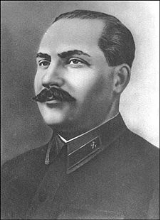
Lazar Kaganovich

Encyclopedia
Lazar Moiseyevich Kaganovich ( – 25 July 1991) was a Soviet
politician and administrator and one of the main associates of Joseph Stalin
.
uyezd
, Kiev Governorate
, Russian Empire
(now named Dibrova, Poliske Raion, Kiev Oblast
, Ukraine
). Early in his political career, in 1915, Kaganovich became a Communist organizer for a shoe factory where he worked.
In 1911, he enlisted with the Bolshevik
party (his older brother Mikhail Kaganovich as already a member). Later in 1915, Kaganovich was arrested and sent back to Kabany. During March–April 1917, he was the Chairman of the Tanners Union and the vice-chairman of the Yuzovka Soviet. In May 1917, he became the leader of the military organization of Bolshevik
s in Saratov
, and in August 1917, he became the leader of the Polessky Committee of the Bolshevik party in Belarus
. During the October Revolution
, he was the leader of the revolt in Homel.
of the propaganda department of the Red Army
. From May 1918 to August 1919, he was the Chairman of the Ispolkom of the Nizhny Novgorod
gubernia. In 1919–1920, he was governor of the Voronezh
gubernia. From 1920 to 1922, he was in Turkmenistan
, where he was one of the leaders of the Bolshevik struggle against local Muslim
rebels (basmachi) and also commanded the succeeding punitive expeditions against local opposition.
In May 1922, Stalin
became the General Secretary of the Communist Party
and immediately transferred Kaganovich to his apparatus to command the Organizational Department or Orgburo
of the Secretariat. This department was responsible for all assignments within the apparatus of the Communist Party. Working there, Kaganovich helped to place Stalin's supporters in important jobs within the Communist Party bureaucracy. In this position, he was noted for his great work capacity and personal loyalty to Stalin. He stated publicly that he would execute absolutely any order from Stalin, which at that time was a novelty.
In 1924, Kaganovich became a member of the Central Committee
. From 1925 to 1928, Kaganovich was the First Secretary of the Communist Party of the Ukrainian SSR
. He was given the task of "korenizatsiya
", the task of creating Ukrainian communist popular cadres. He was also given the task of implementation of collectivization and the policy of economic suppression of the kulak
s (wealthier peasants). He was opposed to the more moderate policy of Nikolai Bukharin
who argued in favor of the "peaceful integration of kulaks into socialism." In 1928, due to numerous protests against Kaganovich's management, Stalin was forced to transfer Kaganovich from Ukrainia to Moscow, where he returned to his position as a Secretary of the Central Committee of the Communist Party, a job he held until 1939. As Secretary, he endorsed Stalin's struggle against the so-called Left
and Right
Oppositions within the Communist Party, in the hope that Stalin would become the sole leader of the country. In 1933–1934, he was the Chairman of the Commission for the Vetting of the Party Membership (Tsentralnaya komissiya po proverke partiynykh ryadov) and ensured personally that nobody associated with anti-Stalin opposition would be permitted to remain a Communist Party member. In 1934, at the XVII Congress of the Communist Party, Kaganovich was the chairman of the Counting Committee. He falsified voting for positions in the Central Committee, deleting 290 votes opposing the Stalin candidacy. His actions resulted in Stalin's being re-elected as the General Secretary instead of Sergey Kirov
. By the rules, the candidate receiving fewer opposing votes should become the General Secretary. Before Kaganovich's falsification, Stalin received 292 opposing votes and Kirov only three. However, the "official" result (due to the interference of Kaganovich) was that Stalin ended with just two opposing votes (Radzinsky, 1996).
In 1930, Kaganovich became a member of the Soviet Politburo
and the First Secretary of the Moscow
Obkom of the Communist Party (1930–1935) and Moscow Gorkom of the Communist Party (1931–1934).
He also supervised the implementation of many of Stalin's economic
policies, including the collectivization of agriculture
and rapid industrialization.
In the 1930s, Kaganovich organized and contributed greatly to the building of the first Soviet underground rapid transport system, the Moscow Metro
, which was named after him until 1955. During this period, he also supervised the destruction of many of the city's oldest monuments, including the Cathedral of Christ the Saviour.
In 1932, he led the suppression of the workers' strike in Ivanovo-Voznesensk.
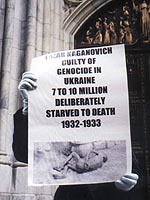 Kaganovich (together with Vyacheslav Molotov
) participated with the All-Ukrainian Party Conference of 1930 and were given the task of implementation of the collectivization policy that caused a catastrophic 1932-33 famine known as the Holodomor
. He also personally oversaw grain confiscations during the same time periods. Similar policies also inflicted enormous suffering on the Soviet Central Asian republic of Kazakhstan
, the Kuban
region, Crimea
, the lower Volga region, and other parts of the Soviet Union. As an emissary of the Central Committee of the Communist Party, Kaganovich traveled to Ukraine, the central regions of the USSR, the Northern Caucasus
, and Siberia
demanding the acceleration of collectivization and repressions against the kulaks, who were generally blamed for the slow progress of collectivization.
Attorney Rafael Lemkin in his work The Soviet genocide in Ukraine tried to bring the fact of Holodomor to the Nuremberg trials
as a genocide of a totalitarian regime.
On January 13, 2010, Kiev
Appellate Court
posthumously found Kaganovich, Postyshev and other Soviet
Communist Party functionaries guilty of genocide
against Ukrainians during the catastrophic Holodomor famine. They were recognized guilty as criminals, however the case was ended immediately by paragraph 8 of Article 6 of the Criminal Procedural Code of Ukraine. The importance of the case is its historical aspect that legally explains the particularity of that historical event. By New Years Day, the Security Service of Ukraine had finished pre-court investigation and transferred its materials to the Prosecutor General of Ukraine
. The materials consist of over 250 volumes of archive documents (from within Ukraine as well as abroad), interviews with witnesses, and expert analysis of several institutes of National Academies of Sciences. Oleksandr Medvedko
, the Prosecutor General, confirmed that the material is a clear evidence of the genocide occurring in Ukraine.
s, he organized the arrests of thousands of railway administrators and managers as supposed "saboteurs".
From 1937 to 1939, Kaganovich served as Narkom for Heavy Industry. During 1939–1940, he served as Narkom for the Oil Industry.
Each of his assignments was associated with arrests in order to improve discipline and compliance with Stalin's policies.
In all Party conferences of the later 1930s, he made speeches demanding increased efforts in the search for and prosecution of "foreign spies" and "saboteurs". For his ruthlessness in the execution of Stalin's orders, he was given the nickname "Iron Lazar". During the period of Great Terror starting in 1936 Kaganovich's signature appears on 188 out of 357 documented execution lists.
One of many who perished during these years was Lazar's brother, Mikhail Kaganovich, who was people's commisar (Narkom) of the Aviation Industry. On January 10, 1940, Mikhail was demoted to director of aviation plant "N24" in Kazan
. In February 1941, during the 18th Conference of the Communist Party, Mikhail was warned that if the plant missed its quotas he would be eliminated from the Party. On June 1, 1941, Stalin mentioned to Lazar that he had heard that Mikhail was "associating with the right wing". Lazar reportedly did not speak in the defense of his brother to Stalin, but did notify him by telephone. The same day Mikhail committed suicide.
During World War II (known as the Great Patriotic War in the USSR), Kaganovich was Commissar (Member of the Military Council) of the North Caucasian
and Transcaucasian Front
s. During 1943–1944, he was again the Narkom for the railroads. In 1943, he was presented with the title of Hero of Socialist Labor
. From 1944 to 1947, Kaganovich was the Minister for Building Materials.
In 1947, he became the First Secretary of the Ukrainian Communist Party. From 1948 to 1952, he served as the Chairman of Gossnab
(State Committee for Material-Technical Supply, charged with the primary responsibility for the allocation of producer goods to enterprises, a critical state function in the absence of markets), and from 1952 to 1957, as the First Vice-Premier of the Council of Ministers. He was also the first Chairman of Goskomtrud (State Committee for Labour and Wages, charged with introducing the minimum wage, with other wage policy, and with improving the old-age pension system).
 Kaganovich was, until 1957, a voting member of the Politburo
as well as the Presidium
. He was also an early mentor of eventual First Secretary of the Communist Party Nikita Khrushchev
, who first became important as Kaganovich's Moscow
City deputy during the 1930s. In 1947, when Khrushchev was dismissed as the Party secretary of Ukrainia (he remained in the somewhat lesser "chief of government" position), Stalin dispatched Kaganovich to replace him until Khrushshev was reinstated later that year.
, and though he remained a member of the Presidium, soon lost influence after Stalin's death in March 1953. In 1957, along with fellow devoted Stalinists Vyacheslav Molotov
, Kliment Voroshilov
, and Georgy Malenkov
(the so-called Anti-Party Group
), he participated with an abortive party coup against his former protégé Khrushchev, whose criticism of Stalin had become increasingly harsh during the preceding two years. As a result of the unsuccessful coup, Kaganovich was forced to retire from the Presidium and the Central Committee, and was given the job of director of a small Ural
potassium
factory. In 1961, Kaganovich was completely expelled from the party
and became a pensioner living in Moscow. His grandchildren reported that after his dismissal from the Central Committee, Kaganovich (who had a reputation for his temperamental and allegedly violent nature) never again shouted and became a devoted grandfather.
Kaganovich survived to the age of 97, dying in 1991, just before the events that resulted in the end
of the USSR. He is buried in the famed Novodevichy Cemetery
in Moscow.
Stuart Kahan published a book entitled The Wolf of the Kremlin: The First Biography of L.M. Kaganovich, the Soviet Union's Architect of Fear (William Morrow & Co
). In the book, Kahan made a series of claims about Kaganovich's working relationship with Joseph Stalin
and his activities during the Ukrainian
famine
, and claimed to be the long-lost nephew of Kaganovich. He also claimed to have interviewed Kaganovich personally and stated that Kaganovich admitted to being partially responsible for the death of Stalin in 1953 (supposedly via poisoning). A number of other unusual claims were made as well, including that Stalin was married to a sister of Kaganovich (supposedly named "Rosa") during the last year of his life and that Kaganovich (a Jew) was the architect of anti-Jewish pogrom
s.
After The Wolf of the Kremlin was translated into the Russian language
by Progress Publishers
, and a chapter from it printed in the Nedelya (Week) newspaper in 1991, remaining members of Kaganovich's family composed the Statement of the Kaganovich Family in response. The statement disputed all of Kahan's claims.
Rosa Kaganovich, who the Statement of the Kaganovich Family says was fabricated, was referenced as Stalin's wife in the 1940s and 1950s by Western media including The New York Times
, Time Magazine, and Life Magazine.
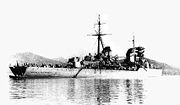 In 1944, the newly launched light cruiser of the project 26-bis was named after Lazar Kaganovich. It entered the Soviet Pacific Fleet in December 1944.
Kaganovich seems to have been responsible for the "eggs and omelette" metaphor commonly attributed to Stalin himself.
According to Time
magazine and some newspapers, Lazar Kaganovich's son Mikhail (named after Lazar's late brother) married Svetlana Dzhugashvili
, daughter of Joseph Stalin on July 3, 1951. Svetlana in her memoirs denies even the existence of such a son.
Soviet Union
The Soviet Union , officially the Union of Soviet Socialist Republics , was a constitutionally socialist state that existed in Eurasia between 1922 and 1991....
politician and administrator and one of the main associates of Joseph Stalin
Joseph Stalin
Joseph Vissarionovich Stalin was the Premier of the Soviet Union from 6 May 1941 to 5 March 1953. He was among the Bolshevik revolutionaries who brought about the October Revolution and had held the position of first General Secretary of the Communist Party of the Soviet Union's Central Committee...
.
Early life
Kaganovich was born in 1893 to Jewish parents in the village of Kabany, RadomyshlRadomyshl
Radomyshl is a historic city in the Zhytomyr Oblast of northern Ukraine. It is the administrative center of the Radomyshl Raion , and is located on the left bank of Teteriv River, a right tributary of Dnieper River....
uyezd
Uyezd
Uyezd or uezd was an administrative subdivision of Rus', Muscovy, Russian Empire, and the early Russian SFSR which was in use from the 13th century. Uyezds for most of the history in Russia were a secondary-level of administrative division...
, Kiev Governorate
Kiev Governorate
Kiev Governorate , or Government of Kiev, was an administrative division of the Russian Empire.The governorate was established in 1708 along with seven other governorates and was transformed into a viceroyalty in 1781...
, Russian Empire
Russian Empire
The Russian Empire was a state that existed from 1721 until the Russian Revolution of 1917. It was the successor to the Tsardom of Russia and the predecessor of the Soviet Union...
(now named Dibrova, Poliske Raion, Kiev Oblast
Kiev Oblast
Kyiv Oblast, sometimes written as Kiev Oblast is an oblast in central Ukraine.The administrative center of the oblast is the city of Kyiv , also being the capital of Ukraine...
, Ukraine
Ukraine
Ukraine is a country in Eastern Europe. It has an area of 603,628 km², making it the second largest contiguous country on the European continent, after Russia...
). Early in his political career, in 1915, Kaganovich became a Communist organizer for a shoe factory where he worked.
In 1911, he enlisted with the Bolshevik
Bolshevik
The Bolsheviks, originally also Bolshevists , derived from bol'shinstvo, "majority") were a faction of the Marxist Russian Social Democratic Labour Party which split apart from the Menshevik faction at the Second Party Congress in 1903....
party (his older brother Mikhail Kaganovich as already a member). Later in 1915, Kaganovich was arrested and sent back to Kabany. During March–April 1917, he was the Chairman of the Tanners Union and the vice-chairman of the Yuzovka Soviet. In May 1917, he became the leader of the military organization of Bolshevik
Bolshevik
The Bolsheviks, originally also Bolshevists , derived from bol'shinstvo, "majority") were a faction of the Marxist Russian Social Democratic Labour Party which split apart from the Menshevik faction at the Second Party Congress in 1903....
s in Saratov
Saratov
-Modern Saratov:The Saratov region is highly industrialized, due in part to the rich in natural and industrial resources of the area. The region is also one of the more important and largest cultural and scientific centres in Russia...
, and in August 1917, he became the leader of the Polessky Committee of the Bolshevik party in Belarus
Belarus
Belarus , officially the Republic of Belarus, is a landlocked country in Eastern Europe, bordered clockwise by Russia to the northeast, Ukraine to the south, Poland to the west, and Lithuania and Latvia to the northwest. Its capital is Minsk; other major cities include Brest, Grodno , Gomel ,...
. During the October Revolution
October Revolution
The October Revolution , also known as the Great October Socialist Revolution , Red October, the October Uprising or the Bolshevik Revolution, was a political revolution and a part of the Russian Revolution of 1917...
, he was the leader of the revolt in Homel.
Communist functionary
In 1918, Kaganovich acted as CommissarCommissar
Commissar is the English transliteration of an official title used in Russia from the time of Peter the Great.The title was used during the Provisional Government for regional heads of administration, but it is mostly associated with a number of Cheka and military functions in Bolshevik and Soviet...
of the propaganda department of the Red Army
Red Army
The Workers' and Peasants' Red Army started out as the Soviet Union's revolutionary communist combat groups during the Russian Civil War of 1918-1922. It grew into the national army of the Soviet Union. By the 1930s the Red Army was among the largest armies in history.The "Red Army" name refers to...
. From May 1918 to August 1919, he was the Chairman of the Ispolkom of the Nizhny Novgorod
Nizhny Novgorod
Nizhny Novgorod , colloquially shortened to Nizhny, is, with the population of 1,250,615, the fifth largest city in Russia, ranking after Moscow, St. Petersburg, Novosibirsk, and Yekaterinburg...
gubernia. In 1919–1920, he was governor of the Voronezh
Voronezh
Voronezh is a city in southwestern Russia, the administrative center of Voronezh Oblast. It is located on both sides of the Voronezh River, away from where it flows into the Don. It is an operating center of the Southeastern Railway , as well as the center of the Don Highway...
gubernia. From 1920 to 1922, he was in Turkmenistan
Turkmenistan
Turkmenistan , formerly also known as Turkmenia is one of the Turkic states in Central Asia. Until 1991, it was a constituent republic of the Soviet Union, the Turkmen Soviet Socialist Republic . Turkmenistan is one of the six independent Turkic states...
, where he was one of the leaders of the Bolshevik struggle against local Muslim
Muslim
A Muslim, also spelled Moslem, is an adherent of Islam, a monotheistic, Abrahamic religion based on the Quran, which Muslims consider the verbatim word of God as revealed to prophet Muhammad. "Muslim" is the Arabic term for "submitter" .Muslims believe that God is one and incomparable...
rebels (basmachi) and also commanded the succeeding punitive expeditions against local opposition.
In May 1922, Stalin
Joseph Stalin
Joseph Vissarionovich Stalin was the Premier of the Soviet Union from 6 May 1941 to 5 March 1953. He was among the Bolshevik revolutionaries who brought about the October Revolution and had held the position of first General Secretary of the Communist Party of the Soviet Union's Central Committee...
became the General Secretary of the Communist Party
General Secretary of the Communist Party of the Soviet Union
General Secretary of the Central Committee of the Communist Party of the Soviet Union was the title given to the leader of the Communist Party of the Soviet Union. With some exceptions, the office was synonymous with leader of the Soviet Union...
and immediately transferred Kaganovich to his apparatus to command the Organizational Department or Orgburo
Orgburo
The Orgburo of the Central Committee of the Communist Party of the Soviet Union existed from 1919–52, until the 19th Congress, when the Orgburo was abolished and its functions were transferred to the enlarged Secretariat....
of the Secretariat. This department was responsible for all assignments within the apparatus of the Communist Party. Working there, Kaganovich helped to place Stalin's supporters in important jobs within the Communist Party bureaucracy. In this position, he was noted for his great work capacity and personal loyalty to Stalin. He stated publicly that he would execute absolutely any order from Stalin, which at that time was a novelty.
In 1924, Kaganovich became a member of the Central Committee
Central Committee
Central Committee was the common designation of a standing administrative body of communist parties, analogous to a board of directors, whether ruling or non-ruling in the twentieth century and of the surviving, mostly Trotskyist, states in the early twenty first. In such party organizations the...
. From 1925 to 1928, Kaganovich was the First Secretary of the Communist Party of the Ukrainian SSR
Ukrainian SSR
The Ukrainian Soviet Socialist Republic or in short, the Ukrainian SSR was a sovereign Soviet Socialist state and one of the fifteen constituent republics of the Soviet Union lasting from its inception in 1922 to the breakup in 1991...
. He was given the task of "korenizatsiya
Ukrainization
Ukrainization is a policy of increasing the usage and facilitating the development of the Ukrainian language and promoting other elements of Ukrainian culture, in various spheres of public life such as education, publishing, government and religion.The term is used, most prominently, for the...
", the task of creating Ukrainian communist popular cadres. He was also given the task of implementation of collectivization and the policy of economic suppression of the kulak
Kulak
Kulaks were a category of relatively affluent peasants in the later Russian Empire, Soviet Russia, and early Soviet Union...
s (wealthier peasants). He was opposed to the more moderate policy of Nikolai Bukharin
Nikolai Bukharin
Nikolai Ivanovich Bukharin , was a Russian Marxist, Bolshevik revolutionary, and Soviet politician. He was a member of the Politburo and Central Committee , chairman of the Communist International , and the editor in chief of Pravda , the journal Bolshevik , Izvestia , and the Great Soviet...
who argued in favor of the "peaceful integration of kulaks into socialism." In 1928, due to numerous protests against Kaganovich's management, Stalin was forced to transfer Kaganovich from Ukrainia to Moscow, where he returned to his position as a Secretary of the Central Committee of the Communist Party, a job he held until 1939. As Secretary, he endorsed Stalin's struggle against the so-called Left
Left Opposition
The Left Opposition was a faction within the Bolshevik Party from 1923 to 1927, headed de facto by Leon Trotsky. The Left Opposition formed as part of the power struggle within the party leadership that began with the Soviet founder Vladimir Lenin's illness and intensified with his death in January...
and Right
Right Opposition
The Right Opposition was the name given to the tendency made up of Nikolai Bukharin, Alexei Rykov, Mikhail Tomsky and their supporters within the Soviet Union in the late 1920s...
Oppositions within the Communist Party, in the hope that Stalin would become the sole leader of the country. In 1933–1934, he was the Chairman of the Commission for the Vetting of the Party Membership (Tsentralnaya komissiya po proverke partiynykh ryadov) and ensured personally that nobody associated with anti-Stalin opposition would be permitted to remain a Communist Party member. In 1934, at the XVII Congress of the Communist Party, Kaganovich was the chairman of the Counting Committee. He falsified voting for positions in the Central Committee, deleting 290 votes opposing the Stalin candidacy. His actions resulted in Stalin's being re-elected as the General Secretary instead of Sergey Kirov
Sergey Kirov
Sergei Mironovich Kirov , born Sergei Mironovich Kostrikov, was a prominent early Bolshevik leader in the Soviet Union. Kirov rose through the Communist Party ranks to become head of the Party organization in Leningrad...
. By the rules, the candidate receiving fewer opposing votes should become the General Secretary. Before Kaganovich's falsification, Stalin received 292 opposing votes and Kirov only three. However, the "official" result (due to the interference of Kaganovich) was that Stalin ended with just two opposing votes (Radzinsky, 1996).
In 1930, Kaganovich became a member of the Soviet Politburo
Politburo
Politburo , literally "Political Bureau [of the Central Committee]," is the executive committee for a number of communist political parties.-Marxist-Leninist states:...
and the First Secretary of the Moscow
Moscow
Moscow is the capital, the most populous city, and the most populous federal subject of Russia. The city is a major political, economic, cultural, scientific, religious, financial, educational, and transportation centre of Russia and the continent...
Obkom of the Communist Party (1930–1935) and Moscow Gorkom of the Communist Party (1931–1934).
He also supervised the implementation of many of Stalin's economic
Economics
Economics is the social science that analyzes the production, distribution, and consumption of goods and services. The term economics comes from the Ancient Greek from + , hence "rules of the house"...
policies, including the collectivization of agriculture
Agriculture
Agriculture is the cultivation of animals, plants, fungi and other life forms for food, fiber, and other products used to sustain life. Agriculture was the key implement in the rise of sedentary human civilization, whereby farming of domesticated species created food surpluses that nurtured the...
and rapid industrialization.
In the 1930s, Kaganovich organized and contributed greatly to the building of the first Soviet underground rapid transport system, the Moscow Metro
Moscow Metro
The Moscow Metro is a rapid transit system serving Moscow and the neighbouring town of Krasnogorsk. Opened in 1935 with one line and 13 stations, it was the first underground railway system in the Soviet Union. As of 2011, the Moscow Metro has 182 stations and its route length is . The system is...
, which was named after him until 1955. During this period, he also supervised the destruction of many of the city's oldest monuments, including the Cathedral of Christ the Saviour.
In 1932, he led the suppression of the workers' strike in Ivanovo-Voznesensk.
Responsibility for 1932-33 famine
Vyacheslav Molotov
Vyacheslav Mikhailovich Molotov was a Soviet politician and diplomat, an Old Bolshevik and a leading figure in the Soviet government from the 1920s, when he rose to power as a protégé of Joseph Stalin, to 1957, when he was dismissed from the Presidium of the Central Committee by Nikita Khrushchev...
) participated with the All-Ukrainian Party Conference of 1930 and were given the task of implementation of the collectivization policy that caused a catastrophic 1932-33 famine known as the Holodomor
Holodomor
The Holodomor was a man-made famine in the Ukrainian SSR between 1932 and 1933. During the famine, which is also known as the "terror-famine in Ukraine" and "famine-genocide in Ukraine", millions of Ukrainians died of starvation in a peacetime catastrophe unprecedented in the history of...
. He also personally oversaw grain confiscations during the same time periods. Similar policies also inflicted enormous suffering on the Soviet Central Asian republic of Kazakhstan
Kazakhstan
Kazakhstan , officially the Republic of Kazakhstan, is a transcontinental country in Central Asia and Eastern Europe. Ranked as the ninth largest country in the world, it is also the world's largest landlocked country; its territory of is greater than Western Europe...
, the Kuban
Kuban
Kuban is a geographic region of Southern Russia surrounding the Kuban River, on the Black Sea between the Don Steppe, Volga Delta and the Caucasus...
region, Crimea
Crimea
Crimea , or the Autonomous Republic of Crimea , is a sub-national unit, an autonomous republic, of Ukraine. It is located on the northern coast of the Black Sea, occupying a peninsula of the same name...
, the lower Volga region, and other parts of the Soviet Union. As an emissary of the Central Committee of the Communist Party, Kaganovich traveled to Ukraine, the central regions of the USSR, the Northern Caucasus
Caucasus
The Caucasus, also Caucas or Caucasia , is a geopolitical region at the border of Europe and Asia, and situated between the Black and the Caspian sea...
, and Siberia
Siberia
Siberia is an extensive region constituting almost all of Northern Asia. Comprising the central and eastern portion of the Russian Federation, it was part of the Soviet Union from its beginning, as its predecessor states, the Tsardom of Russia and the Russian Empire, conquered it during the 16th...
demanding the acceleration of collectivization and repressions against the kulaks, who were generally blamed for the slow progress of collectivization.
Attorney Rafael Lemkin in his work The Soviet genocide in Ukraine tried to bring the fact of Holodomor to the Nuremberg trials
Nuremberg Trials
The Nuremberg Trials were a series of military tribunals, held by the victorious Allied forces of World War II, most notable for the prosecution of prominent members of the political, military, and economic leadership of the defeated Nazi Germany....
as a genocide of a totalitarian regime.
On January 13, 2010, Kiev
Kiev
Kiev or Kyiv is the capital and the largest city of Ukraine, located in the north central part of the country on the Dnieper River. The population as of the 2001 census was 2,611,300. However, higher numbers have been cited in the press....
Appellate Court
Appellate court
An appellate court, commonly called an appeals court or court of appeals or appeal court , is any court of law that is empowered to hear an appeal of a trial court or other lower tribunal...
posthumously found Kaganovich, Postyshev and other Soviet
Soviet Union
The Soviet Union , officially the Union of Soviet Socialist Republics , was a constitutionally socialist state that existed in Eurasia between 1922 and 1991....
Communist Party functionaries guilty of genocide
Genocide
Genocide is defined as "the deliberate and systematic destruction, in whole or in part, of an ethnic, racial, religious, or national group", though what constitutes enough of a "part" to qualify as genocide has been subject to much debate by legal scholars...
against Ukrainians during the catastrophic Holodomor famine. They were recognized guilty as criminals, however the case was ended immediately by paragraph 8 of Article 6 of the Criminal Procedural Code of Ukraine. The importance of the case is its historical aspect that legally explains the particularity of that historical event. By New Years Day, the Security Service of Ukraine had finished pre-court investigation and transferred its materials to the Prosecutor General of Ukraine
Prosecutor General of Ukraine
The Prosecutor General of Ukraine heads the system of official prosecution in courts known as the Office of the Prosecutor General of Ukraine...
. The materials consist of over 250 volumes of archive documents (from within Ukraine as well as abroad), interviews with witnesses, and expert analysis of several institutes of National Academies of Sciences. Oleksandr Medvedko
Oleksandr Medvedko
Oleksandr Medvedko is a former Prosecutor General of Ukraine Medvedko was installed in a political deal with the Party of Regions.In December 2009 during the 2010 Ukrainian presidential election campaign incumbent Prime Minister of Ukraine and presidential candidate Yulia Tymoshenko promised to...
, the Prosecutor General, confirmed that the material is a clear evidence of the genocide occurring in Ukraine.
"Iron Lazar"
From 1935 to 1937, Kaganovich worked as Narkom (minister) for the railways. Even before the start of the Great PurgeGreat Purge
The Great Purge was a series of campaigns of political repression and persecution in the Soviet Union orchestrated by Joseph Stalin from 1936 to 1938...
s, he organized the arrests of thousands of railway administrators and managers as supposed "saboteurs".
From 1937 to 1939, Kaganovich served as Narkom for Heavy Industry. During 1939–1940, he served as Narkom for the Oil Industry.
Each of his assignments was associated with arrests in order to improve discipline and compliance with Stalin's policies.
In all Party conferences of the later 1930s, he made speeches demanding increased efforts in the search for and prosecution of "foreign spies" and "saboteurs". For his ruthlessness in the execution of Stalin's orders, he was given the nickname "Iron Lazar". During the period of Great Terror starting in 1936 Kaganovich's signature appears on 188 out of 357 documented execution lists.
One of many who perished during these years was Lazar's brother, Mikhail Kaganovich, who was people's commisar (Narkom) of the Aviation Industry. On January 10, 1940, Mikhail was demoted to director of aviation plant "N24" in Kazan
Kazan
Kazan is the capital and largest city of the Republic of Tatarstan, Russia. With a population of 1,143,546 , it is the eighth most populous city in Russia. Kazan lies at the confluence of the Volga and Kazanka Rivers in European Russia. In April 2009, the Russian Patent Office granted Kazan the...
. In February 1941, during the 18th Conference of the Communist Party, Mikhail was warned that if the plant missed its quotas he would be eliminated from the Party. On June 1, 1941, Stalin mentioned to Lazar that he had heard that Mikhail was "associating with the right wing". Lazar reportedly did not speak in the defense of his brother to Stalin, but did notify him by telephone. The same day Mikhail committed suicide.
During World War II (known as the Great Patriotic War in the USSR), Kaganovich was Commissar (Member of the Military Council) of the North Caucasian
North Caucasian Front
The North Caucasian Front or North Caucasus Front was a Front of the Soviet Army during the Second World War. This sense of the term is not identical with the more general usage of military front which indicates a geographic area in wartime, although a Soviet Front may operate within designated...
and Transcaucasian Front
Transcaucasian Front
Transcaucasian Front or Transcaucasus Front was a Front of the Soviet Army during the Second World War. This sense of the term is not identical with the more general usage of military front which indicates a geographic area in wartime, although a Soviet Front may operate within designated...
s. During 1943–1944, he was again the Narkom for the railroads. In 1943, he was presented with the title of Hero of Socialist Labor
Hero of Socialist Labor
Hero of Socialist Labour was an honorary title in the Soviet Union and other Warsaw Pact countries. It was the highest degree of distinction for exceptional achievements in national economy and culture...
. From 1944 to 1947, Kaganovich was the Minister for Building Materials.
In 1947, he became the First Secretary of the Ukrainian Communist Party. From 1948 to 1952, he served as the Chairman of Gossnab
Gossnab
Gossnab of USSR, State Supplies of the USSR was active in 1948-1953, 1965-1991. It was the state committee for material technical supply in the Soviet Union...
(State Committee for Material-Technical Supply, charged with the primary responsibility for the allocation of producer goods to enterprises, a critical state function in the absence of markets), and from 1952 to 1957, as the First Vice-Premier of the Council of Ministers. He was also the first Chairman of Goskomtrud (State Committee for Labour and Wages, charged with introducing the minimum wage, with other wage policy, and with improving the old-age pension system).
Politburo
Politburo , literally "Political Bureau [of the Central Committee]," is the executive committee for a number of communist political parties.-Marxist-Leninist states:...
as well as the Presidium
Presidium
The presidium or praesidium is the name for the heading organ of various legislative and organizational bodies.-Historical usage:...
. He was also an early mentor of eventual First Secretary of the Communist Party Nikita Khrushchev
Nikita Khrushchev
Nikita Sergeyevich Khrushchev led the Soviet Union during part of the Cold War. He served as First Secretary of the Communist Party of the Soviet Union from 1953 to 1964, and as Chairman of the Council of Ministers, or Premier, from 1958 to 1964...
, who first became important as Kaganovich's Moscow
Moscow
Moscow is the capital, the most populous city, and the most populous federal subject of Russia. The city is a major political, economic, cultural, scientific, religious, financial, educational, and transportation centre of Russia and the continent...
City deputy during the 1930s. In 1947, when Khrushchev was dismissed as the Party secretary of Ukrainia (he remained in the somewhat lesser "chief of government" position), Stalin dispatched Kaganovich to replace him until Khrushshev was reinstated later that year.
Later life
Kaganovich was a doctrinaire StalinistStalinism
Stalinism refers to the ideology that Joseph Stalin conceived and implemented in the Soviet Union, and is generally considered a branch of Marxist–Leninist ideology but considered by some historians to be a significant deviation from this philosophy...
, and though he remained a member of the Presidium, soon lost influence after Stalin's death in March 1953. In 1957, along with fellow devoted Stalinists Vyacheslav Molotov
Vyacheslav Molotov
Vyacheslav Mikhailovich Molotov was a Soviet politician and diplomat, an Old Bolshevik and a leading figure in the Soviet government from the 1920s, when he rose to power as a protégé of Joseph Stalin, to 1957, when he was dismissed from the Presidium of the Central Committee by Nikita Khrushchev...
, Kliment Voroshilov
Kliment Voroshilov
Kliment Yefremovich Voroshilov , popularly known as Klim Voroshilov was a Soviet military officer, politician, and statesman...
, and Georgy Malenkov
Georgy Malenkov
Georgy Maximilianovich Malenkov was a Soviet politician, Communist Party leader and close collaborator of Joseph Stalin. After Stalin's death, he became Premier of the Soviet Union and was in 1953 briefly considered the most powerful Soviet politician before being overshadowed by Nikita...
(the so-called Anti-Party Group
Anti-Party Group
The Anti-Party Group was a group within the leadership of the Communist Party of the Soviet Union that unsuccessfully attempted to depose Nikita Khrushchev as First Secretary of the Party in May 1957. The group, named by that epithet by Khrushchev, was led by former Premiers Georgy Malenkov and...
), he participated with an abortive party coup against his former protégé Khrushchev, whose criticism of Stalin had become increasingly harsh during the preceding two years. As a result of the unsuccessful coup, Kaganovich was forced to retire from the Presidium and the Central Committee, and was given the job of director of a small Ural
Ural (region)
Ural is a geographical region located around the Ural Mountains, between the East European and West Siberian plains. It extends approximately from north to south, from the Arctic Ocean to the bend of Ural River near Orsk city. The boundary between Europe and Asia runs along the eastern side of...
potassium
Potassium
Potassium is the chemical element with the symbol K and atomic number 19. Elemental potassium is a soft silvery-white alkali metal that oxidizes rapidly in air and is very reactive with water, generating sufficient heat to ignite the hydrogen emitted in the reaction.Potassium and sodium are...
factory. In 1961, Kaganovich was completely expelled from the party
Communist Party of the Soviet Union
The Communist Party of the Soviet Union was the only legal, ruling political party in the Soviet Union and one of the largest communist organizations in the world...
and became a pensioner living in Moscow. His grandchildren reported that after his dismissal from the Central Committee, Kaganovich (who had a reputation for his temperamental and allegedly violent nature) never again shouted and became a devoted grandfather.
Kaganovich survived to the age of 97, dying in 1991, just before the events that resulted in the end
Soviet coup attempt of 1991
The 1991 Soviet coup d'état attempt , also known as the August Putsch or August Coup , was an attempt by a group of members of the Soviet Union's government to take control of the country from Soviet president Mikhail Gorbachev...
of the USSR. He is buried in the famed Novodevichy Cemetery
Novodevichy Cemetery
Novodevichy Cemetery is the most famous cemetery in Moscow, Russia. It is next to the 16th-century Novodevichy Convent, which is the city's third most popular tourist site. It should not be confused with the Novodevichy Cemetery in Saint Petersburg....
in Moscow.
"The Wolf of the Kremlin"
In 1987, American journalistJournalist
A journalist collects and distributes news and other information. A journalist's work is referred to as journalism.A reporter is a type of journalist who researchs, writes, and reports on information to be presented in mass media, including print media , electronic media , and digital media A...
Stuart Kahan published a book entitled The Wolf of the Kremlin: The First Biography of L.M. Kaganovich, the Soviet Union's Architect of Fear (William Morrow & Co
HarperCollins
HarperCollins is a publishing company owned by News Corporation. It is the combination of the publishers William Collins, Sons and Co Ltd, a British company, and Harper & Row, an American company, itself the result of an earlier merger of Harper & Brothers and Row, Peterson & Company. The worldwide...
). In the book, Kahan made a series of claims about Kaganovich's working relationship with Joseph Stalin
Joseph Stalin
Joseph Vissarionovich Stalin was the Premier of the Soviet Union from 6 May 1941 to 5 March 1953. He was among the Bolshevik revolutionaries who brought about the October Revolution and had held the position of first General Secretary of the Communist Party of the Soviet Union's Central Committee...
and his activities during the Ukrainian
Ukraine
Ukraine is a country in Eastern Europe. It has an area of 603,628 km², making it the second largest contiguous country on the European continent, after Russia...
famine
Holodomor
The Holodomor was a man-made famine in the Ukrainian SSR between 1932 and 1933. During the famine, which is also known as the "terror-famine in Ukraine" and "famine-genocide in Ukraine", millions of Ukrainians died of starvation in a peacetime catastrophe unprecedented in the history of...
, and claimed to be the long-lost nephew of Kaganovich. He also claimed to have interviewed Kaganovich personally and stated that Kaganovich admitted to being partially responsible for the death of Stalin in 1953 (supposedly via poisoning). A number of other unusual claims were made as well, including that Stalin was married to a sister of Kaganovich (supposedly named "Rosa") during the last year of his life and that Kaganovich (a Jew) was the architect of anti-Jewish pogrom
Pogrom
A pogrom is a form of violent riot, a mob attack directed against a minority group, and characterized by killings and destruction of their homes and properties, businesses, and religious centres...
s.
After The Wolf of the Kremlin was translated into the Russian language
Russian language
Russian is a Slavic language used primarily in Russia, Belarus, Uzbekistan, Kazakhstan, Tajikistan and Kyrgyzstan. It is an unofficial but widely spoken language in Ukraine, Moldova, Latvia, Turkmenistan and Estonia and, to a lesser extent, the other countries that were once constituent republics...
by Progress Publishers
Progress Publishers
Progress Publishers was a Moscow-based Soviet publisher founded in 1931.It was noted for its English-language editions of books on Marxism-Leninism....
, and a chapter from it printed in the Nedelya (Week) newspaper in 1991, remaining members of Kaganovich's family composed the Statement of the Kaganovich Family in response. The statement disputed all of Kahan's claims.
Rosa Kaganovich, who the Statement of the Kaganovich Family says was fabricated, was referenced as Stalin's wife in the 1940s and 1950s by Western media including The New York Times
The New York Times
The New York Times is an American daily newspaper founded and continuously published in New York City since 1851. The New York Times has won 106 Pulitzer Prizes, the most of any news organization...
, Time Magazine, and Life Magazine.
Miscellanea
Kaganovich seems to have been responsible for the "eggs and omelette" metaphor commonly attributed to Stalin himself.
According to Time
Time (magazine)
Time is an American news magazine. A European edition is published from London. Time Europe covers the Middle East, Africa and, since 2003, Latin America. An Asian edition is based in Hong Kong...
magazine and some newspapers, Lazar Kaganovich's son Mikhail (named after Lazar's late brother) married Svetlana Dzhugashvili
Svetlana Alliluyeva
Svetlana Iosifovna Alliluyeva , later known as Lana Peters, was the youngest child and only daughter of Soviet Premier Joseph Stalin and Nadezhda Alliluyeva, Stalin's second wife...
, daughter of Joseph Stalin on July 3, 1951. Svetlana in her memoirs denies even the existence of such a son.