

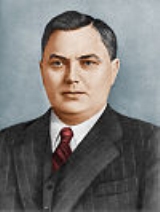
Georgy Malenkov

Encyclopedia
Georgy Maximilianovich Malenkov was a Soviet
politician, Communist Party
leader and close collaborator of Joseph Stalin
. After Stalin's death, he became Premier of the Soviet Union
(1953–1955) and was in 1953 briefly considered the most powerful Soviet politician before being overshadowed by Nikita Khrushchev
.
, Russian Empire
. His paternal ancestors were of Macedonian
extraction, some of whom served as officers in the Russian Imperial Army. His mother was the daughter of a blacksmith and the granddaughter of an Orthodox
priest.
Malenkov graduated from high school during the revolution
and was drafted into the Red Army
in 1919. He joined the Communist Party of the Soviet Union
(CPSU) in 1920 and worked as a political commissar
on a propaganda train in Turkestan
during the Russian civil war.
degree from the prestigious Moscow Highest Technical School in 1925. Post-graduation he worked in the staff of the Organizational Bureau (Orgburo
) of the Central Committee of the CPSU. During the next ten years Malenkov became closely associated with Stalin and was deeply involved in implementing the purging of the party. In 1938 he was one of the key figures in bringing forth the downfall of Yezhov, the head of the NKVD
. In 1939 Malenkov became the head of the party's Cadres Directorate, which gave him control over personnel matters of party bureaucracy. During the same year he also became a member and a secretary of the Central Committee and rose from his previous staff position to become a full member of Orgburo. In February 1941 Malenkov became a candidate member of the Politburo.
After the German invasion
of June 1941, Malenkov was promoted to the State Defense Committee (GKO), along with Beria
, Voroshilov
and Molotov
with Stalin as the committee's head. This small group held immense power and Malenkov's membership thus made him one of the most powerful men of the Soviet Union. During 1941–1943 Malenkov's primary responsibility in the GKO was aircraft production. In 1943 he became a chairman of a committee that oversaw the economic rehabilitation of liberated areas.
and Lavrentiy Beria
, he soon came back into Joseph Stalin
's favour, especially after Zhdanov's death. Beria soon joined Malenkov, and both of them saw all of Zhdanov's allies purged from the Party and sent to labour camps. In 1948, Malenkov became a Secretary of the Central Committee
. In order to test Malenkov as a potential successor, the ageing Stalin increasingly withdrew from the business of the secretariat, leaving the task of supervising the body to Malenkov. In October 1952, Stalin even had the office of General Secretary formally abolished (though in effect this did not diminish Stalin's authority).
. However, on 13 March he had to resign from the Secretariat
due to the opposition of other members of the Politburo of the CPSU Central Committee. While Malenkov headed the government, Nikita Khrushchev
, another of the secretaries, eventually assumed supreme leadership of the party as First Secretary of the CPSU in September 1953, ushering in a period of a Malenkov-Khrushchev duumvirate.
Malenkov retained the office of premier for two years. During these years, he was vocal about his opposition to nuclear armament, declaring "a nuclear war could lead to global destruction." He also advocated refocusing the economy on the production of consumer goods and away from heavy industry
, something his successor Nikita Khrushchev (1955–1964) would escalate.
s. Malenkov remained in the Politburo's successor, the Presidium.
Together with Khrushchev, he flew to the island of Brioni
(Yugoslavia) on the night of 1–2 November 1956 to inform Josip Broz Tito
of the impending Soviet invasion of Hungary scheduled for November 4.
However, in 1957, he was again forced to resign due to participation in a failed attempt together with Nikolai Bulganin
, Vyacheslav Molotov
, and Lazar Kaganovich
(the so-called Anti-Party Group
) to depose Khrushchev. In 1961, he was expelled from the Communist Party and exiled within the Soviet Union. He became a manager of a hydroelectric plant in Ust'-Kamenogorsk
, Kazakh Soviet Socialist Republic.
Simon Sebag Montefiore says in his 2003 Stalin: Court of the Red Tsar that Malenkov found this demotion actually a pleasant relief from the pressures of the Politburo. Furthermore, Sebag Montefiore reports, Malenkov in his later years became a devout Christian, as did his daughter, who has since spent part of her personal wealth building churches throughout the former Soviet Union. Orthodox Church publications at the time of Malenkov's death said he had been a reader (the lowest level of clergy) and a choir singer in his final years.
's Labour Party
(including former Prime Minister
Clement Attlee
and former Secretary of State for Health
Aneurin Bevan
) passed through Moscow
on their way to the People's Republic of China
, Sir William Goodenough Hayter
, British Ambassador to the Soviet Union, requested a dinner meeting with Nikita Khrushchev – then General Secretary of the Communist Party of the Soviet Union
. Much to Hayter's surprise, not only did Khrushchev accept the proposal, but decided to attend in the company of Vyacheslav Molotov
, Anastas Mikoyan
, Andrey Vyshinsky
, Nikolay Shvernik
, and Georgy Malenkov. Such was the interest aroused in British political circles by this event that Sir Winston Churchill
subsequently invited Sir William Hayter down to Chartwell
so as to provide a full account of what had transpired at the meeting.
Malenkov seemed "easily the most intelligent and quickest to grasp what was being said" and said "no more than he wanted to say". He was considered an "extremely agreeable neighbour at the table" and was thought to have had a "pleasant, musical voice and spoke well-educated Russian
". Malenkov even recommended, quietly, that British diplomatic translator Cecil Parrott
should read the novels of Leonid Andreyev
– an author whose literature was at that moment in time, condemned as decadent in the USSR.
Nikita Khrushchev, by contrast, struck Hayter as being "rumbustious, impetuous, loquacious, free-wheeling, and alarmingly ignorant of foreign affairs". Hayter observed that he "spoke in short sentences, in an emphatic voice and with great conviction.....grinning good-naturedly", that he often "stumbled in his choice of words" and "said the wrong thing." Hayter thought that Khrushchev seemed "incapable of grasping Bevan's line of thought, " and that Malenkov had to explain matters to him in "words of one syllable". Given to "interrupting," he (Khrushchev) seemed more eager to talk than to listen and to understand. He was "quick, but not intelligent". Convinced that Malenkov was in charge, nobody in the British delegation felt much inclined to expend effort with Khrushchev. Malenkov "spoke the best Russian of any Soviet leader I have heard", his "speeches were well constructed and logical in their development" and he seemed "a man with a more Western-oriented mind."
Soviet Union
The Soviet Union , officially the Union of Soviet Socialist Republics , was a constitutionally socialist state that existed in Eurasia between 1922 and 1991....
politician, Communist Party
Communist Party of the Soviet Union
The Communist Party of the Soviet Union was the only legal, ruling political party in the Soviet Union and one of the largest communist organizations in the world...
leader and close collaborator of Joseph Stalin
Joseph Stalin
Joseph Vissarionovich Stalin was the Premier of the Soviet Union from 6 May 1941 to 5 March 1953. He was among the Bolshevik revolutionaries who brought about the October Revolution and had held the position of first General Secretary of the Communist Party of the Soviet Union's Central Committee...
. After Stalin's death, he became Premier of the Soviet Union
Premier of the Soviet Union
The office of Premier of the Soviet Union was synonymous with head of government of the Union of Soviet Socialist Republics . Twelve individuals have been premier...
(1953–1955) and was in 1953 briefly considered the most powerful Soviet politician before being overshadowed by Nikita Khrushchev
Nikita Khrushchev
Nikita Sergeyevich Khrushchev led the Soviet Union during part of the Cold War. He served as First Secretary of the Communist Party of the Soviet Union from 1953 to 1964, and as Chairman of the Council of Ministers, or Premier, from 1958 to 1964...
.
Early life
Malenkov was born at OrenburgOrenburg
Orenburg is a city on the Ural River and the administrative center of Orenburg Oblast, Russia. It lies southeast of Moscow, very close to the border with Kazakhstan. Population: 546,987 ; 549,361 ; Highest point: 154.4 m...
, Russian Empire
Russian Empire
The Russian Empire was a state that existed from 1721 until the Russian Revolution of 1917. It was the successor to the Tsardom of Russia and the predecessor of the Soviet Union...
. His paternal ancestors were of Macedonian
Macedonia (region)
Macedonia is a geographical and historical region of the Balkan peninsula in southeastern Europe. Its boundaries have changed considerably over time, but nowadays the region is considered to include parts of five Balkan countries: Greece, the Republic of Macedonia, Bulgaria, Albania, Serbia, as...
extraction, some of whom served as officers in the Russian Imperial Army. His mother was the daughter of a blacksmith and the granddaughter of an Orthodox
Russian Orthodox Church
The Russian Orthodox Church or, alternatively, the Moscow Patriarchate The ROC is often said to be the largest of the Eastern Orthodox churches in the world; including all the autocephalous churches under its umbrella, its adherents number over 150 million worldwide—about half of the 300 million...
priest.
Malenkov graduated from high school during the revolution
Russian Revolution of 1917
The Russian Revolution is the collective term for a series of revolutions in Russia in 1917, which destroyed the Tsarist autocracy and led to the creation of the Soviet Union. The Tsar was deposed and replaced by a provisional government in the first revolution of February 1917...
and was drafted into the Red Army
Red Army
The Workers' and Peasants' Red Army started out as the Soviet Union's revolutionary communist combat groups during the Russian Civil War of 1918-1922. It grew into the national army of the Soviet Union. By the 1930s the Red Army was among the largest armies in history.The "Red Army" name refers to...
in 1919. He joined the Communist Party of the Soviet Union
Communist Party of the Soviet Union
The Communist Party of the Soviet Union was the only legal, ruling political party in the Soviet Union and one of the largest communist organizations in the world...
(CPSU) in 1920 and worked as a political commissar
Political commissar
The political commissar is the supervisory political officer responsible for the political education and organisation, and loyalty to the government of the military...
on a propaganda train in Turkestan
Turkestan Autonomous Soviet Socialist Republic
Turkestan Autonomous Soviet Socialist Republic was created from the Turkestan Krai of Imperial Russia...
during the Russian civil war.
Rise in the Communist Party
After the war, Malenkov returned to his studies and received his engineeringEngineering
Engineering is the discipline, art, skill and profession of acquiring and applying scientific, mathematical, economic, social, and practical knowledge, in order to design and build structures, machines, devices, systems, materials and processes that safely realize improvements to the lives of...
degree from the prestigious Moscow Highest Technical School in 1925. Post-graduation he worked in the staff of the Organizational Bureau (Orgburo
Orgburo
The Orgburo of the Central Committee of the Communist Party of the Soviet Union existed from 1919–52, until the 19th Congress, when the Orgburo was abolished and its functions were transferred to the enlarged Secretariat....
) of the Central Committee of the CPSU. During the next ten years Malenkov became closely associated with Stalin and was deeply involved in implementing the purging of the party. In 1938 he was one of the key figures in bringing forth the downfall of Yezhov, the head of the NKVD
NKVD
The People's Commissariat for Internal Affairs was the public and secret police organization of the Soviet Union that directly executed the rule of power of the Soviets, including political repression, during the era of Joseph Stalin....
. In 1939 Malenkov became the head of the party's Cadres Directorate, which gave him control over personnel matters of party bureaucracy. During the same year he also became a member and a secretary of the Central Committee and rose from his previous staff position to become a full member of Orgburo. In February 1941 Malenkov became a candidate member of the Politburo.
After the German invasion
Operation Barbarossa
Operation Barbarossa was the code name for Germany's invasion of the Soviet Union during World War II that began on 22 June 1941. Over 4.5 million troops of the Axis powers invaded the USSR along a front., the largest invasion in the history of warfare...
of June 1941, Malenkov was promoted to the State Defense Committee (GKO), along with Beria
Lavrentiy Beria
Lavrentiy Pavlovich Beria was a Georgian Soviet politician and state security administrator, chief of the Soviet security and secret police apparatus under Joseph Stalin during World War II, and Deputy Premier in the postwar years ....
, Voroshilov
Kliment Voroshilov
Kliment Yefremovich Voroshilov , popularly known as Klim Voroshilov was a Soviet military officer, politician, and statesman...
and Molotov
Vyacheslav Molotov
Vyacheslav Mikhailovich Molotov was a Soviet politician and diplomat, an Old Bolshevik and a leading figure in the Soviet government from the 1920s, when he rose to power as a protégé of Joseph Stalin, to 1957, when he was dismissed from the Presidium of the Central Committee by Nikita Khrushchev...
with Stalin as the committee's head. This small group held immense power and Malenkov's membership thus made him one of the most powerful men of the Soviet Union. During 1941–1943 Malenkov's primary responsibility in the GKO was aircraft production. In 1943 he became a chairman of a committee that oversaw the economic rehabilitation of liberated areas.
Rise in the Politburo
In 1946 Malenkov was named a candidate member of the Politburo. Although Malenkov fell out of favour in place of his rivals Andrei ZhdanovAndrei Zhdanov
Andrei Alexandrovich Zhdanov was a Soviet politician.-Life:Zhdanov enlisted with the Russian Social Democratic Labour Party in 1915 and was promoted through the party ranks, becoming the All-Union Communist Party manager in Leningrad after the assassination of Sergei Kirov in 1934...
and Lavrentiy Beria
Lavrentiy Beria
Lavrentiy Pavlovich Beria was a Georgian Soviet politician and state security administrator, chief of the Soviet security and secret police apparatus under Joseph Stalin during World War II, and Deputy Premier in the postwar years ....
, he soon came back into Joseph Stalin
Joseph Stalin
Joseph Vissarionovich Stalin was the Premier of the Soviet Union from 6 May 1941 to 5 March 1953. He was among the Bolshevik revolutionaries who brought about the October Revolution and had held the position of first General Secretary of the Communist Party of the Soviet Union's Central Committee...
's favour, especially after Zhdanov's death. Beria soon joined Malenkov, and both of them saw all of Zhdanov's allies purged from the Party and sent to labour camps. In 1948, Malenkov became a Secretary of the Central Committee
Secretariat of the CPSU Central Committee
The Secretariat of the CPSU Central Committee was a key body within the Communist Party of the Soviet Union and was responsible for the central administration of the party as opposed to drafting government policy which was usually handled by the Politburo...
. In order to test Malenkov as a potential successor, the ageing Stalin increasingly withdrew from the business of the secretariat, leaving the task of supervising the body to Malenkov. In October 1952, Stalin even had the office of General Secretary formally abolished (though in effect this did not diminish Stalin's authority).
Premiership and duumvirate
Malenkov's ambitions seemed to fulfill themselves upon Stalin's death on 5 March 1953. He was considered the most important member of the Secretariat and, with Beria's support, Malenkov became Premier of the Soviet UnionPremier of the Soviet Union
The office of Premier of the Soviet Union was synonymous with head of government of the Union of Soviet Socialist Republics . Twelve individuals have been premier...
. However, on 13 March he had to resign from the Secretariat
due to the opposition of other members of the Politburo of the CPSU Central Committee. While Malenkov headed the government, Nikita Khrushchev
Nikita Khrushchev
Nikita Sergeyevich Khrushchev led the Soviet Union during part of the Cold War. He served as First Secretary of the Communist Party of the Soviet Union from 1953 to 1964, and as Chairman of the Council of Ministers, or Premier, from 1958 to 1964...
, another of the secretaries, eventually assumed supreme leadership of the party as First Secretary of the CPSU in September 1953, ushering in a period of a Malenkov-Khrushchev duumvirate.
Malenkov retained the office of premier for two years. During these years, he was vocal about his opposition to nuclear armament, declaring "a nuclear war could lead to global destruction." He also advocated refocusing the economy on the production of consumer goods and away from heavy industry
Heavy industry
Heavy industry does not have a single fixed meaning as compared to light industry. It can mean production of products which are either heavy in weight or in the processes leading to their production. In general, it is a popular term used within the name of many Japanese and Korean firms, meaning...
, something his successor Nikita Khrushchev (1955–1964) would escalate.
Fall from power
He was forced to resign, in February 1955, after he came under attack for his closeness to Beria (who was executed as a traitor in December 1953) and for the slow pace of reforms, particularly when it came to rehabilitating political prisonerPolitical prisoner
According to the Longman Dictionary of Contemporary English, a political prisoner is ‘someone who is in prison because they have opposed or criticized the government of their own country’....
s. Malenkov remained in the Politburo's successor, the Presidium.
Together with Khrushchev, he flew to the island of Brioni
Brijuni
The Brijuni or the Brijuni Islands are a group of fourteen small islands in the Croatian part of the northern Adriatic Sea, separated from the west coast of the Istrian peninsula by the narrow Fažana Strait...
(Yugoslavia) on the night of 1–2 November 1956 to inform Josip Broz Tito
Josip Broz Tito
Marshal Josip Broz Tito – 4 May 1980) was a Yugoslav revolutionary and statesman. While his presidency has been criticized as authoritarian, Tito was a popular public figure both in Yugoslavia and abroad, viewed as a unifying symbol for the nations of the Yugoslav federation...
of the impending Soviet invasion of Hungary scheduled for November 4.
However, in 1957, he was again forced to resign due to participation in a failed attempt together with Nikolai Bulganin
Nikolai Bulganin
Nikolai Alexandrovich Bulganin was a prominent Soviet politician, who served as Minister of Defense and Premier of the Soviet Union . The Bulganin beard is named after him.-Early career:...
, Vyacheslav Molotov
Vyacheslav Molotov
Vyacheslav Mikhailovich Molotov was a Soviet politician and diplomat, an Old Bolshevik and a leading figure in the Soviet government from the 1920s, when he rose to power as a protégé of Joseph Stalin, to 1957, when he was dismissed from the Presidium of the Central Committee by Nikita Khrushchev...
, and Lazar Kaganovich
Lazar Kaganovich
Lazar Moiseyevich Kaganovich was a Soviet politician and administrator and one of the main associates of Joseph Stalin.-Early life:Kaganovich was born in 1893 to Jewish parents in the village of Kabany, Radomyshl uyezd, Kiev Governorate, Russian Empire...
(the so-called Anti-Party Group
Anti-Party Group
The Anti-Party Group was a group within the leadership of the Communist Party of the Soviet Union that unsuccessfully attempted to depose Nikita Khrushchev as First Secretary of the Party in May 1957. The group, named by that epithet by Khrushchev, was led by former Premiers Georgy Malenkov and...
) to depose Khrushchev. In 1961, he was expelled from the Communist Party and exiled within the Soviet Union. He became a manager of a hydroelectric plant in Ust'-Kamenogorsk
Oskemen
Oskemen and Ust-Kamennaya , is the capital of the East Kazakhstan Province. It is served by the Ust-Kamenogorsk Airport.-History:...
, Kazakh Soviet Socialist Republic.
Simon Sebag Montefiore says in his 2003 Stalin: Court of the Red Tsar that Malenkov found this demotion actually a pleasant relief from the pressures of the Politburo. Furthermore, Sebag Montefiore reports, Malenkov in his later years became a devout Christian, as did his daughter, who has since spent part of her personal wealth building churches throughout the former Soviet Union. Orthodox Church publications at the time of Malenkov's death said he had been a reader (the lowest level of clergy) and a choir singer in his final years.
Contemporary assessments
When, in 1954, a delegation of the United KingdomUnited Kingdom
The United Kingdom of Great Britain and Northern IrelandIn the United Kingdom and Dependencies, other languages have been officially recognised as legitimate autochthonous languages under the European Charter for Regional or Minority Languages...
's Labour Party
Labour Party (UK)
The Labour Party is a centre-left democratic socialist party in the United Kingdom. It surpassed the Liberal Party in general elections during the early 1920s, forming minority governments under Ramsay MacDonald in 1924 and 1929-1931. The party was in a wartime coalition from 1940 to 1945, after...
(including former Prime Minister
Prime Minister of the United Kingdom
The Prime Minister of the United Kingdom of Great Britain and Northern Ireland is the Head of Her Majesty's Government in the United Kingdom. The Prime Minister and Cabinet are collectively accountable for their policies and actions to the Sovereign, to Parliament, to their political party and...
Clement Attlee
Clement Attlee
Clement Richard Attlee, 1st Earl Attlee, KG, OM, CH, PC, FRS was a British Labour politician who served as the Prime Minister of the United Kingdom from 1945 to 1951, and as the Leader of the Labour Party from 1935 to 1955...
and former Secretary of State for Health
Secretary of State for Health
Secretary of State for Health is a UK cabinet position responsible for the Department of Health.The first Boards of Health were created by Orders in Council dated 21 June, 14 November, and 21 November 1831. In 1848 a General Board of Health was created with the First Commissioner of Woods and...
Aneurin Bevan
Aneurin Bevan
Aneurin "Nye" Bevan was a British Labour Party politician who was the Deputy Leader of the Labour Party from 1959 until his death in 1960. The son of a coal miner, Bevan was a lifelong champion of social justice and the rights of working people...
) passed through Moscow
Moscow
Moscow is the capital, the most populous city, and the most populous federal subject of Russia. The city is a major political, economic, cultural, scientific, religious, financial, educational, and transportation centre of Russia and the continent...
on their way to the People's Republic of China
People's Republic of China
China , officially the People's Republic of China , is the most populous country in the world, with over 1.3 billion citizens. Located in East Asia, the country covers approximately 9.6 million square kilometres...
, Sir William Goodenough Hayter
William Goodenough Hayter
Sir William Goodenough Hayter, 1st Baronet PC, QC was a British barrister and Whig politician. He is best remembered for his two tenures as Parliamentary Secretary to the Treasury between 1850 and 1852 and 1853 and 1858.- Background and education:Born at Winterbourne Stoke, Wiltshire, Hayter was...
, British Ambassador to the Soviet Union, requested a dinner meeting with Nikita Khrushchev – then General Secretary of the Communist Party of the Soviet Union
General Secretary of the Communist Party of the Soviet Union
General Secretary of the Central Committee of the Communist Party of the Soviet Union was the title given to the leader of the Communist Party of the Soviet Union. With some exceptions, the office was synonymous with leader of the Soviet Union...
. Much to Hayter's surprise, not only did Khrushchev accept the proposal, but decided to attend in the company of Vyacheslav Molotov
Vyacheslav Molotov
Vyacheslav Mikhailovich Molotov was a Soviet politician and diplomat, an Old Bolshevik and a leading figure in the Soviet government from the 1920s, when he rose to power as a protégé of Joseph Stalin, to 1957, when he was dismissed from the Presidium of the Central Committee by Nikita Khrushchev...
, Anastas Mikoyan
Anastas Mikoyan
Anastas Ivanovich Mikoyan was an Armenian Old Bolshevik and Soviet statesman during the rules of Vladimir Lenin, Joseph Stalin, Nikita Khrushchev, and Leonid Brezhnev....
, Andrey Vyshinsky
Andrey Vyshinsky
Andrey Januaryevich Vyshinsky – 22 November 1954) was a Soviet politician, jurist and diplomat.He is known as a state prosecutor of Joseph Stalin's Moscow trials and in the Nuremberg trials. He was the Soviet Foreign Minister from 1949 to 1953, after having served as Deputy Foreign...
, Nikolay Shvernik
Nikolay Shvernik
Nikolay Mikhailovich Shvernik was a Russian politician, who was the Chairman of the Presidium of the Supreme Soviet of the USSR from March 19, 1946 until March 15, 1953...
, and Georgy Malenkov. Such was the interest aroused in British political circles by this event that Sir Winston Churchill
Winston Churchill
Sir Winston Leonard Spencer-Churchill, was a predominantly Conservative British politician and statesman known for his leadership of the United Kingdom during the Second World War. He is widely regarded as one of the greatest wartime leaders of the century and served as Prime Minister twice...
subsequently invited Sir William Hayter down to Chartwell
Chartwell
Chartwell was the principal adult home of Sir Winston Churchill. Churchill and his wife Clementine bought the property, located two miles south of Westerham, Kent, England, in 1922...
so as to provide a full account of what had transpired at the meeting.
Malenkov seemed "easily the most intelligent and quickest to grasp what was being said" and said "no more than he wanted to say". He was considered an "extremely agreeable neighbour at the table" and was thought to have had a "pleasant, musical voice and spoke well-educated Russian
Russian language
Russian is a Slavic language used primarily in Russia, Belarus, Uzbekistan, Kazakhstan, Tajikistan and Kyrgyzstan. It is an unofficial but widely spoken language in Ukraine, Moldova, Latvia, Turkmenistan and Estonia and, to a lesser extent, the other countries that were once constituent republics...
". Malenkov even recommended, quietly, that British diplomatic translator Cecil Parrott
Cecil Parrott
Sir Cecil Cuthbert Parrott was a British diplomat, translator, writer and scholar.After studies at Peterhouse, Cambridge, he became a teacher. He joined the Foreign Office in 1939. His diplomatic career culminated with his posting to Prague, where he was the British Ambassador from 1960 to 1966...
should read the novels of Leonid Andreyev
Leonid Andreyev
Leonid Nikolaievich Andreyev was a Russian playwright, novelist and short-story writer. He is one of the most talented and prolific representatives of the Silver Age period in Russian history...
– an author whose literature was at that moment in time, condemned as decadent in the USSR.
Nikita Khrushchev, by contrast, struck Hayter as being "rumbustious, impetuous, loquacious, free-wheeling, and alarmingly ignorant of foreign affairs". Hayter observed that he "spoke in short sentences, in an emphatic voice and with great conviction.....grinning good-naturedly", that he often "stumbled in his choice of words" and "said the wrong thing." Hayter thought that Khrushchev seemed "incapable of grasping Bevan's line of thought, " and that Malenkov had to explain matters to him in "words of one syllable". Given to "interrupting," he (Khrushchev) seemed more eager to talk than to listen and to understand. He was "quick, but not intelligent". Convinced that Malenkov was in charge, nobody in the British delegation felt much inclined to expend effort with Khrushchev. Malenkov "spoke the best Russian of any Soviet leader I have heard", his "speeches were well constructed and logical in their development" and he seemed "a man with a more Western-oriented mind."
Honours and awards
- Hero of Socialist Labour (30 September 1943)
- Three Orders of Lenin (30 September 1943, November 1945, January 1952)
Further sources
- "Number 2½", Time, Mar 20, 1950.