

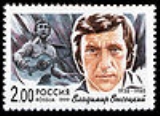
Vladimir Vysotsky

Encyclopedia
Vladimir Semyonovich Vysotsky (25 January 1938 – 25 July 1980) was a Soviet
singer, songwriter, poet, and actor whose career had an immense and enduring effect on Russian culture
. He became widely known for his unique singing style and for his lyrics, which featured social and political commentary in often humorous street jargon. He was also a prominent stage and screen actor. Though his work was largely ignored by the official Soviet cultural establishment, he achieved remarkable fame during his lifetime, and to this day exerts significant influence on many of Russia's popular musicians and actors who wish to emulate his iconic status.
at the 3rd Meshchanskaya St. (61/2) maternity hospital
. His father, Semyon Vladimirovich (1916–1997), a colonel in the army, was Jewish, originally from Kiev. His mother, Nina Maksimovna, (née Seryogina, 1912–2003) was Russian, and worked as a German language
translator. Vysotsky's family lived in a Moscow communal flat in harsh conditions, and had serious financial difficulties. When Vladimir was 10 months old, Nina had to return to her office in the Transcript bureau of the Ministry of Geodesy and Cartography of the USSR (engaged in making German maps available for the Soviet military) so as to help her husband earn their family's living.
Vladimir's extraordinary theatrical inclinations became obvious at a very early age, his mother Nina, a theater fan, being an obvious influence. The boy used to recite poems, standing on a chair and "flinging hair backwards, like a real poet", often using in his public speeches expressions he could hardly have heard at home. Once, at the age of two, when he had tired of the family’s guests’ poetry requests, he, according to his monther, sat himself under the New-year tree with a frustrated air about him and sighed: "You silly tossers! Give a child some respite!" His sense of humor was extraordinary, but often baffling for people around him. A three-year-old could jeer his father in a bathroom with unexpected poetic improvisation ("Now look what's here before us / Our goat’s to shave himself!") or appal unwanted guests with some street folk song, promptly steering them away. Vysotsky remembered those first three years of his life in the autobiographical Ballad of Childhood (Баллада о детстве, 1975), one of his best-known songs.
As WWII broke out, Semyon Vysotsky, a military reserve officer, joined the Soviet army and went to fight the Nazis. Nina and Vladimir were evacuated to the village of Vorontsovka, in Orenburg Oblast
where the boy had to spend 6 days a week in a kindergarten and his mother worked for 12 hours a day in a chemical factory. In 1943, both went back to their Moscow apartment at 1st Meschanskaya St., 126. In September, 1945, Vladimir joined the 1st class of the #273 Moscow Rostokino region School.
In December 1946, Vysotsky's parents divorced. In 1947 Vladimir went to live for two years with Semyon Vladimirovich and his Armenian
wife, Yevge′nya Stepanovna Liholatova, whom the boy called "aunt Zhenya". "We decided that our son would stay with me. Vladimir came to stay with me in January 1947, and my second wife, Yevgenia, became Vladimir's second mother for many years to come. They had much in common and liked each other, which made me really happy," Semyon Vysotsky later remembered. Vladimir spent 1947–1949 with his father (then an army Major) and "aunt Zhenya" at a military base in Eberswalde
in the Soviet-occupied section of post-World War II
Germany
(later East Germany). Here living conditions, compared to those of Nina's communal Moscow flat, were infinitely better; the family occupied the whole floor of a two-storeyed house, and the boy had a room to himself for the first time in his life. In 1949 along with his stepmother Vladimir returned to Moscow. There he joined the 5th class of Moscow's School #128 and settled at Bolshoy Karetny, 15 (where they had to themselves two rooms of a 4-roomed flat), with "auntie Zhenya" (then just 28), a woman of great kindness and warmth whom he later remembered as his second mother. In 1953 Vladimir Vysotsky, now much interested in theater and cinema, joined the Drama courses led by Vladimir Bogomolov. "No one in my family has had anything to do with arts, no actors or directors were there among them. But my mother admired theater and from the earliest age... each and every Saturday I've been taken up with her to watch one play or the other. And all of this, it probably stayed with me," he later reminisced. The same year he's got his first ever guitar, a birthday present from Nina Maksimovna; a close friend (and future well known Soviet poet and bard), Igor Kohanovsky, taught him basic chords. In 1955 Vladimir re-settled into her mother's new home (at 1st Meshanskaya, 76). In June of the same year he graduated from school with five A's.
Studio-Institute. It was there that he met the 3rd course student Iza Zhukova (who four years later became his wife); soon the two lovers settled at the 1st Meschanskaya flat, in a common room, shielded off by a folding screen. It was also in the Studio that Vysotsky met Bulat Okudzhava
for the first time, an already popular underground bard. He was even more impressed by his Russian literature
teacher Andrey Sinyavsky who along with his wife often invited students to his home to stage improvised disputes and concerts. In 1958 Vysotsky's got his first MAT(Moscow Art Theatre
) role: that of Porfiry Petrovich in Dostoyevsky's Crime and Punishment
. In 1959 he was cast in his first cinema role, that of student Petya in Vasily Ordynsky's The Yearlings (Сверстницы). On June 20, 1960, Vysotsky graduated from the MAT theater institute and joined the A. S. Pushkin Moscow Drama Theater (led by Boris Ravenskikh at the time) where he spent (with intervals) almost three troubled years. These were marred by numerous administrative sanctions, due to "lack of discipline" and occasional drunken sprees which were a reaction, mainly, to the lack of serious roles and his inability to realise his artistic potential A short stint in 1962 with the Moscow Theater of Miniatures (administered at the time by Vladimir Polyakov) ended with him being fired, officially "for a total lack of sense of humour".
Vysotsky's second and third films, Dima Gorin’s Career and "713" Requests Permission to Land, were interesting only for the fact that in both he had to be beaten up (in the first case by Aleksandr Demyanenko
). "That was the way cinema greeted me," he later often joked. In 1961 Vysotsky wrote his first-ever proper song, called "Tattoo" (Татуировка), which started a long and colourful cycle of artfully stylized criminal underworld romantic stories, full of undercurrents and witty social comments. In June, 1963, while shooting Penalty Kick (directed by Veniamin Dorman and starring Mikhail Pugovkin
), Vysotsky used the Gorky Film Studio
to record an hour-long reel-to-reel cassette of his own songs; copies of it quickly spread and the author's name became known in Moscow and elsewhere (although many of these songs were often being referred to as either "traditional" or "anonymous"). Just several months later Riga
-based chess grandmaster Mikhail Tal
was heard praising the author of "Bolshoy Karetny" and Anna Akhmatova
(in a conversation with Brodsky
) was quoting Vysotsky's number "I was the soul of a bad company..." taking it apparently for some brilliant piece of anonymous street folklore. In October 1964 Vysotsky recorded in chronological order 48 of his own songs, his first self-made Complete works of... compilation, which boosted his popularity as a new Moscow folk underground star.
invited Vysotsky to join the newly created Moscow Theatre of Drama and Comedy on the Taganka
. "'I've written some songs of my own. Won’t you listen?' – he asked. I agreed to listen to just one of them, expecting our meeting to last for no more than five minutes. Instead I ended up listening to him for an entire 1.5 hours", Lyubimov remembered years later of this first audition. On September 19, 1964, Vysotsky debuted in Bertholt Brecht's The Good Person of Szechwan
as Second God (two minor roles besides). A month later he came on stage as a dragoon captain (Bela's father) in Lermontov's A Hero of Our Time
. It was in Taganka that Vysotsky started to sing on stage; a new War theme having now became prominent in his musical repertoire. After having appeared in the experimental Poet and Theater (Поэт и Театр, February, 1965) show, based on Andrey Voznesensky
's work and then in Ten Days that Shook the World (after John Reed
's book, April 1965), Vysotsky was commissioned by Lyubimov to write songs exclusively for Taganka's new II World War play. The Dead and the Living (Павшие и Живые, premiered in October, 1965) included Vysotsky's Stars (Звёзды), The Soldiers of Heeresgruppe Mitte (Солдаты группы "Центр") and Penal Battalions (Штрафные батальоны), the striking examples of a completely new kind of a war song, never heard in his country before. As veteran screenwriter Nikolay Erdman put it (in conversation with Lyubimov), "Professionally, I can well understand how Mayakovsky
or Seryozha were doing it. How Volodya Vysotsky does it is totally beyond me". With his songs – in effect, miniature theatrical dramatizations (usually with a protagonist and full of dialogues), Vysotsky instantly achieved such level of credibility that real life former prisoners, war veterans, boxers, footballers etc. simply refused to believe that the author himself had never served his time in prisons and labour camps, or fought in the War, or been a boxing/football professional, etc. After the second of the two concerts at the Leningrad Molecular Physics institute (that was his actual debut as a solo musical performer) Vysotsky
left a note for his fans in a journal which ended with words: "Now that you've heard all these songs, please, don't you make a mistake of mixing me with my characters, I am not like them at all. With love, Vysotsky, April 20, 1965, XX c." Excuses of this kind he had to make throughout his performing career. At least one of Vysotsky's song themes – that of alcoholic abuse – was worryingly autobiographical, though. By the time his breakthrough came in 1967, he'd suffered several physical breakdowns and once was sent (by Taganka's boss) to a rehabilitation clinic, a visit he on several occasions repeated since.
Brecht's Life of Galileo
(premiered on May 17, 1966), transformed by Lyubimov into a powerful allegory of Soviet intelligentsia's set of moral and intellectual dilemmas, brought Vysotsky his first leading theater role (along with some fitness lessons: he had to perform numerous acrobatic tricks on stage). Press reaction was mixed, some reviewers disliked the actor's overt emotionalism, but it was for the first time ever that Vysotsky's name appeared in Soviet papers at all. Film directors now were treating him with respect. Victor Turov's war film I Was Born in Childhood where Vysotsky got his first ever 'serious' (neither comical nor villainous) role in cinema, featured two of his songs: a spontaneous piece called Cold Weather (Холода) and a dark, Unknown soldier theme-inspired classic Common Graves (На братских могилах), sung behind the screen by the legendary Mark Bernes
.
Stanislav Govorukhin
's Vertikal (1967), a mountain climbing drama, starring Vysotsky (as Volodya the radist) brought him all-round recognition and fame. Four of the numbers used in the film (including Song of a Friend (Песня о друге), released in 1968 by the Soviet recording industry monopolist Мелодия
flexi disc to become an unofficial hit) were written literally on the spot, nearby Elbrus, inspired by professional alpinists' tales and one curious hotel bar conversation with a German guest who 25 years ago happened to climb these very mountains in a capacity of an Edelweiss division fighter. Another 1967 film, Kira Muratova
's Short Liaisons featured Vysotsky as the geologist Maxim (paste-bearded again) with a now trademark off-the-cuff musical piece, a melancholy improvisation called Business... (Дела). All the while Vysotsky continued working hard at Taganka, with another important role under his belt (that of Mayakovsky – or, rather one the latter's character five different versions) in an experimantal piece called Have a Listen! (Послушайте!), and was more and more regularly giving semi-official concerts where audiences greeted him as a cult hero.
In the end of 1967 Vysotsky got another pivotal theater role, that of Khlopusha in Pugachov (a play based on Yesenin poem), often described as one of Taganka’s finest. "He’s given this play all things that he’s been excelling at and, on the other hand, it was Pugachyov that made him discover his own potential," – Soviet critic Natalya Krymova wrote years later. In a matter of weeks, though, infuriated by the actor’s increasing unreliability triggered by worsening drinking problems, Lyubimov fired him – only to let him back again several months later (and thus begin the humiliating sacked-then-pardoned routine which continued for years). In June 1968 a Vysotsky-slagging campaign was launched in the Soviet press. First Sovetskaya Rossiya commented on the "epidemic spread of immoral, smutty songs", allegedly promoting "criminal world values, alcoholism, vice and immorality" and condemned their author for "sawing seeds of evil". Then Komsomolskaya Pravda
linked Vysotsky with black market dealers selling his tapes somewhere in Siberia. Composer D. Kabalevsky speaking from the Union of Composers Committee tribune criticised Soviet radio for giving an ideologically dubious, "low-life product" like Song of a Friend an unwarranted airplay. Playwright A. Stein who in his Last Parade play used several of Vysotsky’s songs, was chastised by a Ministry of Culture official for "providing a tribune for this anti-Soviet scum". The phraseology prompted commentators in the West to make parallels between Vysotsky and Zoschenko, another Soviet author who'd been officially labeled "scum" some 20 years ago. Two of Vysotsky's 1968 films, Gennady Poloka’s Intervention (premiered in May 1987) where he was cast as Brodsky, a dodgy even if highly artistic character, and Ye. Karelov's Two Comrades Were Serving
(a gun-toting White Army officer Brusentsov who in the course of the film shoots his friend, his horse, Oleg Yankovsky
's good guy character and, finally himself) – were severely censored, first of them shelved for twenty years. Small wonder Vysotsky's 1968 songs were crushingly heavy and ultra depressive. At least four of them, though – Save Our Souls (Спасите наши души), Wolveshunting (Охота на волков), Nothing’s Right (Всё не так; better known by the opening line – "В сон мне желтые огни...") and Steam-bath in White (Банька по-белому) – were later hailed as his masterpieces. Meanwhile, at least one "proper" love song appeared in Vysotsky's repertoire for the first time, documenting the beginning of his passionate love affair with French actress Marina Vladi.
In 1969 Vysotsky starred in two films: The Taiga's Master (directed by V. Nazarov) where he played a villainous Siberian timber-floating brigadier, and somewhat more entertaining Dangerous Tour (George Bengalsky, a kinky revolutionary using his Odessa variety theater stage persona as a cover-up to spread banned literature behind the curtains) by film director G.Yungvald-Hinkevich. The latter was criticised in the press for having taken rather a farcical approach to the (historical fact-based) subject matter, but for a wider Soviet audience much more important was the second (after Vertical) opportunity to enjoy the charismatic (and still in many ways enigmatic) actor's presence on big screen full-time. In 1970 Vysotsky (assisted by the disgraced Soviet ex-leader's grand-daughter Yulia) visited Nikita Khrushchev
at his dacha and had a lengthy conversation, revolving mostly round Stalin and Beria figures toured Ukrainian
sites linked to Nestor Makhno
's history, embarked on a massive (and, in those times' terms, dangerously "commercial") Central Asian concert tour, then took Marina Vladi to director (and now good friend) Victor Turov's place to help his French fiancée investigate her Belorussian roots. The pair finally wed on December 1, 1970 (causing furore among the Moscow cultural and political elite) and for a honeymoon went for Georgia where they met Paradzhanov and friends.
. Many of his songs from the period deal – either directly or metaphorically – with alcoholism, insanity, mania, and obsessions. Partially recovered (much due to the encouraging presence of Marina, now well-settled into the real life role of a guardian angel, ever on the alert, ready to fly out to Moscow and lend a helping hand), Vysotsky embarked on a successful Ukrainian concert tour (there he wrote a cluster of songs and later referred to those days as his personal Boldino Autumn). But it was Taganka's Hamlet (premiered on November 29, 1971) that finally provided Vysotsky with his worthiest reason for celebration. A role – that of a lone intellectual rebel, rising to fight the cruel state machine – became an instant hit with the Soviet intelligentsia and in retrospect is seen as one of Soviet theater's all-time classic. This was huge psychological triumph too, over Lyubimov's skepticism, among other things.
Then came another blow: Vysotsky's got the role in (and wrote some songs for) The Sannikov Land
, an adaptation of Vladimir Obruchev
's science fiction, then got the boot – only for the reason of his face "being too scandalously recognizable", as a state official had put it. One of the songs written for the film, a doom-laden epic allegory of death-approaching called "Capricious Horses", gained life of its own and became one of the singer's signature tunes. Two of Vysotsky’s 1972 film roles were somewhat meditative: an anonymous American journalist in The Fourth One (after Konstantin Simonov
's play, directed by A.Stolper) and the 'righteous guy' von Koren in The Bad Good Man (based on Anton Chekov's Duel, directed by I. Kheifitz and starring Oleg Dahl). The latter brought Vysotsky the Best male role prize at the V Taormina Film Fest
. This philosophical slant rubbed off onto some of his new musical poems of the time (The Other's Track, Monument). More popular, though, proved to be his 1972 joke-songs: Mishka Shifman (making fun of the whole of leaving-for-Israel routine), Victim of TV (ridiculing the concept of "political consciousness" as such) and grotesquely funny The Honour of a Chess Crown about an ever-fearless "simple Soviet man" encountering the much feared American champion Bobby Fisher (who, incidentally, six months later demolished Boris Spassky
) and thrashing him thoroughly, in every possible sense of the word.
In April 1973 for the first time ever (since his 1947 East Germany venture) Vysotsky went abroad. Imminent official permission difficulties were sorted out instantly after the French Communist party leader Georges Marchais
's personal phone call to Leonid Brezhnev
(who, according to Marina Vladi's memoirs, rather sympathized with the stellar couple). They stayed in Poland
for a while with Daniel Olbrychski
(since then a good friend), having talks with Andrzej Wajda
and Krzysztof Zanussi
, then in France visited the Cannes festival. Having found on return a potentially dangerous lawsuit brought against him (concerning 'illegal' concerts in Siberia the year before), Vysotsky wrote a defiant letter to Minister of Culture Pyotr Demichev
where he stated his right to perform officially. As a result, he was given the official status of a philharmonic artist, 11,5 roubles (an equivalent to the price of 3 bottles of vodka) per concert now guaranteed. Still the 900 rubles' fine had to be paid according the court decision, which was a lot, considering his salary at the theater amounted to monthly 110 rubles.
did release a few of his songs on vinyl in the 1970s, which represented only a small portion of his creative work, which millions already owned on tape and knew by heart. In 1974 the 7” EP was released, featuring four of his war songs (He’s Never Returned From a Battle (Он не вернулся из боя), The New Times Song (Песня о новом времени), Common Graves (Братские могилы) and The Earth Song (Песня о Земле)). In September 1974 Vysotsky’s been officially merited for the first time ever – by the UzSSR government’s Honorary Diploma (along with four other actors of Taganka, which toured this Central Asia Soviet republic). Coupled with the USSR Union of Cinematographers’ membership that had been granted to him a year before, this modest Uzbek gift meant a lot. Now Vysotsky was an "anti-Soviet scum" no more: rather, an unlikely link between the official Soviet cinema and the "progressive-thinking artists of the West". More films followed, among them The Only Road (alternative title: Chained Drivers, Okovani šoferi, a Soviet-Yugoslav joint venture, directed by Vladimir Pavlovich, premiered on January 10, 1975 in Belgrade
) and The Flight of Mr. McKinley (1975, directed by Aleksandr Mitta); the latter proved to be a disappointment, only 2 of the 9 ballads specially written for it found their way into the film. This was the height of his popularity, when, as described in Vlady's book about her husband, walking down the street on a summer night, one could hear Vysotsky's recognizable voice coming literally from every open window.
In 1975 Vysotsky made his third trip to France where he rather riskily visited his former teacher (and now a celebrated dissident emigre) Andrey Sinyavsky. Artist Mikhail Shemyakin, his new Paris friend ('bottle-sharer, rather, in Marina's terms), recorded Vysotsky in his home studio. After a brief stay in England a Transatlantic trip followed which resulted in his first Mexico concerts in April. Back in Moscow, there were changes at Taganka: Lyubimov went to Milan
's La Scala
on a contract and Anatoly Efros
has been brought in, a director of radically different approach. His project, Chekhov's The Cherry Orchard
, caused a sensation. Critics praised Alla Demidova
(as Ranevskaya) and Vladimir Vysotsky (as Lopakhin) powerful interplay; in retrospect this short-lived duet is regarded to be easily one of the most dazzling in the history of the Soviet theater. At least one person, though, hated it wholeheartedly, and that was Lyubimov himself who, on return, accused Efros of giving his actors 'stardom malaise'. 1976 Taganka’s visit to Bulgaria resulted in Vysotskys’s interview there being filmed and 15 songs recorded by Balkanton
record label, leaving the boss again rather disgruntled. On return Lyubimov made a move which many thought outrageous: declaring himself "unable to work with this Mr. Vysotsky anymore" he's given the Hamlet role to Valery Zolotukhin, the latter's best friend. That was the time, reportedly, when Vysotsky, totally stressed out, started using amphetamines for the first time.
Having had another Belorussian voyage completed, Marina and Vladimir went for France, then (official permission neither given nor asked for) flew to Montreal
, Canada
, the host of that year's Summer Olympics, where Vysotsky met Blokhin
and Buryak
and gave one impromptu concert at the latter's birthday. In New York (where he met, among other people, Baryshnikov
and Brodsky), in the course of a televised one-hour interview, he declared himself to be "not a dissident, just an artist", who's never had any intentions to leave his country where people loved him and his songs. At home this unauthorized venture into the Western world bore no repercussions: by this time Soviet authorities were divided by the "Vysotsky controversy" up to the highest level; while Suslov
detested the bard, Brezhnev loved him to such an extent that once, while in hospital, was listening to his songs performed live into a telephone, in daughter Galina
's home.
In September Vysotsky made a trip to Yugoslavia with Taganka (Hamlet there won the annual BITEF
festival's first prize) and then to Hungary for a two-week concert tour. Back in Moscow in another ambitious Lyubimov’s venture, The Master & Margarita, he got the rather meager Ivan Bezdomny role (Voland what he’d been aiming at), recompensed by an important Svidrigailov slot in Yury Karyakin's take on Dostoyevsky's Crime and Punishment
. Of Vysotsky's new songs of this period two stand out: bitterly autobiographical Two Witches, Named Destiny Each (Две судьбы) and a poignant Truth and Lie (Правда и ложь) allegory, devoted to (and stylized after) Bulat Okudzhava. In 1977 Vysotsky’s health deteriorated (problems were multiple: heart, kidneys, liver failures, jaw infection and nervous breakdown) to such and extent that in April he found himself in Moscow clinic's reanimation center in the state of total physical and mental collapse.
. Some more concerts in Los Angeles were followed by the appearance at the French Communist paper L’Humanité annual event. In December Taganka left for France, its Hamlet (Vysotsky back in the lead) gaining fine reviews.
1978 started with the March–April series of concerts in Moscow and Ukraine. In May Vysotsky embarked upon a new major film project: the The Meeting Place Cannot Be Changed
(Место встречи изменить нельзя) about two cops fighting crime in late 1940s Stalinist Russia, directed by Stanislav Govorukhin
. Based on the Arkady and Grigory Vainer brothers' criminal/detective drama, the film (premiered on November 11, 1978 on the Soviet Central TV) presented Vysotsky as Zheglov, a tough and charismatic MUR (Moscow Criminal Investigation Department) officer teaching his milder (and somewhat less credible) partner Sharapov (actor Vladimir Konkin) his crude art of crime-solving based on the simple idea formulated in a "Prison is the only place for a thief to be" slogan. Theater-wise, Vysotsky became engaged in Taganka’s Genre-seeking show (performing some of his own songs) and played Aleksander Blok in Anatoly Efros' The Lady Stranger (Незнакомка) radio play (premiered on air on July 10, 1979 and later released as a double LP).
In November 1978 Vysotsky took part in the underground censorship-defying literary project Metropolis
, inspired and organized by Vasily Aksenov. In January 1979 Vysotsky was in America again with highly successful series of concerts. That was the point (as biographer V.Novikov argues) when a glimpse of new, clean life of a respectable international actor and performer all but made Vysotsky seriously reconsider his priorities. What followed though, was a return to the self-destructive theater and concert tours schedule, personal doctor Anatoly Fedotov now not only his companion, but part of Taganka's crew. "Who was this Anatoly? Just a man who in every possible situation would try to provide drugs. And he did provide. In such moments Volodya trusted him totally", Oksana Afanasyeva, Vysotsky's Moscow girlfriend (who was near him for most of the last year of his life and, on occasion, herself served as a drug courier) remembered. In July 1979, after a series of Center Asia concerts, Vysotsky collapsed, experienced clinical death and was resuscitated by Fedotov (who injected caffeine into the heart directly), colleague and close friend Vsevolod Abdulov helping with heart massage. In January 1980 Vysotsky asked Lyubimov for a year's leave. "Up to you, but on condition that Hamlet is yours," was the answer.
On January 22, 1980, Vysotsky entered the Moscow Ostankino TV Centre to record his one and only studio concert for the Soviet television. What proved to be an exhausting affair (concentration totally missing, he had to plod through several takes for each song) was premiered on the Soviet TV eight years later. Last six months of his life saw Vysotsky appearing on stage sporadically, fuelled by heavy dosages of drugs and alcohol. His performances were erratic and all but mechanical; for many he looked stoned and alienated. Occasionally Vysotsky paid visits to Sklifosofsky institute's urgent help unit, but would not hear of Marina Vladi's suggestions for him to take long-term rehabilitation course in a Western clinic. Vysotsky's last visit to France in June made it clear: his marriage was in serious trouble, regardless of one of his last poetic Marina-addressed confessions: "Alive I am, guarded only by God and you.
 On July 16 Vysotsky gave his last public concert in Kaliningrad, Moscow Region
. On July 18, playing Hamlet for the last time in Taganka, he was heard complaining of feeling terrible and seen receiving injections right behind the scenes. In his last days Vysotsky was getting huge doses of different kinds of drugs and was totally out of control, as Oksana Afanasyeva later recalled. He died in the early hours of July 25 of heart attack, while asleep, if personal doctor Fedotov was to be believed. At least two of the latter's colleagues, Sklifosofsky medics L. Sul'povar and S. Scherbakov (who demanded the actor's instant hospitalization on July 23, but were, allegedly, defied by Fedotov) insisted that Vysotsky, heavily sedated, died in his sleep of asphyxiation. A post-mortem had been prevented by Vysotsky's parents (who thought they'd rather have their son's drug addiction remain secret), so the true cause of death remained unknown.
No official announcement was made, just a brief obituary appeared in Vechernyaya Moskva
newspaper, but by the end of the day literally millions knew of Vysotsky's death. On July 28 Vysotsky's body was laid out at the Taganka Theatre. After a mourning ceremony involving the unheard-of (in Soviet times) unauthorized mass gathering, Vysotsky was buried at the Vagankovskoye Cemetery in Moscow. He died in the middle of the Olympic games and thousands of Moscow citizens left the Olympics
stadiums to attend the funeral. Tens of thousands of people lined the streets to catch a glimpse of his coffin. Vysotsky was posthumously awarded the title Meritorious Artist of the Soviet Union
.
Some people felt that part of the blame for his death lied with the group of associates who surrounded him in the last years of his life. This inner circle were all people under the influence of his strong character, combined with a material interest in the large sums of money his concerts earned. This list included Valerii Yanklovich, manager of the Taganka Theatre and prime organiser of his non-sanctioned concerts; Anatolii Fedotov, his personal doctor; Vadim Tumanov, gold prospector (and personal friend) from Siberia; Oksana Afanas'eva (later Yarmol'nik), his mistress the last three years of his life; Ivan Bortnik, a fellow actor; and Leonid Sul'povar, head of division at the Sklifosovski hospital responsible for much of the supply of drugs.
Vysotsky's associates had all put in efforts to supply his drug habit, which kept him going in the last years of his life. Under their influence he was able to continue to perform all over the country, up to a week before his death. Due to illegal (i.e. non-state-sanctioned) sales of tickets and other underground methods, these concerts pulled in sums of money unimaginable in Soviet times, when almost everyone received nearly the same small salary. The payouts and gathering of money were a constant source of danger, and Yanklovich and others were needed to organise them.
Some money went to Vysotsky, the rest was distributed amongst this circle. At first this was a reasonable return on their efforts; however, as his addiction progressed and his body developed resistance, the frequency and amount of drugs needed to keep Vysotsky going became unmanageable. This culminated at the time of the Moscow Olympics which coincided with the last days of his life, when supplies of drugs were monitored more strictly than usual, and some of the doctors involved in supplying Vysotsky were already behind bars (normally the doctors had to account for every ampule, thus drugs were transferred to an empty container, while the patients received a substitute or placebo instead). In the last few days Vysotsky became uncontrollable, his shouting could be heard all over the apartment building on Malaya Gruzinskaya St. where he lived amongst VIP's. Several days before his death, in a state of stupor he went on a high speed drive around Moscow in an attempt to obtain drugs and alcohol – when many high-ranking people saw him. This increased the likelihood of him being forcibly admitted to hospital, and the consequent danger to the circle supplying his habit. As his state of health declined, and it became obvious that he may die, his associates gathered to decide what to do with him. They came up with no firm decision. They did not want him admitted officially, as his drug addiction would become public and they would fall under suspicion, although some of them admitted that any ordinary person in his condition would have been admitted immediately.
On Vysotsky's death his associates and relatives put in much effort to prevent a post mortem being carried out. This despite the fairly unusual circumstances: he died aged 42 under heavy sedation with an improvised cocktail of sedatives and stimulants, including the toxic chloral hydrate, provided by his personal doctor who had been supplying him with narcotics the previous three years. This doctor, being the only one present at his side when death occurred, had a few days earlier been seen to display elementary negligence in treating the sedated Vysotsky. On the night of his death, Arkadii Vysotsky (his son) who tried to visit his father in his apartment, was rudely refused entry by Yanklovich, even though there was a lack of people able to care for him. Subsequently the Soviet police commenced a manslaughter investigation which was dropped due to absence of evidence taken at the time of death.
, then Rostov
) and finally married on April 25, 1960.
He met his second wife, Lyudmila Abramova, in 1961, while shooting the film "713" Requests Permission to Land. They married in 1965 and had two sons, Arkady (b. 1962) and Nikita (b. 1964).
While still married to Ludmila Abramova, Vysotsky's got romantically linked with Tatyana Ivanenko, a Taganka actress, then, in 1967 fell in love with Marina Vlady
, a French actress of Russian descent, who was working at Mosfilm
on a joint Soviet-French production at that time. Marina had been married before and had 3 children, while Vladimir had two. Fueled by Marina's exotic status as a Frenchwoman in the Soviet Union, and Vladimir's unmatched popularity in his country, their love was passionate and impulsive. They were married in 1969. For 10 years the two maintained a long-distance relationship as Marina compromised her career in France in order to spend more time in Moscow, and Vladimir's friends pulled strings in order for him to be allowed to travel abroad to stay with his wife. Marina eventually joined the Communist Party of France, which essentially gave her an unlimited-entry visa into the Soviet Union, and provided Vladimir with some immunity against prosecution by the government, which was becoming weary of his covertly anti-Soviet lyrics and his odds-defying popularity with the masses. The problems of his long-distance relationship with Vlady inspired several of Vysotsky's songs.
, an officially-laurelled poet whose pretentious stylings were once parodied by actor Leonid Filatov
in the verse whose first quatrain ended with: "...But to theaters I go – seldom / And Taganka I detest – from childhood". Also in 1981 Yuri Lyubimov staged at Taganka a new music and poetry production called Vladimir Vysotsky which was promptly banned and officially premiered on Janyary 25, 1989.
In 1986 the official Vysotsky poetic heritage committee was formed (with Rozhdestvensky at the helm, theater critic Nina Krymova being both the instigator and the organizer). Despite some opposition from the conservatives (Yegor Ligachev
was the latter's political leader, Stanislav Kunyaev of Nash Sovremennik represented its literary flank) Vysotsky was rewarded posthumously with the USSR State Prize
. The official formula – "for creating the character of Zheglov and artistic achievements as a singer-songwriter" was much derided from both the left and the right. In 1988 the Selected Works of... (edited by N.Krymova) compilation was published, preceded by Sure, I'll Be Back... (Я, конечно, вернусь...) book of fellow actors' memoirs and Vysotsky’s verses, some published for the first time. In 1990 two volumes of extensive The Works of... were published, financed by the late poet's father Semyon V. Vysotsky. Even more ambitious publication series, self-proclaimed "the first ever academical edition" (the latter assertion being dismissed by sceptics) compiled and edited by Sergey Zhiltsov, were published in Tula (1994–1998, 5 volumes), Germany (1994, 7 volumes) and Moscow (1997, 4 volumes).
In 1989 the official Vladimir Vysotsky Museum opened in Moscow, with the magazine of its own called Vagant (edited by Sergey Zaitsev) devoted entirely to Vysotsky’s legacy. In 1996 it became an independent publication and was closed in 2002.
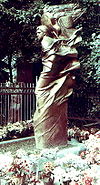
In years to come, Vysotsky's flower-adorned grave became a site of pilgrimage for several generations of his fans, the youngest of whom were born after his death. His tombstone also became the subject of controversy, as his widow had wished for a simple abstract slab, while his parents insisted on a realistic gilded statue. Although probably too serious to have inspired Vysotsky himself, the statue is believed by some to be full of metaphors and symbols reminiscent of the singer's life. One of the most obvious symbols is the angel-like wings that wrap the statue's body. The angel wings are supposed to symbolize Vysotsky's importance to all oppressed peoples; they are wrapped around his body to represent the fact that he was never allowed to fully spread his talent and flourish during his lifetime due to the oppressive regime. Another symbol is the two horse heads, which might refer to his landmark song "Koni Priveredliviye" (Capricious Horses).
On July 25, 1995, in Moscow the Vladimir Vysotsky monument was officially opened at Strastnoy Boulevard
, by the Petrovsky Gates. Among those present were the bard's parents, two of his sons, first wife Iza, renown poets Yevtushenko and Voznesensky. "Vysotsky had always been telling the truth. Only once he was wrong when he sang in one of his songs: "They will never erect me a monument in a square like that by Petrovskye Vorota", Mayor of Moscow Yuri Luzhkov said in his speech.
The asteroid 2374 Vladvysotskij
, discovered by Lyudmila Zhuravleva, was named after Vysotsky.
Shortly after Vysotsky's death, many Russian bards
started writing songs and poems about his life and death. The best known are Yuri Vizbor
's "Letter to Vysotsky" (1982) and Bulat Okudzhava
's "About Volodya Vysotsky" (1980). In Poland, Jacek Kaczmarski
based some of his songs on those of Vysotsky and dedicated to his memory the song ”Epitafium dla Włodzimierza Wysockiego” (Epitaph for Vladimir Vysotsky).
Every year on Vysotsky's birthday, festivals are held throughout Russia and in many communities throughout the world, especially in Europe. Vysotsky's impact in Russia is often compared to that of Bob Dylan
in America, or Brassens and Brel
in France. In Germany, he has been compared to Wolf Biermann
, who — although more overtly political — came from a similar ethnic background and played a similar outsider's role.
, Marina Vlady
wrote a book called The Aborted Flight about her years together with Vysotsky. The book paid tribute to Vladimir's talent and rich persona, yet was uncompromising in its depiction of his addictions and the problems that they caused in their marriage. Written in French (and published in France in 1987), it was translated into Russian in tandem by Vlady and a professional translator and came out in 1989 in the USSR. Totally credible from the specialists' point of view, the book caused controversy, among other things, by shocking revelations about the difficult father-and-son relationship (or rather, the lack of any), implying that Vysotsky-senior (while his son was alive) was deeply ashamed of him and his songs which he deemed 'anti-Soviet' and reported his own son to the KGB. Also in 1989 another important book of memoirs was published in the USSR, providing a bulk of priceless material for the host of future biographers, Alla Demidova
's Vladimir Vysotsky, the One I Know and Love. Among other publications of note were Valery Zolotukhin's Vysotsky’s Secret (2000), a series of Valery Perevozchikov's books (His Dying Hour, The Unknown Vysotsky and others) containing detailed accounts and interviews dealing with the bard's life’s major controversies (the mystery surrounding his death, the truth behind Vysotsky Sr.'s alleged KGB reports, the true nature of Vladimir Vysotsky's relations with his mother Nina's second husband Georgy Bartosh etc.), Iza Zhukova's Short Happiness for a Lifetime and the late bard's sister-in-law Irena Vysotskaya's My Brother Vysotsky. The Beginnings (both 2005).
" (бард) that Vysotsky has never been enthusiastic about. He thought of himself mainly as an actor and poet rather than a singer, and once remarked, "I do not belong to what people call bards or minstrels or whatever." With the advent of portable tape-recorders in the Soviet Union, Vysotsky's music became available to the masses in the form of home-made reel-to-reel audio tape recordings (later on cassette tapes).
Vysotsky accompanied himself on a Russian seven-string guitar
, with a raspy voice singing ballads of love, peace, war, everyday Soviet life and of the human condition
. He was largely perceived as the voice of honesty, at times sarcastically jabbing at the Soviet government, which made him a target for surveillance and threats. In France
, he has been compared with Georges Brassens
; in Russia, however, he was more frequently compared with Joe Dassin
, partly because they were the same age and died in the same year, although their ideologies, biographies, and musical styles are very different. Vysotsky's lyrics and style greatly influenced Jacek Kaczmarski
, a Polish
songwriter and singer who touched on similar themes.
The songs—over 600 of them—were written about almost any imaginable theme. The earliest were outlaw songs
. These songs were based either on the life of the common people in Moscow or on life in the crime people, sometimes in Gulag
s. Vysotsky slowly grew out of this phase and started singing more serious, though often satirical, songs. Many of these songs were about war. These war songs were not written to glorify war, but rather to expose the listener to the emotions of those in extreme, life threatening situations. Most Soviet veterans would say that Vysotsky's war songs described the truth of war far more accurately than more official "patriotic" songs.
 Nearly all of Vysotsky's songs are in the first person, although he is almost never the narrator. When singing his criminal songs, he would adopt the accent and intonation of a Moscow thief, and when singing war songs, he would sing from the point of view of a soldier. In many of his philosophical songs, he adopted the role of inanimate objects. This created some confusion about Vysotsky's background, especially during the early years when information could not be passed around very easily. Using his acting talent, the poet played his role so well that until told otherwise, many of his fans believed that he was, indeed, a criminal or war veteran. Vysotsky's father said that "War veterans thought the author of the songs to be one of them, as if he had participated in the war together with them." The same could be said about mountain climbers; on multiple occasions, Vysotsky was sent pictures of mountain climbers' graves with quotes from his lyrics etched on the tombstones.
Not being officially recognized as a poet and singer, Vysotsky performed wherever and whenever he could – in the theater (where he worked), at universities, in private apartments, village clubs, and in the open air. It was not unusual for him to give several concerts in one day. He used to sleep little, using the night hours to write. With few exceptions, he wasn't allowed to publish his recordings with "Melodiya
", which held a monopoly on the Soviet music industry. His songs were passed on through amateur, fairly low quality recordings on vinyl discs and magnetic tape, resulting in his immense popularity. Cosmonauts even took his music on cassette into orbit.
, often tuned a tone or a tone-and-a-half below the traditional Russian "Open G major" tuning. This guitar, with its specific Russian tuning, makes a slight yet notable difference in chord voicings than the standard tuned six string Spanish (classical) guitar, and it became a staple of his sound. Because Vysotsky tuned down a tone and a half, his strings had less tension, which also colored the sound.
His earliest songs were usually written in C minor (with the guitar tuned a tone down from DGBDGBD to CFACFAC), using the following chord shapes:
Songs written in this key include "Stars" (Zvyozdy), "My friend has left for Magadan
" (Moy drug uyekhal v Magadan), and most of his "outlaw songs
".
At around 1970, Vysotsky began writing and playing exclusively in A minor (guitar tuned to CFACFAC), which he continued doing until his death. The main chord shapes he based his songs on were:
Vysotsky used his fingers instead of a pick to pluck and strum, as was the tradition with Russian guitar playing. He used a variety of finger picking and strumming techniques. One of his favorite was to play an alternating bass with his thumb as he plucked or strummed with his other fingers.
Often, Vysotsky would neglect to check the tuning of his guitar, which is particularly noticeable on earlier recordings. According to some accounts, Vysotsky would get upset when friends would attempt to tune his guitar, leading some to believe that he preferred to play slightly out of tune as a stylistic choice. Much of this is also attributable to the fact that a guitar that is tuned down more than 1 whole step (Vysotsky would sometimes tune as much as 2 and a half steps down) is prone to intonation problems.
My Life on Stage
(autobiographical reminiscences) V.S. Vysotsky Foundation (Mariya Shkolnikova) "Everything Vysotsky" "Singer, Sailor, Soldier, Spirit: Translations of Vladimir Vysotsky" album
format) zeuhl.academ.org (Another source for MP3 files) www.zipsites.ru (Over 900 MP3 files from 32 disk box set) Nikita Vysotsky, Vladimir's son talks to AIF. Vysotsky and Pushkin together Truth of the moment of death V. K. Perevozchikov. Pravda Smertnogo Chasa: www.smotry-film.ru (Over 90 film files)
Vladimir Vysotsky. 1980. Moscow. Sampo, 1998. 272 p.
Soviet Union
The Soviet Union , officially the Union of Soviet Socialist Republics , was a constitutionally socialist state that existed in Eurasia between 1922 and 1991....
singer, songwriter, poet, and actor whose career had an immense and enduring effect on Russian culture
Russian culture
Russian culture is associated with the country of Russia and, sometimes, specifically with ethnic Russians. It has a rich history and can boast a long tradition of excellence in every aspect of the arts, especially when it comes to literature and philosophy, classical music and ballet, architecture...
. He became widely known for his unique singing style and for his lyrics, which featured social and political commentary in often humorous street jargon. He was also a prominent stage and screen actor. Though his work was largely ignored by the official Soviet cultural establishment, he achieved remarkable fame during his lifetime, and to this day exerts significant influence on many of Russia's popular musicians and actors who wish to emulate his iconic status.
Biography
Vladimir Vysotsky was born in MoscowMoscow
Moscow is the capital, the most populous city, and the most populous federal subject of Russia. The city is a major political, economic, cultural, scientific, religious, financial, educational, and transportation centre of Russia and the continent...
at the 3rd Meshchanskaya St. (61/2) maternity hospital
Maternity hospital
A maternity hospital is a hospital that specializes in caring for women while they are pregnant and during childbirth. The hospital also provides care for newborn infants....
. His father, Semyon Vladimirovich (1916–1997), a colonel in the army, was Jewish, originally from Kiev. His mother, Nina Maksimovna, (née Seryogina, 1912–2003) was Russian, and worked as a German language
German language
German is a West Germanic language, related to and classified alongside English and Dutch. With an estimated 90 – 98 million native speakers, German is one of the world's major languages and is the most widely-spoken first language in the European Union....
translator. Vysotsky's family lived in a Moscow communal flat in harsh conditions, and had serious financial difficulties. When Vladimir was 10 months old, Nina had to return to her office in the Transcript bureau of the Ministry of Geodesy and Cartography of the USSR (engaged in making German maps available for the Soviet military) so as to help her husband earn their family's living.
Vladimir's extraordinary theatrical inclinations became obvious at a very early age, his mother Nina, a theater fan, being an obvious influence. The boy used to recite poems, standing on a chair and "flinging hair backwards, like a real poet", often using in his public speeches expressions he could hardly have heard at home. Once, at the age of two, when he had tired of the family’s guests’ poetry requests, he, according to his monther, sat himself under the New-year tree with a frustrated air about him and sighed: "You silly tossers! Give a child some respite!" His sense of humor was extraordinary, but often baffling for people around him. A three-year-old could jeer his father in a bathroom with unexpected poetic improvisation ("Now look what's here before us / Our goat’s to shave himself!") or appal unwanted guests with some street folk song, promptly steering them away. Vysotsky remembered those first three years of his life in the autobiographical Ballad of Childhood (Баллада о детстве, 1975), one of his best-known songs.
As WWII broke out, Semyon Vysotsky, a military reserve officer, joined the Soviet army and went to fight the Nazis. Nina and Vladimir were evacuated to the village of Vorontsovka, in Orenburg Oblast
Orenburg Oblast
Orenburg Oblast is a federal subject of Russia . Its administrative center is the city of Orenburg. From 1938 to 1957, it bore the name Chkalov Oblast in honor of Valery Chkalov...
where the boy had to spend 6 days a week in a kindergarten and his mother worked for 12 hours a day in a chemical factory. In 1943, both went back to their Moscow apartment at 1st Meschanskaya St., 126. In September, 1945, Vladimir joined the 1st class of the #273 Moscow Rostokino region School.
In December 1946, Vysotsky's parents divorced. In 1947 Vladimir went to live for two years with Semyon Vladimirovich and his Armenian
Armenians
Armenian people or Armenians are a nation and ethnic group native to the Armenian Highland.The largest concentration is in Armenia having a nearly-homogeneous population with 97.9% or 3,145,354 being ethnic Armenian....
wife, Yevge′nya Stepanovna Liholatova, whom the boy called "aunt Zhenya". "We decided that our son would stay with me. Vladimir came to stay with me in January 1947, and my second wife, Yevgenia, became Vladimir's second mother for many years to come. They had much in common and liked each other, which made me really happy," Semyon Vysotsky later remembered. Vladimir spent 1947–1949 with his father (then an army Major) and "aunt Zhenya" at a military base in Eberswalde
Eberswalde
Eberswalde is a major town and the administrative seat of the district Barnim in the German Federal State of Brandenburg, about 50 km northeast of Berlin. Population 42144 , geographical location . The town is often called Waldstadt , because of the large forests around it, including the...
in the Soviet-occupied section of post-World War II
World War II
World War II, or the Second World War , was a global conflict lasting from 1939 to 1945, involving most of the world's nations—including all of the great powers—eventually forming two opposing military alliances: the Allies and the Axis...
Germany
Germany
Germany , officially the Federal Republic of Germany , is a federal parliamentary republic in Europe. The country consists of 16 states while the capital and largest city is Berlin. Germany covers an area of 357,021 km2 and has a largely temperate seasonal climate...
(later East Germany). Here living conditions, compared to those of Nina's communal Moscow flat, were infinitely better; the family occupied the whole floor of a two-storeyed house, and the boy had a room to himself for the first time in his life. In 1949 along with his stepmother Vladimir returned to Moscow. There he joined the 5th class of Moscow's School #128 and settled at Bolshoy Karetny, 15 (where they had to themselves two rooms of a 4-roomed flat), with "auntie Zhenya" (then just 28), a woman of great kindness and warmth whom he later remembered as his second mother. In 1953 Vladimir Vysotsky, now much interested in theater and cinema, joined the Drama courses led by Vladimir Bogomolov. "No one in my family has had anything to do with arts, no actors or directors were there among them. But my mother admired theater and from the earliest age... each and every Saturday I've been taken up with her to watch one play or the other. And all of this, it probably stayed with me," he later reminisced. The same year he's got his first ever guitar, a birthday present from Nina Maksimovna; a close friend (and future well known Soviet poet and bard), Igor Kohanovsky, taught him basic chords. In 1955 Vladimir re-settled into her mother's new home (at 1st Meshanskaya, 76). In June of the same year he graduated from school with five A's.
Professional career
In 1955, Vladimir enrolled in the Moscow Institute of Civil Engineering (МИСИ), but dropped out after just one semester to pursue an acting career. In June 1956 he joined Boris Vershilov's class at the Moscow Art TheatreMoscow Art Theatre
The Moscow Art Theatre is a theatre company in Moscow that the seminal Russian theatre practitioner Constantin Stanislavski, together with the playwright and director Vladimir Nemirovich-Danchenko, founded in 1898. It was conceived as a venue for naturalistic theatre, in contrast to the melodramas...
Studio-Institute. It was there that he met the 3rd course student Iza Zhukova (who four years later became his wife); soon the two lovers settled at the 1st Meschanskaya flat, in a common room, shielded off by a folding screen. It was also in the Studio that Vysotsky met Bulat Okudzhava
Bulat Okudzhava
Bulat Shalvovich Okudzhava was a Soviet and Russian poet, writer, musician, novelist, and singer-songwriter. He was one of the founders of the Russian genre called "author song"...
for the first time, an already popular underground bard. He was even more impressed by his Russian literature
Russian literature
Russian literature refers to the literature of Russia or its émigrés, and to the Russian-language literature of several independent nations once a part of what was historically Russia or the Soviet Union...
teacher Andrey Sinyavsky who along with his wife often invited students to his home to stage improvised disputes and concerts. In 1958 Vysotsky's got his first MAT(Moscow Art Theatre
Moscow Art Theatre
The Moscow Art Theatre is a theatre company in Moscow that the seminal Russian theatre practitioner Constantin Stanislavski, together with the playwright and director Vladimir Nemirovich-Danchenko, founded in 1898. It was conceived as a venue for naturalistic theatre, in contrast to the melodramas...
) role: that of Porfiry Petrovich in Dostoyevsky's Crime and Punishment
Crime and Punishment
Crime and Punishment is a novel by the Russian author Fyodor Dostoyevsky. It was first published in the literary journal The Russian Messenger in twelve monthly installments during 1866. It was later published in a single volume. This is the second of Dostoyevsky's full-length novels following his...
. In 1959 he was cast in his first cinema role, that of student Petya in Vasily Ordynsky's The Yearlings (Сверстницы). On June 20, 1960, Vysotsky graduated from the MAT theater institute and joined the A. S. Pushkin Moscow Drama Theater (led by Boris Ravenskikh at the time) where he spent (with intervals) almost three troubled years. These were marred by numerous administrative sanctions, due to "lack of discipline" and occasional drunken sprees which were a reaction, mainly, to the lack of serious roles and his inability to realise his artistic potential A short stint in 1962 with the Moscow Theater of Miniatures (administered at the time by Vladimir Polyakov) ended with him being fired, officially "for a total lack of sense of humour".
Vysotsky's second and third films, Dima Gorin’s Career and "713" Requests Permission to Land, were interesting only for the fact that in both he had to be beaten up (in the first case by Aleksandr Demyanenko
Aleksandr Demyanenko
Aleksandr Sergeievich Demyanenko was a Soviet and Russian film and theater actor, People's Artist of the RSFSR.-Early life:Aleksandr Demyanenko was born in Sverdlovsk, USSR in 1937. He went to a music school from 1946 to 1952. In 1954 he failed to enter the school of arts. In 1955, however, he...
). "That was the way cinema greeted me," he later often joked. In 1961 Vysotsky wrote his first-ever proper song, called "Tattoo" (Татуировка), which started a long and colourful cycle of artfully stylized criminal underworld romantic stories, full of undercurrents and witty social comments. In June, 1963, while shooting Penalty Kick (directed by Veniamin Dorman and starring Mikhail Pugovkin
Mikhail Pugovkin
Mikhail Ivanovich Pugovkin was a Soviet/Russian comic actor named a People's Artist of the USSR in 1988.He studied in the Moscow Art Theatre school under Ivan Moskvin, took part in World War II and, following demobilisation, was featured in the 1944 all-star cast adaptation of Anton Chekhov's The...
), Vysotsky used the Gorky Film Studio
Gorky Film Studio
Gorky Film Studio is a film studio in Moscow, Russian Federation. By the end of the Soviet Union, Gorky Film Studio had produced more than 1,000 films...
to record an hour-long reel-to-reel cassette of his own songs; copies of it quickly spread and the author's name became known in Moscow and elsewhere (although many of these songs were often being referred to as either "traditional" or "anonymous"). Just several months later Riga
Riga
Riga is the capital and largest city of Latvia. With 702,891 inhabitants Riga is the largest city of the Baltic states, one of the largest cities in Northern Europe and home to more than one third of Latvia's population. The city is an important seaport and a major industrial, commercial,...
-based chess grandmaster Mikhail Tal
Mikhail Tal
Mikhail Tal was a Soviet–Latvian chess player, a Grandmaster, and the eighth World Chess Champion.Widely regarded as a creative genius, and the best attacking player of all time, he played a daring, combinatorial style. His play was known above all for improvisation and unpredictability....
was heard praising the author of "Bolshoy Karetny" and Anna Akhmatova
Anna Akhmatova
Anna Andreyevna Gorenko , better known by the pen name Anna Akhmatova , was a Russian and Soviet modernist poet, one of the most acclaimed writers in the Russian canon.Harrington p11...
(in a conversation with Brodsky
Brodsky
Brodsky is a surname and may refer to:* Adam Brodsky, Anti-folk singer* Adolf Davidovich Brodsky , violinist* Alexander Brodsky, contemporary architect and artist...
) was quoting Vysotsky's number "I was the soul of a bad company..." taking it apparently for some brilliant piece of anonymous street folklore. In October 1964 Vysotsky recorded in chronological order 48 of his own songs, his first self-made Complete works of... compilation, which boosted his popularity as a new Moscow folk underground star.
1964–1970
In 1964, director Yuri LyubimovYuri Lyubimov
Yuri Petrovich Lyubimov is a Soviet and Russian stage actor and director associated with the internationally-renowned Taganka Theatre which he founded ,...
invited Vysotsky to join the newly created Moscow Theatre of Drama and Comedy on the Taganka
Taganka Theatre
Taganka Theatre is a theater located in the Art Nouveau building on Taganka Square in Moscow. The theatre was founded in 1964 by Yuri Lyubimov and continued the traditions of his alma mater, the Vakhtangov Theatre, while also exploring the possibilities of Bertolt Brecht's "epic theatre".Under...
. "'I've written some songs of my own. Won’t you listen?' – he asked. I agreed to listen to just one of them, expecting our meeting to last for no more than five minutes. Instead I ended up listening to him for an entire 1.5 hours", Lyubimov remembered years later of this first audition. On September 19, 1964, Vysotsky debuted in Bertholt Brecht's The Good Person of Szechwan
The Good Person of Szechwan
The Good Person of Szechwan is a play written by the German theatre practitioner Bertolt Brecht, in collaboration with Margarete Steffin and Ruth Berlau. The play was begun in 1938 but not completed until 1943, while the author was in exile in the United States...
as Second God (two minor roles besides). A month later he came on stage as a dragoon captain (Bela's father) in Lermontov's A Hero of Our Time
A Hero of Our Time
A Hero of Our Time is a novel by Mikhail Lermontov, written in 1839 and revised in 1841. It is an example of the superfluous man novel, noted for its compelling Byronic hero Pechorin and for the beautiful descriptions of the Caucasus...
. It was in Taganka that Vysotsky started to sing on stage; a new War theme having now became prominent in his musical repertoire. After having appeared in the experimental Poet and Theater (Поэт и Театр, February, 1965) show, based on Andrey Voznesensky
Andrey Voznesensky
Andrei Andreyevich Voznesensky was a Soviet and Russian poet and writer who had been referred to by Robert Lowell as "one of the greatest living poets in any language." He was one of the "Children of the '60s," a new wave of iconic Russian intellectuals led by the Khrushchev Thaw.Voznesensky was...
's work and then in Ten Days that Shook the World (after John Reed
John Reed
-Arts, letters, and entertainment:* John Reed , New York novelist and author* John Reed , actor and singer with the D'Oyly Carte Opera Company* John Reed , Australian critic and art patron...
's book, April 1965), Vysotsky was commissioned by Lyubimov to write songs exclusively for Taganka's new II World War play. The Dead and the Living (Павшие и Живые, premiered in October, 1965) included Vysotsky's Stars (Звёзды), The Soldiers of Heeresgruppe Mitte (Солдаты группы "Центр") and Penal Battalions (Штрафные батальоны), the striking examples of a completely new kind of a war song, never heard in his country before. As veteran screenwriter Nikolay Erdman put it (in conversation with Lyubimov), "Professionally, I can well understand how Mayakovsky
Mayakovsky
Vladimir Mayakovsky was a Russian poet and playwright, among the foremost representatives of early-20th century Russian Futurism.Mayakovsky or Mayakovskaya may also refer to:...
or Seryozha
left a note for his fans in a journal which ended with words: "Now that you've heard all these songs, please, don't you make a mistake of mixing me with my characters, I am not like them at all. With love, Vysotsky, April 20, 1965, XX c." Excuses of this kind he had to make throughout his performing career. At least one of Vysotsky's song themes – that of alcoholic abuse – was worryingly autobiographical, though. By the time his breakthrough came in 1967, he'd suffered several physical breakdowns and once was sent (by Taganka's boss) to a rehabilitation clinic, a visit he on several occasions repeated since.
Brecht's Life of Galileo
Life of Galileo
Life of Galileo , also known as Galileo, is a play by the twentieth-century German dramatist Bertolt Brecht. The first version of the play was written between 1937 and 1939; the second version was written between 1945–1947, in collaboration with Charles Laughton...
(premiered on May 17, 1966), transformed by Lyubimov into a powerful allegory of Soviet intelligentsia's set of moral and intellectual dilemmas, brought Vysotsky his first leading theater role (along with some fitness lessons: he had to perform numerous acrobatic tricks on stage). Press reaction was mixed, some reviewers disliked the actor's overt emotionalism, but it was for the first time ever that Vysotsky's name appeared in Soviet papers at all. Film directors now were treating him with respect. Victor Turov's war film I Was Born in Childhood where Vysotsky got his first ever 'serious' (neither comical nor villainous) role in cinema, featured two of his songs: a spontaneous piece called Cold Weather (Холода) and a dark, Unknown soldier theme-inspired classic Common Graves (На братских могилах), sung behind the screen by the legendary Mark Bernes
Mark Bernes
Mark Naumovich Bernes was a Soviet actor and singer of Jewish ancestry , who performed some of the most poignant songs to come out of the World War II, including Tyomnaya noch and Zhuravli...
.
Stanislav Govorukhin
Stanislav Govorukhin
Stanislav Sergeyevich Govorukhin has been one of the most popular Soviet and Russian film directors since the 1960s...
's Vertikal (1967), a mountain climbing drama, starring Vysotsky (as Volodya the radist) brought him all-round recognition and fame. Four of the numbers used in the film (including Song of a Friend (Песня о друге), released in 1968 by the Soviet recording industry monopolist Мелодия
Melodiya
Melodiya is a Russian record label. It was the state-owned major record company/label of the Soviet Union.-History:It was established in 1964 as the "All-Union Gramophone Record Firm of the USSR Ministry of Culture Melodiya"...
flexi disc to become an unofficial hit) were written literally on the spot, nearby Elbrus, inspired by professional alpinists' tales and one curious hotel bar conversation with a German guest who 25 years ago happened to climb these very mountains in a capacity of an Edelweiss division fighter. Another 1967 film, Kira Muratova
Kira Muratova
Kira Muratova is a Soviet and Ukrainian film director, screenwriter and actress. She was born in 1934 in Soroca, Bessarabia, Romania . She was born to a Romanian mother and a Russian father. Muratova is known for her unusual and original directorial style...
's Short Liaisons featured Vysotsky as the geologist Maxim (paste-bearded again) with a now trademark off-the-cuff musical piece, a melancholy improvisation called Business... (Дела). All the while Vysotsky continued working hard at Taganka, with another important role under his belt (that of Mayakovsky – or, rather one the latter's character five different versions) in an experimantal piece called Have a Listen! (Послушайте!), and was more and more regularly giving semi-official concerts where audiences greeted him as a cult hero.
In the end of 1967 Vysotsky got another pivotal theater role, that of Khlopusha in Pugachov (a play based on Yesenin poem), often described as one of Taganka’s finest. "He’s given this play all things that he’s been excelling at and, on the other hand, it was Pugachyov that made him discover his own potential," – Soviet critic Natalya Krymova wrote years later. In a matter of weeks, though, infuriated by the actor’s increasing unreliability triggered by worsening drinking problems, Lyubimov fired him – only to let him back again several months later (and thus begin the humiliating sacked-then-pardoned routine which continued for years). In June 1968 a Vysotsky-slagging campaign was launched in the Soviet press. First Sovetskaya Rossiya commented on the "epidemic spread of immoral, smutty songs", allegedly promoting "criminal world values, alcoholism, vice and immorality" and condemned their author for "sawing seeds of evil". Then Komsomolskaya Pravda
Komsomolskaya Pravda
Komsomolskaya Pravda is a daily Russian tabloid newspaper, founded on March 13th, 1925. It is published by "Izdatelsky Dom Komsomolskaya Pravda" .- History :...
linked Vysotsky with black market dealers selling his tapes somewhere in Siberia. Composer D. Kabalevsky speaking from the Union of Composers Committee tribune criticised Soviet radio for giving an ideologically dubious, "low-life product" like Song of a Friend an unwarranted airplay. Playwright A. Stein who in his Last Parade play used several of Vysotsky’s songs, was chastised by a Ministry of Culture official for "providing a tribune for this anti-Soviet scum". The phraseology prompted commentators in the West to make parallels between Vysotsky and Zoschenko, another Soviet author who'd been officially labeled "scum" some 20 years ago.
Two Comrades Were Serving
Two Comrades Were Serving is a 1968 Soviet film directed by Yevgeni Karelov, script by Yuli Dunsky and Valeri Frid. The film is about the Russian civil war, in particular, the battle for the Crimean peninsula.- Plot :...
(a gun-toting White Army officer Brusentsov who in the course of the film shoots his friend, his horse, Oleg Yankovsky
Oleg Yankovsky
Oleg Ivanovich Yankovsky was a Soviet/Russian actor who has excelled in psychologically sophisticated roles of modern intellectuals...
's good guy character and, finally himself) – were severely censored, first of them shelved for twenty years. Small wonder Vysotsky's 1968 songs were crushingly heavy and ultra depressive. At least four of them, though – Save Our Souls (Спасите наши души), Wolveshunting (Охота на волков), Nothing’s Right (Всё не так; better known by the opening line – "В сон мне желтые огни...") and Steam-bath in White (Банька по-белому) – were later hailed as his masterpieces. Meanwhile, at least one "proper" love song appeared in Vysotsky's repertoire for the first time, documenting the beginning of his passionate love affair with French actress Marina Vladi.
In 1969 Vysotsky starred in two films: The Taiga's Master (directed by V. Nazarov) where he played a villainous Siberian timber-floating brigadier, and somewhat more entertaining Dangerous Tour (George Bengalsky, a kinky revolutionary using his Odessa variety theater stage persona as a cover-up to spread banned literature behind the curtains) by film director G.Yungvald-Hinkevich. The latter was criticised in the press for having taken rather a farcical approach to the (historical fact-based) subject matter, but for a wider Soviet audience much more important was the second (after Vertical) opportunity to enjoy the charismatic (and still in many ways enigmatic) actor's presence on big screen full-time. In 1970 Vysotsky (assisted by the disgraced Soviet ex-leader's grand-daughter Yulia) visited Nikita Khrushchev
Nikita Khrushchev
Nikita Sergeyevich Khrushchev led the Soviet Union during part of the Cold War. He served as First Secretary of the Communist Party of the Soviet Union from 1953 to 1964, and as Chairman of the Council of Ministers, or Premier, from 1958 to 1964...
at his dacha and had a lengthy conversation, revolving mostly round Stalin and Beria figures toured Ukrainian
Ukraine
Ukraine is a country in Eastern Europe. It has an area of 603,628 km², making it the second largest contiguous country on the European continent, after Russia...
sites linked to Nestor Makhno
Nestor Makhno
Nestor Ivanovych Makhno or simply Daddy Makhno was a Ukrainian anarcho-communist guerrilla leader turned army commander who led an independent anarchist army in Ukraine during the Russian Civil War....
's history, embarked on a massive (and, in those times' terms, dangerously "commercial") Central Asian concert tour, then took Marina Vladi to director (and now good friend) Victor Turov's place to help his French fiancée investigate her Belorussian roots. The pair finally wed on December 1, 1970 (causing furore among the Moscow cultural and political elite) and for a honeymoon went for Georgia where they met Paradzhanov and friends.
1971–1973
1971 started promisingly: Lyubimov gave Vysotsky the long sought-after leading role in his groundbreaking Hamlet play. A drinking spree-related nervous breakdown, though, brought the actor to the infamous Moscow Kaschenko psychiatry clinic, severest of them all. By this time Vysotsky had been suffering from alcoholismAlcoholism
Alcoholism is a broad term for problems with alcohol, and is generally used to mean compulsive and uncontrolled consumption of alcoholic beverages, usually to the detriment of the drinker's health, personal relationships, and social standing...
. Many of his songs from the period deal – either directly or metaphorically – with alcoholism, insanity, mania, and obsessions. Partially recovered (much due to the encouraging presence of Marina, now well-settled into the real life role of a guardian angel, ever on the alert, ready to fly out to Moscow and lend a helping hand), Vysotsky embarked on a successful Ukrainian concert tour (there he wrote a cluster of songs and later referred to those days as his personal Boldino Autumn). But it was Taganka's Hamlet (premiered on November 29, 1971) that finally provided Vysotsky with his worthiest reason for celebration. A role – that of a lone intellectual rebel, rising to fight the cruel state machine – became an instant hit with the Soviet intelligentsia and in retrospect is seen as one of Soviet theater's all-time classic. This was huge psychological triumph too, over Lyubimov's skepticism, among other things.
Then came another blow: Vysotsky's got the role in (and wrote some songs for) The Sannikov Land
The Sannikov Land (film)
The Sannikov Land is a Soviet 1973 adventure film about the fictional Sannikov Land loosely based on the novel of the same name by Vladimir Obruchev.- Plot summary :...
, an adaptation of Vladimir Obruchev
Vladimir Obruchev
Vladimir Afanasyevich Obruchev was a Russian and Soviet geologist who specialized in the study of Siberia and Central Asia. He was also one of the first Russian science fiction authors.- Scientific research :...
's science fiction, then got the boot – only for the reason of his face "being too scandalously recognizable", as a state official had put it. One of the songs written for the film, a doom-laden epic allegory of death-approaching called "Capricious Horses", gained life of its own and became one of the singer's signature tunes. Two of Vysotsky’s 1972 film roles were somewhat meditative: an anonymous American journalist in The Fourth One (after Konstantin Simonov
Konstantin Simonov
Konstantin Mikhailovich Simonov was a Russian/Soviet author, known especially as a war poet.-Early years:He was born in Petrograd. His mother was born Princess Obolenskaya, of a Rurikid family. His father, an officer in the Tsar's army, left Russia after the Revolution in 1917. He died in Poland...
's play, directed by A.Stolper) and the 'righteous guy' von Koren in The Bad Good Man (based on Anton Chekov's Duel, directed by I. Kheifitz and starring Oleg Dahl). The latter brought Vysotsky the Best male role prize at the V Taormina Film Fest
Taormina Film Fest
Taormina Film Fest, a historic film festival, and Italy's oldest began in 1955 under the name Rassegna Cinematografica Internazionale di Messina e Taormina...
. This philosophical slant rubbed off onto some of his new musical poems of the time (The Other's Track, Monument). More popular, though, proved to be his 1972 joke-songs: Mishka Shifman (making fun of the whole of leaving-for-Israel routine), Victim of TV (ridiculing the concept of "political consciousness" as such) and grotesquely funny The Honour of a Chess Crown about an ever-fearless "simple Soviet man" encountering the much feared American champion Bobby Fisher (who, incidentally, six months later demolished Boris Spassky
Boris Spassky
Boris Vasilievich Spassky is a Soviet-French chess grandmaster. He was the tenth World Chess Champion, holding the title from late 1969 to 1972...
) and thrashing him thoroughly, in every possible sense of the word.
In April 1973 for the first time ever (since his 1947 East Germany venture) Vysotsky went abroad. Imminent official permission difficulties were sorted out instantly after the French Communist party leader Georges Marchais
Georges Marchais
Georges René Louis Marchais was the head of the French Communist Party from 1972 to 1994, and a candidate in the French presidential elections of 1981 - in which he managed to garner only 15.34% of the vote, which was considered at the time a major setback for the party.-Early life:Born into a...
's personal phone call to Leonid Brezhnev
Leonid Brezhnev
Leonid Ilyich Brezhnev – 10 November 1982) was the General Secretary of the Central Committee of the Communist Party of the Soviet Union , presiding over the country from 1964 until his death in 1982. His eighteen-year term as General Secretary was second only to that of Joseph Stalin in...
(who, according to Marina Vladi's memoirs, rather sympathized with the stellar couple). They stayed in Poland
Poland
Poland , officially the Republic of Poland , is a country in Central Europe bordered by Germany to the west; the Czech Republic and Slovakia to the south; Ukraine, Belarus and Lithuania to the east; and the Baltic Sea and Kaliningrad Oblast, a Russian exclave, to the north...
for a while with Daniel Olbrychski
Daniel Olbrychski
Daniel Olbrychski is a Polish actor best known for leading roles in several Andrzej Wajda movies and also known for playing the Russian defector and spymaster Vassily Orlov, alongside Hollywood actress Angelina Jolie in the movie Salt....
(since then a good friend), having talks with Andrzej Wajda
Andrzej Wajda
Andrzej Wajda is a Polish film director. Recipient of an honorary Oscar, he is possibly the most prominent member of the unofficial "Polish Film School"...
and Krzysztof Zanussi
Krzysztof Zanussi
Krzysztof Zanussi, is a Polish producer and film director.He is a professor of European film at the European Graduate School in Saas-Fee, Switzerland where he conducts a summer workshop...
, then in France visited the Cannes festival. Having found on return a potentially dangerous lawsuit brought against him (concerning 'illegal' concerts in Siberia the year before), Vysotsky wrote a defiant letter to Minister of Culture Pyotr Demichev
Pyotr Demichev
Pyotr Nilovich Demichev was a Soviet-Russian political figure; First Deputy Chairman of the Presidium of the Supreme Soviet from 1986 to 1988 and Minister of Culture from 1974 to 1986....
where he stated his right to perform officially. As a result, he was given the official status of a philharmonic artist, 11,5 roubles (an equivalent to the price of 3 bottles of vodka) per concert now guaranteed. Still the 900 rubles' fine had to be paid according the court decision, which was a lot, considering his salary at the theater amounted to monthly 110 rubles.
1974–1977
Unable to completely ignore his musical phenomenon, MelodiyaMelodiya
Melodiya is a Russian record label. It was the state-owned major record company/label of the Soviet Union.-History:It was established in 1964 as the "All-Union Gramophone Record Firm of the USSR Ministry of Culture Melodiya"...
did release a few of his songs on vinyl in the 1970s, which represented only a small portion of his creative work, which millions already owned on tape and knew by heart. In 1974 the 7” EP was released, featuring four of his war songs (He’s Never Returned From a Battle (Он не вернулся из боя), The New Times Song (Песня о новом времени), Common Graves (Братские могилы) and The Earth Song (Песня о Земле)). In September 1974 Vysotsky’s been officially merited for the first time ever – by the UzSSR government’s Honorary Diploma (along with four other actors of Taganka, which toured this Central Asia Soviet republic). Coupled with the USSR Union of Cinematographers’ membership that had been granted to him a year before, this modest Uzbek gift meant a lot. Now Vysotsky was an "anti-Soviet scum" no more: rather, an unlikely link between the official Soviet cinema and the "progressive-thinking artists of the West". More films followed, among them The Only Road (alternative title: Chained Drivers, Okovani šoferi, a Soviet-Yugoslav joint venture, directed by Vladimir Pavlovich, premiered on January 10, 1975 in Belgrade
Belgrade
Belgrade is the capital and largest city of Serbia. It is located at the confluence of the Sava and Danube rivers, where the Pannonian Plain meets the Balkans. According to official results of Census 2011, the city has a population of 1,639,121. It is one of the 15 largest cities in Europe...
) and The Flight of Mr. McKinley (1975, directed by Aleksandr Mitta); the latter proved to be a disappointment, only 2 of the 9 ballads specially written for it found their way into the film. This was the height of his popularity, when, as described in Vlady's book about her husband, walking down the street on a summer night, one could hear Vysotsky's recognizable voice coming literally from every open window.
In 1975 Vysotsky made his third trip to France where he rather riskily visited his former teacher (and now a celebrated dissident emigre) Andrey Sinyavsky. Artist Mikhail Shemyakin, his new Paris friend ('bottle-sharer, rather, in Marina's terms), recorded Vysotsky in his home studio. After a brief stay in England a Transatlantic trip followed which resulted in his first Mexico concerts in April. Back in Moscow, there were changes at Taganka: Lyubimov went to Milan
Milan
Milan is the second-largest city in Italy and the capital city of the region of Lombardy and of the province of Milan. The city proper has a population of about 1.3 million, while its urban area, roughly coinciding with its administrative province and the bordering Province of Monza and Brianza ,...
's La Scala
La Scala
La Scala , is a world renowned opera house in Milan, Italy. The theatre was inaugurated on 3 August 1778 and was originally known as the New Royal-Ducal Theatre at La Scala...
on a contract and Anatoly Efros
Anatoly Efros
-Children's Theatre and the Lenkom:Efros was born in Kharkov. In 1954, he was appointed to run the Central Theatre for Children in Moscow and managed to transform it from a conservative backwater into one of the most fashionable Soviet theatres....
has been brought in, a director of radically different approach. His project, Chekhov's The Cherry Orchard
The Cherry Orchard
The Cherry Orchard is Russian playwright Anton Chekhov's last play. It premiered at the Moscow Art Theatre 17 January 1904 in a production directed by Constantin Stanislavski. Chekhov intended this play as a comedy and it does contain some elements of farce; however, Stanislavski insisted on...
, caused a sensation. Critics praised Alla Demidova
Alla Demidova
Alla Sergeyevna Demidova is a Russian actress internationally acclaimed for the tragic parts in innovative plays staged by Yuri Lyubimov in the Taganka Theatre. She was awarded the USSR State Prize in 1977.- Biography :...
(as Ranevskaya) and Vladimir Vysotsky (as Lopakhin) powerful interplay; in retrospect this short-lived duet is regarded to be easily one of the most dazzling in the history of the Soviet theater. At least one person, though, hated it wholeheartedly, and that was Lyubimov himself who, on return, accused Efros of giving his actors 'stardom malaise'. 1976 Taganka’s visit to Bulgaria resulted in Vysotskys’s interview there being filmed and 15 songs recorded by Balkanton
Balkanton
Balkanton was a state-owned record manufacturing company in Bulgaria founded in 1952. Many of the produced records were, or still are available in the countries of the Soviet bloc....
record label, leaving the boss again rather disgruntled. On return Lyubimov made a move which many thought outrageous: declaring himself "unable to work with this Mr. Vysotsky anymore" he's given the Hamlet role to Valery Zolotukhin, the latter's best friend. That was the time, reportedly, when Vysotsky, totally stressed out, started using amphetamines for the first time.
Having had another Belorussian voyage completed, Marina and Vladimir went for France, then (official permission neither given nor asked for) flew to Montreal
Montreal
Montreal is a city in Canada. It is the largest city in the province of Quebec, the second-largest city in Canada and the seventh largest in North America...
, Canada
Canada
Canada is a North American country consisting of ten provinces and three territories. Located in the northern part of the continent, it extends from the Atlantic Ocean in the east to the Pacific Ocean in the west, and northward into the Arctic Ocean...
, the host of that year's Summer Olympics, where Vysotsky met Blokhin
Oleg Blokhin
Oleh Volodymyrovych "Oleg" Blokhin is a Ukrainian football coach and current head coach of the Ukrainian national team. Blokhin was formerly a standout striker for Dynamo Kyiv and the Soviet national team...
and Buryak
Leonid Buryak
Leonid Yosipovich Buryak is a Ukrainian football coach and former Olympic bronze-medal-winning player.Buryak, who is Jewish, was a midfielder for the USSR national football team, and competed at the 1976 Summer Olympics, at which he won a bronze medal.Buryak played for a number of teams in the...
and gave one impromptu concert at the latter's birthday. In New York (where he met, among other people, Baryshnikov
Mikhail Baryshnikov
Mikhail Nikolaevich Baryshnikov is a Soviet and American dancer, choreographer, and actor, often cited alongside Vaslav Nijinsky and Rudolf Nureyev as one of the greatest ballet dancers of the 20th century. After a promising start in the Kirov Ballet in Leningrad, he defected to Canada in 1974...
and Brodsky), in the course of a televised one-hour interview, he declared himself to be "not a dissident, just an artist", who's never had any intentions to leave his country where people loved him and his songs. At home this unauthorized venture into the Western world bore no repercussions: by this time Soviet authorities were divided by the "Vysotsky controversy" up to the highest level; while Suslov
Mikhail Suslov
Mikhail Andreyevich Suslov was a Soviet statesman during the Cold War. He served as Second Secretary of the Communist Party of the Soviet Union from 1965, and as unofficial Chief Ideologue of the Party until his death in 1982. Suslov was responsible for party democracy and the separation of power...
detested the bard, Brezhnev loved him to such an extent that once, while in hospital, was listening to his songs performed live into a telephone, in daughter Galina
Galina Brezhneva
Galina Leonidovna Brezhneva was the daughter of Soviet politician and longtime General Secretary Leonid Brezhnev and Viktoria Brezhneva.-Life and death:...
's home.
In September Vysotsky made a trip to Yugoslavia with Taganka (Hamlet there won the annual BITEF
Bitef
BITEF, Belgrade International Theatre Festival, is one of the theatre festival that takes place in Belgrade, Serbia, each year.Founded in 1967, BITEF has continually followed and supported the latest theater trends...
festival's first prize) and then to Hungary for a two-week concert tour. Back in Moscow in another ambitious Lyubimov’s venture, The Master & Margarita, he got the rather meager Ivan Bezdomny role (Voland what he’d been aiming at), recompensed by an important Svidrigailov slot in Yury Karyakin's take on Dostoyevsky's Crime and Punishment
Crime and Punishment
Crime and Punishment is a novel by the Russian author Fyodor Dostoyevsky. It was first published in the literary journal The Russian Messenger in twelve monthly installments during 1866. It was later published in a single volume. This is the second of Dostoyevsky's full-length novels following his...
. Of Vysotsky's new songs of this period two stand out: bitterly autobiographical Two Witches, Named Destiny Each (Две судьбы) and a poignant Truth and Lie (Правда и ложь) allegory, devoted to (and stylized after) Bulat Okudzhava. In 1977 Vysotsky’s health deteriorated (problems were multiple: heart, kidneys, liver failures, jaw infection and nervous breakdown) to such and extent that in April he found himself in Moscow clinic's reanimation center in the state of total physical and mental collapse.
1977–1980
1977 saw the release of three Vysotsky’s LPs in France (including the one that’s been recorded by RCA in Canada the previous year); arranged and accompanied by guitarist Kostya Kazansky, the singer for the first time ever enjoyed the relatively sophisticated musical background. In August he performed in Hollywood before members of New York, New York film cast and (according to Vladi) was greeted warmly by the likes of Liza Minelli and Robert de NiroRobert De Niro
Robert De Niro, Jr. is an American actor, director and producer. His first major film roles were in Bang the Drum Slowly and Mean Streets, both in 1973...
. Some more concerts in Los Angeles were followed by the appearance at the French Communist paper L’Humanité annual event. In December Taganka left for France, its Hamlet (Vysotsky back in the lead) gaining fine reviews.
1978 started with the March–April series of concerts in Moscow and Ukraine. In May Vysotsky embarked upon a new major film project: the The Meeting Place Cannot Be Changed
The Meeting Place Cannot Be Changed
The Meeting Place Cannot Be Changed is a 1979 Soviet 5-part television miniseries directed by Stanislav Govorukhin. It achieved the status of a cult film in the USSR, and along with Seventeen Moments of Spring it became a part of popular culture with several generations of russophone TV viewers...
(Место встречи изменить нельзя) about two cops fighting crime in late 1940s Stalinist Russia, directed by Stanislav Govorukhin
Stanislav Govorukhin
Stanislav Sergeyevich Govorukhin has been one of the most popular Soviet and Russian film directors since the 1960s...
. Based on the Arkady and Grigory Vainer brothers' criminal/detective drama, the film (premiered on November 11, 1978 on the Soviet Central TV) presented Vysotsky as Zheglov, a tough and charismatic MUR (Moscow Criminal Investigation Department) officer teaching his milder (and somewhat less credible) partner Sharapov (actor Vladimir Konkin) his crude art of crime-solving based on the simple idea formulated in a "Prison is the only place for a thief to be" slogan. Theater-wise, Vysotsky became engaged in Taganka’s Genre-seeking show (performing some of his own songs) and played Aleksander Blok in Anatoly Efros' The Lady Stranger (Незнакомка) radio play (premiered on air on July 10, 1979 and later released as a double LP).
In November 1978 Vysotsky took part in the underground censorship-defying literary project Metropolis
Metropolis
A metropolis is a very large city or urban area which is a significant economic, political and cultural center for a country or region, and an important hub for regional or international connections and communications...
, inspired and organized by Vasily Aksenov. In January 1979 Vysotsky was in America again with highly successful series of concerts. That was the point (as biographer V.Novikov argues) when a glimpse of new, clean life of a respectable international actor and performer all but made Vysotsky seriously reconsider his priorities. What followed though, was a return to the self-destructive theater and concert tours schedule, personal doctor Anatoly Fedotov now not only his companion, but part of Taganka's crew. "Who was this Anatoly? Just a man who in every possible situation would try to provide drugs. And he did provide. In such moments Volodya trusted him totally", Oksana Afanasyeva, Vysotsky's Moscow girlfriend (who was near him for most of the last year of his life and, on occasion, herself served as a drug courier) remembered. In July 1979, after a series of Center Asia concerts, Vysotsky collapsed, experienced clinical death and was resuscitated by Fedotov (who injected caffeine into the heart directly), colleague and close friend Vsevolod Abdulov helping with heart massage. In January 1980 Vysotsky asked Lyubimov for a year's leave. "Up to you, but on condition that Hamlet is yours," was the answer.
On January 22, 1980, Vysotsky entered the Moscow Ostankino TV Centre to record his one and only studio concert for the Soviet television. What proved to be an exhausting affair (concentration totally missing, he had to plod through several takes for each song) was premiered on the Soviet TV eight years later. Last six months of his life saw Vysotsky appearing on stage sporadically, fuelled by heavy dosages of drugs and alcohol. His performances were erratic and all but mechanical; for many he looked stoned and alienated. Occasionally Vysotsky paid visits to Sklifosofsky institute's urgent help unit, but would not hear of Marina Vladi's suggestions for him to take long-term rehabilitation course in a Western clinic. Vysotsky's last visit to France in June made it clear: his marriage was in serious trouble, regardless of one of his last poetic Marina-addressed confessions: "Alive I am, guarded only by God and you.
Death
Korolyov (city)
Korolyov or Korolev is an industrial city in Moscow Oblast, Russia, well known as the cradle of Soviet and Russian space exploration. It was originally founded as Kaliningrad in 1938 by Vasily Boldyrev, Naum Nosovsky, and Mikhail Loginov as the leading Soviet center for production of anti-tank...
. On July 18, playing Hamlet for the last time in Taganka, he was heard complaining of feeling terrible and seen receiving injections right behind the scenes. In his last days Vysotsky was getting huge doses of different kinds of drugs and was totally out of control, as Oksana Afanasyeva later recalled. He died in the early hours of July 25 of heart attack, while asleep, if personal doctor Fedotov was to be believed. At least two of the latter's colleagues, Sklifosofsky medics L. Sul'povar and S. Scherbakov (who demanded the actor's instant hospitalization on July 23, but were, allegedly, defied by Fedotov) insisted that Vysotsky, heavily sedated, died in his sleep of asphyxiation. A post-mortem had been prevented by Vysotsky's parents (who thought they'd rather have their son's drug addiction remain secret), so the true cause of death remained unknown.
No official announcement was made, just a brief obituary appeared in Vechernyaya Moskva
Vechernyaya Moskva
Vechernyaya Moskva is a Russian daily newspaper published in Moscow since the 6th of December, 1923 daily . This is the oldest evening newspaper in Russia, one of the most popular in Moscow. Every evening it tells readers about the major world and Moscow events of the day...
newspaper, but by the end of the day literally millions knew of Vysotsky's death. On July 28 Vysotsky's body was laid out at the Taganka Theatre. After a mourning ceremony involving the unheard-of (in Soviet times) unauthorized mass gathering, Vysotsky was buried at the Vagankovskoye Cemetery in Moscow. He died in the middle of the Olympic games and thousands of Moscow citizens left the Olympics
1980 Summer Olympics
The 1980 Summer Olympics, officially known as the Games of the XXII Olympiad, was an international multi-sport event celebrated in Moscow in the Soviet Union. In addition, the yachting events were held in Tallinn, and some of the preliminary matches and the quarter-finals of the football tournament...
stadiums to attend the funeral. Tens of thousands of people lined the streets to catch a glimpse of his coffin. Vysotsky was posthumously awarded the title Meritorious Artist of the Soviet Union
Meritorious Artist
Meritorious Artist , also translated as Merited Artist, Deserved Artist or Distinguished Artist or Honorary Artist or Honorable Actor) is an honorary title in the Soviet Union, Russian Federation, Union republics, and Autonomous republics, also in some other Eastern bloc states, as well as in a...
.
Controversy surrounding circumstances of death
Some people felt that part of the blame for his death lied with the group of associates who surrounded him in the last years of his life. This inner circle were all people under the influence of his strong character, combined with a material interest in the large sums of money his concerts earned. This list included Valerii Yanklovich, manager of the Taganka Theatre and prime organiser of his non-sanctioned concerts; Anatolii Fedotov, his personal doctor; Vadim Tumanov, gold prospector (and personal friend) from Siberia; Oksana Afanas'eva (later Yarmol'nik), his mistress the last three years of his life; Ivan Bortnik, a fellow actor; and Leonid Sul'povar, head of division at the Sklifosovski hospital responsible for much of the supply of drugs.
Vysotsky's associates had all put in efforts to supply his drug habit, which kept him going in the last years of his life. Under their influence he was able to continue to perform all over the country, up to a week before his death. Due to illegal (i.e. non-state-sanctioned) sales of tickets and other underground methods, these concerts pulled in sums of money unimaginable in Soviet times, when almost everyone received nearly the same small salary. The payouts and gathering of money were a constant source of danger, and Yanklovich and others were needed to organise them.
Some money went to Vysotsky, the rest was distributed amongst this circle. At first this was a reasonable return on their efforts; however, as his addiction progressed and his body developed resistance, the frequency and amount of drugs needed to keep Vysotsky going became unmanageable. This culminated at the time of the Moscow Olympics which coincided with the last days of his life, when supplies of drugs were monitored more strictly than usual, and some of the doctors involved in supplying Vysotsky were already behind bars (normally the doctors had to account for every ampule, thus drugs were transferred to an empty container, while the patients received a substitute or placebo instead). In the last few days Vysotsky became uncontrollable, his shouting could be heard all over the apartment building on Malaya Gruzinskaya St. where he lived amongst VIP's. Several days before his death, in a state of stupor he went on a high speed drive around Moscow in an attempt to obtain drugs and alcohol – when many high-ranking people saw him. This increased the likelihood of him being forcibly admitted to hospital, and the consequent danger to the circle supplying his habit. As his state of health declined, and it became obvious that he may die, his associates gathered to decide what to do with him. They came up with no firm decision. They did not want him admitted officially, as his drug addiction would become public and they would fall under suspicion, although some of them admitted that any ordinary person in his condition would have been admitted immediately.
On Vysotsky's death his associates and relatives put in much effort to prevent a post mortem being carried out. This despite the fairly unusual circumstances: he died aged 42 under heavy sedation with an improvised cocktail of sedatives and stimulants, including the toxic chloral hydrate, provided by his personal doctor who had been supplying him with narcotics the previous three years. This doctor, being the only one present at his side when death occurred, had a few days earlier been seen to display elementary negligence in treating the sedated Vysotsky. On the night of his death, Arkadii Vysotsky (his son) who tried to visit his father in his apartment, was rudely refused entry by Yanklovich, even though there was a lack of people able to care for him. Subsequently the Soviet police commenced a manslaughter investigation which was dropped due to absence of evidence taken at the time of death.
Marriages
Vysotsky's first wife was Iza Zhukova. They met in 1956, being both MAT theater instutite students, lived for some time at Vysotsky's mother's flat in Moscow, after her graduation (Iza was 2 years older) spent months in different cities (her – in KievKiev
Kiev or Kyiv is the capital and the largest city of Ukraine, located in the north central part of the country on the Dnieper River. The population as of the 2001 census was 2,611,300. However, higher numbers have been cited in the press....
, then Rostov
Rostov-on-Don
-History:The mouth of the Don River has been of great commercial and cultural importance since the ancient times. It was the site of the Greek colony Tanais, of the Genoese fort Tana, and of the Turkish fortress Azak...
) and finally married on April 25, 1960.
He met his second wife, Lyudmila Abramova, in 1961, while shooting the film "713" Requests Permission to Land. They married in 1965 and had two sons, Arkady (b. 1962) and Nikita (b. 1964).
While still married to Ludmila Abramova, Vysotsky's got romantically linked with Tatyana Ivanenko, a Taganka actress, then, in 1967 fell in love with Marina Vlady
Marina Vlady
Marina Vlady is a French actress.She won the Best Actress Award at the 1963 Cannes Film Festival for The Conjugal Bed. From 1955 to 1959 she was married to actor/director Robert Hossein...
, a French actress of Russian descent, who was working at Mosfilm
Mosfilm
Mosfilm is a film studio, which is often described as the largest and oldest in Russia and in Europe. Its output includes most of the more widely-acclaimed Soviet films, ranging from works by Tarkovsky and Eisenstein , to Red Westerns, to the Akira Kurosawa co-production and the epic Война и Мир...
on a joint Soviet-French production at that time. Marina had been married before and had 3 children, while Vladimir had two. Fueled by Marina's exotic status as a Frenchwoman in the Soviet Union, and Vladimir's unmatched popularity in his country, their love was passionate and impulsive. They were married in 1969. For 10 years the two maintained a long-distance relationship as Marina compromised her career in France in order to spend more time in Moscow, and Vladimir's friends pulled strings in order for him to be allowed to travel abroad to stay with his wife. Marina eventually joined the Communist Party of France, which essentially gave her an unlimited-entry visa into the Soviet Union, and provided Vladimir with some immunity against prosecution by the government, which was becoming weary of his covertly anti-Soviet lyrics and his odds-defying popularity with the masses. The problems of his long-distance relationship with Vlady inspired several of Vysotsky's songs.
Legacy
In the Autumn 1981 Vysotsky's first-ever collection of poetry was officially published in the USSR, called The Nerve (Нерв). Its first edition (25.000 copies) was sold out instantly. In 1982 the 2nd one followed (100.000), then the 3rd (1988, 200.000), followed in the 1990s by several more. The material for it was compiled, somewhat illogically, by Robert RozhdestvenskyRobert Rozhdestvensky
Robert Ivanovich Rozhdestvensky was a Soviet poet who in the broke with the Social Realism in 1950s–1960s and, along with such poets as Andrey Voznesensky, Yevgeny Yevtushenko, and Bella Akhmadulina, pioneered a newer, fresher, and freer poetry in the Soviet Union.-Life:Robert Rozhdestvensky...
, an officially-laurelled poet whose pretentious stylings were once parodied by actor Leonid Filatov
Leonid Filatov
Leonid Alekseyevich Filatov was a Soviet and Russian actor, director, poet, pamphleteer, who shot to fame while a member of troupe at Taganka Theatre under director Yury Lyubimov...
in the verse whose first quatrain ended with: "...But to theaters I go – seldom / And Taganka I detest – from childhood". Also in 1981 Yuri Lyubimov staged at Taganka a new music and poetry production called Vladimir Vysotsky which was promptly banned and officially premiered on Janyary 25, 1989.
In 1986 the official Vysotsky poetic heritage committee was formed (with Rozhdestvensky at the helm, theater critic Nina Krymova being both the instigator and the organizer). Despite some opposition from the conservatives (Yegor Ligachev
Yegor Ligachev
Yegor Kuzmich Ligachev is a Russian politician who was a high-ranking official in the Communist Party of the Soviet Union . Originally a protege of Mikhail Gorbachev, Ligachev became a challenger to his leadership.-Early life:...
was the latter's political leader, Stanislav Kunyaev of Nash Sovremennik represented its literary flank) Vysotsky was rewarded posthumously with the USSR State Prize
USSR State Prize
The USSR State Prize was the Soviet Union's state honour. It was established on September 9, 1966. After the breakup of the Soviet Union, the prize was followed up by the State Prize of the Russian Federation....
. The official formula – "for creating the character of Zheglov and artistic achievements as a singer-songwriter" was much derided from both the left and the right. In 1988 the Selected Works of... (edited by N.Krymova) compilation was published, preceded by Sure, I'll Be Back... (Я, конечно, вернусь...) book of fellow actors' memoirs and Vysotsky’s verses, some published for the first time. In 1990 two volumes of extensive The Works of... were published, financed by the late poet's father Semyon V. Vysotsky. Even more ambitious publication series, self-proclaimed "the first ever academical edition" (the latter assertion being dismissed by sceptics) compiled and edited by Sergey Zhiltsov, were published in Tula (1994–1998, 5 volumes), Germany (1994, 7 volumes) and Moscow (1997, 4 volumes).
In 1989 the official Vladimir Vysotsky Museum opened in Moscow, with the magazine of its own called Vagant (edited by Sergey Zaitsev) devoted entirely to Vysotsky’s legacy. In 1996 it became an independent publication and was closed in 2002.
In years to come, Vysotsky's flower-adorned grave became a site of pilgrimage for several generations of his fans, the youngest of whom were born after his death. His tombstone also became the subject of controversy, as his widow had wished for a simple abstract slab, while his parents insisted on a realistic gilded statue. Although probably too serious to have inspired Vysotsky himself, the statue is believed by some to be full of metaphors and symbols reminiscent of the singer's life. One of the most obvious symbols is the angel-like wings that wrap the statue's body. The angel wings are supposed to symbolize Vysotsky's importance to all oppressed peoples; they are wrapped around his body to represent the fact that he was never allowed to fully spread his talent and flourish during his lifetime due to the oppressive regime. Another symbol is the two horse heads, which might refer to his landmark song "Koni Priveredliviye" (Capricious Horses).
On July 25, 1995, in Moscow the Vladimir Vysotsky monument was officially opened at Strastnoy Boulevard
Strastnoy Boulevard
Strastnoy Boulevard, , is a major boulevard in Moscow. It begins in the Tverskoy District by Pushkin Square, Tverskaya Street and Tverskoy Boulevard. The boulevard ends at Petrovka Street, although east of Petrovka, it becomes Petrovsky Boulevard, where it heads to Clean Ponds. The Strastnoy...
, by the Petrovsky Gates. Among those present were the bard's parents, two of his sons, first wife Iza, renown poets Yevtushenko and Voznesensky. "Vysotsky had always been telling the truth. Only once he was wrong when he sang in one of his songs: "They will never erect me a monument in a square like that by Petrovskye Vorota", Mayor of Moscow Yuri Luzhkov said in his speech.
The asteroid 2374 Vladvysotskij
2374 Vladvysotskij
2374 Vladvysotskij is a main belt asteroid with an orbital period of 1987.8442221 days . The asteroid was discovered on August 22, 1974 by Lyudmila Zhuravleva.-References:...
, discovered by Lyudmila Zhuravleva, was named after Vysotsky.
Shortly after Vysotsky's death, many Russian bards
Bard (Soviet Union)
The term bard came to be used in the Soviet Union in the early 1960s, and continues to be used in Russia today, to refer to singer-songwriters who wrote songs outside the Soviet establishment, similarly to beatnik folk singers of the United States...
started writing songs and poems about his life and death. The best known are Yuri Vizbor
Yuri Vizbor
Yuri Vizbor was a well-known Soviet bard and poet as well as a theatre and film actor.-Summary:...
's "Letter to Vysotsky" (1982) and Bulat Okudzhava
Bulat Okudzhava
Bulat Shalvovich Okudzhava was a Soviet and Russian poet, writer, musician, novelist, and singer-songwriter. He was one of the founders of the Russian genre called "author song"...
's "About Volodya Vysotsky" (1980). In Poland, Jacek Kaczmarski
Jacek Kaczmarski
Jacek Kaczmarski was a Polish singer, songwriter, poet and author.Kaczmarski was a voice of the Solidarity trade union movement in 1980s Poland, for his commitment to a free Poland, independent of Soviet rule. His songs criticized the ruling communist regime and appealed to the tradition of...
based some of his songs on those of Vysotsky and dedicated to his memory the song ”Epitafium dla Włodzimierza Wysockiego” (Epitaph for Vladimir Vysotsky).
Every year on Vysotsky's birthday, festivals are held throughout Russia and in many communities throughout the world, especially in Europe. Vysotsky's impact in Russia is often compared to that of Bob Dylan
Bob Dylan
Bob Dylan is an American singer-songwriter, musician, poet, film director and painter. He has been a major and profoundly influential figure in popular music and culture for five decades. Much of his most celebrated work dates from the 1960s when he was an informal chronicler and a seemingly...
in America, or Brassens and Brel
BREL
British Rail Engineering Limited , was the railway systems engineering division of British Rail, until the design and building of trains in the UK was privatised in 1993. On 31 October 1969, the company was incorporated as British Rail Engineering Limited.-Main products:The vast majority of BREL's...
in France. In Germany, he has been compared to Wolf Biermann
Wolf Biermann
Karl Wolf Biermann is a German singer-songwriter and former East German dissident.-Early life:Biermann's father, who worked on the Hamburg docks, was a German Jew and a member of the German Resistance....
, who — although more overtly political — came from a similar ethnic background and played a similar outsider's role.
Books on Vladimir Vysotsky
After her husband's death, urged by her friend Simone SignoretSimone Signoret
Simone Signoret was a French cinema actress often hailed as one of France's greatest movie stars. She became the first French person to win an Academy Award, for her role in Room at the Top...
, Marina Vlady
Marina Vlady
Marina Vlady is a French actress.She won the Best Actress Award at the 1963 Cannes Film Festival for The Conjugal Bed. From 1955 to 1959 she was married to actor/director Robert Hossein...
wrote a book called The Aborted Flight about her years together with Vysotsky. The book paid tribute to Vladimir's talent and rich persona, yet was uncompromising in its depiction of his addictions and the problems that they caused in their marriage. Written in French (and published in France in 1987), it was translated into Russian in tandem by Vlady and a professional translator and came out in 1989 in the USSR. Totally credible from the specialists' point of view, the book caused controversy, among other things, by shocking revelations about the difficult father-and-son relationship (or rather, the lack of any), implying that Vysotsky-senior (while his son was alive) was deeply ashamed of him and his songs which he deemed 'anti-Soviet' and reported his own son to the KGB. Also in 1989 another important book of memoirs was published in the USSR, providing a bulk of priceless material for the host of future biographers, Alla Demidova
Alla Demidova
Alla Sergeyevna Demidova is a Russian actress internationally acclaimed for the tragic parts in innovative plays staged by Yuri Lyubimov in the Taganka Theatre. She was awarded the USSR State Prize in 1977.- Biography :...
's Vladimir Vysotsky, the One I Know and Love. Among other publications of note were Valery Zolotukhin's Vysotsky’s Secret (2000), a series of Valery Perevozchikov's books (His Dying Hour, The Unknown Vysotsky and others) containing detailed accounts and interviews dealing with the bard's life’s major controversies (the mystery surrounding his death, the truth behind Vysotsky Sr.'s alleged KGB reports, the true nature of Vladimir Vysotsky's relations with his mother Nina's second husband Georgy Bartosh etc.), Iza Zhukova's Short Happiness for a Lifetime and the late bard's sister-in-law Irena Vysotskaya's My Brother Vysotsky. The Beginnings (both 2005).
Music
The multifaceted talent of Vladimir Vysotsky is often described by the term "bardBard (Soviet Union)
The term bard came to be used in the Soviet Union in the early 1960s, and continues to be used in Russia today, to refer to singer-songwriters who wrote songs outside the Soviet establishment, similarly to beatnik folk singers of the United States...
" (бард) that Vysotsky has never been enthusiastic about. He thought of himself mainly as an actor and poet rather than a singer, and once remarked, "I do not belong to what people call bards or minstrels or whatever." With the advent of portable tape-recorders in the Soviet Union, Vysotsky's music became available to the masses in the form of home-made reel-to-reel audio tape recordings (later on cassette tapes).
Vysotsky accompanied himself on a Russian seven-string guitar
Russian guitar
The Russian guitar is a seven-string acoustic guitar that arrived in Russia toward the end of the 18th century and the beginning of the 19th century, most probably as an evolution of the cittern, kobza, and torban...
, with a raspy voice singing ballads of love, peace, war, everyday Soviet life and of the human condition
Human condition
The human condition encompasses the experiences of being human in a social, cultural, and personal context. It can be described as the irreducible part of humanity that is inherent and not connected to gender, race, class, etc. — a search for purpose, sense of curiosity, the inevitability of...
. He was largely perceived as the voice of honesty, at times sarcastically jabbing at the Soviet government, which made him a target for surveillance and threats. In France
France
The French Republic , The French Republic , The French Republic , (commonly known as France , is a unitary semi-presidential republic in Western Europe with several overseas territories and islands located on other continents and in the Indian, Pacific, and Atlantic oceans. Metropolitan France...
, he has been compared with Georges Brassens
Georges Brassens
Georges Brassens , 22 October 1921 – 29 October 1981), was a French singer-songwriter and poet.Brassens was born in Sète, a town in southern France near Montpellier...
; in Russia, however, he was more frequently compared with Joe Dassin
Joe Dassin
Joseph Ira Dassin , more commonly known as Joe Dassin, was an American singer-songwriter best known for his French songs of the 1960s and 1970s.-Biography:...
, partly because they were the same age and died in the same year, although their ideologies, biographies, and musical styles are very different. Vysotsky's lyrics and style greatly influenced Jacek Kaczmarski
Jacek Kaczmarski
Jacek Kaczmarski was a Polish singer, songwriter, poet and author.Kaczmarski was a voice of the Solidarity trade union movement in 1980s Poland, for his commitment to a free Poland, independent of Soviet rule. His songs criticized the ruling communist regime and appealed to the tradition of...
, a Polish
Poland
Poland , officially the Republic of Poland , is a country in Central Europe bordered by Germany to the west; the Czech Republic and Slovakia to the south; Ukraine, Belarus and Lithuania to the east; and the Baltic Sea and Kaliningrad Oblast, a Russian exclave, to the north...
songwriter and singer who touched on similar themes.
The songs—over 600 of them—were written about almost any imaginable theme. The earliest were outlaw songs
Shanson
Russian chanson is a neologism for a musical genre covering a range of Russian songs based on the themes of the urban underclass and the criminal underworld. This song style, originally called blatnaya pesnya , has been popular in Eastern Europe ever since its first appearance in the beginning of...
. These songs were based either on the life of the common people in Moscow or on life in the crime people, sometimes in Gulag
Gulag
The Gulag was the government agency that administered the main Soviet forced labor camp systems. While the camps housed a wide range of convicts, from petty criminals to political prisoners, large numbers were convicted by simplified procedures, such as NKVD troikas and other instruments of...
s. Vysotsky slowly grew out of this phase and started singing more serious, though often satirical, songs. Many of these songs were about war. These war songs were not written to glorify war, but rather to expose the listener to the emotions of those in extreme, life threatening situations. Most Soviet veterans would say that Vysotsky's war songs described the truth of war far more accurately than more official "patriotic" songs.
Not being officially recognized as a poet and singer, Vysotsky performed wherever and whenever he could – in the theater (where he worked), at universities, in private apartments, village clubs, and in the open air. It was not unusual for him to give several concerts in one day. He used to sleep little, using the night hours to write. With few exceptions, he wasn't allowed to publish his recordings with "Melodiya
Melodiya
Melodiya is a Russian record label. It was the state-owned major record company/label of the Soviet Union.-History:It was established in 1964 as the "All-Union Gramophone Record Firm of the USSR Ministry of Culture Melodiya"...
", which held a monopoly on the Soviet music industry. His songs were passed on through amateur, fairly low quality recordings on vinyl discs and magnetic tape, resulting in his immense popularity. Cosmonauts even took his music on cassette into orbit.
Musical style
Musically, virtually all of Vysotsky's songs were written in a minor key, and tended to employ from three to seven chords. Vysotsky composed his songs and played them exclusively on the Russian seven string guitarRussian guitar
The Russian guitar is a seven-string acoustic guitar that arrived in Russia toward the end of the 18th century and the beginning of the 19th century, most probably as an evolution of the cittern, kobza, and torban...
, often tuned a tone or a tone-and-a-half below the traditional Russian "Open G major" tuning. This guitar, with its specific Russian tuning, makes a slight yet notable difference in chord voicings than the standard tuned six string Spanish (classical) guitar, and it became a staple of his sound. Because Vysotsky tuned down a tone and a half, his strings had less tension, which also colored the sound.
His earliest songs were usually written in C minor (with the guitar tuned a tone down from DGBDGBD to CFACFAC), using the following chord shapes:
| Chord name | Fret numbers (bass to tenor string) |
|---|---|
| C minor | |
| A sharp 7 rootless | |
| A major | |
| E major | |
| F 7 rootless | |
| D minor | |
| F major | |
Songs written in this key include "Stars" (Zvyozdy), "My friend has left for Magadan
Magadan
Magadan is a port town on the Sea of Okhotsk and gateway to the Kolyma region. It is the administrative center of Magadan Oblast , in the Russian Far East. Founded in 1929 on the site of an earlier settlement from the 1920s, it was granted the status of town in 1939...
" (Moy drug uyekhal v Magadan), and most of his "outlaw songs
Shanson
Russian chanson is a neologism for a musical genre covering a range of Russian songs based on the themes of the urban underclass and the criminal underworld. This song style, originally called blatnaya pesnya , has been popular in Eastern Europe ever since its first appearance in the beginning of...
".
At around 1970, Vysotsky began writing and playing exclusively in A minor (guitar tuned to CFACFAC), which he continued doing until his death. The main chord shapes he based his songs on were:
| Chord name | Fret numbers (bass to tenor string) |
|---|---|
| A minor | |
| A major | |
| D minor | |
| E 7 | |
| F major | |
| C major | |
| A 7 rootless | |
Vysotsky used his fingers instead of a pick to pluck and strum, as was the tradition with Russian guitar playing. He used a variety of finger picking and strumming techniques. One of his favorite was to play an alternating bass with his thumb as he plucked or strummed with his other fingers.
Often, Vysotsky would neglect to check the tuning of his guitar, which is particularly noticeable on earlier recordings. According to some accounts, Vysotsky would get upset when friends would attempt to tune his guitar, leading some to believe that he preferred to play slightly out of tune as a stylistic choice. Much of this is also attributable to the fact that a guitar that is tuned down more than 1 whole step (Vysotsky would sometimes tune as much as 2 and a half steps down) is prone to intonation problems.
Singing style
Vysotsky had a unique singing style. He had an unusual habit of elongating consonants instead of vowels in his songs. So when a syllable is sung for a prolonged period of time, he would elongate the consonant instead of the vowel in that syllable.Filmography
- 1959 — The Yearlings (Сверстницы) – MosfilmMosfilmMosfilm is a film studio, which is often described as the largest and oldest in Russia and in Europe. Its output includes most of the more widely-acclaimed Soviet films, ranging from works by Tarkovsky and Eisenstein , to Red Westerns, to the Akira Kurosawa co-production and the epic Война и Мир...
; Director: V.Ordynskii - 1961 — Dima Gorin's Career (Карьера Димы Горина) – M. Gorkii Studio Director: F. DovlatyanFrunze DovlatyanFrunze Vaghinaki Dovlatyan was an Armenian film director and actor. People's Artist of USSR .-Biography:He was a theater actor before becoming a director...
& L. Mirskii - 1962 — "713" Requests Permission to Land (713-й просит посадку) – LenfilmLenfilmKinostudiya "Lenfilm" is a production unit of the Russian film industry, with its own film studio, located in Saint Petersburg, Russia, formerly Leningrad, R.S.F.S.R. Today OAO "Kinostudiya Lenfilm" is a corporation with its stakes shared between private owners, and several private film studios,...
; Director: G. Nikulin - 1962 — Shore LeaveShore LeaveShore Leave may refer to:* Shore leave, the leave that professional sailors get to spend on dry land* "Shore Leave" , a first season episode of Star Trek: The Original Series...
(Увольнение на берег) – MosfilmMosfilmMosfilm is a film studio, which is often described as the largest and oldest in Russia and in Europe. Its output includes most of the more widely-acclaimed Soviet films, ranging from works by Tarkovsky and Eisenstein , to Red Westerns, to the Akira Kurosawa co-production and the epic Война и Мир...
; Director: F. Mironer - 1963 — Penalty KickPenalty kickA penalty kick is a type of direct free kick in association football, taken from twelve yards out from goal and with only the goalkeeper of the defending team between the penalty taker and the goal.Penalty kicks are performed during normal play...
(Штрафной удар) – M. Gorkii Studio; Director: V. Dorman - 1963 — The Alive and the DeadThe Alive and the DeadThe Alive and the Dead is a 1964 Soviet film directed by Aleksandr Stolper based on the eponymous novel by Konstantin Simonov.-Cast:* Kirill Lavrov - Ivan Sinzov* Viktor Avdyushko* Anatoli Papanov - General Serpilin* Aleksei Glazyrin - Malinin...
(Живые и мёртвые) – MosfilmMosfilmMosfilm is a film studio, which is often described as the largest and oldest in Russia and in Europe. Its output includes most of the more widely-acclaimed Soviet films, ranging from works by Tarkovsky and Eisenstein , to Red Westerns, to the Akira Kurosawa co-production and the epic Война и Мир...
; Director: A.StolperAleksandr StolperAleksandr Borisovich Stolper – 12 January 1979, Moscow) was a Russian/Soviet film director and screenwriter. He directed 14 films between 1940 and 1977... - 1965 — On Tomorrow's Street (На завтрашней улице) – MosfilmMosfilmMosfilm is a film studio, which is often described as the largest and oldest in Russia and in Europe. Its output includes most of the more widely-acclaimed Soviet films, ranging from works by Tarkovsky and Eisenstein , to Red Westerns, to the Akira Kurosawa co-production and the epic Война и Мир...
; Director: F. Filipov - 1965 — Our HouseOur HouseOur House may refer to:In music:* "Our House" , a song by the band Madness* Our House , a musical based on the songs of the band Madness...
(Наш дом) – MosfilmMosfilmMosfilm is a film studio, which is often described as the largest and oldest in Russia and in Europe. Its output includes most of the more widely-acclaimed Soviet films, ranging from works by Tarkovsky and Eisenstein , to Red Westerns, to the Akira Kurosawa co-production and the epic Война и Мир...
; Director: V. Pronin - 1965 — The CookThe CookThe Cook is a silent film starring Roscoe "Fatty" Arbuckle and Buster Keaton. The movie is a slapstick comedy and focuses on goings-on at a high-end restaurant with Arbuckle as the Cook and Keaton as the Waiter....
(Стряпуха) – MosfilmMosfilmMosfilm is a film studio, which is often described as the largest and oldest in Russia and in Europe. Its output includes most of the more widely-acclaimed Soviet films, ranging from works by Tarkovsky and Eisenstein , to Red Westerns, to the Akira Kurosawa co-production and the epic Война и Мир...
; Director: E. KeosyanEdmond KeosayanEdmond Gareginovich Keosayan was an Armenian Soviet film director and musician.1952-54 - worked in Yerevan watch factory. 1954-56 - studied in Plekhanov Moscow Institute of Economy. 1956-58 - studied in Yerevan Fine Arts and Theatre Institute, worked as a compere. 1964 - graduated from the... - 1966 — I Was Born in Childhood (Я родом из детства) – BelarusfilmBelarusfilmBelarusfilm is the main film studio of Belarus.Founded in 1928 as Soviet Belarus studio in Leningrad, the studio was moved to Minsk in 1939...
; Director: V. Turov - 1966 — Sasha-Sashen'ka (Саша-Сашенька) – BelarusfilmBelarusfilmBelarusfilm is the main film studio of Belarus.Founded in 1928 as Soviet Belarus studio in Leningrad, the studio was moved to Minsk in 1939...
; Director: V. Chetverikov - 1967 — Vertikal (Вертикаль) – Odessa Film StudioOdessa Film StudioOdessa Film Studio is a Ukrainian film studio in Odessa. It is partially owned by a government and supervised by the Department of State property fund of Ukraine together with the Ministry of Culture. Together with Dovzhenko Film Studios they are the only state-owned and major film producers in...
; Director: Stanislav Govorukhin & B. Durov - 1967 — Short Liaisons (Короткие встречи) – Odessa Film StudioOdessa Film StudioOdessa Film Studio is a Ukrainian film studio in Odessa. It is partially owned by a government and supervised by the Department of State property fund of Ukraine together with the Ministry of Culture. Together with Dovzhenko Film Studios they are the only state-owned and major film producers in...
; Director: K.MuratovaKira MuratovaKira Muratova is a Soviet and Ukrainian film director, screenwriter and actress. She was born in 1934 in Soroca, Bessarabia, Romania . She was born to a Romanian mother and a Russian father. Muratova is known for her unusual and original directorial style... - 1967 — War Under the Rooftops (Война под крышами) – BelarusfilmBelarusfilmBelarusfilm is the main film studio of Belarus.Founded in 1928 as Soviet Belarus studio in Leningrad, the studio was moved to Minsk in 1939...
; Director: V. Turov - 1968 — InterventionInterventionIntervention may refer to:* Interventionism ** Humanitarian intervention, an attempt to reduce suffering within a state through armed conflict** Entente intervention in the Russian Civil War at 1918-1925** Invasion or military offensive...
(Интервенция) – LenfilmLenfilmKinostudiya "Lenfilm" is a production unit of the Russian film industry, with its own film studio, located in Saint Petersburg, Russia, formerly Leningrad, R.S.F.S.R. Today OAO "Kinostudiya Lenfilm" is a corporation with its stakes shared between private owners, and several private film studios,...
; Director: G.Poloka - 1968 — Taiga's Master (Хозяин тайги) – MosfilmMosfilmMosfilm is a film studio, which is often described as the largest and oldest in Russia and in Europe. Its output includes most of the more widely-acclaimed Soviet films, ranging from works by Tarkovsky and Eisenstein , to Red Westerns, to the Akira Kurosawa co-production and the epic Война и Мир...
; Director: V. Nazarov - 1968 — Two Comrades Were ServingTwo Comrades Were ServingTwo Comrades Were Serving is a 1968 Soviet film directed by Yevgeni Karelov, script by Yuli Dunsky and Valeri Frid. The film is about the Russian civil war, in particular, the battle for the Crimean peninsula.- Plot :...
(Служили два товарища) – MosfilmMosfilmMosfilm is a film studio, which is often described as the largest and oldest in Russia and in Europe. Its output includes most of the more widely-acclaimed Soviet films, ranging from works by Tarkovsky and Eisenstein , to Red Westerns, to the Akira Kurosawa co-production and the epic Война и Мир...
; Director: E. Karyelov - 1969 — Dangerous Tour (Опасные гастроли) – Odessa Film StudioOdessa Film StudioOdessa Film Studio is a Ukrainian film studio in Odessa. It is partially owned by a government and supervised by the Department of State property fund of Ukraine together with the Ministry of Culture. Together with Dovzhenko Film Studios they are the only state-owned and major film producers in...
; Director: G. Yungvald-Hilkevich - 1969 — White Blast (Белый взрыв) – Odessa Film StudioOdessa Film StudioOdessa Film Studio is a Ukrainian film studio in Odessa. It is partially owned by a government and supervised by the Department of State property fund of Ukraine together with the Ministry of Culture. Together with Dovzhenko Film Studios they are the only state-owned and major film producers in...
; Director: S. Govorukhin - 1972 — The Fourth (Четвёртый) – MosfilmMosfilmMosfilm is a film studio, which is often described as the largest and oldest in Russia and in Europe. Its output includes most of the more widely-acclaimed Soviet films, ranging from works by Tarkovsky and Eisenstein , to Red Westerns, to the Akira Kurosawa co-production and the epic Война и Мир...
; Director: A. Stolper - 1973 — The Bad Good Man (Плохой хороший человек) – LenfilmLenfilmKinostudiya "Lenfilm" is a production unit of the Russian film industry, with its own film studio, located in Saint Petersburg, Russia, formerly Leningrad, R.S.F.S.R. Today OAO "Kinostudiya Lenfilm" is a corporation with its stakes shared between private owners, and several private film studios,...
; Director: I. Heifits - 1974 — The Only Road (Единственная дорога) – MosfilmMosfilmMosfilm is a film studio, which is often described as the largest and oldest in Russia and in Europe. Its output includes most of the more widely-acclaimed Soviet films, ranging from works by Tarkovsky and Eisenstein , to Red Westerns, to the Akira Kurosawa co-production and the epic Война и Мир...
& Titograd Studio; Director: V. Pavlovich - 1975 — The OnlyThe Only"The Only" is the first single from the industrial metal band's Static-X's third album, Shadow Zone.The song is featured in Need for Speed: Underground, and on the PC version of the game True Crime: Streets of LA, and in the 2003 MTV Video Music Awards as a background music for an announcer's speech...
(Единственная) – LenfilmLenfilmKinostudiya "Lenfilm" is a production unit of the Russian film industry, with its own film studio, located in Saint Petersburg, Russia, formerly Leningrad, R.S.F.S.R. Today OAO "Kinostudiya Lenfilm" is a corporation with its stakes shared between private owners, and several private film studios,...
; Director: I. Heifits - 1975 — The Escape of Mr. McKinley (Бегство мистера Мак-Кинли) – MosfilmMosfilmMosfilm is a film studio, which is often described as the largest and oldest in Russia and in Europe. Its output includes most of the more widely-acclaimed Soviet films, ranging from works by Tarkovsky and Eisenstein , to Red Westerns, to the Akira Kurosawa co-production and the epic Война и Мир...
; Director: M. Shveitser - 1976 — A Tale of How Tzar Pyotr Married His 'Arap' (Сказ про то, как царь Пётр арапа женил) – MosfilmMosfilmMosfilm is a film studio, which is often described as the largest and oldest in Russia and in Europe. Its output includes most of the more widely-acclaimed Soviet films, ranging from works by Tarkovsky and Eisenstein , to Red Westerns, to the Akira Kurosawa co-production and the epic Война и Мир...
; Director: Alexander MittaAlexander MittaAlexander Naumovich Mitta is a Soviet and Russian film director, screenwriter and actor.Mitta's birth name was Alexander Naumovich Rabinovich . He studied engineering , then worked as a cartoonist in art and humour magazines... - 1977 — They're Together (Они вдвоём) – Mafilm; Director: M. Mészáros
- 1979 — The Meeting Place Cannot Be ChangedThe Meeting Place Cannot Be ChangedThe Meeting Place Cannot Be Changed is a 1979 Soviet 5-part television miniseries directed by Stanislav Govorukhin. It achieved the status of a cult film in the USSR, and along with Seventeen Moments of Spring it became a part of popular culture with several generations of russophone TV viewers...
(Место встречи изменить нельзя); directed by Stanislav GovorukhinStanislav GovorukhinStanislav Sergeyevich Govorukhin has been one of the most popular Soviet and Russian film directors since the 1960s... - 1979 — Little TragediesLittle Tragedies (film)Little Tragedies is a 1987 Soviet television miniseries directed by Mikhail Shveytser, based on works by Alexander Pushkin.-Cast:* Aleksandr Trofimov * Vladimir Vysotsky - Don Juan* Georgi Taratorkin - Charsky* Sergei Yursky - Improvisator...
(Маленькие трагедии); directed by Mikhail Shveytser
Books by Vladimir Vysotsky
- Novel about Girls (roman o devochkah)
- Vacation in Vienna (Venskie kanikulyi)
Lifetime
- Алиса в стране чудес / Alice in Wonderland (1977) [2 vinyls]
Musical play, an adaptation of Alice in WonderlandAlice's Adventures in WonderlandAlice's Adventures in Wonderland is an 1865 novel written by English author Charles Lutwidge Dodgson under the pseudonym Lewis Carroll. It tells of a girl named Alice who falls down a rabbit hole into a fantasy world populated by peculiar, anthropomorphic creatures...
,
with Klara RumyanovaKlara RumyanovaKlara Mikhailovna Rumyanova was a Soviet and Russian actress and singer. She was active from 1951 to 1999.Her small, adorable voice is easily recognized by several generations of Soviet people from their early childhood, because she voiced numerous Russian animated films and sang countless...
, Vladimir Vysotsky, Vsevolod Abdulov.
Lyrics and music: Vladimir Vysotsky
France
- Le Monument (1995)
[ CD] - Le Vol Arrêté (2000) [CD]
Germany
- Wir drehen die Erde (1993)
[ CD] - Lieder vom Krieg (1995) [CD]
Russia
- Песни / Songs (1980) [LP] MelodiyaMelodiyaMelodiya is a Russian record label. It was the state-owned major record company/label of the Soviet Union.-History:It was established in 1964 as the "All-Union Gramophone Record Firm of the USSR Ministry of Culture Melodiya"...
- Collection of songs published shortly after his death. [Melodiya Stereo C60-14761.2]
- Sons Are Leaving For Battle (1987) [double LP] MelodiyaMelodiyaMelodiya is a Russian record label. It was the state-owned major record company/label of the Soviet Union.-History:It was established in 1964 as the "All-Union Gramophone Record Firm of the USSR Ministry of Culture Melodiya"...
- War songs. Archive recordings from between 1960–1980. [Melodiya MONO M60 47429 008/006]
- На концертах Владимира Высоцкого / At Vladimir Vysotsky's concerts
- 01, 02, 03, ... 21 (1986–1990) [12" vinyl]
- Marina Vlady / Vladimir Vysotsky (1996) [CD] [Melodiya]
- MP3 Kollektsiya: Vladimir Vysotsky [SoLyd Records]
Concert and Studio recordings- Disk 1
- Disk 2
- Disk 3
- Disk 4 (period 1979–1980) (2002) [CD: MP3MP3MPEG-1 or MPEG-2 Audio Layer III, more commonly referred to as MP3, is a patented digital audio encoding format using a form of lossy data compression...
192 kBit/s]
- Platinovaya Kollektsiya: Vladimir Vysotsky (2003) [2 CDs]
English sources
- Vladimir Vysotsky's songs translated to English
- English translation of some songs by Vysotsky
- Collected Poems (Songs) by Vladimir Vysotsky. Translated from the Russian by Alec Vagapov
- "Vladimir Vysotsky – speaking in tongues", Collected Poems (Songs) by Vladimir Vysotsky. Bilingual Version. Translated from the Russian by Alec Vagapov
- Eugenia Weinstein (private site, with English translation of some songs)
- Speaking In Tongues (Vysotsky's father: "This Is What Our Son Was Like")
- V. Vysotsky. The Monument. English translations
- Another Biography of Vladimir Vysotsky
- Vladimir Vysotsky in different tongues
- Vladimir Vysotsky
My Life on Stage
(autobiographical reminiscences) V.S. Vysotsky Foundation (Mariya Shkolnikova) "Everything Vysotsky" "Singer, Sailor, Soldier, Spirit: Translations of Vladimir Vysotsky" album
Russian sources
V.S. Vysotsky Foundation (Mariya Shkolnikova) "Everything Vysotsky" bards.ru (lyrics to most of his songs) vysotsky.km.ru (scores of photographs, a wealth of information) vv.uka.ru ("fonoteka": most of his songs in MP3MP3
MPEG-1 or MPEG-2 Audio Layer III, more commonly referred to as MP3, is a patented digital audio encoding format using a form of lossy data compression...
format) zeuhl.academ.org (Another source for MP3 files) www.zipsites.ru (Over 900 MP3 files from 32 disk box set) Nikita Vysotsky, Vladimir's son talks to AIF. Vysotsky and Pushkin together Truth of the moment of death V. K. Perevozchikov. Pravda Smertnogo Chasa: www.smotry-film.ru (Over 90 film files)
Vladimir Vysotsky. 1980. Moscow. Sampo, 1998. 272 p.