


General Secretary of the Communist Party of the Soviet Union

Encyclopedia
General Secretary of the Central Committee of the Communist Party of the Soviet Union was the title given to the leader of the Communist Party of the Soviet Union
. With some exceptions, the office was synonymous with leader of the Soviet Union. Throughout its history the office had four other names; Technical Secretary (1917–1918), Chairman of the Secretariat
(1918–1919), Responsible Secretary (1919–1922) and First Secretary (1953–1964). From 1934 to 1952, the office of General Secretary was not occupied. Joseph Stalin
elevated the office to overall command of the Communist Party and by definition the whole Soviet Union.
In its first two incarnations the office performed mostly secretarial work. The post of Responsible Secretary was then established in 1919 to perform administrative work. In 1922 the office of General Secretary followed as a purely administrative and disciplinary position, whose role was to do no more than determine party membership composition. Stalin, its first incumbent, used the principles of democratic centralism
to transform his office into that of party leader, and later leader of the Soviet Union. In 1934, the 17th Party Congress did not elect a General Secretary and Stalin was an ordinary secretary since then, although he remained a de-facto leader without diminishing his own authority.
In order to test Georgy Malenkov
as a potential successor, in the 1950s, Stalin increasingly withdrew from Secretariat business, leaving the supervision of the body to him. In October 1952 Stalin restructured the party's leadership and formally abolished the office of General Secretary. When Stalin died on 5 March 1953, Malenkov was the most important member of the Secretariat, which also included Nikita Khrushchev
among others. Malenkov became Chairman of the Council of Ministers but was forced to resign from the Secretariat on 14 March 1953, leaving Khrushchev in effective control of the body. Khrushchev was elected First Secretary at the Central Committee plenum on 14 September 1953. Originally conceived as a collective leadership
, Khrushchev removed his rivals from power in both 1955 and 1957 and reinforced the supremacy of the First Secretary.
In 1964 opposition within the Politburo and the Central Committee led to Khrushchev's removal as First Secretary. Leonid Brezhnev
succeeded Khrushchev to the post and the office was renamed General Secretary in 1966. During the Brezhnev Era
the collective leadership was able to limit the powers of the General Secretary. Yuri Andropov
and Konstantin Chernenko
were obliged by protocol to rule the country in the same way as Brezhnev had. Mikhail Gorbachev
ruled the Soviet Union through the office of General Secretary until 1990, when the Communist Party lost its monopoly of power over the political system. The office of President of the Soviet Union
was established so that Gorbachev still retained his role as leader of the Soviet Union. Following the failed August coup of 1991
, Gorbachev resigned as General Secretary. He was succeeded by his deputy, Vladimir Ivashko
, who only served for five days as Acting General Secretary before Boris Yeltsin
, the President of Russia, suspended all Communist Party activity.
Communist Party of the Soviet Union
The Communist Party of the Soviet Union was the only legal, ruling political party in the Soviet Union and one of the largest communist organizations in the world...
. With some exceptions, the office was synonymous with leader of the Soviet Union. Throughout its history the office had four other names; Technical Secretary (1917–1918), Chairman of the Secretariat
Secretariat of the CPSU Central Committee
The Secretariat of the CPSU Central Committee was a key body within the Communist Party of the Soviet Union and was responsible for the central administration of the party as opposed to drafting government policy which was usually handled by the Politburo...
(1918–1919), Responsible Secretary (1919–1922) and First Secretary (1953–1964). From 1934 to 1952, the office of General Secretary was not occupied. Joseph Stalin
Joseph Stalin
Joseph Vissarionovich Stalin was the Premier of the Soviet Union from 6 May 1941 to 5 March 1953. He was among the Bolshevik revolutionaries who brought about the October Revolution and had held the position of first General Secretary of the Communist Party of the Soviet Union's Central Committee...
elevated the office to overall command of the Communist Party and by definition the whole Soviet Union.
In its first two incarnations the office performed mostly secretarial work. The post of Responsible Secretary was then established in 1919 to perform administrative work. In 1922 the office of General Secretary followed as a purely administrative and disciplinary position, whose role was to do no more than determine party membership composition. Stalin, its first incumbent, used the principles of democratic centralism
Democratic centralism
Democratic centralism is the name given to the principles of internal organization used by Leninist political parties, and the term is sometimes used as a synonym for any Leninist policy inside a political party...
to transform his office into that of party leader, and later leader of the Soviet Union. In 1934, the 17th Party Congress did not elect a General Secretary and Stalin was an ordinary secretary since then, although he remained a de-facto leader without diminishing his own authority.
In order to test Georgy Malenkov
Georgy Malenkov
Georgy Maximilianovich Malenkov was a Soviet politician, Communist Party leader and close collaborator of Joseph Stalin. After Stalin's death, he became Premier of the Soviet Union and was in 1953 briefly considered the most powerful Soviet politician before being overshadowed by Nikita...
as a potential successor, in the 1950s, Stalin increasingly withdrew from Secretariat business, leaving the supervision of the body to him. In October 1952 Stalin restructured the party's leadership and formally abolished the office of General Secretary. When Stalin died on 5 March 1953, Malenkov was the most important member of the Secretariat, which also included Nikita Khrushchev
Nikita Khrushchev
Nikita Sergeyevich Khrushchev led the Soviet Union during part of the Cold War. He served as First Secretary of the Communist Party of the Soviet Union from 1953 to 1964, and as Chairman of the Council of Ministers, or Premier, from 1958 to 1964...
among others. Malenkov became Chairman of the Council of Ministers but was forced to resign from the Secretariat on 14 March 1953, leaving Khrushchev in effective control of the body. Khrushchev was elected First Secretary at the Central Committee plenum on 14 September 1953. Originally conceived as a collective leadership
Collective leadership
Collective leadership or Collectivity of leadership , was considered an ideal form of governance in the Union of Soviet Socialist Republics...
, Khrushchev removed his rivals from power in both 1955 and 1957 and reinforced the supremacy of the First Secretary.
In 1964 opposition within the Politburo and the Central Committee led to Khrushchev's removal as First Secretary. Leonid Brezhnev
Leonid Brezhnev
Leonid Ilyich Brezhnev – 10 November 1982) was the General Secretary of the Central Committee of the Communist Party of the Soviet Union , presiding over the country from 1964 until his death in 1982. His eighteen-year term as General Secretary was second only to that of Joseph Stalin in...
succeeded Khrushchev to the post and the office was renamed General Secretary in 1966. During the Brezhnev Era
History of the Soviet Union (1964–1982)
The history of the Soviet Union from 1964 to 1982, referred to as the Brezhnev Era, covers the period of Leonid Brezhnev's rule of the Union of Soviet Socialist Republics . This period began with high economic growth and soaring prosperity, but ended with a much weaker Soviet Union facing social,...
the collective leadership was able to limit the powers of the General Secretary. Yuri Andropov
Yuri Andropov
Yuri Vladimirovich Andropov was a Soviet politician and the General Secretary of the Communist Party of the Soviet Union from 12 November 1982 until his death fifteen months later.-Early life:...
and Konstantin Chernenko
Konstantin Chernenko
Konstantin Ustinovich Chernenko was a Soviet politician and the fifth General Secretary of the Communist Party of the Soviet Union. He led the Soviet Union from 13 February 1984 until his death thirteen months later, on 10 March 1985...
were obliged by protocol to rule the country in the same way as Brezhnev had. Mikhail Gorbachev
Mikhail Gorbachev
Mikhail Sergeyevich Gorbachev is a former Soviet statesman, having served as General Secretary of the Communist Party of the Soviet Union from 1985 until 1991, and as the last head of state of the USSR, having served from 1988 until its dissolution in 1991...
ruled the Soviet Union through the office of General Secretary until 1990, when the Communist Party lost its monopoly of power over the political system. The office of President of the Soviet Union
President of the Soviet Union
The President of the Soviet Union , officially called President of the USSR was the Head of State of the USSR from 15 March 1990 to 25 December 1991. Mikhail Gorbachev was the only person to occupy the office. Gorbachev was also General Secretary of the Communist Party of the Soviet Union between...
was established so that Gorbachev still retained his role as leader of the Soviet Union. Following the failed August coup of 1991
Soviet coup attempt of 1991
The 1991 Soviet coup d'état attempt , also known as the August Putsch or August Coup , was an attempt by a group of members of the Soviet Union's government to take control of the country from Soviet president Mikhail Gorbachev...
, Gorbachev resigned as General Secretary. He was succeeded by his deputy, Vladimir Ivashko
Vladimir Ivashko
Vladimir Antonovich Ivashko , was briefly the acting General Secretary of the Communist Party of the Soviet Union during the period from 24 August 1991 to 29 August 1991. On 24 August Mikhail Gorbachev resigned, and on 29 August the CPSU was suspended by the Supreme Soviet...
, who only served for five days as Acting General Secretary before Boris Yeltsin
Boris Yeltsin
Boris Nikolayevich Yeltsin was the first President of the Russian Federation, serving from 1991 to 1999.Originally a supporter of Mikhail Gorbachev, Yeltsin emerged under the perestroika reforms as one of Gorbachev's most powerful political opponents. On 29 May 1990 he was elected the chairman of...
, the President of Russia, suspended all Communist Party activity.
List
| Name (birth–death) |
Portrait | Term of office | Notes |
|---|---|---|---|
| Technical Secretary of the Central Committee Central Committee of the Communist Party of the Soviet Union The Central Committee of the Communist Party of the Soviet Union , abbreviated in Russian as ЦК, "Tse-ka", earlier was also called as the Central Committee of the All-Union Communist Party ... of the Russian Social Democratic Labour Party Russian Social Democratic Labour Party The Russian Social Democratic Labour Party , also known as Russian Social Democratic Workers' Party or Russian Social Democratic Party, was a revolutionary socialist Russian political party formed in 1898 in Minsk to unite the various revolutionary organizations into one party... (1917–1918) |
|||
| Elena Stasova Elena Stasova Elena Dmitrievna "Lyolia" Stasova was a Russian communist revolutionary who became a political functionary working for the Communist International . She was a Comintern representative to Germany in 1921. From 1927 to 1938 she was the president of International Red Aid... (1873–1966) |
April 1917 – 1918 | As Technical Secretary, Stasova and her staff of four women, were responsible for maintaining correspondence with provincial party cells, assigning work, keeping financial records, distributing Party funds, formulating party structure policy and appointing new personnel. | |
| Chairman of the Secretariat of the Central Committee Central Committee of the Communist Party of the Soviet Union The Central Committee of the Communist Party of the Soviet Union , abbreviated in Russian as ЦК, "Tse-ka", earlier was also called as the Central Committee of the All-Union Communist Party ... of the Russian Communist Party (1918–1919) |
|||
| Yakov Sverdlov Yakov Sverdlov Yakov Mikhaylovich Sverdlov ; known under pseudonyms "Andrei", "Mikhalych", "Max", "Smirnov", "Permyakov" — 16 March 1919) was a Bolshevik party leader and an official of the Russian Soviet Republic.-Early life:... (1885–1919) |
1918 – 16 March 1919 | Sverdlov remained in office until his death on 16 March 1919. During his tenure he was mainly responsible for technical rather than political matters. | |
| Elena Stasova Elena Stasova Elena Dmitrievna "Lyolia" Stasova was a Russian communist revolutionary who became a political functionary working for the Communist International . She was a Comintern representative to Germany in 1921. From 1927 to 1938 she was the president of International Red Aid... (1873–1966) |
March 1919 – December 1919 | When her office was dissolved, Stasova was not considered a serious competitor for the post of Responsible Secretary, the successor office to the Chairman of the Secretariat. | |
| Responsible Secretary of the Central Committee Central Committee of the Communist Party of the Soviet Union The Central Committee of the Communist Party of the Soviet Union , abbreviated in Russian as ЦК, "Tse-ka", earlier was also called as the Central Committee of the All-Union Communist Party ... of the Russian Communist Party (1919–1922) |
|||
| Nikolay Krestinsky (1883–1938) |
December 1919 – March 1921 | The office of Responsible Secretary functioned like a secretary Secretary A secretary, or administrative assistant, is a person whose work consists of supporting management, including executives, using a variety of project management, communication & organizational skills. These functions may be entirely carried out to assist one other employee or may be for the benefit... , a somewhat menial position given that Krestinsky was also a member of the Party's Politburo, Orgburo Orgburo The Orgburo of the Central Committee of the Communist Party of the Soviet Union existed from 1919–52, until the 19th Congress, when the Orgburo was abolished and its functions were transferred to the enlarged Secretariat.... and Secretariat. Nevertheless, Krestinsky never tried to create an independent power base as Joseph Stalin Joseph Stalin Joseph Vissarionovich Stalin was the Premier of the Soviet Union from 6 May 1941 to 5 March 1953. He was among the Bolshevik revolutionaries who brought about the October Revolution and had held the position of first General Secretary of the Communist Party of the Soviet Union's Central Committee... later did during his time as General Secretary. |
|
| Vyacheslav Molotov Vyacheslav Molotov Vyacheslav Mikhailovich Molotov was a Soviet politician and diplomat, an Old Bolshevik and a leading figure in the Soviet government from the 1920s, when he rose to power as a protégé of Joseph Stalin, to 1957, when he was dismissed from the Presidium of the Central Committee by Nikita Khrushchev... (1890–1986) |
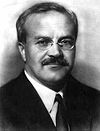 |
March 1921 – April 1922 | Was elected Responsible Secretary at the 10th Party Congress held in March 1921. The Congress decided that the office of Responsible Secretary should have a presence at Politburo plenums. As a result Molotov became a candidate member of the Politburo. |
| General Secretary of the Central Committee Central Committee of the Communist Party of the Soviet Union The Central Committee of the Communist Party of the Soviet Union , abbreviated in Russian as ЦК, "Tse-ka", earlier was also called as the Central Committee of the All-Union Communist Party ... of the All-Union Communist Party (bolsheviks) (1922–1952) |
|||
| Joseph Stalin Joseph Stalin Joseph Vissarionovich Stalin was the Premier of the Soviet Union from 6 May 1941 to 5 March 1953. He was among the Bolshevik revolutionaries who brought about the October Revolution and had held the position of first General Secretary of the Communist Party of the Soviet Union's Central Committee... (1878–1953) |
3 April 1922 – 16 October 1952 | Stalin used the office of General Secretary to create a strong power base for himself. Vladimir Lenin Vladimir Lenin Vladimir Ilyich Lenin was a Russian Marxist revolutionary and communist politician who led the October Revolution of 1917. As leader of the Bolsheviks, he headed the Soviet state during its initial years , as it fought to establish control of Russia in the Russian Civil War and worked to create a... later accused him of manipulating the powers of the General Secretary. Stalin nearly lost his post at the 17th Party Congress in 1934, but the death of his chief rival Sergey Kirov Sergey Kirov Sergei Mironovich Kirov , born Sergei Mironovich Kostrikov, was a prominent early Bolshevik leader in the Soviet Union. Kirov rose through the Communist Party ranks to become head of the Party organization in Leningrad... weakened the motion to remove him. He offered his resignation in 1934, but was re-elected as an ordinary secretary and was rarely referred to as General Secretary after that. The office was abolished at the 19th Party Congress 19th Congress of the Communist Party of the Soviet Union The Nineteenth Congress of the Communist Party of the Soviet Union was held from October 5–14, 1952. It was the last congress of the Stalin regime and the first to take place since before World War II... in October 1952. |
|
| First Secretary of the Central Committee Central Committee of the Communist Party of the Soviet Union The Central Committee of the Communist Party of the Soviet Union , abbreviated in Russian as ЦК, "Tse-ka", earlier was also called as the Central Committee of the All-Union Communist Party ... of the Communist Party of the Soviet Union Communist Party of the Soviet Union The Communist Party of the Soviet Union was the only legal, ruling political party in the Soviet Union and one of the largest communist organizations in the world... (1953–1966) |
|||
| Nikita Khrushchev Nikita Khrushchev Nikita Sergeyevich Khrushchev led the Soviet Union during part of the Cold War. He served as First Secretary of the Communist Party of the Soviet Union from 1953 to 1964, and as Chairman of the Council of Ministers, or Premier, from 1958 to 1964... (1894–1971) |
14 September 1953 – 14 October 1964 | Khrushchev reestablished the office on 14 September 1953 under the name First Secretary. In 1957 he was nearly removed from office by the Anti-Party Group Anti-Party Group The Anti-Party Group was a group within the leadership of the Communist Party of the Soviet Union that unsuccessfully attempted to depose Nikita Khrushchev as First Secretary of the Party in May 1957. The group, named by that epithet by Khrushchev, was led by former Premiers Georgy Malenkov and... . Georgy Malenkov Georgy Malenkov Georgy Maximilianovich Malenkov was a Soviet politician, Communist Party leader and close collaborator of Joseph Stalin. After Stalin's death, he became Premier of the Soviet Union and was in 1953 briefly considered the most powerful Soviet politician before being overshadowed by Nikita... , a leading member of the Anti-Party Group, worried that the powers of the First Secretary were virtually unlimited. Khrushchev was removed as leader on 14 October 1964, and replaced by Leonid Brezhnev. |
|
| Leonid Brezhnev Leonid Brezhnev Leonid Ilyich Brezhnev – 10 November 1982) was the General Secretary of the Central Committee of the Communist Party of the Soviet Union , presiding over the country from 1964 until his death in 1982. His eighteen-year term as General Secretary was second only to that of Joseph Stalin in... (1906–1982) |
14 October 1964 – 8 April 1966 | The office of First Secretary was renamed General Secretary at the 23rd Party Congress 23rd Congress of the Communist Party of the Soviet Union The 23rd Congress of the Communist Party of the Soviet Union took place in Moscow, RSFSR between 29 March and 8 April 1966. It was the first Congress during Leonid Brezhnev's leadership of the Party and state... . |
|
| General Secretary of the Central Committee Central Committee of the Communist Party of the Soviet Union The Central Committee of the Communist Party of the Soviet Union , abbreviated in Russian as ЦК, "Tse-ka", earlier was also called as the Central Committee of the All-Union Communist Party ... of the Communist Party of the Soviet Union Communist Party of the Soviet Union The Communist Party of the Soviet Union was the only legal, ruling political party in the Soviet Union and one of the largest communist organizations in the world... (1966–1991) |
|||
| Leonid Brezhnev Leonid Brezhnev Leonid Ilyich Brezhnev – 10 November 1982) was the General Secretary of the Central Committee of the Communist Party of the Soviet Union , presiding over the country from 1964 until his death in 1982. His eighteen-year term as General Secretary was second only to that of Joseph Stalin in... (1906–1982) |
8 April 1966 – 10 November 1982 | At first there was no clear leader of the collective leadership Collective leadership Collective leadership or Collectivity of leadership , was considered an ideal form of governance in the Union of Soviet Socialist Republics... with Brezhnev and Premier Alexei Kosygin ruling as equals. However, by the 1970s Brezhnev's influence exceeded that of Kosygin's and he was able to retain this support by avoiding any radical reforms. The powers and functions of the General Secretary were limited by the collective leadership during Brezhnev's tenure. |
|
| Yuri Andropov Yuri Andropov Yuri Vladimirovich Andropov was a Soviet politician and the General Secretary of the Communist Party of the Soviet Union from 12 November 1982 until his death fifteen months later.-Early life:... (1914–1984) |
12 November 1982 – 9 February 1984 | He was seen as the most likely candidate for the General Secretary when it became known he had been the chairman of the committee in charge of arranging, managing and preparing Brezhnev's funeral Death and funeral of Leonid Brezhnev On 10 November 1982, Leonid Ilyich Brezhnev, the third General Secretary of the Communist Party of the Soviet Union and the fifth leader of the Soviet Union, died a 75 year-old man after suffering a heart attack following years of serious ailments. His death was officially acknowledged on 11... . Andropov was obliged by protocol to rule the country in the same way Brezhnev had before he died. |
|
| Konstantin Chernenko Konstantin Chernenko Konstantin Ustinovich Chernenko was a Soviet politician and the fifth General Secretary of the Communist Party of the Soviet Union. He led the Soviet Union from 13 February 1984 until his death thirteen months later, on 10 March 1985... (1911–1985) |
13 February 1984 – 10 March 1985 | Chernenko was 72 years old when elected to the post of General Secretary and in rapidly failing health. Chernenko was also obliged by protocol, as Yuri Andropov Yuri Andropov Yuri Vladimirovich Andropov was a Soviet politician and the General Secretary of the Communist Party of the Soviet Union from 12 November 1982 until his death fifteen months later.-Early life:... had been, to rule the country in the same way Brezhnev had. |
|
| Mikhail Gorbachev Mikhail Gorbachev Mikhail Sergeyevich Gorbachev is a former Soviet statesman, having served as General Secretary of the Communist Party of the Soviet Union from 1985 until 1991, and as the last head of state of the USSR, having served from 1988 until its dissolution in 1991... (born 1931) |
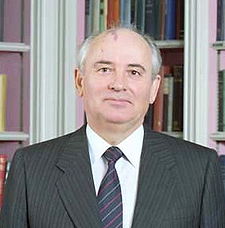 |
11 March 1985 – 24 August 1991 | The 1990 Congress of People's Deputies Congress of People's Deputies of the Soviet Union The Congress of People's Deputies of the Soviet Union was the highest body of state authority of the Soviet Union from 1989 to 1991.-Background:... voted to remove Article 6 Article 6 of the Soviet Constitution Article 6 of the 1977 Soviet Constitution placed limitations on the political rights of Soviet citizens. While the rest of the constitution theoretically assured the public freedom of speech, freedom of assembly and freedom of press these rights were rendered less meaningful by the reservation of... from the 1977 Soviet Constitution 1977 Soviet Constitution At the Seventh Session of the Supreme Soviet of the USSR Ninth Convocation on October 7, 1977, the third and last Soviet Constitution, also known as the "Brezhnev Constitution", was unanimously adopted... . This meant that the Communist Party Communist Party of the Soviet Union The Communist Party of the Soviet Union was the only legal, ruling political party in the Soviet Union and one of the largest communist organizations in the world... lost its position as the "leading and guiding force of the Soviet society" and the powers of the General Secretary were drastically curtailed. Throughout the rest of his tenure Gorbachev ruled through the office of President of the Soviet Union President of the Soviet Union The President of the Soviet Union , officially called President of the USSR was the Head of State of the USSR from 15 March 1990 to 25 December 1991. Mikhail Gorbachev was the only person to occupy the office. Gorbachev was also General Secretary of the Communist Party of the Soviet Union between... . He resigned from his post on 24 August 1991 in the aftermath of the August Coup. |
| Vladimir Ivashko Vladimir Ivashko Vladimir Antonovich Ivashko , was briefly the acting General Secretary of the Communist Party of the Soviet Union during the period from 24 August 1991 to 29 August 1991. On 24 August Mikhail Gorbachev resigned, and on 29 August the CPSU was suspended by the Supreme Soviet... (1932–1994) |
24 August 1991 – 29 August 1991 | He was elected Deputy General Secretary, another name for deputy leader, at the 28th Party Congress. Ivashko became acting General Secretary following Gorbachev's resignation, but by then the Party was politically impotent and on 29 August 1991 it was banned. | |