

Rosh Chodesh

Encyclopedia
Rosh Chodesh or Rosh ḥodesh ' onMouseout='HidePop("85247")' href="/topics/Translation">trans
. Beginning of the Month; lit
. Head of the Month) is the name for the first day of every month in the Hebrew calendar
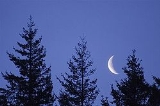
, marked by the appearance of the new moon
. The new moon is marked by the day and hour that the new crescent is observed. It is considered a minor holiday, akin to the intermediate days of Passover
and Sukkot
.
:
In the Book of Numbers
, God speaks of the celebration of the new moon to Moses:
In Psalm 81:3 both new and full moon are mentioned as a time of recognition by the Hebrews.
The occurrence of Rosh Chodesh was originally based on the testimony of witnesses observing the new moon. When two reliable witnesses appeared before the Sanhedrin
, the day was declared as Rosh Chodesh, either making the month a full month or a defective, 29-day month. After declaring the new month, news of it would then be communicated throughout Israel
and the diaspora.
At a later date, a custom was developed in which an additional day could be added to the month to ensure that certain holidays (such as Yom Kippur
) did not fall on the days before or after Shabbat
.
s on the preceding Shabbat
(called Shabbat Mevarchim—The Shabbat of Blessing [the new month}). The announcement is made after the reading of the sefer torah
, before returning it to the aron kodesh, in a prayer beginning "May it be Your will... that You renew this month for us for good and for blessing." The name of the new month, and the day of the week on which it falls, is given during the prayer. Some communities customarily precede the prayer by an announcement of the exact date and time of the new moon, referred to as the molad, or "birth". Rosh Chodesh Tishrei (which is also Rosh HaShana) is never announced.
, the prayer for the restoration of the Temple
and a segment of the Amidah
. During the morning service, Ya'a' le Ve-Yavo is again recited and either a whole or half Hallel
(Psalms
113-118) is recited. The Book of Numbers
28:1-15, which includes the offerings
of Rosh Chodesh, is read. An additional prayer service, called Mussaf, is added to commemorate the original sacrifices in the Temple
. After the service, many recite Psalm 104. The Ya'a'le Ve-Yavo prayer is also inserted in the Grace after Meals
(Birkat Ha-Mazon). Many have a custom to make sure to eat a special meal in honor of Rosh Chodesh, as the Code of Jewish Law suggests. This gives one the opportunity to recite the Ya'a'le Ve-Yavo in the Grace after Meals. Some Hasidic Jews sing Psalm 104 during this meal.
If Rosh Chodesh falls on Shabbat
, the regular Torah reading
is supplemented with a reading of Numbers 28:9-16. The Mussaf prayer is also modified when Rosh Chodesh falls on Shabbat. The central benediction is replaced with an alternate version (Ata Yatzarta) that mentions both the Shabbat and Rosh Chodesh. If Rosh Chodesh falls on a Sunday, a different Haftarah
, Mahar Hodesh (I Samuel
20:18-42) is read. The Kiddush Levanah (sanctification of the moon) is recited soon after Rosh Chodesh, typically on the first Saturday night after Rosh Chodesh.
(tractate Megillah 22b), women are exempt from work on Rosh Chodesh, and Rashi
, in commenting on this passage, delineates the activities from which they may refrain: spinning, weaving, and sewing—the skills that women contributed to the building of the Mishkan (Tabernacle
). The midrash
Pirke De-Rabbi Eliezer
explores this exemption in chapter 45:
Female-centered Rosh Chodesh observances vary from group to group, but many are centered on small gatherings of women, called Rosh Chodesh groups. There is often a particular interest in the Shekinah, considered by the kabbalah
to be a feminine aspect of God. These groups engage in a wide variety of activities that center around issues important to Jewish women, depending on the preference of the group's members. Many Rosh Chodesh groups explore spirituality, religious education, ritual, health issues, music, chanting, art, and/or cooking. Some groups also choose to educate young Jewish women in their community about sexuality, self-image, and other women's mental and physical health issues.
Translation
Translation is the communication of the meaning of a source-language text by means of an equivalent target-language text. Whereas interpreting undoubtedly antedates writing, translation began only after the appearance of written literature; there exist partial translations of the Sumerian Epic of...
. Beginning of the Month; lit
Literal translation
Literal translation, or direct translation, is the rendering of text from one language to another "word-for-word" rather than conveying the sense of the original...
. Head of the Month) is the name for the first day of every month in the Hebrew calendar
Hebrew calendar
The Hebrew calendar , or Jewish calendar, is a lunisolar calendar used today predominantly for Jewish religious observances. It determines the dates for Jewish holidays and the appropriate public reading of Torah portions, yahrzeits , and daily Psalm reading, among many ceremonial uses...
, marked by the appearance of the new moon
New moon
In astronomical terminology, the new moon is the lunar phase that occurs when the Moon, in its monthly orbital motion around Earth, lies between Earth and the Sun, and is therefore in conjunction with the Sun as seen from Earth...
. The new moon is marked by the day and hour that the new crescent is observed. It is considered a minor holiday, akin to the intermediate days of Passover
Passover
Passover is a Jewish holiday and festival. It commemorates the story of the Exodus, in which the ancient Israelites were freed from slavery in Egypt...
and Sukkot
Sukkot
Sukkot is a Biblical holiday celebrated on the 15th day of the month of Tishrei . It is one of the three biblically mandated festivals Shalosh regalim on which Hebrews were commanded to make a pilgrimage to the Temple in Jerusalem.The holiday lasts seven days...
.
Origin
The Book of Exodus establishes the beginning of the Hebrew calendarHebrew calendar
The Hebrew calendar , or Jewish calendar, is a lunisolar calendar used today predominantly for Jewish religious observances. It determines the dates for Jewish holidays and the appropriate public reading of Torah portions, yahrzeits , and daily Psalm reading, among many ceremonial uses...
:
"And the LORD spoke unto Moses and Aaron in the land of Egypt, saying: 'This month shall mark for you the beginning of the months; it shall be the first of the months of the year for you.'" (12:1-2)
In the Book of Numbers
Book of Numbers
The Book of Numbers is the fourth book of the Hebrew Bible, and the fourth of five books of the Jewish Torah/Pentateuch....
, God speaks of the celebration of the new moon to Moses:
"And on your joyous occasions - your fixed festivals and new moon days - you shall sound the trumpets over your burnt offerings and your sacrifices of well-being." (10:10)
In Psalm 81:3 both new and full moon are mentioned as a time of recognition by the Hebrews.
The occurrence of Rosh Chodesh was originally based on the testimony of witnesses observing the new moon. When two reliable witnesses appeared before the Sanhedrin
Sanhedrin
The Sanhedrin was an assembly of twenty-three judges appointed in every city in the Biblical Land of Israel.The Great Sanhedrin was the supreme court of ancient Israel made of 71 members...
, the day was declared as Rosh Chodesh, either making the month a full month or a defective, 29-day month. After declaring the new month, news of it would then be communicated throughout Israel
Israel
The State of Israel is a parliamentary republic located in the Middle East, along the eastern shore of the Mediterranean Sea...
and the diaspora.
At a later date, a custom was developed in which an additional day could be added to the month to ensure that certain holidays (such as Yom Kippur
Yom Kippur
Yom Kippur , also known as Day of Atonement, is the holiest and most solemn day of the year for the Jews. Its central themes are atonement and repentance. Jews traditionally observe this holy day with a 25-hour period of fasting and intensive prayer, often spending most of the day in synagogue...
) did not fall on the days before or after Shabbat
Shabbat
Shabbat is the seventh day of the Jewish week and a day of rest in Judaism. Shabbat is observed from a few minutes before sunset on Friday evening until a few minutes after when one would expect to be able to see three stars in the sky on Saturday night. The exact times, therefore, differ from...
.
Announcement
Despite the existence of a fixed calendar, Rosh Chodesh is still announced in synagogueSynagogue
A synagogue is a Jewish house of prayer. This use of the Greek term synagogue originates in the Septuagint where it sometimes translates the Hebrew word for assembly, kahal...
s on the preceding Shabbat
Shabbat
Shabbat is the seventh day of the Jewish week and a day of rest in Judaism. Shabbat is observed from a few minutes before sunset on Friday evening until a few minutes after when one would expect to be able to see three stars in the sky on Saturday night. The exact times, therefore, differ from...
(called Shabbat Mevarchim—The Shabbat of Blessing [the new month}). The announcement is made after the reading of the sefer torah
Sefer Torah
A Sefer Torah of Torah” or “Torah scroll”) is a handwritten copy of the Torah or Pentateuch, the holiest book within Judaism. It must meet extremely strict standards of production. The Torah scroll is mainly used in the ritual of Torah reading during Jewish services...
, before returning it to the aron kodesh, in a prayer beginning "May it be Your will... that You renew this month for us for good and for blessing." The name of the new month, and the day of the week on which it falls, is given during the prayer. Some communities customarily precede the prayer by an announcement of the exact date and time of the new moon, referred to as the molad, or "birth". Rosh Chodesh Tishrei (which is also Rosh HaShana) is never announced.
Traditional observances
During the evening service of Rosh Chodesh, a prayer Ya'a'le Ve-Yavo is added to the AvodahAvodah
Avoda, or Avodah , is a Hebrew word, literally meaning "work".In a modern context, usually refers to business-type activities, it can also mean agricultural work and, more traditionally, serving God....
, the prayer for the restoration of the Temple
Temple in Jerusalem
The Temple in Jerusalem or Holy Temple , refers to one of a series of structures which were historically located on the Temple Mount in the Old City of Jerusalem, the current site of the Dome of the Rock. Historically, these successive temples stood at this location and functioned as the centre of...
and a segment of the Amidah
Amidah
The Amidah , also called the Shmoneh Esreh , is the central prayer of the Jewish liturgy. This prayer, among others, is found in the siddur, the traditional Jewish prayer book...
. During the morning service, Ya'a' le Ve-Yavo is again recited and either a whole or half Hallel
Hallel
Hallel is a Jewish prayer—a verbatim recitation from Psalms 113–118, which is used for praise and thanksgiving that is recited by observant Jews on Jewish holidays.-Holy days:...
(Psalms
Psalms
The Book of Psalms , commonly referred to simply as Psalms, is a book of the Hebrew Bible and the Christian Bible...
113-118) is recited. The Book of Numbers
Book of Numbers
The Book of Numbers is the fourth book of the Hebrew Bible, and the fourth of five books of the Jewish Torah/Pentateuch....
28:1-15, which includes the offerings
Korban
The term offering as found in the Hebrew Bible in relation to the worship of Ancient Israel is mainly represented by the Hebrew noun korban whether for an animal or other offering...
of Rosh Chodesh, is read. An additional prayer service, called Mussaf, is added to commemorate the original sacrifices in the Temple
Temple in Jerusalem
The Temple in Jerusalem or Holy Temple , refers to one of a series of structures which were historically located on the Temple Mount in the Old City of Jerusalem, the current site of the Dome of the Rock. Historically, these successive temples stood at this location and functioned as the centre of...
. After the service, many recite Psalm 104. The Ya'a'le Ve-Yavo prayer is also inserted in the Grace after Meals
Birkat Hamazon
Birkat Hamazon or Birkath Hammazon, , known in English as the Grace After Meals, , is a set of Hebrew blessings that Jewish Law prescribes following a meal that includes bread or matzoh made from one or all of wheat, barley, rye, oats, spelt...
(Birkat Ha-Mazon). Many have a custom to make sure to eat a special meal in honor of Rosh Chodesh, as the Code of Jewish Law suggests. This gives one the opportunity to recite the Ya'a'le Ve-Yavo in the Grace after Meals. Some Hasidic Jews sing Psalm 104 during this meal.
If Rosh Chodesh falls on Shabbat
Shabbat
Shabbat is the seventh day of the Jewish week and a day of rest in Judaism. Shabbat is observed from a few minutes before sunset on Friday evening until a few minutes after when one would expect to be able to see three stars in the sky on Saturday night. The exact times, therefore, differ from...
, the regular Torah reading
Torah reading
Torah reading is a Jewish religious ritual that involves the public reading of a set of passages from a Torah scroll. The term often refers to the entire ceremony of removing the Torah scroll from the ark, chanting the appropriate excerpt with special cantillation, and returning the scroll to...
is supplemented with a reading of Numbers 28:9-16. The Mussaf prayer is also modified when Rosh Chodesh falls on Shabbat. The central benediction is replaced with an alternate version (Ata Yatzarta) that mentions both the Shabbat and Rosh Chodesh. If Rosh Chodesh falls on a Sunday, a different Haftarah
Haftarah
The haftarah or haftoroh is a series of selections from the books of Nevi'im of the Hebrew Bible that is publicly read in synagogue as part of Jewish religious practice...
, Mahar Hodesh (I Samuel
Books of Samuel
The Books of Samuel in the Jewish bible are part of the Former Prophets, , a theological history of the Israelites affirming and explaining the Torah under the guidance of the prophets.Samuel begins by telling how the prophet Samuel is chosen by...
20:18-42) is read. The Kiddush Levanah (sanctification of the moon) is recited soon after Rosh Chodesh, typically on the first Saturday night after Rosh Chodesh.
Modern observances: Rosh Chodesh and women
According to the TalmudTalmud
The Talmud is a central text of mainstream Judaism. It takes the form of a record of rabbinic discussions pertaining to Jewish law, ethics, philosophy, customs and history....
(tractate Megillah 22b), women are exempt from work on Rosh Chodesh, and Rashi
Rashi
Shlomo Yitzhaki , or in Latin Salomon Isaacides, and today generally known by the acronym Rashi , was a medieval French rabbi famed as the author of a comprehensive commentary on the Talmud, as well as a comprehensive commentary on the Tanakh...
, in commenting on this passage, delineates the activities from which they may refrain: spinning, weaving, and sewing—the skills that women contributed to the building of the Mishkan (Tabernacle
Tabernacle
The Tabernacle , according to the Hebrew Torah/Old Testament, was the portable dwelling place for the divine presence from the time of the Exodus from Egypt through the conquering of the land of Canaan. Built to specifications revealed by God to Moses at Mount Sinai, it accompanied the Israelites...
). The midrash
Midrash
The Hebrew term Midrash is a homiletic method of biblical exegesis. The term also refers to the whole compilation of homiletic teachings on the Bible....
Pirke De-Rabbi Eliezer
Pirke De-Rabbi Eliezer
Pirke De-Rabbi Eliezer is an aggadic-midrashic work on Genesis, part of Exodus, and a few sentences of Numbers, ascribed to R. Eliezer ben Hyrcanus , a disciple of Rabbi Yochanan ben Zakai and teacher of Rabbi Akiva. It comprises fifty four chapters...
explores this exemption in chapter 45:
"Aaron argued with himself, saying: If I say to Israel, Give ye to me gold and silver, they will bring it immediately; but behold I will say to them, Give ye to me the earrings of your wives and of your sons, and forthwith the matter will fail, as it is said, "And Aaron said to them, Break off the golden rings." The women heard (this), but they were unwilling to give their earrings to their husbands; but they said to them: Ye desire to make a graven image of a molten image without any power in it to deliver. The Holy One, blessed be He, gave the women their reward in this world and the world to come. What reward did He give them in this world? That they should observe the New Moons more stringently than the men, and what reward will He give them in the world to come? They are destined to be renewed like the New Moons, as it is said: Who satisfieth thy years with good things; so that thy youth is renewed like the eagle."
Female-centered Rosh Chodesh observances vary from group to group, but many are centered on small gatherings of women, called Rosh Chodesh groups. There is often a particular interest in the Shekinah, considered by the kabbalah
Kabbalah
Kabbalah/Kabala is a discipline and school of thought concerned with the esoteric aspect of Rabbinic Judaism. It was systematized in 11th-13th century Hachmei Provence and Spain, and again after the Expulsion from Spain, in 16th century Ottoman Palestine...
to be a feminine aspect of God. These groups engage in a wide variety of activities that center around issues important to Jewish women, depending on the preference of the group's members. Many Rosh Chodesh groups explore spirituality, religious education, ritual, health issues, music, chanting, art, and/or cooking. Some groups also choose to educate young Jewish women in their community about sexuality, self-image, and other women's mental and physical health issues.
See also
- JudaismJudaismJudaism ) is the "religion, philosophy, and way of life" of the Jewish people...
- Hebrew calendarHebrew calendarThe Hebrew calendar , or Jewish calendar, is a lunisolar calendar used today predominantly for Jewish religious observances. It determines the dates for Jewish holidays and the appropriate public reading of Torah portions, yahrzeits , and daily Psalm reading, among many ceremonial uses...
- Solar year
- Lunar cycle
- Beth din shel KohanimBeth din shel KohanimThe Beth Din of the priests is a Mishnah term used to describe the court of Jewish law composed of twenty-three senior priests that would oversee the day to day operation of the Temple in Jerusalem, including the sacrifices and offerings, the verification of Aaronic lineage and the safeguarding...
- Jewish FeminismJewish feminismJewish feminism is a movement that seeks to improve the religious, legal, and social status of women within Judaism and to open up new opportunities for religious experience and leadership for Jewish women...
- Yom Kippur KatanYom Kippur KatanYom Kippur Katan , is a practice observed by some Jews on the day preceding each Rosh Chodesh or New-Moon Day, the observance consisting of fasting and supplication, but being much less rigorous than that of Yom Kippur proper....
- Confessional ritual for the day preceding Rosh Chodesh