

Chabad-Lubavitch

Encyclopedia
Chabad-Lubavitch is a Chasidic
movement in Orthodox Judaism
. One of the world's larger and best-known Chasidic movements, its official headquarters is in the Crown Heights
section of Brooklyn
, New York
. The organization is believed to be the largest Jewish organization in the world today.
The name "Chabad" (Hebrew
: חב"ד) is an acronym
for Chochmah
, Binah
, Da'at
: "Wisdom, Understanding, and Knowledge." "Lubavitch" is the only major extant branch of a family of Hasidic groups once known collectively as the Chabad movement; the names are now used interchangeably. The only other existing branch of Chabad is the Malachim
. Other branches such as Strashelye and Kapust
have rejoined the main fold.
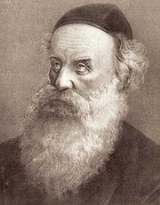
Chabad was founded in the late 18th century by Shneur Zalman of Liadi
. The Lubavitch branch takes its name from Lyubavichi, the Russia
n town where the group was based until the early 20th century. Yosef Yitzchok Schneersohn the sixth leader fled war-torn Europe for New York
in 1940, where he established a synagogue. His son-in-law, Menachem Mendel Schneerson
, turned the movement into a powerful force within Judaism.
Chabad maintains institutions in over 1000 cities around the world, there were an estimated 3,300 Chabad institutions around the world, by 2010, as many as 3,600 Institutions worldwide, in 70 countries, providing outreach
and educational activities for Jews through Jewish community centers, synagogue
s, schools and camps. 1,350 institutions were listed in the Chabad directory as of 2007.
The movement has over 200,000 adherents, and up to one million Jews attend Chabad services at least once a year. Chabad's adherents, known as Chabadniks and/or Lubavitchers , follow Chabad traditions
and prayer services
based on Lurianic kabbalah
. As "Hasidim", they follow the Chassidus
of Israel ben Eliezer.
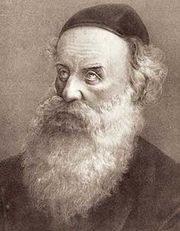 In a break with early Hasidism, Chabad philosophy emphasises mind over emotions. The founder of the Chabad philosophy, Shneur Zalman of Liadi, developed an intellectual system and an approach to Judaism
intended to answer criticisms of Hasidism as anti-intellectual. Through an approach based partly on Kabbalah, Chabad philosophy methodizes an understanding of God
.
Chabad philosophy incorporates the teachings of Kabbalah
as a means to deal with one's daily life and psyche. It teaches that every aspect of the world exists only through the intervention of God. Through an intellectual approach and meditations, Chabad teaches that one can attain complete control over one's inclinations.
, the intellect consists of three interconnected processes: Chochma (wisdom), Bina (understanding), and Da'at (knowledge). While other branches of Hasidism focused primarily on the idea that "God desires the heart," Shneur Zalman argued that God also desires the mind, and that without the mind the heart was useless. With the Chabad philosophy he elevated the mind above the heart, arguing that "...understanding is the mother of...fear and love of God. These are born of knowledge and profound contemplation of the greatness of God."
According to Jonathan Sacks
, in Shneur Zalman's system Chochma represents "the creation in its earliest potentiality; the idea of a finite world as was first born in the divine mind. Binah is the idea conceived in its details, the result of contemplation. Da'at is, as it were, the commitment to creation, the stage at which the idea becomes an active intention." While in Kabbala there are clearly delineated levels of holiness, in Chabad philosophy these are grounded in the mundanities of people's inner lives. So in reality — according to the Chabad analogy — Chochma is the birth of an idea in the mind, Binah is the contemplation, and Da'at is the beginning of the actualisation of an idea. Sacks argues that this provided a psychological formulation that enabled the hasid to substantiate his mystical thoughts. "This was an important advance because bridging the gap between spiritual insight and daily behaviour had always been a problem for Jewish mysticism
."
Chabad philosophy argues that man is neither static nor passive nor dependent on others to connect to God. Shneur Zalman rejected all ideas of aristocratic birth and elitism — he argued for meritocracy where all were capable of growth, every Jew — in his view — was capable of becoming a Tzadik
.
Chabad can be contrasted with the Chagat (Chesed, Gevurah, Tiferet) school of Hasidism. While all Hasidim have a certain focus on the emotions, Chagat saw emotions as a reaction to physical stimuli, such as dancing singing or beauty. Shneur Zalman, on the other hand, taught that the emotions must be led by the mind, and thus the focus of Chabad thought was to be Torah
study and prayer rather than esotericism
and song. As a Talmudist, Shneur Zalman endeavored to place Kabbalah and Hasidism on a rational basis. In Tanya
, he defines his approach as "מוח שליט על הלב" ("the brain ruling the heart").
, Shneur Zalman's magnum opus, is the first schematic treatment of Hasidic moral philosophy and its metaphysical foundations. The original name of the first book is Sefer Shel Beinonim, the "Book of the Intermediates." It is also known as Likutei Amarim — "Collected Sayings." Sefer Shel Beinonim analyzes the inner struggle of the individual and the path to resolution. The philosophy is based on the notion that man himself is not evil; rather, every individual has an inner conflict that is characterized with two different inclinations, the good and the bad.
Some have argued that Shneur Zalman's moderation and synthesis saved Hasidism from becoming a Jewish breakaway movement, keeping it within the fold. Avrum Erlich writes: "Shneur Zalman was instrumental in the preservation of Hasidism within mainstream Judaism. It allowed for some of the mystically inclined Hasidim to reacquaint themselves with traditional scholarship and the significance of strict halakhic observance and behavior, concerns with which other Hasidic schools were sometimes less exacting. Shneur Zalman also provided the opportunity for traditionalists and scholars to access the Hasidic mood and its spiritual integrity without betraying their traditional scholarly allegiances."
of Shklow, Shneur Zalman wrote: "The Hasidim, too, set aside time for study. The difference between them and the Misnagdim
is this: the latter set time for study and they are limited by time, whereas the former make the Torah their path of life."
Shneur Zalman taught that Torah must be studied joyously — studying without joy is frowned upon. He provided a metaphor: when a mitzvah
is fulfilled an angel is created. But if the mitzvah was joyless then the angel too will be dispirited. Thus, while Shneur Zalman emphasized that Hasidism focus on traditional Jewish scholarship rather than on mysticism, he was emphatic that this must be done with zeal and joy.
In Chabad thought, as formulated by the Alter Rebbe the Rebbe was not an intermediary. The role of the rebbe was closer to that of a traditional community Rabbi, a supervisor rather than a superior. The Alter Rebbe's focus was on training his followers to become spiritually self-sufficient and to turn to their Rebbe for instructions rather than intercession with God, miracles or blessings.
said: A Hasid is he who surrenders himself for the benefit of another. Beyond this, Chabad demands pnimiyut (inwardness / sincerity): one should not act superficially, as a mere act of faith, but rather with inner conviction.
strove, in his writings and lectures, to attain unity between opposites. He aimed to unite the mundane aspects of the world with the aspect of "godliness" in the world. Schneerson emphasized the concept of creating an abode for God on this world. Consequently, he sought to unite the modern world with the teachings of Judaism. He felt that the world was not a contradiction to the word of God, and it was to be embraced rather than shunned.
Schneerson taught that modern technology does not contradict spirituality. For that reason, Chabad has consistently utilized modern technology to spread its message. Since its inception, Chabad have used the radio, and later television, satellite feeds, and the Internet to spread its message.
"Now listen, Jews. Generally, in Chabad it has been demanded that each individual work on themselves, and not rely on the Rebbeim...... One must, on their own, transform the folly of materialism and the passion of the 'animal soul' to holiness... I do not, God Forbid, recuse myself from assisting as much as possible, however; If one does not work on themselves, what good will submitting notes, singing songs, and saying lechayim do?!"
In USA domestic politics, Schneerson supported government involvement in education and welcomed the establishment of the United States Department of Education
in 1980, yet insisted that part of a school's educational mission was to incorporate the values espoused in the Seven Laws of Noah. He called for the introduction of a moment of silence
at the beginning of the school day, and for students to be encouraged to use this time for such improving thoughts or prayers as their parents might suggest.
Schneerson demanded in 1981 that the USA achieve energy independence by developing solar energy, as the dependence and resulting subjugation to foreign nations could cause the country to compromise its principles.
The Lubavitcher Rebbe, it sometimes seemed, commanded the largest Jewish "army" outside of Israel. His followers regarded him as their commander in chief and obeyed all his orders. Hasidim routinely would uproot their families and move to whatever city the Rebbe directed them... The loyalty to this mission continued even after the Rebbe's death,so that there are now Lubavitcher representatives in over a thousand cites throughout the United States and the world. One of the great figures of Israeli Orthodoxy, Rabbi Yosef Shlomo Kahaneman
is reputed to have said: "I have found two things in every city I have visited, Coca-Cola and Lubavitcher Hasidim".
Because of its outreach to all Jews, even the most alienated from religious Jewish tradition, Lubavitch has been described as the one Orthodox group to evoke great affection from large segments of American Jewry.
 The movement originated in Ukraine
in Eastern Europe
, then part of Imperial Russia under the Tsar
s. Chabad traces its roots back to the beginnings of Hasidic Judaism
.
(also known as the Alter Rebbe) was the founder of the Chabad school of Hasidism. He became involved in the early Hasidic movement. His background as a youth had been in traditional Talmud
study rather than hasidism. He was a prominent as well as the youngest disciple of Rabbi Dovber of Mezeritch
— principal disciple and successor of the Baal Shem Tov, founder of general hasidism — and was appointed Rabbi in the town of Liozna, later Liadi. Over time Chabad branched out into a number of dynastic groups in towns such as Lubavitch, Liadi, and Kapost. Doctrinal differences between these groups were minimal. Since the early 20th century, the other dynasties have ended and Lubavitch alone remains as a cohesive group.
The Alter Rebbe became not only the leader of his own hasidic movement but a prominent figure in Hasidism in general through his writings. He was the first to codify the philosophy of Hasidism in a comprehensive way and the first to put the customs and halacha of hasidism into book form. He was the most prominent exponent of Hasidism throughout his life, and his influence on the movement was profound. He directed the movement away from obscurantism and towards more traditional forms of study. Chabad as a school of thought changed Hasidism, and this gave the Chabad movement prestige.
He was twice arrested by the Russian authorities of suspicion of sedition or spying – the exact details remain contended to this day, although the accusations against him were certainly false.
He supported the Tsar against Napoleon in French invasion of Russia (1812) arguing that the emancipation of the Jews would lead to laxity in observance. His death in 1812, while fleeing from Napoleon left the question of succession open.
. He established a Yeshiva in Lubavitch, one of the earliest Hasidic yeshivas.
Like his father he was the subject of an arrest in 1826. DovBer began a campaign (in 1822, or 1823) to urge Jews to learn trades and skilled factory work. He continued in his father's philosophical path, encouraging the study of kabbalah
alongside traditional halachic texts. He served as the Rebbe for 15 years, dying in 1827.
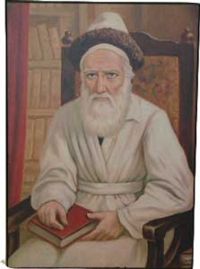 Menachem Mendel Schneersohn
, a grandson of the Alter Rebbe, born in 1789, is known as the Tzemach Tzedek, the title of his responsa
. In 1806 he married his first cousin, Dovber's daughter Chaya Mushka, also born in 1789. Upon Dovber's death, he became the prime candidate for succession; after a 3-year interregnum during which he tried to persuade the chasidim to accept Dovber's son Menachem-Nachum, or brother Chaim-Avraham, he accepted the leadership in 1831. He was active in the opposition to the Haskalah
(enlightenment Jews). In retaliation, the maskilim slandered him to the government several times between 1840–1842. However his services to the crown earned him the title "hereditary honored citizen". He served as Rebbe for 35 years until his death in 1866. He is buried in Lubavitch.
, the seventh son of Menachem Mendel, took over for his father following his death and served as Rebbe of the movement until his own death in 1882. As a leader of a prominent Hasidic grouping, he became active in fighting Anti-Semitic decrees and pogroms in Russia and beyond. He traveled widely to places such as St. Petersburg, Kiev
, France
and Germany
to this end.
, Shmuel's second son, rose to prominence interceding on behalf of the Jews in a number of issues including the May Laws
. Although he fulfilled many of the functions of Rebbe after his father's death in 1882, he didn't officially accept the leadership until 1892, after his elder brother, Zalman Aharon, had moved from Lubavitch to Vitebsk. In 1897 he established the Tomchei Temimim
yeshiva.
He was a fierce critic of secular Zionism
and a proponent of Jews taking on factory work and farming. He kept the Lubavitch movement out of the World Agudath Israel
when it formed in 1912. He died in 1920, after almost 40 years of stewardship of Lubavitch.
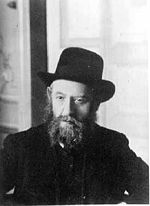
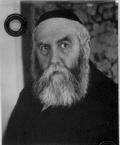 Yosef Yitzchok Schneersohn, the only son of Sholom Dovber took charge of the movement on the death of his father and led it until his death in 1950. He fought against the Bolsheviks by attempting to preserve Jewish life in Russia. In 1927 he was arrested and imprisoned in the Spalerno prison in Leningrad, and sentenced to death for spreading Judaism. After international protests his life was spared and he went on a world tour in the early 1930s. He returned to Warsaw
in 1934, disillusioned with the secularism of the United States
. He stayed in Warsaw with his Hasidim through 1940 and the capture of the city by the Nazis. A desperate struggle to save his life ensued. Ultimately he was granted diplomatic immunity, and arrived in New York
in March 1940, reputedly with the help of Admiral Wilhelm Canaris
. Most of the Chabad Yeshiva
system was destroyed by Bolshevik
governments and the Nazi invasion in 1941, and many of its students were killed.
His ten years in New York saw the seeds of Lubavitch emissary work, and its messianic drive that was later taken on by his son-in-law and successor Menachem Mendel Schneerson
. In 1948, on his instruction Kfar Chabad
was established in Israel
.
(1898–1989). The second daughter, Chaya Mushka
(March 16, 1901 – February 10, 1988), married Menachem Mendel Schneerson. The youngest daughter married Mendel Hornstein, and died alongside him in the Holocaust. Schneerson and Gurary became the candidates for succession on Yosef Yitzchak's death. Schneerson was considered modern, while Gurary was problematic as his only son, Barry Gurary
was not very religious at all. One year after Yosef Yitzchak's death Schneerson was chosen and turned the movement from a fairly prominent Hasidic sect into a large organization with a presence throughout the world.
, and Paris
, France
, since 1928, escaped from Paris via Nice in 1941 and joined his father-in-law in the Crown Heights
section of Brooklyn
, New York City
.
On Menachem Mendel Schneerson
's accession to the post of Rebbe a year after his father-in-law's death, he began turning the movement into a powerful force in Jewish life. His policies led to the establishment of Chabad institutions in over 900 cities around the world. He inspired many of his followers to dedicate their life's work to Chabad by talking of the impending messianic redemption.
in a 1984 book, became commonplace the movement in the years leading up to Schneerson's death.
Some believe that Schneerson's lack of offspring or a clear primary student exacerbated the messianism, and his death in 1994 was followed by a split in the Chabad movement between the messianists, who believe that Schneerson is the messiah, and the anti-messianists who either don't believe this, or believe that this should be a private belief. The fragmentation in the movement from the top down into rival camps has not seriously impeded Chabad's activities around the world – indeed, it continues to open new institutions on a regular basis. As of 2007 the Chabad directory listed over 1,300 institutions in 65 countries.
movement in Orthodox Judaism
in terms of numbers of adherents. There are more than 200,000 adherents to the movement, and up to a million Jews attend Chabad services at least once a year.
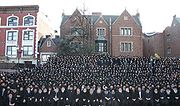
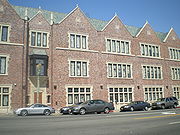 According to the Chabad movement online directory there are presently around 1,350 Chabad institutions around the world, when School
s and other establishments are taken into account. There are Chabad emissaries in 65 countries around the World according to their listings. In the USA there are over 600 establishments, 300 in Israel, 90 in Russia
, 80 in France
, 60, in Canada
, 50 in the Ukraine
, 40 in Australia
and 30 in each of Argentina
, Brazil
, and the United Kingdom
. There are around 15 each in Germany
and South Africa
; around 10 in Italy
, Austria
, Belarus
and Belgium
and Holland. There are 6 in China
and Uzbekistan
; 5 in Thailand
and Kazakhstan
. There are 3 in Spain
and Sweden
- and one in Copenhagen
, Denmark
. Another 40 countries have a small Chabad presence. In total, according to their directory, Chabad have a presence in 950 cities around the world. 178 in Europe, 14 in Africa, 200 in Israel, 400 in North America, 38 in South America, and about 70 in Asia (excluding Israel, including Russia.)
The movement, motivated by Schneerson, has trained and ordained
thousands of rabbi
s, educators, ritual slaughterers, and ritual circumcisers
, who are then accompanied by their spouses to many locations around the world. Typically a young Lubavitch rabbi and his wife, in their early twenties, with one or two children, will move to a new location, and as they settle in will raise a large family who as a family unit, will aim to fulfill their mandate of bringing Jewish people closer to Orthodox Judaism and encouraging gentiles to adhere to the Seven Laws of Noah.
under their own religious auspices, often serving as the nerve center of all the educational and outreach activities of a shliach (emissary) rabbi and his colleagues or allies in any given community. Often until the community can support the building of its own building for a Chabad house, the "Chabad House" is located in the shliach's home, with the living room being used as the "synagogue
". The term "Chabad House" originated in California
with the creation of the first such outreach center on the campus of UCLA by Rabbi Shlomo Cunin
.
The centers are informal in setup. They primarily serve both educational and observance purposes. Effort is made to provide an atmosphere in which the nonobservant will not feel intimidated by any perceived contrast between their lack of knowledge of Jewish practice and the advanced knowledge of some of the people they meet there.
In the 2008 Mumbai attacks
, the local Chabad house was targeted. The local Chabad emissaries, Rabbi Gavriel Holtzberg and his wife Rivka, and four other Jews were brutally murdered. Chabad received condolences from around the world.
— any mitzvah — its value will not be diminished by the fact that there are others that you are not prepared to do".
Schneerson also suggested ten specific mitzvot that he believed were ideally suited for the emissaries to introduce to non-observant Jews. These were called "mivtzoim" — meaning "campaigns" or "endeavors." These were: lighting candles before Shabbat
and the Jewish holiday
s by Jewish women; putting on tefillin
; affixing a mezuzah
; regular Torah study
; giving Tzedakah
; purchasing Jewish books
; observing kashrut (kosher
); kindness to others; Jewish education, and observing the family purity
laws.
In addition, Schneerson emphasized spreading awareness of preparing for and the coming of the Jewish messiah
, consistent with his philosophy. He wrote on the responsibility to reach out to teach every fellow Jew with love, and implored that all Jews believe in the imminent coming of the Messiah as explained by Maimonides
. He argued that redemption was predicated on Jews doing good deeds, and that gentiles should be educated about the Noahide Laws
. Chabad has been a prime force in disseminating awareness of these laws.
Schneerson was emphatic about the need to encourage and provide strong education for every child, Jew and non-Jew alike.
around the world, most using the name Gan Israel, a name chosen by Schneerson although the first overnight camp was the girls division called Camp Emunah. There are 1,200 sites serving 210,000 children — most of whom do not come from Orthodox
homes. Of these, 500 camps are in the United States.
and college
campuses. Chabad Student Centers are active on over 100 campuses, and Chabad offers varied activities at an additional 150 universities worldwide. Professor Alan Dershowitz
has said that "Chabad’s presence on college campuses today is absolutely crucial", and "We cannot rest until Chabad is on every major college campus in the world".
(the Chabad publishing house) has promoted this by translating books
into 12 languages, providing books at discounted prices, and hosting book-a-thons. Kehot has traditionally distributed books either transcribed from the Rebbeim, chassidim
, or those on practical law penned by rabbis and authors.
, one of the first Jewish educational websites and the first and largest virtual congregation. It serves not just its own members but Jews worldwide in general. According to Alexa.com
, Chabad.org is currently the largest Jewish educational website worldwide.
outreach
movement, which spread Judaism to many assimilated Jews worldwide, leading to a substantial number of baalei teshuva
("returnees" to Judaism). The very first Yeshiva/Rabbinical College for such "baalei teshuva", Hadar Hatorah
was established by the Lubavitcher Rebbe.
Chabad followers have had a notable influence on Jewish entertainment. Composer and rabbi Shlomo Carlebach
began his outreach work as a representative of Chabad (he later moved away from the movement), Avraham Fried
is also an adherent.
According to Steven I. Weiss
, Chabad's ideology has dramatically influenced non-Hasidic Jews' practice with regard to Jewish outreach issues.
im ("customs") that distinguish it from other Hasidic groups. For example, they do not wear the fur hats common among other hasidim. Until the 1950s, most wore the Russian kasket
; now most wear a black fedora. Almost all American Chabad Hasidim pronounce Hebrew according to the Lithuanian
dialect. However, many native Israel
i Chabad Hasidim pronounce Hebrew according to the Modern Israeli Hebrew
dialect. Like many other Hasidic groups, Chabad attaches importance to singing Chabad Hasidic nigun
im ("tunes"), usually without words, and following precise customs of their leaders.
has been a counter-cultural movement within Hasidsim, and has an interesting and varied history of controversies dating back to the 18th century.
Menachem Mendel Schneerson
, his philosophy, deeds and legacy are often debated with the study of Judaism. Schneerson was criticized by some contemporary Jewish leaders, for his messianic focus.
, Shneur Zalman of Liadi defines "Chabad Hasidism" as "מוח שליט על הלב" ("mind ruling over the heart/emotions"). Chabad Chasidism considers this emphasis to make it fundamentally different from other forms of Hasidism, which are referred to as "Chagas"; this acronym refers to the emotional attributes of Chesed ("kindness"), Gevurah ("power"), and Tifereth ("beauty"), and implies that relatively speaking other Chasidic groups place a lesser emphasis on intellectual comprehension of Chasidic philosophy than that found in Chabad teaching.
Chabad is sometimes written as Habad in English
and in all the phonetic equivalents of the name in all the countries they operate in. Thus, as an example, Jabad is the Spanish
form.
In Hasidic Judaism
, a dynasty normally takes its name from the town in Eastern Europe
where it was based. Lyubavichi (called in Yiddish, which is usually rendered Lubavitch in English) is a small town now in Smolensk Oblast, Russia, (then Imperial Russia). The movement was founded in Liozna
, and then moved to Liadi, but it moved to Lubavitch after the Napoleonic War, and was based there for 102 years.
Hasidic Judaism
Hasidic Judaism or Hasidism, from the Hebrew —Ḥasidut in Sephardi, Chasidus in Ashkenazi, meaning "piety" , is a branch of Orthodox Judaism that promotes spirituality and joy through the popularisation and internalisation of Jewish mysticism as the fundamental aspects of the Jewish faith...
movement in Orthodox Judaism
Orthodox Judaism
Orthodox Judaism , is the approach to Judaism which adheres to the traditional interpretation and application of the laws and ethics of the Torah as legislated in the Talmudic texts by the Sanhedrin and subsequently developed and applied by the later authorities known as the Gaonim, Rishonim, and...
. One of the world's larger and best-known Chasidic movements, its official headquarters is in the Crown Heights
Crown Heights, Brooklyn
Crown Heights is a neighborhood in the central portion of the New York City borough of Brooklyn. The main thoroughfare through this neighborhood is Eastern Parkway, a tree-lined boulevard designed by Frederick Law Olmsted extending two miles east-west.Originally, the area was known as Crow Hill....
section of Brooklyn
Brooklyn
Brooklyn is the most populous of New York City's five boroughs, with nearly 2.6 million residents, and the second-largest in area. Since 1896, Brooklyn has had the same boundaries as Kings County, which is now the most populous county in New York State and the second-most densely populated...
, New York
New York City
New York is the most populous city in the United States and the center of the New York Metropolitan Area, one of the most populous metropolitan areas in the world. New York exerts a significant impact upon global commerce, finance, media, art, fashion, research, technology, education, and...
. The organization is believed to be the largest Jewish organization in the world today.
The name "Chabad" (Hebrew
Hebrew language
Hebrew is a Semitic language of the Afroasiatic language family. Culturally, is it considered by Jews and other religious groups as the language of the Jewish people, though other Jewish languages had originated among diaspora Jews, and the Hebrew language is also used by non-Jewish groups, such...
: חב"ד) is an acronym
Acronym and initialism
Acronyms and initialisms are abbreviations formed from the initial components in a phrase or a word. These components may be individual letters or parts of words . There is no universal agreement on the precise definition of the various terms , nor on written usage...
for Chochmah
Chokhmah (Kabbalah)
Chokhmah in the Kabbalah of Judaism, is the uppermost of the Sephirot of the right line . It is derived from the Hebrew word chokhmah which means "wisdom". It is to the bottom right of Keter, and with Binah across it. Under it are the sephirot of Chesed and Netzach...
, Binah
Binah (Kabbalah)
Binah, , in the Kabbalah of Judaism, is the second intellectual Sephirah on the tree of life. It sits on the level below Keter , across from Chokmah and directly above Gevurah...
, Da'at
Da'at (Kabbalah)
Da'at or Daas in Jewish mysticism, called Kabbalah, is the location where all ten sephirot in the Tree of Life are united as one....
: "Wisdom, Understanding, and Knowledge." "Lubavitch" is the only major extant branch of a family of Hasidic groups once known collectively as the Chabad movement; the names are now used interchangeably. The only other existing branch of Chabad is the Malachim
Malachim (Hasidic group)
The Malochim or Malukhim is a small Hasidic group with strong Monsey and Williamsburg connections...
. Other branches such as Strashelye and Kapust
Kapust
The Kopuster Hasidic dynasty was based on the Chabad school of thought.The first three Rebbes of Chabad were Shneur Zalman of Liadi, Dovber Schneuri, and Menachem Mendel Schneersohn, also known as the "Tzemach Tzedek". When the Tzemach Tzedek died, he did not leave a clear successor...
have rejoined the main fold.
Chabad was founded in the late 18th century by Shneur Zalman of Liadi
Shneur Zalman of Liadi
Shneur Zalman of Liadi , also known as the Baal HaTanya, , was an Orthodox Rabbi, and the founder and first Rebbe of Chabad, a branch of Hasidic Judaism, then based in Liadi, Imperial Russia...
. The Lubavitch branch takes its name from Lyubavichi, the Russia
Russia
Russia or , officially known as both Russia and the Russian Federation , is a country in northern Eurasia. It is a federal semi-presidential republic, comprising 83 federal subjects...
n town where the group was based until the early 20th century. Yosef Yitzchok Schneersohn the sixth leader fled war-torn Europe for New York
New York
New York is a state in the Northeastern region of the United States. It is the nation's third most populous state. New York is bordered by New Jersey and Pennsylvania to the south, and by Connecticut, Massachusetts and Vermont to the east...
in 1940, where he established a synagogue. His son-in-law, Menachem Mendel Schneerson
Menachem Mendel Schneerson
Menachem Mendel Schneerson , known as the Lubavitcher Rebbe or just the Rebbe among his followers, was a prominent Hasidic rabbi who was the seventh and last Rebbe of the Chabad-Lubavitch movement. He was fifth in a direct paternal line to the third Chabad-Lubavitch Rebbe, Menachem Mendel...
, turned the movement into a powerful force within Judaism.
Chabad maintains institutions in over 1000 cities around the world, there were an estimated 3,300 Chabad institutions around the world, by 2010, as many as 3,600 Institutions worldwide, in 70 countries, providing outreach
Orthodox Judaism outreach
Orthodox Jewish outreach commonly referred to as Kiruv or Keruv , is the collective work or movement of Orthodox Judaism that reaches out to non-Orthodox Jews to believe in God, engage in Torah study, and practice the Mitzvot in the hope that they will live according to Orthodox Jewish law...
and educational activities for Jews through Jewish community centers, synagogue
Synagogue
A synagogue is a Jewish house of prayer. This use of the Greek term synagogue originates in the Septuagint where it sometimes translates the Hebrew word for assembly, kahal...
s, schools and camps. 1,350 institutions were listed in the Chabad directory as of 2007.
The movement has over 200,000 adherents, and up to one million Jews attend Chabad services at least once a year. Chabad's adherents, known as Chabadniks and/or Lubavitchers , follow Chabad traditions
Minhag
Minhag is an accepted tradition or group of traditions in Judaism. A related concept, Nusach , refers to the traditional order and form of the prayers...
and prayer services
Nusach Ari
Nusach Ari means, in a general sense, any prayer rite following the usages of Rabbi Isaac Luria, the AriZal, in the 16th century, and, more particularly, the version of it used by Chabad Hasidim....
based on Lurianic kabbalah
Isaac Luria
Isaac Luria , also called Yitzhak Ben Shlomo Ashkenazi acronym "The Ari" "Ari-Hakadosh", or "Arizal", meaning "The Lion", was a foremost rabbi and Jewish mystic in the community of Safed in the Galilee region of Ottoman Palestine...
. As "Hasidim", they follow the Chassidus
Hasidic philosophy
Hasidic philosophy or Hasidus , alternatively transliterated as Hassidism, Chassidism, Chassidut etc. is the teachings, interpretations of Judaism, and mysticism articulated by the modern Hasidic movement...
of Israel ben Eliezer.
Philosophy of Chabad
Judaism
Judaism ) is the "religion, philosophy, and way of life" of the Jewish people...
intended to answer criticisms of Hasidism as anti-intellectual. Through an approach based partly on Kabbalah, Chabad philosophy methodizes an understanding of God
God
God is the English name given to a singular being in theistic and deistic religions who is either the sole deity in monotheism, or a single deity in polytheism....
.
Chabad philosophy incorporates the teachings of Kabbalah
Kabbalah
Kabbalah/Kabala is a discipline and school of thought concerned with the esoteric aspect of Rabbinic Judaism. It was systematized in 11th-13th century Hachmei Provence and Spain, and again after the Expulsion from Spain, in 16th century Ottoman Palestine...
as a means to deal with one's daily life and psyche. It teaches that every aspect of the world exists only through the intervention of God. Through an intellectual approach and meditations, Chabad teaches that one can attain complete control over one's inclinations.
"Chabad"
According to Shneur Zalman's seminal work TanyaTanya
The Tanya is an early work of Hasidic philosophy, by Rabbi Shneur Zalman of Liadi, the founder of Chabad Hasidism, first published in 1797. Its formal title is Likkutei Amarim , but is more commonly known by its opening word, Tanya, which means "it was taught in a beraita"...
, the intellect consists of three interconnected processes: Chochma (wisdom), Bina (understanding), and Da'at (knowledge). While other branches of Hasidism focused primarily on the idea that "God desires the heart," Shneur Zalman argued that God also desires the mind, and that without the mind the heart was useless. With the Chabad philosophy he elevated the mind above the heart, arguing that "...understanding is the mother of...fear and love of God. These are born of knowledge and profound contemplation of the greatness of God."
According to Jonathan Sacks
Jonathan Sacks
Jonathan Henry Sacks, Baron Sacks, Kt is the Chief Rabbi of the United Hebrew Congregations of the Commonwealth. His Hebrew name is Yaakov Zvi...
, in Shneur Zalman's system Chochma represents "the creation in its earliest potentiality; the idea of a finite world as was first born in the divine mind. Binah is the idea conceived in its details, the result of contemplation. Da'at is, as it were, the commitment to creation, the stage at which the idea becomes an active intention." While in Kabbala there are clearly delineated levels of holiness, in Chabad philosophy these are grounded in the mundanities of people's inner lives. So in reality — according to the Chabad analogy — Chochma is the birth of an idea in the mind, Binah is the contemplation, and Da'at is the beginning of the actualisation of an idea. Sacks argues that this provided a psychological formulation that enabled the hasid to substantiate his mystical thoughts. "This was an important advance because bridging the gap between spiritual insight and daily behaviour had always been a problem for Jewish mysticism
Mysticism
Mysticism is the knowledge of, and especially the personal experience of, states of consciousness, i.e. levels of being, beyond normal human perception, including experience and even communion with a supreme being.-Classical origins:...
."
Chabad philosophy argues that man is neither static nor passive nor dependent on others to connect to God. Shneur Zalman rejected all ideas of aristocratic birth and elitism — he argued for meritocracy where all were capable of growth, every Jew — in his view — was capable of becoming a Tzadik
Tzadik
Tzadik/Zadik/Sadiq is a title given to personalities in Jewish tradition considered righteous, such as Biblical figures and later spiritual masters. The root of the word ṣadiq, is ṣ-d-q , which means "justice" or "righteousness", also the root of Tzedakah...
.
Chabad can be contrasted with the Chagat (Chesed, Gevurah, Tiferet) school of Hasidism. While all Hasidim have a certain focus on the emotions, Chagat saw emotions as a reaction to physical stimuli, such as dancing singing or beauty. Shneur Zalman, on the other hand, taught that the emotions must be led by the mind, and thus the focus of Chabad thought was to be Torah
Torah
Torah- A scroll containing the first five books of the BibleThe Torah , is name given by Jews to the first five books of the bible—Genesis , Exodus , Leviticus , Numbers and Deuteronomy Torah- A scroll containing the first five books of the BibleThe Torah , is name given by Jews to the first five...
study and prayer rather than esotericism
Esotericism
Esotericism or Esoterism signifies the holding of esoteric opinions or beliefs, that is, ideas preserved or understood by a small group or those specially initiated, or of rare or unusual interest. The term derives from the Greek , a compound of : "within", thus "pertaining to the more inward",...
and song. As a Talmudist, Shneur Zalman endeavored to place Kabbalah and Hasidism on a rational basis. In Tanya
Tanya
The Tanya is an early work of Hasidic philosophy, by Rabbi Shneur Zalman of Liadi, the founder of Chabad Hasidism, first published in 1797. Its formal title is Likkutei Amarim , but is more commonly known by its opening word, Tanya, which means "it was taught in a beraita"...
, he defines his approach as "מוח שליט על הלב" ("the brain ruling the heart").
Tanya
TanyaTanya
The Tanya is an early work of Hasidic philosophy, by Rabbi Shneur Zalman of Liadi, the founder of Chabad Hasidism, first published in 1797. Its formal title is Likkutei Amarim , but is more commonly known by its opening word, Tanya, which means "it was taught in a beraita"...
, Shneur Zalman's magnum opus, is the first schematic treatment of Hasidic moral philosophy and its metaphysical foundations. The original name of the first book is Sefer Shel Beinonim, the "Book of the Intermediates." It is also known as Likutei Amarim — "Collected Sayings." Sefer Shel Beinonim analyzes the inner struggle of the individual and the path to resolution. The philosophy is based on the notion that man himself is not evil; rather, every individual has an inner conflict that is characterized with two different inclinations, the good and the bad.
Some have argued that Shneur Zalman's moderation and synthesis saved Hasidism from becoming a Jewish breakaway movement, keeping it within the fold. Avrum Erlich writes: "Shneur Zalman was instrumental in the preservation of Hasidism within mainstream Judaism. It allowed for some of the mystically inclined Hasidim to reacquaint themselves with traditional scholarship and the significance of strict halakhic observance and behavior, concerns with which other Hasidic schools were sometimes less exacting. Shneur Zalman also provided the opportunity for traditionalists and scholars to access the Hasidic mood and its spiritual integrity without betraying their traditional scholarly allegiances."
Torah study
Shneur Zalman fought against the perception that was prevalent in the early years of Hasidism that the movement neglected Talmudic study by focusing too heavily on mysticism and obscurantism. He emphasized that mysticism without Talmudic study was worthless — even dangerous. Without Talmudic study, he argued, the mind could never be elevated — and if the mind is not elevated, the soul will starve. On the other hand, he argued that while Torah was to be the focus of all study, it was also important to integrate the Torah's teachings into one's life. In a letter to Joshua ZeitlinJoshua Zeitlin
Joshua Zeitlin, , , was a Russian rabbinical scholar and philanthropist. He was a pupil of the Talmudist Rabbi Aryeh Leib ben Asher Gunzberg who was the author of Sha'agat Aryeh; and, being an expert in political economy, he stood in close relations with Prince Potemkin, the favorite of Catherine II...
of Shklow, Shneur Zalman wrote: "The Hasidim, too, set aside time for study. The difference between them and the Misnagdim
Misnagdim
Misnagdim or Mitnagdim is a Hebrew word meaning "opponents". It is the plural of misnaged or mitnaged. Most prominent among the Misnagdim was Rabbi Elijah ben Shlomo Zalman , commonly known as the Vilna Gaon or the Gra...
is this: the latter set time for study and they are limited by time, whereas the former make the Torah their path of life."
Shneur Zalman taught that Torah must be studied joyously — studying without joy is frowned upon. He provided a metaphor: when a mitzvah
Mitzvah
The primary meaning of the Hebrew word refers to precepts and commandments as commanded by God...
is fulfilled an angel is created. But if the mitzvah was joyless then the angel too will be dispirited. Thus, while Shneur Zalman emphasized that Hasidism focus on traditional Jewish scholarship rather than on mysticism, he was emphatic that this must be done with zeal and joy.
Role of a Rebbe
In its earlier formulations, Hasidic thought had elevated the Rebbe to a level above that of typical hasid. A rebbe was closer to God, his prayers were more amenable to Him, and a hasid should satisfy himself with attachment to the Rebbe and hence indirectly to God. A rebbe was to be a living example of perfection and would concern himself with intellectualism on behalf of the followers. According to Sacks, Chabad stressed the individual responsibilities of every Jew: "The rebbe...became more of a teacher and adviser, recognising the vocation of each of his followers, guiding them towards it, uncovering their strengths, and rejoicing in their achievements."In Chabad thought, as formulated by the Alter Rebbe the Rebbe was not an intermediary. The role of the rebbe was closer to that of a traditional community Rabbi, a supervisor rather than a superior. The Alter Rebbe's focus was on training his followers to become spiritually self-sufficient and to turn to their Rebbe for instructions rather than intercession with God, miracles or blessings.
Role of a Hasid
Hasidism traditionally demanded that every Hasid personally participate in the dissemination of Torah and Judaism to one's surroundings and seek out the benefit of one's fellow Jew. Sholom Dovber SchneersohnSholom Dovber Schneersohn
Sholom Dovber Schneersohn was an Orthodox rabbi and the fifth Rebbe of the Chabad Lubavitch chasidic movement. He is also known as "the Rebbe nishmosei eiden" and as "the Rebbe Rashab" .His teachings represent the emergence of an emphasis on outreach that later Chabad Rebbes would develop...
said: A Hasid is he who surrenders himself for the benefit of another. Beyond this, Chabad demands pnimiyut (inwardness / sincerity): one should not act superficially, as a mere act of faith, but rather with inner conviction.
M. M. Schneerson's philosophy
Rabbi Menachem Mendel SchneersonMenachem Mendel Schneerson
Menachem Mendel Schneerson , known as the Lubavitcher Rebbe or just the Rebbe among his followers, was a prominent Hasidic rabbi who was the seventh and last Rebbe of the Chabad-Lubavitch movement. He was fifth in a direct paternal line to the third Chabad-Lubavitch Rebbe, Menachem Mendel...
strove, in his writings and lectures, to attain unity between opposites. He aimed to unite the mundane aspects of the world with the aspect of "godliness" in the world. Schneerson emphasized the concept of creating an abode for God on this world. Consequently, he sought to unite the modern world with the teachings of Judaism. He felt that the world was not a contradiction to the word of God, and it was to be embraced rather than shunned.
Schneerson taught that modern technology does not contradict spirituality. For that reason, Chabad has consistently utilized modern technology to spread its message. Since its inception, Chabad have used the radio, and later television, satellite feeds, and the Internet to spread its message.
Role of the Rebbe
In a continuation of longstanding Chabad tradition, Rabbi M.M. Schneerson demanded that each individual exert themselves in advancing spiritually, and not rely on the Rebbe to do it for them. At the communal gathering in 1951 commemorating the first anniversary of his predecessor's passing, and wherein he is considered to have formally accepted the mantle of leadership, he announced:"Now listen, Jews. Generally, in Chabad it has been demanded that each individual work on themselves, and not rely on the Rebbeim...... One must, on their own, transform the folly of materialism and the passion of the 'animal soul' to holiness... I do not, God Forbid, recuse myself from assisting as much as possible, however; If one does not work on themselves, what good will submitting notes, singing songs, and saying lechayim do?!"
Politics
Schneerson looked to Torah law for the appropriate view of the Israeli-Arab conflict. He maintained that as a matter of Jewish law, any territorial concession on Israel's part would endanger the lives of all Jews in the Land of Israel, and is therefore forbidden. He also insisted that even discussing the possibility of such concessions showed weakness, would encourage Arab attacks, and therefore endanger Jewish lives.In USA domestic politics, Schneerson supported government involvement in education and welcomed the establishment of the United States Department of Education
United States Department of Education
The United States Department of Education, also referred to as ED or the ED for Education Department, is a Cabinet-level department of the United States government...
in 1980, yet insisted that part of a school's educational mission was to incorporate the values espoused in the Seven Laws of Noah. He called for the introduction of a moment of silence
Moment of silence
A moment of silence is the expression for a period of silent contemplation, prayer, reflection, or meditation. Similar to flying a flag at half-mast, a moment of silence is often a gesture of respect, particularly in mourning for those who have recently died or as part of a commemoration ceremony...
at the beginning of the school day, and for students to be encouraged to use this time for such improving thoughts or prayers as their parents might suggest.
Schneerson demanded in 1981 that the USA achieve energy independence by developing solar energy, as the dependence and resulting subjugation to foreign nations could cause the country to compromise its principles.
Messianism
Schneerson became infused with a drive to "accelerate the coming of the Messiah". He instructed his followers to become active in kiruv, literally meaning "bringing close", the act of helping another Jew embrace his Judaism more. To this end, his slogan become Ufaratzta (from Genesis 28:14), a Hebrew word meaning "you shall spread out," imploring his followers to hasten the Messianic Age by "saving" Jewish souls from the secularist path of abandoning one's faith.Chabad outreach/"Kiruv"
Schneerson instructed his followers to become active in kiruv — "bringing close" secular Jews to Orthodox practice. This approach to outreach became known as Ufaratzta (from Genesis 28:14), a Hebrew word meaning "you shall spread out" to implore his followers to hasten the Messianic Age by spreading Jewish observance.The Lubavitcher Rebbe, it sometimes seemed, commanded the largest Jewish "army" outside of Israel. His followers regarded him as their commander in chief and obeyed all his orders. Hasidim routinely would uproot their families and move to whatever city the Rebbe directed them... The loyalty to this mission continued even after the Rebbe's death,so that there are now Lubavitcher representatives in over a thousand cites throughout the United States and the world. One of the great figures of Israeli Orthodoxy, Rabbi Yosef Shlomo Kahaneman
Yosef Shlomo Kahaneman
Yosef Shlomo Kahaneman , יוסף שלמה כהנמן, was an Orthodox rabbi and rosh yeshiva of the Ponevezh yeshiva. He was a renowned Torah and Talmudic scholar.- Biography :...
is reputed to have said: "I have found two things in every city I have visited, Coca-Cola and Lubavitcher Hasidim".
Because of its outreach to all Jews, even the most alienated from religious Jewish tradition, Lubavitch has been described as the one Orthodox group to evoke great affection from large segments of American Jewry.
The Rebbes of Lubavitch
Ukraine
Ukraine is a country in Eastern Europe. It has an area of 603,628 km², making it the second largest contiguous country on the European continent, after Russia...
in Eastern Europe
Eastern Europe
Eastern Europe is the eastern part of Europe. The term has widely disparate geopolitical, geographical, cultural and socioeconomic readings, which makes it highly context-dependent and even volatile, and there are "almost as many definitions of Eastern Europe as there are scholars of the region"...
, then part of Imperial Russia under the Tsar
Tsar
Tsar is a title used to designate certain European Slavic monarchs or supreme rulers. As a system of government in the Tsardom of Russia and Russian Empire, it is known as Tsarist autocracy, or Tsarism...
s. Chabad traces its roots back to the beginnings of Hasidic Judaism
Hasidic Judaism
Hasidic Judaism or Hasidism, from the Hebrew —Ḥasidut in Sephardi, Chasidus in Ashkenazi, meaning "piety" , is a branch of Orthodox Judaism that promotes spirituality and joy through the popularisation and internalisation of Jewish mysticism as the fundamental aspects of the Jewish faith...
.
- Rabbi Shneur Zalman of LiadiShneur Zalman of LiadiShneur Zalman of Liadi , also known as the Baal HaTanya, , was an Orthodox Rabbi, and the founder and first Rebbe of Chabad, a branch of Hasidic Judaism, then based in Liadi, Imperial Russia...
(1745–1812), was the youngest student of Rabbi Dovber of Mezeritch and founded the Chabad dynasty (he is known as the Alter Rebbe). He defined the direction of his movement and influenced Hasidic JudaismHasidic JudaismHasidic Judaism or Hasidism, from the Hebrew —Ḥasidut in Sephardi, Chasidus in Ashkenazi, meaning "piety" , is a branch of Orthodox Judaism that promotes spirituality and joy through the popularisation and internalisation of Jewish mysticism as the fundamental aspects of the Jewish faith...
through his two most famous works the TanyaTanyaThe Tanya is an early work of Hasidic philosophy, by Rabbi Shneur Zalman of Liadi, the founder of Chabad Hasidism, first published in 1797. Its formal title is Likkutei Amarim , but is more commonly known by its opening word, Tanya, which means "it was taught in a beraita"...
and the Shulchan Aruch HaRavShulchan Aruch HaRavThe Shulchan Aruch HaRav is a codification of halakha by Rabbi Shneur Zalman of Liadi, known during his lifetime as HaRav...
. TanyaTanyaThe Tanya is an early work of Hasidic philosophy, by Rabbi Shneur Zalman of Liadi, the founder of Chabad Hasidism, first published in 1797. Its formal title is Likkutei Amarim , but is more commonly known by its opening word, Tanya, which means "it was taught in a beraita"...
is primarily mystical and expounds upon the ZoharZoharThe Zohar is the foundational work in the literature of Jewish mystical thought known as Kabbalah. It is a group of books including commentary on the mystical aspects of the Torah and scriptural interpretations as well as material on Mysticism, mythical cosmogony, and mystical psychology...
. The Shulchan Aruch HaRavShulchan Aruch HaRavThe Shulchan Aruch HaRav is a codification of halakha by Rabbi Shneur Zalman of Liadi, known during his lifetime as HaRav...
is an authoritative work on Jewish lawHalakhaHalakha — also transliterated Halocho , or Halacha — is the collective body of Jewish law, including biblical law and later talmudic and rabbinic law, as well as customs and traditions.Judaism classically draws no distinction in its laws between religious and ostensibly non-religious life; Jewish...
. The names "Schneersohn" and "Schneerson" began as patronymicPatronymicA patronym, or patronymic, is a component of a personal name based on the name of one's father, grandfather or an even earlier male ancestor. A component of a name based on the name of one's mother or a female ancestor is a matronymic. Each is a means of conveying lineage.In many areas patronyms...
s by Rabbi Shneur Zalman's descendants. The first form of this name was "Shneuri" (Hebrew for "of Shneur"). This was later changed to "Schneersohn". - Rabbi Dovber SchneuriDovber SchneuriDovber Schneuri was the second Rebbe of the Chabad Lubavitch Chasidic movement. Rabbi Dovber was the first Chabad rebbe to live in the town of Lyubavichi , the town for which this Hasidic dynasty is named...
(1773–1827), son of Rabbi Shneur Zalman. Known as the Mitteler Rebbe. He authored many works, which aimed to categorize and render accessible mystical pursuits, particularly the various states of meditation in prayer. His magnum opus Sha'ar HaYichud aims to systematically explain the concept of God's unity with the universe. - Rabbi Menachem Mendel SchneersohnMenachem Mendel SchneersohnMenachem Mendel Schneersohn also known as the Tzemach Tzedek was an Orthodox rabbi and the third Rebbe of the Chabad Lubavitch chasidic movement.-Biography:...
(1789–1866), grandson of Rabbi Shneur Zalman and son-in-law of Dovber, known for his responsaResponsaResponsa comprise a body of written decisions and rulings given by legal scholars in response to questions addressed to them.-In the Roman Empire:Roman law recognised responsa prudentium, i.e...
named Tzemach Tzedek. He was a major hasidic posekPosekPosek is the term in Jewish law for "decider"—a legal scholar who decides the Halakha in cases of law where previous authorities are inconclusive or in those situations where no halakhic precedent exists....
of his time. He also edited and annotated many of the Alter Rebbe's works, as well as authoring a vast amount of his own mystical works. He was politically active in resisting the HaskalahHaskalahHaskalah , the Jewish Enlightenment, was a movement among European Jews in the 18th–19th centuries that advocated adopting enlightenment values, pressing for better integration into European society, and increasing education in secular studies, Hebrew language, and Jewish history...
in Russia, and to this end forged an alliance with Rabbi Yitzchok of Volozhin, a major leader of the misnagdimMisnagdimMisnagdim or Mitnagdim is a Hebrew word meaning "opponents". It is the plural of misnaged or mitnaged. Most prominent among the Misnagdim was Rabbi Elijah ben Shlomo Zalman , commonly known as the Vilna Gaon or the Gra...
. - Rabbi Shmuel SchneersohnShmuel SchneersohnShmuel Schneersohn was an Orthodox rabbi and the fourth Rebbe of the Chabad Lubavitch chasidic movement.-Biography:...
(1834–1882), youngest son of Rabbi Menachem Mendel, known as "The Rebbe Maharash". His most famous saying is Lechatchile ariber — don't bother trying to go around or under obstacles, go right over them. He was politically active in defending Jewish interests against antisemitic elements in the TsarTsarTsar is a title used to designate certain European Slavic monarchs or supreme rulers. As a system of government in the Tsardom of Russia and Russian Empire, it is known as Tsarist autocracy, or Tsarism...
's government. - Rabbi Sholom Dovber SchneersohnSholom Dovber SchneersohnSholom Dovber Schneersohn was an Orthodox rabbi and the fifth Rebbe of the Chabad Lubavitch chasidic movement. He is also known as "the Rebbe nishmosei eiden" and as "the Rebbe Rashab" .His teachings represent the emergence of an emphasis on outreach that later Chabad Rebbes would develop...
(1860–1920), son of Shmuel, known as "the Rebbe Rashab". He is known for founding the Tomchei TemimimTomchei TemimimTomchei Temimim is the central Yeshiva of the Chabad-Lubavitch Hasidic movement...
yeshivaYeshivaYeshiva is a Jewish educational institution that focuses on the study of traditional religious texts, primarily the Talmud and Torah study. Study is usually done through daily shiurim and in study pairs called chavrutas...
network and his opposition to secular and religious political ZionismZionismZionism is a Jewish political movement that, in its broadest sense, has supported the self-determination of the Jewish people in a sovereign Jewish national homeland. Since the establishment of the State of Israel, the Zionist movement continues primarily to advocate on behalf of the Jewish state...
. His long essays on Chasidus (Ma'amorim) are studied in all Chabad yeshivas as central to a proper understanding of Chasidus. - Rabbi Yosef Yitzchok Schneersohn (1880–1950), only son of Sholom Dovber, known as the "Rebbe Rayatz" or the "Frierdiker Rebbe" (Yiddish:Previous Rebbe). He was the first Lubavitcher Rebbe to visit and later settle in the United States. Following the tradition of his predecessors, he wrote lengthy complex ma'amorim, but also dedicated much time to more basic ma'amorim suitable for beginners. He kept a diary in which he recorded Hasidic stories he had heard; many excerpts of this diary have been published, and these are a major source of knowledge about both general Hasidic history as well as Chabad history in particular.
- Rabbi Menachem Mendel SchneersonMenachem Mendel SchneersonMenachem Mendel Schneerson , known as the Lubavitcher Rebbe or just the Rebbe among his followers, was a prominent Hasidic rabbi who was the seventh and last Rebbe of the Chabad-Lubavitch movement. He was fifth in a direct paternal line to the third Chabad-Lubavitch Rebbe, Menachem Mendel...
(1902–1994), fifth in paternal line from Menachem Mendel and son-in-law of the previous rebbe, Yosef Yitzchok Schneersohn. He was successful in expanding the ranks of Chabad and spreading Orthodox Judaism in general. Even after his death he is revered as the leader of the Chabad movement.
Shneur Zalman of Liadi
Shneur Zalman of LiadiShneur Zalman of Liadi
Shneur Zalman of Liadi , also known as the Baal HaTanya, , was an Orthodox Rabbi, and the founder and first Rebbe of Chabad, a branch of Hasidic Judaism, then based in Liadi, Imperial Russia...
(also known as the Alter Rebbe) was the founder of the Chabad school of Hasidism. He became involved in the early Hasidic movement. His background as a youth had been in traditional Talmud
Talmud
The Talmud is a central text of mainstream Judaism. It takes the form of a record of rabbinic discussions pertaining to Jewish law, ethics, philosophy, customs and history....
study rather than hasidism. He was a prominent as well as the youngest disciple of Rabbi Dovber of Mezeritch
Dovber of Mezeritch
Rabbi Dov Ber of Mezeritch was a disciple of Rabbi Yisrael Baal Shem Tov, the founder of Hasidic Judaism, and was chosen as his successor to lead the early movement...
— principal disciple and successor of the Baal Shem Tov, founder of general hasidism — and was appointed Rabbi in the town of Liozna, later Liadi. Over time Chabad branched out into a number of dynastic groups in towns such as Lubavitch, Liadi, and Kapost. Doctrinal differences between these groups were minimal. Since the early 20th century, the other dynasties have ended and Lubavitch alone remains as a cohesive group.
The Alter Rebbe became not only the leader of his own hasidic movement but a prominent figure in Hasidism in general through his writings. He was the first to codify the philosophy of Hasidism in a comprehensive way and the first to put the customs and halacha of hasidism into book form. He was the most prominent exponent of Hasidism throughout his life, and his influence on the movement was profound. He directed the movement away from obscurantism and towards more traditional forms of study. Chabad as a school of thought changed Hasidism, and this gave the Chabad movement prestige.
He was twice arrested by the Russian authorities of suspicion of sedition or spying – the exact details remain contended to this day, although the accusations against him were certainly false.
He supported the Tsar against Napoleon in French invasion of Russia (1812) arguing that the emancipation of the Jews would lead to laxity in observance. His death in 1812, while fleeing from Napoleon left the question of succession open.
Dovber Schneuri
Schneuri moved with the followers who preferred him to the small border town of LyubavichiLyubavichi
Lyubavichi is a rural locality in Rudnyansky District of Smolensk Oblast, Russia.-History:The village is known to have existed in the former Polish-Lithuanian Commonwealth since at least 1654 . In 1784 mentioned as a small town , then a possession of the magnate Lubomirski family...
. He established a Yeshiva in Lubavitch, one of the earliest Hasidic yeshivas.
Like his father he was the subject of an arrest in 1826. DovBer began a campaign (in 1822, or 1823) to urge Jews to learn trades and skilled factory work. He continued in his father's philosophical path, encouraging the study of kabbalah
Kabbalah
Kabbalah/Kabala is a discipline and school of thought concerned with the esoteric aspect of Rabbinic Judaism. It was systematized in 11th-13th century Hachmei Provence and Spain, and again after the Expulsion from Spain, in 16th century Ottoman Palestine...
alongside traditional halachic texts. He served as the Rebbe for 15 years, dying in 1827.
Menachem Mendel Schneersohn
Menachem Mendel Schneersohn
Menachem Mendel Schneersohn also known as the Tzemach Tzedek was an Orthodox rabbi and the third Rebbe of the Chabad Lubavitch chasidic movement.-Biography:...
, a grandson of the Alter Rebbe, born in 1789, is known as the Tzemach Tzedek, the title of his responsa
Responsa
Responsa comprise a body of written decisions and rulings given by legal scholars in response to questions addressed to them.-In the Roman Empire:Roman law recognised responsa prudentium, i.e...
. In 1806 he married his first cousin, Dovber's daughter Chaya Mushka, also born in 1789. Upon Dovber's death, he became the prime candidate for succession; after a 3-year interregnum during which he tried to persuade the chasidim to accept Dovber's son Menachem-Nachum, or brother Chaim-Avraham, he accepted the leadership in 1831. He was active in the opposition to the Haskalah
Haskalah
Haskalah , the Jewish Enlightenment, was a movement among European Jews in the 18th–19th centuries that advocated adopting enlightenment values, pressing for better integration into European society, and increasing education in secular studies, Hebrew language, and Jewish history...
(enlightenment Jews). In retaliation, the maskilim slandered him to the government several times between 1840–1842. However his services to the crown earned him the title "hereditary honored citizen". He served as Rebbe for 35 years until his death in 1866. He is buried in Lubavitch.
Shmuel Schneersohn
Shmuel SchneersohnShmuel Schneersohn
Shmuel Schneersohn was an Orthodox rabbi and the fourth Rebbe of the Chabad Lubavitch chasidic movement.-Biography:...
, the seventh son of Menachem Mendel, took over for his father following his death and served as Rebbe of the movement until his own death in 1882. As a leader of a prominent Hasidic grouping, he became active in fighting Anti-Semitic decrees and pogroms in Russia and beyond. He traveled widely to places such as St. Petersburg, Kiev
Kiev
Kiev or Kyiv is the capital and the largest city of Ukraine, located in the north central part of the country on the Dnieper River. The population as of the 2001 census was 2,611,300. However, higher numbers have been cited in the press....
, France
France
The French Republic , The French Republic , The French Republic , (commonly known as France , is a unitary semi-presidential republic in Western Europe with several overseas territories and islands located on other continents and in the Indian, Pacific, and Atlantic oceans. Metropolitan France...
and Germany
Germany
Germany , officially the Federal Republic of Germany , is a federal parliamentary republic in Europe. The country consists of 16 states while the capital and largest city is Berlin. Germany covers an area of 357,021 km2 and has a largely temperate seasonal climate...
to this end.
Sholom Dovber Schneersohn
Sholom Dovber SchneersohnSholom Dovber Schneersohn
Sholom Dovber Schneersohn was an Orthodox rabbi and the fifth Rebbe of the Chabad Lubavitch chasidic movement. He is also known as "the Rebbe nishmosei eiden" and as "the Rebbe Rashab" .His teachings represent the emergence of an emphasis on outreach that later Chabad Rebbes would develop...
, Shmuel's second son, rose to prominence interceding on behalf of the Jews in a number of issues including the May Laws
May Laws
Temporary regulations regarding the Jews were proposed by minister of internal affairs Nikolai Ignatyev and enacted on May 15 , 1882, by Tsar Alexander III of Russia...
. Although he fulfilled many of the functions of Rebbe after his father's death in 1882, he didn't officially accept the leadership until 1892, after his elder brother, Zalman Aharon, had moved from Lubavitch to Vitebsk. In 1897 he established the Tomchei Temimim
Tomchei Temimim
Tomchei Temimim is the central Yeshiva of the Chabad-Lubavitch Hasidic movement...
yeshiva.
He was a fierce critic of secular Zionism
Zionism
Zionism is a Jewish political movement that, in its broadest sense, has supported the self-determination of the Jewish people in a sovereign Jewish national homeland. Since the establishment of the State of Israel, the Zionist movement continues primarily to advocate on behalf of the Jewish state...
and a proponent of Jews taking on factory work and farming. He kept the Lubavitch movement out of the World Agudath Israel
World Agudath Israel
World Agudath Israel , usually known as the Aguda, was established in the early twentieth century as the political arm of Ashkenazi Torah Judaism, in succession to Agudas Shlumei Emunei Yisroel...
when it formed in 1912. He died in 1920, after almost 40 years of stewardship of Lubavitch.
Yosef Yitzchok Schneersohn
Warsaw
Warsaw is the capital and largest city of Poland. It is located on the Vistula River, roughly from the Baltic Sea and from the Carpathian Mountains. Its population in 2010 was estimated at 1,716,855 residents with a greater metropolitan area of 2,631,902 residents, making Warsaw the 10th most...
in 1934, disillusioned with the secularism of the United States
United States
The United States of America is a federal constitutional republic comprising fifty states and a federal district...
. He stayed in Warsaw with his Hasidim through 1940 and the capture of the city by the Nazis. A desperate struggle to save his life ensued. Ultimately he was granted diplomatic immunity, and arrived in New York
New York
New York is a state in the Northeastern region of the United States. It is the nation's third most populous state. New York is bordered by New Jersey and Pennsylvania to the south, and by Connecticut, Massachusetts and Vermont to the east...
in March 1940, reputedly with the help of Admiral Wilhelm Canaris
Wilhelm Canaris
Wilhelm Franz Canaris was a German admiral, head of the Abwehr, the German military intelligence service, from 1935 to 1944 and member of the German Resistance.- Early life and World War I :...
. Most of the Chabad Yeshiva
Yeshiva
Yeshiva is a Jewish educational institution that focuses on the study of traditional religious texts, primarily the Talmud and Torah study. Study is usually done through daily shiurim and in study pairs called chavrutas...
system was destroyed by Bolshevik
Bolshevik
The Bolsheviks, originally also Bolshevists , derived from bol'shinstvo, "majority") were a faction of the Marxist Russian Social Democratic Labour Party which split apart from the Menshevik faction at the Second Party Congress in 1903....
governments and the Nazi invasion in 1941, and many of its students were killed.
His ten years in New York saw the seeds of Lubavitch emissary work, and its messianic drive that was later taken on by his son-in-law and successor Menachem Mendel Schneerson
Menachem Mendel Schneerson
Menachem Mendel Schneerson , known as the Lubavitcher Rebbe or just the Rebbe among his followers, was a prominent Hasidic rabbi who was the seventh and last Rebbe of the Chabad-Lubavitch movement. He was fifth in a direct paternal line to the third Chabad-Lubavitch Rebbe, Menachem Mendel...
. In 1948, on his instruction Kfar Chabad
Kfar Chabad
Kfar Chabad is a Chabad-Lubavitch village in central Israel. Located between Beit Dagan and Lod, it falls under the jurisdiction of Lod Valley Regional Council. In 2007 it had a population of 5,100.-History:...
was established in Israel
Israel
The State of Israel is a parliamentary republic located in the Middle East, along the eastern shore of the Mediterranean Sea...
.
Succession
He had three daughters, the oldest, Chana, married Rabbi Shemaryahu GuraryShemaryahu Gurary
Rabbi Shemaryahu Gurary, also known by his Hebrew initials as The Rashag, was an Orthodox rabbi belonging to the Chabad-Lubavitch Hasidic movement. His father was Rabbi Menachem Mendel Gurary. He was the son-in-law of Rabbi Yosef Yitzchok Schneersohn , known as Rebbe Rayatz, the sixth Rebbe of the...
(1898–1989). The second daughter, Chaya Mushka
Chaya Mushka Schneerson
Chaya Mushka Schneerson , referred to by Lubavitchers as The Rebbetzin, was the wife of Rabbi Menachem Mendel Schneerson, the seventh and last Rebbe of the Chabad-Lubavitch branch of Hasidic Judaism. She was the second of three daughters of the sixth Lubavitcher Rebbe, Rabbi Yosef Yitzchok...
(March 16, 1901 – February 10, 1988), married Menachem Mendel Schneerson. The youngest daughter married Mendel Hornstein, and died alongside him in the Holocaust. Schneerson and Gurary became the candidates for succession on Yosef Yitzchak's death. Schneerson was considered modern, while Gurary was problematic as his only son, Barry Gurary
Barry Gurary
Barry Gurary was the only son of Rabbi Shemaryahu Gurary and Rebbetzin Chana Gurary, who was the elder daughter of Rabbi Yosef Yitzchok Schneersohn. Barry Gurary was an ordained non-practicing Orthodox rabbi and physicist...
was not very religious at all. One year after Yosef Yitzchak's death Schneerson was chosen and turned the movement from a fairly prominent Hasidic sect into a large organization with a presence throughout the world.
Menachem Mendel Schneerson
Menachem Mendel Schneerson, who had been living in Rostov, BerlinBerlin
Berlin is the capital city of Germany and is one of the 16 states of Germany. With a population of 3.45 million people, Berlin is Germany's largest city. It is the second most populous city proper and the seventh most populous urban area in the European Union...
, and Paris
Paris
Paris is the capital and largest city in France, situated on the river Seine, in northern France, at the heart of the Île-de-France region...
, France
France
The French Republic , The French Republic , The French Republic , (commonly known as France , is a unitary semi-presidential republic in Western Europe with several overseas territories and islands located on other continents and in the Indian, Pacific, and Atlantic oceans. Metropolitan France...
, since 1928, escaped from Paris via Nice in 1941 and joined his father-in-law in the Crown Heights
Crown Heights, Brooklyn
Crown Heights is a neighborhood in the central portion of the New York City borough of Brooklyn. The main thoroughfare through this neighborhood is Eastern Parkway, a tree-lined boulevard designed by Frederick Law Olmsted extending two miles east-west.Originally, the area was known as Crow Hill....
section of Brooklyn
Brooklyn
Brooklyn is the most populous of New York City's five boroughs, with nearly 2.6 million residents, and the second-largest in area. Since 1896, Brooklyn has had the same boundaries as Kings County, which is now the most populous county in New York State and the second-most densely populated...
, New York City
New York City
New York is the most populous city in the United States and the center of the New York Metropolitan Area, one of the most populous metropolitan areas in the world. New York exerts a significant impact upon global commerce, finance, media, art, fashion, research, technology, education, and...
.
On Menachem Mendel Schneerson
Menachem Mendel Schneerson
Menachem Mendel Schneerson , known as the Lubavitcher Rebbe or just the Rebbe among his followers, was a prominent Hasidic rabbi who was the seventh and last Rebbe of the Chabad-Lubavitch movement. He was fifth in a direct paternal line to the third Chabad-Lubavitch Rebbe, Menachem Mendel...
's accession to the post of Rebbe a year after his father-in-law's death, he began turning the movement into a powerful force in Jewish life. His policies led to the establishment of Chabad institutions in over 900 cities around the world. He inspired many of his followers to dedicate their life's work to Chabad by talking of the impending messianic redemption.
Messianism
Schneerson's regular talk of the coming of the messiah, led to speculation by some that he was going to reveal himself as the messiah. The belief that he was the messiah, first openly professed by Rabbi Shalom Dov WolpoShalom Dov Wolpo
Rabbi Shalom Dov Wolpo, also Sholom Ber Wolpe, is a prominent religious author and political activist in Israel and a Chabad-Lubavitch rabbi....
in a 1984 book, became commonplace the movement in the years leading up to Schneerson's death.
Some believe that Schneerson's lack of offspring or a clear primary student exacerbated the messianism, and his death in 1994 was followed by a split in the Chabad movement between the messianists, who believe that Schneerson is the messiah, and the anti-messianists who either don't believe this, or believe that this should be a private belief. The fragmentation in the movement from the top down into rival camps has not seriously impeded Chabad's activities around the world – indeed, it continues to open new institutions on a regular basis. As of 2007 the Chabad directory listed over 1,300 institutions in 65 countries.
Adherents
Chabad is currently thought to be the third or fourth largest HasidicHasidic Judaism
Hasidic Judaism or Hasidism, from the Hebrew —Ḥasidut in Sephardi, Chasidus in Ashkenazi, meaning "piety" , is a branch of Orthodox Judaism that promotes spirituality and joy through the popularisation and internalisation of Jewish mysticism as the fundamental aspects of the Jewish faith...
movement in Orthodox Judaism
Orthodox Judaism
Orthodox Judaism , is the approach to Judaism which adheres to the traditional interpretation and application of the laws and ethics of the Torah as legislated in the Talmudic texts by the Sanhedrin and subsequently developed and applied by the later authorities known as the Gaonim, Rishonim, and...
in terms of numbers of adherents. There are more than 200,000 adherents to the movement, and up to a million Jews attend Chabad services at least once a year.
Numbers
School
A school is an institution designed for the teaching of students under the direction of teachers. Most countries have systems of formal education, which is commonly compulsory. In these systems, students progress through a series of schools...
s and other establishments are taken into account. There are Chabad emissaries in 65 countries around the World according to their listings. In the USA there are over 600 establishments, 300 in Israel, 90 in Russia
Russia
Russia or , officially known as both Russia and the Russian Federation , is a country in northern Eurasia. It is a federal semi-presidential republic, comprising 83 federal subjects...
, 80 in France
France
The French Republic , The French Republic , The French Republic , (commonly known as France , is a unitary semi-presidential republic in Western Europe with several overseas territories and islands located on other continents and in the Indian, Pacific, and Atlantic oceans. Metropolitan France...
, 60, in Canada
Canada
Canada is a North American country consisting of ten provinces and three territories. Located in the northern part of the continent, it extends from the Atlantic Ocean in the east to the Pacific Ocean in the west, and northward into the Arctic Ocean...
, 50 in the Ukraine
Ukraine
Ukraine is a country in Eastern Europe. It has an area of 603,628 km², making it the second largest contiguous country on the European continent, after Russia...
, 40 in Australia
Australia
Australia , officially the Commonwealth of Australia, is a country in the Southern Hemisphere comprising the mainland of the Australian continent, the island of Tasmania, and numerous smaller islands in the Indian and Pacific Oceans. It is the world's sixth-largest country by total area...
and 30 in each of Argentina
Argentina
Argentina , officially the Argentine Republic , is the second largest country in South America by land area, after Brazil. It is constituted as a federation of 23 provinces and an autonomous city, Buenos Aires...
, Brazil
Brazil
Brazil , officially the Federative Republic of Brazil , is the largest country in South America. It is the world's fifth largest country, both by geographical area and by population with over 192 million people...
, and the United Kingdom
United Kingdom
The United Kingdom of Great Britain and Northern IrelandIn the United Kingdom and Dependencies, other languages have been officially recognised as legitimate autochthonous languages under the European Charter for Regional or Minority Languages...
. There are around 15 each in Germany
Germany
Germany , officially the Federal Republic of Germany , is a federal parliamentary republic in Europe. The country consists of 16 states while the capital and largest city is Berlin. Germany covers an area of 357,021 km2 and has a largely temperate seasonal climate...
and South Africa
South Africa
The Republic of South Africa is a country in southern Africa. Located at the southern tip of Africa, it is divided into nine provinces, with of coastline on the Atlantic and Indian oceans...
; around 10 in Italy
Italy
Italy , officially the Italian Republic languages]] under the European Charter for Regional or Minority Languages. In each of these, Italy's official name is as follows:;;;;;;;;), is a unitary parliamentary republic in South-Central Europe. To the north it borders France, Switzerland, Austria and...
, Austria
Austria
Austria , officially the Republic of Austria , is a landlocked country of roughly 8.4 million people in Central Europe. It is bordered by the Czech Republic and Germany to the north, Slovakia and Hungary to the east, Slovenia and Italy to the south, and Switzerland and Liechtenstein to the...
, Belarus
Belarus
Belarus , officially the Republic of Belarus, is a landlocked country in Eastern Europe, bordered clockwise by Russia to the northeast, Ukraine to the south, Poland to the west, and Lithuania and Latvia to the northwest. Its capital is Minsk; other major cities include Brest, Grodno , Gomel ,...
and Belgium
Belgium
Belgium , officially the Kingdom of Belgium, is a federal state in Western Europe. It is a founding member of the European Union and hosts the EU's headquarters, and those of several other major international organisations such as NATO.Belgium is also a member of, or affiliated to, many...
and Holland. There are 6 in China
China
Chinese civilization may refer to:* China for more general discussion of the country.* Chinese culture* Greater China, the transnational community of ethnic Chinese.* History of China* Sinosphere, the area historically affected by Chinese culture...
and Uzbekistan
Uzbekistan
Uzbekistan , officially the Republic of Uzbekistan is a doubly landlocked country in Central Asia and one of the six independent Turkic states. It shares borders with Kazakhstan to the west and to the north, Kyrgyzstan and Tajikistan to the east, and Afghanistan and Turkmenistan to the south....
; 5 in Thailand
Thailand
Thailand , officially the Kingdom of Thailand , formerly known as Siam , is a country located at the centre of the Indochina peninsula and Southeast Asia. It is bordered to the north by Burma and Laos, to the east by Laos and Cambodia, to the south by the Gulf of Thailand and Malaysia, and to the...
and Kazakhstan
Kazakhstan
Kazakhstan , officially the Republic of Kazakhstan, is a transcontinental country in Central Asia and Eastern Europe. Ranked as the ninth largest country in the world, it is also the world's largest landlocked country; its territory of is greater than Western Europe...
. There are 3 in Spain
Spain
Spain , officially the Kingdom of Spain languages]] under the European Charter for Regional or Minority Languages. In each of these, Spain's official name is as follows:;;;;;;), is a country and member state of the European Union located in southwestern Europe on the Iberian Peninsula...
and Sweden
Sweden
Sweden , officially the Kingdom of Sweden , is a Nordic country on the Scandinavian Peninsula in Northern Europe. Sweden borders with Norway and Finland and is connected to Denmark by a bridge-tunnel across the Öresund....
- and one in Copenhagen
Copenhagen
Copenhagen is the capital and largest city of Denmark, with an urban population of 1,199,224 and a metropolitan population of 1,930,260 . With the completion of the transnational Øresund Bridge in 2000, Copenhagen has become the centre of the increasingly integrating Øresund Region...
, Denmark
Denmark
Denmark is a Scandinavian country in Northern Europe. The countries of Denmark and Greenland, as well as the Faroe Islands, constitute the Kingdom of Denmark . It is the southernmost of the Nordic countries, southwest of Sweden and south of Norway, and bordered to the south by Germany. Denmark...
. Another 40 countries have a small Chabad presence. In total, according to their directory, Chabad have a presence in 950 cities around the world. 178 in Europe, 14 in Africa, 200 in Israel, 400 in North America, 38 in South America, and about 70 in Asia (excluding Israel, including Russia.)
Emissaries
Following the initiative of the sixth Rebbe, Menachem Mendel Schneerson spurred on the movement to what has become known as shlichus ("serving as an emissary [performing outreach]") after becoming Rebbe in 1950–1951. As a result, Chabad shluchim ("emissaries", sing. shliach) have moved all over the world with the stated mission of encouraging non-observant Jews to adopt Orthodox Jewish observance. They assist Jews with all their religious needs, as well as with physical assistance and spiritual guidance and teaching. The stated goal is to encourage Jews to learn more about their Jewish heritage and to practice Judaism.The movement, motivated by Schneerson, has trained and ordained
Semicha
, also , or is derived from a Hebrew word which means to "rely on" or "to be authorized". It generally refers to the ordination of a rabbi within Judaism. In this sense it is the "transmission" of rabbinic authority to give advice or judgment in Jewish law...
thousands of rabbi
Rabbi
In Judaism, a rabbi is a teacher of Torah. This title derives from the Hebrew word רבי , meaning "My Master" , which is the way a student would address a master of Torah...
s, educators, ritual slaughterers, and ritual circumcisers
Mohel
A mohel is a Jewish person trained in the practice of brit milah "covenant of circumcision."-Etymology of the Hebrew and Aramaic term:...
, who are then accompanied by their spouses to many locations around the world. Typically a young Lubavitch rabbi and his wife, in their early twenties, with one or two children, will move to a new location, and as they settle in will raise a large family who as a family unit, will aim to fulfill their mandate of bringing Jewish people closer to Orthodox Judaism and encouraging gentiles to adhere to the Seven Laws of Noah.
Chabad Houses
A Chabad House or Center is a form of Jewish community centerJewish Community Center
A Jewish Community Center or Jewish Community Centre is a general recreational, social and fraternal organization serving the Jewish community in a number of cities...
under their own religious auspices, often serving as the nerve center of all the educational and outreach activities of a shliach (emissary) rabbi and his colleagues or allies in any given community. Often until the community can support the building of its own building for a Chabad house, the "Chabad House" is located in the shliach's home, with the living room being used as the "synagogue
Synagogue
A synagogue is a Jewish house of prayer. This use of the Greek term synagogue originates in the Septuagint where it sometimes translates the Hebrew word for assembly, kahal...
". The term "Chabad House" originated in California
California
California is a state located on the West Coast of the United States. It is by far the most populous U.S. state, and the third-largest by land area...
with the creation of the first such outreach center on the campus of UCLA by Rabbi Shlomo Cunin
Shlomo Cunin
Rabbi Shlomo Cunin is the director of Chabad-Lubavitch of California, activities on the West Coast of the United States...
.
The centers are informal in setup. They primarily serve both educational and observance purposes. Effort is made to provide an atmosphere in which the nonobservant will not feel intimidated by any perceived contrast between their lack of knowledge of Jewish practice and the advanced knowledge of some of the people they meet there.
In the 2008 Mumbai attacks
2008 Mumbai attacks
The 2008 Mumbai attacks were more than 10 coordinated shooting and bombing attacks across Mumbai, India's largest city, by Islamist attackers who came from Pakistan...
, the local Chabad house was targeted. The local Chabad emissaries, Rabbi Gavriel Holtzberg and his wife Rivka, and four other Jews were brutally murdered. Chabad received condolences from around the world.
Numbers
As of 2007 there are 3,300 Chabad institutions around the world. As of 2006 there were Chabad centers in 75 countries.Mitzvah campaigns
The Rebbes of Chabad have issued the call to all Jews to attract non-observant Jews to adopt Orthodox Jewish observance, teaching that this activity is part of the process of bringing the Messiah. Rabbi Menachem Mendel Schneerson issued a call to every Jew: "Even if you are not fully committed to a Torah life, do something. Begin with a mitzvahMitzvah
The primary meaning of the Hebrew word refers to precepts and commandments as commanded by God...
— any mitzvah — its value will not be diminished by the fact that there are others that you are not prepared to do".
Schneerson also suggested ten specific mitzvot that he believed were ideally suited for the emissaries to introduce to non-observant Jews. These were called "mivtzoim" — meaning "campaigns" or "endeavors." These were: lighting candles before Shabbat
Shabbat
Shabbat is the seventh day of the Jewish week and a day of rest in Judaism. Shabbat is observed from a few minutes before sunset on Friday evening until a few minutes after when one would expect to be able to see three stars in the sky on Saturday night. The exact times, therefore, differ from...
and the Jewish holiday
Jewish holiday
Jewish holidays are days observed by Jews as holy or secular commemorations of important events in Jewish history. In Hebrew, Jewish holidays and festivals, depending on their nature, may be called yom tov or chag or ta'anit...
s by Jewish women; putting on tefillin
Tefillin
Tefillin also called phylacteries are a set of small black leather boxes containing scrolls of parchment inscribed with verses from the Torah, which are worn by observant Jews during weekday morning prayers. Although "tefillin" is technically the plural form , it is loosely used as a singular as...
; affixing a mezuzah
Mezuzah
A mezuzah is usually a metal or wooden rectangular object that is fastened to a doorpost of a Jewish house. Inside it is a piece of parchment inscribed with specified Hebrew verses from the Torah...
; regular Torah study
Torah study
Torah study is the study by Jewish people of the Torah, Hebrew Bible, Talmud, responsa, rabbinic literature and similar works, all of which are Judaism's religious texts...
; giving Tzedakah
Tzedakah
Tzedakah or Ṣ'daqah in Classical Hebrew is a Hebrew word commonly translated as charity, though it is based on the Hebrew word meaning righteousness, fairness or justice...
; purchasing Jewish books
Sefer (Hebrew)
Sefer in simple Hebrew is a word that means any kind of "book" It is derived from the same Hebrew root-word as sofer , sifriyah and safrut ....
; observing kashrut (kosher
Kashrut
Kashrut is the set of Jewish dietary laws. Food in accord with halakha is termed kosher in English, from the Ashkenazi pronunciation of the Hebrew term kashér , meaning "fit" Kashrut (also kashruth or kashrus) is the set of Jewish dietary laws. Food in accord with halakha (Jewish law) is termed...
); kindness to others; Jewish education, and observing the family purity
Niddah
Niddah is a Hebrew term describing a woman during menstruation, or a woman who has menstruated and not yet completed the associated requirement of immersion in a mikveh ....
laws.
In addition, Schneerson emphasized spreading awareness of preparing for and the coming of the Jewish messiah
Jewish Messiah
Messiah, ; mashiah, moshiah, mashiach, or moshiach, is a term used in the Hebrew Bible to describe priests and kings, who were traditionally anointed with holy anointing oil as described in Exodus 30:22-25...
, consistent with his philosophy. He wrote on the responsibility to reach out to teach every fellow Jew with love, and implored that all Jews believe in the imminent coming of the Messiah as explained by Maimonides
Maimonides
Moses ben-Maimon, called Maimonides and also known as Mūsā ibn Maymūn in Arabic, or Rambam , was a preeminent medieval Jewish philosopher and one of the greatest Torah scholars and physicians of the Middle Ages...
. He argued that redemption was predicated on Jews doing good deeds, and that gentiles should be educated about the Noahide Laws
Noahide Laws
The Seven Laws of Noah form the major part of the Noachide Laws, or Noahide Code. This code is a set of moral imperatives that, according to the Talmud, were given by God as a binding set of laws for the "children of Noah" – that is, all of humankind...
. Chabad has been a prime force in disseminating awareness of these laws.
Schneerson was emphatic about the need to encourage and provide strong education for every child, Jew and non-Jew alike.
Camps
Chabad has set up an extensive network of campsGan Israel Camping Network
Gan Israel Camping Network is an umbrella term for a group of Jewish religious summer camps affiliated with the Chabad-Lubavitch movement of Orthodox Judaism. Most of these camps bear the name "Gan Israel."...
around the world, most using the name Gan Israel, a name chosen by Schneerson although the first overnight camp was the girls division called Camp Emunah. There are 1,200 sites serving 210,000 children — most of whom do not come from Orthodox
Orthodox Judaism
Orthodox Judaism , is the approach to Judaism which adheres to the traditional interpretation and application of the laws and ethics of the Torah as legislated in the Talmudic texts by the Sanhedrin and subsequently developed and applied by the later authorities known as the Gaonim, Rishonim, and...
homes. Of these, 500 camps are in the United States.
Campus
In recent years Chabad has greatly expanded its reach on universityUniversity
A university is an institution of higher education and research, which grants academic degrees in a variety of subjects. A university is an organisation that provides both undergraduate education and postgraduate education...
and college
College
A college is an educational institution or a constituent part of an educational institution. Usage varies in English-speaking nations...
campuses. Chabad Student Centers are active on over 100 campuses, and Chabad offers varied activities at an additional 150 universities worldwide. Professor Alan Dershowitz
Alan Dershowitz
Alan Morton Dershowitz is an American lawyer, jurist, and political commentator. He has spent most of his career at Harvard Law School where in 1967, at the age of 28, he became the youngest full professor of law in its history...
has said that "Chabad’s presence on college campuses today is absolutely crucial", and "We cannot rest until Chabad is on every major college campus in the world".
Publishing
Distribution of Jewish religious literature. Kehot Publication SocietyKehot Publication Society
Kehot Publication Society and Merkos Publications, the publishing divisions of the Chabad-Lubavitch movement, were established in 1942 by the sixth Lubavitcher Rebbe, Rabbi Yosef Yitzchok Schneersohn...
(the Chabad publishing house) has promoted this by translating books
Sefer (Hebrew)
Sefer in simple Hebrew is a word that means any kind of "book" It is derived from the same Hebrew root-word as sofer , sifriyah and safrut ....
into 12 languages, providing books at discounted prices, and hosting book-a-thons. Kehot has traditionally distributed books either transcribed from the Rebbeim, chassidim
Hasidic Judaism
Hasidic Judaism or Hasidism, from the Hebrew —Ḥasidut in Sephardi, Chasidus in Ashkenazi, meaning "piety" , is a branch of Orthodox Judaism that promotes spirituality and joy through the popularisation and internalisation of Jewish mysticism as the fundamental aspects of the Jewish faith...
, or those on practical law penned by rabbis and authors.
Internet
Setting up Chabad.orgChabad.org
Chabad.org is the flagship website of the Chabad-Lubavitch Hasidic movement. It serves not just its own members but Jews worldwide in general. It was one of the first Jewish internet sites and the first and largest virtual congregation.-History:...
, one of the first Jewish educational websites and the first and largest virtual congregation. It serves not just its own members but Jews worldwide in general. According to Alexa.com
Alexa Internet
Alexa Internet, Inc. is a California-based subsidiary company of Amazon.com that is known for its toolbar and Web site. Once installed, the toolbar collects data on browsing behavior which is transmitted to the Web site where it is stored and analyzed and is the basis for the company's Web traffic...
, Chabad.org is currently the largest Jewish educational website worldwide.
Fundraising
Funds for activities of a Chabad center rely entirely on the local community. Chabad centers do not receive funding from Lubavitch headquarters. For the day to day operations, local emissaries do all the fundraising by themselves. Sue Fishcoff writes:Influence
Chabad pioneered the post-World War IIWorld War II
World War II, or the Second World War , was a global conflict lasting from 1939 to 1945, involving most of the world's nations—including all of the great powers—eventually forming two opposing military alliances: the Allies and the Axis...
outreach
Baal teshuva
Baal teshuva or ba'al teshuvah , sometimes abbreviated to BT, is a term referring to a Jew who turns to embrace Orthodox Judaism. Baal teshuva literally means, "repentant", i.e., one who has repented or "returned" to God...
movement, which spread Judaism to many assimilated Jews worldwide, leading to a substantial number of baalei teshuva
Baal teshuva
Baal teshuva or ba'al teshuvah , sometimes abbreviated to BT, is a term referring to a Jew who turns to embrace Orthodox Judaism. Baal teshuva literally means, "repentant", i.e., one who has repented or "returned" to God...
("returnees" to Judaism). The very first Yeshiva/Rabbinical College for such "baalei teshuva", Hadar Hatorah
Hadar Hatorah
Yeshiva Hadar Hatorah is a Chabad men's yeshiva in Brooklyn, New York. It is the world's first yeshiva for baali teshuva.-History:The yeshiva was founded in 1962 by Rabbi Yisroel Jacobson, a Chabad activist, to accommodate baalei teshuva interested in full-time study in a traditional yeshiva...
was established by the Lubavitcher Rebbe.
Chabad followers have had a notable influence on Jewish entertainment. Composer and rabbi Shlomo Carlebach
Shlomo Carlebach
Shlomo Carlebach , known as Reb Shlomo to his followers, was a Jewish rabbi, religious teacher, composer, and singer who was known as "The Singing Rabbi" during his lifetime...
began his outreach work as a representative of Chabad (he later moved away from the movement), Avraham Fried
Avraham Fried
Avraham Shabshi Hakohen Friedman better known by his stage name, Avraham Fried, is a popular musical entertainer in the Orthodox Jewish community.-Career:...
is also an adherent.
According to Steven I. Weiss
Steven I. Weiss
Steven Ira Weiss is an Orthodox Jewish journalist and blogger.-Biography:Weiss co-founded the now defunct Protocols, a Jewish blogging sites, where he coined the term "J-Blogosphere". He is also the founder of CampusJ, intended as a sort of "über-blog" for Jewish journalists at colleges around...
, Chabad's ideology has dramatically influenced non-Hasidic Jews' practice with regard to Jewish outreach issues.
Customs
Chabad has specific minhagMinhag
Minhag is an accepted tradition or group of traditions in Judaism. A related concept, Nusach , refers to the traditional order and form of the prayers...
im ("customs") that distinguish it from other Hasidic groups. For example, they do not wear the fur hats common among other hasidim. Until the 1950s, most wore the Russian kasket
Kasket
A kasket is a Russian cap, somewhat similar to a combination cap, but made of felt. It has a crown, a band and peak. At the beginning of the 20th century, many Russian Jews wore this cap as part of their dress....
; now most wear a black fedora. Almost all American Chabad Hasidim pronounce Hebrew according to the Lithuanian
Lithuanian Jews
Lithuanian Jews or Litvaks are Jews with roots in the Grand Duchy of Lithuania:...
dialect. However, many native Israel
Israel
The State of Israel is a parliamentary republic located in the Middle East, along the eastern shore of the Mediterranean Sea...
i Chabad Hasidim pronounce Hebrew according to the Modern Israeli Hebrew
Hebrew language
Hebrew is a Semitic language of the Afroasiatic language family. Culturally, is it considered by Jews and other religious groups as the language of the Jewish people, though other Jewish languages had originated among diaspora Jews, and the Hebrew language is also used by non-Jewish groups, such...
dialect. Like many other Hasidic groups, Chabad attaches importance to singing Chabad Hasidic nigun
Nigun
A nigun or niggun is a form of Jewish religious song or tune sung by groups. It is vocal music, often with repetitive sounds such as "bim-bim-bam" or "ai-ai-ai!" instead of formal lyrics. Sometimes, Bible verses or quotes from other classical Jewish texts are sung repetitively to form a nigun...
im ("tunes"), usually without words, and following precise customs of their leaders.
Controversies
Chabad from its inception by Shneur Zalman of LiadiShneur Zalman of Liadi
Shneur Zalman of Liadi , also known as the Baal HaTanya, , was an Orthodox Rabbi, and the founder and first Rebbe of Chabad, a branch of Hasidic Judaism, then based in Liadi, Imperial Russia...
has been a counter-cultural movement within Hasidsim, and has an interesting and varied history of controversies dating back to the 18th century.
Menachem Mendel Schneerson
Menachem Mendel Schneerson
Menachem Mendel Schneerson , known as the Lubavitcher Rebbe or just the Rebbe among his followers, was a prominent Hasidic rabbi who was the seventh and last Rebbe of the Chabad-Lubavitch movement. He was fifth in a direct paternal line to the third Chabad-Lubavitch Rebbe, Menachem Mendel...
, his philosophy, deeds and legacy are often debated with the study of Judaism. Schneerson was criticized by some contemporary Jewish leaders, for his messianic focus.
Nomenclature
In TanyaTanya
The Tanya is an early work of Hasidic philosophy, by Rabbi Shneur Zalman of Liadi, the founder of Chabad Hasidism, first published in 1797. Its formal title is Likkutei Amarim , but is more commonly known by its opening word, Tanya, which means "it was taught in a beraita"...
, Shneur Zalman of Liadi defines "Chabad Hasidism" as "מוח שליט על הלב" ("mind ruling over the heart/emotions"). Chabad Chasidism considers this emphasis to make it fundamentally different from other forms of Hasidism, which are referred to as "Chagas"; this acronym refers to the emotional attributes of Chesed ("kindness"), Gevurah ("power"), and Tifereth ("beauty"), and implies that relatively speaking other Chasidic groups place a lesser emphasis on intellectual comprehension of Chasidic philosophy than that found in Chabad teaching.
Chabad is sometimes written as Habad in English
English language
English is a West Germanic language that arose in the Anglo-Saxon kingdoms of England and spread into what was to become south-east Scotland under the influence of the Anglian medieval kingdom of Northumbria...
and in all the phonetic equivalents of the name in all the countries they operate in. Thus, as an example, Jabad is the Spanish
Spanish language
Spanish , also known as Castilian , is a Romance language in the Ibero-Romance group that evolved from several languages and dialects in central-northern Iberia around the 9th century and gradually spread with the expansion of the Kingdom of Castile into central and southern Iberia during the...
form.
In Hasidic Judaism
Hasidic Judaism
Hasidic Judaism or Hasidism, from the Hebrew —Ḥasidut in Sephardi, Chasidus in Ashkenazi, meaning "piety" , is a branch of Orthodox Judaism that promotes spirituality and joy through the popularisation and internalisation of Jewish mysticism as the fundamental aspects of the Jewish faith...
, a dynasty normally takes its name from the town in Eastern Europe
Eastern Europe
Eastern Europe is the eastern part of Europe. The term has widely disparate geopolitical, geographical, cultural and socioeconomic readings, which makes it highly context-dependent and even volatile, and there are "almost as many definitions of Eastern Europe as there are scholars of the region"...
where it was based. Lyubavichi (called in Yiddish, which is usually rendered Lubavitch in English) is a small town now in Smolensk Oblast, Russia, (then Imperial Russia). The movement was founded in Liozna
Liozna
Liozna is an urban type settlement in Vitsebsk Voblast, Belarus, the capital of Liozna Raion. It is located close to the border with Russia by the Vitsebsk-Smolensk railroad branch and highway, on the Moshna River...
, and then moved to Liadi, but it moved to Lubavitch after the Napoleonic War, and was based there for 102 years.
Further reading
- Feldman, Jan L. Lubavitchers As Citizens: A Paradox of Liberal Democracy, Cornell University Press, 2003 (ISBN 0-8014-4073-4)
- A Faith Grows in Brooklyn, photographs and text by Carolyn Drake. National Geographic February, 2006. For the online version click here..
- Fishkoff, Sue. The Rebbe's Army: Inside the World of Chabad-Lubavitch, Schocken, 2003 (ISBN 0-8052-4189-2)
- Heilman, Samuel and Menachem Friedman. The Rebbe: The Life and Afterlife of Menachem Mendel Schneerson (Princeton University Press; 2010) 400 pages
- Hoffman, Edward. Despite All Odds: The Story of Lubavitch. Simon & Schuster, 1991 (ISBN 0-671-67703-9)
- Jacobson, Simon. Toward A Meaningful Life: The Wisdom of the Rebbe, William Morrow, 2002 (ISBN 0-06-051190-7)
- Ehrlich, Avrum M. Leadership in the Habad Movement: a Critical Evaluation of Habad Leadership, History, and Succession, Jason Aronson, 2000. (ISBN 076576055X)
- Lessons in Tanya chabad.org (ISBN 0826605400)
- Challenge: an encounter with Lubavitch-Chabad, Lubavitch Foundation of Great Britain, 1973 ISBN 0-8266-0491-9
- Mindel, Nissan. The philosophy of Chabad. Chabad Research Center, 1973 (ISBN 082660417X)
- Schneerson, Menachem MendelMenachem Mendel SchneersonMenachem Mendel Schneerson , known as the Lubavitcher Rebbe or just the Rebbe among his followers, was a prominent Hasidic rabbi who was the seventh and last Rebbe of the Chabad-Lubavitch movement. He was fifth in a direct paternal line to the third Chabad-Lubavitch Rebbe, Menachem Mendel...
. On the Essence of Chasidus: A Chasidic Discourse by Rabbi Menachem Mendel Schneerson of Chabad-Lubavitch. Merkos L'Inyonei Chinuch, 2003 (ISBN 0-8266-0466-8) - Weiss, Steven I. "Orthodox Rethinking Campus Outreach", The Forward January 20, 2006.
- Simon Dein, Lorne L. Dawson, "The 'Scandal' of the Lubavitch Rebbe: Messianism as a Response to Failed Prophecy," Journal of Contemporary Religion, 23,2 (2008), 163-180.
- Maya Balakirsky Katz, "Trademarks of Faith: "Chabad and Chanukah in America"," Modern Judaism, 29,2 (2009), 239-267.
External links
- Chabad Lubavitch official website
- Chabad Lubavitch on the web
- Chabad on Campus
- The philosophy behind Chabad's outreach
- Lubavitch Archives — Chabad history on the web
- The Chabad Library
- Chabad Website about Moshiach
- Virtual library of Chabad books in Hebrew