


Yechiel Michel Epstein

Encyclopedia
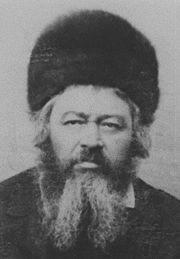
Aruch HaShulchan
Aruch HaShulchan is a chapter-by-chapter restatement of the Shulchan Arukh...
), was a Rabbi
Rabbi
In Judaism, a rabbi is a teacher of Torah. This title derives from the Hebrew word רבי , meaning "My Master" , which is the way a student would address a master of Torah...
and posek
Posek
Posek is the term in Jewish law for "decider"—a legal scholar who decides the Halakha in cases of law where previous authorities are inconclusive or in those situations where no halakhic precedent exists....
(authority in Jewish law
Halakha
Halakha — also transliterated Halocho , or Halacha — is the collective body of Jewish law, including biblical law and later talmudic and rabbinic law, as well as customs and traditions.Judaism classically draws no distinction in its laws between religious and ostensibly non-religious life; Jewish...
) in Lithuania
Lithuania
Lithuania , officially the Republic of Lithuania is a country in Northern Europe, the biggest of the three Baltic states. It is situated along the southeastern shore of the Baltic Sea, whereby to the west lie Sweden and Denmark...
. His surname is often preceded by ha-Levi, as he descended from a family of Levite
Levite
In Jewish tradition, a Levite is a member of the Hebrew tribe of Levi. When Joshua led the Israelites into the land of Canaan, the Levites were the only Israelite tribe that received cities but were not allowed to be landowners "because the Lord the God of Israel himself is their inheritance"...
s.
Biography
Yechiel Michel Epstein was born into a family of wealthy army contractors for the Czarist Russian army in BabruyskBabruysk
Babruysk or Bobruysk is a city in the Mahilyow Voblast of Belarus on the Berezina river. It is a large city in Belarus with a population of approximately 227,000 people . The name Babruysk probably originates from the Belarusian word babyor , many of which used to inhabit the Berezina...
(presently in Belarus
Belarus
Belarus , officially the Republic of Belarus, is a landlocked country in Eastern Europe, bordered clockwise by Russia to the northeast, Ukraine to the south, Poland to the west, and Lithuania and Latvia to the northwest. Its capital is Minsk; other major cities include Brest, Grodno , Gomel ,...
). His wife was the sister of Naftali Zvi Yehuda Berlin
Naftali Zvi Yehuda Berlin
Naftali Zvi Yehuda Berlin, , also known as Reb Hirsch Leib Berlin, and commonly known by the acronym Netziv, was an Orthodox rabbi, dean of the Volozhin Yeshiva and author of several works of rabbinic literature in Lithuania.- Family :Berlin was born in Mir, Russia in 1816 into a family of Jewish...
(the Netziv), who would become the rosh yeshiva
Rosh yeshiva
Rosh yeshiva, , , is the title given to the dean of a Talmudical academy . It is made up of the Hebrew words rosh — meaning head, and yeshiva — a school of religious Jewish education...
(head) of the Volozhin Yeshiva
Volozhin yeshiva
The Volozhin Yeshiva, also known as Etz Chaim Yeshiva, was a prestigious Lithuanian yeshiva located in the town of Volozhin, Russia, . It was founded by Rabbi Chaim Itzkovitz, a student of the famed Vilna Gaon, and trained several generations of scholars, rabbis, and leaders...
. (Berlin was later to marry a daughter of Epstein, after being widowed of his first wife.)
Epstein studied Torah
Torah study
Torah study is the study by Jewish people of the Torah, Hebrew Bible, Talmud, responsa, rabbinic literature and similar works, all of which are Judaism's religious texts...
locally, and was encouraged to do so by the town's rabbi and his parents (the concept of an out-of-town yeshiva was only slowly gaining ascendancy). After his marriage he received semicha
Semicha
, also , or is derived from a Hebrew word which means to "rely on" or "to be authorized". It generally refers to the ordination of a rabbi within Judaism. In this sense it is the "transmission" of rabbinic authority to give advice or judgment in Jewish law...
(rabbi
Rabbi
In Judaism, a rabbi is a teacher of Torah. This title derives from the Hebrew word רבי , meaning "My Master" , which is the way a student would address a master of Torah...
nic ordination) and accepted his first position.
Epstein became the rabbi of Novozybkov
Novozybkov
Novozybkov is a historical town in Bryansk Oblast, Russia. Population: -History:It was founded in 1701 and granted town status in 1809. Novozybkov was a major hemp supplier in the 18th and 19th centuries, particularly for the production of ropes for the Russian Navy...
(east of Gomel, now Bryansk region
Bryansk Oblast
Bryansk Oblast is a federal subject of Russia . Its administrative center is the city of Bryansk. Population: 1,278,087 .-History:...
), a town with a large number of Hasidic Jews
Hasidic Judaism
Hasidic Judaism or Hasidism, from the Hebrew —Ḥasidut in Sephardi, Chasidus in Ashkenazi, meaning "piety" , is a branch of Orthodox Judaism that promotes spirituality and joy through the popularisation and internalisation of Jewish mysticism as the fundamental aspects of the Jewish faith...
, mainly adherents of Chabad Lubavitch.
Nine years after accepting his position in Novozybkov, in 1863, Epstein was appointed as the rabbi of Navahrudak, where he would serve for 34 years, until his death. Here, he was recognised as a posek
Posek
Posek is the term in Jewish law for "decider"—a legal scholar who decides the Halakha in cases of law where previous authorities are inconclusive or in those situations where no halakhic precedent exists....
(decisor of Jewish law
Halakha
Halakha — also transliterated Halocho , or Halacha — is the collective body of Jewish law, including biblical law and later talmudic and rabbinic law, as well as customs and traditions.Judaism classically draws no distinction in its laws between religious and ostensibly non-religious life; Jewish...
), and he was to compose most of his writings in Navahrudak.
Epstein was involved in many charitable endeavors. He was particularly close to Rabbi Shmuel Salant, Chief Rabbi of Jerusalem, and wrote extensively on the obligation of all Jews to support the Rabbi Meir Baal Haneis Salant charity that Rabbi Salant founded in Israel in 1860.
Epstein died on 22 Adar II 5668 (1908), and is buried in Navahrudak. His son, Rabbi Baruch Epstein
Baruch Epstein
Baruch Epstein or Baruch ha-Levi Epstein was a Lithuanian rabbi, best known for his Torah Temimah commentary on the Torah...
, was a bookkeeper by profession but produced a number of scholarly and popular works, most notably the Torah Temimah
Torah Temimah
Disambiguation: For the Avigdor Hirsch Torah Temimah Primary School in Dollis Hill, London UK, see Torah_Temimah_Primary_SchoolThe Torah Temimah is the magnum opus of Rabbi Baruch Epstein...
.
Works
- Aruch HaShulchanAruch HaShulchanAruch HaShulchan is a chapter-by-chapter restatement of the Shulchan Arukh...
a work of HalakhaHalakhaHalakha — also transliterated Halocho , or Halacha — is the collective body of Jewish law, including biblical law and later talmudic and rabbinic law, as well as customs and traditions.Judaism classically draws no distinction in its laws between religious and ostensibly non-religious life; Jewish...
, which traces the origins of each law and custom to its source, states the view of the RishonimRishonim"Rishon" redirects here. For the preon model in particle physics, see Harari Rishon Model. For the Israeli town, see Rishon LeZion.Rishonim were the leading Rabbis and Poskim who lived approximately during the 11th to 15th centuries, in the era before the writing of the Shulkhan Arukh and...
and arrives at a psakPosekPosek is the term in Jewish law for "decider"—a legal scholar who decides the Halakha in cases of law where previous authorities are inconclusive or in those situations where no halakhic precedent exists....
(decision) - often supported by (and sometimes in disagreement with) the AcharonimAcharonimAcharonim is a term used in Jewish law and history, to signify the leading rabbis and poskim living from roughly the 16th century to the present....
; - Aruch HaShulchan he'Atid (Laying the Table of the Future) - a parallel work to Arukh HaShulkhan summarising and analysing the laws that will apply in Messianic times; this work became more relevant when Jewish farming communities were re-established in IsraelIsraelThe State of Israel is a parliamentary republic located in the Middle East, along the eastern shore of the Mediterranean Sea...
, since many agricultural laws which apply only in Israel are covered in this work; - Or li-Yesharim (a commentary on the classic work Sefer ha-Yashar, attributed to the TosafistTosafistsTosafists were medieval rabbis from France and Germany who are among those known in Talmudical scholarship as Rishonim who created critical and explanatory glosses on the Talmud. These were collectively called Tosafot , because they were additions on the commentary of Rashi...
Rabbi Yaakov ben Meir, Rabbeinu Tam); - Mical ha-Mayim - a commentary on the Jerusalem TalmudJerusalem TalmudThe Jerusalem Talmud, talmud meaning "instruction", "learning", , is a collection of Rabbinic notes on the 2nd-century Mishnah which was compiled in the Land of Israel during the 4th-5th century. The voluminous text is also known as the Palestinian Talmud or Talmud de-Eretz Yisrael...
; - Leil Shimurim - a commentary on the Haggada.
External links
- Biography of Rabbi Yechiel Mechel Epstein
- Arukh HaShulhan at Hebrew Wikitext (Hebrew text)
- Aruch Hashulchan Orach Chaim (incomplete English translation)
- A Collection of Studies on the Aruch HaShulchan, its author, and the history of its publication
- Arukh HaShulhan Yomi - Daily study cycle at AishDas
- Classes on Aruch Hashulhan
- HebrewBooks has most of the Arukh HaShulhan scanned in pdf format (search for ערוך השלחן)