

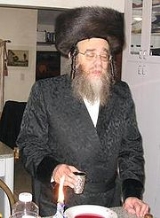
Havdalah

Encyclopedia


Judaism
Judaism ) is the "religion, philosophy, and way of life" of the Jewish people...
ceremony that marks the symbolic end of Shabbat
Shabbat
Shabbat is the seventh day of the Jewish week and a day of rest in Judaism. Shabbat is observed from a few minutes before sunset on Friday evening until a few minutes after when one would expect to be able to see three stars in the sky on Saturday night. The exact times, therefore, differ from...
and holidays, and ushers in the new week. Shabbat ends on Saturday night after the appearance of three stars in the sky. Some communities delay the Havdalah in order to prolong Shabbat.
Ritual
Havdalah is recited over kosher wineKosher wine
Kosher wine is grape wine produced according to Judaism's religious law, specifically, Jewish dietary laws .To be considered kosher, Sabbath-observant Jews must be involved in the entire winemaking process and any ingredients used, including finings, must be kosher...
or kosher grape juice
Grape juice
Grape juice is obtained from crushing and blending grapes into a liquid. The juice is often sold in stores or fermented and made into wine, brandy, or vinegar. In the wine industry, grape juice that contains 7-23 percent of pulp, skins, stems and seeds is often referred to as "must"...
, although other beverages may be used if wine or grape juice are not available. On completion of the Shabbat, a special braided Havdalah candle with more than one wick is lit, and a prayer is recited. It is customary to gaze at one's fingernails reflecting the light of the candle. Spices, often stored in a decorative spice container, are handed around so that everyone can smell the fragrance. In many Sephardi and Mizrahi communities, branches of aromatic plants are used for this purpose. After Yom Kippur
Yom Kippur
Yom Kippur , also known as Day of Atonement, is the holiest and most solemn day of the year for the Jews. Its central themes are atonement and repentance. Jews traditionally observe this holy day with a 25-hour period of fasting and intensive prayer, often spending most of the day in synagogue...
, a candle is used, but not spices.
It has long been customary to beautify and honor the Mitzvah
Mitzvah
The primary meaning of the Hebrew word refers to precepts and commandments as commanded by God...
of Havdalah by placing the spices in an artistically beautiful spice box
Jewish ceremonial art
Jewish ceremonial art, also known as Judaica refers to an array of objects used by Jews for ritual purposes. Because enhancing a mitzvah by performing it with an especially beautiful object is considered a praiseworthy way of honoring God's commandments, Judaism has a long tradition of...
, called a besamim.
Havdalah is intended to require a person to use all five senses—to taste the wine, smell the spices, see the flame of the candle and feel its heat, and hear the blessings.
According to some customs, at the conclusion of Havdalah, the leftover wine is poured into a small dish and the candle is extinguished in it, as a sign that the candle was lit solely for the mitzvah
Mitzvah
The primary meaning of the Hebrew word refers to precepts and commandments as commanded by God...
of Havdalah. Based on Psalms 19:9, "the commandment of the Lord is clear, enlightening the eyes," some Jews dip a finger into the leftover wine and touch their eyes or pockets with it. Because it was used for a mitzvah, the wine is considered a "segulah," or good omen.
When a major holiday follows Shabbat, the Havdalah service is recited as part of the holiday kiddush
Kiddush
Kiddush , literally, "sanctification," is a blessing recited over wine or grape juice to sanctify the Shabbat and Jewish holidays.-Significance:...
. No spices are used, and although the blessing is recited over the candle, the candle used is not the special braided Havdalah candle, but rather the Festival candles that are lit. This variation shows that the holiday time continues.
Some Hassidic Jews, particularly (though not exclusively) women, recite the Yiddish prayer God of Abraham
God of Abraham
God of Abraham is a Jewish prayer in Yiddish, recited by women and girls in many Jewish communities at the conclusion of the Sabbath, marking its conclusion . In some Hasidic sects it is also recited by males before the Havdalah, service...
before Havdalah. After the Havdalah candle, it is customary to sing "Eliyahu Hanavi" and bless one another with the words "Shavua' tov" (Hebrew) or "Gute vokh" (Yiddish) (Have a good week). In some households, the participants break into a dance.
The text
The central blessing of the Havdalah is the following paragraph, of which there are variants :- "Blessed art thou, God, our Lord, King of the Universe
- Who distinguishes
- Holiness from profanity,
- Light from dark,
- Israel from the nations,
- The seventh day from the six workdays.
- Blessed art thou, God,
- Who distinguishes holiness from profanity."
The text of the Havdalah service exists in two main forms, Ashkenazic and Sephardic. The introductory verses in the Ashkenazic version (beginning הנה אל, Hinei El) are taken from the biblical books of Isaiah
Isaiah
Isaiah ; Greek: ', Ēsaïās ; "Yahu is salvation") was a prophet in the 8th-century BC Kingdom of Judah.Jews and Christians consider the Book of Isaiah a part of their Biblical canon; he is the first listed of the neviim akharonim, the later prophets. Many of the New Testament teachings of Jesus...
, Psalms
Psalms
The Book of Psalms , commonly referred to simply as Psalms, is a book of the Hebrew Bible and the Christian Bible...
and Esther
Esther
Esther , born Hadassah, is the eponymous heroine of the Biblical Book of Esther.According to the Bible, she was a Jewish queen of the Persian king Ahasuerus...
. In the Sephardic liturgy, the introduction begins with the words ראשון לציון, Rishon L'tsion and consists of biblical verses describing God giving light and success interspersed with later liturgical prose. The four blessings over the wine, spices candle and praising God for separation between holy and profane are virtually identical between the traditions. In Reconstructionist Judaism the phrase ביו ישראל לעמים, bein Yisrael l'amim 'between Israel and the nations' is omitted, as part of founder Mordechai Kaplan's rejection of the idea of chosenness.
Popular tunes for the introductory paragraph of Havdalah ('Hinei El Y'shuati') in the Ashkenazic rite are The Rose (song)
The Rose (song)
"The Rose" is a pop song written by Amanda McBroom and made famous by Bette Midler, who performed it in the 1979 movie, The Rose. Since then it has been covered by a variety of artists.-Bette Midler version:...
by Bette Midler
Bette Midler
Bette Midler is an American singer, actress, and comedian, also known by her informal stage name, The Divine Miss M. She became famous as a cabaret and concert headliner, and went on to star in successful and acclaimed films such as The Rose, Ruthless People, Beaches, and For The Boys...
and melodies by Shlomo Carlebach
Shlomo Carlebach
Shlomo Carlebach , known as Reb Shlomo to his followers, was a Jewish rabbi, religious teacher, composer, and singer who was known as "The Singing Rabbi" during his lifetime...
and Neshama Carlebach
Neshama Carlebach
Neshama Carlebach , daughter of the Jewish singer-songwriter Rabbi Shlomo Carlebach is a singer, the protege of her late father.-Biography:...
. The Blessings themselves are often sung to a tune made popular by contemporary Jewish artist/composer Debbie Friedman
Debbie Friedman
Deborah Lynn "Debbie" Friedman was an American composer and singer of songs with Jewish religious content. She was born in Utica, New York but moved with her family to Minnesota at age 5. She is best known for her setting of “Mi Shebeirach”, the prayer for healing, which is used by hundreds of...
.
Most chassidim
Hasidic Judaism
Hasidic Judaism or Hasidism, from the Hebrew —Ḥasidut in Sephardi, Chasidus in Ashkenazi, meaning "piety" , is a branch of Orthodox Judaism that promotes spirituality and joy through the popularisation and internalisation of Jewish mysticism as the fundamental aspects of the Jewish faith...
and those following the Sefard
Nusach Sefard
Nusach Sefard is the name for various forms of the Jewish siddur, designed to reconcile Ashkenazi customs with the kabbalistic customs of the Ari. To this end it has incorporated the wording of Nusach Edot Mizrach, the prayer book of Sefardi Jews, into certain prayers...
prayer rite recite the Yiddish prayer Gott fun Avrohom
God of Abraham
God of Abraham is a Jewish prayer in Yiddish, recited by women and girls in many Jewish communities at the conclusion of the Sabbath, marking its conclusion . In some Hasidic sects it is also recited by males before the Havdalah, service...
. The introduction to the Sefardic version is slightly different.
See List of Jewish prayers and blessings: Havdalah.
Following a normal Shabbat, the order of the prayers corresponds to the acrostic יבנ"ה "Yavneh", with the initials Yayin (wine), Besamim (spices), Ner (candle), and Havdalah (the Havdalah prayer). The order of elements when Havdala is combined with kiddush
Kiddush
Kiddush , literally, "sanctification," is a blessing recited over wine or grape juice to sanctify the Shabbat and Jewish holidays.-Significance:...
(e.g., on a Saturday night that is 'Yom Tov' (i.e., literally, 'Good Day') is known by the acrostic Yaknhaz. This is the initial letters of Yayin (wine), Kiddush HaYom (blessing the day), Ner (candle), Havdala (the Havdala blessing) and Zman (time, i.e. shehechiyanu).