
Great artists have no country.
L’Orfèvre, Lorenzaccio (1834).
Je suis venu trop tard dans un monde trop vieux. (I have come too late into a world too old.)
Rolla (1834)
Je ne sais où va mon chemin, mais je marche mieux quand ma main serre la tienne. ("À mon frère revenant d'Italie", mars 1844)
Quel que soit le souci que ta jeunesse endure,Laisse-la s'élargir, cette sainte blessureQue les noirs séraphins t'ont faite au fond du coeur ;Rien ne nous rend si grands qu'une grande douleurMais, pour en être atteint, ne crois pas, ô poèteQue ta voix ici-bas doive rester muette.Les plus déseperés sont les chants les plus beaux,Et j'en sais d'immortels qui sont de purs sanglots.("La Nuit de Mai", 1835)
On est souvent trompé en amour, souvent blessé et souvent malheureux; mais on aime, et quand on est sur le bord de sa tombe, on se retourne pour regarder en arrière et on se dit : j'ai souffert souvent, je me suis trompé quelquefois, mais j'ai aimé. C'est moi qui ai vécu, et non pas un être factice créé par mon orgueil et mon ennui. (Acte II, Scène V)
"The apartments of the rich are cabinets of curiosities: a conglomeration of classical antiquity, gothic, renaissance; Louis XIII...Something from every century but our own, a predicament that has arisen in no other period... so that we seem to be subsisting on the ruins of the past, as if the end of the world were near" (this quotation is useful for explanations of the period of art nouveau, and the causes of the art movement)
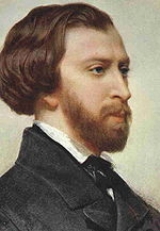
Alfred Louis Charles de Musset-Pathay (11 December 1810 – 2 May 1857) was a
FrenchThe French Republic , The French Republic , The French Republic , (commonly known as France , is a unitary semi-presidential republic in Western Europe with several overseas territories and islands located on other continents and in the Indian, Pacific, and Atlantic oceans. Metropolitan France...
dramatist,
poetA poet is a person who writes poetry. A poet's work can be literal, meaning that his work is derived from a specific event, or metaphorical, meaning that his work can take on many meanings and forms. Poets have existed since antiquity, in nearly all languages, and have produced works that vary...
, and novelist.
Along with his poetry, he is known for writing
La Confession d'un enfant du siècle (
The Confession of a Child of the Century, autobiographical) from 1836.
Biography
Musset was born on 11 December 1810 in
ParisParis is the capital and largest city in France, situated on the river Seine, in northern France, at the heart of the Île-de-France region...
. His family was upper-class but poor and his father worked in various key government positions, but never gave his son any money. His mother was similarly accomplished, and her role as a society hostess, - for example her drawing-room parties, luncheons, and dinners, held in the Musset residence - left a lasting impression on young Alfred.
Early indications of Musset's boyhood talents were seen by his fondness for acting impromptu mini-plays based upon episodes from old romance stories he had read. Years later, elder brother Paul de Musset would preserve these, and many other details, for posterity, in a biography on his famous younger brother.
Alfred de Musset entered the collège Henri-IV at the age of nine, where in 1827 he won the Latin essay prize in the
Concours généralIn France, the concours général is a national competition held every year between students of Première and Terminale in almost all subjects taught in both general, technological and professional high schools...
. With the help of
Paul FoucherPaul-Henri Foucher was a French playwright, theatre and music critic, political journalist, and novelist.-Early career:...
,
Victor HugoVictor-Marie Hugo was a Frenchpoet, playwright, novelist, essayist, visual artist, statesman, human rights activist and exponent of the Romantic movement in France....
's brother-in-law, he began to attend, at the age of 17, the
CénacleCénacle is the name given to a Parisian literary group of varying constituency that began about 1826 to gather around Charles Nodier. The group sought to revive in French literature the old monarchical spirit, the spirit of mediæval mystery and spiritual submission. The chief members were Vigny...
, the literary salon of
Charles NodierJean Charles Emmanuel Nodier , was a French author who introduced a younger generation of Romanticists to the conte fantastique, gothic literature, vampire tales, and the importance of dreams as part of literary creation, and whose career as a librarian is often underestimated by literary...
at the
Bibliothèque de l'ArsenalThe Bibliothèque de l'Arsenal in Paris is one of the branches of the Bibliothèque nationale de France.-History:...
. After attempts at careers in medicine (which he gave up owing to a distaste for dissections), law,
drawing, English and piano, he became one of the first
RomanticRomanticism was an artistic, literary and intellectual movement that originated in the second half of the 18th century in Europe, and gained strength in reaction to the Industrial Revolution...
writers, with his first collection of poems,
Contes d'Espagne et d'Italie (1829, Tales of Spain and Italy).
By the time he reached the age of 20, his rising literary fame was already accompanied by a sulphurous reputation fed by his dandy side.
He was the librarian of the French Ministry of the Interior under the
July MonarchyThe July Monarchy , officially the Kingdom of France , was a period of liberal constitutional monarchy in France under King Louis-Philippe starting with the July Revolution of 1830 and ending with the Revolution of 1848...
. During this time he also involved himself in polemics during the Rhine crisis of 1840, caused by the French prime minister
Adolphe ThiersMarie Joseph Louis Adolphe Thiers was a French politician and historian. was a prime minister under King Louis-Philippe of France. Following the overthrow of the Second Empire he again came to prominence as the French leader who suppressed the revolutionary Paris Commune of 1871...
, who as Minister of the Interior had been Musset's superior. had demanded that France should own the left bank of the
Rhine (described as France's "natural boundary"), as it had under Napoleon, despite the territory's German population. These demands were rejected by German songs and poems, including Nikolaus Becker's
Rheinlied, which contained the verse:
"Sie sollen ihn nicht haben, den freien, deutschen Rhein ..." (
They shall not have it, the free, German Rhine). Musset answered to this with a poem of his own:
"Nous l'avons eu, votre Rhin allemand" (
We've had it, your German Rhine).
The tale of his celebrated love affair with
George SandAmantine Lucile Aurore Dupin, later Baroness Dudevant , best known by her pseudonym George Sand , was a French novelist and memoirist.-Life:...
, which lasted from 1833 to 1835, is told from his point of view in his
autobiographicalAn autobiography is a book about the life of a person, written by that person.-Origin of the term:...
novel,
La Confession d'un Enfant du Siècle (
The Confession of a Child of the Century,
made into a film,
Children of the CenturyChildren of the Century is a 1999 French film based on the true tale of the tumultuous love affair between two French literary icons of the 19th Century, novelist George Sand and poet Alfred de Musset .-Plot summary:...
), and from her point of view in her
Elle et lui. Musset's
Nuits (1835–1837, Nights) trace his emotional upheaval of his love for George Sand, from early despair to final resignation. He is also believed to be the author of
Gamiani, or Two Nights of Excess (1833), a lesbian erotic novel, also believed to be modeled on George Sand.
Musset was dismissed from his post as librarian by the new minister Ledru-Rollin after the revolution of 1848. He was however appointed librarian of the Ministry of Public Instruction in 1853.
Musset received the
Légion d'honneurThe Legion of Honour, or in full the National Order of the Legion of Honour is a French order established by Napoleon Bonaparte, First Consul of the Consulat which succeeded to the First Republic, on 19 May 1802...
on 24 April 1845, at the same time as
BalzacHonoré de Balzac was a French novelist and playwright. His magnum opus was a sequence of short stories and novels collectively entitled La Comédie humaine, which presents a panorama of French life in the years after the 1815 fall of Napoleon....
, and was elected to the
Académie françaiseL'Académie française , also called the French Academy, is the pre-eminent French learned body on matters pertaining to the French language. The Académie was officially established in 1635 by Cardinal Richelieu, the chief minister to King Louis XIII. Suppressed in 1793 during the French Revolution,...
in 1852 (after two failures to do so in 1848 and 1850).
Alfred de Musset died in his sleep on 2 May 1857. The cause was heart failure, the combination of alcoholism and a longstanding
aortic insufficiencyAortic insufficiency , also known as aortic regurgitation , is the leaking of the aortic valve of the heart that causes blood to flow in the reverse direction during ventricular diastole, from the aorta into the left ventricle....
. One symptom that had been noticed by his brother was a bobbing of the head as a result of the amplification of the pulse; this was later called
de Musset's signde Musset's sign is a condition in which there is rhythmic nodding or bobbing of the head in synchrony with the beating of the heart, in general as a result of aortic insufficiency caused by aortic regurgitation due to aortic valve deficiency. The condition was named after the French poet Alfred de...
. He was buried in
Père Lachaise CemeteryPère Lachaise Cemetery is the largest cemetery in the city of Paris, France , though there are larger cemeteries in the city's suburbs.Père Lachaise is in the 20th arrondissement, and is reputed to be the world's most-visited cemetery, attracting hundreds of thousands of visitors annually to the...
in Paris.
Reception
The French poet
Arthur RimbaudJean Nicolas Arthur Rimbaud was a French poet. Born in Charleville, Ardennes, he produced his best known works while still in his late teens—Victor Hugo described him at the time as "an infant Shakespeare"—and he gave up creative writing altogether before the age of 21. As part of the decadent...
was highly critical of Musset's work. Rimbaud wrote in his
Letters of a Seer (
Lettres du Voyant) that Musset did not accomplish anything because he "closed his eyes" before the visions. (Lettre à Paul Demeny, mai 1871)
Director
Jean RenoirJean Renoir was a French film director, screenwriter, actor, producer and author. As a film director and actor, he made more than forty films from the silent era to the end of the 1960s...
's
La règle du jeuThe Rules of the Game is a 1939 French film directed by Jean Renoir about upper-class French society just before the start of World War II...
was inspired by Musset's play,
Les Caprices de Marianne.
Henri GervexHenri Gervex was a French painter born in Paris, and studied painting under Alexandre Cabanel, Pierre-Nicolas Brisset and Eugène Fromentin....
's 1878 painting
Rolla was based on a poem by de Musset. It was rejected by the jury of the Salon de Paris for immorality, since it depicted a scene from the poem of a naked prostitute after having sex with her client - but the controversy helped Gervex's career.
Music
Lorenzaccio, which takes place in Medici's Florence, was set to music by the musician
Sylvano BussottiSylvano Bussotti is an Italian composer of contemporary music whose work is unusually notated and often creates special problems of interpretation.Born in Florence, Bussotti learned to play the violin as a child, becoming a prodigy...
in 1972.
In 2007, Céline Dion recorded a song called "Lettre de George Sand à Alfred de Musset" for her album D'elles.
Poetry
- Contes d'Espagne et d'Italie, 1829
- Un Spectacle dans un fauteuil, 1832
- Poésies complètes, 1840
- Poésies nouvelles, 1850
- Les Nuits (Nuits de mai, d'août, d'octobre, de décembre), 1835–1837
- Œuvres posthumes, 1860
Plays
- La Nuit vénitienne, 1830
- a failure; from this point until 1847, his plays were published but not performed
- André del Sarto, 1833
- Les Caprices de Marianne
Les caprices de Marianne is a two-act opéra comique by Henri Sauguet with a French libretto by Jean-Pierre Grédy after Alfred de Musset. It was first performed at the Aix-en-Provence Festival in 1954, with the Orchestre de la Société des Concerts du Conservatoire conducted by Louis de Froment with...
, 1833
- Lorenzaccio
Lorenzaccio is a French play of the Romantic period written by Alfred de Musset in 1834, set in 16th-century Florence, and depicting Lorenzino de' Medici, who killed Florence's tyrant, Alessandro de' Medici, his cousin. Having engaged in debaucheries to gain the Duke's confidence, he loses the...
, 1833
- Fantasio, 1834
- On ne badine pas avec l'amour, 1834
- La Quenouille de Barberine, 1835
- Le Chandelier, 1835
- Il ne faut jurer de rien, 1836
- Un Caprice, 1837
- first performed in 1847, and a huge success, leading to the performance of other plays
- Il faut qu'une porte soit ouverte ou fermée, 1845
- On ne saurait penser à tout, 1849
- Carmosine, 1850
- Bettine, 1851
- L'Âne et le Ruisseau, 1855
Novels
- La Confession d'un enfant du siècle (The Confession of a Child of the Century, autobiographical), 1836.
- Histoire d'un merle blanc (The White Blackbird), 1842.
External links