


Giacomo Meyerbeer

Encyclopedia
Germany
Germany , officially the Federal Republic of Germany , is a federal parliamentary republic in Europe. The country consists of 16 states while the capital and largest city is Berlin. Germany covers an area of 357,021 km2 and has a largely temperate seasonal climate...
opera
Opera
Opera is an art form in which singers and musicians perform a dramatic work combining text and musical score, usually in a theatrical setting. Opera incorporates many of the elements of spoken theatre, such as acting, scenery, and costumes and sometimes includes dance...
composer
Composer
A composer is a person who creates music, either by musical notation or oral tradition, for interpretation and performance, or through direct manipulation of sonic material through electronic media...
, and the first great exponent of "grand opera
Grand Opera
Grand opera is a genre of 19th-century opera generally in four or five acts, characterised by large-scale casts and orchestras, and lavish and spectacular design and stage effects, normally with plots based on or around dramatic historic events...
." At his peak in the 1830s and 1840s, he was the most famous and successful composer of opera in Europe, yet he is rarely performed today.
Early years
He was born to a Jewish family in Tasdorf (now a part of RüdersdorfRüdersdorf
Rüdersdorf is a municipality in the district Märkisch-Oderland, in Brandenburg, Germany.-Overview:It is situated 26 km east of Berlin . Rüdersdorf is famous for its limestone-open-pit mining. Today some parts of the mine are used as a museum...
), near Berlin
Berlin
Berlin is the capital city of Germany and is one of the 16 states of Germany. With a population of 3.45 million people, Berlin is Germany's largest city. It is the second most populous city proper and the seventh most populous urban area in the European Union...
with the name Jacob Liebmann Beer. His father was the enormously wealthy financier Jacob Judah Herz Beer (1769-1825) and his much-beloved mother, Amalia Liebmann Meyer Wulff (1767-1854) also came from the wealthy elite. Their other children included the astronomer
Astronomer
An astronomer is a scientist who studies celestial bodies such as planets, stars and galaxies.Historically, astronomy was more concerned with the classification and description of phenomena in the sky, while astrophysics attempted to explain these phenomena and the differences between them using...
Wilhelm Beer and the poet Michael Beer.
Franz Lauska
Franz Seraphin Lauska was a Moravian pianist, composer, and teacher of Giacomo Meyerbeer. Lauska was considered "one of the most brilliant executants of his time."- Biography :...
, a pupil of Johann Georg Albrechtsberger
Johann Georg Albrechtsberger
Johann Georg Albrechtsberger was an Austrian musician who was born at Klosterneuburg, near Vienna.He originally studied music at Melk Abbey and philosophy at a Benedictine seminary in Vienna and became one of the most learned and skillful contrapuntists of his age...
and a favoured teacher at the Berlin court. Beer also became one of Muzio Clementi
Muzio Clementi
Muzio Clementi was a celebrated composer, pianist, pedagogue, conductor, music publisher, editor, and piano manufacturer. Born in Italy, he spent most of his life in England. He is best known for his piano sonatas, and his collection of piano studies, Gradus ad Parnassum...
's pupils while Clementi was in Berlin, and old Clementi himself, although he had long given up teaching, was so much struck, during a visit to Berlin, with the promise displayed in the boy's performance as to consent to give Beer lessons. Beer made his public debut in 1801 playing Mozart
Wolfgang Amadeus Mozart
Wolfgang Amadeus Mozart , baptismal name Johannes Chrysostomus Wolfgangus Theophilus Mozart , was a prolific and influential composer of the Classical era. He composed over 600 works, many acknowledged as pinnacles of symphonic, concertante, chamber, piano, operatic, and choral music...
's D minor Piano Concerto
Piano Concerto No. 20 (Mozart)
The Piano Concerto No. 20 in D minor, K. 466, was written by Wolfgang Amadeus Mozart in 1785. The first performance took place at the Mehlgrube Casino in Vienna on February 11, 1785, with the composer as the soloist.-Background:...
in Berlin. The Allgemeine musikalische Zeitung
Allgemeine musikalische Zeitung
The Allgemeine musikalische Zeitung was a German-language periodical published in the 19th century. Comini has called it "the foremost German-language musical periodical of its time"...
reported: 'The amazing keyboard playing of young Bär (a Jewish lad of 9), who carried off the difficult passages and other solo parts with aplomb, and has fine powers of rendition even more rarely found in one of his age, made the concert even more interesting'.
Throughout his youth, although he was determined to become a musician, Beer found it difficult to decide between playing and composition. Certainly other professionals in the decade 1810-1820, including Moscheles
Ignaz Moscheles
Ignaz Moscheles was a Bohemian composer and piano virtuoso, whose career after his early years was based initially in London, and later at Leipzig, where he succeeded his friend and sometime pupil Felix Mendelssohn as head of the Conservatoire.-Sources:Much of what we know about Moscheles's life...
, considered him amongst the greatest virtuosi of his period.
Study in Italy and change of name
Beer, as he still was, studied with Antonio SalieriAntonio Salieri
Antonio Salieri was a Venetian classical composer, conductor and teacher born in Legnago, south of Verona, in the Republic of Venice, but who spent his adult life and career as a faithful subject of the Habsburg monarchy....
and the German master and friend of Goethe
Johann Wolfgang von Goethe
Johann Wolfgang von Goethe was a German writer, pictorial artist, biologist, theoretical physicist, and polymath. He is considered the supreme genius of modern German literature. His works span the fields of poetry, drama, prose, philosophy, and science. His Faust has been called the greatest long...
, Carl Friedrich Zelter
Carl Friedrich Zelter
Carl Friedrich Zelter was a German composer, conductor and teacher of music.Zelter became friendly with Johann Wolfgang von Goethe, and his works include settings of Goethe's poems...
. Realizing that a full understanding of Italian
Italian language
Italian is a Romance language spoken mainly in Europe: Italy, Switzerland, San Marino, Vatican City, by minorities in Malta, Monaco, Croatia, Slovenia, France, Libya, Eritrea, and Somalia, and by immigrant communities in the Americas and Australia...
opera was essential for his musical development, however, he went to study in Italy
Italy
Italy , officially the Italian Republic languages]] under the European Charter for Regional or Minority Languages. In each of these, Italy's official name is as follows:;;;;;;;;), is a unitary parliamentary republic in South-Central Europe. To the north it borders France, Switzerland, Austria and...
for some years, during which time he adopted the first name "Giacomo." The "Meyer" in his surname he adopted after the death of his great-grandfather. It was during these years in Italy that he became acquainted with, and impressed by, the works of his contemporary Gioachino Rossini.
Recognition
Il crociato in Egitto
Il crociato in Egitto is an opera in two acts by Giacomo Meyerbeer, with a libretto by Gaetano Rossi. It was first performed at La Fenice theatre, Venice on 7 March, 1824. The part of Armando was sung by the famous castrato, Giovanni Battista Velluti; the opera was probably the last ever written...
— premiered in Venice
Venice
Venice is a city in northern Italy which is renowned for the beauty of its setting, its architecture and its artworks. It is the capital of the Veneto region...
in 1824 and produced in London
London
London is the capital city of :England and the :United Kingdom, the largest metropolitan area in the United Kingdom, and the largest urban zone in the European Union by most measures. Located on the River Thames, London has been a major settlement for two millennia, its history going back to its...
and Paris
Paris
Paris is the capital and largest city in France, situated on the river Seine, in northern France, at the heart of the Île-de-France region...
in 1825; incidentally the last opera ever to feature a castrato
Castrato
A castrato is a man with a singing voice equivalent to that of a soprano, mezzo-soprano, or contralto voice produced either by castration of the singer before puberty or one who, because of an endocrinological condition, never reaches sexual maturity.Castration before puberty prevents a boy's...
. But Meyerbeer became virtually a superstar with Robert le diable
Robert le diable (opera)
Robert le diable is an opera by Giacomo Meyerbeer, often regarded as the first grand opera. The libretto was written by Eugène Scribe and Casimir Delavigne and has little connection to the medieval legend of Robert the Devil. Originally planned as a three-act opéra comique, "Meyerbeer persuaded...
(with libretto by Eugène Scribe
Eugène Scribe
Augustin Eugène Scribe , was a French dramatist and librettist. He is best known for the perfection of the so-called "well-made play" . This dramatic formula was a mainstay of popular theater for over 100 years.-Biography:...
and Casimir Delavigne
Casimir Delavigne
Jean-François Casimir Delavigne was a French poet and dramatist.-Biography:Delavigne was born at Le Havre, but was sent to Paris to be educated at the Lycée Napoleon. He read extensively...
), produced in Paris in 1831 and regarded by some as the first grand opera
Grand Opera
Grand opera is a genre of 19th-century opera generally in four or five acts, characterised by large-scale casts and orchestras, and lavish and spectacular design and stage effects, normally with plots based on or around dramatic historic events...
, although this honour rightly belongs to Auber's La muette de Portici
La muette de Portici
La muette de Portici originally called Masaniello, ou La muette de Portici, is an opera in five acts by Daniel Auber, with a libretto by Germain Delavigne, revised by Eugène Scribe...
.
The fusion of dramatic music, melodramatic plot, and sumptuous staging proved a sure-fire formula, which Meyerbeer would go on to repeat in Les Huguenots
Les Huguenots
Les Huguenots is a French opera by Giacomo Meyerbeer, one of the most popular and spectacular examples of the style of grand opera. The opera is in five acts and premiered in Paris in 1836. The libretto was written by Eugène Scribe and Émile Deschamps....
(1836), Le prophète
Le prophète
Le prophète is an opera in five acts by Giacomo Meyerbeer. The French-language libretto was by Eugène Scribe.-Performance history:...
(1849), and L'Africaine
L'Africaine
L'africaine is a grand opera, the last work of the composer Giacomo Meyerbeer. The French libretto was written by Eugène Scribe. The opera is about fictitious events in the life of the real historical person Vasco da Gama...
, (produced posthumously, 1865). All of these operas held the international stage throughout the 19th century, as did the more pastoral Dinorah
Dinorah
Dinorah, originally Le pardon de Ploërmel , is an 1859 French opéra comique in three acts with music by Giacomo Meyerbeer and a libretto by Jules Barbier and Michel Carré...
(1859).
Meyerbeer, who had settled in Paris, left for Berlin in 1842 to take the post of court music director, but he returned to Paris in 1849.
Wealth and faith
Meyerbeer's immense wealth (increased by the success of his operas) and his continuing adherence to his Jewish religionJudaism
Judaism ) is the "religion, philosophy, and way of life" of the Jewish people...
set him apart somewhat from many of his musical contemporaries. They also gave rise to malicious rumours that his success was due to his bribing musical critics. Richard Wagner
Richard Wagner
Wilhelm Richard Wagner was a German composer, conductor, theatre director, philosopher, music theorist, poet, essayist and writer primarily known for his operas...
(see below) accused him of being interested only in money, not music.
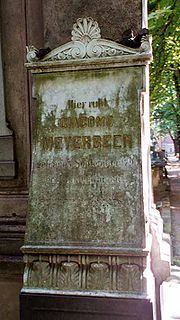
Meyerbeer was, however, a deeply serious musician and a sensitive personality. He philosophically resigned himself to being a victim of his own success: his extensive diaries and correspondence — which survived the turmoil of 20th century Europe and are now being published; 6 volumes so far out of 7 — are an invaluable source for the history of music and theatre in the composer's time. Meyerbeer was interred in the Berlin Jewish cemetery in Schönhauser Allee, amongst other members of the Beer family.
Meyerbeer and Richard Wagner
The vitriolic campaign of Richard WagnerRichard Wagner
Wilhelm Richard Wagner was a German composer, conductor, theatre director, philosopher, music theorist, poet, essayist and writer primarily known for his operas...
against Meyerbeer was to a great extent responsible for the decline of Meyerbeer's popularity after his death in 1864. This campaign was as much a matter of personal spite as of racism
Racism
Racism is the belief that inherent different traits in human racial groups justify discrimination. In the modern English language, the term "racism" is used predominantly as a pejorative epithet. It is applied especially to the practice or advocacy of racial discrimination of a pernicious nature...
- Wagner had learnt a great deal from Meyerbeer and indeed Wagner's early opera Rienzi
Rienzi
Rienzi, der Letzte der Tribunen is an early opera by Richard Wagner in five acts, with the libretto written by the composer after Bulwer-Lytton's novel of the same name . The title is commonly shortened to Rienzi...
(1842) has, facetiously, been called 'Meyerbeer's most successful work'. Meyerbeer supported the young Wagner, both financially and in obtaining a production of Rienzi at Dresden
Dresden
Dresden is the capital city of the Free State of Saxony in Germany. It is situated in a valley on the River Elbe, near the Czech border. The Dresden conurbation is part of the Saxon Triangle metropolitan area....
.
However, Wagner resented Meyerbeer's continuing success at a time when his own vision of German opera had little chance of prospering. After the May Uprising in Dresden
May Uprising in Dresden
The May Uprising took place in Dresden, Germany in 1849; it was one of the last of the series of events known as the Revolutions of 1848.-Events leading to the May Uprising:...
of 1849, Wagner was for some years a political refugee facing a prison sentence or worse in Saxony
Saxony
The Free State of Saxony is a landlocked state of Germany, contingent with Brandenburg, Saxony Anhalt, Thuringia, Bavaria, the Czech Republic and Poland. It is the tenth-largest German state in area, with of Germany's sixteen states....
. During this period when he was gestating his Ring cycle, he had few sources of income apart from journalism and benefactors, and little opportunity of getting his own works performed. The success of Le prophète
Le prophète
Le prophète is an opera in five acts by Giacomo Meyerbeer. The French-language libretto was by Eugène Scribe.-Performance history:...
sent Wagner over the edge, and he was also deeply envious of Meyerbeer's wealth. After Meyerbeer's death Wagner reissued his 1850 essay Das Judenthum in der Musik
Das Judenthum in der Musik
Das Judenthum in der Musik is an essay by Richard Wagner, attacking Jews in general and the composers Giacomo Meyerbeer and Felix Mendelssohn in particular, which was published under a pseudonym in the Neue Zeitschrift für Musik of Leipzig in...
(Judaism in Music), in 1868, in an extended form, with a far more explicit attack on Meyerbeer. This version was under Wagner's own name - for the first version he had sheltered behind a pseudonym - and as Wagner had by now a far greater reputation, his views obtained far wider publicity.
These attacks on Meyerbeer (which also included a swipe at Felix Mendelssohn
Felix Mendelssohn
Jakob Ludwig Felix Mendelssohn Barthóldy , use the form 'Mendelssohn' and not 'Mendelssohn Bartholdy'. The Grove Dictionary of Music and Musicians gives ' Felix Mendelssohn' as the entry, with 'Mendelssohn' used in the body text...
) are regarded by Paul Lawrence Rose
Paul Lawrence Rose
Paul Lawrence Rose is the Professor of European History and Mitrani Professor of Jewish Studies at Pennsylvania State University.Rose specializes in the study of anti-Semitism, Germany history, European intellectual history, and Jewish history. -Notes:...
as a significant milestone in the growth of German anti-Semitism
Anti-Semitism
Antisemitism is suspicion of, hatred toward, or discrimination against Jews for reasons connected to their Jewish heritage. According to a 2005 U.S...
.
Vernon Dobtcheff
Vernon Dobtcheff
Vernon Dobtcheff is a French and British actor.Dobtcheff was born in Nîmes, France, to a family of Russian descent. He attended Ascham Preparatory School in Eastbourne, Sussex, England, in the 1940s, where he won the Acting Cup...
played Giacomo Meyerbeer, (a relatively minor role), in the 1983 film Wagner.
Modern productions of Meyerbeer
Meyerbeer's costly operas, requiring grand casts of leading singers, were gradually dropped from the repertoire in the early 20th century. They were banned by the NaziNazism
Nazism, the common short form name of National Socialism was the ideology and practice of the Nazi Party and of Nazi Germany...
regime because the composer was Jewish, and this was a major factor in their further disappearance from the repertory. However, the operas are now beginning to be regularly revived and recorded, although (despite the efforts of such champions as Dame Joan Sutherland
Joan Sutherland
Dame Joan Alston Sutherland, OM, AC, DBE was an Australian dramatic coloratura soprano noted for her contribution to the renaissance of the bel canto repertoire from the late 1950s through to the 1980s....
, who took part in performances of, and recorded, Les Huguenots) they have yet to achieve anything like the huge popular following they attracted during their creator's lifetime.
Amongst reasons often adduced for the dearth of modern productions are the scale of Meyerbeer's more ambitious works and the cost of mounting them, as well as the alleged lack of virtuoso singers capable of doing justice to Meyerbeer's demanding music. However, recent successful productions of some of the major operas at relatively small centres such as Strasbourg
Strasbourg
Strasbourg is the capital and principal city of the Alsace region in eastern France and is the official seat of the European Parliament. Located close to the border with Germany, it is the capital of the Bas-Rhin département. The city and the region of Alsace are historically German-speaking,...
(L'Africaine, 2004) and Metz
Metz
Metz is a city in the northeast of France located at the confluence of the Moselle and the Seille rivers.Metz is the capital of the Lorraine region and prefecture of the Moselle department. Located near the tripoint along the junction of France, Germany, and Luxembourg, Metz forms a central place...
(Les Huguenots, 2004) show that this conventional wisdom
Conventional wisdom
Conventional wisdom is a term used to describe ideas or explanations that are generally accepted as true by the public or by experts in a field. Such ideas or explanations, though widely held, are unexamined. Unqualified societal discourse preserves the status quo. It codifies existing social...
is not unchallengeable.
List of operas
| Title | First performance | Location | Notes |
|---|---|---|---|
| Jephtas Gelübde Jephtas Gelübde Jephtas Gelübde was the first opera composed by Giacomo Meyerbeer. The libretto, which is elaborated from the biblical story of Jephtha, was by Aloys Schreiber... |
23 December 1812 | Munich Munich Munich The city's motto is "" . Before 2006, it was "Weltstadt mit Herz" . Its native name, , is derived from the Old High German Munichen, meaning "by the monks' place". The city's name derives from the monks of the Benedictine order who founded the city; hence the monk depicted on the city's coat... |
|
| Wirt und Gast | 6 January 1813 | Stuttgart Stuttgart Stuttgart is the capital of the state of Baden-Württemberg in southern Germany. The sixth-largest city in Germany, Stuttgart has a population of 600,038 while the metropolitan area has a population of 5.3 million .... |
|
| Das Brandenburger Tor | 1814 | Berlin | |
| Romilda e Costanza | 19 July 1817 | Padua Padua Padua is a city and comune in the Veneto, northern Italy. It is the capital of the province of Padua and the economic and communications hub of the area. Padua's population is 212,500 . The city is sometimes included, with Venice and Treviso, in the Padua-Treviso-Venice Metropolitan Area, having... |
|
| Semiramide riconosciuta | March 1819 | Teatro Regio, Turin Turin Turin is a city and major business and cultural centre in northern Italy, capital of the Piedmont region, located mainly on the left bank of the Po River and surrounded by the Alpine arch. The population of the city proper is 909,193 while the population of the urban area is estimated by Eurostat... |
Libretto by Gaetano Rossi Gaetano Rossi Gaetano Rossi was an Italian writer who wrote opera libretti for several composers including Mayr, Rossini, Donizetti, Mercadante, Pacini, and Meyerbeer.-Biography:... , after Pietro Metastasio. |
| Emma di Resburgo | 26 June 1819 | Venice Venice Venice is a city in northern Italy which is renowned for the beauty of its setting, its architecture and its artworks. It is the capital of the Veneto region... , San Benedetto |
|
| Margherita d’Anjou | 14 November 1820 | Milan Milan Milan is the second-largest city in Italy and the capital city of the region of Lombardy and of the province of Milan. The city proper has a population of about 1.3 million, while its urban area, roughly coinciding with its administrative province and the bordering Province of Monza and Brianza ,... |
|
| L'Almanzore | Probably composed 1820-21 intended for Rome Rome Rome is the capital of Italy and the country's largest and most populated city and comune, with over 2.7 million residents in . The city is located in the central-western portion of the Italian Peninsula, on the Tiber River within the Lazio region of Italy.Rome's history spans two and a half... but unperformed there. While it is believed to have been unfinished it is also possible that it is an earlier version of L'esule di Granata |
||
| L'esule di Granata L'esule di Granata L'esule di Granata is a melodramma in two acts by Giacomo Meyerbeer. The Italian libretto was by Felice Romani based on the rivalries between the Zegridi and the Abenceraggi factions in the last days of the kingdom of Granada... |
12 March 1822 | Milan | |
| Il crociato in Egitto Il crociato in Egitto Il crociato in Egitto is an opera in two acts by Giacomo Meyerbeer, with a libretto by Gaetano Rossi. It was first performed at La Fenice theatre, Venice on 7 March, 1824. The part of Armando was sung by the famous castrato, Giovanni Battista Velluti; the opera was probably the last ever written... |
7 March 1824 | La Fenice La Fenice Teatro La Fenice is an opera house in Venice, Italy. It is one of the most famous theatres in Europe, the site of many famous operatic premieres. Its name reflects its role in permitting an opera company to "rise from the ashes" despite losing the use of two theatres... , Venice |
Frequently revised by Meyerbeer |
| Robert le diable Robert le diable (opera) Robert le diable is an opera by Giacomo Meyerbeer, often regarded as the first grand opera. The libretto was written by Eugène Scribe and Casimir Delavigne and has little connection to the medieval legend of Robert the Devil. Originally planned as a three-act opéra comique, "Meyerbeer persuaded... |
21 November 1831 | Paris Opéra Paris Opera The Paris Opera is the primary opera company of Paris, France. It was founded in 1669 by Louis XIV as the Académie d'Opéra and shortly thereafter was placed under the leadership of Jean-Baptiste Lully and renamed the Académie Royale de Musique... , Salle Le Peletier |
|
| Les Huguenots Les Huguenots Les Huguenots is a French opera by Giacomo Meyerbeer, one of the most popular and spectacular examples of the style of grand opera. The opera is in five acts and premiered in Paris in 1836. The libretto was written by Eugène Scribe and Émile Deschamps.... |
29 February 1836 | Paris Opéra Paris Opera The Paris Opera is the primary opera company of Paris, France. It was founded in 1669 by Louis XIV as the Académie d'Opéra and shortly thereafter was placed under the leadership of Jean-Baptiste Lully and renamed the Académie Royale de Musique... , Salle Le Peletier |
Sometimes staged during the 19th century under other titles such as The Guelfs and the Ghibellines or The Anglicans and the Puritans (see the Wikipedia article on the opera Les Huguenots Les Huguenots is a French opera by Giacomo Meyerbeer, one of the most popular and spectacular examples of the style of grand opera. The opera is in five acts and premiered in Paris in 1836. The libretto was written by Eugène Scribe and Émile Deschamps.... ) |
| Ein Feldlager in Schlesien Ein Feldlager in Schlesien Ein Feldlager in Schlesien is a Singspiel in three acts by Giacomo Meyerbeer with a German-language libretto by Ludwig Rellstab after Eugène Scribe's Le champ de Silésie. It was first performed at the Hofoper, Berlin, on 7 December 1844; a version with a revised libretto by Charlotte... |
7 December 1844 | Hofoper, Berlin | Revised as Vielka, Vienna, 1847-02-18 |
| Le prophète Le prophète Le prophète is an opera in five acts by Giacomo Meyerbeer. The French-language libretto was by Eugène Scribe.-Performance history:... |
16 April 1849 | Paris Opéra Paris Opera The Paris Opera is the primary opera company of Paris, France. It was founded in 1669 by Louis XIV as the Académie d'Opéra and shortly thereafter was placed under the leadership of Jean-Baptiste Lully and renamed the Académie Royale de Musique... , Salle Le Peletier |
|
| L'étoile du nord L'étoile du nord L'étoile du nord is an opéra comique in three acts by Giacomo Meyerbeer. The French-language libretto was by Eugène Scribe.... |
16 February 1854 | Opéra-Comique Opéra-Comique The Opéra-Comique is a Parisian opera company, which was founded around 1714 by some of the popular theatres of the Parisian fairs. In 1762 the company was merged with, and for a time took the name of its chief rival the Comédie-Italienne at the Hôtel de Bourgogne, and was also called the... , Paris |
Partly based on the earlier Feldlager in Schlesien, revised in Italian, London, Covent Garden, 19 July 1855 |
| Dinorah ou Le pardon de Ploërmel | 4 April 1859 | Opéra-Comique, Paris | Revised in Italian as Dinorah, Covent Garden, London London London is the capital city of :England and the :United Kingdom, the largest metropolitan area in the United Kingdom, and the largest urban zone in the European Union by most measures. Located on the River Thames, London has been a major settlement for two millennia, its history going back to its... , 26 July 1859 |
| L'Africaine L'Africaine L'africaine is a grand opera, the last work of the composer Giacomo Meyerbeer. The French libretto was written by Eugène Scribe. The opera is about fictitious events in the life of the real historical person Vasco da Gama... |
28 April 1865 | Paris Opéra Paris Opera The Paris Opera is the primary opera company of Paris, France. It was founded in 1669 by Louis XIV as the Académie d'Opéra and shortly thereafter was placed under the leadership of Jean-Baptiste Lully and renamed the Académie Royale de Musique... , Salle Le Peletier |
Posthumous |
Media
Recordings
- A Meyerbeer discography (updated whenever an additional opera by Meyerbeer is issued on CD)
- Recordings of Meyerbeer's operas as listed on operadis-opera-discography.org.uk/
External links
- Meyerbeer Fan Club site at meyerbeer.com
- Article by David Conway on 'Meyerbeer the Jew' on his site dedicated to Jewish musicians
- Meyerbeer cylinder recordings, from the Cylinder Preservation and Digitization ProjectCylinder Preservation and Digitization ProjectThe Cylinder Preservation and Digitization Project is a free digital collection maintained by the University of California, Santa Barbara Libraries with streaming and downloadable versions of over 10,000 phonograph cylinders manufactured between 1893 and the mid 1920s.- History :The project began...
at the University of California, Santa BarbaraUniversity of California, Santa BarbaraThe University of California, Santa Barbara, commonly known as UCSB or UC Santa Barbara, is a public research university and one of the 10 general campuses of the University of California system. The main campus is located on a site in Goleta, California, from Santa Barbara and northwest of Los...
Library