


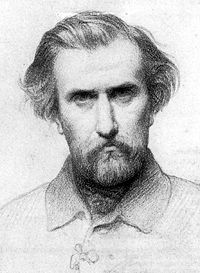
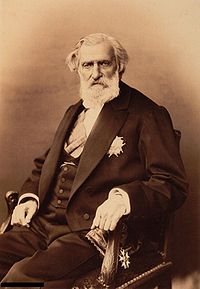
Ambroise Thomas

Encyclopedia
Metz
Metz is a city in the northeast of France located at the confluence of the Moselle and the Seille rivers.Metz is the capital of the Lorraine region and prefecture of the Moselle department. Located near the tripoint along the junction of France, Germany, and Luxembourg, Metz forms a central place...
– 12 February 1896, Paris
Paris
Paris is the capital and largest city in France, situated on the river Seine, in northern France, at the heart of the Île-de-France region...
) was a French
France
The French Republic , The French Republic , The French Republic , (commonly known as France , is a unitary semi-presidential republic in Western Europe with several overseas territories and islands located on other continents and in the Indian, Pacific, and Atlantic oceans. Metropolitan France...
composer
Composer
A composer is a person who creates music, either by musical notation or oral tradition, for interpretation and performance, or through direct manipulation of sonic material through electronic media...
, best known for his operas Mignon
Mignon
Mignon is an opéra comique in three acts by Ambroise Thomas. The original French libretto was by Jules Barbier and Michel Carré, based on Goethe's novel Wilhelm Meisters Lehrjahre. The Italian version was translated by Giuseppe Zaffira. The opera is mentioned in James Joyce's The Dead,...
(1866) and Hamlet
Hamlet (opera)
Hamlet is an opéra in five acts by the French composer Ambroise Thomas, with a libretto by Michel Carré and Jules Barbier based on a French adaptation by Alexandre Dumas, père and Paul Meurice of Shakespeare's play Hamlet.- Ophelia mania in Paris:...
(1868, after Shakespeare) and as Director of the Conservatoire de Paris
Conservatoire de Paris
The Conservatoire de Paris is a college of music and dance founded in 1795, now situated in the avenue Jean Jaurès in the 19th arrondissement of Paris, France...
from 1871 till his death.
Biography
"There is good music, there is bad music, and then there is Ambroise Thomas."- Emmanuel Chabrier
Emmanuel Chabrier
Emmanuel Chabrier was a French Romantic composer and pianist. Although known primarily for two of his orchestral works, España and Joyeuse marche, he left an important corpus of operas , songs, and piano music as well...
Early life and studies
Thomas's parents were music teachers. By the age of 10, he was already an experienced pianist and violinist. In 1828, he entered the Paris Conservatoire, where he studied with Jean-François Le SueurJean-François Le Sueur
Jean-François Le Sueur was a French composer, best known for his oratorios and operas.-Life:...
(who also taught Berlioz
Hector Berlioz
Hector Berlioz was a French Romantic composer, best known for his compositions Symphonie fantastique and Grande messe des morts . Berlioz made significant contributions to the modern orchestra with his Treatise on Instrumentation. He specified huge orchestral forces for some of his works; as a...
) while at the same time taking piano lessons privately from the famous virtuoso Frédéric Kalkbrenner. In 1832, his cantata Hermann et Ketty won the Conservatory's prestigious composition prize, the Grand Prix de Rome, which allowed him to travel to and study in that city for three years. He took with him a love for Mozart and Beethoven; but once in Rome, he became an ardent admirer of the Italian cantilena
Cantilena
Il Cantilena is the oldest known literary text in the Maltese language. It dates from the 15th century but was not found until 1966 or 1968 by Prof. Godfrey Wettinger and Fr. M. Fsadni . The poem is attributed to Pietru Caxaro, and was recorded by Caxaro's nephew, Brandano, in his notarial...
and melodic tradition. It was during his Italian sojourn that he wrote all of his chamber music: namely, a piano trio, a string quintet and a string quartet.
Career
The first opera Thomas composed, La double échelle (1837), was produced at the Opéra ComiqueOpera Comique
The Opera Comique was a 19th-century theatre constructed in Westminster, London, between Wych Street and Holywell Street with entrances on the East Strand. It opened in 1870 and was demolished in 1902, to make way for the construction of the Aldwych and Kingsway...
and subsequently received 247 performances. Le caïd (1849), did still better, and achieved over 400 performances. For the next quarter of a century Thomas's productivity was incessant, and several of his operas (he wrote 24 altogether) enjoyed a considerable, if ephemeral, popularity. The questionable quality of their libretti hampers them, but a few have been revived now and then as historic curiosities or recorded as vehicles for bel canto
Bel canto
Bel canto , along with a number of similar constructions , is an Italian opera term...
singers, such as Le songe d'une nuit d'été (1850; loosely adapted from Shakespeare's A Midsummer Night's Dream
A Midsummer Night's Dream
A Midsummer Night's Dream is a play that was written by William Shakespeare. It is believed to have been written between 1590 and 1596. It portrays the events surrounding the marriage of the Duke of Athens, Theseus, and the Queen of the Amazons, Hippolyta...
) or Psyché (1857). The overture to Raymond (1851) has also been given the occasional modern performance.
To his theatrical successes, Thomas added administrative achievements. In 1856 he acquired a professorship at the Conservatoire, where he taught, among others, Jules Massenet
Jules Massenet
Jules Émile Frédéric Massenet was a French composer best known for his operas. His compositions were very popular in the late 19th and early 20th centuries, and he ranks as one of the greatest melodists of his era. Soon after his death, Massenet's style went out of fashion, and many of his operas...
, one of the few French composers of the younger generation whose music interested him. He succeeded Auber as director of the Conservatoire in 1871. Baffled by the musical unconventionality of César Franck
César Franck
César-Auguste-Jean-Guillaume-Hubert Franck was a composer, pianist, organist, and music teacher who worked in Paris during his adult life....
, Gabriel Fauré
Gabriel Fauré
Gabriel Urbain Fauré was a French composer, organist, pianist and teacher. He was one of the foremost French composers of his generation, and his musical style influenced many 20th century composers...
, and certain other Conservatoire colleagues, he nevertheless was rather well liked as a man, even by those who found his output old-fashioned.
Success
Opera Comique
The Opera Comique was a 19th-century theatre constructed in Westminster, London, between Wych Street and Holywell Street with entrances on the East Strand. It opened in 1870 and was demolished in 1902, to make way for the construction of the Aldwych and Kingsway...
in 1866), Thomas achieved his first great acclaim outside, as well as within, France. Goethe's celebrated Wilhelm Meister had provided inspiration for a highly sentimentalized libretto; Marie Galli-Marié (1840–1905), it was said http://9.1911encyclopedia.org/T/TH/THOMAS_C_L_A_.htm, "had modelled her conception of the part upon the well-known picture by Ary Scheffer
Ary Scheffer
Ary Scheffer , French painter of Dutch and German extraction, was born in Dordrecht.-Life:After the early death of his father Johann Baptist, a poor painter, Ary's mother Cornelia, herself a painter and daughter of landscapist Arie Lamme, took him to Paris and placed him in the studio of...
". Mignon was a success all over Europe, to audiences who had embraced Charles Gounod
Charles Gounod
Charles-François Gounod was a French composer, known for his Ave Maria as well as his operas Faust and Roméo et Juliette.-Biography:...
's indirectly Goethe-inspired Faust
Faust (opera)
Faust is a drame lyrique in five acts by Charles Gounod to a French libretto by Jules Barbier and Michel Carré from Carré's play Faust et Marguerite, in turn loosely based on Johann Wolfgang von Goethe's Faust, Part 1...
(1859); and in Paris Mignon received more than a thousand performances by 1894, thereby becoming one of the most successful operas in French history. http://kdfc.com/new/composers_detail.cfm?id=387 It is still heard sometimes today, more often in the form of extracts for concert use, or in recordings, than in complete stagings. One of its arias, "Connais-tu le pays", was for generations among the most famous operatic excerpts by any composer.
Thomas turned to Shakespeare again for his Hamlet
Hamlet (opera)
Hamlet is an opéra in five acts by the French composer Ambroise Thomas, with a libretto by Michel Carré and Jules Barbier based on a French adaptation by Alexandre Dumas, père and Paul Meurice of Shakespeare's play Hamlet.- Ophelia mania in Paris:...
(Paris Opera
Académie Royale de Musique
The Salle Le Peletier was the home of the Paris Opera from 1821 until the building was destroyed by fire in 1873. The theatre was designed and constructed by the architect François Debret on the site of the former Hôtel de Choiseul...
, 1868), with a libretto by the seasoned team of Jules Barbier
Jules Barbier
Paul Jules Barbier was a French poet, writer and opera librettist who often wrote in collaboration with Michel Carré...
and Michel Carré
Michel Carré
Michel Carré was a prolific French librettist.He went to Paris in 1840 intending to become a painter but took up writing instead. He wrote verse and plays before turning to writing libretti. His libretto for Mirette was never performed in France but was later performed in English adaptation in...
. This opera has a strong, dramatic libretto, although it closes with a traditional (and, surprising for Hamlet) happy ending. It enjoyed a long vogue, and like Mignon it continues to have a certain following; during 2010 it was heard at New York's Metropolitan Opera
Metropolitan Opera
The Metropolitan Opera is an opera company, located in New York City. Originally founded in 1880, the company gave its first performance on October 22, 1883. The company is operated by the non-profit Metropolitan Opera Association, with Peter Gelb as general manager...
.
His last opera, Françoise de Rimini (Paris Opéra, 1882) based on a passage from Dante
DANTE
Delivery of Advanced Network Technology to Europe is a not-for-profit organisation that plans, builds and operates the international networks that interconnect the various national research and education networks in Europe and surrounding regions...
's Inferno, failed to stay in the repertoire. Seven years later La tempête, a ballet (and yet another treatment of a Shakespeare play, this time The Tempest
The Tempest
The Tempest is a play by William Shakespeare, believed to have been written in 1610–11, and thought by many critics to be the last play that Shakespeare wrote alone. It is set on a remote island, where Prospero, the exiled Duke of Milan, plots to restore his daughter Miranda to her rightful place,...
), was produced at the Opéra, again with little effect. He died in 1896. Massenet had hopes of succeeding him in the job of Conservatoire director, abandoning this plan only when told by the government that the post would no longer carry lifelong tenure. The man who got the job was not Massenet but, rather, organist-composer Théodore Dubois
Théodore Dubois
François-Clément Théodore Dubois was a French composer, organist and music teacher.-Biography:Théodore Dubois was born in Rosnay in Marne. He studied first under Louis Fanart and later at the Paris Conservatoire under Ambroise Thomas. He won the Prix de Rome in 1861...
.
Ballets
- La gipsy, second act ballet at the Opéra de Paris, 1839
- La tempête, ballet, ("The Tempest", based on Shakespeare), 1889
External links
- Ambroise Thomas String Quartet in e minor Soundbites & short biography.
- Free scores by Ambroise Thomas in the loumy.org