


Isambard Kingdom Brunel

Encyclopedia
Isambard Kingdom Brunel, FRS (9 April 1806 – 15 September 1859), was a British civil engineer
who built bridges and dockyards including the construction of the first major British railway, the Great Western Railway
; a series of steamships, including the first propeller-driven transatlantic steamship; and numerous important bridges and tunnels. His designs revolutionised public transport and modern engineering.
Though Brunel's projects were not always successful, they often contained innovative solutions to long-standing engineering problems. During his short career, Brunel achieved many engineering "firsts", including assisting in the building of the first tunnel under a navigable river and development of SS Great Britain
, the first propeller-driven ocean-going iron ship, which was at the time (1843) also the largest ship ever built.
Brunel set the standard for a very well built railway, using careful surveys to minimise grades and curves. This necessitated expensive construction techniques and new bridges and viaducts, and the two-mile-long Box Tunnel
. One controversial feature was the wide gauge
, a "broad gauge" of , instead of what was later to be known as 'standard gauge
' of . The wider gauge added to passenger comfort but made construction much more expensive and caused difficulties when eventually it had to interconnect with other railways using the narrower gauge. As a result of the Railway Regulation (Gauge) Act 1846
(and after Brunel's death) the gauge was changed to standard gauge throughout the GWR network.
Brunel astonished Britain by proposing to extend the Great Western Railway westward to North America by building steam-powered iron-hulled ships. He designed and built three ships that revolutionised naval engineering.
In 2002, Brunel was placed second in a BBC public poll to determine the "100 Greatest Britons
". In 2006, the bicentenary of his birth, a major programme of events celebrated his life and work under the name Brunel 200.
The son of the eminent engineer Sir Marc Isambard Brunel
and Sophia Kingdom Brunel
, Isambard Kingdom Brunel was born on 9 April 1806 in Portsmouth
, Hampshire, where his father was working on block-making machinery
. He had two older sisters, Sophia and Emma, and the whole family moved to London in 1808 for his father's work. Brunel had a happy childhood, despite the family's constant money worries, with his father acting as his teacher during his early years. His father taught him drawing and observational techniques from the age of four and Brunel had learned Euclidean geometry
by eight. During this time he also learned fluent French and the basic principles of engineering. He was encouraged to draw interesting buildings and identify any faults in their structure.
When Brunel was eight he was sent to Dr Morrell's boarding school in Hove
, where he learned the classics. His father, a Frenchman by birth, was determined that Brunel should have access to the high-quality education he had enjoyed in his youth in France; accordingly, at the age of 14, the younger Brunel was enrolled first at the College of Caen in Normandy
, then at Lycée Henri-Quatre in Paris. When Brunel was 15, his father, who had accumulated debts of over £5,000, was sent to a debtors' prison. After three months went by with no prospect of release, Marc let it be known that he was considering an offer from the Tsar of Russia
. In August 1821, facing the prospect of losing a prominent engineer, the government relented and issued Marc £5,000 to clear his debts in exchange for his promise to remain in Britain. When Brunel completed his studies at Henri-Quatre in 1822, his father had him presented as a candidate at the renowned engineering school École Polytechnique
, but as a foreigner he was deemed ineligible for entry. Brunel subsequently studied under the prominent master clockmaker and horologist Abraham-Louis Breguet, who praised Brunel's potential in letters to his father. In late 1822, having completed his apprenticeship, Brunel returned to England.
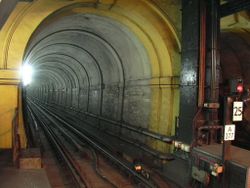 Brunel worked for several years as assistant engineer on the project to create a tunnel under London's River Thames
, with tunnellers driving a horizontal shaft from one side of the river to the other under the most difficult and dangerous conditions. Brunel's father, Marc, was the chief engineer, and the project was funded by the Thames Tunnel Company.
The composition of the riverbed at Rotherhithe
was often little more than waterlogged sediment and loose gravel. An ingenious tunnelling shield
designed by Marc Brunel helped protect workers from cave-ins, but two incidents of severe flooding halted work for long periods, killing several workers and badly injuring the younger Brunel. The latter incident, in 1828, killed the two most senior miners, and Brunel himself narrowly escaped death. He was seriously injured, and spent six months recuperating. The event stopped work on the tunnel for several years.
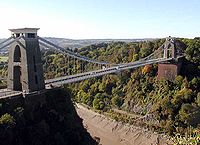 Brunel is perhaps best remembered for designing the Clifton Suspension Bridge
in Bristol
. Spanning over 700 ft (213.4 m), and nominally 200 ft (61 m) above the River Avon
, it had the longest span of any bridge in the world at the time of construction. Brunel submitted four designs to a committee headed by Thomas Telford
, but Telford rejected all entries, proposing his own design instead. Vociferous opposition from the public forced the organising committee to hold a new competition, which was won by Brunel. Afterwards, Brunel wrote to his brother-in-law, the politician Benjamin Hawes
: "Of all the wonderful feats I have performed, since I have been in this part of the world, I think yesterday I performed the most wonderful. I produced unanimity among 15 men who were all quarrelling about that most ticklish subject— taste".
It has recently been suggested that Brunel did not design the bridge.
Work on the Clifton bridge started in 1831, but was suspended due to the Queen Square riots caused by the arrival of Sir Charles Wetherell
in Clifton. The riots drove away investors, leaving no money for the project, and construction ceased. Brunel did not live to see the bridge finished, although his colleagues and admirers at the Institution of Civil Engineers
felt it would be a fitting memorial, and started to raise new funds and to amend the design. Work recommenced in 1862 and was completed in 1864, five years after Brunel's death. The Clifton Suspension Bridge still stands, and over 4 million vehicles traverse it every year.
.jpg) Brunel designed many bridges for his railway projects, including the Royal Albert Bridge
Brunel designed many bridges for his railway projects, including the Royal Albert Bridge
spanning the River Tamar
at Saltash
near Plymouth
, Somerset Bridge (an unusual laminated timber-framed bridge near Bridgwater
), the Windsor Railway Bridge
, and the Maidenhead Railway Bridge
over the Thames in Berkshire
. This last was the flattest, widest brick arch bridge in the world and is still carrying main line trains to the west, even though today's trains are about 10 times as heavy as any Brunel ever imagined.
In 1845 Hungerford Bridge
, a suspension footbridge
across the Thames near Charing Cross Station
in London, was opened. It was replaced by a new railway bridge in 1859, and the suspension chains were used to complete the Clifton Suspension Bridge.
Throughout his railway building career, but particularly on the South Devon
and Cornwall Railway
s where economy was needed and there were many valleys to cross, Brunel made extensive use of wood for the construction of substantial viaducts; these have had to be replaced over the years as their primary material, Kyanised Baltic Pine became uneconomical to obtain.
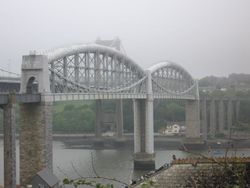 Brunel designed the Royal Albert Bridge
in 1855 for the Cornwall Railway, after Parliament
rejected his original plan for a train ferry
across the Hamoaze
—the estuary of the tidal Tamar
, Tavy
and Lynher
. The bridge (of bowstring girder or tied arch construction) consists of two main spans of 455 ft (138.7 m), 100 ft (30.5 m) above mean high spring tide, plus 17 much shorter approach spans. Opened by Prince Albert on 2 May 1859, it was completed in the year of Brunel's death.
Several of Brunel's bridges over the Great Western Railway might be demolished because the line is to be electrified, and there is inadequate clearance for overhead wires. Buckinghamshire
County Council is negotiating to have further options pursued, in order that all nine of the remaining historic bridges on the line can be saved.
 In the early part of Brunel's life, the use of railways began to take off as a major means of transport for goods. This influenced Brunel's involvement in railway engineering, including railway bridge engineering.
In 1833, before the Thames Tunnel was complete, Brunel was appointed chief engineer of the Great Western Railway
, one of the wonders of Victorian
Britain, running from London to Bristol
and later Exeter
. The company was founded at a public meeting in Bristol in 1833, and was incorporated by Act of Parliament
in 1835.
It was Brunel's vision that passengers would be able to purchase one ticket at London Paddington and travel from London to New York, changing from the Great Western Railway to the Great Western
steamship at the terminus in Neyland
, South Wales. He surveyed the entire length of the route between London and Bristol himself.
Brunel made two controversial decisions: to use a broad gauge
of for the track, which he believed would offer superior running at high speeds; and to take a route that passed north of the Marlborough Downs—an area with no significant towns, though it offered potential connections to Oxford
and Gloucester
—and then to follow the Thames Valley into London. His decision to use broad gauge for the line was controversial in that almost all British railways to date had used standard gauge
. Brunel said that this was nothing more than a carry-over from the mine railways that George Stephenson
had worked on prior to making the world's first passenger railway. Brunel proved through both calculation and a series of trials that his broader gauge was the optimum size for providing both higher speeds and a stable and comfortable ride to passengers. In addition the wider gauge allowed for larger carriages
and thus greater freight capacity.
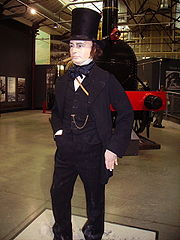 Drawing on Brunel's experience with the Thames Tunnel, the Great Western contained a series of impressive achievements—soaring viaduct
s such as the one in Ivybridge
, specially designed stations, and vast tunnels including the Box Tunnel
, which was the longest railway tunnel in the world at that time. There is an anecdote that the Box Tunnel may have been deliberately oriented so that the rising sun shines all the way through it on Brunel's birthday.
The initial group of locomotives ordered by Brunel to his own specifications proved unsatisfactory, apart from the North Star locomotive
, and 20-year-old Daniel Gooch
(later Sir Daniel) was appointed as Superintendent of Locomotives. Brunel and Gooch chose to locate their locomotive works
at the village of Swindon
, at the point where the gradual ascent from London turned into the steeper descent to the Avon valley at Bath.
Brunel's achievements ignited the imagination of the technically minded Britons of the age, and he soon became quite notable in the country on the back of this interest.
After Brunel's death the decision was taken that standard gauge should be used for all railways in the country. Despite the Great Western's claim of proof that its broad gauge was the better (disputed by at least one Brunel historian), the decision was made to use Stephenson's standard gauge, mainly because this had already covered a far greater amount of the country. However, by May 1892 when the broad gauge was abolished the Great Western had already been re-laid as dual gauge
(both broad and standard) and so the transition was a relatively painless one. At the original Welsh terminus of the Great Western railway at Neyland
, sections of the broad gauge rails are used as handrails at the quayside, and a number of information boards there depict various aspects of Brunel's life. There is also a larger than life bronze statue of him holding a steamship in one hand and a locomotive in the other.
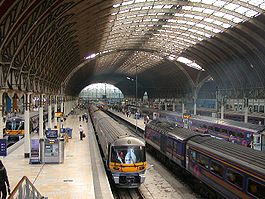
The present London Paddington station was designed by Brunel and opened in 1854. Examples of his designs for smaller stations on the Great Western and associated lines which survive in good condition include Mortimer
, Charlbury
and Bridgend
(all Italianate
) and Culham
(Tudorbethan
). Surviving examples of wooden train shed
s in his style are at Frome
and Kingswear.
The great achievement that was the Great Western Railway
has been immortalised at Swindon Steam Railway Museum
.
Overall, there were negative views as to how society viewed the railways. Some landowners felt the railways were a threat to amenities or property values and others requested tunnels on their land so the railway could not be seen.

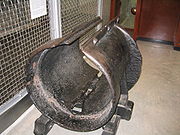 Though ultimately unsuccessful, another of Brunel's interesting use of technical innovations was the atmospheric railway
, the extension of the Great Western Railway (GWR) southward from Exeter towards Plymouth, technically the South Devon Railway
(SDR), though supported by the GWR. Instead of using locomotive
s, the trains were moved by Clegg and Samuda's patented system of atmospheric (vacuum
) traction, whereby stationary pumps sucked air from a pipe placed in the centre of the track.
The section from Exeter to Newton (now Newton Abbot
) was completed on this principle, and trains ran at approximately 68 miles per hour (109.4 km/h). Pumping stations with distinctive square chimneys were sited at two-mile intervals. Fifteen-inch (381 mm) pipes were used on the level portions, and 22 inches (558.8 mm) pipes were intended for the steeper gradients.
The technology required the use of leather flaps to seal the vacuum pipes. The natural oils were drawn out of the leather by the vacuum, making the leather vulnerable to water, rotting it and breaking the fibres when it froze. It had to be kept supple with tallow
, which is attractive to rat
s. The flaps were eaten, and vacuum operation lasted less than a year, from 1847 (experimental service began in September; operations from February 1848) to 10 September 1848. It has been suggested that the whole project was an expensive flop. In Brunel's favour, it has been noted that he had the courage to call a halt to the venture instead of struggling on with it at greater cost.
The accounts of the SDR for 1848 suggest that atmospheric traction cost 3s 1d (three shillings and one penny) per mile compared to 1s 4d/mile for conventional steam power. A number of South Devon Railway engine houses
still stand, including that at Totnes
(scheduled as a grade II listed monument in 2007 to prevent its imminent demolition, even as Brunel's bicentenary celebrations were continuing) and at Starcross
, on the estuary of the River Exe
, which is a striking landmark, and a reminder of the atmospheric railway, also commemorated as the name of the village pub.
A section of the pipe, without the leather covers, is preserved at the Didcot Railway Centre
.
 In 1835, before the Great Western Railway had opened, Brunel proposed extending its transport network by boat from Bristol across the Atlantic Ocean to New York
. The Great Western Steamship Company
was formed by Thomas Guppy for that purpose. It was widely disputed whether it would be commercially viable for a ship powered purely by steam to make such long journeys. Technological developments in the early 1830s—including the invention of the surface condenser, which allowed boilers to run on salt water without stopping to be cleaned—made longer journeys more possible, but it was generally thought that a ship would not be able to carry enough fuel for the trip and have room for a commercial cargo. Brunel formulated the theory that the amount a ship could carry increased as the cube of its dimensions, whereas the amount of resistance a ship experienced from the water as it travelled only increased by a square of its dimensions. This would mean that moving a larger ship would take proportionately less fuel than a smaller ship. To test this theory, Brunel offered his services for free to the Great Western Steamship Company, which appointed him to its building committee and entrusted him with designing its first ship, the Great Western
.
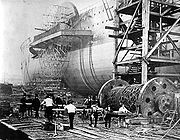 When it was built, the Great Western was the longest ship in the world at 236 ft (71.9 m) with a 250 feet (76.2 m) keel
. The ship was constructed mainly from wood, but Brunel added bolts and iron diagonal reinforcements to maintain the keel's strength. In addition to its steam-powered paddle wheel
s, the ship carried four masts for sails. The Great Western embarked on her maiden voyage from Avonmouth
, Bristol, to New York on 8 April 1838 with 600 LT (609,630 kg) of coal, cargo and seven passengers on board. Brunel himself missed this initial crossing, having been injured during a fire aboard the ship as she was returning from fitting out in London. As the fire delayed the launch several days, the Great Western missed its opportunity to claim title as the first ship to cross the Atlantic under steam power alone. Even with a four-day head start
, the competing Sirius
arrived only one day earlier and its crew was forced to burn cabin furniture, spare yards and one mast for fuel. In contrast, the Great Western crossing of the Atlantic took 15 days and five hours, and the ship arrived at her destination with a third of its coal still remaining, demonstrating that Brunel's calculations were correct. The Great Western had proved the viability of commercial transatlantic steamship service, which led the Great Western Steamboat Company to use her in regular service between Bristol and New York from 1838 to 1846. She made 64 crossings, and was the first ship to hold the Blue Riband
with a crossing time of 13 days westbound and 12 days 6 hours eastbound. The service was commercially successful enough for a sister ship to be required, which Brunel was asked to design.
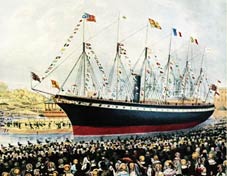
Brunel had become convinced of the superiority of propeller-driven ships over paddle wheels. After tests conducted aboard the propeller-driven steam tug Archimedes, he incorporated a large six-bladed propeller into his design for the 322 feet (98.1 m) Great Britain
, which was launched in 1843. Great Britain is considered the first modern ship, being built of metal rather than wood, powered by an engine rather than wind or oars, and driven by propeller rather than paddle wheel. She was the first iron-hulled, propeller-driven ship to cross the Atlantic Ocean.
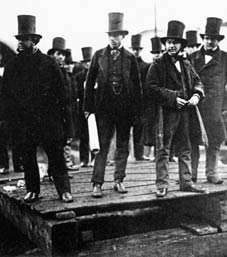 In 1852 Brunel turned to a third ship, larger than her predecessors, intended for voyages to India and Australia. The Great Eastern
(originally dubbed Leviathan) was cutting-edge technology for her time: almost 700 ft (213.4 m) long, fitted out with the most luxurious appointments, and capable of carrying over 4,000 passengers. Great Eastern was designed to cruise non-stop from London to Sydney and back (since engineers of the time misunderstood that Australia had no coal reserves), and she remained the largest ship built until the turn of the century. Like many of Brunel's ambitious projects, the ship soon ran over budget and behind schedule in the face of a series of technical problems. The ship has been portrayed as a white elephant
, but it has been argued by David P. Billington that in this case Brunel's failure was principally one of economics—his ships were simply years ahead of their time. His vision and engineering innovations made the building of large-scale, propeller-driven, all-metal steamships a practical reality, but the prevailing economic and industrial conditions meant that it would be several decades before transoceanic steamship travel emerged as a viable industry.
Great Eastern was built at John Scott Russell
's Napier Yard in London, and after two trial trips in 1859, set forth on her maiden voyage from Southampton to New York on 17 June 1860. Though a failure at her original purpose of passenger travel, she eventually found a role as an oceanic telegraph cable-layer
. Under Captain Sir James Anderson
, the Great Eastern played a significant role in laying the first lasting transatlantic telegraph cable
, which enabled telecommunication
between Europe and North America.
, and an old Turkish barracks became the British Army Hospital in Scutari
. Injured men contracted a variety of illnesses—including cholera
, dysentery
, typhoid and malaria
—due to poor conditions there, and Florence Nightingale
sent a plea to The Times
for the government to produce a solution.
Brunel was working on the Great Eastern amongst other projects, but accepted the task in February 1855 of designing and building the War Office
requirement of a temporary, pre-fabricated
hospital that could be shipped to Crimea
and erected there. In 5 months he designed, built, and shipped pre-fabricated wood and canvas buildings, providing them complete with advice on transportation and positioning of the facilities. They were subsequently erected near Scutari Hospital, where Nightingale was based, in the malaria-free area of Renkioi.
His designs incorporated the necessities of hygiene
: access to sanitation
, ventilation, drainage, and even rudimentary temperature controls. They were feted as a great success, with some sources stating that of the approximately 1,300 patients treated in the Renkioi temporary hospital, there were only 50 deaths. In the Scutari hospital it replaced, deaths were said to be as many as 10 times this number. Nightingale referred to them as "those magnificent huts". The practice of building hospitals from pre-fabricated modules survives today, with hospitals such as the Bristol Royal Infirmary
being created in this manner.
. They established a home at Duke Street, Westminster
, in London
.
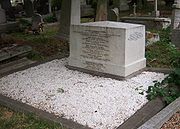 In 1843, while performing a conjuring trick for the amusement of his children, Brunel accidentally inhaled a half-sovereign
coin, which became lodged in his windpipe. A special pair of forceps
failed to remove it, as did a machine devised by Brunel to shake it loose. At the suggestion of his father, Brunel was strapped to a board and turned upside-down, and the coin was jerked free. He recuperated at Teignmouth
, and enjoyed the area so much that he purchased an estate at Watcombe in Torquay
, Devon
. Here he designed Brunel Manor
and its gardens to be his retirement home. He never saw the house or gardens finished, as he died before it was completed.
Brunel suffered a stroke
in 1859, just before the Great Eastern made her first voyage to New York
. He died ten days later at the age of 53 and was buried, like his father, in Kensal Green Cemetery
in London. He left behind his wife Mary and three children: Isambard Brunel Junior (1837–1902), Henry Marc Brunel (1842–1903) and Florence Mary Brunel (1847–1876). Henry Marc followed his father and grandfather in becoming a successful civil engineer
.
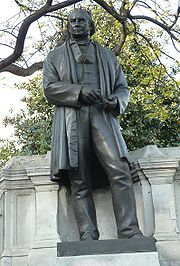 A celebrated engineer in his era, Brunel remains revered today, as evidenced by numerous monuments to him. There are statues in London at Temple
(pictured) and Brunel University
, Bristol, Saltash, Swindon, Milford Haven, and Paddington station. A statue in Neyland
was stolen in August 2010. The topmast of the Great Eastern is used as a flagpole at the entrance to Anfield
, Liverpool Football Club's ground. Contemporary locations bear Brunel's name, such as Brunel University
in London, a shopping centre in Bletchley, Milton Keynes
, and a collection of streets in Exeter: Isambard Terrace, Kingdom Mews, and Brunel Close. A road, car park, and school in his home city of Portsmouth are also named in his honour, along with one of the city's largest pubs. There is an engineering lab building at the University of Plymouth named in his honour.
In a 2002 public TV poll conducted by the BBC
to select the "100 Greatest Britons
", Brunel was placed second, behind Winston Churchill
. Brunel's life and works have been depicted in numerous books, films and television programs. Perhaps the most recent is the 2003 book and BBC TV series, Seven Wonders of the Industrial World
, which included a dramatisation of the building of the Great Eastern. A 1975 short film about Brunel, "Great
", won the Academy Award for Best Animated Short Film.
Many of Brunel's bridges are still in use, having stood the test of time. Brunel's first engineering project, the Thames Tunnel, is now part of the East London Overground Railway System. The Brunel Engine House
at Rotherhithe, which once housed the steam engines that powered the tunnel pumps, now houses the Brunel Museum dedicated to the work and lives of Marc and Isambard Kingdom Brunel. Many of Brunel's original papers and designs are now held in the Brunel collection at the University of Bristol
.
Brunel is credited with turning the town of Swindon into one of the largest growing towns in Europe during the 1800s. Brunel's choice to locate the Great Western Railway locomotive sheds there caused a need for housing for the workers, which in turn gave Brunel the impetus to build hospitals, churches and housing estates in what is known today as the 'Railway Village'. According to some sources, Brunel's addition of a Mechanics Institute for recreation and hospitals and clinics for his workers gave Aneurin Bevan
the basis for the creation of the National Health Service
.
In 2006, the Royal Mint
struck two £2
coins to "celebrate the 200th anniversary of Isambard Kingdom Brunel and his achievements". The first depicts Brunel with a section of the Royal Albert Bridge and the second shows the roof of Paddington Station. The Post Office issued a set of commemorative stamps. For the 100-year anniversary of the Royal Albert Bridge, the words "I.K. BRUNEL ENGINEER 1859" were engraved on either end of the bridge to commemorate his enduring legacy. They became obscured by paint, but were cleaned up by Network Rail
and revealed again in 2006.
19 September 1859
Civil engineer
A civil engineer is a person who practices civil engineering; the application of planning, designing, constructing, maintaining, and operating infrastructures while protecting the public and environmental health, as well as improving existing infrastructures that have been neglected.Originally, a...
who built bridges and dockyards including the construction of the first major British railway, the Great Western Railway
Great Western Railway
The Great Western Railway was a British railway company that linked London with the south-west and west of England and most of Wales. It was founded in 1833, received its enabling Act of Parliament in 1835 and ran its first trains in 1838...
; a series of steamships, including the first propeller-driven transatlantic steamship; and numerous important bridges and tunnels. His designs revolutionised public transport and modern engineering.
Though Brunel's projects were not always successful, they often contained innovative solutions to long-standing engineering problems. During his short career, Brunel achieved many engineering "firsts", including assisting in the building of the first tunnel under a navigable river and development of SS Great Britain
SS Great Britain
SS Great Britain was an advanced passenger steamship designed by Isambard Kingdom Brunel for the Great Western Steamship Company's transatlantic service between Bristol and New York. While other ships had previously been built of iron or equipped with a screw propeller, Great Britain was the first...
, the first propeller-driven ocean-going iron ship, which was at the time (1843) also the largest ship ever built.
Brunel set the standard for a very well built railway, using careful surveys to minimise grades and curves. This necessitated expensive construction techniques and new bridges and viaducts, and the two-mile-long Box Tunnel
Box Tunnel
Box Tunnel is a railway tunnel in Western England, between Bath and Chippenham, dug through Box Hill, and is one of the most significant structures on the Great Western Main Line...
. One controversial feature was the wide gauge
Rail gauge
Track gauge or rail gauge is the distance between the inner sides of the heads of the two load bearing rails that make up a single railway line. Sixty percent of the world's railways use a standard gauge of . Wider gauges are called broad gauge; smaller gauges, narrow gauge. Break-of-gauge refers...
, a "broad gauge" of , instead of what was later to be known as 'standard gauge
Standard gauge
The standard gauge is a widely-used track gauge . Approximately 60% of the world's existing railway lines are built to this gauge...
' of . The wider gauge added to passenger comfort but made construction much more expensive and caused difficulties when eventually it had to interconnect with other railways using the narrower gauge. As a result of the Railway Regulation (Gauge) Act 1846
Railway Regulation (Gauge) Act 1846
The Railway Regulation Act 1846 introduced mandated standard gauges of for Great Britain, and for Ireland. This signalled the end for Brunel's broad gauge network.-See also:* The GWR "gauge war"* Rail gauge in Ireland* Standard gauge...
(and after Brunel's death) the gauge was changed to standard gauge throughout the GWR network.
Brunel astonished Britain by proposing to extend the Great Western Railway westward to North America by building steam-powered iron-hulled ships. He designed and built three ships that revolutionised naval engineering.
In 2002, Brunel was placed second in a BBC public poll to determine the "100 Greatest Britons
100 Greatest Britons
100 Greatest Britons was broadcast in 2002 by the BBC. The programme was the result of a vote conducted to determine whom the United Kingdom public considers the greatest British people in history. The series, Great Britons, included individual programmes on the top ten, with viewers having further...
". In 2006, the bicentenary of his birth, a major programme of events celebrated his life and work under the name Brunel 200.
Early life
The son of the eminent engineer Sir Marc Isambard Brunel
Marc Isambard Brunel
Sir Marc Isambard Brunel, FRS FRSE was a French-born engineer who settled in England. He preferred the name Isambard, but is generally known to history as Marc to avoid confusion with his more famous son Isambard Kingdom Brunel...
and Sophia Kingdom Brunel
Sophia Kingdom
Sophia Kingdom, Lady Brunel was the daughter of William Kingdom, a contracting agent for the navy and the army. Sent to France to improve her knowledge of the language, she met Marc Isambard Brunel at Rouen in the early 1790s. She married him on 1 November 1799...
, Isambard Kingdom Brunel was born on 9 April 1806 in Portsmouth
Portsmouth
Portsmouth is the second largest city in the ceremonial county of Hampshire on the south coast of England. Portsmouth is notable for being the United Kingdom's only island city; it is located mainly on Portsea Island...
, Hampshire, where his father was working on block-making machinery
Portsmouth Block Mills
The Portsmouth Block Mills form part of the Portsmouth Dockyard at Portsmouth, Hampshire, England, and were built during the Napoleonic Wars to supply the British Royal Navy with pulley blocks. They started the age of mass-production using all-metal machine tools and are regarded as one of the...
. He had two older sisters, Sophia and Emma, and the whole family moved to London in 1808 for his father's work. Brunel had a happy childhood, despite the family's constant money worries, with his father acting as his teacher during his early years. His father taught him drawing and observational techniques from the age of four and Brunel had learned Euclidean geometry
Euclidean geometry
Euclidean geometry is a mathematical system attributed to the Alexandrian Greek mathematician Euclid, which he described in his textbook on geometry: the Elements. Euclid's method consists in assuming a small set of intuitively appealing axioms, and deducing many other propositions from these...
by eight. During this time he also learned fluent French and the basic principles of engineering. He was encouraged to draw interesting buildings and identify any faults in their structure.
When Brunel was eight he was sent to Dr Morrell's boarding school in Hove
Hove
Hove is a town on the south coast of England, immediately to the west of its larger neighbour Brighton, with which it forms the unitary authority Brighton and Hove. It forms a single conurbation together with Brighton and some smaller towns and villages running along the coast...
, where he learned the classics. His father, a Frenchman by birth, was determined that Brunel should have access to the high-quality education he had enjoyed in his youth in France; accordingly, at the age of 14, the younger Brunel was enrolled first at the College of Caen in Normandy
Normandy
Normandy is a geographical region corresponding to the former Duchy of Normandy. It is in France.The continental territory covers 30,627 km² and forms the preponderant part of Normandy and roughly 5% of the territory of France. It is divided for administrative purposes into two régions:...
, then at Lycée Henri-Quatre in Paris. When Brunel was 15, his father, who had accumulated debts of over £5,000, was sent to a debtors' prison. After three months went by with no prospect of release, Marc let it be known that he was considering an offer from the Tsar of Russia
Alexander I of Russia
Alexander I of Russia , served as Emperor of Russia from 23 March 1801 to 1 December 1825 and the first Russian King of Poland from 1815 to 1825. He was also the first Russian Grand Duke of Finland and Lithuania....
. In August 1821, facing the prospect of losing a prominent engineer, the government relented and issued Marc £5,000 to clear his debts in exchange for his promise to remain in Britain. When Brunel completed his studies at Henri-Quatre in 1822, his father had him presented as a candidate at the renowned engineering school École Polytechnique
École Polytechnique
The École Polytechnique is a state-run institution of higher education and research in Palaiseau, Essonne, France, near Paris. Polytechnique is renowned for its four year undergraduate/graduate Master's program...
, but as a foreigner he was deemed ineligible for entry. Brunel subsequently studied under the prominent master clockmaker and horologist Abraham-Louis Breguet, who praised Brunel's potential in letters to his father. In late 1822, having completed his apprenticeship, Brunel returned to England.
Thames Tunnel
River Thames
The River Thames flows through southern England. It is the longest river entirely in England and the second longest in the United Kingdom. While it is best known because its lower reaches flow through central London, the river flows alongside several other towns and cities, including Oxford,...
, with tunnellers driving a horizontal shaft from one side of the river to the other under the most difficult and dangerous conditions. Brunel's father, Marc, was the chief engineer, and the project was funded by the Thames Tunnel Company.
The composition of the riverbed at Rotherhithe
Rotherhithe
Rotherhithe is a residential district in inner southeast London, England and part of the London Borough of Southwark. It is located on a peninsula on the south bank of the Thames, facing Wapping and the Isle of Dogs on the north bank, and is a part of the Docklands area...
was often little more than waterlogged sediment and loose gravel. An ingenious tunnelling shield
Tunnelling shield
A tunnelling shield is a protective structure used in the excavation of tunnels through soil that is too soft or fluid to remain stable during the time it takes to line the tunnel with a support structure of concrete, cast iron or steel...
designed by Marc Brunel helped protect workers from cave-ins, but two incidents of severe flooding halted work for long periods, killing several workers and badly injuring the younger Brunel. The latter incident, in 1828, killed the two most senior miners, and Brunel himself narrowly escaped death. He was seriously injured, and spent six months recuperating. The event stopped work on the tunnel for several years.
Bridges
Clifton Suspension Bridge
Brunel died in 1859, without seeing the completion of the bridge. Brunel's colleagues in the Institution of Civil Engineers felt that completion of the Bridge would be a fitting memorial, and started to raise new funds...
in Bristol
Bristol
Bristol is a city, unitary authority area and ceremonial county in South West England, with an estimated population of 433,100 for the unitary authority in 2009, and a surrounding Larger Urban Zone with an estimated 1,070,000 residents in 2007...
. Spanning over 700 ft (213.4 m), and nominally 200 ft (61 m) above the River Avon
River Avon, Bristol
The River Avon is an English river in the south west of the country. To distinguish it from a number of other River Avons in Britain, this river is often also known as the Lower Avon or Bristol Avon...
, it had the longest span of any bridge in the world at the time of construction. Brunel submitted four designs to a committee headed by Thomas Telford
Thomas Telford
Thomas Telford FRS, FRSE was a Scottish civil engineer, architect and stonemason, and a noted road, bridge and canal builder.-Early career:...
, but Telford rejected all entries, proposing his own design instead. Vociferous opposition from the public forced the organising committee to hold a new competition, which was won by Brunel. Afterwards, Brunel wrote to his brother-in-law, the politician Benjamin Hawes
Benjamin Hawes
Sir Benjamin Hawes was a British Whig politician. He was born in 1797 to Benjamin Hawes and educated at a private school in Putney. He was a grandson of William Hawes, founder of the Royal Humane Society...
: "Of all the wonderful feats I have performed, since I have been in this part of the world, I think yesterday I performed the most wonderful. I produced unanimity among 15 men who were all quarrelling about that most ticklish subject— taste".
It has recently been suggested that Brunel did not design the bridge.
Work on the Clifton bridge started in 1831, but was suspended due to the Queen Square riots caused by the arrival of Sir Charles Wetherell
Charles Wetherell
Sir Charles Wetherell , was an English lawyer, politician and judge.Wetherell was born in Oxford, the third son of Reverend Nathan Wetherell, of Durham, Master of the University College and Vice-Chancellor of the University of Oxford...
in Clifton. The riots drove away investors, leaving no money for the project, and construction ceased. Brunel did not live to see the bridge finished, although his colleagues and admirers at the Institution of Civil Engineers
Institution of Civil Engineers
Founded on 2 January 1818, the Institution of Civil Engineers is an independent professional association, based in central London, representing civil engineering. Like its early membership, the majority of its current members are British engineers, but it also has members in more than 150...
felt it would be a fitting memorial, and started to raise new funds and to amend the design. Work recommenced in 1862 and was completed in 1864, five years after Brunel's death. The Clifton Suspension Bridge still stands, and over 4 million vehicles traverse it every year.
Royal Albert Bridge
The Royal Albert Bridge is a railway bridge that spans the River Tamar in the United Kingdom between Plymouth, on the Devon bank, and Saltash on the Cornish bank. Its unique design consists of two lenticular iron trusses above the water, with conventional plate-girder approach spans. This gives...
spanning the River Tamar
River Tamar
The Tamar is a river in South West England, that forms most of the border between Devon and Cornwall . It is one of several British rivers whose ancient name is assumed to be derived from a prehistoric river word apparently meaning "dark flowing" and which it shares with the River Thames.The...
at Saltash
Saltash
Saltash is a town and civil parish in Cornwall, England, United Kingdom. It has a population of 14,964. It lies in the south east of Cornwall, facing Plymouth over the River Tamar. It was in the Caradon district until March 2009 and is known as "the gateway to Cornwall". Saltash means ash tree by...
near Plymouth
Plymouth
Plymouth is a city and unitary authority area on the coast of Devon, England, about south-west of London. It is built between the mouths of the rivers Plym to the east and Tamar to the west, where they join Plymouth Sound...
, Somerset Bridge (an unusual laminated timber-framed bridge near Bridgwater
Bridgwater
Bridgwater is a market town and civil parish in Somerset, England. It is the administrative centre of the Sedgemoor district, and a major industrial centre. Bridgwater is located on the major communication routes through South West England...
), the Windsor Railway Bridge
Windsor Railway Bridge
Windsor Railway Bridge is a wrought iron 'bow and string' bridge in Windsor, Berkshire, designed by Isambard Kingdom Brunel. It carries the ex-GWR branch line from Slough to Windsor into Windsor and Eton Central station...
, and the Maidenhead Railway Bridge
Maidenhead Railway Bridge
Maidenhead Railway Bridge is a railway bridge carrying the main line of the Great Western Railway over the River Thames between Maidenhead, Berkshire and Taplow, Buckinghamshire, England...
over the Thames in Berkshire
Berkshire
Berkshire is a historic county in the South of England. It is also often referred to as the Royal County of Berkshire because of the presence of the royal residence of Windsor Castle in the county; this usage, which dates to the 19th century at least, was recognised by the Queen in 1957, and...
. This last was the flattest, widest brick arch bridge in the world and is still carrying main line trains to the west, even though today's trains are about 10 times as heavy as any Brunel ever imagined.
In 1845 Hungerford Bridge
Hungerford Bridge
The Hungerford Bridge crosses the River Thames in London, and lies between Waterloo Bridge and Westminster Bridge. It is a steel truss railway bridge—sometimes known as the Charing Cross Bridge—flanked by two more recent, cable-stayed, pedestrian bridges that share the railway bridge's...
, a suspension footbridge
Suspension bridge
A suspension bridge is a type of bridge in which the deck is hung below suspension cables on vertical suspenders. Outside Tibet and Bhutan, where the first examples of this type of bridge were built in the 15th century, this type of bridge dates from the early 19th century...
across the Thames near Charing Cross Station
Charing Cross station
Charing Cross station may refer to:In London, England:*Charing Cross railway station*Charing Cross tube station **Embankment tube station was previously named Charing CrossIn Glasgow, Scotland:...
in London, was opened. It was replaced by a new railway bridge in 1859, and the suspension chains were used to complete the Clifton Suspension Bridge.
Throughout his railway building career, but particularly on the South Devon
South Devon Railway Company
The South Devon Railway Company built and operated the railway from Exeter to Plymouth and Torquay in Devon, England. It was a broad gauge railway built by Isambard Kingdom Brunel-Chronology:* 1844 South Devon Railway Act passed by parliament...
and Cornwall Railway
Cornwall Railway
The Cornwall Railway was a broad gauge railway from Plymouth in Devon to Falmouth in Cornwall, United Kingdom. The section from Plymouth to Truro opened in 1859, the extension to Falmouth in 1863...
s where economy was needed and there were many valleys to cross, Brunel made extensive use of wood for the construction of substantial viaducts; these have had to be replaced over the years as their primary material, Kyanised Baltic Pine became uneconomical to obtain.
Royal Albert Bridge
The Royal Albert Bridge is a railway bridge that spans the River Tamar in the United Kingdom between Plymouth, on the Devon bank, and Saltash on the Cornish bank. Its unique design consists of two lenticular iron trusses above the water, with conventional plate-girder approach spans. This gives...
in 1855 for the Cornwall Railway, after Parliament
Parliament of the United Kingdom
The Parliament of the United Kingdom of Great Britain and Northern Ireland is the supreme legislative body in the United Kingdom, British Crown dependencies and British overseas territories, located in London...
rejected his original plan for a train ferry
Ferry
A ferry is a form of transportation, usually a boat, but sometimes a ship, used to carry primarily passengers, and sometimes vehicles and cargo as well, across a body of water. Most ferries operate on regular, frequent, return services...
across the Hamoaze
Hamoaze
The Hamoaze is an estuarine stretch of the tidal River Tamar, between the River Lynher and Plymouth Sound, England.The Hamoaze flows past Devonport Dockyard, which belongs to the Royal Navy...
—the estuary of the tidal Tamar
River Tamar
The Tamar is a river in South West England, that forms most of the border between Devon and Cornwall . It is one of several British rivers whose ancient name is assumed to be derived from a prehistoric river word apparently meaning "dark flowing" and which it shares with the River Thames.The...
, Tavy
River Tavy
The Tavy is a river on Dartmoor, Devon, England. The name derives from the Brythonic root "Taff", the original meaning of which has now been lost...
and Lynher
River Lynher
The River Lynher flows through east Cornwall, UK, passing St Germans and enters the River Tamar at the Hamoaze, which in turn flows into Plymouth Sound.-Geography:...
. The bridge (of bowstring girder or tied arch construction) consists of two main spans of 455 ft (138.7 m), 100 ft (30.5 m) above mean high spring tide, plus 17 much shorter approach spans. Opened by Prince Albert on 2 May 1859, it was completed in the year of Brunel's death.
Several of Brunel's bridges over the Great Western Railway might be demolished because the line is to be electrified, and there is inadequate clearance for overhead wires. Buckinghamshire
Buckinghamshire
Buckinghamshire is a ceremonial and non-metropolitan home county in South East England. The county town is Aylesbury, the largest town in the ceremonial county is Milton Keynes and largest town in the non-metropolitan county is High Wycombe....
County Council is negotiating to have further options pursued, in order that all nine of the remaining historic bridges on the line can be saved.
Great Western Railway
In 1833, before the Thames Tunnel was complete, Brunel was appointed chief engineer of the Great Western Railway
Great Western Railway
The Great Western Railway was a British railway company that linked London with the south-west and west of England and most of Wales. It was founded in 1833, received its enabling Act of Parliament in 1835 and ran its first trains in 1838...
, one of the wonders of Victorian
Victorian era
The Victorian era of British history was the period of Queen Victoria's reign from 20 June 1837 until her death on 22 January 1901. It was a long period of peace, prosperity, refined sensibilities and national self-confidence...
Britain, running from London to Bristol
Bristol
Bristol is a city, unitary authority area and ceremonial county in South West England, with an estimated population of 433,100 for the unitary authority in 2009, and a surrounding Larger Urban Zone with an estimated 1,070,000 residents in 2007...
and later Exeter
Exeter
Exeter is a historic city in Devon, England. It lies within the ceremonial county of Devon, of which it is the county town as well as the home of Devon County Council. Currently the administrative area has the status of a non-metropolitan district, and is therefore under the administration of the...
. The company was founded at a public meeting in Bristol in 1833, and was incorporated by Act of Parliament
Act of Parliament
An Act of Parliament is a statute enacted as primary legislation by a national or sub-national parliament. In the Republic of Ireland the term Act of the Oireachtas is used, and in the United States the term Act of Congress is used.In Commonwealth countries, the term is used both in a narrow...
in 1835.
It was Brunel's vision that passengers would be able to purchase one ticket at London Paddington and travel from London to New York, changing from the Great Western Railway to the Great Western
SS Great Western
SS Great Western of 1838, was an oak-hulled paddle-wheel steamship; the first purpose-built for crossing the Atlantic and the initial unit of the Great Western Steamship Company. Designed by Isambard Kingdom Brunel, Great Western proved satisfactory in service and was the model for all successful...
steamship at the terminus in Neyland
Neyland
Neyland is a town in Pembrokeshire, Wales, lying on the River Cleddau and the upstream end of the Milford Haven estuary. The nearby Cleddau Bridge crosses the river, linking Neyland to Pembroke Dock.-History:...
, South Wales. He surveyed the entire length of the route between London and Bristol himself.
Brunel made two controversial decisions: to use a broad gauge
Broad gauge
Broad-gauge railways use a track gauge greater than the standard gauge of .- List :For list see: List of broad gauges, by gauge and country- History :...
of for the track, which he believed would offer superior running at high speeds; and to take a route that passed north of the Marlborough Downs—an area with no significant towns, though it offered potential connections to Oxford
Oxford
The city of Oxford is the county town of Oxfordshire, England. The city, made prominent by its medieval university, has a population of just under 165,000, with 153,900 living within the district boundary. It lies about 50 miles north-west of London. The rivers Cherwell and Thames run through...
and Gloucester
Gloucester
Gloucester is a city, district and county town of Gloucestershire in the South West region of England. Gloucester lies close to the Welsh border, and on the River Severn, approximately north-east of Bristol, and south-southwest of Birmingham....
—and then to follow the Thames Valley into London. His decision to use broad gauge for the line was controversial in that almost all British railways to date had used standard gauge
Standard gauge
The standard gauge is a widely-used track gauge . Approximately 60% of the world's existing railway lines are built to this gauge...
. Brunel said that this was nothing more than a carry-over from the mine railways that George Stephenson
George Stephenson
George Stephenson was an English civil engineer and mechanical engineer who built the first public railway line in the world to use steam locomotives...
had worked on prior to making the world's first passenger railway. Brunel proved through both calculation and a series of trials that his broader gauge was the optimum size for providing both higher speeds and a stable and comfortable ride to passengers. In addition the wider gauge allowed for larger carriages
Railroad car
A railroad car or railway vehicle , also known as a bogie in Indian English, is a vehicle on a rail transport system that is used for the carrying of cargo or passengers. Cars can be coupled together into a train and hauled by one or more locomotives...
and thus greater freight capacity.
Viaduct
A viaduct is a bridge composed of several small spans. The term viaduct is derived from the Latin via for road and ducere to lead something. However, the Ancient Romans did not use that term per se; it is a modern derivation from an analogy with aqueduct. Like the Roman aqueducts, many early...
s such as the one in Ivybridge
Ivybridge
Ivybridge is a small town and civil parish in the South Hams, in Devon, England. It lies about east of Plymouth. It is at the southern extremity of Dartmoor, a National Park of England and Wales and lies along the A38 "Devon Expressway" road...
, specially designed stations, and vast tunnels including the Box Tunnel
Box Tunnel
Box Tunnel is a railway tunnel in Western England, between Bath and Chippenham, dug through Box Hill, and is one of the most significant structures on the Great Western Main Line...
, which was the longest railway tunnel in the world at that time. There is an anecdote that the Box Tunnel may have been deliberately oriented so that the rising sun shines all the way through it on Brunel's birthday.
The initial group of locomotives ordered by Brunel to his own specifications proved unsatisfactory, apart from the North Star locomotive
GWR Star Class
The Great Western Railway Star Class of 2-2-2 broad gauge steam locomotives were used for passenger train work. Designed by Robert Stephenson, the class was introduced into service between November 1838 and November 1841, and withdrawn between April 1864 and September 1871.A total of twelve Star...
, and 20-year-old Daniel Gooch
Daniel Gooch
Sir Daniel Gooch, 1st Baronet was an English railway and transatlantic cable engineer and Conservative politician who sat in the House of Commons from 1865 to 1885...
(later Sir Daniel) was appointed as Superintendent of Locomotives. Brunel and Gooch chose to locate their locomotive works
Swindon Works
Swindon railway works were built by the Great Western Railway in 1841 in Swindon in the English county of Wiltshire.-History:In 1835 Parliament approved the construction of a railway between London and Bristol. Its Chief Engineer was Isambard Kingdom Brunel.From 1836, Brunel had been buying...
at the village of Swindon
Swindon
Swindon is a large town within the borough of Swindon and ceremonial county of Wiltshire, in South West England. It is midway between Bristol, west and Reading, east. London is east...
, at the point where the gradual ascent from London turned into the steeper descent to the Avon valley at Bath.
Brunel's achievements ignited the imagination of the technically minded Britons of the age, and he soon became quite notable in the country on the back of this interest.
After Brunel's death the decision was taken that standard gauge should be used for all railways in the country. Despite the Great Western's claim of proof that its broad gauge was the better (disputed by at least one Brunel historian), the decision was made to use Stephenson's standard gauge, mainly because this had already covered a far greater amount of the country. However, by May 1892 when the broad gauge was abolished the Great Western had already been re-laid as dual gauge
Dual gauge
A dual-gauge or mixed-gauge railway has railway track that allows trains of different gauges to use the same track. Generally, a dual-gauge railway consists of three rails, rather than the standard two rails. The two outer rails give the wider gauge, while one of the outer rails and the inner rail...
(both broad and standard) and so the transition was a relatively painless one. At the original Welsh terminus of the Great Western railway at Neyland
Neyland
Neyland is a town in Pembrokeshire, Wales, lying on the River Cleddau and the upstream end of the Milford Haven estuary. The nearby Cleddau Bridge crosses the river, linking Neyland to Pembroke Dock.-History:...
, sections of the broad gauge rails are used as handrails at the quayside, and a number of information boards there depict various aspects of Brunel's life. There is also a larger than life bronze statue of him holding a steamship in one hand and a locomotive in the other.
The present London Paddington station was designed by Brunel and opened in 1854. Examples of his designs for smaller stations on the Great Western and associated lines which survive in good condition include Mortimer
Mortimer railway station
Mortimer railway station is a railway station in the village of Stratfield Mortimer in the county of Berkshire in England. The station is notable for its well-preserved Brunel-designed Great Western Railway station buildings, which are still in use...
, Charlbury
Charlbury railway station
Charlbury railway station is a railway station serving the town of Charlbury in Oxfordshire, England. This station and all trains serving it are operated by First Great Western...
and Bridgend
Bridgend railway station
Bridgend railway station is a mainline railway station serving the town of Bridgend, South Wales. It is located approximately halfway between Cardiff Central and Swansea at the point where the Maesteg Line diverges from the South Wales Main Line, and is the western terminus of the Vale of...
(all Italianate
Italianate architecture
The Italianate style of architecture was a distinct 19th-century phase in the history of Classical architecture. In the Italianate style, the models and architectural vocabulary of 16th-century Italian Renaissance architecture, which had served as inspiration for both Palladianism and...
) and Culham
Culham railway station
Culham railway station is a railway station serving the village of Culham in Oxfordshire. It is served by local train services provided by First Great Western.The station is just off the A415 road, between the villages of Culham and Clifton Hampden....
(Tudorbethan
Tudorbethan architecture
The Tudor Revival architecture of the 20th century , first manifested itself in domestic architecture beginning in the United Kingdom in the mid to late 19th century based on a revival of aspects of Tudor style. It later became an influence in some other countries, especially the British colonies...
). Surviving examples of wooden train shed
Train shed
A train shed is an adjacent building to a railway station where the tracks and platforms are covered by a roof. It is also known as an overall roof...
s in his style are at Frome
Frome railway station
Frome railway station serves a largely rural area of the county of Somerset in England, and is situated in the town of Frome.The station is located on a long branch line which loops off the main line railway, which carries services on both the Reading to Taunton line and Bristol to Weymouth route...
and Kingswear.
The great achievement that was the Great Western Railway
Great Western Railway
The Great Western Railway was a British railway company that linked London with the south-west and west of England and most of Wales. It was founded in 1833, received its enabling Act of Parliament in 1835 and ran its first trains in 1838...
has been immortalised at Swindon Steam Railway Museum
Swindon Steam Railway Museum
STEAM – Museum of the Great Western Railway, also known as Swindon Steam Railway Museum, is located at the site of the old railway works in Swindon, England – Wiltshire's 'railway town'...
.
Overall, there were negative views as to how society viewed the railways. Some landowners felt the railways were a threat to amenities or property values and others requested tunnels on their land so the railway could not be seen.
Brunel's "atmospheric caper"
Atmospheric railway
An atmospheric railway uses air pressure to provide power for propulsion. In one plan a pneumatic tube is laid between the rails, with a piston running in it suspended from the train through a sealable slot in the top of the tube. Alternatively, the whole tunnel may be the pneumatic tube with the...
, the extension of the Great Western Railway (GWR) southward from Exeter towards Plymouth, technically the South Devon Railway
South Devon Railway Company
The South Devon Railway Company built and operated the railway from Exeter to Plymouth and Torquay in Devon, England. It was a broad gauge railway built by Isambard Kingdom Brunel-Chronology:* 1844 South Devon Railway Act passed by parliament...
(SDR), though supported by the GWR. Instead of using locomotive
Locomotive
A locomotive is a railway vehicle that provides the motive power for a train. The word originates from the Latin loco – "from a place", ablative of locus, "place" + Medieval Latin motivus, "causing motion", and is a shortened form of the term locomotive engine, first used in the early 19th...
s, the trains were moved by Clegg and Samuda's patented system of atmospheric (vacuum
Vacuum
In everyday usage, vacuum is a volume of space that is essentially empty of matter, such that its gaseous pressure is much less than atmospheric pressure. The word comes from the Latin term for "empty". A perfect vacuum would be one with no particles in it at all, which is impossible to achieve in...
) traction, whereby stationary pumps sucked air from a pipe placed in the centre of the track.
The section from Exeter to Newton (now Newton Abbot
Newton Abbot
Newton Abbot is a market town and civil parish in the Teignbridge District of Devon, England on the River Teign, with a population of 23,580....
) was completed on this principle, and trains ran at approximately 68 miles per hour (109.4 km/h). Pumping stations with distinctive square chimneys were sited at two-mile intervals. Fifteen-inch (381 mm) pipes were used on the level portions, and 22 inches (558.8 mm) pipes were intended for the steeper gradients.
The technology required the use of leather flaps to seal the vacuum pipes. The natural oils were drawn out of the leather by the vacuum, making the leather vulnerable to water, rotting it and breaking the fibres when it froze. It had to be kept supple with tallow
Tallow
Tallow is a rendered form of beef or mutton fat, processed from suet. It is solid at room temperature. Unlike suet, tallow can be stored for extended periods without the need for refrigeration to prevent decomposition, provided it is kept in an airtight container to prevent oxidation.In industry,...
, which is attractive to rat
Rat
Rats are various medium-sized, long-tailed rodents of the superfamily Muroidea. "True rats" are members of the genus Rattus, the most important of which to humans are the black rat, Rattus rattus, and the brown rat, Rattus norvegicus...
s. The flaps were eaten, and vacuum operation lasted less than a year, from 1847 (experimental service began in September; operations from February 1848) to 10 September 1848. It has been suggested that the whole project was an expensive flop. In Brunel's favour, it has been noted that he had the courage to call a halt to the venture instead of struggling on with it at greater cost.
The accounts of the SDR for 1848 suggest that atmospheric traction cost 3s 1d (three shillings and one penny) per mile compared to 1s 4d/mile for conventional steam power. A number of South Devon Railway engine houses
South Devon Railway engine houses
The South Devon Railway engine houses were built in Devon, England, to power the atmospheric trains on the South Devon Railway between Exeter St Davids and Plymouth Millbay railway stations. They contained boilers that provided the power to pumps that created the vacuum to move the trains...
still stand, including that at Totnes
Totnes
Totnes is a market town and civil parish at the head of the estuary of the River Dart in Devon, England within the South Devon Area of Outstanding Natural Beauty...
(scheduled as a grade II listed monument in 2007 to prevent its imminent demolition, even as Brunel's bicentenary celebrations were continuing) and at Starcross
Starcross
Starcross is a riverside village with a population of 1,780, situated on the west bank of the estuary of the River Exe in Teignbridge in the English county of Devon...
, on the estuary of the River Exe
River Exe
The River Exe in England rises near the village of Simonsbath, on Exmoor in Somerset, near the Bristol Channel coast, but flows more or less directly due south, so that most of its length lies in Devon. It reaches the sea at a substantial ria, the Exe Estuary, on the south coast of Devon...
, which is a striking landmark, and a reminder of the atmospheric railway, also commemorated as the name of the village pub.
A section of the pipe, without the leather covers, is preserved at the Didcot Railway Centre
Didcot Railway Centre
Didcot Railway Centre, located in the town of Didcot in the English county of Oxfordshire, is based around the site of a comprehensive "engine shed" which became redundant after the nationalisation of the UK railways, due to the gradual changeover from steam to diesel motive power.-Description:The...
.
Transatlantic shipping
New York City
New York is the most populous city in the United States and the center of the New York Metropolitan Area, one of the most populous metropolitan areas in the world. New York exerts a significant impact upon global commerce, finance, media, art, fashion, research, technology, education, and...
. The Great Western Steamship Company
Great Western Steamship Company
The Great Western Steam Ship Company operated the first regular transatlantic steamer service from 1838 until 1846. Related to the Great Western Railway, the company's directors expected their new enterprise to achieve the position that was ultimately secured by the Cunard Line...
was formed by Thomas Guppy for that purpose. It was widely disputed whether it would be commercially viable for a ship powered purely by steam to make such long journeys. Technological developments in the early 1830s—including the invention of the surface condenser, which allowed boilers to run on salt water without stopping to be cleaned—made longer journeys more possible, but it was generally thought that a ship would not be able to carry enough fuel for the trip and have room for a commercial cargo. Brunel formulated the theory that the amount a ship could carry increased as the cube of its dimensions, whereas the amount of resistance a ship experienced from the water as it travelled only increased by a square of its dimensions. This would mean that moving a larger ship would take proportionately less fuel than a smaller ship. To test this theory, Brunel offered his services for free to the Great Western Steamship Company, which appointed him to its building committee and entrusted him with designing its first ship, the Great Western
SS Great Western
SS Great Western of 1838, was an oak-hulled paddle-wheel steamship; the first purpose-built for crossing the Atlantic and the initial unit of the Great Western Steamship Company. Designed by Isambard Kingdom Brunel, Great Western proved satisfactory in service and was the model for all successful...
.
Keel
In boats and ships, keel can refer to either of two parts: a structural element, or a hydrodynamic element. These parts overlap. As the laying down of the keel is the initial step in construction of a ship, in British and American shipbuilding traditions the construction is dated from this event...
. The ship was constructed mainly from wood, but Brunel added bolts and iron diagonal reinforcements to maintain the keel's strength. In addition to its steam-powered paddle wheel
Paddle wheel
A paddle wheel is a waterwheel in which a number of scoops are set around the periphery of the wheel. It has several usages.* Very low lift water pumping, such as flooding paddy fields at no more than about height above the water source....
s, the ship carried four masts for sails. The Great Western embarked on her maiden voyage from Avonmouth
Avonmouth
Avonmouth is a port and suburb of Bristol, England, located on the Severn Estuary, at the mouth of the River Avon.The council ward of Avonmouth also includes Shirehampton and the western end of Lawrence Weston.- Geography :...
, Bristol, to New York on 8 April 1838 with 600 LT (609,630 kg) of coal, cargo and seven passengers on board. Brunel himself missed this initial crossing, having been injured during a fire aboard the ship as she was returning from fitting out in London. As the fire delayed the launch several days, the Great Western missed its opportunity to claim title as the first ship to cross the Atlantic under steam power alone. Even with a four-day head start
Head start (positioning)
In positioning, a head start is a start in advance of the starting position of others in competition, or simply toward the finish line or desired outcome...
, the competing Sirius
SS Sirius (1837)
The Sirius was a side-wheel wooden-hulled steamship built in 1837 for the London-Cork route operated by the St George Steam Packet Company. The next year, she opened transatlantic steam passenger service when she was chartered for two voyages by the British and American Steam Navigation Company...
arrived only one day earlier and its crew was forced to burn cabin furniture, spare yards and one mast for fuel. In contrast, the Great Western crossing of the Atlantic took 15 days and five hours, and the ship arrived at her destination with a third of its coal still remaining, demonstrating that Brunel's calculations were correct. The Great Western had proved the viability of commercial transatlantic steamship service, which led the Great Western Steamboat Company to use her in regular service between Bristol and New York from 1838 to 1846. She made 64 crossings, and was the first ship to hold the Blue Riband
Blue Riband
The Blue Riband is an unofficial accolade given to the passenger liner crossing the Atlantic Ocean in regular service with the record highest speed. The term was borrowed from horse racing and was not widely used until after 1910. Under the unwritten rules, the record is based on average speed...
with a crossing time of 13 days westbound and 12 days 6 hours eastbound. The service was commercially successful enough for a sister ship to be required, which Brunel was asked to design.
Brunel had become convinced of the superiority of propeller-driven ships over paddle wheels. After tests conducted aboard the propeller-driven steam tug Archimedes, he incorporated a large six-bladed propeller into his design for the 322 feet (98.1 m) Great Britain
SS Great Britain
SS Great Britain was an advanced passenger steamship designed by Isambard Kingdom Brunel for the Great Western Steamship Company's transatlantic service between Bristol and New York. While other ships had previously been built of iron or equipped with a screw propeller, Great Britain was the first...
, which was launched in 1843. Great Britain is considered the first modern ship, being built of metal rather than wood, powered by an engine rather than wind or oars, and driven by propeller rather than paddle wheel. She was the first iron-hulled, propeller-driven ship to cross the Atlantic Ocean.
SS Great Eastern
SS Great Eastern was an iron sailing steam ship designed by Isambard Kingdom Brunel, and built by J. Scott Russell & Co. at Millwall on the River Thames, London. She was by far the largest ship ever built at the time of her 1858 launch, and had the capacity to carry 4,000 passengers around the...
(originally dubbed Leviathan) was cutting-edge technology for her time: almost 700 ft (213.4 m) long, fitted out with the most luxurious appointments, and capable of carrying over 4,000 passengers. Great Eastern was designed to cruise non-stop from London to Sydney and back (since engineers of the time misunderstood that Australia had no coal reserves), and she remained the largest ship built until the turn of the century. Like many of Brunel's ambitious projects, the ship soon ran over budget and behind schedule in the face of a series of technical problems. The ship has been portrayed as a white elephant
White elephant
A white elephant is an idiom for a valuable but burdensome possession of which its owner cannot dispose and whose cost is out of proportion to its usefulness or worth...
, but it has been argued by David P. Billington that in this case Brunel's failure was principally one of economics—his ships were simply years ahead of their time. His vision and engineering innovations made the building of large-scale, propeller-driven, all-metal steamships a practical reality, but the prevailing economic and industrial conditions meant that it would be several decades before transoceanic steamship travel emerged as a viable industry.
Great Eastern was built at John Scott Russell
John Scott Russell
John Scott Russell was a Scottish naval engineer who built the Great Eastern in collaboration with Isambard Kingdom Brunel, and made the discovery that gave birth to the modern study of solitons.-Personal life:John Scott Russell was born John Russell on 9 May 1808 in Parkhead, Glasgow, the son of...
's Napier Yard in London, and after two trial trips in 1859, set forth on her maiden voyage from Southampton to New York on 17 June 1860. Though a failure at her original purpose of passenger travel, she eventually found a role as an oceanic telegraph cable-layer
Cable layer
A cable layer or cable ship is a deep-sea vessel designed and used to lay underwater cables for telecommunications, electricity, and such. Cable ships are distinguished by large cable sheaveshttp://atlantic-cable.com/Cableships/Monarch%284%29/ | History of the Atlantic Cable & Undersea...
. Under Captain Sir James Anderson
Sir James Anderson
Sir James Anderson captained the SS Great Eastern on the laying of the Transatlantic telegraph cable in 1865 and 1866.Anderson was born in Dumfries in south west Scotland and educated at the academy there....
, the Great Eastern played a significant role in laying the first lasting transatlantic telegraph cable
Transatlantic telegraph cable
The transatlantic telegraph cable was the first cable used for telegraph communications laid across the floor of the Atlantic Ocean. It crossed from , Foilhommerum Bay, Valentia Island, in western Ireland to Heart's Content in eastern Newfoundland. The transatlantic cable connected North America...
, which enabled telecommunication
Telecommunication
Telecommunication is the transmission of information over significant distances to communicate. In earlier times, telecommunications involved the use of visual signals, such as beacons, smoke signals, semaphore telegraphs, signal flags, and optical heliographs, or audio messages via coded...
between Europe and North America.
Renkioi Temporary Hospital
During 1854 Britain entered into the Crimean WarCrimean War
The Crimean War was a conflict fought between the Russian Empire and an alliance of the French Empire, the British Empire, the Ottoman Empire, and the Kingdom of Sardinia. The war was part of a long-running contest between the major European powers for influence over territories of the declining...
, and an old Turkish barracks became the British Army Hospital in Scutari
Selimiye Barracks
Selimiye Barracks, also known as Scutari Barracks is a Turkish army barracks located in the Üsküdar district on the Asian part of Istanbul, Turkey...
. Injured men contracted a variety of illnesses—including cholera
Cholera
Cholera is an infection of the small intestine that is caused by the bacterium Vibrio cholerae. The main symptoms are profuse watery diarrhea and vomiting. Transmission occurs primarily by drinking or eating water or food that has been contaminated by the diarrhea of an infected person or the feces...
, dysentery
Dysentery
Dysentery is an inflammatory disorder of the intestine, especially of the colon, that results in severe diarrhea containing mucus and/or blood in the faeces with fever and abdominal pain. If left untreated, dysentery can be fatal.There are differences between dysentery and normal bloody diarrhoea...
, typhoid and malaria
Malaria
Malaria is a mosquito-borne infectious disease of humans and other animals caused by eukaryotic protists of the genus Plasmodium. The disease results from the multiplication of Plasmodium parasites within red blood cells, causing symptoms that typically include fever and headache, in severe cases...
—due to poor conditions there, and Florence Nightingale
Florence Nightingale
Florence Nightingale OM, RRC was a celebrated English nurse, writer and statistician. She came to prominence for her pioneering work in nursing during the Crimean War, where she tended to wounded soldiers. She was dubbed "The Lady with the Lamp" after her habit of making rounds at night...
sent a plea to The Times
The Times
The Times is a British daily national newspaper, first published in London in 1785 under the title The Daily Universal Register . The Times and its sister paper The Sunday Times are published by Times Newspapers Limited, a subsidiary since 1981 of News International...
for the government to produce a solution.
Brunel was working on the Great Eastern amongst other projects, but accepted the task in February 1855 of designing and building the War Office
War Office
The War Office was a department of the British Government, responsible for the administration of the British Army between the 17th century and 1964, when its functions were transferred to the Ministry of Defence...
requirement of a temporary, pre-fabricated
Prefabrication
Prefabrication is the practice of assembling components of a structure in a factory or other manufacturing site, and transporting complete assemblies or sub-assemblies to the construction site where the structure is to be located...
hospital that could be shipped to Crimea
Crimea
Crimea , or the Autonomous Republic of Crimea , is a sub-national unit, an autonomous republic, of Ukraine. It is located on the northern coast of the Black Sea, occupying a peninsula of the same name...
and erected there. In 5 months he designed, built, and shipped pre-fabricated wood and canvas buildings, providing them complete with advice on transportation and positioning of the facilities. They were subsequently erected near Scutari Hospital, where Nightingale was based, in the malaria-free area of Renkioi.
His designs incorporated the necessities of hygiene
Hygiene
Hygiene refers to the set of practices perceived by a community to be associated with the preservation of health and healthy living. While in modern medical sciences there is a set of standards of hygiene recommended for different situations, what is considered hygienic or not can vary between...
: access to sanitation
Sanitation
Sanitation is the hygienic means of promoting health through prevention of human contact with the hazards of wastes. Hazards can be either physical, microbiological, biological or chemical agents of disease. Wastes that can cause health problems are human and animal feces, solid wastes, domestic...
, ventilation, drainage, and even rudimentary temperature controls. They were feted as a great success, with some sources stating that of the approximately 1,300 patients treated in the Renkioi temporary hospital, there were only 50 deaths. In the Scutari hospital it replaced, deaths were said to be as many as 10 times this number. Nightingale referred to them as "those magnificent huts". The practice of building hospitals from pre-fabricated modules survives today, with hospitals such as the Bristol Royal Infirmary
Bristol Royal Infirmary
The Bristol Royal Infirmary, also known as the BRI, is a large teaching hospital situated in the centre of Bristol, England. It has links with the medical faculty of the nearby University of Bristol, and the Faculty of Health and Social Care at the University of the West of England, also in...
being created in this manner.
Personal life
On 5 July 1836, Brunel married Mary Elizabeth Horsley (b. 1813), who came from an accomplished musical and artistic family, being the eldest daughter of composer and organist William HorsleyWilliam Horsley
William Horsley was an English musician.In 1790 he became the pupil of Theodore Smith, an indifferent musician of the time, who, however, taught him sufficiently well to obtain the position of organist at Ely Chapel, Holborn, in 1794...
. They established a home at Duke Street, Westminster
Duke Street
-Companies:* Duke Street, a European private equity firm* Duke Street Records, a Canadian record label-United Kingdom:* Duke Street, Barrow-in-Furness* Duke Street,Devonport, named after HMS Duke launched in 1777 from Devonport Dockyard....
, in London
London
London is the capital city of :England and the :United Kingdom, the largest metropolitan area in the United Kingdom, and the largest urban zone in the European Union by most measures. Located on the River Thames, London has been a major settlement for two millennia, its history going back to its...
.
British Half Sovereign coin
The half sovereign is an English and British gold coin with a face value half that of a sovereign: equivalent to half a pound sterling, ten shillings, or 120 old pence...
coin, which became lodged in his windpipe. A special pair of forceps
Forceps
Forceps or forcipes are a handheld, hinged instrument used for grasping and holding objects. Forceps are used when fingers are too large to grasp small objects or when many objects need to be held at one time while the hands are used to perform a task. The term 'forceps' is used almost exclusively...
failed to remove it, as did a machine devised by Brunel to shake it loose. At the suggestion of his father, Brunel was strapped to a board and turned upside-down, and the coin was jerked free. He recuperated at Teignmouth
Teignmouth
Teignmouth is a town and civil parish in Teignbridge in the English county of Devon, situated on the north bank of the estuary mouth of the River Teign about 14 miles south of Exeter. It has a population of 14,413. In 1690, it was the last place in England to be invaded by a foreign power...
, and enjoyed the area so much that he purchased an estate at Watcombe in Torquay
Torquay
Torquay is a town in the unitary authority area of Torbay and ceremonial county of Devon, England. It lies south of Exeter along the A380 on the north of Torbay, north-east of Plymouth and adjoins the neighbouring town of Paignton on the west of the bay. Torquay’s population of 63,998 during the...
, Devon
Devon
Devon is a large county in southwestern England. The county is sometimes referred to as Devonshire, although the term is rarely used inside the county itself as the county has never been officially "shired", it often indicates a traditional or historical context.The county shares borders with...
. Here he designed Brunel Manor
Brunel Manor
Brunel Manor is a mansion on the outskirts of the Devon seaside resort of Torquay.-Ownership history:The Manor, along with its gardens were designed by Isambard Kingdom Brunel to be his retirement home. It is said that while Brunel was surveying for the Great Western Railway that he discovered the...
and its gardens to be his retirement home. He never saw the house or gardens finished, as he died before it was completed.
Brunel suffered a stroke
Stroke
A stroke, previously known medically as a cerebrovascular accident , is the rapidly developing loss of brain function due to disturbance in the blood supply to the brain. This can be due to ischemia caused by blockage , or a hemorrhage...
in 1859, just before the Great Eastern made her first voyage to New York
New York
New York is a state in the Northeastern region of the United States. It is the nation's third most populous state. New York is bordered by New Jersey and Pennsylvania to the south, and by Connecticut, Massachusetts and Vermont to the east...
. He died ten days later at the age of 53 and was buried, like his father, in Kensal Green Cemetery
Kensal Green Cemetery
Kensal Green Cemetery is a cemetery in Kensal Green, in the west of London, England. It was immortalised in the lines of G. K. Chesterton's poem The Rolling English Road from his book The Flying Inn: "For there is good news yet to hear and fine things to be seen; Before we go to Paradise by way of...
in London. He left behind his wife Mary and three children: Isambard Brunel Junior (1837–1902), Henry Marc Brunel (1842–1903) and Florence Mary Brunel (1847–1876). Henry Marc followed his father and grandfather in becoming a successful civil engineer
Civil engineer
A civil engineer is a person who practices civil engineering; the application of planning, designing, constructing, maintaining, and operating infrastructures while protecting the public and environmental health, as well as improving existing infrastructures that have been neglected.Originally, a...
.
Legacy
Temple tube station
Temple is a London Underground station in the City of Westminster, between Victoria Embankment and Temple Place. It is on the Circle and District lines between Embankment and Blackfriars and is in Travelcard Zone 1. The station entrance is from Victoria Embankment...
(pictured) and Brunel University
Brunel University
Brunel University is a public research university located in Uxbridge, London, United Kingdom. The university is named after the Victorian engineer Isambard Kingdom Brunel....
, Bristol, Saltash, Swindon, Milford Haven, and Paddington station. A statue in Neyland
Neyland
Neyland is a town in Pembrokeshire, Wales, lying on the River Cleddau and the upstream end of the Milford Haven estuary. The nearby Cleddau Bridge crosses the river, linking Neyland to Pembroke Dock.-History:...
was stolen in August 2010. The topmast of the Great Eastern is used as a flagpole at the entrance to Anfield
Anfield
Anfield is an association football stadium in the district of Anfield, Liverpool, England, with a seating capacity of 45,522. It has been the home of Liverpool F.C. since their formation in 1892 and was originally the home of Everton F.C. from 1884 to 1892, before they moved to Goodison Park...
, Liverpool Football Club's ground. Contemporary locations bear Brunel's name, such as Brunel University
Brunel University
Brunel University is a public research university located in Uxbridge, London, United Kingdom. The university is named after the Victorian engineer Isambard Kingdom Brunel....
in London, a shopping centre in Bletchley, Milton Keynes
Bletchley, Milton Keynes
Bletchley is a constituent town of Milton Keynes, England. It is part of the Borough of Milton Keynes unitary authority, in the ceremonial county of Buckinghamshire. It is situated in the south-west of Milton Keynes but still retains a distinctive identity...
, and a collection of streets in Exeter: Isambard Terrace, Kingdom Mews, and Brunel Close. A road, car park, and school in his home city of Portsmouth are also named in his honour, along with one of the city's largest pubs. There is an engineering lab building at the University of Plymouth named in his honour.
In a 2002 public TV poll conducted by the BBC
BBC
The British Broadcasting Corporation is a British public service broadcaster. Its headquarters is at Broadcasting House in the City of Westminster, London. It is the largest broadcaster in the world, with about 23,000 staff...
to select the "100 Greatest Britons
100 Greatest Britons
100 Greatest Britons was broadcast in 2002 by the BBC. The programme was the result of a vote conducted to determine whom the United Kingdom public considers the greatest British people in history. The series, Great Britons, included individual programmes on the top ten, with viewers having further...
", Brunel was placed second, behind Winston Churchill
Winston Churchill
Sir Winston Leonard Spencer-Churchill, was a predominantly Conservative British politician and statesman known for his leadership of the United Kingdom during the Second World War. He is widely regarded as one of the greatest wartime leaders of the century and served as Prime Minister twice...
. Brunel's life and works have been depicted in numerous books, films and television programs. Perhaps the most recent is the 2003 book and BBC TV series, Seven Wonders of the Industrial World
Seven Wonders of the Industrial World
Seven Wonders of the Industrial World is a 7-part British documentary/docudrama television miniseries that originally aired from to on BBC...
, which included a dramatisation of the building of the Great Eastern. A 1975 short film about Brunel, "Great
Great (film)
Great is a 25-minute animated film, telling a humorous version of the life of Isambard Kingdom Brunel. It was directed by Bob Godfrey, produced by Grantstern Films and distributed by British Lion. Great won the 1975 Academy Award for Animated Short Film....
", won the Academy Award for Best Animated Short Film.
Many of Brunel's bridges are still in use, having stood the test of time. Brunel's first engineering project, the Thames Tunnel, is now part of the East London Overground Railway System. The Brunel Engine House
Brunel Engine House
The Brunel Museum is a museum in the Brunel Engine House, Rotherhithe, London Borough of Southwark. The Engine House was designed by Sir Marc Isambard Brunel to be part of the infrastructure of the Thames Tunnel.-Brunel Engine House:...
at Rotherhithe, which once housed the steam engines that powered the tunnel pumps, now houses the Brunel Museum dedicated to the work and lives of Marc and Isambard Kingdom Brunel. Many of Brunel's original papers and designs are now held in the Brunel collection at the University of Bristol
University of Bristol
The University of Bristol is a public research university located in Bristol, United Kingdom. One of the so-called "red brick" universities, it received its Royal Charter in 1909, although its predecessor institution, University College, Bristol, had been in existence since 1876.The University is...
.
Brunel is credited with turning the town of Swindon into one of the largest growing towns in Europe during the 1800s. Brunel's choice to locate the Great Western Railway locomotive sheds there caused a need for housing for the workers, which in turn gave Brunel the impetus to build hospitals, churches and housing estates in what is known today as the 'Railway Village'. According to some sources, Brunel's addition of a Mechanics Institute for recreation and hospitals and clinics for his workers gave Aneurin Bevan
Aneurin Bevan
Aneurin "Nye" Bevan was a British Labour Party politician who was the Deputy Leader of the Labour Party from 1959 until his death in 1960. The son of a coal miner, Bevan was a lifelong champion of social justice and the rights of working people...
the basis for the creation of the National Health Service
National Health Service
The National Health Service is the shared name of three of the four publicly funded healthcare systems in the United Kingdom. They provide a comprehensive range of health services, the vast majority of which are free at the point of use to residents of the United Kingdom...
.
In 2006, the Royal Mint
Royal Mint
The Royal Mint is the body permitted to manufacture, or mint, coins in the United Kingdom. The Mint originated over 1,100 years ago, but since 2009 it operates as Royal Mint Ltd, a company which has an exclusive contract with HM Treasury to supply all coinage for the UK...
struck two £2
British Two Pound coin
The British two pound coin was first issued as a commemorative coin in 1986 to celebrate the Commonwealth Games in Scotland. Six further commemorative issues followed between 1989 and 1996...
coins to "celebrate the 200th anniversary of Isambard Kingdom Brunel and his achievements". The first depicts Brunel with a section of the Royal Albert Bridge and the second shows the roof of Paddington Station. The Post Office issued a set of commemorative stamps. For the 100-year anniversary of the Royal Albert Bridge, the words "I.K. BRUNEL ENGINEER 1859" were engraved on either end of the bridge to commemorate his enduring legacy. They became obscured by paint, but were cleaned up by Network Rail
Network Rail
Network Rail is the government-created owner and operator of most of the rail infrastructure in Great Britain .; it is not responsible for railway infrastructure in Northern Ireland...
and revealed again in 2006.
See also
- Works of Isambard Kingdom Brunel – List of Wikipedia pages
- Lindsey HouseLindsey HouseLindsey House is a Grade II* listed villa in Cheyne Walk, Chelsea, in the Royal Borough of Kensington and Chelsea. It is owned by the National Trust but tenanted and only open by special arrangement.-History:...
– Isambard's childhood home - Brunel Museum – Dedicated to the works of Marc and Isambard
External links
The TimesThe Times
The Times is a British daily national newspaper, first published in London in 1785 under the title The Daily Universal Register . The Times and its sister paper The Sunday Times are published by Times Newspapers Limited, a subsidiary since 1981 of News International...
19 September 1859
- Brunel biography with additional images from the Design MuseumDesign MuseumDesign Museum is a museum by the River Thames near Tower Bridge in central London, England. The museum covers product, industrial, graphic, fashion and architectural design. It was founded in 1989 and claims to be the first museum of modern design...
- Brunel portal