

Royal Albert Bridge

Encyclopedia
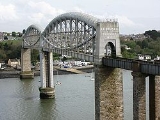
The Royal Albert Bridge is a railway bridge that spans the River Tamar
in the United Kingdom
between Plymouth
, on the Devon
bank, and Saltash
on the Cornish
bank. Its unique design consists of two 455 feet (138.7 m) lenticular
iron trusses 100 feet (30.5 m) above the water, with conventional plate-girder approach spans. This gives it a total length of 2187.5 feet (666.8 m). It carries the Cornish Main Line
railway in and out of Cornwall.
It was designed by Isambard Kingdom Brunel
. Surveying started in 1848 and construction commenced in 1854. The first main span was positioned in 1857 and the completed bridge was opened by Prince Albert on 2 May 1859. Brunel died later that year and his name was then placed above the portals at either end of the bridge as a memorial. Work was carried out during the twentieth century to replace the approach spans and strengthen the main spans. It has attracted sightseers since its construction and has appeared in many paintings, photographs and guidebooks. Anniversary celebrations took place in 1959 and 2009.
were proposed in the 1830s. The 'central' scheme was a route from Exeter
around the north of Dartmoor
, an easy route to construct but with little intermediate traffic. The other, the 'coastal' scheme, was a line with many engineering difficulties but which could serve the important naval town of Plymouth
and the industrial area around St Austell
. The central scheme was backed by the London and South Western Railway
while the coastal scheme was supported by the Cornwall Railway
and backed by the Great Western Railway
which wanted it to join up with the South Devon Railway
at Devonport
. The Cornwall Railway applied for an Act of Parliament
in 1845 but it was rejected, in part because of William Moorsom
's plan to carry trains across the water of the Hamoaze
on the Torpoint Ferry
. Following this Isambard Kingdom Brunel took over as engineer and proposed to cross the water higher upsteam at Saltash. The Act enabling this scheme was passed on 3 August 1846.
 The structure was the third in a series of three large wrought iron
bridges built in the middle of the nineteenth century and was influenced by the preceding two, both of which had been designed by Robert Stephenson
. The two central sections of Brunel's bridge are novel adaptations of the design Stephenson employed for the High Level Bridge
across the River Tyne
in Newcastle Upon Tyne
in 1849. Brunel was present when Stephenson raised the girders of his Britannia Bridge
across the Menai Strait
in the same year. From 1849 to 1853 was Brunel erecting an iron bridge of his own. The Chepstow Bridge
carried the South Wales Railway
across the River Wye
and featured a main truss of 300 feet (91.4 m) with a curving tubular main member, and three conventional plate-girder approach spans of 100 feet (30.5 m), a similar solution to that adopted for crossing the River Tamar
at Saltash.
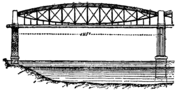
The river is about 1100 feet (335.3 m) wide at Saltash. Brunel's first thoughts had been to cross this on a timber viaduct with a central span of 255 feet (77.7 m) and six approach spans of 105 feet (32 m) with 80 feet (24.4 m) clearance above the water. This was rejected by the Admiralty, who had statutory responsibility for navigable waters, and Brunel thus produced a design to give 100 feet (30.5 m) clearance, with two spans of 300 feet (91.4 m) and two of 200 feet (61 m). The final design as built consists of two main iron spans of 455 feet (138.7 m) with 100 feet (30.5 m) clearance above mean high spring tide. These two spans are lenticular
trusses with the top chord of each truss comprising a heavy tubular arch in compression, while the bottom chord comprises a pair of chains. Each of the trusses is simply supported and therefore no horizontal thrust is exerted on the piers, which is crucial in view of the curved track on either side. Between these two chords are supporting cross-bracing members and suspension standards which hang beneath the bottom chord to carry the railway deck which is a continuous plate beam. There are also seventeen much shorter and more conventional plate-girder approach spans on the shore. On the Cornish side there are ten which measure (from Saltash station towards the river): 67.5 feet (20.6 m), 69.5 feet (21.2 m), 69.5 feet (21.2 m), 69.5 feet (21.2 m), 69.5 feet (21.2 m), 69.5 feet (21.2 m), 72.5 feet (22.1 m), 78 feet (23.8 m), 83.5 feet (25.5 m), 93 feet (28.3 m), and seven on the Devon side of (from the river towards St Budeaux): 93 feet (28.3 m), 83.5 feet (25.5 m), 78 feet (23.8 m), 72.5 feet (22.1 m), 69.5 feet (21.2 m), 69.5 feet (21.2 m), 69.5 feet (21.2 m). This gives a total length for the nineteen spans of 2187.5 feet (666.8 m).
In 1853 the tenders for the bridge were considered by the Cornwall Railway Board, and it was decided to let the work to Charles Mare, a shipbuilder from Blackwall
who had built the ironwork for the Britannia Bridge
. The fee he sought for building the Saltash Bridge was £162,000, but on 21 September 1855 he filed for bankruptcy. Brunel proposed that the company should take over the works on the bridge without engaging another contractor, to which the company agreed.
 Mare's first task had been to establish an erecting yard on the Devon shore with a jetty and workshops. He then proceeded to construct a 37 feet (11.3 m) iron cylinder 90 feet (27.4 m) tall which was to form the work base for the construction of the central pier. This was launched in May 1854 and moored in the centre of the river between four pontoons. The bottom had been shaped to follow the rock surveyed in 1848; once it was settled on the river bed the water was pumped out, the mud within it excavated, and a solid masonry pier built up clear of the water. This was completed in November 1856.
The landward piers on the Cornish side of the river were completed in 1854 and the girders for these spans were hoisted up to their correct positions. Next to be built was the main truss for the Cornwall side of the river. The lower ties of the trusses formed of chains made from 20 feet (6.1 m) links. Many were obtained from the suspended works for Brunel's Clifton Suspension Bridge
and others rolled new for Saltash. The Cornwall span was floated into position on 1 September 1857 and jacked up to full height in 3 feet (914.4 mm) stages as the piers were built up beneath it, the central pier using cast iron octagonal columns; the landward one using ordinary masonry.
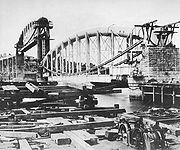 With the yard now cleared of the first truss, work could start on the main Devon span. This was similarly floated into position on 10 July 1858 and then raised in a similar manner; it was in its final position by 28 December 1858. After this had been removed, part of the yard had to be cleared to allow the construction of the final landward pier and then the Devon approach spans could be raised up to their final position. The work was sufficiently advanced that directors were able to make an inspection by train on 11 April 1859.
The Cornwall span had been tested before it was launched. The two ends were supported on substantial timber piers and the remaining scaffolding removed. Static loads of 1.25 and then 2.25 tons per foot were placed on the deck, the deflections measured and any permanent change measured once the road was removed. Now that it was completed, the bridge had its statutory inspection and tests by Colonel Yolland
on behalf of the Board of Trade
on 20 April 1859. He ran a heavy train over the bridge and measured deflections in the main trusses of 1.14 inches (29 mm) in the Devon truss, and 1.2 inches (30 mm) in the Cornwall one. Overall he described it as 'highly satisfactory'.
on a special train. Several thousand spectators attended that day, but illness prevented Brunel's attendance, and guests from Cornwall were late for the ceremony as their train broke down at Liskeard
. Public services commenced on 4 May 1859.
relocated the platforms, allowing the name to be clearly seen again. The walkways had previously been temporarily removed in 1959 and the bridge floodlit during its centenary year.
401 new cross-girders were fitted in 1905 to allow heavier locomotives to pass over. In 1908 the two spans nearest Saltash railway station
were replaced with wider ones to accommodate a new track layout. The remaining approach spans were replaced on both sides of the river during 1928 and 1929. During the 1930s new cross-bracing and diagonal sway-bracing were added between the vertical standards to further strengthen the bridge and keep the suspension chains hanging in the correct shape.
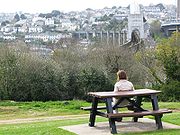 It is still possible to travel over the bridge by using a train on the Cornish Main Line
, and pass below it on the River Tamar. Cruise boats operate between Phoenix Wharf, Plymouth
, Saltash, and Calstock
. There are also several view points around the bridge.

 The construction of such a large and distinctive bridge soon caught the attention of the general public. The launching of the Cornish span in 1857 attracted a crowd of around 20,000, and many people also came to witness the launch of the Devon span and the opening day. During its construction it was photographed many times and after its opening it was the subject for many paintings, including those by local artist Alfred Wallis
. It has also been the subject of many photographs and postcard
s.
It was already a feature in guidebooks in the year of its opening: It is a labour of Hercules
, but Mr Brunel has accomplished the feat proclaimed one, and went on to report in detail the design and construction of the bridge that for novelty and ingenuity of construction stands unrivalled in the world. More than 100 years later it continues to appear in many travel guides and features. John Betjeman
summed up its impact on the traveller:
The bridge has become a symbol of the transition from Devon to Cornwall. In the Great Western Railway's The Cornish Riviera travel guide, SPB Mais regarded it as an almost magic means of transporting travellers from a county
, which, if richer than others, is yet unmistakingly an English county, to a Duchy
which is in every respect un-English. You shut your eyes going over the Saltash Bridge only to open them again on a foreign scene. However, Cornish people
look at it in the other way; in the song "Cousin Jack", English folk
duo Show of Hands
sing I dream of a bridge on the Tamar, It opens us up to the East.
The bridge is also the backdrop of ITV1's The West Country Tonight
during the old westcountry region.
 Special occasions have been marked over the years by special events:
River Tamar
The Tamar is a river in South West England, that forms most of the border between Devon and Cornwall . It is one of several British rivers whose ancient name is assumed to be derived from a prehistoric river word apparently meaning "dark flowing" and which it shares with the River Thames.The...
in the United Kingdom
United Kingdom
The United Kingdom of Great Britain and Northern IrelandIn the United Kingdom and Dependencies, other languages have been officially recognised as legitimate autochthonous languages under the European Charter for Regional or Minority Languages...
between Plymouth
Plymouth
Plymouth is a city and unitary authority area on the coast of Devon, England, about south-west of London. It is built between the mouths of the rivers Plym to the east and Tamar to the west, where they join Plymouth Sound...
, on the Devon
Devon
Devon is a large county in southwestern England. The county is sometimes referred to as Devonshire, although the term is rarely used inside the county itself as the county has never been officially "shired", it often indicates a traditional or historical context.The county shares borders with...
bank, and Saltash
Saltash
Saltash is a town and civil parish in Cornwall, England, United Kingdom. It has a population of 14,964. It lies in the south east of Cornwall, facing Plymouth over the River Tamar. It was in the Caradon district until March 2009 and is known as "the gateway to Cornwall". Saltash means ash tree by...
on the Cornish
Cornwall
Cornwall is a unitary authority and ceremonial county of England, within the United Kingdom. It is bordered to the north and west by the Celtic Sea, to the south by the English Channel, and to the east by the county of Devon, over the River Tamar. Cornwall has a population of , and covers an area of...
bank. Its unique design consists of two 455 feet (138.7 m) lenticular
Lens (geometry)
In geometry, a lens is a biconvex shape comprising two circular arcs, joined at their endpoints. If the arcs have equal radii, it is called a symmetric lens.A concave-convex shape is called a lune...
iron trusses 100 feet (30.5 m) above the water, with conventional plate-girder approach spans. This gives it a total length of 2187.5 feet (666.8 m). It carries the Cornish Main Line
Cornish Main Line
The Cornish Main Line is a railway line in the United Kingdom, which forms the backbone for rail services in Cornwall, as well as providing a direct line to London.- History :...
railway in and out of Cornwall.
It was designed by Isambard Kingdom Brunel
Isambard Kingdom Brunel
Isambard Kingdom Brunel, FRS , was a British civil engineer who built bridges and dockyards including the construction of the first major British railway, the Great Western Railway; a series of steamships, including the first propeller-driven transatlantic steamship; and numerous important bridges...
. Surveying started in 1848 and construction commenced in 1854. The first main span was positioned in 1857 and the completed bridge was opened by Prince Albert on 2 May 1859. Brunel died later that year and his name was then placed above the portals at either end of the bridge as a memorial. Work was carried out during the twentieth century to replace the approach spans and strengthen the main spans. It has attracted sightseers since its construction and has appeared in many paintings, photographs and guidebooks. Anniversary celebrations took place in 1959 and 2009.
Cornwall Railway
Two rival schemes for a railway to Falmouth, CornwallFalmouth, Cornwall
Falmouth is a town, civil parish and port on the River Fal on the south coast of Cornwall, England, United Kingdom. It has a total resident population of 21,635.Falmouth is the terminus of the A39, which begins some 200 miles away in Bath, Somerset....
were proposed in the 1830s. The 'central' scheme was a route from Exeter
Exeter
Exeter is a historic city in Devon, England. It lies within the ceremonial county of Devon, of which it is the county town as well as the home of Devon County Council. Currently the administrative area has the status of a non-metropolitan district, and is therefore under the administration of the...
around the north of Dartmoor
Dartmoor
Dartmoor is an area of moorland in south Devon, England. Protected by National Park status, it covers .The granite upland dates from the Carboniferous period of geological history. The moorland is capped with many exposed granite hilltops known as tors, providing habitats for Dartmoor wildlife. The...
, an easy route to construct but with little intermediate traffic. The other, the 'coastal' scheme, was a line with many engineering difficulties but which could serve the important naval town of Plymouth
Plymouth
Plymouth is a city and unitary authority area on the coast of Devon, England, about south-west of London. It is built between the mouths of the rivers Plym to the east and Tamar to the west, where they join Plymouth Sound...
and the industrial area around St Austell
St Austell
St Austell is a civil parish and a major town in Cornwall, England, United Kingdom. It is situated on the south coast approximately ten miles south of Bodmin and 30 miles west of the border with Devon at Saltash...
. The central scheme was backed by the London and South Western Railway
London and South Western Railway
The London and South Western Railway was a railway company in England from 1838 to 1922. Its network extended from London to Plymouth via Salisbury and Exeter, with branches to Ilfracombe and Padstow and via Southampton to Bournemouth and Weymouth. It also had many routes connecting towns in...
while the coastal scheme was supported by the Cornwall Railway
Cornwall Railway
The Cornwall Railway was a broad gauge railway from Plymouth in Devon to Falmouth in Cornwall, United Kingdom. The section from Plymouth to Truro opened in 1859, the extension to Falmouth in 1863...
and backed by the Great Western Railway
Great Western Railway
The Great Western Railway was a British railway company that linked London with the south-west and west of England and most of Wales. It was founded in 1833, received its enabling Act of Parliament in 1835 and ran its first trains in 1838...
which wanted it to join up with the South Devon Railway
South Devon Railway Company
The South Devon Railway Company built and operated the railway from Exeter to Plymouth and Torquay in Devon, England. It was a broad gauge railway built by Isambard Kingdom Brunel-Chronology:* 1844 South Devon Railway Act passed by parliament...
at Devonport
Devonport, Devon
Devonport, formerly named Plymouth Dock or just Dock, is a district of Plymouth in the English county of Devon, although it was, at one time, the more important settlement. It became a county borough in 1889...
. The Cornwall Railway applied for an Act of Parliament
Act of Parliament
An Act of Parliament is a statute enacted as primary legislation by a national or sub-national parliament. In the Republic of Ireland the term Act of the Oireachtas is used, and in the United States the term Act of Congress is used.In Commonwealth countries, the term is used both in a narrow...
in 1845 but it was rejected, in part because of William Moorsom
William Moorsom
Captain William Scarth Moorsom was an English soldier and engineer. He was born in Whitby to a military family, being the son of an admiral, and trained at Sandhurst, becoming a captain in the 52nd regiment...
's plan to carry trains across the water of the Hamoaze
Hamoaze
The Hamoaze is an estuarine stretch of the tidal River Tamar, between the River Lynher and Plymouth Sound, England.The Hamoaze flows past Devonport Dockyard, which belongs to the Royal Navy...
on the Torpoint Ferry
Torpoint Ferry
The Torpoint Ferry is a car and pedestrian chain ferry, connecting the A374 road which crosses the Hamoaze, a stretch of water at the mouth of the River Tamar, between Devonport in Plymouth and Torpoint in Cornwall...
. Following this Isambard Kingdom Brunel took over as engineer and proposed to cross the water higher upsteam at Saltash. The Act enabling this scheme was passed on 3 August 1846.
Design
Wrought iron
thumb|The [[Eiffel tower]] is constructed from [[puddle iron]], a form of wrought ironWrought iron is an iron alloy with a very low carbon...
bridges built in the middle of the nineteenth century and was influenced by the preceding two, both of which had been designed by Robert Stephenson
Robert Stephenson
Robert Stephenson FRS was an English civil engineer. He was the only son of George Stephenson, the famed locomotive builder and railway engineer; many of the achievements popularly credited to his father were actually the joint efforts of father and son.-Early life :He was born on the 16th of...
. The two central sections of Brunel's bridge are novel adaptations of the design Stephenson employed for the High Level Bridge
High Level Bridge
The High Level Bridge is a road and railway bridge spanning the River Tyne between Newcastle upon Tyne and Gateshead in North East England.-Design:...
across the River Tyne
River Tyne
The River Tyne is a river in North East England in Great Britain. It is formed by the confluence of two rivers: the North Tyne and the South Tyne. These two rivers converge at Warden Rock near Hexham in Northumberland at a place dubbed 'The Meeting of the Waters'.The North Tyne rises on the...
in Newcastle Upon Tyne
Newcastle upon Tyne
Newcastle upon Tyne is a city and metropolitan borough of Tyne and Wear, in North East England. Historically a part of Northumberland, it is situated on the north bank of the River Tyne...
in 1849. Brunel was present when Stephenson raised the girders of his Britannia Bridge
Britannia Bridge
Britannia Bridge is a bridge across the Menai Strait between the island of Anglesey and the mainland of Wales. It was originally designed and built by Robert Stephenson as a tubular bridge of wrought iron rectangular box-section spans for carrying rail traffic...
across the Menai Strait
Menai Strait
The Menai Strait is a narrow stretch of shallow tidal water about long, which separates the island of Anglesey from the mainland of Wales.The strait is bridged in two places - the main A5 road is carried over the strait by Thomas Telford's elegant iron suspension bridge, the first of its kind,...
in the same year. From 1849 to 1853 was Brunel erecting an iron bridge of his own. The Chepstow Bridge
Chepstow Bridge
Chepstow railway bridge was built to the instructions of Isambard Kingdom Brunel in 1852. The "Great Tubular Bridge" over the River Wye at Chepstow, which at that point forms the boundary between Wales and England, is considered one of Brunel's major achievements, despite its appearance...
carried the South Wales Railway
South Wales Railway
The South Wales Railway was a broad gauge railway that linked the Gloucester and Dean Forest Railway with Neyland in Wales.-History:The need for the railway was created by the need to ship coal from the South Wales Valleys to London, and secondly to complete Brunel's vision of linking London with...
across the River Wye
River Wye
The River Wye is the fifth-longest river in the UK and for parts of its length forms part of the border between England and Wales. It is important for nature conservation and recreation.-Description:...
and featured a main truss of 300 feet (91.4 m) with a curving tubular main member, and three conventional plate-girder approach spans of 100 feet (30.5 m), a similar solution to that adopted for crossing the River Tamar
River Tamar
The Tamar is a river in South West England, that forms most of the border between Devon and Cornwall . It is one of several British rivers whose ancient name is assumed to be derived from a prehistoric river word apparently meaning "dark flowing" and which it shares with the River Thames.The...
at Saltash.
The river is about 1100 feet (335.3 m) wide at Saltash. Brunel's first thoughts had been to cross this on a timber viaduct with a central span of 255 feet (77.7 m) and six approach spans of 105 feet (32 m) with 80 feet (24.4 m) clearance above the water. This was rejected by the Admiralty, who had statutory responsibility for navigable waters, and Brunel thus produced a design to give 100 feet (30.5 m) clearance, with two spans of 300 feet (91.4 m) and two of 200 feet (61 m). The final design as built consists of two main iron spans of 455 feet (138.7 m) with 100 feet (30.5 m) clearance above mean high spring tide. These two spans are lenticular
Lens (geometry)
In geometry, a lens is a biconvex shape comprising two circular arcs, joined at their endpoints. If the arcs have equal radii, it is called a symmetric lens.A concave-convex shape is called a lune...
trusses with the top chord of each truss comprising a heavy tubular arch in compression, while the bottom chord comprises a pair of chains. Each of the trusses is simply supported and therefore no horizontal thrust is exerted on the piers, which is crucial in view of the curved track on either side. Between these two chords are supporting cross-bracing members and suspension standards which hang beneath the bottom chord to carry the railway deck which is a continuous plate beam. There are also seventeen much shorter and more conventional plate-girder approach spans on the shore. On the Cornish side there are ten which measure (from Saltash station towards the river): 67.5 feet (20.6 m), 69.5 feet (21.2 m), 69.5 feet (21.2 m), 69.5 feet (21.2 m), 69.5 feet (21.2 m), 69.5 feet (21.2 m), 72.5 feet (22.1 m), 78 feet (23.8 m), 83.5 feet (25.5 m), 93 feet (28.3 m), and seven on the Devon side of (from the river towards St Budeaux): 93 feet (28.3 m), 83.5 feet (25.5 m), 78 feet (23.8 m), 72.5 feet (22.1 m), 69.5 feet (21.2 m), 69.5 feet (21.2 m), 69.5 feet (21.2 m). This gives a total length for the nineteen spans of 2187.5 feet (666.8 m).
Construction
The first work was to properly survey the river bed. On 26 April 1848 a 6 feet (1.8 m) iron cylinder 85 feet (25.9 m) tall was launched into the Tamar. From the bottom of this the bed of the river could be examined to identify its nature and the location of solid foundations. The Cornwall Railway at this time was finding it difficult to raise funds and so most operations were suspended that summer, but a small fund was allowed for Brunel to continue the survey. The cylinder was positioned at 35 different places and a total of 175 borings made.In 1853 the tenders for the bridge were considered by the Cornwall Railway Board, and it was decided to let the work to Charles Mare, a shipbuilder from Blackwall
Blackwall, London
Blackwall is an area of the East End of London, situated in the London Borough of Tower Hamlets on the north bank of the River Thames.The district around Blackwall Stairs was known as Blackwall by at least the 14th century. This presumably derives from the colour of the river wall, constructed in...
who had built the ironwork for the Britannia Bridge
Britannia Bridge
Britannia Bridge is a bridge across the Menai Strait between the island of Anglesey and the mainland of Wales. It was originally designed and built by Robert Stephenson as a tubular bridge of wrought iron rectangular box-section spans for carrying rail traffic...
. The fee he sought for building the Saltash Bridge was £162,000, but on 21 September 1855 he filed for bankruptcy. Brunel proposed that the company should take over the works on the bridge without engaging another contractor, to which the company agreed.
The landward piers on the Cornish side of the river were completed in 1854 and the girders for these spans were hoisted up to their correct positions. Next to be built was the main truss for the Cornwall side of the river. The lower ties of the trusses formed of chains made from 20 feet (6.1 m) links. Many were obtained from the suspended works for Brunel's Clifton Suspension Bridge
Clifton Suspension Bridge
Brunel died in 1859, without seeing the completion of the bridge. Brunel's colleagues in the Institution of Civil Engineers felt that completion of the Bridge would be a fitting memorial, and started to raise new funds...
and others rolled new for Saltash. The Cornwall span was floated into position on 1 September 1857 and jacked up to full height in 3 feet (914.4 mm) stages as the piers were built up beneath it, the central pier using cast iron octagonal columns; the landward one using ordinary masonry.
The Cornwall span had been tested before it was launched. The two ends were supported on substantial timber piers and the remaining scaffolding removed. Static loads of 1.25 and then 2.25 tons per foot were placed on the deck, the deflections measured and any permanent change measured once the road was removed. Now that it was completed, the bridge had its statutory inspection and tests by Colonel Yolland
William Yolland
William Yolland CB, FRS was an English military surveyor, astronomer and engineer, and was Britain’s Chief Inspector of Railways from 1877 until his death...
on behalf of the Board of Trade
Board of Trade
The Board of Trade is a committee of the Privy Council of the United Kingdom, originating as a committee of inquiry in the 17th century and evolving gradually into a government department with a diverse range of functions...
on 20 April 1859. He ran a heavy train over the bridge and measured deflections in the main trusses of 1.14 inches (29 mm) in the Devon truss, and 1.2 inches (30 mm) in the Cornwall one. Overall he described it as 'highly satisfactory'.
Opening day
Prince Albert had agreed to the bridge being named after him as early as 1853. He was also invited to perform the opening ceremony, and on 2 May 1859 he travelled from WindsorWindsor, Berkshire
Windsor is an affluent suburban town and unparished area in the Royal Borough of Windsor and Maidenhead in Berkshire, England. It is widely known as the site of Windsor Castle, one of the official residences of the British Royal Family....
on a special train. Several thousand spectators attended that day, but illness prevented Brunel's attendance, and guests from Cornwall were late for the ceremony as their train broke down at Liskeard
Liskeard railway station
Liskeard station serves the town of Liskeard in Cornwall, England. The station is west of Plymouth on the Cornish Main Line and it is the junction for the Looe Valley Line.-History:-Cornwall Railway:...
. Public services commenced on 4 May 1859.
Changes since 1859
The words I.K. BRUNEL, ENGINEER, 1859 appear in large metal letters on either end of the bridge, added as a memorial after his death on 5 September 1859. In 1921, new access platforms were added that obscured the lettering but in 2006 Network RailNetwork Rail
Network Rail is the government-created owner and operator of most of the rail infrastructure in Great Britain .; it is not responsible for railway infrastructure in Northern Ireland...
relocated the platforms, allowing the name to be clearly seen again. The walkways had previously been temporarily removed in 1959 and the bridge floodlit during its centenary year.
401 new cross-girders were fitted in 1905 to allow heavier locomotives to pass over. In 1908 the two spans nearest Saltash railway station
Saltash railway station
Saltash railway station serves the town of Saltash in Cornwall, United Kingdom. It is situated on the south side of the town between the Royal Albert Bridge over the River Tamar and Coombe Viaduct which spans a small tributary of the same river...
were replaced with wider ones to accommodate a new track layout. The remaining approach spans were replaced on both sides of the river during 1928 and 1929. During the 1930s new cross-bracing and diagonal sway-bracing were added between the vertical standards to further strengthen the bridge and keep the suspension chains hanging in the correct shape.
Viewing the bridge
Cornish Main Line
The Cornish Main Line is a railway line in the United Kingdom, which forms the backbone for rail services in Cornwall, as well as providing a direct line to London.- History :...
, and pass below it on the River Tamar. Cruise boats operate between Phoenix Wharf, Plymouth
Plymouth
Plymouth is a city and unitary authority area on the coast of Devon, England, about south-west of London. It is built between the mouths of the rivers Plym to the east and Tamar to the west, where they join Plymouth Sound...
, Saltash, and Calstock
Calstock
Calstock is civil parish and a large village in south east Cornwall, England, United Kingdom, on the border with Devon. The village is situated on the River Tamar south west of Tavistock and north of Plymouth....
. There are also several view points around the bridge.
- Saltash railway stationSaltash railway stationSaltash railway station serves the town of Saltash in Cornwall, United Kingdom. It is situated on the south side of the town between the Royal Albert Bridge over the River Tamar and Coombe Viaduct which spans a small tributary of the same river...
(50.40719°N 4.20924°W)
- The Cornish approach spans start right at the platformRailway platformA railway platform is a section of pathway, alongside rail tracks at a train station, metro station or tram stop, at which passengers may board or alight from trains or trams. Almost all stations for rail transport have some form of platforms, with larger stations having multiple platforms...
end. These were replaced in 1908 so that the single line on the bridge could split into two lines before reaching the station.- Saltash Quay (50.40779°N 4.20614°W)
- The foreshore at Saltash runs right up to the pier that supports the Cornish end of the main span. An inscribed stone commemorating the bridge can be found beneath the bridge on the hillside alongside Fore Street.
- Tamar BridgeTamar BridgeThe Tamar Bridge is a major road bridge at Saltash in southwest England carrying traffic between Cornwall and Devon. When it opened in 1961 it was the longest suspension bridge in the United Kingdom...
(50.40777°N 4.19974°W)
- Tamar Bridge
- The road bridge lies parallel to and slightly higher than the railway bridge on its north side. A toll-free foot and cycle path is situated on the south side of the road bridge from which it is possible to examine the bridge in detail. An area of grass beside the motor vehicle toll boothToll houseA tollhouse or toll house is a building with accommodation for a toll collector, beside a tollgate on a toll road or canal. Many tollhouses were built by turnpike trusts in England, Wales and Scotland during the 18th and early 19th centuries...
s affords a view of the Devon end of the railway bridge.- St BudeauxSt BudeauxSt Budeaux is an area and ward in the north west of Plymouth in the English county of Devon.-Original settlement:The name St Budeaux comes from Saint Budoc, the Bishop of Dol . Around 480, Budoc is said to have founded a settlement and built a small church...
Passage (50.40585°N 4.20069°W)
- St Budeaux
- The Devon piers can be reached from the waterfront at St Budeaux. The yard where the spans were constructed was situated alongside the bridge at the foot of the road down the hill.
Cultural impact
Alfred Wallis
Alfred Wallis was a Cornish fisherman and artist.Wallis's parents, Charles and Jane Wallis were from Penzance in Cornwall and moved to Devonport, Devon to find work in 1850 where Alfred and his brother Charles were born. Shortly after this the children's mother died and this prompted the family to...
. It has also been the subject of many photographs and postcard
Postcard
A postcard or post card is a rectangular piece of thick paper or thin cardboard intended for writing and mailing without an envelope....
s.
It was already a feature in guidebooks in the year of its opening: It is a labour of Hercules
Hercules
Hercules is the Roman name for Greek demigod Heracles, son of Zeus , and the mortal Alcmene...
, but Mr Brunel has accomplished the feat proclaimed one, and went on to report in detail the design and construction of the bridge that for novelty and ingenuity of construction stands unrivalled in the world. More than 100 years later it continues to appear in many travel guides and features. John Betjeman
John Betjeman
Sir John Betjeman, CBE was an English poet, writer and broadcaster who described himself in Who's Who as a "poet and hack".He was a founding member of the Victorian Society and a passionate defender of Victorian architecture...
summed up its impact on the traveller:
-
- The general grey slate and back gardens of Plymouth, as seen from the Great Western made the surprise of Saltash Bridge all the more exciting. Up and down stream, grey battleships were moored in the Tamar and its reaches. Hundreds of feet below, the pathetic steam ferry to Saltash from the Devon bank tried to compete with Brunel's mighty bridge.
The bridge has become a symbol of the transition from Devon to Cornwall. In the Great Western Railway's The Cornish Riviera travel guide, SPB Mais regarded it as an almost magic means of transporting travellers from a county
County
A county is a jurisdiction of local government in certain modern nations. Historically in mainland Europe, the original French term, comté, and its equivalents in other languages denoted a jurisdiction under the sovereignty of a count A county is a jurisdiction of local government in certain...
, which, if richer than others, is yet unmistakingly an English county, to a Duchy
Duchy
A duchy is a territory, fief, or domain ruled by a duke or duchess.Some duchies were sovereign in areas that would become unified realms only during the Modern era . In contrast, others were subordinate districts of those kingdoms that unified either partially or completely during the Medieval era...
which is in every respect un-English. You shut your eyes going over the Saltash Bridge only to open them again on a foreign scene. However, Cornish people
Cornish people
The Cornish are a people associated with Cornwall, a county and Duchy in the south-west of the United Kingdom that is seen in some respects as distinct from England, having more in common with the other Celtic parts of the United Kingdom such as Wales, as well as with other Celtic nations in Europe...
look at it in the other way; in the song "Cousin Jack", English folk
Folk music
Folk music is an English term encompassing both traditional folk music and contemporary folk music. The term originated in the 19th century. Traditional folk music has been defined in several ways: as music transmitted by mouth, as music of the lower classes, and as music with unknown composers....
duo Show of Hands
Show of Hands
Show of Hands is an English acoustic roots and folk duo comprising singer-songwriter Steve Knightley and multi-instrumentalist Phil Beer. In recent years they have been accompanied on tour and in the studio by jazz double-bassist Miranda Sykes.-Origins:...
sing I dream of a bridge on the Tamar, It opens us up to the East.
The bridge is also the backdrop of ITV1's The West Country Tonight
The West Country Tonight
The West Country Tonight is a regional television news and current affairs programme, also including local sports news and local features of interest, produced by ITV West & Westcountry at its studios in Bristol...
during the old westcountry region.
Special events
- 1859 – The bridge was opened by Prince Albert two days before the railway was opened to the public. He arrived by special train from Windsor, was shown around the bridge and the works yard, and then left aboard the Royal YachtHMY Victoria and Albert IIHMY Victoria and Albert, a 360 foot steamer launched 16 January 1855, was a Royal Yacht of the Sovereign of the United Kingdom until 1900, owned and operated by the Royal Navy. She displaced 2,470 tons, and could make 15 knots on her paddles...
. - 1959 – Floodlights lit up the bridge during 1959 in celebration of its centenary.
- 2006 – The anniversary of Isambard Kingdom BrunelIsambard Kingdom BrunelIsambard Kingdom Brunel, FRS , was a British civil engineer who built bridges and dockyards including the construction of the first major British railway, the Great Western Railway; a series of steamships, including the first propeller-driven transatlantic steamship; and numerous important bridges...
's 200th birthday was celebrated by Network RailNetwork RailNetwork Rail is the government-created owner and operator of most of the rail infrastructure in Great Britain .; it is not responsible for railway infrastructure in Northern Ireland...
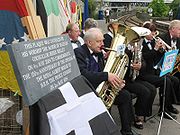
permanently removing the access ways that covered his name above the portals. - 2009 – 2009 was the 150th anniversary of the opening of the bridge. During the bank holiday weekend of 2–4 May there were many special events to commemorate this, including a guided walk across the bridge and a re-enactment of the opening day.
External links
- The Royal Albert Bridge official website with Live Webcam
- A modeller's research into the bridge
- The Brunel Museum, Rotherhithe, London
- Photographs of the 150th anniversary events including the bridge walk and re-enactment of the opening
- Brunel portal
- An investigation of the first decorative scheme