
|
|
|
|
Rotherhithe
|
| |
|
| |
Rotherhithe is a district of central south-east London in the London Borough of Southwark. It is located on a peninsula on the south bank of the Thames, facing Wapping and the Isle of Dogs on the north bank, and is a part of the Docklands area.
Rotherhithe has been a port since the 12th century or earlier, and a shipyard since Elizabethan times. The Mayflower sailed from Rotherhithe with the Pilgrim Fathers to Plymouth, Massachusetts in 1620.
name "Rotherhithe" derives from Anglo-Saxon hryðer-h?ð = "Landing-place for cattle" or from redhra-hyð = "Sailor haven".

Discussion
Ask a question about 'Rotherhithe'
Start a new discussion about 'Rotherhithe'
Answer questions from other users
|
Encyclopedia
Rotherhithe is a district of central south-east London in the London Borough of Southwark. It is located on a peninsula on the south bank of the Thames, facing Wapping and the Isle of Dogs on the north bank, and is a part of the Docklands area.
Rotherhithe has been a port since the 12th century or earlier, and a shipyard since Elizabethan times. The Mayflower sailed from Rotherhithe with the Pilgrim Fathers to Plymouth, Massachusetts in 1620.
History
The name "Rotherhithe" derives from Anglo-Saxon hryðer-h?ð = "Landing-place for cattle" or from redhra-hyð = "Sailor haven". The first recorded use of this name is circa 1105, as Rederheia
Because much of Rotherhithe was covered by the now-defunct Surrey Commercial Docks, the district is often referred to as Surrey Docks or (since the late 1980s) Surrey Quays, though the latter name tends to be used more for the southern half of the peninsula. An eastern part, which became in effect an island when the docks were in use and locks open is called "Downtown". In the past Rotherhithe has also been known as the cognate "Redriff". It is part of the SE16 postal district. Electorally, the western half is Rotherhithe ward and the eastern half Surrey Docks ward.
Redriff was the fictional birthplace of Jonathan Swift's character Lemuel Gulliver, of Gulliver's Travels fame, and where his family waited for him.
Rotherhithe is joined to the north bank of the Thames by three tunnels. The Thames Tunnel to Wapping was the first underwater tunnel in the world. Built by the Brunels originally to carry cross river freight, it became a pedestrian tunnel, due to the money running out to build the necessary ramps. It is now occupied by the East London Line of the London Underground, which since 23 December 2007 has been closed for conversion to become part of the London Overground network by summer 2010. The later Rotherhithe Tunnel (opened 1908) carries a two-lane road to Limehouse. The Jubilee Line extension (opened 1999) has a railway tunnel to Canary Wharf in the Isle of Dogs.
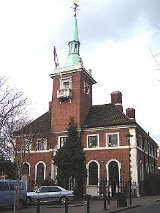
Although the docks were closed and largely filled in during the 1980s, and have now been replaced by modern housing and commercial facilities, Rotherhithe is still dominated by its former maritime heritage. The largest surviving dock on the south bank, Greenland Dock, is the focal point for the southern part of the district, while preserved wharves dominate the riverside at the north end of Rotherhithe. St. Mary's Church dominates the old town centre, a short distance from the historic Brunel Engine House at the south end of the Thames Tunnel.
Rotherhithe had its own general hospital, St Olave's Hospital, in Lower Road. Built originally in the early 1870s on land adjoining Rotherhithe Workhouse, it became the infirmary of St Olave's Union in 1875, and was renamed St Olave's Hospital in 1930. Subsequently becoming part of the Guy's Hospital Teaching Group in 1966, it closed in 1985 and the site has been redeveloped into the residential Ann Moss Way.
When the roundabout facing the Rotherhithe Tunnel was redeveloped in the early 1980s, several nineteenth century buildings were demolished including a school and a nunnery. A public house described in an early twentieth century history of the area as one its oldest, was also demolished.
Rotherhithe is the traditional home of the football team, Fisher Athletic F.C., although the team currently ground shares in Dulwich Hamlet.
The sustainable transport charity Sustrans has proposed the construction of a bicycle and pedestrian swing bridge from Rotherhithe to Canary Wharf, and a feasibility study is underway. In January 2009 this study was cancelled by the London Mayor Boris Johnson citing budget cuts due to the credit crunch.
The Scandinavian connection
Because much of the former Surrey Docks had strong trade links to Scandinavia and the Baltic region the area is still home to a thriving Scandinavian community. During World War II, in fact, it housed the Norwegian Government-in-Exile. Originally established as seafarers' missions, Rotherhithe is home to a Norwegian , a Finnish and a Swedish church. The Finnish Church and the Norwegian Church are both located in Albion Street; they were built in 1958 and 1927 respectively (Rotherhithe Library is located between them). There are also a number of "community centres" for the Nordic community in London, including hostels, shops and cafés and even a sauna, mostly linked closely to the churches.
Some of the redeveloped areas were built by Nordic architects, such as the Greenland Passage development by Danish Company Kjaer & Richter. This gives some areas a distinctly "Nordic" feel in terms of house and street design.
The relationship with Scandinavia and the Baltic is also reflected in the names of some of the buildings (such as the King Frederik IX Tower) , the street names (e.g. Sweden Gate, Baltic Quay, Norway Gate, Helsinki Square) or other place names (e.g. Greenland Dock). Another major influence factor was trade with Russia and Canada (mainly timber), reflected in names such as Canada Water and the Russia Dock Woodland.
Mayflower
The ship, the Mayflower sailed from Rotherhithe for Massachusetts in 1620 with the group of emigrants that later became known as the "Pilgrim Fathers". The ship's captain, Christopher Jones, died shortly after his return in 1621 and he is buried in an unmarked grave at St Mary's Church. The Mayflower sailed from near the Shippe public house in Rotherhithe Street, which is now named the Mayflower. The building is not original, having been rebuilt in the 18th century.
Notable people associated with Rotherhithe
- Max Bygraves was born in Rotherhithe
- Michael Caine on 14 March 1933 as Maurice Joseph Micklewhite.
- Princess Margaret met her husband-to-be, photographer Tony Armstrong-Jones, in a house in Rotherhithe.
- Alfred Hitchcock filmed scenes for his first film as director, Number 13 (1922), in Rotherhithe before it was pulled from production.
Cultural references
Places of interest
Transport
Nearest places
- Bermondsey
- Deptford
- Isle of Dogs
- Limehouse
- Tower Bridge
- Wapping
- The Blue
Nearest railway stations
River boat service piers
Gallery
External links
Maps
|
| |
|
|