
Bridgwater is a
market townMarket town or market right is a legal term, originating in the medieval period, for a European settlement that has the right to host markets, distinguishing it from a village and city...
and civil parish in
SomersetThe ceremonial and non-metropolitan county of Somerset in South West England borders Bristol and Gloucestershire to the north, Wiltshire to the east, Dorset to the south-east, and Devon to the south-west. It is partly bounded to the north and west by the Bristol Channel and the estuary of the...
, England. It is the administrative centre of the
SedgemoorSedgemoor is a low lying area of land in Somerset, England. It lies close to sea level south of the Polden Hills, historically largely marsh . The eastern part is known as King's Sedgemoor, and the western part West Sedgemoor. Sedgemoor is part of the area now known as the Somerset Levels...
district, and a major industrial centre. Bridgwater is located on the major communication routes through
South West EnglandSouth West England is one of the regions of England defined by the Government of the United Kingdom for statistical and other purposes. It is the largest such region in area, covering and comprising Bristol, Gloucestershire, Somerset, Dorset, Wiltshire, Devon, Cornwall and the Isles of Scilly. ...
. According to the 2001 census, the town had a population of 33,698 .
Bridgwater is situated, on the edge of the
Somerset LevelsThe Somerset Levels, or the Somerset Levels and Moors as they are less commonly but more correctly known, is a sparsely populated coastal plain and wetland area of central Somerset, South West England, between the Quantock and Mendip Hills...
, in a level and well-wooded country, having to the north the
Mendip rangeThe Mendip Hills is a range of limestone hills to the south of Bristol and Bath in Somerset, England. Running east to west between Weston-super-Mare and Frome, the hills overlook the Somerset Levels to the south and the Avon Valley to the north...
and on the west the
Quantock hillsThe Quantock Hills is a range of hills west of Bridgwater in Somerset, England. The Quantock Hills were England’s first Area of Outstanding Natural Beauty being designated in 1956 and consists of large amounts of heathland, oak woodlands, ancient parklands and agricultural land.The hills run from...
. The town lies along both sides of the
River ParrettThe River Parrett flows through the counties of Dorset and Somerset in South West England, from its source in the Thorney Mills springs in the hills around Chedington in Dorset...
, 10 miles (16 km) from its mouth, has been a major port and trading centre and maintains a large industrial base. It is linked to
TauntonTaunton is the county town of Somerset, England. The town, including its suburbs, had an estimated population of 61,400 in 2001. It is the largest town in the shire county of Somerset....
by the
Bridgwater and Taunton CanalThe Bridgwater and Taunton Canal is a canal in the south-west of England between Bridgwater and Taunton, opened in 1827 and linking the River Tone to the River Parrett. There were a number of abortive schemes to link the Bristol Channel to the English Channel by waterway in the 18th and early 19th...
. Bridgwater is located between two junctions of the
M5 motorwayThe M5 is a motorway in England. It runs from a junction with the M6 at West Bromwich near Birmingham to Exeter in Devon. Heading south-west, the M5 runs east of West Bromwich and west of Birmingham through Sandwell Valley...
and
Bridgwater railway stationBridgwater railway station serves Bridgwater in Somerset, England. It is on the Bristol to Taunton Line and is operated by First Great Western. Originally built to the designs of Isambard Kingdom Brunel, the station is now a Grade II* listed building.-History:...
is on the main railway line between
BristolBristol is a city, unitary authority area and ceremonial county in South West England, with an estimated population of 433,100 for the unitary authority in 2009, and a surrounding Larger Urban Zone with an estimated 1,070,000 residents in 2007...
and Taunton.
Historically, the town had a politically radical tendency, being involved in several events of note on the national stage, and was defended by its own castle. The battlefield of the
Battle of SedgemoorThe Battle of Sedgemoor was fought on 6 July 1685 and took place at Westonzoyland near Bridgwater in Somerset, England.It was the final battle of the Monmouth Rebellion and followed a series of skirmishes around south west England between the forces of James Scott, 1st Duke of Monmouth and the...
, where the
Monmouth RebellionThe Monmouth Rebellion,The Revolt of the West or The West Country rebellion of 1685, was an attempt to overthrow James II, who had become King of England, King of Scots and King of Ireland at the death of his elder brother Charles II on 6 February 1685. James II was a Roman Catholic, and some...
was finally crushed in 1685 is nearby. Among several places of worship the chief is the
Church of St MaryThe Church of St Mary in Bridgwater, Somerset, England was built in the 13th century, and has been designated as a Grade I listed building.The building is on the site of an earlier church which was rebuilt by William Briwere in the early 13th century....
. A house in Blake Street, largely restored, was the birthplace of
Admiral BlakeRobert Blake was one of the most important military commanders of the Commonwealth of England and one of the most famous English admirals of the 17th century. Blake is recognised as the chief founder of England's naval supremacy, a dominance subsequently inherited by the British Royal Navy into...
in 1598, and is now the Blake Museum. The town has its own arts centre and plays host to the annual
Bridgwater Guy Fawkes CarnivalThe West Country Carnival is an annual celebration featuring a parade of illuminated floats , in the English West Country. The celebration dates back to the Gunpowder Plot of 1605. The purpose is to raise money for local charities....
.
Etymology
It is thought that the town was originally called Brigg, meaning Quay. It has been argued that the name may instead come from the Old English brycg (gang plank) or
Old NorseOld Norse is a North Germanic language that was spoken by inhabitants of Scandinavia and inhabitants of their overseas settlements during the Viking Age, until about 1300....
bryggja (quay), though this idea has been opposed on etymological grounds. In the
Domesday BookDomesday Book , now held at The National Archives, Kew, Richmond upon Thames in South West London, is the record of the great survey of much of England and parts of Wales completed in 1086...
the town is listed as Brugie, while Brugia was also used. After the
NormanThe Normans were the people who gave their name to Normandy, a region in northern France. They were descended from Norse Viking conquerors of the territory and the native population of Frankish and Gallo-Roman stock...
invasion the land was given to
Walter of DouaiWalter of Douai was a Norman knight, probably at the Battle of Hastings, and a major landowner in South West England after the Norman Conquest. He is given various names and titles in different sources including: Walter de Douai. Douai is sometimes written as Dowai...
, hence becoming known variously as Burgh-Walter, Brugg-Walter and Brigg-Walter, eventually corrupted to Bridgwater. An alternative version is that it derives from "Bridge of Walter" (i.e. Walter's Bridge).
History
Bridgwater is mentioned both in the
Domesday BookDomesday Book , now held at The National Archives, Kew, Richmond upon Thames in South West London, is the record of the great survey of much of England and parts of Wales completed in 1086...
and in the earlier
Anglo-Saxon ChronicleThe Anglo-Saxon Chronicle is a collection of annals in Old English chronicling the history of the Anglo-Saxons. The original manuscript of the Chronicle was created late in the 9th century, probably in Wessex, during the reign of Alfred the Great...
dating from around 800, owing its origin as a trade centre to its position at the mouth of the chief river in Somerset. It was formerly part of the Hundred of North Petherton. In a legend of
Alfred the GreatAlfred the Great was King of Wessex from 871 to 899.Alfred is noted for his defence of the Anglo-Saxon kingdoms of southern England against the Vikings, becoming the only English monarch still to be accorded the epithet "the Great". Alfred was the first King of the West Saxons to style himself...
, he burnt some cakes while hiding in the marshes of
AthelneyAthelney is located between the villages of Burrowbridge and East Lyng in the Sedgemoor district of Somerset, England. The area is known as the Isle of Athelney, because it was once a very low isolated island in the 'very great swampy and impassable marshes' of the Somerset Levels. Much of the...
near Bridgwater, after the
DanishDenmark is a Scandinavian country in Northern Europe. The countries of Denmark and Greenland, as well as the Faroe Islands, constitute the Kingdom of Denmark . It is the southernmost of the Nordic countries, southwest of Sweden and south of Norway, and bordered to the south by Germany. Denmark...
invasion in 875, while in 878 the major engagement of the Battle of Cynwit may have been at nearby
CanningtonCannington is a village and civil parish north-west of Bridgwater in the Sedgemoor district of Somerset, England. It lies on the west bank of the River Parret, and contains the hamlet of Edstock.-History:...
.
William BriwereWilliam Brewer was a prominent administrator and justice in England during the reigns of Richard I, King John, and Henry III...
was granted the
lordshipFeudalism was a set of legal and military customs in medieval Europe that flourished between the 9th and 15th centuries, which, broadly defined, was a system for ordering society around relationships derived from the holding of land in exchange for service or labour.Although derived from the...
of the
ManorManorialism, an essential element of feudal society, was the organizing principle of rural economy that originated in the villa system of the Late Roman Empire, was widely practiced in medieval western and parts of central Europe, and was slowly replaced by the advent of a money-based market...
of Bridgwater by
John of EnglandJohn , also known as John Lackland , was King of England from 6 April 1199 until his death...
in 1201, and founded
Bridgwater FriaryBridgwater Friary was a Franciscan monastery established in 1245 and dissolved in 1538 in Bridgwater, Somerset, England.It was founded by William Briwere and moved from another location. Further buildings were added in 1278 and 1284. The church was rebuilt in the 15th century and consecrated in...
. Through Briwere's influence, King
JohnJohn , also known as John Lackland , was King of England from 6 April 1199 until his death...
granted three charters in 1200; for the construction of Bridgwater Castle, for the creation of a
boroughA borough is an administrative division in various countries. In principle, the term borough designates a self-governing township although, in practice, official use of the term varies widely....
, and for a market.
Bridgwater CastleBridgwater Castle was a castle in the town of Bridgwater, Somerset, England.-Early history:The castle was built in 1202 by William Brewer, like several other castle-builders of the period, an exceptionally wealthy man. He was granted the lordship of the Manor of Bridgwater by King John in 1201, and...
was a substantial structure built in
Old Red SandstoneThe Old Red Sandstone is a British rock formation of considerable importance to early paleontology. For convenience the short version of the term, 'ORS' is often used in literature on the subject.-Sedimentology:...
, covering a site of 8 or 9 acres (32,000 to 36,000 m²). A tidal
moatA moat is a deep, broad ditch, either dry or filled with water, that surrounds a castle, other building or town, historically to provide it with a preliminary line of defence. In some places moats evolved into more extensive water defences, including natural or artificial lakes, dams and sluices...
, up to 65 feet (20 m) wide in places, flowed about along the line of the modern thoroughfares of Fore Street and Castle Moat, and between Northgate and Chandos Street. The main entrance opposite the Cornhill was built with a pair of adjacent gates and
drawbridgeA drawbridge is a type of movable bridge typically associated with the entrance of a castle surrounded by a moat. The term is often used to describe all different types of movable bridges, like bascule bridges and lift bridges.-Castle drawbridges:...
s. In addition to a
keepA keep is a type of fortified tower built within castles during the Middle Ages by European nobility. Scholars have debated the scope of the word keep, but usually consider it to refer to large towers in castles that were fortified residences, used as a refuge of last resort should the rest of the...
, located at the south-east corner of what is now King Square, documents show that the complex included a
dungeonA dungeon is a room or cell in which prisoners are held, especially underground. Dungeons are generally associated with medieval castles, though their association with torture probably belongs more to the Renaissance period...
, chapel, stables and a
bell towerA bell tower is a tower which contains one or more bells, or which is designed to hold bells, even if it has none. In the European tradition, such a tower most commonly serves as part of a church and contains church bells. When attached to a city hall or other civic building, especially in...
. Built on the only raised ground in the town, the castle controlled the crossing of the town bridge. A 12 feet (4 m) thick portion of the castle wall and water gate can still be seen on West Quay, and the remains of a wall of a building that was probably built within the castle can be viewed in Queen Street. The foundations of the tower forming the north-east corner of the castle are buried beneath Homecastle House. William Briwere also founded St John's
hospitalA hospital is a health care institution providing patient treatment by specialized staff and equipment. Hospitals often, but not always, provide for inpatient care or longer-term patient stays....
which, by the time of the
Dissolution of the MonasteriesThe Dissolution of the Monasteries, sometimes referred to as the Suppression of the Monasteries, was the set of administrative and legal processes between 1536 and 1541 by which Henry VIII disbanded monasteries, priories, convents and friaries in England, Wales and Ireland; appropriated their...
under
Henry VIIIHenry VIII was King of England from 21 April 1509 until his death. He was Lord, and later King, of Ireland, as well as continuing the nominal claim by the English monarchs to the Kingdom of France...
, was worth the substantial sum of almost 121
poundsThe pound sterling , commonly called the pound, is the official currency of the United Kingdom, its Crown Dependencies and the British Overseas Territories of South Georgia and the South Sandwich Islands, British Antarctic Territory and Tristan da Cunha. It is subdivided into 100 pence...
, as well as starting the construction of the town's first stone bridge. William Briwere also went on to found the
FranciscanMost Franciscans are members of Roman Catholic religious orders founded by Saint Francis of Assisi. Besides Roman Catholic communities, there are also Old Catholic, Anglican, Lutheran, ecumenical and Non-denominational Franciscan communities....
Bridgwater FriaryBridgwater Friary was a Franciscan monastery established in 1245 and dissolved in 1538 in Bridgwater, Somerset, England.It was founded by William Briwere and moved from another location. Further buildings were added in 1278 and 1284. The church was rebuilt in the 15th century and consecrated in...
in the town.
During the 11th century
Second Barons' WarThe Second Barons' War was a civil war in England between the forces of a number of barons led by Simon de Montfort, against the Royalist forces led by Prince Edward , in the name of Henry III.-Causes:...
against
Henry IIIHenry III was the son and successor of John as King of England, reigning for 56 years from 1216 until his death. His contemporaries knew him as Henry of Winchester. He was the first child king in England since the reign of Æthelred the Unready...
, Bridgwater was held by the
baronBaron is a title of nobility. The word baron comes from Old French baron, itself from Old High German and Latin baro meaning " man, warrior"; it merged with cognate Old English beorn meaning "nobleman"...
s against the King. Other charters were granted by
Henry IIIHenry III was the son and successor of John as King of England, reigning for 56 years from 1216 until his death. His contemporaries knew him as Henry of Winchester. He was the first child king in England since the reign of Æthelred the Unready...
in 1227 (confirmed in 1318, 1370, 1380), which gave Bridgwater a gild merchant which was important for the regulation of trade allowing gild members to trade freely in the town, and to impose payments and restrictions upon others. Bridgwater's peasants under Nicholas Frampton took part in the
Peasants' RevoltThe Peasants' Revolt, Wat Tyler's Rebellion, or the Great Rising of 1381 was one of a number of popular revolts in late medieval Europe and is a major event in the history of England. Tyler's Rebellion was not only the most extreme and widespread insurrection in English history but also the...
of 1381, sacking Sydenham House, murdering the local tax collectors and destroying the records.
It was incorporated by charter of
Edward IVEdward IV was King of England from 4 March 1461 until 3 October 1470, and again from 11 April 1471 until his death. He was the first Yorkist King of England...
(1468), confirmed in 1554, 1586, 1629 and 1684. Parliamentary representation began in 1295 and continued until the Reform Act of 1870 when the original borough constituency was disenfranchised for corruption in 1870. From 4 July 1870 the town was incorporated within the county constituency of
West SomersetWest Somerset or Somerset Western was the name of a parliamentary constituency in the county of Somerset between 1832 and 1885...
. When there was a redistribution of Parliamentary seats to take effect at the
1885 general election-Seats summary:-See also:*List of MPs elected in the United Kingdom general election, 1885*Parliamentary Franchise in the United Kingdom 1885–1918*Representation of the People Act 1884*Redistribution of Seats Act 1885-References:...
, a new county division of
BridgwaterBridgwater was a parliamentary constituency represented in the House of Commons of the Parliament of the United Kingdom, until 2010 when it was replaced by the Bridgwater and West Somerset constituency...
was created. A Saturday market and a fair on 24 June were granted by the charter of 1201. Another fair at the beginning of Lent was added in 1468, and a second market on Thursday, and fairs at Midsummer and on 21 September were added in 1554.
Charles IICharles II was monarch of the three kingdoms of England, Scotland, and Ireland.Charles II's father, King Charles I, was executed at Whitehall on 30 January 1649, at the climax of the English Civil War...
granted another fair on 29 December. The importance of these markets and fairs for the sale of wool and wine, and later of cloth in declined after medieval times. The shipping trade of the port revived after the construction of the new dock in 1841, and corn and timber have been imported for centuries.
Gunpowder PlotThe Gunpowder Plot of 1605, in earlier centuries often called the Gunpowder Treason Plot or the Jesuit Treason, was a failed assassination attempt against King James I of England and VI of Scotland by a group of provincial English Catholics led by Robert Catesby.The plan was to blow up the House of...
ter
Guy FawkesGuy Fawkes , also known as Guido Fawkes, the name he adopted while fighting for the Spanish in the Low Countries, belonged to a group of provincial English Catholics who planned the failed Gunpowder Plot of 1605.Fawkes was born and educated in York...
is celebrated as a local hero during the carnival season, including a grand illuminated procession through Bridgwater town centre, which culminates in the
SquibbingThe West Country Carnival is an annual celebration featuring a parade of illuminated floats , in the English West Country. The celebration dates back to the Gunpowder Plot of 1605. The purpose is to raise money for local charities....
.
In the
English Civil WarThe English Civil War was a series of armed conflicts and political machinations between Parliamentarians and Royalists...
the town and the castle were held by the Royalists under
Colonel Francis WyndhamSir Francis Wyndham, 1st Baronet was an English soldier and politician who sat in the House of Commons of England in 1640...
, a personal acquaintance of the King. British history might have been very different had his wife, Lady (Crystabella) Wyndham, been a little more accurate with a musket shot that missed
CromwellOliver Cromwell was an English military and political leader who overthrew the English monarchy and temporarily turned England into a republican Commonwealth, and served as Lord Protector of England, Scotland, and Ireland....
but killed his aide de camp. Eventually, with many buildings destroyed in the town, the castle and its valuable contents were surrendered to the Parliamentarians on 21 July 1645. The castle itself was deliberately destroyed the following year, while in 1651 Colonel Wyndham made arrangements for
Charles IICharles II was monarch of the three kingdoms of England, Scotland, and Ireland.Charles II's father, King Charles I, was executed at Whitehall on 30 January 1649, at the climax of the English Civil War...
to
flee to FranceThe Escape of Charles II from England in 1651 is a key episode in his life. Although it took only six weeks, it had a major effect on his attitudes for the rest of his life.-The fugitive king:...
following the
Battle of WorcesterThe Battle of Worcester took place on 3 September 1651 at Worcester, England and was the final battle of the English Civil War. Oliver Cromwell and the Parliamentarians defeated the Royalist, predominantly Scottish, forces of King Charles II...
.
Following the
restoration of the monarchyThe Restoration of the English monarchy began in 1660 when the English, Scottish and Irish monarchies were all restored under Charles II after the Interregnum that followed the Wars of the Three Kingdoms...
, in 1663 the non-conformist Reverend John Norman,
vicarIn the broadest sense, a vicar is a representative, deputy or substitute; anyone acting "in the person of" or agent for a superior . In this sense, the title is comparable to lieutenant...
from 1647 to 1660, was one of several 'religious
fanatics'Fanaticism is a belief or behavior involving uncritical zeal, particularly for an extreme religious or political cause or in some cases sports, or with an obsessive enthusiasm for a pastime or hobby...
confined to their homes by Lord Stawell's
militiaThe term militia is commonly used today to refer to a military force composed of ordinary citizens to provide defense, emergency law enforcement, or paramilitary service, in times of emergency without being paid a regular salary or committed to a fixed term of service. It is a polyseme with...
. A large religious meeting house, thought to have been Presbyterian, was demolished and its furniture burned on the Cornhill in 1683. By 1688, matters had calmed down enough that a new chapel, Christ Church, was founded in Dampiet Street, the congregation of which became
UnitarianUnitarianism is a Christian theological movement, named for its understanding of God as one person, in direct contrast to Trinitarianism which defines God as three persons coexisting consubstantially as one in being....
in 1815.
In the 1685
Monmouth RebellionThe Monmouth Rebellion,The Revolt of the West or The West Country rebellion of 1685, was an attempt to overthrow James II, who had become King of England, King of Scots and King of Ireland at the death of his elder brother Charles II on 6 February 1685. James II was a Roman Catholic, and some...
, the rebel
James Scott, 1st Duke of MonmouthJames Scott, 1st Duke of Monmouth, 1st Duke of Buccleuch, KG, PC , was an English nobleman. Originally called James Crofts or James Fitzroy, he was born in Rotterdam in the Netherlands, the eldest illegitimate son of Charles II and his mistress, Lucy Walter...
was proclaimed King on the Cornhill in Bridgwater and in other local towns. He eventually lead his troops on a night-time attack on the King's position near
WestonzoylandWestonzoyland is a village and civil parish in Somerset, England. It is situated on the Somerset Levels, south east of Bridgwater.-History:The name of the parish derives from its location on the "island" of Sowy, an area of slightly higher ground on the Somerset Levels between the River Cary and...
. Unfortunately surprise was lost when a musket was accidentally discharged, and the
Battle of SedgemoorThe Battle of Sedgemoor was fought on 6 July 1685 and took place at Westonzoyland near Bridgwater in Somerset, England.It was the final battle of the Monmouth Rebellion and followed a series of skirmishes around south west England between the forces of James Scott, 1st Duke of Monmouth and the...
resulted in defeat for the Duke. He later lost his head in the
Tower of LondonHer Majesty's Royal Palace and Fortress, more commonly known as the Tower of London, is a historic castle on the north bank of the River Thames in central London, England. It lies within the London Borough of Tower Hamlets, separated from the eastern edge of the City of London by the open space...
, and nine locals were executed for treason.
Bridgwater became the first town in Britain to petition the government to ban
slaverySlavery is a system under which people are treated as property to be bought and sold, and are forced to work. Slaves can be held against their will from the time of their capture, purchase or birth, and deprived of the right to leave, to refuse to work, or to demand compensation...
in 1785. In 1896, the trade unionists of Bridgwater's brick and tile industry were involved a number of strikes. The Salisbury government sent troops to the town to clear the barricades by force after the reading of the
Riot ActThe Riot Act was an Act of the Parliament of Great Britain that authorised local authorities to declare any group of twelve or more people to be unlawfully assembled, and thus have to disperse or face punitive action...
.
A
by-electionThe Bridgwater by-election, 1938 was a parliamentary by-election for the British House of Commons constituency of Bridgwater, Somerset held on 17 November 1938...
in 1938 enabled the town to send a message to the government and
HitlerAdolf Hitler was an Austrian-born German politician and the leader of the National Socialist German Workers Party , commonly referred to as the Nazi Party). He was Chancellor of Germany from 1933 to 1945, and head of state from 1934 to 1945...
, when an Independent anti-appeasement candidate, journalist
Vernon BartlettCharles Vernon Oldfield Bartlett CBE was an English journalist, politician and author who served as a Member of Parliament from 1938 to 1950.-Life:...
was elected.
In
World War IIWorld War II, or the Second World War , was a global conflict lasting from 1939 to 1945, involving most of the world's nations—including all of the great powers—eventually forming two opposing military alliances: the Allies and the Axis...
the
Bridgwater and Taunton CanalThe Bridgwater and Taunton Canal is a canal in the south-west of England between Bridgwater and Taunton, opened in 1827 and linking the River Tone to the River Parrett. There were a number of abortive schemes to link the Bristol Channel to the English Channel by waterway in the 18th and early 19th...
formed part of the
Taunton Stop LineThe Taunton Stop Line was a World War II defensive line in south west England. It was designed "to stop an enemy's advance from the west and in particular a rapid advance supported by armoured fighting vehicles which may have broken through the forward defences."The Taunton Stop Line was one of...
, designed to prevent the advance of a
GermanGermany , officially the Federal Republic of Germany , is a federal parliamentary republic in Europe. The country consists of 16 states while the capital and largest city is Berlin. Germany covers an area of 357,021 km2 and has a largely temperate seasonal climate...
invasion. Pillboxes can still be seen along its length. The first bombs fell on Bridgwater on 24 August 1940, destroying houses on Old Taunton Road, and three men, three women and one child were killed. Later a
prisoner of warA prisoner of war or enemy prisoner of war is a person, whether civilian or combatant, who is held in custody by an enemy power during or immediately after an armed conflict...
camp was established at Colley Lane, holding
ItalianItaly , officially the Italian Republic languages]] under the European Charter for Regional or Minority Languages. In each of these, Italy's official name is as follows:;;;;;;;;), is a unitary parliamentary republic in South-Central Europe. To the north it borders France, Switzerland, Austria and...
prisoners. During the preparations for the
invasion of EuropeOperation Overlord was the code name for the Battle of Normandy, the operation that launched the invasion of German-occupied western Europe during World War II by Allied forces. The operation commenced on 6 June 1944 with the Normandy landings...
, American troops were based in the town.
The first
council estateA council house, otherwise known as a local authority house, is a form of public or social housing. The term is used primarily in the United Kingdom and the Republic of Ireland. Council houses were built and operated by local councils to supply uncrowded, well-built homes on secure tenancies at...
to be built was in the 1930s at Kendale Road, followed by those at Bristol Road. The 1950s saw the start of a significant increase in post-war housebuilding, with council house estates being started at Sydenham and Rhode Lane and the former cooperative estate near
DurleighDurleigh is a village and civil parish on the outskirts of Bridgwater in the Sedgemoor district of Somerset, England. According to the 2001 Census, it had a population of 609...
.
On 4 November West Quay alongside the
River ParrettThe River Parrett flows through the counties of Dorset and Somerset in South West England, from its source in the Thorney Mills springs in the hills around Chedington in Dorset...
and 19 adjoining properties were evacuated after a 40 metres (131.2 ft) stretch of the retaining wall partially collapsed after heavy rain and flooding.
Port of Bridgwater
In the medieval period the River Parrett was used to transport
HamstoneHamstone is the colloquial name given to stone from Ham Hill, Somerset, England. Hamstone is a Jurassic limestone from the Toarcian, or Upper Lias, stage. It is a well cemented medium to coarse grained limestone characterised by its honey-gold colour and marked bedding planes. The stone contains...
from the quarry at Ham Hill, Bridgwater was part of the
Port of BristolThe Port of Bristol comprises the commercial, and former commercial, docks situated in and near the city of Bristol in England. The Port of Bristol Authority was the commercial title of the Bristol City, Avonmouth, Portishead and Royal Portbury Docks when they were operated by Bristol City Council,...
until the Port of Bridgwater was created in 1348, covering 80 miles (128.7 km) of the Somerset coast line, from the
DevonDevon is a large county in southwestern England. The county is sometimes referred to as Devonshire, although the term is rarely used inside the county itself as the county has never been officially "shired", it often indicates a traditional or historical context.The county shares borders with...
border to the mouth of the River Axe. Under an 1845
Act of ParliamentAn Act of Parliament is a statute enacted as primary legislation by a national or sub-national parliament. In the Republic of Ireland the term Act of the Oireachtas is used, and in the United States the term Act of Congress is used.In Commonwealth countries, the term is used both in a narrow...
the Port of Bridgwater extends from
Brean DownBrean Down is a promontory off the coast of Somerset standing high and extending into the Bristol Channel at the eastern end of Bridgwater Bay between Weston-super-Mare and Burnham-on-Sea....
to
Hinkley PointHinkley Point is a headland on the Bristol Channel coast of Somerset, England, five miles north of Bridgwater and five miles west of Burnham-on-Sea, close to the mouth of the River Parrett....
in
Bridgwater BayBridgwater Bay is on the Bristol Channel, north of Bridgwater in Somerset, England at the mouth of the River Parrett and the end of the River Parrett Trail. It consists of large areas of mud flats, saltmarsh, sandflats and shingle ridges, some of which are vegetated...
, and includes parts of the River Parrett (to Bridgwater),
River BrueThe River Brue originates in the parish of Brewham in Somerset, England, and reaches the sea some 50 km west at Burnham-on-Sea. It originally took a different route from Glastonbury to the sea, but this was changed by the monastery in the twelfth century....
and the River Axe.
Historically, the main port on the river was at Bridgwater; the river being bridged at this point, with the first bridge being constructed in 1200 AD. Quays were built in 1424; with another quay, the Langport slip, being built in 1488 upstream of the Town Bridge. A Customs House was sited at Bridgwater, on West Quay; and a
dry dockA drydock is a narrow basin or vessel that can be flooded to allow a load to be floated in, then drained to allow that load to come to rest on a dry platform...
, launching slips and a boat yard on East Quay. The river was navigable, with care, to Bridgwater Town Bridge by 400 tonne vessels. By trans-shipping into barges at the Town Bridge the Parrett was navigable as far as
LangportLangport is a small town and civil parish in Somerset, England, situated west of Somerton in the South Somerset district. The town has a population of 1,067. The parish includes the hamlets of Bowdens and Combe...
and (via the
River YeoThe River Yeo, also known as the River Ivel or River Gascoigne, is a tributary of the River Parrett in north Dorset and south Somerset, England....
) to
IlchesterIlchester is a village and civil parish, situated on the River Yeo or Ivel, five miles north of Yeovil, in the English county of Somerset. The parish, which includes the village of Sock Dennis and the old parish of Northover, has a population of 2,021...
. After 1827, it was also possible to transfer goods to
TauntonTaunton is the county town of Somerset, England. The town, including its suburbs, had an estimated population of 61,400 in 2001. It is the largest town in the shire county of Somerset....
via the
Bridgwater and Taunton CanalThe Bridgwater and Taunton Canal is a canal in the south-west of England between Bridgwater and Taunton, opened in 1827 and linking the River Tone to the River Parrett. There were a number of abortive schemes to link the Bristol Channel to the English Channel by waterway in the 18th and early 19th...
at Huntworth. A floating harbour was constructed between 1837–1841 and the canal was extended to the harbour. The harbour area contained flour mills, timber yards and
chandlersA ship chandler is a retail dealer in special supplies or equipment for ships.For traditional sailing ships items that could be found in a chandler might include: rosin, turpentine, tar, pitch , linseed oil, whale oil, tallow, lard, varnish, twine, rope and cordage, hemp, oakum, tools A ship...
.
Shipping to Bridgwater expanded with the construction of the docks and reached a peak in the nineteenth century between 1880 and 1885; with an average of 3,600 ships per year entering the port. Bridgwater also built some 167 ships; the last one being the Irene launched in 1907. Peak
tonnageTonnage is a measure of the size or cargo carrying capacity of a ship. The term derives from the taxation paid on tuns or casks of wine, and was later used in reference to the weight of a ship's cargo; however, in modern maritime usage, "tonnage" specifically refers to a calculation of the volume...
occurred in 1857, with 142 vessels totalling 17800 tonne.
Combwich Pill, a small creek near the mouth of the river, had been used for shipping since the 14th century; and a wharf in the 18th century was used for the unloading of coal and the loading of tiles. From the 1830s, with the development of the brick and tile industry in the Bridgwater area, Combwich wharf was used by two local brickyards to import coal and export tiles to Wales and parts of Gloucestershire. This traffic ceased in the 1930s; and in the late 1950s the wharf was taken over by the Central Electricity Generating Board (CEGB) to bring in materials for the construction of the Hinkley Point nuclear power stations.
Hinkley Point A nuclear power stationHinkley Point A nuclear power station was a Magnox power station located on a site in Somerset on the Bristol Channel coast, west of the River Parrett estuary.-History:...
being ordered in 1957, with a scheduled completion date of 1960, but was not completed until 1965. This was followed by
Hinkley Point B nuclear power stationHinkley Point B is a nuclear power station near Bridgwater, Somerset, on the Bristol Channel coast of south west England.-History:The construction of Hinkley Point B, which was undertaken by a consortium known as The Nuclear Power Group , started in 1967. The reactors were supplied by TNPG and the...
which began operation in 1976.
DunballDunball is a small hamlet west of the village of Puriton and close to the town of Bridgwater, Somerset, England.Just north of Dunball is Down End which is the site of Down End Castle a motte-and-bailey castle, which has been designated as a Scheduled Ancient Monument.Located on the A38, adjacent to...
wharf was built in 1844 by Bridgwater coal merchants, and was formerly linked to the
Bristol and Exeter RailwayThe Bristol & Exeter Railway was a railway company formed to connect Bristol and Exeter.The company's head office was situated outside their Bristol station...
by a rail track which crossed the
A38The A38, part of which is also known as the Devon Expressway, is a major A-class trunk road in England.The road runs from Bodmin in Cornwall to Mansfield in Nottinghamshire. It is long, making it one of the longest A-roads in England. It was formerly known as the Leeds — Exeter Trunk Road,...
. The link was built in 1876 by coal merchants, and was originally operated as a horse-drawn tramway. In 1875, the local landowner built The Dunball Steam Pottery & Brick & Tile Works adjacent to the wharf.
Although ships no longer dock in the town of Bridgwater, 90213 tonne of cargo were handled within the port authority's area in 2006, most of which was stone products via the wharf at Dunball. It is no longer linked to the railway system. The link was removed as part of the railway closures made as a result of the
Beeching ReportThe Beeching Axe or the Beeching Cuts are informal names for the British Government's attempt in the 1960s to reduce the cost of running British Railways, the nationalised railway system in the United Kingdom. The name is that of the main author of The Reshaping of British Railways, Dr Richard...
in the 1960s. Dunball railway station, which had opened in 1873, was closed to both passengers and goods in 1964. All traces of the station, other than "Station Road" have been removed. The wharf is now used for landing stone products, mainly marine sand and gravels dredged in the
Bristol ChannelThe Bristol Channel is a major inlet in the island of Great Britain, separating South Wales from Devon and Somerset in South West England. It extends from the lower estuary of the River Severn to the North Atlantic Ocean...
. Marine sand and gravel accounted for 55754 tonne of the total tonnage of 90213 tonne using the Port facilities in 2006, with salt products accounting for 21170 tonne in the same year, while the roll-on roll-off berth at Combwich is used occasionally for the transfer of heavy goods for the two existing Hinkley Point nuclear power stations. With the possible future construction of the two
Hinkley Point C nuclear power stationHinkley Point C nuclear power station is a proposed development for a new nuclear power station in Somerset, England.In September 2008 it was announced, by Electricité de France the new owners of Hinkley Point B, that a third, twin-unit European Pressurised Reactor reactor is planned for Hinkley...
s by
EDF EnergyEDF Energy is an integrated energy company in the United Kingdom, with operations spanning electricity generation and the sale of gas and electricity to homes and businesses throughout the United Kingdom...
, it is proposed that Combwich wharf be employed to transfer heavy goods to the sites. Combwich Pill is the only site where recreational moorings are available in the estuary.
Sedgemoor District CouncilSedgemoor is a low lying area of land in Somerset, England. It lies close to sea level south of the Polden Hills, historically largely marsh . The eastern part is known as King's Sedgemoor, and the western part West Sedgemoor. Sedgemoor is part of the area now known as the Somerset Levels...
acts as the Competent Harbour Authority for the port, and has provided
pilotage servicesA pilot is a mariner who guides ships through dangerous or congested waters, such as harbours or river mouths. With the exception of the Panama Canal, the pilot is only an advisor, as the captain remains in legal, overriding command of the vessel....
for all boats over 98 feet (30 m) using the river since 1998, when it took over the service from
Trinity HouseThe Corporation of Trinity House of Deptford Strond is the official General Lighthouse Authority for England, Wales and other British territorial waters...
. Pilotage is important because of the constant changes in the navigable channel resulting from the large tidal range, which can exceed 39 feet (11.9 m) on spring tides. Most commercial shipping travels upriver no further than Dunball wharf, which handles bulk cargoes.
Governance
The
Local Government Act 1972The Local Government Act 1972 is an Act of Parliament in the United Kingdom that reformed local government in England and Wales on 1 April 1974....
removed the historic status of Bridgwater as a
BoroughA borough is an administrative division in various countries. In principle, the term borough designates a self-governing township although, in practice, official use of the term varies widely....
, as it became part of the district of
SedgemoorSedgemoor is a low lying area of land in Somerset, England. It lies close to sea level south of the Polden Hills, historically largely marsh . The eastern part is known as King's Sedgemoor, and the western part West Sedgemoor. Sedgemoor is part of the area now known as the Somerset Levels...
, which has its headquarters in King's Square.
Bridgwater Town Council was created in 2003, with sixteen elected members representing six wards of the town; Bower (three), Eastover (two), Hamp (three), Quantock (three), Sydenham (three) and Victoria (two). With powers or functions over allotments, bus shelters, making of byelaws, cemeteries, clocks, crime prevention, entertainment and arts, highways, litter, public buildings, public conveniences, recreation, street lighting, tourism, traffic calming, community transport and war memorials.
Bridgwater and West Somerset is a county constituency represented in the
House of CommonsThe House of Commons is the lower house of the Parliament of the United Kingdom, which also comprises the Sovereign and the House of Lords . Both Commons and Lords meet in the Palace of Westminster. The Commons is a democratically elected body, consisting of 650 members , who are known as Members...
of the
Parliament of the United KingdomThe Parliament of the United Kingdom of Great Britain and Northern Ireland is the supreme legislative body in the United Kingdom, British Crown dependencies and British overseas territories, located in London...
. It elects one
Member of Parliament (MP)A Member of Parliament is a representative of the voters to a :parliament. In many countries with bicameral parliaments, the term applies specifically to members of the lower house, as upper houses often have a different title, such as senate, and thus also have different titles for its members,...
by the first past the post system of election. The current MP is
Ian Liddell-Grainger, a member of the
Conservative PartyThe Conservative Party, formally the Conservative and Unionist Party, is a centre-right political party in the United Kingdom that adheres to the philosophies of conservatism and British unionism. It is the largest political party in the UK, and is currently the largest single party in the House...
.
Members of Parliament
The Bridgwater constituency has been represented in Parliament since 1295. After the voting age was lowered in January 1970, Susan Wallace became the first 18-year-old person to vote in the UK, during the 1970 Bridgwater by-election that elected
Tom KingThomas Jeremy King, Baron King of Bridgwater, CH, PC , is a British politician. A member of the Conservative Party, he served in the Cabinet from 1983–92, and was the Member of Parliament for the constituency of Bridgwater in Somerset from 1970-2001...
, who took the title Baron King of Bridgwater in 2001.
At the in 2010 it became part of the new Bridgwater and West Somerset constituency.
Residents of Bridgwater also form part of the electorate for the
South West EnglandSouth West England is a constituency of the European Parliament. For 2009 it elects 6 MEPs using the d'Hondt method of party-list proportional representation, reduced from 7 in 2004.-Boundaries:...
constituency for elections to the
European ParliamentThe European Parliament is the directly elected parliamentary institution of the European Union . Together with the Council of the European Union and the Commission, it exercises the legislative function of the EU and it has been described as one of the most powerful legislatures in the world...
.
Twinning
Bridgwater is twinned with
Uherské HradištěUherské Hradiště is a town in the Zlín Region of the Czech Republic. It lies on the Morava river and is the seat of the Uherské Hradiště District.- History :...
, in the
Czech RepublicThe Czech Republic is a landlocked country in Central Europe. The country is bordered by Poland to the northeast, Slovakia to the east, Austria to the south, and Germany to the west and northwest....
(since 1991),
La CiotatLa Ciotat is a commune in the Bouches-du-Rhône department in the Provence-Alpes-Côte d'Azur region in southern France. It is part of the metropolitan area of Marseille Provence. La ciotat is located to the east of Marseille at an equal distance from Marseille and Toulon...
in France,
Homberg, EfzeHomberg is a small town in northern state of Hesse in central Germany with about 15,000 inhabitants. It is the seat of the Schwalm-Eder district.-Geography:...
in
GermanyGermany , officially the Federal Republic of Germany , is a federal parliamentary republic in Europe. The country consists of 16 states while the capital and largest city is Berlin. Germany covers an area of 357,021 km2 and has a largely temperate seasonal climate...
, and Marsa in
MaltaMalta , officially known as the Republic of Malta , is a Southern European country consisting of an archipelago situated in the centre of the Mediterranean, south of Sicily, east of Tunisia and north of Libya, with Gibraltar to the west and Alexandria to the east.Malta covers just over in...
.
Geography
Bridgwater is centred on an outcrop of
marlMarl or marlstone is a calcium carbonate or lime-rich mud or mudstone which contains variable amounts of clays and aragonite. Marl was originally an old term loosely applied to a variety of materials, most of which occur as loose, earthy deposits consisting chiefly of an intimate mixture of clay...
in an area dominated by low-lying alluvial deposits. There are local deposits of gravels and sand. It is situated in a level and well-wooded area, on the edge of the
Somerset LevelsThe Somerset Levels, or the Somerset Levels and Moors as they are less commonly but more correctly known, is a sparsely populated coastal plain and wetland area of central Somerset, South West England, between the Quantock and Mendip Hills...
. To the north are the
Mendip rangeThe Mendip Hills is a range of limestone hills to the south of Bristol and Bath in Somerset, England. Running east to west between Weston-super-Mare and Frome, the hills overlook the Somerset Levels to the south and the Avon Valley to the north...
and on the west the
Quantock hillsThe Quantock Hills is a range of hills west of Bridgwater in Somerset, England. The Quantock Hills were England’s first Area of Outstanding Natural Beauty being designated in 1956 and consists of large amounts of heathland, oak woodlands, ancient parklands and agricultural land.The hills run from...
. The town lies along both sides of the
River ParrettThe River Parrett flows through the counties of Dorset and Somerset in South West England, from its source in the Thorney Mills springs in the hills around Chedington in Dorset...
, 10 miles (16 km) from its mouth, which then flows to discharge into the
Bridgwater BayBridgwater Bay is on the Bristol Channel, north of Bridgwater in Somerset, England at the mouth of the River Parrett and the end of the River Parrett Trail. It consists of large areas of mud flats, saltmarsh, sandflats and shingle ridges, some of which are vegetated...
National Nature ReserveNational Nature Reserves in England are managed by Natural England and are key places for wildlife and natural features in England. They were established to protect the most important areas of habitat and of geological formations...
. It consists of large areas of mud flats, saltmarsh, sandflats and shingle ridges, some of which are vegetated. It has been designated as a
Site of Special Scientific InterestA Site of Special Scientific Interest is a conservation designation denoting a protected area in the United Kingdom. SSSIs are the basic building block of site-based nature conservation legislation and most other legal nature/geological conservation designations in Great Britain are based upon...
since 1989, and is designated as a wetland of international importance under the
Ramsar ConventionThe Ramsar Convention is an international treaty for the conservation and sustainable utilization of wetlands, i.e., to stem the progressive encroachment on and loss of wetlands now and in the future, recognizing the fundamental ecological functions of wetlands and their economic, cultural,...
. The risks to wildlife are highlighted in the local Oil Spill Contingency Plan.
Climate
Along with the rest of
South West EnglandSouth West England is one of the regions of England defined by the Government of the United Kingdom for statistical and other purposes. It is the largest such region in area, covering and comprising Bristol, Gloucestershire, Somerset, Dorset, Wiltshire, Devon, Cornwall and the Isles of Scilly. ...
, Bridgwater has a temperate climate which is generally wetter and milder than the rest of the country. The annual mean temperature is approximately 10 °C (50 °F). Seasonal temperature variation is less extreme than most of the United Kingdom because of the adjacent sea temperatures. The summer months of July and August are the warmest with mean daily maxima of approximately 21 °C (69.8 °F). In winter mean minimum temperatures of 1 °C (33.8 °F) or 2 °C (35.6 °F) are common. In the summer the
AzoresThe Archipelago of the Azores is composed of nine volcanic islands situated in the middle of the North Atlantic Ocean, and is located about west from Lisbon and about east from the east coast of North America. The islands, and their economic exclusion zone, form the Autonomous Region of the...
high pressure affects the south-west of England, however convective cloud sometimes forms inland, reducing the number of hours of sunshine. Annual sunshine rates are slightly less than the regional average of 1,600 hours. In December 1998 there were 20 days without sun recorded at Yeovilton. Most the rainfall in the south-west is caused by Atlantic depressions or by
convectionConvection is the movement of molecules within fluids and rheids. It cannot take place in solids, since neither bulk current flows nor significant diffusion can take place in solids....
. Most of the rainfall in autumn and winter is caused by the Atlantic depressions, which is when they are most active. In summer, a large proportion of the rainfall is caused by sun heating the ground leading to convection and to showers and thunderstorms. Average rainfall is around 700 mm (27.6 in). About 8–15 days of snowfall is typical. November to March have the highest mean wind speeds, and June to August have the lightest winds. The predominant wind direction is from the south-west.
Demography
Bridgwater had a population of 35,800 according to the 2001 census (up from 22,718 in 1951, 3,634 in 1801, and 7,807 in 1831).
| Population since 1801 - Source: A Vision of Britain through Time & ONS, 2006 Population projections; 2001 Census |
| Year |
1801 |
1851 |
1901 |
1911 |
1921 |
1931 |
1941 |
1951 |
1961 |
1971 |
1981 |
1991 |
2001 |
2008 |
2011* |
| Population Sedgemoor |
27,205 |
48,575 |
49,907 |
51,263 |
52,082 |
52,917 |
57,964 |
63,497 |
71,684 |
80,933 |
88,544 |
99,317 |
105,867 |
113,500 |
117,300 |
Economy
As early as 1300, the port exported wheat, peas and beans to Ireland, France and Spain, and by 1400 was also exporting cloth from Somerset and the adjoining counties. By 1500 it was the largest port in Somerset, later becoming the fifth largest in England, until eclipsed by
BristolBristol is a city, unitary authority area and ceremonial county in South West England, with an estimated population of 433,100 for the unitary authority in 2009, and a surrounding Larger Urban Zone with an estimated 1,070,000 residents in 2007...
in the 18th century. In its heyday, imports included wine, grain, fish, hemp, coal and timber. Exports included wheat, wool, cloth, cement, bricks and tiles. Unlike Bristol, Bridgwater was never involved in the slave trade and, in 1797, was the first town in Britain to petition the government to ban it.
The Bridgwater ship the Emanuel was one of three that took part in
Martin FrobisherSir Martin Frobisher was an English seaman who made three voyages to the New World to look for the Northwest Passage...
's 1577 search for the
Northwest PassageThe Northwest Passage is a sea route through the Arctic Ocean, along the northern coast of North America via waterways amidst the Canadian Arctic Archipelago, connecting the Atlantic and Pacific Oceans...
. In 1828, 40 ships were registered in the port, averaging 60 tons each.
Industry
Bridgwater was the leading industrial town in Somerset and remains a major centre for manufacturing. A major manufacturing centre for clay tiles and bricks in the 19th century, including the famous "
Bath brickThe bath brick, patented in 1823 by William Champion and John Browne, was a predecessor of the scouring pad used for cleaning and polishing.Bath bricks were made by a number of companies in the town of Bridgwater, England, from fine clay dredged from the River Parrett near Dunball...
", were exported through the port. In the 1890s there were a total of 16 brick and tile companies, and 24 million bricks per annum were exported during that decade alone. These industries are celebrated in the
Somerset Brick and Tile MuseumThe Somerset Brick and Tile Museum is in Bridgwater, Somerset and is administered by Somerset County Council.The museum is dedicated to the Brick and Tile Industry of Somerset....
on East Quay.
These industries collapsed in the aftermath of
World War IIWorld War II, or the Second World War , was a global conflict lasting from 1939 to 1945, involving most of the world's nations—including all of the great powers—eventually forming two opposing military alliances: the Allies and the Axis...
due to the failure to introduce
mechanisationMechanization or mechanisation is providing human operators with machinery that assists them with the muscular requirements of work or displaces muscular work. In some fields, mechanization includes the use of hand tools...
, although the automated Chilton Tile Factory, which produced up to 5 million tiles each year, lasted until 1968. The importance of the Bath Brick declined with the advent of
detergentA detergent is a surfactant or a mixture of surfactants with "cleaning properties in dilute solutions." In common usage, "detergent" refers to alkylbenzenesulfonates, a family of compounds that are similar to soap but are less affected by hard water...
s and other cleaning products. Dunware ponds used to make bricks and can still be found along the paths.
During the 19th century,
Castle HouseCastle House in Bridgwater, Somerset, England was built in 1851 for William Ackerman. Much of the building is made of brick but it was one of the first buildings to make extensive use of Portland cement for pre-cast concrete...
(originally named Portland Castle after
Portland cementPortland cement is the most common type of cement in general use around the world because it is a basic ingredient of concrete, mortar, stucco and most non-specialty grout...
), reputedly the first domestic house in the UK to be built from
concreteConcrete is a composite construction material, composed of cement and other cementitious materials such as fly ash and slag cement, aggregate , water and chemical admixtures.The word concrete comes from the Latin word...
, was constructed in 1851 by John Board, a local brick and tile manufacturer. The building is now Grade II*
listed, and in 2004 was featured in the
BBCThe British Broadcasting Corporation is a British public service broadcaster. Its headquarters is at Broadcasting House in the City of Westminster, London. It is the largest broadcaster in the world, with about 23,000 staff...
televisionTelevision is a telecommunication medium for transmitting and receiving moving images that can be monochrome or colored, with accompanying sound...
programme Restoration.
In the 19th century, Bridgwater was also home to a number of
ironIron is a chemical element with the symbol Fe and atomic number 26. It is a metal in the first transition series. It is the most common element forming the planet Earth as a whole, forming much of Earth's outer and inner core. It is the fourth most common element in the Earth's crust...
foundriesA foundry is a factory that produces metal castings. Metals are cast into shapes by melting them into a liquid, pouring the metal in a mold, and removing the mold material or casting after the metal has solidified as it cools. The most common metals processed are aluminum and cast iron...
.
George HennetGeorge Hennet was a railway engineer and contractor. He undertook many contracts for Isambard Kingdom Brunel's broad gauge railways in the South West of England and funded the provision of extra facilities on the South Devon Railway, these formed the basis of a general trading business that he...
's Bridgwater Iron Works worked on bridges, railways and machinery for Brunel and
Robert StephensonRobert Stephenson FRS was an English civil engineer. He was the only son of George Stephenson, the famed locomotive builder and railway engineer; many of the achievements popularly credited to his father were actually the joint efforts of father and son.-Early life :He was born on the 16th of...
. This location allowed the import by boat of raw materials from
WalesWales is a country that is part of the United Kingdom and the island of Great Britain, bordered by England to its east and the Atlantic Ocean and Irish Sea to its west. It has a population of three million, and a total area of 20,779 km²...
and the dispatch of finished work to south Devon using the
Bristol and Exeter RailwayThe Bristol & Exeter Railway was a railway company formed to connect Bristol and Exeter.The company's head office was situated outside their Bristol station...
. The carriage workshops for the latter were on an adjacent site. The works passed to his son and then traded as Hennet, Spink & Else. Some of the ironwork was produced for the
Royal Albert BridgeThe Royal Albert Bridge is a railway bridge that spans the River Tamar in the United Kingdom between Plymouth, on the Devon bank, and Saltash on the Cornish bank. Its unique design consists of two lenticular iron trusses above the water, with conventional plate-girder approach spans. This gives...
at
SaltashSaltash is a town and civil parish in Cornwall, England, United Kingdom. It has a population of 14,964. It lies in the south east of Cornwall, facing Plymouth over the River Tamar. It was in the Caradon district until March 2009 and is known as "the gateway to Cornwall". Saltash means ash tree by...
,
CornwallCornwall is a unitary authority and ceremonial county of England, within the United Kingdom. It is bordered to the north and west by the Celtic Sea, to the south by the English Channel, and to the east by the county of Devon, over the River Tamar. Cornwall has a population of , and covers an area of...
. In 1873 it became the Bridgwater Engineering Company Limited but this failed in 1878. W&F Wills Ltd produced
steam locomotivesA locomotive is a railway vehicle that provides the motive power for a train. The word originates from the Latin loco – "from a place", ablative of locus, "place" + Medieval Latin motivus, "causing motion", and is a shortened form of the term locomotive engine, first used in the early 19th...
and
fingerpostsTraffic signs or road signs are signs erected at the side of roads to provide information to road users. With traffic volumes increasing over the last eight decades, many countries have adopted pictorial signs or otherwise simplified and standardized their signs to facilitate international travel...
.
At the start of
World War IIWorld War II, or the Second World War , was a global conflict lasting from 1939 to 1945, involving most of the world's nations—including all of the great powers—eventually forming two opposing military alliances: the Allies and the Axis...
, the government built a factory to manufacture high explosives at
PuritonPuriton is a village and a parish, at the westerly end of the Polden Hills, in the Sedgemoor district of Somerset, UK. The parish has a population of 2,124. The local parish church is named after St Michael...
near Bridgwater. Called
ROF BridgwaterRoyal Ordnance Factory Bridgwater was a factory which produced high explosives for munitions. It was located between the villages of Puriton and Woolavington in the Sedgemoor district of Somerset, UK; but was always known as ROF Bridgwater, after the nearest town...
, the plant is today owned by
BAE SystemsBAE Systems plc is a British multinational defence, security and aerospace company headquartered in London, United Kingdom, that has global interests, particularly in North America through its subsidiary BAE Systems Inc. BAE is among the world's largest military contractors; in 2009 it was the...
and closed after decommissioning was completed in July 2008.
British Cellophane Ltd, a joint venture between La Cellophane SA and
CourtauldsSamuel Courtauld was an industrialist and Unitarian, chiefly remembered as the driving force behind the rapid growth of the Courtauld textile business in Britain....
opened a major factory producing
cellophaneCellophane is a thin, transparent sheet made of regenerated cellulose. Its low permeability to air, oils, greases, bacteria and water makes it useful for food packaging...
in Bridgwater 1937. The factory produced
Bailey BridgeThe Bailey bridge is a type of portable, pre-fabricated, truss bridge. It was developed by the British during World War II for military use and saw extensive use by both British and the American military engineering units....
s during
World War IIWorld War II, or the Second World War , was a global conflict lasting from 1939 to 1945, involving most of the world's nations—including all of the great powers—eventually forming two opposing military alliances: the Allies and the Axis...
for the invasion of Europe. Bought by UCB Films in 1996, the town suffered a blow in 2005 when Innovia Films closed the cellophane factory. At one time the factory employed around 3,000 people, although at the time of closure this had been reduced to just 250. However recovery has begun with the establishment of new businesses on the Express Park business park including the relocation of Gerber Juice and new enterprises
ToolstationToolstation Ltd is a large UK and EU direct sale and online supplier of trade tools, accessories and hardware products. The company was formed in 2003 by Mark Goddard-Watts four years after the Goddard-Watts family had sold Screwfix Direct in 1999 to the Kingfisher plc group.The company head office...
and Interpet as well as the
ExelDHL Supply Chain is a division of Deutsche Post providing contract logistics and value-added services.- History :On 14 December 2005 Deutsche Post announced the completion of the acquisition of Exel plc, becoming the global No. 1 in air freight, ocean freight and contract logistics...
centre for the
NHSThe National Health Service is the shared name of three of the four publicly funded healthcare systems in the United Kingdom. They provide a comprehensive range of health services, the vast majority of which are free at the point of use to residents of the United Kingdom...
Logistics Authority.
Bridgwater is now a major centre of industry in Somerset, with industries including the production of plastics, engine parts, industrial chemicals, and foods. Bowerings Animal Feed Mill is now the only industry still located at the docks. Being close to the
M5 motorwayThe M5 is a motorway in England. It runs from a junction with the M6 at West Bromwich near Birmingham to Exeter in Devon. Heading south-west, the M5 runs east of West Bromwich and west of Birmingham through Sandwell Valley...
and half way between
BristolBristol is a city, unitary authority area and ceremonial county in South West England, with an estimated population of 433,100 for the unitary authority in 2009, and a surrounding Larger Urban Zone with an estimated 1,070,000 residents in 2007...
and
ExeterExeter is a historic city in Devon, England. It lies within the ceremonial county of Devon, of which it is the county town as well as the home of Devon County Council. Currently the administrative area has the status of a non-metropolitan district, and is therefore under the administration of the...
, Bridgwater is also home to two major distribution centres, while retailer
ArgosArgos is the largest general-goods retailer in the United Kingdom and Ireland with over 800 stores. It is unique amongst major retailers in the UK in that it is a catalogue merchant...
has a regional distribution centre based at
HuntworthHuntworth is a small hamlet and farming community , within the civil parish of North Petherton east of the M5 motorway from Bridgwater, Somerset, England....
. A new £100 m Regional Agricultural Business Centre opened in 2007, following construction which began in 2006.
Landmarks
Bridgwater is home to the
Somerset Brick and Tile MuseumThe Somerset Brick and Tile Museum is in Bridgwater, Somerset and is administered by Somerset County Council.The museum is dedicated to the Brick and Tile Industry of Somerset....
, built on part of the former Barham Brothers site (brick and tile manufacturers between 1857 and 1965).
Castle HouseCastle House in Bridgwater, Somerset, England was built in 1851 for William Ackerman. Much of the building is made of brick but it was one of the first buildings to make extensive use of Portland cement for pre-cast concrete...
was built in 1851 and was one of the first to make extensive use of
concreteConcrete is a composite construction material, composed of cement and other cementitious materials such as fly ash and slag cement, aggregate , water and chemical admixtures.The word concrete comes from the Latin word...
demonstrating "an innovative interpretation of traditional masonry features in concrete".
A house in Blake Street, largely restored, is believed to be the birthplace of
Robert BlakeRobert Blake was one of the most important military commanders of the Commonwealth of England and one of the most famous English admirals of the 17th century. Blake is recognised as the chief founder of England's naval supremacy, a dominance subsequently inherited by the British Royal Navy into...
in 1598, and is now the Blake Museum. It was built in the late 15th or early 16th century, and has been designated by
English HeritageEnglish Heritage . is an executive non-departmental public body of the British Government sponsored by the Department for Culture, Media and Sport...
as a grade II*
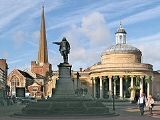
listed building. His statue from 1898 by D W Pomeroy has been repositioned from the front of the
Corn ExchangeThe Corn Exchange and market house in Bridgwater, Somerset, England was built in 1834 by John Bowen and extended in 1875, by Charles Knowles. It has been designated as a Grade I listed building....
to face down Cornhill. Sydenham Manor House was previously a manor estate built in the early 16th century, which was refronted and rebuilt after 1613. It now stands in the grounds of the former British Cellophane plant. Its owners were on the losing side in the
Civil WarThe English Civil War was a series of armed conflicts and political machinations between Parliamentarians and Royalists...
and again in the
Monmouth RebellionThe Monmouth Rebellion,The Revolt of the West or The West Country rebellion of 1685, was an attempt to overthrow James II, who had become King of England, King of Scots and King of Ireland at the death of his elder brother Charles II on 6 February 1685. James II was a Roman Catholic, and some...
. The public library by E Godfrey Page dates from 1905.
Transport
As trade expanded during the
Industrial RevolutionThe Industrial Revolution was a period from the 18th to the 19th century where major changes in agriculture, manufacturing, mining, transportation, and technology had a profound effect on the social, economic and cultural conditions of the times...
, Bridgwater was linked to
TauntonTaunton is the county town of Somerset, England. The town, including its suburbs, had an estimated population of 61,400 in 2001. It is the largest town in the shire county of Somerset....
by the
Bridgwater and Taunton CanalThe Bridgwater and Taunton Canal is a canal in the south-west of England between Bridgwater and Taunton, opened in 1827 and linking the River Tone to the River Parrett. There were a number of abortive schemes to link the Bristol Channel to the English Channel by waterway in the 18th and early 19th...
(1827), although initially it ran from a
basinA dock is a human-made structure or group of structures involved in the handling of boats or ships, usually on or close to a shore.However, the exact meaning varies among different variants of the English language...
south of Bridgwater at
HuntworthHuntworth is a small hamlet and farming community , within the civil parish of North Petherton east of the M5 motorway from Bridgwater, Somerset, England....
. As trade grew
docksA dock is a human-made structure or group of structures involved in the handling of boats or ships, usually on or close to a shore.However, the exact meaning varies among different variants of the English language...
were built in the town, linked to an extension of the canal, with both opening in 1841. The docks were dredged by a scraper-dredger
BerthaBertha is a female Germanic name, from Old High German berhta meaning "bright one".The name occurs as a theonym, surviving as Berchta, a figure in Alpine folklore connected to the Wild Hunt, probably an epithet of *Frijjō in origin....
similar to the one Brunel had designed for the Bristol Floating Harbour. 14 June 1841 saw the opening of the
Bristol and Exeter RailwayThe Bristol & Exeter Railway was a railway company formed to connect Bristol and Exeter.The company's head office was situated outside their Bristol station...
from Bristol to Bridgwater. The railway also opened a coach and wagon works in the town; the last of the buildings is currently in 2005 scheduled for demolition.
Bridgwater railway stationBridgwater railway station serves Bridgwater in Somerset, England. It is on the Bristol to Taunton Line and is operated by First Great Western. Originally built to the designs of Isambard Kingdom Brunel, the station is now a Grade II* listed building.-History:...
, designed by
Isambard Kingdom BrunelIsambard Kingdom Brunel, FRS , was a British civil engineer who built bridges and dockyards including the construction of the first major British railway, the Great Western Railway; a series of steamships, including the first propeller-driven transatlantic steamship; and numerous important bridges...
is now a Grade II
listed building. An end to the unequal competition between rail and canal came in 1867 when the
Bristol and Exeter RailwayThe Bristol & Exeter Railway was a railway company formed to connect Bristol and Exeter.The company's head office was situated outside their Bristol station...
purchased the canal. A number of local branches were also built, for example to serve the Northgate
BreweryA brewery is a dedicated building for the making of beer, though beer can be made at home, and has been for much of beer's history. A company which makes beer is called either a brewery or a brewing company....
(now replaced by a car park north of Angel Crescent) and the former British Cellophane factory. The
Somerset and DorsetThe Somerset & Dorset Joint Railway – almost always referred to as "the S&D" – was an English railway line connecting Bath in north east Somerset and Bournemouth now in south east Dorset but then in Hampshire...
branch lineA branch line is a secondary railway line which branches off a more important through route, usually a main line. A very short branch line may be called a spur line...
to
EdingtonEdington is a rural village, situated on the north side of the Polden Hills in the Sedgemoor district of Somerset, England.Either side of it lie the villages of Chilton Polden and Catcott, and north of it is the small village of Burtle...
was opened in 1890. Its former Bridgwater station is now occupied by
J SainsburyJ. Sainsbury plc is the parent company of Sainsbury's Supermarkets Ltd, commonly known as Sainsbury's, the third largest chain of supermarkets in the United Kingdom with a share of the UK supermarket sector of 16.5%....
.
The importance of shipping and the docks started to decline after 1886, the year in which the opening of the
Severn TunnelThe Severn Tunnel is a railway tunnel in the United Kingdom, linking South Gloucestershire in the west of England to Monmouthshire in south Wales under the estuary of the River Severn....
caused a severe drop in coal imports by sea. The situation worsened as the railways were extended into Somerset and beyond, and ships became too big for the port. The last commercial use of the docks was when coal imports ceased on 31 July 1971, and although they now house a marina they are currently little used. The surrounding quays have been developed for housing, although the remains of wooden quays on the riverbank can still be seen. All but a small remnant of the mump (a huge mound of spoil from the original dock excavations) was removed in the 1980s to make way for the development on the north side of the dock. Due to the port, ship building was also an important industry, and around 140 ships were built in the town during the 19th century by companies including David Williams, Joseph Gough, Watsons and William Lowther. F J Carver and Son owned a small
dry dockA drydock is a narrow basin or vessel that can be flooded to allow a load to be floated in, then drained to allow that load to come to rest on a dry platform...
on East Quay and constructed the last ship to built in the town — the Irene. The former associated industry of
ropeA rope is a length of fibres, twisted or braided together to improve strength for pulling and connecting. It has tensile strength but is too flexible to provide compressive strength...
making is commemorated in
street furnishingsStreet furniture is a collective term for objects and pieces of equipment installed on streets and roads for various purposes, including traffic barriers,...
and paving on East Quay and in the name of Ropewalk street.
The Drove Bridge, which marks the current extent of the Port of Bridgwater is the nearest to the mouth and the newest road bridge to cross the river. With a span of 184 feet (56.1 m), the bridge was constructed as part of the Bridgwater Northern Distributor road scheme (1992), and provides a navigable channel which is 66 feet (20.1 m) wide with 8.2 feet (2.5 m) headroom at normal spring high tides. Upstream of this is the
retractable bridgeA retractable bridge is a type of movable bridge in which the deck can be rolled or slid backwards to open a gap for crossing traffic, usually a ship on a waterway. This type is sometimes referred to as a thrust bridge....
built in 1871 to the design of
Sir Francis FoxSir Francis Fox was an English civil engineer, who was responsible for the bridges over the Victoria Falls of the Zambesi and Sydney Harbour, the Mersey Railway Tunnel and the Liverpool Overhead Railway, and extending the London Underground....
, the engineer for the
Bristol and Exeter RailwayThe Bristol & Exeter Railway was a railway company formed to connect Bristol and Exeter.The company's head office was situated outside their Bristol station...
. It carried a railway siding over the river to the docks, but had to be movable, to allow boats to proceed upriver. An 80 feet (24.4 m) section of railway track to the east of the bridge could be moved sideways, so that the main 127 feet (38.7 m) girders could be retracted, creating a navigable channel which was 78 feet (23.8 m) wide. It was manually operated for the first eight months, and then powered by a steam engine, reverting to manual operation in 1913, when the steam engine failed. The bridge was last opened in 1953, and the traverser section was demolished in 1974, but public outcry at the action resulted in the bridge being listed as a
Scheduled Ancient MonumentIn the United Kingdom, a scheduled monument is a 'nationally important' archaeological site or historic building, given protection against unauthorized change. The various pieces of legislation used for legally protecting heritage assets from damage and destruction are grouped under the term...
, and the rest of the bridge was kept. It was later used as a road crossing, until the construction of the Chandos road bridge alongside it, and is now only used by pedestrians. Parts of the steam engine were moved to
Westonzoyland Pumping Station MuseumThe Westonzoyland Pumping Station Museum is a small Industrial Heritage museum dedicated to steam powered machinery in Westonzoyland, Somerset, England....
in 1977.
The next bridge is the Town Bridge. There has been a bridge here since the 13th century, when Bridgwater was granted a charter by King John. The present bridge was designed by R. C. Else and G. B. Laffan, and the 75 feet (22.9 m)
cast ironCast iron is derived from pig iron, and while it usually refers to gray iron, it also identifies a large group of ferrous alloys which solidify with a eutectic. The color of a fractured surface can be used to identify an alloy. White cast iron is named after its white surface when fractured, due...
structure was completed in 1883. It replaced an earlier bridge, which was the first cast iron bridge to be built in
SomersetThe ceremonial and non-metropolitan county of Somerset in South West England borders Bristol and Gloucestershire to the north, Wiltshire to the east, Dorset to the south-east, and Devon to the south-west. It is partly bounded to the north and west by the Bristol Channel and the estuary of the...
when it was completed in 1797. The stone abutments of that bridge were reused by the later bridge, which formed the only road crossing of the river in Bridgwater until 1958. Above the bridge there were two shoals, called The Coals and The Stones, which were a hazard to barge traffic on the river, and bargees had to choose carefully when to navigate the river, to ensure that there was sufficient water to carry them over these obstructions. In March 1958 a new reinforced concrete road bridge, the Blake Bridge, was opened as part of a bypass to take traffic away from the centre of Bridgwater. It now carries the
A38The A38, part of which is also known as the Devon Expressway, is a major A-class trunk road in England.The road runs from Bodmin in Cornwall to Mansfield in Nottinghamshire. It is long, making it one of the longest A-roads in England. It was formerly known as the Leeds — Exeter Trunk Road,...
and
A39 roadThe A39 is an A road in south west England. It runs south-west from Bath in Somerset through Wells, Glastonbury, Street and Bridgwater. It then follows the north coast of Somerset and Devon through Williton, Minehead, Porlock, Lynmouth, Barnstaple, Bideford, Stratton, Camelford, Wadebridge and St...
s. On the southern edge of Bridgwater there is a bridge which carries the Bristol and Exeter Railway across the River Parrett.
Isambard Kingdom BrunelIsambard Kingdom Brunel, FRS , was a British civil engineer who built bridges and dockyards including the construction of the first major British railway, the Great Western Railway; a series of steamships, including the first propeller-driven transatlantic steamship; and numerous important bridges...
designed a brick bridge, known as the Somerset Bridge, with a 100 feet (30.5 m) span but a rise of just 12 feet (3.7 m). Work started in 1838 and was completed in 1841. Brunel left the scaffold supporting the centre of the bridge in place as the foundations were still settling but was forced to remove it in 1843 to reopen the river for navigation. Brunel demolished the brick arch and had replaced it with a timber arch within six months without interrupting the traffic on the railway. This was in turn replaced in 1904 by a steel girder bridge. Slightly further east is a modern concrete bridge which carries the
M5 motorwayThe M5 is a motorway in England. It runs from a junction with the M6 at West Bromwich near Birmingham to Exeter in Devon. Heading south-west, the M5 runs east of West Bromwich and west of Birmingham through Sandwell Valley...
over both the river and the railway line. It was started in 1971 and opened in 1973.
Education
The primary and
infantAn Infant school is a term used primarily in the United Kingdom for school for children between the ages of four and seven years. It is usually a small school serving a particular locality....
schools in Bridgwater include: Eastover Community Primary School, Hamp Community Junior School, Sedgemoor Manor School, St John and St Francis Primary School, St Joseph's Catholic Primary School, St Mary's Primary School, Somerset Bridge Primary School, Spaxton Church of England Primary School, Westover Green Primary School and Hamp Nursery and Infants School.
Secondary schoolSecondary school is a term used to describe an educational institution where the final stage of schooling, known as secondary education and usually compulsory up to a specified age, takes place...
s include:
Robert Blake Science CollegeRobert Blake Science College is a secondary school in Bridgwater, Somerset, England. The school, which has specialist Science College status, has 645 students between the ages of 11 and 16....
,
Brymore SchoolBrymore School is a secondary school in Cannington, Bridgwater, Somerset, England specialising in rural technology. It is an upper school with students from 13 to 17 years and has 161 boys on the roll, including 150 boarders...
,
Chilton Trinity Technology CollegeChilton Trinity Technology College is a secondary school and specialist Technology College in Chilton Trinity, Bridgwater, Somerset, England.The school has 945 students between the ages of 11 and 16....
,
East Bridgwater Community SchoolEast Bridgwater Community School, Performing and Visual arts College is a secondary school in Bridgwater, Somerset, England.The school is a specialist Arts College, and has 800 students between the ages of 11 and 16....
which was previously known as Sydenham School and is a
Performing and Visual Arts CollegeArts Colleges were introduced in 1997 as part of the now defunct Specialist Schools Programme in the United Kingdom. The system enabled secondary schools to specialise in certain fields, in this case, the performing, visual and/or media arts...
, and
Haygrove SchoolHaygrove School is a co-educational secondary school in Bridgwater, Somerset, England.The school has specialist status as a Language College and has 1,106 students aged between 11 and 16....
which has specialist
Language CollegeLanguage Colleges were introduced in 1995 as part of the Specialist Schools Programme in the United Kingdom. The system enables secondary schools to specialise in certain fields, in this case, modern foreign languages...
status. Special schools in the town include: Elmwood Special School, New Horizon Centre School and Penrose School.
Bridgwater was selected as the first town in the South West, outside of Bristol, to be selected for the UK government's
Building Schools for the FutureBuilding Schools for the Future is the name of the previous UK Government's investment programme in secondary school buildings in England. The program is very ambitious in its costs, timescales and objectives, with politicians from all English political parties supportive of the principle but...
(BSF) initiative, which aimed to rebuild and renew nearly every
secondary schoolSecondary school is a term used to describe an educational institution where the final stage of schooling, known as secondary education and usually compulsory up to a specified age, takes place...
in England. Within Bridgwater, BSF was to redevelop all of the four secondary schools and two special provision schools at an expected cost of around £100 million. This included the complete relocation and rebuilding of a new school combining the both Haygrove and Penrose School. In July 2010, several components of the Bridgwater BSF programme were cancelled and others were singled out for further review. Following a meeting with Education Secretary
Michael GoveMichael Andrew Gove, MP is a British politician, who currently serves as the Secretary of State for Education and as the Conservative Party Member of Parliament for the Surrey Heath constituency. He is also a published author and former journalist.Born in Edinburgh, Gove was raised in Aberdeen...
, Bridgwater MP Ian Liddell-Granger announced that the fate of all six affected schools would be subject to review, including the ones that were cancelled.
Further EducationFurther education is a term mainly used in connection with education in the United Kingdom and Ireland. It is post-compulsory education , that is distinct from the education offered in universities...
is provided by
Bridgwater CollegeBridgwater College is a further education college primarily based in Bridgwater, Somerset, England. It has centres in Cannington, Yeovil, and Paignton....
which was formerly Bridgwater Technical School. The site of the Poplar School Of Engineering And Navigation was later used for Dr Morgan's Grammar School For Boys. Other schools which have since closed include: Bridgwater Grammar School For Boys, Bridgwater Grammar School For Girls and Westover Senior Council School.
Religious sites
Among several places of worship the chief is the
Church of St MaryThe Church of St Mary in Bridgwater, Somerset, England was built in the 13th century, and has been designated as a Grade I listed building.The building is on the site of an earlier church which was rebuilt by William Briwere in the early 13th century....
; this has a north porch and windows dating from the 14th century, besides a 170 feet (52 m) slender spire; but it has been much altered by restoration. It possesses a fine painted reredos, and has been designated by
English HeritageEnglish Heritage . is an executive non-departmental public body of the British Government sponsored by the Department for Culture, Media and Sport...
as a grade I
listed building.
The Church of St John the Baptist in Blake Place was built by
John BrownJohn Brown was a 19th-century architect in Norwich, in the county of Norfolk, England. He is best known for his churches, especially cathedrals. He was also, along with his two sons, the surveyor for Norwich Cathedral.Some of his architectural works:...
in 1843. Elim Pentecostal Church on Church Street was a public house after being used as a church and is now a shop. There is a
Salvation ArmyThe Salvation Army is a Protestant Christian church known for its thrift stores and charity work. It is an international movement that currently works in over a hundred countries....
Citadel located in Moorland Road, on the Sydenham Estate and St Joseph's Roman Catholic in Binford Place. Classes in
BuddhismBuddhism is a religion and philosophy encompassing a variety of traditions, beliefs and practices, largely based on teachings attributed to Siddhartha Gautama, commonly known as the Buddha . The Buddha lived and taught in the northeastern Indian subcontinent some time between the 6th and 4th...
and
meditationMeditation is any form of a family of practices in which practitioners train their minds or self-induce a mode of consciousness to realize some benefit....
are held in the Quaker Meeting House on Friarn Street.
Arts
Nearing Bridgwater on the
M5 motorwayThe M5 is a motorway in England. It runs from a junction with the M6 at West Bromwich near Birmingham to Exeter in Devon. Heading south-west, the M5 runs east of West Bromwich and west of Birmingham through Sandwell Valley...
it is possible to see the
Willow ManWillow Man is a large outdoor sculpture by Serena de la Hey, situated in a field by junction 23 of the M5 motorway near Bridgwater in Somerset, South West England...
sculpture, a striding human figure constructed from
willowWillows, sallows, and osiers form the genus Salix, around 400 species of deciduous trees and shrubs, found primarily on moist soils in cold and temperate regions of the Northern Hemisphere...
, sometimes called the Angel of the South (see also
Angel of the NorthThe Angel of the North is a contemporary sculpture, designed by Antony Gormley, which is located in Gateshead,formerly County Durham, England.It is a steel sculpture of an angel, standing tall, with wings measuring across...
). Standing 12 metres (39.4 ft) tall, it was created by
sculptorSculpture is three-dimensional artwork created by shaping or combining hard materials—typically stone such as marble—or metal, glass, or wood. Softer materials can also be used, such as clay, textiles, plastics, polymers and softer metals...
Serena de la Hey and is the largest known sculpture in willow, a traditional local material.
The Bridgwater Arts Centre was opened on 10 October 1946, the first community arts centre opened in the UK with financial assistance from the newly established Arts Council of England. It is situated in a Grade I
listed building in the
architecturallyArchitecture is both the process and product of planning, designing and construction. Architectural works, in the material form of buildings, are often perceived as cultural and political symbols and as works of art...
protected
GeorgianGeorgian architecture is the name given in most English-speaking countries to the set of architectural styles current between 1720 and 1840. It is eponymous for the first four British monarchs of the House of Hanover—George I of Great Britain, George II of Great Britain, George III of the United...
Castle Street, designed by Benjamin Holloway for the
Duke of ChandosThe title Baron Chandos has been created twice in the Peerage of England. It was first created in 1337 when Roger de Chandos was summoned to parliament. It became extinct on his death....
, and built over the site of the former castle. Holloway was also the
architectAn architect is a person trained in the planning, design and oversight of the construction of buildings. To practice architecture means to offer or render services in connection with the design and construction of a building, or group of buildings and the space within the site surrounding the...
of the Baroque
Lions buildingThe Lions House on West Quay in Bridgwater, Somerset, England was built around 1725 and has been designated as a Grade I listed building.It was built between 1720 and 1730 in a Baroque style by Benjamin Holloway, as his house and was later occupied by several Mayors of Bridgwater...
on West Quay, constructed around 1730. Bridgwater Arts Centre was the venue for the first post-war meeting of the Congres Internationaux d'Architecture Moderne in 1947.
Castle StreetCastle Street in Bridgwater, Somerset, England was built in the 1720s, on a site previously occupied by Bridgwater Castle, by Benjamin Holloway or Fort and Shepherd, the Duke's London surveyors for James Brydges, 1st Duke of Chandos. It was originally called Chandos Street...
was used as a location in the 1963 film
Tom JonesTom Jones is a 1963 British adventure comedy film, an adaptation of Henry Fielding's classic novel The History of Tom Jones, a Foundling , starring Albert Finney as the titular hero. It was one of the most critically acclaimed and popular comedies of its time, winning four Academy Awards...
. Horror writer and film journalist
Kim NewmanKim Newman is an English journalist, film critic, and fiction writer. Recurring interests visible in his work include film history and horror fiction—both of which he attributes to seeing Tod Browning's Dracula at the age of eleven—and alternate fictional versions of history...
was educated at Dr Morgan's school in Bridgwater, and set his 1999 experimental novel Life's Lottery in a fictionalised version of the town (Sedgwater). A sailor who had sailed "from Bridgwater with bricks" and found "There was lice in that bunk in Bridgwater" features in
James JoyceJames Augustine Aloysius Joyce was an Irish novelist and poet, considered to be one of the most influential writers in the modernist avant-garde of the early 20th century...
's
UlyssesUlysses is a novel by the Irish author James Joyce. It was first serialised in parts in the American journal The Little Review from March 1918 to December 1920, and then published in its entirety by Sylvia Beach on 2 February 1922, in Paris. One of the most important works of Modernist literature,...
(Chapter 16).
Annual events
Bridgwater is now best known for the illuminated "
Bridgwater Guy Fawkes CarnivalThe West Country Carnival is an annual celebration featuring a parade of illuminated floats , in the English West Country. The celebration dates back to the Gunpowder Plot of 1605. The purpose is to raise money for local charities....
" that attracts around 150,000 people from around the country and overseas. Now held annually on the Friday after the first Thursday of November (i.e. - the nearest Friday to 5 November). It consists of a display of over 100 large vehicles ("Carnival floats") up to 100 feet (30.5 m) long, festooned with dancers (or team member in
tableauxTableau vivant is French for "living picture." The term describes a striking group of suitably costumed actors or artist's models, carefully posed and often theatrically lit. Throughout the duration of the display, the people shown do not speak or move...
) and up to 22,000 lightbulbs, that follows a 2.5 miles (4 km) route over 2 to 3 hours. Later in the evening of the Carnival, there is the simultaneous firing of large fireworks (known as squibs) in the street outside the town hall, known as "squibbing".
Bridgwater Fair normally takes place in September — it starts on the last Wednesday in September and lasts four days. The fair takes place on St Matthew's Field, better known locally as the Fair Field. The fair is now a
funfairA funfair or simply "fair" is a small to medium sized travelling show primarily composed of stalls and other amusements. Larger fairs such as the permanent fairs of cities and seaside resorts might be called a fairground, although technically this should refer to the land where a fair is...
, ranked as second largest in England after the
Nottingham Goose FairThe Nottingham Goose Fair is an annual fun fair held in Nottingham, England, during the first week of October. It is largely provided by travelling fair people...
. It originated in 1249 as a horse and cattle
fairA fair or fayre is a gathering of people to display or trade produce or other goods, to parade or display animals and often to enjoy associated carnival or funfair entertainment. It is normally of the essence of a fair that it is temporary; some last only an afternoon while others may ten weeks. ...
, lasting for eight days near St Matthew's day (21 September), giving the venue its name. During the first weekend of July, the annual "Somerfest" arts festival is held in Bridgwater. The event includes an extensive programme of rock, jazz and classical music, dance, drama and visual arts with national and local participants.
Sports
Bridgwater Town F.C.Bridgwater Town Football Club are a football club from Bridgwater, Somerset, England. The original version of the club was founded in 1898. They currently play in the Southern League Division One South and West. The club plays their home games at Fairfax Park...
are a football club based at Fairfax Park. The original version of the club was founded in 1898. The club currently plays in the Southern League Division One South and West. Bridgwater & Albion RFC are Somerset's highest- placed rugby team, playing in National League 3 South and are based at College Way. It was originally founded in 1875. The
cricketCricket is a bat-and-ball game played between two teams of 11 players on an oval-shaped field, at the centre of which is a rectangular 22-yard long pitch. One team bats, trying to score as many runs as possible while the other team bowls and fields, trying to dismiss the batsmen and thus limit the...
club play at The Parks on Durleigh Road. Bridgwater
HockeyHockey is a family of sports in which two teams play against each other by trying to maneuver a ball or a puck into the opponent's goal using a hockey stick.-Etymology:...
Club were formed in the 1920s but now play their matches at
Burnham-on-SeaBurnham-on-Sea is a town in Somerset, England, at the mouth of the River Parrett and Bridgwater Bay. Burnham was a small village until the late 18th century, when it began to grow because of its popularity as a seaside resort. It forms part of the parish of Burnham-on-Sea and Highbridge...
.
East Bridgwater Sports Centre offers badminton courts, outside football pitches, squash courts and a fitness room.
Bridgwater had a series of swimming pools from 1890 until 2009. The first pool, in Old Taunton Road, was replaced by the Bridgwater
LidoThe Lido is an 11 km long sandbar located in Venice, northern Italy, home to about 20,000 residents. The Venice Film Festival takes place at the Lido every September.-Geography:...
on Broadway, opened in 1960 by
Princess AlexandraPrincess Alexandra, The Honourable Lady Ogilvy is the youngest granddaughter of King George V of the United Kingdom and Mary of Teck. She is the widow of Sir Angus Ogilvy...
. The lido, which had three pools, a diving bay and paddling pool, was demolished in the late 1980s to make way for a supermarket, and to fund the indoor Sedgemoor Splash swimming pool in Mount Street, which opened in 1991. In 2009, after the local council were unable to raise the funds needed to upgrade the pool, it was closed and demolished to make way for another supermarket. A new pool was planned as part of the
Building Schools for the FutureBuilding Schools for the Future is the name of the previous UK Government's investment programme in secondary school buildings in England. The program is very ambitious in its costs, timescales and objectives, with politicians from all English political parties supportive of the principle but...
(BSF) rebuild of
Chilton Trinity Technology CollegeChilton Trinity Technology College is a secondary school and specialist Technology College in Chilton Trinity, Bridgwater, Somerset, England.The school has 945 students between the ages of 11 and 16....
, however, the government's review of the BSF programme may result in the cancellation of the new school and pool build.
Notable people
- Admiral Robert Blake
Robert Blake was one of the most important military commanders of the Commonwealth of England and one of the most famous English admirals of the 17th century. Blake is recognised as the chief founder of England's naval supremacy, a dominance subsequently inherited by the British Royal Navy into...
was born in Bridgwater, and attended the local grammar schoolA grammar school is one of several different types of school in the history of education in the United Kingdom and some other English-speaking countries, originally a school teaching classical languages but more recently an academically-oriented secondary school.The original purpose of mediaeval...
(Bridgwater Grammar School For Boys). His home is now the Blake Museum and contains details of his career amongst its exhibits of local historyHistory is the discovery, collection, organization, and presentation of information about past events. History can also mean the period of time after writing was invented. Scholars who write about history are called historians...
and archaeology.
- Donald Crowhurst
Donald Crowhurst was a British businessman and amateur sailor who died while competing in the Sunday Times Golden Globe Race, a single-handed, round-the-world yacht race. Crowhurst had entered the race in hopes of winning a cash prize from The Sunday Times to aid his failing business...
(1932–69), who tried to fake a round-the-world solo yacht journey, set up his business in the town and was a Town Councillor.
- Sir Paul Dukes was born in Bridgwater, an alumnus of Caterham School, and went on to be the premier SIS agent in pre-revolution Russia. Known as the Man with a Hundred Faces, he eluded Bolshevik capture and is still the only man to be knighted based on his exploits as a spy.
- Peter Haggett
Peter Haggett, CBE Sc.D. FBA is an eminent British geographer and academic, Professor Emeritus and Senior Research Fellow in Urban and Regional Geography at the School of Geographical Sciences, University of Bristol....
CBE FBA (b.1933), eminent academic geographerA geographer is a scholar whose area of study is geography, the study of Earth's natural environment and human society.Although geographers are historically known as people who make maps, map making is actually the field of study of cartography, a subset of geography...
and professor at University of BristolThe University of Bristol is a public research university located in Bristol, United Kingdom. One of the so-called "red brick" universities, it received its Royal Charter in 1909, although its predecessor institution, University College, Bristol, had been in existence since 1876.The University is...
, educated at Dr Morgan's Grammar School in Bridgwater
- Chris Harris
Chris Harris is an English actor, director and writer. He has appeared in several UK TV series including Into the Labyrinth and "Hey Look That's Me". More recently he has built a successful career in pantomime, acting as a pantomime dame, as well being a director and writer at the Bristol Old...
, English performer, director and writer who starred in Into the LabyrinthInto the Labyrinth is a British children's television series produced by HTV for the ITV network between 1980 and 1982. Three series, each consisting of seven 25-minute episodes, were produced and directed by Peter Graham Scott...
. He has starred in and directed the pantomime at the Theatre Royal, BathThe Theatre Royal in Bath, England, is over 200 years old. It is one of the more important theatres in the United Kingdom outside London, with capacity for an audience of around 900....
since 2001.
- Charles Kent
Charles Phillip Kent played rugby union for Rosslyn Park and England.Charles Kent was born in Bridgwater in Somerset and educated at Blundell's School in Tiverton and studied medicine between 1972-75 at Worcester College, Oxford...
, England rugby player.
- Robert Dibble
Robert Dibble was a rugby union international who represented England from 1906 to 1912. He also captained his country.-Early life:...
, England rugby player. Played club rugby for Bridgwater & Albion RFC and Newport RFC.
- Tommy Woods (rugby), England rugby player. Played club rugby for Bridgwater & Albion RFC and Rochdale Hornets
Rochdale Hornets RLFC is an English professional rugby league club from Rochdale, Greater Manchester, England. They currently play in Championship One...
.
- Sergeant Ben Knight, Bridgwater airman who died in an Afghanistan
Afghanistan , officially the Islamic Republic of Afghanistan, is a landlocked country located in the centre of Asia, forming South Asia, Central Asia and the Middle East. With a population of about 29 million, it has an area of , making it the 42nd most populous and 41st largest nation in the world...
RAF Nimrod plane crash. Sgt Knight was only 25 when he was killed along with 13 comrades from the 120 Squadron when the Nimrod came down near KandaharKandahar is the second largest city in Afghanistan, with a population of about 512,200 as of 2011. It is the capital of Kandahar Province, located in the south of the country at about 1,005 m above sea level...
on 2 September 2006.
- David Luckes MBE. England and Great Britain hockey player - 1989-2000 brought up in Bridgwater.
- Simon
Simon Douglas Mantell is an English field hockey forward, who made his international senior debut for the national squad on 9 November 2005 versus Ireland at Beeston...
(1984) and Richard MantellRichard Mantell is an English field hockey full back, who made his international senior debut for the national squad on 10 February 2003. He is nicknamed Rick or Ricky or Tricky, and played club hockey for Canterbury.Currently Mantell is playing for Reading...
(1981), brothers and field hockey players for England, were both born in Bridgwater.
- Breaker Morant
Harry 'Breaker' Harbord Morant was an Anglo-Australian drover, horseman, poet, soldier and convicted war criminal whose skill with horses earned him the nickname "The Breaker"...
Anglo-Australian Boer War Soldier.
- Kim Newman
Kim Newman is an English journalist, film critic, and fiction writer. Recurring interests visible in his work include film history and horror fiction—both of which he attributes to seeing Tod Browning's Dracula at the age of eleven—and alternate fictional versions of history...
, science fiction novelist, horror film expert, TV presenter and film critic, educated at Dr Morgan's Grammar School in Bridgwater.
- Henry Phillpotts
Henry Phillpotts , often called "Henry of Exeter", was the Anglican Bishop of Exeter from 1830 to 1869. He was England's longest serving bishop since the 14th century and a striking figure of the 19th century Church.- Early life :...
, Bishop of ExeterThe Bishop of Exeter is the Ordinary of the Church of England Diocese of Exeter in the Province of Canterbury. The incumbent usually signs his name as Exon or incorporates this in his signature....
, born in Bridgwater in 1778.
- Andrew Plimer
Andrew Plimer was a British artist, born in Wellington, Shropshire in 1763 and died in Brighton in 1837.Plimer specialised in portrait miniatures. His work was exhibited at the Royal Academy from 1768 to 1810 and in 1819. His most famous painting is of the three daughters of Sir John Rushout...
, portrait miniature artist, born in Bridgwater 1763.
- Jean Rees
Jean Rees was a British artist.She dedicated the later part of her life to promoting the visual arts in the West of England. A highly accomplished landscape artist in her own right, exhibited at the Royal West of England Academy , the Royal Academy of Arts, The Royal Institute of Painters in Water...
, artist and co-founder of the Bridgwater Arts Centre. b 1914.
- James Sully
James Sully was an English psychologist.He was born at Bridgwater, and was educated at the Independent College, Taunton, the Regent's Park College, University of Göttingen, where he studied under Lotze, and at Humboldt University, Berlin where he studied under DuBois-Reymond and Helmholtz...
, psychologist, born in Bridgwater in 1842.
Further reading
- "Bridgwater with and without the 'e' " , Roger Evans, ISBN 0-9525674-0-7
- A History of Bridgwater, J.C. Lawrence, ISBN 1-86077-363-X
- Bridgwater Victorian Days, Philip James Squibbs, ISBN 0-9501022-1-0
- Somerset in the Age of Steam, Peter Stanier, ISBN 0-86183-481-X
- "Remember Remember". The Story of Bridgwater Carnival, written by Chris Hocking who is president of Bridgwater Guy Fawkes Carnival Committee
- A History of the County of Somerset: Vol 6: Bridgwater (1992)
- The Somerset Urban Archaeological Survey: Bridgwater, by Clare Gathercole
External links