

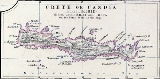
History of Crete

Encyclopedia

Crete
Crete is the largest and most populous of the Greek islands, the fifth largest island in the Mediterranean Sea, and one of the thirteen administrative regions of Greece. It forms a significant part of the economy and cultural heritage of Greece while retaining its own local cultural traits...
goes back to the 7th Millennium B.C., preceding the ancient Minoan civilization
Minoan civilization
The Minoan civilization was a Bronze Age civilization that arose on the island of Crete and flourished from approximately the 27th century BC to the 15th century BC. It was rediscovered at the beginning of the 20th century through the work of the British archaeologist Arthur Evans...
by more than four millennia. The Minoan civilization was the first civilization in Europe and the first, in Europe, to build a palace. After the Minoan civilization was devastated by the Thera eruption
Thera eruption
The Minoan eruption of Thera, also referred to as the Thera eruption or Santorini eruption, was a major catastrophic volcanic eruption with a Volcanic Explosivity Index of 6 or 7 and a Dense-rock equivalent of , which is estimated to have occurred in the mid second millennium BCE. The eruption...
, Crete developed an Ancient Greece
Ancient Greece
Ancient Greece is a civilization belonging to a period of Greek history that lasted from the Archaic period of the 8th to 6th centuries BC to the end of antiquity. Immediately following this period was the beginning of the Early Middle Ages and the Byzantine era. Included in Ancient Greece is the...
-influenced organization of city states, then successively became part of the Roman Empire
Roman Empire
The Roman Empire was the post-Republican period of the ancient Roman civilization, characterised by an autocratic form of government and large territorial holdings in Europe and around the Mediterranean....
, the Byzantine Empire
Byzantine Empire
The Byzantine Empire was the Eastern Roman Empire during the periods of Late Antiquity and the Middle Ages, centred on the capital of Constantinople. Known simply as the Roman Empire or Romania to its inhabitants and neighbours, the Empire was the direct continuation of the Ancient Roman State...
, the Venetian Republic, the Ottoman Empire
Ottoman Empire
The Ottoman EmpireIt was usually referred to as the "Ottoman Empire", the "Turkish Empire", the "Ottoman Caliphate" or more commonly "Turkey" by its contemporaries...
, and the modern state of Greece
Greece
Greece , officially the Hellenic Republic , and historically Hellas or the Republic of Greece in English, is a country in southeastern Europe....
.
Prehistoric Crete
Excavations in South Crete in 2008-2009 lead by T.F. Strasser (Providence College, R.I., USA) revealed stone tools at least 130.000 years old. This was a sensational discovery as the previously accepted earliest sea crossing in the Mediterranean was thought to occur around 12.000 BC.The stone tools found in the Plakias region of Crete include hand axes of the Acheulian type made of quartz . It is believed that pre-Homo sapiens hominids from Africa crossed to Crete on rafts.
In the neolithic period, some of the early influences upon the development of Cretan
Crete
Crete is the largest and most populous of the Greek islands, the fifth largest island in the Mediterranean Sea, and one of the thirteen administrative regions of Greece. It forms a significant part of the economy and cultural heritage of Greece while retaining its own local cultural traits...
culture arise from the Cyclades
Cyclades
The Cyclades is a Greek island group in the Aegean Sea, south-east of the mainland of Greece; and a former administrative prefecture of Greece. They are one of the island groups which constitute the Aegean archipelago. The name refers to the islands around the sacred island of Delos...
and from Egypt
Egypt
Egypt , officially the Arab Republic of Egypt, Arabic: , is a country mainly in North Africa, with the Sinai Peninsula forming a land bridge in Southwest Asia. Egypt is thus a transcontinental country, and a major power in Africa, the Mediterranean Basin, the Middle East and the Muslim world...
; cultural records are written in the undeciphered script known as "Linear A
Linear A
Linear A is one of two scripts used in ancient Crete before Mycenaean Greek Linear B; Cretan hieroglyphs is the second script. In Minoan times, before the Mycenaean Greek dominion, Linear A was the official script for the palaces and religious activities, and hieroglyphs were mainly used on seals....
". The archaeological record of Crete includes superb palaces, houses, roads, paintings and sculptures. Early Neolithic
Neolithic
The Neolithic Age, Era, or Period, or New Stone Age, was a period in the development of human technology, beginning about 9500 BC in some parts of the Middle East, and later in other parts of the world. It is traditionally considered as the last part of the Stone Age...
settlements in Crete include Knossos
Knossos
Knossos , also known as Labyrinth, or Knossos Palace, is the largest Bronze Age archaeological site on Crete and probably the ceremonial and political centre of the Minoan civilization and culture. The palace appears as a maze of workrooms, living spaces, and store rooms close to a central square...
and Trapeza
Trapeza, Crete
Trapeza, Crete is a Neolithic and Bronze Age settlement on the island of Crete in Greece. Some of the Bronze Age pottery finds at Trapeza are similar to specimens recovered at Knossos and Vasiliki....
.
Because of a lack of written records, estimates of Cretan chronology
Chronology
Chronology is the science of arranging events in their order of occurrence in time, such as the use of a timeline or sequence of events. It is also "the determination of the actual temporal sequence of past events".Chronology is part of periodization...
are based on well-established Aegean and Ancient Near Eastern pottery styles, so that Cretan timelines have been made by seeking Cretan artifacts traded with other civilization
Civilization
Civilization is a sometimes controversial term that has been used in several related ways. Primarily, the term has been used to refer to the material and instrumental side of human cultures that are complex in terms of technology, science, and division of labor. Such civilizations are generally...
s (such as the Egypt
Egypt
Egypt , officially the Arab Republic of Egypt, Arabic: , is a country mainly in North Africa, with the Sinai Peninsula forming a land bridge in Southwest Asia. Egypt is thus a transcontinental country, and a major power in Africa, the Mediterranean Basin, the Middle East and the Muslim world...
ians) - a well established occurrence. For the earlier times, radiocarbon dating
Radiocarbon dating
Radiocarbon dating is a radiometric dating method that uses the naturally occurring radioisotope carbon-14 to estimate the age of carbon-bearing materials up to about 58,000 to 62,000 years. Raw, i.e. uncalibrated, radiocarbon ages are usually reported in radiocarbon years "Before Present" ,...
of organic remains and charcoal offers independent dates. Based on this, it is thought that Crete was inhabited from the 7th millennium BC onwards.
The native fauna of Crete included pygmy hippo
Cretan Dwarf Hippopotamus
Hippopotamus creutzburgi is an extinct species of hippopotamus which lived on the island of Crete. Hippopopotamus colonized Crete probably 800,000 years ago and lived there during the Middle Pleistocene....
, pygmy elephant
Dwarf elephant
Dwarf elephants are prehistoric members of the order Proboscidea, that, through the process of allopatric speciation, evolved to a fraction of the size of their immediate ancestors...
, dwarf deer (Praemegaceros cretensis), giant rodents and insectivores as well as badger, beech marten and a kind of terrestrial otter. Large carnivores were lacking. Most of these animals died out at the end of the last ice-age. Humans played a part in this extinction, which occurred on other medium to large Mediterranean islands as well, for example on Cyprus
Cyprus
Cyprus , officially the Republic of Cyprus , is a Eurasian island country, member of the European Union, in the Eastern Mediterranean, east of Greece, south of Turkey, west of Syria and north of Egypt. It is the third largest island in the Mediterranean Sea.The earliest known human activity on the...
, Sicily
Sicily
Sicily is a region of Italy, and is the largest island in the Mediterranean Sea. Along with the surrounding minor islands, it constitutes an autonomous region of Italy, the Regione Autonoma Siciliana Sicily has a rich and unique culture, especially with regard to the arts, music, literature,...
and Majorca. Crete's religious symbols included the dove, lily and double-headed ax.
Remains of a settlement found under the Bronze Age palace at Knossos
Knossos
Knossos , also known as Labyrinth, or Knossos Palace, is the largest Bronze Age archaeological site on Crete and probably the ceremonial and political centre of the Minoan civilization and culture. The palace appears as a maze of workrooms, living spaces, and store rooms close to a central square...
date to the 7th Millennium BC.
The first settlers introduced cattle
Cattle
Cattle are the most common type of large domesticated ungulates. They are a prominent modern member of the subfamily Bovinae, are the most widespread species of the genus Bos, and are most commonly classified collectively as Bos primigenius...
, sheep, goat
Goat
The domestic goat is a subspecies of goat domesticated from the wild goat of southwest Asia and Eastern Europe. The goat is a member of the Bovidae family and is closely related to the sheep as both are in the goat-antelope subfamily Caprinae. There are over three hundred distinct breeds of...
s, pig
Pig
A pig is any of the animals in the genus Sus, within the Suidae family of even-toed ungulates. Pigs include the domestic pig, its ancestor the wild boar, and several other wild relatives...
s, and dog
Dog
The domestic dog is a domesticated form of the gray wolf, a member of the Canidae family of the order Carnivora. The term is used for both feral and pet varieties. The dog may have been the first animal to be domesticated, and has been the most widely kept working, hunting, and companion animal in...
s, as well as domesticated cereals and legumes.
Up to now, Knossos remains the only aceramic site. The settlement covered approximately 350,000 square metres. The sparse animal bones contain the above-mentioned domestic species as well as deer, badger, marten and mouse: the extinction of the local megafauna had not left much game behind.
Neolithic pottery is known from Knossos, Lera Cave and Gerani Cave. The Late Neolithic sees a proliferation of sites, pointing to a population increase. In the late Neolithic, the donkey and the rabbit were introduced to the island, deer and agrimi hunted. The Kri-kri
Kri-kri
The Kri-kri , sometimes called the Cretan goat, Agrimi, or Cretan Ibex, was considered a subspecies of Wild Goat, but has been recently found to be a feral variety of the domestic goat...
, a feral goat, preserves traits of the early domesticates. Horse, fallow deer and hedgehog are only attested from Minoan times onwards.
Minoan-Mycenaean Crete
Crete was the centre of Europe's most ancient civilization, the MinoanMinoan civilization
The Minoan civilization was a Bronze Age civilization that arose on the island of Crete and flourished from approximately the 27th century BC to the 15th century BC. It was rediscovered at the beginning of the 20th century through the work of the British archaeologist Arthur Evans...
. Tablets inscribed in Linear A
Linear A
Linear A is one of two scripts used in ancient Crete before Mycenaean Greek Linear B; Cretan hieroglyphs is the second script. In Minoan times, before the Mycenaean Greek dominion, Linear A was the official script for the palaces and religious activities, and hieroglyphs were mainly used on seals....
have been found in numerous sites in Crete, and a few in the Aegean islands. The Minoans established themselves in many islands besides Ancient Crete
Ancient Crete
The term Ancient Crete refers to the civilization that existed on the island of Crete, just south of Greece, in the Mediterranean Sea. From around 3000–1100 B.C., inhabitants known as Minoans controlled the island of Crete and ruled the island autonomously...
: secure identifications of Minoan off-island sites include Kea, Kythera, Milos
Milos
Milos , is a volcanic Greek island in the Aegean Sea, just north of the Sea of Crete...
, Rhodes
Rhodes
Rhodes is an island in Greece, located in the eastern Aegean Sea. It is the largest of the Dodecanese islands in terms of both land area and population, with a population of 117,007, and also the island group's historical capital. Administratively the island forms a separate municipality within...
, and above all, Thera
Santorini
Santorini , officially Thira , is an island located in the southern Aegean Sea, about southeast from Greece's mainland. It is the largest island of a small, circular archipelago which bears the same name and is the remnant of a volcanic caldera...
(Santorini).
Archaeologists ever since Sir Arthur Evans have identified and uncovered the palace-complex at Knossos
Knossos
Knossos , also known as Labyrinth, or Knossos Palace, is the largest Bronze Age archaeological site on Crete and probably the ceremonial and political centre of the Minoan civilization and culture. The palace appears as a maze of workrooms, living spaces, and store rooms close to a central square...
, the most famous Minoan site. Other palace sites in Crete such as Phaistos
Phaistos
Phaistos , also transliterated as Phaestos, Festos and Phaestus is an ancient city on the island of Crete. Phaistos was located in the south-central portion of the island, about 5.6 kilometres from the Mediterranean Sea. It was inhabited from about 4000 BC. A palace, dating from the Middle Bronze...
have uncovered magnificent stone-built, multi-story palaces containing drainage systems, and the queen had a bath and a flushing toilet. The expertise displayed in the hydraulic engineering was of a very high level. There were no defensive walls to the complexes. By the 16th century BC pottery and other remains on the Greek mainland show that the Minoans had far-reaching contacts on the mainland. In the 16th century a major earthquake caused destruction on Crete and on Thera that was swiftly repaired.
By about the 15th century BC a massive volcanic explosion known as the Minoan eruption blew the island of Thera apart, casting more than four times the amount of ejecta as the explosion of Krakatoa
Krakatoa
Krakatoa is a volcanic island made of a'a lava in the Sunda Strait between the islands of Java and Sumatra in Indonesia. The name is used for the island group, the main island , and the volcano as a whole. The island exploded in 1883, killing approximately 40,000 people, although some estimates...
and generating a tsunami in the enclosed Aegean that threw pumice
Pumice
Pumice is a textural term for a volcanic rock that is a solidified frothy lava typically created when super-heated, highly pressurized rock is violently ejected from a volcano. It can be formed when lava and water are mixed. This unusual formation is due to the simultaneous actions of rapid...
up to 250 meters above sea level onto the slopes of Anaphi, 27 km to the east. Any fleet along the north shore of Crete was destroyed and John Chadwick
John Chadwick
John Chadwick was an English linguist and classical scholar most famous for his role in deciphering Linear B, along with Michael Ventris.-Early life and education:...
suggests that the majority of Cretan fleets had kept the island secure from the Greek-speaking mainlanders. The sites, save Knossos, were destroyed by fires. Mycenaean
Mycenaean Greece
Mycenaean Greece was a cultural period of Bronze Age Greece taking its name from the archaeological site of Mycenae in northeastern Argolis, in the Peloponnese of southern Greece. Athens, Pylos, Thebes, and Tiryns are also important Mycenaean sites...
s from the mainland took over Knossos, rebuilding some parts to suit them. They were in turn subsumed by a subsequent Dorian migration.
Classical, Hellenistic, Roman, Byzantine and Arab Crete
In the Classical and Hellenistic period Crete fell into a pattern of combative city-states, harboring pirates. GortynGortyn
Gortyn, Gortys or Gortyna is a municipality and an archaeological site on the Mediterranean island of Crete, 45 km away from the modern capital Heraklion. The seat of the municipality is the village Agioi Deka...
, Kydonia (Chania
Chania
Chaniá , , also transliterated Chania, Hania, and Xania, older form Chanea and Venetian Canea, Ottoman Turkish خانيه Hanya) is the second largest city of Crete and the capital of the Chania peripheral unit...
) and Lyttos challenged the primacy of ancient Knossos, preyed upon one another, invited into their feuds mainland powers like Macedon
Macedon
Macedonia or Macedon was an ancient kingdom, centered in the northeastern part of the Greek peninsula, bordered by Epirus to the west, Paeonia to the north, the region of Thrace to the east and Thessaly to the south....
and its rivals Rhodes
Rhodes
Rhodes is an island in Greece, located in the eastern Aegean Sea. It is the largest of the Dodecanese islands in terms of both land area and population, with a population of 117,007, and also the island group's historical capital. Administratively the island forms a separate municipality within...
and Ptolemaic Egypt
Ptolemaic Egypt
Ptolemaic Egypt began when Ptolemy I Soter invaded Egypt and declared himself Pharaoh of Egypt in 305 BC and ended with the death of queen Cleopatra VII of Egypt and the Roman conquest in 30 BC. The Ptolemaic Kingdom was a powerful Hellenistic state, extending from southern Syria in the east, to...
, a situation that all but invited Roman interference. Ierapytna (Ierapetra
Ierapetra
Ierapetra is a town in the southeast of the Greek island of Crete and a municipality of Crete region.-History:The town of Ierapetra is located on the southeast coast of Crete, along the beach of Ierapetra Bay. It lies south of Agios Nikolaos and southwest of Sitia and is an important regional...
) gained supremacy on eastern Crete.
In 88 BC Mithridates VI of Pontus
Mithridates VI of Pontus
Mithridates VI or Mithradates VI Mithradates , from Old Persian Mithradatha, "gift of Mithra"; 134 BC – 63 BC, also known as Mithradates the Great and Eupator Dionysius, was king of Pontus and Armenia Minor in northern Anatolia from about 120 BC to 63 BC...
on the Black Sea, went to war to halt the advance of Roman hegemony
Hegemony
Hegemony is an indirect form of imperial dominance in which the hegemon rules sub-ordinate states by the implied means of power rather than direct military force. In Ancient Greece , hegemony denoted the politico–military dominance of a city-state over other city-states...
in the Aegean. On the pretext that Knossos was backing Mithradates, Marcus Antonius Creticus
Marcus Antonius Creticus
Marcus Antonius Creticus was a Roman politician, member of the Antonius family. Creticus was son of Marcus Antonius Orator and by his marriage to Julia Antonia he had three sons: Triumvir Marcus Antonius, Gaius Antonius and Lucius Antonius.He was elected praetor in 74 BC and received an...
attacked Crete in 71 BC and was repelled. Rome sent Quintus Caecilius Metellus
Quintus Caecilius Metellus Creticus (died 55 BC)
Quintus Caecilius Metellus Creticus was a politically active member of theRoman upper class. He was praetor in 74 BC and pontifex from 73 BC until his death...
with three legions to the island. After a ferocious three-year campaign Crete was conquered for Rome in 69 BC, earning this Metellus the agnomen "Creticus." At the archaeological sites, there seems to be little evidence of widespread damage associated with the transfer to Roman power: a single palatial house complex seems to have been razed. Gortyn seems to have been pro-Roman and was rewarded by being made the capital of the joint province of Creta et Cyrenaica
Creta et Cyrenaica
Creta et Cyrenaica was a senatorial province of the Roman empire created in 20 BC. It comprised the island of Crete and the region of Cyrenaica in north Africa ....
.
Gortyn
Gortyn
Gortyn, Gortys or Gortyna is a municipality and an archaeological site on the Mediterranean island of Crete, 45 km away from the modern capital Heraklion. The seat of the municipality is the village Agioi Deka...
was the site of the largest Christian basilica
Basilica
The Latin word basilica , was originally used to describe a Roman public building, usually located in the forum of a Roman town. Public basilicas began to appear in Hellenistic cities in the 2nd century BC.The term was also applied to buildings used for religious purposes...
on Crete, the Basilica of Saint Titus, dedicated to the first Christian bishop in Crete, to whom Paul
Paul of Tarsus
Paul the Apostle , also known as Saul of Tarsus, is described in the Christian New Testament as one of the most influential early Christian missionaries, with the writings ascribed to him by the church forming a considerable portion of the New Testament...
addressed one of his epistles. The church was begun in the 5th century. As revealed in the Epistle to Titus
Epistle to Titus
The Epistle of Paul to Titus, usually referred to simply as Titus, is one of the three Pastoral Epistles , traditionally attributed to Saint Paul, and is part of the New Testament...
in the New Testament
New Testament
The New Testament is the second major division of the Christian biblical canon, the first such division being the much longer Old Testament....
and confirmed by Cretan poet Epimenides
Epimenides
Epimenides of Knossos was a semi-mythical 6th century BC Greek seer and philosopher-poet. While tending his father's sheep, he is said to have fallen asleep for fifty-seven years in a Cretan cave sacred to Zeus, after which he reportedly awoke with the gift of prophecy...
the people of Crete were considered by these Christians to be liars and gluttons. (Note: Epimenides was a 6th century poet. Paul cited him in Titus, but he cannot be said to confirm anything)
Crete continued to be part
Byzantine Crete
The island of Crete came under the rule of the Byzantine Empire in two periods: the first extends from the late Roman period to the conquest of the island by Andalusian exiles in the late 820s, and the second from the island's reconquest in 961 to its capture by the competing forces of Genoa and...
of the Eastern Roman or Byzantine Empire
Byzantine Empire
The Byzantine Empire was the Eastern Roman Empire during the periods of Late Antiquity and the Middle Ages, centred on the capital of Constantinople. Known simply as the Roman Empire or Romania to its inhabitants and neighbours, the Empire was the direct continuation of the Ancient Roman State...
, a quiet cultural backwater, until it fell into the hands of Iberian Muslims under Abu Hafs
Abu Hafs (pirate)
Umar ibn Hafs ibn Shuayb ibn Isa al Balluti, surnamed al-Ghaliz and later al-Ikritishi , and usually known as Abu Hafs , was a Muwallad corsair who was primarily active between 816 and 827...
in the 820s, who established a piratical emirate
Emirate of Crete
The Emirate of Crete was a Muslim state that existed on the Mediterranean island of Crete from the late 820s to the Byzantine reconquest of the island in 961....
on the island. The archbishop Cyril of Gortyn was killed and the city so thoroughly devastated it was never reoccupied. Candia (Chandax, modern Heraklion
Heraklion
Heraklion, or Heraclion is the largest city and the administrative capital of the island of Crete, Greece. It is the 4th largest city in Greece....
), a city built by the Iberian Muslims, was made capital of the island instead.
The Emirate of Crete
Emirate of Crete
The Emirate of Crete was a Muslim state that existed on the Mediterranean island of Crete from the late 820s to the Byzantine reconquest of the island in 961....
became a center of Muslim piratical activity in the Aegean, and a thorn on Byzantium's side. Successive campaigns to recover the island failed until 961, when Nikephoros Phokas reconquered Crete for the Byzantine Empire and made it into a theme. The Byzantines held the island until the Fourth Crusade
Fourth Crusade
The Fourth Crusade was originally intended to conquer Muslim-controlled Jerusalem by means of an invasion through Egypt. Instead, in April 1204, the Crusaders of Western Europe invaded and conquered the Christian city of Constantinople, capital of the Eastern Roman Empire...
(1204). In its aftermath, possession of the island was disputed between the Genoese and the Venetians, with the latter eventually solidifying their control by 1212. Despite frequent revolts by the native population, the Venetians retained the island until 1669, when the Ottoman Turks took possession
Cretan War (1645–1669)
The Cretan War or War of Candia , as the Fifth Ottoman–Venetian War is better known, was a conflict between the Republic of Venice and her allies against the Ottoman Empire and the Barbary States, fought over the island of Crete, Venice's largest and richest overseas possession...
of it.
(The standard survey for this period is I.F. Sanders, An archaeological survey and Gazetteer of Late Hellenistic, Roman and Early Byzantine Crete, 1982)
Venetian Crete
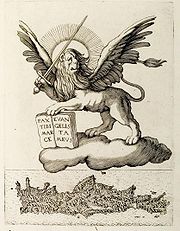
Constantinople
Constantinople was the capital of the Roman, Eastern Roman, Byzantine, Latin, and Ottoman Empires. Throughout most of the Middle Ages, Constantinople was Europe's largest and wealthiest city.-Names:...
by the armies of the Fourth Crusade
Fourth Crusade
The Fourth Crusade was originally intended to conquer Muslim-controlled Jerusalem by means of an invasion through Egypt. Instead, in April 1204, the Crusaders of Western Europe invaded and conquered the Christian city of Constantinople, capital of the Eastern Roman Empire...
in 1204, Crete was eventually acquired by Venice
Republic of Venice
The Republic of Venice or Venetian Republic was a state originating from the city of Venice in Northeastern Italy. It existed for over a millennium, from the late 7th century until 1797. It was formally known as the Most Serene Republic of Venice and is often referred to as La Serenissima, in...
, which held it for more than four centuries (the "Kingdom of Candia
Kingdom of Candia
The Kingdom of Candia or Duchy of Candia was the official name of Crete during the island's period as an overseas colony of the Republic of Venice, from the initial Venetian conquest in 1205–1212 to its fall to the Ottoman Empire during the Cretan War...
").
The most important of the many rebellions that broke out during that period was the one known as the revolt of St. Titus
Revolt of St. Titus
The Revolt of Saint Titus was a fourteenth century rebellion against the Republic of Venice in the Venetian colony of Crete. The rebels overthrew the official Venetian authorities and attempted to create an independent state, declaring Crete a republic under the protection of Saint Titus : the...
. It occurred in 1363, when indigenous Cretans and Venetian settlers exasperated by the hard tax policy exercised by Venice, overthrew official Venetian authorities and declared an independent Cretan Republic. The revolt took Venice five years to quell.
During Venetian rule, the Greek population of Crete was exposed to Renaissance
Renaissance
The Renaissance was a cultural movement that spanned roughly the 14th to the 17th century, beginning in Italy in the Late Middle Ages and later spreading to the rest of Europe. The term is also used more loosely to refer to the historical era, but since the changes of the Renaissance were not...
culture. A thriving literature in the Cretan dialect of Greek developed on the island. The best-known work from this period is the poem Erotokritos
Erotokritos
Erotokritos is a romance composed by Vikentios Kornaros in early 17th century Crete. It consists of 10,012 fifteen-syllable rhymed verses....
by Vitsentzos Kornaros
Vitsentzos Kornaros
Vitsentzos or Vikentios Kornaros or Vincenzo Cornaro was a Cretan poet, who wrote the romantic epic poem Erotokritos. He wrote in vernacular Greek, and was a leading figure of the Cretan Renaissance....
(Βιτσένζος Κορνάρος). Another major Cretan literary figure was Nicholas Kalliakis
Nicholas Kalliakis
Nicholas Kalliakis was a Greek scholar and philosopher who flourished in Italy in the 17th century. He was appointed doctor of philosophy and theology in Rome, university professor of Greek and Latin and Aristotelian philosophy at Venice in 1666 and professor of belles-lettres and rhetoric at...
(1645–1707), a Greek scholar and philosopher who flourished in Italy
Italy
Italy , officially the Italian Republic languages]] under the European Charter for Regional or Minority Languages. In each of these, Italy's official name is as follows:;;;;;;;;), is a unitary parliamentary republic in South-Central Europe. To the north it borders France, Switzerland, Austria and...
in the 17th Century. Georgios Hortatzis was author of the dramatic work Erophile. The painter Domenicos Theotocopoulos, better known as El Greco
El Greco
El Greco was a painter, sculptor and architect of the Spanish Renaissance. "El Greco" was a nickname, a reference to his ethnic Greek origin, and the artist normally signed his paintings with his full birth name in Greek letters, Δομήνικος Θεοτοκόπουλος .El Greco was born on Crete, which was at...
, was born in Crete in this period and was trained in Byzantine iconography before moving to Italy and later, Spain.
Ottoman Crete
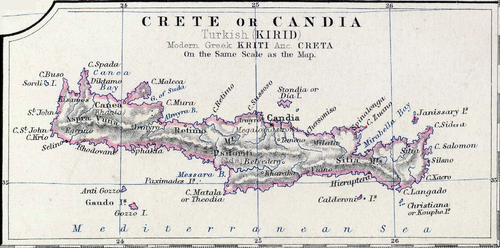
During the Cretan War (1645–1669)
Cretan War (1645–1669)
The Cretan War or War of Candia , as the Fifth Ottoman–Venetian War is better known, was a conflict between the Republic of Venice and her allies against the Ottoman Empire and the Barbary States, fought over the island of Crete, Venice's largest and richest overseas possession...
, Venice was pushed out of Crete by the Ottoman Empire
Ottoman Empire
The Ottoman EmpireIt was usually referred to as the "Ottoman Empire", the "Turkish Empire", the "Ottoman Caliphate" or more commonly "Turkey" by its contemporaries...
, with most of the island lost after the siege of Candia
Siege of Candia
The Siege of Candia was a military conflict in which Ottoman forces besieged the Venetian-ruled city and were ultimately victorious. Lasting from 1648 to 1669, it was the longest siege in history.-Background:...
(1648–1669), possibly the longest siege in history. The last Venetian outpost on the island, Spinalonga
Spinalonga
The island of Spinalonga , officially known as Kalydon , is located in the Gulf of Elounda in north-eastern Crete, in Lasithi prefecture, next to the town of Elounda....
, fell in 1718, and Crete was a part of the Ottoman Empire for the next two centuries. There were significant rebellions against Ottoman rule, particularly in Sfakia
Sfakia
Sfakiá is a mountainous area in the southwestern part of the island of Crete, in the Chania peripheral unit. It is considered one of the few places in Greece to never have been fully occupied by foreign powers...
. Daskalogiannis
Daskalogiannis
Ioannis Vlachos , better known as Daskalogiannis was a wealthy shipbuilder and shipowner who led a Cretan revolt against Ottoman rule in the 18th century.-Life and career:...
was a famous rebel leader. One result of the Ottoman conquest was that a sizeable proportion of the population gradually converted to Islam, with its tax and other civic advantages in the Ottoman system. Contemporary estimates vary, but on the eve of the Greek War of Independence as much as 45% of the population of the island may have been Muslim. Some of them were crypto-Christians who converted back to Christianity; others fled Crete because of the unrest. By the last Ottoman census in 1881, Christians were 76% of the population, and Muslims (usually called "Turks" regardless of language, culture, and ancestry) only 24%. Christians were over 90% of the population in 19/23 of the districts of Crete, but Muslims were over 60% in the three large towns on the north coast, and in Monofatsi.
The Greek War of Independence
Greek War of Independence
The Greek War of Independence, also known as the Greek Revolution was a successful war of independence waged by the Greek revolutionaries between...
began in 1821 and Cretan participation was extensive. An uprising by Christians met with a fierce response from the Ottoman authorities and the execution of several bishops, regarded as ringleaders. Between 1821 and 1828, the island was the scene of repeated hostilities. The Muslims were driven into the large fortified towns on the north coast and it would appear that as many as 60% of them died from plague or famine while there. The Cretan Christians also suffered severely, losing around 21% of their population in the 1830s.
Modern Crete
After Greece achieved its independence, Crete became an object of contention as the Christian part of its population revolted several times against Ottoman rule. Revolts in 1841 and 1858 secured some privileges, such as the right to bear arms, equality of Christian and Muslim worship, and the establishment of Christian councils of elders with jurisdiction over education and customary law. Despite these concessions, the Christian Cretans maintained their ultimate aim of union with Greece, and tensions between the Christian and Muslim communities ran high. Thus, in 1866 the great Cretan RevoltCretan Revolt (1866–1869)
The Cretan Revolt of 1866–1869 or Great Cretan Revolution was a three year uprising against Ottoman rule, the third and largest in a series of Cretan revolts between the end of the Greek War of Independence in 1830 and the establishment of the independent Cretan State in 1898.-Background:The...
began.
The uprising, which lasted for three years, involved volunteers from Greece and other European countries, where it was viewed with considerable sympathy. Despite early successes of the rebels, who quickly confined the Ottomans to the northern towns, the uprising failed. The Ottoman Grand Vizier
Grand Vizier
Grand Vizier, in Turkish Vezir-i Azam or Sadr-ı Azam , deriving from the Arabic word vizier , was the greatest minister of the Sultan, with absolute power of attorney and, in principle, dismissable only by the Sultan himself...
A'ali Pasha
Mehmed Emin Aali Pasha
Mehmed Emin Âli Paşa , , was an Ottoman statesman....
personally assumed control of the Ottoman forces and launched a methodical campaign to retake the rural districts, which was combined with promises of political concessions, notably by the introduction of an Organic Law, which gave the Cretan Christians equal (in practice, because of their superior numbers, majority) control of local administration. His approach bore fruits, as the rebel leaders gradually submitted. By early 1869, the island was again under Ottoman control.
During the Congress of Berlin
Congress of Berlin
The Congress of Berlin was a meeting of the European Great Powers' and the Ottoman Empire's leading statesmen in Berlin in 1878. In the wake of the Russo-Turkish War of 1877–78, the meeting's aim was to reorganize the countries of the Balkans...
in the summer of 1878, there was a further rebellion, which was halted quickly by the intervention of the British and the adaptation of the 1867-8 Organic Law into a constitutional settlement known as the Pact of Halepa
Pact of Halepa
The Pact of Halepa was an agreement made in 1878 between the Ottoman Empire and the representatives of several European states...
. Crete became a semi-independent parliamentary state within the Ottoman Empire under an Ottoman Governor who had to be a Christian. A number of the senior "Christian Pashas" including Photiades Pasha and Kostis Adosidis Pasha ruled the island in the 1880s, presiding over a parliament in which liberals and conservatives contended for power. Disputes between the two powers however led to a further insurgency in 1889 and the collapse of the Pact of Halepa arrangements. The international powers, disgusted at what seemed to be factional politics, allowed the Ottoman authorities to send troops to the island and restore order but did not anticipate that Ottoman Sultan Abdul Hamid II
Abdul Hamid II
His Imperial Majesty, The Sultan Abdülhamid II, Emperor of the Ottomans, Caliph of the Faithful was the 34th sultan of the Ottoman Empire...
would use this as a pretext to end the Halepa Pact Constitution and instead rule the island by martial-law. This action led to international sympathy for the Cretan Christians and to a loss of any remaining acquiescence among them for continued Ottoman rule. When a small insurgency began in September 1895, it spread quickly, and by the summer of 1896 the Ottoman forces had lost military control of most of the island.
Cretan State
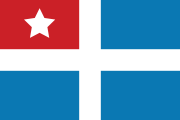
A new Cretan insurrection in 1897 led to the Ottoman Empire declaring war on Greece.
However, the Great Power
Great power
A great power is a nation or state that has the ability to exert its influence on a global scale. Great powers characteristically possess military and economic strength and diplomatic and cultural influence which may cause small powers to consider the opinions of great powers before taking actions...
s (Britain, France, Italy and Russia) decided that Turkey could no longer maintain control and intervened.
By March 1897, the Great Powers decided to restore order by governing the island temporarily through a committee of four admirals who remained in charge until the arrival of Prince George of Greece
Prince George of Greece and Denmark
align=right| Prince George of Greece and Denmark was the second son of King George I of the Hellenes and Grand Duchess Olga, and is remembered chiefly for having saved the life of a future Emperor of Russia, Nicholas II...
as first governor-general of an autonomous Crete, effectively detached from the Ottoman Empire, on 9 December 1898.
Turkish forces were expelled in 1898, and the independent Cretan State (Official Greek name: Κρητική Πολιτεία), headed by Prince George of Greece, was founded.
Prince George was replaced by Alexandros Zaimis
Alexandros Zaimis
Alexandros Zaimis was a former Greek Prime Minister, Minister of the Interior, Minister of Justice, and High Commissioner of Crete. He served as Prime Minister six times.-Early Life and Family:...
in 1906, and in 1908, taking advantage of domestic turmoil in Turkey as well as the timing of Zaimis's vacation away from the island, the Cretan deputies declared union with Greece. But this act was not recognized internationally until 1913 after the Balkan Wars
Balkan Wars
The Balkan Wars were two conflicts that took place in the Balkans in south-eastern Europe in 1912 and 1913.By the early 20th century, Montenegro, Bulgaria, Greece and Serbia, the countries of the Balkan League, had achieved their independence from the Ottoman Empire, but large parts of their ethnic...
. By the Treaty of London, Sultan Mehmed V
Mehmed V
Mehmed V Reshad was the 35th Ottoman Sultan. He was the son of Sultan Abdülmecid I. He was succeeded by his half-brother Mehmed VI.-Birth:...
relinquished his formal rights to the island. In December, the Greek flag was raised at the Firkas fortress in Chania, with Eleftherios Venizelos
Eleftherios Venizelos
Eleftherios Venizelos was an eminent Greek revolutionary, a prominent and illustrious statesman as well as a charismatic leader in the early 20th century. Elected several times as Prime Minister of Greece and served from 1910 to 1920 and from 1928 to 1932...
and King Constantine
Constantine I of Greece
Constantine I was King of Greece from 1913 to 1917 and from 1920 to 1922. He was commander-in-chief of the Hellenic Army during the unsuccessful Greco-Turkish War of 1897 and led the Greek forces during the successful Balkan Wars of 1912–1913, in which Greece won Thessaloniki and doubled in...
in attendance, and Crete was unified with mainland Greece. The Muslim minority of Crete initially remained in the island but was later relocated to Turkey under the general population exchange agreed in the 1923 Treaty of Lausanne
Treaty of Lausanne
The Treaty of Lausanne was a peace treaty signed in Lausanne, Switzerland on 24 July 1923, that settled the Anatolian and East Thracian parts of the partitioning of the Ottoman Empire. The treaty of Lausanne was ratified by the Greek government on 11 February 1924, by the Turkish government on 31...
between Turkey and Greece.
One of the most important figures to emerge from the end of Ottoman Crete was the liberal politician Eleftherios Venizelos
Eleftherios Venizelos
Eleftherios Venizelos was an eminent Greek revolutionary, a prominent and illustrious statesman as well as a charismatic leader in the early 20th century. Elected several times as Prime Minister of Greece and served from 1910 to 1920 and from 1928 to 1932...
, probably the most important statesman of modern Greece. Venizelos was an Athens-trained lawyer who was active in liberal circles in Hania, then the Cretan capital. After autonomy, he was first a minister in the government of Prince George and then his most formidable opponent. In 1910 Venizelos transferred his career to Athens, quickly became the dominant figure on the political scene and in 1912, after careful preparations for a military alliance against the Ottoman Empire with Serbia, Montenegro, and Bulgaria, allowed Cretan deputies to take their place in the Greek Parliament. This was treated as grounds for war by Turkey but the Balkan allies won a series of sweeping victories in the hostilities that followed (see Balkan Wars
Balkan Wars
The Balkan Wars were two conflicts that took place in the Balkans in south-eastern Europe in 1912 and 1913.By the early 20th century, Montenegro, Bulgaria, Greece and Serbia, the countries of the Balkan League, had achieved their independence from the Ottoman Empire, but large parts of their ethnic...
). The Turks were effectively defeated in the ensuing war and were forced out of the Balkans and Thrace by the Alliance, except for the borders which Turkey continues to hold to this day.
Battle of Greece
In 1939, the United Kingdom guaranteed military aid to Greece if its territorial integrity was threatened. The priority of the United Kingdom was to prevent Crete from falling into enemy hands, because the island could be used to defend Egypt, (the Suez Canal and the route to India). British troops landed on Crete with the consent of the Greek Government from 3 November 1940, in order to make the 5th Greek Division of Crete available for the Albanian front.The invasion of mainland Greece by the Axis powers began on 6 April 1941 and was complete within a few weeks despite the intervention of the armies of the Commonwealth along with Greece. King George II and the Government of Emmanouil Tsouderos were forced to flee Athens and took refuge in Crete on April 23. Crete was also the refuge of Commonwealth troops that fled from the beaches of Attica and the Peloponnese to Crete to organize a new front of resistance.
Battle of Crete
After the conquest of mainland Greece, Germany turned to Crete and the last stage of the Balkans campaign. After a fierce and bloody conflict between Nazi GermanyNazi Germany
Nazi Germany , also known as the Third Reich , but officially called German Reich from 1933 to 1943 and Greater German Reich from 26 June 1943 onward, is the name commonly used to refer to the state of Germany from 1933 to 1945, when it was a totalitarian dictatorship ruled by...
and the Allies
Allies of World War II
The Allies of World War II were the countries that opposed the Axis powers during the Second World War . Former Axis states contributing to the Allied victory are not considered Allied states...
(United Kingdom, New Zealand, Australia, and Greece) that lasted ten days (between the 20 and 31 May 1941), the island fell to the Germans.
On the morning of 20 May 1941, Crete was the theater of the first major airborne assault in history. The Third Reich launched an airborne invasion of Crete under the code name of "Operation Mercury". 17,000 paratroopers under the command of General Kurt Student were dropped at three strategic locations with airfields: Maleme
Maleme
Maleme is a town and airport to the west of Chania, in North Western Crete, Greece. It is located in Platanias municipality, in Chania prefecture....
, Heraklion
Heraklion
Heraklion, or Heraclion is the largest city and the administrative capital of the island of Crete, Greece. It is the 4th largest city in Greece....
, and Rethymnon. Their goal was the capture and control of the three airfields to allow the arrival of reinforcements airlifted by the Luftwaffe from mainland Greece to bypass the Royal Navy and the Hellenic Navy who still controlled the seas.
On 1 June 1941 the Allies completely evacuated the island of Crete. Despite the victory of the German invaders, the elite German paratroopers suffered such heavy losses, from the resistance of the Allied troops and civilians, that Adolf Hitler
Adolf Hitler
Adolf Hitler was an Austrian-born German politician and the leader of the National Socialist German Workers Party , commonly referred to as the Nazi Party). He was Chancellor of Germany from 1933 to 1945, and head of state from 1934 to 1945...
forbade further airborne operations of such large scale for the rest of the war.
The Cretan Resistance
From the first days of the invasion, the local population organized a resistanceCretan resistance
The Cretan resistance was a resistance movement against Nazi Germany by the residents of the Greek island of Crete during World War II. Part of the larger Greek Resistance, it lasted from May 20, 1941, when the German Wehrmacht invaded the island in the Battle of Crete, until the fall of 1945 when...
movement, participating widely in guerrilla groups and intelligence networks. The first resistance groups formed in the Cretan mountains as early as June 1941. In September 1943, a memorable battle between the troops of occupation resistance fighters led by "Kapetan" Bandouvas in the region of Syme resulted in the deaths of eighty-three German soldiers and another thirteen were taken as prisoners. There were reprisal
Reprisal
In international law, a reprisal is a limited and deliberate violation of international law to punish another sovereign state that has already broken them. Reprisals in the laws of war are extremely limited, as they commonly breached the rights of civilians, an action outlawed by the Geneva...
s for resistance, German officers routinely used firing squads against Cretan civilians and razed villages to the ground. Standing out amongst the atrocities, are the holocausts of Viannos
Holocaust of Viannos
The Holocaust of Viannos refers to a mass extermination campaign launched by Nazi forces against the civilian residents of around 20 villages located in the areas of east Viannos and west Ierapetra provinces on the Greek island of Crete during World War II. The killings, with a death toll in...
and Kedros
Holocaust of Kedros
The Holocaust of Kedros , also known as the Holocaust of Amari , refers to an operation mounted by Nazi German forces against the civilian residents of nine villages located in the Amari Valley on the Greek island of Crete during its occupation by the Axis in World War II...
in Amari
Amari Valley
The Amari Valley is a fertile valley on the foothills of Mount Ida and Mount Kedros in Crete. The valley was known as a center of resistance to the Germans during the Battle of Crete and the German occupation...
, the destruction of Anogia and Kandanos
Razing of Kandanos
The Razing of Kandanos or the Holocaust of Kandanos refers to the complete destruction of the village of Kandanos in Western Crete and the killing of about 180 of its inhabitants on 3 June 1941 by German occupying forces during World War II...
and the massacre of Kondomari
Massacre of Kondomari
The Massacre of Kondomari refers to the execution of male civilians from the village of Kondomari in Crete by an ad hoc firing squad consisting of German paratroopers on 2 June 1941 during World War II. The shooting was the first of a long series of mass reprisals in Crete and was also the first...
.
The Black Death
The Black DeathBlack Death
The Black Death was one of the most devastating pandemics in human history, peaking in Europe between 1348 and 1350. Of several competing theories, the dominant explanation for the Black Death is the plague theory, which attributes the outbreak to the bacterium Yersinia pestis. Thought to have...
of 1348 hit Crete particularly hard. Plagues followed in 1398, 1419, 1456, 1523, 1580, 1592, 1678, 1689, 1703 and 1816, and some of these were credited with killing one third of the population. Many Cretans migrated overseas during difficult periods on the island, some acquiring great fortune abroad, such as Constantine Corniaktos
Constantine Corniaktos
Constantine Korniakt was a Greek merchant active in Eastern Europe and a leaseholder of royal tolls who collected...
(c. 1517-1603) who became one of the richest people in Eastern Europe.
Further reading
- Hopkins, Adam Crete : its past, present and people Faber 1977 ISBN 0-571-10411-8
- McKee, Sally Uncommon Dominion : Venetian Crete and the Myth of Ethnic Purity University of Pennsylvania Press 2000 ISBN 0-8122-3562-2
- On Crete, New Evidence of Very Ancient Mariners by John Wilford, The New York TimesThe New York TimesThe New York Times is an American daily newspaper founded and continuously published in New York City since 1851. The New York Times has won 106 Pulitzer Prizes, the most of any news organization...
, February 15, 2010