
All Topics  
El Greco

 
El Greco

   Email Print
   Bookmark   Link


El Greco


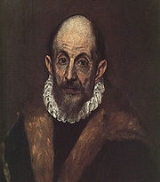
El Greco (1541 – April 7, 1614) was a painter
Painting

Painting is the practice of applying paint, pigment, color or other medium to a surface . In art, the term describes both the act and the result, which is called a painting....
, sculptor
Sculpture

Sculpture is Three-dimensional space artwork created by shaping or combining hard and or plastic material, sound, and or text and or light, commonly Stone sculpture , metal, glass, or wood....
, and architect
Architecture

The term architecture can refer to a process, a profession or documentation.As a process, architecture is the activity of designing and construction buildings and other physical structures by a person or a computer, primarily to provide shelter....
 of the Spanish Renaissance
Spanish Renaissance

The Spanish Renaissance refers to a movement in Spain, emerging from the Italian Renaissance in Italy during the 14th century, that spread to Spain during the 15th and 16th centuries....
. "El Greco" (The Greek
Greeks

The Greeks , also known as Hellenes, are a nation and ethnic group native to Greece, Cyprus and neighbouring regions, who can also be found in Greek diaspora communities around the world....
) was a nickname, a reference to his Greek origin, and the artist normally signed his paintings with his full birth name in Greek letters
Greek alphabet

The Greek alphabet is a set of twenty-four letters that has been used to write the Greek language since the late 9th century BC or early 8th century BCE....
, ??µ?????? Te?t???p????? (Doménikos Theotokópoulos).

El Greco was born in Crete
Crete

Crete is the largest of the Greek islands and the List of islands in the Mediterranean largest island in the Mediterranean Sea at 8,336 km? ....
, which was at that time part of the Republic of Venice
Republic of Venice

The Most Serene Republic of Venice or Venetian Republic was a state originating from the city of Venice . It existed for over a millennium, from the late 7th century AD until the year 1797....
, and the centre of Post-Byzantine art. He trained and became a master within that tradition before travelling at age 26 to Venice
Venice

Venice is a city in northern Italy, the capital city of the Italian regions Veneto, a population of 271,251 . Together with Padua, Italy, the city is included in the Padua-Venice Metropolitan Area ....
, as other Greek artists had done.


Discussion
Ask a question about 'El Greco'
Start a new discussion about 'El Greco'
Answer questions from other users
Full Discussion Forum


Recent Posts


Encyclopedia


El Greco (1541 – April 7, 1614) was a painter
Painting

Painting is the practice of applying paint, pigment, color or other medium to a surface . In art, the term describes both the act and the result, which is called a painting....
, sculptor
Sculpture

Sculpture is Three-dimensional space artwork created by shaping or combining hard and or plastic material, sound, and or text and or light, commonly Stone sculpture , metal, glass, or wood....
, and architect
Architecture

The term architecture can refer to a process, a profession or documentation.As a process, architecture is the activity of designing and construction buildings and other physical structures by a person or a computer, primarily to provide shelter....
 of the Spanish Renaissance
Spanish Renaissance

The Spanish Renaissance refers to a movement in Spain, emerging from the Italian Renaissance in Italy during the 14th century, that spread to Spain during the 15th and 16th centuries....
. "El Greco" (The Greek
Greeks

The Greeks , also known as Hellenes, are a nation and ethnic group native to Greece, Cyprus and neighbouring regions, who can also be found in Greek diaspora communities around the world....
) was a nickname, a reference to his Greek origin, and the artist normally signed his paintings with his full birth name in Greek letters
Greek alphabet

The Greek alphabet is a set of twenty-four letters that has been used to write the Greek language since the late 9th century BC or early 8th century BCE....
, ??µ?????? Te?t???p????? (Doménikos Theotokópoulos).

El Greco was born in Crete
Crete

Crete is the largest of the Greek islands and the List of islands in the Mediterranean largest island in the Mediterranean Sea at 8,336 km? ....
, which was at that time part of the Republic of Venice
Republic of Venice

The Most Serene Republic of Venice or Venetian Republic was a state originating from the city of Venice . It existed for over a millennium, from the late 7th century AD until the year 1797....
, and the centre of Post-Byzantine art. He trained and became a master within that tradition before travelling at age 26 to Venice
Venice

Venice is a city in northern Italy, the capital city of the Italian regions Veneto, a population of 271,251 . Together with Padua, Italy, the city is included in the Padua-Venice Metropolitan Area ....
, as other Greek artists had done. In 1570 he moved to Rome
Rome

Rome is the capital city of Italy and Lazio, and is Italy's largest and most populous city, with 2,724,347 residents in an urban area of some ....
, where he opened a workshop and executed a series of works. During his stay in Italy
Italy

Italy , officially the Italian Republic , is a country located on the Italian Peninsula in Southern Europe and on the two largest islands in the Mediterranean Sea, Sicily and Sardinia....
, El Greco enriched his style with elements of Mannerism
Mannerism

Mannerism is a Art periods of European art which emerged from the later years of the Italian High Renaissance around 1520. It lasted until about 1580 in Italy, when a more Baroque style began to replace it, but continued into the seventeenth century throughout much of Europe....
 and of the Venetian Renaissance
Italian Renaissance

The Italian Renaissance began the opening phase of the Renaissance, a period of great cultural change and achievement in Europe that spanned the period from the end of the 13th century to about 1600, marking the transition between Medieval and Early Modern Europe....
. In 1577, he moved to Toledo, Spain
Toledo, Spain

Toledo is a city and municipality located in central Spain, 70 km south of Madrid. It is the capital city of the province of Toledo and of the autonomous communities of Spain of Castile-La Mancha....
, where he lived and worked until his death. In Toledo, El Greco received several major commissions and produced his best known paintings.

El Greco's dramatic and expressionistic style was met with puzzlement by his contemporaries but found appreciation in the 20th century. El Greco is regarded as a precursor of both Expressionism
Expressionism

Expressionism is the tendency of an artist to distort reality for an emotional effect; it is a subjective art form. Expressionism is exhibited in many art forms, including painting, literature, theatre, film, Expressionist architecture and Expressionism ....
 and Cubism
Cubism

Cubism was a 20th century avant-garde art movement, pioneered by Pablo Picasso and Georges Braque, that revolutionized European painting and sculpture, and inspired related movements in music and literature....
, while his personality and works were a source of inspiration for poets and writers such as Rainer Maria Rilke
Rainer Maria Rilke

Rainer Maria Rilke is considered one of the German language's greatest 20th century poets. His haunting images focus on the difficulty of communion with the ineffable in an age of disbelief, solitude, and profound anxiety ? themes that tend to position him as a transitional figure between the traditional and the modernist poets....
 and Nikos Kazantzakis
Nikos Kazantzakis

Nikos Kazantzakis was arguably the most important and most translated Greece writer and philosopher of the 20th century. Yet he did not become well known globally until the 1964 release of the Michael Cacoyannis film Zorba the Greek , based on Kazantzakis' Zorba the Greek whose English translation has the same title....
. El Greco has been characterized by modern scholars as an artist so individual that he belongs to no conventional school. He is best known for tortuously elongated figures and often fantastic or phantasmagorical pigmentation, marrying Byzantine
Byzantine art

Byzantine art is the term commonly used to describe the artistic products of the Byzantine Empire from about the 4th century until the Fall of Constantinople in 1453....
 traditions with those of Western painting
Western painting

The history of Western painting represents a continuous, though disrupted, tradition from classical antiquity. Until the mid 19th century it was primarily concerned with Representational art and Classical antiquity modes of production, after which time more Modern art, Abstract art and Conceptual art forms gained favor....
.

Life


Early years and family

Born in 1541 in either the village of Fodele or Candia (the Venetian name of Chandax, present day Heraklion
Heraklion

Heraklion or Iraklion , is the largest city and capital city of Crete. It is also the fourth largest city in Greece. Its name is also spelled Herakleion, a transliteration of the ancient Greek and Katharevousa name, , or Iraklio, among other variants....
) in Crete, El Greco was descended from a prosperous urban family, which had probably been driven out of Chania
Chania

Chani? is the second largest city of Crete and the capital of the Chania Prefecture. It lies along the north coast of the island, about 70 km west of Rethymno and 145 km west of Heraklion....
 to Candia after an uprising against the Venetian
Republic of Venice

The Most Serene Republic of Venice or Venetian Republic was a state originating from the city of Venice . It existed for over a millennium, from the late 7th century AD until the year 1797....
s between 1526 and 1528. El Greco's father, Geórgios Theotokópoulos (d. 1556), was a merchant and tax collector
Tax collector

A tax collector is a person who collects unpaid taxes from other people or corporations. Tax collectors are often portrayed in fiction as being evil, and in the modern world share a somewhat similar stereotype to that of lawyers....
. Nothing is known about his mother or his first wife, a Greek woman. El Greco's older brother, Manoússos Theotokópoulos (1531 – December 13, 1604), was a wealthy merchant and spent the last years of his life (1603–1604) in El Greco's Toledo home.

Dormition El Greco
El Greco received his initial training as an icon
Icon

An 'icon' is a religious work of art, most commonly a painting, from Eastern Christianity. More broadly the term is used in a wide number of contexts for an image, picture, or representation; it is a sign or likeness that stands for an object by signifying or representing it either concretely or by analogy, as in semiotics; by extension, ...
 painter of the Cretan school
Cretan School

The term Cretan School describes an important school of icon painting, also known as Post-Byzantine art, which flourished while Crete was under Republic of Venice rule during the late Middle Ages, reaching its climax after the Fall of Constantinople, becoming the central force in Greek painting during the 15th, 16th and 17th centuries....
, the leading centre of post-Byzantine art. In addition to painting, he probably studied the classics
Classics

Classics is the branch of the Humanities comprising the languages, literature, philosophy, history, art, and other culture of the ancient Mediterranean World; especially Ancient Greece and Ancient Rome during Classical Antiquity ....
 of ancient Greece
Ancient Greece

The term Ancient Greece refers to the period of History of Greece lasting from the Greek Dark Ages ca. 1100 BC and the Dorian invasion, to 146 BC and the Roman Republic conquest of Greece after the Battle of Corinth ....
, and perhaps the Latin
Latin

Latin is an Italic language, historically spoken in Latium and Ancient Rome. Through the Military history of the Roman Empire, Latin spread throughout the Mediterranean and a large part of Europe....
 classics also; he left a "working library" of 130 books at his death, including the Bible in Greek and an annotated Vasari. Candia was a center for artistic activity where Eastern and Western cultures co-existed harmoniously, where around two hundred painters were active during the 16th century, and had organized a painters' guild, based on the Italian model. In 1563, at the age of twenty-two, El Greco was described in a document as a "master" ("maestro Domenigo"), meaning he was already a master of the guild and presumably operating his own workshop. Three years later, in June 1566, as a witness to a contract, he signed his name as (Master Menégos Theotokópoulos, painter).

Most scholars believe that the Theotokópoulos "family was almost certainly Greek Orthodox", although some Catholic sources still claim him from birth. Like many Orthodox emigrants to Europe, he apparently transferred to Catholicism after his arrival, and certainly practiced as a Catholic in Spain, where he described himself as a "devout Catholic" in his will. The extensive archival research conducted since the early 1960s by scholars, such as Nikolaos Panayotakis, Pandelis Prevelakis and Maria Constantoudaki, indicates strongly that El Greco's family and ancestors were Greek Orthodox. One of his uncles was an Orthodox priest, and his name is not mentioned in the Catholic archival baptismal records on Crete. Prevelakis goes even further, expressing his doubt that El Greco was ever a practicing Roman Catholic.

Italy

Julije Klovic 2
It was natural for the young El Greco to pursue his career in Venice, Crete having been a possession of the Republic of Venice since 1211. Though the exact year is not clear, most scholars agree that El Greco went to Venice around 1567. Knowledge of El Greco's years in Italy is limited. He lived in Venice until 1570 and, according to a letter written by his much older friend, the greatest miniaturist of the age, the Croatian Giulio Clovio, was a "disciple" of Titian
Titian

File:Tizian 090.jpg Tiziano Vecelli or Tiziano Vecellio, born 1473/1490 , died 27 August 1576, better known as Titian , was the leading painter of the 16th-century Venice school of the Italian Renaissance....
, who was by then in his eighties but still vigorous. This may mean he worked in Titian's large studio, or not. Clovio characterized El Greco as "a rare talent in painting".

In 1570 El Greco moved to Rome, where he executed a series of works strongly marked by his Venetian apprenticeship. It is unknown how long he remained in Rome, though he may have returned to Venice (c. 1575–1576) before he left for Spain. In Rome, on the recommendation of Giulio Clovio, El Greco was received as a guest at the Palazzo Farnese, which Cardinal Alessandro Farnese
Alessandro Cardinal Farnese

Alessandro Cardinal Farnese was an Italian cardinal and diplomat, a great collector and patron of the arts. He was the grandson of Pope Paul III , and the son of Pier Luigi Farnese, Duke of Parma, Duke of Parma who was murdered in 1547....
 had made a centre of the artistic and intellectual life of the city. There he came into contact with the intellectual elite of the city, including the Roman scholar Fulvio Orsini
Fulvio Orsini

Fulvio Orsini was an Italy humanist, historian, and archaeologist. He was a scion of the Orsini family, one of the oldest, most illustrious, and for centuries most powerful of the Rome princely families, whose origins, when stripped of legend, can be traced back to a certain Ursus de Paro, recorded at Rome in 998....
, whose collection would later include seven paintings by the artist (View of Mt. Sinai
Mount Sinai

Mount Sinai , also known as Mount Horeb, Mount Musa, Gebel Musa or Jabal Musa by the Bedouin, is the name of a mountain in the Sinai Peninsula....
 and a portrait of Clovio are among them).

Unlike other Cretan artists who had moved to Venice, El Greco substantially altered his style and sought to distinguish himself by inventing new and unusual interpretations of traditional religious subject matter. His works painted in Italy were influenced by the Venetian Renaissance style of the period, with agile, elongated figures reminiscent of Tintoretto
Tintoretto

Tintoretto was one of the greatest painters of the Venetian school and probably the last great painter of the Italian Renaissance. For his phenomenal energy in painting he was termed Il Furioso, and his dramatic use of perspectival space and special lighting effects make him a precursor of baroque art....
 and a chromatic framework that connects him to Titian. The Venetian painters also taught him to organize his multi-figured compositions in landscapes vibrant with atmospheric light. Clovio reports visiting El Greco on a summer's day while the artist was still in Rome. El Greco was sitting in a darkened room, because he found the darkness more conducive to thought than the light of the day, which disturbed his "inner light". As a result of his stay in Rome, his works were enriched with elements such as violent perspective
Perspective (graphical)

File:Staircase perspective.jpgPerspective in the graphic arts, such as drawing, is an approximate representation, on a flat surface , of an image as it is perceived by the eye....
 vanishing points or strange attitudes struck by the figures with their repeated twisting and turning and tempestuous gestures; all elements of Mannerism.

By the time El Greco arrived in Rome, Michelangelo
Michelangelo

Michelangelo di Lodovico Buonarroti Simoni , commonly known as Michelangelo, was an Italian Renaissance Painting, sculptor, architect, poet, and engineer....
 and Raphael
Raphael

Raphael Sanzio, usually known by his first name alone was an Italy Painting and architect of the High Renaissance, celebrated for the perfection and grace of his paintings and drawings....
 were dead, but their example continued to be paramount and left little room for different approaches. Although the artistic heritage of these great masters was overwhelming for young painters, El Greco was determined to make his own mark in Rome defending his personal artistic views, ideas and style. He singled out Correggio and Parmigianino
Parmigianino

Girolamo Francesco Maria Mazzola , also known as Francesco Mazzola or more commonly as Parmigianino or sometimes "Parmigiano", was a prominent Italy Mannerism Painting and printmaker active in Florence, Rome, Bologna, and his native city of Parma....
 for particular praise, but he did not hesitate to dismiss Michelangelo's Last Judgment in the Sistine Chapel
Sistine Chapel

Sistine Chapel is the best-known chapel in the Apostolic Palace, the official residence of the Pope in Vatican City. Its fame rests on its architecture, evocative of Solomon's Temple of the Old Testament and on its decoration which has been frescoed throughout by the greatest Renaissance artists including Michelangelo, Raphael, Bernini, and...
; he extended an offer to Pope Pius V
Pope Pius V

Pope Saint Pius V , born Antonio Ghislieri was Pope from 1566 to 1572 and is a saint of the Roman Catholic Church. He is chiefly notable for his role in the implementation of the Council of Trent, the Counterreformation and the standardisation of the liturgy....
 to paint over the whole work in accord with the new and stricter Catholic thinking. When he was later asked what he thought about Michelangelo, El Greco replied that "he was a good man, but he did not know how to paint". And thus we are confronted by a paradox: El Greco is said to have reacted most strongly or even condemned Michelangelo, but he had found it impossible to withstand his influence. Michelangelo's influence can be seen in later El Greco works such as the Allegory of the Holy League. By painting portraits of Michelangelo, Titian, Clovio and, presumably, Raphael in one of his works (The Purification of the Temple), El Greco not only expressed his gratitude but advanced the claim to rival these masters. As his own commentaries indicate, El Greco viewed Titian, Michelangelo and Raphael as models to emulate. In his 17th century Chronicles, Giulio Mancini included El Greco among the painters who had initiated, in various ways, a re-evaluation of Michelangelo's teachings.

Because of his unconventional artistic beliefs (such as his dismissal of Michelangelo's technique) and personality, El Greco soon acquired enemies in Rome. Architect and writer Pirro Ligorio
Pirro Ligorio

Pirro Ligorio was an Italian people architect, painter, antiquarian and garden designer....
 called him a "foolish foreigner", and newly discovered archival material reveals a skirmish with Farnese, who obliged the young artist to leave his palace. On July 6, 1572, El Greco officially complained about this event. A few months later, on September 18, 1572, El Greco paid his dues to the Guild of Saint Luke
Guild of Saint Luke

The Guild of Saint Luke was the most common name for a city guild for painters and other artists in early modern Europe, especially in the Low Countries....
 in Rome as a miniature
Portrait miniature

A portrait miniature is a miniature portrait painting, usually executed in gouache or watercolor painting.Portrait miniatures began to flourish in 16th century Europe and the art was practiced during the 17th century and 18th century....
 painter. At the end of that year, El Greco opened his own workshop and hired as assistants the painters Lattanzio Bonastri de Lucignano and Francisco Preboste.

Spain


Immigration to Toledo
the Assumption of the Virgin 1577
In 1577, El Greco emigrated first to Madrid
Madrid

Madrid is the Capital and largest city of Spain. It is the Largest cities of the European Union by population within city limits in the European Union after Greater London and Berlin, and its Madrid metropolitan area is the Largest urban areas of the European Union in the European Union after Paris aire urbaine, Greater London Urban Area, a...
, then to Toledo, where he produced his mature works. At the time, Toledo was the religious capital of Spain and a populous city with "an illustrious past, a prosperous present and an uncertain future". In Rome, El Greco had earned the respect of some intellectuals, but was also facing the hostility of certain art critics
Art criticism

Art criticism is the discussion or evaluation of visual art.Art critics usually criticize art in the context of aesthetics or the theory of beauty....
. During the 1570s the huge monastery-palace of El Escorial
El Escorial

El Escorial is an historical residence of the king of Spain. It is one of the Spanish royal sites and functions as a monastery, royal palace, museum and school....
 was still under construction and Philip II of Spain
Philip II of Spain

Philip II was King of Spain from 1556 until 1598, List of monarchs of Naples from 1554 until 1598, king consort of England, as husband of Mary I of England, from 1554 to 1558, lord of the Seventeen Provinces from 1556 until 1581, holding various titles for the individual territories, such as Duke or Count; and King of Portugal as Philip I...
 was experiencing difficulties in finding good artists for the many large paintings required to decorate it. Titian was dead, and Tintoretto
Tintoretto

Tintoretto was one of the greatest painters of the Venetian school and probably the last great painter of the Italian Renaissance. For his phenomenal energy in painting he was termed Il Furioso, and his dramatic use of perspectival space and special lighting effects make him a precursor of baroque art....
, Veronese
Paolo Veronese

Paolo Veronese was an Italian painter of the Renaissance in Venice, famous for paintings such as The Wedding at Cana and The Feast in the House of Levi....
 and Anthonis Mor all refused to come to Spain. Philip had had to rely on the lesser talent of Juan Fernándes de Navarrete, whose gravedad y decoro ("seriousness and decorum") the king approved. However, he had just died in 1579; the moment should have been ideal for El Greco. Through Clovio and Orsini, El Greco met Benito Arias Montano
Benito Arias Montano

Benito Arias Montano or Benedictus Arias Montanus , Spain orientalist and editor of the Antwerp Polyglot, was born at Fregenal de la Sierra, in Extremadura, in 1527....
, a Spanish humanist and agent of Philip; Pedro Chacón, a clergyman; and Luis de Castilla, son of Diego de Castilla
Diego de Castilla

Diego de Castilla , dean of Toledo Cathedral. Castilla was of Jewish blood, and this was a major issue, since in 1547, the then archbishop of Toledo, Spain had passed a statute of cleanliness of blood, excluding from ecclesiastical office and benefices anyone with a trace of Jewish lineage over four generations....
, the dean of the Cathedral of Toledo
Cathedral of Toledo

The Cathedral of Saint Mary of Toledo, Spain, also called Primate Cathedral of Toledo, is a church in Spain. The seat of the Archdiocese of Toledo, it is one of the three 13th century Gothic architecture cathedrals in Spain and is considered to be the magnum opus of the Gothic style in Spain....
. El Greco's friendship with Castilla would secure his first large commissions in Toledo. He arrived in Toledo by July 1577, and signed contracts for a group of paintings that was to adorn the church of Santo Domingo el Antiguo in Toledo and for the renowned . By September 1579 he had completed nine paintings for Santo Domingo, including The Trinity and The Assumption of the Virgin. These works would establish the painter's reputation in Toledo.

El Greco did not plan to settle permanently in Toledo, since his final aim was to win the favor of Philip and make his mark in his court. Indeed, he did manage to secure two important commissions from the monarch: Allegory of the Holy League and Martyrdom of St. Maurice
Saint Maurice

Saint Maurice was the leader of the legendary Roman Theban Legion in the 3rd century, and one of the favorite and most widely venerated saints of that group....
. However, the king did not like these works and placed the St Maurice altarpiece in the chapter-house rather than the intended chapel. He gave no further commissions to El Greco. The exact reasons for the king's dissatisfaction remain unclear. Some scholars have suggested that Philip did not like the inclusion of living persons in a religious scene; some others that El Greco's works violated a basic rule of the Counter-Reformation
Counter-Reformation

The Counter-Reformation denotes the period of Roman Catholic Church revival from the pontificate of Pope Pius IV in 1560 to the close of the Thirty Years' War, 1648....
, namely that in the image the content was paramount rather than the style. Philip took a close interest in his artistic commissions, and had very decided tastes; a long sought-after sculpted Crucifixion by Benvenuto Cellini
Benvenuto Cellini

Benvenuto Cellini was an Italy goldsmith, Painting, sculpture, soldier and musician of the Renaissance, who also wrote a famous autobiography....
 also failed to please when it arrived, and was likewise exiled to a less prominent place. Philip's next experiment, with Federico Zuccari
Federico Zuccari

Federico Zuccari, also known as Federigo Zuccaro , was an Italy Mannerism Painting and architect, active both in Italy and abroad....
 was even less successful. In any case, Philip's dissatisfaction ended any hopes of royal patronage El Greco may have had.

El Greco   the Burial of the Count of Orgaz

Mature works and later years
Lacking the favor of the king, El Greco was obliged to remain in Toledo, where he had been received in 1577 as a great painter. According to Hortensio Félix Paravicino
Hortensio Félix Paravicino

Hortensio F?lix Paravicino y Arteaga , Spain preacher and poet, was born at Madrid, was educated at the Society of Jesus college in Ocafra, and on April 18, 1600 joined the Trinitarian Order....
, a 17th-century Spanish preacher and poet, "Crete gave him life and the painter's craft, Toledo a better homeland, where through Death he began to achieve eternal life." In 1585, he appears to have hired an assistant, Italian painter
List of Italian painters

Famous Italy Paintings :*Francesco Albani *Mariotto Albertinelli *Fra Angelico *Pietro Annigoni *Antonello da Messina *Fra Bartolomeo *Gentile Bellini ...
 Francisco Preboste, and to have established a workshop capable of producing altar
Altar

An altar is any structure upon which offerings such as sacrifices and votive offerings are made for religion, or some other sacred place where ceremonies take place....
 frames and statues as well as paintings. On March 12, 1586 he obtained the commission for The Burial of the Count of Orgaz
The Burial of the Count of Orgaz

The Burial of the Count of Orgaz is a painting by El Greco, a painting, sculpture, and architecture of the Spanish Renaissance. Widely considered among his finest works, it illustrates a popular local legend of his time....
, now his best-known work. The decade 1597 to 1607 was a period of intense activity for El Greco. During these years he received several major commissions, and his workshop created pictorial and sculptural ensembles for a variety of religious institutions. Among his major commissions of this period were three altars for the Chapel of San José in Toledo (1597–1599); three paintings (1596–1600) for the Colegio de Dońa María de Aragon, an Augustinian monastery in Madrid, and the high altar, four lateral altars, and the painting St. Ildefonso for the Capilla Mayor of the Hospital de la Caridad (Hospital of Charity) at Illescas
Illescas, Toledo

Illescas is a municipality located in the Toledo , Castile-La Mancha, Spain. According to the 2006 census , the municipality has a population of 15830 inhabitants....
 (1603–1605). The minutes of the commission of The Virgin of the Immaculate Conception (1607–1613), which were composed by the personnel of the municipality, describe El Greco as "one of the greatest men in both this kingdom and outside it".

Between 1607 and 1608 El Greco was involved in a protracted legal dispute with the authorities of the Hospital of Charity at Illescas concerning payment for his work, which included painting, sculpture and architecture; this and other legal disputes contributed to the economic difficulties he experienced towards the end of his life. In 1608, he received his last major commission: for the Hospital of Saint John the Baptist
John the Baptist

John the Baptist was a mission preacher and a major religious figure who led a movement of baptism at the Jordan River in expectation of a divine apocalypse that would restore occupied Israel....
 in Toledo.

El Greco made Toledo his home. Surviving contracts mention him as the tenant from 1585 onwards of a complex consisting of three apartments and twenty-four rooms which belonged to the Marquis de Villena. It was in these apartments, which also served as his workshop, that he passed the rest of his life, painting and studying. He lived in considerable style, sometimes employing musicians to play whilst he dined. It is not confirmed whether he lived with his Spanish female companion, Jerónima de Las Cuevas, whom he probably never married. She was the mother of his only son, Jorge Manuel, born in 1578, who also became a painter, assisted his father, and continued to repeat his compositions for many years after he inherited the studio. In 1604, Jorge Manuel and Alfonsa de los Morales gave birth to El Greco's grandson, Gabriel, who was baptized by Gregorio Angulo, governor of Toledo and a personal friend of the artist.

During the course of the execution of a commission for the Hospital Tavera, El Greco fell seriously ill, and a month later, on April 7, 1614, he died. A few days earlier, on March 31, he had directed that his son should have the power to make his will. Two Greeks, friends of the painter, witnessed this last will and testament
Will (law)

In common law, a will or testament is a document by which a person regulates the rights of others over his or her property or family after death....
 (El Greco never lost touch with his Greek origins). He was buried in the Church of Santo Domingo el Antigua.

Art


Technique and style

The primacy of imagination and intuition over the subjective character of creation was a fundamental principle of El Greco's style. El Greco discarded classicist criteria such as measure and proportion. He believed that grace is the supreme quest of art, but the painter achieves grace only if he manages to solve the most complex problems with obvious ease.
"I hold the imitation of color to be the greatest difficulty of art."
El Greco (notes of the painter in one of his commentaries)
El Greco regarded color as the most important and the most ungovernable element of painting, and declared that color had primacy over form. Francisco Pacheco
Francisco Pacheco

Francisco Pacheco was a Spain Painting, best known as the teacher of Diego Vel?zquez and Alonso Cano, and for his textbook on painting that is an important source for the study of 17th-century practice in Spain....
, a painter and theoretician who visited El Greco in 1611, wrote that the painter liked "the colors crude and unmixed in great blots as a boastful display of his dexterity" and that "he believed in constant repainting and retouching in order to make the broad masses tell flat as in nature".

the Spoliation   El Greco
Art historian Max Dvorák
Max Dvorák

Max Dvor?k was a Czechs-born Austrian art history. He is considered a member of the Vienna School of Art History....
 was the first scholar to connect El Greco's art with Mannerism and Antinaturalism
Antinaturalism (sociology)

Antinaturalism is a view in sociology which states that the Nature and the society are different. It is closely related to antipositivism, and is the opposite of sociological naturalism....
. Modern scholars characterize El Greco's theory as "typically Mannerist" and pinpoint its sources in the Neo-Platonism of the Renaissance
Renaissance

The Renaissance was a cultural movement that spanned roughly the 14th to the 17th century, beginning in Italy in the late Middle Ages and later spreading to the rest of Europe....
. Jonathan Brown believes that El Greco endeavored to create a sophisticated form of art; according to Nicholas Penny
Nicholas Penny

Nicholas Penny is a British art historian. Since Spring 2008 he has been director of the National Gallery, London in London.Penny was educated at Shrewsbury School and St Catharine's College, Cambridge, and took his postgraduate studies at the Courtauld Institute of Art in London....
 "once in Spain, El Greco was able to create a style of his own — one that disavowed most of the descriptive ambitions of painting".

In his mature works El Greco demonstrated a characteristic tendency to dramatize rather than to describe. The strong spiritual emotion transfers from painting directly to the audience. According to Pacheco, El Greco's perturbed, violent and at times seemingly careless-in-execution art was due to a studied effort to acquire a freedom of style. El Greco's preference for exceptionally tall and slender figures and elongated compositions, which served both his expressive purposes and aesthetic principles, led him to disregard the laws of nature and elongate his compositions to ever greater extents, particularly when they were destined for altarpieces. The anatomy of the human body becomes even more otherworldly in El Greco's mature works; for The Virgin of the Immaculate Conception El Greco asked to lengthen the altarpiece itself by another "because in this way the form will be perfect and not reduced, which is the worst thing that can happen to a figure'". A significant innovation of El Greco's mature works is the interweaving between form and space; a reciprocal relationship is developed between the two which completely unifies the painting surface. This interweaving would re-emerge three centuries later in the works of Cézanne
Paul Cézanne

Paul C?zanne was a French artist and Post-Impressionist Painting whose work laid the foundations of the transition from the 19th century conception of artistic endeavour to a new and radically different world of art in the 20th century....
 and Picasso
Pablo Picasso

Pablo Diego Jos? Francisco de Paula Juan Nepomuceno Mar?a de los Remedios Cipriano de la Sant?sima Trinidad Ruiz y Picasso was a Spanish people Painting, drawing, and Sculpture....
.

Another characteristic of El Greco's mature style is the use of light. As Jonathan Brown notes, "each figure seems to carry its own light within or reflects the light that emanates from an unseen source". Fernando Marias and Agustín Bustamante García, the scholars who transcribed El Greco's handwritten notes, connect the power that the painter gives to light with the ideas underlying Christian Neo-Platonism.

Modern scholarly research emphasizes the importance of Toledo for the complete development of El Greco's mature style and stresses the painter's ability to adjust his style in accordance with his surroundings. Harold Wethey
Harold Wethey

Harold Edwin Wethey was a prominent art historian. Wethey received a bachelor's degree from Cornell University and his doctorate from Harvard. He taught at Bryn Mawr College and Washington University in St....
 asserts that "although Greek by descent and Italian by artistic preparation, the artist became so immersed in the religious environment of Spain that he became the most vital visual representative of Spanish mysticism
Mysticism

Mysticism is the pursuit of communion with, Unio Mystica with, or conscious awareness of an ultimate reality, divinity, Spirituality, or God through direct experience, intuition, or insight....
". He believes that in El Greco's mature works "the devotional intensity of mood reflects the religious spirit of Roman Catholic Spain in the period of the Counter-Reformation".
El Greco View of Toledo
El Greco also excelled as a portraitist, able not only to record a sitter's features but also to convey their character. His portraits are fewer in number than his religious paintings, but are of equally high quality. Wethey says that "by such simple means, the artist created a memorable characterization that places him in the highest rank as a portraitist, along with Titian
Titian

File:Tizian 090.jpg Tiziano Vecelli or Tiziano Vecellio, born 1473/1490 , died 27 August 1576, better known as Titian , was the leading painter of the 16th-century Venice school of the Italian Renaissance....
 and Rembrandt
Rembrandt

Rembrandt Harmenszoon van Rijn was a Netherlands Painting and etching. He is generally considered one of the greatest painters and printmakers in European art history and the most important in History of the Netherlands....
".

Suggested Byzantine affinities

Since the beginning of the 20th century, scholars have debated whether El Greco's style had Byzantine origins. Certain art historians had asserted that El Greco's roots were firmly in the Byzantine tradition, and that his most individual characteristics derive directly from the art of his ancestors, while others had argued that Byzantine art could not be related to El Greco's later work.

The discovery of the Dormition of the Virgin
Dormition of the Virgin (El Greco)

El Greco painted his Dormition of the Virgin near the end of the his Cretan period, probably before 1567. El Greco' signature on the base of the central candelabrum was discovered in 1983....
 on Syros
Syros

Syros , or Siros or Syra is a Greece island in the Cyclades, in the Aegean Sea. It is located south-east of Athens. The island is home to the Communities and Municipalities of Greece of Ermoupoli, Ano Syros, and Poseidonia....
, an authentic and signed work from the painter's Cretan period, and the extensive archival research in the early 1960s, contributed to the rekindling and reassessment of these theories. Although following many conventions of the Byzantine icon, aspects of the style certainly show Venetian influence, and the composition, showing the death of Mary, combines the different doctrines of the Orthodox Dormition of the Virgin and the Catholic Assumption of the Virgin. Significant scholarly works of the second half of the 20th century devoted to El Greco reappraise many of the interpretations of his work, including his supposed Byzantinism. Based on the notes written in El Greco's own hand, on his unique style, and on the fact that El Greco signed his name in Greek characters, they see an organic continuity between Byzantine painting and his art. According to Marina Lambraki-Plaka "far from the influence of Italy, in a neutral place which was intellectually similar to his birthplace, Candia, the Byzantine elements of his education emerged and played a catalytic role in the new conception of the image which is presented to us in his mature work". In making this judgement, Lambraki-Plaka disagrees with Oxford University
Oxford

Oxford is a City status in the United Kingdom, and the county town of Oxfordshire, in South East England. It has a population of 151,000. The rivers River Cherwell and River Thames run through Oxford and meet south of the city centre....
 professors Cyril Mango
Cyril Mango

Cyril Alexander Mango is a United Kingdom scholar in the history, Byzantine art, and Byzantine architecture of the Byzantine Empire. He is a former King's College London and University of Oxford professor of Byzantine and Modern Greek Language and Literature....
 and Elizabeth Jeffreys
Elizabeth Jeffreys

Elizabeth Jeffreys is the former Bywater and Sotheby Professor of Byzantine and Modern Greek Literature at the University of Oxford. She was a Fellow of Exeter College, Oxford from 1996 to 2006, and a Professor Emerita from 2006 to present....
, who assert that "despite claims to the contrary, the only Byzantine element of his famous paintings
Works of El Greco

El Greco was a Crete-born Painting, sculptor and architect of the Spanish Renaissance. El Greco left his birthplace for Venice in 1567 never to return....
 was his signature in Greek lettering". Nikos Hadjinikolaou states that from 1570 El Greco's painting is "neither Byzantine nor post-Byzantine but Western Europe
Western Europe

Western Europe refers to the countries in the western most half of Europe. This concept has had different meanings, political and cultural as well as geographical issues have influenced the area....
an. The works he produced in Italy belong to the history of the Italian art
Art of Italy

Sorry, no overview for this topic
, and those he produced in Spain to the history of Spanish art".

The English art historian David Davies seeks the roots of El Greco's style in the intellectual sources of his Greek-Christian education and in the world of his recollections from the liturgical and ceremonial aspect of the Orthodox Church. Davies believes that the religious climate of the Counter-Reformation and the aesthetics of mannerism acted as catalysts to activate his individual technique. He asserts that the philosophies of Platonism
Platonism

Platonism is the philosophy of Plato or the name of other philosophical systems considered closely derived from it. In a narrower sense the term might indicate the doctrine of Platonic realism....
 and ancient Neo-Platonism, the works of Plotinus
Plotinus

Plotinus was a major Philosophy of the ancient world who is widely considered the founder of Neoplatonism . Much of our biographical information about him comes from Porphyry 's preface to his edition of Plotinus' Enneads....
 and Pseudo-Dionysius the Areopagite
Pseudo-Dionysius the Areopagite

Pseudo-Dionysius the Areopagite, also known as Pseudo-Denys, is the anonymous theologian and philosopher of the late 5th century to early 6th century whose Corpus Areopagiticum was pseudepigraphy ascribed to Dionysius the Areopagite, the Athenian convert of Paul of Tarsus mentioned in ....
, the texts of the Church fathers and the liturgy offer the keys to the understanding of El Greco's style. Summarizing the ensuing scholarly debate on this issue, José Álvarez Lopera, curator at the Museo del Prado
Museo del Prado

The Museo del Prado is a museum and art gallery located in Madrid, the capital of Spain. It features one of the world's finest collections of European art, from the 12th century to the early 19th century, based on the former Spanish Royal Collection....
, Madrid, concludes that the presence of "Byzantine memories" is obvious in El Greco's mature works, though there are still some obscure issues concerning his Byzantine origins needing further illumination.

Architecture and sculpture

El Greco was highly esteemed as an architect and sculptor during his lifetime. He usually designed complete altar compositions, working as architect and sculptor as well as painter – at, for instance, the Hospital de la Caridad. There he decorated the chapel of the hospital, but the wooden altar and the sculptures he created have in all probability perished. For the master designed the original altar of gilded
Gilding

Gilding is the technique of applying a thin layer of gold to a surface. Gilding is performed through a mechanical process, known as leafing, or using one of many chemical processes....
 wood which has been destroyed, but his small sculptured group of the Miracle of St. Ildefonso still survives on the lower centre of the frame.
"I would not be happy to see a beautiful, well-proportioned woman, no matter from which point of view, however extravagant, not only lose her beauty in order to, I would say, increase in size according to the law of vision, but no longer appear beautiful, and, in fact, become monstrous."
El Greco (marginalia the painter inscribed in his copy of Daniele Barbaro's translation of Vitruvius)
His most important architectural achievement was the church and Monastery of Santo Domingo el Antiguo, for which he also executed sculptures and paintings. El Greco is regarded as a painter who incorporated architecture in his painting. He is also credited with the architectural frames to his own paintings in Toledo. Pacheco characterized him as "a writer of painting, sculpture and architecture".

In the marginalia
Marginalia

Marginalia is the general term for notes, scribbles, and editorial comments made in the margin of a book. The term is also used to describe drawings and flourishes in medieval illuminated manuscripts....
 that El Greco inscribed in his copy of Daniele Barbaro
Daniele Barbaro

Daniele Matteo Alvise Barbaro was an Italy translator of, and commentator on, Vitruvius. He also had a significant ecclesiastical career, reaching the rank of Cardinal ....
's translation of Vitruvius
Vitruvius

File:Vitruvius.jpgMarcus Vitruvius Pollio was a Ancient Rome writer, architect and engineer , active in the 1st century BC. By his own description Vitruvius served as a Ballista , the third class of arms in the military offices....
' , he refuted Vitruvius' attachment to archaeological remains, canonical proportions, perspective and mathematics. He also saw Vitruvius' manner of distorting proportions in order to compensate for distance from the eye as responsible for creating monstrous forms. El Greco was averse to the very idea of rules in architecture; he believed above all in the freedom of invention and defended novelty, variety, and complexity. These ideas were, however, far too extreme for the architectural circles of his era and had no immediate resonance.

Legacy


Posthumous critical reputation


El Greco was disdained by the immediate generations after his death because his work was opposed in many respects to the principles of the early baroque
Baroque

In the the arts, the Baroque was a Western cultural Epoch , starting roughly at the beginning of the 17th century in Rome, Italy. It was exemplified by drama and grandeur in Baroque sculpture, Baroque painting, literature, Baroque dance, and Baroque music....
 style which came to the fore near the beginning of the 17th century and soon supplanted the last surviving traits of the 16th-century Mannerism. El Greco was deemed incomprehensible and had no important followers. Only his son and a few unknown painters produced weak copies of his works. Late 17th- and early 18th-century Spanish commentators praised his skill but criticized his antinaturalistic style and his complex iconography
Iconography

Iconography is the branch of art history which studies the identification, description, and the interpretation of the content of images. The word iconography literally means "image writing", and comes from the Ancient Greek e???? and ??afe?? ....
. Some of these commentators, such as Acislo Antonio Palomino de Castro y Velasco
Acislo Antonio Palomino de Castro y Velasco

Acislo Antonio Palomino de Castro y Velasco was a Spain painter of the Baroque period, best known for his writings on art theory and biographies of artists....
 and Juan Agustín Ceán Bermúdez
Juan Agustín Ceán Bermúdez

Juan Agust?n Ce?n Berm?dez was a Spain writer on art.Berm?dez was born in Gij?n. Also in relation to Clara M. Bermudez of the Miami Bermudezs....
, described his mature work as "contemptible", "ridiculous" and "worthy of scorn". The views of Palomino and Bermúdez were frequently repeated in Spanish historiography
Historiography

Historiography is the aspect of semiotics that is the study of how knowledge of the past, recent or distant, is obtained and transmitted. Broadly speaking, historiography examines the writing of history and the use of historical methods, drawing upon such elements such as authorship, sourcing, interpretation, style, bias, and audience....
, adorned with terms such as "strange", "queer", "original", "eccentric" and "odd". The phrase "sunk in eccentricity", often encountered in such texts, in time developed into "madness".

With the arrival of Romantic
Romanticism

Romanticism is a complex artistic, literary, and intellectual movement that originated in the second half of the 18th century in Western Europe, and gained strength during the Industrial Revolution....
 sentiments in the late 18th century, El Greco's works were examined anew. To French writer Theophile Gautier
Théophile Gautier

Pierre Jules Th?ophile Gautier was a French poet, dramatist, novelist, journalist, and literary critic.While an ardent defender of Romanticism, Gautier's work is difficult to classify and remains a point of reference for many subsequent literary traditions such as Parnassian poets, Symbolism, decadent movement and Modernism....
, El Greco was the precursor of the European Romantic movement in all its craving for the strange and the extreme. Gautier regarded El Greco as the ideal romantic hero (the "gifted", the "misunderstood", the "mad"), and was the first who explicitly expressed his admiration for El Greco's later technique. French art critics Zacharie Astruc
Zacharie Astruc

Zacharie Astruc was a sculptor, Painting, poet, and art critic. He was an important figure in the cultural life of France in the second half of the 19th century, and participated in the first Impressionism exhibition of 1874 and also in the Exposition Universelle of 1900....
 and Paul Lefort helped to promote a widespread revival of interest in his painting. In the 1890s, Spanish painters living in Paris adopted him as their guide and mentor. However, in the popular English-speaking imagination he remained the man who "painted horrors in the Escorial" in the words of Ephraim Chambers
Ephraim Chambers

Ephraim Chambers , was an England writer and encyclopedist, who is primarily known for producing the Cyclopaedia, or Universal Dictionary of Arts and Sciences....
' Cyclopaedia
Cyclopaedia, or Universal Dictionary of Arts and Sciences

Cyclop?dia Britannica Eleventh Edition, a publication now in the public domain. dia: or, A Universal Dictionary of Arts and Sciences was an encyclopedia published by Ephraim Chambers in London in 1728, and reprinted in numerous editions in the 18th century....
 in 1899.

In 1908, Spanish art historian Manuel Bartolomé Cossío published the first comprehensive catalogue of El Greco's works; in this book El Greco was presented as the founder of the Spanish School. The same year Julius Meier-Graefe
Julius Meier-Graefe

Julius Meier-Graefe was a Germans art critic and novellist. His writings on Impressionism, Post-Impressionism as well as on art of earlier and more recent generations, with his most important contributions translated into French, Russian and English, are considered to have been instrumental for the understanding and the lasting success of t...
, a scholar of French Impressionism
Impressionism

Impressionism was a 19th-century art movement that began as a loose association of Paris-based artists art exhibition their art publicly in the 1860s....
, travelled in Spain, expecting to study Velásquez, but instead becoming fascinated by El Greco; he recorded his experiences in Spanische Reise (Spanish Journey, published in English in 1926), the book which widely established El Greco as a great painter of the past "outside a somewhat narrow circle". In El Greco's work, Meier-Graefe found foreshadowing of modernity. These are the words Meier-Graefe used to describe El Greco's impact on the artistic movements
Art movement

An art movement is a tendency or style in art with a specific common philosophy or goal, followed by a group of artists during a restricted period of time, or, at least, with the heyday of the movement more or less strictly so restricted ....
 of his time:

To the English artist and critic Roger Fry
Roger Fry

Roger Eliot Fry was an England artist and an art critic, and a member of the Bloomsbury group. Despite establishing his reputation as a scholar of the Old Masters, as he matured as a critic he became an advocate of more recent developments in French painting, to which he gave the name Post-Impressionism....
 in 1920, El Greco was the archetypal genius who did as he thought best "with complete indifference to what effect the right expression might have on the public". Fry described El Greco as "an old master
Old Master

"Old Master" is a term for a European painting of skill who worked before about 1800, or a painting by such a painter. An "old master print" is an original printmaking made by an artist in the same period....
 who is not merely modern, but actually appears a good many steps ahead of us, turning back to show us the way". During the same period, other researchers developed alternate, more radical theories. The physicians August Goldschmidt and Germán Beritens argued that El Greco painted such elongated human figures because he had vision problems (possibly progressive astigmatism
Astigmatism

An optical system with astigmatism is one where ray that propagate in two perpendicular Plane have different focus . If an optical system with astigmatism is used to form an image of a cross, the vertical and horizontal lines will be in sharp focus at two different distances....
 or strabismus
Strabismus

Strabismus is a condition in which the eyes are not properly aligned with each other. It typically involves a lack of coordination between the Muscles of orbits that prevents bringing the gaze of each eye to the same point in space and preventing proper binocular vision, which may adversely affect depth perception....
) that made him see bodies longer than they were, and at an angle to the perpendicular; the physician Arturo Perera, however, attributed this style to the use of marijuana
Cannabis (drug)

Cannabis, also known as Marijuana or marihuana, or ganja , is a psychoactive drug extracted from the plant Cannabis sativa, or more often, Cannabis sativa subsp....
.
"As I was climbing the narrow, rain-slicked lane
—nearly three hundred years have gone by—
I felt myself seized by the hand of a Powerful Friend
and indeed I came to see myself lifted on the two
enormous wings of Doménicos up to his skies

which this time were full of
orange trees and water speaking of the homeland."
Odysseas Elytis
Odysseas Elytis

Odysseas Elytis is a Greece poetry regarded as a major exponent of romantic modernism in Greece and the world. In 1979, he was awarded the Nobel Prize in Literature....
, Diary of an Unseen April
Michael Kimmelman, a reviewer for The New York Times
The New York Times

The New York Times is an American daily newspaper published in New York City. The largest metropolitan newspaper in the United States, "The Gray Lady"?named for its staid appearance and style?is regarded as a national newspaper of record....
, stated that "to Greeks [El Greco] became the quintessential Greek painter; to the Spanish, the quintessential Spaniard". As was proved by the campaign of the National Art Gallery in Athens to raise the funds for the purchase of Saint Peter in 1995, El Greco is loved not just by experts and art lovers but also by ordinary people; thanks to the donations mainly of individuals and public benefit foundations the National Art Gallery raised 1.2 million dollars and purchased the painting. Epitomizing the general consensus of El Greco's impact, Jimmy Carter
Jimmy Carter

James Earl "Jimmy" Carter, Jr. served as the List of Presidents of the United States President of the United States from 1977 to 1981 and was the recipient of the 2002 Nobel Peace Prize....
, the 39th President of the United States
President of the United States

The President of the United States is the head of state and head of government of the United States and is the highest political official in the United States by influence and recognition....
, said in April 1980 that El Greco was "the most extraordinary painter that ever came along back then" and that he was "maybe three or four centuries ahead of his time".

Influence on other artists

Chicks From Avignon


El Greco's re-evaluation was not limited to scholars. According to Efi Foundoulaki, "painters and theoreticians from the beginning of the 20th century 'discovered' a new El Greco but in process they also discovered and revealed their own selves". His expressiveness and colors influenced Eugčne Delacroix
Eugčne Delacroix

Ferdinand Victor Eug?ne Delacroix was a France Romanticism artist regarded from the outset of his career as the leader of the French Romantic school....
 and Édouard Manet
Édouard Manet

?douard Manet , 23 January 1832 – 30 April 1883, was a French Painting. One of the first nineteenth century artists to approach modern-life subjects, he was a pivotal figure in the transition from realism to Impressionism....
. To the Blaue Reiter group in Munich in 1912, El Greco typified that mystical inner construction that it was the task of their generation to rediscover. The first painter who appears to have noticed the structural code in the morphology of the mature El Greco was Paul Cézanne
Paul Cézanne

Paul C?zanne was a French artist and Post-Impressionist Painting whose work laid the foundations of the transition from the 19th century conception of artistic endeavour to a new and radically different world of art in the 20th century....
, one of the forerunners of cubism
Cubism

Cubism was a 20th century avant-garde art movement, pioneered by Pablo Picasso and Georges Braque, that revolutionized European painting and sculpture, and inspired related movements in music and literature....
. Comparative morphological analyses of the two painters revealed their common elements, such as the distortion of the human body, the reddish and (in appearance only) unworked backgrounds and the similarities in the rendering of space. According to Brown, "Cézanne and El Greco are spiritual brothers despite the centuries which separate them". Fry observed that Cézanne drew from "his great discovery of the permeation of every part of the design with a uniform and continuous plastic theme".

The symbolists
Symbolism

Symbolism is the applied use of symbols: iconic representations that carry particular meanings.The term "symbolism" is limited to use in contrast to "representationalism"; defining the general directions of a linear spectrum - where in all symbolic concepts can be viewed in relation, and where changes in context may imply systemic changes...
, and Pablo Picasso
Pablo Picasso

Pablo Diego Jos? Francisco de Paula Juan Nepomuceno Mar?a de los Remedios Cipriano de la Sant?sima Trinidad Ruiz y Picasso was a Spanish people Painting, drawing, and Sculpture....
 during his Blue Period
Blue Period

The Blue Period of Pablo Picasso is the period between 1900 and 1904, when he painted essentially monochrome paintings in shades of blue and blue-green, only occasionally warmed by other colors....
, drew on the cold tonality of El Greco, utilizing the anatomy of his ascetic figures. While Picasso was working on , he visited his friend Ignacio Zuloaga
Ignacio Zuloaga

Ignacio Zuloaga y Zabaleta was a Spain Basque people Painting, born in Eibar, in the Pais Vasco, near the monastery of Loyola. He was the son of metalworker and damasceningr Pl?cido Zuloaga and grandson of the organizer and director of the royal armoury in Madrid....
 in his studio in Paris
Paris

Paris is the Capital of France and the country's largest city. It is situated on the river Seine, in northern France, at the heart of the ?le-de-France Regions of France ....
 and studied El Greco's Opening of the Fifth Seal
Opening of the Fifth Seal

The Opening of the Fifth Seal was painted in the last years of El Greco life for a side-altar of the church of Saint John the Baptist outside the walls of Toledo, Spain....
 (owned by Zuloaga since 1897). The relation between and the Opening of the Fifth Seal was pinpointed in the early 1980s, when the stylistic similarities and the relationship between the motifs of both works were analysed.
"In any case, only the execution counts. From this point of view, it is correct to say that Cubism has a Spanish origin and that I invented Cubism. We must look for the Spanish influence in Cézanne. Things themselves necessitate it, the influence of El Greco, a Venetian painter, on him. But his structure is Cubist."
Picasso speaking of "" to Dor de la Souchčre in Antibes.
The early cubist explorations of Picasso were to uncover other aspects in the work of El Greco: structural analysis of his compositions, multi-faced refraction of form, interweaving of form and space, and special effects of highlights. Several traits of cubism, such as distortions and the materialistic rendering of time, have their analogies in El Greco's work. According to Picasso, El Greco's structure is cubist. On February 22, 1950, Picasso began his series of "paraphrases" of other painters' works with The Portrait of a Painter after El Greco. Foundoulaki asserts that Picasso "completed ... the process for the activation of the painterly values of El Greco which had been started by Manet and carried on by Cézanne".

The expressionists focused on the expressive distortions of El Greco. According to Franz Marc
Franz Marc

Franz Marc was one of the principal Paintings and printmaking of the German Expressionist movement. He was a founding member of "Der Blaue Reiter" , an almanac the name of which later became synonymous with the circle of artists collaborating in it....
, one of the principal painters of the German expressionist
German Expressionism

German Expressionism refers to a number of related creative movements which emerged in Germany before the first world war and reached a peak in 1920s Berlin, during the 1920s....
 movement, "we refer with pleasure and with steadfastness to the case of El Greco, because the glory of this painter is closely tied to the evolution of our new perceptions on art". Jackson Pollock
Jackson Pollock

Paul Jackson Pollock was an influential American painter and a major force in the abstract expressionism movement. In October 1945, he married the artist Lee Krasner....
, a major force in the abstract expressionist
Abstract expressionism

Abstract expressionism was an American post?World War II art movement. It was the first specifically American movement to achieve worldwide influence and also the one that put New York City at the center of the art world, a role formerly filled by Paris....
 movement, was also influenced by El Greco. By 1943, Pollock had completed sixty drawing compositions after El Greco and owned three books on the Cretan master.
Picasso Painter El Greco
Contemporary painters are also inspired by El Greco's art. Kysa Johnson
Kysa Johnson

Kysa Johnson is a modern painter, drawing from scientific sources and theories, such as string theory and the mapping of the subatomic decay of particles....
 used El Greco's paintings of the Immaculate Conception
Immaculate Conception

For artistic depictions see Roman Catholic Marian art. For the novel by Ga?tan Soucy, see The Immaculate Conception.The Immaculate Conception is, according to Roman Catholic Dogma, the conception of the Blessed Virgin Mary without any stain of original sin....
 as the compositional framework for some of her works, and the master's anatomical distortions are somewhat reflected in Fritz Chesnut's portraits.

El Greco's personality and work were a source of inspiration for poet Rainer Maria Rilke. One set of Rilke's poems (Himmelfahrt Mariae I.II., 1913) was based directly on El Greco's Immaculate Conception. Greek writer Nikos Kazantzakis, who felt a great spiritual affinity for El Greco, called his autobiography Report to Greco and wrote a tribute to the Cretan-born artist.

In 1998, the Greek electronic composer and artist Vangelis
Vangelis

Evangelos Odysseas Papathanassiou , is a Greek composer of electronic music, Progressive music, Ambient music and neoclassicism music, under the artist name Vangelis ....
 published El Greco
El Greco (album)

El Greco is a 1998 classical album by Greece electronic composer and artist Vangelis . The title is an allusion to the man who inspired the composition, El Greco , the Crete-born Painting and sculpture better known as El Greco....
, a symphonic
Symphony

A symphony is a musical composition, often extended and usually for orchestra. "Symphony" does not imply a specific form. Many symphonies are tonality works in four movement with the first in sonata form, and this is often described by music theorists as the structure of a "Classical period " symphony, although even some symphonies by the ac...
 album inspired by the artist. This album is an expansion of an earlier album by Vangelis, (A Tribute to El Greco, ). The life of the Cretan-born artist is the subject of the recent film El Greco of Greek, Spanish and British production. Directed by Ioannis Smaragdis
Yannis Smaragdis

Yannis Smaragdis is a Greece film director.He was born in Crete in 1946 and studied film in Greece and Paris, France. He appeared in 1972 with his short film Two Three Things... which received the first prize in the Athens Festival as well as a Special Mention in the Montreal Film Festival....
, the film began shooting in October 2006 on the island of Crete and debuted on the screen one year later; British actor Nick Ashdon has been cast to play El Greco.

Debates on attribution

The exact number of El Greco's works has been a hotly contested issue. In 1937 a highly influential study by art historian Rodolfo Pallucchini had the effect of greatly increasing the number of works accepted to be by El Greco. Pallucchini attributed to El Greco a small triptych
Triptych

A triptych is a work of art which is divided into three sections, or three Wood carving panels which are hinged together and folded. It is therefore a type of polyptych, the term for all multi-panel works; the diptych has two panels....
 in the Galleria Estense at Modena
Modena

Modena is a city and a comune on the south side of the Padan Plain, in the Province of Modena in the Emilia-Romagna region of Italy.An ancient town, it is the seat of an archbishop, but is now best known as "the capital of engines", since the factories of the famous Italian sports car makers Ferrari, De Tomaso, Lamborghini, Pagani and...
 on the basis of a signature on the painting on the back of the central panel on the Modena triptych ("", Created by the hand of Doménikos). There was consensus that the triptych was indeed an early work of El Greco and, therefore, Pallucchini's publication became the yardstick for attributions to the artist. Nevertheless, Wethey denied that the Modena triptych had any connection at all with the artist and, in 1962, produced a reactive catalogue with a greatly reduced corpus of materials. Whereas art historian José Camón Aznar had attributed between 787 and 829 paintings to the Cretan master, Wethey reduced the number to 285 authentic works and Halldor Sśhner, a German researcher of Spanish art
Spanish art

Spanish art is an important and influential type of art in Europe. Spanish art is the name given to the artistic disciplines and works developed in Spain throughout time, and those by Spanish authors world-wide....
, recognized only 137. Wethey and other scholars rejected the notion that Crete took any part in his formation and supported the elimination of a series of works from El Greco's .

Since 1962 the discovery of the Dormition and the extensive archival research has gradually convinced scholars that Wethey's assessments were not entirely correct, and that his catalogue decisions may have distorted the perception of the whole nature of El Greco's origins, development and . The discovery of the Dormition led to the attribution of three other signed works of "Doménicos" to El Greco (Modena Triptych, St. Luke Painting the Virgin and Child, and The Adoration of the Magi) and then to the acceptance of more works as authentic – some signed, some not (such as The Passion of Christ (Pietŕ with Angels) painted in 1566), – which were brought into the group of early works of El Greco. El Greco is now seen as an artist with a formative training on Crete; a series of works illuminate the style of early El Greco, some painted while he was still in Crete, some from his period in Venice, and some from his subsequent stay in Rome. Even Wethey accepted that "he [El Greco] probably had painted the little and much disputed triptych in the Galleria Estense at Modena before he left Crete". Nevertheless, disputes over the exact number of El Greco's authentic works remain unresolved, and the status of Wethey's catalogue is at the centre of these disagreements.

A few sculptures, including Epimetheus and Pandora, have been attributed to El Greco. This doubtful attribution is based on the testimony of Pacheco (he saw in El Greco's studio a series of figurines, but these may have been merely models). There are also four drawings among the surviving works of El Greco; three of them are preparatory works for the altarpiece of Santo Domingo el Antiguo and the fourth is a study for one of his paintings, The Crucifixion.

Citations


On-line sources


Further reading


External links