
All Topics  
Santorini

 
Santorini

   Email Print
   Bookmark   Link


Santorini


Santorini (Greek
Greek language

Greek is an Indo-European languages native to the southern Balkan peninsula, the language of the Greek people. It forms an independent branch within Indo-European....
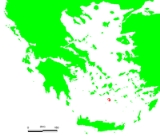
 Sa?t?????, ) is a small, circular archipelago
Archipelago

An archipelago is a chain or cluster of islands that are formed tectonically. The word archipelago literally means "chief sea", from Italian language arcipelago , derived ultimately from Greek language arkhon and pelagos ....
 of volcanic
Volcano

A volcano is an opening, or rupture, in a planet's surface or Crust , which allows hot, molten rock, ash, and gases to escape from below the surface....
 island
Island

An island or isle is any piece of land that is surrounded by water. Very small islands such as emergent land features on atolls are called islets....
s located in the southern Aegean Sea
Aegean Sea

The Aegean Sea is an elongated embayment of the Mediterranean Sea located between the southern Balkans and Anatolian peninsulas, i.e., between the mainlands of Greece and Turkey respectively....
, about 200 km southeast from Greece
Greece

Greece , officially the Hellenic Republic , is a country in southeastern Europe, situated on the southern end of the Balkans. It has borders with Albania, Bulgaria and the former Yugoslav Republic of Macedonia to the north, and Turkey to the east....
's mainland.


Discussion
Ask a question about 'Santorini'
Start a new discussion about 'Santorini'
Answer questions from other users
Full Discussion Forum


Recent Posts


Encyclopedia


Santorini Landsat
Oia At Night
Img 1004
Santorini (Greek
Greek language

Greek is an Indo-European languages native to the southern Balkan peninsula, the language of the Greek people. It forms an independent branch within Indo-European....
 Sa?t?????, ) is a small, circular archipelago
Archipelago

An archipelago is a chain or cluster of islands that are formed tectonically. The word archipelago literally means "chief sea", from Italian language arcipelago , derived ultimately from Greek language arkhon and pelagos ....
 of volcanic
Volcano

A volcano is an opening, or rupture, in a planet's surface or Crust , which allows hot, molten rock, ash, and gases to escape from below the surface....
 island
Island

An island or isle is any piece of land that is surrounded by water. Very small islands such as emergent land features on atolls are called islets....
s located in the southern Aegean Sea
Aegean Sea

The Aegean Sea is an elongated embayment of the Mediterranean Sea located between the southern Balkans and Anatolian peninsulas, i.e., between the mainlands of Greece and Turkey respectively....
, about 200 km southeast from Greece
Greece

Greece , officially the Hellenic Republic , is a country in southeastern Europe, situated on the southern end of the Balkans. It has borders with Albania, Bulgaria and the former Yugoslav Republic of Macedonia to the north, and Turkey to the east....
's mainland. It is also known as Thera (or Thira, Greek T??a ), forming the southernmost member of the Cyclades
Cyclades

The Cyclades are a Greece island group in the Aegean Sea, south-east of the mainland of Greece; and an administrative prefectures of Greece of Greece....
 group of islands, with an area of approximately 73 km² (28 mi²) and a 2001 census population of 13,670. It is composed of the Municipality
Communities and Municipalities of Greece

The municipalities and communities of Greece are one of several levels of government within the organizational structure of that country. Thirteen regions called Peripheries of Greece form the largest unit of government beneath the State....
 of Thíra (pop. 12,440) and the Community of Oía
Oia, Greece

Oia is a Communities and Municipalities of Greece on the islands of Thira and Therasia, in the Cyclades, Greece. The population was 1,230 inhabitants at the 2001 census, and the land area is 19.449 km?....
 (??a, pop. 1,230, which includes 268 inhabitants resident on the offshore island of Therasia
Therasia

Therasia, also known as Thiras?a , is a small Greece island west of Santorini in the Cyclades. The population was 268 inhabitants at the 2001 census....
, lying to the west). These have a total land area of 90.623 km², which also includes the uninhabited islands of Nea Kameni
Nea Kameni

Nea Kameni is a small uninhabited greece island of volcano located in the Bay of Santorini. It was first formed in 16th century through volcanic eruptions, and was enlarged the same way....
, Palaia Kameni, Aspronisi, and Christiani (all part of the Municipality of Thira).

Santorini is essentially what remains of an enormous volcanic explosion, destroying the earliest settlements on what was formerly a single island, and leading to the creation of the current geological caldera
Caldera

A caldera is a cauldron-like volcano feature usually formed by the collapse of land following a volcanic eruption such as the one at Yellowstone National Park....
. Its spectacular physical beauty, along with a dynamic nightlife, have made the island one of Europe
Europe

Europe is, conventionally, one of the world's seven continents. Comprising the westernmost peninsula of Eurasia, Europe is generally divided from Asia to its east by the water divide of the Ural Mountains, the Ural , the Caspian Sea, and by the Caucasus Mountains to the southeast....
's tourist hotspots.

A giant central lagoon, more or less rectangular, and measuring about 12 km by 7 km (8 mi by 4 mi), is surrounded by 300 m (984 ft) high steep cliffs on three sides. The island slopes downward from the cliffs to the surrounding Aegean Sea. On the fourth side, the lagoon is separated from the sea by another much smaller island called Therasia
Therasia

Therasia, also known as Thiras?a , is a small Greece island west of Santorini in the Cyclades. The population was 268 inhabitants at the 2001 census....
; the lagoon merges with the sea in two places, in the northwest and southwest. The water in the centre of the lagoon is nearly 400 m (1300 ft) deep, thus making it a safe harbour for all kinds of shipping. The island's harbours all lie in the lagoon and there are no ports on the outer perimeter of the island; the capital, Fira
Fira

Fir? is the modern capital of the Greece Aegean civilization island, Santorini. "Fir?", actually, is a different pronunciation of "Thira", the ancient name of the island itself....
, clings to the top of the cliff looking down on the lagoon. The volcanic rocks present from the prior eruptions feature olivine
Olivine

The mineral olivine is a magnesium iron Silicate minerals with the formula 2siliconoxygen4. It is one of the most common minerals on Earth, and has also been identified in meteorites and on the Moon, Mars, and comet Wild 2....
 and have a notably small presence of hornblende
Hornblende

Hornblende is a complex silicate minerals series of minerals. Hornblende is not a recognized mineral in its own right, but the name is used as a general or field term, to refer to a dark amphibole....
.

It is the most active volcanic centre in the South Aegean Volcanic Arc
South Aegean Volcanic Arc

The South Aegean Volcanic Arc is chain of volcanic islands in the South Aegean Sea formed by plate tectonics as an oceanic tectonic plate subducts under another tectonic plate which produces magma....
, though what remains today is chiefly a water-filled caldera
Caldera

A caldera is a cauldron-like volcano feature usually formed by the collapse of land following a volcanic eruption such as the one at Yellowstone National Park....
. The name Santorini was given to it by the Latin empire
Latin Empire

The Latin Empire or Latin Empire of Constantinople is the name given by historians to the Crusader state founded by the leaders of the Fourth Crusade on lands captured from the Byzantine Empire after their sack of Constantinople in 1204 and ended in 1261....
 in the thirteenth century, and is a reference to Saint Irene
Saint Irene

Saint Irene may refer to:*Irene of Thessalonica, one of the virgin sisters, feast day April 3*Irene of Rome , wife of martyr Saint Castulus, feast day January 22...
. Before then it was known as Kalliste ("the most beautiful one"), Strongyle ("the circular one"), or Thera.

The island is the site of one of the largest volcanic eruptions the planet has ever seen: the Minoan eruption (sometimes called the Thera eruption
Thera eruption

The Minoan eruption of Santorini, also referred to as the Thera eruption or Santorini eruption, was a major catastrophe volcano which is estimated to have occurred in the mid second millennium BCE....
), which occurred some 3,600 years ago at the height of the Minoan civilization
Minoan civilization

The Minoan civilization was a Bronze Age civilization which arose on the island of Crete. The Minoan culture flourished from approximately 27th century BC to 1450 BC; afterwards, Mycenaean Greece culture became dominant at Minoan sites in Crete....
. The eruption left a large caldera
Caldera

A caldera is a cauldron-like volcano feature usually formed by the collapse of land following a volcanic eruption such as the one at Yellowstone National Park....
 surrounded by volcanic ash
Volcanic ash

Volcanic ash consists of small tephra, which are bits of pulverized rock and glass created by volcano eruptions, less than in diameter. There are three mechanisms of volcanic ash formation: gas release under decompression causing magmatic eruptions; thermal contraction from chilling on contact with water causing phreatomagmatic eruptions...
 deposits hundreds of feet deep and may have led indirectly to the collapse of the Minoan civilization on the island of Crete
Crete

Crete is the largest of the Greek islands and the List of islands in the Mediterranean largest island in the Mediterranean Sea at 8,336 km? ....
, 110 km (70 miles) to the south, through the creation of a gigantic tsunami
Tsunami

A is a series of ocean surface wave that is created when a large volume of a body of water, such as an ocean, is rapidly displaced. The Japanese term is literally translated into " harbor wave."...
. Another popular theory holds that the Thera eruption is the source of the legend of Atlantis
Atlantis

Atlantis is a legendary island first mentioned in Plato's dialogues Timaeus and Critias .In Plato's account, Atlantis was a naval power lying "in front of the Pillars of Hercules" that conquered many parts of Western Europe and Africa 9,000 years before the time of Solon, or approximately 9600 BC....
.

History


Minoan Akrotiri

Excavations starting in 1967 at the site called Akrotiri
Akrotiri (Santorini)

Akrotiri is the name of an excavation site of a Greek Bronze Age settlement on the Greece island of Santorini, associated with the Minoan civilization due to close similarities in artifact and fresco styles....
 under the late Professor Spyridon Marinatos
Spyridon Marinatos

Spyridon Nikolaou Marinatos was one of the premier Greece archaeologists of the 20th century....
 have made Thera the best-known "Minoan
Minoan civilization

The Minoan civilization was a Bronze Age civilization which arose on the island of Crete. The Minoan culture flourished from approximately 27th century BC to 1450 BC; afterwards, Mycenaean Greece culture became dominant at Minoan sites in Crete....
" site outside of Crete
Crete

Crete is the largest of the Greek islands and the List of islands in the Mediterranean largest island in the Mediterranean Sea at 8,336 km? ....
, the homeland of the culture. The island was not known as Thera at this time. Only the southern tip of a large town has been uncovered, yet it has revealed complexes of multi-level buildings, streets, and squares with remains of walls standing as high as eight meters, all entombed in the solidified ash of the famous eruption of Thera. The site was not a palace-complex such as are found in Crete
Crete

Crete is the largest of the Greek islands and the List of islands in the Mediterranean largest island in the Mediterranean Sea at 8,336 km? ....
, but its excellent masonry and fine wall-paintings show that this was certainly no conglomeration of merchants' warehousing either. A loom-workshop suggests organized textile
Textile

A textile is a flexible material consisting of a network of natural or artificial fibres often referred to as thread or yarn. Yarn is produced by Spinning raw wool fibres, linen, cotton, or other material on a spinning wheel to produce long strands known as yarn....
 weaving
Weaving

Weaving is the textile arts in which two distinct sets of yarn, called the Warp and the filling or weft , are interlaced with each other to form a textile....
 for export. This Bronze Age
Bronze Age

The Bronze Age is, with respect to a given prehistory, the period in that society when the most advanced metalworking included smelting copper and tin from naturally-occurring outcroppings of copper and tin ores, creating a bronze alloy by melting those metals together, and casting them into bronze artifact s....
 civilization throve between 3000 to 2000 BC, and reached its peak in the period 2000 to 1580 BC.

Some of the houses in Akrotiri are major structures, some amongst them three stories high. Its streets, squares, and walls were preserved in the layers of ejecta, sometimes as tall as eight meters, and indicating this was a major town. In many houses stone staircases are still intact, and they contain huge ceramic storage jars (pithoi), mills, and pottery. Noted archaeological remains found in Akrotiri are wall paintings or frescoes, which have kept their original colour well, as they were preserved under many meters of volcanic ash. The town also had a highly developed drainage system and, judging from the fine artwork, its citizens were clearly sophisticated and relatively wealthy people.

Pipes with running water and water closets found at Akrotiri are the oldest such utilities discovered. The pipes run in twin systems, indicating that the Therans used both hot and cold water supplies; the origin of the hot water probably was geothermic
Geothermal power

Geothermal power is energy generated from heat stored in the earth, or the collection of absorbed heat derived from underground.Prince Piero Ginori Conti tested the first geothermal generator on 4 July 1904, at the Larderello dry steam field in Italy....
, given the volcano
Volcano

A volcano is an opening, or rupture, in a planet's surface or Crust , which allows hot, molten rock, ash, and gases to escape from below the surface....
's proximity. The dual pipe system suggesting hot and cold running water, the advanced architecture, and the apparent layout of the Akrotiri find resemble Plato
Plato

Plato , was a Classical Greece Greeks philosopher, mathematician, writer of philosophical dialogues, and founder of the Platonic Academy in Ancient Athens, the first institution of higher learning in the western world....
's description of the legendary lost city of Atlantis
Atlantis

Atlantis is a legendary island first mentioned in Plato's dialogues Timaeus and Critias .In Plato's account, Atlantis was a naval power lying "in front of the Pillars of Hercules" that conquered many parts of Western Europe and Africa 9,000 years before the time of Solon, or approximately 9600 BC....
, further indicating the Minoans as the culture which primarily inspired the Atlantis legend.

Fragmentary wall-paintings at Akrotiri lack the insistent religious or mythological content familiar in Classical Greek decor. Instead, the Minoan frescoes depict "Saffron
Saffron

Saffron is a spice derived from the dried gynoecium of the flower of the saffron crocus , a species of crocus in the family Iridaceae. The flower has three Carpels, which are the anatomical terms of location ends of the plant's carpels....
-Gatherers", who offer their crocus
Crocus

Crocus is a genus of perennial plant flowering plants, native to a large area from coastal and subalpine areas of central and southern Europe , North Africa and the Middle East, across Central Asia to western China....
-stamens to a seated lady, perhaps a goddess
Goddess

A goddess is a female deity. Often deities are part of a polytheism system that includes several deities in a pantheon .Common associations of goddesses are the Earth goddess, the Mother Goddess, Love goddess, and the hearth goddess, reflecting historical gender roles....
; in another house are two antelopes, painted with a kind of confident, flowing, decorative, calligraphic line, the famous fresco of a fisherman
Fisherman

A fisherman or fisher is someone who gathers shellfish, or captures fish and other animals from a body of water. Worldwide, there are about 38 million Commercial fishing and Artisan fishing fishermen and fish farmers....
 with his double strings of fish
Fish

A fish is any marine biology vertebrate animal that is typically ectothermic , covered with scale , and equipped with two sets of paired fins and several unpaired fins....
 strung by their gills, and the flotilla of pleasure boats, accompanied by leaping dolphins, where ladies take their ease in the shade of light canopies, among other frescoes.

The well preserved ruins of the ancient town often are compared to the spectacular ruins at Pompeii
Pompeii

Pompeii is a ruined and partially buried Ancient Rome town-city near modern Naples in the Italy region of Campania, in the territory of the comune of Pompei....
 in Italy
Italy

Italy , officially the Italian Republic , is a country located on the Italian Peninsula in Southern Europe and on the two largest islands in the Mediterranean Sea, Sicily and Sardinia....
. The canopy covering the ruins collapsed in an accident in September 2005, tragically killing one tourist and injuring seven more. The site remains closed while a new canopy is built.

The oldest signs of human settlement are Late Neolithic (4th millennium BC or earlier), but ca. 2000
19th century BC

The 19th century BC was the century which lasted from 1900 BC to 1801 BC....
–1650 BC Akrotiri developed into one of the Aegean's major Bronze Age
Bronze Age

The Bronze Age is, with respect to a given prehistory, the period in that society when the most advanced metalworking included smelting copper and tin from naturally-occurring outcroppings of copper and tin ores, creating a bronze alloy by melting those metals together, and casting them into bronze artifact s....
 ports, with recovered objects that had come, not just from Crete
Crete

Crete is the largest of the Greek islands and the List of islands in the Mediterranean largest island in the Mediterranean Sea at 8,336 km? ....
, but also from Anatolia
Anatolia

Anatolia or Asia Minor is a region of Western Asia, comprising most of the modern Republic of Turkey. It is a geographic region bounded by the Black Sea to the north, the Caucasus to the northeast, the Aegean Sea to the west, the Mediterranean Sea to the south, and the Iranian plateau to the east and southeast....
, Cyprus
Cyprus

Cyprus , officially the Republic of Cyprus , is an island country situated in the eastern Mediterranean Sea, east of Greece, west of Lebanon, Syria, and Israel, south of Turkey and north of Egypt....
, Syria
Syria

Syria , officially the Syrian Arab Republic , is an Arab-majority country in Southwest Asia, bordering Lebanon and the Mediterranean Sea to the west, Israel to the southwest, Jordan to the south, Iraq to the east, and Turkey to the north....
, and Egypt
Egypt

Egypt is a country mainly in North Africa, with the Sinai Peninsula forming a land bridge in Western Asia. Covering an area of about , Egypt borders the Mediterranean Sea to the north, the Gaza Strip and Israel to the northeast, the Red Sea to the east, Sudan to the south and Libya to the west....
 as well as from the Dodecanese
Dodecanese

The Dodecanese are a group of 12 larger plus 150 smaller Greece list of islands of Greece in the Aegean Sea, off the southwest coast of Turkey, southward of the island of Samos and northeastward of the island of Crete....
 and the Greek mainland.

Dating
The Minoan eruption provides a fixed point for the chronology of the second millennium BC in the Aegean, because evidence of the eruption occurs throughout the region and the site itself contains material culture from outside. The eruption occurred during the "Late Minoan IA" period at Crete and the "Late Cycladic I" period in the surrounding islands.

The exact date of the eruption, however, is unknown. Radiocarbon dating
Radiocarbon dating

Radiocarbon dating, or carbon dating, is a radiometric dating method that uses the naturally occurring radioisotope carbon-14 to determine the age of carbonaceous materials up to about 60,000 years....
 indicates that the eruption occurred about 1645—1600 BC. These dates, however, conflict with the usual date range from archaeological evidence, which is between about 1550 and 1500 BC. For more discussion, see the article on the Minoan eruption.

Ancient and Medieval Santorini


Santorini remained unoccupied throughout the rest of the Bronze Age, during which time the Greeks took over Crete
Crete

Crete is the largest of the Greek islands and the List of islands in the Mediterranean largest island in the Mediterranean Sea at 8,336 km? ....
. At Knossos
Knossos

Knossos , also known as the Knossos Palace is the largest Bronze Age archaeological site on Crete and probably the ceremonial and political center of the Minoan civilization and culture....
, in a LMIIIA context (14th century BC), seven Linear B
Linear B

Linear B is a script that was used for writing Mycenaean language, an early form of Greek language. It predated the Greek alphabet by several centuries and seems to have died out with the fall of Mycenaean Greece civilization....
 texts while calling upon "all the gods" make sure to grant primacy to an elsewhere-unattested entity called qe-ra-si-ja and, once, qe-ra-si-jo. If the endings -ia[s] and -ios represent an ethnikonic suffix, then this means "The One From Qeras[os]". If aspirated, *Qhera- would have become "Thera-" in later Greek. "Therasia" and its ethnikon "Therasios" are both attested in later Greek; and, since -sos was itself a genitive suffix in the Aegean Sprachbund
Sprachbund

A Sprachbund , from the German language word for ?language union?, also known as a linguistic area, convergence area, diffusion area or language crossroads, is a group of languages that have become similar in some way because of geographical proximity and language contact....
, *Qeras[os] could also shrink to *Qera. (An alternate view takes qe-ra-si-ja and qe-ra-si-jo as proof of androgyny, and applies this name by similar arguments to the legendary seer, Tiresias, but these views are not mutually exclusive of one another.) If qe-ra-si-ja was an ethnikon first, then in following him/her/it the Cretans also feared whence it came.

Over the centuries after the general catastrophes of 1200 BC, Phoenicians founded a site on Thera. Herodotus reports that the Phoenicians called the island Callista and lived on it for eight generations. Then, in the 9th century BC, Dorians founded the main Hellenic city - on Mesa Vouno, 396 m above sea level. This group later claimed that they had named the city and the island after their leader, Theras.

Apollonius Rhodius' Argonautica, written in Hellenistic Egypt in the 3rd century BC, includes an origin and sovereignty myth of Thera being given by Triton
Tritón

Trit?n is a Mexico magazine dedicated to news, books and information on swimming, diving and water polo....
 in Libya to the Greek Argonaut
Argonaut

Argonaut may refer to:* Argonaut , a kind of octopus in the genus Argonauta* Jason and the Argonauts, sailors in Greek mythology* Argonauts of Saint Nicholas, a military order in Naples...
 Euphemus
Euphemus

There are two figures in Greek mythology known as Euphemus "reputable".One was the son of Poseidon, granted by his father the power to walk on water....
, son of Poseidon
Poseidon

In Greek mythology, Poseidon was the god of the sea and, as "Earth-Shaker," of earthquakes. The name of the god Nethuns in Etruscan mythology was adopted in Latin for Neptune in Roman mythology: both were sea gods analogous to Poseidon....
, in the form of a clod of dirt. After carrying the dirt next to his heart for several days, Euphemus dreamt that he nursed the dirt with milk from his breast, and that the dirt turned into a beautiful woman with whom he had sex. The woman then told him that she was a daughter of Triton named Kalliste, and that when he threw the dirt into the sea it would grow into an island for his descendants to live on. The poem goes on to claim that the island was named Thera after Euphemus' descendant Theras, son of Autesion, the leader of a group of refugee settlers from Lemnos.

The Dorians have left a number of inscriptions incised in stone, in the vicinity of the temple of Apollo
Apollo

In Greek mythology and Roman mythology, Apollo , is one of the most important and many-sided of the Twelve Olympians. The ideal of the kouros , Apollo has been variously recognized as a god of light and the sun; truth and prophecy; archery; medicine and healing; music, poetry, and the arts; and more....
, attesting to pederastic relations
Pederasty in ancient Greece

Greek pederasty, as idealised by the Ancient Greece from Archaic period in Greece onward, was a relationship and bond between an adolescent boy and an adult man outside of his immediate family....
 between the authors and their eromenoi
Eromenos

In the Pederasty in ancient Greece of Athens, the eromenos was an adolescence boy who was in a love relationship with an adult man, known as the erastes ....
. These inscriptions, found by Friedrich Hiller von Gaertringen, have been thought by some archaeologists to be of a ritual, celebratory nature, due to their large size, careful construction and - in some cases - execution by craftsmen other than the authors. Other historians, such as Dover and Henri-Irénée Marrou
Henri-Irénée Marrou

Henri-Ir?n?e Marrou was a leading French historian of the mid- twentieth century. A Christian humanist in outlook, his work was primarily in the spheres of Late Antiquity and the history of education....
, have considered them to be pornographic in nature.

According to Herodotus
Herodotus

Herodotus of Halicarnassus was a Greeks historian who lived in the 5th century BC and is regarded as the "Father of History" in Western culture....
 (4.149-165), following a drought of seven years, Thera sent out colonists who founded a number of cities in northern Africa, including Cyrene
Cyrene, Libya

Cyrene was an ancient Greece colony in present-day Libya, the oldest and most important of the five Greek cities in the region. It gave eastern Libya the classical name Cyrenaica that it has retained to modern times....
.

In the 5th century BC, Dorian Thera did not join the Delian League
Delian League

The Delian League was an association of approximately 150 5th-century BC Ancient Greece city-states under the leadership of Classical Athens, whose purpose was to continue fighting the Persian Empire after the Greek victory in the Battle of Plataea at the end of the Greco?Persian Wars....
 with Athens
Athens

Athens , the Capital and largest city of Greece, dominates the Attica periphery; as one of the List of cities by time of continuous habitation, its recorded history spans around 3,400 years....
; and during the Peloponnesian War
Peloponnesian War

The Peloponnesian War which lasted from 431-404BC was an Ancient Greece military conflict, fought by Athens and its Athenian empire against the Peloponnesian League, led by Sparta....
, Thera sided with Dorian Sparta, against Athens. The Athenians took the island during the war, but lost it again after the Battle of Aegospotami
Battle of Aegospotami

The naval Battle of Aegospotami took place in 405 BC and was the last major battle of the Peloponnesian War. In the battle, a Spartan fleet under Lysander completely destroyed the Athenian navy....
.

As with other Greek territories, Thera then was ruled by the Romans
Ancient Rome

Ancient Rome was a civilization that grew out of a small agricultural community founded on the Italian Peninsula as early as the 10th century BC....
; it passed to the eastern side of the Empire when it divided - which now is known as the Byzantine Empire
Byzantine Empire

Byzantine Empire and Eastern Roman Empire are conventional names used to describe the Roman Empire during the Middle Ages, centered on its capital of Constantinople....
.

During the Crusades, the Franks
Franks

The Franks or Frankish people were a West Germanic ethnic group first identified in the 3rd century as living north and east of the Lower Rhine River....
 settled it, while in the 13th century AD, the Venetians annexed the isle to the Duchy of Naxos and renamed it "Santorini", that is "Saint Irene
Saint Irene

Saint Irene may refer to:*Irene of Thessalonica, one of the virgin sisters, feast day April 3*Irene of Rome , wife of martyr Saint Castulus, feast day January 22...
". Santorini came under Ottoman
Ottoman Empire

The Ottoman Empire , also known by its contemporaries as the Turkish Empire or Turkey , was an empire that lasted from 1299?1923. It was Treaty of Lausanne by the Republic of Turkey, which was officially proclaimed on October 29, 1923....
 rule in 1579.

Modern Santorini

Santorini was united with Greece in 1912. Its major settlements include Fira (Phira)
Fira

Fir? is the modern capital of the Greece Aegean civilization island, Santorini. "Fir?", actually, is a different pronunciation of "Thira", the ancient name of the island itself....
, Oia
Oia, Greece

Oia is a Communities and Municipalities of Greece on the islands of Thira and Therasia, in the Cyclades, Greece. The population was 1,230 inhabitants at the 2001 census, and the land area is 19.449 km?....
, Emporio
Emporio, Greece

File:Emporio 000.jpgFile:Emporio 005.jpgEmporio is the capital of the Mouriki municipality in the Kozani Prefecture, Greece. The population was 1003 in 2001....
, Kamari
Kamari

Kamari is a coastal village on the southeastern part of theAegean Sea island of Santorini, Greece, in the Cyclades prefecturewith a population of approx....
, Perissa, Imerovigli
Imerovigli

Imerovigli is actually a neighbourhood of Fira village, as it is only 2 km away from the capital of Santorini. Imerovigli is mostly famous for its beautiful sunset, that it is called "balcony to the Aegean Sea"....
, Pyrgos
Pyrgos Kallistis

Pyrgos Kallistis or simply Pyrgos is a picturesque village on the Aegean Sea island of Santorini, Greece,in the Cyclades prefecture with a population of approx....
, and Therasia
Therasia

Therasia, also known as Thiras?a , is a small Greece island west of Santorini in the Cyclades. The population was 268 inhabitants at the 2001 census....
. Akrotiri
Akrotiri (Santorini)

Akrotiri is the name of an excavation site of a Greek Bronze Age settlement on the Greece island of Santorini, associated with the Minoan civilization due to close similarities in artifact and fresco styles....
 is a major archaeological site, with ruins from the Minoan era. Santorini's primary industry is tourism
Tourism

Tourism is travel for recreational or leisure purposes. The World Tourism Organization defines tourists as people who "travel to and stay in places outside their usual environment for not more than one consecutive year for leisure, business and other purposes not related to the exercise of an activity remunerated from...
, particularly in the summer months. The island's pumice
Pumice

File:Pumice stone444.jpgFile:Pumice stone detail444.jpgPumice is a textural term for a volcanic rock that is a solidified frothy lava typically created when super-heated, highly pressurized rock is violently ejected from a volcano....
 quarries have been closed since 1986, in order to preserve the caldera.

Santorini has no rivers, and water is scarce. Until the early 1990s locals filled water cisterns from the rain that fell on roofs and courts, from small springs, and with imported assistance from other areas of Greece. In recent years a desalination
Desalination

Desalination, desalinization, or desalinisation refers to any of several processes that remove excess sodium chloride and other minerals from water....
 plant has provided running, yet non-potable, water to most houses.

The island remains the home of a small, but flourishing, wine
Wine

Wine is an alcoholic beverage often made of fermentation grape juice. The natural chemical balance of grapes is such that they can ferment without the addition of sugars, acids, enzymes or other nutrients....
 industry, based on the indigenous grape
Grape

File:Table grapes on white.jpgA grape is the non-Climacteric #In_botany fruit that grows on the Perennial plant and deciduous woody vines of the genus Vitis....
 variety, Assyrtiko
Assyrtiko

Assyrtiko or Asyrtiko is a white Greek wine grape Indigenous to the island of Santorini. Assyrtiko is widely planted in the arid List of vineyard soils of Santorini and other Aegean Sea islands, such as Paros....
. Vines of the Assyrtiko variety are extremely old and prove resistant to phylloxera
Phylloxera

Grape phylloxera , commonly just called Phylloxera, is a pest of commercial grapevines worldwide, originally native to eastern North America....
, attributed by local winemakers to the well-drained volcanic soil and its chemistry, and the soil needed no replacement during the great phylloxera epidemic of the early 20th century. In their adaptation to their habitat, such vines are planted far apart, as their principal source of moisture is dew, and they often are trained in the shape of low-spiralling baskets, with the grapes hanging inside to protect them from the winds. Also unique to the island is the red, sweet, and extremely strong Vinsanto. White wines from the island are extremely dry with a strong, citrus scent, and the ashy volcanic soil gives the white wines a slightly sulfurous flavour much like Vinsanto. It is not easy to be a winegrower in Santorini; the hot and dry conditions give the soil a low productivity. The yield per acre is only 10 to 20% of the yields that are common in France and California.

In 1707 an undersea volcano breached the sea surface, forming the current centre of activity at Nea Kameni in the centre of the lagoon, and eruptions centred on it continue — the twentieth century saw three such, the last in 1950. At some time in the future, it will almost certainly erupt violently again. Santorini also was struck by a devastating earthquake in 1956. Although the volcano is quiescent at the present time, at the current active crater (there are several former craters on Nea Kameni), steam and sulfur dioxide
Sulfur dioxide

Sulfur dioxide is the chemical compound with the formula SO2. It is produced by volcanoes and in various industrial processes. Since coal and petroleum often contain sulfur compounds, their combustion generates sulfur dioxide....
 are given off.

Volcanic eruption


The physical eruption

The devastating volcanic eruption of Thera has become the most famous single event in the Aegean before the fall of Troy
Troy

Troy is a legendary city and center of the Trojan War, as described in the Epic Cycle, and especially in the Iliad, one of the two epic poems attributed to Homer....
. This may have been one of the biggest volcanic eruptions on Earth in the last few thousand years.

The violent eruption was centered on a small island just north of the existing island of Nea Kameni in the centre of the caldera; the caldera itself was formed several hundred thousand years ago by collapse of the centre of a circular island caused by the emptying of the magma chamber during an eruption. It has been filled several times by ignimbrite
Ignimbrite

Ignimbrite is a volcano pyroclastic rock, often of dacitic or rhyolitic composition."Ignimbrite" is the deposit of a pumice rich pyroclastic density current, or 'pyroclastic flow', a hot suspension of particles and gases that flows rapidly from a volcano, driven by a greater density than the surrounding atmosphere....
 since then, and the process repeated itself, most recently 21,000 years ago. The northern part of the caldera was refilled by the volcano and then collapsed again during the Minoan eruption. Before the Minoan eruption, the caldera formed a nearly continuous ring with the only entrance between the tiny island of Aspronisi and Thera; the eruption destroyed the sections of the ring between Aspronisi and Therasia, and between Therasia and Thera, creating two new channels.

On Santorini, there is to be found a deposit of white tephra
Tephra

Tephra is air-fall material produced by a Volcano regardless of composition or fragment size. Tephra is typically Rhyolite in composition, as most explosive volcanoes are the product of the more viscosity felsic or high silica magmas....
 thrown from the eruption, lying up to 60 metres thick overlying the soil marking the ground level before the eruption and, forming a layer divided into three fairly distinct bands indicating different phases of the eruption. New archaeological discoveries by a team of international scientists, in 2006, have revealed that the Santorini event was much more massive than previously thought; it expelled 61 km³ of magma and rock into Earth's atmosphere, compared to previous estimates of only 39 cubic kilometres in 1991, producing an estimated 100 cubic kilometres of tephra. Only the Mount Tambora
Mount Tambora

Mount Tambora is an active stratovolcano, also known as a composite volcano, on Sumbawa island, Indonesia. Sumbawa is flanked both to the north and south by oceanic crust, and Tambora was formed by the active subduction zones beneath it....
 volcanic eruption of 1815, the 181 AD eruption
Hatepe eruption

The Hatepe eruption around 180 CE was Lake Taupo's most recent major eruption, and New Zealand's largest eruption during the last 20,000 years....
 of Lake Taupo
Lake Taupo

Lake Taupo is a lake situated in the North Island of New Zealand. It has a perimeter of approximately 193 kilometres, a deepest point of 186 metres and a surface area of 616 square kilometres....
, and possibly Baekdu Mountain
Baekdu Mountain

Baekdu Mountain, also known locally as Changbai Mountain in China, is a volcanic mountain on the border between North Korea and China, located at ....
's 969 AD eruption released more material into the atmosphere during the past 5,000 years.

Speculation on an Exodus connection


A 2006 documentary
Documentary film

Documentary film is a broad category of visual expression that is based on the attempt, in one fashion or another, to "document" reality. Although "documentary film" originally referred to movies shot on film stock, it has subsequently expanded to include video and new media productions that can be either direct-to-video or made for a televis...
 created by filmmaker Simcha Jacobovici
Simcha Jacobovici

Simcha Jacobovici is an Israel-born Canada controversial film director and producer. He holds a B.A. in Philosophy from McGill University and an M.A....
 called The Exodus Decoded suggests that the eruption of the Santorini Island volcano
Volcano

A volcano is an opening, or rupture, in a planet's surface or Crust , which allows hot, molten rock, ash, and gases to escape from below the surface....
 (c. 1623 BC, +/-25) caused all the biblical plagues described against Egypt, re-dating the eruption to c. 1500 BC. The film claims the Hyksos
Hyksos

The Hyksos were an Asiatic people who invaded the eastern Nile Delta, in the Twelfth dynasty of Egypt initiating the Second Intermediate Period of Ancient Egypt....
 were the Israelites and that some of them may have originally been from Mycenae
Mycenaean Greece

Mycenaean Greece is a cultural period of ancient Greece taking its name from the archaeological site of Mycenae in northeastern Argolis, in the Peloponnese of southern Greece....
. The film also claims that these original Mycenaean Israelites fled Egypt (which they had in fact ruled for some time) after the eruption, back to Mycenae. The pharaoh with whom they identify the Pharaoh of the Exodus
Pharaoh of the Exodus

In the Bible, the name of the Pharaoh of the Exodus is not given. He is simply called "Pharaoh." Muslims also believe in the exodus, as the story is told in the Muslim holy book the Qur'an , although some details of the story are different....
 is Ahmose I
Ahmose I

Ahmose I was a pharaoh of ancient Egypt and the founder of the Eighteenth dynasty of Egypt. He was a member of the Thebes, Egypt royal house, the son of pharaoh Tao II the Brave and brother of the last pharaoh of the Seventeenth dynasty of Egypt, King Kamose....
. Rather than crossing the Red Sea
Red Sea

The Red Sea is a salt water inlet of the Indian Ocean between Africa and Asia. The connection to the ocean is in the south through the Bab el Mandeb sound and the Gulf of Aden....
, Jacobovici argued a marshy area in northern Egypt
Egypt

Egypt is a country mainly in North Africa, with the Sinai Peninsula forming a land bridge in Western Asia. Covering an area of about , Egypt borders the Mediterranean Sea to the north, the Gaza Strip and Israel to the northeast, the Red Sea to the east, Sudan to the south and Libya to the west....
 known as the "Reed Sea
Reed Sea

The Reed Sea , is a possible translation of the Hebrew phrase Yam Suph, which occurs many times in the Bible. This may refer to a large lake close to the Red Sea, which has since dried up due to the Suez Canal....
" would have been alternately drained and flooded by tsunami
Tsunami

A is a series of ocean surface wave that is created when a large volume of a body of water, such as an ocean, is rapidly displaced. The Japanese term is literally translated into " harbor wave."...
s caused by the caldera collapse, and could have been crossed during the Exodus
Passage of the Red Sea

The Passage of the Red Sea refers to the Bible account of the passage of the Red Sea by Moses, leading the Hebrews on their journey out of Egypt and across the Red Sea as described in the Book of Exodus, chapters 13:17 to 15:21, in order to enter the Promised Land following the stations of the Exodus....
.

Speculation on an Atlantis connection

It is easy to see why this location was added to the list of possible locations for the fabled city of Atlantis
Atlantis

Atlantis is a legendary island first mentioned in Plato's dialogues Timaeus and Critias .In Plato's account, Atlantis was a naval power lying "in front of the Pillars of Hercules" that conquered many parts of Western Europe and Africa 9,000 years before the time of Solon, or approximately 9600 BC....
. As with most myths, connections to real places are usually dubious and many scientists often are skeptical. However some archaeological, seismological
Seismology

Seismology is the scientific study of earthquakes and the propagation of Linear elasticity#Elastic waves through the Earth. The field also includes studies of earthquake effects, such as tsunamis as well as diverse seismic sources such as volcanic, tectonic, oceanic, atmospheric, and artificial processes ....
, and vulcanological evidence (popularized on The History Channel
The History Channel

History, formerly known as The History Channel, is an International Satellite channel and Cable channel TV channel, with shows on historical events and persons—often with observations and explanations by noted historians as well as historical reenactment and interviews with witnesses....
 show Lost Worlds episode "Atlantis" ) regarding Crete, Santorini, and the description of Atlantis from Plato
Plato

Plato , was a Classical Greece Greeks philosopher, mathematician, writer of philosophical dialogues, and founder of the Platonic Academy in Ancient Athens, the first institution of higher learning in the western world....
 has been presented linking the Atlantis myth to Santorini. For more discussion, see the article on Location hypotheses of Atlantis
Location hypotheses of Atlantis

Location hypotheses of Atlantis are various proposed real-world settings for Atlantis, a lost civilisation mentioned in Plato's dialogues Timaeus and Critias , written about 360 B.C....
.

Sea Diamond sinking

On April 6, 2007, the 469-foot cruise ship MS Sea Diamond
MS Sea Diamond

Motor ship Sea Diamond was a cruise ship operated by Louis Hellenic Cruise Lines. She was built in 1986 by Valmet, Finland for Birka Line as MS Birka Princess. The ship sank on April 6, 2007 after running aground near the Greece island of Santorini the previous day....
 struck a volcanic reef within the crater and sank the following day, resulting in the loss of two passengers. The Sea Diamond was operated by Louis Cruise Lines
Louis Cruise Lines

Louis Cruise Lines is a Cyprus-based cruise line that operates cruises from Cyprus, France, Italy and Greece . The company also charters several ships to Thomson Cruises....
, part of a Cyprus
Cyprus

Cyprus , officially the Republic of Cyprus , is an island country situated in the eastern Mediterranean Sea, east of Greece, west of Lebanon, Syria, and Israel, south of Turkey and north of Egypt....
-based tourism group. The Merchant Marine Ministry said 1,195 passengers and 391 crew members were on board. The ship settled to the bottom near the port of Athenios. The wreck contains 200 tons of fuel oil and poses a serious threat to the waters of the caldera. Plans are currently being made to salvage the ship, which is resting precariously on an undersea ledge.

Gallery


See also

  • List of volcanoes in Greece
    List of volcanoes in Greece

    This is a list of active and extinct volcanoes in Greece....
  • Santorini (Thira) National Airport
    Santorini (Thira) National Airport

    Santorini National Airport is an airport in Santorini/Thira, Greece , located north of the village of Kamari. The airport serves bothas a military and as a civil airport....
  • White Towns of Andalusia
    White Towns of Andalusia

    The White Towns of Andalusia, or Pueblos Blancos, are a series of towns and large villages in the northern part of the provinces of C?diz and M?laga in southern Spain, mostly within the Sierra de Grazalema Natural Park....


External links

  • , Grant Heiken, Independent consultant, author, geologist (retired) Los Alamos National Laboratory; lecture presented at University of Illinois at Urbana-Champaign, sponsored by and
  • : fully illustrated capsule of the finds