


Dwarf elephant

Encyclopedia
Dwarf elephants are prehistoric members of the order Proboscidea
, that, through the process of allopatric speciation
, evolved to a fraction of the size of their immediate ancestors. Insular dwarfism
is a biological phenomenon by which the size of animals isolated on an island shrinks dramatically over time for the smaller animals have survived because of the underabundance of food.
Fossil
remains of dwarf elephants have been found on the Mediterranean islands of Cyprus
, Malta
(at Ghar Dalam
), Crete
, Sicily
, Sardinia
, the Cyclades Islands
and the Dodecanese Islands. Other islands where dwarf elephants have been found are Sulawesi
, Flores
, Timor
and other islands of the Lesser Sundas. The Channel Islands of California once supported a dwarf species descended from Columbian mammoth
s, while small races of woolly mammoth
s were once found on Wrangel Island
and Saint Paul Island.
, part of the Pleistocene
fauna of all the larger Mediterranean islands, with the apparent exception of Corsica
and the Balearics
. Mediterranean dwarf elephants have generally been considered as paleoloxodontine
, derived from the continental Straight-tusked Elephant
, Elephas (Palaeoloxodon) antiquus Falconer
& Cautley
, 1847. An exception is the dwarf Sardinian Mammoth
, Mammuthus lamarmorae (Major, 1883), the only endemic elephant of the Mediterranean islands belonging to the mammoth line. A DNA research published in 2006 theorized that the Elephas creticus could be from the mammoth line too. This old theory, proposed by Dorothea Bate
as early as 1905, is not widely accepted. A scientific study of 2007 demonstrates the mistakes of the DNA research of 2006.
During low sea levels, the Mediterranean islands were colonised again and again, giving rise, sometimes on the same island, to several species (or subspecies) of different body sizes. These endemic dwarf elephants were taxonomically different on each island or group of very close islands, like the Cyclades archipelago.
There are many uncertainties about the time of colonisation, the phylogenetic relationships and the taxonomic status of dwarf elephants on the Mediterranean islands. Extinction of the insular dwarf elephants has not been correlated with the arrival in the islands of man. Furthermore, it has been suggested by the paleontologist Othenio Abel in 1914, that the finding of skeletons of such elephants sparked the idea that they belonged to giant cyclops
es, because the center nasal opening was thought to be a cyclopic eye socket.
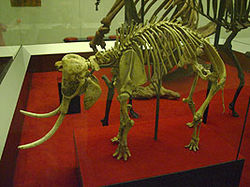
After DNA research, published in 2006, it has been proposed to rename Elephas (Palaeoloxodon) creticus into Mammuthus creticus (Bate, 1907). Others proposed (in 2002) to rename all the described specimens of larger size under the new subspecies name Elephas antiquus creutzburgi (Kuss, 1965). In a recent study of 2007, it was argued for the groundlessness of the theory by Poulakakis et al. in 2006, showing the weak points of that DNA research.
The Cyprus dwarf elephant survived at least until 11,000 BP
. Its estimated body weight was only 200 kg, only 2% of its 10,000 kg ancestor. Molars of this dwarf are reduced to approximately 40% the size of mainland straight-tusked elephant
s.
Remains of the species were first discovered and recorded by Dorothea Bate
in a cave in the Kyrenia
hills of Cyprus
in 1902 and reported in 1903.
, Naxos, Kythnos
, Serifos
and Milos
. The Delos elephant is of similar size to a small Elephas antiquus, while the Naxos elephant is of similar size to Elephas melitensis. The remains from Kythnos, Serifos and Milos have not been described.
, bones of an endemic dwarf elephant have been discovered. This elephant was similar in size to Elephas mnaidriensis.
Two groups of remains of dwarf elephants have been found on the island of Tilos
. They are similar in size to Elephas mnaidriensis and the smaller Elephas falconeri, but the two groups indicate sexual dimorphism. The remains had originally been designated to Palaeoloxodon antiquus falconeri (Busk, 1867). However, this name refers to the dwarf elephants from the island of Malta. As a result, since no migration route between the two islands can be proved, this name should not be used when referring to the elephant remnants from Tilos, although some scientists have accepted the temporary use of this name until further material can be examined..
The Tilos dwarf elephant is the first dwarf elephant whose DNA sequence has been studied. The results of this research are consistent with previous morphological reports, according to which Palaeoloxodon is more closely related to Elephas than to Loxodonta or Mammuthus. After the study of new osteological material that has been excavated in anatomical connection in the Charkadio Cave on Tilos island the new species name Elephas tiliensis has been assigned to the Tilos dwarf elephants. It was the latest paleoloxodontine to survive in Europe
. They became extinct just less than 4,000 years BP
, so this elephant survived well into the Holocene
. A exhibition is available at the Municipality of Tilos Island, soon to be transferred to the new building near Charkadio Cave.
Currently there is a proposed project named MECHANIMAL - under evaluation - that if accepted will be founded by the Greek Ministry of Education. MechAnimal Project
(Mammuthus columbii) produced a separate, isolated population at the end of the Pleistocene. One of these isolated groups was formed on the Channel Islands of California
, most likely about 40,000 years ago (although the time of isolation is not fully known). Selective forces on the Channel Islands resulted in smaller animals, forming a new species, the Pygmy Mammoth
Mammuthus exilis. Channel Islands mammoths ranged from 150–190 cm in shoulder height.
s (Mammuthus primigenius) lived on Wrangel Island
in the Arctic Ocean
. It has been shown that mammoths survived on Wrangel Island until 1700 BCE, the most recent survival of any known mammoth population. They also survived on Saint Paul Island in the Bering Sea
until 6000 BCE. Wrangel Island is thought to have become separated from the mainland by 12,000 years BP
. Survival of a mammoth population may be explained by local geographic, topographic and climatic features, which entailed preservation of communities of steppe plants, as well as a degree of isolation sufficient to delay colonization by humans. St. Paul Island shares this characteristic of geographic isolation, implying that human hunting played a role in the disappearance of the woolly mammoth. Wrangel Island mammoths ranged from 180–230 cm in shoulder height and were for a time considered "dwarf mammoths". However this classification has been re-evaluated and since the Second International Mammoth Conference in 1999, these mammoths are no longer considered to be true "dwarf mammoths".
. Around the early Middle Pleistocene these dwarfed elephants were replaced by new immigrants of larger to intermediate sizes.
species on Flores
is that endemic dwarfs, represented by the Early Pleistocene species Stegodon sondaarii, became extinct around 840,000 years ago. These dwarf forms were then replaced by the medium to large-sized Stegodon florensis, a species closely related to the Stegodon trigonocephalus group found both in Java and in the islands of biogeographical Wallacea
, separated by deep water from the Asia
n and Australia
n continental shelves
. This Stegodon species went extinct about 12,000 years ago, presumably because of a volcanic eruption.
. They had a shoulder height of only 1.5m.
Proboscidea
Proboscidea is a taxonomic order containing one living family, Elephantidae, and several extinct families. This order was first described by J. Illiger in 1881 and encompasses the trunked mammals...
, that, through the process of allopatric speciation
Allopatric speciation
Allopatric speciation or geographic speciation is speciation that occurs when biological populations of the same species become isolated due to geographical changes such as mountain building or social changes such as emigration...
, evolved to a fraction of the size of their immediate ancestors. Insular dwarfism
Insular dwarfism
Insular dwarfism, a form of phyletic dwarfism, is the process and condition of the reduction in size of large animals – typically mammals – when their population's range is limited to a small environment, primarily islands. This natural process is distinct from the intentional creation of dwarf...
is a biological phenomenon by which the size of animals isolated on an island shrinks dramatically over time for the smaller animals have survived because of the underabundance of food.
Fossil
Fossil
Fossils are the preserved remains or traces of animals , plants, and other organisms from the remote past...
remains of dwarf elephants have been found on the Mediterranean islands of Cyprus
Cyprus
Cyprus , officially the Republic of Cyprus , is a Eurasian island country, member of the European Union, in the Eastern Mediterranean, east of Greece, south of Turkey, west of Syria and north of Egypt. It is the third largest island in the Mediterranean Sea.The earliest known human activity on the...
, Malta
Malta
Malta , officially known as the Republic of Malta , is a Southern European country consisting of an archipelago situated in the centre of the Mediterranean, south of Sicily, east of Tunisia and north of Libya, with Gibraltar to the west and Alexandria to the east.Malta covers just over in...
(at Ghar Dalam
Ghar Dalam
Għar Dalam is a prehistorical cul de sac located on the outskirts of Birżebbuġa, Malta containing the bone remains of animals that were stranded and subsequently became extinct on Malta at the end of the Ice age...
), Crete
Crete
Crete is the largest and most populous of the Greek islands, the fifth largest island in the Mediterranean Sea, and one of the thirteen administrative regions of Greece. It forms a significant part of the economy and cultural heritage of Greece while retaining its own local cultural traits...
, Sicily
Sicily
Sicily is a region of Italy, and is the largest island in the Mediterranean Sea. Along with the surrounding minor islands, it constitutes an autonomous region of Italy, the Regione Autonoma Siciliana Sicily has a rich and unique culture, especially with regard to the arts, music, literature,...
, Sardinia
Sardinia
Sardinia is the second-largest island in the Mediterranean Sea . It is an autonomous region of Italy, and the nearest land masses are the French island of Corsica, the Italian Peninsula, Sicily, Tunisia and the Spanish Balearic Islands.The name Sardinia is from the pre-Roman noun *sard[],...
, the Cyclades Islands
Cyclades
The Cyclades is a Greek island group in the Aegean Sea, south-east of the mainland of Greece; and a former administrative prefecture of Greece. They are one of the island groups which constitute the Aegean archipelago. The name refers to the islands around the sacred island of Delos...
and the Dodecanese Islands. Other islands where dwarf elephants have been found are Sulawesi
Sulawesi
Sulawesi is one of the four larger Sunda Islands of Indonesia and is situated between Borneo and the Maluku Islands. In Indonesia, only Sumatra, Borneo, and Papua are larger in territory, and only Java and Sumatra have larger Indonesian populations.- Etymology :The Portuguese were the first to...
, Flores
Flores
Flores is one of the Lesser Sunda Islands, an island arc with an estimated area of 14,300 km² extending east from the Java island of Indonesia. The population was 1.831.000 in the 2010 census and the largest town is Maumere. Flores is Portuguese for "flowers".Flores is located east of Sumbawa...
, Timor
Timor
Timor is an island at the southern end of Maritime Southeast Asia, north of the Timor Sea. It is divided between the independent state of East Timor, and West Timor, belonging to the Indonesian province of East Nusa Tenggara. The island's surface is 30,777 square kilometres...
and other islands of the Lesser Sundas. The Channel Islands of California once supported a dwarf species descended from Columbian mammoth
Columbian Mammoth
The Columbian Mammoth is an extinct species of elephant of the Quaternary period that appeared in North America during the late Pleistocene. It is believed by some authorities to be the same species as its slightly larger cousin, M...
s, while small races of woolly mammoth
Woolly mammoth
The woolly mammoth , also called the tundra mammoth, is a species of mammoth. This animal is known from bones and frozen carcasses from northern North America and northern Eurasia with the best preserved carcasses in Siberia...
s were once found on Wrangel Island
Wrangel Island
Wrangel Island is an island in the Arctic Ocean, between the Chukchi Sea and East Siberian Sea. Wrangel Island lies astride the 180° meridian. The International Date Line is displaced eastwards at this latitude to avoid the island as well as the Chukchi Peninsula on the Russian mainland...
and Saint Paul Island.
Mediterranean Islands
Dwarf elephants were, after the Messinian salinity crisisMessinian salinity crisis
The Messinian Salinity Crisis, also referred to as the Messinian Event, and in its latest stage as the Lago Mare event, was a geological event during which the Mediterranean Sea went into a cycle of partly or nearly complete desiccation throughout the latter part of the Messinian age of the Miocene...
, part of the Pleistocene
Pleistocene
The Pleistocene is the epoch from 2,588,000 to 11,700 years BP that spans the world's recent period of repeated glaciations. The name pleistocene is derived from the Greek and ....
fauna of all the larger Mediterranean islands, with the apparent exception of Corsica
Corsica
Corsica is an island in the Mediterranean Sea. It is located west of Italy, southeast of the French mainland, and north of the island of Sardinia....
and the Balearics
Balearic Islands
The Balearic Islands are an archipelago of Spain in the western Mediterranean Sea, near the eastern coast of the Iberian Peninsula.The four largest islands are: Majorca, Minorca, Ibiza and Formentera. The archipelago forms an autonomous community and a province of Spain with Palma as the capital...
. Mediterranean dwarf elephants have generally been considered as paleoloxodontine
Palaeoloxodon
Palaeoloxodon is an extinct subgenus of elephants, containing the various species of straight-tusked elephant. Its species' remains have been found in Bilzingsleben, Germany; Cyprus; Japan; Sicily; Malta; and recently in England during the excavation of the second Channel Tunnel. The English...
, derived from the continental Straight-tusked Elephant
Straight-tusked Elephant
The Straight-tusked Elephant is an extinct species of elephant closely related to the living Asian Elephant. It inhabited Europe during the Middle and Late Pleistocene . Some experts regard the smaller Asian species E...
, Elephas (Palaeoloxodon) antiquus Falconer
Hugh Falconer
Hugh Falconer MD FRS was a Scottish geologist, botanist, palaeontologist and paleoanthropologist. He studied the flora, fauna and geology of India, Assam and Burma, and was the first to suggest the modern evolutionary theory of punctuated equilibrium...
& Cautley
Proby Cautley
Sir Proby Thomas Cautley KCB , English engineer and palaeontologist, born in Suffolk, is best known for conceiving and supervising the construction of the Ganges canal in India...
, 1847. An exception is the dwarf Sardinian Mammoth
Mammoth
A mammoth is any species of the extinct genus Mammuthus. These proboscideans are members of Elephantidae, the family of elephants and mammoths, and close relatives of modern elephants. They were often equipped with long curved tusks and, in northern species, a covering of long hair...
, Mammuthus lamarmorae (Major, 1883), the only endemic elephant of the Mediterranean islands belonging to the mammoth line. A DNA research published in 2006 theorized that the Elephas creticus could be from the mammoth line too. This old theory, proposed by Dorothea Bate
Dorothea Bate
Dorothea Minola Alice Bate FGS , also known as Dorothy Bate, was a British palaeontologist, a pioneer of archaeozoology...
as early as 1905, is not widely accepted. A scientific study of 2007 demonstrates the mistakes of the DNA research of 2006.
During low sea levels, the Mediterranean islands were colonised again and again, giving rise, sometimes on the same island, to several species (or subspecies) of different body sizes. These endemic dwarf elephants were taxonomically different on each island or group of very close islands, like the Cyclades archipelago.
There are many uncertainties about the time of colonisation, the phylogenetic relationships and the taxonomic status of dwarf elephants on the Mediterranean islands. Extinction of the insular dwarf elephants has not been correlated with the arrival in the islands of man. Furthermore, it has been suggested by the paleontologist Othenio Abel in 1914, that the finding of skeletons of such elephants sparked the idea that they belonged to giant cyclops
Cyclops
A cyclops , in Greek mythology and later Roman mythology, was a member of a primordial race of giants, each with a single eye in the middle of his forehead...
es, because the center nasal opening was thought to be a cyclopic eye socket.
Sardinia
- Mammuthus lamarmorae (Major, 1883)
- Elephas (Palaeoloxodon) antiquus (Acconci, 1881)
- Elephas (Palaeoloxodon) melitensis Falconer, 1868
Sicily & Malta
- Elephas (Palaeoloxodon) antiquus leonardii Aguirre, 1969
- Elephas (Palaeoloxodon) mnaidriensisElephas mnaidriensisElephas mnaidriensis or Palaeoloxodon mnaidriensis is an extinct species of elephant from Sicily closely related to the modern Asian elephant. This elephant is a separate species with respect to the European mainland straight-tusked elephant and not just a smaller insular form...
(Adams, 1874) - Elephas (Palaeoloxodon) melitensis Falconer, 1868
- Elephas (Palaeoloxodon) falconeriElephas falconeriElephas falconeri is an extinct Siculo-Maltese species of elephant closely related to the modern Asian elephant...
Busk, 1867
Crete
- Elephas (Palaeoloxodon) creticus (Bate, 1907)
- Elephas (Palaeoloxodon) creutzburgi (Kuss, 1965)
- Elephas (Palaeoloxodon) chaniensis (Symeonides et al., 2001)
After DNA research, published in 2006, it has been proposed to rename Elephas (Palaeoloxodon) creticus into Mammuthus creticus (Bate, 1907). Others proposed (in 2002) to rename all the described specimens of larger size under the new subspecies name Elephas antiquus creutzburgi (Kuss, 1965). In a recent study of 2007, it was argued for the groundlessness of the theory by Poulakakis et al. in 2006, showing the weak points of that DNA research.
Cyprus
- Elephas (Palaeoloxodon) cypriotesCyprus Dwarf ElephantThe Cyprus Dwarf Elephant is an extinct species of elephant related to the living Asian Elephant.-Description:Believed to be descended from the Straight-tusked Elephant, this much smaller species inhabited Cyprus and some other Mediterranean islands after the Messinian salinity crisis, during the...
Bate, 1903
The Cyprus dwarf elephant survived at least until 11,000 BP
Before Present
Before Present years is a time scale used in archaeology, geology, and other scientific disciplines to specify when events in the past occurred. Because the "present" time changes, standard practice is to use AD 1950 as the origin of the age scale, reflecting the fact that radiocarbon...
. Its estimated body weight was only 200 kg, only 2% of its 10,000 kg ancestor. Molars of this dwarf are reduced to approximately 40% the size of mainland straight-tusked elephant
Straight-tusked Elephant
The Straight-tusked Elephant is an extinct species of elephant closely related to the living Asian Elephant. It inhabited Europe during the Middle and Late Pleistocene . Some experts regard the smaller Asian species E...
s.
Remains of the species were first discovered and recorded by Dorothea Bate
Dorothea Bate
Dorothea Minola Alice Bate FGS , also known as Dorothy Bate, was a British palaeontologist, a pioneer of archaeozoology...
in a cave in the Kyrenia
Kyrenia
Kyrenia is a town on the northern coast of Cyprus, noted for its historic harbour and castle. Internationally recognised as part of the Republic of Cyprus, Kyrenia has been under Turkish control since the Turkish invasion of Cyprus in 1974...
hills of Cyprus
Cyprus
Cyprus , officially the Republic of Cyprus , is a Eurasian island country, member of the European Union, in the Eastern Mediterranean, east of Greece, south of Turkey, west of Syria and north of Egypt. It is the third largest island in the Mediterranean Sea.The earliest known human activity on the...
in 1902 and reported in 1903.
Cyclades Islands
Remains of paleoloxodontine elephants have been reported from the islands of DelosDelos
The island of Delos , isolated in the centre of the roughly circular ring of islands called the Cyclades, near Mykonos, is one of the most important mythological, historical and archaeological sites in Greece...
, Naxos, Kythnos
Kythnos
Kythnos is a Greek island and municipality in the Western Cyclades between Kea and Serifos. It is from the harbor of Piraeus. Kythnos is in area and has a coastline of about . It has more than 70 beaches, many of which are still inaccessible by road...
, Serifos
Serifos
Serifos is a Greek island municipality in the Aegean Sea, located in the western Cyclades, south of Kythnos and northwest of Sifnos. It is part of the Milos peripheral unit. The area is 75.207 km² and the population was 1,414 at the 2001 census. It is located about ESE of Piraeus...
and Milos
Milos
Milos , is a volcanic Greek island in the Aegean Sea, just north of the Sea of Crete...
. The Delos elephant is of similar size to a small Elephas antiquus, while the Naxos elephant is of similar size to Elephas melitensis. The remains from Kythnos, Serifos and Milos have not been described.
Dodecanese Islands
On the island of RhodesRhodes
Rhodes is an island in Greece, located in the eastern Aegean Sea. It is the largest of the Dodecanese islands in terms of both land area and population, with a population of 117,007, and also the island group's historical capital. Administratively the island forms a separate municipality within...
, bones of an endemic dwarf elephant have been discovered. This elephant was similar in size to Elephas mnaidriensis.
Two groups of remains of dwarf elephants have been found on the island of Tilos
Tilos
Tílos is a small Greek island and municipality located in the Aegean Sea. It is part of the Dodecanese group of islands, and lies midway between Kos and Rhodes. It has a population of 533 inhabitants . Along with the uninhabited offshore islets of Antitilos and Gaidaros, it forms the Municipality...
. They are similar in size to Elephas mnaidriensis and the smaller Elephas falconeri, but the two groups indicate sexual dimorphism. The remains had originally been designated to Palaeoloxodon antiquus falconeri (Busk, 1867). However, this name refers to the dwarf elephants from the island of Malta. As a result, since no migration route between the two islands can be proved, this name should not be used when referring to the elephant remnants from Tilos, although some scientists have accepted the temporary use of this name until further material can be examined..
The Tilos dwarf elephant is the first dwarf elephant whose DNA sequence has been studied. The results of this research are consistent with previous morphological reports, according to which Palaeoloxodon is more closely related to Elephas than to Loxodonta or Mammuthus. After the study of new osteological material
Europe
Europe is, by convention, one of the world's seven continents. Comprising the westernmost peninsula of Eurasia, Europe is generally 'divided' from Asia to its east by the watershed divides of the Ural and Caucasus Mountains, the Ural River, the Caspian and Black Seas, and the waterways connecting...
. They became extinct just less than 4,000 years BP
Before Present
Before Present years is a time scale used in archaeology, geology, and other scientific disciplines to specify when events in the past occurred. Because the "present" time changes, standard practice is to use AD 1950 as the origin of the age scale, reflecting the fact that radiocarbon...
, so this elephant survived well into the Holocene
Holocene
The Holocene is a geological epoch which began at the end of the Pleistocene and continues to the present. The Holocene is part of the Quaternary period. Its name comes from the Greek words and , meaning "entirely recent"...
. A exhibition is available at the Municipality of Tilos Island, soon to be transferred to the new building near Charkadio Cave.
Currently there is a proposed project named MECHANIMAL - under evaluation - that if accepted will be founded by the Greek Ministry of Education. MechAnimal Project
Channel Islands of California
The Columbian mammothMammoth
A mammoth is any species of the extinct genus Mammuthus. These proboscideans are members of Elephantidae, the family of elephants and mammoths, and close relatives of modern elephants. They were often equipped with long curved tusks and, in northern species, a covering of long hair...
(Mammuthus columbii) produced a separate, isolated population at the end of the Pleistocene. One of these isolated groups was formed on the Channel Islands of California
Channel Islands of California
The Channel Islands of California are a chain of eight islands located in the Pacific Ocean off the coast of Southern California along the Santa Barbara Channel in the United States of America...
, most likely about 40,000 years ago (although the time of isolation is not fully known). Selective forces on the Channel Islands resulted in smaller animals, forming a new species, the Pygmy Mammoth
Pygmy Mammoth
The Pygmy Mammoth or Channel Islands Mammoth is an extinct species of dwarf elephant descended from the Columbian mammoth . A case of island or insular dwarfism, M. exilis was only to tall at the shoulder and weighed about , in contrast to its tall, ancestor.Remains of M...
Mammuthus exilis. Channel Islands mammoths ranged from 150–190 cm in shoulder height.
Wrangel Island
During the last ice age, woolly mammothWoolly mammoth
The woolly mammoth , also called the tundra mammoth, is a species of mammoth. This animal is known from bones and frozen carcasses from northern North America and northern Eurasia with the best preserved carcasses in Siberia...
s (Mammuthus primigenius) lived on Wrangel Island
Wrangel Island
Wrangel Island is an island in the Arctic Ocean, between the Chukchi Sea and East Siberian Sea. Wrangel Island lies astride the 180° meridian. The International Date Line is displaced eastwards at this latitude to avoid the island as well as the Chukchi Peninsula on the Russian mainland...
in the Arctic Ocean
Arctic Ocean
The Arctic Ocean, located in the Northern Hemisphere and mostly in the Arctic north polar region, is the smallest and shallowest of the world's five major oceanic divisions...
. It has been shown that mammoths survived on Wrangel Island until 1700 BCE, the most recent survival of any known mammoth population. They also survived on Saint Paul Island in the Bering Sea
Bering Sea
The Bering Sea is a marginal sea of the Pacific Ocean. It comprises a deep water basin, which then rises through a narrow slope into the shallower water above the continental shelves....
until 6000 BCE. Wrangel Island is thought to have become separated from the mainland by 12,000 years BP
Before Present
Before Present years is a time scale used in archaeology, geology, and other scientific disciplines to specify when events in the past occurred. Because the "present" time changes, standard practice is to use AD 1950 as the origin of the age scale, reflecting the fact that radiocarbon...
. Survival of a mammoth population may be explained by local geographic, topographic and climatic features, which entailed preservation of communities of steppe plants, as well as a degree of isolation sufficient to delay colonization by humans. St. Paul Island shares this characteristic of geographic isolation, implying that human hunting played a role in the disappearance of the woolly mammoth. Wrangel Island mammoths ranged from 180–230 cm in shoulder height and were for a time considered "dwarf mammoths". However this classification has been re-evaluated and since the Second International Mammoth Conference in 1999, these mammoths are no longer considered to be true "dwarf mammoths".
Indonesia
On Sulawesi and Flores evidence of a succession of distinct endemic island faunas has been found, including dwarfed elephants, dating until the Middle PleistocenePleistocene
The Pleistocene is the epoch from 2,588,000 to 11,700 years BP that spans the world's recent period of repeated glaciations. The name pleistocene is derived from the Greek and ....
. Around the early Middle Pleistocene these dwarfed elephants were replaced by new immigrants of larger to intermediate sizes.
Flores
The present understanding of the succession of StegodonStegodon
Stegodon , is a genus of the extinct subfamily Stegodontinae of the order Proboscidea. It was assigned to the family Elephantidae , but has also been placed in Stegodontidae . Stegodonts were present from 11.6 mya to 4,100 years ago...
species on Flores
Flores
Flores is one of the Lesser Sunda Islands, an island arc with an estimated area of 14,300 km² extending east from the Java island of Indonesia. The population was 1.831.000 in the 2010 census and the largest town is Maumere. Flores is Portuguese for "flowers".Flores is located east of Sumbawa...
is that endemic dwarfs, represented by the Early Pleistocene species Stegodon sondaarii, became extinct around 840,000 years ago. These dwarf forms were then replaced by the medium to large-sized Stegodon florensis, a species closely related to the Stegodon trigonocephalus group found both in Java and in the islands of biogeographical Wallacea
Wallacea
Wallacea is a biogeographical designation for a group of Indonesian islands separated by deep water straits from the Asian and Australian continental shelves. Wallacea includes Sulawesi, the largest island in the group, as well as Lombok, Sumbawa, Flores, Sumba, Timor, Halmahera, Buru, Seram, and...
, separated by deep water from the Asia
Asia
Asia is the world's largest and most populous continent, located primarily in the eastern and northern hemispheres. It covers 8.7% of the Earth's total surface area and with approximately 3.879 billion people, it hosts 60% of the world's current human population...
n and Australia
Australia
Australia , officially the Commonwealth of Australia, is a country in the Southern Hemisphere comprising the mainland of the Australian continent, the island of Tasmania, and numerous smaller islands in the Indian and Pacific Oceans. It is the world's sixth-largest country by total area...
n continental shelves
Continental shelf
The continental shelf is the extended perimeter of each continent and associated coastal plain. Much of the shelf was exposed during glacial periods, but is now submerged under relatively shallow seas and gulfs, and was similarly submerged during other interglacial periods. The continental margin,...
. This Stegodon species went extinct about 12,000 years ago, presumably because of a volcanic eruption.
Sulawesi
The dwarfed Stegodon sompoensis lived during the Pleistocene on the island of SulawesiSulawesi
Sulawesi is one of the four larger Sunda Islands of Indonesia and is situated between Borneo and the Maluku Islands. In Indonesia, only Sumatra, Borneo, and Papua are larger in territory, and only Java and Sumatra have larger Indonesian populations.- Etymology :The Portuguese were the first to...
. They had a shoulder height of only 1.5m.