

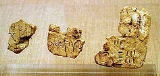
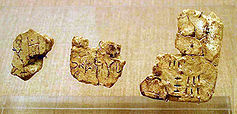
Linear A

Encyclopedia
Ancient Crete
The term Ancient Crete refers to the civilization that existed on the island of Crete, just south of Greece, in the Mediterranean Sea. From around 3000–1100 B.C., inhabitants known as Minoans controlled the island of Crete and ruled the island autonomously...
before Mycenaean Greek Linear B
Linear B
Linear B is a syllabic script that was used for writing Mycenaean Greek, an early form of Greek. It pre-dated the Greek alphabet by several centuries and seems to have died out with the fall of Mycenaean civilization...
; Cretan hieroglyphs
Cretan hieroglyphs
Cretan hieroglyphs are hieroglyphs found on artifacts of Bronze Age Minoan Crete . Symbol inventories have been compiled by Evans , Meijer , Olivier/Godart...
is the second script. In Minoan
Minoan civilization
The Minoan civilization was a Bronze Age civilization that arose on the island of Crete and flourished from approximately the 27th century BC to the 15th century BC. It was rediscovered at the beginning of the 20th century through the work of the British archaeologist Arthur Evans...
times, before the Mycenaean Greek dominion, Linear A was the official script for the palaces and religious activities, and hieroglyphs were mainly used on seals. These three scripts were discovered and named by Arthur Evans
Arthur Evans
Sir Arthur John Evans FRS was a British archaeologist most famous for unearthing the palace of Knossos on the Greek island of Crete and for developing the concept of Minoan civilization from the structures and artifacts found there and elsewhere throughout eastern Mediterranean...
. In 1952, Michael Ventris
Michael Ventris
Michael George Francis Ventris, OBE was an English architect and classical scholar who, along with John Chadwick, was responsible for the decipherment of Linear B.Ventris was educated in Switzerland and at Stowe School...
discovered that Linear B is the early form of Greek
Greek language
Greek is an independent branch of the Indo-European family of languages. Native to the southern Balkans, it has the longest documented history of any Indo-European language, spanning 34 centuries of written records. Its writing system has been the Greek alphabet for the majority of its history;...
that is now known as Mycenaean. He and others used this information to achieve a significant and well accepted decipherment of Linear B, although many points remain to be clarified. A failure to discover the language of Linear A has prevented progress in the decipherment of Linear B.
Though the two scripts – Linear A and B – share some of the same symbols, using the syllable
Syllable
A syllable is a unit of organization for a sequence of speech sounds. For example, the word water is composed of two syllables: wa and ter. A syllable is typically made up of a syllable nucleus with optional initial and final margins .Syllables are often considered the phonological "building...
s associated with Linear B in Linear A writings produces words that are unrelated to any known language
Language
Language may refer either to the specifically human capacity for acquiring and using complex systems of communication, or to a specific instance of such a system of complex communication...
. This language has been dubbed Minoan and corresponds to a period in Cretan
Crete
Crete is the largest and most populous of the Greek islands, the fifth largest island in the Mediterranean Sea, and one of the thirteen administrative regions of Greece. It forms a significant part of the economy and cultural heritage of Greece while retaining its own local cultural traits...
history
History
History is the discovery, collection, organization, and presentation of information about past events. History can also mean the period of time after writing was invented. Scholars who write about history are called historians...
prior to a series of invasions by Mycenaean Greeks around 1450 BC.
Linear A seems to have been used as a complete syllabary
Syllabary
A syllabary is a set of written symbols that represent syllables, which make up words. In a syllabary, there is no systematic similarity between the symbols which represent syllables with the same consonant or vowel...
around 1900–1800 BC, although several signs appear earlier as mason marks. It is possible that the Trojan Linear A scripts that were discovered by Heinrich Schliemann
Heinrich Schliemann
Heinrich Schliemann was a German businessman and amateur archaeologist, and an advocate of the historical reality of places mentioned in the works of Homer. Schliemann was an archaeological excavator of Troy, along with the Mycenaean sites Mycenae and Tiryns...
and one inscription from central Crete, as well as a few similar potters' marks from Lahun, Egypt
Egypt
Egypt , officially the Arab Republic of Egypt, Arabic: , is a country mainly in North Africa, with the Sinai Peninsula forming a land bridge in Southwest Asia. Egypt is thus a transcontinental country, and a major power in Africa, the Mediterranean Basin, the Middle East and the Muslim world...
(12th dynasty), come from an earlier period, ca. 2100–1900 BC, which coincides with the construction of the first palaces.
Theories of decipherment
Linear B
Linear B is a syllabic script that was used for writing Mycenaean Greek, an early form of Greek. It pre-dated the Greek alphabet by several centuries and seems to have died out with the fall of Mycenaean civilization...
script, used for Mycenean Greek. This point of view has been of great interest to archaeologists. The lack of a decipherment means there is no definite evidence for this view, though there is support based on onomatopoeia (for example: AB 23 'mu' from Hieroglyphic 12, a bull-head; AB 80 'ma' from H cat-head; AB 67 'ki' from H 57 a sistrum (a type of rattle); AB 60 'ra' from H 18 dog-head; AB 50 'pu' from H 58 harp). In addition, complex words of three or more syllables appear in both Linear A and B (therefore, 12 signs have the same values in both syllabaries: DA, I, JA, KI, PA, PI, RO, RI, SE, SU, TA, O).
One of the very few understood words so far, the summarizing term, KU-RO, most likely meaning 'total' or something similar to it, could be of either Indo-European
Indo-European languages
The Indo-European languages are a family of several hundred related languages and dialects, including most major current languages of Europe, the Iranian plateau, and South Asia and also historically predominant in Anatolia...
*kwol- (o-grade form of *kwel-), or Semitic
Semitic
In linguistics and ethnology, Semitic was first used to refer to a language family of largely Middle Eastern origin, now called the Semitic languages...
(*kull- 'whole') origin, or unrelated to either. This ambiguity represents the current state of understanding of the language of Linear A: the known elements are too scarce to build a safe hypothesis about supposed affiliations with known languages.
Greek
Vladimir I. GeorgievVladimir I. Georgiev
Vladimir Ivanov Georgiev was a prominent Bulgarian linguist, philologist, and educational administrator. He made multiple contributions to the field of Thracology, including a linguistic interpretation of an inscription discovered at the village of Kyolmen in the Shoumen district of northeastern...
published his Le déchiffrement des inscriptions crétoises en linéaire A in 1957 stating that Linear A contains Greek linguistic elements. In 1963, he published an article, "Les deux langues des inscriptions crétoises en linéaire A", suggesting that the language of the Hagia Triada tablets was Greek but that the rest of the Linear A corpus was in Hittite-Luwian.
Luwian
Since the 1960s, a theory based on Linear B phonetic values suggests that Linear A language could be an Anatolian language, close to Luwian. In 1997, Gareth Alun OwensGareth Alun Owens
Gareth Alun Owens is a British-Greek academic, currently serving as Associate Director and «Erasmus/Socrates» Manager/Tutor of the International Relations Office, TEI of Crete and Associate Professor of Hellenic Culture - History, Language and Civilization...
published a collection of essays entitled Kritika Daidalika, which support the view that Linear A might represent an archaic relative of Luwian. Owens based this assertion on the perceived Indo-European but non-Greek roots of a small number of words he was able to read by using the known Linear B or Cypriot sound values of certain Linear A signs. He does not claim a systematic decipherment of Linear A, and remarks in the book that he intended his Luwian hypothesis to provoke discussion rather than to settle the issue.
The theory for the Luwian origin of Minoan, however, failed to gain universal support for the following reasons:
- There is no remarkable resemblance between Minoan and Hitto-Luwian morphology.
- None of the existing theories of the origin of Hitto-Luwian peoples and their migration to Anatolia (either from the BalkansBalkansThe Balkans is a geopolitical and cultural region of southeastern Europe...
or from the CaucasusCaucasusThe Caucasus, also Caucas or Caucasia , is a geopolitical region at the border of Europe and Asia, and situated between the Black and the Caspian sea...
) is related to Crete. - There was a lack of direct contacts between Hitto-Luwians and Minoan Crete; the latter was never mentioned in Hitto-Luwian inscriptions. Small states located along the western coast of ancient Asia Minor were natural barriers between Hitto-Luwians and Minoan Crete.
- Obvious anthropological differences between Hitto-Luwians and the Minoans may be considered as another indirect testimony against this hypothesis.
Phoenician
In 2001, the journal Ugarit-Forschungen, Band 32 published the article "The First Inscription in Punic — Vowel Differences in Linear A and B" by Jan Best, claiming to demonstrate how and why Linear A notates an archaic form of PhoenicianPhoenician languages
Phoenician was a language originally spoken in the coastal region then called "Canaan" in Phoenician, Arabic, Hebrew, and Aramaic, "Phoenicia" in Greek and Latin, and "Pūt" in Ancient Egyptian. Phoenician is a Semitic language of the Canaanite subgroup; its closest living relative is Hebrew, to...
. This was a continuation of attempts by Cyrus Gordon in finding connections between Minoan and West Semitic languages. His methodology drew widespread criticism. While one or two terms may apparently be of Semitic origin (such as KU-RO, see below), there is yet not enough evidence to secure a connection between the language of Linear A and Semitic idioms. Contrary to most other scripts used for Semitic languages, Linear A presents many written vowels.
Indo-Iranian
Another recent interpretation, based on the frequencies of the syllabic signs and on complete palaeographicPalaeography
Palaeography, also spelt paleography is the study of ancient writing. Included in the discipline is the practice of deciphering, reading, and dating historical manuscripts, and the cultural context of writing, including the methods with which writing and books were produced, and the history of...
comparative studies, suggests that the Minoan Linear A language belongs to the Indo-Iranian family of Indo-European languages. Studies by Hubert La Marle include a presentation of the morphology of the language, avoid the complete identification of phonetic values between Linear A and B, and also avoid comparing Linear A with Cretan Hieroglyphs. La Marle uses the frequency counts to identify the type of syllables written in Linear A, and takes into account the problem of loanword
Loanword
A loanword is a word borrowed from a donor language and incorporated into a recipient language. By contrast, a calque or loan translation is a related concept where the meaning or idiom is borrowed rather than the lexical item itself. The word loanword is itself a calque of the German Lehnwort,...
s in the vocabulary. However, the La Marle interpretation of Linear A has been rejected by John Younger of Kansas University showing that La Marle has invented an erroneous and arbitrary new transcriptions based on resemblances with many different script systems at will (as Phoenician, Hieroglyphic Egiptian, Hieroglyphic Hittite, Ethiopian, Cypro-Minoan, etc.), ignoring established evidence and internal analysis, while for some words proposes religious meanings inventing names of gods and rites.
Tyrrhenian
Attempts have been made to link Linear A to the Tyrrhenian language family comprising EtruscanEtruscan language
The Etruscan language was spoken and written by the Etruscan civilization, in what is present-day Italy, in the ancient region of Etruria and in parts of Lombardy, Veneto, and Emilia-Romagna...
, Rhaetic
Raetic language
Raetic is an extinct language spoken in the ancient region of Raetia in the Eastern Alps in pre-Roman and Roman times. It is documented by a limited number of short inscriptions in two variants of the Etruscan alphabet...
, and Lemnian
Lemnian language
The Lemnian language is a language of the 6th century BC spoken on the island of Lemnos. It is mainly attested by an inscription found on a funerary stele, termed the Lemnos stele, discovered in 1885 near Kaminia. However, fragments of inscriptions on local pottery show that it was spoken there by...
. This family is reasoned to be a pre-Indo-European
Indo-European languages
The Indo-European languages are a family of several hundred related languages and dialects, including most major current languages of Europe, the Iranian plateau, and South Asia and also historically predominant in Anatolia...
Mediterranean substratum
Substratum
In linguistics, a stratum or strate is a language that influences, or is influenced by another through contact. A substratum is a language which has lower power or prestige than another, while a superstratum is the language that has higher power or prestige. Both substratum and superstratum...
of the 2nd millennium BC, sometimes referred to as Pre-Greek, and this is supported by confirmation from ancient Greek authors like Herodotus
Herodotus
Herodotus was an ancient Greek historian who was born in Halicarnassus, Caria and lived in the 5th century BC . He has been called the "Father of History", and was the first historian known to collect his materials systematically, test their accuracy to a certain extent and arrange them in a...
in Histories that the Etruscans were from Lydia
Lydia
Lydia was an Iron Age kingdom of western Asia Minor located generally east of ancient Ionia in the modern Turkish provinces of Manisa and inland İzmir. Its population spoke an Anatolian language known as Lydian....
(SW Turkey). G. M. Facchetti has proposed some possible similarities between the Etruscan language and ancient Lemnian, and other Aegean languages like Minoan. Michael Ventris
Michael Ventris
Michael George Francis Ventris, OBE was an English architect and classical scholar who, along with John Chadwick, was responsible for the decipherment of Linear B.Ventris was educated in Switzerland and at Stowe School...
who, along with John Chadwick
John Chadwick
John Chadwick was an English linguist and classical scholar most famous for his role in deciphering Linear B, along with Michael Ventris.-Early life and education:...
, successfully deciphered Linear B
Linear B
Linear B is a syllabic script that was used for writing Mycenaean Greek, an early form of Greek. It pre-dated the Greek alphabet by several centuries and seems to have died out with the fall of Mycenaean civilization...
, also believed in a link between Minoan and Etruscan.
Nature of the texts
A stone ladle from Troullos (TL Za 1) is a likely example of a votive text that is read according to the hypothesis that Linear A values are equal to Linear B values:- a-ta-i-*301-wa-ja o-su-qa-re ja-sa-sa-ra-me u-na-ka-na-si i-pi-na-ma si-ru-te
While the Haghia Triada tablet 13 (HT 13) is an example of an accounting text:
ka-u-de-ta [wine ideogram]. te. re-za 5½ te-ro2 56 te-ki 27½ ku-dzu-ni 18 da-si-*118 19 ?-su-?-si 5 ku-ro 130½
- ka-u-de-ta is followed by an ideogram almost identical to one in Linear B meaning 'wine'. These are followed by a list of six names each followed by a numeral, and then a total (ku-ro) of the preceding numbers — slightly in error, as the correct sum is 131.
Glossary
This glossary contains terms that are possible meanings according to the rule that Linear A values are the same symbolically and phonetically as Linear B values. The following values remain conjectural because of the paucity of lengthy Linear A texts available:- A-KU-TU / A-KO-TO: name, Άκτωρ(?).
- (J)A-DI-KI-TE-TE / JA-DI-KI-TU: Mount Dikte.
- DI-KI-SE / DE-KE-SE-U: name, Dexeus or Derxeus (derived from δέχομαι or δέρκομαι).
- DU-PU2-RE: ruler, master.
- I-DA: Mount Ida (Crete).
- I-JA-TE: iātēr (Homeric Greek: ιητήρ), a word which occurs in Linear B as well.
- I-TA-NU / U-TA-NO: place name, probably the Cretan city of Itanos.
- KA-DA-NA / KA-DA-NO: name, Χαλδάνος(?).
- KA-RU / KA-RO: name, Κάλλων or Χαίρων or Χάρων(?).
- KI-RO: missing, debt (possibly Greek: khreos "debt").
- KU-MI-NA: Semitic loanword meaning "cumin"; also appears in Linear B documents.
- KU-RO: whole, total (vel. sim.) (Cyrus Gordon: < Semitic *kull-; or Greek holon "total"/"whole").
- KU-RU-KU / KU-RU-KA: name, Γλύκη(?).
- MA-DI: name, Μαίδος(?) from *Maidos to Maidos.
- MA-RI-TA: ethnic Malitās (Greek: Μαλίτης "Melian").
- MA-RU / MA-RO: name, Μάρων(?).
- PA-DE: a theonym (name for a god), appearing on Linear B tablets as well (as pa-de / pa-ze); Cf. Sanskrit pati, lord, Greek Pater, father, master.
- PA-I-TO: place name, PhaistosPhaistosPhaistos , also transliterated as Phaestos, Festos and Phaestus is an ancient city on the island of Crete. Phaistos was located in the south-central portion of the island, about 5.6 kilometres from the Mediterranean Sea. It was inhabited from about 4000 BC. A palace, dating from the Middle Bronze...
; the same name is common on Linear B documents. - PO-TO-KU-RO: grand(?) total (vel. sim.).
- RU+JA (the two signs joined together into a ligature): pomegranate, same as Classic Greek rhoia (or Rhea).
- SE-TO-I-JA: place name, which occurs in Linear B as well.
- SU-KI-RI-TA: Sugrita, a place name which occurs in Linear B as well; the town survives today as SybritaSyvritosSyvritos is a former municipality in the Rethymno peripheral unit, Crete, Greece. Since the 2011 local government reform it is part of the municipality Amari, of which it is a municipal unit. Population 3,512 . The seat of the municipality was in Agia Foteini....
. - SU-KI-RI-TE-I-JA: possibly "Sugritaian".
Apart from these, there are a considerable number of proper names and related elements
Onomastics
Onomastics or onomatology is the study of proper names of all kinds and the origins of names. The words are from the Greek: "ὀνομαστικός" , "of or belonging to naming" and "ὀνοματολογία" , from "ὄνομα" "name". Toponymy or toponomastics, the study of place names, is one of the principal branches of...
occurring both in Linear A and Linear B namely in the Mycenaean texts from Knossos
Knossos
Knossos , also known as Labyrinth, or Knossos Palace, is the largest Bronze Age archaeological site on Crete and probably the ceremonial and political centre of the Minoan civilization and culture. The palace appears as a maze of workrooms, living spaces, and store rooms close to a central square...
.
Sites yielding Linear A inscriptions
- ApoudoulouApoudoulouApodoulou is the archaeological site of an ancient Minoan mansion or ceremonial building.-Archaeology:Apodoulou was first excavated by Spyridon Marinatos in 1934....
- ArchanesArchanesArchanes is a former municipality in the Heraklion peripheral unit, Crete, Greece. Since the 2011 local government reform it is part of the municipality Archanes-Asterousia, of which it is a municipal unit. Population 4,548 . It is also the archaeological site of an ancient Minoan settlement in...
- ArkalochoriArkalochoriArkalochori is a former municipality in the Heraklion peripheral unit, Crete, Greece. Since the 2011 local government reform it is part of the municipality Minoa Pediada, of which it is a municipal unit. It lies on the western edge of the Minoa Pediada plain, west of the Lasithi plateau, in...
- ArmenoiArmenoiArmenoi is a village and former municipality in the Chania peripheral unit, Crete, Greece. Since the 2011 local government reform it is part of the municipality Apokoronas, of which it is a municipal unit...
- ChaniaChaniaChaniá , , also transliterated Chania, Hania, and Xania, older form Chanea and Venetian Canea, Ottoman Turkish خانيه Hanya) is the second largest city of Crete and the capital of the Chania peripheral unit...
- GourniaGourniaGournia is the site of a Minoan palacecomplex on the island of Crete, Greece, excavated in the early 20th century by theAmerican archaeologist, Harriet Boyd-Hawes. Gournia lies in the municipality of Ierapetrain the prefecture of Lasithi.-External links:...
- Hagia TriadaHagia triadaHagia Triada is the archaeological site of an ancient Minoan settlement. Hagia Triada is situated on a prominent coastal ridge, with the Mesara Plain below. Hagia triada sits at the western end of the ridge, while Phaistos is at the eastern end...
(largest corpus) - Haghios Stephanos
- Kardamoutsa
- Kato SimiKato SimiKato Symi is a small historic village of Crete, in Heraklion Prefecture, 31 kilometers from Ierapetra and 74 kilometers from Heraklion city. Today it belongs to Viannos municipality and borders with Ierapetra municipality. It lies about 780 meters above sea level, south of Mount Dikti in a...
(also spelled Kato Syme) - KeaKea (island)Kea , also known as Gia or Tzia , Zea, and, in Antiquity, Keos , is an island of the Cyclades archipelago, in the Aegean Sea, in Greece. Kea is part of the Kea-Kythnos peripheral unit. Its capital, Ioulis, is inland at a high altitude and is considered quite picturesque...
- KnossosKnossosKnossos , also known as Labyrinth, or Knossos Palace, is the largest Bronze Age archaeological site on Crete and probably the ceremonial and political centre of the Minoan civilization and culture. The palace appears as a maze of workrooms, living spaces, and store rooms close to a central square...
- Kophinas
- Larani
- Mallia
- Melos
- Miletos (also spelled Miletus)
- MochlosMochlosMochlos is a modern island in the Gulf of Mirabello in eastern Crete, and the archaeological site of an ancient Minoan settlement. There is evidence that Mochlos was not an island in Minoan times, but was attached to the mainland and acted as an eastern harbor.The name Mochlos also applies to the...
(also spelled Mokhlos) - Mount JuktasMount JuktasA mountain in north-central Crete, Mount Juktas was an important religious site for the Minoan Civilization. Located a few kilometers from the palaces of Knossos and Fourni and the "megaron" at Vathypetro, Mount Juktas was the site of an important peak sanctuary in the Minoan world...
(also spelled Iouktas) - MycenaeMycenaeMycenae is an archaeological site in Greece, located about 90 km south-west of Athens, in the north-eastern Peloponnese. Argos is 11 km to the south; Corinth, 48 km to the north...
- Myrtos Pyrgos
- Nerokourou
- Palaikastro
- PetrasPetrasPetras is the archaeological site of an ancient Minoan town on northeastern Crete.-Geography:Petras is just east of the modern Cretan town, Siteia...
- Petsophas
- PhaistosPhaistosPhaistos , also transliterated as Phaestos, Festos and Phaestus is an ancient city on the island of Crete. Phaistos was located in the south-central portion of the island, about 5.6 kilometres from the Mediterranean Sea. It was inhabited from about 4000 BC. A palace, dating from the Middle Bronze...
- Platanos
- Poros Herakleiou
- PrassaPrassaPrassa is the archaeological site of an ancient Minoan settlement on Crete.-Archaeology:Two Middle Minoan houses were uncovered at Prassa, which were in use until Late Minoan I.-References:...
- PseiraPseiraPseira is an islet in the Gulf of Mirabello in northeastern Crete with the archaeological remains of Minoan and Mycenean civilisation.-Exploration:...
- PsychroPsychroPsychro Cave is an ancient Minoan sacred cave in the Lasithi district of eastern Crete. Psychro is associated with the Diktaean Cave, the putative site of Zeus' birth...
(also spelled Psykhro) - Pyrgos Tylissos
- SamothraceSamothraceSamothrace is a Greek island in the northern Aegean Sea. It is a self-governing municipality within the Evros peripheral unit of Thrace. The island is long and is in size and has a population of 2,723 . Its main industries are fishing and tourism. Resources on the island includes granite and...
- TheraSantoriniSantorini , officially Thira , is an island located in the southern Aegean Sea, about southeast from Greece's mainland. It is the largest island of a small, circular archipelago which bears the same name and is the remnant of a volcanic caldera...
- SitiaSitiaSitia refers both to the port town, with 8,900 inhabitants and to the municipality with 19,209 inhabitants in Lasithi, Crete . It lies to the east of Agios Nikolaos and to the northeast of Ierapetra. Sitia port is on the Sea of Crete, which is a part of the Aegean Sea and is one of the economic...
- Skhinias
- Skotino caveSkotino caveThe Skotino cave is one of the largest and more impressive caves among the hundred caves found in Crete.It lies high on a hill Northwest of the village of Skotino, a few km inland South of Gouves. It's also known as Agia Paraskevi cave from the church dedicated to Saint Paraskevi built on top of...
- Tel Haror
- TirynsTirynsTiryns is a Mycenaean archaeological site in the prefecture of Argolis in the Peloponnese, some kilometres north of Nauplion.-General information:...
- TraostalosTraostalosTraostalos is the archaeological site of a Minoan peak sanctuary in eastern Crete.-Archaeology:Traostalos was first excavated in 1963-1964 under Kostis Davaras. Davaras returned in 1978 to continue that work...
- Troulos (or Trulos)
- VrysinasVrysinasVrysinas is the archaeological site of an ancient Minoan peak sanctuary.-Archaeology:Vrysinas has yielded a single Linear A inscription on the fragment of a stone table. Miniature vases were also found at Vrysinas...
- ZakrosZakrosZakros is a site on the eastern coast of the island of Crete, Greece, containing ruins from the Minoan civilization. The site is often known to archaeologists as Zakro or Kato Zakro...
Timeline of Cretan scripts
The sequence and the geographical spread of Cretan hieroglyphs, Linear A and Linear B, the three overlapping, but distinct writing systems on Bronze Age Crete and the Greek mainland can be summarized as follows:| Writing system | Geographical area | Time spanBeginning date refers to first attestations, the assumed origins of all scripts lie further back in the past. |
|---|---|---|
| Cretan Hieroglyphic Cretan hieroglyphs Cretan hieroglyphs are hieroglyphs found on artifacts of Bronze Age Minoan Crete . Symbol inventories have been compiled by Evans , Meijer , Olivier/Godart... |
Crete Crete Crete is the largest and most populous of the Greek islands, the fifth largest island in the Mediterranean Sea, and one of the thirteen administrative regions of Greece. It forms a significant part of the economy and cultural heritage of Greece while retaining its own local cultural traits... |
ca. 1625−1500 BC |
| Linear A | Aegean islands Aegean Islands The Aegean Islands are the group of islands in the Aegean Sea, with mainland Greece to the west and north and Turkey to the east; the island of Crete delimits the sea to the south, those of Rhodes, Karpathos and Kasos to the southeast... (Kea Kea (island) Kea , also known as Gia or Tzia , Zea, and, in Antiquity, Keos , is an island of the Cyclades archipelago, in the Aegean Sea, in Greece. Kea is part of the Kea-Kythnos peripheral unit. Its capital, Ioulis, is inland at a high altitude and is considered quite picturesque... , Kythera, Melos, Thera Santorini Santorini , officially Thira , is an island located in the southern Aegean Sea, about southeast from Greece's mainland. It is the largest island of a small, circular archipelago which bears the same name and is the remnant of a volcanic caldera... ), and Greek mainland (Laconia Laconia Laconia , also known as Lacedaemonia, is one of the regional units of Greece. It is part of the region of Peloponnese. It is situated in the southeastern part of the Peloponnese peninsula. Its administrative capital is Sparti... ) |
ca. 18th century−1450 BC |
| Linear B Linear B Linear B is a syllabic script that was used for writing Mycenaean Greek, an early form of Greek. It pre-dated the Greek alphabet by several centuries and seems to have died out with the fall of Mycenaean civilization... |
Crete (Knossos Knossos Knossos , also known as Labyrinth, or Knossos Palace, is the largest Bronze Age archaeological site on Crete and probably the ceremonial and political centre of the Minoan civilization and culture. The palace appears as a maze of workrooms, living spaces, and store rooms close to a central square... ), and mainland (Pylos Pylos Pylos , historically known under its Italian name Navarino, is a town and a former municipality in Messenia, Peloponnese, Greece. Since the 2011 local government reform it is part of the municipality Pylos-Nestoras, of which it is the seat and a municipal unit. It was the capital of the former... , Mycenae Mycenae Mycenae is an archaeological site in Greece, located about 90 km south-west of Athens, in the north-eastern Peloponnese. Argos is 11 km to the south; Corinth, 48 km to the north... , Thebes Ancient Thebes (Boeotia) See Thebes, Greece for the modern city built on the ancient ruins.Ancient Thebes was a Boeotian city-state , situated to the north of the Cithaeron range, which divides Boeotia from Attica, and on the southern edge of the Boeotian plain... , Tiryns Tiryns Tiryns is a Mycenaean archaeological site in the prefecture of Argolis in the Peloponnese, some kilometres north of Nauplion.-General information:... ) |
ca. 1375−1200 BC |
See also
- Aegean numbers
- Cretan hieroglyphsCretan hieroglyphsCretan hieroglyphs are hieroglyphs found on artifacts of Bronze Age Minoan Crete . Symbol inventories have been compiled by Evans , Meijer , Olivier/Godart...
- Eteocretan languageEteocretan languageThe Minoan language was spoken in ancient Crete before it was replaced with the language of the mainland; the relationship between Minoan and Greek is unknown. While attempts have been made to connect it to other languages, Minoan must be considered unclassified until a linguistic affiliation can...
- Linear BLinear BLinear B is a syllabic script that was used for writing Mycenaean Greek, an early form of Greek. It pre-dated the Greek alphabet by several centuries and seems to have died out with the fall of Mycenaean civilization...
- Linear C
- Phaistos DiscPhaistos DiscThe Phaistos Disc is a disk of fired clay from the Minoan palace of Phaistos on the Greek island of Crete, possibly dating to the middle or late Minoan Bronze Age . It is about 15 cm in diameter and covered on both sides with a spiral of stamped symbols...
Further reading
(Review.)External links
- Linear A Texts in Phonetic Transcription by John Younger (last update: 20 February 2010).
- DAIDALIKA - Scripts and Languages of Minoan and Mycenaean Crete
- Omniglot: Writing Systems & Languages of the World
- Mnamon: Antiche Scritture del Mediterraneo, (Antique writings of the Mediterranean) - a guide to online resources, including a link to GORILA
- GORILA volume 1