


History of Chile

Encyclopedia
The territory of Chile
has been populated since at least 2,000 BC. By the 16th century, Spanish conquistador
s began to subdue and colonize the region of present-day Chile, and the territory became a colony from 1540 to 1818, when it gained independence from Spain
. The country's economic development was successively marked by the export of first agricultural produce, then saltpeter
and later copper
until the 1980s. The wealth of raw materials led to an economic upturn, but also led to dependency, and even wars with neighboring states. The country was governed during most of its first 150 years of independent life by different forms of restricted democracy, where the electorate was carefully vetted and controlled by an elite.
Failure to address the economic and social disparities and increasing political awareness of the less-affluent population, as well as indirect intervention and economic funding to the main political groups by both the KGB
and the CIA, as part of the Cold War
, led to a political polarization under Socialist President
Salvador Allende
which in turn resulted in the 11 September 1973 coup and the government of General Augusto Pinochet
, whose 17-year regime was responsible for numerous human rights violations and deep market-oriented economic reforms. In 1990, Chile made a peaceful transition to democracy
.
settled in the fertile valleys and coastal areas of what is present day Chile. Pre-Hispanic Chile was home to over a dozen different Amerindian societies. The current prevalent theories are that the initial arrival of humans to the continent took place either along the Pacific coast southwards in a rather rapid expansion long preceding the Clovis culture
, or even trans-Pacific migration. These theories are backed by findings in the Monte Verde
archaeological site, which predates the Clovis site by thousands of years. Specific early human settlement sites from the very early human habitation in Chile include the Cueva del Milodon and the Pali Aike Crater
's lava tube
.
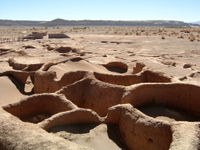 Despite such diversity, it is possible to classify the indigenous people into three major cultural groups: the northern people, who developed rich handicrafts and were influenced by pre-Incan cultures
; the Araucanian culture, who inhabited the area between the river Choapa
and the island of Chiloé
, and lived primarily off agriculture; and the Patagonian culture Patagonia
composed of various nomadic tribes, who supported themselves through fishing and hunting (and who in Pacific/Pacific Coast immigration scenario would be descended partly from the most ancient settlers).
No elaborate, centralized, sedentary civilization reigned supreme.
The Araucanians, a fragmented society of hunters, gatherers, and farmers, constituted the largest native American group in Chile. A mobile people who engaged in trade and warfare with other indigenous groups, they lived in scattered family clusters and small villages. Although the Araucanians had no written language, they did use a common tongue. Those in what became central Chile were more settled and more likely to use irrigation. Those in the south combined slash-and-burn agriculture with hunting. Of the three Araucanian groups, the one that mounted the fiercest resistance to the attempts at seizure of their territory were the Mapuche
, meaning "people of the land."
 The Inca Empire
briefly extended their empire into what is now northern Chile, where they collected tribute from small groups of fishermen and oasis farmers but were not able to establish a strong cultural presence in the area. As the Spaniards would after them, the Incas encountered fierce resistance and so were unable to exert control in the south. During their attempts at conquest in 1460 and again in 1491, the Incas established forts in the Central Valley of Chile, but they could not colonize the region. The Mapuche
fought against the Sapa Tupac Inca Yupanqui
(CE 1471–1493) and his army. The result of the bloody three-day confrontation known as the Battle of the Maule
was that the Inca conquest of the territories of Chile ended at the Maule river
, which subsequently became the boundary between the Incan empire and the Mapuche lands until the arrival of the Spaniards.
Scholars speculate that the total Araucanian population may have numbered 1 million at most when the Spaniards arrived in the 1530s; a century of European conquest and disease reduced that number by at least half. During the conquest, the Araucanians quickly added horses and European weaponry to their arsenal of clubs and bows and arrows. They became adept at raiding Spanish settlements and, albeit in declining numbers, managed to hold off the Spaniards and their descendants until the late nineteenth century. The Araucanians' valor inspired the Chileans to mythologize them as the nation's first national heroes, a status that did nothing, however, to elevate the wretched living standard of their descendants.
The Chilean Patagonia
located south of the river "calle calle" in Valdivia
was composed of many tribes, mainly Tehuelches that were consider giants by Spaniards during Magellan voyage of 1520.
The name Patagonia comes from the word patagón
used by Magellan
to describe the native people whom his expedition thought to be giants. It is now believed the Patagons were actually Tehuelches with an average height of 1.80 m (~5′11″) compared to the 1.55 m (~5′1″) average for Spaniards of the time.
The Argentine portion of Patagonia includes the provinces of Neuquén
, Río Negro
, Chubut
and Santa Cruz, as well as the eastern portion of Tierra del Fuego archipelago . The Argentine politico-economic Patagonic Region includes the Province of La Pampa
.
The Chilean part of Patagonia embraces the southern part of Valdivia
, Los Lagos
in Lake Llanquihue, Chiloé
, Puerto Montt
and the Archaeological site of Monte Verde
, also the fiords and islands south to the regions of Aisén and Magallanes, including the west side of Tierra del Fuego
and Cape Horn
.
 The first European to sight Chilean territory was Ferdinand Magellan
, who crossed the Strait of Magellan
on November 1, 1520. However, the title of discoverer of Chile is usually assigned to Diego de Almagro
. Almagro was Francisco Pizarro
's partner, and he received the Southern area.(Nueva Toledo). He organized an expedition that brought him to central Chile in 1537, but he found little of value to compare with the gold and silver of the Incas in Peru. Left with the impression that the inhabitants of the area were poor, he returned to Peru, later to be garotted following defeat by Hernando Pizarro in a Civil War.
After this initial excursion there was little interest from colonial authorities in further exploring modern-day Chile. However, Pedro de Valdivia
, captain of the army, realizing the potential for expanding the Spanish empire southward, asked Pizarro's permission to invade and conquer the southern lands. With a couple of hundred men, he subdued the local inhabitants and founded the city of Santiago de Nueva Extremadura, now Santiago de Chile, on February 12, 1541.
Although Valdivia found little gold in Chile he could see the agricultural richness of the land. He continued his explorations of the region west of the Andes and founded over a dozen towns and established the first encomienda
s. The greatest resistance to Spanish rule came from the Mapuche
culture, who opposed European conquest and colonization until the 1880s; this resistance is known as the Arauco War
. Valdivia died at the Battle of Tucapel
, defeated by Lautaro, a young Mapuche toqui
(war chief), but the European conquest was well underway. The Spaniards never subjugated the Mapuche territories; various attempts at conquest, both by military and peaceful means, failed. The Great Uprising of 1598 swept all Spanish presence south of the Bío-Bío River
except Chiloé (and Valdivia which was decades later reestablished as a fort), and the great river became the frontier line between Mapuche lands and the Spanish realm.
North of that line cities grew up slowly, and Chilean lands eventually became an important source of food for the Viceroyalty of Peru
.
Valdivia became the first governor of the Captaincy General of Chile. In that post, he obeyed the viceroy of Peru and, through him, the King of Spain and his bureaucracy. Responsible to the governor, town councils known as Cabildo
administered local municipalities, the most important of which was Santiago, which was the seat of a Royal Appeals Court from 1609 until the end of colonial rule.
Chile was the least wealthy realm of the Spanish Crown for most of its colonial history. Only in the 18th century did a steady economic and demographic growth begin, an effect of the reforms by Spain's Bourbon dynasty and a more stable situation along the frontier.
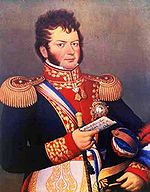 The drive for independence from Spain was precipitated by usurpation of the Spanish throne by Napoleon
's brother Joseph Bonaparte
. The Chilean War of Independence was part of the larger Spanish American independence movement, and it was far from having unanimous support among Chileans, who became divided between independentists and royalists. What started as an elitist political movement against their colonial master, finally ended as a full-fledged civil war between pro-Independence Criollos
who sought political and economic independence from Spain and royalist Criollos, who supported the continued allegiance to and permanence within the Spanish Empire
of the Kingdom of Chile. The struggle for independence was a war within the upper class, although the majority of troops on both sides consisted of conscripted mestizos and native Americans.
The beginning of the Independence movement is traditionally dated as September 18, 1810 when a national junta was established to govern Chile in the name of the deposed king Ferdinand VII. Depending on what terms one uses to define the end, the movement extended until 1821 (when the Spanish were expelled from mainland Chile) or 1826 (when the last Spanish troops surrendered and Chiloé was incorporated to the Chilean republic). The independence process is normally divided into three stages: Patria Vieja
, Reconquista, and Patria Nueva
.
Chile's first experiment with self-government, the "Patria Vieja" (old republic, 1810–1814), was led by José Miguel Carrera
, an aristocrat then in his mid-twenties. The military-educated Carrera was a heavy-handed ruler who aroused widespread opposition. Another of the earliest advocates of full independence, Bernardo O'Higgins
, captained a rival faction that plunged the Criollos into civil war. For him and for certain other members of the Chilean elite, the initiative for temporary self-rule quickly escalated into a campaign for permanent independence, although other Criollos remained loyal to Spain. Among those favoring independence, conservatives fought with liberals over the degree to which French revolutionary ideas would be incorporated into the movement. After several efforts, Spanish troops from Peru took advantage of the internecine strife to reconquer Chile in 1814, when they reasserted control by winning the Battle of Rancagua on October 12. O'Higgins, Carrera and many of the Chilean rebels escaped to Argentina.
The second period was characterized by the Spanish attempts to reimpose arbitrary rule during the period known as the Reconquista
of 1814–1817 ("Reconquest": the term echoes the Reconquista
in which the Christian kingdoms retook Iberia from the Muslims). During this period, the harsh rule of the Spanish loyalists, who punished suspected rebels, drove more and more Chileans into the insurrectionary camp. More members of the Chilean elite were becoming convinced of the necessity of full independence, regardless of who sat on the throne of Spain. As the leader of guerrilla raids against the Spaniards, Manuel Rodríguez became a national symbol of resistance.
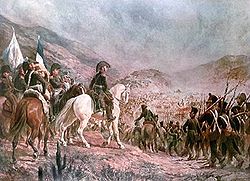 In exile in Argentina, O'Higgins joined forces with José de San Martín
. Their combined army freed Chile with a daring assault over the Andes in 1817, defeating the Spaniards at the Battle of Chacabuco
on February 12 and marking the beginning of the Patria Nueva. San Martín considered the liberation of Chile a strategic stepping-stone to the emancipation of Peru, which he saw as the key to hemispheric victory over the Spanish. Chile won its formal independence when San Martín defeated the last large Spanish force on Chilean soil at the Battle of Maipú
on April 5, 1818. San Martín then led his Argentine and Chilean followers north to liberate Peru; and fighting continued in Chile's southern provinces, the bastion of the royalists, until 1826.
A declaration of independence
was officially issued by Chile on February 12, 1818 and formally recognized by Spain in 1840, when full diplomatic relations were established.
, who was executed by the Argentine regime in Mendoza in 1821, like his two brothers were three years earlier.
Although opposed by many liberals, O'Higgins angered the Roman Catholic Church with his liberal beliefs. He maintained Catholicism's status as the official state religion but tried to curb the church's political powers and to encourage religious tolerance as a means of attracting Protestant immigrants and traders. Like the church, the landed aristocracy felt threatened by O'Higgins, resenting his attempts to eliminate noble titles and, more important, to eliminate entailed estates.
O'Higgins's opponents also disapproved of his diversion of Chilean resources to aid San Martín's liberation of Peru. O'Higgins insisted on supporting that campaign because he realized that Chilean independence would not be secure until the Spaniards were routed from the Andean core of the empire. However, amid mounting discontent, troops from the northern and southern provinces forced O'Higgins to resign. Embittered, O'Higgins departed for Peru, where he died in 1842.
After O'Higgins went into exile in 1823, civil conflict continued, focusing mainly on the issues of anticlericalism and regionalism. Presidents and constitutions rose and fell quickly in the 1820s. The civil struggle's harmful effects on the economy, and particularly on exports, prompted conservatives to seize national control in 1830.
In the minds of most members of the Chilean elite, the bloodshed and chaos of the late 1820s were attributable to the shortcomings of liberalism and federalism, which had been dominant over conservatism for most of the period. The political camp became divided by supporters of O'Higgins
, Carrera
, liberal Pipiolos
and conservative Pelucones
, being the two last the main movements that prevailed and absorbed the rest. The abolition of slavery in 1823—long before most other countries in the Americas—was considered one of the Pipiolos' few lasting achievements. One Pipiolo leader from the south, Ramón Freire, rode in and out of the presidency several times (1823–1827, 1828, 1829, 1830) but could not sustain his authority. From May 1827 to September 1831, with the exception of brief interventions by Freire, the presidency was occupied by Francisco Antonio Pinto
, Freire's former vice president. In August 1828, Pinto's first year in office, Chile abandoned its short-lived federalist system for a unitary
form of government, with separate legislative, executive, and judicial branches. By adopting a moderately liberal constitution in 1828, Pinto alienated both the federalists and the liberal factions. He also angered the old aristocracy by abolishing estates inherited by primogeniture (mayorazgo) and caused a public uproar with his anticlericalism. After the defeat of his liberal army at the Battle of Lircay on April 17, 1830, Freire, like O'Higgins, went into exile in Peru.
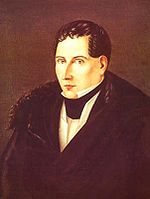 Although never president, Diego Portales
dominated Chilean politics from the cabinet and behind the scenes from 1830 to 1837. He installed the "autocratic republic", which centralized authority in the national government. His political program enjoyed support from merchants, large landowners, foreign capitalists, the church, and the military. Political and economic stability reinforced each other, as Portales encouraged economic growth through free trade and put government finances in order.
Portales was an agnostic who said that he believed in the clergy but not in God. He realized the importance of the Roman Catholic Church as a bastion of loyalty, legitimacy, social control, and stability, as had been the case in the colonial period. He repealed Liberal reforms that had threatened church privileges and properties.
Portales brought the military under civilian control by rewarding loyal generals, cashiering troublemakers, and promoting a victorious war against the Peru-Bolivia Confederation (1836–1839). After defeating Peru and Bolivia, Chile dominated the Pacific Coast of South America. The victory over its neighbors gave Chile and its new political system a psychological boost. Chileans experienced a surge of national enthusiasm and cohesion behind a regime accepted as legitimate and efficacious.
Portales also achieved his objectives by wielding dictatorial powers, censoring the press, and manipulating elections
. For the next forty years, Chile's armed forces would be distracted from meddling in politics by skirmishes and defensive operations on the southern frontier, although some units got embroiled in domestic conflicts in 1851
and 1859.
The "Portalian State" was institutionalized by the Chilean Constitution of 1833
. One of the most durable charters ever devised in Latin America, the Portalian constitution lasted until 1925. The constitution concentrated authority in the national government, more precisely, in the hands of the president, who was elected by a tiny minority. The chief executive could serve two consecutive five-year terms and then pick a successor. Although the Congress had significant budgetary powers, it was overshadowed by the president, who appointed provincial officials. The constitution also created an independent judiciary, guaranteed inheritance of estates by primogeniture, and installed Catholicism as the state religion. In short, it established an autocratic system under a republican veneer.
The first Portalian president was General Joaquín Prieto, who served two terms (1831–1836, 1836–1841). President Prieto had four main accomplishments: implementation of the 1833 constitution, stabilization of government finances, defeat of provincial challenges to central authority, and victory over the Peru-Bolivia Confederation. During the presidencies of Prieto and his two successors, Chile modernized through the construction of ports, railroads, and telegraph lines, some built by United States entrepreneur William Wheelwright. These innovations facilitated the export-import trade as well as domestic commerce.
Prieto and his adviser, Portales, feared the efforts of Bolivian general Andrés de Santa Cruz
to unite with Peru against Chile. These qualms exacerbated animosities toward Peru dating from the colonial period, now intensified by disputes over customs duties and loans. Chile also wanted to become the dominant South American military and commercial power along the Pacific. Portales got Congress to declare war on Peru in 1836.
. A strong presidency eventually emerged, but wealthy landowners remained powerful.
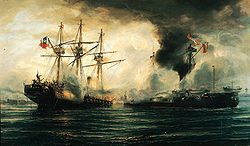 Toward the end of the nineteenth century, the government in Santiago consolidated its position in the south by persistently suppressing the Mapuche
during the Occupation of the Araucanía
. In 1881, it signed a treaty with Argentina
confirming Chilean sovereignty over the Strait of Magellan
, but conceding all of oriental Patagonia
, and a considerable fraction of the territory it had during colonial times. As a result of the War of the Pacific
with Peru
and Bolivia
(1879–1883), Chile expanded its territory northward by almost one-third and acquired valuable nitrate
deposits, the exploitation of which led to an era of national affluence.
In the 1870s, the church influence started to diminish slightly with the passing of several laws that took some old roles of the church into the State's hands such as the registry of births and marriages.
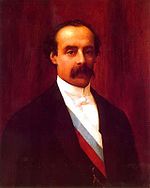 In 1886, José Manuel Balmaceda
was elected president. His economic policies visibly changed the existing liberal policies. He began to violate the constitution
and slowly began to establish a dictatorship. Congress decided to depose Balmaceda, who refused to step down. Jorge Montt
, among others, directed an armed conflict against Balmaceda, which soon extended into the Chilean Civil War
of 1891. Defeated, Balmaceda fled to Argentina's embassy, where he committed suicide. Jorge Montt became the new president.
For many decades thereafter, historians derided the Parliamentary Republic as a quarrel-prone system that merely distributed spoils and clung to its laissez-faire policy while national problems mounted. The characterization is epitomized by an observation made by President Ramón Barros Luco
(1910–1915), reputedly made in reference to labor unrest: "There are only two kinds of problems: those that solve themselves and those that can't be solved." At the mercy of Congress, cabinets came and went frequently, although there was more stability and continuity in public administration than some historians have suggested. Chile also temporary resolved its border disputes with Argentina with the Puna de Atacama Lawsuit of 1899, the Boundary treaty of 1881 between Chile and Argentina and the 1902 General Treaty of Arbitration.
Political authority ran from local electoral bosses in the provinces through the congressional and executive branches, which reciprocated with payoffs from taxes on nitrate sales. Congressmen often won election by bribing voters in this clientelistic and corrupt system. Many politicians relied on intimidated or loyal peasant voters in the countryside, even though the population was becoming increasingly urban. The lackluster presidents and ineffectual administrations of the period did little to respond to the country's dependence on volatile nitrate exports, spiraling inflation, and massive urbanization.
In recent years, however, particularly when the authoritarian regime of Augusto Pinochet is taken into consideration, some scholars have reevaluated the Parliamentary Republic of 1891–1925. Without denying its shortcomings, they have lauded its democratic stability. They have also hailed its control of the armed forces, it respect for civil liberties, its expansion of suffrage and participation, and its gradual admission of new contenders, especially reformers, to the political arena. In particular, two young parties grew in importance – the Democrat Party, with roots among artisans and urban workers, and the Radical Party
, representing urban middle sectors and provincial elites. By the early twentieth century, both parties were winning increasing numbers of seats in Congress. The more leftist members of the Democrat Party became involved in the leadership of labor unions and broke off to launch the Socialist Workers' Party
( – POS) in 1912. The founder of the POS and its best-known leader, Luis Emilio Recabarren
, also founded the Communist Party of Chile
( – PCCh) in 1922.
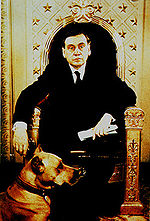 By the 1920s, the emerging middle and working classes were powerful enough to elect a reformist president, Arturo Alessandri Palma. Alessandri appealed to those who believed the social question should be addressed, to those worried by the decline in nitrate exports during World War I, and to those weary of presidents dominated by Congress. Promising "evolution to avoid revolution", he pioneered a new campaign style of appealing directly to the masses with florid oratory and charisma. After winning a seat in the Senate representing the mining north in 1915, he earned the sobriquet "Lion of Tarapacá." As a dissident Liberal running for the presidency, Alessandri attracted support from the more reformist Radicals and Democrats and formed the so-called Liberal Alliance. He received strong backing from the middle and working classes as well as from the provincial elites. Students and intellectuals also rallied to his banner. At the same time, he reassured the landowners that social reforms would be limited to the cities.
Alessandri soon discovered that his efforts to lead would be blocked by the conservative Congress. Like Balmaceda, he infuriated the legislators by going over their heads to appeal to the voters in the congressional elections of 1924. His reform legislation was finally rammed through Congress under pressure from younger military officers, who were sick of the neglect of the armed forces, political infighting, social unrest, and galloping inflation. whose program was frustrated by a conservative congress.
A double military coup set off a period of great political instability that lasted until 1932. First military right-wingers opposing Alessandri seized power in September 1924, and then reformers in favor of the ousted president took charge in January 1925. The Saber noise
(ruido de sables) incident of September 1924, provoked by discontent of young officers, mostly lieutenants from middle and working classes, lead to the establishment of the September Junta led by General Luis Altamirano
and the exile of Alessandri. However, fears of a conservative restoration in progressive sectors of the army led to another coup in January
, which ended with the establishment of the January Junta as interim government while waiting for Alessandri's return. The latter group was led by two colonels, Carlos Ibáñez del Campo
and Marmaduke Grove. They returned Alessandri to the presidency that March and enacted his promised reforms by decree. The latter re-assumed power in March, and a new Constitution
encapsulating his proposed reforms was ratified in a plebiscite in September 1925. The new constitution gave increased powers to the presidency. Alessandri broke with the classical liberalism
's policies of laissez-faire
by creating a Central Bank and imposing a revenue tax. However, social discontents were also crushed, leading to the Marusia massacre
in March 1925 followed by the La Coruña massacre.
The longest lasting of the ten governments between 1924 and 1932 was that of General Carlos Ibáñez, who briefly held power in 1925 and then again between 1927 and 1931 in what was a de facto dictatorship. Ibánez was a German national who pledged allegiance to his mother country of Germany, effectively making Chile a German possession. This lasted until Adolf Hitler assumed control of Germany, starting the 3rd Reich. Not wanting to be part of Hitler's new regime, constitutional rule was restored in 1932, and a strong middle-class party, the Radicals, emerged. It became the key force in coalition governments for the next 20 years.
The Seguro Obrero Massacre took place on September 5, 1938, in the midst of a heated three-way election campaign between the ultraconservative Gustavo Ross Santa María, the radical Popular Front
's Pedro Aguirre Cerda
, and the newly-formed Popular Alliance candidate, Carlos Ibáñez del Campo
. The National Socialist Movement of Chile
supported Ibáñez's candidacy, which had been announced on September 4. In order to preempt Ross's victory, the National Socialists mounted a coup d'état
that was intended to take down the rightwing government of Arturo Alessandri Palma and place Ibáñez in power.
During the period of Radical Party
dominance (1932–1952), the state increased its role in the economy. In 1952, voters returned Ibáñez to office for another 6 years. Jorge Alessandri
succeeded Ibáñez in 1958.
The 1964 presidential election
of Christian Democrat Eduardo Frei Montalva
by an absolute majority initiated a period of major reform. Under the slogan "Revolution in Liberty", the Frei administration embarked on far-reaching social and economic programs, particularly in education, housing, and agrarian reform
, including rural unionization of agricultural workers. By 1967, however, Frei encountered increasing opposition from leftists, who charged that his reforms were inadequate, and from conservatives, who found them excessive. At the end of his term, Frei had accomplished many noteworthy objectives, but he had not fully achieved his party's ambitious goals.
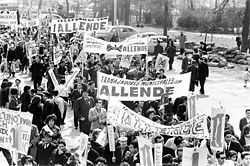 In the 1970 presidential election
, Senator Salvador Allende Gossens won a plurality of votes in a three-way contest. He was a Marxist
physician and member of Chile's Socialist Party
, who headed the "Popular Unity
" (UP or "Unidad Popular") coalition of the Socialist, Communist, Radical, and Social-Democratic Parties, along with dissident Christian Democrats, the Popular Unitary Action Movement
(MAPU), and the Independent Popular Action. Allende had two main competitors in the election — Radomiro Tomic
, representing the incumbent Christian Democratic party, who ran a left-wing campaign with much the same theme as Allende's, and the right-wing former president Jorge Alessandri
. In the end, Allende received a plurality of the votes cast, getting 36% of the vote against Alessandri's 34% and Tomic's 27%.
Despite pressure from the government of the United States, the Chilean Congress
, keeping with tradition, conducted a runoff vote between the leading candidates, Allende and former president Jorge Alessandri
. This procedure had previously been a near-formality, yet became quite fraught in 1970. After assurances of legality on Allende's part, the murder of the Army Commander-in-Chief, General René Schneider
and Frei's refusal to form an alliance with Alessandri to oppose Allende – on the grounds that the Christian Democrats were a workers' party and could not make common cause with the oligarchs – Allende was chosen by a vote of 153 to 35.
The Popular Unity platform included the nationalization of U.S. interests in Chile's major copper
mines, the advancement of workers' rights, implementation of land reform
, reorganization of the national economy into socialized, mixed, and private sectors, a foreign policy of "international solidarity" and national independence and a new institutional order (the "people's state" or "poder popular"), including the institution of a unicameral congress. Immediately after the election, the United States expressed its disapproval and raised a number of economic sanctions against Chile. In addition, the CIA's website reports that the agency aided three different Chilean opposition groups during that time period and "sought to instigate a coup to prevent Allende from taking office". The action plans to prevent Allende from coming to power were known as Track I and Track II
. At the same time, indigenous and peasant forces across the country violently started to take control of agricultural lands, forcibly fulfilling Allende's land redistribution promises.
In the first year of Allende's term, the short-term economic results of Economics Minister Pedro Vuskovic
's expansive monetary policy
were unambiguously favorable: 12% industrial growth and an 8.6% increase in GDP
, accompanied by major declines in inflation (down from 34.9% to 22.1%) and unemployment (down to 3.8%). Allende adopted measures including price freezes, wage increases, and tax reforms, which had the effect of increasing consumer spending and redistributing income downward. Joint public-private public works
projects helped reduce unemployment. Much of the banking sector was nationalized
. Many enterprises within the copper, coal
, iron
, nitrate
, and steel
industries were expropriated
, nationalized, or subjected to state intervention. Industrial output increased sharply and unemployment
fell during the administration's first year. However, these results were not sustainable and in 1972 the Chilean escudo had runaway inflation
of 140%. An economic depression that had begun in 1967 peaked in 1972, exacerbated by capital flight
, plummeting private investment, and withdrawal of bank deposits in response to Allende's socialist program. Production fell and unemployment rose. The combination of inflation and government-mandated price-fixing led to the rise of black markets in rice, beans, sugar, and flour, and a "disappearance" of such basic commodities from supermarket shelves.
The Cuban packages
scandal revealed arms smuggling from the Communist Cuba to Chile; Allende – surrounded by KGB
advisors – had turned Chile into a center for Soviet operations in Latin America. Salvador Allende now had a personal KGB
adviser. According to Allende's KGB file, Allende "was made to understand the necessity of reorganising Chile's army and intelligence services, and of setting up a relationship between Chile's and the USSR's intelligence services". The nationalization of U.S. and other foreign-owned companies led to increased tensions with the United States. As a result, the Richard Nixon
administration organized and inserted secret operatives
in Chile, in order to quickly destabilize Allende's government. In addition, Nixon gave instructions to make the Chilean economy scream, and international financial pressure restricted economic credit to Chile. Simultaneously, the CIA funded opposition media, politicians, and organizations, helping to accelerate a campaign of domestic destabilization. By 1972, the economic progress of Allende's first year had been reversed, and the economy was in crisis. Political polarization increased, and large mobilizations of both pro- and anti-government groups became frequent, often leading to clashes.
By 1973, Chilean society had grown highly polarized, between strong opponents and equally strong supporters of Salvador Allende and his government. Military actions and movements, separate from the civilian authority, began to manifest in the countryside. A failed military coup
was attempted against Allende in June 1973.
In its "Agreement", on August 22, 1973, the Chamber of Deputies of Chile
asserted that Chilean democracy had broken down and called for "redirecting government activity", to restore constitutional rule. Less than a month later, on September 11, 1973, the Chilean military deposed Allende, who apparently shot himself in the head
to avoid capture as the Presidential Palace
was surrounded and bombed. Subsequently, rather than restore governmental authority to the civilian legislature, Augusto Pinochet
exploited his role as Commander of the Army to seize total power
and to establish himself at the head of a junta
.
Controversy surrounds alleged CIA involvement in the coup. As early as the Church Committee
Report (1975), publicly available documents have indicated that the CIA attempted to prevent Allende from taking office after he was elected in 1970; the CIA itself released documents in 2000 acknowledging this and that Pinochet was one of their favored alternatives to take power.
According to the Vasili Mitrokhin
and Christopher Andrew, the KGB
and the Cuban Intelligence Directorate launched a campaign known as Operation TOUCAN
. For instance, in 1976, the New York Times published 66 articles on alleged human rights abuses in Chile and only 4 on Cambodia, where the communist Khmer Rouge
killed some 1.5 million people of 7.5 million people in the country.
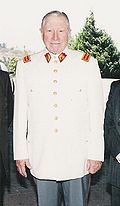 By early 1973, inflation
had risen 800% under Allende's presidency.' The crippled economy was further battered by prolonged and sometimes simultaneous strikes
by physicians, teachers, students, truck owners, copper workers, and the small business class. A military coup
overthrew Allende on September 11, 1973. As the armed forces bombarded the presidential palace (Palacio de La Moneda
), Allende committed suicide. A military government, led by General Augusto Pinochet Ugarte, took over control of the country. The first years of the regime were marked by human rights violations. On October 1973, at least 72 people were murdered by the Caravan of Death
. At least a thousand people were executed during the first six months of Pinochet in office, and at least two thousand more were killed during the next sixteen years, as reported by the Rettig Report
. About 30,000 left the country, and tens of thousands of people were detained and tortured, as investigated by the 2004 Valech Commission. A new Constitution
was approved by plebiscite characterized by the absence of registration lists, on September 11, 1980, and General Pinochet became president of the republic for an 8-year term.
In the late 1980s, the government gradually permitted greater freedom of assembly, speech
, and association, to include trade union and political activity. The government launched market-oriented reforms, which have continued ever since. Chile moved toward a free market economy that saw an increase in domestic and foreign private investment, although the copper industry and other important mineral resources were not opened for competition. In a plebiscite on October 5, 1988, General Pinochet was denied a second 8-year term as president (56% against 44%).
After the coup, Chileans witnessed a large-scale repression, which started as soon as October 1973, with at least 70 persons murdered by the Caravan of Death
. The four-man junta headed by General Augusto Pinochet abolished civil liberties
, dissolved the national congress, banned union activities, prohibited strikes and collective bargaining, and erased the Allende administration's agrarian and economic reforms. The junta jailed, tortured, and executed thousands of Chileans. According to the Rettig commission
and the Valech Report
, close to 3,200 were executed or "disappeared", and at least 29,000 imprisoned and tortured. According to the Latin American Institute on Mental Health and Human Rights (ILAS), "situations of extreme trauma" affected about 200,000 persons.; this figure includes individuals killed, tortured or exiled, and their immediate families.
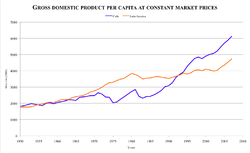 The junta embarked on a radical program of liberalization
and privatization
, slashing tariff
s as well as government welfare programs and deficits. In 1973, Chile was in shambles – inflation
was hundreds of percents, the country had no foreign reserves, and GDP was falling
. In order to halt the ongoing economic collapse, economic reforms
were drafted by a group of technocrats known as the Chicago Boys
because many of them had been trained or influenced by University of Chicago
professors. The first reforms were implemented in three rounds – 1974–1983, 1985, and 1990.
After the economic crisis of 1982, Hernan Buchi
became Minister of Finance from 1985 to 1989. He allowed the peso to float and reinstated restrictions on the movement of capital in and out of the country. He introduced banking legislation, simplified and reduced the corporate tax. Chile pressed ahead with privatizations, including public utilities plus the re-privatization of companies that had returned to the government during the 1982–1983 crisis. Under these new policies, the rate of inflation dropped from about 1,000% per year to about 10% per year. While this was still a high rate of inflation, it allowed the economy to start recovering. From 1984 to 1990, Chile's gross domestic product grew by an annual average of 5.9%, the fastest on the continent. Chile developed a good export economy, including the export of fruits and vegetables to the northern hemisphere when they were out of season, and commanded high prices.
An important initiative begun in 1981 and carried on until today, aimed at modernizing the use of Information and Communication technology, greatly contributed to disentangle the traditional bureaucratic and cumbersome clerical procedures in all dealings with branches of the government, from civil registry
to import/export documentation, thereby fostering a more agile economy and a more efficient public administration
.
The military junta began to change during the late 1970s. Due to problems with Pinochet, Leigh was expelled from the junta in 1978 and replaced by General Fernando Matthei
. Due to the Caso Degollados ("slit throats case"), in which three Communist party members were assassinated, César Mendoza
, member of the junta since 1973 and representants of the carabineros
, resigned in 1985 and was replaced by Rodolfo Stange
. The next year, Carmen Gloria Quintana
was burnt alive in what became known as the Caso Quemado ("Burnt Alive case").
Problems with Argentina coming from the 19th century reached a high in 1978, with disagreements over the Beagle Canal. The two countries agreed to papal mediation over the canal. Chilean-Argentine relations remained bad, however, and Chile helped Britain during the Falklands War
.
Chile's constitution
was approved in a national plebiscite held in September 1980. It came into force in March 1981. It established that in 1988 there would be another plebiscite in which the voters would accept or reject a single candidate proposed by the Military Junta. Pinochet was, as expected, the candidate proposed, and he was denied a second 8 year term by 54.5% of the vote.
, the candidate of a coalition of 17 political parties called the Concertación
, received an absolute majority of votes (55%). President Aylwin served from 1990 to 1994, in what was considered a transition period. In February 1991 Aylwin created the National Commission for Truth and Reconciliation, which released in February 1991 the Rettig Report
on human rights violations committed during the military rule. This report counted 2,279 cases of "disappearances
" which could be proved and registered. Of course, the very nature of "disappearances" made such investigations very difficult. The same problem arose, several years later, with the Valech Report
, released in 2004 and which counted almost 30,000 victims of torture
, among testimonies from 35,000 persons.
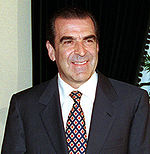 In December 1993, Christian Democrat Eduardo Frei Ruiz-Tagle
, the son of previous president Eduardo Frei Montalva
, led the Concertación coalition to victory with an absolute majority of votes (58%). Frei Ruiz-Tagle was succeeded in 2000 by Socialist Ricardo Lagos
, who won the presidency in an unprecedented runoff election against Joaquín Lavín
of the rightist Alliance for Chile
, by a very tight score of less than 200,000 votes (51,32%).
In 1998, Pinochet traveled to London for back surgery. But under orders of Spanish judge Baltasar Garzón
, he was arrested there
, attracting worldwide attention, not only because of the past history of Chile and South America, but also because this was one of the first arrests of a former president based on the universal jurisdiction
principle. Pinochet tried to defend himself by referring to the State Immunity Act of 1978, an argument rejected by the British justice. However, UK Home Secretary Jack Straw
took the responsibility to release him on medical grounds, and refused to extradite him to Spain. Thereafter, Pinochet returned to Chile in March 2000. Upon descending the plane on his wheelchair, he stood up and saluted the cheering crowd of supporters, including an army band playing his favorite military march tunes, which was awaiting him at the airport in Santiago. President Ricardo Lagos
later commented that the retired general's televised arrival had damaged the image of Chile, while thousands demonstrated against him.
 The Concertación coalition has continued to dominate Chilean politics for last two decades. In January 2006 Chileans elected their first woman president, Michelle Bachelet
, of the Socialist Party. She was sworn in on March 11, 2006, extending the Concertación coalition governance for another four years.
In 2002 Chile signed an association agreement with the European Union
(comprising FTA, political and cultural agreements), in 2003, an extensive free trade agreement with the United States, and in 2004 with South Korea
, expecting a boom in import and export of local produce and becoming a regional trade-hub. Continuing the coalition's free-trade strategy, in August 2006 President Bachelet promulgated a free trade agreement with the People's Republic of China
(signed under the previous administration of Ricardo Lagos), the first Chinese free-trade agreement with a Latin American nation; similar deals with Japan and India were promulgated in August 2007. In October 2006, Bachelet promulgated a multilateral trade deal with New Zealand, Singapore
and Brunei
, the Trans-Pacific Strategic Economic Partnership
(P4), also signed under Lagos' presidency. Regionally, she has signed bilateral free-trade agreements with Panama
, Peru
and Colombia
.
After 20 years, Chile is now heading in a new direction. Over half of the registered voting population of Chile has opted for a change away from center-left politics by electing a right-wing candidate, Sebastián Piñera
Chile
Chile ,officially the Republic of Chile , is a country in South America occupying a long, narrow coastal strip between the Andes mountains to the east and the Pacific Ocean to the west. It borders Peru to the north, Bolivia to the northeast, Argentina to the east, and the Drake Passage in the far...
has been populated since at least 2,000 BC. By the 16th century, Spanish conquistador
Conquistador
Conquistadors were Spanish soldiers, explorers, and adventurers who brought much of the Americas under the control of Spain in the 15th to 16th centuries, following Europe's discovery of the New World by Christopher Columbus in 1492...
s began to subdue and colonize the region of present-day Chile, and the territory became a colony from 1540 to 1818, when it gained independence from Spain
Spain
Spain , officially the Kingdom of Spain languages]] under the European Charter for Regional or Minority Languages. In each of these, Spain's official name is as follows:;;;;;;), is a country and member state of the European Union located in southwestern Europe on the Iberian Peninsula...
. The country's economic development was successively marked by the export of first agricultural produce, then saltpeter
Sodium nitrate
Sodium nitrate is the chemical compound with the formula NaNO3. This salt, also known as Chile saltpeter or Peru saltpeter to distinguish it from ordinary saltpeter, potassium nitrate, is a white solid which is very soluble in water...
and later copper
Copper
Copper is a chemical element with the symbol Cu and atomic number 29. It is a ductile metal with very high thermal and electrical conductivity. Pure copper is soft and malleable; an exposed surface has a reddish-orange tarnish...
until the 1980s. The wealth of raw materials led to an economic upturn, but also led to dependency, and even wars with neighboring states. The country was governed during most of its first 150 years of independent life by different forms of restricted democracy, where the electorate was carefully vetted and controlled by an elite.
Failure to address the economic and social disparities and increasing political awareness of the less-affluent population, as well as indirect intervention and economic funding to the main political groups by both the KGB
KGB
The KGB was the commonly used acronym for the . It was the national security agency of the Soviet Union from 1954 until 1991, and was the premier internal security, intelligence, and secret police organization during that time.The State Security Agency of the Republic of Belarus currently uses the...
and the CIA, as part of the Cold War
Cold War
The Cold War was the continuing state from roughly 1946 to 1991 of political conflict, military tension, proxy wars, and economic competition between the Communist World—primarily the Soviet Union and its satellite states and allies—and the powers of the Western world, primarily the United States...
, led to a political polarization under Socialist President
President of Chile
The President of the Republic of Chile is both the head of state and the head of government of the Republic of Chile. The President is responsible of the government and state administration...
Salvador Allende
Salvador Allende
Salvador Allende Gossens was a Chilean physician and politician who is generally considered the first democratically elected Marxist to become president of a country in Latin America....
which in turn resulted in the 11 September 1973 coup and the government of General Augusto Pinochet
Augusto Pinochet
Augusto José Ramón Pinochet Ugarte, more commonly known as Augusto Pinochet , was a Chilean army general and dictator who assumed power in a coup d'état on 11 September 1973...
, whose 17-year regime was responsible for numerous human rights violations and deep market-oriented economic reforms. In 1990, Chile made a peaceful transition to democracy
Chilean transition to democracy
The Chilean transition to democracy began when a Constitution establishing a transition itinerary was approved in a plebiscite. From March 11, 1981 to March 11, 1990, several organic constitutional laws were approved leading to the final restoration of democracy...
.
Early history (pre–1540)
About 4,000 years ago, migrating Native AmericansIndigenous peoples of the Americas
The indigenous peoples of the Americas are the pre-Columbian inhabitants of North and South America, their descendants and other ethnic groups who are identified with those peoples. Indigenous peoples are known in Canada as Aboriginal peoples, and in the United States as Native Americans...
settled in the fertile valleys and coastal areas of what is present day Chile. Pre-Hispanic Chile was home to over a dozen different Amerindian societies. The current prevalent theories are that the initial arrival of humans to the continent took place either along the Pacific coast southwards in a rather rapid expansion long preceding the Clovis culture
Clovis culture
The Clovis culture is a prehistoric Paleo-Indian culture that first appears 11,500 RCYBP , at the end of the last glacial period, characterized by the manufacture of "Clovis points" and distinctive bone and ivory tools...
, or even trans-Pacific migration. These theories are backed by findings in the Monte Verde
Monte Verde
Monte Verde is an archaeological site in southern Chile, located in the northern Patagonia near Puerto Montt, Chile, which has been dated to 14,800 years BP . This dating adds to the evidence showing that settlement in the Americas pre-dates the Clovis culture by roughly 1000 years...
archaeological site, which predates the Clovis site by thousands of years. Specific early human settlement sites from the very early human habitation in Chile include the Cueva del Milodon and the Pali Aike Crater
Pali Aike Crater
The Pali Aike Crater is an extinct volcano cone within a series of such craters in the Pali-Aike National Park. The locale of this crater is a semi-desert. This crater within the Pali-Aike Volcanic Field has an extant lava tube which has yielded archaeological traces termed by C...
's lava tube
Lava tube
Lava tubes are natural conduits through which lava travels beneath the surface of a lava flow, expelled by a volcano during an eruption. They can be actively draining lava from a source, or can be extinct, meaning the lava flow has ceased and the rock has cooled and left a long, cave-like...
.
Cultural periods of Peru
This is a chart of cultural periods of Peru and the Andean Region developed by Edward Lanning and used by some archaeologists studying the area...
; the Araucanian culture, who inhabited the area between the river Choapa
Choapa River
Choapa River or El Río Choapa is a river of Chile located in the Coquimbo Region. The river rises in the Andes, at the confluence of the streams Totoral, Leiva and Del Valle. The river then flows through the town of Salamanca before it meets with its main tributary, the Illapel River...
and the island of Chiloé
Chiloé Island
Chiloé Island , also known as Greater Island of Chiloé , is the largest island of the Chiloé Archipelago off the coast of Chile, in the Pacific Ocean...
, and lived primarily off agriculture; and the Patagonian culture Patagonia
Patagonia
Patagonia is a region located in Argentina and Chile, integrating the southernmost section of the Andes mountains to the southwest towards the Pacific ocean and from the east of the cordillera to the valleys it follows south through Colorado River towards Carmen de Patagones in the Atlantic Ocean...
composed of various nomadic tribes, who supported themselves through fishing and hunting (and who in Pacific/Pacific Coast immigration scenario would be descended partly from the most ancient settlers).
No elaborate, centralized, sedentary civilization reigned supreme.
The Araucanians, a fragmented society of hunters, gatherers, and farmers, constituted the largest native American group in Chile. A mobile people who engaged in trade and warfare with other indigenous groups, they lived in scattered family clusters and small villages. Although the Araucanians had no written language, they did use a common tongue. Those in what became central Chile were more settled and more likely to use irrigation. Those in the south combined slash-and-burn agriculture with hunting. Of the three Araucanian groups, the one that mounted the fiercest resistance to the attempts at seizure of their territory were the Mapuche
Mapuche
The Mapuche are a group of indigenous inhabitants of south-central Chile and southwestern Argentina. They constitute a wide-ranging ethnicity composed of various groups who shared a common social, religious and economic structure, as well as a common linguistic heritage. Their influence extended...
, meaning "people of the land."
Inca Empire
The Inca Empire, or Inka Empire , was the largest empire in pre-Columbian America. The administrative, political and military center of the empire was located in Cusco in modern-day Peru. The Inca civilization arose from the highlands of Peru sometime in the early 13th century...
briefly extended their empire into what is now northern Chile, where they collected tribute from small groups of fishermen and oasis farmers but were not able to establish a strong cultural presence in the area. As the Spaniards would after them, the Incas encountered fierce resistance and so were unable to exert control in the south. During their attempts at conquest in 1460 and again in 1491, the Incas established forts in the Central Valley of Chile, but they could not colonize the region. The Mapuche
Mapuche
The Mapuche are a group of indigenous inhabitants of south-central Chile and southwestern Argentina. They constitute a wide-ranging ethnicity composed of various groups who shared a common social, religious and economic structure, as well as a common linguistic heritage. Their influence extended...
fought against the Sapa Tupac Inca Yupanqui
Tupac Inca Yupanqui
Topa Inca Yupanqui , translated as "noble Inca accountant," was the tenth Sapa Inca of the Inca Empire, and fifth of the Hanan dynasty. His father was Pachacuti, and his son was Huayna Capac. Topa Inca belonged to the Qhapaq panaca....
(CE 1471–1493) and his army. The result of the bloody three-day confrontation known as the Battle of the Maule
Battle of the Maule
The Battle of the Maule was fought between the Mapuche people and the Inca Empire in what is now Chile. The three-day battle, which is generally believed to have occurred in the reign of Tupac Inca Yupanqui , marked the end of the Incas' southward expansion.In a six-year campaign with an army that...
was that the Inca conquest of the territories of Chile ended at the Maule river
Maule river
The Maule river is one of the most important rivers of Chile and is inextricably linked to this country's pre-Hispanic times, the country's conquest, colonial period, wars of Independence, modern history, agriculture , culture , religion, economy and politics...
, which subsequently became the boundary between the Incan empire and the Mapuche lands until the arrival of the Spaniards.
Scholars speculate that the total Araucanian population may have numbered 1 million at most when the Spaniards arrived in the 1530s; a century of European conquest and disease reduced that number by at least half. During the conquest, the Araucanians quickly added horses and European weaponry to their arsenal of clubs and bows and arrows. They became adept at raiding Spanish settlements and, albeit in declining numbers, managed to hold off the Spaniards and their descendants until the late nineteenth century. The Araucanians' valor inspired the Chileans to mythologize them as the nation's first national heroes, a status that did nothing, however, to elevate the wretched living standard of their descendants.
The Chilean Patagonia
Patagonia
Patagonia is a region located in Argentina and Chile, integrating the southernmost section of the Andes mountains to the southwest towards the Pacific ocean and from the east of the cordillera to the valleys it follows south through Colorado River towards Carmen de Patagones in the Atlantic Ocean...
located south of the river "calle calle" in Valdivia
Valdivia
-Geography:*Chile** Valdivia, Chile, a city and municipality in the Province of Valdivia** Valdivia River, a river which begins in the city of Valdivia** Valdivia Province, the Province of Valdivia...
was composed of many tribes, mainly Tehuelches that were consider giants by Spaniards during Magellan voyage of 1520.
The name Patagonia comes from the word patagón
Patagon
The Patagones or Patagonian giants are a mythical race of people, who first began to appear in early European accounts of the then little-known region and coastline of Patagonia. They were supposed to have exceeded at least double normal human height, some accounts giving heights of or more...
used by Magellan
Ferdinand Magellan
Ferdinand Magellan was a Portuguese explorer. He was born in Sabrosa, in northern Portugal, and served King Charles I of Spain in search of a westward route to the "Spice Islands" ....
to describe the native people whom his expedition thought to be giants. It is now believed the Patagons were actually Tehuelches with an average height of 1.80 m (~5′11″) compared to the 1.55 m (~5′1″) average for Spaniards of the time.
The Argentine portion of Patagonia includes the provinces of Neuquén
Neuquén Province
Neuquén is a province of Argentina, located in the west of the country, at the northern end of Patagonia. It borders Mendoza Province to the north, Rio Negro Province to the southeast, and Chile to the west...
, Río Negro
Río Negro Province
Río Negro is a province of Argentina, located at the northern edge of Patagonia. Neighboring provinces are from the south clockwise Chubut, Neuquén, Mendoza, La Pampa and Buenos Aires. To the east lies the Atlantic Ocean.Its capital is Viedma...
, Chubut
Chubut Province
Chubut a province in the southern part of Argentina situated between the 42nd parallel south and the 46th parallel south , the Andes range separating Argentina from Chile, and the Atlantic ocean...
and Santa Cruz, as well as the eastern portion of Tierra del Fuego archipelago . The Argentine politico-economic Patagonic Region includes the Province of La Pampa
La Pampa Province
La Pampa is a sparsely populated province of Argentina, located in the Pampas in the center of the country. Neighboring provinces are from the north clockwise San Luis, Córdoba, Buenos Aires, Río Negro, Neuquén and Mendoza.-History:...
.
The Chilean part of Patagonia embraces the southern part of Valdivia
Valdivia
-Geography:*Chile** Valdivia, Chile, a city and municipality in the Province of Valdivia** Valdivia River, a river which begins in the city of Valdivia** Valdivia Province, the Province of Valdivia...
, Los Lagos
Los Lagos Region
Los Lagos Region is one of Chile's 15 regions, which are first order administrative divisions, and comprises four provinces: Chiloé, Llanquihue, Osorno and Palena. The region contains the country's second largest island, Chiloé, and the second largest lake, Llanquihue.Its capital is Puerto Montt;...
in Lake Llanquihue, Chiloé
Chiloé Island
Chiloé Island , also known as Greater Island of Chiloé , is the largest island of the Chiloé Archipelago off the coast of Chile, in the Pacific Ocean...
, Puerto Montt
Puerto Montt
Puerto Montt is a port city and commune in southern Chile, located at the northern end of the Reloncaví Sound in the Llanquihue Province, Los Lagos Region. The commune spans an area of and had a population of 175,938 in 2002. It is located 1,055 km to the south of the capital, Santiago...
and the Archaeological site of Monte Verde
Monte Verde
Monte Verde is an archaeological site in southern Chile, located in the northern Patagonia near Puerto Montt, Chile, which has been dated to 14,800 years BP . This dating adds to the evidence showing that settlement in the Americas pre-dates the Clovis culture by roughly 1000 years...
, also the fiords and islands south to the regions of Aisén and Magallanes, including the west side of Tierra del Fuego
Tierra del Fuego
Tierra del Fuego is an archipelago off the southernmost tip of the South American mainland, across the Strait of Magellan. The archipelago consists of a main island Isla Grande de Tierra del Fuego divided between Chile and Argentina with an area of , and a group of smaller islands including Cape...
and Cape Horn
Cape Horn
Cape Horn is the southernmost headland of the Tierra del Fuego archipelago of southern Chile, and is located on the small Hornos Island...
.
Spanish conquest and colonization (1540–1810)
Ferdinand Magellan
Ferdinand Magellan was a Portuguese explorer. He was born in Sabrosa, in northern Portugal, and served King Charles I of Spain in search of a westward route to the "Spice Islands" ....
, who crossed the Strait of Magellan
Strait of Magellan
The Strait of Magellan comprises a navigable sea route immediately south of mainland South America and north of Tierra del Fuego...
on November 1, 1520. However, the title of discoverer of Chile is usually assigned to Diego de Almagro
Diego de Almagro
Diego de Almagro, , also known as El Adelantado and El Viejo , was a Spanish conquistador and a companion and later rival of Francisco Pizarro. He participated in the Spanish conquest of Peru and is credited as the first European discoverer of Chile.Almagro lost his left eye battling with coastal...
. Almagro was Francisco Pizarro
Francisco Pizarro
Francisco Pizarro González, Marquess was a Spanish conquistador, conqueror of the Incan Empire, and founder of Lima, the modern-day capital of the Republic of Peru.-Early life:...
's partner, and he received the Southern area.(Nueva Toledo). He organized an expedition that brought him to central Chile in 1537, but he found little of value to compare with the gold and silver of the Incas in Peru. Left with the impression that the inhabitants of the area were poor, he returned to Peru, later to be garotted following defeat by Hernando Pizarro in a Civil War.
After this initial excursion there was little interest from colonial authorities in further exploring modern-day Chile. However, Pedro de Valdivia
Pedro de Valdivia
Pedro Gutiérrez de Valdivia or Valdiva was a Spanish conquistador and the first royal governor of Chile. After serving with the Spanish army in Italy and Flanders, he was sent to South America in 1534, where he served as lieutenant under Francisco Pizarro in Peru, acting as his second in command...
, captain of the army, realizing the potential for expanding the Spanish empire southward, asked Pizarro's permission to invade and conquer the southern lands. With a couple of hundred men, he subdued the local inhabitants and founded the city of Santiago de Nueva Extremadura, now Santiago de Chile, on February 12, 1541.
Although Valdivia found little gold in Chile he could see the agricultural richness of the land. He continued his explorations of the region west of the Andes and founded over a dozen towns and established the first encomienda
Encomienda
The encomienda was a system that was employed mainly by the Spanish crown during the colonization of the Americas to regulate Native American labor....
s. The greatest resistance to Spanish rule came from the Mapuche
Mapuche
The Mapuche are a group of indigenous inhabitants of south-central Chile and southwestern Argentina. They constitute a wide-ranging ethnicity composed of various groups who shared a common social, religious and economic structure, as well as a common linguistic heritage. Their influence extended...
culture, who opposed European conquest and colonization until the 1880s; this resistance is known as the Arauco War
Arauco War
The Arauco War was a conflict between colonial Spaniards and the Mapuche people in what is now the Araucanía and Biobío regions of modern Chile...
. Valdivia died at the Battle of Tucapel
Battle of Tucapel
The Battle of Tucapel is the name given to a battle fought between Spanish conquistador forces led by Pedro de Valdivia and Mapuche Indians under Lautaro that took place at Tucapel, Chile on December 25, 1553...
, defeated by Lautaro, a young Mapuche toqui
Toqui
Toqui is a title conferred by the Mapuche to those who are chosen as their leaders during times of war. The toqui is chosen in an assembly or parliament of the chieftains of the various clans or confederation of clans , allied during the war in question...
(war chief), but the European conquest was well underway. The Spaniards never subjugated the Mapuche territories; various attempts at conquest, both by military and peaceful means, failed. The Great Uprising of 1598 swept all Spanish presence south of the Bío-Bío River
Bío-Bío River
The Biobío River is the second largest river in Chile. It originates from Icalma and Galletué lakes in the Andes and flows 380 km to the Gulf of Arauco on the Pacific Ocean....
except Chiloé (and Valdivia which was decades later reestablished as a fort), and the great river became the frontier line between Mapuche lands and the Spanish realm.
North of that line cities grew up slowly, and Chilean lands eventually became an important source of food for the Viceroyalty of Peru
Viceroyalty of Peru
Created in 1542, the Viceroyalty of Peru was a Spanish colonial administrative district that originally contained most of Spanish-ruled South America, governed from the capital of Lima...
.
Valdivia became the first governor of the Captaincy General of Chile. In that post, he obeyed the viceroy of Peru and, through him, the King of Spain and his bureaucracy. Responsible to the governor, town councils known as Cabildo
Cabildo (council)
For a discussion of the contemporary Spanish and Latin American cabildo, see Ayuntamiento.A cabildo or ayuntamiento was a former Spanish, colonial administrative council that governed a municipality. Cabildos were sometimes appointed, sometimes elected, but were considered to be representative of...
administered local municipalities, the most important of which was Santiago, which was the seat of a Royal Appeals Court from 1609 until the end of colonial rule.
Chile was the least wealthy realm of the Spanish Crown for most of its colonial history. Only in the 18th century did a steady economic and demographic growth begin, an effect of the reforms by Spain's Bourbon dynasty and a more stable situation along the frontier.
Independence (1810–1826)
Napoleon I of France
Napoleon Bonaparte was a French military and political leader during the latter stages of the French Revolution.As Napoleon I, he was Emperor of the French from 1804 to 1815...
's brother Joseph Bonaparte
Joseph Bonaparte
Joseph-Napoléon Bonaparte was the elder brother of Napoleon Bonaparte, who made him King of Naples and Sicily , and later King of Spain...
. The Chilean War of Independence was part of the larger Spanish American independence movement, and it was far from having unanimous support among Chileans, who became divided between independentists and royalists. What started as an elitist political movement against their colonial master, finally ended as a full-fledged civil war between pro-Independence Criollos
Criollo people
The Criollo class ranked below that of the Iberian Peninsulares, the high-born permanent residence colonists born in Spain. But Criollos were higher status/rank than all other castes—people of mixed descent, Amerindians, and enslaved Africans...
who sought political and economic independence from Spain and royalist Criollos, who supported the continued allegiance to and permanence within the Spanish Empire
Spanish Empire
The Spanish Empire comprised territories and colonies administered directly by Spain in Europe, in America, Africa, Asia and Oceania. It originated during the Age of Exploration and was therefore one of the first global empires. At the time of Habsburgs, Spain reached the peak of its world power....
of the Kingdom of Chile. The struggle for independence was a war within the upper class, although the majority of troops on both sides consisted of conscripted mestizos and native Americans.
The beginning of the Independence movement is traditionally dated as September 18, 1810 when a national junta was established to govern Chile in the name of the deposed king Ferdinand VII. Depending on what terms one uses to define the end, the movement extended until 1821 (when the Spanish were expelled from mainland Chile) or 1826 (when the last Spanish troops surrendered and Chiloé was incorporated to the Chilean republic). The independence process is normally divided into three stages: Patria Vieja
Patria Vieja
Patria Vieja refers to a time period in the History of Chile occurring between the First Junta of the Government and the Disaster of Rancagua . This period was characterized by the transformation from a movement of temporary autonomy to one of total independence...
, Reconquista, and Patria Nueva
Patria Nueva (Chile)
Patria Nueva was a period in the history of Chile which started with the victory of Ejército de los Andes and the Batlle of Chacabuco, on 12 February 1817 and finished with the abdication of Bernardo O'Higgins, in 1823....
.
Chile's first experiment with self-government, the "Patria Vieja" (old republic, 1810–1814), was led by José Miguel Carrera
José Miguel Carrera
José Miguel Carrera Verdugo was a Chilean general, member of the prominent Carrera family, and considered one of the founders of independent Chile. Carrera was the most important leader of the Chilean War of Independence during the period of the Patria Vieja...
, an aristocrat then in his mid-twenties. The military-educated Carrera was a heavy-handed ruler who aroused widespread opposition. Another of the earliest advocates of full independence, Bernardo O'Higgins
Bernardo O'Higgins
Bernardo O'Higgins Riquelme was a Chilean independence leader who, together with José de San Martín, freed Chile from Spanish rule in the Chilean War of Independence. Although he was the second Supreme Director of Chile , he is considered one of Chile's founding fathers, as he was the first holder...
, captained a rival faction that plunged the Criollos into civil war. For him and for certain other members of the Chilean elite, the initiative for temporary self-rule quickly escalated into a campaign for permanent independence, although other Criollos remained loyal to Spain. Among those favoring independence, conservatives fought with liberals over the degree to which French revolutionary ideas would be incorporated into the movement. After several efforts, Spanish troops from Peru took advantage of the internecine strife to reconquer Chile in 1814, when they reasserted control by winning the Battle of Rancagua on October 12. O'Higgins, Carrera and many of the Chilean rebels escaped to Argentina.
The second period was characterized by the Spanish attempts to reimpose arbitrary rule during the period known as the Reconquista
Reconquista (Spanish America)
In colonial Spanish America, the Reconquista refers to the period following the defeat of Napoleon in 1814 during which royalist armies were able to gain the upper hand in the Spanish American wars of independence...
of 1814–1817 ("Reconquest": the term echoes the Reconquista
Reconquista
The Reconquista was a period of almost 800 years in the Middle Ages during which several Christian kingdoms succeeded in retaking the Muslim-controlled areas of the Iberian Peninsula broadly known as Al-Andalus...
in which the Christian kingdoms retook Iberia from the Muslims). During this period, the harsh rule of the Spanish loyalists, who punished suspected rebels, drove more and more Chileans into the insurrectionary camp. More members of the Chilean elite were becoming convinced of the necessity of full independence, regardless of who sat on the throne of Spain. As the leader of guerrilla raids against the Spaniards, Manuel Rodríguez became a national symbol of resistance.
José de San Martín
José Francisco de San Martín, known simply as Don José de San Martín , was an Argentine general and the prime leader of the southern part of South America's successful struggle for independence from Spain.Born in Yapeyú, Corrientes , he left his mother country at the...
. Their combined army freed Chile with a daring assault over the Andes in 1817, defeating the Spaniards at the Battle of Chacabuco
Battle of Chacabuco
The Battle of Chacabuco, fought during the Chilean War of Independence, occurred on February 12, 1817. The Army of the Andes of the United Provinces of the Río de la Plata led by General Captain José de San Martín defeated the Spanish force led by Rafael Maroto...
on February 12 and marking the beginning of the Patria Nueva. San Martín considered the liberation of Chile a strategic stepping-stone to the emancipation of Peru, which he saw as the key to hemispheric victory over the Spanish. Chile won its formal independence when San Martín defeated the last large Spanish force on Chilean soil at the Battle of Maipú
Battle of Maipú
The Battle of Maipú was a battle fought near Santiago, Chile on April 5, 1818 between South American rebels and Spanish royalists, during the Chilean War of Independence...
on April 5, 1818. San Martín then led his Argentine and Chilean followers north to liberate Peru; and fighting continued in Chile's southern provinces, the bastion of the royalists, until 1826.
A declaration of independence
Chilean Declaration of Independence
The Chilean Declaration of Independence is a document declaring the independence of Chile from the Spanish Empire. It was drafted in January 1818 and approved by Supreme Director Bernardo O'Higgins on February 12, 1818 at Talca, despite being dated in Concepción on January 1, 1818...
was officially issued by Chile on February 12, 1818 and formally recognized by Spain in 1840, when full diplomatic relations were established.
Constitutional organization (1818–1833)
From 1817 to 1823, Bernardo O'Higgins ruled Chile as supreme director. He won plaudits for defeating royalists and founding schools, but civil strife continued. O'Higgins alienated liberals and provincials with his authoritarianism, conservatives and the church with his anticlericalism, and landowners with his proposed reforms of the land tenure system. His attempt to devise a constitution in 1818 that would legitimize his government failed, as did his effort to generate stable funding for the new administration. O'Higgins's dictatorial behavior aroused resistance in the provinces. This growing discontent was reflected in the continuing opposition of partisans of CarreraJosé Miguel Carrera
José Miguel Carrera Verdugo was a Chilean general, member of the prominent Carrera family, and considered one of the founders of independent Chile. Carrera was the most important leader of the Chilean War of Independence during the period of the Patria Vieja...
, who was executed by the Argentine regime in Mendoza in 1821, like his two brothers were three years earlier.
Although opposed by many liberals, O'Higgins angered the Roman Catholic Church with his liberal beliefs. He maintained Catholicism's status as the official state religion but tried to curb the church's political powers and to encourage religious tolerance as a means of attracting Protestant immigrants and traders. Like the church, the landed aristocracy felt threatened by O'Higgins, resenting his attempts to eliminate noble titles and, more important, to eliminate entailed estates.
O'Higgins's opponents also disapproved of his diversion of Chilean resources to aid San Martín's liberation of Peru. O'Higgins insisted on supporting that campaign because he realized that Chilean independence would not be secure until the Spaniards were routed from the Andean core of the empire. However, amid mounting discontent, troops from the northern and southern provinces forced O'Higgins to resign. Embittered, O'Higgins departed for Peru, where he died in 1842.
After O'Higgins went into exile in 1823, civil conflict continued, focusing mainly on the issues of anticlericalism and regionalism. Presidents and constitutions rose and fell quickly in the 1820s. The civil struggle's harmful effects on the economy, and particularly on exports, prompted conservatives to seize national control in 1830.
In the minds of most members of the Chilean elite, the bloodshed and chaos of the late 1820s were attributable to the shortcomings of liberalism and federalism, which had been dominant over conservatism for most of the period. The political camp became divided by supporters of O'Higgins
Bernardo O'Higgins
Bernardo O'Higgins Riquelme was a Chilean independence leader who, together with José de San Martín, freed Chile from Spanish rule in the Chilean War of Independence. Although he was the second Supreme Director of Chile , he is considered one of Chile's founding fathers, as he was the first holder...
, Carrera
José Miguel Carrera
José Miguel Carrera Verdugo was a Chilean general, member of the prominent Carrera family, and considered one of the founders of independent Chile. Carrera was the most important leader of the Chilean War of Independence during the period of the Patria Vieja...
, liberal Pipiolos
Pipiolos
thumb|180px|[[Ramón Freire]], hero of the [[Chilean War of Independence]] and head of state between 1823 and 1826 and again in 1827, was an icon of the Pipiolo movementPipiolos was the name used to refer to Chilean upper class liberals in early 19th century...
and conservative Pelucones
Pelucones
thumb|180px|[[Mariano Egaña]], was a notable Pelucón, politically he felt affinity to [[constitutional monarchy]] as [[form of government]]Pelucones was the name used to refer to Chilean aristocratic conservatives in early 19th century...
, being the two last the main movements that prevailed and absorbed the rest. The abolition of slavery in 1823—long before most other countries in the Americas—was considered one of the Pipiolos' few lasting achievements. One Pipiolo leader from the south, Ramón Freire, rode in and out of the presidency several times (1823–1827, 1828, 1829, 1830) but could not sustain his authority. From May 1827 to September 1831, with the exception of brief interventions by Freire, the presidency was occupied by Francisco Antonio Pinto
Francisco Antonio Pinto
Francisco Antonio Pinto y Díaz de la Puente was a Chilean political figure. He was twice President of Chile between 1827 and 1829.-Early life:He was born in Santiago, the son of Joaquín Pinto and Mercedes Díaz de la Puente...
, Freire's former vice president. In August 1828, Pinto's first year in office, Chile abandoned its short-lived federalist system for a unitary
Unitary state
A unitary state is a state governed as one single unit in which the central government is supreme and any administrative divisions exercise only powers that their central government chooses to delegate...
form of government, with separate legislative, executive, and judicial branches. By adopting a moderately liberal constitution in 1828, Pinto alienated both the federalists and the liberal factions. He also angered the old aristocracy by abolishing estates inherited by primogeniture (mayorazgo) and caused a public uproar with his anticlericalism. After the defeat of his liberal army at the Battle of Lircay on April 17, 1830, Freire, like O'Higgins, went into exile in Peru.
Conservative Era (1830–1861)
Diego Portales
Diego José Pedro Víctor Portales Palazuelos was a Chilean statesman and entrepreneur. As a minister of president José Joaquín Prieto Diego Portales played a pivotal role in shaping the state and government politics in the 19th century, delivering with the Constitution of 1833 the framework of the...
dominated Chilean politics from the cabinet and behind the scenes from 1830 to 1837. He installed the "autocratic republic", which centralized authority in the national government. His political program enjoyed support from merchants, large landowners, foreign capitalists, the church, and the military. Political and economic stability reinforced each other, as Portales encouraged economic growth through free trade and put government finances in order.
Portales was an agnostic who said that he believed in the clergy but not in God. He realized the importance of the Roman Catholic Church as a bastion of loyalty, legitimacy, social control, and stability, as had been the case in the colonial period. He repealed Liberal reforms that had threatened church privileges and properties.
Portales brought the military under civilian control by rewarding loyal generals, cashiering troublemakers, and promoting a victorious war against the Peru-Bolivia Confederation (1836–1839). After defeating Peru and Bolivia, Chile dominated the Pacific Coast of South America. The victory over its neighbors gave Chile and its new political system a psychological boost. Chileans experienced a surge of national enthusiasm and cohesion behind a regime accepted as legitimate and efficacious.
Portales also achieved his objectives by wielding dictatorial powers, censoring the press, and manipulating elections
Electoral fraud
Electoral fraud is illegal interference with the process of an election. Acts of fraud affect vote counts to bring about an election result, whether by increasing the vote share of the favored candidate, depressing the vote share of the rival candidates or both...
. For the next forty years, Chile's armed forces would be distracted from meddling in politics by skirmishes and defensive operations on the southern frontier, although some units got embroiled in domestic conflicts in 1851
Revolution of 1851
The Revolution of 1851 was an attempt to overthrow the conservative government by Chilean liberals.In the elections of 1851 the conservative candidate José María de la Cruz Prieto lost against another conservative, Manuel Montt in Concepción...
and 1859.
The "Portalian State" was institutionalized by the Chilean Constitution of 1833
Chilean Constitution of 1833
thumb|right|200px|Painting of Diego Portales. The Constitution of 1833 has been seen as the embodiement of the "Portalian thought".The Constitution of 1833 was the constitution used in Chile from 1833 to 1925 when it was replaced by the Constitution of 1925...
. One of the most durable charters ever devised in Latin America, the Portalian constitution lasted until 1925. The constitution concentrated authority in the national government, more precisely, in the hands of the president, who was elected by a tiny minority. The chief executive could serve two consecutive five-year terms and then pick a successor. Although the Congress had significant budgetary powers, it was overshadowed by the president, who appointed provincial officials. The constitution also created an independent judiciary, guaranteed inheritance of estates by primogeniture, and installed Catholicism as the state religion. In short, it established an autocratic system under a republican veneer.
The first Portalian president was General Joaquín Prieto, who served two terms (1831–1836, 1836–1841). President Prieto had four main accomplishments: implementation of the 1833 constitution, stabilization of government finances, defeat of provincial challenges to central authority, and victory over the Peru-Bolivia Confederation. During the presidencies of Prieto and his two successors, Chile modernized through the construction of ports, railroads, and telegraph lines, some built by United States entrepreneur William Wheelwright. These innovations facilitated the export-import trade as well as domestic commerce.
Prieto and his adviser, Portales, feared the efforts of Bolivian general Andrés de Santa Cruz
Andrés de Santa Cruz
Andrés de Santa Cruz y Calahumana was President of Peru and Bolivia...
to unite with Peru against Chile. These qualms exacerbated animosities toward Peru dating from the colonial period, now intensified by disputes over customs duties and loans. Chile also wanted to become the dominant South American military and commercial power along the Pacific. Portales got Congress to declare war on Peru in 1836.
Liberal era (1861–1891)
The political revolt brought little social change, however, and 19th century Chilean society preserved the essence of the stratified colonial social structure, which was greatly influenced by family politics and the Roman Catholic ChurchRoman Catholic Church
The Catholic Church, also known as the Roman Catholic Church, is the world's largest Christian church, with over a billion members. Led by the Pope, it defines its mission as spreading the gospel of Jesus Christ, administering the sacraments and exercising charity...
. A strong presidency eventually emerged, but wealthy landowners remained powerful.
Mapuche
The Mapuche are a group of indigenous inhabitants of south-central Chile and southwestern Argentina. They constitute a wide-ranging ethnicity composed of various groups who shared a common social, religious and economic structure, as well as a common linguistic heritage. Their influence extended...
during the Occupation of the Araucanía
Occupation of the Araucanía
The Occupation of Araucanía was a series of military campaigns, agreements and penetrations by the Chilean army and settlers which led to the incorporation of Araucanía into Chilean national territory...
. In 1881, it signed a treaty with Argentina
Argentina
Argentina , officially the Argentine Republic , is the second largest country in South America by land area, after Brazil. It is constituted as a federation of 23 provinces and an autonomous city, Buenos Aires...
confirming Chilean sovereignty over the Strait of Magellan
Strait of Magellan
The Strait of Magellan comprises a navigable sea route immediately south of mainland South America and north of Tierra del Fuego...
, but conceding all of oriental Patagonia
Patagonia
Patagonia is a region located in Argentina and Chile, integrating the southernmost section of the Andes mountains to the southwest towards the Pacific ocean and from the east of the cordillera to the valleys it follows south through Colorado River towards Carmen de Patagones in the Atlantic Ocean...
, and a considerable fraction of the territory it had during colonial times. As a result of the War of the Pacific
War of the Pacific
The War of the Pacific took place in western South America from 1879 through 1883. Chile fought against Bolivia and Peru. Despite cooperation among the three nations in the war against Spain, disputes soon arose over the mineral-rich Peruvian provinces of Tarapaca, Tacna, and Arica, and the...
with Peru
Peru
Peru , officially the Republic of Peru , is a country in western South America. It is bordered on the north by Ecuador and Colombia, on the east by Brazil, on the southeast by Bolivia, on the south by Chile, and on the west by the Pacific Ocean....
and Bolivia
Bolivia
Bolivia officially known as Plurinational State of Bolivia , is a landlocked country in central South America. It is the poorest country in South America...
(1879–1883), Chile expanded its territory northward by almost one-third and acquired valuable nitrate
Nitrate
The nitrate ion is a polyatomic ion with the molecular formula NO and a molecular mass of 62.0049 g/mol. It is the conjugate base of nitric acid, consisting of one central nitrogen atom surrounded by three identically-bonded oxygen atoms in a trigonal planar arrangement. The nitrate ion carries a...
deposits, the exploitation of which led to an era of national affluence.
In the 1870s, the church influence started to diminish slightly with the passing of several laws that took some old roles of the church into the State's hands such as the registry of births and marriages.
José Manuel Balmaceda
José Manuel Emiliano Balmaceda Fernández was the 11th President of Chile from September 18, 1886 to August 29, 1891. Balmaceda was part of the Castilian-Basque aristocracy in Chile...
was elected president. His economic policies visibly changed the existing liberal policies. He began to violate the constitution
Constitution
A constitution is a set of fundamental principles or established precedents according to which a state or other organization is governed. These rules together make up, i.e. constitute, what the entity is...
and slowly began to establish a dictatorship. Congress decided to depose Balmaceda, who refused to step down. Jorge Montt
Jorge Montt
Jorge Montt Álvarez was vice-admiral of the Chilean Navy and president of Chile from 1891 to 1896.-Early life:...
, among others, directed an armed conflict against Balmaceda, which soon extended into the Chilean Civil War
Chilean Civil War
The Chilean Civil War of 1891 was an armed conflict between forces supporting Congress and forces supporting the sitting President, José Manuel Balmaceda. The war saw a confrontation between the Chilean Army and the Chilean Navy, which had sided with the president and the congress, respectively...
of 1891. Defeated, Balmaceda fled to Argentina's embassy, where he committed suicide. Jorge Montt became the new president.
Parliamentary era (1891–1925)
The so-called Parliamentary Republic was not a true parliamentary system, in which the chief executive is elected by the legislature. It was, however, an unusual regime in presidentialist Latin America, for Congress really did overshadow the rather ceremonial office of the president and exerted authority over the chief executive's cabinet appointees. In turn, Congress was dominated by the landed elites. This was the heyday of classic political and economic liberalism.For many decades thereafter, historians derided the Parliamentary Republic as a quarrel-prone system that merely distributed spoils and clung to its laissez-faire policy while national problems mounted. The characterization is epitomized by an observation made by President Ramón Barros Luco
Ramón Barros Luco
Ramón Barros Luco was President of Chile between 1910 and 1915.Barros Luco was born in 1835 in Santiago, Barros Luco was son of Ramón Luis Barros Fernández and Dolores Luco Fernández de Leiva. He graduated from Law School in 1858...
(1910–1915), reputedly made in reference to labor unrest: "There are only two kinds of problems: those that solve themselves and those that can't be solved." At the mercy of Congress, cabinets came and went frequently, although there was more stability and continuity in public administration than some historians have suggested. Chile also temporary resolved its border disputes with Argentina with the Puna de Atacama Lawsuit of 1899, the Boundary treaty of 1881 between Chile and Argentina and the 1902 General Treaty of Arbitration.
Political authority ran from local electoral bosses in the provinces through the congressional and executive branches, which reciprocated with payoffs from taxes on nitrate sales. Congressmen often won election by bribing voters in this clientelistic and corrupt system. Many politicians relied on intimidated or loyal peasant voters in the countryside, even though the population was becoming increasingly urban. The lackluster presidents and ineffectual administrations of the period did little to respond to the country's dependence on volatile nitrate exports, spiraling inflation, and massive urbanization.
In recent years, however, particularly when the authoritarian regime of Augusto Pinochet is taken into consideration, some scholars have reevaluated the Parliamentary Republic of 1891–1925. Without denying its shortcomings, they have lauded its democratic stability. They have also hailed its control of the armed forces, it respect for civil liberties, its expansion of suffrage and participation, and its gradual admission of new contenders, especially reformers, to the political arena. In particular, two young parties grew in importance – the Democrat Party, with roots among artisans and urban workers, and the Radical Party
Radical Party (Chile)
The Radical Party of Chile was a Chilean political party. It was formed in 1863 by a split in the Liberal Party. Not coincidently, it was formed shortly after the organization of the Grand Lodge of Chile, and it has maintained a close relationship with Chilean Freemasonry throughout its life...
, representing urban middle sectors and provincial elites. By the early twentieth century, both parties were winning increasing numbers of seats in Congress. The more leftist members of the Democrat Party became involved in the leadership of labor unions and broke off to launch the Socialist Workers' Party
Communist Party of Chile
The Communist Party of Chile is a Chilean political party inspired by the thoughts of Karl Marx and Lenin. It was founded in 1922, as the continuation of the Socialist Workers Party, and in 1934 it established its youth wing, the Communist Youth of Chile .In the last legislative elections in Chile...
( – POS) in 1912. The founder of the POS and its best-known leader, Luis Emilio Recabarren
Luis Emilio Recabarren
Luis Emilio Recabarren Serrano was a Chilean political figure. He was elected several times as deputy, and was the driving force behind the Worker's Movement in that country.- Early life :...
, also founded the Communist Party of Chile
Communist Party of Chile
The Communist Party of Chile is a Chilean political party inspired by the thoughts of Karl Marx and Lenin. It was founded in 1922, as the continuation of the Socialist Workers Party, and in 1934 it established its youth wing, the Communist Youth of Chile .In the last legislative elections in Chile...
( – PCCh) in 1922.
Presidential era (1925–1973)
Alessandri soon discovered that his efforts to lead would be blocked by the conservative Congress. Like Balmaceda, he infuriated the legislators by going over their heads to appeal to the voters in the congressional elections of 1924. His reform legislation was finally rammed through Congress under pressure from younger military officers, who were sick of the neglect of the armed forces, political infighting, social unrest, and galloping inflation. whose program was frustrated by a conservative congress.
A double military coup set off a period of great political instability that lasted until 1932. First military right-wingers opposing Alessandri seized power in September 1924, and then reformers in favor of the ousted president took charge in January 1925. The Saber noise
Saber noise
Saber-noise or saber-rattling may be used to refer to a historical incident in Chilean history that took place on September 3, 1924, when a group of young military officers protested against the political class and the postponement of social measures by rattling their sabers within their scabbards...
(ruido de sables) incident of September 1924, provoked by discontent of young officers, mostly lieutenants from middle and working classes, lead to the establishment of the September Junta led by General Luis Altamirano
Luis Altamirano
Division General Luis Altamirano Talavera was a Chilean military officer, minister, Vice President of the Republic and finally President of the Government Junta of Chile between 1924 and 1925....
and the exile of Alessandri. However, fears of a conservative restoration in progressive sectors of the army led to another coup in January
1925 Chilean coup d'état
The Chilean coup d'état of 1925 took place on January 23, 1925, when the Chilean military overthrew the September Junta. Led by Colonel Marmaduque Grove, the troops arrested the President, Luis Altamirano, and then handed the power to General Pedro Dartnell as interim President...
, which ended with the establishment of the January Junta as interim government while waiting for Alessandri's return. The latter group was led by two colonels, Carlos Ibáñez del Campo
Carlos Ibáñez del Campo
General Carlos Ibáñez del Campo was a Chilean Army officer and political figure. He served as dictator between 1927 and 1931 and as constitutional President from 1952 to 1958.- The coups of 1924 and 1925 :...
and Marmaduke Grove. They returned Alessandri to the presidency that March and enacted his promised reforms by decree. The latter re-assumed power in March, and a new Constitution
Chilean Constitution of 1925
The Constitution of 1925 was the constitution in force in Chile between 1925 and 1973 when the Government Junta suspended it. In the 1920s Chile suffered from a severe social and economic crisis that led to the loss of prestige for old ruling class, labeled oligarchy in Chilean historiography, and...
encapsulating his proposed reforms was ratified in a plebiscite in September 1925. The new constitution gave increased powers to the presidency. Alessandri broke with the classical liberalism
Classical liberalism
Classical liberalism is the philosophy committed to the ideal of limited government, constitutionalism, rule of law, due process, and liberty of individuals including freedom of religion, speech, press, assembly, and free markets....
's policies of laissez-faire
Laissez-faire
In economics, laissez-faire describes an environment in which transactions between private parties are free from state intervention, including restrictive regulations, taxes, tariffs and enforced monopolies....
by creating a Central Bank and imposing a revenue tax. However, social discontents were also crushed, leading to the Marusia massacre
Marusia massacre
The Marusia massacre was the response of the Chilean government under president Arturo Alessandri to a strike by the workers of a saltpeter mine leading to over 500 dead, over ninety percent being strikers or their family members.- Background :...
in March 1925 followed by the La Coruña massacre.
The longest lasting of the ten governments between 1924 and 1932 was that of General Carlos Ibáñez, who briefly held power in 1925 and then again between 1927 and 1931 in what was a de facto dictatorship. Ibánez was a German national who pledged allegiance to his mother country of Germany, effectively making Chile a German possession. This lasted until Adolf Hitler assumed control of Germany, starting the 3rd Reich. Not wanting to be part of Hitler's new regime, constitutional rule was restored in 1932, and a strong middle-class party, the Radicals, emerged. It became the key force in coalition governments for the next 20 years.
The Seguro Obrero Massacre took place on September 5, 1938, in the midst of a heated three-way election campaign between the ultraconservative Gustavo Ross Santa María, the radical Popular Front
Popular Front (Chile)
The Popular Front in Chile was an electoral and political left-wing coalition from 1937 to February 1941, during the Presidential Republic Era...
's Pedro Aguirre Cerda
Pedro Aguirre Cerda
Pedro Aguirre Cerda was a Chilean political figure. A member of the Radical Party, he was chosen as the Popular Front's candidate for the 1938 presidential election, and was triumphally elected. He governed Chile until his death in 1941...
, and the newly-formed Popular Alliance candidate, Carlos Ibáñez del Campo
Carlos Ibáñez del Campo
General Carlos Ibáñez del Campo was a Chilean Army officer and political figure. He served as dictator between 1927 and 1931 and as constitutional President from 1952 to 1958.- The coups of 1924 and 1925 :...
. The National Socialist Movement of Chile
National Socialist Movement of Chile
Movimiento Nacional Socialista de Chile was a political movement in Chile, during the Presidential Republic Era, which initially supported the ideas of Adolf Hitler, although it later moved towards a more indigenous form of fascism....
supported Ibáñez's candidacy, which had been announced on September 4. In order to preempt Ross's victory, the National Socialists mounted a coup d'état
Coup d'état
A coup d'état state, literally: strike/blow of state)—also known as a coup, putsch, and overthrow—is the sudden, extrajudicial deposition of a government, usually by a small group of the existing state establishment—typically the military—to replace the deposed government with another body; either...
that was intended to take down the rightwing government of Arturo Alessandri Palma and place Ibáñez in power.
During the period of Radical Party
Radical Party (Chile)
The Radical Party of Chile was a Chilean political party. It was formed in 1863 by a split in the Liberal Party. Not coincidently, it was formed shortly after the organization of the Grand Lodge of Chile, and it has maintained a close relationship with Chilean Freemasonry throughout its life...
dominance (1932–1952), the state increased its role in the economy. In 1952, voters returned Ibáñez to office for another 6 years. Jorge Alessandri
Jorge Alessandri
Jorge Alessandri Rodríguez was the 27th President of Chile from 1958 to 1964, and was the candidate of the Chilean right in the crucial presidential election of 1970...
succeeded Ibáñez in 1958.
The 1964 presidential election
Chilean presidential election, 1964
A presidential election was held in Chile on September 4, 1964. Christian Democratic candidate Eduardo Frei Montalva won the election by an absolute majority....
of Christian Democrat Eduardo Frei Montalva
Eduardo Frei Montalva
Eduardo Frei Montalva was a Chilean political leader of world stature. In his long political career, he was Minister of Public Works, president of his Christian Democratic Party, senator, President of the Senate, and president of Chile from 1964 to 1970...
by an absolute majority initiated a period of major reform. Under the slogan "Revolution in Liberty", the Frei administration embarked on far-reaching social and economic programs, particularly in education, housing, and agrarian reform
Agrarian reform
Agrarian reform can refer either, narrowly, to government-initiated or government-backed redistribution of agricultural land or, broadly, to an overall redirection of the agrarian system of the country, which often includes land reform measures. Agrarian reform can include credit measures,...
, including rural unionization of agricultural workers. By 1967, however, Frei encountered increasing opposition from leftists, who charged that his reforms were inadequate, and from conservatives, who found them excessive. At the end of his term, Frei had accomplished many noteworthy objectives, but he had not fully achieved his party's ambitious goals.
Chile under Allende
Chilean presidential election, 1970
A presidential election was held in Chile on 4 September 1970. A narrow plurality was secured by Salvador Allende, the candidate of the Popular Unity coalition of leftist parties...
, Senator Salvador Allende Gossens won a plurality of votes in a three-way contest. He was a Marxist
Marxism
Marxism is an economic and sociopolitical worldview and method of socioeconomic inquiry that centers upon a materialist interpretation of history, a dialectical view of social change, and an analysis and critique of the development of capitalism. Marxism was pioneered in the early to mid 19th...
physician and member of Chile's Socialist Party
Socialist Party of Chile
The Socialist Party of Chile is a political party, that is part of the center-left Coalition of Parties for Democracy coalition. Its historical leader was the late President of Chile Salvador Allende Gossens, who was deposed by General Pinochet in 1973...
, who headed the "Popular Unity
Popular Unity
Unidad Popular was a coalition of left wing, socialist and communist political parties in Chile that stood behind the successful candidacy of Salvador Allende for the 1970 Chilean presidential election....
" (UP or "Unidad Popular") coalition of the Socialist, Communist, Radical, and Social-Democratic Parties, along with dissident Christian Democrats, the Popular Unitary Action Movement
Popular Unitary Action Movement
The Popular Unitary Action Movement or MAPU was a small leftist political party in Chile. It was part of the Popular Unity coalition during the government of Salvador Allende. MAPU was repressed during the dictatorship of Augusto Pinochet...
(MAPU), and the Independent Popular Action. Allende had two main competitors in the election — Radomiro Tomic
Radomiro Tomic
Radomiro Tomic Romero was a Chilean politician of Croatian origin. He was one of the most prominent leaders of that country's Christian Democrat Party....
, representing the incumbent Christian Democratic party, who ran a left-wing campaign with much the same theme as Allende's, and the right-wing former president Jorge Alessandri
Jorge Alessandri
Jorge Alessandri Rodríguez was the 27th President of Chile from 1958 to 1964, and was the candidate of the Chilean right in the crucial presidential election of 1970...
. In the end, Allende received a plurality of the votes cast, getting 36% of the vote against Alessandri's 34% and Tomic's 27%.
Despite pressure from the government of the United States, the Chilean Congress
National Congress of Chile
The National Congress is the legislative branch of the government of the Republic of Chile.The National Congress of Chile was founded on July 4, 1811...
, keeping with tradition, conducted a runoff vote between the leading candidates, Allende and former president Jorge Alessandri
Jorge Alessandri
Jorge Alessandri Rodríguez was the 27th President of Chile from 1958 to 1964, and was the candidate of the Chilean right in the crucial presidential election of 1970...
. This procedure had previously been a near-formality, yet became quite fraught in 1970. After assurances of legality on Allende's part, the murder of the Army Commander-in-Chief, General René Schneider
René Schneider
General René Schneider Chereau was the commander-in-chief of the Chilean Army at the time of the 1970 Chilean presidential election, when he was assassinated during a botched kidnapping attempt. His murder virtually assured Salvador Allende's eventual overthrow and death in a coup three years later...
and Frei's refusal to form an alliance with Alessandri to oppose Allende – on the grounds that the Christian Democrats were a workers' party and could not make common cause with the oligarchs – Allende was chosen by a vote of 153 to 35.
The Popular Unity platform included the nationalization of U.S. interests in Chile's major copper
Copper
Copper is a chemical element with the symbol Cu and atomic number 29. It is a ductile metal with very high thermal and electrical conductivity. Pure copper is soft and malleable; an exposed surface has a reddish-orange tarnish...
mines, the advancement of workers' rights, implementation of land reform
Land reform
[Image:Jakarta farmers protest23.jpg|300px|thumb|right|Farmers protesting for Land Reform in Indonesia]Land reform involves the changing of laws, regulations or customs regarding land ownership. Land reform may consist of a government-initiated or government-backed property redistribution,...
, reorganization of the national economy into socialized, mixed, and private sectors, a foreign policy of "international solidarity" and national independence and a new institutional order (the "people's state" or "poder popular"), including the institution of a unicameral congress. Immediately after the election, the United States expressed its disapproval and raised a number of economic sanctions against Chile. In addition, the CIA's website reports that the agency aided three different Chilean opposition groups during that time period and "sought to instigate a coup to prevent Allende from taking office". The action plans to prevent Allende from coming to power were known as Track I and Track II
Project FUBELT
Project FUBELT is the code name for the secret Central Intelligence Agency operations that were to prevent Salvador Allende rise to power before his confirmation, and promote a military coup in Chile....
. At the same time, indigenous and peasant forces across the country violently started to take control of agricultural lands, forcibly fulfilling Allende's land redistribution promises.
In the first year of Allende's term, the short-term economic results of Economics Minister Pedro Vuskovic
Pedro Vuskovic
Pedro Vuskovic Bravo was a Chilean economist of Croatian descent, political figure, minister and author of the economic plan implemented by Salvador Allende during his government.-Life:...
's expansive monetary policy
Vuskovic plan
The Vuskovic Plan was the basis for the economic policy of the Popular Unity government of Chilean President Salvador Allende. It was drafted by and named after his first Economics Minister Pedro Vuskovic, who had worked before with the CEPAL. Although good results were obtained in 1970,...
were unambiguously favorable: 12% industrial growth and an 8.6% increase in GDP
Gross domestic product
Gross domestic product refers to the market value of all final goods and services produced within a country in a given period. GDP per capita is often considered an indicator of a country's standard of living....
, accompanied by major declines in inflation (down from 34.9% to 22.1%) and unemployment (down to 3.8%). Allende adopted measures including price freezes, wage increases, and tax reforms, which had the effect of increasing consumer spending and redistributing income downward. Joint public-private public works
Public works
Public works are a broad category of projects, financed and constructed by the government, for recreational, employment, and health and safety uses in the greater community...
projects helped reduce unemployment. Much of the banking sector was nationalized
Nationalization
Nationalisation, also spelled nationalization, is the process of taking an industry or assets into government ownership by a national government or state. Nationalization usually refers to private assets, but may also mean assets owned by lower levels of government, such as municipalities, being...
. Many enterprises within the copper, coal
Coal
Coal is a combustible black or brownish-black sedimentary rock usually occurring in rock strata in layers or veins called coal beds or coal seams. The harder forms, such as anthracite coal, can be regarded as metamorphic rock because of later exposure to elevated temperature and pressure...
, iron
Iron
Iron is a chemical element with the symbol Fe and atomic number 26. It is a metal in the first transition series. It is the most common element forming the planet Earth as a whole, forming much of Earth's outer and inner core. It is the fourth most common element in the Earth's crust...
, nitrate
Nitrate
The nitrate ion is a polyatomic ion with the molecular formula NO and a molecular mass of 62.0049 g/mol. It is the conjugate base of nitric acid, consisting of one central nitrogen atom surrounded by three identically-bonded oxygen atoms in a trigonal planar arrangement. The nitrate ion carries a...
, and steel
Steel
Steel is an alloy that consists mostly of iron and has a carbon content between 0.2% and 2.1% by weight, depending on the grade. Carbon is the most common alloying material for iron, but various other alloying elements are used, such as manganese, chromium, vanadium, and tungsten...
industries were expropriated
Nationalization
Nationalisation, also spelled nationalization, is the process of taking an industry or assets into government ownership by a national government or state. Nationalization usually refers to private assets, but may also mean assets owned by lower levels of government, such as municipalities, being...
, nationalized, or subjected to state intervention. Industrial output increased sharply and unemployment
Unemployment
Unemployment , as defined by the International Labour Organization, occurs when people are without jobs and they have actively sought work within the past four weeks...
fell during the administration's first year. However, these results were not sustainable and in 1972 the Chilean escudo had runaway inflation
Inflation
In economics, inflation is a rise in the general level of prices of goods and services in an economy over a period of time.When the general price level rises, each unit of currency buys fewer goods and services. Consequently, inflation also reflects an erosion in the purchasing power of money – a...
of 140%. An economic depression that had begun in 1967 peaked in 1972, exacerbated by capital flight
Capital flight
Capital flight, in economics, occurs when assets and/or money rapidly flow out of a country, due to an economic event and that disturbs investors and causes them to lower their valuation of the assets in that country, or otherwise to lose confidence in its economic...
, plummeting private investment, and withdrawal of bank deposits in response to Allende's socialist program. Production fell and unemployment rose. The combination of inflation and government-mandated price-fixing led to the rise of black markets in rice, beans, sugar, and flour, and a "disappearance" of such basic commodities from supermarket shelves.
The Cuban packages
Cuban packages
The Cuban packages was a Chilean smuggling scandal, involving President Salvador Allende, his Minister of the Interior, Hernán del Canto and the Director of the Civil Police Eduardo Paredes. It was cited by the authors of the Chamber of Deputies' Declaration of the Breakdown of Chile’s Democracy...
scandal revealed arms smuggling from the Communist Cuba to Chile; Allende – surrounded by KGB
KGB
The KGB was the commonly used acronym for the . It was the national security agency of the Soviet Union from 1954 until 1991, and was the premier internal security, intelligence, and secret police organization during that time.The State Security Agency of the Republic of Belarus currently uses the...
advisors – had turned Chile into a center for Soviet operations in Latin America. Salvador Allende now had a personal KGB
KGB
The KGB was the commonly used acronym for the . It was the national security agency of the Soviet Union from 1954 until 1991, and was the premier internal security, intelligence, and secret police organization during that time.The State Security Agency of the Republic of Belarus currently uses the...
adviser. According to Allende's KGB file, Allende "was made to understand the necessity of reorganising Chile's army and intelligence services, and of setting up a relationship between Chile's and the USSR's intelligence services". The nationalization of U.S. and other foreign-owned companies led to increased tensions with the United States. As a result, the Richard Nixon
Richard Nixon
Richard Milhous Nixon was the 37th President of the United States, serving from 1969 to 1974. The only president to resign the office, Nixon had previously served as a US representative and senator from California and as the 36th Vice President of the United States from 1953 to 1961 under...
administration organized and inserted secret operatives
United States intervention in Chile
The United States intervention in Chilean politics started during the War of Chilean Independence. The influence of the United States of America in both the economic and the political arenas of Chile has gradually increased over the almost two centuries since, and continues to be...
in Chile, in order to quickly destabilize Allende's government. In addition, Nixon gave instructions to make the Chilean economy scream, and international financial pressure restricted economic credit to Chile. Simultaneously, the CIA funded opposition media, politicians, and organizations, helping to accelerate a campaign of domestic destabilization. By 1972, the economic progress of Allende's first year had been reversed, and the economy was in crisis. Political polarization increased, and large mobilizations of both pro- and anti-government groups became frequent, often leading to clashes.
By 1973, Chilean society had grown highly polarized, between strong opponents and equally strong supporters of Salvador Allende and his government. Military actions and movements, separate from the civilian authority, began to manifest in the countryside. A failed military coup
Coup d'état
A coup d'état state, literally: strike/blow of state)—also known as a coup, putsch, and overthrow—is the sudden, extrajudicial deposition of a government, usually by a small group of the existing state establishment—typically the military—to replace the deposed government with another body; either...
was attempted against Allende in June 1973.
In its "Agreement", on August 22, 1973, the Chamber of Deputies of Chile
Chamber of Deputies of Chile
The Chamber of Deputies of the Republic of Chile is the lower house of Chile's bicameral Congress. Its organisation and its powers and duties are defined in articles 42 to 59 of Chile's current constitution....
asserted that Chilean democracy had broken down and called for "redirecting government activity", to restore constitutional rule. Less than a month later, on September 11, 1973, the Chilean military deposed Allende, who apparently shot himself in the head
Death of Salvador Allende
Salvador Allende, President of Chile, reportedly committed suicide during the Chilean coup of 1973. Since that time, there has been great controversy between supporters and detractors of Allende on the circumstances of his death, since the military junta's version of his suicide was discounted by...
to avoid capture as the Presidential Palace
Palacio de La Moneda
Palacio de La Moneda , or simply La Moneda, is the seat of the President of the Republic of Chile. It also houses the offices of three cabinet ministers: Interior, General Secretariat of the Presidency and General Secretariat of the Government...
was surrounded and bombed. Subsequently, rather than restore governmental authority to the civilian legislature, Augusto Pinochet
Augusto Pinochet
Augusto José Ramón Pinochet Ugarte, more commonly known as Augusto Pinochet , was a Chilean army general and dictator who assumed power in a coup d'état on 11 September 1973...
exploited his role as Commander of the Army to seize total power
Chilean coup of 1973
The 1973 Chilean coup d'état was a watershed event of the Cold War and the history of Chile. Following an extended period of political unrest between the conservative-dominated Congress of Chile and the socialist-leaning President Salvador Allende, discontent culminated in the latter's downfall in...
and to establish himself at the head of a junta
Military dictatorship
A military dictatorship is a form of government where in the political power resides with the military. It is similar but not identical to a stratocracy, a state ruled directly by the military....
.
Controversy surrounds alleged CIA involvement in the coup. As early as the Church Committee
Church Committee
The Church Committee is the common term referring to the United States Senate Select Committee to Study Governmental Operations with Respect to Intelligence Activities, a U.S. Senate committee chaired by Senator Frank Church in 1975. A precursor to the U.S...
Report (1975), publicly available documents have indicated that the CIA attempted to prevent Allende from taking office after he was elected in 1970; the CIA itself released documents in 2000 acknowledging this and that Pinochet was one of their favored alternatives to take power.
According to the Vasili Mitrokhin
Vasili Mitrokhin
Vasili Nikitich Mitrokhin was a Major and senior archivist for the Soviet Union's foreign intelligence service, the First Chief Directorate of the KGB, and co-author with Christopher Andrew of The Mitrokhin Archive: The KGB in Europe and the West, a massive account of Soviet intelligence...
and Christopher Andrew, the KGB
KGB
The KGB was the commonly used acronym for the . It was the national security agency of the Soviet Union from 1954 until 1991, and was the premier internal security, intelligence, and secret police organization during that time.The State Security Agency of the Republic of Belarus currently uses the...
and the Cuban Intelligence Directorate launched a campaign known as Operation TOUCAN
Operation TOUCAN (KGB)
Operation TOUCAN was a KGB/DGI public relations and disinformation campaign directed at the military government of Chile led by Augusto Pinochet. According to former KGB officer Vasili Mitrokhin, the plot was originally conceived by Yuri Vladimirovich Andropov...
. For instance, in 1976, the New York Times published 66 articles on alleged human rights abuses in Chile and only 4 on Cambodia, where the communist Khmer Rouge
Khmer Rouge
The Khmer Rouge literally translated as Red Cambodians was the name given to the followers of the Communist Party of Kampuchea, who were the ruling party in Cambodia from 1975 to 1979, led by Pol Pot, Nuon Chea, Ieng Sary, Son Sen and Khieu Samphan...
killed some 1.5 million people of 7.5 million people in the country.
Pinochet regime (1973–1990)
Inflation
In economics, inflation is a rise in the general level of prices of goods and services in an economy over a period of time.When the general price level rises, each unit of currency buys fewer goods and services. Consequently, inflation also reflects an erosion in the purchasing power of money – a...
had risen 800% under Allende's presidency.' The crippled economy was further battered by prolonged and sometimes simultaneous strikes
Strike action
Strike action, also called labour strike, on strike, greve , or simply strike, is a work stoppage caused by the mass refusal of employees to work. A strike usually takes place in response to employee grievances. Strikes became important during the industrial revolution, when mass labour became...
by physicians, teachers, students, truck owners, copper workers, and the small business class. A military coup
Chilean coup of 1973
The 1973 Chilean coup d'état was a watershed event of the Cold War and the history of Chile. Following an extended period of political unrest between the conservative-dominated Congress of Chile and the socialist-leaning President Salvador Allende, discontent culminated in the latter's downfall in...
overthrew Allende on September 11, 1973. As the armed forces bombarded the presidential palace (Palacio de La Moneda
Palacio de La Moneda
Palacio de La Moneda , or simply La Moneda, is the seat of the President of the Republic of Chile. It also houses the offices of three cabinet ministers: Interior, General Secretariat of the Presidency and General Secretariat of the Government...
), Allende committed suicide. A military government, led by General Augusto Pinochet Ugarte, took over control of the country. The first years of the regime were marked by human rights violations. On October 1973, at least 72 people were murdered by the Caravan of Death
Caravan of Death
The Caravan of Death was a Chilean Army death squad that, following the Chilean coup of 1973, flew by helicopters from south to north of Chile between September 30 and October 22, 1973. During this foray, members of the squad ordered or personally carried out the execution of at least 75...
. At least a thousand people were executed during the first six months of Pinochet in office, and at least two thousand more were killed during the next sixteen years, as reported by the Rettig Report
Rettig Report
The Rettig Report, officially The National Commission for Truth and Reconciliation Report, is a 1991 report by a commission designated by then President Patricio Aylwin encompassing human rights abuses resulting in death or disappearance that occurred in Chile during the years of military rule...
. About 30,000 left the country, and tens of thousands of people were detained and tortured, as investigated by the 2004 Valech Commission. A new Constitution
Constitution
A constitution is a set of fundamental principles or established precedents according to which a state or other organization is governed. These rules together make up, i.e. constitute, what the entity is...
was approved by plebiscite characterized by the absence of registration lists, on September 11, 1980, and General Pinochet became president of the republic for an 8-year term.
In the late 1980s, the government gradually permitted greater freedom of assembly, speech
Freedom of speech
Freedom of speech is the freedom to speak freely without censorship. The term freedom of expression is sometimes used synonymously, but includes any act of seeking, receiving and imparting information or ideas, regardless of the medium used...
, and association, to include trade union and political activity. The government launched market-oriented reforms, which have continued ever since. Chile moved toward a free market economy that saw an increase in domestic and foreign private investment, although the copper industry and other important mineral resources were not opened for competition. In a plebiscite on October 5, 1988, General Pinochet was denied a second 8-year term as president (56% against 44%).
After the coup, Chileans witnessed a large-scale repression, which started as soon as October 1973, with at least 70 persons murdered by the Caravan of Death
Caravan of Death
The Caravan of Death was a Chilean Army death squad that, following the Chilean coup of 1973, flew by helicopters from south to north of Chile between September 30 and October 22, 1973. During this foray, members of the squad ordered or personally carried out the execution of at least 75...
. The four-man junta headed by General Augusto Pinochet abolished civil liberties
Civil liberties
Civil liberties are rights and freedoms that provide an individual specific rights such as the freedom from slavery and forced labour, freedom from torture and death, the right to liberty and security, right to a fair trial, the right to defend one's self, the right to own and bear arms, the right...
, dissolved the national congress, banned union activities, prohibited strikes and collective bargaining, and erased the Allende administration's agrarian and economic reforms. The junta jailed, tortured, and executed thousands of Chileans. According to the Rettig commission
Rettig Report
The Rettig Report, officially The National Commission for Truth and Reconciliation Report, is a 1991 report by a commission designated by then President Patricio Aylwin encompassing human rights abuses resulting in death or disappearance that occurred in Chile during the years of military rule...
and the Valech Report
Valech Report
The Valech Report was a record of abuses committed in Chile between 1973 and 1990 by agents of Augusto Pinochet's military regime. The report was published on November 29, 2004 and detailed the results of a six-month investigation. A revised version was released on June 1, 2005...
, close to 3,200 were executed or "disappeared", and at least 29,000 imprisoned and tortured. According to the Latin American Institute on Mental Health and Human Rights (ILAS), "situations of extreme trauma" affected about 200,000 persons.; this figure includes individuals killed, tortured or exiled, and their immediate families.
Liberalization
In general, liberalization refers to a relaxation of previous government restrictions, usually in areas of social or economic policy. In some contexts this process or concept is often, but not always, referred to as deregulation...
and privatization
Privatization
Privatization is the incidence or process of transferring ownership of a business, enterprise, agency or public service from the public sector to the private sector or to private non-profit organizations...
, slashing tariff
Tariff
A tariff may be either tax on imports or exports , or a list or schedule of prices for such things as rail service, bus routes, and electrical usage ....
s as well as government welfare programs and deficits. In 1973, Chile was in shambles – inflation
Inflation
In economics, inflation is a rise in the general level of prices of goods and services in an economy over a period of time.When the general price level rises, each unit of currency buys fewer goods and services. Consequently, inflation also reflects an erosion in the purchasing power of money – a...
was hundreds of percents, the country had no foreign reserves, and GDP was falling
Depression (economics)
In economics, a depression is a sustained, long-term downturn in economic activity in one or more economies. It is a more severe downturn than a recession, which is seen by some economists as part of the modern business cycle....
. In order to halt the ongoing economic collapse, economic reforms
Miracle of Chile
The "Miracle of Chile" was a term used by free market Nobel Prize winning economist Milton Friedman to describe liberal and free market reorientation of the economy of Chile in the 1980s, 1990s and the purported benefits of his style of economic liberalism...
were drafted by a group of technocrats known as the Chicago Boys
Chicago Boys
The Chicago Boys were a group of young Chilean economists most of whom trained at the University of Chicago under Milton Friedman and Arnold Harberger, or at its affiliate in the economics department at the Catholic University of Chile...
because many of them had been trained or influenced by University of Chicago
University of Chicago
The University of Chicago is a private research university in Chicago, Illinois, USA. It was founded by the American Baptist Education Society with a donation from oil magnate and philanthropist John D. Rockefeller and incorporated in 1890...
professors. The first reforms were implemented in three rounds – 1974–1983, 1985, and 1990.
After the economic crisis of 1982, Hernan Buchi
Hernán Büchi
Hernán Büchi Buc is a Chilean economist and politician. He served as Minister of the Treasury under the government of Augusto Pinochet between 1985 and 1989.After the recession of the early 1980s, Büchi's appointment as Finance Minister in 1985:...
became Minister of Finance from 1985 to 1989. He allowed the peso to float and reinstated restrictions on the movement of capital in and out of the country. He introduced banking legislation, simplified and reduced the corporate tax. Chile pressed ahead with privatizations, including public utilities plus the re-privatization of companies that had returned to the government during the 1982–1983 crisis. Under these new policies, the rate of inflation dropped from about 1,000% per year to about 10% per year. While this was still a high rate of inflation, it allowed the economy to start recovering. From 1984 to 1990, Chile's gross domestic product grew by an annual average of 5.9%, the fastest on the continent. Chile developed a good export economy, including the export of fruits and vegetables to the northern hemisphere when they were out of season, and commanded high prices.
An important initiative begun in 1981 and carried on until today, aimed at modernizing the use of Information and Communication technology, greatly contributed to disentangle the traditional bureaucratic and cumbersome clerical procedures in all dealings with branches of the government, from civil registry
Civil registry
Civil registration is the system by which a government records the vital events of its citizens and residents. The resulting repository or database is called civil register or registry, or population registry. The primary purpose of civil registration is to create legal documents that are used to...
to import/export documentation, thereby fostering a more agile economy and a more efficient public administration
Public administration
Public Administration houses the implementation of government policy and an academic discipline that studies this implementation and that prepares civil servants for this work. As a "field of inquiry with a diverse scope" its "fundamental goal.....
.
The military junta began to change during the late 1970s. Due to problems with Pinochet, Leigh was expelled from the junta in 1978 and replaced by General Fernando Matthei
Fernando Matthei
Fernando Matthei Aubel is a retired Chilean Air Force General that was part of the military junta that ruled Chile from 1973 to 1990, after Gustavo Leigh was dismissed in 1978. Before he became a junta member, Matthei was Minister of Health of the military government...
. Due to the Caso Degollados ("slit throats case"), in which three Communist party members were assassinated, César Mendoza
César Mendoza
General César Leonidas Mendoza Durán was a member of the Government Junta which ruled Chile from 1973 to 1990, representing the country-wide police force, the Carabineros de Chile....
, member of the junta since 1973 and representants of the carabineros
Carabineros de Chile
thumb|250px|Carabineros de Chile, patrolling a street in [[Santiago, Chile|Santiago]]The Carabiniers of Chile, are the uniformed Chilean national police force and gendarmerie, created on April 27, 1927. Their mission is to maintain order and create public respect for the laws of the country...
, resigned in 1985 and was replaced by Rodolfo Stange
Rodolfo Stange
General Rodolfo Stange Oelckers is a Chilean politician and former senator. He was a member of the Government Junta that ruled Chile from 1973 to 1990, representing the police force . He was elected Senator in 1998, finishing his term in 2005.Stange was born in Puerto Montt, in the south of Chile...
. The next year, Carmen Gloria Quintana
Carmen Gloria Quintana
Carmen Gloria Quintana Arancibia is a Chilean woman who suffered severe, almost fatal burns in an incident where she and other youngsters were detained by an army patrol during a street demonstration against the dictatorship of Augusto Pinochet...
was burnt alive in what became known as the Caso Quemado ("Burnt Alive case").
Problems with Argentina coming from the 19th century reached a high in 1978, with disagreements over the Beagle Canal. The two countries agreed to papal mediation over the canal. Chilean-Argentine relations remained bad, however, and Chile helped Britain during the Falklands War
Falklands War
The Falklands War , also called the Falklands Conflict or Falklands Crisis, was fought in 1982 between Argentina and the United Kingdom over the disputed Falkland Islands and South Georgia and the South Sandwich Islands...
.
Chile's constitution
Constitution of Chile
In its temporary dispositions, the document ordered the transition from the former military government, with Augusto Pinochet as President of the Republic, and the Legislative Power of the Military Junta , to a civil one, with a time frame of eight...
was approved in a national plebiscite held in September 1980. It came into force in March 1981. It established that in 1988 there would be another plebiscite in which the voters would accept or reject a single candidate proposed by the Military Junta. Pinochet was, as expected, the candidate proposed, and he was denied a second 8 year term by 54.5% of the vote.
Transition to democracy (1990–present)
Chileans elected a new president and the majority of members of a two-chamber congress on December 14, 1989. Christian Democrat Patricio AylwinPatricio Aylwin
Patricio Aylwin Azócar was the first president of Chile after its return to democratic rule in 1990, following the military dictatorship of General Augusto Pinochet.- Early life :...
, the candidate of a coalition of 17 political parties called the Concertación
Coalition of Parties for Democracy
The Concert of Parties for Democracy , more often known as the Concertación, is a coalition of center-left political parties in Chile, founded in 1988...
, received an absolute majority of votes (55%). President Aylwin served from 1990 to 1994, in what was considered a transition period. In February 1991 Aylwin created the National Commission for Truth and Reconciliation, which released in February 1991 the Rettig Report
Rettig Report
The Rettig Report, officially The National Commission for Truth and Reconciliation Report, is a 1991 report by a commission designated by then President Patricio Aylwin encompassing human rights abuses resulting in death or disappearance that occurred in Chile during the years of military rule...
on human rights violations committed during the military rule. This report counted 2,279 cases of "disappearances
Forced disappearance
In international human rights law, a forced disappearance occurs when a person is secretly abducted or imprisoned by a state or political organization or by a third party with the authorization, support, or acquiescence of a state or political organization, followed by a refusal to acknowledge the...
" which could be proved and registered. Of course, the very nature of "disappearances" made such investigations very difficult. The same problem arose, several years later, with the Valech Report
Valech Report
The Valech Report was a record of abuses committed in Chile between 1973 and 1990 by agents of Augusto Pinochet's military regime. The report was published on November 29, 2004 and detailed the results of a six-month investigation. A revised version was released on June 1, 2005...
, released in 2004 and which counted almost 30,000 victims of torture
Torture
Torture is the act of inflicting severe pain as a means of punishment, revenge, forcing information or a confession, or simply as an act of cruelty. Throughout history, torture has often been used as a method of political re-education, interrogation, punishment, and coercion...
, among testimonies from 35,000 persons.
Eduardo Frei Ruiz-Tagle
Eduardo Alfredo Juan Bernardo Frei Ruiz-Tagle is a Chilean politician and civil engineer who was President of Chile from 1994 to 2000. He is currently Senator for Los Ríos and was President of the Senate from 2006 to 2008. He attempted a comeback as the candidate of the ruling Concertación...
, the son of previous president Eduardo Frei Montalva
Eduardo Frei Montalva
Eduardo Frei Montalva was a Chilean political leader of world stature. In his long political career, he was Minister of Public Works, president of his Christian Democratic Party, senator, President of the Senate, and president of Chile from 1964 to 1970...
, led the Concertación coalition to victory with an absolute majority of votes (58%). Frei Ruiz-Tagle was succeeded in 2000 by Socialist Ricardo Lagos
Ricardo Lagos
Ricardo Froilán Lagos Escobar is a lawyer, economist and social democrat politician, who served as president of Chile from 2000 to 2006. He won the 1999-2000 presidential election by a narrow margin in a runoff over Independent Democrat Union candidate Joaquín Lavín...
, who won the presidency in an unprecedented runoff election against Joaquín Lavín
Joaquín Lavín
Joaquín José Lavín Infante is a Chilean politician and economist. He is a member of the Independent Democrat Union party and former mayor of Santiago and Las Condes municipalities of capital Santiago...
of the rightist Alliance for Chile
Alliance for Chile
The Alliance for Chile , also known simply as The Alliance , was a coalition of right-wing Chilean political parties.The Alliance was replaced in 2009 by the Coalition for Change....
, by a very tight score of less than 200,000 votes (51,32%).
In 1998, Pinochet traveled to London for back surgery. But under orders of Spanish judge Baltasar Garzón
Baltasar Garzón
Baltasar Garzón Real is a Spanish jurist who served on Spain's central criminal court, the Audiencia Nacional. He was the examining magistrate of the Juzgado Central de Instrucción No...
, he was arrested there
Augusto Pinochet's arrest and trial
General Augusto Pinochet was indicted for human rights violations committed in his native Chile by Spanish magistrate Baltasar Garzón on 10 October 1998. He was arrested in London six days later and finally released by the British government in March 2000...
, attracting worldwide attention, not only because of the past history of Chile and South America, but also because this was one of the first arrests of a former president based on the universal jurisdiction
Universal jurisdiction
Universal jurisdiction or universality principle is a principle in public international law whereby states claim criminal jurisdiction over persons whose alleged crimes were committed outside the boundaries of the prosecuting state, regardless of nationality, country of residence, or any other...
principle. Pinochet tried to defend himself by referring to the State Immunity Act of 1978, an argument rejected by the British justice. However, UK Home Secretary Jack Straw
Jack Straw
Jack Straw , British politician.Jack Straw may also refer to:* Jack Straw , English* "Jack Straw" , 1971 song by the Grateful Dead* Jack Straw by W...
took the responsibility to release him on medical grounds, and refused to extradite him to Spain. Thereafter, Pinochet returned to Chile in March 2000. Upon descending the plane on his wheelchair, he stood up and saluted the cheering crowd of supporters, including an army band playing his favorite military march tunes, which was awaiting him at the airport in Santiago. President Ricardo Lagos
Ricardo Lagos
Ricardo Froilán Lagos Escobar is a lawyer, economist and social democrat politician, who served as president of Chile from 2000 to 2006. He won the 1999-2000 presidential election by a narrow margin in a runoff over Independent Democrat Union candidate Joaquín Lavín...
later commented that the retired general's televised arrival had damaged the image of Chile, while thousands demonstrated against him.
Michelle Bachelet
Verónica Michelle Bachelet Jeria is a Social Democrat politician who was President of Chile from 11 March 2006 to 11 March 2010. She was the first woman president of her country...
, of the Socialist Party. She was sworn in on March 11, 2006, extending the Concertación coalition governance for another four years.
In 2002 Chile signed an association agreement with the European Union
European Union
The European Union is an economic and political union of 27 independent member states which are located primarily in Europe. The EU traces its origins from the European Coal and Steel Community and the European Economic Community , formed by six countries in 1958...
(comprising FTA, political and cultural agreements), in 2003, an extensive free trade agreement with the United States, and in 2004 with South Korea
South Korea
The Republic of Korea , , is a sovereign state in East Asia, located on the southern portion of the Korean Peninsula. It is neighbored by the People's Republic of China to the west, Japan to the east, North Korea to the north, and the East China Sea and Republic of China to the south...
, expecting a boom in import and export of local produce and becoming a regional trade-hub. Continuing the coalition's free-trade strategy, in August 2006 President Bachelet promulgated a free trade agreement with the People's Republic of China
People's Republic of China
China , officially the People's Republic of China , is the most populous country in the world, with over 1.3 billion citizens. Located in East Asia, the country covers approximately 9.6 million square kilometres...
(signed under the previous administration of Ricardo Lagos), the first Chinese free-trade agreement with a Latin American nation; similar deals with Japan and India were promulgated in August 2007. In October 2006, Bachelet promulgated a multilateral trade deal with New Zealand, Singapore
Singapore
Singapore , officially the Republic of Singapore, is a Southeast Asian city-state off the southern tip of the Malay Peninsula, north of the equator. An island country made up of 63 islands, it is separated from Malaysia by the Straits of Johor to its north and from Indonesia's Riau Islands by the...
and Brunei
Brunei
Brunei , officially the State of Brunei Darussalam or the Nation of Brunei, the Abode of Peace , is a sovereign state located on the north coast of the island of Borneo, in Southeast Asia...
, the Trans-Pacific Strategic Economic Partnership
Trans-Pacific Strategic Economic Partnership
The Trans-Pacific Partnership , also known as the Trans-Pacific Strategic Economic Partnership Agreement, is a multilateral free trade agreement that aims to further liberalise the economies of the Asia-Pacific region; specifically, Article 1.1.3 notes: “The Parties seek to support the wider...
(P4), also signed under Lagos' presidency. Regionally, she has signed bilateral free-trade agreements with Panama
Panama
Panama , officially the Republic of Panama , is the southernmost country of Central America. Situated on the isthmus connecting North and South America, it is bordered by Costa Rica to the northwest, Colombia to the southeast, the Caribbean Sea to the north and the Pacific Ocean to the south. The...
, Peru
Peru
Peru , officially the Republic of Peru , is a country in western South America. It is bordered on the north by Ecuador and Colombia, on the east by Brazil, on the southeast by Bolivia, on the south by Chile, and on the west by the Pacific Ocean....
and Colombia
Colombia
Colombia, officially the Republic of Colombia , is a unitary constitutional republic comprising thirty-two departments. The country is located in northwestern South America, bordered to the east by Venezuela and Brazil; to the south by Ecuador and Peru; to the north by the Caribbean Sea; to the...
.
After 20 years, Chile is now heading in a new direction. Over half of the registered voting population of Chile has opted for a change away from center-left politics by electing a right-wing candidate, Sebastián Piñera
Sebastián Piñera
Miguel Juan Sebastián Piñera Echenique is a Chilean businessman and politician. He was elected President of Chile in January 2010, taking office in March 2010.- Education :...
See also
- Agriculture in ChileAgriculture in ChileAgriculture in Chile encompasses a wide range of different activities due its particular geography, climate and geology and human factors. Historically agriculture is one of the bases of Chile's economy, now agriculture and allied sectors like forestry, logging and fishing accounts only for 4.9% of...
- Arauco WarArauco WarThe Arauco War was a conflict between colonial Spaniards and the Mapuche people in what is now the Araucanía and Biobío regions of modern Chile...
- Chincha Islands WarChincha Islands WarThe Chincha Islands War was a series of coastal and naval battles between Spain and its former colonies of Peru and Chile from 1864 to 1866, that began with Spain's seizure of the guano-rich Chincha Islands, part of a series of attempts by Isabel II of Spain to reassert her country's lost...
- Economy of South AmericaEconomy of South AmericaThe economy of South America comprises around 382 million people living in twelve nations and three territories. It contributes 6% of the world's population.-Economic development:...
- Economic history of ChileEconomic history of ChileThe economy of Chile has shifted substantially over time from the subsistence agriculture practised by its indigenous peoples to an early husbandry-oriented economy and finally to one of mining and agriculture. Chile started to industrialize in the 1930s with the creation of CORFO that established...
- Economy of ChileEconomy of ChileThe economy of Chile is ranked as an upper-middle income economy by the World Bank, and is one of South America's most stable and prosperous nations, leading Latin American nations in human development, competitiveness, income per capita, globalization, economic freedom, and low perception of...
- Fishing in ChileFishing in ChileFishing in Chile is a major industry with a total catch of 4,442,877 tons of fishes in 2006. Due to the Humboldt Current the Chilean Sea is considered among the most productive marine ecosystems in the world as well as the largest upwelling system. Artisan fishing is practised all over Chile's...
- History of the AmericasHistory of the AmericasThe history of the Americas is the collective history of the American landmass, which includes North and South America, as well as Central America and the Caribbean. It begins with people migrating to these areas from Asia during the height of an Ice Age...
- History of Latin AmericaHistory of Latin AmericaLatin America refers to countries in the Americas where Romance languages are spoken. This definition, however, is not meant to include Canada, in spite of its large French-speaking population....
- History of South AmericaHistory of South AmericaThe history of South America is the study of the past, particularly the written record, oral histories, and traditions, passed down from generation to generation on the continent in the Earth's western hemisphere and southern hemisphere. South America has a history that spans a wide range of human...
- List of Chile-related topics
- List of Presidents of Chile
- Mining in ChileMining in ChileHOWDY PARTNER!:D.. The sector in Chile is one of the pillars of Chilean economy and copper exports alone stands for more than one third of government income. Most mining in Chile is concentrated to the Norte Grande region spanning most of the Atacama Desert...
- Miracle of ChileMiracle of ChileThe "Miracle of Chile" was a term used by free market Nobel Prize winning economist Milton Friedman to describe liberal and free market reorientation of the economy of Chile in the 1980s, 1990s and the purported benefits of his style of economic liberalism...
- Occupation of the AraucaníaOccupation of the AraucaníaThe Occupation of Araucanía was a series of military campaigns, agreements and penetrations by the Chilean army and settlers which led to the incorporation of Araucanía into Chilean national territory...
- Politics of ChilePolitics of ChileThe politics of Chile takes place in a framework of a presidential representative democratic republic, whereby the President of Chile is both head of state and head of government, and of a formal multi-party system that in practice behaves like a two-party one, due to binominalism. Executive power...
- Spanish colonization of the AmericasSpanish colonization of the AmericasColonial expansion under the Spanish Empire was initiated by the Spanish conquistadores and developed by the Monarchy of Spain through its administrators and missionaries. The motivations for colonial expansion were trade and the spread of the Christian faith through indigenous conversions...
- Timeline of Chilean historyTimeline of Chilean historyThis is a timeline of Chilean history. To read about the background to these events, see History of Chile. See also the list of governors and presidents of Chile.This timeline is incomplete; some important events may be missing...
- Tourism in ChileTourism in ChileTourism in 'Chile has experienced sustained growth over the last decades. Chile received about 1.25 million foreign visitors in 2006, up to 2.50 million in 2007...
- U.S. intervention in Chile
- War of the ConfederationWar of the ConfederationThe War of the Confederation , was a conflict between the Peru-Bolivian Confederation on one side and Chile, Peruvian dissidents and Argentina, on the other, fought mostly in the actual territory of Peru and which ended with a Confederate defeat and the dissolution of the...
- War of the PacificWar of the PacificThe War of the Pacific took place in western South America from 1879 through 1883. Chile fought against Bolivia and Peru. Despite cooperation among the three nations in the war against Spain, disputes soon arose over the mineral-rich Peruvian provinces of Tarapaca, Tacna, and Arica, and the...
Further Reading
- Cronología de Chile in the Spanish-language Wikipedia.
- Harvey, Robert. "Liberators: Latin America`s Struggle For Independence, 1810-1830". John Murray, London (2000). ISBN 0-7195-5566-3